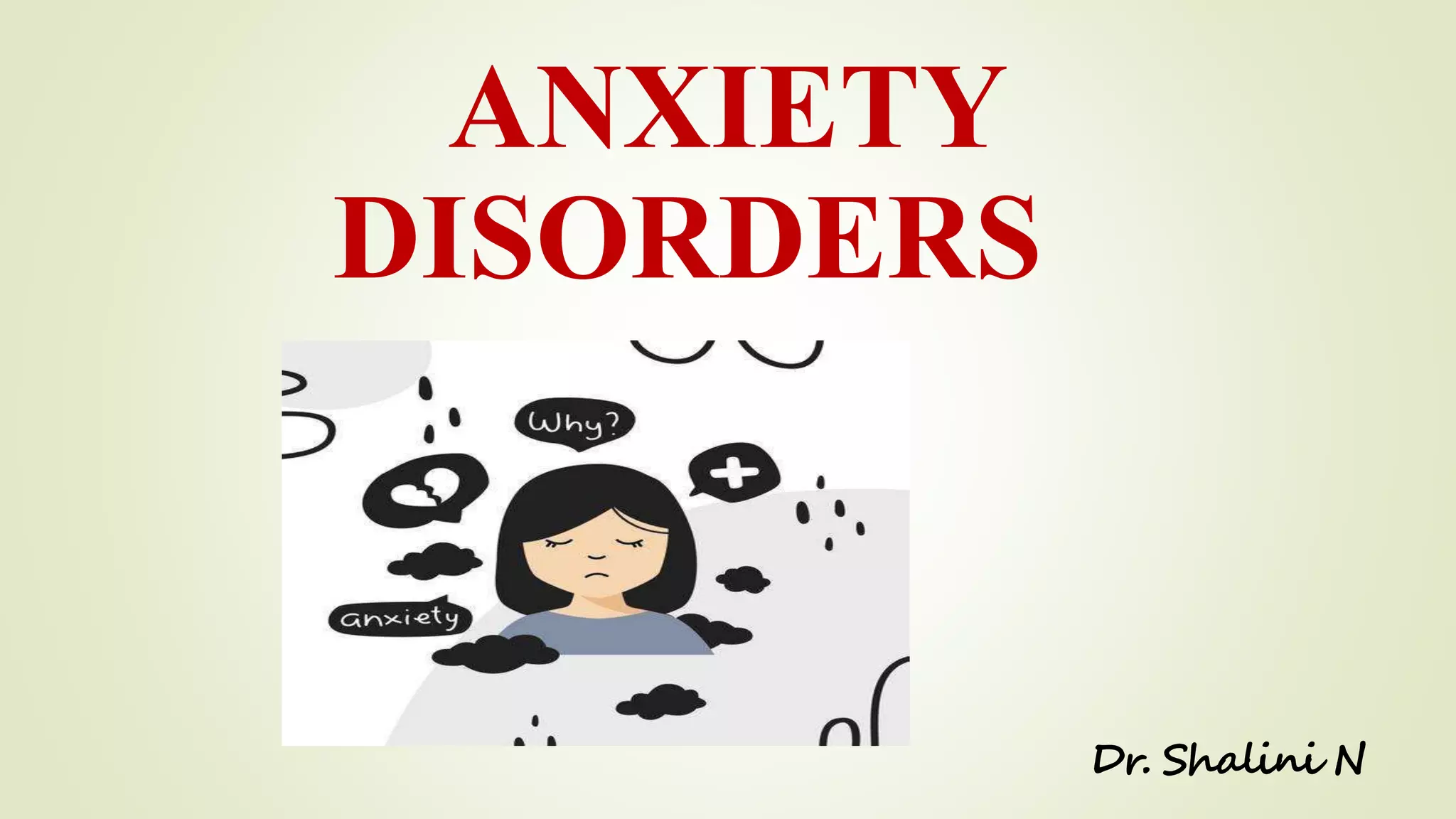
ANXIETY
DISORDERS
Dr. Shalini N
DEFINITION
Anxiety can be defined as a subjective sense of unease, dread or
foreboding and can indicate a primary psychiatric condition. Anxiety
can produce uncomfortable and potentially debilitating psychological
(e.g. worry or feeling of threat) and physiological arousal (e.g.
tachycardia or shortness of breath).
Anxiety disorder is a chronic condition characterized by an
excessive and persistent sense of apprehension, with physical symptoms
such as sweating, palpitation and feeling of stress.
EPIDEMIOLOGY-
• In general, anxiety disorders are a group of heterogenous illness that
develop before age 30 and are more common in women, individuals
with social issues, and those with a family history of anxiety and
depression.
• In United States, the 1-yaer prevalence rate for anxiety disorders was
13.3% in persons aged 18 to 54 years and 10.6% in those over age 55
years.
ETIOLOGY-
1. Genetic factors.
2. Environmental factors (early childhood trauma, traumatic social
experience).
3. Known or unrecognized medical condition.
4. Substance-induced anxiety disorder (OTC medications, herbal
medications, substances of abuse).
ASPECTS OFANXIETY
Anxiety has three aspects.
1. Physical: It includes
precipitation. Increase in
symptoms.
headache, nausea,
heart rate etc., and
trembling, sweating,
may other physical
2.Behavioural: It may include avoidance behaviour, dependent
behaviour and agitated behaviour.
3.Cognitive: It may include worry, fear of losing control, apprehension
about future, confused thoughts, difficulty concentration, and thinking
about that things are getting out of control.
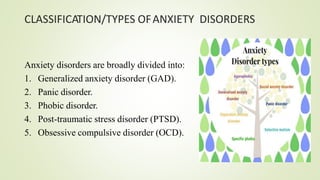
CLASSIFICATION/TYPES OFANXIETY DISORDERS
Anxiety disorders are broadly divided into:
1. Generalized anxiety disorder (GAD).
2. Panic disorder.
3. Phobic disorder.
4. Post-traumatic stress disorder (PTSD).
5. Obsessive compulsive disorder (OCD).
1. GENERALIZED ANXIETY DISORDER (GAD)
It is the chronic anxiety state associated with uncontrollable
worry. Patients with GAD have persistent, excessive, unrealistic worry
associated with muscle tension, impaired concentration and insomnia.
Complaints of shortness of breath, palpitations and tachycardia are
relatively rare. Alcohol abuse and dependence are common in GAD
patients.
Risk factors:
Factors that may increase the risk of GAD include:
i) Family members with an anxiety disorder
ii) Increase in stress
iii) Exposure to physical or emotional trauma
iv) Unemployment, poverty
v) Drug abuse
Symptoms:
i. Psychological and cognitive symptoms:
• Excessive anxiety
• Worries that are difficult to control
• Feeling keyed up or on edge
• Poor concentration or mind going blank
ii. Physical symptoms:
• Restlessness
• Fatigue
• Muscle tension
• Sleep disturbance
• Irritability
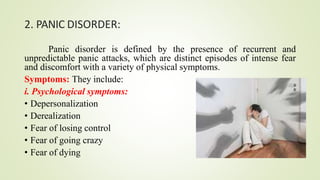
2. PANIC DISORDER:
Panic disorder is defined by the presence of recurrent and
unpredictable panic attacks, which are distinct episodes of intense fear
and discomfort with a variety of physical symptoms.
Symptoms: They include:
i. Psychological symptoms:
• Depersonalization
• Derealization
• Fear of losing control
• Fear of going crazy
• Fear of dying
ii. Physical symptoms:
• Abdominal distress
• Chest pain or discomfort
• Chills, dizziness or light-headedness
• Feeling of choking, hot flushes
• Palpitations
• Nausea, paresthesias, shortness of breath
• Sweating, tachycardia, trembling or shaking
3. PHOBIC DISORDERS:
They are again classified into:
i) Specific phobia
ii) Social phobia/Social anxiety disorder (SAD)
iii) Agoraphobia
i. Specific phobia:
Specific phobia is marked and persistent fear of a circumscribed
object or situation (e.g., insects, heights, blood, or public
transportation). Apart from contact with the feared object or situation,
the patient is usually free of symptoms. Most persons simply avoid the
feared object and adjust to certain restrictions on their activities.
ii. Social phobia:
It is characterized by clinically significant anxiety provoked by
exposure to certain types of social or performance situations, often
leading to avoidance behaviours. Common physical symptoms include
blushing, diarrhea, sweating and tachycardia.
iii. Agoraphobia:
It is anxiety or avoidance of places or situations from which
escape might be difficult (or embarrassing) or in which help may not be
available in the event of having a panic attack or panic-like symptoms.
Phobic disorders are common, affecting 10% of population. The
patients avoid phobic stimulus and this avoidance usually impairs
occupational or social functioning.
Common phobias include fear of closed spaces (claustrophobia),
fear of blood, fear of flying. Patient with social phobia, in particular,
have a high rate of co-morbid alcohol abuse, as well as of other
psychiatric conditions (e.g. eating disorder).
4. POST TRAUMATIC STRESS DISORDER (PTSD)
Patients with stress disorders are at risk for the development of
other disorders related to anxiety, mood and substance abuse (especially
alcohol).
Symptoms:
i. Re-experiencing symptoms:
• Recurrent, intrusive distressing memories of the trauma
• Recurrent, disturbing dreams of the event
• Feeling that the traumatic event is recurring
flashbacks)
• Physiologic reaction to reminders of the trauma
(e.g., dissociative
ii. Avoidance symptoms:
• Avoidance of conversations about the trauma
• Avoidance of thoughts or feelings about the trauma
• Avoidance of activities that are reminders of the event
• Avoidance of people or places that arouse recollections of the trauma
• Inability to recall an important aspect of the trauma
• Anhedonia
• Estrangement from others
• Restricted affect
• Sense of a foreshortened future (e.g., does not expect to have a career,
marriage)
iii. Hyperarousal symptoms:
• Decreased concentration
• Easily startled
• Hypervigilance
• Insomnia
• Irritability or angry outbursts
• Symptoms usually begin early, within 3 months of the traumatic
incident, but sometimes that begin years afterward. Symptoms must
last more than a month.
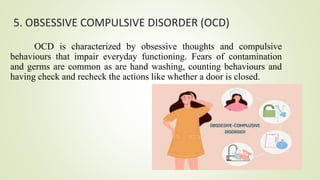
5. OBSESSIVE COMPULSIVE DISORDER (OCD)
OCD is characterized by obsessive thoughts and compulsive
behaviours that impair everyday functioning. Fears of contamination
and germs are common as are hand washing, counting behaviours and
having check and recheck the actions like whether a door is closed.
Symptoms:
i. Obsessions:
• Repetitive thoughts (e.g., feeling contaminated after touching an
object, doubting whether the stove was turned off).
• Repetitive images (e.g., recurrent sexually explicit pictures).
• Repetitive impulses (e.g., need for symmetry or putting things in
specific order, impulse to shout out obscenities in a church).
ii. Compulsions:
• Repetitive activities (e.g., hand washing, checking, ordering, need to
ask, need to confess).
• Repetitive mental acts (e.g., counting, repeating words silently,
praying).
MANAGEMENT OFANXIETY DISORDERS
Treatment for anxiety disorders often requires multiple
approaches. The patient may need short-term treatment with an
anxiolytic, such as benzodiazepine, to help reduce the immediate
symptoms combined with psychological therapies and an antidepressant
for long term treatment and prevention of symptoms returning.
NON-PHARMACOLOGICAL TREATMENT
Psychotherapy:
1. The specific psychotherapy with the most supporting evidence in anxiety
disorders is cognitive behavioural therapy (CBT). Cognitive behavioural
therapy focuses on the ‘here and now’ and explores how the individual
feels about themselves and others and how behaviour is related to those
thoughts.
2. Through individual therapy or group work the patient and therapist
identify and question maladaptive thoughts and help develop an
alternative perspective. Individual goals and strategies are developed and
evaluated with patients encouraged to practice what they have learned
between sessions.
3. Therapy usually lasts for around 60-90 minutes every week for 8-16
weeks or longer in more resistant cases.
4. Specific phobias are also almost exclusively treated using exposure
techniques and most patients will respond to this treatment. Only a very
few will require additional drug therapy.
PHARMACOLOGICALTREATMENT
1. Benzodiazepines: Diazepam, oxazepam, lorazepam
2. Azapirones: Buspirone, ispapirone
3. Sedative antihistaminic: Hydroxyzine – 200-400
mg/day
4. β-adrenergic blocker: Propranolol
5. Selective serotonin reuptake inhibitors (SSRIs):
paroxetine, fluvoxamine, sertraline ,fluoxetine
6. Tricyclic antidepressants (TCAs): Clomipramine
Classification of anti-anxiety drugs:
1. BENZODIAZEPINES:
MOA:
Benzodiazepines work by increasing the efficiency of a natural brain
chemical, GABA, to decrease the excitability of neurons.
Binding of benzodiazepines to GABAA receptor complex promotes
binding of GABA, which in turn increases of chloride ions across the
neuronal cell membrane, resulting in inhibition of neuronal firing.
ADRs: Blood disorders, respiratory depression, hypotension, jaundice etc.
Dose:
• Diazepam- 2-40mg/day PO or 5-10mg IV
• Oxazepam- 30-120mg/day
• lorazepam- 0.5-10mg/day
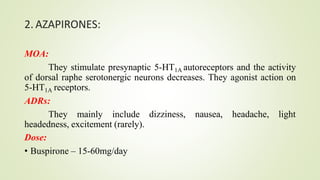
2. AZAPIRONES:
MOA:
They stimulate presynaptic 5-HT1A autoreceptors and the activity
of dorsal raphe serotonergic neurons decreases. They agonist action on
5-HT1A receptors.
ADRs:
They mainly include
headedness, excitement (rarely).
Dose:
• Buspirone – 15-60mg/day
dizziness, nausea, headache, light
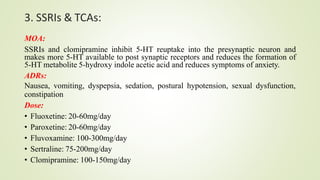
3. SSRIs & TCAs:
MOA:
SSRIs and clomipramine inhibit 5-HT reuptake into the presynaptic neuron and
makes more 5-HT available to post synaptic receptors and reduces the formation of
5-HT metabolite 5-hydroxy indole acetic acid and reduces symptoms of anxiety.
ADRs:
Nausea, vomiting, dyspepsia, sedation, postural hypotension, sexual dysfunction,
constipation
Dose:
• Fluoxetine: 20-60mg/day
• Paroxetine: 20-60mg/day
• Fluvoxamine: 100-300mg/day
• Sertraline: 75-200mg/day
• Clomipramine: 100-150mg/day
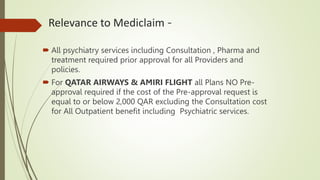
Relevance to Mediclaim -
 All psychiatry services including Consultation , Pharma and
treatment required prior approval for all Providers and
policies.
 For QATAR AIRWAYS & AMIRI FLIGHT all Plans NO Pre-
approval required if the cost of the Pre-approval request is
equal to or below 2,000 QAR excluding the Consultation cost
for All Outpatient benefit including Psychiatric services.
Anxiety disorders.pptx

Anxiety disorders.pptx

  • 1.
  • 2.
    DEFINITION Anxiety can bedefined as a subjective sense of unease, dread or foreboding and can indicate a primary psychiatric condition. Anxiety can produce uncomfortable and potentially debilitating psychological (e.g. worry or feeling of threat) and physiological arousal (e.g. tachycardia or shortness of breath). Anxiety disorder is a chronic condition characterized by an excessive and persistent sense of apprehension, with physical symptoms such as sweating, palpitation and feeling of stress.
  • 3.
    EPIDEMIOLOGY- • In general,anxiety disorders are a group of heterogenous illness that develop before age 30 and are more common in women, individuals with social issues, and those with a family history of anxiety and depression. • In United States, the 1-yaer prevalence rate for anxiety disorders was 13.3% in persons aged 18 to 54 years and 10.6% in those over age 55 years.
  • 4.
    ETIOLOGY- 1. Genetic factors. 2.Environmental factors (early childhood trauma, traumatic social experience). 3. Known or unrecognized medical condition. 4. Substance-induced anxiety disorder (OTC medications, herbal medications, substances of abuse).
  • 5.
    ASPECTS OFANXIETY Anxiety hasthree aspects. 1. Physical: It includes precipitation. Increase in symptoms. headache, nausea, heart rate etc., and trembling, sweating, may other physical 2.Behavioural: It may include avoidance behaviour, dependent behaviour and agitated behaviour. 3.Cognitive: It may include worry, fear of losing control, apprehension about future, confused thoughts, difficulty concentration, and thinking about that things are getting out of control.
  • 6.
    CLASSIFICATION/TYPES OFANXIETY DISORDERS Anxietydisorders are broadly divided into: 1. Generalized anxiety disorder (GAD). 2. Panic disorder. 3. Phobic disorder. 4. Post-traumatic stress disorder (PTSD). 5. Obsessive compulsive disorder (OCD).
  • 7.
    1. GENERALIZED ANXIETYDISORDER (GAD) It is the chronic anxiety state associated with uncontrollable worry. Patients with GAD have persistent, excessive, unrealistic worry associated with muscle tension, impaired concentration and insomnia. Complaints of shortness of breath, palpitations and tachycardia are relatively rare. Alcohol abuse and dependence are common in GAD patients.
  • 8.
    Risk factors: Factors thatmay increase the risk of GAD include: i) Family members with an anxiety disorder ii) Increase in stress iii) Exposure to physical or emotional trauma iv) Unemployment, poverty v) Drug abuse
  • 9.
    Symptoms: i. Psychological andcognitive symptoms: • Excessive anxiety • Worries that are difficult to control • Feeling keyed up or on edge • Poor concentration or mind going blank ii. Physical symptoms: • Restlessness • Fatigue • Muscle tension • Sleep disturbance • Irritability
  • 10.
    2. PANIC DISORDER: Panicdisorder is defined by the presence of recurrent and unpredictable panic attacks, which are distinct episodes of intense fear and discomfort with a variety of physical symptoms. Symptoms: They include: i. Psychological symptoms: • Depersonalization • Derealization • Fear of losing control • Fear of going crazy • Fear of dying
  • 11.
    ii. Physical symptoms: •Abdominal distress • Chest pain or discomfort • Chills, dizziness or light-headedness • Feeling of choking, hot flushes • Palpitations • Nausea, paresthesias, shortness of breath • Sweating, tachycardia, trembling or shaking
  • 12.
    3. PHOBIC DISORDERS: Theyare again classified into: i) Specific phobia ii) Social phobia/Social anxiety disorder (SAD) iii) Agoraphobia
  • 13.
    i. Specific phobia: Specificphobia is marked and persistent fear of a circumscribed object or situation (e.g., insects, heights, blood, or public transportation). Apart from contact with the feared object or situation, the patient is usually free of symptoms. Most persons simply avoid the feared object and adjust to certain restrictions on their activities. ii. Social phobia: It is characterized by clinically significant anxiety provoked by exposure to certain types of social or performance situations, often leading to avoidance behaviours. Common physical symptoms include blushing, diarrhea, sweating and tachycardia.
  • 14.
    iii. Agoraphobia: It isanxiety or avoidance of places or situations from which escape might be difficult (or embarrassing) or in which help may not be available in the event of having a panic attack or panic-like symptoms. Phobic disorders are common, affecting 10% of population. The patients avoid phobic stimulus and this avoidance usually impairs occupational or social functioning. Common phobias include fear of closed spaces (claustrophobia), fear of blood, fear of flying. Patient with social phobia, in particular, have a high rate of co-morbid alcohol abuse, as well as of other psychiatric conditions (e.g. eating disorder).
  • 15.
    4. POST TRAUMATICSTRESS DISORDER (PTSD) Patients with stress disorders are at risk for the development of other disorders related to anxiety, mood and substance abuse (especially alcohol). Symptoms: i. Re-experiencing symptoms: • Recurrent, intrusive distressing memories of the trauma • Recurrent, disturbing dreams of the event • Feeling that the traumatic event is recurring flashbacks) • Physiologic reaction to reminders of the trauma (e.g., dissociative
  • 16.
    ii. Avoidance symptoms: •Avoidance of conversations about the trauma • Avoidance of thoughts or feelings about the trauma • Avoidance of activities that are reminders of the event • Avoidance of people or places that arouse recollections of the trauma • Inability to recall an important aspect of the trauma • Anhedonia • Estrangement from others • Restricted affect • Sense of a foreshortened future (e.g., does not expect to have a career, marriage)
  • 17.
    iii. Hyperarousal symptoms: •Decreased concentration • Easily startled • Hypervigilance • Insomnia • Irritability or angry outbursts • Symptoms usually begin early, within 3 months of the traumatic incident, but sometimes that begin years afterward. Symptoms must last more than a month.
  • 18.
    5. OBSESSIVE COMPULSIVEDISORDER (OCD) OCD is characterized by obsessive thoughts and compulsive behaviours that impair everyday functioning. Fears of contamination and germs are common as are hand washing, counting behaviours and having check and recheck the actions like whether a door is closed.
  • 19.
    Symptoms: i. Obsessions: • Repetitivethoughts (e.g., feeling contaminated after touching an object, doubting whether the stove was turned off). • Repetitive images (e.g., recurrent sexually explicit pictures). • Repetitive impulses (e.g., need for symmetry or putting things in specific order, impulse to shout out obscenities in a church). ii. Compulsions: • Repetitive activities (e.g., hand washing, checking, ordering, need to ask, need to confess). • Repetitive mental acts (e.g., counting, repeating words silently, praying).
  • 20.
    MANAGEMENT OFANXIETY DISORDERS Treatmentfor anxiety disorders often requires multiple approaches. The patient may need short-term treatment with an anxiolytic, such as benzodiazepine, to help reduce the immediate symptoms combined with psychological therapies and an antidepressant for long term treatment and prevention of symptoms returning.
  • 21.
    NON-PHARMACOLOGICAL TREATMENT Psychotherapy: 1. Thespecific psychotherapy with the most supporting evidence in anxiety disorders is cognitive behavioural therapy (CBT). Cognitive behavioural therapy focuses on the ‘here and now’ and explores how the individual feels about themselves and others and how behaviour is related to those thoughts. 2. Through individual therapy or group work the patient and therapist identify and question maladaptive thoughts and help develop an alternative perspective. Individual goals and strategies are developed and evaluated with patients encouraged to practice what they have learned between sessions. 3. Therapy usually lasts for around 60-90 minutes every week for 8-16 weeks or longer in more resistant cases. 4. Specific phobias are also almost exclusively treated using exposure techniques and most patients will respond to this treatment. Only a very few will require additional drug therapy.
  • 22.
    PHARMACOLOGICALTREATMENT 1. Benzodiazepines: Diazepam,oxazepam, lorazepam 2. Azapirones: Buspirone, ispapirone 3. Sedative antihistaminic: Hydroxyzine – 200-400 mg/day 4. β-adrenergic blocker: Propranolol 5. Selective serotonin reuptake inhibitors (SSRIs): paroxetine, fluvoxamine, sertraline ,fluoxetine 6. Tricyclic antidepressants (TCAs): Clomipramine Classification of anti-anxiety drugs:
  • 23.
    1. BENZODIAZEPINES: MOA: Benzodiazepines workby increasing the efficiency of a natural brain chemical, GABA, to decrease the excitability of neurons. Binding of benzodiazepines to GABAA receptor complex promotes binding of GABA, which in turn increases of chloride ions across the neuronal cell membrane, resulting in inhibition of neuronal firing. ADRs: Blood disorders, respiratory depression, hypotension, jaundice etc. Dose: • Diazepam- 2-40mg/day PO or 5-10mg IV • Oxazepam- 30-120mg/day • lorazepam- 0.5-10mg/day
  • 24.
    2. AZAPIRONES: MOA: They stimulatepresynaptic 5-HT1A autoreceptors and the activity of dorsal raphe serotonergic neurons decreases. They agonist action on 5-HT1A receptors. ADRs: They mainly include headedness, excitement (rarely). Dose: • Buspirone – 15-60mg/day dizziness, nausea, headache, light
  • 25.
    3. SSRIs &TCAs: MOA: SSRIs and clomipramine inhibit 5-HT reuptake into the presynaptic neuron and makes more 5-HT available to post synaptic receptors and reduces the formation of 5-HT metabolite 5-hydroxy indole acetic acid and reduces symptoms of anxiety. ADRs: Nausea, vomiting, dyspepsia, sedation, postural hypotension, sexual dysfunction, constipation Dose: • Fluoxetine: 20-60mg/day • Paroxetine: 20-60mg/day • Fluvoxamine: 100-300mg/day • Sertraline: 75-200mg/day • Clomipramine: 100-150mg/day
  • 26.
    Relevance to Mediclaim-  All psychiatry services including Consultation , Pharma and treatment required prior approval for all Providers and policies.  For QATAR AIRWAYS & AMIRI FLIGHT all Plans NO Pre- approval required if the cost of the Pre-approval request is equal to or below 2,000 QAR excluding the Consultation cost for All Outpatient benefit including Psychiatric services.