Prof. Rooban Thavarajah
Tooth Morphology
Lecture Series
Dr. Rooban Thavarajah
Deciduous Dentition
Maxillary Central Incisor
Introduction
 Very similar to its permanent successor.
 Same arch position, function, and shape.
 No mamelons in newly erupted teeth.
 Only anterior tooth of either dentition, in
which the MD crown width is greater than
the incisocervical crown height.
Dr. Rooban Thavarajah
Labial Aspect
 MD > Cervicoincisal length ( OPPOSITE for Permanent)
 Smooth straight incisal edges
 Root cone shaped with uniform taper
 No mamelons
 Mesial & distal outlines are more convex than in the
permanent central.
 Smooth, convex labial surface - no developmental
depressions or imbrication lines.
Dr. Rooban Thavarajah
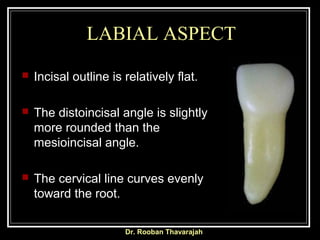
LABIAL ASPECT
 Incisal outline is relatively flat.
 The distoincisal angle is slightly
more rounded than the
mesioincisal angle.
 The cervical line curves evenly
toward the root.
Dr. Rooban Thavarajah
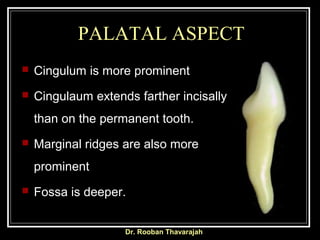
PALATAL ASPECT
 Cingulum is more prominent
 Cingulaum extends farther incisally
than on the permanent tooth.
 Marginal ridges are also more
prominent
 Fossa is deeper.
Dr. Rooban Thavarajah
PROXIMAL ASPECT
Dr. Rooban Thavarajah
 Similar to that of the permanent tooth
 In deciduous tooth - Mesial
 Relatively wider labiolingually
 Cervical line exhibits less curvature incisally.
 Distal aspect
 Similar to mesial aspect, except that the cervical
line curvature is less.
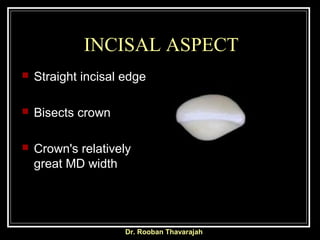
INCISAL ASPECT
 Straight incisal edge
 Bisects crown
 Crown's relatively
great MD width
Dr. Rooban Thavarajah
ROOT
 Single root
 Round and tapers evenly to the apex.
 Very similar to permanent especially in
cross section
 It is longer, relative to crown length, than in
the permanent central.
Dr. Rooban Thavarajah
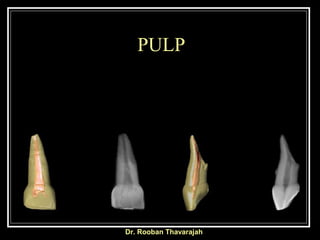
PULP
Dr. Rooban Thavarajah
Add Chronology &
Dimension
Dr. Rooban Thavarajah

Morphology of Human Deciduous Maxillary Central Incisor Tooth

  • 1.
    Prof. Rooban Thavarajah ToothMorphology Lecture Series Dr. Rooban Thavarajah
  • 2.
    Dr. Rooban Thavarajah DeciduousDentition Maxillary Central Incisor
  • 3.
    Introduction  Very similarto its permanent successor.  Same arch position, function, and shape.  No mamelons in newly erupted teeth.  Only anterior tooth of either dentition, in which the MD crown width is greater than the incisocervical crown height. Dr. Rooban Thavarajah
  • 4.
    Labial Aspect  MD> Cervicoincisal length ( OPPOSITE for Permanent)  Smooth straight incisal edges  Root cone shaped with uniform taper  No mamelons  Mesial & distal outlines are more convex than in the permanent central.  Smooth, convex labial surface - no developmental depressions or imbrication lines. Dr. Rooban Thavarajah
  • 5.
    LABIAL ASPECT  Incisaloutline is relatively flat.  The distoincisal angle is slightly more rounded than the mesioincisal angle.  The cervical line curves evenly toward the root. Dr. Rooban Thavarajah
  • 6.
    PALATAL ASPECT  Cingulumis more prominent  Cingulaum extends farther incisally than on the permanent tooth.  Marginal ridges are also more prominent  Fossa is deeper. Dr. Rooban Thavarajah
  • 7.
    PROXIMAL ASPECT Dr. RoobanThavarajah  Similar to that of the permanent tooth  In deciduous tooth - Mesial  Relatively wider labiolingually  Cervical line exhibits less curvature incisally.  Distal aspect  Similar to mesial aspect, except that the cervical line curvature is less.
  • 8.
    INCISAL ASPECT  Straightincisal edge  Bisects crown  Crown's relatively great MD width Dr. Rooban Thavarajah
  • 9.
    ROOT  Single root Round and tapers evenly to the apex.  Very similar to permanent especially in cross section  It is longer, relative to crown length, than in the permanent central. Dr. Rooban Thavarajah
  • 10.
  • 11.