THYROID DRUGS
THYROID DRUGS
• The basic unit of thyroid is follicle. The
follicular cells under the influence of TSH,
secretes 2 thyroid hormones T3 and T4.
• The thyroid hormones are synthesized in the
thyroid follicles as a part of thyroglobulin
molecule, which is a glycoprotein synthesized
by thyroid cells.
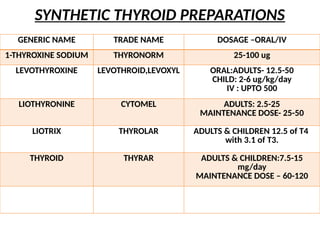
SYNTHETIC THYROID PREPARATIONS
GENERIC NAME TRADE NAME DOSAGE –ORAL/IV
1-THYROXINE SODIUM THYRONORM 25-100 ug
LEVOTHYROXINE LEVOTHROID,LEVOXYL ORAL:ADULTS- 12.5-50
CHILD: 2-6 ug/kg/day
IV : UPTO 500
LIOTHYRONINE CYTOMEL ADULTS: 2.5-25
MAINTENANCE DOSE- 25-50
LIOTRIX THYROLAR ADULTS & CHILDREN 12.5 of T4
with 3.1 of T3.
THYROID THYRAR ADULTS & CHILDREN:7.5-15
mg/day
MAINTENANCE DOSE – 60-120
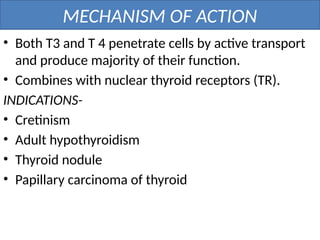
MECHANISM OF ACTION
• Both T3 and T 4 penetrate cells by active transport
and produce majority of their function.
• Combines with nuclear thyroid receptors (TR).
INDICATIONS-
• Cretinism
• Adult hypothyroidism
• Thyroid nodule
• Papillary carcinoma of thyroid
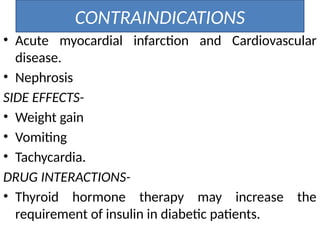
CONTRAINDICATIONS
• Acute myocardial infarction and Cardiovascular
disease.
• Nephrosis
SIDE EFFECTS-
• Weight gain
• Vomiting
• Tachycardia.
DRUG INTERACTIONS-
• Thyroid hormone therapy may increase the
requirement of insulin in diabetic patients.
• With thyroid hormone therapy, larger doses of
Digoxin is needed for digitalization.
NURSING RESPONSIBILITIES-
• Assess vital signs, BP, weight and height of weight
change, normal diet and response to temperature.
• In children, check height.
• Monitor thyroid function test results and blood
glucose levels.
PATIENT EDUCATION
• Teach client how to monitor pulse, weight and
height.
• Instruct to adhere to dosage schedule and intervals.
• Immediately report any chest pain and other signs
of aggravated CV disease.
• With juvenile hypothyroidism therapy, explain
dramatic weight loss and catch up growth.
• Explain side effects and related treatment, if
changes in insulin or anticoagulant are needed.
THYROID INHIBITORS
THYROID INHIBITORS
• These are the drugs use to lower functional capacity
of hyperactive thyroid glands.
• Used to treat hyperthyroidisms, i.e. State of
hyperactivity of the thyroid gland with
overproduction of T3 and T4. This state is
particularly seen in Graves’ disease.
INDICATIONS-
• Graves’ disease
• Toxic uninodular goitre.
• Subacute thyroiditis.
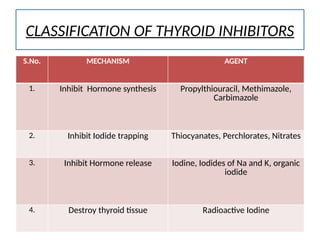
CLASSIFICATION OF THYROID INHIBITORS
S.No. MECHANISM AGENT
1. Inhibit Hormone synthesis Propylthiouracil, Methimazole,
Carbimazole
2. Inhibit Iodide trapping Thiocyanates, Perchlorates, Nitrates
3. Inhibit Hormone release Iodine, Iodides of Na and K, organic
iodide
4. Destroy thyroid tissue Radioactive Iodine
MECHANISM OF ACTION
THIOAMIDES DERIVATIVES-
• Binds to thyroid peroxidase and prevent oxidation
of iodide.
• Inhibit iodination of tyrosine residues in
thyroglobulin.
• Onset of action is slow requiring 3-4 weeks.
THIOAMIDES DERIVATIVES
DRUG DOSE REMARKS
PROPYLTHIOURACIL 50-150 mg BD-TDS Inhibit peripheral conversion
of T4 to T3
METHIMAZOLE 5-10 mg TDS Active metabolic
CARBIMAZOLE 5-15 mg TDS Acts largely by getting
converted to methimazole
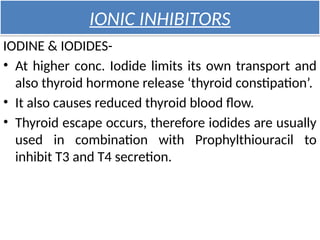
IONIC INHIBITORS
IODINE & IODIDES-
• At higher conc. Iodide limits its own transport and
also thyroid hormone release ‘thyroid constipation’.
• It also causes reduced thyroid blood flow.
• Thyroid escape occurs, therefore iodides are usually
used in combination with Prophylthiouracil to
inhibit T3 and T4 secretion.
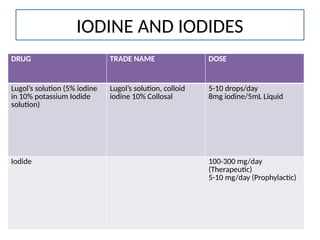
IODINE AND IODIDES
DRUG TRADE NAME DOSE
Lugol’s solution (5% iodine
in 10% potassium Iodide
solution)
Lugol’s solution, colloid
iodine 10% Collosal
5-10 drops/day
8mg iodine/5mL Liquid
Iodide 100-300 mg/day
(Therapeutic)
5-10 mg/day (Prophylactic)
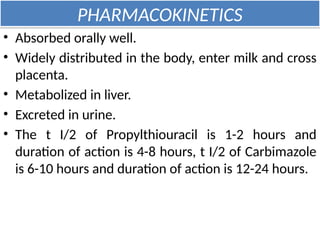
PHARMACOKINETICS
• Absorbed orally well.
• Widely distributed in the body, enter milk and cross
placenta.
• Metabolized in liver.
• Excreted in urine.
• The t I/2 of Propylthiouracil is 1-2 hours and
duration of action is 4-8 hours, t I/2 of Carbimazole
is 6-10 hours and duration of action is 12-24 hours.
CONTRAINDICATIONS
• Previous allergic.
• Impaired hepatic function may require low doses.
• Bronchial asthma.
• Heart blocks and CCF.
• Pregnancy
SIDE EFFECTS-
• Fever, itching, skin rash, joint pain.
ADVERSE EFFECTS
• Hypothyroidism and goiter can occur due to
over dosage.
• Dizziness and alteration in taste.
• Agranulocytosis.
• Hypersenstivity to iodides.
NURSING RESPONSIBILITIES
• Assess for tingling of finger and toes.
• Monitor weight and check for hair loss and skin
changes.
• Check complete CBC, LFTs.
• Dilute oral iodine solution well in milk, juice or
other beverages.
• Assess for metallic taste in mouth, sneezing,
vomiting and bloody diarrhoea.
PATIENT EDUCATION
• Explain need to wear medical identification
tag/bracelet.
• Explain goals and side effects of medications.
• Advise to report any fever, chills, sore throat
and unusual bleeding.
• Instruct to take medicine at same time of day
and with meals or snacks.

Thyroid drugs.pptx endocrine drugs thyroid

  • 1.
  • 2.
    THYROID DRUGS • Thebasic unit of thyroid is follicle. The follicular cells under the influence of TSH, secretes 2 thyroid hormones T3 and T4. • The thyroid hormones are synthesized in the thyroid follicles as a part of thyroglobulin molecule, which is a glycoprotein synthesized by thyroid cells.
  • 3.
    SYNTHETIC THYROID PREPARATIONS GENERICNAME TRADE NAME DOSAGE –ORAL/IV 1-THYROXINE SODIUM THYRONORM 25-100 ug LEVOTHYROXINE LEVOTHROID,LEVOXYL ORAL:ADULTS- 12.5-50 CHILD: 2-6 ug/kg/day IV : UPTO 500 LIOTHYRONINE CYTOMEL ADULTS: 2.5-25 MAINTENANCE DOSE- 25-50 LIOTRIX THYROLAR ADULTS & CHILDREN 12.5 of T4 with 3.1 of T3. THYROID THYRAR ADULTS & CHILDREN:7.5-15 mg/day MAINTENANCE DOSE – 60-120
  • 4.
    MECHANISM OF ACTION •Both T3 and T 4 penetrate cells by active transport and produce majority of their function. • Combines with nuclear thyroid receptors (TR). INDICATIONS- • Cretinism • Adult hypothyroidism • Thyroid nodule • Papillary carcinoma of thyroid
  • 5.
    CONTRAINDICATIONS • Acute myocardialinfarction and Cardiovascular disease. • Nephrosis SIDE EFFECTS- • Weight gain • Vomiting • Tachycardia. DRUG INTERACTIONS- • Thyroid hormone therapy may increase the requirement of insulin in diabetic patients.
  • 6.
    • With thyroidhormone therapy, larger doses of Digoxin is needed for digitalization. NURSING RESPONSIBILITIES- • Assess vital signs, BP, weight and height of weight change, normal diet and response to temperature. • In children, check height. • Monitor thyroid function test results and blood glucose levels.
  • 7.
    PATIENT EDUCATION • Teachclient how to monitor pulse, weight and height. • Instruct to adhere to dosage schedule and intervals. • Immediately report any chest pain and other signs of aggravated CV disease. • With juvenile hypothyroidism therapy, explain dramatic weight loss and catch up growth. • Explain side effects and related treatment, if changes in insulin or anticoagulant are needed.
  • 8.
  • 9.
    THYROID INHIBITORS • Theseare the drugs use to lower functional capacity of hyperactive thyroid glands. • Used to treat hyperthyroidisms, i.e. State of hyperactivity of the thyroid gland with overproduction of T3 and T4. This state is particularly seen in Graves’ disease. INDICATIONS- • Graves’ disease • Toxic uninodular goitre. • Subacute thyroiditis.
  • 10.
    CLASSIFICATION OF THYROIDINHIBITORS S.No. MECHANISM AGENT 1. Inhibit Hormone synthesis Propylthiouracil, Methimazole, Carbimazole 2. Inhibit Iodide trapping Thiocyanates, Perchlorates, Nitrates 3. Inhibit Hormone release Iodine, Iodides of Na and K, organic iodide 4. Destroy thyroid tissue Radioactive Iodine
  • 11.
    MECHANISM OF ACTION THIOAMIDESDERIVATIVES- • Binds to thyroid peroxidase and prevent oxidation of iodide. • Inhibit iodination of tyrosine residues in thyroglobulin. • Onset of action is slow requiring 3-4 weeks.
  • 12.
    THIOAMIDES DERIVATIVES DRUG DOSEREMARKS PROPYLTHIOURACIL 50-150 mg BD-TDS Inhibit peripheral conversion of T4 to T3 METHIMAZOLE 5-10 mg TDS Active metabolic CARBIMAZOLE 5-15 mg TDS Acts largely by getting converted to methimazole
  • 13.
    IONIC INHIBITORS IODINE &IODIDES- • At higher conc. Iodide limits its own transport and also thyroid hormone release ‘thyroid constipation’. • It also causes reduced thyroid blood flow. • Thyroid escape occurs, therefore iodides are usually used in combination with Prophylthiouracil to inhibit T3 and T4 secretion.
  • 14.
    IODINE AND IODIDES DRUGTRADE NAME DOSE Lugol’s solution (5% iodine in 10% potassium Iodide solution) Lugol’s solution, colloid iodine 10% Collosal 5-10 drops/day 8mg iodine/5mL Liquid Iodide 100-300 mg/day (Therapeutic) 5-10 mg/day (Prophylactic)
  • 15.
    PHARMACOKINETICS • Absorbed orallywell. • Widely distributed in the body, enter milk and cross placenta. • Metabolized in liver. • Excreted in urine. • The t I/2 of Propylthiouracil is 1-2 hours and duration of action is 4-8 hours, t I/2 of Carbimazole is 6-10 hours and duration of action is 12-24 hours.
  • 16.
    CONTRAINDICATIONS • Previous allergic. •Impaired hepatic function may require low doses. • Bronchial asthma. • Heart blocks and CCF. • Pregnancy SIDE EFFECTS- • Fever, itching, skin rash, joint pain.
  • 17.
    ADVERSE EFFECTS • Hypothyroidismand goiter can occur due to over dosage. • Dizziness and alteration in taste. • Agranulocytosis. • Hypersenstivity to iodides.
  • 18.
    NURSING RESPONSIBILITIES • Assessfor tingling of finger and toes. • Monitor weight and check for hair loss and skin changes. • Check complete CBC, LFTs. • Dilute oral iodine solution well in milk, juice or other beverages. • Assess for metallic taste in mouth, sneezing, vomiting and bloody diarrhoea.
  • 19.
    PATIENT EDUCATION • Explainneed to wear medical identification tag/bracelet. • Explain goals and side effects of medications. • Advise to report any fever, chills, sore throat and unusual bleeding. • Instruct to take medicine at same time of day and with meals or snacks.