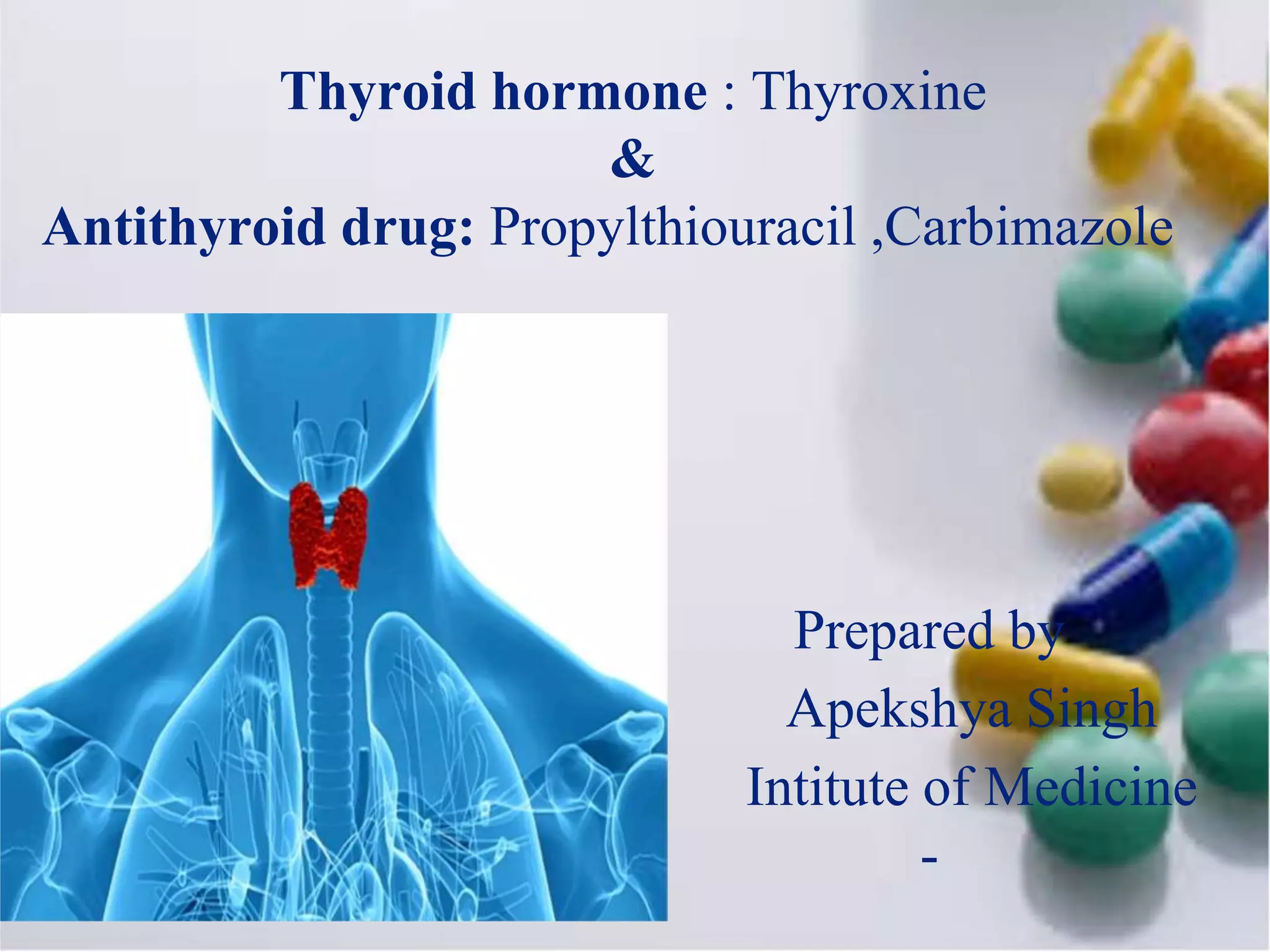
Thyroid hormone : Thyroxine
&
Antithyroid drug: Propylthiouracil ,Carbimazole
Prepared by
Apekshya Singh
Intitute of Medicine
-
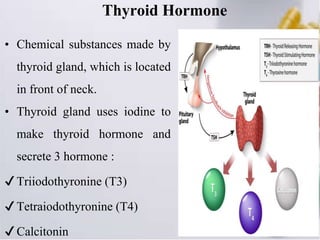
Thyroid Hormone
• Chemical substances made by
thyroid gland, which is located
in front of neck.
• Thyroid gland uses iodine to
make thyroid hormone and
secrete 3 hormone :
✔ Triiodothyronine (T3)
✔ Tetraiodothyronine (T4)
✔ Calcitonin
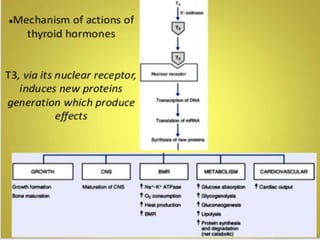
Function of thyroid hormone
• Increase the basal metabolic rate.
• These hormones regulate protein, fat, carbohydrate
metabolism and stimulate vitamin metabolism.
• Thyroid hormone is important for the growth and
development of all tissues including bones and the brain.
• In adults, thyroid hormone helps to maintain brain function,
food metabolism, and body temperature
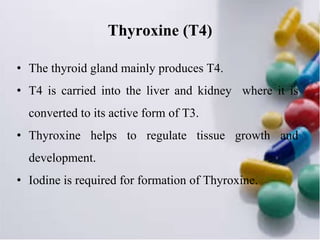
Thyroxine (T4)
• The thyroid gland mainly produces T4.
• T4 is carried into the liver and kidney where it is
converted to its active form of T3.
• Thyroxine helps to regulate tissue growth and
development.
• Iodine is required for formation of Thyroxine.
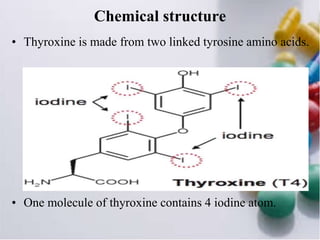
Chemical structure
• Thyroxine is made from two linked tyrosine amino acids.
• One molecule of thyroxine contains 4 iodine atom.
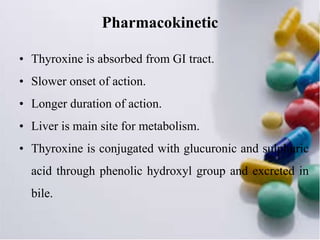
Pharmacokinetic
• Thyroxine is absorbed from GI tract.
• Slower onset of action.
• Longer duration of action.
• Liver is main site for metabolism.
• Thyroxine is conjugated with glucuronic and sulphuric
acid through phenolic hydroxyl group and excreted in
bile.
Synthesis
• Thyroxine is synthesized by iodination of tyrosines and
the coupling of iodo tyrosines in the thyroglobulin.
• It is released from thyroglobulin by proteolysis and
secreted into the blood.
• Then, is peripherally deiodinated to form
triiodothyronine which exerts a broad spectrum of
stimulatory effects on cell metabolism.
Adverse effect
• Hyperthyroidism
• Hypothyroidism
✔ Cretinism ( in children)
✔ Myxedema ( in adult )
Therapeutic use
● Cretinism
● Adult hypothyroidism
● Nodular thyroid diseases
● Myxoedema coma
● Thyroid cancer
Antithyroid drugs
• Antithyroid agent is a hormone antagonist acting upon
thyroid hormone.
• Used in treatment of hyperthyroid condition.
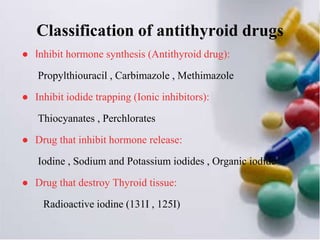
Classification of antithyroid drugs
● Inhibit hormone synthesis (Antithyroid drug):
Propylthiouracil , Carbimazole , Methimazole
● Inhibit iodide trapping (Ionic inhibitors):
Thiocyanates , Perchlorates
● Drug that inhibit hormone release:
Iodine , Sodium and Potassium iodides , Organic iodide
● Drug that destroy Thyroid tissue:
Radioactive iodine (131I , 125I)
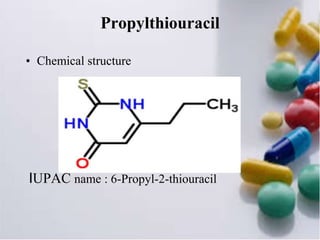
Propylthiouracil
• Chemical structure
IUPAC name : 6-Propyl-2-thiouracil
Physicochemical property
• Odorless
• White crystalline powder of starch like appearance to eye
and to touch
• Bitter taste
• Saturated solution is neutral or slightly acid to litmus
• Slightly soluble in water , practically insoluble in
ether,chloroform ,benzene and freely soluble in aqueous
solution of ammonia and alkali hydroxides.
Pharmacokinetics
• Propylthiouracil is rapidly and readily absorbed from
GI tract following oral administration.
• Has short half life and needs to be given every 6-8
hours.
• Readily crosses placenta.
• Widely distributed but get accumulated in thyroid
gland.
• Metabolized in liver and Excreted in urine.
Mechanism of action
• Propylthiouracil binds to thyroid peroxidase and inhibits
the conversion of iodide to iodine.
• Inhibit iodination of tyrosine residue in thyroglobulin.
• Inhibit coupling of iodotyrosine
• Also inhibit peripheral deiodination of T4 to T3.
• Thyroglobulin is degraded to produce (T4) and (T3).
Therefore propylthiouracil effectively inhibits the
production of new thyroid hormones.
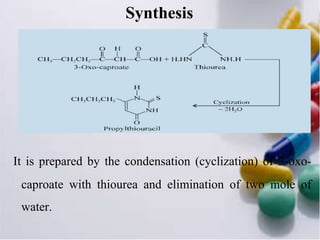
Synthesis
It is prepared by the condensation (cyclization) of 3-oxo-
caproate with thiourea and elimination of two mole of
water.
Dose
• For hyperthyroidism in adults : initially 200 to 300 mg
per day in 3 divided doses .
• The usual maintenance dosage is 100 to 150 mg daily.
• For children 6 to 10 year of age initial dosage is 50 to 150
mg daily.
• For pediatric patient 10 year and over initial dosage is 150
to 300 mg daily.
Adverse effect
• Fever, sore throat, headache, red skin rash , muscle or
joint pain
• Decrease sense of taste or hair loss
• Agranulocytosis
• Edema
• Hepatitis
• Cholestatic jaundice (rare but potentially fatal)
Carbimazole
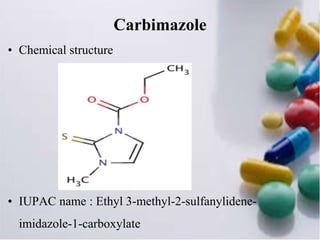
• Chemical structure
• IUPAC name : Ethyl 3-methyl-2-sulfanylidene-
imidazole-1-carboxylate
Physicochemical properties
• White or creamy white crystalline powder.
• Slightly soluble in water.
• Should store in well closed container.
Pharmacokinetics
• More potent given in a single daily dose.
• Completely absorbed and readily accumulated in
thyroid gland.
• Less protein bound.
• Has longer duration of action.
• Gets converted to methimazole which is active.
• Passage across placenta is low.
Mechanism of action
• Decreases the uptake and concentration of inorganic
iodine by thyroid.
• It also reduces the formation of di-iodotyrosine and
thyroxine.
• Once converted to its active form of methimazole, it
prevents the thyroid peroxidase enzyme from coupling
and iodinating the tyrosine residues on thyroglobulin,
hence reducing the production of the thyroid hormones T3
and T4.
Adverse effect
❏ Whilst rashes and pruritus are common .
❏ Bone marrow suppression causing neutropenia and
agranulocytosis
❏ Sore throat or fever
❏ Stomach upset
❏ Mouth ulcer
Uses
• Hyperthyroidism
• Thyrotoxicosis
Dose
• 5-10 mg, 8 hourly
• Maintenance dose : 5 mg ,6 -24 months
Brand name
• Neomercazole
• Vidalta
• Thyrocab
Thyroid hormone and antithyroid drug

Thyroid hormone and antithyroid drug

  • 1.
    Thyroid hormone :Thyroxine & Antithyroid drug: Propylthiouracil ,Carbimazole Prepared by Apekshya Singh Intitute of Medicine -
  • 2.
    Thyroid Hormone • Chemicalsubstances made by thyroid gland, which is located in front of neck. • Thyroid gland uses iodine to make thyroid hormone and secrete 3 hormone : ✔ Triiodothyronine (T3) ✔ Tetraiodothyronine (T4) ✔ Calcitonin
  • 3.
    Function of thyroidhormone • Increase the basal metabolic rate. • These hormones regulate protein, fat, carbohydrate metabolism and stimulate vitamin metabolism. • Thyroid hormone is important for the growth and development of all tissues including bones and the brain. • In adults, thyroid hormone helps to maintain brain function, food metabolism, and body temperature
  • 5.
    Thyroxine (T4) • Thethyroid gland mainly produces T4. • T4 is carried into the liver and kidney where it is converted to its active form of T3. • Thyroxine helps to regulate tissue growth and development. • Iodine is required for formation of Thyroxine.
  • 6.
    Chemical structure • Thyroxineis made from two linked tyrosine amino acids. • One molecule of thyroxine contains 4 iodine atom.
  • 7.
    Pharmacokinetic • Thyroxine isabsorbed from GI tract. • Slower onset of action. • Longer duration of action. • Liver is main site for metabolism. • Thyroxine is conjugated with glucuronic and sulphuric acid through phenolic hydroxyl group and excreted in bile.
  • 8.
    Synthesis • Thyroxine issynthesized by iodination of tyrosines and the coupling of iodo tyrosines in the thyroglobulin. • It is released from thyroglobulin by proteolysis and secreted into the blood. • Then, is peripherally deiodinated to form triiodothyronine which exerts a broad spectrum of stimulatory effects on cell metabolism.
  • 9.
    Adverse effect • Hyperthyroidism •Hypothyroidism ✔ Cretinism ( in children) ✔ Myxedema ( in adult )
  • 10.
    Therapeutic use ● Cretinism ●Adult hypothyroidism ● Nodular thyroid diseases ● Myxoedema coma ● Thyroid cancer
  • 11.
    Antithyroid drugs • Antithyroidagent is a hormone antagonist acting upon thyroid hormone. • Used in treatment of hyperthyroid condition.
  • 12.
    Classification of antithyroiddrugs ● Inhibit hormone synthesis (Antithyroid drug): Propylthiouracil , Carbimazole , Methimazole ● Inhibit iodide trapping (Ionic inhibitors): Thiocyanates , Perchlorates ● Drug that inhibit hormone release: Iodine , Sodium and Potassium iodides , Organic iodide ● Drug that destroy Thyroid tissue: Radioactive iodine (131I , 125I)
  • 13.
  • 14.
    Physicochemical property • Odorless •White crystalline powder of starch like appearance to eye and to touch • Bitter taste • Saturated solution is neutral or slightly acid to litmus • Slightly soluble in water , practically insoluble in ether,chloroform ,benzene and freely soluble in aqueous solution of ammonia and alkali hydroxides.
  • 15.
    Pharmacokinetics • Propylthiouracil israpidly and readily absorbed from GI tract following oral administration. • Has short half life and needs to be given every 6-8 hours. • Readily crosses placenta. • Widely distributed but get accumulated in thyroid gland. • Metabolized in liver and Excreted in urine.
  • 16.
    Mechanism of action •Propylthiouracil binds to thyroid peroxidase and inhibits the conversion of iodide to iodine. • Inhibit iodination of tyrosine residue in thyroglobulin. • Inhibit coupling of iodotyrosine • Also inhibit peripheral deiodination of T4 to T3. • Thyroglobulin is degraded to produce (T4) and (T3). Therefore propylthiouracil effectively inhibits the production of new thyroid hormones.
  • 17.
    Synthesis It is preparedby the condensation (cyclization) of 3-oxo- caproate with thiourea and elimination of two mole of water.
  • 18.
    Dose • For hyperthyroidismin adults : initially 200 to 300 mg per day in 3 divided doses . • The usual maintenance dosage is 100 to 150 mg daily. • For children 6 to 10 year of age initial dosage is 50 to 150 mg daily. • For pediatric patient 10 year and over initial dosage is 150 to 300 mg daily.
  • 19.
    Adverse effect • Fever,sore throat, headache, red skin rash , muscle or joint pain • Decrease sense of taste or hair loss • Agranulocytosis • Edema • Hepatitis • Cholestatic jaundice (rare but potentially fatal)
  • 20.
    Carbimazole • Chemical structure •IUPAC name : Ethyl 3-methyl-2-sulfanylidene- imidazole-1-carboxylate
  • 21.
    Physicochemical properties • Whiteor creamy white crystalline powder. • Slightly soluble in water. • Should store in well closed container.
  • 22.
    Pharmacokinetics • More potentgiven in a single daily dose. • Completely absorbed and readily accumulated in thyroid gland. • Less protein bound. • Has longer duration of action. • Gets converted to methimazole which is active. • Passage across placenta is low.
  • 23.
    Mechanism of action •Decreases the uptake and concentration of inorganic iodine by thyroid. • It also reduces the formation of di-iodotyrosine and thyroxine. • Once converted to its active form of methimazole, it prevents the thyroid peroxidase enzyme from coupling and iodinating the tyrosine residues on thyroglobulin, hence reducing the production of the thyroid hormones T3 and T4.
  • 24.
    Adverse effect ❏ Whilstrashes and pruritus are common . ❏ Bone marrow suppression causing neutropenia and agranulocytosis ❏ Sore throat or fever ❏ Stomach upset ❏ Mouth ulcer
  • 25.
  • 26.
    Dose • 5-10 mg,8 hourly • Maintenance dose : 5 mg ,6 -24 months Brand name • Neomercazole • Vidalta • Thyrocab