ANTITHYROID AGENTS
DILSHANA FATHIMA
MSC. BIOCHEMISTRY
ANTITHYROID AGENTS
• Is a hormone antagonist acting upon thyroid hormones.
• Antithyroid medication generally are administered in
preperation for RAI ablation/surgery.
• The drugs commonly used are
propylthiouracil(PTU),methimazole,carbamizole etc.
• These drugs act by inhibiting the enzyme thyroid
peroxidase & in that way block the synthesis of thyroid
hormone.
• Reduce thyroid hormone production by inhibiting the
organic binding of iodine & coupling of iodotyrosines.
• A less common antithyroid agent is potassium
perchlorate.
• About 30-40% of patients treated with antithyroid
drug became euthyroid.
• A common problem with antithyroid drug is
undershooting/overshooting causing persistent
hyperthyroidism/hypothyroidism.
• A rare complication of antithyroid therapy is
agranulocytosis which calls for immediate
discontinuation of drug.
• All antithyroid drugs are quickly absorbed orally,
widely distributed in the body, enter milk & cross
placenta.
• Are metabolised in liver & excreted in urine
primarily as metabolites.
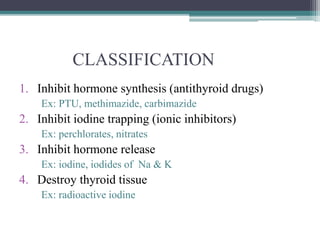
CLASSIFICATION
1. Inhibit hormone synthesis (antithyroid drugs)
Ex: PTU, methimazide, carbimazide
2. Inhibit iodine trapping (ionic inhibitors)
Ex: perchlorates, nitrates
3. Inhibit hormone release
Ex: iodine, iodides of Na & K
4. Destroy thyroid tissue
Ex: radioactive iodine
MECHANISM OF ACTION
• Iodides: blocks the release of stored thyroid
hormones from thyroid gland.
• β blockers: blocks the conversion of T4 to T3
• Thioamides: prevent the production of more T4 &
T3
 blocks the conversion of T4 to T3
outside the thyroid.
ADVANTAGES
• No surgical risk
• No scar/chances of injury to parathyroid or nearest
laryngeal nerve
• If treatment with antithyroid shoes side effects like
hypothyroidism then stoppage of treatment reverse
the action.
• Used for children as well as young adults.
• Control thyrotoxicosis in grave’s disease & toxic
nodular goiter.
• Can be used preoperatively
DISADVANTAGE
• Prolonged treatment is needed because stoppage of
treatment shows recurrence.
• Relapse rate is high
• High drug toxicity & side effects
• Not practicable in unintelligent pateint.

Antithyroid agents

  • 1.
  • 2.
    ANTITHYROID AGENTS • Isa hormone antagonist acting upon thyroid hormones. • Antithyroid medication generally are administered in preperation for RAI ablation/surgery. • The drugs commonly used are propylthiouracil(PTU),methimazole,carbamizole etc. • These drugs act by inhibiting the enzyme thyroid peroxidase & in that way block the synthesis of thyroid hormone. • Reduce thyroid hormone production by inhibiting the organic binding of iodine & coupling of iodotyrosines.
  • 3.
    • A lesscommon antithyroid agent is potassium perchlorate. • About 30-40% of patients treated with antithyroid drug became euthyroid. • A common problem with antithyroid drug is undershooting/overshooting causing persistent hyperthyroidism/hypothyroidism. • A rare complication of antithyroid therapy is agranulocytosis which calls for immediate discontinuation of drug. • All antithyroid drugs are quickly absorbed orally, widely distributed in the body, enter milk & cross placenta. • Are metabolised in liver & excreted in urine primarily as metabolites.
  • 4.
    CLASSIFICATION 1. Inhibit hormonesynthesis (antithyroid drugs) Ex: PTU, methimazide, carbimazide 2. Inhibit iodine trapping (ionic inhibitors) Ex: perchlorates, nitrates 3. Inhibit hormone release Ex: iodine, iodides of Na & K 4. Destroy thyroid tissue Ex: radioactive iodine
  • 5.
  • 6.
    • Iodides: blocksthe release of stored thyroid hormones from thyroid gland. • β blockers: blocks the conversion of T4 to T3 • Thioamides: prevent the production of more T4 & T3  blocks the conversion of T4 to T3 outside the thyroid.
  • 7.
    ADVANTAGES • No surgicalrisk • No scar/chances of injury to parathyroid or nearest laryngeal nerve • If treatment with antithyroid shoes side effects like hypothyroidism then stoppage of treatment reverse the action. • Used for children as well as young adults. • Control thyrotoxicosis in grave’s disease & toxic nodular goiter. • Can be used preoperatively
  • 8.
    DISADVANTAGE • Prolonged treatmentis needed because stoppage of treatment shows recurrence. • Relapse rate is high • High drug toxicity & side effects • Not practicable in unintelligent pateint.