DRUGS USED IN
HYPERTHYROIDISM
Objectives
 At the end of 1st lecture the studetns will be able
to :
 Classify common drugs used for treatment of
hyperthyroidism
 Details the drugs regarding , mechanism of
action , pharmacological effects , clinical uses &
side effects
 Recognize treatment of special cases of
hyperthyroidism such as pregnancy, breast
feeding , Grave,s disease & thyroid storm 7
8
9
10
11
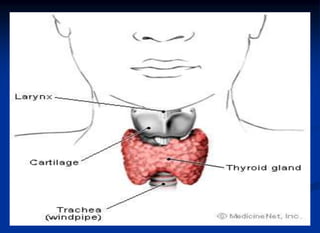
HYPERTHYROIDISM
 Elevated levels of T3 and T4 in the blood.
 Causes :
 Adenomas / carcinomas
 Thyroiditis
 Autoimmune
12
GRAVES' DISEASE
 Most common cause of hyperthyroidism 60-80%.
 Autoimmune disorder associated with circulating
immunoglobulins that bind to and stimulate the
thyrotropin ( TSH) receptor , resulting in sustained
thyroid over activity & it can be familial.
13
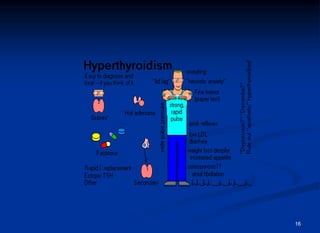
Manifestations of Hyperthyroidism
 Nervousness , irritability.
 Tremors
 palpitation
 Weight loss
 sweating
 Heat intolerance
14
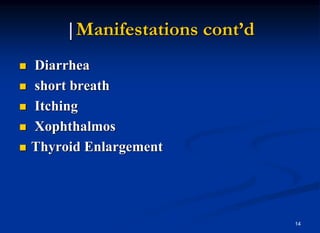
|Manifestations cont’d
 Diarrhea
 short breath
 Itching
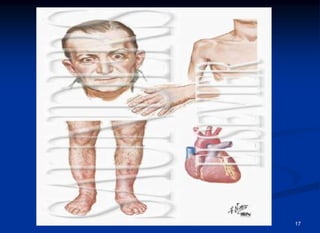
 Xophthalmos
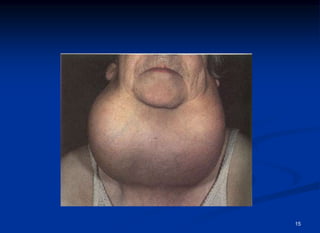
 Thyroid Enlargement
15
16
17
18
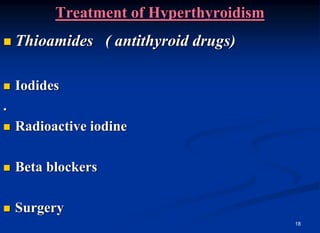
Treatment of Hyperthyroidism
 Thioamides ( antithyroid drugs)
 Iodides
.
 Radioactive iodine
 Beta blockers
 Surgery
19
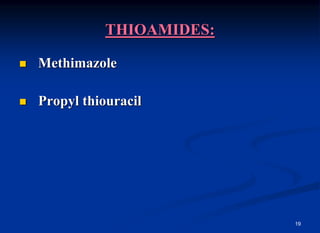
THIOAMIDES:
 Methimazole
 Propyl thiouracil
20
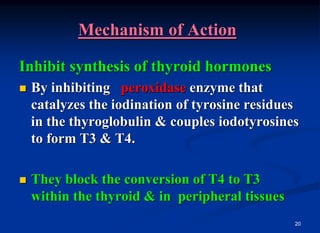
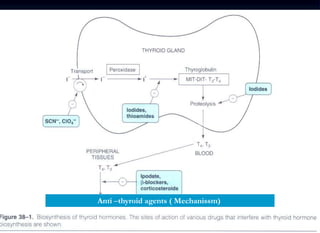
Mechanism of Action
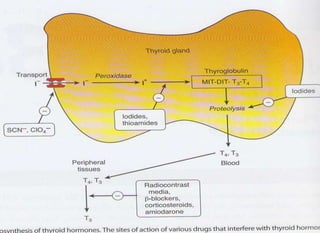
Inhibit synthesis of thyroid hormones
 By inhibiting peroxidase enzyme that
catalyzes the iodination of tyrosine residues
in the thyroglobulin & couples iodotyrosines
to form T3 & T4.
 They block the conversion of T4 to T3
within the thyroid & in peripheral tissues
21
22
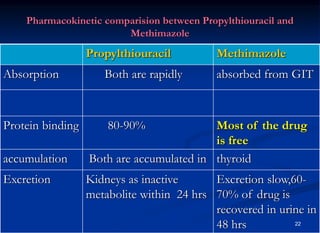
Pharmacokinetic comparision between Propylthiouracil and
Methimazole
Propylthiouracil Methimazole
Absorption Both are rapidly absorbed from GIT
Protein binding 80-90% Most of the drug
is free
accumulation Both are accumulated in thyroid
Excretion Kidneys as inactive
metabolite within 24 hrs
Excretion slow,60-
70% of drug is
recovered in urine in
48 hrs
23
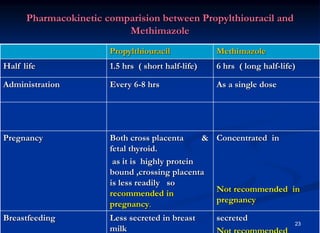
Pharmacokinetic comparision between Propylthiouracil and
Methimazole
Propylthiouracil Methimazole
Half life 1.5 hrs ( short half-life) 6 hrs ( long half-life)
Administration Every 6-8 hrs As a single dose
Pregnancy Both cross placenta &
fetal thyroid.
as it is highly protein
bound ,crossing placenta
is less readily so
recommended in
pregnancy.
Concentrated in
Not recommended in
pregnancy
Breastfeeding Less secreted in breast
milk
secreted
24
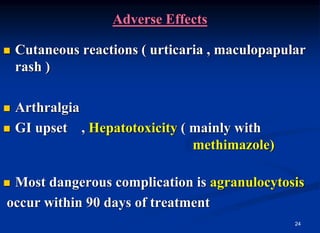
Adverse Effects
 Cutaneous reactions ( urticaria , maculopapular
rash )
 Arthralgia
 GI upset , Hepatotoxicity ( mainly with
methimazole)
 Most dangerous complication is agranulocytosis
occur within 90 days of treatment
25
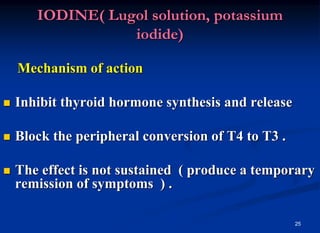
IODINE( Lugol solution, potassium
iodide)
Mechanism of action
 Inhibit thyroid hormone synthesis and release
 Block the peripheral conversion of T4 to T3 .
 The effect is not sustained ( produce a temporary
remission of symptoms ) .
26
Anti –thyroid agents ( Mechanissm)
27
Clinical uses
 Prior to thyroid surgery to decrease vascularity
& size of the gland .
 Following radio active iodine therapy.
 Thyrotoxicosis
Examples
 Organic iodides as :iopanoic acid or ipodate
 Potassium iodide
28
Precautions /toxicity:
 Should not be used as a single therapy
 Should not be used in pregnancy
 May produce iodism ( acniform rash,
swelling of salivary glands, mucous
membrane ulceration, metallic taste
bleeding disorders and rarely anaphylaxis ).
29
RADIOACTIVE IODINE
 131 I isotope ( therapeutic effect due to emission of β
rays )
 Accumulates in the thyroid gland and destroys
parenchymal cells, producing a long-term decrease in
thyroid hormone levels. Clinical improvement may
take 2-3 months
 Half -life 5 days
 Cross placenta & excreted in breast milk
 Easy to administer ,effective , painless and less
expensive
Radioactive Iodine ( con.)
 Available as a solution or in capsules
 Clinical uses
 Hyperthyroidism mainly in old patients
(above 40)
 Graves, disease
 Patients with toxic nodular goiter
 As a diagnostic
30
Disadvantages
 High incidence of delayed hypothyroidism
 Large doses have cytotoxic actions ( necrosis
of the follicular cells followed by fibrosis )
 May cause genetic damage
 May cause leukemia & neoplasia
(carcinogenic )
31
32
ADRENOCEPTOR BLOCKING AGENTS:
 Adjunctive therapy to relief the adrenergic
symptoms of hyperthyroidism such as
tremor, palpitation, heat intolerance and
nervousness.
 E.g. Propranolol, Atenolol , Metoprolol.
 Propranolol is contraindicated in asthmatic
patients
33
THYROIDECTOMY
 Sub-total thyriodectomy is the treatment of
choice in very large gland or multinodular
goiter
34
THYROID STORM
 A sudden acute exacerbation of all of the
symptoms of thyrotoxicosis, presenting as a life
threatening syndrome.
 There is hyper metabolism, and excessive
adrenergic activity, death may occur due to heart
failure and shock.
 Is a medical emergency .
 Propranolol 1-2mg slows IV or 40-80 mg orally
every 6 hours
35
 Potassium iodide 10 drops orally daily or
 Propylthiouracil 250 mg orally every six
hours or 400 mg every six hours rectally.
 Hydrocortisone 50 mg IV every 6 hours to
prevent shock.
 If above methods fail peritoneal dialysis.
36
Thyrotoxicosis during pregnancy
 Better to start therapy before pregnancy with 131I
or subtotal thyroidectomy to avoid acute
exacerbation during pregnancy
 During pregnancy radioiodine is contraindicated.
 Propylthiouracil is the drug of choice during
pregnancy.

drugs used in hyperthyroidism

  • 1.
  • 2.
    Objectives  At theend of 1st lecture the studetns will be able to :  Classify common drugs used for treatment of hyperthyroidism  Details the drugs regarding , mechanism of action , pharmacological effects , clinical uses & side effects  Recognize treatment of special cases of hyperthyroidism such as pregnancy, breast feeding , Grave,s disease & thyroid storm 7
  • 3.
  • 4.
  • 5.
  • 6.
    11 HYPERTHYROIDISM  Elevated levelsof T3 and T4 in the blood.  Causes :  Adenomas / carcinomas  Thyroiditis  Autoimmune
  • 7.
    12 GRAVES' DISEASE  Mostcommon cause of hyperthyroidism 60-80%.  Autoimmune disorder associated with circulating immunoglobulins that bind to and stimulate the thyrotropin ( TSH) receptor , resulting in sustained thyroid over activity & it can be familial.
  • 8.
    13 Manifestations of Hyperthyroidism Nervousness , irritability.  Tremors  palpitation  Weight loss  sweating  Heat intolerance
  • 9.
    14 |Manifestations cont’d  Diarrhea short breath  Itching  Xophthalmos  Thyroid Enlargement
  • 10.
  • 11.
  • 12.
  • 13.
    18 Treatment of Hyperthyroidism Thioamides ( antithyroid drugs)  Iodides .  Radioactive iodine  Beta blockers  Surgery
  • 14.
  • 15.
    20 Mechanism of Action Inhibitsynthesis of thyroid hormones  By inhibiting peroxidase enzyme that catalyzes the iodination of tyrosine residues in the thyroglobulin & couples iodotyrosines to form T3 & T4.  They block the conversion of T4 to T3 within the thyroid & in peripheral tissues
  • 16.
  • 17.
    22 Pharmacokinetic comparision betweenPropylthiouracil and Methimazole Propylthiouracil Methimazole Absorption Both are rapidly absorbed from GIT Protein binding 80-90% Most of the drug is free accumulation Both are accumulated in thyroid Excretion Kidneys as inactive metabolite within 24 hrs Excretion slow,60- 70% of drug is recovered in urine in 48 hrs
  • 18.
    23 Pharmacokinetic comparision betweenPropylthiouracil and Methimazole Propylthiouracil Methimazole Half life 1.5 hrs ( short half-life) 6 hrs ( long half-life) Administration Every 6-8 hrs As a single dose Pregnancy Both cross placenta & fetal thyroid. as it is highly protein bound ,crossing placenta is less readily so recommended in pregnancy. Concentrated in Not recommended in pregnancy Breastfeeding Less secreted in breast milk secreted
  • 19.
    24 Adverse Effects  Cutaneousreactions ( urticaria , maculopapular rash )  Arthralgia  GI upset , Hepatotoxicity ( mainly with methimazole)  Most dangerous complication is agranulocytosis occur within 90 days of treatment
  • 20.
    25 IODINE( Lugol solution,potassium iodide) Mechanism of action  Inhibit thyroid hormone synthesis and release  Block the peripheral conversion of T4 to T3 .  The effect is not sustained ( produce a temporary remission of symptoms ) .
  • 21.
  • 22.
    27 Clinical uses  Priorto thyroid surgery to decrease vascularity & size of the gland .  Following radio active iodine therapy.  Thyrotoxicosis Examples  Organic iodides as :iopanoic acid or ipodate  Potassium iodide
  • 23.
    28 Precautions /toxicity:  Shouldnot be used as a single therapy  Should not be used in pregnancy  May produce iodism ( acniform rash, swelling of salivary glands, mucous membrane ulceration, metallic taste bleeding disorders and rarely anaphylaxis ).
  • 24.
    29 RADIOACTIVE IODINE  131I isotope ( therapeutic effect due to emission of β rays )  Accumulates in the thyroid gland and destroys parenchymal cells, producing a long-term decrease in thyroid hormone levels. Clinical improvement may take 2-3 months  Half -life 5 days  Cross placenta & excreted in breast milk  Easy to administer ,effective , painless and less expensive
  • 25.
    Radioactive Iodine (con.)  Available as a solution or in capsules  Clinical uses  Hyperthyroidism mainly in old patients (above 40)  Graves, disease  Patients with toxic nodular goiter  As a diagnostic 30
  • 26.
    Disadvantages  High incidenceof delayed hypothyroidism  Large doses have cytotoxic actions ( necrosis of the follicular cells followed by fibrosis )  May cause genetic damage  May cause leukemia & neoplasia (carcinogenic ) 31
  • 27.
    32 ADRENOCEPTOR BLOCKING AGENTS: Adjunctive therapy to relief the adrenergic symptoms of hyperthyroidism such as tremor, palpitation, heat intolerance and nervousness.  E.g. Propranolol, Atenolol , Metoprolol.  Propranolol is contraindicated in asthmatic patients
  • 28.
    33 THYROIDECTOMY  Sub-total thyriodectomyis the treatment of choice in very large gland or multinodular goiter
  • 29.
    34 THYROID STORM  Asudden acute exacerbation of all of the symptoms of thyrotoxicosis, presenting as a life threatening syndrome.  There is hyper metabolism, and excessive adrenergic activity, death may occur due to heart failure and shock.  Is a medical emergency .  Propranolol 1-2mg slows IV or 40-80 mg orally every 6 hours
  • 30.
    35  Potassium iodide10 drops orally daily or  Propylthiouracil 250 mg orally every six hours or 400 mg every six hours rectally.  Hydrocortisone 50 mg IV every 6 hours to prevent shock.  If above methods fail peritoneal dialysis.
  • 31.
    36 Thyrotoxicosis during pregnancy Better to start therapy before pregnancy with 131I or subtotal thyroidectomy to avoid acute exacerbation during pregnancy  During pregnancy radioiodine is contraindicated.  Propylthiouracil is the drug of choice during pregnancy.