
1
-Sapate P D,
Student(ABW/34/2011),
Lokmangal Agril biotech college,
Wadala.
2

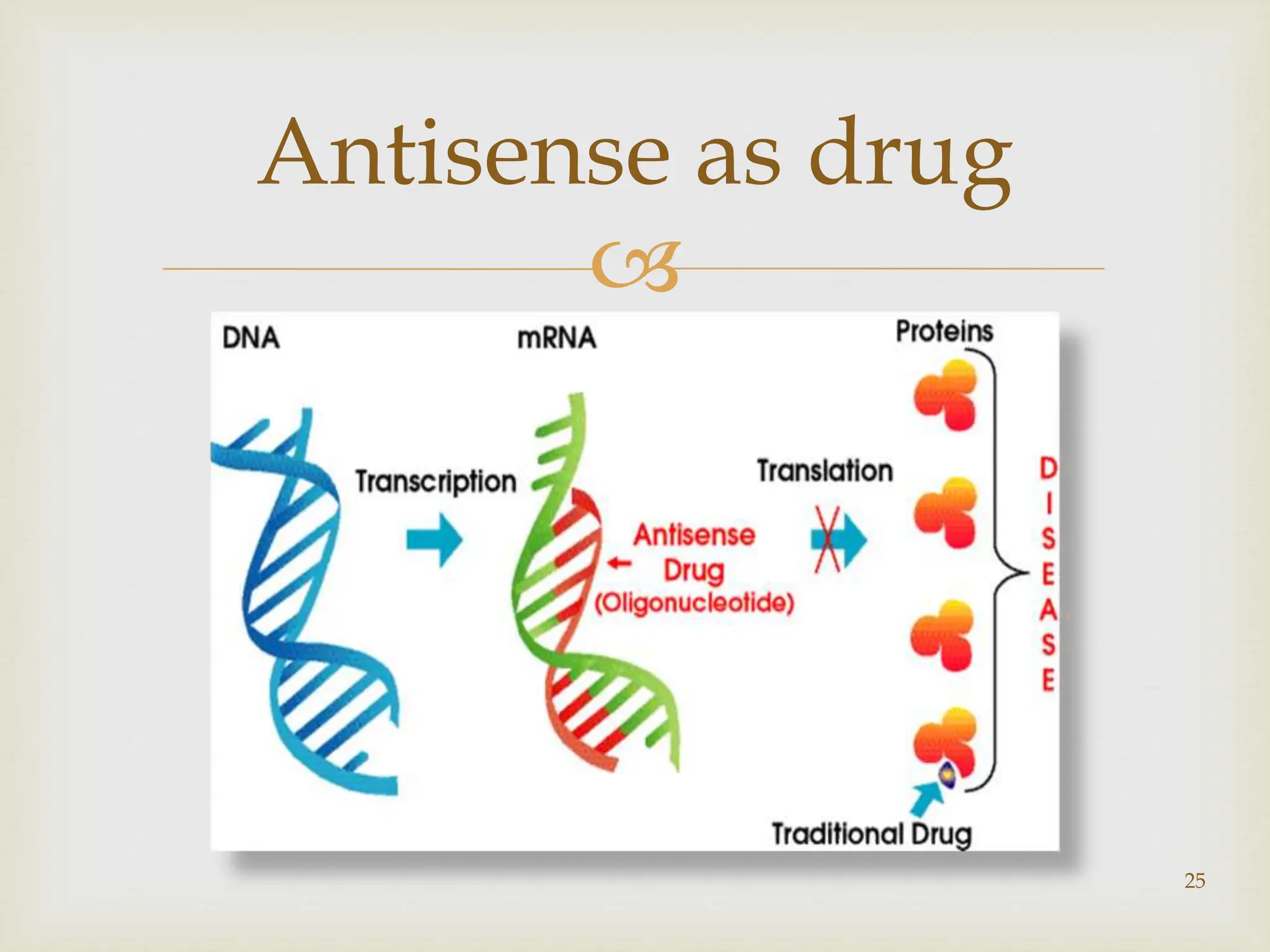
 Antisense RNA is a single-stranded RNA that is
complementary to a messenger RNA (mRNA) strand
transcribed within a cell
 Antisense RNA introduced into a cell to inhibit
translation of a complementary mRNA by base
pairing to it and creating barrier to the translation
machinery.
 E.g.
hok/sok system of the E. coli R1 plasmid.
INTRODUCTION
3

 This translational arrest causes reduced amount of
protein expression.
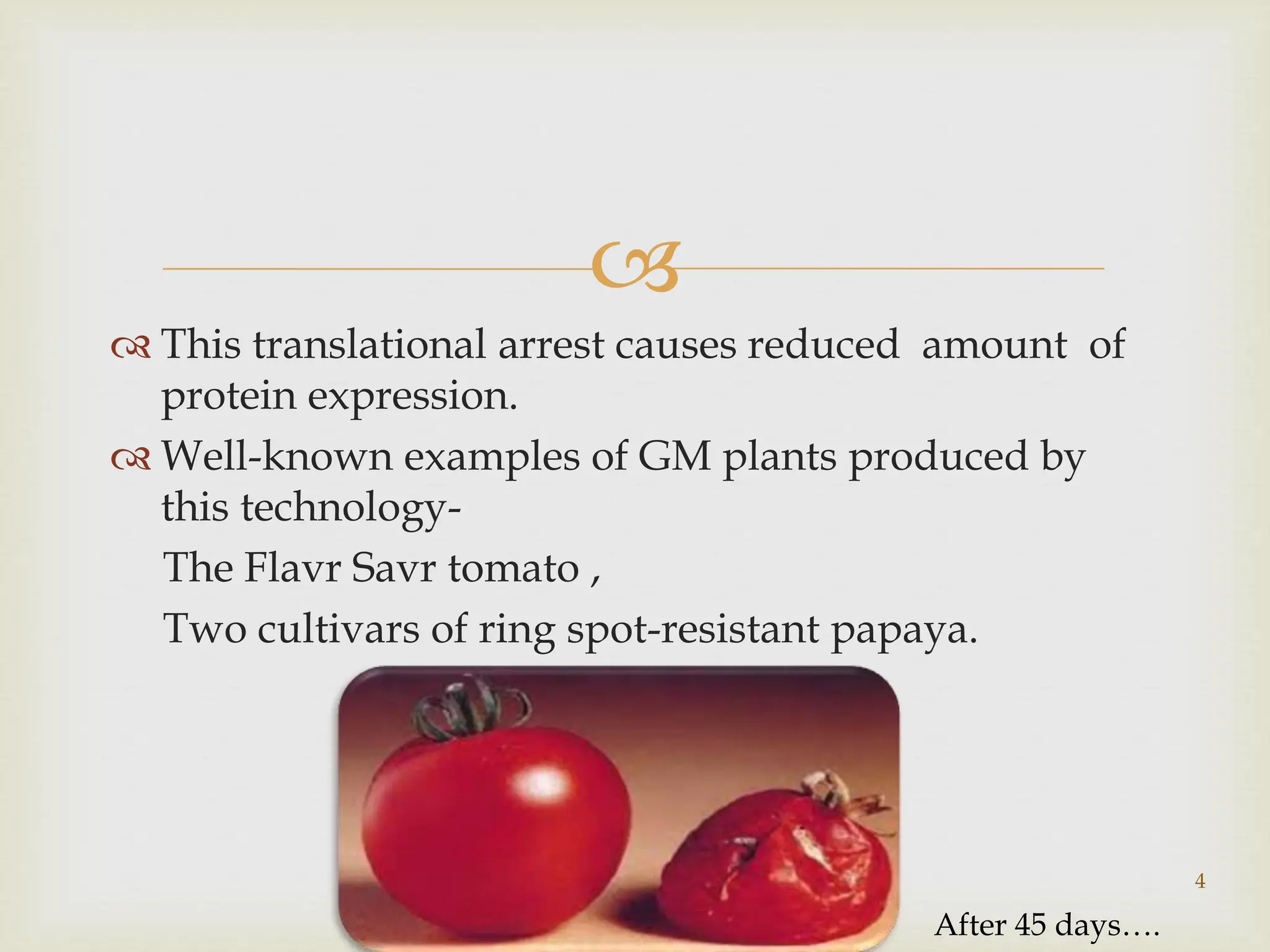
 Well-known examples of GM plants produced by
this technology-
The Flavr Savr tomato ,
Two cultivars of ring spot-resistant papaya.
4
After 45 days….

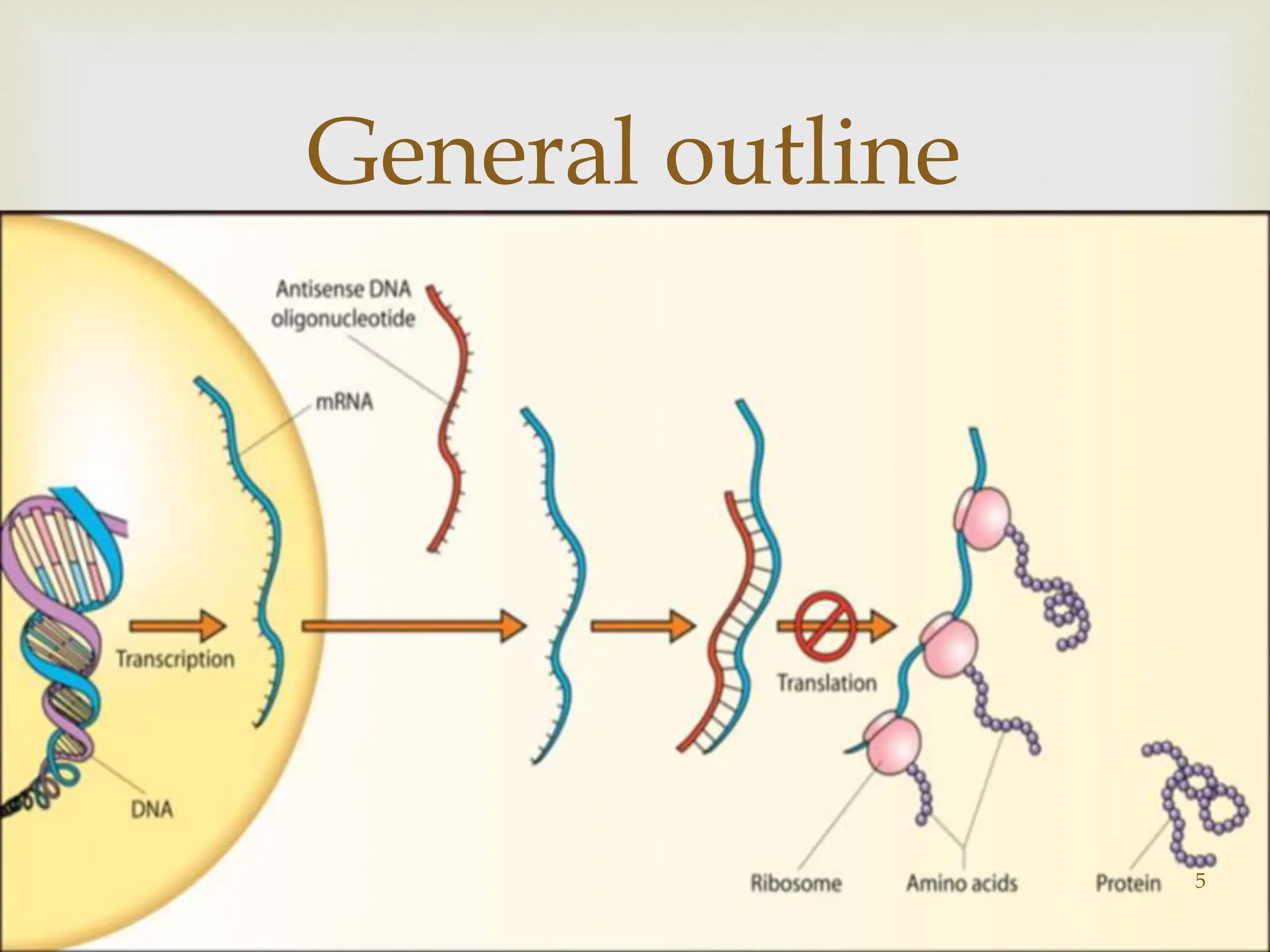
General outline
5

 The intended effect in both will be same i.e. gene
silencing but the processing is little but different.
 Antisense technology degrades RNA by enzymes
RNaseH while RNAi employed the enzyme DICER
to degrade the m RNA.
 RNAi are twice larger than the antisense
oligonucleotide.
Diff. between antisense
technology & RNAi
6

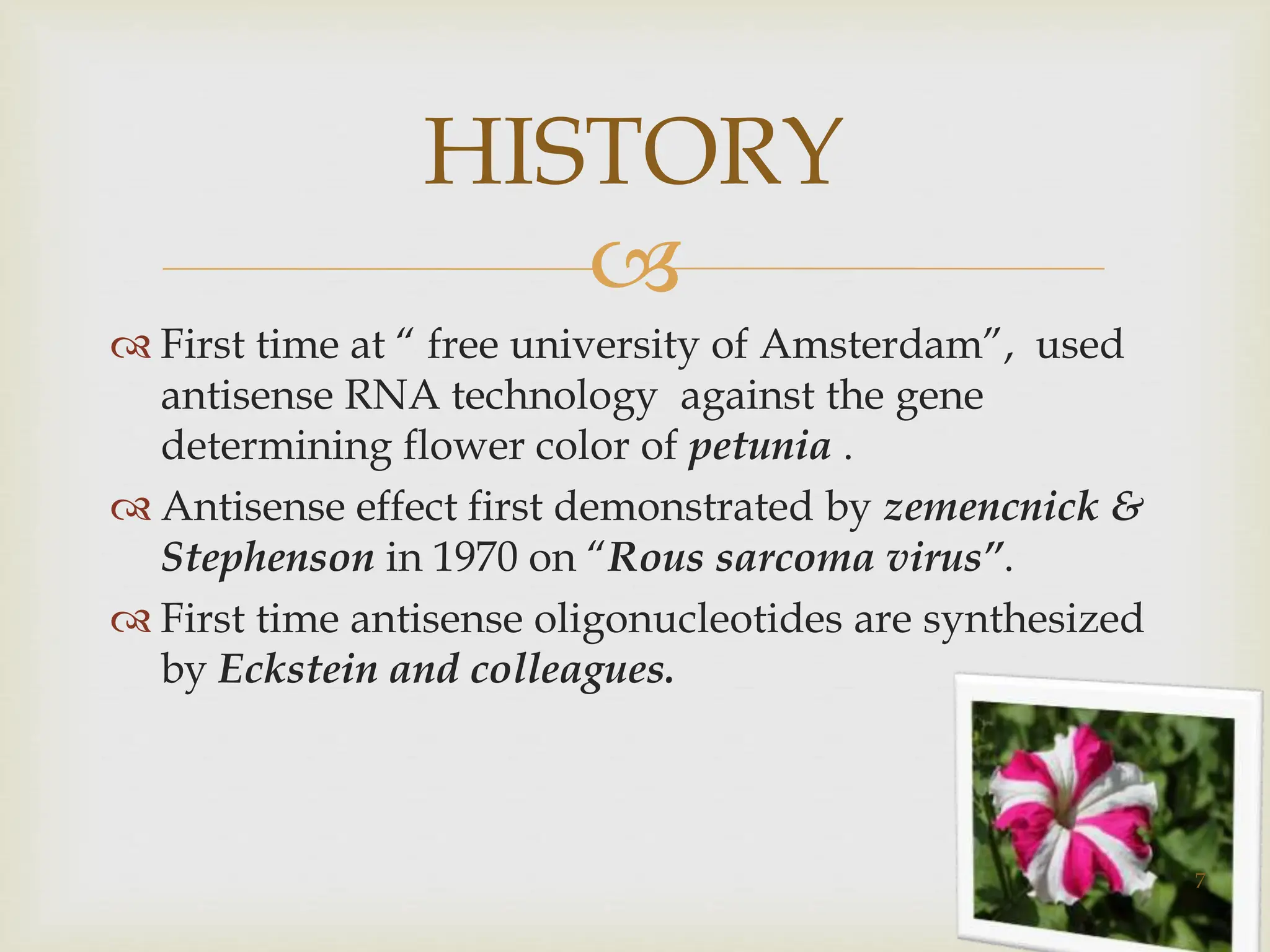
 First time at “ free university of Amsterdam”, used
antisense RNA technology against the gene
determining flower color of petunia .
 Antisense effect first demonstrated by zemencnick &
Stephenson in 1970 on “Rous sarcoma virus”.
 First time antisense oligonucleotides are synthesized
by Eckstein and colleagues.
HISTORY
7

 In 1995 Guo and Kemp hues:
injection of either antisense or sense RNAs in the
germ line of C. elegans was equally effective at
silencing homologous target genes.
8

 There is HOK(host killing)/SOK(suppress killing) system
in R1 plasmid in E.Coli.
 when E. coli cell undergoes division , daughter cell inherit
hok gene & sok gene from parent. But due to short life of
cell, the sok gene is get degraded. So in normal cell, hok
gene get over expressed & cell get die.
 But when R1 plasmid is get inherited , it having the sok
gene & sok promoter.
 Then it transcripts sok gene & it is get overexpressed
against hok gene.
Nature’s antisense system
9

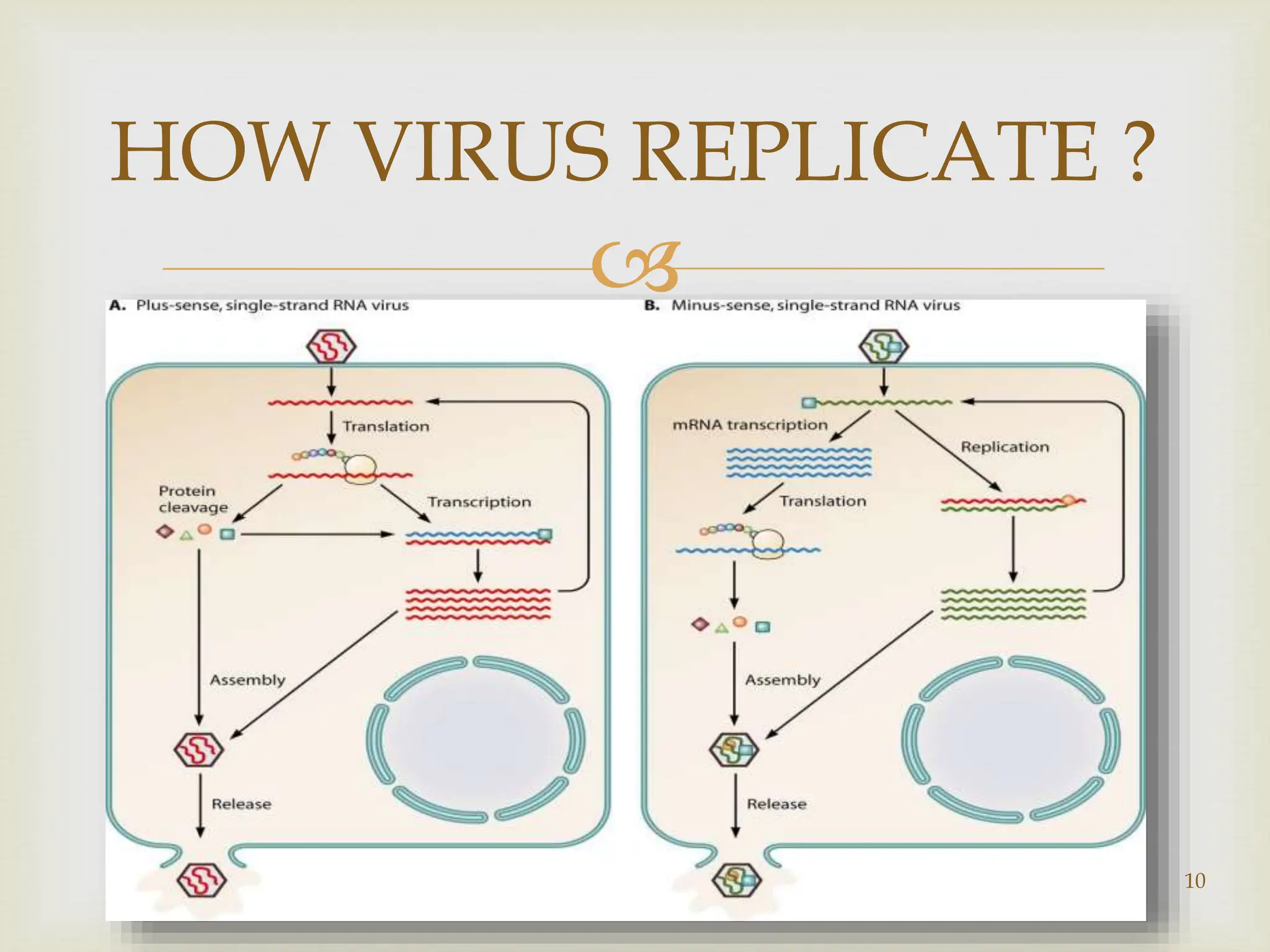
HOW VIRUS REPLICATE ?
10

 In this technique, Short segments of single stranded
RNA are introduced.
 These oligonucleotides are complementary to the
mRNA, which physically bind to the mRNA.
 So , they block the expression of particular gene.
 In case of viruses, antisense oligonucleotides inhibit
viral replication with blocking expression of
integrated proviral genes.
 Usually consist of 15–20 nucleotides.
MECHANISM
11

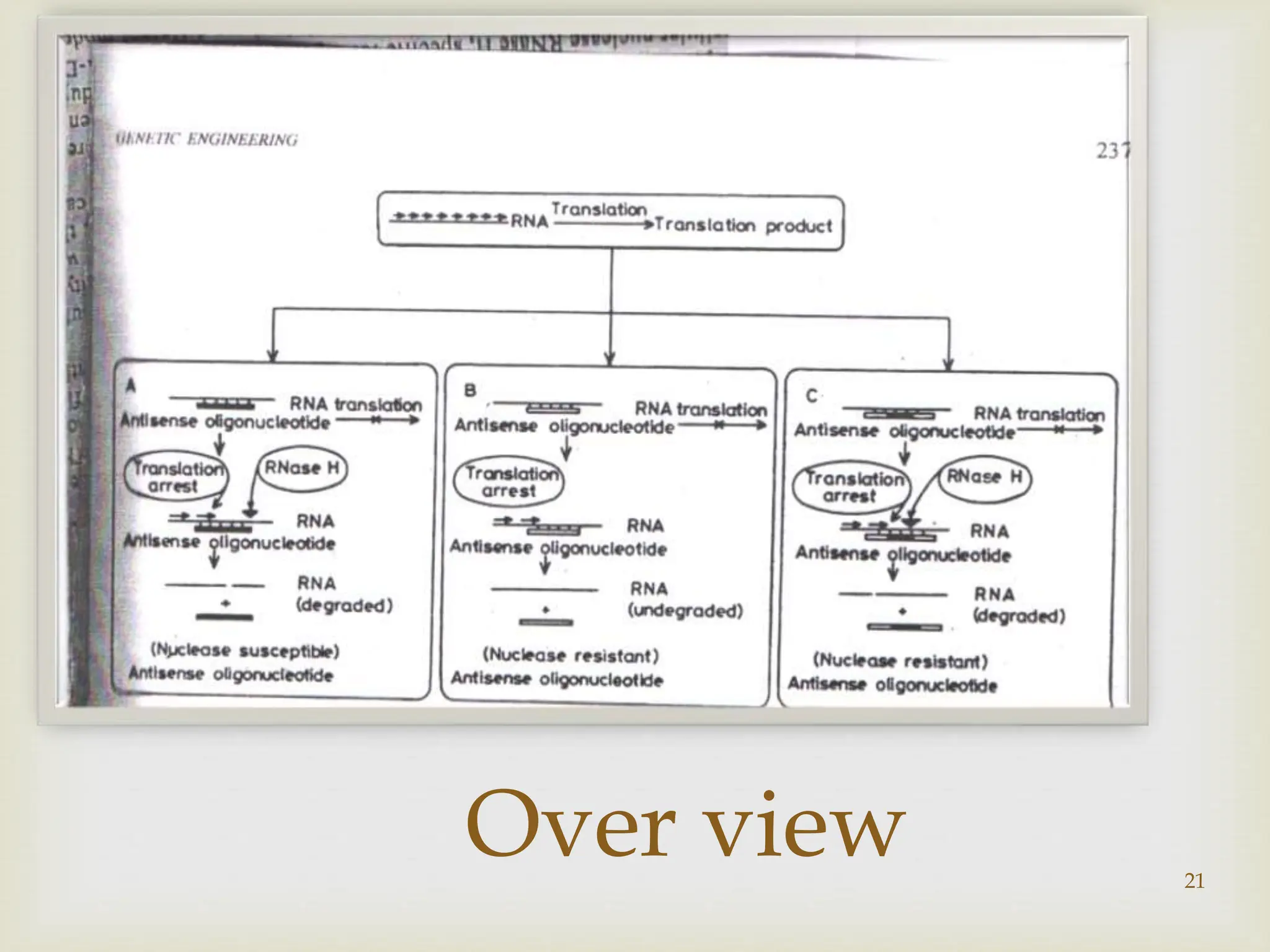
 Translation of mRNA may be blocked by two
possible mechanisms , These are:-
1] by base specific hybridization – which prevents
access by translation machinery i.e. “hybridization
arrest”.
2] by forming RNA/DNA duplex which is
recognized by nuclease RNaseH , specific for digesting
RNA in an RNA/DNA duplex.
12

 RNaseH is a non-specific endonuclease, catalyzes the
cleavage of RNA via hydrolytic mechanism.
 RNaseH has ribonuclease activity cleaves the 3’-O-P
bond of RNA in a DNA/RNA duplex.
13

 Unique DNA sequence
 Efficient cellular uptake
 Minimal nonspecific binding
 Target specific hybridization
 Non-toxic antisense construct
14
Characteristics of antisense
oligonucleotides

 The antisense technology can be modified in THREE
modes because of chemical modifications of the
oligonucleotides.
 These modes are due to activation of RNaseH &
internucleotides linkages which do not activate
enzyme.
15
Approaches

 The antisense oligonucleotides binds the target
sequence causing both “hybridisation arrest ” &
“RNaseH activation”.
 Degradation of mRNA by RNaseH results into
release of oligonucleotides.
 They may bind to other copies of target mRNA.
 These oligonucleotides are also susceptible to other
nucleases.
 This a major parameter affecting catalytic mode of
degradation.
16
1st approach

 In this, antisense oligonucleotides binds to target
sequence result in translation arrest but they do not
activate enzyme RNaseH.
 Oligoribonucleotides & there analogues ,
oligodeoxyribonucleotides , various non phosphate
& phosphate internucleotides linkages fall in this
category.
 They show resistance against nucleuses enzyme and
never get degraded by them.
17
2nd approach

 They also show effective translational arrest .
 But the major problem is that they are generally
required higher molar concentrations than those
which activate RNaseH.
18

 It combines features of both previous approaches.
 They contains both internucleotides linkages which
are responsible for RNaseH activation & which
shows resistance against them.
 Digestion of mRNA target in RNA-DNA duplex
releases oligonucleotides which are resistance
against nuclease enzyme, hence are more effective
than oligonucleotides in 1st approach.
19
3rd approach

 They may form hybrids of
oligodeoxyribonucleotides & Oligoribonucleotides.
 The antiviral activity of an antisense oligonucleotides
depends usually on specific binding to a target
nucleic acid.
20

Over view 21

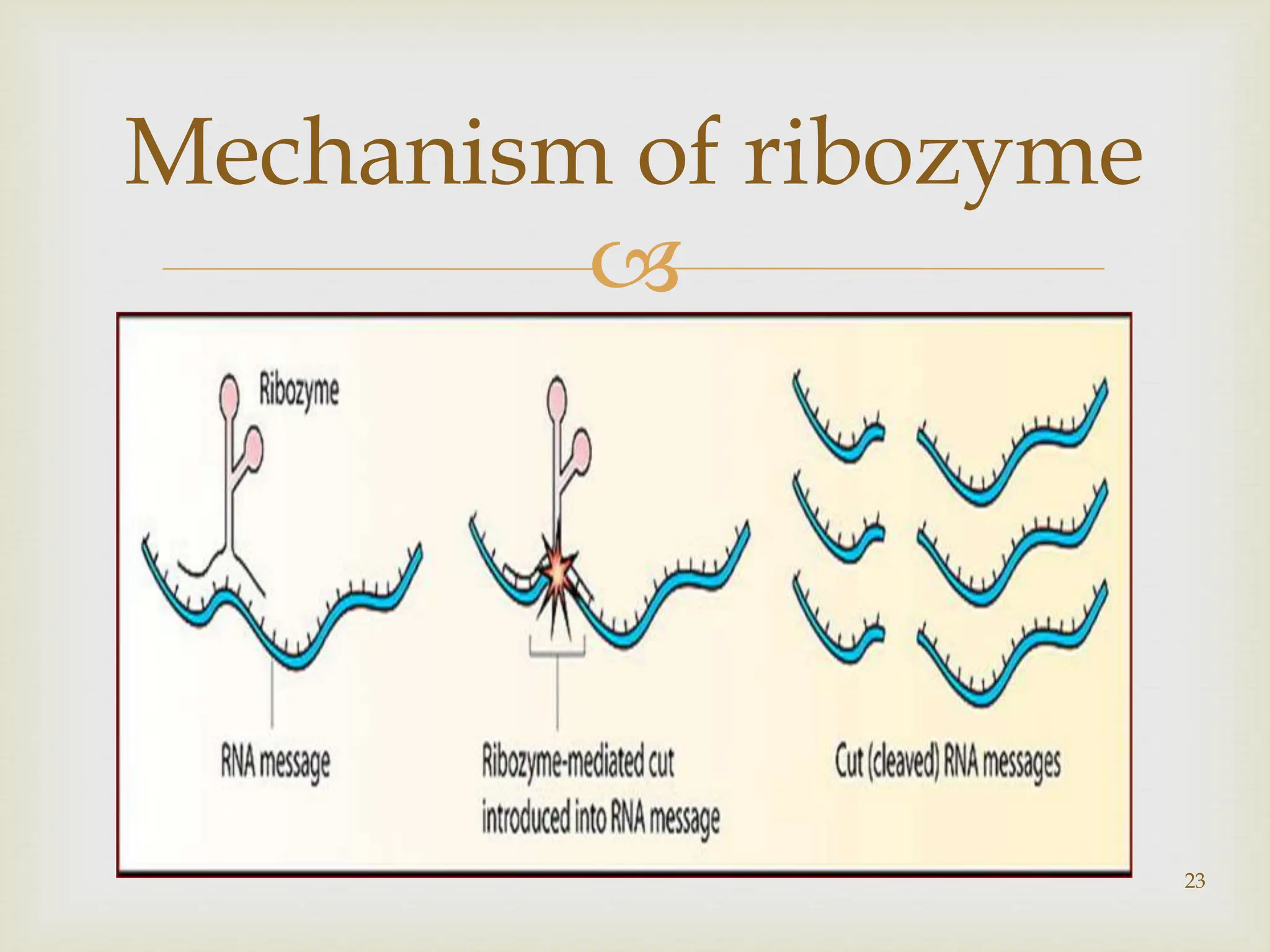
 Thomas and coworkers coined the term ‘ribozymes’.
 These are RNA molecules which have catalytic
activity which degrade nucleotides .
 Ribozyme Bind to the target RNA moiety and
inactivate it by cleaving the phosphodiester
backbone at a specific cutting site.
 Ribozyme destroy RNA that carries the massage of
disease.
 These are effectively used against HIV virus.
22
Ribozymes

23
Mechanism of ribozyme

1. Flavr Savr tomato-
antisense RNA used against an enzyme
polygalacturonase, an softening enzyme which is responsible
for ripening.
2. Transgenic ACMV-resistant cassava plants* –
Used against African cassava mosaic virus
(ACMV) which causes cassava mosaic disease causing major
economic loss in Africa.
3. Formivirsen-
is the first antiviral drug developed against CMV.
APPLICATION
24

25
Antisense as drug

 Antisense technology shows potential for diverse
application to field of basic research & therapy.
 One of the most approved approaches for inactivating a
single specific gene.
 But it may sometime give undesirable effect.
 Generally , antisense RNA still lack effective design,
biological activity, and efficient route of administration.
 Antisense technologies form a very powerful weapon for
studying gene function and for discovering more specific
treatments of disease.
conclusion
26

 Attempts are made to genetically engineer transgenic
plants to express antisense RNA instead activate the
RNAi pathway, although the processes result in
“gene silencing”.
27

 A textbook of biotechnology 2nd edition by H. D.
Kumar
 www.youtube.com
 Nature biotechnology.
 www.ncbi.nlm.nih.com (PubMed ID 17173627)*
 www.google.com
References :-
28

Queries ?
(If any)
29

THANKs FOR YOUR
KIND ATTENSION
30

anisensernatechbysapate-140914092120-phpapp01.pdf

  • 1.
  • 2.
    -Sapate P D, Student(ABW/34/2011), LokmangalAgril biotech college, Wadala. 2
  • 3.
      Antisense RNAis a single-stranded RNA that is complementary to a messenger RNA (mRNA) strand transcribed within a cell  Antisense RNA introduced into a cell to inhibit translation of a complementary mRNA by base pairing to it and creating barrier to the translation machinery.  E.g. hok/sok system of the E. coli R1 plasmid. INTRODUCTION 3
  • 4.
      This translationalarrest causes reduced amount of protein expression.  Well-known examples of GM plants produced by this technology- The Flavr Savr tomato , Two cultivars of ring spot-resistant papaya. 4 After 45 days….
  • 5.
  • 6.
      The intendedeffect in both will be same i.e. gene silencing but the processing is little but different.  Antisense technology degrades RNA by enzymes RNaseH while RNAi employed the enzyme DICER to degrade the m RNA.  RNAi are twice larger than the antisense oligonucleotide. Diff. between antisense technology & RNAi 6
  • 7.
      First timeat “ free university of Amsterdam”, used antisense RNA technology against the gene determining flower color of petunia .  Antisense effect first demonstrated by zemencnick & Stephenson in 1970 on “Rous sarcoma virus”.  First time antisense oligonucleotides are synthesized by Eckstein and colleagues. HISTORY 7
  • 8.
      In 1995Guo and Kemp hues: injection of either antisense or sense RNAs in the germ line of C. elegans was equally effective at silencing homologous target genes. 8
  • 9.
      There isHOK(host killing)/SOK(suppress killing) system in R1 plasmid in E.Coli.  when E. coli cell undergoes division , daughter cell inherit hok gene & sok gene from parent. But due to short life of cell, the sok gene is get degraded. So in normal cell, hok gene get over expressed & cell get die.  But when R1 plasmid is get inherited , it having the sok gene & sok promoter.  Then it transcripts sok gene & it is get overexpressed against hok gene. Nature’s antisense system 9
  • 10.
  • 11.
      In thistechnique, Short segments of single stranded RNA are introduced.  These oligonucleotides are complementary to the mRNA, which physically bind to the mRNA.  So , they block the expression of particular gene.  In case of viruses, antisense oligonucleotides inhibit viral replication with blocking expression of integrated proviral genes.  Usually consist of 15–20 nucleotides. MECHANISM 11
  • 12.
      Translation ofmRNA may be blocked by two possible mechanisms , These are:- 1] by base specific hybridization – which prevents access by translation machinery i.e. “hybridization arrest”. 2] by forming RNA/DNA duplex which is recognized by nuclease RNaseH , specific for digesting RNA in an RNA/DNA duplex. 12
  • 13.
      RNaseH isa non-specific endonuclease, catalyzes the cleavage of RNA via hydrolytic mechanism.  RNaseH has ribonuclease activity cleaves the 3’-O-P bond of RNA in a DNA/RNA duplex. 13
  • 14.
      Unique DNAsequence  Efficient cellular uptake  Minimal nonspecific binding  Target specific hybridization  Non-toxic antisense construct 14 Characteristics of antisense oligonucleotides
  • 15.
      The antisensetechnology can be modified in THREE modes because of chemical modifications of the oligonucleotides.  These modes are due to activation of RNaseH & internucleotides linkages which do not activate enzyme. 15 Approaches
  • 16.
      The antisenseoligonucleotides binds the target sequence causing both “hybridisation arrest ” & “RNaseH activation”.  Degradation of mRNA by RNaseH results into release of oligonucleotides.  They may bind to other copies of target mRNA.  These oligonucleotides are also susceptible to other nucleases.  This a major parameter affecting catalytic mode of degradation. 16 1st approach
  • 17.
      In this,antisense oligonucleotides binds to target sequence result in translation arrest but they do not activate enzyme RNaseH.  Oligoribonucleotides & there analogues , oligodeoxyribonucleotides , various non phosphate & phosphate internucleotides linkages fall in this category.  They show resistance against nucleuses enzyme and never get degraded by them. 17 2nd approach
  • 18.
      They alsoshow effective translational arrest .  But the major problem is that they are generally required higher molar concentrations than those which activate RNaseH. 18
  • 19.
      It combinesfeatures of both previous approaches.  They contains both internucleotides linkages which are responsible for RNaseH activation & which shows resistance against them.  Digestion of mRNA target in RNA-DNA duplex releases oligonucleotides which are resistance against nuclease enzyme, hence are more effective than oligonucleotides in 1st approach. 19 3rd approach
  • 20.
      They mayform hybrids of oligodeoxyribonucleotides & Oligoribonucleotides.  The antiviral activity of an antisense oligonucleotides depends usually on specific binding to a target nucleic acid. 20
  • 21.
  • 22.
      Thomas andcoworkers coined the term ‘ribozymes’.  These are RNA molecules which have catalytic activity which degrade nucleotides .  Ribozyme Bind to the target RNA moiety and inactivate it by cleaving the phosphodiester backbone at a specific cutting site.  Ribozyme destroy RNA that carries the massage of disease.  These are effectively used against HIV virus. 22 Ribozymes
  • 23.
  • 24.
     1. Flavr Savrtomato- antisense RNA used against an enzyme polygalacturonase, an softening enzyme which is responsible for ripening. 2. Transgenic ACMV-resistant cassava plants* – Used against African cassava mosaic virus (ACMV) which causes cassava mosaic disease causing major economic loss in Africa. 3. Formivirsen- is the first antiviral drug developed against CMV. APPLICATION 24
  • 25.
  • 26.
      Antisense technologyshows potential for diverse application to field of basic research & therapy.  One of the most approved approaches for inactivating a single specific gene.  But it may sometime give undesirable effect.  Generally , antisense RNA still lack effective design, biological activity, and efficient route of administration.  Antisense technologies form a very powerful weapon for studying gene function and for discovering more specific treatments of disease. conclusion 26
  • 27.
      Attempts aremade to genetically engineer transgenic plants to express antisense RNA instead activate the RNAi pathway, although the processes result in “gene silencing”. 27
  • 28.
      A textbookof biotechnology 2nd edition by H. D. Kumar  www.youtube.com  Nature biotechnology.  www.ncbi.nlm.nih.com (PubMed ID 17173627)*  www.google.com References :- 28
  • 29.
  • 30.