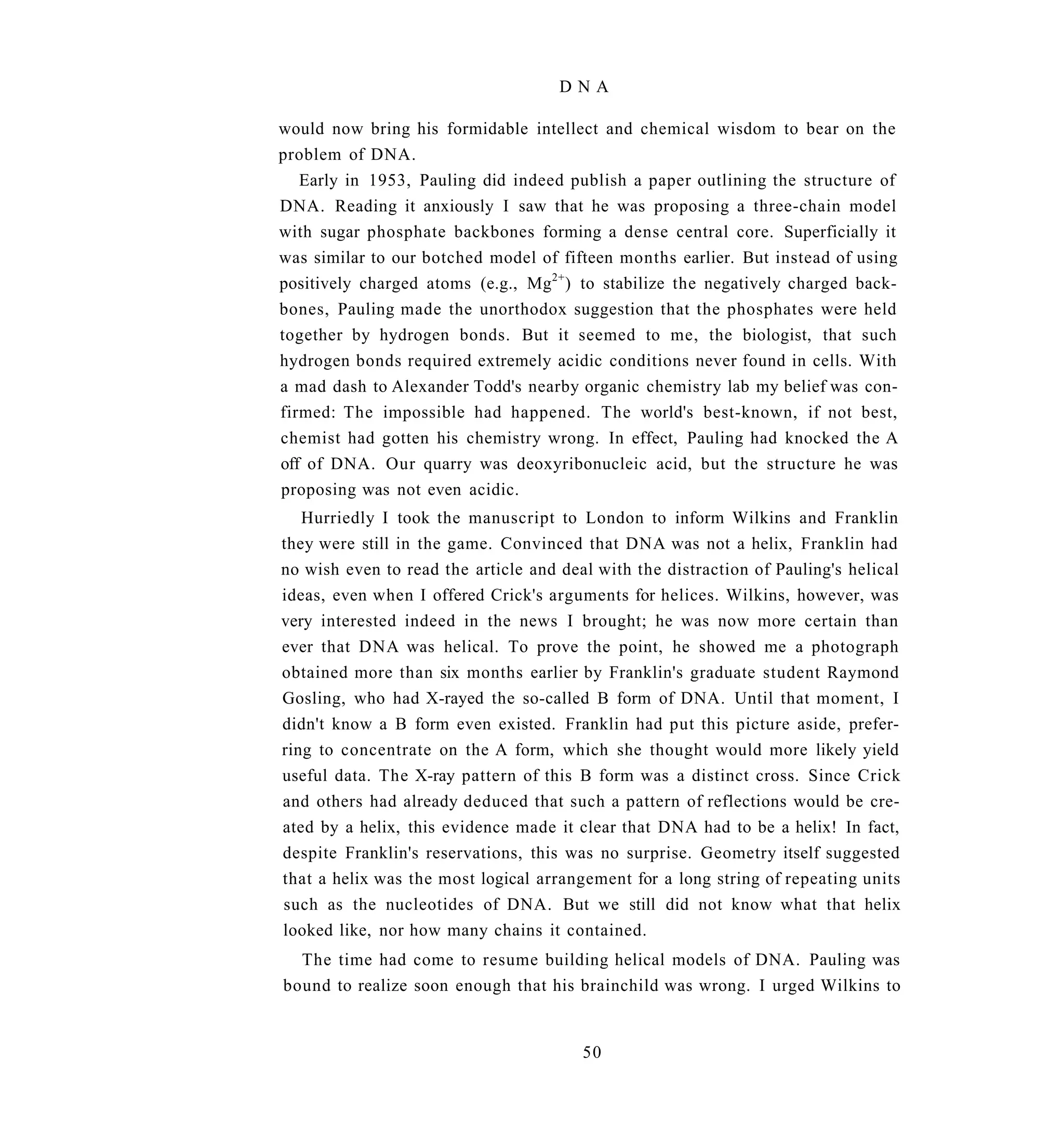
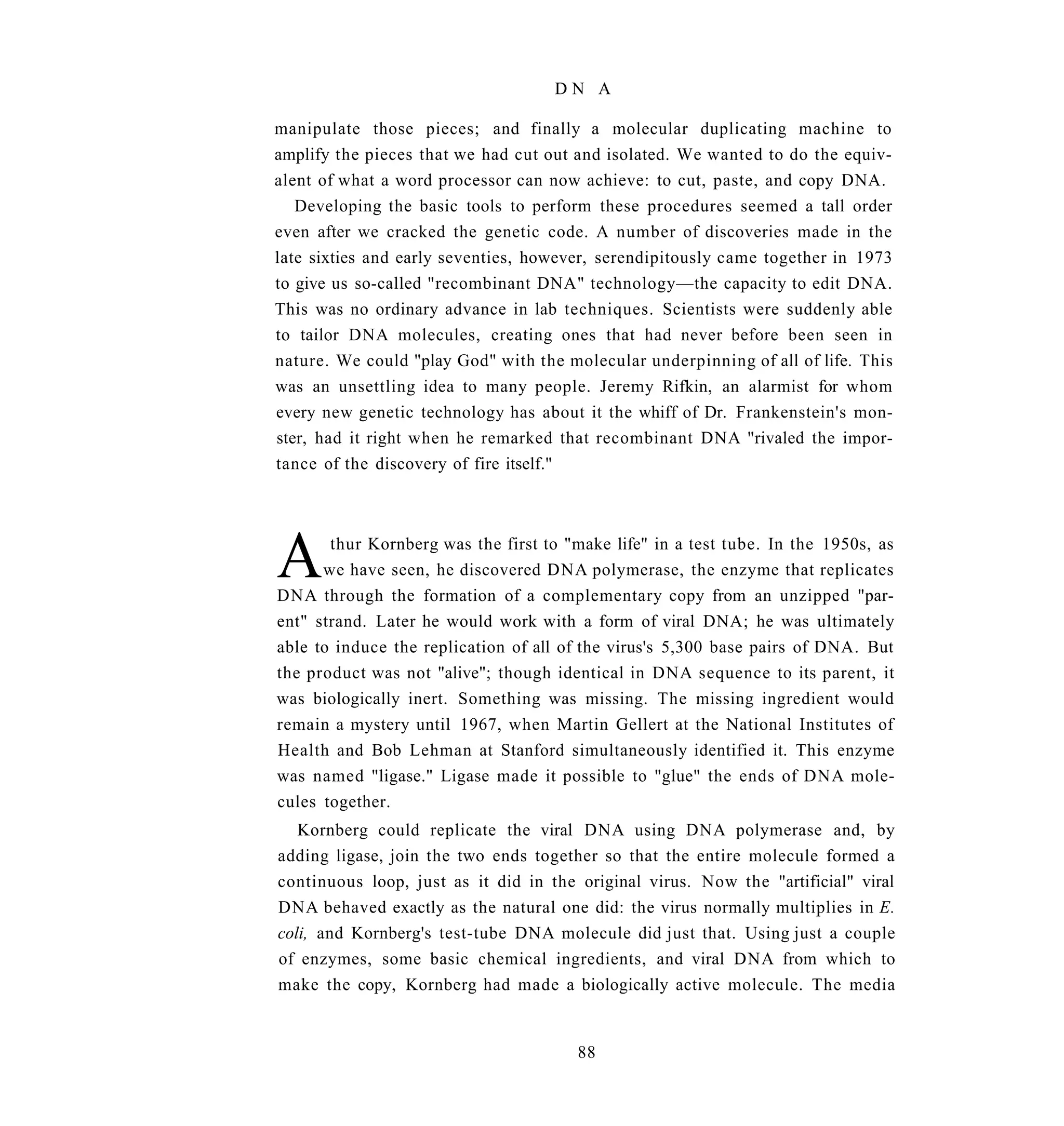
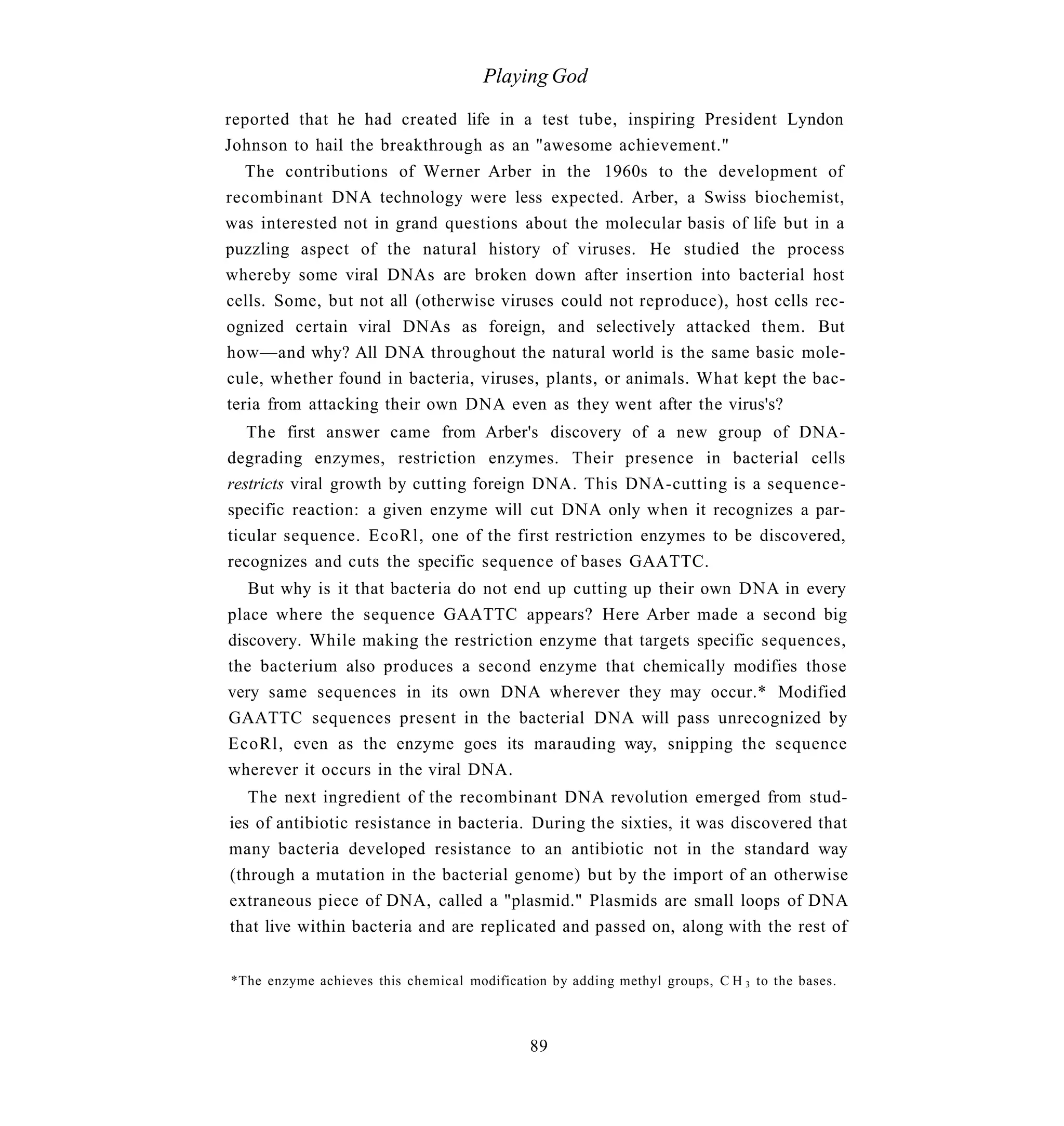
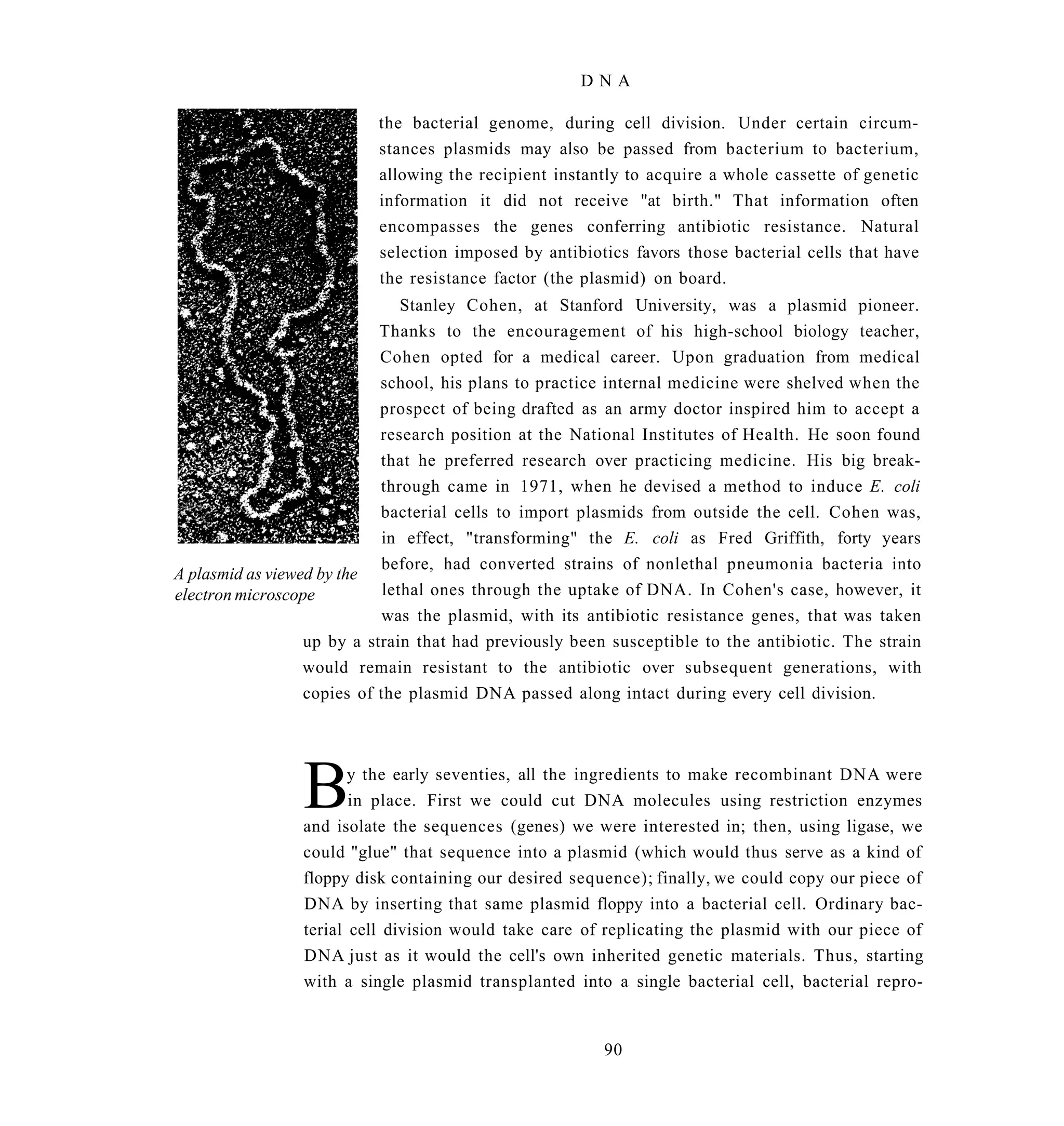
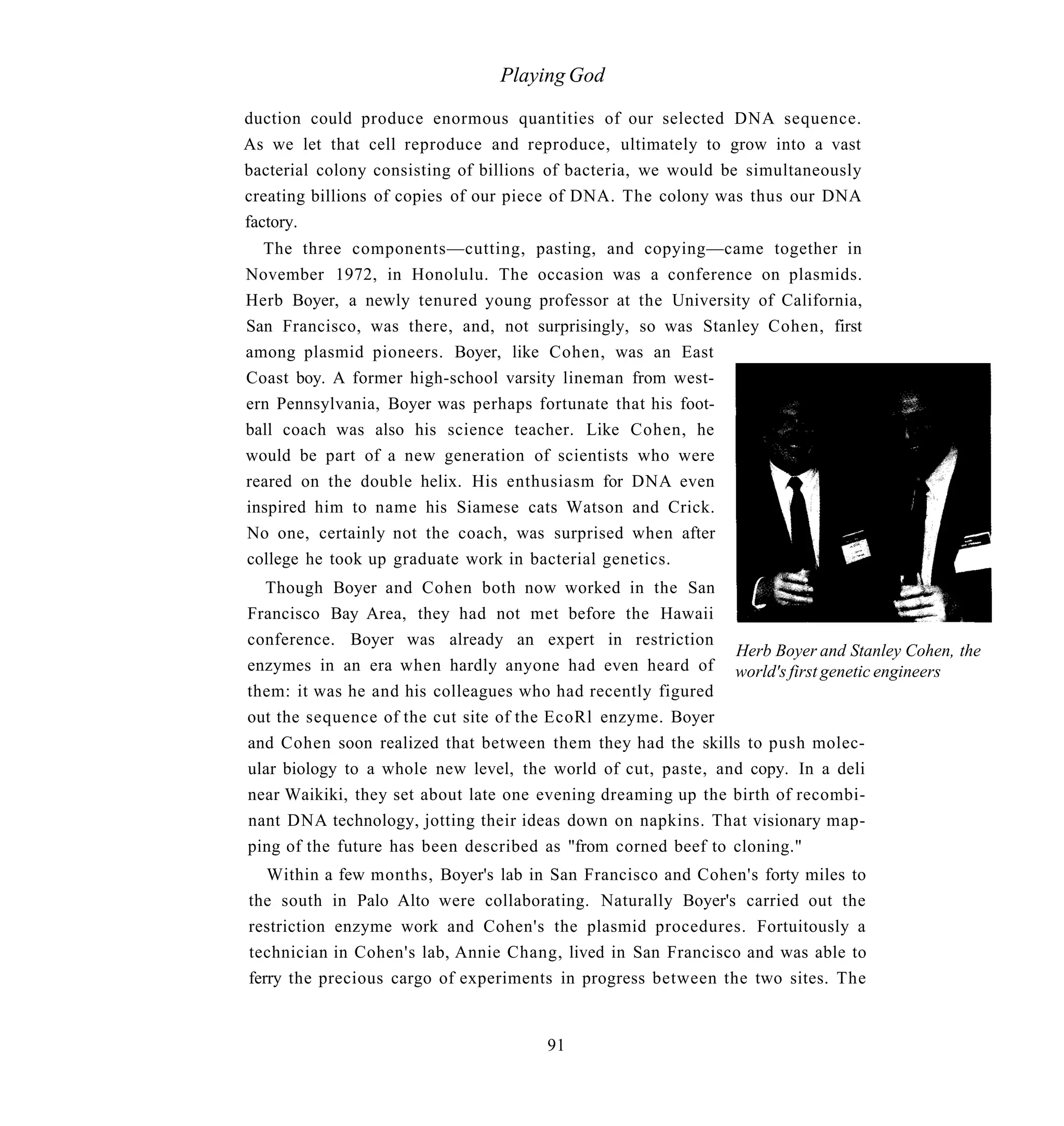
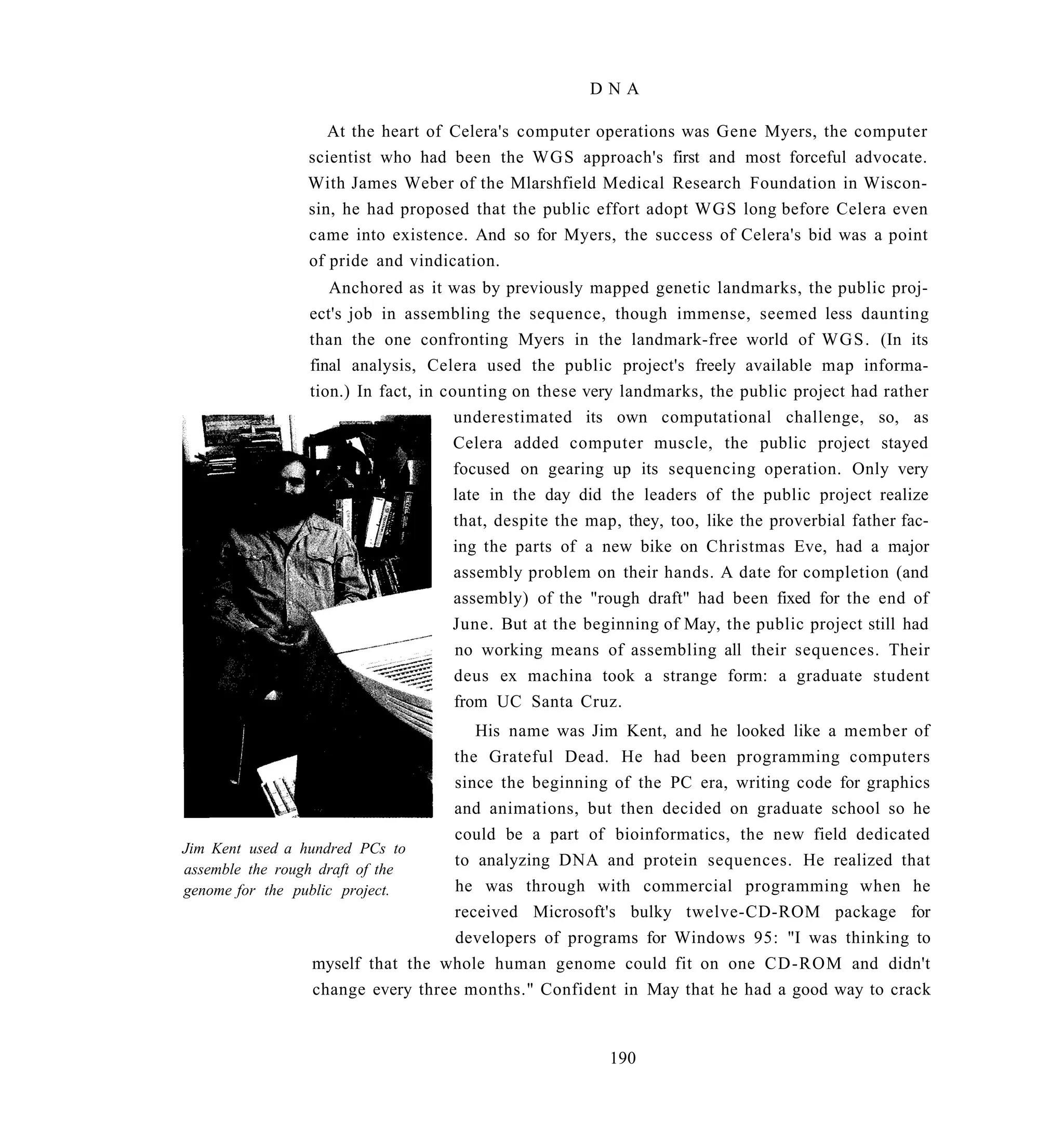
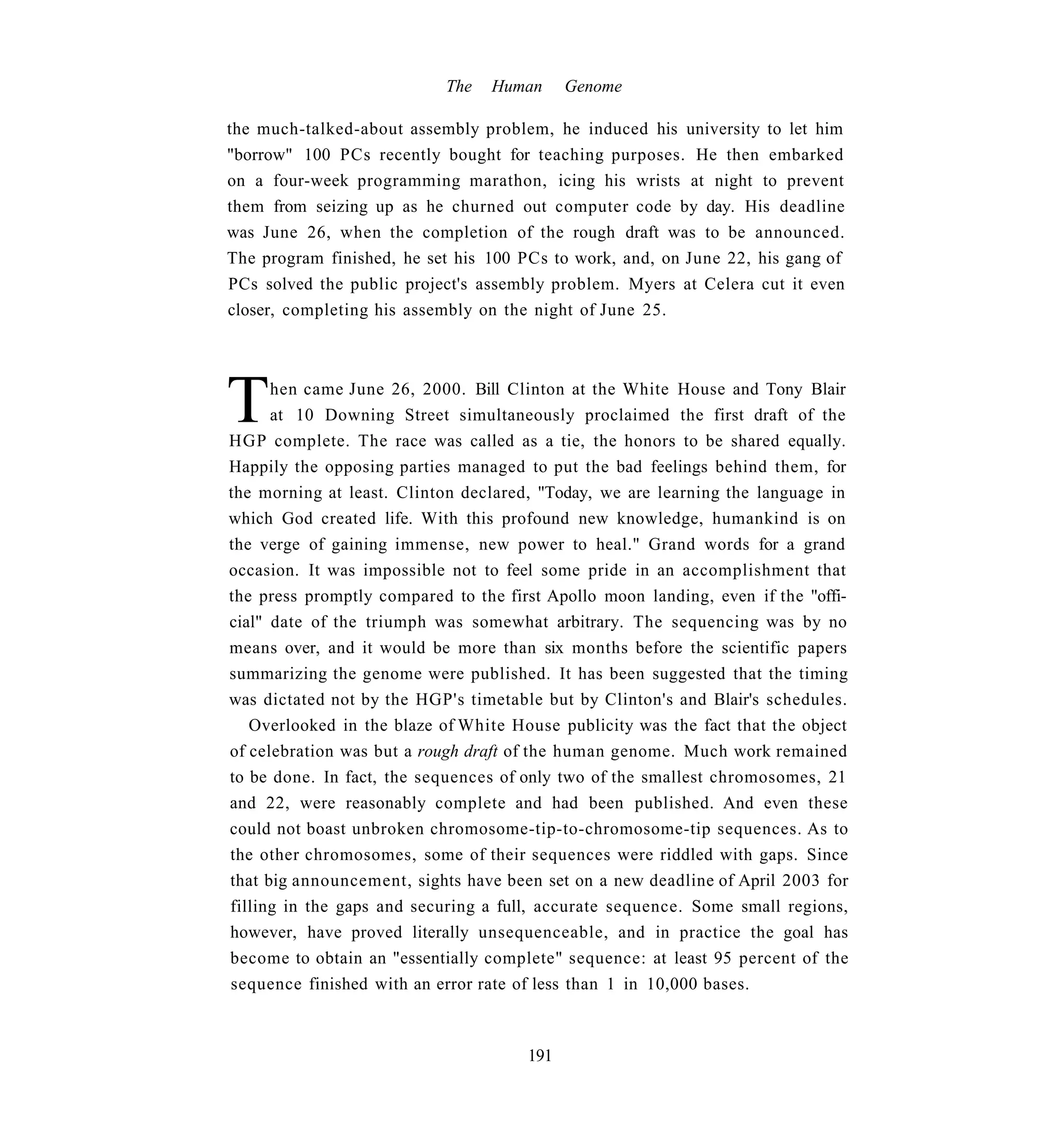
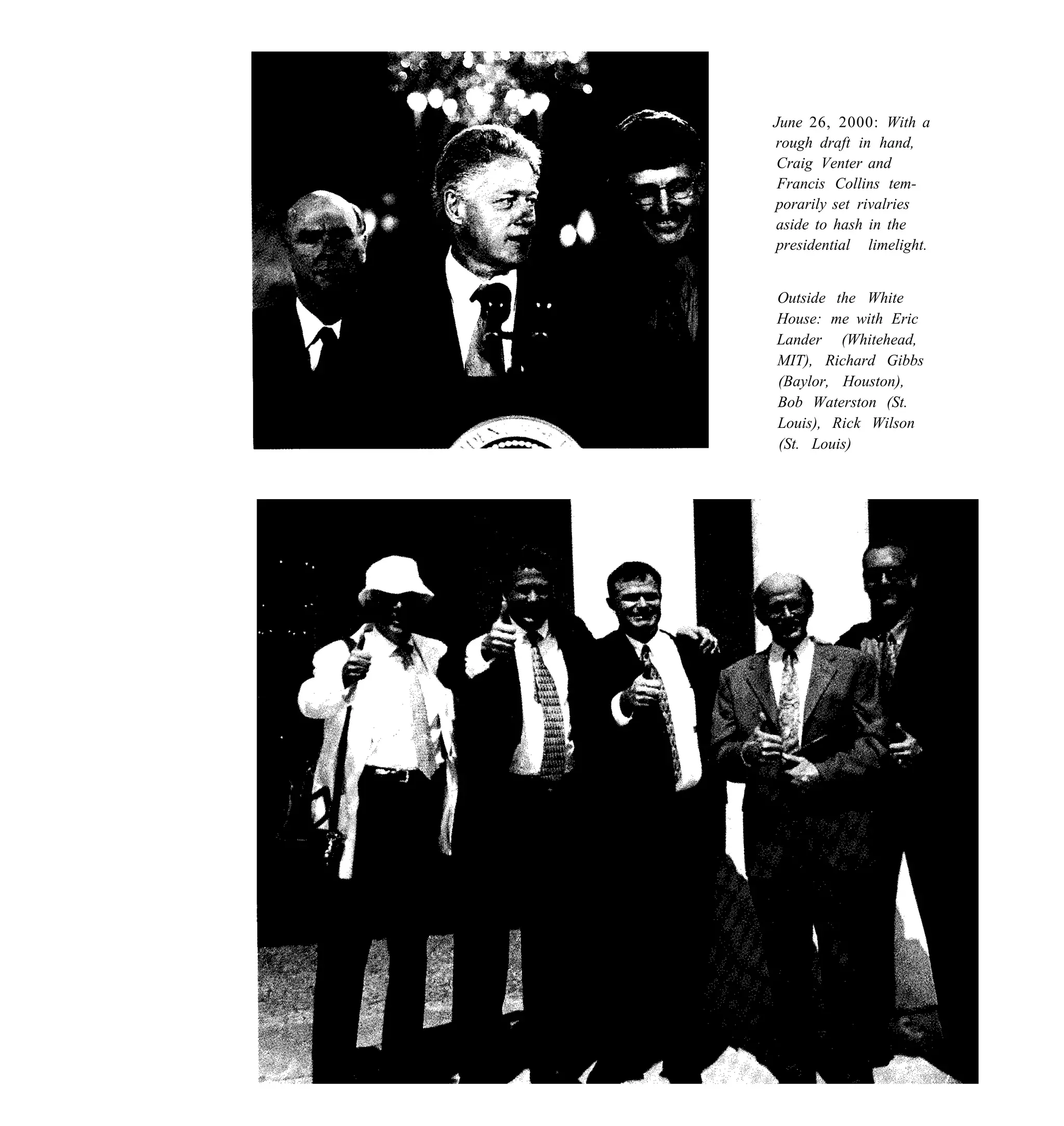
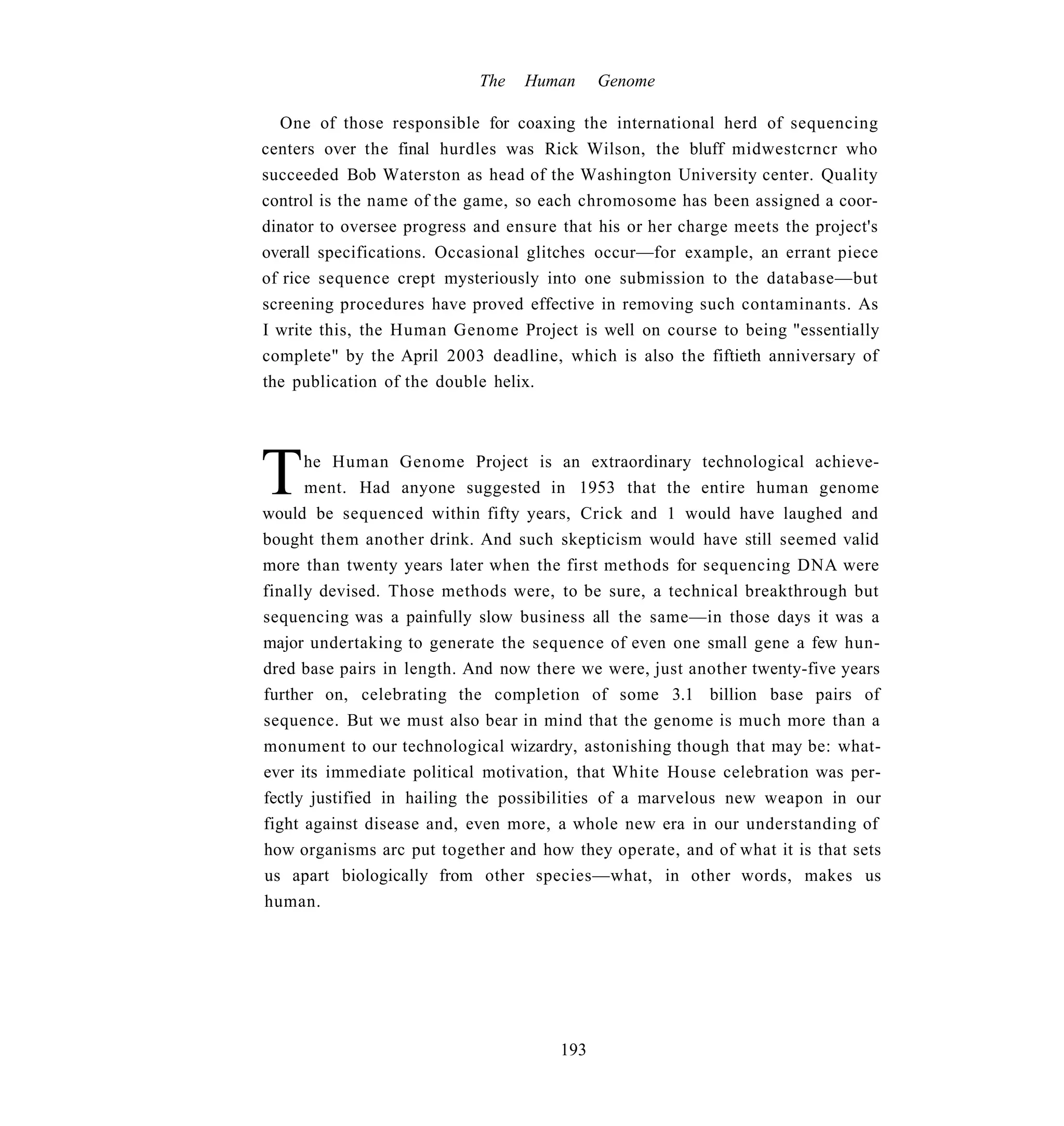
DNA
THE S E C R E T OF LIFE

   J A M E S D. W A T S O N
     WITH A N D R E W BERRY


          A L F R E D A. K N O P F
               N E W YORK
                   2003
T H I S IS A B O R Z O I B O O K
                P U B L I S H E D BY A L F R E D A.   KNOPF


                 Copyright © 2003 by DNA Show LLC
 All rights reserved under International and Pan-American Copyright
  Conventions. Published in the United States by Alfred A. Knopf, a
  division of Random House, Inc., New York, and simultaneously in
 Canada by Alfred A. Knopf Canada, Limited, Toronto. Distributed by
                    Random House, Inc., New York.
                           www. aaknopf. com

  Knopf, Borzoi Books, and the colophon are registered trademarks of
                         Random House, Inc.

         Library of Congress Cataloging-in-Publication Data

                     Watson, James D., 1928-
    DNA: the secret of life /James D. Watson, with Andrew Berry.
                               p.   cm.
           Includes bibliographical references and index.
                        ISBN 0-375-41546-7
       1. Genetics—Popular works. 2. DNA—Popular works.
                     I. Berry, Andrew. II. Title.
                         QH437W387 2003
576.5—dc21                                                2002190725

            Manufactured in the United States of America
                           First Edition
A U T H O R S '   NOTE


D         NA: The Secret of Life was conceived over dinner in 1999. Under dis-
          cussion was how best to mark the fiftieth anniversary of the discovery
          the double helix. Publisher Neil Patterson joined one of us, James D.
Watson, in dreaming up a multifaceted venture including this book, a television
series, and additional more avowedly educational projects. Neil's presence was
no accident: he published JDW's first book, The Molecular Biology of the Gene,
in 1965, and ever since has lurked genielike behind JDW's writing projects.
Doron Weber at the Alfred P. Sloan Foundation then secured seed money to
ensure that the idea would turn into something more concrete. Andrew Berry
was recruited in 2000 to hammer out a detailed outline for the TV series and
has since become a regular commuter between his base in Cambridge, Massa-
chusetts, and JDW's at Cold Spring Harbor Laboratory on the north coast of
Long Island, close to New York City.
   From the start, our goal was to go beyond merely recounting the events of the
past fifty years. DNA has moved from being an esoteric molecule only of inter-
est to a handful of specialists to being the heart of a technology that is trans-
forming many aspects of the way we all live. With that transformation has come
a host of difficult questions about its impact—practical, social, and ethical.
Taking the fiftieth anniversary as an opportunity to pause and take stock of
where we are, we give an unabashedly personal view both of the history and of
the issues. Moreover, it is JDW's personal view and is accordingly written in the
first-person singular. The double helix was already ten years old when DNA was
working its in utero magic on a fetal AB.

                                       ix
Authors'   Note

   We have tried to write for a general audience, intending that someone with
zero biological knowledge should be able to understand the book's every word.
Every technical term is explained when first introduced. Should you need to
refresh your memory about a term when you come across one of its later
appearances, you can refer to the index, where such words are printed in bold to
make locating them easy; a number also in bold will take you to the page on
which the term is defined. We have inevitably skimped on many of the tech-
nical details and recommend that readers interested in learning more go to
DNAi.org, the Web site of the multimedia companion project, DNA Interac-
tive, aimed at high-schoolers and entry-level college students. Here you will
find animations explaining basic processes and an extensive archive of inter-
views with the scientists involved. In addition, the Further Reading section lists
books relevant to each chapter. Where possible we have avoided the technical
literature, but the titles listed nevertheless provide a more in-depth exploration
of particular topics than we supply
   We thank the many people who contributed generously to this project in one
way or another in the acknowledgments at the back of the book. Four individu-
als, however, deserve special mention. George Andreou, our preternaturally
patient editor at Knopf, wrote much more of this book—the good bits—than
either of us would ever let on. Kiryn Hasfinger, our superbly efficient assistant
at Cold Spring Harbor Lab, cajoled, bullied, edited, researched, nit-picked,
mediated, wrote—all in approximately equal measure. The book simply would
not have happened without her. Jan Witkowski, also of Cold Spring Harbor
Lab, did a marvelous job of pulling together chapters 10, 11, and 12 in record
time and provided indispensable guidance throughout the project. Maureen
Berejka, J D W s assistant, rendered sterling service as usual in her capacity as
the sole inhabitant of Planet Earth capable of interpreting J D W s handwriting.


     James D. Watson
     Cold Spring Harbor, New York


     Andrew Berry
     Cambridge, Massachusetts


                                        x
I N T R O D U C T I O N


                 THE S E C R E T OF LIFE


A
           s was normal for a Saturday morning, I got to work at Cambridge Uni-
           versity's Cavendish Laboratory earlier than Franeis Crick on February
           28, 1953. I had good reason for being up early. I knew that we were
close—though I had no idea just how close—to figuring out the structure of a
then little-known molecule called deoxyribonucleic acid: DNA. This was not
any old molecule: DNA, as Crick and I appreciated, holds the very key to the
nature of living things. It stores the hereditary information that is passed on
from one generation to the next, and it orchestrates the incredibly complex
world of the cell. Figuring out its 3-D structure—the molecule's architecture—
would, we hoped, provide a glimpse of what Crick referred to only half-jokingly
as "the secret of life."
   We already knew that DNA molecules consist of multiple copies of a single
basic unit, the nucleotide, which comes in four forms: adenine (A), thymine
(T), guanine (G), and cytosine (C). I had spent the previous afternoon making
cardboard cutouts of these various components, and now, undisturbed on a
quiet Saturday morning, I could shuffle around the pieces of the 3-D jigsaw
puzzle. How did they all fit together? Soon I realized that a simple pairing
scheme worked exquisitely well: A fitted neatly with T, and G with C. Was this
it? Did the molecule consist of two chains linked together by A-T and G-C
pairs? It was so simple, so elegant, that it almost had to be right. But I had made
mistakes in the past, and before I could get too excited, my pairing scheme
would have to survive the scrutiny of Crick's critical eye. It was an anxious wait.


                                        xi
Introduction

But I need not have worried: Crick realized straightaway that my pairing idea
implied a double-helix structure with the two molecular chains running in
opposite directions. Everything known about DNA and its properties—the
facts we had been wrestling with as we tried to solve the problem—made sense
in light of those gentle complementary twists. Most important, the way the mol-
ecule was organized immediately suggested solutions to two of biology's oldest
mysteries: how hereditary information is stored, and how it is replicated.
Despite this, Crick's brag in the Eagle, the pub where we habitually ate lunch,
that we had indeed discovered that "secret of life," struck me as somewhat
immodest, especially in England, where understatement is a way of life.
   Crick, however, was right. Our discovery put an end to a debate as old as the
human species: Does life have some magical, mystical essence, or is it, like any
chemical reaction carried out in a science class, the product of normal physical
and chemical processes? Is there something divine at the heart of a cell that
brings it to life? The double helix answered that question with a definitive No.
   Charles Darwin's theory of evolution, which showed how all of life is interre-
lated, was a major advance in our understanding of the world in materialistic—
physicochemical—terms. The breakthroughs of biologists Theodor Schwann
and Louis Pasteur during the second half of the nineteenth century were also
an important step forward. Rotting meat did not spontaneously yield maggots;
rather, familiar biological agents and processes were responsible—in this case
egg-laying flies. The idea of spontaneous generation had been discredited.
   Despite these advances, various forms of vitalism—the belief that physico-
chemical processes cannot explain life and its processes—lingered on. Many
biologists, reluctant to accept natural selection as the sole determinant of the
fate of evolutionary lineages, invoked a poorly defined overseeing spiritual force
to account for adaptation. Physicists, accustomed to dealing with a simple,
pared-down world—a few particles, a few forces—found the messy complexity
of biology bewildering. Maybe, they suggested, the processes at the heart of the
cell, the ones governing the basics of life, go beyond the familiar laws of physics
and chemistry.
  That is why the double helix was so important. It brought the Enlighten-
ment's revolution in materialistic thinking into the cell. The intellectual journey
that had begun with Copernicus displacing humans from the center of the uni-


                                        xii
Introduction

verse and continued with Darwin's insistence that humans are merely modified
monkeys had finally focused in on the very essence of life. And there was noth-
ing special about it. The double helix is an elegant structure, but its message is
downright prosaic: life is simply a matter of chemistry.
   Crick and I were quick to grasp the intellectual significance of our discovery,
but there was no way we could have foreseen the explosive impact of the dou-
ble helix on science and society. Contained in the molecule's graceful curves
was the key to molecular biology, a new science whose progress over the subse-
quent fifty years has been astounding. Not only has it yielded a stunning array of
insights into fundamental biological processes, but it is now having an ever
more profound impact on medicine, on agriculture, and on the law. DNA is no
longer a matter of interest only to white-coated scientists in obscure university
laboratories; it affects us all.
   By the mid-sixties, we had worked out the basic mechanics of the cell, and
we knew how, via the "genetic code," the four-letter alphabet of DNA sequence
is translated into the twenty-letter alphabet of the proteins. The next explosive
spurt in the new science's growth came in the 1970s with the introduction of
techniques for manipulating DNA and reading its sequence of base pairs. We
were no longer condemned to watch nature from the sidelines but could actu-
ally tinker with the DNA of living organisms, and we could actually read life's
basic script. Extraordinary new scientific vistas opened up: we would at last
come to grips with genetic diseases from cystic fibrosis to cancer; we would rev-
olutionize criminal justice through genetic fingerprinting methods; we would
profoundly revise ideas about human origins—about who we are and where we
came from—by using DNA-bascd approaches to prehistory; and we would
improve agriculturally important species with an effectiveness we had previ-
ously only dreamed of.
   But the climax of the first fifty years of the DNA revolution came on Monday,
June 26, 2000, with the announcement by U.S. president Bill Clinton of the
completion of the rough draft sequence of the human genome: "Today, we are
learning the language in which God created life. With this profound new
knowledge, humankind is on the verge of gaining immense, new power to heal."
The genome project was a coming-of-age for molecular biology: it had become
"big science," with big money and big results. Not only was it an extraordinary


                                       xiii
Introduction

technological achievement—the amount of information mined from the human
complement of twenty-three pairs of chromosomes is staggering—but it was
also a landmark in terms of our idea of what it is to be human. It is our DNA
that distinguishes us from all other species, and that makes us the creative,
conscious, dominant, destructive creatures that we arc. And here, in its entirety,
was that set of DNA—the human instruction book.
   DNA has come a long way from that Saturday morning in Cambridge. How-
ever, it is also clear that the science of molecular biology—what DNA can do
for us—still has a long way to go. Cancer still has to be cured; effective gene
therapies for genetic diseases still have to be developed; genetic engineering
still has to realize its phenomenal potential for improving our food. But all these
things will come. The first fifty years of the DNA revolution witnessed a great
deal of remarkable scientific progress as well as the initial application of that
progress to human problems. The future will see many more scientific
advances, but increasingly the focus will be on DNA's ever greater impact on
the way we live.
C H A P T E R    ONE


          BEGINNINGS OF GENETICS:
           FROM M E N D E L TO HITLER


M            y mother, Bonnie Jean, believed in genes. She was proud of her
              father's Scottish origins, and saw in him the traditional Scottish
              virtues of honesty, hard work, and thriftiness. She, too, possessed
these qualities and felt that they must have been passed down to her from him.
His tragic early death meant that her only nongenetic legacy was a set of tiny lit-
tle girl's kilts he had ordered for her from Glasgow. Perhaps therefore it is not
surprising that she valued her father's biological legacy over his material one.
   Growing up, I had endless arguments with Mother about the relative roles
played by nature and nurture in shaping us. By choosing nurture over nature, I
was effectively subscribing to the belief that I could make myself into whatever
I wanted to be. I did not want to accept that my genes mattered that much, pre-
ferring to attribute my Watson grandmother's extreme fatness to her having
overeaten. If her shape was the product of her genes, then I too might have a
hefty future. However, even as a teenager, I would not have disputed the evi-
dent basics of inheritance, that like begets like. My arguments with my mother
concerned complex characteristics like aspects of personality, not the simple
attributes that, even as an obstinate adolescent, I could see were passed down
over the generations, resulting in "family likeness." My nose is my mother's and
now belongs to my son Duncan.
   Sometimes characteristics come and go within a few generations, but some-
times they persist over many. One of the most famous examples of a long-lived
trait is known as the "Hapsburg Lip." This distinctive elongation of the jaw and


                                        3
DNA


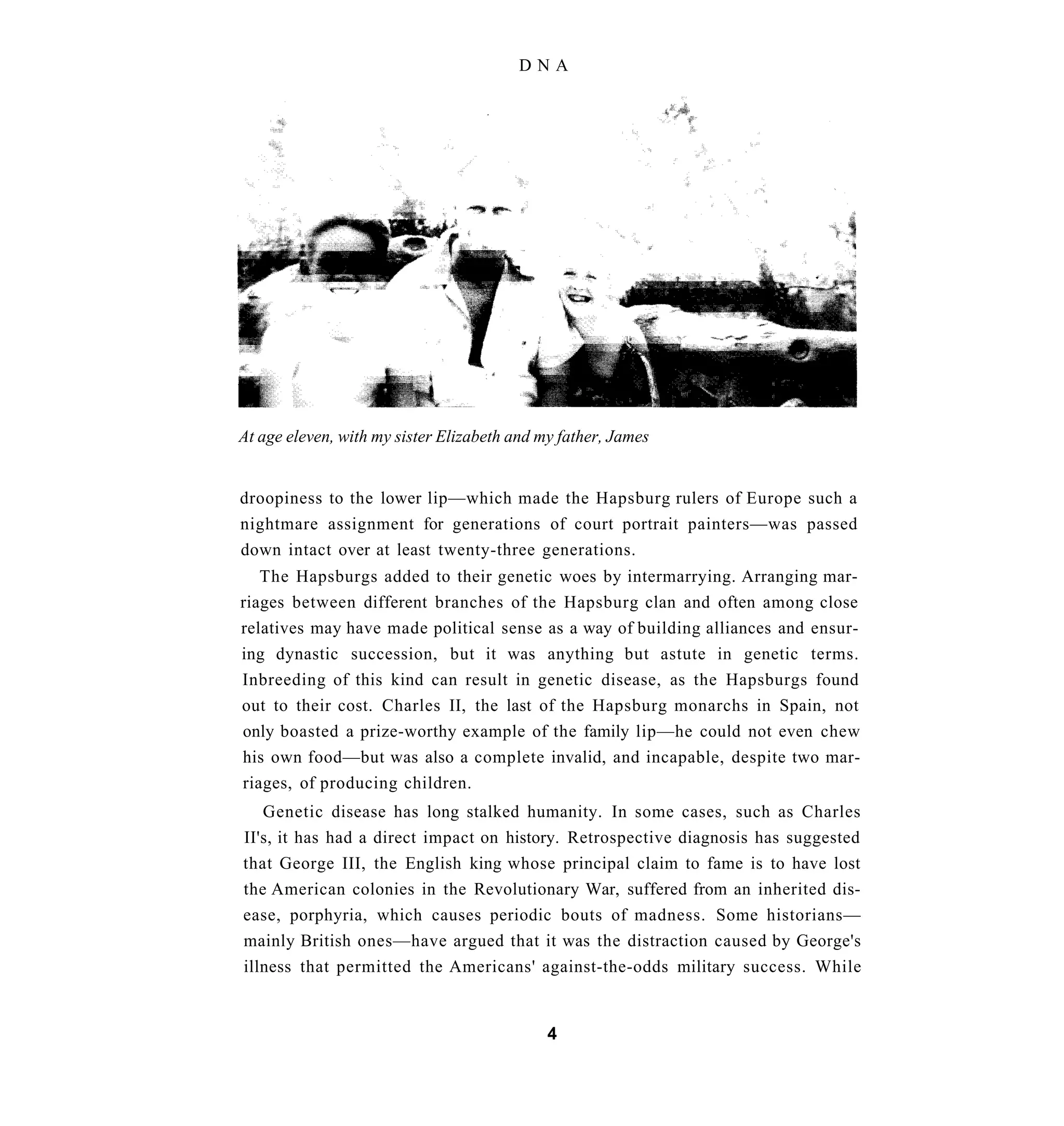
At age eleven, with my sister Elizabeth and my father, James


droopiness to the lower lip—which made the Hapsburg rulers of Europe such a
nightmare assignment for generations of court portrait painters—was passed
down intact over at least twenty-three generations.
   The Hapsburgs added to their genetic woes by intermarrying. Arranging mar-
riages between different branches of the Hapsburg clan and often among close
relatives may have made political sense as a way of building alliances and ensur-
ing dynastic succession, but it was anything but astute in genetic terms.
Inbreeding of this kind can result in genetic disease, as the Hapsburgs found
out to their cost. Charles II, the last of the Hapsburg monarchs in Spain, not
only boasted a prize-worthy example of the family lip—he could not even chew
his own food—but was also a complete invalid, and incapable, despite two mar-
riages, of producing children.
   Genetic disease has long stalked humanity. In some cases, such as Charles
II's, it has had a direct impact on history. Retrospective diagnosis has suggested
that George III, the English king whose principal claim to fame is to have lost
the American colonies in the Revolutionary War, suffered from an inherited dis-
ease, porphyria, which causes periodic bouts of madness. Some historians—
mainly British ones—have argued that it was the distraction caused by George's
illness that permitted the Americans' against-the-odds military success. While


                                             4
Beginnings    of Genetics

most hereditary diseases have no such geopolitical impact, they nevertheless
have brutal and often tragic consequences for the afflicted families, sometimes
for many generations. Understanding genetics is not just about understanding
why we look like our parents. It is also about coming to grips with some of
humankind's oldest enemies: the flaws in our genes that cause genetic disease.


       Our ancestors must have wondered about the workings of heredity as soon
       as evolution endowed them with brains capable of formulating the right
kind of question. And the readily observable principle that close relatives tend
to be similar can carry you a long way if, like our ancestors, your concern with
the application of genetics is limited to practical matters like improving domes-
ticated animals (for, say, milk yield in cattle) and plants (for, say, the size of
fruit). Generations of careful selection—breeding initially to domesticate
appropriate species, and then breeding only from the most productive cows and
from the trees with the largest fruit—resulted in animals and plants tailor-made
for human purposes. Underlying this enormous unrecorded effort is that simple
rule of thumb: that the most productive cows will produce highly productive
offspring and from the seeds of trees with large fruit large-fruited trees will
grow. Thus, despite the extraordinary advances of the past hundred years or so,
the twentieth and twenty-first centuries by no means have a monopoly on
genetic insight. Although it wasn't until 1909 that the British biologist William
Bateson gave the science of inheritance a name, genetics, and although the
DNA revolution has opened up new and extraordinary vistas of potential
progress, in fact the single greatest application of genetics to human well-being
was carried out eons ago by anonymous ancient farmers. Almost everything we
eat—cereals, fruit, meat, dairy products—is the legacy of that earliest and most
far-reaching application of genetic manipulations to human problems.
   An understanding of the actual mechanics of genetics proved a tougher nut
to crack. Gregor Mendel (1822—1884) published his famous paper on the sub-
ject in 1866 (and it was ignored by the scientific community for another thirty-
four years). Why did it take so long? After all, heredity is a major aspect of the
natural world, and, more important, it is readily, and universally, observable: a
dog owner sees how a cross between a brown and black dog turns out, and all
DNA

parents consciously or subconsciously track the appearance of their own char-
acteristics in their children. One simple reason is that genetic mechanisms turn
out to be complicated. Mendel's solution to the problem is not intuitively obvi-
ous: children are not, after all, simply a blend of their parents' characteristics.
Perhaps most important was the failure by early biologists to distinguish
between two fundamentally different processes, heredity and development.
Today we understand that a fertilized egg contains the genetic information, con-
tributed by both parents, that determines whether someone will be afflicted
with, say, porphyria. That is heredity. The subsequent process, the development
of a new individual from that humble starting point of a single cell, the fertilized
egg, involves implementing that information. Broken down in terms of aca-
demic disciplines, genetics focuses on the information and developmental biol-
ogy focuses on the use of that information. Lumping heredity and development
together into a single phenomenon, early scientists never asked the questions
that might have steered them toward the secret of heredity. Nevertheless, the
effort had been under way in some form since the dawn of Western history.
   The Greeks, including Hippocrates, pondered heredity. They devised a the-
ory of "pangenesis," which claimed that sex involved the transfer of miniatur-
ized body parts: "Hairs, nails, veins, arteries, tendons and their bones, albeit
invisible as their particles are so small. While growing, they gradually separate
from each other." This idea enjoyed a brief renaissance when Charles Darwin,
desperate to support his theory of evolution by natural selection with a viable
hypothesis of inheritance, put forward a modified version of pangenesis in the
second half of the nineteenth century. In Darwin's scheme, each organ—eyes,
kidneys, bones—contributed circulating "gemmules" that accumulated in the
sex organs, and were ultimately exchanged in the course of sexual reproduction.
Because these gemmules were produced throughout an organism's lifetime,
Darwin argued any change that occurred in the individual after birth, like the
stretch of a giraffe's neck imparted by craning for the highest foliage, could be
passed on to the next generation. Ironically, then, to buttress his theory of natu-
ral selection Darwin came to champion aspects of Jean-Baptiste Lamarck's the-
ory of inheritance of acquired characteristics—the very theory that his
evolutionary ideas did so much to discredit. Darwin was invoking only
Lamarck's theory of inheritance; he continued to believe that natural selection


                                         6
Beginnings    of Genetics

was the driving force behind evolution, but supposed that natural selection
operated on the variation produced by pangenesis. Had Darwin known about
Mendel's work (although Mendel published his results shortly after The
Origin of Species appeared, Darwin was never aware of them), he might have
been spared the embarrassment of this late-career endorsement of some of
Lamarck's ideas.
  Whereas pangenesis supposed that embryos were assembled from a set of
minuscule components, another approach, "preformationism," avoided the
assembly step altogether: either the egg or the sperm (exactly which was a con-
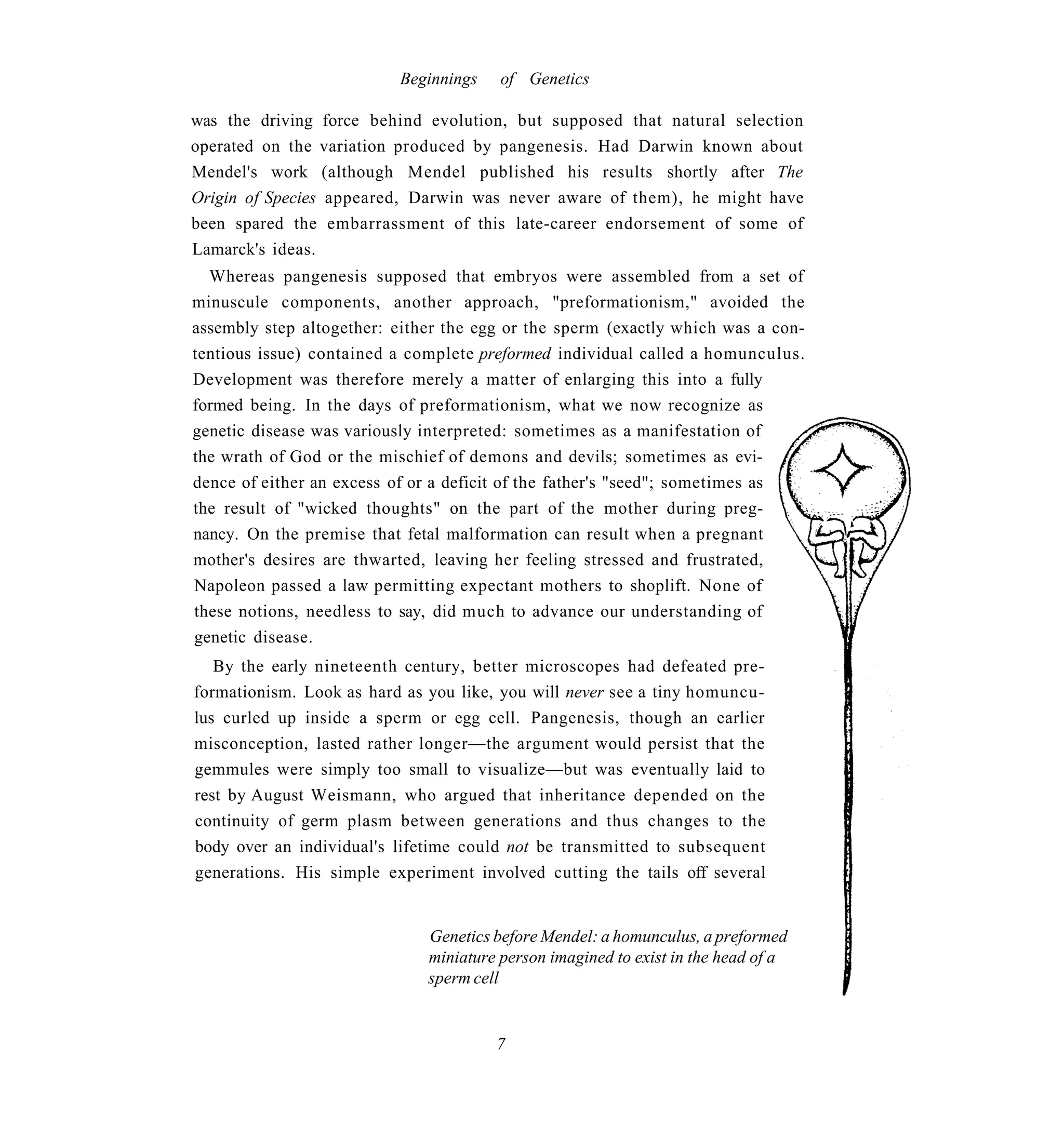
tentious issue) contained a complete preformed individual called a homunculus.
Development was therefore merely a matter of enlarging this into a fully
formed being. In the days of preformationism, what we now recognize as
genetic disease was variously interpreted: sometimes as a manifestation of
the wrath of God or the mischief of demons and devils; sometimes as evi-
dence of either an excess of or a deficit of the father's "seed"; sometimes as
the result of "wicked thoughts" on the part of the mother during preg-
nancy. On the premise that fetal malformation can result when a pregnant
mother's desires are thwarted, leaving her feeling stressed and frustrated,
Napoleon passed a law permitting expectant mothers to shoplift. None of
these notions, needless to say, did much to advance our understanding of
genetic disease.
   By the early nineteenth century, better microscopes had defeated pre-
formationism. Look as hard as you like, you will never see a tiny homuncu-
lus curled up inside a sperm or egg cell. Pangenesis, though an earlier
misconception, lasted rather longer—the argument would persist that the
gemmules were simply too small to visualize—but was eventually laid to
rest by August Weismann, who argued that inheritance depended on the
continuity of germ plasm between generations and thus changes to the
body over an individual's lifetime could not be transmitted to subsequent
generations. His simple experiment involved cutting the tails off several


                              Genetics before Mendel: a homunculus, a preformed
                              miniature person imagined to exist in the head of a
                              sperm cell


                                       7
DNA

generations of mice. According to Darwin's pangenesis, tailless mice would pro-
duce gemmules signifying "no tail" and so their offspring should develop a
severely stunted hind appendage or none at all. When Weismann showed that
the tail kept appearing after many generations of amputees, pangenesis bit
the dust.


G     regor Mendel was the one who got it right. By any standards, however, he
      was an unlikely candidate for scientific superstardom. Born to a farming
family in what is now the Czech Republic, he excelled at the village school and,
at twenty-one, entered the Augustinian monastery at Brunn. After proving a dis-
aster as a parish priest—his response to the ministry was a nervous break-
down—he tried his hand at teaching. By all accounts he was a good teacher, but
in order to qualify to teach a full range of subjects, he had to take an exam. He
failed it. Mendel's father superior, Abbot Napp, then dispatched him to the
University of Vienna, where he was to bone up full-time for the retesting.
Despite apparently doing well in physics at Vienna, Mendel again failed the
exam, and so never rose above the rank of substitute teacher.
   Around 1856, at Abbot Napp's suggestion, Mendel undertook some scientific
experiments on heredity. He chose to study a number of characteristics of the
pea plants he grew in his own patch of the monastery garden. In 1865 he pre-
sented his results to the local natural history society in two lectures, and, a year
later, published them in the society's journal. The work was a tour de force: the
experiments were brilliantly designed and painstakingly executed, and his
analysis of the results was insightful and deft. It seems that his training in
physics contributed to his breakthrough because, unlike other biologists of that
time, he approached the problem quantitatively. Rather than simply noting that
crossbreeding of red and white flowers resulted in some red and some white off-
spring, Mendel actually counted them, realizing that the ratios of red to white
progeny might be significant—as indeed they are. Despite sending copies of his
article to various prominent scientists, Mendel found himself completely
ignored by the scientific community. His attempt to draw attention to his
results merely backfired. He wrote to his one contact among the ranking scien-
tists of the day, botanist Karl Nageli in Munich, asking him to replicate the


                                         8
Beginnings   of Genetics

experiments, and he duly sent off 140 carefully labeled packets of seeds. He
should not have bothered. Nageli believed that the obscure monk should be of
service to him, rather than the other way around, so he sent Mendel seeds of his
own favorite plant, hawkweed, challenging the monk to re-create his results
with a different species. Sad to say, for various reasons, hawkweed is not well-
suited to breeding experiments such as those Mendel had performed on the
peas. The entire exercise was a waste of his time.
   Mendel's low-profile existence as monk-teacher-researcher ended abruptly in
1868 when, on Napp's death, he was elected abbot of the monastery Although
he continued his research—increasingly on bees and the weather—administra-
tive duties were a burden, especially as the monastery became embroiled in a
messy dispute over back taxes. Other factors, too, hampered him as a scientist.
Portliness eventually curtailed his fieldwork: as he wrote, hill climbing had
become "very difficult for me in a world where universal gravitation prevails."
His doctors prescribed tobacco to keep his weight in check, and he obliged
them by smoking twenty cigars a day, as many as Winston Churchill. It was not
his lungs, however, that let him down: in 1884, at the age of sixty-one, Mendel
succumbed to a combination of heart and kidney disease.
   Not only were Mendel's results buried in an obscure journal, but they would
have been unintelligible to most scientists of the era. He was far ahead of his
time with his combination of careful experiment and sophisticated quantitative
analysis. Little wonder, perhaps, that it was not until 1900 that the scientific
community caught up with him. The rediscovery of Mendel's work, by three
plant geneticists interested in similar problems, provoked a revolution in biol-
ogy. At last the scientific world was ready for the monk's peas.


M      endel realized that there are specific factors—later to be called
       "genes"—that are passed from parent to offspring. He worked out that
these factors come in pairs and that the offspring receives one from each
parent.
   Noticing that peas came in two distinct colors, green and yellow, he deduced
that there were two versions of the pea-color gene. A pea has to have two copies
of the G version if it is to become green, in which case we say that it is GG for


                                        9
DNA

the pea-color gene. It must therefore have received a G pea-color gene from
both of its parents. However, yellow peas can result both from YY and YG com-
binations. Having only one copy of the Y version is sufficient to produce yellow
peas. Y trumps G. Because in the YG case the Y signal dominates the G signal,
we call Y "dominant." The subordinate G version of the pea-color gene is called
"recessive."
   Each parent pea plant has two copies of the pea-color gene, yet it contributes
only one copy to each offspring; the other copy is furnished by the other parent.
In plants, pollen grains contain sperm cells—the male contribution to the next
generation—and each sperm cell contains just one copy of the pea-color gene.
A parent pea plant with a YG combination will produce sperm that contain
either a Y version or a G one. Mendel discovered that the process is random: 50
percent of the sperm produced by that plant will have a Y and 50 percent will
have a G.
   Suddenly many of the mysteries of heredity made sense. Characteristics, like
the Hapsburg Lip, that are transmitted with a high probability (actually 50 per-
cent) from generation to generation are dominant. Other characteristics that
appear in family trees much more sporadically, often skipping generations, may
be recessive. When a gene is recessive an individual has to have two copies of it
for the corresponding trait to be expressed. Those with one copy of the gene are
carriers: they don't themselves exhibit the characteristic, but they can pass the
gene on. Albinism, in which the body fails to produce pigment so the skin and
hair are strikingly white, is an example of a recessive characteristic that is trans-
mitted in this way. Therefore, to be albino you have to have two copies of the
gene, one from each parent. (This was the case with the Reverend Dr. William
Archibald Spooner, who was also—perhaps only by coincidence—prone to a
peculiar form of linguistic confusion whereby, for example, "a well-oiled bicy-
cle" might become "a well-boiled icicle." Such reversals would come to be
termed "spoonerisms" in his honor.) Your parents, meanwhile, may have shown
no sign of the gene at all. If, as is often the case, each has only one copy, then
they are both carriers. The trait has skipped at least one generation.
   Mendel's results implied that things—material objects—were transmitted
from generation to generation. But what was the nature of these things?
   At about the time of Mendel's death in 1884, scientists using ever-improving


                                         10
Beginnings    of Genetics
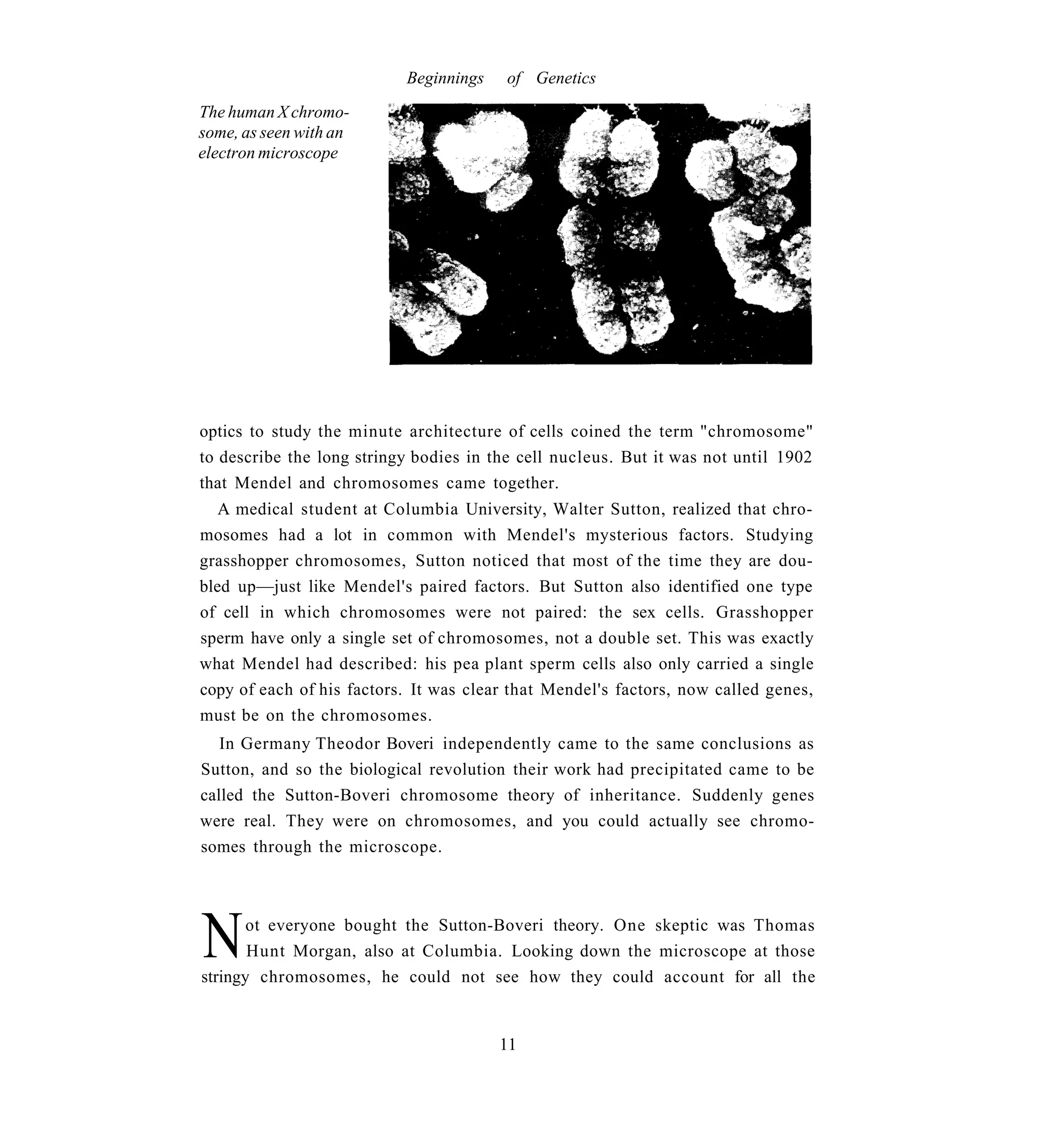
The human X chromo-
some, as seen with an
electron microscope


optics to study the minute architecture of cells coined the term "chromosome"
to describe the long stringy bodies in the cell nucleus. But it was not until 1902
that Mendel and chromosomes came together.
   A medical student at Columbia University, Walter Sutton, realized that chro-
mosomes had a lot in common with Mendel's mysterious factors. Studying
grasshopper chromosomes, Sutton noticed that most of the time they are dou-
bled up—just like Mendel's paired factors. But Sutton also identified one type
of cell in which chromosomes were not paired: the sex cells. Grasshopper
sperm have only a single set of chromosomes, not a double set. This was exactly
what Mendel had described: his pea plant sperm cells also only carried a single
copy of each of his factors. It was clear that Mendel's factors, now called genes,
must be on the chromosomes.
   In Germany Theodor Boveri independently came to the same conclusions as
Sutton, and so the biological revolution their work had precipitated came to be
called the Sutton-Boveri chromosome theory of inheritance. Suddenly genes
were real. They were on chromosomes, and you could actually see chromo-
somes through the microscope.


N      ot everyone bought the Sutton-Boveri theory. One skeptic was Thomas
       Hunt Morgan, also at Columbia. Looking down the microscope at those
stringy chromosomes, he could not see how they could account for all the


                                        11
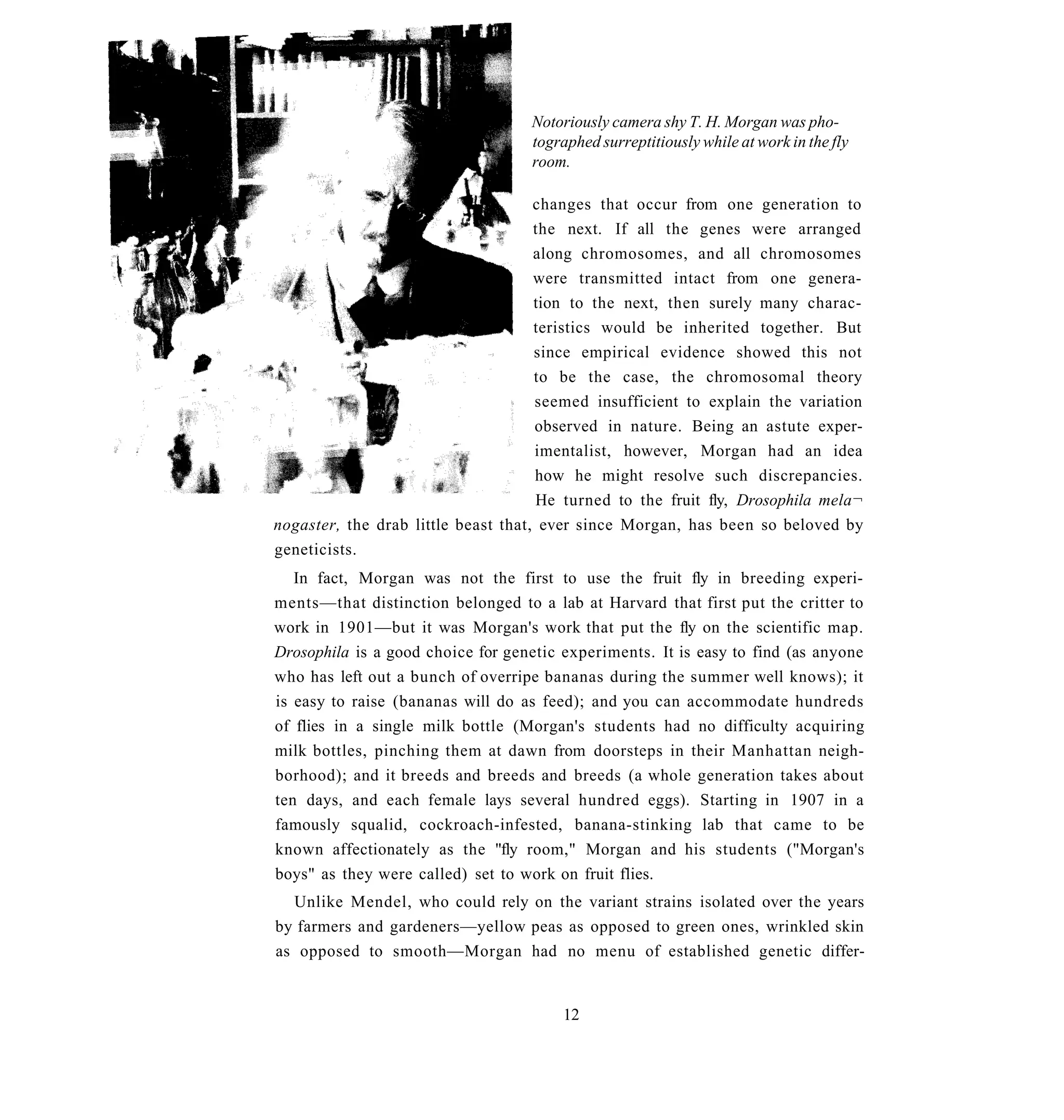
Notoriously camera shy T. H. Morgan was pho-
                                   tographed surreptitiously while at work in the fly
                                   room.

                                     changes that occur from one generation to
                                     the next. If all the genes were arranged
                                     along chromosomes, and all chromosomes
                                     were transmitted intact from one genera-
                                     tion to the next, then surely many charac-
                                     teristics would be inherited together. But
                                     since empirical evidence showed this not
                                     to be the case, the chromosomal theory
                                     seemed insufficient to explain the variation
                                     observed in nature. Being an astute exper-
                                     imentalist, however, Morgan had an idea
                                     how he might resolve such discrepancies.
                                     He turned to the fruit fly, Drosophila mela¬
nogaster, the drab little beast that, ever since Morgan, has been so beloved by
geneticists.
   In fact, Morgan was not the first to use the fruit fly in breeding experi-
ments—that distinction belonged to a lab at Harvard that first put the critter to
work in 1901—but it was Morgan's work that put the fly on the scientific map.
Drosophila is a good choice for genetic experiments. It is easy to find (as anyone
who has left out a bunch of overripe bananas during the summer well knows); it
is easy to raise (bananas will do as feed); and you can accommodate hundreds
of flies in a single milk bottle (Morgan's students had no difficulty acquiring
milk bottles, pinching them at dawn from doorsteps in their Manhattan neigh-
borhood); and it breeds and breeds and breeds (a whole generation takes about
ten days, and each female lays several hundred eggs). Starting in 1907 in a
famously squalid, cockroach-infested, banana-stinking lab that came to be
known affectionately as the "fly room," Morgan and his students ("Morgan's
boys" as they were called) set to work on fruit flies.
  Unlike Mendel, who could rely on the variant strains isolated over the years
by farmers and gardeners—yellow peas as opposed to green ones, wrinkled skin
as opposed to smooth—Morgan had no menu of established genetic differ-


                                        12
Beginnings    of Genetics

ences in the fruit fly to draw upon. And you cannot do genetics until you have
isolated some distinct characteristics to track through the generations. Mor-
gan's first goal therefore was to find "mutants," the fruit fly equivalents of yellow
    or wrinkled peas. He was looking for genetic novelties, random variations
         that somehow simply appeared in the population.
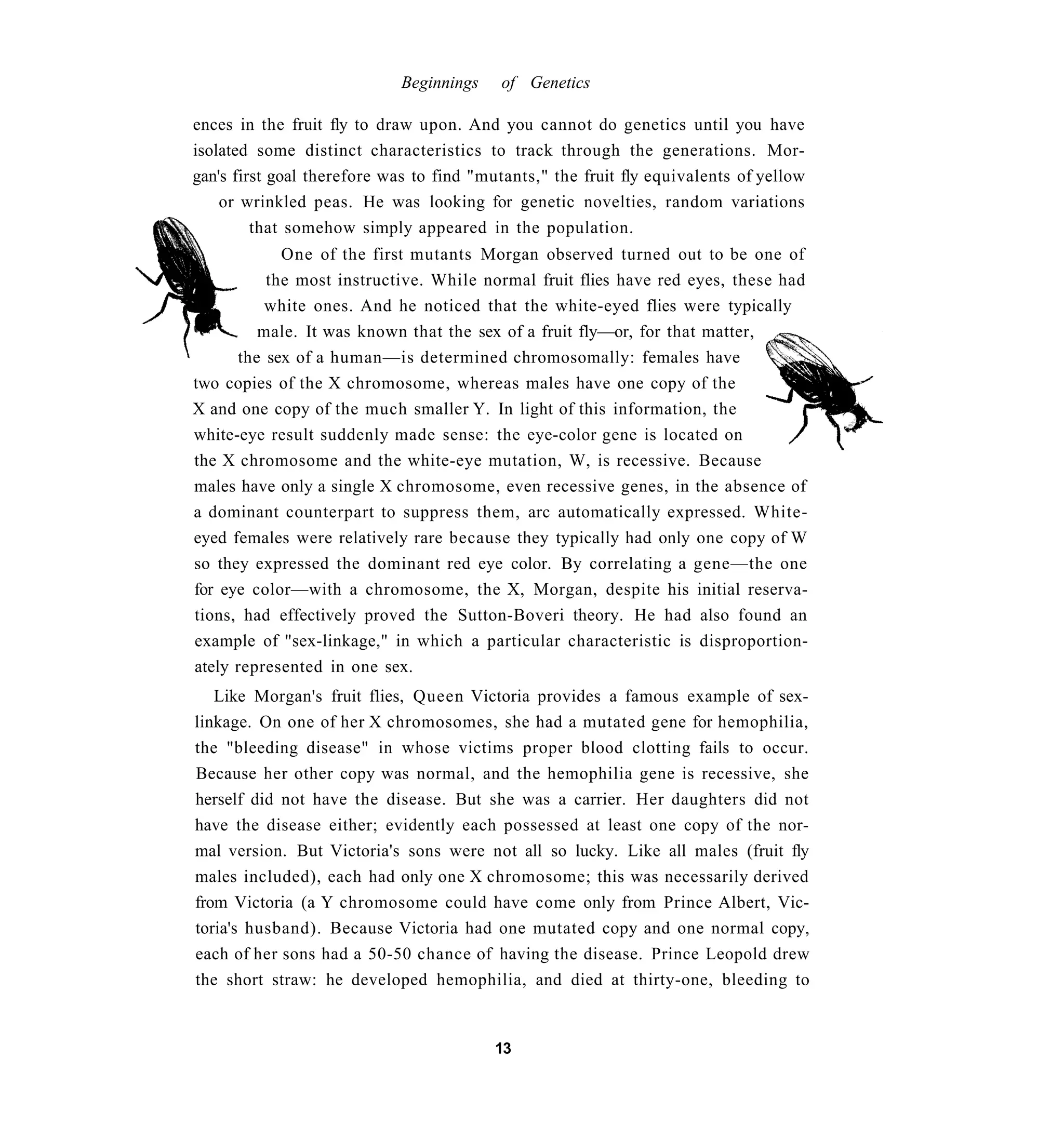
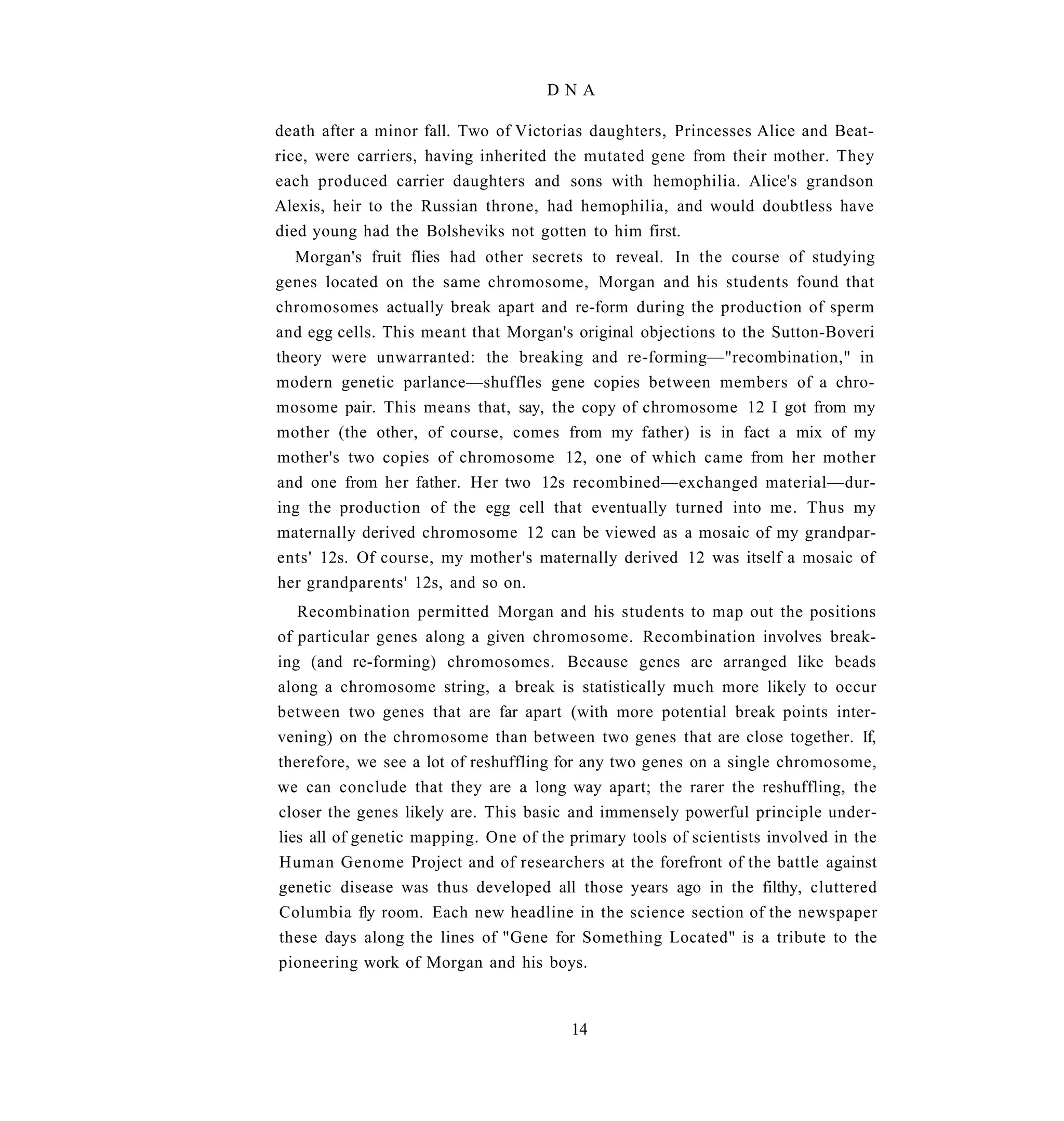
            One of the first mutants Morgan observed turned out to be one of
          the most instructive. While normal fruit flies have red eyes, these had
          white ones. And he noticed that the white-eyed flies were typically
         male. It was known that the sex of a fruit fly—or, for that matter,
      the sex of a human—is determined chromosomally: females have
two copies of the X chromosome, whereas males have one copy of the
X and one copy of the much smaller Y. In light of this information, the
white-eye result suddenly made sense: the eye-color gene is located on
the X chromosome and the white-eye mutation, W, is recessive. Because
males have only a single X chromosome, even recessive genes, in the absence of
a dominant counterpart to suppress them, arc automatically expressed. White-
eyed females were relatively rare because they typically had only one copy of W
so they expressed the dominant red eye color. By correlating a gene—the one
for eye color—with a chromosome, the X, Morgan, despite his initial reserva-
tions, had effectively proved the Sutton-Boveri theory. He had also found an
example of "sex-linkage," in which a particular characteristic is disproportion-
ately represented in one sex.
   Like Morgan's fruit flies, Queen Victoria provides a famous example of sex-
linkage. On one of her X chromosomes, she had a mutated gene for hemophilia,
the "bleeding disease" in whose victims proper blood clotting fails to occur.
Because her other copy was normal, and the hemophilia gene is recessive, she
herself did not have the disease. But she was a carrier. Her daughters did not
have the disease either; evidently each possessed at least one copy of the nor-
mal version. But Victoria's sons were not all so lucky. Like all males (fruit fly
males included), each had only one X chromosome; this was necessarily derived
from Victoria (a Y chromosome could have come only from Prince Albert, Vic-
toria's husband). Because Victoria had one mutated copy and one normal copy,
each of her sons had a 50-50 chance of having the disease. Prince Leopold drew
the short straw: he developed hemophilia, and died at thirty-one, bleeding to


                                         13
DNA

death after a minor fall. Two of Victorias daughters, Princesses Alice and Beat-
rice, were carriers, having inherited the mutated gene from their mother. They
each produced carrier daughters and sons with hemophilia. Alice's grandson
Alexis, heir to the Russian throne, had hemophilia, and would doubtless have
died young had the Bolsheviks not gotten to him first.
   Morgan's fruit flies had other secrets to reveal. In the course of studying
genes located on the same chromosome, Morgan and his students found that
chromosomes actually break apart and re-form during the production of sperm
and egg cells. This meant that Morgan's original objections to the Sutton-Boveri
theory were unwarranted: the breaking and re-forming—"recombination," in
modern genetic parlance—shuffles gene copies between members of a chro-
mosome pair. This means that, say, the copy of chromosome 12 I got from my
mother (the other, of course, comes from my father) is in fact a mix of my
mother's two copies of chromosome 12, one of which came from her mother
and one from her father. Her two 12s recombined—exchanged material—dur-
ing the production of the egg cell that eventually turned into me. Thus my
maternally derived chromosome 12 can be viewed as a mosaic of my grandpar-
ents' 12s. Of course, my mother's maternally derived 12 was itself a mosaic of
her grandparents' 12s, and so on.
   Recombination permitted Morgan and his students to map out the positions
of particular genes along a given chromosome. Recombination involves break-
ing (and re-forming) chromosomes. Because genes are arranged like beads
along a chromosome string, a break is statistically much more likely to occur
between two genes that are far apart (with more potential break points inter-
vening) on the chromosome than between two genes that are close together. If,
therefore, we see a lot of reshuffling for any two genes on a single chromosome,
we can conclude that they are a long way apart; the rarer the reshuffling, the
closer the genes likely are. This basic and immensely powerful principle under-
lies all of genetic mapping. One of the primary tools of scientists involved in the
Human Genome Project and of researchers at the forefront of the battle against
genetic disease was thus developed all those years ago in the filthy, cluttered
Columbia fly room. Each new headline in the science section of the newspaper
these days along the lines of "Gene for Something Located" is a tribute to the
pioneering work of Morgan and his boys.


                                        14
Beginnings    of Genetics


T     he rediscovery of Mendel's work, and the breakthroughs that followed it,
      sparked a surge of interest in the social significance of genetics. While
scientists had been grappling with the precise mechanisms of heredity through
the eighteenth and nineteenth centuries, public concern had been mounting
about the burden placed on society by what came to be called the "degenerate
classes"—the inhabitants of poorhouses, workhouses, and insane asylums.
What could be done with these people? It remained a matter of controversy
whether they should be treated charitably—which, the less charitably inclined
claimed, ensured such folk would never exert themselves and would therefore
remain forever dependent on the largesse of the state or of private institu-
tions,—or whether they should be simply ignored, which, according to. the char-
itably inclined, would result only in perpetuating the inability of the
unfortunate to extricate themselves from their blighted circumstances.
   The publication of Darwin's Origin of Species in 1859 brought these issues
into sharp focus. Although Darwin carefully omitted to mention human evolu-
tion, fearing that to do so would only further inflame an already raging contro-
versy, it required no great leap of imagination to apply his idea of natural
selection to humans. Natural selection is the force that determines the fate of
all genetic variations in nature—mutations like the one Morgan found in the
fruit fly eye-color gene, but also perhaps differences in the abilities of human
individuals to fend for themselves.
   Natural populations have an enormous reproductive potential. Take fruit
flies, with their generation time of just ten days, and females that produce some
three hundred eggs apiece (half of which will be female): starting with a single
fruit fly couple, after a month (i.e., three generations later), you will have 150 X
 150 X 1 50 fruit flies on your hands—that's more than 3 million flies, all of them
derived from just one pair in just one month. Darwin made the point by choos-
ing a species from the other end of the reproductive spectrum:


  The elephant is reckoned to be the slowest breeder of all known animals,
  and I have taken some pains to estimate its probable minimum rate of nat-
  ural increase: it will be under the mark to assume that it breeds when thirty
  years old, and goes on breeding till ninety years old, bringing forth three


                                        15
DNA

  pairs of young in this interval; if this be so, at the end of the fifth century
  there would be alive fifteen million elephants, descended from the first pair.


   All these calculations assume that all the baby fruit flies and all the baby ele-
phants make it successfully to adulthood. In theory, therefore, there must be an
infinitely large supply of food and water to sustain this kind of reproductive
overdrive. In reality, of course, those resources are limited, and not all baby fruit
flies or baby elephants make it. There is competition among individuals within
a species for those resources. What determines who wins the struggle for access
to the resources? Darwin pointed out genetic variation means that some indi-
viduals have advantages in what he called "the struggle for existence." To take
the famous example of Darwin's finches from the Galapagos Islands, those indi-
viduals with genetic advantages—like the right size of beak for eating the most
abundant seeds—are more likely to survive and reproduce. So the advantageous
genetic variant—having a bill the right size—tends to be passed on to the next
generation. The result is that natural selection enriches the next generation
with the beneficial mutation so that eventually, over enough generations, every
member of the species ends up with that characteristic.
   The Victorians applied the same logic to humans. They looked around and
were alarmed by what they saw. The decent, moral, hardworking middle classes
were being massively outreproduced by the dirty, immoral, lazy lower classes.
The Victorians assumed that the virtues of decency, morality, and hard work ran
in families just as the vices of filth, wantonness, and indolence did. Such char-
acteristics must then be hereditary; thus, to the Victorians, morality and
immorality were merely two of Darwin's genetic variants. And if the great
unwashed were outreproducing the respectable classes, then the "bad" genes
would be increasing in the human population. The species was doomed!
Humans would gradually become more and more depraved as the "immorality"
gene became more and more common.
   Francis Galton had good reason to pay special attention to Darwin's book, as
the author was his cousin and friend. Darwin, some thirteen years older, had
provided guidance during Galton's rather rocky college experience. But it was
The Origin of Species that would inspire Galton to start a social and genetic cru-
sade that would ultimately have disastrous consequences. In 1883, a year after
his cousin's death, Galton gave the movement a name: eugenics.

                                         16
Beginnings   of Genetics


E     ugenics was only one of Galton's many interests; Galton enthusiasts refer
      to him as a polymath, detractors as a dilettante. In fact, he made signifi-
cant contributions to geography, anthropology, psychology, genetics, meteorol-
ogy, statistics, and, by setting fingerprint analysis on a sound scientific footing,
to criminology. Born in 1822 into a prosperous family,
his education—partly in medicine and partly in mathe-
matics—was mostly a chronicle of defeated expecta-
tions. The death of his father when he was twenty-one
simultaneously freed him from paternal restraint and
yielded a handsome inheritance; the young man duly
took advantage of both. After a full six years of being,
what might be described today as a trust-fund dropout,
however, Galton settled down to become a productive
member of the Victorian establishment. He made his
name leading an expedition to a then little known
region of southwest Africa in 1850-52. In his account
of his explorations, we encounter the first instance of
the one strand that connects his many varied interests:
he counted and measured everything. Galton was only
happy when he could reduce a phenomenon to a set of
 numbers.
  At a missionary station he encountered a striking
specimen of steatopygia—a condition of particularly
protuberant buttocks, common among the indigenous A nineteenth-century exaggerated view of a
Nama women of the region—and realized that this Nama woman
woman was naturally endowed with the figure that was
then fashionable in Europe. The only difference was that it required enormous
(and costly) ingenuity on the part of European dressmakers to create the
desired "look" lor their clients.

  I profess to be a scientific man, and was exceedingly anxious to obtain
  accurate measurements of her shape; but there was a difficulty in doing
  this. I did not know a word of Hottentot [the Dutch name for the Nama],
  and could never therefore have explained to the lady what the object of my

                                          17
DNA

  footrule could be; and I really dared not ask my worthy missionary host to
  interpret for me. I therefore felt in a dilemma as I gazed at her form, that
  gift of bounteous nature to this favoured race, which no mantua-maker,
  with all her crinoline and stuffing, can do otherwise than humbly imitate.
  The object of my admiration stood under a tree, and was turning herself
  about to all points of the compass, as ladies who wish to be admired usu-
  ally do. Of a sudden my eye fell upon my sextant; the bright thought
  struck me, and I took a series of observations upon her figure in every
  direction, up and down, crossways, diagonally, and so forth, and 1 regis-
  tered them carefully upon an outline drawing for fear of any mistake; this
  being done, I boldly pulled out my measuring tape, and measured the
  distance from where I was to the place she stood, and having thus
  obtained both base and angles, I worked out the results by trigonometry
  and logarithms.


  Galton's passion for quantification resulted in his developing many of the
fundamental principles of modern statistics. It also yielded some clever obser-
vations. For example, he tested the efficacy of prayer. He figured that if prayer
worked, those most prayed for should be at an advantage; to test the hypothesis
he studied the longevity of British monarchs. Every Sunday, congregations in
the Church of England following the Book of Common Prayer beseeched God to
"Endue the king/queen plenteously with heavenly gifts; Grant him/her in health
and wealth long to live." Surely, Galton reasoned, the cumulative effect of all
those prayers should be beneficial. In fact, prayer seemed ineffectual: he found
that on average the monarchs died somewhat younger than other members of
the British aristocracy.
   Because of the Darwin connection—their common grandfather, Erasmus
Darwin, too was one of the intellectual giants of his day—Galton was especially
sensitive to the way in which certain lineages seemed to spawn disproportion-
ately large numbers of prominent and successful people. In 1869 he published
what would become the underpinning of all his ideas on eugenics, a treatise
called Hereditary Genius: An Inquiry into Its Laws and Consequences. In it he
purported to show that talent, like simple genetic traits such as the Hapsburg
Lip, does indeed run in families; he recounted, for example, how some families


                                       18
Beginnings    of Genetics

had produced generation after generation of judges. His analysis largely ne-
glected to take into account the effect of the environment: the son of a promi-
nent judge is, after all, rather more likely to become a judge—by virtue of his
father's connections, it nothing else—than the son of a peasant farmer. Galton
did not, however, completely overlook the effect of the environment, and it was
he who first referred to the "nature/nurture" dichotomy, possibly in reference to
Shakespeare's irredeemable villain, Caliban, "a devil, a born devil, on whose
nature/Nurture can never stick."
  The results of his analysis, however, left no doubt in Galton's mind.


  I have no patience with the hypothesis occasionally expressed, and often
  implied, especially in tales written to teach children to be good, that babies
  are born pretty much alike, and that the sole agencies in creating differ-
  ences between boy and boy, and man and man, are steady application and
  moral effort. It is in the most unqualified manner that I object to preten-
  sions of natural equality.


  A corollary of his conviction that these traits are genetically determined, he
argued, was that it would be possible to "improve" the human stock by prefer-
entially breeding gifted individuals, and preventing the less gifted from repro-
ducing.


  It is easy . . . to obtain by careful selection a permanent breed of dogs or
  horses gifted with peculiar powers of running, or of doing anything else, so
  it would be quite practicable to produce a highly-gifted race of men by
  judicious marriages during several consecutive generations.


   Galton introduced the terms eugenics (literally "good in birth") to describe
this application of the basic principle of agricultural breeding to humans. In
time, eugenics came to refer to "self-directed human evolution": by making con-
scious choices about who should have children, eugenicists believed that they
could head off the "eugenic crisis" precipitated in the Victorian imagination by
the high rates of reproduction of inferior stock coupled with the typically small
families of the superior middle classes.


                                        19
DNA


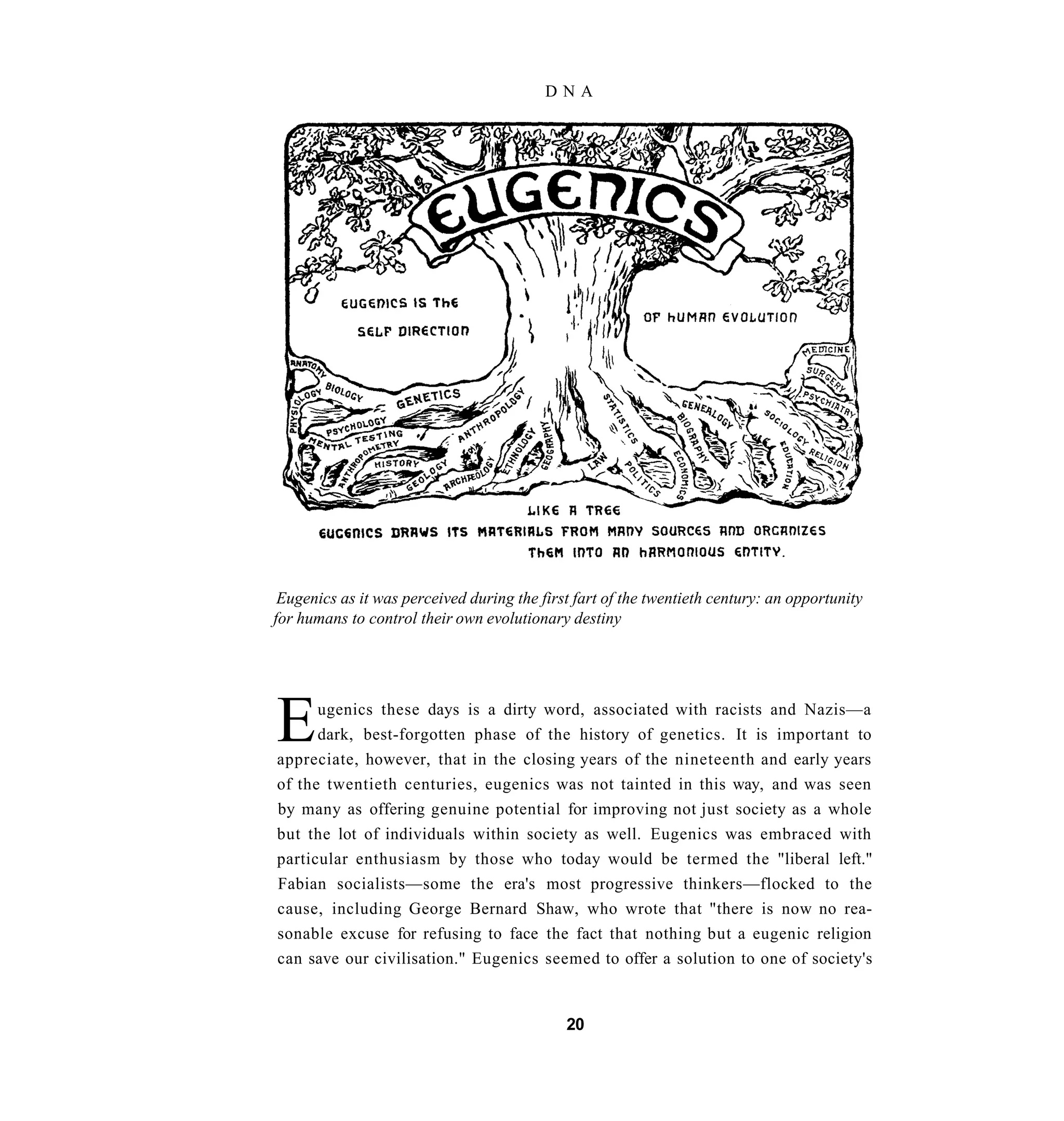
 Eugenics as it was perceived during the first fart of the twentieth century: an opportunity
for humans to control their own evolutionary destiny


E     ugenics these days is a dirty word, associated with racists and Nazis—a
      dark, best-forgotten phase of the history of genetics. It is important to
appreciate, however, that in the closing years of the nineteenth and early years
of the twentieth centuries, eugenics was not tainted in this way, and was seen
by many as offering genuine potential for improving not just society as a whole
but the lot of individuals within society as well. Eugenics was embraced with
particular enthusiasm by those who today would be termed the "liberal left."
Fabian socialists—some the era's most progressive thinkers—flocked to the
cause, including George Bernard Shaw, who wrote that "there is now no rea-
sonable excuse for refusing to face the fact that nothing but a eugenic religion
can save our civilisation." Eugenics seemed to offer a solution to one of society's


                                             20
Beginnings    of Genetics

most persistent woes: that segment of the population that is incapable of exist-
ing outside an institution.
   Whereas Galton had preached what came to be known as "positive eugen-
ics," encouraging genetically superior people to have children, the American
eugenics movement preferred to focus on "negative eugenics," preventing
genetically inferior people from doing so. The goals of each program were basi-
cally the same—the improvement of the human genetic stock—but these two
approaches were very different.
   The American focus on getting rid of bad genes, as opposed to increasing fre-
quencies of good ones, stemmed from a few influential family studies of
"degeneration" and "feeblemindedness"—two peculiar terms characteristic of
the American obsession with genetic decline. In 1875 Richard Dugdale pub-
lished his account of the Juke clan of upstate New York. Here, according to
Dugdale, were several generations of seriously bad apples—murderers, alco-
holics, and rapists. Apparently in the area near their home in New York State
the very name "Juke" was a term of reproach.
   Another highly influential study was published in 1912 by Henry Goddard,
the psychologist who gave us the word "moron," on what he called "The Kallikak
Family." This is the story of two family lines originating from a single male
ancestor who had a child out of wedlock (with a "feebleminded" wench he met
in a tavern while serving in the military during the American Revolutionary
War), as well as siring a legitimate family. The illegitimate side of the Kallikak
line, according to Goddard, was bad news indeed, "a race of defective degener-
ates," while the legitimate side comprised respectable, upstanding members of
the community. To Goddard, this "natural experiment in heredity" was an exem-
plary tale of good genes versus bad. This view was reflected in the fictitious
name he chose for the family. "Kallikak" is a hybrid of two Greek words, kalos
(beautiful, of good repute) and kakos (bad).
  "Rigorous" new methods for testing mental performance—the first IQ tests,
which were introduced to the United States from Europe by the same Henry
Goddard—seemed to confirm the general impression that the human species
was gaining downward momentum on a genetic slippery slope. In those early days
of IQ testing, it was thought that high intelligence and an alert mind inevitably
implied a capacity to absorb large quantities of information. Thus how much you


                                        21
DNA

knew was considered a sort of index of your IQ. Following this line of reasoning,
early IQ tests included lots of general knowledge questions. Here are a few
from a standard test administered to U.S. Army recruits during World War I:

         Pick one of four:

         The Wyandotte is a kind of:
         1) horse    2) fowl     3) cattle        4) granite

         The ampere is used in measuring:
         1) wind power 2) electricity 3) water power           4) rainfall

         The number of a Zulu's legs is:
         1) two     2) four    3) six   4) eight

         [Answers are 2, 2, 1]


  Some half of the nation's army recruits flunked the test and were deemed
"feebleminded." These results galvanized the eugenics movement in the United
States: it seemed to concerned Americans that the gene pool really was becom-
ing more and more awash in low-intelligence genes.


S     cientists realized that eugenic policies required some understanding
      of the genetics underlying characteristics like feeblemindedness. With
the rediscovery of Mendel's work, it seemed that this might actually be pos-
sible. The lead in this endeavor was taken on Long Island by one of my prede-
cessors as director of Cold Spring Harbor Laboratory. His name was Charles
Davenport.
   In 1910, with funding from a railroad heiress, Davenport established the
Eugenics Record Office at Cold Spring Harbor. Its mission was to collect basic
information—pedigrees—on the genetics of traits ranging from epilepsy to
criminality It became the nerve center of the American eugenics movement.
Cold Spring Harbor's mission was much the same then as it is now: today we
strive to be at the forefront of genetic research, and Davenport had no less lofty
aspirations—but in those days the forefront was eugenics. However, there is no


                                             22
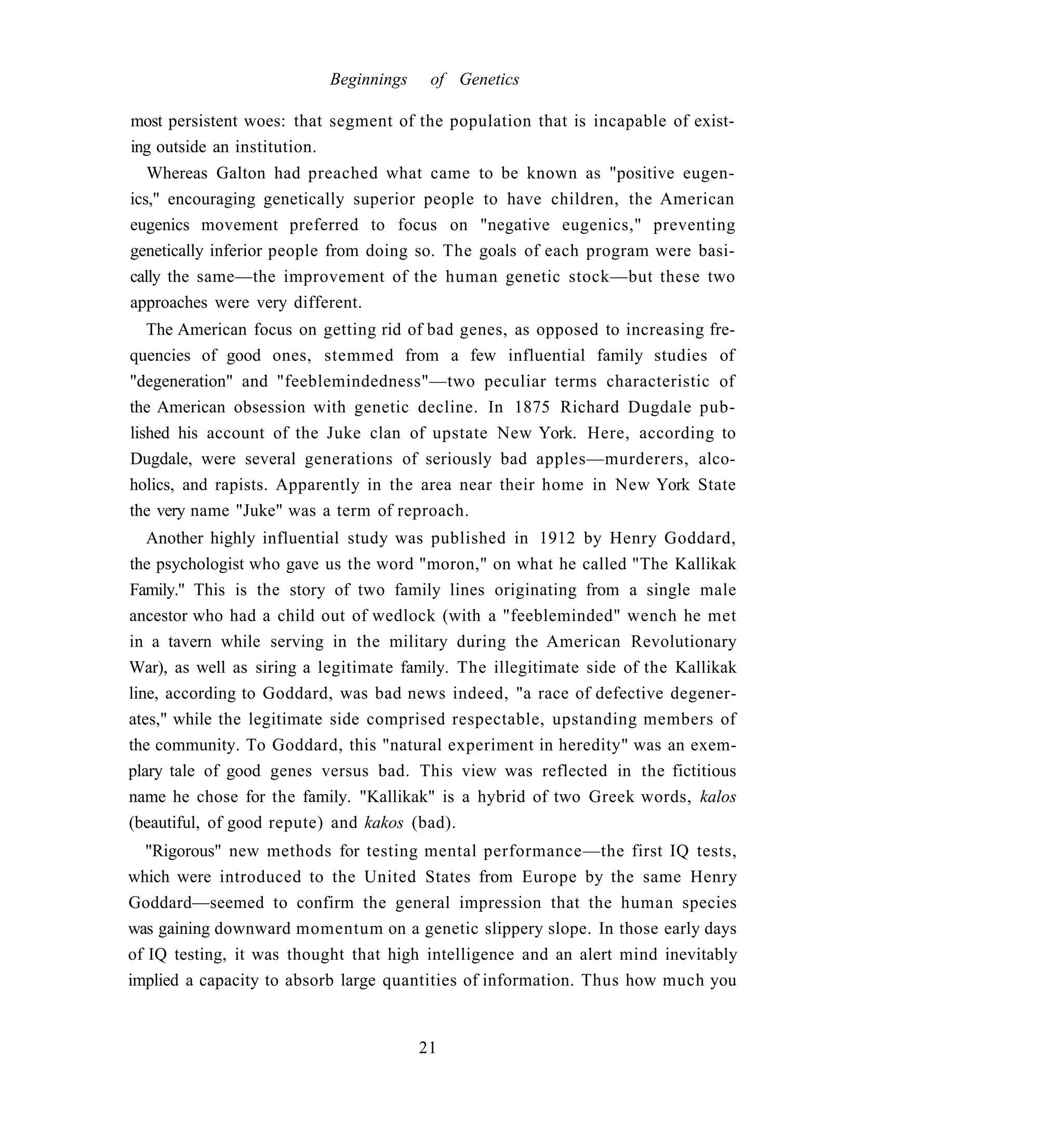
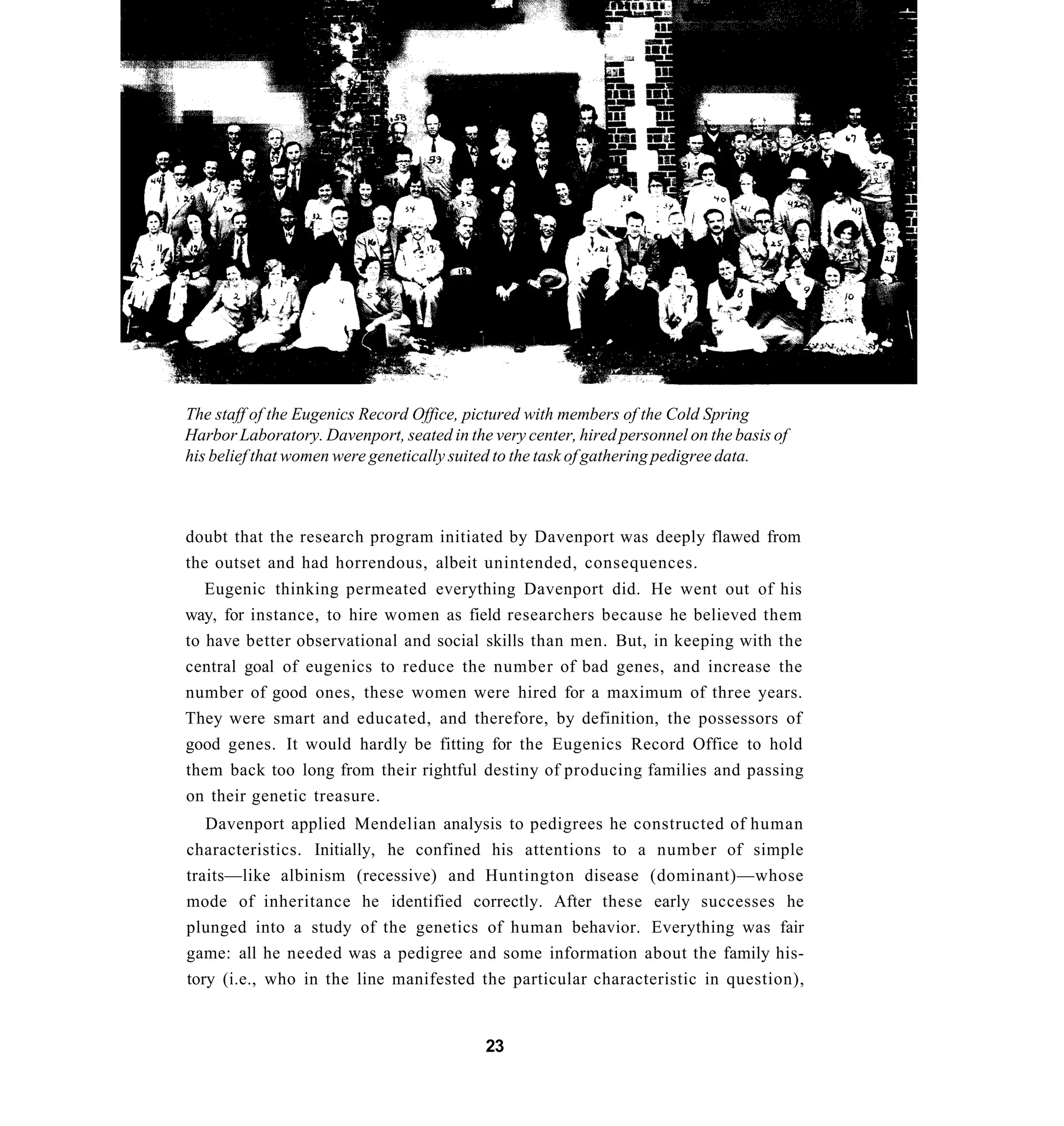
The staff of the Eugenics Record Office, pictured with members of the Cold Spring
Harbor Laboratory. Davenport, seated in the very center, hired personnel on the basis of
his belief that women were genetically suited to the task of gathering pedigree data.


doubt that the research program initiated by Davenport was deeply flawed from
the outset and had horrendous, albeit unintended, consequences.
   Eugenic thinking permeated everything Davenport did. He went out of his
way, for instance, to hire women as field researchers because he believed them
to have better observational and social skills than men. But, in keeping with the
central goal of eugenics to reduce the number of bad genes, and increase the
number of good ones, these women were hired for a maximum of three years.
They were smart and educated, and therefore, by definition, the possessors of
good genes. It would hardly be fitting for the Eugenics Record Office to hold
them back too long from their rightful destiny of producing families and passing
on their genetic treasure.
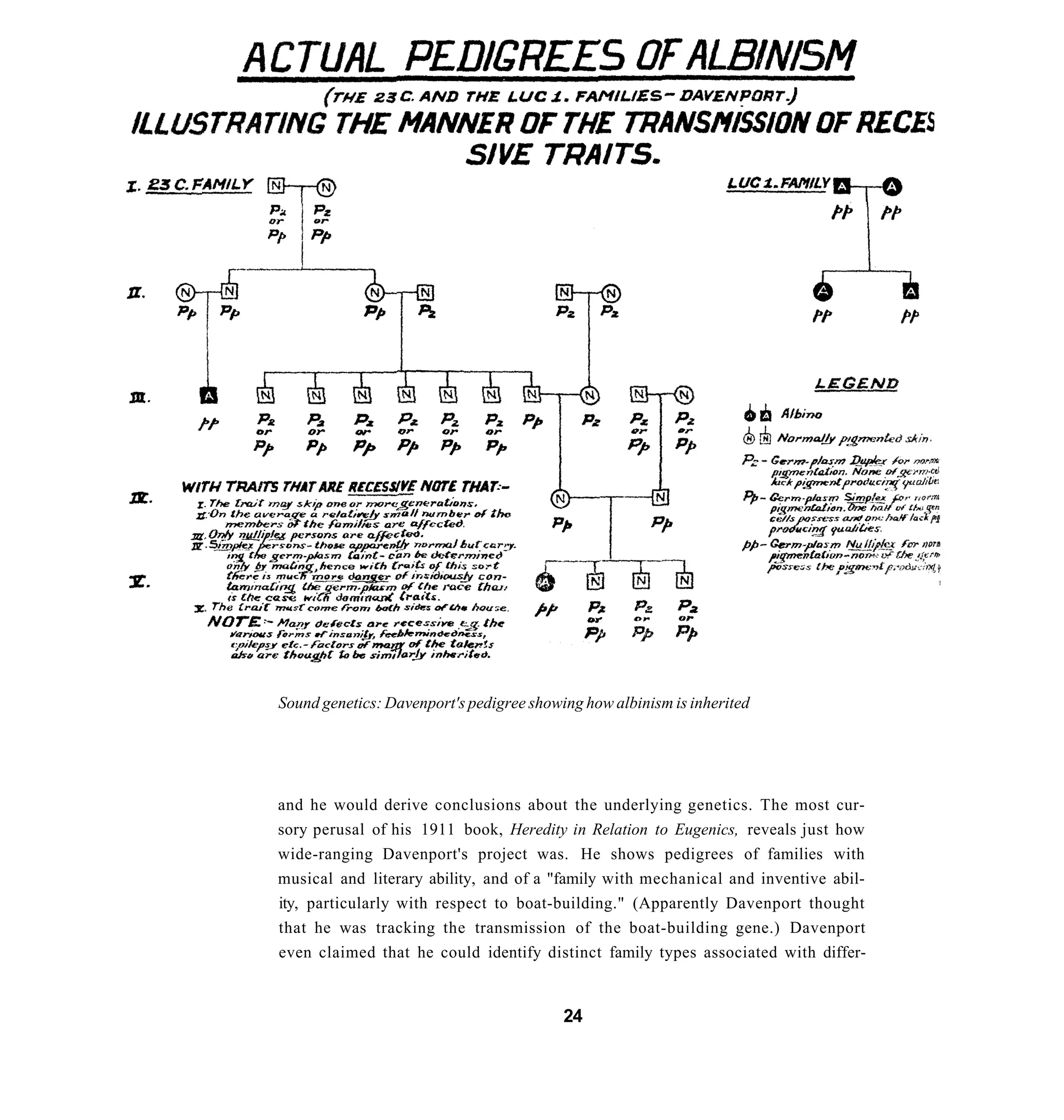
   Davenport applied Mendelian analysis to pedigrees he constructed of human
characteristics. Initially, he confined his attentions to a number of simple
traits—like albinism (recessive) and Huntington disease (dominant)—whose
mode of inheritance he identified correctly. After these early successes he
plunged into a study of the genetics of human behavior. Everything was fair
game: all he needed was a pedigree and some information about the family his-
tory (i.e., who in the line manifested the particular characteristic in question),


                                           23
Sound genetics: Davenport's pedigree showing how albinism is inherited


and he would derive conclusions about the underlying genetics. The most cur-
sory perusal of his 1911 book, Heredity in Relation to Eugenics, reveals just how
wide-ranging Davenport's project was. He shows pedigrees of families with
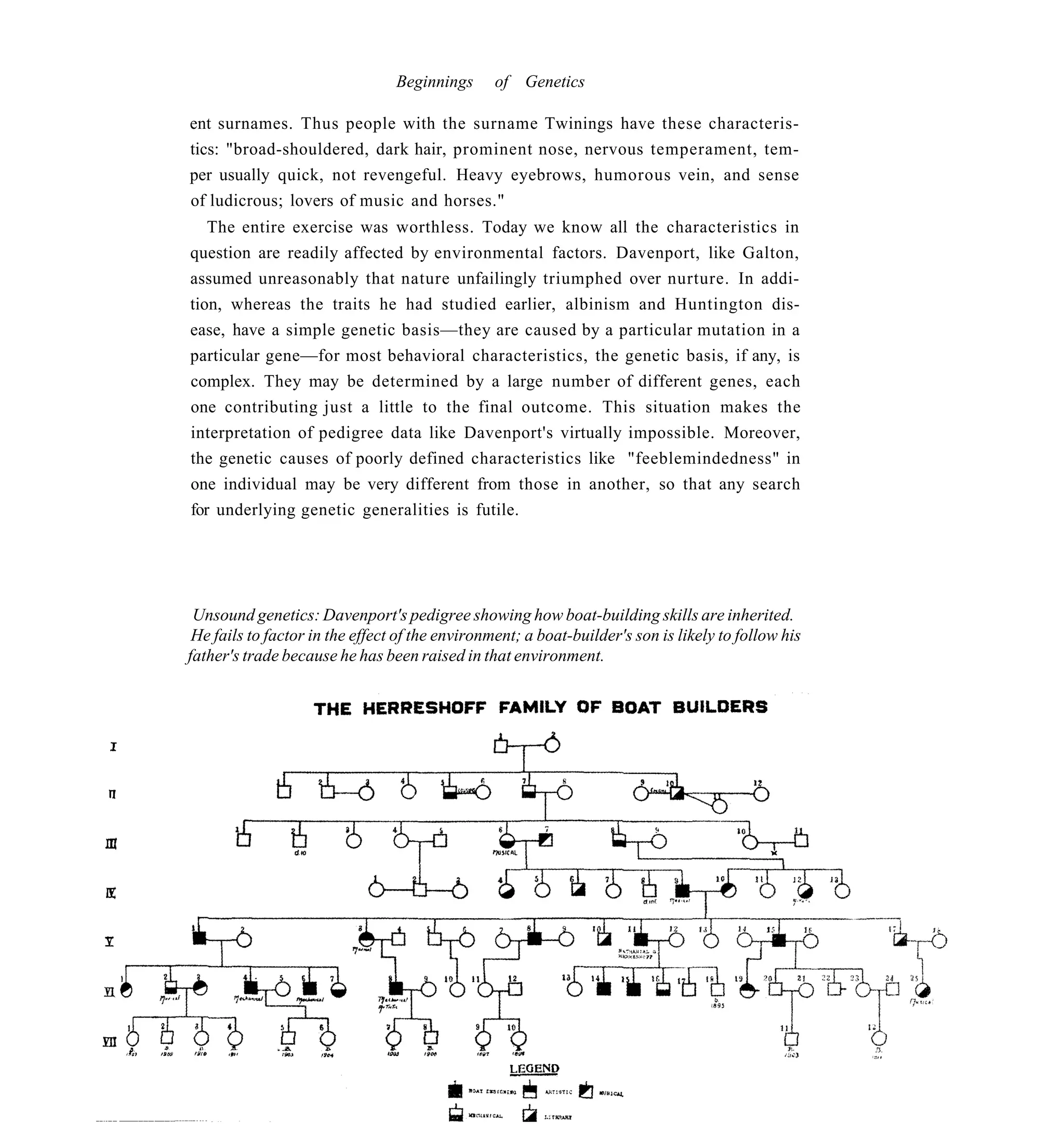
musical and literary ability, and of a "family with mechanical and inventive abil-
ity, particularly with respect to boat-building." (Apparently Davenport thought
that he was tracking the transmission of the boat-building gene.) Davenport
even claimed that he could identify distinct family types associated with differ-


                                          24
Beginnings      of Genetics

ent surnames. Thus people with the surname Twinings have these characteris-
tics: "broad-shouldered, dark hair, prominent nose, nervous temperament, tem-
per usually quick, not revengeful. Heavy eyebrows, humorous vein, and sense
of ludicrous; lovers of music and horses."
   The entire exercise was worthless. Today we know all the characteristics in
question are readily affected by environmental factors. Davenport, like Galton,
assumed unreasonably that nature unfailingly triumphed over nurture. In addi-
tion, whereas the traits he had studied earlier, albinism and Huntington dis-
ease, have a simple genetic basis—they are caused by a particular mutation in a
particular gene—for most behavioral characteristics, the genetic basis, if any, is
complex. They may be determined by a large number of different genes, each
one contributing just a little to the final outcome. This situation makes the
interpretation of pedigree data like Davenport's virtually impossible. Moreover,
the genetic causes of poorly defined characteristics like "feeblemindedness" in
one individual may be very different from those in another, so that any search
for underlying genetic generalities is futile.


 Unsound genetics: Davenport's pedigree showing how boat-building skills are inherited.
 He fails to factor in the effect of the environment; a boat-builder's son is likely to follow his
father's trade because he has been raised in that environment.
DNA


R     egardless of the success or failure of Davenports scientific program, the
      eugenics movement had already developed a momentum of its own. Local
chapters of the Eugenics Society organized competitions at state fairs, giving
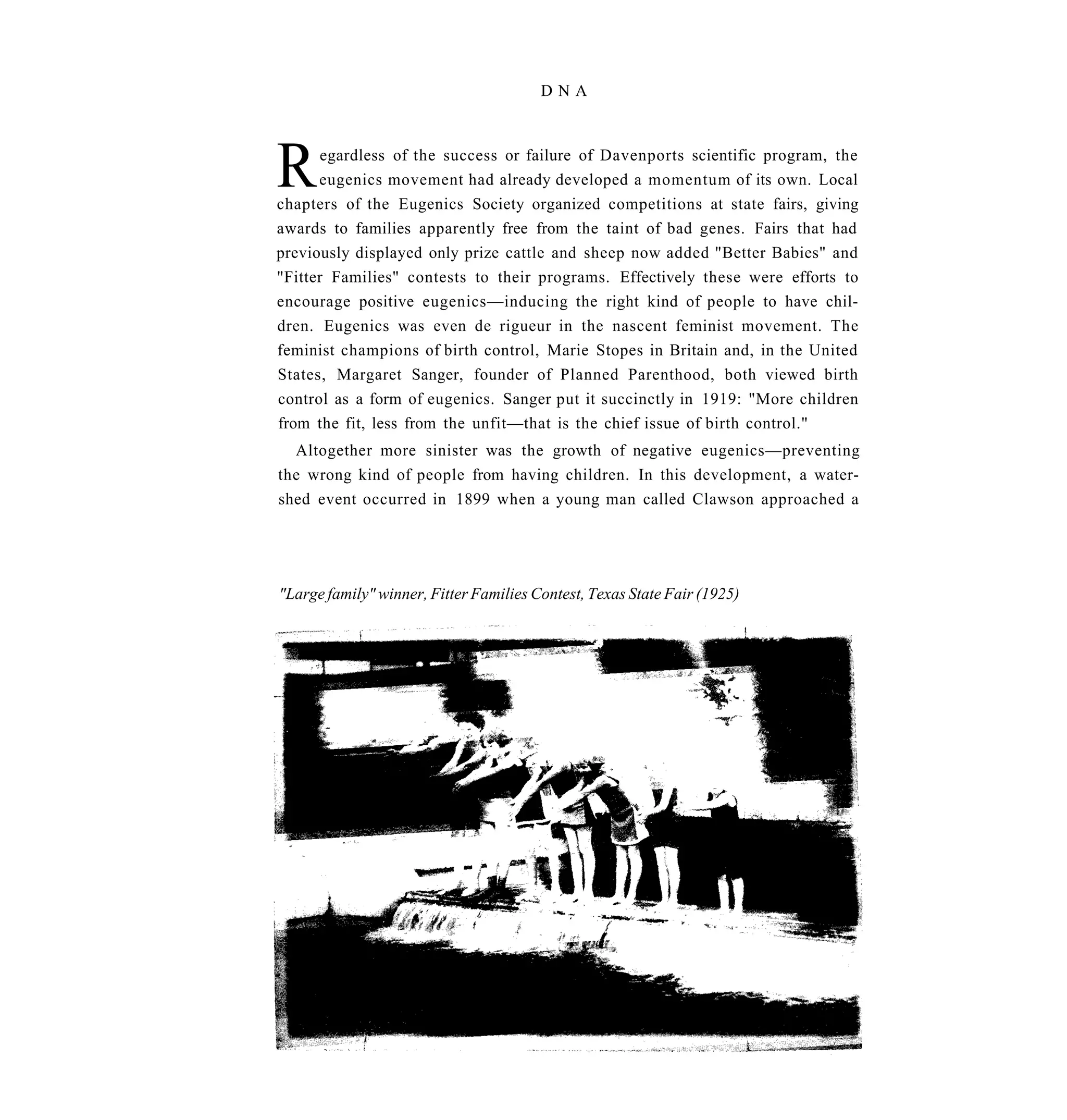
awards to families apparently free from the taint of bad genes. Fairs that had
previously displayed only prize cattle and sheep now added "Better Babies" and
"Fitter Families" contests to their programs. Effectively these were efforts to
encourage positive eugenics—inducing the right kind of people to have chil-
dren. Eugenics was even de rigueur in the nascent feminist movement. The
feminist champions of birth control, Marie Stopes in Britain and, in the United
States, Margaret Sanger, founder of Planned Parenthood, both viewed birth
control as a form of eugenics. Sanger put it succinctly in 1919: "More children
from the fit, less from the unfit—that is the chief issue of birth control."
  Altogether more sinister was the growth of negative eugenics—preventing
the wrong kind of people from having children. In this development, a water-
shed event occurred in 1899 when a young man called Clawson approached a


"Large family" winner, Fitter Families Contest, Texas State Fair (1925)
Beginnings    of Genetics

prison doctor in Indiana called Harry Sharp (appropriately named in light of his
enthusiasm for the surgeon's knife). Clawson's problem—or so it was diagnosed
by the medical establishment of the day—was compulsive masturbation. He
reported that he had been hard at it ever since the age of twelve. Masturbation
was seen as part of the general syndrome of degeneracy, and Sharp accepted the
conventional wisdom (however bizarre it may seem to us today) that Clawson's
mental shortcomings—he had made no progress in school—were caused by
his compulsion. The solution? Sharp performed a vasectomy, then a recently
invented procedure, and subsequently claimed that he had "cured" Clawson. As
a result, Sharp developed his own compulsion: to perform vasectomies.
   Sharp promoted his success in treating Clawson (for which, incidentally, we
have only Sharp's own report as confirmation) as evidence of the procedure's
efficacy for treating all those identified as being of Clawson's kind—all "degen-
erates." Sterilization had two things going for it. First, it might prevent degener-
ate behavior, as Sharp claimed it had in Clawson. This, if nothing else, would
save society a lot of money because those who had required incarceration,
whether in prisons or insane asylums, would be rendered "safe" for release.
Second, it would prevent the likes of Clawson from passing their inferior
(degenerate) genes on to subsequent generations. Sterilization, Sharp believed,
offered the perfect solution to the eugenic crisis.
   Sharp was an effective lobbyist, and in 1907 Indiana passed the first compul-
sory sterilization law, authorizing the sterilization of confirmed "criminals,
idiots, rapists, and imbeciles." Indiana's was the first of many: eventually thirty
American states had enacted similar statutes, and by 1941 some sixty thousand
individuals in the United States had duly been sterilized, half of them in Cali-
fornia alone. The laws, which effectively resulted in state governments deciding
who could and who could not have children, were challenged in court, but in
1927 the Supreme Court upheld the Virginia statute in the landmark case of
Carrie Buck. Oliver Wendell Holmes wrote the decision:


  It is better for all the world if, instead of waiting to execute degenerate off-
  spring for crime, or to let them starve for their imbecility, society can pre-
  vent those who are manifestly unfit from continuing their kind . . . Three
  generations of imbeciles is enough.


                                         27
DNA

   Sterilization caught on outside the United States as well—and not only in
Nazi Germany. Switzerland and the Scandinavian countries enacted similar leg-
islation.


R     acism is not implicit to eugenics—good genes, the ones eugenics seeks to
      promote, can in principle belong to people of any race. Starting with Gal-
ton, however, whose account of his African expedition had confirmed preju-
dices about "inferior races," the prominent practitioners of eugenics tended to
be racists who used eugenics to provide a "scientific" justification for racist
views. Henry Goddard, of Kallikak family fame, conducted IQ tests on immi-
grants at Ellis Island in 1913 and found as many as 80 percent of potential new
Americans to be certifiably feebleminded. The IQ tests he carried out during
World War I for the U.S. Army reached a similar conclusion: 45 percent of
foreign-born draftees had a mental age of less than eight (only 21 percent of
native-born draftees fell into this category). That the tests were biased—they
were, after all, carried out in English—was not taken to be relevant: racists had
the ammunition they required, and eugenics would be pressed into the service
of the cause.
   Although the term "white supremacist" had yet to be coined, America had
plenty of them early in the twentieth century. White Anglo-Saxon Protestants,
Theodore Roosevelt prominent among them, were concerned that immigration
was corrupting the WASP paradise that America, in their view, was supposed to
be. In 1916 Madison Grant, a wealthy New Yorker and friend of both Daven-
port and Roosevelt, published The Passing of the Great Race, in which he argued
that the Nordic peoples are superior to all others, including other Europeans.
To preserve the United States' fine Nordic genetic heritage, Grant campaigned
for immigration restrictions on all non-Nordics. He championed racist eugenic
policies, too:


   Under existing conditions the most practical and hopeful method of race
   improvement is through the elimination of the least desirable elements in
   the nation by depriving them of the power to contribute to future genera-
   tions. It is well known to stock breeders that the color of a herd of cattle


                                       28
Beginnings    of Genetics

  can be modified by continuous destruction of worthless shades and of
  course this is true of other characters. Black sheep, for instance, have been
  practically obliterated by cutting out generation after generation all ani-
  mals that show this color phase.


   Despite appearances, Grant's book was hardly a minor publication by a mar-
ginalized crackpot; it was an influential best-seller. Later translated into Ger-
man, it appealed—not surprisingly—to the Nazis. Grant gleefully recalled
having received a personal letter from Hitler, who wrote to say that the book
was his Bible.
   Although not as prominent as Grant, arguably the most influential of the era's
exponents of "scientific" racism was Davenport's right-hand man, Harry Laugh-
lin. Son of an Iowa preacher, Laughlin's expertise was in racehorse pedigrees
and chicken breeding. He oversaw the operations of the Eugenics Record
Office, but was at his most effective as a lobbyist. In the name of eugenics, he
fanatically promoted forced sterilization measures and restrictions on the influx
of genetically dubious foreigners (i.e., non—northern Europeans). Particularly
important historically was his role as an expert witness at congressional hear-
ings on immigration: Laughlin gave full rein to his prejudices, all of them of
course dressed up as "science." When the data were problematic, he fudged
them. When he unexpectedly found, for instance, that immigrant Jewish chil-
dren did better than the native-born in public schools, Laughlin changed the
categories he presented, lumping Jews in with whatever nation they had come
from, thereby diluting away their superior performance. The passage in 1924 of
the Johnson-Reed Immigration Act, which severely restricted immigration from
southern Europe and elsewhere, was greeted as a triumph by the likes of Madi-
son Grant; it was Harry Laughlin's finest hour. As vice president some years ear-
lier, Calvin Coolidge had chosen to overlook both Native Americans and the
nation's immigration history when he declared that "America must remain
American." Now, as president, he signed his wish into law.
   Like Grant, Laughlin had his fans among the Nazis, who modeled some of
their own legislation on the American laws he had developed. In 1936 he
enthusiastically accepted an honorary degree from Heidelberg University,
which chose to honor him as "the farseeing representative of racial policy in


                                        29
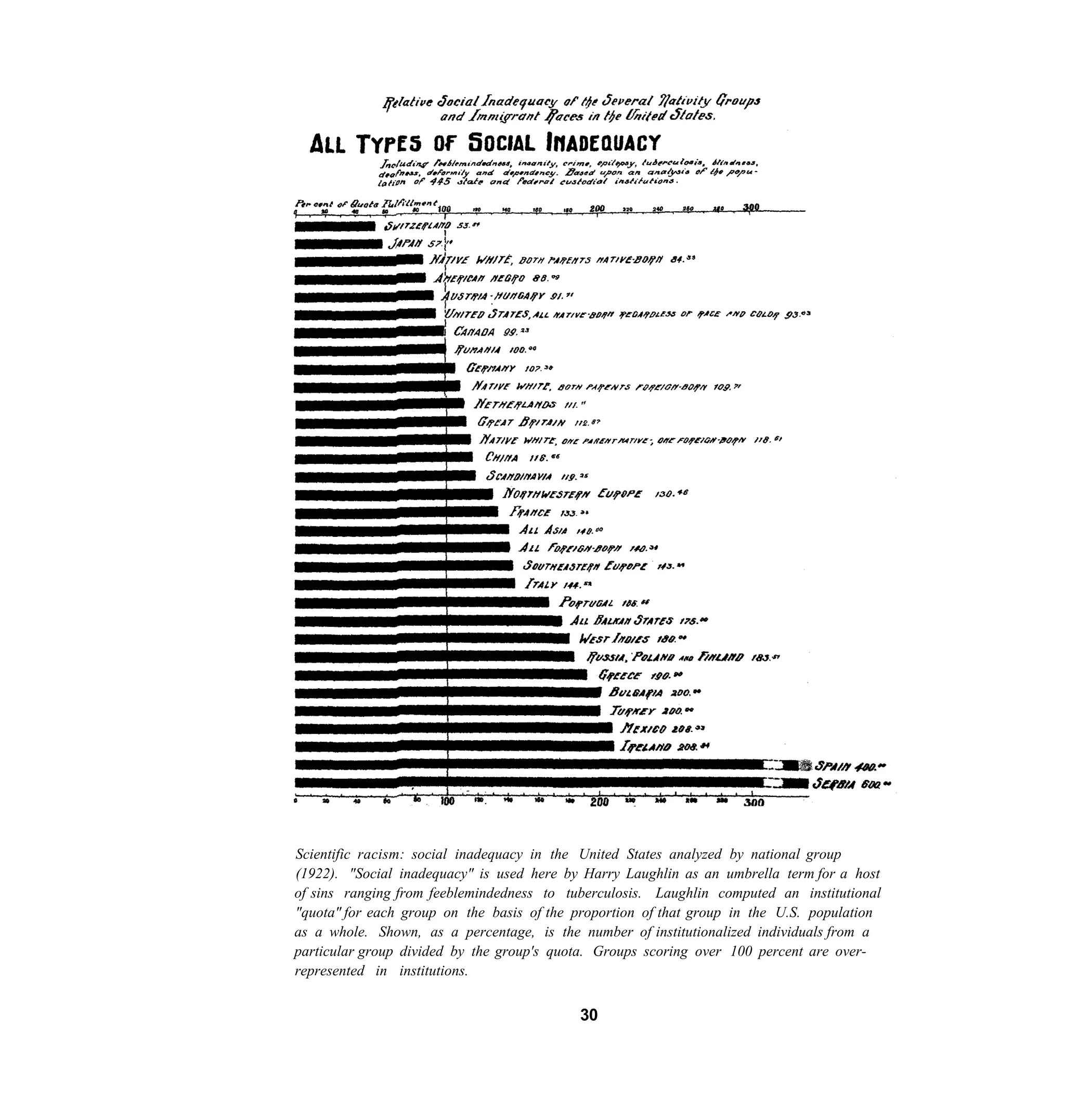
Scientific racism: social inadequacy in the United States analyzed by national group
(1922). "Social inadequacy" is used here by Harry Laughlin as an umbrella term for a host
of sins ranging from feeblemindedness to tuberculosis. Laughlin computed an institutional
"quota" for each group on the basis of the proportion of that group in the U.S. population
as a whole. Shown, as a percentage, is the number of institutionalized individuals from a
particular group divided by the group's quota. Groups scoring over 100 percent are over-
represented in institutions.


                                           30
Beginnings    of Genetics

America." In time, however, a form of late-onset epilepsy ensured that Laugh-
lin's later years were especially pathetic. All his professional life he had cam-
paigned for the sterilization of epileptics on the grounds that they were
genetically degenerate.


H     itler's Mein Kampf is saturated with pseudoscientific racist ranting
      derived from long-standing German claims of racial superiority and from
some of the uglier aspects of the American eugenics movement. Hitler wrote
that the state "must declare unfit for propagation all who are in any way visibly
sick or who have inherited a disease and can therefore pass it on, and put this
into actual practice," and elsewhere, "Those who are physically and mentally
unhealthy and unworthy must not perpetuate their suffering in the body of their
children." Shortly after coming to power in 1933, the Nazis had passed a com-
prehensive sterilization law—the "law for the prevention of progeny with hered-
itary defects"—that was explicitly based on the American model. (Laughlin
proudly published a translation of the law.) Within three years, 225,000 people
had been sterilized.
   Positive eugenics, encouraging the "right" people to have children, also
thrived in Nazi Germany, where "right" meant properly Aryan. Heinrich Himm-
ler, head of the SS (the Nazi elite corps), saw his mission in eugenic terms: SS
officers should ensure Germany's genetic future by having as many children as
possible. In 1936, he established special maternity homes for SS wives to guar-
antee that they got the best possible care during pregnancy. The proclamations
at the 1935 Nuremberg Rally included a "law for the protection of German
blood and German honor," which prohibited marriage between Germans and
Jews and even "extra-marital sexual intercourse between Jews and citizens of
German or related blood." The Nazis were unfailingly thorough in closing up
any reproductive loopholes.
   Neither, tragically, were there any loopholes in the U.S. Johnson-Reed Immi-
gration Act that Harry Laughlin had worked so hard to engineer. For many Jews
fleeing Nazi persecution, the United States was the logical first choice of desti-
nation, but the country's restrictive—and racist—immigration policies resulted
in many being turned away. Not only had Laughlin's sterilization law provided
Hitler with the model for his ghastly program, but his impact on immigration

                                        31
DNA

legislation meant that the United States would in effect abandon German Jewry
to its fate at the hands of the Nazis.
   In 1939, with the war under way, the Nazis introduced euthanasia. Steriliza-
tion proved too much trouble. And why waste the food? The inmates of asylums
were categorized as "useless eaters." Questionnaires were distributed among
the mental hospitals where panels of experts were instructed to mark them with
a cross in the cases of patients whose lives they deemed "not worth living."
Seventy-five thousand came back so marked, and the technology of mass
murder—the gas chamber—was duly developed. Subsequently, the Nazis
expanded the definition of "not worth living" to include whole ethnic groups,
among them the Gypsies and, in particular, the Jews. What came to be called
the Holocaust was the culmination of Nazi eugenics.


E      ugenics ultimately proved a tragedy for humankind. It also proved a disas-
       ter for the emerging science of genetics, which could not escape the taint.
In fact, despite the prominence of eugenicists like Davenport, many scientists
had criticized the movement and dissociated themselves from it. Alfred Russel
Wallace, the co-discoverer with Darwin of natural selection, condemned
eugenics in 1912 as "simply the meddlesome interference of an arrogant, scien-
tific priestcraft." Thomas Hunt Morgan, of fruit fly fame, resigned on "scientific
grounds" from the board of scientific directors of the Eugenics Record Office.
Raymond Pearl, at Johns Hopkins, wrote in 1928 that "orthodox eugenicists are
going contrary to the best established facts of genetical science."
   Eugenics had lost its credibility in the scientific community long before the
Nazis appropriated it for their own horrific purposes. The science underpinning
it was bogus, and the social programs constructed upon it utterly reprehensible.
Nevertheless, by midcentury the valid science of genetics, human genetics in
particular, had a major public relations problem on its hands. When in 1948 I
first came to Cold Spring Harbor, former home of the by-then-defunct Eugen-
ics Record Office, nobody would even mention the "E word"; nobody was will-
ing to talk about our science's past even though past issues of the German
Journal of Racial Hygiene still lingered on the shelves of the library.
   Realizing that such goals were not scientifically feasible, geneticists had long


                                          32
Beginnings    of Genetics

since forsaken the grand search for patterns of inheritance of human behavioral
characteristics—whether Davenport's feeblemindedness or Galton's genius—
and were now focusing instead on the gene and how it functioned in the cell.
With the development during the 1930s and 1940s of new and more effective
technologies for studying biological molecules in ever greater detail, the time
had finally arrived for an assault on the greatest biological mystery of all: what is
the chemical nature of the gene?


                                          33
CHAPTER          TWO


                 THE D O U B L E H E L I X :
                         T H I S I S LIFE


I   got hooked on the gene during my third year at the University of Chicago.
    Until then, I had planned to be a naturalist and looked forward to a career
    far removed from the urban bustle of Chicago's South Side, where I grew
up. My change of heart was inspired not by an unforgettable teacher but a little
book that appeared in 1944, What Is Life?, by the Austrian-born father of wave
mechanics, Erwin Schrodinger. It grew out of several lectures he had given the
year before at the Institute for Advanced Study in Dublin. That a great physicist
had taken the time to write about biology caught my fancy. In those days, like
most people, I considered chemistry and physics to be the "real" sciences, and
theoretical physicists were science's top dogs.
   Schrodinger argued that life could be thought of in terms of storing and pass-
ing on biological information. Chromosomes were thus simply information
bearers. Because so much information had to be packed into every cell, it must
be compressed into what Schrodinger called a "hereditary code-script" embed-
ded in the molecular fabric of chromosomes. To understand life, then, we
would have to identify these molecules, and crack their code. He even specu-
lated that understanding life—which would involve finding the gene—might
take us beyond the laws of physics as we then understood them. Schrodinger's
book was tremendously influential. Many of those who would become major
players in Act 1 of molecular biology's great drama, including Francis Crick (a
former physicist himself), had, like me, read What Is Life? and been impressed.
  In my own case, Schrodinger struck a chord because I too was intrigued by
DNA

                           the essence of life. A small minority of scientists still thought life
                           depended upon a vital force emanating from an all-powerful god. But
                           like most of my teachers, I disdained the very idea of vitalism. If such
                           a "vital" force were calling the shots in nature's game, there was little
                           hope life would ever be understood through the methods of science.
                           On the other hand, the notion that life might be perpetuated by
                           means of an instruction book inscribed in a secret code appealed to
                           me. What sort of molecular code could be so elaborate as to convey
                           all the multitudinous wonder of the living world? And what sort of
                           molecular trick could ensure that the code is exactly copied every
                           time a chromosome duplicates?
The physicist Erwin             At the time of Schrodinger's Dublin lectures, most biologists sup-
Schrodinger, whose book      posed that proteins would eventually be identified as the primary
What Is Life? turned me
                             bearers of genetic instruction. Proteins are molecular chains built up
on to the gene
                             from twenty different building blocks, the amino acids. Because per-
                 mutations in the order of amino acids along the chain are virtually infinite, pro-
                 teins could, in principle, readily encode the information underpinning life's
                 extraordinary diversity. DNA then was not considered a serious candidate for
                 the bearer of code-scripts, even though it was exclusively located on chromo-
                 somes and had been known about for some seventy-five years. In 1869,
                 Friedreich Miescher, a Swiss biochemist working in Germany, had isolated from
                 pus-soaked bandages supplied by a local hospital a substance he called
                 "nuclein." Because pus consists largely of white blood cells, which, unlike red
                 blood cells, have nuclei and therefore DNA-containing chromosomes,
                 Miescher had stumbled on a good source of DNA. When he later discovered
                 that "nuclein" was to be found in chromosomes alone, Miescher understood
                 that his discovery was indeed a big one. In 1893, he wrote: "Inheritance insures
                 a continuity in form from generation to generation that lies even deeper than
                 the chemical molecule. It lies in the structuring atomic groups. In this sense, I
                 am a supporter of the chemical heredity theory."
                    Nevertheless, for decades afterward, chemistry would remain unequal to the
                 task of analyzing the immense size and complexity of the DNA molecule. Only
                 in the 1930s was DNA shown to be a long molecule containing four different
                 chemical bases: adenine (A), guanine (G), thymine (T), and cytosine (C). But


                                                         36
The   Double Helix

at the time of Schrodinger's lectures, it was still unclear just how the subunits
(called deoxynucleotides) of the molecule were chemically linked. Nor was it
known whether DNA molecules might vary in their sequences of the four dif-
ferent bases. If DNA were indeed Schrodinger's code-script, then the molecule
would have to be capable of existing in an immense number of different forms.
But back then it was still considered a possibility that one simple sequence like
AGTC might be repeated over and over along the entire length of DNA chains.
  DNA did not move into the genetic limelight until 1944, when Oswald
Avery's lab at the Rockefeller Institute in New York City reported that the com-
position of the surface coats of pneumonia bacteria could be changed. This was
not the result he and his junior colleagues, Colin MacLeod and Maclyn
McCarty, expected.
   For more than a decade Avery's group had been following up on another most
unexpected observation made in 1928 by Fred Griffith, a scientist in the British
Ministry of Health. Griffith was interested in pneumonia and studied its bacte-
rial agent, Pneumococcus. It was known that there were two strains, designated
"smooth" (S) and "rough" (R) according to their appearance under the micro-
scope. These strains differed not only visually but also in their virulence. Inject
S bacteria into a mouse, and within a few days the mouse dies; inject R bacteria
and the mouse remains healthy. It turns out that S bacterial cells have a coating
that prevents the mouse's immune system from recognizing the invader. The R
cells have no such coating and are therefore readily attacked by the mouse's
immune defenses.


A view through the microscope of blood cells treated with
a chemical that stains DNA. In order to maximize their
oxygen-transporting capacity, red blood cells have no
nucleus and therefore no DNA. But white blood cells,
which patrol the bloodstream in search of intruders, have a
nucleus containing chromosomes.


                                           37
DNA

   Through his involvement with public health, Griffith knew that multiple
strains had sometimes been isolated from a single patient, and so he was curi-
ous about how different strains might interact in his unfortunate mice. With
one combination, he made a remarkable discovery: when he injected heat-
killed S bacteria (harmless) and normal R bacteria (also harmless), the mouse
died. How could two harmless forms of bacteria conspire to become lethal?
The clue came when he isolated the Pneumococcus bacteria retrieved from the
dead mice and discovered living S bacteria. It appeared the living innocuous
R bacteria had acquired something from the dead S variant; whatever it was,
that something had allowed the R in the presence of the heat-killed S bacteria
to transform itself into a living killer S strain. Griffith confirmed that this
change was for real by culturing the S bacteria from the dead mouse over
several generations: the bacteria bred true for the S type, just as any regular
S strain would. A genetic change had indeed occurred to the R bacteria in-
jected into the mouse.
   Though this transformation phenomenon seemed to defy all understanding,
Griffith's observations at first created little stir in the scientific world. This was
partly because Griffith was intensely private and so averse to large gatherings
that he seldom attended scientific conferences. Once, he had to be virtually
forced to give a lecture. Bundled into a taxi and escorted to the hall by col-
leagues, he discoursed in a mumbled monotone, emphasizing an obscure corner
of his microbiological work but making no mention of bacterial transformation.
Luckily, however, not everyone overlooked Griffith's breakthrough.
   Oswald Avery was also interested in the sugarlike coats of the Pneumococcus.
He set out to duplicate Griffith's experiment in order to isolate and characterize
whatever it was that had caused those R cells to change to the S type. In 1944
Avery, MacLeod, and McCarty published their results: an exquisite set of exper-
iments showing unequivocally that DNA was the transforming principle. Cul-
turing the bacteria in the test tube rather than in mice made it much easier to
search for the chemical identity of the transforming factor in the heat-killed S
cells. Methodically destroying one by one the biochemical components of the
heat-treated S cells, Avery and his group looked to see whether transformation
was prevented. First they degraded the sugarlike coat of the S bacteria. Trans-
formation still occurred: the coat was not the transforming principle. Next they


                                          38
The   Double Helix

used a mixture of two protein-destroying enzymes, trypsin and chymotrypsin, to
degrade virtually all the proteins in the S cells. To their surprise, transformation
was again unaffected. Next they tried an enzyme (RNase) that breaks down
RNA (ribonucleic acid), a second class of nucleic acids similar to DNA and
possibly involved in protein synthesis. Again transformation occurred. Finally,
they came to DNA, exposing the S bacterial extracts to the DNA-destroying
enzyme, DNase. This time they hit a home run. All S-inducing activity ceased
completely. The transforming factor was DNA.
   In part because of its bombshell implications, the resulting February 1944
paper by Avery, MacLeod, and McCarty met with a mixed response. Many
geneticists accepted their conclusions. After all, DNA was found on every chro-
mosome; why shouldn't it be the genetic material? By contrast, however, most
biochemists expressed doubt that DNA was a complex enough molecule to act
as the repository of such a vast quantity of biological information. They contin-
ued to believe that proteins, the other component of chromosomes, would prove
to be the hereditary substance. In principle, as the biochemists rightly noted, it
would be much easier to encode a vast body of complex information using the
twenty-letter amino-acid alphabet of proteins than the four-letter nucleotide
alphabet of DNA. Particularly vitriolic in his rejection of DNA as the genetic
substance was Avery's own colleague at the Rockefeller Institute, the protein
chemist Alfred Mirsky. By then, however, Avery was no longer scientifically
active. The Rockefeller Institute had mandatorily retired him at age sixty-five.
   Avery missed out on more than the opportunity to defend his work against
the attacks of his colleagues: He was never awarded the Nobel Prize, which was
certainly his due, for identifying DNA as the transforming principle. Because
the Nobel committee makes its records public fifty years following each award,
we now know that Avery's candidacy was blocked by the Swedish physical
chemist Einar Hammarsten. Though Hammarsten's reputation was based
largely on his having produced DNA samples of unprecedented high quality, he
still believed genes to be an undiscovered class of proteins. In fact, even after
the double helix was found, Hammarsten continued to insist that Avery should
not receive the prize until after the mechanism of DNA transformation had
been completely worked out. Avery died in 1955; had he lived only a few more
years, he would almost certainly have gotten the prize.


                                        39
DNA


W       hen I arrived at Indiana University in the fall of 1947 with plans to pur-
        sue the gene for my Ph.D. thesis, Avery's paper came up over and over in
conversations. By then, no one doubted the reproducibility of his results, and
more recent work coming out of the Rockefeller Institute made it all the less
likely that proteins would prove to be the genetic actors in bacterial transforma-
tion. DNA had at last become an important objective for chemists setting their
sights on the next breakthrough. In Cambridge, England, the canny Scottish
chemist Alexander Todd rose to the challenge of identifying the chemical bonds
that linked together nucleotides in DNA. By early 1951, his lab had proved that
these links were always the same, such that the backbone of the DNA molecule
was very regular. During the same period, the Austrian-born refugee Erwin
Chargaff, at the College of Physicians and Surgeons of Columbia University,
used the new technique of paper chromatography to measure the relative
amounts of the four DNA bases in DNA samples extracted from a variety of
vertebrates and bacteria. While some species had DNA in which adenine and
thymine predominated, others had DNA with more guanine and cytosine. The
possibility thus presented itself that no two DNA molecules had the same com-
position.
   At Indiana I joined a small group of visionary scientists, mostly physicists and
chemists, studying the reproductive process of the viruses that attack bacteria
(bacteriophages—"phages" for short). The Phage Group was born when my
Ph.D. supervisor, the Italian-trained medic Salvador Luria and his close friend,
the German-born theoretical physicist Max Delbrück, teamed up with the
American physical chemist Alfred Hershey. During World War II both Luria
and Delbruck were considered enemy aliens, and thus ineligible to serve in the
war effort of American science, even though Luria, a Jew, had been forced to
leave France for New York City and Delbriick had fled Germany as an objector
to Nazism. Thus excluded, they continued to work in their respective university
labs—Luria at Indiana and Delbruck at Vanderbilt—and collaborated on phage
experiments during successive summers at Cold Spring Harbor. In 1943, they
joined forces with the brilliant but taciturn Hershey, then doing phage research
of his own at Washington University in St. Louis.
  The Phage Group's program was based on its belief that phages, like all


                                        40
The   Double   Helix

viruses, were in effect naked genes. This concept had first been proposed in
1922 by the imaginative American geneticist Herman J. Muller, who three years
later demonstrated that X rays cause mutations. His belated Nobel Prize came
in 1946, just after he joined the faculty of Indiana University. It was his pres-
ence, in fact, that led me to Indiana. Having started his career under T. H. Mor-
gan, Muller knew better than anyone else how genetics had evolved during the
first half of the twentieth century, and I was enthralled by his lectures during
my first term. His work on fruit flies (Drosophila), however, seemed to me to
belong more to the past than to the future, and I only briefly considered doing
thesis research under his supervision. I opted instead for Luria's phages, an
even speedier experimental subject than Drosophila: genetic crosses of phages
done one day could be analyzed the next.
   For my Ph.D. thesis research, Luria had me follow in his footsteps by study-
ing how X rays killed phage particles. Initially I had hoped to show that viral
death was caused by damage to phage DNA. Reluctantly, however, I eventually
had to concede that my experimental approach could never give unambiguous
answers at the chemical level. I could draw only biological conclusions. Even
though phages were indeed effectively naked genes, I realized that the deep
answers the Phage Group was seeking could be arrived at only through
advanced chemistry. DNA somehow had to transcend its status as an acronym;
it had to be understood as a molecular structure in all its chemical detail.
   Upon finishing my thesis, I saw no alternative but to move to a lab where I
could study DNA chemistry. Unfortunately, however, knowing almost no pure
chemistry, I would have been out of my depth in any lab attempting difficult
experiments in organic or physical chemistry. I therefore took a postdoctoral fel-
lowship in the Copenhagen lab of the biochemist Herman Kalckar in the fall of
1950. He was studying the synthesis of the small molecules that make up
DNA, but I figured out quickly that his biochemical approach would never lead
to an understanding of the essence of the gene. Every day spent in his lab would
be one more day's delay in learning how DNA carried genetic information.
  My Copenhagen year nonetheless ended productively. To escape the cold
Danish spring, I went to the Zoological Station at Naples during April and May.
During my last week there, I attended a small conference on X-ray diffraction
methods for determining the 3-D structure of molecules. X-ray diffraction is a


                                       41
DNA

                way of studying the atomic structure of any molecule that can be crystallized.
                The crystal is bombarded with X rays, which bounce off its atoms and arc scat-
                tered. The scatter pattern gives information about the structure of the mole-
                cule but, taken alone, is not enough to solve the structure. The additional
                information needed is the "phase assignment," which deals with the wave
                properties of the molecule. Solving the phase problem was not easy, and at that
                time only the most audacious scientists were willing to take it on. Most of the
                successes of the diffraction method had been achieved with relatively simple
                molecules.
                   My expectations for the conference were low. I believed that a three-
                 dimensional understanding of protein structure, or for that matter of DNA, was
                 more than a decade away. Disappointing earlier X-ray photos suggested that
                 DNA was particularly unlikely to yield up its secrets via the X-ray approach.
                                                       These results were not surprising since the
                                                       exact sequences of DNA were expected
                                                       to differ from one individual molecule to
                                                       another. The resulting irregularity of surface
                                                       configurations would understandably pre-
                                                       vent the long thin DNA chains from lying
                                                       neatly side by side in the regular repeating
                                                       patterns required for X-ray analysis to be
                                                       successful.
                                                          It was therefore a surprise and a delight to
                                                       hear the last-minute talk on DNA by a thirty-
                                                       four-year-old Englishman named Maurice
                                                       Wilkins from the Biophysics Lab of King's
                                                       College, London. Wilkins was a physicist
                                                       who during the war had worked on the Man-
                                                       hattan Project. For him, as for many of the
                                                       other scientists involved, the actual deploy-
                                                       ment of the bomb on Hiroshima and
                                                       Nagasaki, supposedly the culmination of all
                                                       their work, was profoundly disillusioning.
Maurice Wilkins in his lab at King's College, London     He considered forsaking science altogether


                                                           42
The     Double   Helix

to become a painter in Paris, but biology intervened. He too had read
Schrodinger's book, and was now tackling DNA with X-ray diffraction.
   He displayed a photograph of an X-ray diffraction pattern he had recently
obtained, and its many precise reflections indicated a highly regular crystalline
packing. DNA, one had to conclude, must have a regular structure, the eluci­
dation of which might well reveal the nature of the gene. Instantly I saw myself
moving to London to help Wilkins find the structure. My attempts to converse
with him after his talk, however, went nowhere. All I got for my efforts was a
declaration of his conviction that much hard work lay ahead.
   While I was hitting consecutive dead ends, back in America the world's pre­
eminent chemist, Caltech's Linus Pauling, announced a major triumph: he had
found the exact arrangement in which chains of amino acids (called polypep­
tides) fold up in proteins, and called his structure the α-helix (alpha helix). That
it was Pauling who made this breakthrough was no surprise: he was a scientific
superstar. His book The Nature of the Chemical Bond essentially laid the foun­
dation of modern chemistry, and, for chemists of the day, it was the Bible. Paul­
ing had been a precocious child. When he was nine, his father, a druggist in
Oregon, wrote to the Oregonian newspaper requesting suggestions of reading
matter for his bookish son, adding that he had already read the Bible and Dar­
win's Origin of Species. But the early death of Pauling's father, which brought
the family to financial ruin, makes it remarkable that the promising young man
managed to get an education at all.
  As soon as I returned to Copenhagen I read about Pauling's α-helix. To my
surprise, his model was not based on a deductive leap from experimental X-ray
diffraction data. Instead, it was Pauling's long experience as a structural
chemist that had emboldened him to infer which type of helical fold would be
most compatible with the underlying chemical features of the polypeptide
chain. Pauling made scale models of the different parts of the protein molecule,
working out plausible schemes in three dimensions. He had reduced the prob­
lem to a kind of three-dimensional jigsaw puzzle in a way that was simple yet
brilliant.
  Whether the α-helix was correct—in addition to being pretty—was now the
question. Only a week later, I got the answer. Sir Lawrence Bragg, the English
inventor of X-ray crystallography and 1915 Nobel laureate in Physics, came to


                                         43
DNA


Lawrence Bragg (left) with Linus Pauling, who is carrying a model of the α-helix


Copenhagen and excitedly reported that his junior colleague, the Austrian-born
chemist Max Perutz, had ingeniously used synthetic polypeptides to confirm
the correctness of Pauling's α-helix. It was a bittersweet triumph for Bragg's
Cavendish Laboratory. The year before, they had completely missed the boat in
their paper outlining possible helical folds for polypeptide chains.
   By then Salvador Luria had tentatively arranged for me to take up a research


                                           44
The   Double   Helix

position at the Cavendish. Located at Cambridge University, this was the most
famous laboratory in all of science. Here Ernest Rutherford first described the
structure of the atom. Now it was Bragg's own domain, and I was to work as
apprentice to the English chemist John Kendrew, who was interested in deter-
mining the 3-D structure of the protein myoglobin. Luria advised me to visit the
Cavendish as soon as possible. With Kendrew in the States, Max Perutz would
check me out. Together, Kendrew and Perutz had earlier established the Med-
ical Research Council (MRC) Unit for the Study of the Structure of Biological
Systems.
   A month later in Cambridge, Perutz assured me that I could quickly master
the necessary X-ray diffraction theory and should have no difficulty fitting in
with the others in their tiny MRC Unit. To my relief, he was not put off by my
biology background. Nor was Lawrence Bragg, who briefly came down from his
office to look me over.
   I was twenty-three when I arrived back at the MRC Unit in Cambridge in
early October. I found myself sharing space in the biochemistry room with a
thirty-five-year-old ex-physicist, Francis Crick, who had spent the war working
on magnetic mines for the Admiralty. When the war ended, Crick had planned
to stay on in military research, but, on reading Schrödinger's
What Is Life?, he had moved toward biology. Now he was at
the Cavendish to pursue the 3-D structure of proteins for
his Ph.D.
   Crick was always fascinated by the intricacies of impor-
tant problems. His endless questions as a child compelled
his weary parents to buy him a children's encyclopedia, hop-
ing that it would satisfy his curiosity. But it only made him
insecure: he confided to his mother his fear that everything
would have been discovered by the time he grew up, leaving
him nothing to do. His mother reassured him (correctly, as it
happened) that there would still be a thing or two for him to
figure out.
  A great talker, Crick was invariably the center of attention
in any gathering. His booming laugh was forever echoing          Francis Crick with the
down the hallways of the Cavendish. As the MRC Unit's res-       Cavendish X-ray tube
DNA

ident theoretician, he used to come up with a novel insight at least once a
month, and he would explain his latest idea at great length to anyone willing to
listen. The morning we met he lit up when he learned that my objective in com-
ing to Cambridge was to learn enough crystallography to have a go at the DNA
structure. Soon I was asking Crick's opinion about using Pauling's model-
building approach to go directly for the structure. Would we need many more
years of diffraction experimentation before modeling would be practicable? To
bring us up to speed on the status of DNA structural studies, Crick invited
Maurice Wilkins, a friend since the end of the war, up from London for Sunday
lunch. Then we could learn what progress Wilkins had made since his talk in
Naples.
   Wilkins expressed his belief that DNA's structure was a helix, formed by sev-
eral chains of linked nucleotides twisted around each other. All that remained
to be settled was the number of chains. At the time, Wilkins favored three on
the basis of his density measurements of DNA fibers. He was keen to start
model-building, but he had run into a roadblock in the form of a new addition
to the King's College Biophysics Unit, Rosalind Franklin.
   A thirty-one-year-old Cambridge-trained physical chemist, Franklin was an
obsessively professional scientist; for her twenty-ninth birthday all she
requested was her own subscription to her field's technical journal, Acta Crys¬
tallographica. Logical and precise, she was impatient with those who acted oth-
erwise. And she was given to strong opinions, once describing her Ph.D. thesis
adviser, Ronald Norrish, a future Nobel Laureate, as "stupid, bigoted, deceitful,
ill-mannered and tyrannical." Outside the laboratory, she was a determined and
gutsy mountaineer, and, coming from the upper echelons of London society,
she belonged to a more rarefied social world than most scientists. At the end of
a hard day at the bench, she would occasionally change out of her lab coat into
an elegant evening gown and disappear into the night.
   Just back from a four-year X-ray crystallographic investigation of graphite in
Paris, Franklin had been assigned to the DNA project while Wilkins was away
from King's. Unfortunately, the pair soon proved incompatible. Franklin, direct
and data-focused, and Wilkins, retiring and speculative, were destined never to
collaborate. Shortly before Wilkins accepted our lunch invitation, the two had
had a big blowup in which Franklin had insisted that no model-building could


                                       46
Rosalind Franklin on
one of the mountain
hiking vacations she
loved


commence before she collected much more extensive diffraction data. Now
they effectively didn't communicate, and Wilkins would have no chance to
learn of her progress until Franklin presented her lab seminar scheduled for the
beginning of November. If we wanted to listen, Crick and I were welcome to go
as Wilkins's guests.
   Crick was unable to make the seminar, so I attended alone and briefed him
later on what I believed to be its key take-home messages on crystalline DNA.


                                      47
DNA

In particular, I described from memory Franklin's measurements of the crystal¬
lographic repeats and the water content. This prompted Crick to begin sketch-
ing helical grids on a sheet of paper, explaining that the new helical X-ray theory
he had devised with Bill Cochran and Vladimir Vand would permit even me, a
former bird-watcher, to predict correctly the diffraction patterns expected from
the molecular models we would soon be building at the Cavendish.
   As soon as we got back to Cambridge, I arranged for the Cavendish machine
shop to construct the phosphorous atom models needed for short sections of
the sugar phosphate backbone found in DNA. Once these became available,
we tested different ways the backbones might twist around each other in the
center of the DNA molecule. Their regular repeating atomic structure should
allow the atoms to come together in a consistent, repeated conformation. Fol-
lowing Wilkins's hunch, we focused on three-chain models. When one of these
appeared to be almost plausible, Crick made a phone call to Wilkins to
announce we had a model we thought might be DNA.
  The next day both Wilkins and Franklin came up to see what we had done.
The threat of unanticipated competition briefly united them in common pur-
pose. Franklin wasted no time in faulting our basic concept. My memory was
that she had reported almost no water present in crystalline DNA. In fact, the
opposite was true. Being a crystallographic novice, I had confused the terms
"unit cell" and "asymmetric unit." Crystalline DNA was in fact water-rich. Con-
sequently, Franklin pointed out, the backbone had to be on the outside and not,
as we had it, in the center, if only to accommodate all the water molecules she
had observed in her crystals.
   That unfortunate November day cast a very long shadow. Franklins opposi-
tion to model-building was reinforced. Doing experiments, not playing with
Tinkertoy representations of atoms, was the way she intended to proceed. Even
worse, Sir Lawrence Bragg passed down the word that Crick and I should desist
from all further attempts at building a DNA model. It was further decreed that
DNA research should be left to the King's lab, with Cambridge continuing to
focus solely on proteins. There was no sense in two MRC-fundcd labs compet-
ing against each other. With no more bright ideas up our sleeves, Crick and I
were reluctantly forced to back off, at least lor the time being.
   It was not a good moment to be condemned to the DNA sidelines. Linus


                                        48
The   Double   Helix

Pauling had written Wilkins to request a copy of the crystalline DNA diffraction
pattern. Though Wilkins had declined, saying he wanted more time to interpret
it himself, Pauling was hardly obliged to depend upon data from King's. If he
wished, he could easily start serious X-ray diffraction studies at Caltech.
   The following spring, I duly turned away from DNA and set about extend-
ing prewar studies on the pencil-shaped tobacco mosaic virus using the
Cavendish's powerful new X-ray beam. This light experimental workload gave
me plenty of time to wander through various Cambridge libraries. In the zool-
ogy building, I read Erwin Chargaff's paper describing his finding that the DNA
bases adenine and thymine occurred in roughly equal amounts, as did the bases
guanine and cytosine. Hearing of these one-to-one ratios Crick wondered
whether, during DNA duplication, adenine residues might be attracted to
thymine and vice versa, and whether a corresponding attraction might exist
between guanine and cytosine. If so, base sequences on the "parental" chains
(e.g., ATGC) would have to be complementary to those on "daughter" strands
(yielding in this case TACG).
   These remained idle thoughts until Erwin Chargaff came through Cam-
bridge in the summer of 1952 on his way to the International Biochemical Con-
gress in Paris. Chargaff expressed annoyance that neither Crick nor I saw the
need to know the chemical structures of the four bases. He was even more
upset when we told him that we could simply look up the structures in text-
books as the need arose. I was left hoping that Chargaff's data would prove
irrelevant. Crick, however, was energized to do several experiments looking for
molecular "sandwiches" that might form when adenine and thymine (or alter-
natively, guanine and cytosine) were mixed together in solution. But his experi-
ments went nowhere.
   Like Chargaff, Linus Pauling also attended the International Biochemical
Congress, where the big news was the latest result from the Phage Group. Alfred
Hershey and Martha Chase at Cold Spring Harbor had just confirmed Avery's
transforming principle: DNA was the hereditary material! Hershey and Chase
proved that only the DNA of the phage virus enters bacterial cells; its protein
coat remains on the outside. It was more obvious than ever that DNA must be
understood at the molecular level if we were to uncover the essence of the gene.
With Hershey and Chase's result the talk of the town, I was sure that Pauling


                                      49
DNA

would now bring his formidable intellect and chemical wisdom to bear on the
problem of DNA.
   Early in 1953, Pauling did indeed publish a paper outlining the structure of
DNA. Reading it anxiously I saw that he was proposing a three-chain model
with sugar phosphate backbones forming a dense central core. Superficially it
was similar to our botched model of fifteen months earlier. But instead of using
positively charged atoms (e.g., Mg 2+ ) to stabilize the negatively charged back-
bones, Pauling made the unorthodox suggestion that the phosphates were held
together by hydrogen bonds. But it seemed to me, the biologist, that such
hydrogen bonds required extremely acidic conditions never found in cells. With
a mad dash to Alexander Todd's nearby organic chemistry lab my belief was con-
firmed: The impossible had happened. The world's best-known, if not best,
chemist had gotten his chemistry wrong. In effect, Pauling had knocked the A
off of DNA. Our quarry was deoxyribonucleic acid, but the structure he was
proposing was not even acidic.
   Hurriedly I took the manuscript to London to inform Wilkins and Franklin
they were still in the game. Convinced that DNA was not a helix, Franklin had
no wish even to read the article and deal with the distraction of Pauling's helical
ideas, even when I offered Crick's arguments for helices. Wilkins, however, was
very interested indeed in the news I brought; he was now more certain than
ever that DNA was helical. To prove the point, he showed me a photograph
obtained more than six months earlier by Franklin's graduate student Raymond
Gosling, who had X-rayed the so-called B form of DNA. Until that moment, I
didn't know a B form even existed. Franklin had put this picture aside, prefer-
ring to concentrate on the A form, which she thought would more likely yield
useful data. The X-ray pattern of this B form was a distinct cross. Since Crick
and others had already deduced that such a pattern of reflections would be cre-
ated by a helix, this evidence made it clear that DNA had to be a helix! In fact,
despite Franklin's reservations, this was no surprise. Geometry itself suggested
that a helix was the most logical arrangement for a long string of repeating units
such as the nucleotides of DNA. But we still did not know what that helix
looked like, nor how many chains it contained.
  The time had come to resume building helical models of DNA. Pauling was
bound to realize soon enough that his brainchild was wrong. I urged Wilkins to


                                        50
The    Double Helix


X-ray photos of the A and B forms of DNA from, respectively, Maurice Wilkins and
Rosalind Franklin. The differences in molecular structure are caused by differences in the
amount of water associated with each DNA molecule.


waste no time. But he wanted to wait until Franklin had completed her sched-
uled departure for another lab later that spring. She had decided to move on to
avoid the unpleasantness at King's. Before leaving, she had been ordered to stop
further work with DNA and had already passed on many of her diffraction
images to Wilkins.
   When I returned to Cambridge and broke the news of the DNA B form,
Bragg no longer saw any reason for Crick and me to avoid DNA. He very much
wanted the DNA structure to be found on his side of the Atlantic. So we went
back to model-building, looking for a way the known basic components of
DNA—the backbone of the molecule and the four different bases, adenine,
thymine, guanine, and cytosine—could fit together to make a helix. I commis-
sioned the shop at the Cavendish to make us a set of tin bases, but they couldn't
produce them fast enough for me: I ended up cutting out rough approximations
from stiff cardboard.
   By this time I realized the DNA density-measurement evidence actually
slightly favored a two-chain, rather than three-chain, model. So I decided to
search out plausible double helices. As a biologist, I preferred the idea of a
genetic molecule made of two, rather than three, components. After all, chro-
mosomes, like cells, increase in number by duplicating, not triplicating.


                                            51
DNA


The chemical backbone of DNA


   I knew that our previous model with the backbone on the inside and the
bases hanging out was wrong. Chemical evidence from the University of
Nottingham, which I had too long ignored, indicated that the bases must be
hydrogen-bonded to each other. They could only form bonds like this in the reg-
ular manner implied by the X-ray diffraction d a t a if they were in the center of
the molecule. But how could they come together in pairs? For two weeks I got
nowhere, misled by an error in my nucleic acid chemistry textbook. Happily, on
February 27, Jerry Donahue, a theoretical chemist visiting the Cavendish from
Caltech, pointed out that the textbook was wrong. So I changed the locations of
the hydrogen atoms on my cardboard cutouts of the molecules.
   The next morning, February 28, 1953, the key features of the DNA model all
fell into place. The two chains were held together by strong hydrogen bonds
between adenine-thymine and guanine-cytokine base pairs. The inferences
Crick had drawn the year before based on Chargaff's research had indeed been
correct. Adenine does bond to thymine and guanine does bond to cytosine, but
not through flat surfaces to form molecular sandwiches. When Crick arrived,
he took it all in rapidly, and gave my base-pairing scheme his blessing. He real-
ized right away that it would result in the two strands of the double helix run-
ning in opposite directions.


                                       52
The   Double   Helix

   It was quite a moment. We felt sure that this was it. Anything that simple,
that elegant just had to be right. What got us most excited was the complemen-
tarity of the base sequences along the two chains. If you knew the sequence—
the order of bases—along one chain, you automatically knew the sequence
along the other. It was immediately apparent that this must be how the genetic
messages of genes are copied so exactly when chromosomes duplicate prior to
cell division. The molecule would "unzip" to form two separate strands. Each
separate strand then could serve as the template for the synthesis of a new
strand, one double helix becoming two.
   In What is Life? Schrodinger had suggested that the language of life might be
like Morse code, a series of dots and dashes. He wasn't far off. The language of
DNA is a linear series of As, Ts, Gs, and Cs. And just as transcribing a page out


The insight that made it all
come together: complemen-
tary pairing of the bases


                                        53
DNA
Bases and
backbone in
place: the
double helix.
 (A) is a
schematic
showing the
system of base-
pairing that
 binds the two
strands together.
 (B) is a "space-
filling" model
showing, to
 scale, the
 atomic detail
 of the molecule.


of a book can result in the odd typo, the rare mistake creeps in when all these
As, Ts, Gs, and Cs are being copied along a chromosome. These errors are the
mutations geneticists had talked about for almost fifty years. Change an "i" to an
"a" and "Jim" becomes "Jam" in English; change a T to a C and "ATG" becomes
"ACG" in DNA.
   The double helix made sense chemically and it made sense biologically. Now
there was no need to be concerned about Schrodinger's suggestion that new
laws of physics might be necessary for an understanding of how the hereditary
code-script is duplicated: genes in fact were no different from the rest of chem-
istry. Later that day, during lunch at the Eagle, the pub virtually adjacent to the
Cavendish Lab, Crick, ever the talker, could not help but tell everyone we had
just found the "secret of life." I myself, though no less electrified by the


                                        54
The   Double   Helix

thought, would have waited until we had a pretty three-dimensional model to
show off.
   Among the first to see our demonstration model was the chemist Alexander
Todd. That the nature of the gene was so simple both surprised and pleased
him. Later, however, he must have asked himself why his own lab, having estab-
lished the general chemical structure of DNA chains, had not moved on to ask-
ing how the chains folded up in three dimensions. Instead the essence of the
molecule was left to be discovered by a two-man team, a biologist and a physi-
cist, neither of whom possessed a detailed command even of undergraduate
chemistry. But paradoxically, this was, at least in part, the key to our success:
Crick and I arrived at the double helix first precisely because most chemists at
that time thought DNA too big a molecule to understand by chemical analysis.
   At the same time, the only two chemists with the vision to seek DNA's 3-D
structure made major tactical mistakes: Rosalind Franklin's was her resistance to
model-building; Linus Pauling's was a matter of simply neglecting to read the
existing literature on DNA, particularly the data on its base composition pub-
lished by Chargaff. Ironically, Pauling and Chargaff sailed across the Atlantic on
the same ship following the Paris Biochemical Congress in 1952, but failed to hit
it off. Pauling was long accustomed to being right. And he believed there was no
chemical problem he could not work out from first principles by himself. Usually
this confidence was not misplaced. During the Cold War, as a prominent critic of
the American nuclear weapons development program, he was questioned by the
FBI after giving a talk. How did he know how much plutonium there is in an
atomic bomb? Pauling's response was "Nobody told me. I figured it out."
   Over the next several months Crick and (to a lesser extent) I relished show-
ing off our model to an endless stream of curious scientists. However, the Cam-
bridge biochemists did not invite us to give a formal talk in the biochemistry
building. They started to refer to it as the "WC," punning our initials with those
used in Britain for the toilet or water closet. That we had found the double helix
without doing experiments irked them.
  The manuscript that we submitted to Nature in early April was published just
over three weeks later, on April 25, 1953. Accompanying it were two longer
papers by Franklin and Wilkins, both supporting the general correctness of our
model. In June, I gave the first presentation of our model at the Cold Spring


                                       55
56
Short and sweet: our Nature paper
announcing the discovery. The same issue
also carried longer articles by Rosalind
Franklin and Maurice Wilkins.

Unveiling the double helix: my lecture at
Cold Spring Harbor Laboratory, June 1953


Harbor symposium on viruses. Max Del-
brück saw to it that I was offered, at the
last minute, an invitation to speak. To
this intellectually high-powered meeting
I brought a three-dimensional model
built in the Cavendish, the adenine-
thymine base pairs in red and the
guanine-cytosine base pairs in green.
   In the audience was Seymour Ben-
zer, yet another ex-physicist who had
heeded the clarion call of Schrödinger's
book. He immediately understood what
our breakthrough meant for his studies
of mutations in viruses. He realized that he could now do for a short stretch of
bacteriophage DNA what Morgan's boys had done forty years earlier for fruit fly
chromosomes: he would map mutations—determine their order—along a gene,
just as the fruit fly pioneers had mapped genes along a chromosome. Like Mor-
gan, Benzer would have to depend on recombination to generate new genetic
combinations, but, whereas Morgan had the advantage of a ready mechanism of
recombination—the production of sex cells in a fruit fly—Benzer had to induce
recombination by simultaneously infecting a single bacterial host cell with two
different strains of bacteriophage, which differed by one or more mutations in
the region of interest. Within the bacterial cell, recombination—the exchange
of segments of molecules—would occasionally occur between the different
viral DNA molecules, producing new permutations of mutations—so-called
"recombinants." Within a single astonishingly productive year in his Purdue


                                           57
DNA

  University lab, Benzer produced a map of a single bacterio-
  phage gene, rII, showing how a series of mutations—all errors
  in the genetic script—were laid out linearly along the virus
  DNA. The language was simple and linear, just like a line of
  text on the written page.
    The response of the Hungarian physicist Leo Szilard to my
  Cold Spring Harbor talk on the double helix was less aca-
  demic. His question was, "Can you patent it?" At one time
  Szilard's main source of income had been a patent that he
  held with Einstein, and he had later tried unsuccessfully to
  patent with Enrico Fermi the nuclear reactor they built at the
  University of Chicago in 1942. But then as now patents were
  given only for useful inventions and at the time no one could
  conceive of a practical use for DNA. Perhaps then, Szilard
  suggested, we should copyright it.


  T    here remained, however, a single missing piece in the
       double helical jigsaw puzzle: our unzipping idea for
  DNA replication had yet to be experimentally verified. Max
  Delbrück, for example, was unconvinced. Though he liked
  the double helix as a model, he worried that unzipping it
  might generate horrible knots. Five years later, a former stu-
  dent of Pauling's, Matt Meselson, and the equally bright
  young phage worker Frank Stahl put to rest such fears when
  they published the results of a single elegant experiment.
     They had met in the summer of 1954 at the Marine Bio-
  logical Laboratory at Woods Hole, Massachusetts, where I
  was then lecturing, and agreed—over a good many gin marti-
  nis—that they should get together to do some science. The


DNA replication: the double helix is unzipped and each strand copied.


                         58
The     Double   Helix


     The Meselson-Stahl experiment


result of their collaboration has been described as "the most beautiful experi-
ment in biology."
   They used a centrifugation technique that allowed them to sort molecules
according to slight differences in weight; following a centrifugal spin, heavier
molecules end up nearer the bottom of the test tube than lighter ones. Because
nitrogen atoms (N) are a component of DNA, and because they exist in two dis-
tinct forms, one light and one heavy, Meselson and Stahl were able to tag seg-
ments of DNA and thereby track the process of its replication in bacteria.
Initially all the bacteria were raised in a medium containing heavy N, which was
thus incorporated in both strands of the DNA. From this culture they took a
sample, transferring it to a medium containing only light N, ensuring that the
next round of DNA replication would have to make use of light N. If, as Crick
and I had predicted, DNA replication involves unzipping the double helix and


                                        59
DNA

                                             copying each strand, the resultant two "daughter"
                                             DNA molecules in the experiment would be
                                             hybrids, each consisting of one heavy N strand (the
                                             template strand derived from the "parent" molecule)
                                             and one light N strand (the one newly fabricated
                                             from the new medium). Meselson and Stahl's cen¬
                                             trifugation procedure bore out these expectations
                                             precisely. They found three discrete bands in their
                                             centrifuge tubes, with the heavy-then-light sample
                                             halfway between the heavy-heavy and light-light
                                             samples. DNA replication works just as our model
                                             supposed it would.
                                                 The biochemical nuts and bolts of DNA replica-
                                              tion were being analyzed at around the same time in
                                              Arthur Kornberg's laboratory at Washington Univer-
                                              sity in St. Louis. By developing a new, "cell-free" sys-
                                              tem for DNA synthesis, Kornberg discovered an
                                              enzyme (DNA polymerase) that links the DNA
                                              components and makes the chemical bonds of the
                                              DNA backbone. Kornberg's enzymatic synthesis of
                                              DNA was such an unanticipated and important
Matt Meselson beside an ultra-centrifuge, the
                                              event that he was awarded the 1959 Nobel Prize in
hardware at the heart of "the most beautiful
experiment in biology"                        Physiology or Medicine, less than two years after the
                                              key experiments. After his prize was announced,
                   Kornberg was photographed holding a copy of the double helix model I had
                  taken to Cold Spring Harbor in 1953.
                    It was not until 1962 that Francis Crick, Maurice Wilkins, and I were to
                 receive our own Nobel Prize in Physiology or Medicine. Four years earlier, Ros-
                 alind Franklin had died of ovarian cancer at the tragically young age of thirty-
                 seven. Before then Crick had become a close colleague and a real friend of
                 Franklin's. Following the two operations that would fail to stem the advance of
                 her cancer, Franklin convalesced with Crick and his wife, Odile, in Cambridge.
                    It was and remains a long-standing rule of the Nobel Committee never to
                 split a single prize more than three ways. Had Franklin lived, the problem


                                                          60
The   Double   Helix

would have arisen whether to bestow the award upon
her or Maurice Wilkins. The Swedes might have
resolved the dilemma by awarding them both the Nobel
Prize in Chemistry that year. Instead, it went to Max
Perutz and John Kendrew, who had elucidated the
three-dimensional structures of hemoglobin and myo-
globin respectively.


T     he discovery of the double helix sounded the death
      knell for vitalism. Serious scientists, even those
religiously inclined, realized that a complete under-
standing of life would not require the revelation of new
laws of nature. Life was just a matter of physics and
chemistry, albeit exquisitely organized physics and        Arthur Kornberg at the time of winning
                                                           his Nobel Prize
chemistry. The immediate task ahead would be to figure
out how the DNA-encoded script of life went about its work. How does the
molecular machinery of cells read the messages of DNA molecules? As the next
chapter will reveal, the unexpected complexity of the reading mechanism led to
profound insights into how life first came about.
CHAPTER           THREE


                 R E A D I N G THE CODE:
              BRINGING DNA TO LIFE


L       ong before Oswald Avery's experiments put DNA in the spotlight as the
        "transforming principle," geneticists were trying to understand just how
        the hereditary material—whatever it might be—was able to influence
the characteristics of a particular organism. How did Mendel's "factors" affect
the form of peas, making them either wrinkled or round?
   The first clue came around the turn of the century, just after the rediscovery
of Mendel's work. Archibald Garrod, an English physician whose slow progress
through medical school and singular lack of a bedside manner had ensured him
a career in research rather than patient care at St. Bartholomew's Hospital in
London, was interested in a group of rare diseases of which a common marked
symptom was strangely colored urine. One of these diseases, alkaptonuria, has
been dubbed "black diaper syndrome" because those afflicted with it pass urine
that turns black on exposure to air. Despite this alarming symptom, the disease
is usually not lethal, though it can lead in later life to an arthritis-like condition
as the black-urine pigments accumulate in the joints and spine. Contemporary
science attributed the blackening to a substance produced by bacteria living in
the gut, but Garrod argued that the appearance of black urine in newborns,
whose guts lack bacterial colonies, implied that the substance was produced by
the body itself. He inferred that it was the product of a flaw in the body's chem-
ical machinery, an "error in metabolism" in his words, suggesting there might be
a critical glitch in some biochemical pathway.
   Garrod further observed that alkaptonuria, though very rare in the population


                                        63
DNA

as a whole, occurred more frequently among children of marriages between
blood relatives. In 1902, he was able to explain the phenomenon in terms of
Mendel's newly rediscovered laws. Here was the pattern of inheritance to be
expected of a rare recessive gene: two first cousins, say, have both received a
copy of the "alkaptonuria" gene from the same grandparent, creating a one-in-
four chance that their union will produce a child homozygous for the gene (i.e.,
a child with two copies of the recessive gene) who will therefore develop alkap-
tonuria. Combining his biochemical and genetic analyses, Garrod concluded
that alkaptonuria is an "inborn error in metabolism." Though nobody really
appreciated it at the time, Garrod was thus the first to make the causal connec-
tion between genes and their physiological effect. Genes in some way governed
metabolic processes, and an error in a gene—a mutation—could result in a
defective metabolic pathway.
   The next significant step would not occur until 1941, when George Beadle
and Ed Tatum published their study of induced mutations in a tropical bread
mold. Beadle had grown up outside Wahoo, Nebraska, and would have taken
over the family farm had a high-school science teacher not encouraged him to
consider an alternative career. Through the thirties, first at Caltech in associa-
tion with T. H. Morgan of fruit fly fame and then at the Institut de Biologie
Physico-Chimique in Paris, Beadle had applied himself to discovering how
genes work their magic in affecting, for example, eye color in fruit flies. Upon
his arrival at Stanford University in 1937, he recruited Tatum, who joined the
effort against the advice of his academic advisers. Ed Tatum had been both an
undergraduate and graduate student at the University of Wisconsin, doing stud-
ies of bacteria that lived in milk (of which there was no shortage in the Cheese
State). Though the job with Beadle might be intellectually challenging, Tatum's
Wisconsin professors counseled in favor of the financial security to be found in
a career with the dairy industry. Fortunately for science, Tatum chose Beadle
over butter.
   Beadle and Tatum came to realize that fruit flies were too complex for the
kind of research at hand: finding the effect of a single mutation in an animal as
complicated as Drosophila would be like looking for a needle in a haystack.
They chose instead to work with an altogether simpler species, Neurospora
crassa, the orange-red mold that grows on bread in tropical countries. The plan
was simple: subject the mold to X rays to cause mutations—just as Muller had

                                       64
Reading the Code

done with fruit flies—and then try to determine the impact of the resulting
mutations on the fungi. They would track the effects of the mutations in this
way: Normal (i.e., unmutated) Neurospora, it was known, could survive on a so-
called minimal culture medium; on this basic "diet" they could evidently syn-
thesize biochemically all the larger molecules they required to live, constructing
them from the simpler ones in the nutrient medium. Beadle and Tatum theo-
rized that a mutation that knocked out any of those synthetic pathways would
result in the irradiated mold strain being unable to grow on minimal medium;
that same strain should, however, still manage to thrive on a "complete"
medium, one containing all the molecules necessary for life, like amino acids
and vitamins. In other words, the mutation preventing the synthesis of a key
nutrient would be rendered harmless if the nutrient were available directly from
the culture medium.
   Beadle and Tatum irradiated some five thousand specimens, then set about
testing each one to see whether it could survive on minimal medium. The first
survived fine; so did the second, and the third . . . It was not until they tested
strain number 299 that they found one that could no longer exist on minimal
medium, though as predicted it could survive on the complete version. Number
299 would be but the first of many mutant strains that they would analyze. The
next step was to see what exact capacity the mutants had lost. Maybe 299 could
not synthesize essential amino acids. Beadle and Tatum tried adding amino
acids to the minimal medium, but still 299 failed to grow. What about vitamins?
They added a slew of them to the minimal medium, and this time 299 thrived.
Now it was time to narrow the field, adding each vitamin individually and then
gauging the growth response of 299. Niacin didn't work, nor riboflavin, but
when they added vitamin B 6 , 299 was able to survive on minimal medium. 299s
X-ray-induced mutation had somehow disrupted the synthetic pathway
involved in the production of B 6 . But how? Knowing that biochemical syntheses
of this kind are governed by protein enzymes that promote the individual incre-
mental chemical reactions along the pathway, Beadle and Tatum suggested that
each mutation they discovered had knocked out a particular enzyme. And since
mutations occur in genes, genes must produce enzymes. When it appeared in
1941, their study inspired a slogan that summarized what had become the
understanding of how genes work: "One gene, one enzyme."
  But since all enzymes were then thought to be proteins, the question soon

                                       65
DNA

arose whether genes also encoded the many cellular proteins that were not
enzymes. The first suggestion that genes might provide the information for all
proteins came from Linus Pauling's lab at Caltech. He and his student Harvey
Itano studied hemoglobin, the protein in red blood cells that transports oxygen
from the lung to metabolically active tissues, like muscle, where it is needed. In
particular, they focused on the hemoglobin of people with sickle-cell disease,
also known as sickle-cell anemia, a genetic disorder common in Africans, and
therefore among African Americans as well. The red blood cells of sickle-cell
victims tend to become deformed, assuming a distinctive "sickle" shape under
the microscope, and the resulting blockages in capillaries can be horribly
painful, even lethal. Later research would uncover an evolutionary rationale for
the disease's prevalence among Africans: because part of the malaria parasite's
life cycle is spent in red blood cells, people with sickle-cell hemoglobin suffer
less severely from malaria. Human evolution seems to have struck a Faustian
bargain on behalf of some inhabitants of tropical regions: the sickle-cell afflic-
tion confers some protection against the ravages of malaria.
   Itano and Pauling compared the hemoglobin proteins of sickle-cell patients
with those of non-sickle-cell individuals and found that the two molecules dif-
fered in their electrical charge. Around that time, the late forties, geneticists
determined that sickle-cell disease is transmitted as a classical Mendelian
recessive character. Sickle-cell disease, they therefore inferred, must be caused
by a mutation in the hemoglobin gene, a mutation that affects the chemical
composition of the resultant hemoglobin protein. And so it was that Pauling was
able to refine Garrod's notion of "inborn errors of metabolism" by recognizing
some to be what he called "molecular diseases." Sickle-cell was just that, a
molecular disease.
   In 1956, the sickle-cell hemoglobin story was taken a step further by Vernon
Ingram, working in the Cavendish Laboratory where Francis Crick and I had
found the double helix. Using recently developed methods of identifying the
specific amino acids in the chain that makes up a protein, Ingram was able to
specify precisely the molecular difference that Itano and Pauling had noted as
affecting the overall charge of the molecule. It amounted to a single amino acid:
Ingram determined that glutamic acid, found at position 6 in the normal protein
chain, is replaced, in sickle-cell hemoglobin, by valine. Here, conclusively, was


                                        66
The impact of mutation. A single base change in the DNA sequence of the human beta
hemoglobin gene results in the incorporation of the amino acid valine rather than glu-
tamic acid into the protein. This single difference causes sickle-cell disease, in which the
red blood cells become distorted into a characteristic sickle shape.


evidence that genetic mutations—differences in the sequence of As, Ts, Gs,
and Cs in the DNA code of a gene—could be "mapped" directly to differences
in the amino acid sequences of proteins. Proteins are life's active molecules:
they form the enzymes that catalyze biochemical reactions, and they also pro-
vide the body's major structural components, like keratin, of which skin, hair,
and nails are composed. And so the way DNA exerts its controlling magic over
cells, over development, over life as a whole, is through proteins.
   But how is the information encoded in DNA—a molecular string of
nucleotides, As, Ts, Gs, and Cs—converted into a protein—a string of amino
acids?


S    hortly after Francis Crick and I published our account of the double helix,
     we began to hear from the well-known Russian-born theoretical physicist
George Gamow. His letters—invariably handwritten and embellished with car-
toons and other squiggles, some quite relevant, others less so—were always


                                             67
DNA

signed simply "Geo" (pronounced "Jo," as we would later discover). He'd
become interested in DNA and, even before Ingram had conclusively demon­
strated the connection between the DNA base sequence and the amino acid
sequence of proteins, in the relationship between DNA and protein. Sensing
that biology was at last becoming an exact science, Gamow foresaw a time
when every organism could be described genetically by a very long number rep­
resented exclusively by the numerals 1,2,3, and 4, each one standing for one of
the bases, A, T, G, and C. At first, we took him for a buffoon; we ignored his first
letter. A few months later, however, when Crick met him in New York City, the
magnitude of his gifts became clear and we promptly welcomed him aboard the
DNA bandwagon as one of its earliest recruits.
  Gamow had come to the United States in 1934 to escape the engulfing
tyranny of Stalin's Soviet Union. In a 1948 paper, he explained the abundance
of different chemical elements present throughout the universe in relation to
thermonuclear processes that had taken place in the early phases of the Big
Bang. The research, having been carried out by Gamow and his graduate stu­
dent Ralph Alpher, would have been published with the byline of "Alpher and
Gamow" had Gamow not decided to include as well the name of his friend
Hans Bethe, an eminently talented physicist to be sure, but one who had con­
tributed nothing to the study. It delighted the inveterate prankster Gamow that
the paper appeared attributed to "Alpher, Bethe, and Gamow," no less than that
its publication date was, fortuitously, April 1. To this day, cosmologists still refer
to it as the αßy (Alpha-Beta-Gamma) paper.
  By the time I first met Gamow in 1954, he had already devised a formal
scheme in which he proposed that overlapping triplets of DNA bases served to
specify certain amino acids. Underlying his theory was a belief that there
existed on the surface of each base pair a cavity that was complementary in
shape to part of the surface of one of the amino acids. I told Gamow I was skep-
tical: DNA could not be the direct template along which amino acids arranged
themselves before being connected into polypeptide chains, as lengths of
linked amino acids are called. Being a physicist, Gamow had not, I supposed,
read the scientific papers refuting the notion that protein synthesis occurs
where DNA is located—in the nucleus. In fact, it had been observed that the
removal of the nucleus from a cell has no immediate effect on the rate at which


                                         68
Reading the Code

proteins are made. Today we know that amino acids are actually assembled into
proteins in ribosomes, small cellular particles containing a second form of
nucleic acid called RNA.
   RNA's exact role in life's biochemical puzzle was unclear at that time. In
some viruses, like tobacco mosaic virus, it seemed to play a role similar to DNA
in other species, encoding the proteins specific to that organism. And in cells,
RNA had to be involved somehow in protein synthesis, since cells that made
lots of proteins were always RNA-rich. Even before we found the double helix,
I thought it likely that the genetic information in chromosomal DNA was used
to make RNA chains of complementary sequences. These RNA chains might in
turn serve as the templates that specified the order of amino acids in their
respective proteins. If so, RNA was thus an intermediate between DNA and
protein. Francis Crick would later refer to this DNA —> RNA —> protein flow of
information as the "central dogma." The view soon gained support with the dis-
covery in 1959 of the enzyme RNA polymerase. In virtually all cells, it catalyzes
the production of single-stranded RNA chains from double-stranded DNA
templates.
   It appeared the essential clues to the process by which proteins are made
would come from further studies of RNA, not DNA. To advance the cause of
"cracking the code"—deciphering that elusive relationship between DNA
sequence and the amino acid sequence of proteins—Gamow and I formed the
RNA Tie Club. Its members would be limited to twenty, one for each of the
twenty different amino acids. Gamow designed a club necktie and commis-
sioned the production of the amino-acid-specific tiepins. These were badges of
office, each bearing the standardized three-letter abbreviation of an amino acid,
the one the member wearing the pin was responsible for studying. I had PRO
for proline and Gamow had ALA for alanine. In an era when tiepins with letters
usually advertised one's initials, Gamow took pleasure in confusing people with
his ALA pin. His joke backfired when a sharp-eyed hotel clerk refused to honor
his check, noting that the name printed on the check bore no relation to the ini-
tials on the gentleman's jewelry.
   The fact that most of the scientists interested in the coding problem at that
time could be squeezed into the club's membership of twenty showed how
small the DNA-RNA world was. Gamow easily found room for a nonbiologist


                                       69
The RNA Tie Club: Geo Gamow's
characteristic scrawl in a letter; the man
himself; a 1955 club meeting, with ties
in evidence (Francis Crick, Alex Rich,
Leslie Orgel, and me)
Reading the Code

friend, the physicist Edward Teller (LEU—leucine), while I inducted Richard
Feynman (GLY—glycine), the extraordinarily imaginative Caltech physicist
who, when momentarily frustrated in his exploration of inner atomic forces,
often visited me in the biology building where I was then working.
  One element of Gamow's 1954 scheme had the virtue of being testable:
because it involved overlapping DNA triplets, it predicted that many pairs of
amino acids would in fact never be found adjacent in proteins. So Gamow
eagerly awaited the sequencing of additional proteins. To his disappointment,
more and more amino acids began to be found next to each other, and his
scheme became increasingly untenable. The coup de grâce for all Gamow-type
codes came in 1956 when Sydney Brenner (VAL—valine) analyzed every amino
acid sequence then available.
   Brenner had been raised in a small town outside Johannesburg, South Africa,
in two rooms at the back of his father's cobbler's shop. Though the elder Bren-
ner, a Lithuanian immigrant, was illiterate, his precocious son discovered a love
of reading at the age of four and, led by this passion, would be turned on to biol-
ogy by a textbook called The Science of Life. Though he was one day to admit
having stolen the book from the public library, neither larceny nor poverty could
slow Brenner's progress: he entered the University of Witwatersrand's under-
graduate medical program at fourteen, and was working on his Ph.D. at Oxford
when he came to Cambridge a month after our discovery of the double helix.
He recalls his reaction to our model: "That's when I saw that this was it. And in
a flash you just knew that this was very fundamental."
  Gamow was not the only one whose theories were biting the dust: I had my
own share of disappointments. Having gone to Caltech in the immediate after-
math of the double helix, I wanted to find the structure of RNA. To my despair,
Alexander Rich (ARG—arginine) and I soon discovered that X-ray diffraction of
RNA yielded uninterpretable patterns: the molecule's structure was evidently
not as beautifully regular as that of DNA. Equally depressing, in a note sent out
early in 1955 to all Tie Club members, Francis Crick (TYR—tyrosine) pre-
dicted that the structure of RNA would not, as I supposed, hold the secret of
the DNA —> protein transformation. Rather, he suggested that amino acids
were likely ferried to the actual site of protein synthesis by what he called
"adaptor molecules," of which there existed one specific to every amino acid.


                                       71
DNA

He speculated that these adaptors themselves might be very small RNA mole-
cules. For two years I resisted his reasoning. Then a most unexpected biochem-
ical finding proved that his novel idea was right on the mark.
   It came from work at the Massachusetts General Hospital in Boston, where
Paul Zamecnik had for several years been developing cell-free systems for
studying protein synthesis. Cells are highly compartmentalized bodies, and
Zamecnik correctly saw the need to study what was going on inside them with-
out the complications posed by their various membranes. Using material
derived from rat liver tissue, he and his collaborators were able to re-create in a
test tube a simplified version of the cell interior in which they could track
radioactively tagged amino acids as they were assembled into proteins. In this
way Zamecnik was able to identify the ribosome as the site of protein synthesis,
a fact that George Gamow did not accept initially.
   Soon, with his colleague Mahlon Hoagland, Zamecnik made the even more
unexpected discovery that amino acids, prior to being incorporated into
polypeptide chains, were bound to small RNA molecules. This result puzzled
them until they heard from me of Crick's adaptor theory. They then quickly con-
firmed Crick's suggestion that a specific RNA adaptor (called transfer RNA)
existed for each amino acid. And each of these transfer RNA molecules also
had on its surface a specific sequence of bases that permitted it to bind to a cor-
responding segment of the RNA template, thereby lining up the amino acids for
protein synthesis.
   Until the discovery of transfer RNA, all cellular RNA was thought to have a
template role. Now we realized RNA could come in several different forms,
though the two major RNA chains that comprised the ribosomes predominated.
Puzzling at the time was the observation that these two RNA chains were of
constant sizes. If these chains were the actual templates for protein synthesis,
we would have expected them to vary in length in relation to the different sizes
of their protein products. Equally disturbing, these chains proved very stable
metabolically: once synthesized they did not break down. Yet experiments at the
Institut Pasteur in Paris suggested that many templates for bacterial protein
synthesis were short-lived. Even stranger, the sequences of the bases in the two
ribosomal RNA chains showed no correlation to sequences of bases along the
respective chromosomal DNA molecules.


                                        72
Reading the Code

   Resolution of these paradoxes came in 1960 with discovery of a third form of
RNA, messenger RNA. This was to prove the true template for protein synthe-
sis. Experiments done in my lab at Harvard and at both Caltech and Cambridge
by Matt Meselson, François Jacob, and Sydney Brenner showed that ribosomes
were, in effect, molecular factories. Messenger RNA passed between the two
ribosomal subunits like ticker tape being fed into an old-fashioned computer.
Transfer RNAs, each with its amino acid, attached to the messenger RNA in
the ribosome so that the amino acids were appropriately ordered before being
chemically linked to form polypeptide chains.
   Still unclear was the genetic code, the rules for translating a nucleic acid
sequence into an ordered polypeptide sequence. In a 1956 RNA Tie Club man-
uscript, Sydney Brenner laid out the theoretical issues. In essence they boiled
down to this: how could the code specify which one of 20 amino acids was to be
incorporated into a protein chain at a particular point when there are only four
DNA letters, A, T, G, C? Obviously a single nucleotide, with only four possible
identities, was insufficient, and even two—which would allow for 16 ( 4 x 4 )
possible permutations—wouldn't work. It would take at minimum three
nucleotides, a triplet, to code for a single amino acid. But this also supposed a
puzzling redundant capacity. With a triplet, there could exist 64 permutations
(4 X 4 X 4); since the code needed only 20, was it the case that most amino
acids could be encoded by more than one triplet? If that were so, in principle, a
"quadruplet" code ( 4 x 4 x 4 x 4 ) yielding 256 permutations was also perfectly
feasible, though it implied even greater redundancy.
   In 1961 at Cambridge University, Brenner and Crick did the definitive exper-
iment that demonstrated that the code was triplet-based. By a clever use
of chemical mutagens they were able to delete or insert DNA base pairs.
They found that inserting or deleting a single base pair results in a harmful
"frameshift" because the entire code beyond the site of the mutation is scram-
bled. Imagine a three-letter word code as follows: JIM ATE T H E FAT CAT.
Now imagine that the first "T" is deleted. If we are to preserve the three-letter
word structure of the sentence, we have JIM AET H E F ATC AT—gibberish
beyond the site of the deletion. The same thing happens when two base pairs
are deleted or inserted: removing the first "T" and "E," we get JIM ATH EFA
TCA T—more gibberish. Now what happens if we delete (or insert) three let-


                                       73
DNA

ters? Removing the first "A," "T," and "E," we get JIM T H E FAT CAT; although
we have lost one "word"—ATE—we have nevertheless retained the sense of the
rest of the sentence. And even if our deletion straddles "words"—say we delete
the first "T" and "E," and the second "T"—we still lose only those two words,
and are again able to recover the intended sentence beyond them: JIM AHE
FAT CAT. So it is with DNA sequence: a single insertion/deletion massively
disrupts the protein because of the frameshift effect, which changes every sin-
gle amino acid beyond the insertion/deletion point; so does a double inser-
tion/deletion. But a triple insertion/deletion along a DNA molecule will not
necessarily have a catastrophic effect; they will add/eliminate one amino acid
but this does not necessarily disrupt all biological activity.
   Crick came into the lab late one night with his colleague Leslie Barnett to
check on the final result of the triple-deletion experiment, and realized at once
the significance of the result, telling Barnett, "We're the only two who know it's
a triplet code!" With me, Crick had been the first to glimpse the double helical
secret of life; now he was the first to know for sure that the secret is written in
three-letter words.


S     o the code came in threes, and the links from DNA to protein were RNA-
      mediated. But we still had to crack the code. What pair of amino acids was
specified by a stretch of DNA with, say, sequence ATA TAT or GGT CAT? The
first glimpse of the solution came in a talk given by Marshall Nirenberg at the
International Congress of Biochemistry in Moscow in 1961.
   After hearing about the discovery of messenger RNA, Nirenberg, working at
the U.S. National Institutes of Health, wondered whether RNA synthesized in
vitro would work as well as the naturally occurring messenger form when it
came to protein synthesis in cell-free systems. To find out, he used RNA tai-
lored according to procedures developed at New York University six years earlier
by the French biochemist Marianne Grunberg-Manago. She had discovered an
RNA-specific enzyme that could produce strings like AAAAAA or GGGGGG.
And because one key chemical difference between RNA and DNA is RNA's
substitution of uracil, "U," for thymine, "T," this enzyme would also produce
strings of U, UUUUU . . . —poly-U, in the biochemical jargon. It was poly-U


                                        74
Reading the Code

that Nirenberg and his German collaborator, Heinrich Matthaei, added to their
cell-free system on May 22, 1961. The result was striking: the ribosomes
started to pump out a simple protein, one consisting of a string of a single amino
acid, phenylalanine. They had discovered that poly-U encodes polyphenylala¬
nine. Therefore, one of the three-letter words by which the genetic code speci-
fied phenylalanine had to be UUU.
  The International Congress that summer of 1961 brought together all the
major players in molecular biology. Nirenberg, then a young scientist nobody
had heard of, was slated to speak for just ten minutes, and hardly anyone,


                                                        The genetic code, showing the triplet
                                                        sequences for messenger RNA. An important
                                                        difference between DNA and RNA is that
                                                        DNA uses thymine and RNA uracil. Both
                                                        bases are complementary to adenine. Stop
                                                        codons do what their name suggests: they
                                                        mark the end of the coding part of a gene.


                                       75
DNA

                                                including myself, attended his talk. But when
                                                news of his bombshell began to spread, Crick
                                                promptly inserted him into a later session of the
                                                conference so that Nirenberg could make his
                                                announcement to a now-expectant capacity audi-
                                                ence. It was an extraordinary moment. A quiet,
                                                self-effacing young no-name speaking before a
                                                who's who crowd of molecular biology had shown
                                                the way toward finding the complete genetic
                                                code.
                                                      Practically speaking, Nirenberg and Matthaei
                                                   had solved but one sixty-fourth of the problem—
                                                   all we now knew was what UUU codes for phen-
                                                   ylalanine. There remained sixty-three other
                                                   three-letter triplets (codons) to figure out, and
                                                   the following years would see a frenzy of research
Francis Crick (center) with Gobind Khorana         as we labored to discover what amino acids these
and Marianne Grunberg-Manago. Khorana
                                                   other codons represented. The tricky part was
unraveled much of the genetic code after Niren¬
berg's initial breakthrough, which was based on    synthesizing the various permutations of RNA:
Grunberg-Manago's pioneering research.             poly-U was relatively straightforward to produce,
                                                   but what about AGG? A lot of ingenious chem-
                    istry went into solving these problems, much of it done at the University of Wis-
                    consin by Gobind Khorana. By 1966, what each of the sixty-four codons
                    specifies (in other words, the genetic code itself) had been established;
                    Khorana and Nirenberg received the Nobel Prize for Physiology or Medicine
                    in 1968.


                 L     et's now put the whole story together and look at how a particular protein,
                       hemoglobin, is produced.
                    Red blood cells are specialized as oxygen transporters: they use hemoglobin
                 to transport oxygen from the lungs to the tissues where it is needed. Red blood
                 cells are produced in the bone marrow by stem cells—at a rate of about two and
                 a half million per second.
                    When the need arises to produce hemoglobin, the relevant segment of the

                                                          76
From DNA to protein. DNA is transcribed in the nucleus into messenger RNA, which is
then exported to the cytoplasm for translation into protein. Translation occurs in ribo¬
somes: transfer RNAs complementary to each base pair triplet codon in the messenger
RNA deliver amino acids, which are bonded together to form a protein chain.

                                           77
DNA

bone-marrow DNA—the hemoglobin gene—unzips just as DNA unzips when
it is replicating. This time, instead of copying both strands, only one is copied
or, to use the technical term, transcribed; and rather than a new strand of DNA,
the product created with the help of the enzyme RNA polymerase is a new sin-
gle strand of messenger RNA, which corresponds to the hemoglobin gene. The
DNA from which the RNA has been derived now zips itself up again.
   The messenger RNA is transported out of the nucleus and delivered to a
ribosome, itself composed of RNA and proteins, where the information in the
sequence of the messenger RNA will be used to generate a new protein mole-
cule. This process is known as translation. Amino acids are delivered to the
scene attached to transfer RNA. At one end of the transfer RNA is a particular
triplet (in the case given in the diagram, CAA) that recognizes its opposite cor-
responding triplet in the messenger RNA, GUU. At its other end the transfer
RNA is towing its matching amino acid, in this case valine. At the next triplet
along the messenger RNA, because the DNA sequence is TTC (which speci-
fies lysine), we have a lysine transfer RNA. All that remains now is to glue the
two amino acids together biochemically. Do that 100 times, and you have a pro-
tein chain 100 amino acids long; the order of the amino acids has been speci-
fied by the order of As, Ts, Gs, and Cs in the DNA from which the messenger
RNA was created. The two kinds of hemoglobin chains are 141 and 146 amino
acids in length.
   Proteins, however, are more than just linear chains of amino acids. Once the
chain has been made, proteins fold into complex configurations, sometimes by
themselves, sometimes assisted by "helper" molecules. It is only once they
assume this configuration that they become biologically active. In the case of
hemoglobin, it takes four chains, two of one kind and two of a slightly different
kind, before the molecule is in business. And loaded into the center of each
twisted chain is the key to oxygen transport, an iron atom.


I  t has been possible to use today's molecular biological tricks to go back and
   reconsider some of the classic examples of early genetics. For Mendel, the
mechanism that caused some peas to be wrinkled and others round was myste-
rious; as far as he was concerned, these were merely characteristics that obeyed


                                       78
Reading the Code

the laws of inheritance he had worked out. Now, however, we understand the
difference in molecular detail.
   In 1990, scientists in England found that wrinkled peas lack a certain
enzyme involved in the processing of starch, the carbohydrate that is stored in
seeds. It turns out that the gene for that enzyme in wrinkled-pea plants is non-
functional owing to a mutation (in this case an intrusion of irrelevant DNA into
the middle of the gene). Because wrinkled peas contain, as a result of this
mutation, less starch and more sugar, they tend to lose more water as they are
maturing. The outside seed coat of the pea, however, fails to shrink as the water
escapes (and the volume of the pea decreases), and the result is the character-
istic wrinkling—the contents being too little to fill out the coat.
   Archibald Garrod's alkaptonuria has also entered the molecular era. In 1995,
Spanish scientists working with fungi found a mutated gene that resulted in the
accumulation of the same substance that Garrod had noted in the urine of al¬
kaptonurics. The gene in question ordinarily produces an enzyme that turns out
to be a basic feature of many living systems, and is present in humans. By com-
paring the sequence of the fungal gene to human sequences, it was possible to
find the human gene, which encodes an enzyme called homogentisate dioxy-
genase. The next step was to compare the gene in normal individuals with the
one in alkaptonurics. Lo and behold, the alkaptonurics' gene was nonfunc-
tional, courtesy of single base pair mutations. Garrod's "inborn error in metabo-
lism" is caused by a single difference in DNA sequence.


At       the 1966 Cold Spring Harbor Symposium on the genetic code, there
       was a sense that we had done it all. The code was cracked, and we knew
in outline how DNA exerted control of living processes through the proteins it
specifies. Some of the old hands decided that it was time to move beyond the
study of the gene per se. Francis Crick decided to move into neurobiology;
never one to shy away from big problems, he was particularly interested in fig-
uring out how the human brain works. Sydney Brenner turned to developmen-
tal biology, choosing to concentrate on a simple nematode worm in the belief
that precisely so simple a creature would most readily permit scientists to
unravel the connections between genes and development. Today, the worm, as


                                       79
DNA

it is known in the trade, is indeed the source of many of our insights into how
organisms are put together. The worm's contribution was recognized by the
Nobel Committee in 2002 when Brenner and two longstanding worm stalwarts,
John Sulston at Cambridge and Bob Horvitz at MIT, were awarded the Nobel
Prize in Physiology or Medicine.
   Most of the early pioneers in the DNA game, however, chose to remain
focused on the basic mechanisms of gene function. Why are some proteins
much more abundant than others? Many genes are switched on only in specific
cells or only at particular times in the life of a cell; how is that switching
achieved? A muscle cell is hugely different from a liver cell, both in its function
and in its appearance under the microscope. Changes in gene expression create
this cellular diversity and differentiation: in essence, muscle cells and liver cells
produce different sets of proteins. The simplest way to produce different pro-
teins is to regulate which genes are transcribed in each cell. Thus some
so-called housekeeping proteins—the ones essential for the functioning of the
cell, such as those involved in the replication of DNA—are produced by all
cells. Beyond that, particular genes are switched on at particular moments in
particular cells to produce appropriate proteins. It is also possible to think of
development—the process of growth from a single fertilized egg into a stagger-
ingly complex adult human—as an enormous exercise in gene-switching: as tis-
sues arise through development, so whole suites of genes must be switched on
and off.
   The first important advances in our understanding of how genes are switched
on and off came from experiments in the 1960s by Francois Jacob and Jacques
Monod at the Institut Pasteur in Paris. Monod had started slowly in science
because, poor fellow, he was talented in so many fields that he had difficulty
focusing. During the thirties, he spent time at Caltech's biology department
under T. H. Morgan, father of fruit fly genetics, but not even daily exposure to
Morgan's no-longer-so-boyish "boys" could turn Monod into a fruit fly convert.
He preferred conducting Bach concerts at the university—which later offered
him a job teaching undergraduate music appreciation—and in the lavish homes
of local millionaires. Not until 1940 did he complete his Ph.D. at the Sorbonne
in Paris, by which time he was already heavily involved in the French Resis-
tance. In one of the few instances of biology's complicity in espionage, Monod


                                         80
Reading the Code

was able to conceal vital secret papers in the hollow
leg bones of a giraffe skeleton on display outside his
lab. As the war progressed, so did his importance to
the Resistance (and with it his vulnerability to the
Nazis). By D-day he was playing a major role in facil-
itating the Allied advance and harrying the German
retreat.
   Jacob too was involved in the war effort, having
escaped to Britain and joined General de Gaulle's
Free French Army. He served in North Africa and
participated in the D-day landings. Shortly there-
after, he was nearly killed by a bomb; twenty pieces Francois Jacob, Jacques Monod, and Andre
of shrapnel were removed, but he retains to this day Lwoff
another eighty. Because his arm was damaged, his
injuries ended his ambition to be a surgeon, and, inspired like so many of our
generation by Schrödinger's What Is Life?, he drifted toward biology. His
attempts to join Monod's research group were, however, repeatedly rebuffed.
But after seven or eight tries, by Jacob's own count, Monod's boss, the microbi-
ologist Andre Lwoff, caved in in June 1950:


  Without giving me a chance to explain anew my wishes, my ignorance, my
  eagerness, [Lwoff] announced, "You know, we have discovered the induc-
  tion of the prophage!" [i.e., how to activate bacteriophage DNA that has
  been incorporated into the host bacterium's DNA].
    I said, "Oh!" putting into it all the admiration I could and thinking to
  myself, "What the devil is a prophage?"
     Then he asked, "Would it interest you to work on phage?" I stammered
  out that that was exactly what I had hoped. "Good; come along on the first
  of September."


Jacob apparently went straight from the interview to a bookshop to find a dic-
tionary that might tell him what he had just committed himself to.
   Despite its inauspicious beginnings, the Jacob-Monod collaboration pro-
duced science of the very highest caliber. They tackled the gene-switching


                                       81
DNA

problem in E. coli, the familiar intestinal bacterium, focusing on its ability to
make use of lactose, a kind of sugar. In order to digest lactose, the bacterium
produces an enzyme called beta-galactosidase, which breaks the nutrient into
two subunits, simpler sugars called galactose and glucose. When lactose is
absent in the bacterial medium, the cell produces no beta-galactosidase; when,
however, lactose is introduced, the cell starts to produce the enzyme. Conclud-
ing that it is the presence of lactose that induces the production of beta-
galactosidase, Jacob and Monod set about discovering how that induction
occurs.
   In a series of elegant experiments, they found evidence of a "repressor" mole-
cule that, in the absence of lactose, prevents the transcription of the beta-
galactosidase gene. When, however, lactose is present, it binds to the repressor,
thereby keeping it from blocking the transcription; thus the presence of lactose
enables the transcription of the gene. In fact, Jacob and Monod found that lac-
tose metabolism is coordinately controlled: it is not simply a matter of one gene
being switched on or off at a given time. Other genes participate in digesting
lactose, and the single repressor system serves to regulate all of them. While E.
coli is a relatively simple system in which to investigate gene-switching, subse-
quent work on more complicated organisms, including humans, has revealed
that the same basic principles apply across the board.
   Jacob and Monod obtained their results by studying mutant strains of E. coli.
They had no direct evidence of a repressor molecule: its existence was merely a
logical inference from their solution to the genetic puzzle. Their ideas were not
validated in the molecular realm until the late sixties, when Walter (Wally)
Gilbert and Benno Muller-Hill at Harvard set out to isolate and analyze the
repressor molecule itself. Jacob and Monod had only predicted its existence;
Gilbert and Muller-Hill actually found it. Because the repressor is normally
present only in tiny amounts, just a few molecules per cell, gathering a sample
large enough to analyze proved technically challenging. But they got it in the
end. At the same time, Mark Ptashne, working down the hall in another lab,
managed to isolate and characterize another repressor molecule, this one in a
bacteriophage gene-switching system. Repressor molecules turn out to be pro-
teins that can bind to DNA. In the absence of lactose, then, that is exactly what
the beta-galactosidase repressor does: by binding to a site on the E. coli DNA


                                       82
Reading the Code

close to the point at which transcription of the beta-galactosidase gene starts,
the repressor prevents the enzyme that produces messenger RNA from the
gene from doing its job. When, however, lactose is introduced, that sugar binds
to the repressor, preventing it from occupying the site on the DNA molecule
close to the beta-galactosidase gene; transcription is then free to proceed.
   The characterization of the repressor molecule completed a loop in our
understanding of the molecular processes underpinning life. We knew that
DNA produces protein via RNA; now we also knew that protein could interact
directly with DNA, in the form of DNA-binding proteins, to regulate a gene's
activity.


T     he discovery of the central role of RNA in the cell raised an interesting
      (and long-unanswered) question: why does the information in DNA need
to go through an RNA intermediate before it can be translated into a polypep-
tide sequence? Shortly after the genetic code was worked out, Francis Crick
proposed a solution to this paradox, suggesting that RNA predated DNA. He
imagined RNA to have been the first genetic molecule, at a time when life was
RNA-based: there would have been an "RNA world" prior the familiar "DNA
world" of today (and of the past few billion years). Crick imagined that the dif-
ferent chemistry of RNA (based on its possession of the sugar ribose in its back-
bone, rather than the deoxyribose of DNA) might endow it with enzymatic
properties that would permit it to catalyze its own self-replication.
   Crick argued that DNA had to be a later development, probably in response
to the relative instability of RNA molecules, which degrade and mutate much
more easily than DNA molecules. If you want a good stable, long-term storage
molecule for genetic data, then DNA is a much better bet than RNA.
  Crick's ideas about an RNA world preceding the DNA one went largely
unnoticed until 1983. That's when Tom Cech at the University of Colorado and
Sidney Altman at Yale independently showed that RNA molecules do indeed
have catalytic properties, a discovery that earned them the Nobel Prize in
Chemistry in 1989. Even more compelling evidence of a pre-DNA RNA world
came a decade later, when Harry Noller at the University of California, Santa
Cruz, showed that the formation of peptide bonds, which link amino acids


                                       83
DNA
                                                              Harry Noller grap-
                                                              pling with the
                                                              ribosome


together in proteins, is not catalyzed by any of the sixty different proteins found
associated with the ribosome, the site of protein synthesis. Instead, peptide
bond formation is catalyzed by RNA. He arrived at this conclusion by stripping
away all the proteins from the ribosome and finding that it was still capable of
forming peptide bonds. Exquisitely detailed analysis of the 3-D structure of the
ribosome by Noller and others shows why: the proteins are scattered over the
surface, far from the scene of action at the heart of the ribosome.
   These discoveries inadvertently resolved the chicken-and-egg problem of the
origin of life. The prevailing assumption that the original life-form consisted of
a DNA molecule posed an inescapable contradiction: DNA cannot assemble
itself; it requires proteins to do so. Which came first? Proteins, which have no
known means of duplicating information, or DNA, which can duplicate infor-
mation but only in the presence of proteins? The problem was insoluble: you
cannot, we thought, have DNA without proteins, and you cannot have proteins
without DNA.
   RNA, however, being a DNA equivalent (it can store and replicate genetic
information) as well as a protein equivalent (it can catalyze critical chemical


                                        84
Reading the Code


The evolution of life post—Big Bang. Exactly when life originated will likely never he
known for sure but the first life-forms were probably entirely RNA based.


reactions) offers an answer. In fact, in the "RNA world" the chicken-and-egg
problem simply disappears. RNA is both the chicken and the egg.
   RNA is an evolutionary heirloom. Once natural selection has solved a prob-
lem, it tends to stick with that solution, in effect following the maxim "If it ain't
broke, don't fix it." In other words, in the absence of selective pressure to
change, cellular systems do not innovate and so bear many imprints of the
evolutionary past. A process may be carried out in a certain way simply because
it first evolved that way, not because that is absolutely the best and most effi-
cient way.


M       olecular biology had come a long way in its first twenty years after the
        discovery of the double helix. We understood the basic machinery of life,
and we even had a grasp on how genes are regulated. But all we had been doing
so far was observing; we were molecular naturalists for whom the rain forest
was the cell—all we could do was describe what was there. The time had come
to become proactive. Enough observation: we were beckoned by the prospect of
intervention, of manipulating living things. The advent of recombinant DNA
technologies, and with them the ability to tailor DNA molecules, would make
all this possible.


                                            85
C H A P T E R      FOUR


                                          P L A Y I N G GOD:
                      CUSTOMIZED DNA MOLECULES


              D        NA molecules are immensely long. Only one continuous DNA double
                       helix is present in any given chromosome. Popular commentators like
                       to evoke the vastness of these molecules through comparisons to the
             number of entries in the New York City phone book or the length of the River
             Danube. Such comparisons don't help me—I have no sense of how many
             phone numbers there are in New York City, and mention of the Danube more
             readily suggests a Strauss waltz than any sense of linear distance.
                 Except for the sex chromosomes, X and Y, the human chromosomes are
              numbered according to size. Chromosome 1 is the largest and chromosomes 21
              and 22 are the smallest. In chromosome 1 there resides 8 percent of each cell's
              total DNA, about a quarter of a billion base pairs. Chromosomes 21 and 22
              contain some 40 and 45 million base pairs respectively. Even the smallest
              DNA molecules, those from small viruses, have no fewer than several thousand
              base pairs.
                 The great size of DNA molecules posed a big problem in the early days of
              molecular biology. To come to grips with a particular gene—a particular stretch
              of DNA—we would have to devise some way of isolating it from all the rest of
              the DNA that sprawled around it in either direction. But it was not only a mat-
              ter of isolating the gene; we also needed some way of "amplifying" it: obtaining
              a large enough sample of it to work with. In essence we needed a molecular
              editing system: a pair of molecular scissors that could cut the DNA text into
              manageable sections; a kind of molecular glue pot that would allow us to


A P4 laboratory, the ultrasafe facility required for biomedical research on lethal bugs like the Ebola virus
or for developing biological weapons. During the late 1970s, scientists using genetic engineering methods
to do research on human DNA were also required to use a P4 laboratory'.
DN A

manipulate those pieces; and finally a molecular duplicating machine to
amplify the pieces that we had cut out and isolated. We wanted to do the equiv-
alent of what a word processor can now achieve: to cut, paste, and copy DNA.
   Developing the basic tools to perform these procedures seemed a tall order
even after we cracked the genetic code. A number of discoveries made in the
late sixties and early seventies, however, serendipitously came together in 1973
to give us so-called "recombinant DNA" technology—the capacity to edit DNA.
This was no ordinary advance in lab techniques. Scientists were suddenly able
to tailor DNA molecules, creating ones that had never before been seen in
nature. We could "play God" with the molecular underpinning of all of life. This
was an unsettling idea to many people. Jeremy Rifkin, an alarmist for whom
every new genetic technology has about it the whiff of Dr. Frankenstein's mon-
ster, had it right when he remarked that recombinant DNA "rivaled the impor-
tance of the discovery of fire itself."


A      thur Kornberg was the first to "make life" in a test tube. In the 1950s, as
      we have seen, he discovered DNA polymerase, the enzyme that replicates
DNA through the formation of a complementary copy from an unzipped "par-
ent" strand. Later he would work with a form of viral DNA; he was ultimately
able to induce the replication of all of the virus's 5,300 base pairs of DNA. But
the product was not "alive"; though identical in DNA sequence to its parent, it
was biologically inert. Something was missing. The missing ingredient would
remain a mystery until 1967, when Martin Gellert at the National Institutes of
Health and Bob Lehman at Stanford simultaneously identified it. This enzyme
was named "ligase." Ligase made it possible to "glue" the ends of DNA mole-
cules together.
   Kornberg could replicate the viral DNA using DNA polymerase and, by
adding ligase, join the two ends together so that the entire molecule formed a
continuous loop, just as it did in the original virus. Now the "artificial" viral
DNA behaved exactly as the natural one did: the virus normally multiplies in E.
coli, and Kornberg's test-tube DNA molecule did just that. Using just a couple
of enzymes, some basic chemical ingredients, and viral DNA from which to
make the copy, Kornberg had made a biologically active molecule. The media


                                       88
Playing God

reported that he had created life in a test tube, inspiring President Lyndon
Johnson to hail the breakthrough as an "awesome achievement."
   The contributions of Werner Arber in the 1960s to the development of
recombinant DNA technology were less expected. Arber, a Swiss biochemist,
was interested not in grand questions about the molecular basis of life but in a
puzzling aspect of the natural history of viruses. He studied the process
whereby some viral DNAs are broken down after insertion into bacterial host
cells. Some, but not all (otherwise viruses could not reproduce), host cells rec-
ognized certain viral DNAs as foreign, and selectively attacked them. But
how—and why? All DNA throughout the natural world is the same basic mole-
cule, whether found in bacteria, viruses, plants, or animals. What kept the bac-
teria from attacking their own DNA even as they went after the virus's?
   The first answer came from Arber's discovery of a new group of DNA-
degrading enzymes, restriction enzymes. Their presence in bacterial cells
restricts viral growth by cutting foreign DNA. This DNA-cutting is a sequence-
specific reaction: a given enzyme will cut DNA only when it recognizes a par-
ticular sequence. EcoRl, one of the first restriction enzymes to be discovered,
recognizes and cuts the specific sequence of bases GAATTC.
   But why is it that bacteria do not end up cutting up their own DNA in every
place where the sequence GAATTC appears? Here Arber made a second big
discovery. While making the restriction enzyme that targets specific sequences,
the bacterium also produces a second enzyme that chemically modifies those
very same sequences in its own DNA wherever they may occur.* Modified
GAATTC sequences present in the bacterial DNA will pass unrecognized by
EcoRl, even as the enzyme goes its marauding way, snipping the sequence
wherever it occurs in the viral DNA.
   The next ingredient of the recombinant DNA revolution emerged from stud-
ies of antibiotic resistance in bacteria. During the sixties, it was discovered that
many bacteria developed resistance to an antibiotic not in the standard way
(through a mutation in the bacterial genome) but by the import of an otherwise
extraneous piece of DNA, called a "plasmid." Plasmids are small loops of DNA
that live within bacteria and are replicated and passed on, along with the rest of


*The enzyme achieves this chemical modification by adding methyl groups, C H 3 to the bases.


                                             89
DNA

                           the bacterial genome, during cell division. Under certain circum-
                           stances plasmids may also be passed from bacterium to bacterium,
                           allowing the recipient instantly to acquire a whole cassette of genetic
                           information it did not receive "at birth." That information often
                           encompasses the genes conferring antibiotic resistance. Natural
                           selection imposed by antibiotics favors those bacterial cells that have
                           the resistance factor (the plasmid) on board.
                                Stanley Cohen, at Stanford University, was a plasmid pioneer.
                            Thanks to the encouragement of his high-school biology teacher,
                            Cohen opted for a medical career. Upon graduation from medical
                            school, his plans to practice internal medicine were shelved when the
                            prospect of being drafted as an army doctor inspired him to accept a
                            research position at the National Institutes of Health. He soon found
                            that he preferred research over practicing medicine. His big break-
                            through came in 1971, when he devised a method to induce E. coli
                            bacterial cells to import plasmids from outside the cell. Cohen was,
                            in effect, "transforming" the E. coli as Fred Griffith, forty years
                            before, had converted strains of nonlethal pneumonia bacteria into
A plasmid as viewed by the
electron microscope          lethal ones through the uptake of DNA. In Cohen's case, however, it
                            was the plasmid, with its antibiotic resistance genes, that was taken
                  up by a strain that had previously been susceptible to the antibiotic. The strain
                  would remain resistant to the antibiotic over subsequent generations, with
                  copies of the plasmid DNA passed along intact during every cell division.


                 B      y the early seventies, all the ingredients to make recombinant DNA were
                        in place. First we could cut DNA molecules using restriction enzymes
                 and isolate the sequences (genes) we were interested in; then, using ligase, we
                 could "glue" that sequence into a plasmid (which would thus serve as a kind of
                 floppy disk containing our desired sequence); finally, we could copy our piece of
                 DNA by inserting that same plasmid floppy into a bacterial cell. Ordinary bac-
                 terial cell division would take care of replicating the plasmid with our piece of
                 DNA just as it would the cell's own inherited genetic materials. Thus, starting
                 with a single plasmid transplanted into a single bacterial cell, bacterial repro-


                                                        90
Playing God

duction could produce enormous quantities of our selected DNA sequence.
As we let that cell reproduce and reproduce, ultimately to grow into a vast
bacterial colony consisting of billions of bacteria, we would be simultaneously
creating billions of copies of our piece of DNA. The colony was thus our DNA
factory.
  The three components—cutting, pasting, and copying—came together in
November 1972, in Honolulu. The occasion was a conference on plasmids.
Herb Boyer, a newly tenured young professor at the University of California,
San Francisco, was there, and, not surprisingly, so was Stanley Cohen, first
among plasmid pioneers. Boyer, like Cohen, was an East
Coast boy. A former high-school varsity lineman from west-
ern Pennsylvania, Boyer was perhaps fortunate that his foot-
ball coach was also his science teacher. Like Cohen, he
would be part of a new generation of scientists who were
reared on the double helix. His enthusiasm for DNA even
inspired him to name his Siamese cats Watson and Crick.
No one, certainly not the coach, was surprised when after
college he took up graduate work in bacterial genetics.
  Though Boyer and Cohen both now worked in the San
Francisco Bay Area, they had not met before the Hawaii
conference. Boyer was already an expert in restriction
                                                              Herb Boyer and Stanley Cohen, the
enzymes in an era when hardly anyone had even heard of world's first genetic engineers
them: it was he and his colleagues who had recently figured
out the sequence of the cut site of the EcoRl enzyme. Boyer
and Cohen soon realized that between them they had the skills to push molec-
ular biology to a whole new level, the world of cut, paste, and copy. In a deli
near Waikiki, they set about late one evening dreaming up the birth of recombi-
nant DNA technology, jotting their ideas down on napkins. That visionary map-
ping of the future has been described as "from corned beef to cloning."
   Within a few months, Boyer's lab in San Francisco and Cohen's forty miles to
the south in Palo Alto were collaborating. Naturally Boyer's carried out the
restriction enzyme work and Cohen's the plasmid procedures. Fortuitously a
technician in Cohen's lab, Annie Chang, lived in San Francisco and was able to
ferry the precious cargo of experiments in progress between the two sites. The


                                      91
DNA

first experiment intended to make a hybrid, "a recombinant," of two different
plasmids, each of which was known to confer resistance to a particular antibi-
otic. On one plasmid there was a gene, a stretch of DNA, for resistance to tetra-
cycline, and on the other a gene for resistance to kanamycin. (Initially, as we
might expect, bacteria carrying the first type of plasmid were killed by
kanamycin while those with the second were killed by tetracycline.) The goal
was to make a single "super-plasmid" that would confer resistance to both.
   First, the two types of unaltered plasmid were snipped with restriction
enzymes. Next the plasmids were mixed in the same test tube and ligase added
to prompt the snipped ends to glue themselves together. For some molecules in
the mix, the ligase would merely cause a snipped plasmid to make itself whole
again—the two ends of the same plasmid would have been glued together.
Sometimes, however, the ligase would cause a snipped plasmid to incorporate
pieces of DNA from the other type of plasmid, thus yielding the desired hybrid.
With this accomplished, the next step was to transplant all the plasmids into
bacteria by using Cohen's plasmid-importing tricks. Colonies thus generated
were then cultured on plates coated with both tetracycline and kanamycin.
Plasmids that had simply re-formed would still confer resistance to only one of
the antibiotics; bacteria carrying such plasmids would therefore not survive on
the double-antibiotic medium. The only bacteria to survive were those with
recombinant plasmids—those that had reassembled themselves from the two
kinds of DNA present, the one coding for tetracycline resistance and the one
coding for resistance to kanamycin.
   The next challenge lay in creating a hybrid plasmid using DNA from a com-
pletely different sort of organism—a human being, for example. An early suc-
cessful experiment involved putting a gene from the African clawed toad into an
E. coli plasmid and transplanting that into bacteria. Every time cells in the bac-
terial colony divided, they duplicated the inserted segment of toad DNA. We
had, in the rather confusing terminology of molecular biology, "cloned" the toad
DNA.* Mammal DNA, too, proved eminently clonable. This is not terribly sur-

* "Cloning" is the term applied to producing multiple identical pieces of a piece of DNA inserted
into a bacterial cell. The term is confusingly also applied to the cloning of whole animals, most
notably Dolly the sheep. In the first type we are copying just a piece of DNA; in the other, we are
copying an entire genome.


                                                92
Playing God


Recombinant DNA: cloning a gene


                                      93
DNA

                                 prising, in retrospect: a piece of DNA after all is finally still DNA,
                                 its chemical properties the same irrespective of its source. It was
                                 soon clear that Cohen and Boyer's protocols for cloning fragments
                                 of plasmid DNA would work just fine with DNA from any and
                                 every creature.
                                     Phase 2 of the molecular biology revolution was thus under way.
                                  In phase 1 we aimed to describe how DNA works in the cell; now,
The gut microbe E. coli.          with recombinant DNA,* we had the tools to intervene, to manip-
Should you care to look,          ulate DNA. The stage was set for rapid progress, as we spied the
about 10 million of these can
                                  chance to "play God." It was intoxicating: the extraordinary poten-
he found in every gram of
human feces.
                                  tial for delving deep into the mysteries of life and the opportunities
                                  for making real progress in the fight against diseases like cancer.
                   But while Cohen and Boyer may indeed have opened our eyes to extraordinary
                   scientific vistas, had they also opened a Pandora's box? Were there undiscov-
                   ered perils in molecular cloning? Should we go on cheerfully inserting pieces of
                   human DNA into E. coli, a species predominant in the microbial jungle in our
                   guts? What if the altered forms should find their way into our bodies? In short,
                   could we in good conscience simply turn a deaf ear to the cry of the alarmists,
                   that we were creating bacterial Frankensteins?


                 I n 1961 a monkey virus called SV40 ("SV" stands for "simian virus") was iso-
                   lated from rhesus monkey kidneys being used for the preparation of polio
                 vaccine. Although the virus was believed to have no effect on the monkeys in
                 which it naturally occurs, experiments soon showed that it could cause cancer
                 in rodents and, under certain laboratory conditions, even in human cells.
                 Because the polio vaccination program had, since its inception in 1955,
                 infected millions of American children with the virus, this discovery was alarm-
                 ing indeed. Had the polio prevention program inadvertently condemned a gen-


                  *The term "recombinant DNA'' may present a little confusion in light of our encounter with
                  "recombination" in the context of classical genetics. In Mendelian genetics, recombination
                  involved the breaking and re-forming of chromosomes, with the result of a "mixing and matching"
                  of chromosomal segments. In the molecular version, "mixing and matching" occurs on a much
                  smaller scale, recombining two stretches of DNA into a single composite molecule.


                                                                94
Paul Berg with his viral Honda


eration to cancer? The answer, fortu-
nately, seems to be "no"; no epidemic
of cancer has resulted, and SV40
seems to be no more pernicious in
living humans than it is in monkeys.
Nevertheless, even as SV40 was
becoming a fixture in molecular biol-
ogy laboratories, there remained doubts about its safety. I was particularly con-
cerned since I was by this time head of the Cold Spring Harbor Laboratory,
where growing ranks of young scientists were working with SV40 to probe the
genetic basis of cancer.
   Meanwhile, at Stanford University Medical School, Paul Berg was more
excited by the promise than by the dangers of SV40; he foresaw the possibility
of using the virus to introduce pieces of DNA—foreign genes—into mam-
malian cells. The virus would work as a molecular delivery system in mammals,
just as plasmids had been put to work in bacteria by Stanley Cohen. But
whereas Cohen used bacteria essentially as copy machines, which could
amplify up a particular piece of DNA, Berg saw in SV40 a means to introduce
corrective genes into the victims of genetic disease. Berg was ahead of his time.
 He aspired to carry out what today is called gene therapy: introducing new
genetic material into a living person to compensate for inherited genetic flaws.
   Berg had come to Stanford as a junior professor in 1959 as part of the pack-
age deal that also brought the more eminent Arthur Kornberg there from Wash-
ington University in St. Louis. In fact, Berg's connections to Kornberg can be
traced all the way back to their common birthplace of Brooklyn, New York,
where each in his time was to pass through the same high-school science club
run by a Miss Sophie Wolfe. Berg recalled: "She made science fun, she made us
share ideas." It was an understatement really: Miss Wolfe's science club at
Abraham Lincoln High School would produce three Nobel laureates—Korn-
berg (1959), Berg (1980), and the crystallographer Jerome Karle (1985)—all of
whom have paid tribute to her influence.
  While Cohen and Boyer, and by now others, were ironing out the details of


                                          95
DNA

how to cut and paste DNA molecules, Berg planned a truly bold experiment: he
would see whether SV40, implanted with a piece of DNA not its own, could be
made to transport that foreign gene into an animal cell. For convenience he
would use as the source of his non-SV40 DNA a readily available bacterial
virus, a bacteriophage. The aim was to see whether a composite molecule con-
sisting of SV40 DNA and the bacteriophage DNA could successfully invade an
animal cell. If it could, as Berg hoped, then the possibility existed that he could
ultimately use this system to insert useful genes into human cells.
   At Cold Spring Harbor Laboratory in the summer of 1971, a graduate stu-
dent of Berg's gave a presentation explaining the planned experiment. One sci-
entist in the audience was alarmed enough to phone Berg straightaway. What if,
he asked, things happened to work in reverse? In other words, what if the SV40
virus, rather than taking up the viral DNA and then inserting it into the animal
cell, was itself manipulated by the bacteriophage DNA, which might cause the
SV40 DNA to be inserted into, say, an E. coli bacterial cell? It was not an unre-
alistic scenario: after all, that is precisely what many bacteriophages are pro-
grammed to do—to insert their DNA into bacterial cells. Since E. coli is both
ubiquitous and intimately associated with humans, as the major component of
our gut flora, Berg's well-meaning experiment might result in dangerous
colonies of E. coli carrying SV40 monkey virus, a potential cancer agent. Berg
heeded his colleague's misgivings, though he did not share them: he decided to
postpone the experiments until more could be learned about SV40's potential to
cause human cancer.
   Biohazard anxieties followed hard on the heels of the news of Boyer and
Cohen's success with their recombinant DNA procedures. At a scientific con-
ference on nucleic acids in New Hampshire in the summer of 1973, a majority
voted to petition the National Academy of Sciences to investigate without delay
the dangers of the new technology. A year later a committee appointed by the
National Academy and chaired by Paul Berg published its conclusions in a let-
ter to the journal Science. I myself signed the letter, as did many of the others—
including Cohen and Boyer—who were most active in the relevant research. In
what has since come to be known as the "Moratorium Letter" we called upon
"scientists throughout the world" to suspend voluntarily all recombinant studies
"until the potential hazards of such recombinant DNA molecules have been


                                        96
Playing God
better evaluated or until adequate methods are developed for preventing their
spread." An important element of this statement was the admission that "our
concern is based on judgements of potential rather than demonstrated risk
since there are few experimental data on the hazards of such DNA molecules."
  All too soon, however, I found myself feeling deeply frustrated and regretful
of my involvement in the Moratorium Letter. Molecular cloning had the obvi-
ous potential to do a fantastic amount of good in the world, but now, having
worked so hard and arrived at the brink of a biological revolution, here we were
conspiring to draw back. It was a confusing moment. As Michael Rogers wrote
in his 1975 report on the subject for Rolling Stone, "The molecular biologists
had clearly reached the edge of an experimental precipice that may ultimately
prove equal to that faced by nuclear physicists in the years prior to the atom
bomb." Were we being prudent or chickenhearted? I couldn't quite tell yet, but
I was beginning to feel it was the latter.
   The "Pandora's Box Congress": that's how Rogers described the February
1975 meeting of 140 scientists from around the world at the Asilomar confer-
ence center in Pacific Grove, California. The agenda was to determine once and
for all whether recombinant DNA really held more peril than promise. Should
the moratorium be permanent? Should we press ahead regardless of potential
risk, or wait for the development of certain safeguards? As chair of the organiz-
ing committee, Paul Berg was also nominal head of the conference, and so had
the almost impossible task of drafting a consensus statement by the end of the
meeting.
   The press was there, scratching its collective head as scientists bandied
about the latest jargon. The lawyers were there, too, just to remind us that there
were also legal issues to be addressed: for example, would I, as head of a lab
doing recombinant research, be liable if a technician of mine developed cancer?
As to the scientists, they were by nature and training averse to hazarding pre-
dictions in the absence of knowledge; they rightly suspected that it would be
impossible to reach a unanimous decision. Perhaps Berg was equally doubtful;
in any case, he opted for freedom of expression over firm leadership from the
chair. The resulting debate was therefore something of a free-for-all, with the
proceedings not infrequently derailed by some speaker intent only on rambling
irrelevantly and at length about the important work going on in his or her lab.


                                       97
DNA
                                                           Debating DNA: Maxine
                                                           Singer, Norton Zinder,
                                                           Sydney Brenner, and
                                                           Paul Berg grapple with
                                                           the issues during the
                                                           Asilomar conference.


Opinions ranged wildly, from the timid—"prolong the moratorium"—to the
gung ho—"the moratorium be damned, let's get on with the science." I was def-
initely on the latter end of the spectrum. I now felt that it was more irresponsi-
ble to defer research on the basis of unknown and unquantified dangers. There
were desperately sick people out there, people with cancer or cystic fibrosis—
what gave us the right to deny them perhaps their only hope?
   Sydney Brenner, then based in the United Kingdom, at Cambridge, offered
one of the very few pieces of relevant data. He had collected colonies of the
E. coli strain known as K-12, the favorite bacterial workhorse for this kind of
molecular cloning research. Particular rare strains of E. coli occasionally cause
outbreaks of food poisoning, but in fact the vast majority of E. coli strains are
harmless, and Brenner assumed that K-12 was no exception. What interested
him was not his own health but K-12's: could it survive outside the laboratory?
He stirred the microbes into a glass of milk (they were rather unpalatable served
up straight), and went on to quaff the vile mixture. He monitored what came
out the other end to see whether any K-12 cells had managed to colonize his
intestine. His finding was negative, suggesting that K-12, despite thriving in a
petri dish, was not viable in the "natural" world. Still, others questioned the
inference: even if the K-12 bacteria were themselves unable to survive, this was
no proof they could not exchange plasmids—or other genetic information—

                                        98
Playing God

with strains that could live perfectly well in our guts. Thus "genetically engi-
neered" genes could still enter the population of intestine-dwelling bacteria.
Brenner then championed the idea that we should develop a K-12 strain that
was without question incapable of living outside the laboratory. We could do
this by a genetic alteration that would ensure the strain could grow only when
supplied with specialized nutrients. And of course we would specify a set of
nutrients that would never be available in the natural world; the full comple-
ment of nutrients would occur together only in the lab. A K-12 thus modified
would be a "safe" bacterium, viable in our controlled research setting, but
doomed in the real world.
  With Brenner's urging, this middle-ground proposal carried the day. There
was plenty of grumbling from both extremes, of course, but the conference
ended with coherent recommendations allowing research to continue on dis-
abled, non-disease-causing bacteria and mandating expensive containment
facilities for work involving the DNA of mammals. These recommendations
would form the basis for a set of guidelines issued a year later by the National
Institutes of Health.
   I departed feeling despondent, isolated from most of my peers. Stanley
Cohen and Herb Boyer found the occasion disheartening as well; they believed,
as I did, that many of our colleagues had compromised their better judgment as
scientists just to be seen by the assembled press as "good guys" (and not as
potential Dr. Frankensteins). In fact, the vast majority had never worked with
disease-causing organisms and little understood the implications of the
research restrictions they wanted to impose on those of us who did. I was irked
by the arbitrariness of much of what had been agreed: DNA from cold-blooded
vertebrates was, for instance, deemed acceptable, while mammalian DNA was
ruled off-limits for most scientists. Apparently it was safe to work with DNA
from a toad but not with DNA from a mouse. Dumbstruck by such nonsense, I
offered up a bit of my own: didn't everyone know that toads cause warts? But
my facetious objections were in vain.


T   he guidelines led many participants in the Asilomar conference to expect
    clear sailing for research based on cloning in "safe bacteria." But anyone
who set off under such an impression very soon hit choppy seas. According to

                                       99
DNA

the logic peddled by the popular press, if scientists themselves saw cause for
concern, then the public at large should really be alarmed. These were, after all,
still the days, though waning, of the American counterculture. Both the Viet-
nam War and Richard Nixon's political career had only recently petered out; a
suspicious public, ill-equipped to understand complexities that science itself
was only beginning to fathom, was only too eager to swallow theories of evil
conspiracies perpetrated by the Establishment. For our part, we scientists were
quite surprised to see ourselves counted among this elite, to which we had
never before imagined we belonged. Even Herb Boyer, the veritable model of a
hippie scientist, would find himself named in the special Halloween issue of
the Berkeley Barb, the Bay Area's underground paper, as one of the region's "ten
biggest bogeymen," a distinction otherwise reserved for corrupt pols and union-
busting capitalists.
   My greatest fear was that this blooming public paranoia about molecular
biology would result in draconian legislation. Having experimental dos and
don'ts laid down for us in some cumbersome legalese could only be bad for sci-
ence. Plans for experiments would have to be submitted to politically minded
review panels, and the whole hopeless bureaucracy that comes with this kind of
territory would take hold like the moths in Grandmother's closet. Meanwhile,
our best attempts to assess the real risk potential of our work continued to be
dogged by a complete lack of data and by the logical difficulty of proving a neg-
ative. No recombinant DNA catastrophe had ever occurred, but the press con-
tinued to outdo itself imagining "worst case scenarios." In his account of a
meeting in Washington, D.C., in 1977, the biochemist Leon Heppel aptly
summed up the absurdities scientists perceived in the controversy.


   I felt the way I would feel if I had been selected for an ad hoc committee
   convened by the Spanish Government to try to evaluate the risks assumed
  by Christopher Columbus and his sailors, a committee that was supposed
   to set up guidelines for what to do in case the earth was flat, how far the
   crew might safely venture to the earth's edge, etc.

   Even withering irony, however, could little hinder those hell-bent on counter-
ing what they saw as science's Promethean hubris. One such crusader was


                                                Hearings in Cambridge, Massachusetts, that resulted
                                                   in a citywide ban on recombinant DNA research
DNA

Alfred Vellucci, the mayor of Cambridge, Massachusetts. Vellucci had earned
his political chops championing the common man at the expense of his town's
elite institutions of learning, namely, MIT and Harvard. The recombinant DNA
tempest provided him with a political bonanza. A contemporary account cap-
tures nicely what was going on.


  In his cranberry doubleknit jacket and black pants, with his yellow-striped
  blue shirt struggling to contain a beer belly, right down to his crooked teeth
  and overstuffed pockets, Al Vellucci is the incarnation of middle-American
  frustration at these scientists, these technocrats, these smartass Harvard
  eggheads who think they've got the world by a string and wind up dropping
  it in a puddle of mud. And who winds up in the puddle? Not the eggheads.
  No, it's always Al Vellucci and the ordinary working people who are left
  alone to wipe themselves off.


   Whence this heat? Scientists at Harvard had voiced a desire to build an on-
campus containment facility for doing recombinant work in strict accordance
with the new NIH guidelines. But, seeing his chance and backed by a left-wing
Harvard-MIT cabal with its own anti-DNA agenda, Vellucci managed to push
through a several months' ban on all recombinant DNA research in Cambridge.
The result was a brief but pronounced local brain drain, as Harvard and MIT
biologists headed off to less politically charged climes. Vellucci, meanwhile,
began to enjoy his newfound prominence as society's scientific watchdog. In
 1977 he would write to the president of the National Academy of Sciences:


  In today's edition of the Boston Herald American, a Hearst Publication,
  there are two reports which concern me greatly. In Dover, MA, a "strange,
  orange-eyed creature" was sighted and in Hollis, New Hampshire, a man
  and his two sons were confronted by a "hairy, nine foot creature."
     I would respectfully ask that your prestigious institution investigate
  these findings. I would hope as well that you might check to see whether
  or not these "strange creatures" (should they in fact exist), are in any way
  connected to recombinant DNA experiments taking place in the New
  England area.


                                       102
Playing God


T     hough much debated, attempts to enact national legislation regulating
      recombinant DNA experiments fortunately never came to fruition. Sena-
tor Ted Kennedy of Massachusetts entered the fray early on, holding a Senate
hearing just a month after Asilomar. In 1976, he wrote President Ford to advise
that the federal government should control industrial as well as academic DNA
research. In March of 7 7 , I testified before a hearing of the California state leg-
islature. Governor Jerry Brown was in attendance, and so I had the occasion to
advise him in person that it would be a mistake to consider any legislative action
except in the event of unexplained illnesses among the scientists at Stanford. If
those actually handling recombinant DNA remained perfectly healthy, the pub-
lic would be better served if lawmakers focused on more evident dangers to
public health, like bike riding.
   As more and more experiments were performed, whether under NIH guide-
lines or under those imposed by regulators in other countries, it became more
and more apparent that recombinant DNA procedures were not creating
Frankenbugs (much less—pace Mr. Vellucci—"strange orange-eyed crea-
DNA

tures"). By 1978 I could write, "Compared to almost any other object that starts
with the letter D, DNA is very safe indeed. Far better to worry about daggers,
dynamite, dogs, dieldrin, dioxin, or drunken drivers than to draw up Rube Gold-
berg schemes on how our laboratory-made DNA will lead to the extinction of
the human race."
   Later that year, in Washington, D.C., the Recombinant DNA Advisory Com-
mittee (RAC) of the NIH proposed much less restrictive guidelines that would
permit most recombinant work—including tumor virus DNA research—to go
forward. And in 1979, Joseph Califano, Secretary of Health, Education, and
Welfare, approved the changes, thus ending a period of pointless stagnation for
mammalian cancer research.
   In practical terms, the outcome of the Asilomar consensus was ultimately
nothing more than five sad years of delay in important research, and five frus-
trating years of disruption in the careers of many young scientists.
   As the 1970s ended, the issues raised by Cohen and Boycr's original experi-
ments turned gradually into non-issues. We had been forced to take an unprof-
itable detour, but at least it showed that molecular scientists wanted to be
socially responsible.


M      olecular biology during the second half of the 1970s, however, was not
       completely derailed by politics; these years did in fact see a number of
important advances, most of them building upon the still controversial Boyer-
Cohen molecular cloning technology. The most significant breakthrough was
the invention of methods for reading the sequence of DNA. Sequencing
depends on having a large quantity of the particular stretch of DNA that you are
interested in, so it was not feasible—except in the case of small viral DNA—
until cloning technologies had been developed. As we have seen, cloning, in
essence, involves inserting the desired piece of DNA into a plasmid, which is
then itself inserted into a bacterium. The bacteria, allowed to divide and grow,
will then produce a vast number of copies of the DNA fragment. Once har-
vested from the bacteria, this large quantity of the DNA fragment is then ripe
for sequencing.
   Two sequencing techniques were developed simultaneously, one by Wally


                                      104
Gilbert in Cambridge, Massachusetts (Harvard),
and the other by Fred Sanger in Cambridge, Eng-
land. Gilbert's interest in sequencing DNA
stemmed from his having isolated the repressor pro-
tein in the E. coli beta-galactosidase gene regulation
system. As we have seen, he had shown that the
repressor binds to the DNA close to the gene, pre-
venting its transcription into RNA chains. Now he
wanted to know the sequence of that DNA region. A
fortuitous meeting with the brilliant Soviet chemist
Andrei Mirzabekov suggested to Gilbert a way—
using certain potent combinations of chemicals—to
break DNA chains at just the desired, base-specific
sites.
   As a high-school senior in Washington, D.C.,
Gilbert used to cut class to read up on physics at the
Library of Congress. He was then pursuing the Holy
Grail of all high-school science prodigies: a prize in
the Westinghouse Talent Search.* He duly won his
prize in 1949. (Years later, in 1980, he would receive
a call from the Swedish Academy in Stockholm, Wally Gilbert (top) and Fred Sanger,
                                                        sequence kings
adding to the statistical evidence that winning the
Westinghouse is one of the best predictors of a
future Nobel.) Gilbert stuck with physics as an undergraduate and graduate
student, and a year after I arrived at Harvard in 1956 he joined the physics fac-
ulty. But once I got him interested in my lab's work on RNA, he abandoned his
field for mine. Thoughtful and unrelenting, Gilbert has ever since been at the
forefront of molecular biology.
   Of the two sequencing methods, however, it is Sanger's that has better with-
stood the test of time. Some of the DNA-breaking chemicals required by
Gilbert's are difficult to work with; given half a chance, they will start breaking
up the researcher's own DNA. Sanger's method, on the other hand, uses the


*In 1998, as the Old Economy gave way to the New, the honor was renamed the Intel Prize.


                                            105
DNA

same enzyme that copies DNA naturally in cells, DNA polymerase. His trick
involves making the copy out of base pairs that have been slightly altered.
Instead of using only the normal "deoxy" bases (As, Ts, Gs, and Cs) found nat-
urally in DNA (deoxyribonucleic acid), Sanger also added some so-called
"dideoxy bases." Dideoxy bases have a peculiar property: DNA polymerase will
happily incorporate them into the growing DNA chain (i.e., the copy being
assembled as the complement of the template strand), but it cannot then add
any further bases to the chain. In other words, the duplicate chain cannot be
extended beyond a dideoxy base.
   Imagine a template strand whose sequence is GGCCTAGTA. There are
many, many copies of that strand in the experiment. Now imagine that the
strand is being copied using DNA polymerase, in the presence of a mixture of
normal A, T, G, and C plus some dideoxy A. The enzyme will copy along, adding
first a C (to correspond to the initial G), then another C, then a G, and another
G. But when the enzyme reaches the first T, there are two possibilities: either it
can add a normal A to the growing chain, or it can add a dideoxy A. If it picks up
a dideoxy A, then the strand can grow no further, and the result is a short chain
that ends in a dideoxy A (ddA): CCGGddA. If it happens to add a normal A,
however, then DNA polymerase can continue adding bases: T, C, etc. The next
chance for a dideoxy "stop" of this kind will not come until the enzyme reaches
the next T Here again it may add either a normal A or a ddA. If it adds a ddA,
the result is another truncated chain, though a slightly longer one: this chain
has a sequence of CCGGATCddA. And so it goes every time the enzyme
encounters a T (i.e., has occasion to add an A to the chain); if by chance it
selects a normal A, the chain continues, but in the case of a ddA the chain ter-
minates there.
   Where does this leave us? At the end of this experiment, we have a whole
slew of chains of varying lengths copied from the template DNA; what do they
all have in common? They all end with a ddA.
   Now, imagine the same process carried out for each of the other three bases:
in the case of T, for instance, we use a mix of normal A, T, G, and C plus ddT;
the resultant molecules will be either CCGGAddT or CCGGATCAddT
  Having staged the reaction all four ways—once with ddA, once with ddT,
once with ddG, and once with ddC—we have four sets of DNA chains: one
consists of chains ending in ddA, one with chains ending with ddT, and so on.

                                       106
The Sanger method of DNA sequencing


Now if we could only sort all these mini-chains according to their respective,
slightly varying lengths, we could infer the sequence. How? A moment, please.
First, let's see how we could do the sorting. We can place all the DNA frag-
ments on a plate full of a special gel, and place the plate of gel in an electric
field. In the pull of the electric field the DNA molecules will be forced to
migrate through the gel, and the speed with which a particular mini-chain will
travel is a function of its size: short chains travel faster than long ones. Within a
fixed interval of time, the smallest mini-chain, in our case a simple ddC, will
travel furthest; the next smallest, CddC, will travel a slightly shorter distance;

                                        107
DNA

and the next one, CCddG, a slightly shorter one still. Now Sanger's trick should
be clear: by reading off the relative positions of all these mini-chains after a
timed race through our gel, we can infer the sequence of our piece of DNA: first
is a C, then another C, then a G, and so on.
  In 1980, Sanger shared the Nobel Prize in Chemistry with Gilbert and with
Paul Berg, who was recognized for his contribution to the development of the
recombinant DNA technologies. (Inexplicably neither Stanley Cohen nor Herb
Boyer has been so honored.)
   For Sanger, this was his second Nobel.* He had received the chemistry prize
in 1958 for inventing the method by which proteins are sequenced—that is, by
which their amino acid sequence is determined—and applying it to human
insulin. But there is absolutely no relation between Sanger's method for protein
sequencing and the one he devised for sequencing DNA; neither technically
nor imaginatively did the one give rise to the other. He invented both from
scratch, and should perhaps be regarded as the presiding technical genius of
the early history of molecular biology.
   Sanger is not what you might expect of a double Nobel laureate. Born to a
Quaker family, he became a socialist and was a conscientious objector during
the Second World War. More improbably, he does not advertise his achieve-
ments, preferring to keep the evidence of his Nobel honors in storage: "You get
a nice gold medal, which is in the bank. And you get a certificate, which is in
the loft." He has even turned down a knighthood: "A knighthood makes you dif-
ferent, doesn't it? And I don't want to be different." Having retired, Sanger is
content these days to tend his garden outside Cambridge, though he still makes
the occasional self-effacing and cheerful appearance at the Sanger Centre, the
genome-sequencing facility near Cambridge that opened in 1993.


S     equencing would confirm one of the most remarkable findings of the
      1970s. We already knew that genes were linear chains of As, Ts, Gs, and

*As a double Nobelist, Sanger is in exalted company. Marie Curie received the prize in physics
(1903) and then in chemistry (1911); John Bardeen received the physics prize twice, for the dis-
covery of transistors (1956) and for superconductivity (1972); and Linus Pauling received the
chemistry prize (1954) and the peace prize (1962).


                                              108
Playing God


      Introns and exons. Noncoding introns are edited out of the messenger RNA prior to
      protein production.


Cs, and that these bases were translated three at a time, in accordance with the
genetic code, to create the linear chains of amino acids we call proteins. But
remarkable research by Richard Roberts, Phil Sharp, and others revealed that,
in many organisms, genes actually exist in pieces, with the vital coding DNA
broken up by chunks of irrelevant DNA. Only once the messenger RNA has
been transcribed is the mess sorted out by an "editing" process that eliminates
the irrelevant parts. It would be as though this book contained occasional extra-
neous paragraphs, apparently tossed in at random, about baseball or the history
of the Roman Empire. Wally Gilbert dubbed the intrusive sequences "introns"
and the ones responsible for actual protein-coding (i.e., functionally part of the


                                         109
DNA

gene) he named "exons." It turns out that introns are principally a feature of
sophisticated organisms; they do not appear in bacteria.
   Some genes are extraordinarily intron-rich. For example, in humans, the gene
for blood clotting factor VIII (which may be mutated in people with hemo-
philia) has twenty-five introns. Factor VIII is a large protein, some two thousand
amino acids long, but the exons that code for it constitute a mere 4 percent of
the total length of the gene. The remaining 96 percent of the gene is made up of
introns.
   Why, then, do introns exist? Obviously their presence vastly complicates cel-
lular processes, since they always have to be edited out to form the messenger
RNA; and that editing seems a tricky business, especially when you consider
that a single error in excising an intron from the messenger RNA for, say, clot-
ting factor VIII would likely result in a frameshift mutation that would render
the resulting protein useless. One theory holds that these molecular intruders
are merely vestigial, an evolutionary heirloom, left over from the early days of
life on earth. Still it remains a much-debated issue how introns came to be and
what if any use they may have in life's great code.


O      nce we became aware of the general nature of genes in eukaryotes (organ-
       isms whose cells contain a compartment, the nucleus, specialized for
storing the genetic material; prokaryotes, such as bacteria, lack nuclei), a scien-
tific gold rush was launched. Teams of eager scientists armed with the latest
technology raced to be the first to isolate (clone) and characterize key genes.
Among the earliest treasures to be found were genes in which mutations give
rise to cancers in mammals. Once scientists had completed the DNA sequenc-
ing of several well-studied tumor viruses, SV40 for one, they could then
pinpoint the exact cancer-causing genes. These genes were capable of trans-
forming normal cells into cells with cancerlike properties, with for instance a
propensity for the kind of uncontrolled growth and cell division that results in
tumors. It was not long until molecular biologists began to isolate genes from
human cancer cells, finally confirming that human cancer arises because of
changes at the DNA level and not from simple nongenetic accidents of growth,
as had been supposed. We found genes that accelerate or promote cancer


                                       110
Playing God

growth and we found genes that slow or inhibit it. Like an automobile, a cell, it
seems, needs both an accelerator and a brake to function properly.
  The treasure hunt for genes took over molecular biology. In 1981, Cold
Spring Harbor Laboratory started an advanced summer course that taught
gene-cloning techniques. Molecular Cloning, the lab manual that was devel-
oped out of this course, sold more than eighty thousand copies over the follow-
ing three years. The first phase of the DNA revolution (1953—72)—the early
excitement that grew out of the discovery of the double helix and led to the
genetic code—eventually involved some three thousand scientists. But the sec-
ond phase, inaugurated by recombinant DNA and DNA sequencing technolo-
gies, would see those ranks swell a hundredfold in little more than a decade.
  Part of this expansion reflected the birth of a brand new industry: biotechnol-
ogy. After 1975, DNA was no longer solely the concern of biologists trying to
understand the molecular underpinnings of life. The molecule moved beyond
the academic cloisters inhabited by white-coated scientists into a very different
world populated largely by men in silk ties and sharp suits. The name Francis
Crick had given his home in Cambridge, the Golden Helix, now had a whole
new meaning.


                                       111
C H A P T E R   FIVE


                        DNA, DOLLARS, AND DRUGS:
                                       BIOTECHNOLOGY


             H        erb Boyer has a way with meetings. We have seen how his 1972 chat
                      with Stanley Cohen in a Waikiki deli led to the experiments that made
                      recombinant DNA a reality. In 1976, lightning struck a second time:
            the scene was San Francisco, the meeting was with a venture capitalist named
            Bob Swanson, and the result was a whole new industry that would come to be
            called biotechnology.
               Only twenty-seven when he took the initiative and contacted Boyer, Swanson
            was already making a name for himself in high-stakes finance. He was looking
            for a new business opportunity, and with his background in science he sensed
            one in the newly minted technology of recombinant DNA. Trouble was, every-
            one Swanson spoke to told him that he was jumping the gun. Even Stanley
            Cohen suggested that commercial applications were at least several years away.
            As for Boyer himself, he disliked distractions, especially when they involved
            men in suits, who always look out of place in the jeans-and-T-shirt world of aca-
            demic science. Somehow, though, Swanson cajoled him into sparing ten min-
            utes of his time one Friday afternoon.
               Ten minutes turned into several hours, and then several beers when the
             meeting was adjourned to nearby Churchill's Bar, where Swanson discovered
             he had succeeded in rousing a latent entrepreneur. It was in Derry Borough
             High School's 1954 yearbook that class president Boyer had first declared his
             ambition "to become a successful businessman."
                The basic proposition was extraordinarily simple: find a way to use the


Time magazine marks the birth of the biotechnol-
ogy business (and looks forward to a royal wedding).
DNA

Cohen-Boyer technology to produce proteins that are marketable. A gene for a
"useful" protein—say, one with therapeutic value, such as human insulin—
could be inserted into a bacterium, which in turn would start manufacturing
the protein. Then it would just be a matter of scaling up production, from petri
dishes in the laboratory to vast industrial-size vats, and harvesting the protein as
it was produced. Simple in principle, but not so simple in practice. Neverthe-
less, Boyer and Swanson were optimistic: each plunked down $500 to form a
partnership dedicated to exploiting the new technology. In April 1976 they
formed the world's first biotech company. Swanson's suggestion that they call
the firm "Her-Bob," a combination of their first names, was mercifully rejected
by Boyer, who offered instead "Genentech," short for "genetic engineering tech-
nology."
   Insulin was an obvious commercial first target for Genentech. Diabetics
require regular injections of this protein since their bodies naturally produce
either too little of it (Type II diabetes) or none at all (Type I). Before the discov-
ery in 1921 of insulin's role in regulating blood-sugar levels, Type I diabetes was
lethal. Since then, the production of insulin for use by diabetics has become a
major industry. Because blood-sugar levels are regulated much the same way in
all mammals, it is possible to use insulin from domestic animals, mainly pigs
and cows. Pig and cow insulins differ slightly from the human version: pig
insulin by 1 amino acid in the 51-amino-acid protein chain, and cow insulin by
3. These differences can occasionally cause adverse effects in patients; diabet-
ics sometimes develop allergies to the "foreign" protein. The biotech way
around these allergy problems would be to provide diabetics with the real
McCoy, human insulin.
   With an estimated 8 million diabetics in the United States, insulin promised
a biotech gold mine. Boyer and Swanson, however, were not alone in recogniz-
ing its potential. A group of Boyer's colleagues at the University of California,
San Francisco (UCSF), as well as Wally Gilbert at Harvard, had also realized
that cloning human insulin would prove both scientifically and commercially
valuable. In May 1978, the stakes were raised when Gilbert and several others
from the United States and Europe formed their own company, Biogen. The
contrasting origins of Biogen and Genentech show just how fast things were
moving: Genentech was envisioned by a twenty-seven-year-old willing to work


                                         114
DNA,    Dollars, and Drugs

the phones; Biogen was put together by a consortium of seasoned venture capi-
talists who head-hunted top scientists. Genentech was born in a San Francisco
bar, Biogen in a fancy European hotel. Both companies, however, shared the
same vision, and insulin was part of it. The race was on.


I nducing a bacterium to produce a human protein is tricky. Particularly awk-
  ward is the presence of introns, those noncoding segments of DNA found in
human genes. Since bacteria have no introns, they have no means for dealing
with them. While the human cell carefully "edits" the messenger RNA to
remove these noncoding segments, bacteria, with no such capacity, cannot pro-
duce a protein from a human gene. And so, if E. coli were really going to be har-
nessed to produce human proteins from human genes, the intron obstacle
needed to be overcome first.
   The rival start-ups approached the problem in different ways. Genentech's
strategy was to chemically synthesize the intron-free portions of the gene,
which could then be inserted into a plasmid. They would in effect be cloning an
artificial copy of the original gene. Nowadays, this cumbersome method is
seldom used, but at the time Genentech's was a smart strategy. The Asilomar
biohazard meeting had occurred only a short time earlier, and genetic cloning,
particularly when it involved human genes, was still viewed with great suspicion
and fell under heavy regulation. However, by using an artificial copy of the
gene, rather than one actually extracted from a human being, Genentech had
found a loophole. The company's insulin hunt could proceed unimpeded by
the new rules.
   Genentech's competitors followed an alternative approach—the one gener-
ally used today—but, working with DNA taken from actual human cells, they
would soon find themselves stumbling into a regulatory nightmare. Their
method employed one of molecular biology's most surprising discoveries to
date: that the central dogma governing the flow of genetic information—the
rule that DNA begets RNA, which in turn begets protein—could occasionally
be violated. In the 1950s scientists had discovered a group of viruses that con-
tain RNA but lack DNA. HIV, the virus that causes AIDS, is a member of this
group. Subsequent research showed that these viruses could nevertheless


                                       115
DNA

                               convert their RNA into DNA after inserting it
                               into a host cell. These viruses thus defy the
                               central dogma with their backward RNA —>
                               DNA path. The critical trick is performed by an
                               enzyme, reverse transcriptase, that converts
                               RNA to DNA. Its discovery in 1970 earned
                               Howard Temin and David Baltimore the 1975
                               Nobel Prize in Physiology or Medicine.
                                   Reverse transcriptase suggested to Biogen
                                and others an elegant way to create their own
                                intron-free human insulin gene for insertion in
                                bacteria. The first step was to isolate the mes-
                                senger RNA produced by the insulin gene.
                                Because of the editing process, the messenger
                                RNA lacks the introns in the DNA from which
                                it is copied. The RNA itself is not especially
                                useful because RNA, unlike DNA, is a delicate
                                molecule liable to degrade rapidly; also the
                                Cohen-Boyer system calls for inserting DNA—
                                not RNA—into bacterial cells. The goal, there-
                                fore, was to make DNA from the edited
                                messenger RNA molecule using reverse tran-
                                scriptase. The result would be a piece of DNA
                                without the introns but with all the information
                                that bacteria would require to make the human
                                insulin protein—a cleaned-up insulin gene.
   In the end Genentech would win the race, but just barely. Using the reverse
transcriptase method, Gilbert's team had succeeded in cloning the rat gene for
insulin and then coaxing a bacterium into producing the rat protein. All that
remained was to repeat the process with the human gene. Here, however, is
where Biogen met its regulatory Waterloo. To clone human DNA, Gilbert's
team had to find a P4 containment facility—one with the highest level of con-
tainment, the sort required for work on such unpleasant beasts as the Ebola
virus. They managed to persuade the British military to grant them access to
Porton Down, a biological warfare laboratory in the south of England.

                                      116
DNA,    Dollars, and Drugs

  In his book about the race to clone insulin, Stephen Hall records the almost
surreal indignities suffered by Gilbert and his colleagues.

  Merely entering the P4 lab was an ordeal. After removing all clothing, each
  researcher donned government-issue white boxer shorts, black rubber
  boots, blue pajama-like garments, a tan hospital-style gown open in the
  back, two pairs of gloves, and a blue plastic hat resembling a shower cap.
  Everything then passed through a quick formaldehyde wash. Everything.
  All the gear, all the bottles, all the glassware, all the equipment. All the sci-
  entific recipes, written down on paper, had to pass through the wash; so
  the researchers slipped the instructions, one sheet at a time, inside plastic
  Ziploc bags, hoping that formaldehyde would not leak in and turn the
  paper into a brown, crinkly, parchment-like mess. Any document exposed
  to lab air would ultimately have to be destroyed, so the Harvard group
  could not even bring in their lab notebooks to make entries. After stepping
  through a basin of formaldehyde, the workers descended a short flight of
  steps into the P4 lab itself. The same hygienic rigmarole, including a
  shower, had to be repeated whenever anyone left the lab.


   All this for the simple privilege of cloning a piece of human DNA. Today, in
our less paranoid and better informed times, the same procedure is often per-
formed in rudimentary labs by undergraduates taking introductory molecular
biology. The whole episode was a bust for Gilbert and his team as they failed to
clone the insulin gene. Not surprisingly they blamed their P4 nightmare.
   The Genentech team faced no such regulatory hurdles, but their technical
challenges in inducing E. coli to produce insulin from their chemically synthe-
sized gene were considerable all the same. For Swanson the businessman, the
problems were not merely scientific. Since 1923, the U.S. insulin market had
been dominated by a single producer, Eli Lilly, which by the late seventies was
a $3 billion company with an 85 percent share of the insulin market. Swanson
knew Genentech was in no position to compete with the 800-pound gorilla,
even with a genetically engineered human insulin, a product patently superior
to Lilly's farm-animal version. He decided to cut a deal and approached Lilly,
offering an exclusive license to Genentech's insulin. And so as his scientist
partners beavered away in the lab, Swanson hustled away in the boardroom.

                                         117
DNA

Lilly, he was sure, would agree; even such a giant could ill afford to miss out on
what recombinant DNA technology represented, namely the very future of
pharmaceutical production.
   But Swanson wasn't the only one with a proposal, and Lilly was actually
funding one of the competing efforts. A Lilly official had even been dispatched
to Strasbourg, France, to oversee a promising attempt to clone the insulin gene
using methods similar to Gilbert's. However, when the news came through that
Genentech had gotten there first, Lilly's attention was instantly diverted to Cal-
ifornia. Genentech and Lilly signed an agreement on August 25, 1978, one day
after the final experimental confirmation. The biotech business was no longer
just a dream. Genentech would go public in September 1980. Within minutes
its shares rose from a starting price of $35 to $89. At the time, this was the most
rapid escalation in value in the history of Wall Street. Boyer and Swanson sud-
denly found themselves worth some $66 million apiece.
  Traditionally in academic biology, all that mattered was precedence: who
made the discovery first. One was rewarded in kudos, not cash. There were
exceptions—the Nobel Prize, for instance, does come with a hefty financial
award—but in general we did biology because we loved it. Our meager aca-
demic salaries certainly did not offer much of an inducement.
  With the advent of biotechnology, all that changed. The 1980s would see
changes in the relationship of science and commerce that were unimaginable a
decade before. Biology was now a big-money game, and with the money came a
whole new mind-set, and new complications.
   For one thing, the founders of biotech companies were typically university
professors, and not surprisingly the research underpinning their companies'
commercial prospects typically originated in their university labs. It was in his
Zurich University lab, for instance, that Charles Weissmann, one of Biogen's
founders, cloned human interferon, which, as a treatment for multiple sclero-
sis, has since become the company's biggest moneymaker. And Harvard Univer-
sity hosted Wally Gilbert's ultimately unsuccessful attempt to add recombinant
insulin to Biogen's roster of products. Certain questions were soon bound to be
asked: Should professors be permitted to enrich themselves on the basis of
work done in their university's facilities? Would the commercialization of aca-
demic science create irreconcilable conflicts of interest? And the prospect of a


                                        118
D N A , Dollars, and Drugs

new era of industrial-scale molecular biology fanned the still-glowing embers of
the safety debate: with big money at stake, just how far would the captains of
this new industry push the safety envelope?
   Harvard's initial response was to form a biotech company of its own. With
plenty of venture capital and the intellectual capital of two of the university's
star molecular biologists, Mark Ptashne and Tom Maniatis, the business plan
seemed a sure thing; a major player was about to enter the biotech game. In the
fall of 1980, however, the plan fell apart. When the measure was put to a vote,
the faculty refused to allow Fair Harvard to dip its lily-white academic toes into
the murky waters of commerce. There were concerns that the enterprise would
create conflicts of interest within the biology department: with a profit center in
place, would faculty continue to be hired strictly on the basis of academic merit
or would their potential to contribute to the firm now come into consideration?
Ultimately, Harvard was forced to withdraw, giving up its 20 percent stake in
the company. Sixteen years later, the cost of that call would become apparent
when the firm was sold to the pharmaceutical giant Wyeth for $1.25 billion.
And to this day, Harvard's Department of Molecular and Cellular Biology lacks
a designated endowment to support research above the cost of salaries.
   The decision of Ptashne and Maniatis to press on regardless precipitated a
fresh set of obstacles. Mayor Vellucci's moratorium on recombinant DNA
research in Cambridge was a thing of the past, but anti-DNA sentiment lin-
gered on. Carefully avoiding a flashy high-tech name like Genentech or Biogen,
Ptashne and Maniatis named their company Genetics Insti-
tute, hoping to evoke the less threatening fruit fly era of biol-
ogy, rather than the brave new world of DNA. In the same
spirit, the fledgling company decided to hang its shingle not
in Cambridge but in the neighboring city of Somerville. A
stormy hearing in Somerville City Hall, however, demon-
strated that the Vellucci effect extended beyond the Cam-
bridge city limits: Genetics Institute was denied a license to
operate. Fortunately the city of Boston, just across the
Charles River from Cambridge, proved more receptive, and
the new firm set up shop in an empty hospital building in
Boston's Mission Hill district. As it became more and more


                                        119
DNA

apparent that recombinant methods posed no health or environmental risk, the
Vellucci brand of antibiotech fanaticism could not endure. Within a few years,
Genetics Institute would move to North Cambridge, just down the road from
the university parent that had abandoned it at birth.
   Over the past twenty years, the suspicion and sanctimoniousness attending
the early days of the relationship between academic and commercial molecular
biology has given way to something approaching a productive symbiosis. For
their part universities now actively encourage their faculty to cultivate commer-
cial interests. Learning from Harvard's mistake with Genetics Institute, they
have developed ways to cash in on the lucrative applications of technology
invented on campus. New codes of practice aim to prevent conflicts of interest
for professors straddling both worlds. In the early days of biotech, academic sci-
entists were all too often accused of "selling out" when they became involved
with a company. Now involvement in commercial biotech is a standard part of a
hotshot DNA career. The money is handy, and there are intellectual rewards as
well because, for good business reasons, biotech is invariably on the scientific
cutting edge.
   Stanley Cohen proved himself a forerunner not only in technology but also in
the evolution from a purely academic mind-set to one adapted to the age of big-
bucks biology. He had known from the beginning that recombinant DNA had
potential for commercial applications, but it had never occurred to him that the
Cohen-Boyer cloning method should be patented. It was Niels Reimers in
Stanford's technology licensing office who suggested that a patent might be in
order when he read on the front page of the New York Times about the home
team's big win. At first Cohen was dubious; the breakthrough in question, he
argued, was dependent on generations of earlier research that had been freely
shared, and so it seemed inappropriate to patent what was merely the latest
development. But every invention builds on ones that have come before (the
steam locomotive could only come after the steam engine); and patents rightly
belong to those innovators who extend the achievements of the past in decisive
and influential ways. In 1980, six years after Stanford first submitted the appli-
cation, the Cohen-Boyer process was granted its patent.
   In principle the patenting of methods could stifle innovation by restricting
the application of important technologies, but Stanford handled the matter
wisely, and there were no such negative consequences. Cohen and Boyer (and

                                       120
DNA,   Dollars, and Drugs

their institutions) were rewarded for their commercially significant contribu-
tion, but not at the expense of academic progress. In the first place, the patent
ensured that only corporate entities would be charged for use of the technology;
academic researchers could use it free of charge. Second, Stanford resisted the
temptation to impose a very high licensing fee, which would have prevented all
but the wealthiest companies and institutions from using recombinant DNA.
For a relatively modest $ 10,000 a year with a maximum 3 percent royalty on the
sales of products based on the technology, the Cohen-Boyer method was avail-
able to anyone who wanted to use it. This strategy, good for science, proved to
be good for business as well: the patent has contributed some quarter of a bil-
lion dollars to the coffers of UCSF and Stanford. And both Boyer and Cohen
generously donated part of their shares of the proceeds to their universities.
   It was only a matter of time before organisms genetically altered by technol-
ogy would themselves be patented. The test case had in fact originated in 1972;
it involved a bacterium that had been modified using not recombinant DNA
technology but traditional genetic methods. The implications for the biotech
business were clear nevertheless: if bacteria modified with conventional tech-
niques were patentable, then those modified by the new recombinant methods
would be too.
   In 1972, Ananda Chakrabarty, a research scientist at General Electric,
applied for a patent on a Pseudomonas bacteria strain he had developed as an
all-in-one oil-slick degrader. Before this, the most efficient way to break down
an oil spill was to use a number of different bacteria, each of which degraded a
different component of the oil. By combining different plasmids, each coding
for a different degradation pathway, he managed to produce a superdegrader
strain of Pseudomonas. Chakrabarty's initial patent application was turned
down, but after wending its way through the legal system for eight years it was
finally granted in 1980, when the Supreme Court ruled five to four in his favor,
concluding that "a live, human-made micro-organism is patentable subject mat-
ter" if, as in this case, it "is the result of human ingenuity and research."
   Despite the clarification supplied by the Chakrabarty case, the early encoun-
ters between biotechnology and the law were inevitably messy. The stakes were
high and—as we shall see in the case of DNA fingerprinting in chapter 10—
lawyers, juries, and scientists too often speak different languages. By 1983,
both Genentech and Genetics Institute had successfully cloned the gene for

                                       121
DNA

tissue plasminogen activator (t-PA), which is an important weapon against the
blood clots that cause strokes and heart attacks. Genetics Institute did not,
however, apply for a patent, deeming the science underlying the cloning of t-PA
"obvious"—in other words, unpatentable. Genentech, however, applied for and
was granted a patent, on which, by definition, Genetics Institute had infringed.
   The case first came to court in England. The presiding judge, Mr. Justice
Whitford, sat behind a large stack of books for much of the trial, appearing to be
asleep. The basic question was whether the first party to clone a gene should be
granted all subsequent rights over the production and use of the protein. In
finding for Genetics Institute and its backers, the drug company Wellcome, Jus-
tice Whitford concluded that Genentech could justify a narrow claim for the
limited process used by them to clone t-PA but could not justify broad claims
for the protein product. Genentech appealed. In England when such esoteric
technical cases are appealed they are heard by three specialist judges, who are
led through the issues by an independent expert—in this instance, Sydney
Brenner. The judges turned down Genentech's appeal, agreeing with Genetics
Institute that the "discovery" was indeed obvious, and therefore the Genentech
patent was invalid.
   In the United States, such cases are argued in front of a jury. Genentech's
lawyers ensured that no member of the jury had a college education. Thus what
might be obvious to a scientist or to legal experts trained in science was not
obvious to members of that jury. The jury found against Genetics Institute,
deeming the broad-based Genentech patent valid. Not, perhaps, American jus-
tice's finest hour, but the case did nevertheless establish a precedent: from then
on, people applied for patents on their products regardless of whether or not the
science was "obvious." In future disputes, all that would matter was who cloned
the gene first.
   Good patents, I would suggest, strike a balance: they recognize and reward
innovative work and protect it from being ripped off, but they also make new
technology available to do the most good. Unfortunately, Stanford's wise exam-
ple has not been followed in every case of important new DNA methodology.
The polymerase chain reaction (PCR), for instance, is an invaluable technique
for amplifying small quantities of DNA. Invented in 1983 at the Cetus Corpo-
ration, PCR—about which we shall hear more in chapter 7, in connection with


                                       122
D N A , Dollars, and Drugs

the Human Genome Project—quickly became one of the workhorses of aca-
demic molecular biology. Its commercial applications, however, have been
much more limited. After granting one commercial license to Kodak, Cetus
sold PCR for $300 million to the Swiss giant Hoffmann-LaRoche, makers
of chemical, pharmaceutical, and medical diagnostic products. Hoffmann-
LaRoche in turn decided that, rather than granting further licenses, the way to
maximize the return on their investment was to establish a monopoly on PCR-
based diagnostic testing. As part of this strategy, it cornered the AIDS testing
business. And only as the patent expiration date drew near did the firm grant
any licenses for the technology; those granted have generally been to other
major diagnostic companies that can afford the commensurably large fees. To
create a subsidiary revenue stream from the same patent, Hoffmann-LaRoche
has also levied hefty charges on producers of machines that carry out PCR. And
so, to market a simple device for schoolchildren to use, the Cold Spring Harbor
Dolan DNA Learning Center must pay the company a 15 percent royalty.
   An even more pernicious effect on the productive availability of new tech-
nologies has been exerted by lawyers moving aggressively to patent not only new
inventions but also the general ideas underpinning them. The patent on a
genetically altered mouse created by Phil Leder is a case in point. In the course
of their cancer research, Leder's group at Harvard produced a strain of mouse
that was particularly prone to developing breast cancer. They did this using
established techniques for inserting a geneti-
cally engineered cancer gene into a fertilized
mouse egg cell. Because the factors inducing
cancer in mice may be similar to those at work
in humans, this "onco-mouse" was expected to
help us understand human cancer. But instead
of applying for a patent limited to the specific
mouse Leder's team had produced, Harvard's
lawyers sought one that covered all cancer-
prone transgenic animals—they didn't even
draw the line at mice. This umbrella patent
was granted in 1988, and so was born the
cancerous little rodent dubbed the "Harvard Phil Leder with his "Harvard" onco-mouse


                      123
DNA

mouse.'' In fact, because the work in Leder's laboratory was underwritten by
Du Pont, the commercial rights resided not with the university but with the
chemical giant. The "Harvard mouse" might have been more aptly called the
"Du Pont mouse." But whatever its name, the impact of the patent on cancer
research has been profound and counterproductive.
   Companies interested in developing new forms of cancer-prone mice have
been put off by the fees demanded by Du Pont, and those keen to use existing
cancer mouse strains to screen experimental drugs have likewise curtailed their
programs. Du Pont has begun demanding that academic institutions disclose
what experiments are being performed using the company's patented onco-
mice. This represents an unprecedented, and unacceptable, intrusion of big
business into academic laboratories. UCSF, MIT's Whitehead Institute, and
Cold Spring Harbor Laboratory, among other research institutions, have
refused to cooperate.
  When patents involve "enabling technologies" that are fundamental to carry-
ing out the necessary molecular manipulations, the patent holders can literally
hold an entire area of research for ransom. And while every patent application
should be treated on its particular merits, there are nevertheless some general
rules that should be observed. Patents on methods clearly vital to scientific
progress should follow the precedent set by the Cohen-Boyer case: the technol-
ogy should be generally available (not controlled by a single licensee) and
should be reasonably priced. These limitations by no means go against the ethic
of free enterprise. If a new method is a genuine step forward, then it will be
extensively used and even a modest royalty will result in substantial revenue.
Patents on products, however—drugs, transgenic organisms—should be limited
to the specific product created, not the entire range of additional products the
new one might suggest.


G     enentech's insulin triumph put biotechnology on the map. A quarter of a
      century later, genetic engineering with recombinant DNA technology is a
routine part of the drug-discovery industry. These procedures permit the pro-
duction in large quantities of human proteins, which are otherwise difficult to
acquire. In many cases, the genetically engineered proteins are safer for thera-
peutic and diagnostic uses than their predecessors. Extreme short stature,

                                      124
DNA,    Dollars, and Drugs

dwarfism, often stems from a lack of human growth hormone (HGH). In 1959,
doctors first started treating dwarfism with H G H , which then could be obtained
only from the brains of cadavers. The treatment worked fine, but it was later
recognized to carry the risk of a terrible infection: patients sometimes devel-
oped Creutzfeldt-Jakob disease, a ghastly brain-wasting affliction, similar to so-
called mad cow disease. In 1985, the FDA banned the use of H G H derived
from cadavers. By happy coincidence, Genentech's recombinant HGH—which
carries no risk of infection—was approved for use that same year.
   During the biotech industry's first phase, most companies focused on proteins
of known function. Cloned human insulin was bound to succeed; after all, peo-
ple had already been injecting themselves with some form of insulin for more
than fifty years when Genentech introduced its product. Another example was
epoetin alpha (EPO), a protein that stimulates the body to produce red blood
cells. The target population for EPO is patients undergoing kidney dialysis who
suffer from anemia caused by loss of red blood cells. To meet the need for this
product, Amgen, based in Southern California, and Genetics Institute both
developed a recombinant form of EPO. That EPO was a useful and commercially
viable product was a given; the only unknown was which company would come to
dominate the market. Despite being trained in the arcane subtleties of physical
chemistry, Amgen C E O George Rathmann has adapted well to the rough and
tumble of the business world. Competition brings out a decidedly unsubtle side
in him: negotiating with him is like wrestling with a large bear whose twinkling
eye assures you that it is only mauling you because it is obliged to. Amgen and its
backer, Johnson & Johnson, duly won the court battle with Genetics Institute,
and EPO is now worth $2 billion a year to Amgen alone. Amgen is accordingly
today the biggest player in the biotech stakes, worth some $64 billion.
   After biotech's pioneers had rounded up the "obvious" products, proteins
with known physiological function like insulin, t-PA, H G H , and EPO, a sec-
ond, more speculative phase in the industry got under way. Having run out of
surefire winners, companies hungry for further bonanzas began to back possible
contenders, even long shots. From knowing that something worked, they went
to merely hoping that a potential product would work. Unfortunately, the com-
bination of longer odds, technical challenges, and regulatory hurdles to be
cleared before a drug is approved by the FDA has taken its toll on many a
bright-eyed biotech start-up.

                                       125
DNA

   The discovery of growth factors—proteins that promote cell proliferation and
survival—provoked a proliferation of new biotech companies. Among them,
both New York—based Regeneron and Synergen, located in Colorado, hoped to
find a treatment for ALS (amyotrophic lateral sclerosis or Lou Gehrig's disease),
the awful degenerative affliction of nerve cells. Their idea was fine in principle,
but in practice there was simply too little known at the time about how nerve
growth factors act for these efforts to be anything more than shots in the dark.
Trials on two groups of ALS patients failed, and the disease remains untreatable
today. The experiments did, however, reveal an interesting side effect: those
taking the drugs lost weight. In a twist that illustrates just how serendipitous
the biotech business can be, Regeneron is today developing a modified version
of its drug as a weight-loss therapy.
   Another initially speculative enterprise that has seen more than its fair share
of dashed commercial hopes is monoclonal antibody (MAb) technology. When
they were invented in the mid-1970s at the MRC Laboratory of Molecular Biol-
ogy at Cambridge University by Cesar Milstein and Georges Kohler, MAbs
were hailed as the silver bullets that would quickly change the face of medicine.
Nevertheless, in an oversight that would today be unthinkable, the MRC failed
to patent them. Silver bullets they proved not to be, but, after decades of disap-
pointment, they are just now coming into their own.
   Antibodies are molecules produced by the immune system to bind to and
identify invading organisms. Derived from a single line of antibody-producing
cells, MAbs are antibodies programmed to bind to a unique target. They can be
readily produced in mice by injecting animals with the target material, inducing
an immune response, and culturing the blood cells from the mouse that pro-
duced the MAb. Because MAbs can recognize and bind to specific molecules,
it was hoped that they could be used with pinpoint accuracy against any
number of pernicious intruders—tumor cells, for instance. Such optimism
prompted the founding of a slew of MAb-based companies, but they quickly
ran into obstacles. Ironically, the most significant of these was the human
body's own immune system, which identified the mouse MAbs as foreign and
duly destroyed them before they could act on their targets. A variety of methods
have since been devised to "humanize" MAbs—to replace as much as possible
of the mouse antibodies with human components. And the latest generation of
MAbs represents the biggest growth area in biotech today.

                                        126
DNA,    Dollars, and Drugs

   Centocor, based near Philadelphia, now owned by Johnson & Johnson, has
developed ReoPro, an MAb specific to a protein on the surface of platelets, which
promote the formation of blood clots. By preventing platelets from sticking
together, ReoPro reduces the chance of lethal clot formation in patients undergo-
ing angioplasty, for instance. Genentech, never one to lag in the biotech stakes, now
markets Herceptin, an MAb that targets certain forms of breast cancer. Immunex
in Seattle produces an MAb-based drug called Enbrel, which fights rheumatoid
arthritis, a condition associated with the presence of excessive amounts of a partic-
ular protein, tumor necrosis factor (TNF), involved in regulating the immune sys-
tem. Enbrel works by capturing the excess T N F molecules, preventing them from
provoking an immune reaction against the tissue in our joints.
   Still other biotech companies are interested in cloning genes whose protein
products are potential targets for new pharmaceuticals. Among the most eagerly
sought are the genes for proteins usually found on cell surfaces that serve as
receptors for neurotransmitters, hormones, and growth factors. It is through
such chemical messengers that the human body coordinates the actions of any
individual cell with the actions of trillions of others. Drugs developed blindly in
the past through trial and error have recently been found to operate by affecting
these receptors. And that same new molecular understanding has also explained
why so many of these drugs have side effects. Receptors often belong to large
families of similar proteins. A drug may indeed effectively target a receptor rele-
vant to the disease in question, but it also may wind up inadvertently targeting
similar receptors, thus producing side effects. Intelligent drug design should
permit more specific targeting of the receptors so that only the relevant one is
blocked. However, as with MAbs, what seems a great idea on paper is too often
hard to apply in practice, and even harder to make big bucks from.
   This depressing lesson was learned by SIBIA, a San Diego start-up associated
with the Salk Institute. The discovery of membrane receptors for the neuro-
transmitter nicotinic acid promised a breakthrough treatment for Parkinson dis-
ease, but as so often in biotech a good idea was only the beginning of a long
scientific process. Ultimately, after giving promising results in monkeys, SIBIA's
drug candidate failed in humans.
   Like the unexpected weight loss associated with Regeneron's nerve growth
factor, breakthroughs in this area too are often born of pure luck rather than the
scientific calculus of rational drug design. In 1991, for instance, a Seattle-based

                                         127
DNA

company, ICOS, led by George Rathmann of Amgen fame, was working with a
class of enzymes called "phosphodiesterases," which degrade cell-signaling
molecules. Their quarry was new drugs to lower blood pressure, but one of their
test drugs had a surprising side effect. They had stumbled onto a Viagra-like
therapy for erectile dysfunction, which may well yield a bigger jackpot than any
they previously dreamed of.*


T      he market for easier erections notwithstanding, the search for cancer ther-
       apies has, not surprisingly, become the single greatest driving force for the
biotech industry. The classic "cell-killing" approach to attacking cancer, using
radiation or chemotherapy, invariably also kills healthy normal cells, typically
with dreadful side effects. With developing DNA methodologies researchers
are finally closing in on drugs that can target only those key proteins—many of
them growth factors and their receptors on the cell surface—that promote can-
cer cell growth and division. Developing a drug that inhibits a desired target
without disabling other vital proteins is a formidable challenge even for the best
of medicinal chemists. And the uncertain journey from a successfully cloned
drug target gene to the widespread availability of an FDA-approved pharmaceu-
tical is a veritable odyssey that seldom takes less than ten years.
   Success stories are hard to come by, but will, I am sure, become more com-
mon. Discovered by chemists at the Swiss company Novartis, Gleevec works
against a blood cancer called chronic myeloid leukemia (CML) by specifically
blocking the growth-stimulating activity of membrane receptor proteins that are
overproduced by cancerous cells of this type. If given early in the course of
CML, Gleevec generally leads to long disease-free remissions, and hopefully in
many cases to true cures. For some unlucky individuals, though, the disease
reappears when new mutations in the gene encoding the membrane-receptor
proteins render Gleevec ineffective.
   One of the most important anticancer-drug target proteins may be the recep-
tor for epidermal growth factor (EGFR). This receptor frequently shows up in


*Viagra itself has a similar history. Also originally developed to combat high blood pressure, trials
on male medical students convinced researchers that it had other properties.


                                                128
DNA,    Dollars, and Drugs

much higher quantities in cancer cells (particularly in breast and lung cancers)
than in normal ones, which suggests that it may well be a winner as a drug tar-
get. Several potent drugs that specifically block EGFR action are now in late-
stage clinical testing. But while the arrival of target-specific drugs will certainly
introduce big new guns in the war against cancer, the likelihood is that, after
initial remission, many patients will suffer a relapse as resistance to the new
drugs evolves among the cancer cells colonizing the body.
   For this reason, many have come to believe that a better long-term way of
fighting cancer cells may involve targeting their nutritional lifelines. They, like
all cells in the body, need nutrients to grow, and they receive these nutrients
from blood vessels that grow near them. If you block the growth of blood vessels
into tumors, you can eventually starve to death the cancer cells they serve. The
idea that small tumors become dangerous only once they are infiltrated by
newly formed blood vessels (a process called "angiogenesis") first occurred to
Judah Folkman in the early 1960s while he was doing his military service in the
Naval Medical Research Institute outside Washington, D.C. The precocious
son of an Ohio rabbi, Folkman was the first graduate of Ohio State University to
enter Harvard Medical School. By the time he went to high school he had
already assisted in surgery on a dog, and in college he invented a surgical device
to cool the liver when its blood supply was temporarily cut off. At thirty-four, he
became the youngest professor of surgery in the history of Harvard University.
Folkman's anti-angiogenesis ideas could not, however, be explored therapeuti-
cally until the recent discovery of three specific growth factors that play vital
roles in the growth of "endothelial" cells, those that line blood vessels.
Inhibitors developed against these growth factors—anti-angiogenesis drugs—
might very well prove effective against many forms of cancer. Some forty years
after Folkman's original insight, we may at last be able in the foreseeable future
to cure most cancers, including those that have become resistant to the best
conventional anticancer drugs.
   Already Sugen, a firm outside San Francisco, has developed two highly spe-
cific small-molecule drugs that work against distinct angiogenesis growth fac-
tors and inhibit tumors in model animal systems. Neither drug given separately
has yet proved effective against advanced human cancers. However, prelimi-
nary data from experiments with cancer-prone mice done by Doug Hanahan at


                                        129
DNA

UCSF suggest the Sugen drugs might have worked had they been administered
in tandem. Unfortunately the future of onco-mouse experiments at UCSF and
elsewhere is jeopardized by the ongoing dispute provoked by Du Ponts aggres-
sive onco-mouse licensing policies.
   Blood vessel infiltration into mouse tumors has also been prevented by a
newly discovered group of proteins that are likely naturally occurring inhibitors
of blood vessel formation. Two such proteins, angiostatin and endostatin, iso-
lated by Michael O'Reilly in Judah Folkman's lab, are currently in clinical trials.
While neither is present in blood in amounts large enough to be extracted for
human testing, recombinant DNA procedures permit both proteins to be made
in yeast cells in quantities sufficient for clinical use. And while neither angio-
statin nor endostatin alone has yet demonstrated miracle-like anticancer effects
in humans, mouse experiments suggest that, as with Sugen's drugs, an effica-
cious combination of the two may soon be discovered. Over the next decade, a
virtual armada of small-molecule and protein inhibitors will probably be ready
to sail through the systems of cancer sufferers, thwarting blood vessel formation
before tumors have a chance to become lethal. And if tumor growth can indeed
be curtailed in this way, we may come to regard cancer as we do diabetes, as a
disease that can be controlled rather than completely cured outright.


S     ince recombinant technologies allow us to harness cells to produce virtu-
      ally any protein, the question has logically arisen: Why limit ourselves to
pharmaceuticals? Consider the example of spider silk. So-called dragline silk,
which forms the radiating spokes of a spider web, is an extraordinarily tough
fiber. By weight, it is five times as strong as steel. Though there are ways spiders
can be coaxed to spin more than their immediate needs require, unfortunately,
attempts to create spider farms have foundered because the creatures are too
territorial to be reared en masse. Now, however, the silk-protein-producing
genes have been isolated and can be inserted into other organisms, which can
thus serve as spider-silk factories. This very line of research is being funded by
the Pentagon, which sees Spiderman in the U.S. Army's future: soldiers may
one day be clad in protective suits of spider-silk body armor.
   Another exciting new frontier in biotechnology involves improving on natural


                                        130
DNA,   Dollars, and Drugs

proteins. Why be content with nature's design, arrived at by sometimes arbitrary
and now irrelevant evolutionary pressures, when a little manipulation might
yield something more useful? Starting with an existing protein, we now have the
ability to make slight alterations in its amino acid sequence. The limitation,
unfortunately, is in our knowledge of what effect altering even a single amino
acid in the chain is likely to have on the protein's properties.
   Here we can return to nature's example for a solution: a procedure known as
"directed molecular evolution" effectively mimics natural selection. In natural
selection new variants are generated at random by mutation and then win-
nowed by competition among individuals; successful—better adapted—vari-
ants are more likely to live and contribute to the next generation. Directed
molecular evolution stages this process in the test tube. After using biochemical
tricks to introduce random mutations into the gene for a protein, we can then
mimic genetic recombination to shuffle the mutations to create new sequences.
From among the resulting new proteins our system selects the ones that per-
form best under the conditions specified. The whole cycle is repeated several
times, each time with the "successful" molecules from the previous cycle com-
peting in the next.
   For a nice example of how directed molecular evolution can work, we need
look no farther than the laundry room. Here disasters occur when a single col-
ored item finds its way accidentally into a load of whites: some of the dye
inevitably leaches out of that red T-shirt and before you know it every sheet in
the house is a pale pink. It so happens that a peroxidase enzyme naturally pro-
duced by a toadstool—the inkcap mushroom, to be specific—has the property
of decolorizing the dyes that have leached out of clothing. The problem, how-
ever, is that the enzyme cannot function in the hot soapy environment of a
washing machine. By using directed molecular evolution, however, it has been
possible to improve the enzyme's capacity for coping with these conditions: one
specially "evolved" enzyme, for instance, demonstrated an ability to withstand
high temperatures 174 times greater than that of the toadstool's own enzyme.
And such useful "evolutions" do not take long. Natural selection takes eons, but
directed molecular evolution in the test tube does the job in just hours or days.
  Genetic engineers realized early that their technologies could also have a
positive impact on agriculture. As the biotech world now knows all too well, the


                                      131
DNA

resulting genetically modified (GM) plants are now at the center of a firestorm
of controversy. So it's interesting to note that an earlier contribution to agricul-
ture—one that increased milk production—also led to an outcry.
   Bovine growth hormone (BGH) is similar in many ways to human growth
hormone, but it has an agriculturally valuable side effect: it increases milk pro-
duction in cows. Monsanto, the St. Louis—based agricultural chemical com-
pany, cloned the BGH gene and produced recombinant BGH. Cows naturally
produce the hormone, but, with injections of Monsanto's BGH, their milk
yields increased by about 10 percent. In late 1993 the FDA approved the use of
BGH, and by 1997 some 20 percent of the nation's 10 million cows were receiv-
ing BGH supplements. The milk produced is indistinguishable from that pro-
duced by nonsupplemented cows: they both contain the same small amounts
of BGH. In fact, a major argument against labeling milk as "non-BGH-
supplemented" versus "BGH-supplemented" is that it is impossible to distin-
guish between milk from supplemented and nonsupplemented cows, so there
is no way to determine whether or not such advertising is fraudulent. Because
BGH permits farmers to reach their milk production targets with fewer cattle, it
is in principle beneficial to the environment because it could result in a reduc-
tion in the size of dairy herds. Because methane gas produced by cattle con-
tributes significantly to the greenhouse effect, herd reduction may actually have
a long-term effect on global warming. Methane is twenty-five times more effec-
tive at retaining heat than carbon dioxide, and on average a grazing cow pro-
 duces six hundred flatulent liters of the stuff a day—enough to inflate forty
 party balloons.
   At the time I was surprised that BGH provoked such an outburst from the
anti-DNA lobby. Now, as the GM food controversy drags on, I have learned that
professional polemicists can make an issue out of anything. Jeremy Rifkin,
biotechnology's most obsessive foe, was launched on his career in naysaying by
the U.S. Bicentennial in 1976. He objected. After that he moved on to object-
ing to DNA. His response in the mid-1980s to the suggestion that BGH would
not likely inflame the public was, "I'll make it an issue! I'll find something! It's
the first product of biotechnology out the door, and I'm going to fight it." Fight
it he did. "It's unnatural" (but it's indistinguishable from "natural" milk). "It con-
tains proteins that cause cancer" (it doesn't, and in any case proteins are broken


                                         132
DNA, Dollars, and. Drugs
Jeremy Rifkin,
professional
naysayer. you
name it, he has
tried to stop it.


down during digestion). "It'll drive the small farmer out of business" (but, unlike
with many new technologies, there are no up-front capital costs, so the small
farmer is not being discriminated against). "It'll hurt the cows" (nearly nine
years of commercial experience on millions of cows has proved this not to be
the case). In the end, rather like the Asilomar-era objections to recombinant
techniques, the issue petered out when it became clear that none of Rifkin's
gloom-and-doom scenarios were realistic.
   The spat over BGH was a taste of what was to come. For Rifkin and like-
 minded DNA-phobes, BGH was merely the appetizer: genetically modified
 foods would be the protesters' main course.


                                        133
C H A P T E R     SIX


                      T E M P E S T IN A CEREAL B O X :
                            GENETICALLY                         MODIFIED
                                         AGRICULTURE


            I    n June 1962, Rachel Carson's book Silent Spring created a sensation when
                 it was serialized in The New Yorker. Her terrifying claim was that pesticides
                 were poisoning the environment, contaminating even our food. At that time
            I was a consultant to John Kennedy's President's Scientific Advisory Committee
            (PSAC). My main brief was to look over the military's biological warfare pro-
            gram, so I was only too glad to be diverted by an invitation to serve on a sub-
            committee that would formulate the administration's response to Carson's
            concerns. Carson herself gave evidence, and I was impressed by her careful
            exposition and circumspect approach to the issues. In person, too, she was
            nothing like the hysterical ecofreak she was portrayed as by the pesticide indus-
            try's vested interests. An executive of the American Cyanamid Company, for
            instance, insisted that "if man were to faithfully follow the teachings of Miss
            Carson, we would return to the Dark Ages, and the insects and diseases and
            vermin would once again inherit the earth." Monsanto, another giant pesticide
            producer, published a rebuttal of Silent Spring, called The Desolate Year, and
            distributed five thousand copies free to the media.
               My most direct experience of the world Carson described, however, came a
            year later when I headed a PSAC panel looking into the threat posed to the
            nation's cotton crop by herbivorous insects, especially the boll weevil. Touring
            the cotton fields of the Mississippi Delta, West Texas, and the Central Valley of
            California, one could hardly fail to notice the utter dependence of cotton grow-
            ers on chemical pesticides. En route to an insect research laboratory near


The British press made a meal of the genetically modified foods issue
Rachel Carson testifying in 1962 before a congres-
sional subcommittee appointed to look into her
claims about the dangers posed by pesticides. Before
she rang the alarm, DDT (right) was seen as every-
one's best friend.


                  Brownsville, Texas, our car was inadvertently doused from above by a crop
                  duster. Here billboards featured not the familiar Burma-Shave ads but pitches
                  for the latest and greatest insect-killing compounds. Poisonous chemicals
                  seemed to be a major part of life in cotton country.
                     Whether Carson had gauged the threat accurately or not, there had to be a
                  better way to deal with the cotton crop's six-legged enemies than drenching
                  huge tracts of country with chemicals. One possibility promoted by the U.S.
                  Department of Agriculture scientists in Brownsville was to mobilize the insects'
                  own enemies—the polyhedral virus, for instance, which attacks the bollworm
                  (soon to become a greater threat to cotton than the boll weevil)—but such
                  strategies proved impracticable. Back then, I could not have conceived of a
                  solution that would involve creating plants with built-in resistance to pest


                                                        136
Tempest in a Cereal Box

insects: such an idea would simply have seemed too good to be true. But these
days that is exactly how farmers are beating the pests while at the same time
reducing dependence on noxious chemicals.
  Genetic engineering has produced crop plants with onboard pest resistance.
The environment is the big winner because pesticide use is decreased, and yet
paradoxically organizations dedicated to protecting the environment have been
the most vociferous in opposing the introduction of these so-called genetically
modified (GM) plants.


A     s with genetic engineering in animals, the tricky first step in plant
      biotechnology is to get your desired piece of DNA (the helpful gene) into
the plant cell, and afterwards into the plant's genome. As molecular biologists
frequently discover, nature had devised a mechanism for doing this eons before
biologists even thought about it.
   Crown gall disease results in the formation of an unattrac-
tive lumpy "tumor," known as a gall, on the plant stem. It is
caused by a common soil bacterium called Agrobacterium
tumefaciens, which opportunistically infects plants where
they are damaged by, say, the nibbling of a herbivorous
insect. How the bacterial parasite carries out the attack is
remarkable. It constructs a tunnel through which it delivers
a parcel of its own genetic material into the plant cell. The
parcel consists of a stretch of DNA that is carefully excised
from a special plasmid and then wrapped in a protective pro-
tein coat before being shipped off through the tunnel. Once
the DNA parcel is delivered, it becomes integrated, as a
virus's DNA would be, into the host cell's DNA. Unlike a
virus, however, this stretch of DNA, once lodged, does not
crank out more copies of itself. Instead, it produces both       A plant with crown gall disease,
plant growth hormones and specialized proteins, which            caused by Agrobacterium tumefa-
serve as nutrients for the bacterium. These promote simulta-     ciens. The lumpy tumor is the
                                                                 bacterium's ingenious way of ensur-
neous plant cell division and bacterial growth by creating a     ing that the plant produces plenty of
positive feedback loop: the growth hormones cause the plant      what the bacterium needs.


                                       137
DNA

cells to multiply more rapidly, with the invasive bacterial DNA being copied at
each cell division along with the host cell's, so that more and more bacterial
nutrients and plant growth hormones are produced.
   For the plant the result of this frenzy of uncontrolled growth is a lumpy cell
mass, the gall, which for the bacterium serves as a kind of factory in which the
plant is coerced into producing precisely what the bacterium needs, and in ever
greater quantities. As parasitic strategies go, Agrobacterium's is brilliant: it has
raised the exploitation of plants to an art form.
   The details of Agrobacterium's parasitism were worked out during the 1970s
by Mary-Dell Chilton at the University of Washington in Seattle and by Marc
van Montagu and Jeff Schell at the Free University of Ghent, Belgium. At the
time the recombinant DNA debate was raging at Asilomar and elsewhere.
Chilton and her Seattle colleagues later noted ironically that, in transferring
DNA from one species to another without the protection of a P4 containment
facility, Agrohacterium was "operating outside the National Institutes of Health
guidelines."
   Chilton, van Montagu, and Schell soon were not alone in their fascination
with Agrohacterium. In the early eighties Monsanto, the same company that
had condemned Rachel Carson's attack on pesticides, realized that Agrohac-
terium was more than just a biological oddity. Its bizarre parasitic lifestyle might
hold the key to getting genes into plants. When Chilton moved from Seattle
to Washington University, St. Louis, Monsanto's hometown, she found that
her new neighbors took a more than passing interest in her work. Monsanto
may have made its entry late in the Agrohacterium stakes, but it had the money
and other resources to catch up fast. Before long both the Chilton and the van
Montagu/Schell laboratories were being funded by the chemical giant in return
for a promise to share their findings with their benefactor.
   Monsanto's success was built on the scientific acumen of three men, Rob
Horsch, Steve Rogers, and Robb Fraley, all of whom joined the company in the
early eighties. Over the next two decades they would engineer an agricultural
revolution. Horsch always "loved the smell of [the soil], the heat of it" and, even
as a boy, wanted "always to grow things better than what I could find at the gro-
cery store." He instantly saw a job at Monsanto as an opportunity to follow that
dream on an enormous scale. By contrast, Rogers, a molecular biologist at Indi-
ana University, initially discarded the company's letter of invitation, viewing the

                                        138
Tempest in a Cereal Box

prospect of such work as "selling out" to industry. Upon visiting, however, he
discovered not only a vigorous research environment but also an abundance of
one key element that was always in short supply in academic research: money.
He was converted. Fraley was possessed early on by a vision for agricultural
biotechnology. He came to the company after approaching Ernie Jaworski, the
executive whose bold vision had started Monsanto's biotechnology program.
Jaworski proved not only a visionary but also an affable employer. He was
unfazed by his first encounter with the new man when they were both passing
through Boston's Logan Airport: Fraley announced that one of his goals was to
take over Jaworski's job.
   All three Agrobacterium groups—Chilton's, van Montagu and Schell's, and
Monsanto's—saw the bacterium's strategy as an invitation to manipulate the
genetics of plants. By then it wasn't hard to imagine using the standard cut-and-
paste tools of molecular biology to perform the relatively simple act of inserting
into Agrobacterium's plasmid a gene of one's choice to be transferred to the
plant cell. Thereafter, when the genetically modified bacterium infected a host,
it would insert the chosen gene into the plant cell's chromosome. Agrobacterium
is a ready-made delivery system for getting foreign DNA into plants; it is a nat-
ural genetic engineer. In January 1983, at a watershed conference in Miami,
Chilton, Horsch (for Monsanto), and Schell all presented independent results
confirming that Agrobacterium was up to the task. And by this time, each of the
three groups had also applied for patents on Agrobacterium-based methods of
genetic alteration. Schell's was recognized in Europe, but in the United States,
a falling-out between Chilton and Monsanto would rumble through the courts
until 2000, when a patent was finally awarded to Chilton and her new
employer, Syngenta. But having now seen a bit of the Wild West show that is
intellectual property patents, one shouldn't be surprised to hear that the story
does not end so neatly there: as I write, Syngenta is in court suing Monsanto for
patent infringement.


A     t first Agrobacterium was thought to work its devious magic only on cer-
      tain plants. Among these, we could not, alas, count the agriculturally
important group that includes cereals such as corn, wheat, and rice. However,
in the years since it gave birth to plant genetic engineering, Agrobacterium has

                                       139
itself been the focus of genetic engineers, and technical advances have
                extended its empire to even the most recalcitrant crop species. Before these
                innovations, we had to rely upon a rather more haphazard, but no less effective,
                way of getting our DNA selection into a corn, wheat, or rice cell. The desired
                gene is affixed to tiny gold or tungsten pellets, which are literally fired like bul-
                             lets into the cell. The trick is to fire the pellets with enough force to
                                  enter the cell, but not so much that they will exit the other
                                         side! The method lacks Agrobacterium's finesse, but it
                                            does get the job done.
                                                This "gene gun" was developed during the early
                                             1980s by John Sanford at Cornell's Agricultural
                                            Research Station. Sanford chose to experiment with
                                         onions because of their conveniently large cells; he
                                 recalls that the combination of blasted onions and gunpowder
                            made his lab smell like a McDonald's franchise on a firing range. Ini-
                           tial reactions to his concept were incredulous, but in 1987 Sanford
                          unveiled his botanical firearm in the pages of Nature. By 1990, scien-
A "gene gun" for shooting tists had succeeded in using the gun to shoot new genes into corn,
DNA into plant cells       America's most important food crop, worth $19 billion in 2001 alone.


                C     orn is not only a valuable food crop; unique among major American crops,
                      it also has long been a valuable seed crop. The seed business has tradition-
                ally been something of a financial dead-end: a farmer buys your seed, but then
                for subsequent plantings he can take seed from the crop he has just grown, so
                he never needs to buy your seed again. American corn seed companies solved
                the problem of nonrepeat business in the twenties by marketing hybrid corn,
                each hybrid the product of a cross between two particular genetic lines of corn.
                The hybrid's characteristic high yield makes it attractive to farmers. Because of
                the Mendelian mechanics of breeding, the strategy of using seed from the crop
                itself (i.e., the product of a hybrid X hybrid cross) fails because most of the seed
                will lack those high-yield characteristics of the original hybrid. Farmers there-
                fore must return to the seed company every year for a new batch of high-yield
                hybrid seed.


                                                         140
Hybrid corn compa-
nies have for years
 hired an army of
 "detasselers" to re-
move the male
flowers, tassels, from
 corn plants. This
prevents self-
pollination, ensuring
 that the seeds pro-
duced are indeed
 hybrid—the product
 of the cross between
 two separate strains.


   America's biggest hybrid corn seed company, Pioneer Hi-Bred International
(now owned by Du Pont), has long been a midwestern institution. Today it con-
trols about 40 percent of the U.S. corn seed market, with $1 billion in annual
sales. Founded in 1926 by Henry Wallace, who went on to become Franklin D.
Roosevelt's vice president, the company used to hire as many as forty thousand
high-schoolers every summer to ensure the hybridity of its hybrid corn. The two
parental strains were grown in neighboring stands, and then these "detasselers"
removed by hand the male pollen-producing flowers (tassels) before they
became mature from one of the two strains. Therefore, only the other strain
could serve as a possible source of pollen, so all the seed produced by the detas-
seled strain was sure to be hybrid. Even today, detasseling provides summer
work for thousands: in July 2002, Pioneer hired thirty-five thousand temps for
the job.
  One of Pioneer's earliest customers was Roswell Garst, an Iowa farmer who,
impressed by Wallace's hybrids, bought a license to sell Pioneer seed corn. On
September 23, 1959, in one of the less frigid moments of the Cold War, the
Soviet leader Nikita Khrushchev visited Garst's farm to learn more about the
American agricultural miracle and the hybrid corn behind it. The nation
Khrushchev had inherited from Stalin had neglected agriculture in the drive


                                       141
The Cold War Corn
                                                         Summit: Soviet leader
                                                         Khrushchev with Iowa
                                                        farmer Roswell Garst
                                                         (right) in 1959


toward industrialization, and the new premier was keen to make amends. In
1961, the incoming Kennedy administration approved the sale to the Soviets of
corn seed, agricultural equipment, and fertilizer, all of which contributed to the
doubling of Soviet corn production in just two years.


As      the GM food debate swirls around us, it is important to appreciate that
      our custom of eating food that has been genetically modified is actually
thousands of years old. In fact, both our domesticated animals, the source of
our meat, and the crop plants that furnish our grains, fruits, and vegetables, are
very far removed genetically from their wild forebears.
  Agriculture did not suddenly arise, fully fledged, ten thousand years ago.
Many of the wild ancestors of crop plants, for example, offered relatively little
to the early farmers: they were low-yield and hard to grow. Modification was
necessary if agriculture was to succeed. Early farmers understood that modifi-
cation must be bred in ("genetic," we would say) if desirable characteristics
were to be maintained from generation to generation. Thus began our agrarian
ancestors' enormous program of genetic modification. And in the absence of


                                        142
Tempest in a Cereal Box
                                    The effect of eons of artificial selection:
                                   corn and its wild ancestor, teosinte (left)


gene guns and the like, this activity depended on some form of arti-
ficial selection, whereby farmers bred only those individuals exhibit-
ing the desired traits—the cows with the highest milk yield, for
example. In effect, the farmers were doing what nature does in the
course of natural selection: picking and choosing from among the
range of available genetic variants to ensure that the next generation
would be enriched with those best adapted for consumption, in the
case of farmers; for survival, in the case of nature. Biotechnology
has given us a way to generate the desired variants, so that we do not
have to wait for them to arise naturally; as such, it is but the latest in
a long line of methods that have been used to genetically modify our
food.


W       eeds are difficult to eliminate. Like the crop whose growth they inhibit,
        they are plants too. How do you kill weeds without killing your crop? Ide-
ally, there would be some kind of pass-over system whereby every plant lacking
a "protective mark"—the weeds, in this case—would be killed, while those pos-
sessing the mark—the crop—would be spared. Genetic engineering has fur-
nished farmers and gardeners just such a system in the form of Monsanto's
"Roundup Ready" technology. "Roundup" is a broad-spectrum herbicide that
can kill almost any plant. But through genetic alteration Monsanto scientists
have also produced "Roundup Ready" crops that possess built-in resistance to
the herbicide, and do just fine as all the weeds around them are biting the dust.
Of course, it suits the company's commercial interests that farmers who buy
Monsanto's adapted seed will buy Monsanto's herbicide as well. But such an
approach is also actually beneficial to the environment. Normally a farmer must
use a range of different weed killers, each one toxic to a particular group of
weeds but safe for the crop. There are many potential weed groups to guard
against. Using a single herbicide for all the weeds in creation actually reduces


                                          143
DNA

the environmental levels of such chemicals, and Roundup itself is rapidly
degraded in the soil.
   Unfortunately, the rise of agriculture was a boon not only to our ancestors but
to herbivorous insects as well. Imagine being an insect that eats wheat and
related wild grasses. Once upon a time, thousands of years ago, you had to for-
age far and wide for your dinner. Then along came agriculture, and humans
conveniently started laying out dinner in enormous stands. It is not surprising
that crops have to be defended against insect attack. From the elimination
point of view at least, insects pose less of a problem than weeds because it is
possible to devise poisons that target animals, not plants. The trouble is that
humans and other creatures we value are animals as well.
   The full extent of the risks involved with the use of pesticides was not widely
apparent until Rachel Carson first documented them. The impact on the envi-
ronment of long-lived chlorine-containing pesticides like DDT (banned in
Europe and North America since 1972) has been devastating. In addition, there
is a danger that residues from these pesticides will wind up in our food. While
these chemicals at low dosage may not be lethal—they were, after all, designed
to kill animals at a considerable evolutionary remove from us—there remain
concerns about possible mutagenic effects, resulting in human cancers and
birth defects. An alternative to DDT came in the form of a group of organophos¬
phate pesticides, like parathion. In their favor, they decompose rapidly once
applied and do not linger in the environment. On the other hand, they are even
more acutely toxic than DDT; the sarin nerve gas used in the terrorist attack on
the Tokyo subway system in 1995, for instance, is a member of the organophos¬
phate group.
   Even solutions using nature's own chemicals have produced a backlash. In
the mid-1960s, chemical companies began developing synthetic versions of a
natural insecticide, pyrethrin, derived from a small daisylike chrysanthemum.
These helped keep farm pests in check for more than a decade until, not sur-
prisingly, their widespread use led to the emergence of resistant insect popula-
tions. Even more troubling, however, pyrethrin, though natural, is not
necessarily good for humans; in fact, like many plant-derived substances it can
be quite toxic. Pyrethrin experiments with rats have produced Parkinson-like
symptoms, and epidemiologists have noted that this disease has a higher inci-


                                       144
Tempest in a Cereal Box

dence in rural environments than in urban ones. Overall—and there is a dearth
of reliable data—the Environmental Protection Agency estimates that there
may be as many as 300,000 pesticide-related illnesses among U.S. farmworkers
every year.
   Organic farmers have always had their tricks for avoiding pesticides. One
ingenious organic method relies on a toxin derived from a bacterium—or, often,
the bacterium itself—to protect plants from insect attack. Bacillus thuringiensis
(Bt) naturally assaults the cells of insect intestines, feasting upon the nutrients
released by the damaged cells. The guts of the insects exposed to the bacterium
are paralyzed, causing the creatures to die from the combined effects of star-
vation and tissue damage. Originally identified in 1901, when it decimated
Japan's silkworm population, Bacillus thuringiensis was not so named until
1911, during an outbreak among flour moths in the German province of
Thuringia. First used as a pesticide in France in 1938, the bacterium was origi-
nally thought to work only against lepidopteran (moth/butterfly) caterpillars,
but different strains have subsequently proved effective against the larvae of
beetles and flies. Best of all, the bacterium is insect-specific: most animal intes-
tines are acidic—that is, low pH—but the insect larval gut is highly alkaline—
high pH—just the environment in which the pernicious Bt toxin is activated.
   In the age of recombinant DNA technology the success of Bacillus
thuringiensis as a pesticide has inspired genetic engineers. What if, instead of
applying the bacterium scattershot to crops, the gene for the Bt toxin were engi-
neered into the genome of crop plants? The farmer would never again need to
dust his crops because every mouthful of the plant would be lethal to the insect
ingesting it (and harmless to us). The method has at least two clear advantages
over the traditional dumping of pesticides on crops. First, only insects that
actually eat the crop will be exposed to the pesticide; non-pests are not harmed,
as they would be with external application. Second, implanting the Bt toxin
gene into the plant genome causes it to be produced by every cell of the plant;
traditional pesticides are typically applied only to the leaf and stem. And so bugs
that feed on the roots or that bore inside plant tissues, formerly immune to
externally applied pesticides, are now also condemned to a Bt death.
  Today we have a whole range of Bt designer crops, including "Bt corn," "Bt
potato," "Bt cotton," and "Bt soybean," and the net effect has been a massive


                                        145
DNA


Bt cotton: cotton genetically engineered to produce insecticidal Bt toxin (right) thrives
while a non-Bt crop is trashed by pest insects.


reduction in the use of pesticides. In 1995 cotton farmers in the Mississippi
Delta sprayed their fields an average of 4.5 times per season. Just one year later,
as Bt cotton caught on, that average—for all farms, including those planting non-
Bt cotton varieties—dropped to 2.5 times. It is estimated that since 1996 the use
of Bt crops has resulted in an annual reduction of 2 million gallons of pesticides
in the United States. I have not visited cotton country lately but I would wager
that billboards there are no longer hawking chemical insect-killers; in fact, I sus-
pect that Burma-Shave ads are more likely to make a comeback than ones for
pesticides. And other countries are starting to benefit as well: in China in 1999
the planting of Bt cotton reduced pesticide use by an estimated 1,300 tons.
   Biotechnology has also fortified plants against other traditional enemies in a
surprising form of disease prevention superficially similar to vaccination. We
inject our children with mild forms of various pathogens to induce an immune
response that will protect them against infection when they are subsequently
exposed to the disease. Remarkably when a plant, which has no immune system


                                             146
Tempest in a Cereal Box

properly speaking, has been exposed to a particular virus, it often becomes
resistant to other strains of the same virus. Roger Beachy at Washington Uni-
versity, in St. Louis, realized that this phenomenon of "cross-protection" might
allow genetic engineers to "immunize" plants against threatening diseases. He
tried inserting the gene for the virus's protein coat into the plants to see whether
this might induce cross-protection without exposure to the virus itself. It did
indeed. Somehow the presence in the cell of the viral coat protein prevents the
cell from being taken over by invading viruses.
   Beachy's method saved the Hawaiian papaya business. Between 1993 and
1997, production declined by 40 percent thanks to an invasion of the papaya
ringspot virus; one of the islands' major industries was thus threatened with
extinction. By inserting a gene for just part of the virus's coat protein into the
papaya's genome, scientists were able to create plants resistant to attacks by the
virus. Hawaii's papayas lived to fight another day.
   Scientists at Monsanto later applied the same harmless method to combat a
common disease caused by potato virus X. (Potato viruses are unimaginatively
named. There is also a potato virus Y.) Unfortunately, McDonald's and other
major players in the burger business feared the use of such modified spuds
would lead to boycotts organized by the anti-GM food partisans. Consequently,
the fries they now serve cost more than they should.


N     ature conceived onboard defense systems hundreds of millions of years
      before human genetic engineers started inserting Bt genes into crop
plants. Biochemists recognize a whole class of plant substances, so-called sec-
ondary products, that are not involved in the general metabolism of the plant.
Rather, they are produced to protect against herbivores and other would-be
attackers. The average plant is, in fact, stuffed full of chemical toxins developed
by evolution. Over the ages, natural selection has understandably favored those
plants containing the nastiest range of secondary products because they are less
vulnerable to damage by herbivores. In fact, many of the substances that
humans have learned to extract from plants for use as medicine (digitalis from
the foxglove plant, used in precise doses, can treat heart patients), stimulants
(cocaine from the coca plant), or pesticides (pyrethrin from chrysanthemums)


                                        147
DNA

belong to this class of secondary products. Poisonous to the plant's natural ene-
mies, these substances constitute the plants meticulously evolved defensive
response.
   Bruce Ames, who devised the Ames test, a procedure widely relied upon for
determining whether or not a particular substance is carcinogenic, has noted
that the natural chemicals in our food are every bit as lethal as the noxious
chemicals we worry about. Referring to tests on rats, he takes coffee as an
example:


  There are more rodent carcinogens in one cup of coffee than pesticide
  residues you get in a year. And there's still a thousand chemicals left to test
  in a cup of coffee. So it just shows our double standard: If it's synthetic we
  really freak out, and if it's natural we forget about it.


   One ingenious set of chemical defenses in plants involves furanocoumarins,
a group of chemicals that become toxic only when directly exposed to ultravio-
let light. By this natural adaptation, the toxins are activated only when a herbi-
vore starts munching on the plants, breaking open the cells and exposing their
contents to sunlight. Furanocoumarins present in the peel of limes were
responsible for a bizarre plague that struck a Club Med resort in the Caribbean.
The guests who found themselves afflicted with ugly rashes on their thighs had
all participated in a game that involved passing a lime from one person to the
next without using hands, feet, arms, or head. In the bright Caribbean sunlight
the activated furanocoumarins in the humiliated lime had wreaked a terrible
revenge on numerous thighs.
   Plants and herbivores are involved in an evolutionary arms race: nature
selects plants to be ever more toxic, and herbivores to be ever more efficient at
detoxifying the plant's defensive substances while metabolizing the nutritious
ones. In the face of furanocoumarins, some herbivores have evolved clever
countermeasures. Some caterpillars, for example, roll up a leaf before starting
to munch. Sunlight does not penetrate the shady confines of their leaf roll, and
thus the furanocoumarins are not activated.
  Adding a particular Bt gene to crop plants is merely one way the human
species as an interested party can give plants a leg up in this evolutionary arms


                                        148
Tempest in a Cereal Box

race. We should not be surprised, however, to see pest insects eventually evolve
resistance to that particular toxin. Such a response, after all, is the next stage in
the ancient conflict. When it happens, farmers will likely find that the multi-
plicity of available Bt toxin strains can furnish them yet another exit from the
vicious evolutionary cycle: as resistance to one type becomes common, they can
simply plant crops with an alternative strain of Bt toxin onboard.


I  n addition to defending a plant against its enemies, biotechnology can also
   help bring a more desirable product to market. Unfortunately, however,
sometimes the cleverest biotechnologists can fail to see the forest for the trees
(or the crop for the fruits). So it was with Calgene, an innovative California-
based company. In 1994 Calgene earned the distinction of producing the very
first GM product to reach supermarket shelves. Calgene had solved a major
problem of tomato growing: how to bring ripe fruit to market instead of picking
them when green, as is customary. But in their technical triumph they forgot
fundamentals: their rather unfortunately named "Flavr-Savr" tomato was nei-
ther tasty nor cheap enough to succeed. And so it was that the tomato had the
added distinction of being one of the first GM products to disappear from
supermarket shelves.
   Still, the technology was ingenious. Tomato ripening is naturally accompa-
nied by softening, thanks to the gene encoding an enzyme called polygalact-
uronase (PG), which softens the fruit by breaking down the cell walls. Because
soft tomatoes do not travel well, the fruit are typically picked when they are still
green (and firm) and then reddened using ethene gas, a ripening agent. Calgene
researchers figured that knocking out the PG gene would result in fruit that
stayed firm longer, even after ripening on the vine. They inserted an inverted
copy of the PG gene, which, owing to the affinities between complementary
base pairs, had the effect of causing the RNA produced by the PG gene proper
to become "bound up" with the RNA produced by the inverted gene, thus neu-
tralizing the former's capacity to create the softening enzyme. The lack of PG
function meant that the tomato stayed firmer, and so it was now possible in
principle to deliver fresher, riper tomatoes to supermarket shelves. But Cal-
gene, triumphant in its molecular wizardry, underestimated the trickiness of


                                         149
DNA

basic tomato farming. (As one grower hired by the company commented, "Put a
molecular biologist out on a farm, and he'd starve to death.") The strain of
tomato Calgene had chosen to enhance was a particularly bland and tasteless
one: there simply was not much "flavr" to save, let alone savor. The tomato was
a technological triumph but a commercial failure.
   Overall, plant technology's most potentially important contribution to human
well-being may involve enhancing the nutrient profile of crop plants, compen-
sating for their natural shortcomings as sources of nourishment. Because plants
are typically low in amino acids essential for human life, those who eat a purely
vegetarian diet, among whom we may count most of the developing world, may
suffer from amino acid deficiencies. Genetic engineering can ensure that crops
contain a fuller array of nutrients, including amino acids, than the unmodified
versions that would otherwise be grown and eaten in these parts of the world.
   To take an example, in 1992 U N I C E F estimated that some 124 million chil-
dren around the world were dangerously deficient in vitamin A. The annual
result is some half million cases of childhood blindness; many of these children
will even die for want of the vitamin. Since rice does not contain vitamin A or its
biochemical precursors, these deficient populations are concentrated in parts
of the world where rice is the staple diet.
   An international effort, funded largely by the Rockefeller Foundation (a non-
profit organization and therefore protected from the charges of commercialism
or exploitation often leveled at producers of GM foods), has developed what
has come to be called "golden rice." Though this rice doesn't contain vitamin A
per se, it yields a critical precursor, beta-carotene (which gives carrots their
bright orange color and golden rice the fainter orange tint that inspired its
name). As those involved in humanitarian relief have learned, however, malnu-
trition can be more complex than a single deficiency: the absorption of vitamin
A precursors in the gut works best in the presence of fat, but the malnourished
whom the golden rice was designed to help often have little or no fat in their
diet. Nevertheless golden rice represents at least one step in the right direction.
It is here that we see the broader promise of GM agriculture to diminish human
suffering.
  We are merely at the beginning of a great GM plant revolution, only starting
to see the astonishing range of potential applications. Apart from delivering
nutrients where they are wanting, plants may also one day hold the key to dis-

                                        150
Tempest in a Cereal Box

tributing orally administered vaccine proteins. By simply engineering a banana
that produces, say, the polio vaccine protein—which would remain intact in the
fruit, which travels well and is most often eaten uncooked—we could one day
distribute the vaccine to parts of the world that lack public health infrastruc-
ture. Plants may also serve less vital but still immensely helpful purposes. One
company, for example, has succeeded in inducing cotton plants to produce a
form of polyester, thereby creating a natural cotton-polyester blend. With such
potential to reduce our dependence on chemical manufacturing processes (of
which polyester fabrication is but one) and their polluting by-products, plant
engineering will provide ways as yet unimagined to preserve the environment.


M     onsanto was definitely the leader of the GM food pack, but naturally its
      primacy was challenged. The German pharmaceutical company Hoechst
developed its own Roundup equivalent, an herbicide called Basta (or Liberty in
the United States), with which they marketed "LibertyLink" crops genetically
engineered for resistance. Another European pharmaceutical giant, Aventis,
produced a version of Bt corn called "Starlink."
   But Monsanto, aiming to capitalize on being biggest and first, aggressively
lobbied the big seed companies, notably Pioneer, to license Monsanto's prod-
ucts. But Pioneer was still wed to its long-established hybrid corn methods so
its response to the heated courtship was frustratingly lukewarm and, in deals
made in 1992 and 1993, Monsanto looked inept when it was able to exact from
the seed giant only a paltry $500,000 for rights to Roundup Ready soybeans and
$38 million for Bt corn. When he became C E O of Monsanto in 1995, Robert
Shapiro aimed to redress this defeat by positioning the company for all-out
domination of the seed market. For a start, he broadened the attack on the old
seed-business problem of farmers who replant using seed from last year's crop
rather than paying the seed company a second time. The hybrid solution that
worked so well for corn was unworkable for other crops. Shapiro, therefore, pro-
posed that farmers using Bt seed sign a "technology agreement" with Monsanto,
obliging them both to pay for use of the gene and to refrain from replanting with
seed generated by their own crops. What Shapiro had engineered was a hugely
effective way to make Monsanto anathema in the farming community.
  Shapiro was an unlikely C E O for a midwestern agrichemical company. Work-

                                      151
DNA

ing as a lawyer at the pharmaceutical outfit Searle, he had the marketing equiv-
alent of science's "Eureka!" moment. By compelling Pepsi and Coca-Cola to put
the name of Searle's brand of chemical sweetener on their diet soft drink con-
tainers, Shapiro made NutraSweet synonymous with a low-calorie lifestyle. In
1985, Monsanto acquired Searle and Shapiro started to make his way up the
parent company's corporate ladder. Naturally, once he was appointed C E O , Mr.
NutraSweet had to prove he was no one-trick pony.
  In an $8 billion spending spree in 1997—98, Monsanto bought a number of
major seed companies, including Pioneer's biggest rival, Dekalb, as Shapiro
schemed to make Monsanto into the Microsoft of seeds. One of his intended
purchases, the Delta and Pine Land Company, controlled 70 percent of the U.S.
cottonseed market. Delta and Pine also owned the rights to an interesting
biotech innovation invented in a U.S. Department of Agriculture research lab in
Lubbock, Texas: a technique for preventing a crop from producing any fertile
seeds. The ingenious molecular trick involves flipping a set of genetic switches in
the seed before it is sold to the farmer. The crop develops normally but produces
seeds incapable of germinating. Here was the real key to making money in the
seed business! Farmers would have to come back every year to the seed company.
  Though it might seem in principle counterproductive and something of an
oxymoron, nongerminating seed is actually of general benefit to agriculture in
the long run. If farmers buy seed every year (as they do anyway, in the case of
hybrid corn), then the improved economics of seed production promote the
development of new (and better) varieties. Ordinary (germinating) forms would
always be available for those who wished them. Farmers would buy the nonger-
minating kind only if it were superior in yield and other characteristics farmers
care about. In short, nongerminating technology, while closing off one option,
provides farmers with more and ever improved seed choices.
   For Monsanto, however, this technology precipitated a public relations disas-
ter. Activists dubbed it the "terminator gene." They evoked visions of the down-
trodden third world farmer, accustomed by tradition to relying on his last crop
to provide seeds to sow for the new one. Suddenly finding his own seeds use-
less, he would have no choice but to return to the greedy multinational and, like
Oliver Twist, beg pathetically for more. Monsanto backed off, a humiliated
Shapiro publicly disavowed the technology, and the terminator gene remains
out of commission to this day. Through the public relations fallout, its only real

                                        152
Tempest in a Cereal Box

impact to date has been the termination of Monsanto's grandiose ambitions of
the late 1990s.
   Much of the hostility to GM foods, as we saw in the last chapter with bovine
growth hormone, has been orchestrated by professional alarmists like Jeremy
Rifkin. His counterpart in the United Kingdom, Lord Peter Melchett, was
equally effective until he lost credibility in the environmental movement by
quitting Greenpeace to join a public relations firm that has in the past worked
for Monsanto. Rifkin, the son of a self-made plastic-bag manufacturer from
Chicago, may differ in style from Melchett, a former Eton boy from a grand
family, but they share a vision of corporate America as conspiratorial juggernaut
pitted against the helpless common man.
   Nor has the reception of GM foods been aided by the knee-jerk, politically
craven attitudes and even scientific incompetence typical of governmental reg-
ulatory agencies—in this country the Food and Drug Administration (FDA) and
the Environmental Protection Agency (EPA)—when they have been confronted
with these new technologies. Roger Beachy, who first identified the "cross-
protection" phenomenon that saved Hawaii's papaya farmers from ruin, remem-
bers how the EPA responded to his breakthrough:


  I naively thought that developing virus-resistant plants in order to reduce
  the use of insecticides would be viewed as a positive advance. However
  the EPA basically said, "If you use a gene that protects the plant from a
  virus, which is a pest, that gene must be considered a pesticide." Thus
  the EPA considered the genetically transformed plants to be pesticidal.
  The point of the story is that as genetic sciences and biotech developed,
  the federal agencies were taken somewhat by surprise. The agencies did
  not have the background or expertise to regulate the new varieties of crop
  plants that were developed, and they did not have the background to regu-
  late the environmental impacts of transgenic crops in agriculture.


  An even more glaring instance of the government regulators' ineptitude came
in the so-called Starlink episode. Starlink, a Bt corn variety produced by the
European multinational Aventis, had run afoul of the EPA when its Bt protein
was found not to degrade as readily as other Bt proteins in an acidic environ-
ment, one like that of the human stomach. In principle, therefore, eating Star-

                                       153
DNA

link corn might cause an allergic reaction, though there was never any evidence
that it actually would. The EPA dithered. Eventually it decided to approve Star-
link for use in cattle feed, but not for human consumption. And so under EPA
"zero-tolerance" regulations, the presence of a single molecule of Starlink in a
food product constituted illegal contamination. Farmers were growing Starlink
and non-Starlink corn side by side, and non-Starlink crops inevitably became
contaminated: even a single Starlink plant that had inadvertently found its way
into the harvest from whole fields of non-Starlink was enough. Not surprisingly,
Starlink began to show up in food products. The absolute quantities were tiny,
but genetic testing to detect the presence of Starlink is supersensitive. In late
September 2000, Kraft Foods launched a recall of taco shells deemed to be
tainted with Starlink, and a week later Aventis began a buy-back program to
recover Starlink seed from the farmers who had bought it. The estimated cost of
this "cleanup" program: $100 million.
   Blame for this debacle can only be laid at the door of an overzealous and irra-
tional EPA. Permitting the use of corn for one purpose (animal feed) and not
another (human consumption), and then mandating absolute purity in food is,
as is now amply apparent, absurd. Let us be clear that if "contamination" is
defined as the presence of a single molecule of a foreign substance, then every
morsel of our food is contaminated! With lead, with DDT, with bacterial toxins,
and a host of other scary things. What matters, from the point of view of public
health, is the concentration levels of these substances, which can range from
the negligible to the lethal. It should also be considered a reasonable require-
ment in labeling something a contaminant that there be at least minimal evi-
dence of demonstrable detriment to health. Starlink has never been shown to
harm anyone, not even a laboratory rat. The only positive outcome of this whole
sorry episode has been a change in EPA policy abolishing "split" permits: an
agricultural product will hereafter be approved for all food-related uses or not.


T    hat the anti-GM food lobby is most powerful in Europe is no accident.
     Europeans, the British in particular, have good reason both to be suspi-
cious about what is in their food and to distrust what they are told about it. In
1984, a farmer in the south of England first noticed that one of his cows was


                                       154
Tempest in a Cereal Box

behaving strangely; by 1993, 100,000 British cattle had died from a new brain
disease, bovine spongiform encephalopathy (BSE), commonly known as mad
cow disease. Government ministers scrambled to assure the public that the dis-
ease, probably transmitted in cow fodder derived from remnants of slaughtered
animals, was not transmissible to humans. By February 2002, 106 Britons had
died from the human form of BSE. They had been infected by eating BSE-
contaminated meat.
   The insecurity and distrust generated by BSE has spilled over into the dis-
cussion of GM foods, dubbed by the British press "Frankenfoods." As Friends
of the Earth announced in a press release in April 1997, "After BSE, you'd think
the food industry would know better than to slip 'hidden' ingredients down peo-
ple's throats." But that, more or less, is exactly what Monsanto was planning to
do in Europe. Certain the anti-GM food campaign was merely a passing dis-
traction, management pressed ahead with its plans to bring GM products to
European supermarket shelves. It was to prove a major miscalculation: through
1998, the consumer backlash gained momentum. Headline writers at the
British tabloids had a field day: "GM Foods Are Playing Games with Nature: If
Cancer Is the Only Side-Effect We Will Be Lucky"; "Astonishing Deceit of GM
Food Giant"; "Mutant Crops." Prime Minister Tony Blair's halfhearted defense
merely provoked tabloid scorn: "The Prime Monster; Fury As Blair Says: I Eat
Frankenstein Food and It's Safe." In March 1999, the British supermarket
chain Marks and Spencer announced that it would not carry GM food prod-
ucts, and soon Monsanto's European biotech dreams were in jeopardy. Not sur-
prisingly other food retailers took similar actions: it made good sense to show
supersensitivity to consumer concerns, and no sense at all to stick one's neck
out in support of an unpopular American multinational.
   It was around this time of the Frankenfood maelstrom in Europe that news of
the terminator gene and Monsanto's plans to dominate the global seed market
began to circulate on the home front. With much of the opposition orchestrated
by environmental groups, the company's attempts to defend itself were ham-
strung by its own past. Having started out as a producer of pesticides, Mon-
santo was loath to incur the liability of explicitly renouncing these chemicals as
environmental hazards. Yet one of the greatest virtues of both Roundup Ready
and Bt technologies is the extent to which they reduce the need for herbicides


                                       155
DNA

and insecticides. The official industry line since the 1950s had been that proper
use of the right pesticides harmed neither the environment nor the farmer
applying them: Monsanto still could not now admit that Rachel Carson had
been right all along. Unable to simultaneously condemn pesticides and sell
them, the company could not make use of one of the most compelling of argu-
ments in defense of the use of biotechnology on the farm.
   Monsanto was never able to reverse this unfortunate momentum. In April
2000, the company effected a merger but its partner, the pharmaceutical giant
Pharmacia & Upjohn, was primarily interested in acquiring Monsanto's drug
division, Searle. The agricultural business, later spun off as an independent
entity, still exists today under the name Monsanto. Gone, however, are the com-
pany's pioneering bravado and aura of invincibility.


T     he GM foods debate has conflated two distinct sets of issues. First, there
      have been the purely scientific questions of whether GM foods pose a
threat to our health or to the environment. Second, there are economic and
political questions centered on the practices of aggressive multinational compa-
nies and the effects of globalization. Much of the rhetoric has focused on
agribusiness, Monsanto in particular. Having seemed throughout the 1990s to
view the technology as little more than a means of dominating the world food
supply, the company may indeed have harbored unwholesome dreams of
becoming the Microsoft of the food industry, but since its stunning reversal of
fortunes, this aspect of the controversy has been rendered largely baseless. It is
not likely that another company with as much to lose will stumble into the same
minefield. A meaningful evaluation of GM food should be based on scientific
considerations, not political or economic ones. Let us therefore review some of
the common claims.


It ain't natural. Virtually no human being, save the very few remaining genuine
hunter-gatherers, eats a strictly "natural" diet. Pace Prince Charles, who
famously declared in 1998 that "this kind of genetic modification takes
mankind into realms that belong to God," our ancestors have in fact been fid-
dling in these realms for eons.


                                       156
Tempest in a Cereal Box

   Early plant breeders often crossed different species, bringing into existence
entirely new ones with no direct counterparts in nature. Wheat, for example, is
the product of a whole series of crosses. Einkorn wheat, a naturally occurring
progenitor, crossed with a species of goat grass, produced emmer wheat. And
the bread wheat we know was produced by a subsequent crossing of emmer
with yet another goat grass. Our wheat is thus a combination—perhaps one
nature would have never devised—of the characteristics of all these ancestors.
  Furthermore, crossing plants in this way results in the wholesale generation
of genetic novelty: every gene is affected, often with unforeseeable effects.
Biotechnology, by contrast, allows us to be much more precise in introducing
new genetic material into a plant species, one gene at a time. It is the difference

                                                                    Detail of Brueghel's painting
                                                                    The Harvesters shows wheat as it
                                                                   was in the sixteenth century—five
                                                                   feet high. Artificial selection has
                                                                   since halved its height, making it
                                                                    easier to harvest; because the plant
                                                                    puts less energy into growing its
                                                                    stem, its seed heads are larger and
                                                                    more nutritious.
DNA

between traditional agriculture's genetic sledgehammer and biotech's genetic
tweezers.

It will result in allergens and toxins in our food. Again, the great advantage of
today's transgenic technologies is the precision they allow us in determining
how we change the plant. Aware that certain substances tend to provoke aller-
gic reactions, we can accordingly avoid them. But this concern persists, stem-
ming to some degree from an oft-told tale about the addition of a Brazil nut
protein to soybeans. It was a well-intentioned undertaking: the West African
diet is often deficient in methionine, an amino acid abundant in a protein pro-
duced by Brazil nuts. It seemed a sensible solution to insert the gene for the
protein into West Africa's soybean, but then someone remembered that there is
a common allergic reaction to Brazil nut proteins that can have serious conse-
quences, and so the project was shelved. Obviously the scientists involved had
no intention of unleashing a new food that would promptly send thousands of
people into anaphylactic shock; they halted the project once the serious draw-
backs were appreciated. But for most commentators it was an instance of
molecular engineers playing with fire, heedless of the consequences. In princi-
ple, genetic engineering can actually reduce the instance of allergens in food:
perhaps the Brazil nut itself will one day be available free of the protein that was
deemed unsafe to import into the soybean.


It is indiscriminate, and will result in harm to nontarget species. In 1999 a
now-famous study showed that monarch butterfly caterpillars feeding on leaves
heavily dusted with pollen from Bt corn were prone to perish. This was scarcely
surprising: Bt pollen contains the Bt gene, and therefore the Bt toxin, and the
toxin is intentionally lethal to insects. But everyone loves butterflies, and so
environmentalists opposed to GM foods had found an icon. Would the
monarch, they wondered, be but the first of many inadvertent victims of GM
technology? Upon examination, the experimental conditions under which the
caterpillars were tested were found to be so extreme—the levels of the Bt
pollen so high—as to tell us virtually nothing of practical value about the likely
mortality of caterpillar populations in nature. Indeed, further study has sug-
gested that the impact of Bt plants on the monarch (and other nontarget
insects) is trivial. But even if it were not, we should ask how it might compare

                                        158
Re-ports of the impact of Bt corn pollen on the caterpillars of monarch butterflies galva-
nized opponents of agricultural biotechnology. In 2000, this protester dressed as a
monarch attracted the interest of Boston's finest.


with the effects of the traditional non-GM alternative: pesticides. As we have
seen, in the absence of GM methods, these substances must be applied liber-
ally if we are to have agriculture that is as productive as modern society
requires. Whereas the toxin built into Bt plants affects only those insects that
actually feed off the plant tissue (and to some lesser degree, insects exposed to
Bt pollen), pesticides unambiguously affect all insects exposed, pest and non-
pest alike. The monarch butterfly, were it capable of weighing in on the debate,
would assuredly cast its vote in favor of Bt corn.


It will lead to an environmental meltdown with the rise of "superweeds." The
worry here is that genes for herbicide resistance (like those in Roundup Ready
plants) will migrate out of the crop genome into that of the weed population

                                             159
DNA

through interspecies hybridization. This is not inconceivable, but it is unlikely
to occur on a wide scale for the following reason: interspecies hybrids tend to be
feeble creations, not well equipped for survival. This is especially true when one
of the species is a domesticated variety bred to thrive only when mollycoddled
by a farmer. But let us suppose, for argument's sake, that the resistance gene
does enter the weed population and is sustained there. It would not actually be
the end of the world, or even of agriculture, but rather an instance of something
that has occurred frequently in the history of farming: resistance arising in pest
species in response to attempts to eradicate them. The most famous example is
the evolution of resistance to DDT in pest insects. In applying a pesticide, a
farmer is exerting strong natural selection in favor of resistance, and evolution,
we know, is a subtle and able foe: resistance arises readily. The result is that the
scientists have to go back to the drawing board and come up with a new pesti-
cide or herbicide, one to which the target species is not resistant; the whole
evolutionary cycle will then run its course before culminating once more in the
evolution of resistance in the target species. The acquisition of resistance,
therefore, is the potential undoing of virtually all attempts to control pests; it is
by no means peculiar to GM strategies. It's simply the bell that signals the next
 round, and summons human ingenuity to invent anew.
   Despite her concern about the impact of multinational corporations on farm-
ers in countries like India, Suman Sahai of the New Delhi—based Gene Cam-
paign has pointed out that the GM food controversy is a feature of societies for
which food is not a life-and-death issue. In India, where people literally starve
to death, as Sahai points out, up to 60 percent of fruit grown in hill regions rots
before it reaches market. Just imagine the potential good of a technology that
delays ripening, like the one used to create the Flavr-Savr tomato. The most
important role of GM foods may lie in the salvation they offer developing
regions, where surging birthrates and the pressure to produce on the limited
available arable land lead to an overuse of pesticides and herbicides with devas-
tating effects upon both the environment and the farmers applying them; where
nutritional deficiencies are a way of life and, too often, of death; and where the
destruction of one crop by a pest can be a literal death sentence for farmers and
their families.
   As we have seen, the invention of recombinant DNA methods in the early


                                         160
Tempest in a Cereal Box

1970s resulted in a round of controversy and soul-searching centered on the
Asilomar conference. Now it is happening all over again. At the time of Asilo¬
mar, it may at least be said, we were facing several major unknowns: we could
not then say for certain that manipulating the genetic makeup of the human gut
bacterium, E. coli, would not result in new strains of disease-causing bacteria.
But our quest to understand and our pursuit of potential for good proceeded,
however haltingly. In the case of the present controversy, anxieties persist
despite our much greater understanding of what we are actually doing. While a
considerable proportion of Asilomar's participants urged caution, today one
would be hard-pressed to find a scientist opposed in principle to GM foods.
Recognizing the power of GM technologies to benefit both our species and the
natural world, even the renowned environmentalist E. O. Wilson has endorsed
them: "Where genetically engineered crop strains prove nutritionally and envi-
ronmentally safe upon careful research and regulation . . . they should be
employed."
  The opposition to GM foods is largely a sociopolitical movement whose argu-
ments, though couched in the language of science, are typically unscientific.
Indeed, some of the anti-GM pseudoscience propagated by the media—
whether in the interests of sensationalism or out of misguided but well-
intentioned concern—would be actually amusing were it not evident that such
gibberish is in fact an effective weapon in the propaganda war. Monsanto's Rob
Horsch has had his fair share of run-ins with protesters:


  I was once accused of bribing farmers by an activist at a press conference
  in Washington, D.C. I asked what they meant. The activist answered that
  by giving farmers a better performing product at a cheaper price those
  farmers profited from using our products. I just looked at them with my
  mouth hanging open.


Let me be utterly plain in stating my belief that it is nothing less than an
absurdity to deprive ourselves of the benefits of GM foods by demonizing them;
and, with the need for them so great in the developing world, it is nothing less
than a crime to be governed by the irrational suppositions of Prince Charles and
others.


                                      161
Experimental plots vandalized at Cold Spring Harbor Laboratory, 2000
Tempest in a Cereal Box

   In fact, a few years from now, when the West inevitably regains its senses and
throws off the shackles of Luddite paranoia, it may find itself seriously lagging
in agricultural technology. Food production in Europe and the United States
will come to be more expensive and less efficient than elsewhere in the world.
Meanwhile, countries like China, which can ill afford to entertain illogical mis-
givings, will forge ahead. The Chinese attitude is entirely pragmatic: With 23
percent of the world's population but only 7 percent of its arable land, China
needs the increased yields and added nutritional value of GM crops if it is to
feed its population.
   On reflection, we erred too much on the side of caution at Asilomar, quailing
before unquantified (indeed, unquantifiable) concerns about unknown and
unforeseeable perils. But after a needless and costly delay, we resumed our pur-
suit of science's highest moral obligation: to apply what is known for the great-
est possible benefit of humankind. In the current controversy, as our society
delays in sanctimonious ignorance, we would do well to remember how much is
at stake: the health of hungry people and the preservation of our most precious
legacy, the environment.
   In July 2000 anti-GM-food protesters vandalized a field of experimental corn
at Cold Spring Harbor Lab. In fact there were no GM plants in the field; all the
vandals managed to destroy was two years' hard work on the part of two young
scientists at the lab. But the story is instructive all the same. At a time in which
the destruction of GM crops has become positively fashionable in parts of
Europe, when even the pursuit of knowledge on that continent and this one can
come under attack, those in the vanguard of the cause might do well to ask
themselves: what are we fighting for?


                                        163
C H A P T E R     SEVEN


                THE H U M A N G E N O M E :
                  LIFE'S           SCREENPLAY


T         he human body is bewilderingly complex. Traditionally biologists have
          focused on one small part and tried to understand it in detail. This
          basic approach did not change with the advent of molecular biology.
Scientists tor the most part still specialize on one gene or on the genes involved
in one biochemical pathway. But the parts of any machine do not operate inde-
pendently. If I were to study the carburetor of my car engine, even in exquisite
detail, I would still have no idea about the overall function of the engine, much
less the entire car. To understand what an engine is for, and how it works, I'd
need to study the whole thing—I'd need to place the carburetor in context, as
one functioning part among many. The same is true of genes. To understand the
genetic processes underpinning life, we need more than a detailed knowledge
of particular genes or pathways; we need to place that knowledge in the context
of the entire system—the genome.
   The genome is the entire set of genetic instructions in the nucleus of every
cell. (In fact, each cell contains two genomes, one derived from each parent: the
two copies of each chromosome we inherit furnish us with two copies of each
gene, and therefore two copies of the genome.) Genome sizes vary from species
to species. From measurements of the amount of DNA in a single cell, we have
been able to estimate that the human genome—half the DNA contents of a sin-
gle nucleus—contains some 3.1 billion base pairs: 3,100,000,000 As, Ts, Gs,
and Cs.
  Genes figure in our every success and woe, even the ultimate one: they are


                                       165
DNA

implicated to some extent in all causes of mortality except accidents. In the
most obvious cases, diseases like cystic fibrosis and Tay-Sachs are caused
directly by mutations. But there are many other genes whose work is just as
deadly, if more oblique, influencing our susceptibility to common killers like
cancer and heart disease, both of which may run in families. Even our response
to infectious diseases like measles and the common cold has a genetic compo-
nent since the immune system is governed by our DNA. And aging is largely a
genetic phenomenon as well: the effects we associate with getting older are to
some extent a reflection of the lifelong accumulation of mutations in our genes.
Thus, if we are to understand fully, and ultimately come to grips with, these life¬
or-death genetic factors, we must have a complete inventory of all the genetic
players in the human body.
   Above all, the human genome contains the key to our humanity. The freshly
fertilized egg of a human and that of a chimpanzee are, superficially at least,
indistinguishable, but one contains the human genome and the other the
chimp genome. In each, it is the DNA that oversees the extraordinary transfor-
mation from a relatively simple single cell to the stunningly complex adult
of the species, comprised, in the human instance, of 100 trillion cells. But only
the chimp genome can make a chimp, and only the human genome a human.
The human genome is the great set of assembly instructions that governs the
development of every one of us. Human nature itself is inscribed in that book.
   Understanding what is at stake, one might imagine that to champion a proj-
ect seeking to sequence all the human genome's DNA would be no more con-
troversial than sticking up for Mom and apple pie. Who in his right mind would
object? In the mid-1980s, however, when the possibility of sequencing the
genome was first discussed, this was viewed by some as a decidedly dubious
idea. To others it simply seemed too preposterously ambitious. It was like sug-
gesting to a Victorian balloonist that we attempt to put a man on the moon.


I t was a telescope, of all things, that inadvertently helped inaugurate the
  Human Genome Project (HGP). In the early 1980s, astronomers at the Uni-
versity of California proposed to build the biggest, most powerful telescope in
the world, with a projected cost of some $75 million. When the Max Hoffman


                                        166
The   Human      Genome

Foundation pledged $36 million, a grateful UC agreed to name the project for
its generous benefactor. Unfortunately, this way of saying thank-you compli-
cated the business of raising the remaining money. Other potential donors were
reluctant to put up funds for a telescope already named for someone else, so the
project stalled. Eventually, a second, much wealthier California philanthropy,
the W. M. Keck Foundation, stepped in with a pledge to underwrite the entire
project. UC was happy to accept, Hoffman or no. (The new Keck telescope, on
the summit of Mauna Kea in Hawaii, would be fully operational by May 1993.)
Unprepared to play second fiddle to Keck, the Hoffman Foundation withdrew
its pledge, and UC administrators sensed a $36 million opportunity. In particu-
lar, Robert Sinsheimer, chancellor of UC Santa Cruz, realized that the Hoffman
money could bankroll a major project that would "put Santa Cruz on the map."
   Sinsheimer, a biologist by training, was keen to see his field enter the major
leagues of big-money sciences. Physicists had their pricey supercolliders,
astronomers their $75 million telescopes and satellites; why shouldn't biologists
have their own high-profile, big-money project? So he suggested that Santa
Cruz build an institute dedicated to sequencing the human genome; in May
 1985, a conference convened at Santa Cruz to discuss Sinsheimer's idea. Over-
all it was deemed too ambitious and the participants agreed that the initial
emphasis should instead be on exploring particular regions of the genome that
were of medical importance. In the end, the discussion was moot because the
Hoffman money did not actually make its way into the University of California's
coffers. However, the Santa Cruz meeting had sown the seed.
   The next step toward the Human Genome Project also came from deep in
left field: the U.S. Department of Energy (DOE). Though its brief naturally
concentrated on the nation's energy needs, the DOE did have at least one bio-
logical mandate: to assess the health risks of nuclear energy. In this connection,
it had funded monitoring of long-term genetic damage in survivors of the
atomic blasts at Nagasaki and Hiroshima and their descendants. What could be
more useful in identifying mutations caused by radiation than a full reference
sequence of the human genome? In the fall of 1985, the DOE's Charles DeLisi
called a meeting to discuss his agency's genome initiative. The biological estab-
lishment was skeptical at best: Stanford geneticist David Botstein condemned
the project as "DOE's program for unemployed bomb-makers," and James Wyn-


                                       167
DNA

gaarden, then head of the National Institutes of Health (NIH), likened the idea
to "the National Bureau of Standards proposing to build the B-2 bomber." Not
surprisingly, the NIH itself was eventually to become the most prominent mem-
ber of the Human Genome Project coalition; nevertheless, the DOE played a
significant role throughout the project, and, in the final reckoning, would be
responsible for some 11 percent of the sequencing.
   By 1986 the genome buzz was getting stronger. That June, I organized a spe-
cial session to discuss the project during a major meeting on human genetics at
Cold Spring Harbor Laboratory. Wally Gilbert, who had attended Sinsheimer's
meeting the year before in California, took the lead by making a daunting cost
projection: 3 billion base pairs, 3 billion dollars. This was big-money science for
sure. It was an inconceivable sum to imagine without public funding, and some
at the meeting were naturally concerned that the megaproject, whose success
was hardly assured, would inevitably suck funds away from other critical
research. The Human Genome Project, it was feared, would become scientific
research's ultimate money pit. And at the level of the individual scientific ego,
there was, even in the best case, relatively little career bang for the buck. While
the H G P promised technical challenges aplenty, it failed to offer much in the
way of intellectual thrill or fame to those who actually met them. Even an impor-
tant breakthrough would be dwarfed by the size of the undertaking as a whole
and who was going to dedicate his life to the endless tedium of sequencing,
sequencing, sequencing? Stanford's David Botstein, in particular, demanded
extreme caution: "It means changing the structure of science in such a way as to
indenture us all, especially the young people, to this enormous thing like the
Space Shuttle."
   Despite the less than overwhelming endorsement, that meeting at Cold
Spring Harbor Laboratory convinced me that sequencing the human genome
was destined soon to become an international scientific priority, and that, when
it did, the NIH should be a major player. I persuaded the James S. McDonnell
Foundation to fund an in-depth study of the relevant issues under the aegis of
the National Academy of Sciences (NAS). With Bruce Alberts of UC San Fran-
cisco chairing the committee, I felt assured that all ideas would be subject to
the fiercest scrutiny. Not long before, Alberts had published an article warning
that the rise of "big science" threatened to swamp traditional research's vast


                                        168
Genesis of the genome
project: Wally Gilbert and
David Botstein at logger-
heads at Cold Spring
Harbor Laboratory, 1986


archipelago of innovative contributions from individual labs the world over.
Without knowing for sure what our group would find, I took my place, along
with Wally Gilbert, Sydney Brenner, and David Botstein, on the fifteen-
member committee that during 1987 would hammer out the details of a poten-
tial genome project.
   In those early days, Gilbert was the Human Genome Project's most forceful
proponent. He rightly called it "an incomparable tool for the investigation of
every aspect of human function." But having discovered the allure of the heady
biotech mix of science and business at Biogen, the company he had helped
found, Gilbert saw in the genome an extraordinary new business opportunity.
And so, after serving briefly, he ceded his spot on the committee to Washington
University's Maynard Olson to avoid any possible conflict of interest. Molecular
biology had already proved its potential as big business, and Gilbert saw no
need to go begging at the public trough. He reasoned that a private company
with its own enormous sequencing laboratory could do the job and then sell
genome information to pharmaceutical manufacturers and other interested par-
ties. In spring 1987, Gilbert announced his plan to form Genome Corporation.
Deaf to the howls of complaint at the prospect of genome data coming under
private ownership (thus possibly limiting its application for the general good),
Gilbert set about trying to raise venture capital. Unfortunately, he was handi-
capped at the outset by his own less-than-golden track record as a C E O . Fol-
lowing his resignation in 1982 from the Harvard faculty to take the reins of


                                      169
DNA

Biogen, the company promptly lost $11.6 million in 1983 and $13 million in
1984. Understandably, Gilbert took refuge behind ivy-covered walls, returning
to Harvard in December 1984, but Biogen continued to lose money after his
departure. It was hardly the stuff of a mouth-watering investment prospectus,
but ultimately Gilbert's grand plan foundered owing more to circumstances
beyond his control than to any managerial shortcoming: the stock market crash
of October 1987 abruptly terminated Genome Corp.'s gestation.
   In fact, Gilbert was guilty of nothing as much as being ahead of his time. His
plan was not so different from the one Celera Genomics would implement so
successfully a full ten years after Genome Corp. was stillborn. And the con-
cerns his venture provoked about the private ownership of DNA sequence data
would come into ever sharper focus as the H G P progressed.
   The plan our Gilbert-less NAS committee devised under Alberts made sense
at the time—and indeed the Human Genome Project has been carried out
more or less according to its prescriptions. Our cost and timing projections have
also proved respectably close to the mark. Knowing, as any PC owner has
learned, that over time technology gets both better and cheaper, we recom-
mended that the lions share of actual sequencing work be put off until the
techniques reached a sensibly cost-effective level. In the meanwhile, the
improvement of sequencing technologies should have high priority. In part
toward this end, we recommended that the (smaller) genomes of simpler organ-
isms be sequenced as well. The knowledge gained thereby would be valuable
both intrinsically (as a basis for enlightening comparisons with the eventual
human sequence) and as a means for honing our methods before attacking the
big enchilada. (Of course the obvious nonhuman candidates were the geneti-
cists' old flames: E. coli, baker's yeast, C. elegans [the nematode worm popular-
ized for research by Sydney Brenner], and the fruit fly.)
   Meanwhile, we should concentrate on mapping the genome as accurately as
possible. Mapping would be both genetic and physical. Genetic mapping
entails determining relative positions, the order of genetic landmarks along the
chromosomes, just as Morgan's boys had originally done for the chromosomes
of fruit flies. Physical mapping entails actually identifying the absolute posi-
tions of those genetic landmarks on the chromosome. (Genetic mapping tells
you that gene 2, say, lies between genes 1 and 3; physical mapping tells you that


                                       170
The   Human      Genome

gene 2 is 1 million base pairs from gene 1, and gene 3 is located 2 million base
pairs further along the chromosome.) Genetic mapping would lay out the basic
structure of the genome; physical mapping would provide the sequencers,
when eventually they were let loose on the genome, with fixed positional
anchors along the chromosomes. The location on a chromosome of each sepa-
rate chunk of sequence could then be determined by reference to those
anchors.
  We estimated that the entire project would take about fifteen years and cost
about $200 million per year. We did a lot more fancy arithmetic, but there was
no getting away from Gilbert's $1 per base pair estimate. Each space shuttle
mission costs some $470 million. The Human Genome Project would cost six
space shuttle launches.
   Our report was published in February 1988. The rough draft of the genome
was published in 2001. The gaps continue to be filled in by sequencing labs
around the world as I write, and in 2003—the fiftieth anniversary of the discov-
ery of the double helix and the fifteenth of the committee's report—we will see
the completion of the sequence.
   While the NAS committee was still deliberating, I went to see key members
of the House and Senate subcommittees on health that oversee the NIH's
budget. James Wyngaarden, head of NIH, was in favor of the genome project
"from the very start," as he put it, but less farsighted individuals at NIH were
opposed. In my pitch for $30 million to get NIH on the genome track, I empha-
sized the medical implications of knowing the genome sequence. Lawmakers,
like the rest of us, have all too often lost loved ones to diseases like cancer that
have genetic roots, and could appreciate how knowing the sequence of the
human genome would facilitate our fight against such diseases. In the end we
got $18 million.
   Meanwhile the DOE was able to secure $12 million for its own effort, mainly
by playing up the project as a technological feat. This, one must remember, was
the era of Japanese dominance in manufacturing technology; Detroit was in
peril of being run over by Japan's automobile industry, and many feared the
American edge in high-tech would be the next domino to fall. Rumor had it that
three giant Japanese conglomerates (Matsui, Fuji, and Seiko) had combined
forces to produce a machine capable of sequencing 1 million base pairs a day. It


                                        171
DNA

turned out to be a false alarm, but such anxieties ensured that the U.S. genome
initiative would be pursued with the sort of fervor that put Americans on the
moon before the Soviets.
   In May 1988 Wyngaarden asked me to run NIH's side of the project. When I
expressed reluctance to forsake the directorship of the Cold Spring Harbor
Laboratory, he was able to arrange for me to do the NIH job on a part-time
basis. I couldn't say no. Eighteen months later, with the H G P fast becoming an
irresistible force, NIH's genome office was upgraded to the National Center for
Human Genome Research; 1 was appointed its first director.
   It was my job both to pry the cash away from Congress and to ensure that it
was wisely spent. A major concern of mine was that the HGP's budget be sepa-
rate from that of the rest of NIH. I thought it vitally important that the Human
Genome Project not jeopardize the livelihood of non-HGP science; we had no
right to succeed if by our success other scientists could legitimately charge that
their research was being sacrificed on the altar of the megaproject. At the same
time, I felt that we, the scientists embarking on this unprecedented enterprise,
ought to signal somehow our awareness of its profundity. The Human Genome
Project is much more than a vast roll call of As, Ts, Gs, and Cs: it is as precious
a body of knowledge as humankind will ever acquire, with a potential to speak
to our most basic philosophical questions about human nature, for purposes of
good and mischief alike. I decided that 3 percent of our total budget (a small
proportion, but a large sum nevertheless) should be dedicated to exploring the
ethical, legal, and social implications of the Human Genome Project. Later at
Senator Al Gore's urging, this was increased to 5 percent.
   It was during these early days of the project that a pattern of international
collaboration was established. The United States was directing the effort and
carrying out more than half the work; the rest would be done mainly in the
United Kingdom, France, Germany, and Japan. Despite a long tradition in
genetics and molecular biology, the U.K.'s Medical Research Council was only
a minor contributor. Like the whole of British science, it was suffering from
Mrs. Thatcher's myopically stingy funding policies. Fortunately, the Wellcome
Trust, a private biomedical charity, came to the rescue: in 1992 it established a
purpose-built sequencing facility outside Cambridge—the Sanger Centre
named, as we have seen, for Fred Sanger. In managing the international effort,


                                        172
The   Human      Genome

I decided to assign distinct parts of the genome to different nations. In this way,
I figured, a participating nation would feel that it was invested in something
concrete, say, a particular chromosome arm, rather than laboring on a nameless
collection of anonymous clones. The Japanese effort, for example, focused
largely on chromosome 21. Sad to say, in the rush to finish, this tidy order broke
down, and it proved to be not so easy after all to superimpose the genome map
on a map of the world.
   From the start I was certain that the Human Genome Project could not be
accomplished through a large number of small efforts—a combination of many,
many contributing labs. The logistics would be hopelessly messy, and the bene-
fits of scale and automation would be lost. Early on, therefore, genome mapping
centers were established at Washington University in St. Louis, Stanford and
UCSF in California, the University of Michigan at Ann Arbor, MIT in Cam-
bridge, and Baylor College of Medicine in Houston. The DOE's operations,
first centered at their Los Alamos and Livermore National Laboratories, in time
came to be centralized in Walnut Creek, California.
   The next order of business was to investigate and develop alternative
sequencing technologies with a view to reducing overall cost to about 50 cents
a base pair. Several pilot projects were launched. Ironically, the method that
eventually paid off, fluorescent dye-based automated sequencing, did not fare
especially well during this phase. In retrospect, the pilot automated machine
effort should have been carried out by Craig Venter, an NIH staff researcher
who had already proved adept at getting the most out of the procedure. He had
applied to do it, but Lee Hood, as the technology's original developer, was pre-
ferred. This early rebuff of Venter was to have repercussions later.


I n the end, the HGP did not involve the wholesale invention of new methods
  of analyzing DNA; rather, it was the improvement and automation of familiar
methods that ultimately enabled a progressive scaling up from hundreds to
thousands and then to millions of base pairs of sequence. Critical to the proj-
ect, however, was a revolutionary technique for generating large quantities of
particular DNA segments (you need large quantities of a given segment, or
gene, if you are going to sequence it). Until the mid-eighties, amplifying a


                                        173
particular DNA region depended on the
                                                     Cohen-Boyer method of molecular cloning:
                                                     you would cut out your piece of DNA, insert
                                                     it into a plasmid, and then insert the modi-
                                                     fied plasmid into a bacterial cell. The cell
                                                     would then replicate, duplicating each time
                                                     your inserted DNA segment. Once suffi-
                                                     cient bacterial growth had occurred, you
                                                     would purify your DNA segment out from
                                                     the total mass of DNA in the bacterial pop-
                                                     ulation. This procedure, though refined
                                                     since Boyer and Cohen's original experi-
Kary Mullis, inventor of PCR                         ments, was still cumbersome and time-
                                                     consuming. The development of the poly-
                  merase chain reaction (PCR) was therefore a great leap forward: it achieves the
                  same goal, selective amplification of your piece of DNA, within a couple of
                  hours, and without any need to mess around with bacteria.
                   PCR was invented by Kary Mullis, then an employee of Cetus Corporation.
                By his own account, "The revelation came to me one Friday night in April,
                1983, as I gripped the steering wheel of my car and snaked along a moonlit
                mountain road into northern California's redwood country." It is remarkable
                that he should have been inspired in the face of such peril. Not that the roads
                in Northern California are particularly treacherous, but as a friend—who once
                saw the daredevil Mullis in Aspen skiing down the center of an icy road through
                speeding two-way traffic—explained to the New York Times: "Mullis had a
                vision that he would die by crashing his head against a redwood tree. Hence he
                is fearless wherever there are no redwoods." Mullis received the Nobel Prize in
                Chemistry for his invention in 1993 and has since become ever more eccentric.
                His advocacy of the revisionist theory that AIDS is not caused by HIV has dam-
                aged both his credibility and public health efforts.
                   PCR is an exquisitely simple process. By chemical methods, we synthesize
                two primers—short stretches of single-stranded DNA, usually about twenty
                base pairs in length—that correspond in sequence to regions flanking the piece
                of DNA we are interested in. These primers bracket our gene. We add the


                                                       174
The   Human      Genome


Amplifying the DNA region you're interested in: the polymerase chain reaction


primers to our template DNA, which has been extracted from a sample of tis-
sue. The template effectively consists of the entire genome, and the goal is to
massively enrich our sample for the target region. When DNA is heated up to
95°C, the two strands come apart. This allows each primer to bond to the
twenty-base-pair stretches of template whose sequences are complementary to
the primer's. We have thus formed two small twenty-base-pair islands of
double-stranded DNA along the single strands of the template DNA. DNA
polymerase—the enzyme that copies DNA by incorporating new base pairs in
complementary positions along a DNA strand—will only start at a site where
the DNA is already double-stranded. DNA polymerase therefore starts its work
at the double-stranded island made by the union of the primer and the comple-
mentary template region. The polymerase makes a complementary copy of the
template DNA starting from each primer, and therefore copying the target
region. At the end of this process, the total amount of target DNA will have


                                          175
DNA

doubled. Now we repeat the heating step, and the whole process occurs again;
once more, the number of copies of the DNA bracketed by the two primers
doubles. Each cycle of this process results in a doubling of the target region.
After twenty-five cycles of PCR—which means in less than two hours—we
have a 225 (about a 34 million—fold) increase in the amount of our target DNA.
In effect, the resulting solution, which started off as a mixture of template
DNA, primers, DNA polymerase enzyme, and free As, Ts, Gs, and Cs, is a con-
centrated solution of the target DNA region.
   A major early problem with PCR is that DNA polymerase, the enzyme that
does the work, is destroyed at 95°C. It was therefore necessary to add it afresh
in each of the process's twenty-five cycles. Polymerase is expensive, and so it
was soon apparent that PCR, for all its potential, would not be an economically
practical tool if it involved literally burning huge quantities of the stuff. Happily
Mother Nature came to the rescue. Plenty of organisms live at temperatures
much higher than the 37°C that is optimal for E. coli, the original source of the
enzyme; and these creatures' proteins—including enzymes like DNA poly-
merase—have adapted over cons of natural selection to cope with serious heat.
Today PCR is typically performed using a form of DNA polymerase derived
from Thermns aquaticus, a bacterium that lives in the hot springs of Yellowstone
National Park.
   PCR quickly became a major workhorse of the Human Genome Project. The
process is basically the same as that developed by Mullis, but it has been auto-
mated. No longer dependent on legions of bleary-eyed graduate students to
effect the painstaking transfer of tiny quantities of fluid into plastic tubes, a
state-of-the-art genome lab features robot-controlled production lines. PCR
robots engaged in a project on the scale of sequencing the human genome
inevitably churn through vast quantities of the heat-resistant polymerase
enzyme. H G P scientists therefore especially resented the unnecessarily hefty
royalties added to the cost of the enzyme by the owner of the PCR patent, the
European industrial-pharmaceutical giant Hoffmann-LaRoche.
  The other workhorse was the DNA sequencing method itself. Again, the
underlying chemistry was not new: the H G P used the same method worked out
by Fred Sanger in the mid-seventies. Innovation came as a matter of scale,
through the mechanization of sequencing.


                                         176
Genomes

   Sequencing automation was initially developed in Lee Hood's Cal-
tech lab. As a high-school quarterback in Montana, Hood led his team
to successive state championships; he would carry the lesson of team-
work into his academic career. Peopled by an eclectic mixture of
chemists, biologists, and engineers, Hood's lab became a leader in
technological innovation.
  Automated sequencing was actually the brainchild of Lloyd Smith
and Mike Hunkapiller. Then in Hood's lab, Hunkapillcr approached
Smith about a sequencing method using a different colored dye for
each base type. In principle the idea promised to make the Sanger
process four times more efficient: instead of four separate sets of
sequencing reactions, each run in a separate gel lane, color-coding
would make it possible to do everything with a single set of reactions,
and run the result in a single gel lane. Smith was initially pessimistic,
fearing the quantities of dye implied by the method would be too small
to detect. But being an expert in laser applications, he soon conceived
a solution using special dyes that fluoresce under a laser.
   Following the standard Sanger method, a procession of DNA frag-
ments would be created and sorted by the gel according to size. Each
fragment would be tagged with a fluorescent dye corresponding to its
chain-terminating dideoxy nucleotide (see page 106); the color emit-
ted by that fragment would thereby indicate the identity of that base.
A laser would then scan across the bottom of the gel, activating the
fluorescence, and an electric eye would be in place to detect the color
being emitted by each piece of DNA. This information would be fed
straight into a computer, obviating the excruciating data-entry process
that dogged manual sequencing.
   Hunkapiller left Hood's lab in 1983 to join a recently formed instru-    Read the fine print: DNA
                                                                            sequence outputt from an
ment manufacturer, Applied Biosystems, Inc. (AB1). It was ABI
                                                                            automated sequencing
that produced the first commercial Smith-Hunkapiller sequencing             machine. Each color
machine. Since then, the efficiency of the process has been enor-            represents one of the
mously improved: gels—unwieldy and slow—have been discarded                 four bases.
and replaced with high-throughput capillary systems—thin tubes in
which the DNA fragments are size-sorted very rapidly. Today, the lat-


                                       177
DNA

est generation of ABI's sequencing machines is phenomenally fast, some thou-
sand times speedier than the prototype. With minimal human intervention
(about fifteen minutes every twenty-four hours), these machines can produce
as much as half a million base pairs of sequence per day. It was ultimately this
technology that made the genome project doable.
   While DNA sequencing strategies were being optimized during the first part
of the Human Genome Project, the mapping phase forged ahead. The immedi-
ate goal was a rough outline of the entire genome that would guide us in deter-
mining where each block of eventual sequence was located. The genome had to
be broken up into manageable chunks, and it would be those chunks that would
be mapped. Initially we pursued this objective using yeast artificial chromo-
somes (YACs), a means devised by Maynard Olson of importing large pieces of
human DNA into yeast cells. Once implanted, YACs are replicated together with
the normal yeast chromosomes. But attempts to load up to a million base pairs of
human DNA into a single YAC exposed methodological problems. Segments, it
was discovered, were getting shuffled, and since mapping is all about the order
of genes along the chromosome, this shuffling of sequences was just about
the worst thing that could happen. BACs (bacterial artificial chromosomes),
developed by Pieter de Jong in Buffalo, came to the rescue. These are smaller,
just 100,000 to 200,000 base pairs long, and much less prone to shuffling.


The team at the heart of Trance's contribution to the genome project. Jean Weissenbach is
third from left and Daniel Cohen is on the right. Next to Cohen is Jean Dausset, the
visionary immunologist who launched the effort.
The   Human      Genome

   For those attacking the human genome map head on—groups in Boston,
Iowa, Utah, and France—the critical first steps involved finding genetic mark-
ers—locations where the same stretch of DNA drawn from two different indi-
viduals differed by one or more base pairs. These sites of variation would serve
as landmarks for orienting our efforts throughout the genome. In short order the
French effort, under Daniel Cohen and Jean Weissenbach, produced excellent
maps at Généthon, a factorylike genomic research institute funded by the
French Muscular Dystrophy Association. Like the Wellcome Trust across the
English Channel, the French charity took up some of the slack created by
insufficient government support. When, in the final push, detailed physical
mapping of BACs became necessary, John McPherson's program at the genome
center at Washington University was the major contributor.


A     s the HGP lurched into high gear, the debate persisted about the best way
      to proceed. Some pointed out that a large portion of the human genome is
what we in the trade call "junk," stretches of DNA that apparently don't code
for anything. Indeed those stretches that encode proteins—genes—constitute
only a small traction of the total. Why therefore, these critics asked, should we
sequence the entire genome—why bother with the junk? There is actually an
extremely quick-and-dirty way to secure a snapshot of all the coding genes in
the genome, using the reverse transcriptase technology described in chapter 5.
Purify a sample of messenger RNA from any type of tissue; if your source is the
brain, you will have a sample of RNA for all the genes expressed in the brain.
Using reverse transcriptase, you can then create DNA copies (known as
cDNAs) of these genes and the cDNAs can then be sequenced.
   This quick and dirty approach, however, was no substitute for doing the
whole thing. As we now know, many of the most interesting parts of the genome
lie outside genes, constituting the control mechanisms that switch the genes on
and off. And so, in the case of the cDNA analysis of brain tissue just described,
you will have an overview of the genes switched on in the brain but no idea how
they arc switched on: the hugely important regulatory regions of DNA are not
transcribed into RNA by the RNA polymerase enzyme that copies the DNA
strand into messenger RNA.


                                       179
DNA

  Working at the relatively cash-strapped Medical Research Council (MRC) in
Britain, Sydney Brenner pioneered this cDNA-based approach to large-scale
gene discovery. With limited research funds, he figured that sequencing cDNAs
was the most cost-etfective way of using what little money he had. Keen to reap
the commercial benefits of the sequences, the MRC prevented Brenner from
publishing them until British pharmaceutical firms had a chance to position
themselves to profit from them.
   On a visit to Sydney Brenner's lab, Craig Venter was impressed by this cDNA
strategy. He could hardly wait to return to his NIH lab outside Washington,
D.C., where he would apply the technique himself to produce a treasure trove
of new genes. By sequencing even a small part of each one, Venter could deter-
mine whether or not it was new to science. In June 1991 an NIH official urged
him to apply for patents on 337 of these new genes, although he had, in many
instances, no clue about their function. A year later, having applied the tech-
nique more broadly, Venter added 2,421 sequences to the list submitted to the
patent office. In my judgment, the very notion of blindly patenting sequences
without knowledge of what they do was outrageous: what precisely was one pro-
tecting? This conduct could only be seen as a preemptive financial claim on a
truly meaningful discovery someone else might yet make. I expounded my
objections to the higher-ups at NIH, but to no avail. And the agency's persis-
tence in endorsing the practice—a policy that was later reversed—spelled the
beginning of the end of my career as a government bureaucrat. I had mixed feel-
ings when Bernadine Healy, head of NIH, forced me to resign in 1992. Four
years in the Washington pressure cooker had been enough. But what really mat-
tered to me was that by the time of my departure, the Human Genome Project
was undeflectably on course.


V    enter's taste of the commercial possibilities of patenting chunks of the
     genome whetted his appetite for more. But he wanted it both ways: to
remain a part of the academic community, in which information was freely
shared and salaries were small; and also to enter the business arena, in which
his discoveries could be kept under wraps until the patent cleared and he
could cash in. With the help of a fairy godfather, venture capitalist Wallace


                                      180
The   Human     Genome

Steinberg (the inventor of the Reach toothbrush), Venter got his wish in 1992.
Steinberg supplied $70 million to set up not one but two organizations: a non-
profit, The Institute for Genomic Research (TIGR, pronounced "tiger"), to be
headed by Venter, and a sister company, Human Genome Sciences (HGS), to
be headed by commercially inclined molecular biologist William Haseltine. It
would work this way: TIGR, the research engine, would crank out cDNA
sequences, and HGS, the business arm, would
market the discoveries. HGS would always have six
months to review TIGR's data prior to publication,
except when the findings indicated potential to
develop a drug, in which case HGS would have a
year.
   Having grown up in California, Venter initially
chose surfing over higher education. But a traumatic
yearlong tour as a medical assistant in Vietnam dur-
ing the war seemed to focus his mind, and on his
return to the United States he acquired in short
order an undergraduate degree and a Ph.D. in phys-
iology and pharmacology from the University of Cal-
ifornia, San Diego. His migration from academia
into the commercial sector made sense viewed in
relation to his personal finances: by his own reckon-
ing, he had $2,000 in the bank when he founded
TIGR. But he was quick to turn his fortunes around:
                                                       The genome project goes commercial:
early in 1993 the British pharmaceutical company William Haseltine and Craig Venter.
SmithKline Beecham, anxious for a stake in the
genome gold rush, paid $125 million for the exclu-
sive commercial rights to Venter's growing list of new genes. And a year later,
the New York Times revealed that Venter's 10 percent share of HGS was itself
worth $13.4 million. Not afraid to spend it, he dropped $4 million on an eighty-
two-foot racing yacht, whose spinnaker he adorned with a twenty-foot image of
himself.
  In the 1970s William Haseltine had been at Harvard as a graduate student
under the joint direction of Wally Gilbert and myself. Alterward, he would run


                                      181
DNA

an innovative HIV research center at the medical school's Dana Farber Cancer
Center. But it was his marriage to the multimillionaire socialite Gale Hayman
(creator of the 1980s must-have perfume Giorgio Beverly Hills) that gave him
the most visibility and ensured Haseltine had rather more than $2,000 in the
bank when he set up HGS. Even before he went corporate, his jet-setting had
provoked comment from members of his Harvard Medical School laboratory.
"What's the difference between Bill Haseltine and God?" Answer: "God is
everywhere; Haseltine is everywhere but Boston, where he's supposed to be."
  Precious little skill or ingenuity was involved in Venter and Haseltine's
scramble to patent every human gene they could find on the basis of cDNA
sequencing. TIGR and HGS were simply the biotech equivalent of the kids
who round up all the toys at the playground just so no other kid can play with
them.
   In 1995, HGS filed a patent for a gene called CCR5. HGS's preliminary
sequence analysis suggested that the gene encoded a cell-surface protein in the
immune system, and was therefore worth "owning" since such proteins may
potentially serve as targets for drugs affecting the immune system. CCR5 was
one of a batch of 140 patents for similar genes that HGS applied for. But in
1996 researchers discovered the role of CCR5 in the pathway by which HIV,
the virus that causes AIDS, invades the immune system's T cells. They also
found that mutations in CCR5 were responsible for AIDS resistance: it had
been observed that some gay men—who turned out to have mutated CCR5
genes—never contracted the disease despite repeated exposure to HIV. Thus
CCR5 was and remains clearly destined to play an important part in our assault
on HIV. But although it made no contribution whatsoever to the hard work and
solid science that determined CCR5's central role in AIDS infection, HGS
stands to profit enormously from simply having got its hands on the gene first;
and by exacting a fee for every attempted application of the knowledge, its
CCR5 patent will sorely tax an area of medical research that desperately needs
every penny it has. Haseltine's response is by turns unapologetic—"If somebody
uses this gene in a drug discovery program after the patent has been
issued . . . and does it for commercial purposes, they have infringed the
patent"—and indignant: "We'd be entitled not just to damages, but to double
and triple damages."


                                      182
The   Human     Genome

   This kind of speculative gene patenting creates a terrible drag on medical
research and development, leading in the long run to fewer and poorer treat-
ment options. The trouble is that the speculators are in effect patenting poten-
tial drug targets—the proteins upon which any drug or treatment yet to be
invented might act. For most big pharmaceutical firms gene patents on drug tar-
gets, filed by biotech companies with little or no biological information on func-
tion, become a poison pill. The large royalties demanded by gene-finding
monopolies tip the economic balance against drug development; cloning a drug
target is at most 1 percent of the way to an approved drug. Furthermore, if a
company produces a drug with a particular target for which it also holds the
patent on the underlying gene, that company has no immediate incentive to
develop better drugs for that target. Why invest in R&D when your patent
makes it prohibitively costly—if not simply illegal—for other companies to get
in on the act?
  The prospect of the TIGR/HGS/SmithKline Beecham triumvirate having a
commercial stranglehold on human gene sequences alarmed both the academic
and commercial molecular biology communities. In 1994 Merck, one of
SmithKline Beecham's traditional rivals in the pharmaceutical business, pro-
vided the genome center at Washington University with $10 million to
sequence human cDNAs and publish them openly, thus delivering an open-
access riposte to HGS.
   At about the time that T1GR and HGS were taking their first steps to com-
mercialize the genome, Francis Collins was appointed to succeed me as the
director of the NIH's genome effort. Collins was an excellent choice. He had
proven himself a top-notch gene mapper, with several major disease genes
under his belt, including the ones for cystic fibrosis, neurofibromatosis (the so-
called Elephant Man disease), and, as part of a multipronged effort, Hunting-
ton disease. Had prizes been awarded in the early matches of the H G P
tournament—those contests for the mapping and characterization of important
genes—the palm would surely have gone to Collins. He did himself keep score
after his own fashion: a Honda Nighthawk motorcycle being his preferred mode
of transport, his colleagues added a decal to his helmet every time a new gene
was mapped in his lab.
  Collins was raised in Virginia's Shenandoah Valley on a ninety-five-acre farm


                                       183
DNA

without plumbing. Initially home-schooled by his parents, a drama professor
and a playwright, he wrote and directed his own stage production of The Wizard
of Oz at age seven. The wicked witch of science, however, dragged Collins away
from a career in the theater; after completing a Ph.D. in physical chemistry at
Yale, he went to medical school and from there into a research career in medical
genetics. Collins is a member of a rare species, the devoutly religious scientist.
In college, he recalls, "I was a pretty obnoxious atheist," but that changed in
medical school, when "I watched people in terrible medical circumstances who
were engaged in battles for survival, which many of them lost. I watched how
some people leaned on their faith and saw what strength it gave them." To the
Human Genome Project Collins brought scientific excellence as well as a spir-
itual dimension singularly lacking in his predecessor.


B     y the mid-nineties, with the initial mapping of the human genome
      accomplished and sequencing technologies fast developing, it was time
to get down to the nitty-gritty of As, Ts, Gs, and Cs—time to start sequencing.
Sticking to the game plan outlined at the outset by our NAS committee, we
would first attack an array of model organisms: bacteria to start with, and then
on to more complicated creatures (with more complicated genomes). The
lowly nematode worm, C. elegans, was the first big nonbacterial challenge, and
as the joint achievement of John Sulston at Britain's Sanger Centre and Bob
Waterston at Washington University it provided an excellent model of interna-
tional collaboration. The worm's sequence was published in December 1998,
all 97 million base pairs of it. No bigger than a comma on this page, and com-
prising a fixed number of cells, just 959, the worm nevertheless has some
20,000 genes.
   At first sight, Sulston appeared ill-suited to a leadership role in Big Science.
He had spent most of his professional life staring down a microscope in order to
produce in astonishing detail a complete description, cell by cell, of the devel-
opment of the worm. Bearded and avuncular, he is the son of a Church of Eng-
land vicar and also a lifelong socialist who believes passionately that business
and the human genome should have nothing in common. Like Francis Collins,
he is a motorcycle enthusiast; he used to commute on his 550cc machine from


                                       184
International collaboration (right): British and
American scientists were the first to complete the
sequencing of the genome of a complex organism,
 the nematode, C. elegans. The project's leaders
 (below), Bob Waterston and John Sulston, still
found time to relax.


his home outside Cambridge to the Sanger
Centre until, just as the H G P was gathering
speed, an accident left him severely injured
and his bike, as he put it, "little more than
nuts and bolts." The Wellcome Trust, which
was funding the Sanger Centre, was horri-
fied to learn that the project's scientific
leader was taking his life in his hands every
time he came to work: "After we'd invested
all that money in this bloke!" complained
Bridget Ogilvie, then the trust's director.
   Sulston's U.S. partner, Waterston, was
an engineering major at Princeton and
imported plenty of engineering savvy to the
big sequencing center he ran at Washington
University. Waterston has the capacity to
extrapolate—to start small and finish big. Accompanying his daughter on a jog,
he found he liked running, and is now an accomplished marathon runner. Dur-
ing its first year of operation, his sequencing group produced just forty thousand
base pairs of worm sequence, but within a few years it was cranking out enor-
mous amounts, and Waterston was one of the earliest to urge an all-out human
sequencing effort.


B     ut even as those in the international H G P collaboration began to
      sequence model organisms, gearing up for the big one, the molecular bio-
logical equivalent of an earthquake shook the whole enterprise.


                                            185
D NA

   Craig Venter and TIGR had been doing well. Having milked his cDNA gene
discovery strategy lor several years, Venter became interested in sequencing
whole genomes. In this, too, he was persuaded of the superiority of his own
approach. The H G P had been carefully mapping the location of the different
chunks of DNA on the chromosomes before actually sequencing them. That
way, you already knew that chunk A was adjacent to chunk B and could look for
overlaps between them when it came to knitting together the final sequence.
Venter preferred a "whole genome shotgun" (WGS) approach, in which there
was no initial mapping: you simply broke the genome up into random chunks,
sequenced them all, fed all the sequences into a computer, and relied upon the
computer to put them all in the right order on the basis of overlaps, without
benefit of any prior positional information. Venter and his team at TIGR
showed that this brute force method could indeed work, at least for simple
genomes: in 1995 they published the genome sequence of a bacterium,
Haemophilus influenzae, using this method.
   It remained problematic, however, whether WGS would work for a large and
complex genome like the human one. The problem is repeats—segments of the
same sequence occurring in different places in the genome—which could in
principle scupper a WGS sequencing attempt. These repeats might well mis-
lead even the most sophisticated computer algorithm. If, for instance, a repeat
occurs in chunks A and P, the computer could mistakenly situate A next to Q
rather than in its proper position, next to B. For its part, the HGP itself had dis-
cussed this scenario when it considered using a W G S approach, and, based on
careful calculations by Phil Green in Seattle, the consortium concluded that
such an effort would likely be confounded by the human genome's massive
amount of long-repeating sequences of junk DNA.
   In January 1998, Alike Hunkapiller of ABI, maker of automated sequencing
machines, invited Venter to cheek out his newest model, the PRISM 3700.
Venter was impressed, but nothing could have prepared him for what was to fol-
low. Hunkapiller suggested that Venter form a new company, funded by ABI's
parent company, PerkinElmer, to sequence the human genome. Venter had no
misgivings about forsaking TIGR—relations had long since soured with Hasel-
tine at HGS. And so he wasted no time in founding the firm that was later to be
called Celera Genomics. The company motto: "Speed matters. Discovery can't


                                        186
The   Human     Genome

wait." The plan: to sequence the entire human genome by WGS using three
hundred of Hunkapiller's machines and the single greatest concentration of
computing power outside the Pentagon. The project would take two years and
cost between $200 million and $500 million.
   The news broke just before the leaders of what would come to be called the
public (as opposed to private) Human Genome Project were meeting at Cold
Spring Harbor Laboratory. To put it mildly, the news was not well received. The
worldwide public project had already spent some $1.9 billion (of public money),
and now, as the New York Times was spinning it, we might have nothing to show
for the money except for the sequence of the mouse genome, while Venter
waltzed off with the holy grail, the human genome. What was especially galling
was Venter's flouting of what had come to be known as the Bermuda principles.
In 1996, at an H G P conference in Bermuda—a meeting Venter attended—the
HGP had agreed that sequence data should be released as soon as it was gener-
ated. The genome sequence, we all concurred, should be public property. Now
a renegade, Venter had different ideas: he claimed he would defer releasing new
sequence data for three months, selling licenses to pharmaceutical companies
and any other parties seriously interested in buying a preview.
   Fortuitously, the Wellcome Trust's Michael Morgan was able to give the pub-
lic project a welcome boost just days after Venter's announcement by declaring
that it would be doubling its support for the Sanger Centre, bringing the total
up to around $350 million. Though the timing of the announcement made this
look like a direct response to Venter's challenge, the increase in funding had in
fact been in the works for quite some time. Shortly afterwards the U.S. Con-
gress beefed up its own contribution to the public HGP's coffers. The race was
on. In fact, from the outset there were always going to be at least two winners.
Science only stood to benefit from two human genome sequences, one against
which to check the other. (With over 3 billion base pairs involved, there was
bound to be a typo or two.) Another winner would surely be ABI: they stood to
sell a lot more PRISM sequencing machines, which most labs in the public
project would now have to buy to keep up with Venter!
   The acrimonious exchanges between the leaders of the private and public
projects would become a fixture of newspaper science pages for the next couple
of years. The back and forth got to a pitch that moved President Clinton to


                                      187
DNA

direct his science adviser, "Fix it . . . make these guys work together." But
through it all, the sequencing moved ahead, and Venter did demonstrate that a
WGS approach could work on a respectably sized genome when, in collabora-
tion with the fruit fly wing of the public consortium, he announced the comple-
tion of an advanced draft of the Drosophila genome early in 2000. It, however,
contains relatively little repetitive junk DNA, and Celera's success in assem-
bling it in no way guaranteed WGS would work on the human genome.
   No individual was more vital to meeting the Celera challenge than Eric Lan-
der. It was he who envisioned an almost entirely automated sequencing process
in which robots would take the place of technicians, and it was he who had the
drive to make this vision a reality. Lander's resume indeed shows he knew a
thing or two about drive. A Brooklyn boy, he was a curve-busting math whiz at
Stuyvesant High in Manhattan who went on to win first prize in the Westing-
house Talent Search; he then became valedictorian of his class at Princeton
('78) before earning his Ph.D. at Oxford on a Rhodes fellowship. A MacArthur
"genius" award in 1987 seemed almost redundant. His mother, incidentally, has
no idea how it all happened: "I'd love to say I'm responsible, but it's not true. . . .
I'd have to say it was dumb luck."
   Ultimately finding pure mathematics "an isolated, monastic kind of field,"
Lander, notably gregarious by the standards of his discipline, joined the jollier
faculty of the Harvard Business School, but he soon found himself distracted
and intrigued by the labors ol his younger brother, a neuroscientist. Inspired,
Lander taught himself biology by moonlighting in Harvard's and MIT's biology
departments, all the while scarcely missing a beat on his day job at the B-school:
"I pretty much picked up molecular biology on street corners," he says. "But
around here, there are a lot of very good street corners." In 1989 he became a
professor of biology on one of those street corners, MIT's Whitehead Institute.
   Even among the so-called G5—the public effort's five major centers, which
also included the Sanger Centre, Washington University's Genome Sequencing
Center, Baylor College of Medicine, and the DOE in Walnut Creek—Lander's
lab would be the largest single contributor of DNA sequences. His team at MIT
would also be responsible for much of the enormous acceleration of productiv-
ity in the home stretch leading up to the release of the draft genome. On
November 17, 1999, the public project celebrated its billionth base pair, with


                                          188
Mass production meets DNA sequencing: MIT's Whitehead Institute.


the sequencing of a G. Just four months later, on March 9, 2000, a T was base
number 2 billion. The G5 was cranking. Because Celera was using the public
project's data, which were posted immediately on the Internet and were now
pouring in thick and fast, Venter, perhaps finally breaking a sweat, halved the
amount of sequencing he had originally projected Celera would do.
   As the public/private race reached a climax in the media, behind the barri-
cades the focus was increasingly shifting to the effort's mathematical brain
trust, scientists hidden in back rooms among banks of computers. They were
the ones who had to make sense of all those As, Ts, Gs, and Cs of crude
sequence. They had two major tasks. First: To assemble a whole final sequence
from the many, many discrete chunks on hand. Most parts had been sequenced
numerous times, so there were several genomes' worth of sequence to sort out,
all of which had to be distilled down into a single canonical genome sequence.
Computationally, this was an enormous undertaking. Second: To figure out
what was what in the final sequence, and above all where the genes were. Iden-
tifying the genome's components—distinguishing between one stretch of As,
Ts, Gs, and Cs that encoded nothing but junk and another that encoded a pro-
tein—depended on extremely computer-intensive approaches.


                                        189
DNA

                   At the heart of Celera's computer operations was Gene Myers, the computer
                scientist who had been the WGS approach's first and most forceful advocate.
                With James Weber of the Mlarshfield Medical Research Foundation in Wiscon-
                sin, he had proposed that the public effort adopt WGS long before Celera even
                came into existence. And so for Myers, the success of Celera's bid was a point
                of pride and vindication.
                   Anchored as it was by previously mapped genetic landmarks, the public proj-
                ect's job in assembling the sequence, though immense, seemed less daunting
                than the one confronting Myers in the landmark-free world of WGS. (In its
                final analysis, Celera used the public project's freely available map informa-
                tion.) In fact, in counting on these very landmarks, the public project had rather
                                     underestimated its own computational challenge, so, as
                                     Celera added computer muscle, the public project stayed
                                     focused on gearing up its sequencing operation. Only very
                                     late in the day did the leaders of the public project realize
                                     that, despite the map, they, too, like the proverbial father fac-
                                     ing the parts of a new bike on Christmas Eve, had a major
                                     assembly problem on their hands. A date for completion (and
                                     assembly) of the "rough draft" had been fixed for the end of
                                    June. But at the beginning of May, the public project still had
                                     no working means of assembling all their sequences. Their
                                     deus ex machina took a strange form: a graduate student
                                     from UC Santa Cruz.
                                       His name was Jim Kent, and he looked like a member of
                                    the Grateful Dead. He had been programming computers
                                    since the beginning of the PC era, writing code for graphics
                                    and animations, but then decided on graduate school so he
                                    could be a part of bioinformatics, the new field dedicated
Jim Kent used a hundred PCs to
                                    to analyzing DNA and protein sequences. He realized that
assemble the rough draft of the
genome for the public project.      he was through with commercial programming when he
                                    received Microsoft's bulky twelve-CD-ROM package for
                                    developers of programs for Windows 95: "I was thinking to
                  myself that the whole human genome could fit on one CD-ROM and didn't
                  change every three months." Confident in May that he had a good way to crack


                                                         190
The   Human     Genome

the much-talked-about assembly problem, he induced his university to let him
"borrow" 100 PCs recently bought for teaching purposes. He then embarked
on a four-week programming marathon, icing his wrists at night to prevent
them from seizing up as he churned out computer code by day. His deadline
was June 26, when the completion of the rough draft was to be announced.
The program finished, he set his 100 PCs to work, and, on June 22, his gang of
PCs solved the public project's assembly problem. Myers at Celera cut it even
closer, completing his assembly on the night of June 25.


T     hen came June 26, 2000. Bill Clinton at the White House and Tony Blair
      at 10 Downing Street simultaneously proclaimed the first draft of the
HGP complete. The race was called as a tie, the honors to be shared equally.
Happily the opposing parties managed to put the bad feelings behind them, for
the morning at least. Clinton declared, "Today, we are learning the language in
which God created life. With this profound new knowledge, humankind is on
the verge of gaining immense, new power to heal." Grand words for a grand
occasion. It was impossible not to feel some pride in an accomplishment that
the press promptly compared to the first Apollo moon landing, even if the "offi-
cial" date of the triumph was somewhat arbitrary. The sequencing was by no
means over, and it would be more than six months before the scientific papers
summarizing the genome were published. It has been suggested that the timing
was dictated not by the HGP's timetable but by Clinton's and Blair's schedules.
   Overlooked in the blaze of White House publicity was the fact that the object
of celebration was but a rough draft of the human genome. Much work remained
to be done. In fact, the sequences of only two of the smallest chromosomes, 21
and 22, were reasonably complete and had been published. And even these
could not boast unbroken chromosome-tip-to-chromosome-tip sequences. As to
the other chromosomes, some of their sequences were riddled with gaps. Since
that big announcement, sights have been set on a new deadline of April 2003 for
filling in the gaps and securing a full, accurate sequence. Some small regions,
however, have proved literally unsequenceable, and in practice the goal has
become to obtain an "essentially complete" sequence: at least 95 percent of the
sequence finished with an error rate of less than 1 in 10,000 bases.


                                      191
June 26, 2000: With a
rough draft in hand,
Craig Venter and
 Francis Collins tem-
porarily set rivalries
aside to hash in the
presidential limelight.


Outside the White
House: me with Eric
Lander (Whitehead,
MIT), Richard Gibbs
(Baylor, Houston),
Bob Waterston (St.
Louis), Rick Wilson
(St. Louis)
The   Human      Genome

  One of those responsible for coaxing the international herd of sequencing
centers over the final hurdles was Rick Wilson, the bluff midwestcrncr who
succeeded Bob Waterston as head of the Washington University center. Quality
control is the name of the game, so each chromosome has been assigned a coor-
dinator to oversee progress and ensure that his or her charge meets the project's
overall specifications. Occasional glitches occur—for example, an errant piece
of rice sequence crept mysteriously into one submission to the database—but
screening procedures have proved effective in removing such contaminants. As
I write this, the Human Genome Project is well on course to being "essentially
complete" by the April 2003 deadline, which is also the fiftieth anniversary of
the publication of the double helix.


T     he Human Genome Project is an extraordinary technological achieve-
      ment. Had anyone suggested in 1953 that the entire human genome
would be sequenced within fifty years, Crick and 1 would have laughed and
bought them another drink. And such skepticism would have still seemed valid
more than twenty years later when the first methods for sequencing DNA were
finally devised. Those methods were, to be sure, a technical breakthrough but
sequencing was a painfully slow business all the same—in those days it was a
major undertaking to generate the sequence of even one small gene a few hun-
dred base pairs in length. And now there we were, just another twenty-five years
further on, celebrating the completion of some 3.1 billion base pairs of
sequence. But we must also bear in mind that the genome is much more than a
monument to our technological wizardry, astonishing though that may be: what-
ever its immediate political motivation, that White House celebration was per-
fectly justified in hailing the possibilities of a marvelous new weapon in our
fight against disease and, even more, a whole new era in our understanding of
how organisms arc put together and how they operate, and of what it is that sets
us apart biologically from other species—what, in other words, makes us
human.


                                       193
C H A P T E R    E I G H T


                  READING                  GENOMES:
               E V O L U T I O N IN A C T I O N


I    used to wish that when the human genome was finally completely
     sequenced it would turn out to contain 72,415 genes. My enthusiasm for
     this obscure number stemmed from the Human Genome Project's first big
surprise. In December 1999, sandwiched between two major sequencing land-
marks—billions one and two—came the first completed chromosome, number
22. Although a small one, constituting only 1.1 percent of the total genome,
chromosome 22 was still 33.4 million base pairs long. This was our first glimpse
of what the genome as a whole might look like; as one commentator for Nature
wrote, it was like "seeing the surface or the landscape of a new planet for the
first time." Most interesting was the density of genes along the chromosome.
We had no reason to believe that chromosome 22 would not be representative
of the entire genome, so we expected to find about 1.1 percent of all human
genes in its sequence. That is to say, given the standard textbook estimate of
about 100,000 human genes in total, we should have expected to see about
1,100 of them on chromosome 22. Almost exactly half that number were found:
545. Here was the first big hint that the human genome was not as gene-rich as
we had supposed.
   Suddenly the human gene count was a hot topic. At the Cold Spring Harbor
Laboratory conference on the genome in May 2000, Ewan Birney, who was
spearheading the Sanger Centre's computer analysis of the sequence, organized
a contest he called Genesweep. It was a lottery based on estimating the correct
gene count, which would finally be determined with the completion of the


                                      195
DNA

sequence in 2003; the winner would be the one who had come closest to the
right answer. (That Birney should have become the HGP's unofficial bookie
wasn't entirely surprising: numbers are his thing. After Eton, he took a year to
tackle quantitative problems in biology while living in my house on Long
Island—a far cry from trekking in the Himalayas or tending bar in Rio, just two
of the more likely ways a young Briton might spend the "gap year" before uni-
versity. Birney's CSHL work yielded two important research papers before he
even set foot in Oxford.)
  Originally Birney charged $ 1 per entry, but the price of admission to the pool
increased with every published estimate that brought us closer to a final count.
1 was able to get in on the ground floor, putting $ 1 down on 72,415. My bet was
a calculated attempt to reconcile the textbook figure, 100,000, and the new-
best guess of around 50,000, based on the chromosome 22 result. The exact
count is unknown as I write, but with every passing month, my bet appears
more and more wildly over the mark. Looks like I will be a dollar down on the
genome.
   Perhaps the only question to generate as much idle speculation as the gene
count was that of whose genes we were sequencing. The information was in
principle confidential, so money was not going to change hands on this one, but
many wondered all the same. In the case of the public project, the DNA sample
we sequenced had come from a number of randomly selected individuals from
around Buffalo, New York, the same area where the processing work—isolating
the DNA and inserting it into bacterial artificial chromosomes for mapping and
sequencing—was taking place. Initially Celera claimed that its material too had
been derived from six anonymous donors, a multicultural group, but in 2002
Craig Venter could not resist letting the world know that the main genome
Reading     Genomes

sequenced was actually his own. Today that sequence is Venter's last remaining
connection to the company. Concerned that sequencing genomes, though
glamorous and newsworthy, was not proving viable from a business perspective,
Celera reinvented itself as a drug company and bid farewell to its founder in
2002. As for Venter, he has established two new institutes, one to study the eth-
ical issues raised by modern genetics, and the other to use the genomes of bac-
teria to find fresh sources of renewable energy.


W       ith the whole rough draft in hand, it is now confirmed that there is noth-
        ing atypical about the gene density on chromosome 22. If anything, in
fact, chromosome 22 with its 545 genes was for its size gene-rich rather than
gene-poor. Only 236 genes have been definitively located on chromosome 21,
which is about the same size. To date we have found only about 35,000 genes in
total from the entire complement of 24 human chromosomes (22 + X + Y ) . And
while we should stress that the final number can only rise as we make more dis-
coveries, we are all but certain to end well below the 50,000 mark, never mind
the 100,000 one.
   As to how far below, only time will tell. Finding genes is not actually such a
straightforward task: protein-coding regions are but strings of As, Ts, Gs, and
Cs embedded among all the other As, Ts, Gs, and Cs of the genome—they do
not stand out in any obvious way. And remember, only about 2 percent of the
human genome actually codes for proteins; the rest, unflatteringly referred to as
"junk,'' is made up of apparently functionless stretches of varying length, many
of which occur repeatedly. And junk can even be found strewn within the genes
themselves; studded with noncoding segments (introns), genes can sometimes


                                        The genes on human chromosome 2: 255,000,000 base pairs long
straddle enormous expanses of DNA, the coding parts like so many towns iso-
lated between barren stretches of molecular highway. The longest human gene
found so far, dystrophin (in which mutations cause muscular dystrophy),
sprawls over some 2.4 million base pairs. Of these, a mere 11,055 (0.5 percent
of the gene) encode the actual protein; the rest consists of the gene's seventy-
nine introns (a typical human gene has eight). It is this awkward architecture of
the genome that makes gene identification so difficult.
  But human gene spotting has become less tricky now that the genome of the
mouse is better known. The credit goes to evolution: in their functional parts


Comparison of mouse and human DNA for the same gene. Included is an intron—a
noncoding region within the gene (shown in a box)—and parts of two exons—regions that
code for the protein produced by the gene. The highlighted bases are where there has been
no change over evolution between the two sequences. A dash implies the loss of a base in
one species. The overall similarity of the mouse and human sequences suggests that
natural selection has been tremendously effective in eliminating mutations. In the intron,
where mutations are typically inconsequential, we see much more divergence than in the
exons, where a change may impair the junction of the protein.
the human and mouse genomes, like the genomes of all mammals, are remark-
ably similar, having diverged relatively little over the eons intervening since the
two species' common ancestor. The junk DNA regions, by contrast, have been
evolution's wild frontier; without natural selection to keep mutation in check, as
it does in coding segments, mutations aplenty have accumulated so that there is
substantial genetic divergence between the two species in these regions. Look-
ing for similarity in sequence between the human and mouse data is therefore
an effective way of identifying functional areas, like genes.
   Identifying human genes has also been facilitated by the completion of a
rough draft of the puffer fish genome. Fugu, as it is better known to aficionados
of Japanese cuisine, contains a potent neurotoxin; a competent chef removes
the poison-containing organs, so dinner should produce only a little numbness
in the mouth. But some eighty people die each year from poorly prepared fugu,
and the Japanese imperial family is forbidden by law from enjoying this deli-
cacy. More than a decade ago, Sydney Brenner developed a taste tor the puffer,
at least as an object of genetic inquiry. Its genome, just one-ninth the size of the
human one, contains much less junk than ours: approximately one-third of it
encodes proteins. Under Brenner's leadership, the fugu genome rough draft
was completed for some $ 12 million, a genuine bargain by genome-sequencing
standards. The gene count at present seems to fall between 32,000 and 40,000,
in the same ballpark as humans. Interestingly, though, while fugu genes have
roughly the same number OLE introns as human and mouse genes, the fugu
introns are typically much shorter.
  Even at 35,000, the present working estimate of the human gene count gives
a somewhat exaggerated impression of our essential genetic complexity. Over
evolution, certain genes have spun off sets of related ones, resulting in groups of


                                        199
DNA

similar genes of like, but subtly different, function. These so-called gene fami-
lies originate by accident when, in the course of producing egg or sperm cells, a
chunk within a chromosome is inadvertently duplicated, so that there are now
two copies of a particular gene on that chromosome. As long as one copy con-
tinues to function, the other is unchecked by natural selection, free to diverge
in whatever direction evolution may choose as mutations accumulate. Occa-
sionally the mutations will result in the gene acquiring a new function, usually
one closely related to that of the original gene. In fact, many of our human
genes consist of slight variations upon a relatively few genetic themes. Con-
sider, for example, that 575 of our genes (nearly 2 percent of our total comple-
ment) are responsible for encoding different forms of protein kinase enzymes,
chemical messengers that pass signals around the cell. Then, there are the 900
human genes underlying your nose's capacity to smell: the proteins encoded are
odor receptors, each one recognizing a different smell molecule or class of mol-
ecules. Roughly these same 900 genes are present in the mouse as well. But
here is the difference: the mouse, having adapted to a mainly nocturnal exis-
tence, has greater need of its sense of smell—natural selection has favored the
keener sniffer and kept most of the 900 odor-detecting genes in service. In the
human case, however, some 60 percent of these genes have been allowed to
deteriorate over evolution. Presumably, as we became more dependent on sight,
we have needed fewer smell receptors, so natural selection did not intervene
when mutations caused many of our smell genes to be incapable of producing
functioning proteins, making us relatively inept smellers compared with other
 warm-blooded creatures.
  How does our gene number compare with that of other organisms?


   COMMON NAME                  SPECIES NAME               NUMBER OF GENES
   Human                   Homo sapiens                          35,000
   Mustard plant           Arabidopsis thaliana                  27,000
   Nematode worm           Caenorhabditis elegans                20,000
   Fruit fly               Drosophila melanogaster               14,000
   Baker's yeast           Saccharomyces cerevisiae                6,000
   Gut bacterium           Escherichia coli                        4,000


                                      200
Reading     Genomes

   In terms of gene complement, then, we are only fractionally more complex
than a weedy little plant. Even more sobering is the comparison with the nema-
tode, a creature composed of only 959 cells (against our own estimated 100 tril-
lion), of which some 302 are nerve cells that form the worm's decidedly simple
brain (ours consists of 100 billion nerve cells)—orders of magnitude difference
in structural complexity and yet we have not even double the worm's gene com-
plement. How can we account for this embarrassing discrepancy? It's no cause
for embarrassment at all: humans, it would appear, are simply able to do more
with their genetic hardware.
  In fact, I would propose there is a correlation between intelligence and low
gene count. My guess is that being smart—having a decent nerve center like
ours or even the fruit fly's—permits complex functioning with relatively few
genes (if indeed "few" has any real meaning in relation to the number 35,000).
Our brain gives us sensory and neuromotor capabilities far beyond those of the
eyeless, inching nematode, and thus a greater range of behavioral response
options. And the plant, being rooted, has fewer options still: it requires a full
onboard set of genetic resources for dealing with every environmental contin-
gency. A brainy species by contrast can respond to, say, a cold snap by using its
nerve cells to seek out more favorable conditions (a warm cave will do).
  Vertebrate complexity may also be enhanced by sophisticated genetic
switches that are typically located near genes. With the genome sequencing
accomplished, we can now analyze in detail these regions flanking genes. It is
here that regulation occurs, with regulatory proteins binding to the DNA to
turn the adjacent gene on or off. Vertebrate genes seem to be governed by a
much more elaborate set of switching mechanisms than those of simpler organ-
isms. It is this nimble and complicated coordination of genes that permits the
complexities of vertebrate life. Moreover, a given gene may in addition yield
many different proteins, either because different exons are coupled together to
create slightly different proteins (a process known as "alternative splicing") or
because biochemical changes are made to the proteins after they have been
produced.
  The unexpectedly low human gene count provoked several op-ed page rumi-
nations on its significance. These tended toward a common theme. Stephen Jay
Gould (whose recent premature death tragically silenced an impassioned


                                        201
DNA

voice), writing in the New York limes, hailed the low count as the death knell of
reductionism, the reigning doctrine of virtually all biological inquiry. This doc-
trine holds that complex systems are built from the bottom up. Put another way:
To understand events at complex levels of organization, we must first under-
stand them at simpler levels and piece together these simpler dynamics. And so
it follows that by understanding the workings of the genome, we will ultimately
understand how organisms are assembled. Gould and others took the surpris-
ingly small human gene count as evidence that such a bottom-up approach is
not only unworkable but also invalid. In light of its unexpected genetic simplic-
ity, the human organism, argued the antireductionists, was living proof that we
cannot begin to understand ourselves in relation to a sum of smaller processes.
To them, our low gene number implied that nurture, not nature, must be the
primary determinant of who each one of us is. It was, in short, a declaration of
independence from the tyranny supposedly exercised by our genes.
   Like Gould, I well appreciate that nurture plays an important part in shap-
ing each of us. His evaluation of nature's role, however, is utterly wrong: our
low gene count by no means invalidates a reductionist approach to biological
systems; nor does it justify any logical inference that we are not determined by
our genes. A fertilized egg containing a chimp genome still inevitably produces
a chimp, while a fertilized egg containing a human genome produces a human.
No amount of exposure to classical music or violence on TV could make it oth-
erwise. Yes, we have a long way to go in developing our understanding of just
how the information in those two remarkably similar genomes is applied to the
task of producing two apparently very different organisms, but the fact remains
that the greatest part of what each individual organism will be is programmed
ineluctablv into its every cell, in the genome. In fact, I see our discovery of a
low human gene count as good news for standard reductionist approaches to
biology: it's much easier to sort through the effects of 35,000 genes than
 100,000.


W    hile humans may not have an enormous number of genes, we do
     have, as the sprawling dystrophin gene illustrates, a large, messy
genome. Returning again to the worm comparison: while we have not even


                                       202
Reading     Genomes

twice as many genes, our genome is thirtv-three times larger. Why the dis-
crepancy? Gene mappers describe the human genome as a desert spotted
with occasional genetic oases—genes. Fifty percent of the genome is consti-
tuted of repetitive junklike sequences of no apparent function; a full 10 per-
cent of our DNA consists of a million scattered copies of a single sequence,
called Alu:


  GGCCGGGCGCGGTGGCTCACGCGTGTAATGCCAGCACTTTGG
  GAGGCCGAGGCGGCGGGATCACCTCAGGTCAGGAGTTCGAGA
  CCAGCCTGGCCAACATCCTGAAACGCCGTCTCTACTAAAAATA
  CAAAAATTAGCCGGGCGTGGTGGCGCGGGCCTGTAATCCGAG
  CTACTCGGGAGGCTGAGGGAGGAGAATCGCTTGAACGCGGGA
  GGCGGAGGTTGCAGTGAGCCGAGATCGCGCCACTGCACTCCA
  GCCTGGGCGACAGAGCGAGAGTCCGTGTCAAAAAA


Writing it out a million times would give a sense of the scale of the Alu pres-
ence in our DNA. In fact, levels of repetitive sequence are even higher than
they would appear: sequences that would once have been instantly identifiable
as repeats have, over many generations of mutation, diverged beyond recogni-
tion as members of a particular class of repetitive DNA. Imagine a set of three
short repeats: ATTG ATTG ATTG. Over time mutation will change them, but if
the period is short, we can still see where they came from: AGTG ATGG
GTTG. Over a longer period, their original identity is completely lost in the wel-
ter of mutation: ACCT C G G G GTCG. Proportions of repetitive DNA are
much lower in many other species: 11 percent of the mustard weed genome is
repetitive, 7 percent of the nematode worms, and just 3 percent of the fruit
fly's. The large size of our genome is mostly due to its containing more junk than
that of many other species.
   These differences in the amounts of junk DNA explain a long-standing evo-
lutionary conundrum. The basic expectation is that more complex organisms
should have bigger genomes—they need to encode more information—than
simple ones. There is indeed a correlation between genome size and an organ-
ism's level of complexity: the yeast genome is bigger than that of E. coli but
smaller than ours. It is, however, only a weak correlation.


                                        203
DNA

                                                                      APPROX.
                                                                    GENOME SIZE
                                                                    (MILLIONS OF
   COMMON NAME                    SPECIES NAME                       BASE PAIRS)
   Fruit Fly                Drosophila melanogaster                         180
   Fugu (puffer)            Fugu rubripes                                   400
   Snake                    Boa constrictor                               2,100
   Human                    Homo sapiens                                  3,100
   Locust                   Schistocerca gregaria                         9,300
   Onion                    Allium cepa                                 18,000
   Newt                     Amphinma means                              84,000
   Lungfish                 Protopierns aethiopicus                    140,000
   Fern                     Ophioglossum petiolatum                    160,000
   Amoeba                   Amoeba cliilria                            670,000


   It is reasonable to suppose that natural selection operates to keep genome
size as low as possible. After all, every time a cell divides, it must replicate all its
DNA; the more it has to copy, the greater the room for error, and the more


                                                                 Onions on top: the
                                                                 genome of one oj his
                                                                 onions is six times
                                                                 larger than the onion
                                                                 vendor's.
Reading     Genomes

energy and time the process requires. It is quite an undertaking for the amoeba
(or newt, or lungfish). So what could have caused the amount of DNA in these
species to get so out of hand? In cases of unusually large genomes, we can only
infer that some other selective forces must have negated the selection-driven
impulse to keep the genome slim. It could be, for instance, that large genomes
are advantageous to species likely to be exposed to environmental extremes.
Lungfish live at the interface of land and water, and they can survive protracted
periods of drought by burying themselves in mud; it could be they need more
genetic hardware than a species adapted to a single medium.
   Two major evolutionary mechanisms account for this DNA excess: genome
doubling, and the proliferation of particular sequences
within a genome. Many species, particularly in the plant
kingdom, are actually the product of a cross between two
preexisting ones. The new species often simply combines
the DNA complement from each of its parent species,
yielding a double genome. Alternatively, through some
kind of genetic accident, a genome may get doubled with-
out input from another species. For example, one of the
standbys of molecular biology, baker's yeast, has about
6,000 genes. But close inspection reveals that a large pro-
portion of those genes are duplicates—baker's yeast often
has two divergent copies of many of its genes. At some
early stage in its evolutionary history, the yeast genome
apparently got doubled. Initially the gene copies would
have been identical, but, over time, they have diverged.
   An even richer source of excess DNA has arisen from
the multiplication of genetic sequences capable of repli-
cating and inserting themselves at more than one site in a
given genome. These so-called mobile elements have
been found to come in many varieties. But when their dis- Barbara McClintock, discoverer of
                                                           mobile genetic elements
covery was first announced by Barbara McClintock in
1950, the very idea of "jumping" genes was too far-fetched for most scientists
accustomed to the simple logic of Mendel. McClintock, a superb corn geneti-
cist, had already endured something of a bumpy career ride. When it became


                                        205
DNA

clear in 1941 that she would not be granted tenure at the University of Mis-
souri, she came to Cold Spring Harbor Laboratory, where she would remain an
active member of the stall until her death in 1992, at the age of ninety. McClin¬
tock once told a colleague, "Really trust what you see." This was exactly how she
did her science: her revolutionary idea that some genetic elements could move
around genomes followed simply from observable facts. She had been studying
the genetics underlying the development of diflerent-colored kernels in corn,
and noticed that sometimes, part way through the development of an individual
kernel, the color would switch. A single kernel might then turn out variegated,
with both patches of the expected yellow cells and patches of purple ones. How
to account for this sudden switch? McClintock inferred that a genetic ele-
ment—a mobile element—had hopped into or out of the pigment gene.
   Only with the advent of recombinant DNA technologies have we come to
appreciate just how common mobile elements are; we now recognize them as
major components of many, if not most, genomes, including our own. And some
of the most common mobile elements, those that appear again and again in dif-
ferent sites in the same genome, have earned names reflecting their itinerant
lifestyles: two fruit fly mobile elements, for example, are called "gypsy" and
"hobo." And among those who study a simple plant called Volvox one mobile
element is honored for its extraordinary capacity to jump around the genome: it
is known as the "(Michael) Jordan element."
   Mobile elements contain DNA sequences that code for enzymes that,
through their capacity to cut and paste chromosomal DNA, work to ensure that
copies of their particular element are inserted into new chromosomal sites. If a
jump carries a mobile element into a junk sequence, the functioning of the
organism is unaffected, and the only result is more junk DNA. But when the
jump lands the mobile element in a vital gene, thereby disabling its function,
then selection intervenes: the organism may die or otherwise be prevented from
passing on the new jumped-in gene. Very rarely the movements of mobile ele-
ments may either create new genes or alter old ones in a way that benefits the
host organism. Over the course of evolution, therefore, the effect of mobile ele-
ments seems mainly to have been the generation of novelty. And curiously, in
recent human history, there is little evidence of active jumping: most of our junk
 DNA, it appears, was generated long ago. In contrast, the mouse genome con-


                                       206
Reading     Genomes

tains many actively reinserting mobile elements, making for a much more
dynamic genome. But this seems not to trouble the mouse species unduly; the
intrinsically high reproductive potential of mice likely helps the species as a
whole tolerate the genetic disasters attending frequent jumps into vitally func-
tioning genetic regions.


What our genome looks like: the major features of a small human chromosome,
number 20


H     aving been used to establish many of the basic facts about how DNA
      functions, E. coli's track record as a model organism was unparalleled.
Not surprisingly, its genome therefore ranked high on the Human Genome
Project's early "to do" list. It was Fred Blattner of the University of Wisconsin
who was most eager to start sequencing E. coli. But his grant proposals went
nowhere until the H O P got funded and he was awarded one of the first sub-
stantial sequencing grants. Were it not lor his initial reluctance to adopt auto-
mated sequencing, his lab would have been the first to sequence a complete
bacterial genome. But in 1991 his strategy for scaling up the operation was an


                                         207
An entire genome. The genetic map of Haemophilus influenzae: 1,727 genes in 1.8
million base pairs.


old-fashioned one: employ more undergraduates. Another latecomer to automa-
tion was Wally Gilbert, whom I had urged two years before to have a go at the
smallest known bacterial genomes, those of the parasitic Mycoplasma—tiny
bacteria that live within cells. Sadly, when a clever new manual sequencing
strategy of his came to naught, his Mycoplasma project died with it. Blattner
did, however, accept automation in time to establish in 1997 that the E. coli
genome contains some 4,100 genes.
   But the broader race to complete the first bacterial genome had been won
two years before at The Institute for Genomic Research (TIGR) by a large team
led by Hamilton Smith, Craig Venter, and his wife, Claire Fraser. And the bac-
terium they sequenced was Haemophilus influenzae, from which twenty years


                                        208
Reading     Genomes

earlier Smith—a towering six-foot-six one-time math major who had gone on to
medical school—had isolated the first useful DNA cutting (restriction)
enzymes, a feat that won him the Nobel Prize in Physiology or Medicine in
1978. With Haemophilus DNA prepared by Smith, Venter and Fraser used a
whole genome shotgun approach to sequence its 1.8 million base pairs. Just
documenting the first "small" genome was enough to suggest the awesome size
of the awaiting larger ones: if all the As, Ts, Gs, and Cs of the Haemophilus
genome were printed on paper of this size, the resulting book would run some
four thousand pages. Two pages on average would be needed for each of its
1,727 genes. Of these, only 55 percent have readily identifiable functions: for
example, energy production involves at least 112 genes, and DNA replication,
repair, and recombination requires a minimum of 87. We can tell from their
sequences that the remaining 45 percent are functioning genes, but we simply
can't at this stage be sure what it is they do.
   By bacterial standards, the Haemophilus genome is pretty small. The size of a
bacterial genome is related to the diversity of environments a particular species
is likely to encounter. A species that leads a dull life in a single uniform
setting—say, the gut of another creature—can well get by with a relatively small
genome. One that hopes to see the world, however, and is apt to encounter
more varied conditions, must be equipped to respond, and flexibility of
response usually depends on having alternative sets of genes, each tailored to
particular conditions, and ready at all times to be switched on.
   Pseudomonas aeruginosa, a bacterium that can cause infections in humans
(and poses a particular danger for cystic fibrosis [CF] patients), lives in many
different environments. We saw in chapter 5 how a genetically doctored form of
a related species became the first living organism to be patented; in that case, it
was adapted to life in an oil slick, an environment notably different from the
human lung. The Pseudomonas aeruginosa genome contains 6.4 million base
pairs and 5,570 genes. About 7 percent of those genes encode transcription fac-
tors, proteins that switch genes on or off; a respectable proportion of its entire
genetic complement is thus devoted to regulation. The E. coli "repressor"'
whose existence was predicted by Jacques Monod and Francois Jacob in the
early sixties (see chapter 3) is just such a transcription factor. A rule of thumb
then would go as follows: The greater the range of environments potentially


                                        209
DNA

encountered by a bacterial species, the larger its genome, and the greater the
proportion of that genome dedicated to gene-switching.
  TIGR did not stop at Haemophilus. In 1995, collaborating with Clyde
Hutchison at the University of North Carolina, the institute sequenced the
genome of Mycoplasma genitalium as part of what has been dubbed the "mini-
mal genome project." M. genitalium (which, despite its ominous name, is a
benign inhabitant of human plumbing) has the smallest known nonviral
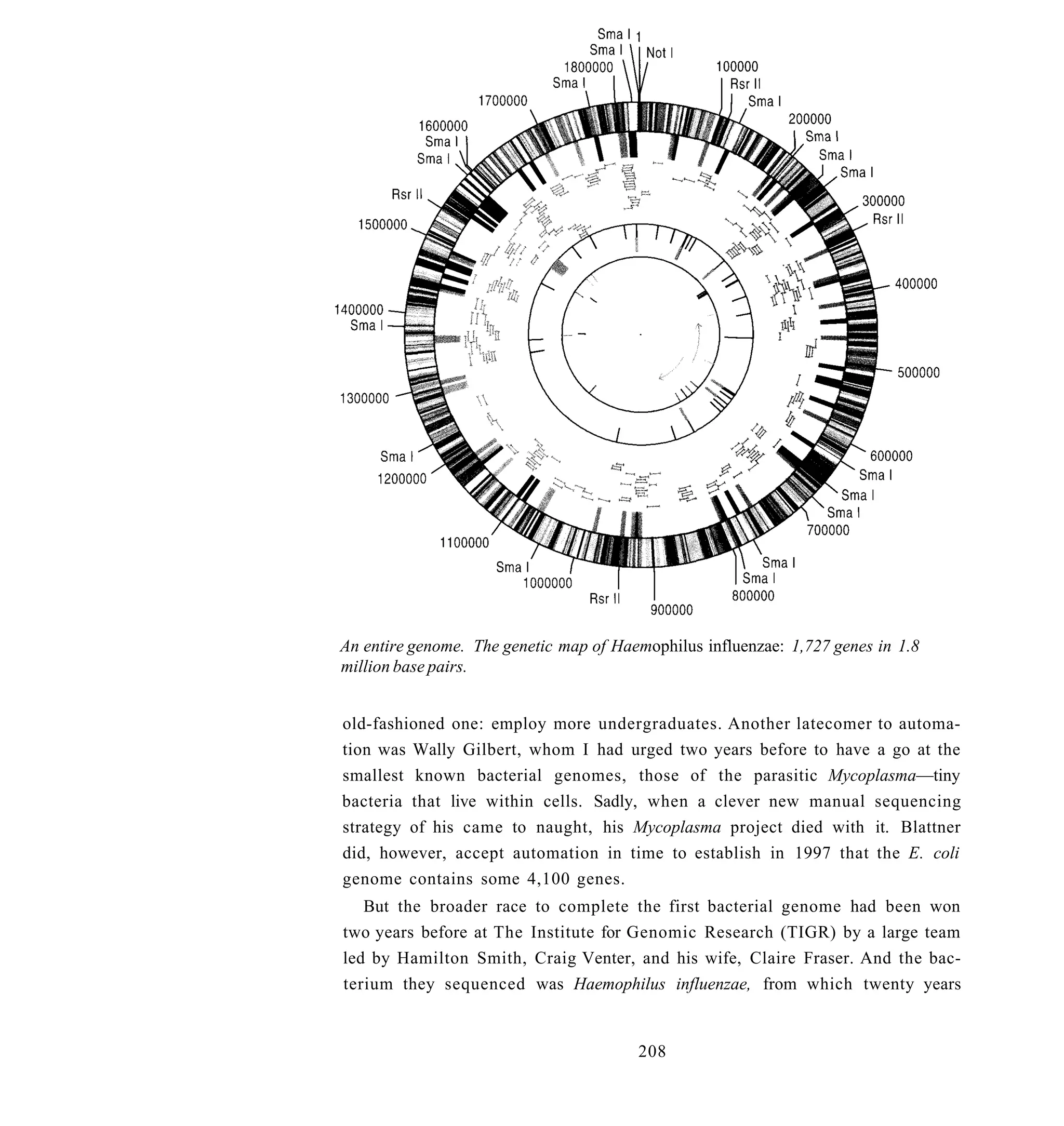
genome, some 580,000 base pairs. (Viruses have smaller genomes but, by
co-opting the genomes of their hosts, can get away with not having the genetic
wherewithal for many fundamental processes.) And that relatively short
sequence was found to comprise 517 genes. So a question naturally arose: Is
that the minimal gene complement necessary to sustain life. Subsequent
research has set about knocking out M. genitalium's genes to see which are
absolutely vital and which are not. Currently it appears that the minimal
genome contains no more than 350 genes and possibly as few as 260. Admit-
tedly, this is a somewhat artificially defined "minimum" since the enfeebled
bugs are supplied through their growth medium with every substance they
could conceivably need. It's a bit like claiming kidneys are not necessary for life
because patients can survive on dialysis machines.
   Will we ever be able to construct a functioning minimal cell from scratch, by
artificially combining its separate purified components? Considering there are
more than a hundred Mycoplasma genitalium proteins whose functions remain
a mystery, the achievement of such a goal seems for now a long way off. Even
the five hundred proteins of Mycoplasma, some represented in the cell by a
huge number of molecules, some by just a handful, constitute an enormously
complex living system. I, for one, have enough difficulty following a movie like
Gosford Park in which there are more than four or five major characters; the
thought of blocking out the complexity of interactions among the vital players
inside a living cell is nothing short of mind-blowing. For the living cell is no neat
miniature machine; it is rather, as Sydney Brenner put it, "a snake pit of
writhing molecules." Still, Craig Venter is confident that the era of the artificial
cell is just around the corner, and he has wasted no time in assembling a panel
of bioethicists to counsel him on whether to venture forth. They, like me, see no
moral dilemma in trying to "create life" in this way. If such a feat were ever
Reading     Genomes

achieved, it would merely reaffirm what most of us in molecular biology have
long known to be the truth: the essence of life is complicated chemistry and
nothing more. Such a finding would have made headlines a century ago; today
it's no big deal. Only the opposite conclusion—that there is more to the life of
the cell than the sum of its basic components and processes—could generate
deep excitement in today's scientific world.


D     NA analysis has already changed the face of microbiology. Before DNA
      techniques were broadly applied, methods of identifying bacterial species
were extremely limited in their powers of resolution: you could note the form of
colonies growing in a petri dish, view the shape of individual cells through the
microscope, or use such relatively crude biochemical assays as the Gram test,
by which species can be sorted as either "negative" or "positive" depending on
features of their cell wall. With DNA sequencing, microbiologists suddenly had
an identification factor that was discernibly, definitively different in every
species. Even species, like those inhabiting the ocean depths, that cannot be
cultured in a laboratory because of the difficulty of mimicking their natural
growing conditions are amenable to DNA analysis, providing a sample can be
collected from the deep.
   Now led by Claire Fraser, TIGR remains the leader of the bacterial genomics
pack. In short order they have polished off the genomes of more than twenty
different bacteria, including that of an ulcer-causing Helicobacter, a cholera-
causing Vibrio, a meningitis-causing Neisseria, and a respiratory-disease-
inducing Chlamydia. Their biggest competitor is a group at the Sanger Centre.
The British contingent is led by Bart Barrell, who had the luck not to be in the
United States, where his limited academic credentials would have barred him
from top-gun status: he has no Ph.D., having come into science straight out of
high school to work as Fred Sanger's assistant long before DNA sequencing
became a reality. Before moving on to bacteria, Barrell made his name as an
automation pioneer, having used several ABI sequencing machines to crank out
some 40 percent of the baker's yeast genome of 14 million bases while the
largely European yeast-sequencing consortium remained wedded to manual
methods. Barrell's group later had the satisfaction of being the first to complete


                                        211
DNA

                the sequence of Mycobacterium tuberculosis, the agent of the fearsome afflic-
                tion once known as consumption.
                   In high school, Claire Fraser "had felt like an outcast because it wasn't cool to
                be a woman taking so many science courses. "After studying at Rensselaer Poly-
                technic Institute, where she first became interested in microbes, she applied to
                medical school. Rather than accepting a place at prestigious Yale, she opted for
                SUNY Buffalo because her boyfriend was moving to Toronto. The director of
                admissions at Yale was nonplussed: "Well, young lady, I hope you know what
                you're doing." The Toronto connection would, alas, prove ephemeral; in 1981
                                    Fraser married Venter, then a young assistant professor at
                                    SUNY Buffalo. "We went to a [scientific] meeting for our
                                    honeymoon," she recalled, "and wrote a grant proposal
                                    there."
                                          The power of DNA analysis of microbes has been har-
                                       nessed with great success in medical diagnostics: to treat an
                                       infection effectively, doctors must first identify' the microbe
                                       causing it. Traditionally the identification has required cul-
                                       turing the bacteria from infected tissue—a process that is
                                       maddeningly slow, particularly in cases when time is of the
                                       essence. Using a fast, simple, and more accurate DNA test
                                       to recognize the microbe, doctors can start appropriate
                                       treatment that much sooner. And recently the same technol-
                                       ogy was pressed into service to deal with a national emer-
                                       gency: the hunt for the perpetrator of the anthrax outrage in
Claire Fraser, TIGR's guide through the United States in the fall of 2001. By sequencing the
the genomic jungle                     anthrax bacteria from the first victim, TIGR investigators
                                       obtained a genetic fingerprint of the precise strain used. The
                  hope is that this precise information on the source of the anthrax will lead even-
                  tually to the culprit.
                    As we learn more about microbial genomes, a striking pattern is emerging. As
                 we have seen, vertebrate evolution is a story of progressive genetic economy:
                 through a widening array of mechanisms for gene regulation, it has become pos-
                 sible to do more and more with the same genes. And even when new genes do
                 appear, they tend to be merely variations on an existing genetic theme. Bacte-


                                                         212
Reading    Genomes

rial evolution, by contrast, is proving itself a saga of far more radical transforma-
tion, a dizzying process that favors the importation or generation of whole new
genes, as opposed to merely tinkering with what already exists.
   Indeed, recombinant technology owes its very existence to the extraordinary
ability of bacteria to incorporate new pieces of DNA (usually plasmids). Not
surprisingly, then, microbial evolution too bears the footprint of dramatic gene-
importing events of the past. E. coli, normally a benign inhabitant of our intes-
tines (and of petri dishes), has morphed through gene importation into a killer
variant. The toxins produced by one strain that occasionally causes outbreaks of
food poisoning (killing twenty-one people in Scotland in 1996—97) and head-
lines about "Killer Burgers" are attributable to massive genetic "borrowing" from
other species.
   Genetic material normally moves vertically down a lineage—from ancestor to
descendant—so this importation of DNA from outside is known as "horizontal
transfer." Comparison of the genome sequence of normal E. coli to that of the
pathogenic strain has revealed a shared genetic "backbone," identifying both
strains as members of a common species, but there are many "islands" of diver-
gent DNA unique to the pathogen. Overall, the pathogen lacks 528 of the nor-
mal strain's genes and has instead a staggering 1,387 genes not present in the
normal strain. In that 528-for-1,387 exchange lies the key to the transformation
of one of natures most innocuous products into a killer.
   Other bacterial nasties also show similar evidence of wholesale horizontal
transfer. Vibrio cholerae, the agent of cholera, is unusual for a bacterium in that
it has two separate chromosomes. The larger one (about 3 million base pairs in
length) appears to be the microbe's original equipment, containing most of the
genes essential to the functioning of the cell. The smaller one (about 1 million
base pairs in length) seems to be a mosaic, made up of bits and pieces of DNA
imported from other species.
   Complex organisms, especially large ones like humans, are by design fairly
inviolable gatekeepers of their own internal biochemistry: in most cases, if we
don't ingest or inhale a substance, it cannot alter us profoundly. And so the bio-
chemical processes of all vertebrates have tended over time to remain very sim-
ilar. Bacteria, on the other hand, are much more exposed to the chemical
vagaries of the environment; a colony may find itself suddenly awash in a nox-


                                          213
DNA

ious chemical—say, a disinfectant like household bleach. Little wonder these
highly vulnerable organisms have evolved a stunning variety of chemistries.
Indeed bacterial evolution has been driven by chemical innovation, the inven-
tion of enzymes (or the retrofitting of old ones) to do new chemical tricks. One
of the most fascinating and instructive instances of this evolutionary pattern
occurs among bacteria whose secrets we have only recently begun to learn
about, a group known collectively as the "extremophilcs" because of its mem-
bers' predilection for the most inhospitable environments.
   Bacteria have been found in Yellowstone hot springs {Pyrococcus furiosus
thrives in boiling water and freezes to death at temperatures below 70°C
[158°F]) and in the superheated water of deep-sea vents (where the high pres-
sure at depth prevents the water from boiling). They have been found living in
environments as acidic as concentrated sulfuric acid and in acutely alkaline
environments as well. Thermophila acidophilum is an all-around extremophile,
withstanding, as its name suggests, both high temperatures and low pH. Some
species have been discovered in rocks associated with oil deposits, converting
oil and other organic material into sources of cellular energy, rather like so many
tiny sophisticated automobiles. One of these species inhabits rocks a mile or
more down and dies in the presence of oxygen; appropriately, it is named Bacil-
lus infernus.
   Perhaps the most remarkable microbes discovered in recent years are the
ones that subvert what was once considered a key dogma of biological sci-
ence—that all energy lor living processes comes ultimately from the sun.
Whereas even Bacillus infernus and oil-consuming bacteria found in sedimen-
tary rocks are connected to the organic past—the sun shone eons ago on the
plants and animals whose remains are today's fossil fuels—so-called lithoau-
totrophs are capable of extracting the nutrients they need from rocks created de
novo by volcanoes. These rocks—granite is an example—bear no traces of
organic material; they contain no vestige of the energy of sunny prehistoric
days. Lithoautotrophs have to construct their own organic molecules out of
these inorganic materials. They live, literally, on a diet of rock.
  There has been no more persuasive indicator of our general ignorance of the
microbial universe than our belated discovery of the bacterial genus Prochloro-
coccus, whose planktonic cells photosynthesize as they float in the open ocean.


                                        214
Reading     Genomes

As many as 200,000 may inhabit a single milliliter of seawater, making this
arguably the most abundantly represented species on the planet. It is certainly
responsible for a huge proportion of the ocean's contribution to the global food
chain. And yet Prochlorococcus was unknown to us until 1988.
   The extraordinary microbial universe around us reflects the phenomenal
power of eons of natural selection. Indeed the history of life on our planet can
be told mostly as a tale of bacteria; more complicated organisms, ourselves
included, are embarrassingly late arrivals—a virtual afterthought. Life appears
to have originated as bacteria some 3.5 billion years ago. The first eukaryotes—
cells whose genes are enclosed within nuclei—arose around 800 million years
later, but they remained single-celled for about a billion years after that. Only
about half a billion years ago did the breakthroughs occur that would ultimately
give rise to the likes of the earthworm, the fruit fly, and Homo sapiens. The pre-
dominance of bacteria is reflected in the DNA-based reconstruction of the tree
of life first carried out by Carl Woese at the University of Illinois: the tree of life
is a bacterial tree, with a few multicellular beings forming a late-growth twig.
Now generally accepted, Woese's ideas were at first strenuously opposed within
the biological establishment. Still some of the implications of the DNA-based
approach to the tree of life have been difficult to take: they have shown, for
instance, that animals are not, as was once supposed, closely related to plants;
rather, the closest relatives of animals are fungi. Humans and mushrooms stem
from the same evolutionary root.


T     he Human Genome Project has proved Darwin more right than Darwin
      himself would ever have dared dream. Molecular similarities stem ulti-
mately from the way in which all organisms are related through common
descent. A successful evolutionary "invention" (a mutation or set of mutations
that is favored by natural selection) is passed down from one generation to the
next. As the tree of life diversifies—existing lineages splitting to produce new
ones (reptiles persist as such, but also bud off into both bird and mammal line-
ages)—that invention may eventually appear in a huge range of descendant
species. Some 46 percent of the proteins we sec in yeast, for example, also
appear in humans. The yeast (fungal) lineage and the one that ultimately gave


                                           215
DNA

rise to humans probably split about 1 billion years ago. Since each has subse-
quently developed independently, free to follow its own evolutionary trajectory,
there have been in effect 1 billion years of evolutionary activity since that
yeast/human common ancestor; and yet, through all that time, that set of pro-
teins that existed in the common ancestor has changed only minimally. Once
evolution solves a particular problem—for example, designing an enzyme to
catalyze a particular biochemical reaction—it tends to stick with that solution.
We have seen how this kind of evolutionary inertia is responsible for the cen-
trality of RNA in cellular processes: life started in an "RNA world," and the
legacy remains with us to this day. And the inertia extends to the biochemical
details: 43 percent of worm proteins, 61 percent of fruit fly proteins, and 75
percent of fugu proteins have marked sequence similarities to human proteins.
   Comparing genomes has also revealed how proteins evolve. Protein mole-
cules can typically be envisioned as collections of distinct domains—stretches
of amino acid chains that have a particular function, or form a particular three-
dimensional structure—and evolution seems to operate by shuffling domains,
creating new permutations. Presumably most new permutations are as useless
as they are random, doomed to be eliminated by natural selection; but in the
rare instance that a new permutation proves beneficial, a new protein is born.
Some 90 percent of the domains that have been identified in human proteins
are also present in fruit fly and worm proteins. In effect, therefore, even a pro-
tein unique to humans is likely nothing more than a reshuffled version of one
found in Drosophila.
   There is no better demonstration of this fundamental biochemical similarity
among organisms than so-called rescue experiments, the aim of which is to
eliminate a particular protein in one species and then use the corresponding
protein from another species to "rescue" the missing function. We have already
seen this strategy implemented in the case of insulin. Because human and cow-
insulins are so similar, diabetics who fail to produce their own can be given the
cow version as a substitute.
  In an example evocative of B-movie science fiction, researchers have been
able to induce fruit flies to grow eyes on their legs by manipulating a particular
gene that specifies where an eye should go. That gene then induces the many-
genes involved in producing a complete eye to go to work in that designated


                                       216
Reading     Genomes

location. The mouse's corresponding gene is so similar to the fruit fly's that it
will perform the same function when situated—by the genetic engineer's
sleight of hand—in a fruit fly whose gene has been eliminated. That this can be
done is nothing less than remarkable. Fruit flies and mice have been separated
by evolution for at least half a billion years, so—following the logic applied
above to humans and yeast evolving simultaneously along independent lines—
the gene has in fact been conserved over a billion years of evolution. This is all
the more astonishing when we consider that fruit fly and mouse eyes have fun-
damentally different structures and optics. Presumably each lineage perfected
an eye appropriate for its respective purposes, but the basic machinery for
determining the location of that eye, needing no improvement, stayed the same.


T    he most humbling aspect of the Human Genome Project so far has been
     the realization that we know remarkably little about what the vast majority
of human genes do. To use the hard-won information properly requires us to
devise methods for studying the function of genes on a genomewide scale.
   In the wake of the HGP, two new postgenomic fields have duly emerged,
both of them burdened with unimaginative names incorporating the "-omic" of
their ancestor: proteomics and transcriptomics. Proteomics is the study of the
proteins encoded by genes. Transcriptomics is devoted to determining where
and when genes are expressed—that is, which genes are transcriptionally active
in a given cell. If the genome is ultimately to be understood in its more dynamic
reality, not as a mere set of instructions for life's assembly but as the screenplay
for life's movie—all the drama described in the precise order it is meant to
occur—then proteomics and transcriptomics provide the keys to glimpsing the
live action. The more we learn, the more we see of Life, the Movie.
   We have long appreciated that a protein is a great deal more in biological
terms than the linear string of amino acids that compose it. How the string folds
up to produce a distinctive three-dimensional configuration is really the key to
its function—what proteomics seeks to know. Structural analysis is still done
using X-ray diffraction: the molecule is bombarded with X rays that bounce off
its atoms and scatter in a pattern from which the three-dimensional shape may
be inferred. In 1962, my one-time colleagues at the Cavendish Lab at Cam-


                                         217
DNA


Proteomics: the 3-D structure of a cancer-causing protein, BCR-ABL. The fusion of the
two genes caused by a chromosomal abnormality leads to the production of this protein,
which stimulates cell proliferation and may cause a form of leukemia. Shown in purple is
a small molecule drug, Gleevec, which inhibits BCR-ABL function (see chapter 5). It is
with 3-D information like this that drugs will in the future be designed to target particu-
lar proteins. This representation of BCR-ABL's structure does not show the details of the
atoms or individual amino acids, but nevertheless accurately reflects the protein's layout.


bridge University, John Kendrew and Max Perutz, received the Nobel Prize in
Chemistry for their elucidation of the structures of, respectively, myoglobin
(which stores oxygen in muscle) and hemoglobin (which transports oxygen in
the bloodstream). Theirs was a monumental effort. The complexity of the X-ray
diffraction images they had to interpret made me appreciate the relative sim-
plicity of DNA!
   Knowledge of a protein's three-dimensional structure greatly assists the work
of medical chemists in their hunt for new drugs that work, as many do, by
inhibiting protein functioning. In the ever more specialized and automated
world of pharmaceutical research, several companies now offer to determine


                                            218
Reading     Genomes

the structure of proteins as if they were production-line commodities. And the
work is now immeasurably easier than it was in the day of Perutz and Kendrew:
with more powerful X-ray sources, automated data recording, and faster com-
puters driven by increasingly clever software, the time needed for solving a
structure can be reduced from many years to a matter of weeks.
   All too often, however, the three-dimensional structure itself provides no par-
ticular indication of that protein's function. Important clues may come instead
from studying how the mystery protein interacts with other known ones. A sim-
ple way to identify such interactions involves spotting out samples of a set of
known proteins on a microscope slide and then dousing them with the mystery
protein, which has been previously treated so it will fluoresce under UV light.
Where our test protein "sticks" to a particular spot on the slide's protein grid, it
has become bound to the protein in that spot, causing it too to become fluores-
cent. Presumably, then, these two proteins are engineered to interact within
the cell.
   Ideally, to know life's screenplay, to "see" life's movie, we need to discover all
the precise changes in protein composition that occur over the individual's
development, from the moment of fertilization all the way through to adult-
hood. Though many proteins will be found to be active throughout the process,
some will prove specific to a particular developmental stage, so in each growth
phase we should expect to see different sets of proteins. Adult and fetal hemo-
globins, for example, are subtly different. Similarly, each variety of tissue pro-
duces its own profile of proteins.
   The most reliable way to sort out the various proteins from a given tissue
sample is still the long-established method that uses two-dimensional gels to
separate protein molecules on the basis of differences in their electrical charge
and molecular weight. The several thousand protein spots thus differentiated
can then be analyzed with a mass spectrometer, an instrument that can deter-
mine each one's amino acid sequence. Unfortunately, to apply proteomics like
this to the vast number of proteins coded by an entire genome requires more
funding than academic scientists typically have. For the most part, such expen-
sive enterprises are left to the better-endowed researchers of large pharmaceu-
tical companies. But because of the method's limitations, even their labs can't
routinely find proteins that are present in very small amounts.


                                         219
DNA

   This type of high-throughput proteomics, with all its expensive hardware and
industrial-scale automation of complicated procedures, is therefore not the way
most scientists nowadays study gene function at the genome level. Instead,
methods of transcriptomics have been adopted, because they are cheaper and
easier to apply: the functioning of all genes in a genome can be tracked by
measuring the relative amounts of their respective messenger RNA (mRNA)
products. If you are interested in the genes being expressed in, say, a human
liver cell, you isolate a sample of mRNAs from liver tissue. This represents a
snapshot of the mRNA population in the liver cell: very active genes, those
most heavily transcribed and that produce many mRNA molecules, will be
more abundantly represented, whereas genes that are rarely transcribed will
contribute only a few copies to the mRNA sample.
   The key to transcriptomics is a surprisingly simple invention known as a
DNA microarray. Imagine a microscope slide with a grid of 35,000 tiny dot-
shaped wells etched onto it. Using precise micropipetting techniques, DNA
sequences from just one gene are deposited in each well so that the grid con-
tains every gene in the human genome. Critically, the location on the micro-
scope slide of each gene's DNA is known. Affymetrix, a company near Stanford,
has managed to miniaturize these arrays even further by etching them onto a
sliver of silicon the size of a small computer chip, yielding a "DNA chip."
   Using standard biochemical techniques, you can tag your liver mRNAs with
a chemical marker so, like the proteins mentioned above, they will fluoresce
obligingly under UV light. Then comes the step where the power and simplicity
of the technique becomes wonderfully apparent: you simply dump your sample
of mRNAs onto the microarray with its minuscule chessboard of 35,000 gene-
filled wells. The very same base-pairing bonds that hold together the two
strands of the double helix will compel each mRNA molecule to pair off with
the gene from which it was derived. The complementarity is precise and fool-
proof: the mRNA from gene X will bond only to the very spot occupied by gene
X on the microarray. The next step is merely to observe which spots have picked
up the fluorescent mRNAs. One spot on the microarray may show no fluores-
cence, implying that there was no complementary mRNA in the sample—and
thus, we may infer, no active transcription of that gene in the liver cell. On the
other hand, a number of spots do fluoresce, some with particular intensity; this
indicates that many mRNA molecules have bound to it. Conclusion: a very

                                       220
Reading     Genomes

active gene. Thus, with a single simple experimental assay, you have identified
every one of the genes active in the liver. And such molecular panoramas have
been made possible thanks to the success of the Human Genome Project and
the new mind-set it has ushered into biology: we no longer need be content to
study bits and pieces—we can now see the whole picture in all its spectacular
glory.
   It is hardly surprising that Stanford's Pat Brown, one of the method's leading
practitioners, sees DNA microarrays as "a new kind of microscope." Marveling
at the technology's potential to reveal a whole new genetic universe, he has
declared: "We're toddlers now just starting to discover our world."
   Transcriptomics is more than just another brilliant technical innovation. It
promises to take us to a new level in the hunt for the genes that cause illness:
using microarray technology we can discover the chemical basis for particular
afflictions by studying the differences between healthy and diseased tissue as a
function of gene expression. The logic is simple. We carry out microarray gene
expression analysis on both normal and cancerous tissue, and spot the difference
between the two, the genes being expressed in one and not the other. Once we can
identify which genes are malfunctioning—either over- or underexpressing them-
selves in the cancerous tissue, tor instance—we may be able to establish a target
that can be attacked with pinpoint molecular therapies as opposed to broadly toxic
radio- and chemotherapies that destroy healthy as well as diseased cells.
   And we can apply the same technologies to distinguish among different
forms of the same disease. Standard microscopy has offered limited assistance
in this task: cancers that look alike to the pathologist peering through the eye-
piece can in fact be critically different at the molecular level. Lymphoma cells,
for instance, come in varieties that are hard to tell apart visually, even with the
highest powers of resolution, but the differences in their gene expression pro-
files are clear, and vitally important in devising the most effective treatment.
Referring to the earlier tendency to assume all cancers of a particular tissue
have the same root, Brown said, "It was like thinking a stomachache has only
one cause. Recognizing the distinctions makes it possible for us to do a better
job of treating these cancers."
  At Cold Spring Harbor Laboratory, Michael Wigler is using the method in yet
another way: rather than adding RNA to a microarray and looking for gene
expression, he is adding DNA from cancer cells to create a profile of the genetic

                                        221
DNA

diversity present in tumors. Many cancers are caused by chromosomal
rearrangements—such as might occur when segments of a chromosome are
inadvertently duplicated, leading to an excess in the number of genes that code
for growth-promoting proteins. Other cancers arise due to the loss of genes cod-
ing for proteins that repress cell growth. Applying Wigler's technique, clinicians
biopsy cancerous and healthy tissues from the same person. DNA from the
cancerous tissue is chemically tagged with a red dye while the DNA from
the normal tissue is tagged green. DNA microarrays, containing all 35,000 of
the known human genes, are exposed to a mixture of the two samples. Like
mRNA in a standard microarray experiment, the labeled DNA molecules bind
base pair to base pair to their complementary sequences in the array. Genes
amplified in cancer cells are marked by red spots (because there are many more
red-tagged molecules binding to that spot than green-tagged ones) while genes
deleted in cancer cells show up as green spots on the microarray (because there
is no red-tagged molecule to bind there). Such experiments have already greatly
expanded the list of genes known to contribute to breast cancer.
   Whenever we tackle a specific human disease, we realize the extent to which
we are probing in the dark. We could move so much more quickly to the heart
of the problem—know the exact nature of what is wrong and how we might fix
it—if only we had a more detailed knowledge of how our genes express them-
selves when all is well. With a fully formed dynamic understanding of when and
where each of our 35,000-plus genes functions during normal development
from fertilized egg to functioning adult, we would have a basis of comparison by
which to understand every affliction: what we need is the complete human
"transcriptome." This is the next holy grail of genetics, the next big quest in
need of superfunding. In the short term, a likelier, even more important objec-
tive will be to obtain the complete transcriptome for the mouse, whose advan-
tage over humans is that we can both observe and intervene experimentally
during the course of prenatal development. Even collecting all such relevant
data from the mouse will require major investments of money and time. And, as
proved by the experience of DNA sequencing, we will be well served to take the
time to gain what expertise we can by completing transcriptomes for simpler
model organisms before taking on the mouse, much less the human.
   Microarray studies of gene expression during the yeast cell cycle have already


                                       222
Cell division: a cell's chromosomes (blue) are duplicated and then lined up along a special
"spindle" (green) prior to being assigned to each daughter cell. High-tech imaging tech-
niques help bring to life the extraordinary chromosomal waltz underpinning life's ability
to perpetuate itself.

revealed the staggering complexity inherent in the molecular dynamics of cell
division alone. More than eight hundred genes are involved, each called into
action at its precisely specified time in the cell cycle. Here too we may depend
on evolution's reluctance to fix what ain't broke: a biological process, once suc-
cessfully evolved, will likely continue to employ the same basic molecular
actors for as long as life persists on earth. As far as we can tell, those same pro-
teins that direct development through the course of the yeast cell cycle carry
out similar roles in the human cell.


U      ltimately the goal of all three "-omics" (gen-, prote-, and transcript-) is to
       create a full picture, detailed right down to the level of the individual mol-
ecule, of how living things are assembled and operate. As we have seen, in even
the simplest cases, the complexity is bewildering, and, despite the spectacular
progress of the last decade, there remain many daunting challenges. As they
relate to complex organisms, the molecular underpinnings of development—
that extraordinary egg-to-adult journey that is governed by a linear code strand
composed of just four letters—are for now best understood in the case of the
fruit fly.


                                           223
DNA

   The fly has, of course, been the focus of intensive genetic investigation ever
since its adoption by T. H. Morgan, and through the ensuing years of continual
innovation Drosophila melanogaster has remained a genetic gold mine. In the
late seventies at the European Molecular Biology Laboratory in Heidelberg,
Germany, Christiane "Janni" Nusslein-Volhard and Eric Wieschaus undertook a
spectacularly ambitious fruit fly project. They used chemicals to induce muta-
tions and then looked for disruptions in the very early embryonic stages of the
flies' progeny. Classically, the quarry of the fruit fly geneticist was mutations
affecting adults, like the one Morgan found to produce white (rather than red)
eyes. In focusing on embryos, Nusslein-Volhard and Wieschaus were not only
condemning themselves to years of eyestrain as they stared down microscopes
in pursuit of those elusive mutants, they were also venturing into utterly
uncharted territory. The payoff, however, was spectacular. Their analysis uncov-
ered several suites of genes that lay out the fundamental body plan of the devel-
oping fly larva.
   The more universal message of their work is that genetic information is hier-
archically organized. Nusslein-Volhard and Wieschaus noticed that some of
their mutants showed very broad effects while others evinced more restricted
ones; from this they inferred correctly that the broad-effect genes operate early
in development—at the top of a switching hierarchy—while the restricted-
effect genes operated later. What they had found was a cascade of transcription
factors: genes switching on other genes that in turn switch on others still, and
so on. Indeed, hierarchical gene-switching of this kind is the key to the con-
struction of complex bodies. A gene producing the biological equivalent of a
brick will, left to its own devices, produce a pile of bricks; with proper coordi-
nation, however, it can produce a wall, and ultimately a building.
   Normal development depends on cells "knowing" where they are in a body. A
cell in the tip of a fly's wing, after all, should develop along very different lines
than one located in the region that will give rise to the fly's brain. The first piece
of essential positional information is the simplest: How does the developing
fruit fly embryo know which end is which? Where should the head go? Bicoid,
a protein produced by a gene in the mother, is distributed in varying concentra-
tions through the embryo. The effect is called a "concentration gradient": the
protein levels are highest at the head end and fall off as you travel toward


                                         224
Reading     Genomes

the rear. Thus the bicoid concentration gradient instructs all cells within the
embryo as to where they fall on the head-to-tail axis. Fruit fly development is
segmental, meaning that the body is organized into compartments, all of which
have much in common but each of which has some features unique to it. In
many respects, a head segment is organized just like one in the thorax (the mid-
dle part of the insect body), but the former has head-specific organs, like eyes,
and the latter thorax-specific ones, like legs. Nusslein-Volhard and Wieschaus
found groups of genes that specify the identities of different segments. For
instance, "pair-rule" genes encode transcription factors—genetic switches—
expressed in alternating segments. Pair-rule gene mutants result in an embryo
with developmental problems in every second segment.
   In 1995, Nusslein-Volhard and Wieschaus received the Nobel Prize in Phys-
iology or Medicine for their pioneering work. Unlike most laureates, both have
remained active lab scientists—not for them the retreat into a big diploma-
festooned office. For Wieschaus, science is still irresistible: "Because embryos
are beautiful and because cells do remarkable things, I still go into the lab every


Fruit fly faces. On the left is a normal individual, with a fair of feathery antennae pro-
truding from its forehead. On the right is an antennapedia mutant, in which the antennae
have been replaced by fully formed legs.
DNA

day with great enthusiasm." As a child in Birmingham, Alabama, he dreamed of
becoming an artist. Short of money as a sophomore at the University of Notre
Dame, however, he took on one of the smelliest and most menial jobs in all of
science: making the "fly food" (a noxious gelatinous concoction consisting
largely of molasses) for a research lab's experimental population of fruit flies.
Most people who serve as chef to a few hundred thousand messy and unappre-
ciative insects would likely develop a lifelong aversion to the critters. For
Wieschaus the result was the opposite: a lifelong commitment to the fruit fly
and the mysteries of its development.
   Born into an artistic German family, Nusslein-Volhard was one of those stu-
dents who excels at everything that interests them but puts absolutely no effort
into anything else. Her hard work in illuminating the fruit fly's developmental
genetics would have been achievement enough to justify two careers, but in the
wake of her Nobel she has redirected her formidable attention to the develop-
ment of another species altogether, the zebra fish: new work that promises to
unlock many of the secrets of vertebrate development. At the 2001 event mark-
ing the centenary of the Nobel Prize it struck me that she was the only woman
scientist present among the throngs of gray-haired males. Indeed, she is one of
only ten women ever to win a Nobel in science.
  One of those no-longer-youthful men was Caltech's Ed Lewis, an old fruit fly
hand who shared the prize with Nusslein-Volhard and Wieschaus. Actually
Lewis doesn't much fit the gray-hair stereotype: though in his eighties at that
Stockholm event, when he wasn't obliged to wear tails he was often seen in run-
ning gear! He too had long been concerned with the genetic control of fruit fly
development, but his special interest was "homeotic mutations." These produce
a most bizarre result: one developing segment mistakenly acquires the identity
of a neighboring segment. His long and painstaking dedication to the Hox
genes, in which these mutations occur, exemplifies values vanishing in an era
when fads too often set science's agenda.
   Homeotic mutations—which we now know disrupt transcription factor-
encoding genes (the genetic switches)—can have drastic effects. The "antenna-
pedia" mutation results in the fly's growing legs where its antennae belong: a
fully formed pair of legs protruding from its forehead. The "bithorax" mutation
is almost as weird. Normally one of the segments making up the thorax pro-


                                       226
Reading     Genomes

duces the fly's pair of wings while the next thoracic segment toward the rear
generates a pair of small stabilizing structures called "halteres." In a bithorax fly,
the haltere segment mistakenly produces wings, so a fly that should have two
wings in fact has four, the second pair just as perfectly formed as the first.
   When they function properly, the genes regulating segment identity ensure
that each body section acquires organs appropriate to its position: a head seg-
ment acquires antennae, and a thoracic segment acquires wings and legs. In the
event of homeotic mutations, however, there is a confusion of segment identity.
Thus, in the case of antennapedia, a head segment imagines itself a thoracic
one and duly produces a leg rather than an antenna. Note, though, that while
the leg is in the wrong place, it's still a perfectly good leg. Implication: The
antennapedia positional gene switches on a whole suite of genes, typically those
that produce an antenna, or, aberrantly, those that produce a leg; but the coor-
dination within the suite is unhindered even when these genes are activated in
the wrong place at the wrong time. Here again we see how genes high up in the
developmental hierarchy control the fate of many, many genes farther down the
line. As any librarian knows, hierarchical organization is an efficient way in
which to store and retrieve information. With such a cascade arrangement, a
surprisingly few genes can take you a long way.


N       ow that we are in the new era of comprehensiveness in biology ushered in
        by the once-unimaginable feat of the Human Genome Project, it may
seem curious that we should find ourselves following the cutting edge of one of
the next frontiers—that of developmental genetics—back into the realm of the
fruit fly. But there is nowhere for us to go but back to the future, for even with
the entire human genome in hand, the program and cues according to which its
instructions are carried out remain a colossal mystery. Eventually we shall know
the screenplay of human life as well as we know that of the fly. A comprehensive
description of the patterns of human gene expression (the transcriptome) will
be developed. A full inventory of the actions of all our proteins (the proteome)
will be produced. And we will have a full and spectacularly complex picture of
how each one of us is put together, and how each one of the multitudinous mol-
ecules we are made of figures in the functioning of you and me.


                                          227
CHAPTER           NINE


                         OUT OF AFRICA:
                    DNA AND THE H U M A N PAST


          I   n August 1856 German quarry workers discovered part of a skeleton as they
              blasted their way into a limestone cave in the Neander Valley outside Dus-
              seldorf. At first the remains appeared to be those of an extinct bear species
          whose bones often showed up in caves, but a local schoolteacher realized that
          the creature in fact belonged to a species much closer to our own. The exact
          identity of the owner of the bones, however, would prove a point of controversy.
          Particularly puzzling was the skull's thick brow ridge. One bizarre suggestion
          was that the bones belonged to an injured Cossack cavalryman who had
          crawled into the cave to die during the Napoleonic wars. Chronic pain from a
          preexisting condition, so the crackpot theory went, had produced a permanent
          furrow in the poor fellow's brow, deforming the bones of the skull to create the
          distinctive ridge. In 1863, in the midst of the debate about human origins pro-
          voked by the publication of Darwin's Origin of Species four years earlier, the
          original owner of the bones was given a name: Homo neanderthalensis. The
          bones belonged to a species distinct from, but similar to, Homo sapiens.
            Though the German bones were the first to be officially designated Nean-
          derthal, others found earlier in Belgium and Gibraltar were now recognized as
          being from members of the same species. More than a century later, many more
          specimens of H. neanderthalensis have been unearthed, and we now believe
          that Neanderthals settled throughout Europe, the Middle East, and parts of
          North Africa until about 30,000 years ago. French paleontologist Marcellin
          Boule is largely responsible for the popular image of Neanderthals as dim-

Barbecues, ancient and modern: an artist's reconstruction (top) of a Neanderthal
encampment in southern Europe about 35,000 years ago, with the equivalent scene
from the more recent past (bottom). Are we descended from Neanderthals? DNA
evidence suggests not.
DNA

witted and hulking. But his reconstruction, which used material from a French
site at La Chapelle-aux-Saints, was based on a single individual who turns out
to have been elderly and arthritic. In fact, Neanderthal brains were slightly
larger than ours (and of a different shape due to a flatter cranium) and evidence
from burial sites suggests that Neanderthals were culturally sophisticated
enough to engage in funeral rituals; they may then have even believed in an
afterlife.
   The biggest debate triggered by the discovery of Neanderthals, however, cen-
tered not on how smart they were but on how they might be related to us. Are
we descended from them? Paleontology suggests that modern humans arrived
in Europe at roughly the same time as the last of the Neanderthals disappeared.
Did the two groups interbreed or were the Neanderthals simply eliminated?
Because the events in question happened in the ancient past and the surviving
evidence is fragmentary—little beyond the odd bone—debates like this can
drag on and on, keeping academic paleontologists and anthropologists endlessly
entertained. Is a particular bone specimen perhaps intermediate between the
thick bones typical of Neanderthals and the lighter bones of modern humans?
Such specimens may have belonged to a hybrid individual produced by inter-
breeding between the two groups—a missing link. But then again they might
just as well have come from a full Neanderthal with atypically light bones, or,
for that matter, a fully modern human with unusually thick ones.
   To everyone's surprise, the debate has been resolved by DNA: 30,000-year-
old DNA extracted in 1997 from the very bones that started it all in 1856. Hav-
ing evolved in order to store information securely and transmit it from one
generation to the next, DNA, no surprise, shows great chemical stability. It
doesn't degrade spontaneously or react readily with other molecules. But it is
not impervious to chemical damage. At the moment of death, the body's genetic
materials, like all its other constituents, become susceptible to a horde of
would-be degraders: reactive chemicals, and enzymes that break down the
molecular fabric. These chemical reactions require the presence of water, so
DNA may be preserved if a corpse dehydrates fast enough. But even under
ideal preservation conditions, the molecule is likely to survive perhaps 50,000
years at the absolute maximum. To obtain a legible DNA sequence from
30,000-year-old Neanderthal remains, preserved imperfectly, was therefore a
tall order at best.

                                       230
Out of Africa

   But Svante Paabo, a tall, laconic Swede at the University of Munich, decided
to have a crack at the problem. If anyone could do it, he was the one. Paabo had
pioneered work on the retrieval of so-called ancient DNA; he had scored
sequences from Egyptian mummies, frozen mammoths, and the 5,000-year-old
"Ice Man" who melted out of an Alpine glacier in 1991. Despite this impressive
resume, though, the prospect of drilling into a precious Neanderthal relic to
look for intact DNA, if indeed any was to be found inside, was daunting. As his
archaeologist colleague Ralf Schmitz recalls, "It was like getting permission to
cut into the Mona Lisa."
   Matthias Krings, Paabo's graduate student, took on the project. He was pes-
simistic at first, but favorable early analyses to assess the bones' state of preser-
vation emboldened Krings to press ahead. His search for viable DNA was
focused not in the cells' nuclei, as one might expect, but in the little bodies
called mitochondria, which are scattered throughout the cell outside the
nucleus and produce the cell's energy. Each mitochondrion contains a small
loop of DNA, some 16,600 base pairs in length. And because there are from
500 to 1,000 mitochondria in every cell, but only two copies of the genome
proper (in the nucleus), Krings knew that those decaying Neanderthal bones
were much more likely to yield intact mitochondrial sequences than intact
nuclear ones. Furthermore, since mitochondrial DNA (mtDNA) had long been
a staple of studies of human evolution, Krings would have plenty of modern
human sequences against which to make comparisons.
   A major worry for Krings and Paabo was contamination. In the past a number
of claimed successes at sequencing ancient DNA had proved to be erroneous
when the sequence turned out to be from a modern source that had contami-
nated the sample. Every day each of us sloughs off a vast number of dead skin
cells, showering our DNA into the environment to wind up we know not where.
The polymerase chain reaction (PCR), with which Krings expected to amplify
the stretch of mtDNA he hoped to find, is so sensitive that it can act upon a
single molecule, amplifying any DNA it might encounter regardless of whether
the source is ancient or still kicking. What if the Neanderthal DNA was too
degraded for PCR to work, but the reaction proceeded nevertheless, amplifying
a DNA sequence from an invisible contaminating particle that had flaked off
Krings himself? Krings might then have to explain how he and the Neanderthal
happened to have the same mtDNA sequence—a result unlikely to please the

                                        231
DNA

young man's boss, and even less his parents. To insure against this possibility,
Krings and Paabo arranged for a separate laboratory, Mark Stoneking's at Penn-
sylvania State University, to replicate the study. Contamination might occur
there, too, but probably not with DNA from Krings, a continent away. And if
both labs obtained the same result from the sample, it would be reasonable to
suppose they had found a bona fide Neanderthal sequence.
   "I can't describe how exciting it was,'' says Krings of the moment he first
glimpsed the sequencing results. "Something started to crawl up my spine."
Although, as feared, some sequences showed evidence of contamination, in
others he could see something wondrous: a collection of intriguing similarities
to, and differences from, the modern human sequence. Piecing together seg-
ments, he was able to reconstruct a Neanderthal mtDNA stretch running 379
base pairs. But the results weren't yet in from Penn State. Those sequences,
however, proved to be the same: the identical 379 base pairs. "That's when we
opened the champagne," Krings recalls.
   The Neanderthal sequence had more in common with modern human
mtDNA sequences than with those of chimpanzees, telling us that Nean-
derthals were unquestionably part of the human evolutionary lineage. At the
same time, however, there were dramatic differences between the Neanderthal
sequences and all 986 available sequences of modern human mtDNA to which
Krings compared his sample. And even the most similar of those 986 sequences
still differed from the Neanderthal one by at least 20 base pairs (or 5 percent).
Subsequently, mtDNA has been sequenced from two other Neanderthals, one
found in southwest Russia, the other in Croatia. The sequences, as expected,
are not identical to the original one—we would expect to see variation among
Neanderthal individuals just as we would among modern humans—but they
are similar. The sum of the genetic evidence leads us to conclude that while
Neanderthals do have their place on the evolutionary tree of humans and their
relatives, the Neanderthal branch is a long way from the modern human limb.
If, when they encountered each other in Europe 30,000 years ago, Neanderthals
and moderns had indeed interbred, Neanderthal mtDNA sequences would
have entered the modern human gene pool. That we see no evidence of such
Neanderthal input implies that modern humans eliminated the Neanderthals
rather than interbreeding with them. But whether they achieved the lethal


                                       232
Out    of Africa

result by direct confrontation or by more subtle means is something the DNA
can't tell us.


S     tudies of Neanderthal DNA have shown that we are genetically distinct
      from Neanderthals. But the overall lesson of molecular studies of human
evolution has tended to run in the opposite direction, revealing just how aston-
ishingly close we are genetically to the rest of the natural world. In fact, molec-
ular data have often challenged (and overthrown) long-held assumptions about
human origins.
  The great chemist Linus Pauling was the father of modern molecular
approaches to evolution. During the early 1960s, he and Emile Zuckerkandl
compared the amino acid sequences of corresponding proteins from several
species. These were the early days of protein sequencing, and their data were
inevitably limited. Nevertheless, the pair noticed a striking pattern: the more
closely related two species are in evolutionary terms, the more similar are the
sequences of their corresponding proteins. For example, comparing one of the
protein chains of hemoglobin molecules, Pauling and Zuckerkandl noted that
over its total length of 141 amino acids, there is only one difference between
the human version and the chimpanzee, but the difference between humans
and horses is 18 amino acids. The molecular sequence data reflect the fact that
horses have been evolutionarily separated from humans longer than chim-
panzees. Unearthing evolutionary history buried in biological molecules is now
common practice; at the time, however, the idea was novel and controversial.
   Molecular approaches to studying evolution depend on the correlation of two
variables: the length of time two species (or populations) have been separated
and the extent of molecular divergence between them. The logic of this "molec-
ular clock" is simple. To illustrate it, let us imagine some matchmaking between
two pairs of identical twins, one of genetically identical females and one of
identical males. Each female is wed to one of the males, and each couple is
then placed on its own otherwise uninhabited island. From a genetic perspec-
tive, the populations of the two islands are at the outset indistinguishable. Now
leave each couple and its descendants alone for a few million years. At the end
of this period, mutations will have occurred in the population on one island that


                                       233
DNA

will not have occurred in the population on the other. And vice versa. Because
mutations occur at a low rate and because individual genomes, being large,
offer huge numbers of possible sites where mutations might occur, it is incon-
ceivable that both populations will have acquired the same set of mutations. So
when we sequence DNA from the descendants of each couple, we will find that
many differences between the once-identical genomes have accumulated. We
say that the populations have "diverged" genetically. The longer they have been
separated, the more divergent they will be.
   But how do we tell time, so to speak, by looking at this "molecular clock"? Put
another way, how can we measure the genetic divergence between ourselves,
say, and the rest of the natural world? In the late sixties, long before the advent
of DNA sequencing, Allan Wilson, a whimsical New Zealander at UC Berkeley,
together with his colleague Vince Sarich, set about applying the Pauling-
Zuckerkandl logic to humans and their closest relatives. But at a time when pro-
tein sequencing was still a dauntingly cumbersome and laborious affair, Wilson
and Sarich found an ingenious shortcut.
   The strength of an immune reaction to a foreign protein reflects how foreign
the protein is: if it is relatively similar to the body's own protein, then the
immune reaction is relatively weak, but if it is very different the reaction is pro-
portionately stronger. Wilson and Sarich compared reaction strengths by taking
a protein from one species and measuring the immune responses it triggered in
others. This gave them an index of the molecular divergence between two
species, but to introduce a time dimension to this "molecular clock" they
needed to calibrate it. Fossil evidence implied that New and Old World mon-
keys (the two major groups of monkeys) separated from their common ancestor
around 30 million years ago—and so Wilson and Sarich set the immunological
"distance" between New and Old World monkeys as equivalent to 30 million
years' separation. Where did this put humans in relation to their closest evolu-
tionary kin, chimpanzees and gorillas? In 1967 Wilson and Sarich published
their estimate that the human lineage had separated from that of the great apes
about 5 million years ago. Their claim provoked an uproar: in paleoanthropolog¬
ical circles conventional wisdom held that the divergence had occurred around
25 million years ago. Between humans and apes, the establishment insisted,
there is clearly much more than 5 million years' worth of difference. It was, for
many, cause enough to dismiss the Berkeley team's newfangled genetic method

                                        234
Out   of Africa

as untrustworthy, and, to declare that, anyway, geneticists should stick to their
fruit flies, and leave humans to the anthropologists! Wilson and Sarich, how-
ever, weathered the storm. And subsequent research has shown that their dat-
ing of the human/great ape split was remarkably accurate.
   When the time came to extend his analysis of the human/ape divide from
proteins to DNA, Wilson entrusted the effort to his graduate student Mary-
Claire King. The product, in 1975, was one of the outstanding scientific papers
of the twentieth century. For a long time, though, such a triumphant outcome
seemed unlikely, especially from King's perspective. Her work had not been
going well, owing in part to the enormous distraction
created at Berkeley by the anti—Vietnam War move-
ment in the early 1970s. King considered going off
to Washington, D.C., to work for Ralph Nader, but
fortunately she sought Wilson's advice. "If everyone
whose experiments failed stopped doing science,"
he wisely counseled, "there wouldn't be any sci-
ence." King stuck with it.
   King and Wilson's comparison of the chimpanzee
and human genomes combined a number of meth-
ods, including a clever technique called "DNA
hybridization." When two complementary strands of
DNA come together to form a double helix, they
can be separated by heating the sample to 95°C—a
phenomenon called "melting" in the molecular
                                                        Mary-Claire King
geneticist's jargon. What happens when the two
strands are not perfectly complementary—when
there are mutations in one of them? It turns out that two such strands will melt
apart at a temperature lower than 95°C. How much lower will depend upon
the degree of difference between the two strands: the greater the difference,
the less the heat required to pry them apart. King and Wilson used this princi-
ple to compare human and chimpanzee DNAs. The closer the two were in
sequence, the closer the double helix's melting point would be to the perfect-
match standard of 95°C. The closeness observed was surprising indeed: King
was able to infer that human and chimpanzee DNA differ in sequence by a
mere 1 percent. In fact humans have more in common with chimpanzees than

                                       235
DNA

chimpanzees do with gorillas, the genomes of the latter two differing by about
3 percent.
    So striking was the result that King and Wilson felt obliged to put forward an
explanation for the apparent discrepancy between the rates of genetic evolu-
tion—slow—and of anatomical and behavioral evolution—fast. How could so
little genetic change account for the substantial difference we see between
the chimpanzee at the zoo and the species on the other side of the glass? They
suggested that most of the important evolutionary changes had occurred in
the pieces of DNA that control the switching on and off of genes. This way, a
small genetic change could have a major effect by changing, say, the timing of
the expression of a gene. In other words, nature can create two very different-
looking creatures by orchestrating the same genes to work in different ways.


T    he next, and biggest, bombshell from Wilson's Berkeley lab came in 1987.
     Using patterns of DNA sequence variation, he and his colleague Rebecca
Cann figured out the family tree for our entire species. It was one of the very
few pieces of science ever to make the cover of Newsweek.
   As Krings would in his analysis of Neanderthals a decade later, Cann and
Wilson relied on mitochondrial DNA. There were several reasons for using
mtDNA, but as usual the practical ones were most important. In the days
before PCR technology had entered the research mainstream, getting enough
DNA to probe a particular gene or region could be quite a headache. And Cann
and Wilson's study called for analyzing not one but 147 samples. They therefore
needed as much DNA as they could get their hands on. A human tissue sample
is massively rich in mtDNA compared with the chromosomal DNA found in
cell nuclei. Still, Cann and Wilson would need plenty of tissue if they were to
have any hope of extracting even mtDNA in sufficient quantities. Their solu-
tion: placentas. Usually discarded by hospitals after babies arc delivered, these
are a rich source of mtDNA. All Cann and Wilson had to do was persuade 147
pregnant women to donate their babies' placentas to science—146, actually,
because Mary-Claire King was more than willing to contribute her daughter's
placenta. And they knew that to reconstruct the human family as completely as
possible they would need tissue from the most genetically diverse range of
donors they could assemble. Here America's melting-pot population offered a

                                       236
The mitochondrial DNA
human family tree
DNA

distinct advantage: they would not have to travel to Africa to get hold of African
DNA—the slave trade had brought African genes to our shores. But Cann and
Wilson would have to depend on collaborators in New Guinea and Australia to
find Aboriginal women (not much represented in the U.S. gene pool) who were
willing to participate.
   Your mtDNA is inherited from your mother. Your fathers genetic contribu-
tion, contained in the head of a single sperm, did not include mitochondrial
material. The sperm's DNA is injected into an egg cell that already contains
mitochondria derived from the mother. Cann and Wilson would therefore be
tracing the history of the human female line. Inherited from just one parent,
mtDNA never gets an opportunity to undergo recombination, the process by
which segments of chromosome arms are exchanged so that mutations are
shuffled from one chromosome to another. The absence of recombination in
mtDNA is a major advantage when we come to reconstruct the family tree
based on similarity of DNA sequences. If two sequences have the same muta-
tion, we know that they must be descended from a common ancestor (in whom
that mutation originally arose). Were recombination occurring, however, one of
the lineages could have acquired the mutation just recently through a recombi¬
national shuffling event, so having a mutation in common would not necessar-
ily indicate common ancestry. Now the logic for using mtDNA to make the
family tree is simple. Similar sequences—those with plenty of mutations in
common—indicate close relationship; sequences with many differences indi-
cate a more distant relationship. In visual terms, close relatives—those that
derive from a relatively recent common ancestor—will cluster close together on
the family tree; distant relatives are more spread out, because their common
ancestor is relatively far back.
   Cann and Wilson found that the human family tree has two major branches,
one comprising only various groups within Africa and the other consisting of
some African groups plus everyone else. This implies that modern humans
arose in Africa—that is where the ancestors common to all of us lived. This idea
was hardly new. Noting that both our closest relatives, chimpanzees and goril-
las, are native to Africa, Charles Darwin himself inferred that humans had
evolved there too. The most striking, and controversial, aspect of Cann and Wil-
son's family tree is how far back it goes in time. By making a number of simple
assumptions about the rate at which mutations accumulate through evolution,

                                       238
Out   of Africa

it is possible to calculate the age of the family tree—the time back to the great-
great-great-great- . . . -grandmother of us all. Cann and Wilson came up with an
estimate of about 150,000 years. Even the most distantly related currently liv-
ing humans shared a common ancestor as recently as 150,000 years ago.
   Like Sarich and Wilson's result two decades earlier, Cann and Wilson's was
greeted by many in the anthropological community with outraged disbelief.
One widely accepted view of human evolution held that our species was
descended from individuals who left Africa about 2
million years ago before settling throughout the Old
World. Such a model implied that the family tree
should be about thirteen times deeper. Cann and
Wilson's alternative, dubbed by the media "The Eve
Hypothesis" or, less misleadingly, "Out of Africa,"
did not deny the more ancient migration, but rather
implied that when modern humans arrived in
Europe they displaced those populations of early
hominids derived from the original exodus nearly 2
million years before. Homo erectus, the species that
spread out from Africa 2 million years ago, migrated
through the Old World and gave rise, about 700,000
years ago, to Neanderthals, who were thus in effect
their European descendants. Then, no more than
about 150,000 years ago, another group, Homo sapi-
ens or modern humans—also descendants of Homo
erectus but a group that had evolved without ever
having left the mother continent—now chose to Mitochondrial Eve as cover girl
repeat the odyssey out of Africa made eons before by
their H. erectus ancestors. We have seen how the Neanderthals failed to inter-
breed with the new arrivals in Europe, and the same seems to have been true
whenever H. sapiens encountered H. erectus. Wherever they met, the former
displaced the latter. And the disappearance of the last Neanderthal, around
29,000 years ago, represents the extinction of the last of the nonmodern
descendants of H. erectus.
  Cann, Wilson, and their colleagues had changed fundamentally the way we
understand our human past.

                                       239
DNA


S      ubsequent research has confirmed Cann and Wilson's conclusion. Much
       of the newer work has come out of the Stanford laboratory of Luigi Luca
Cavalli-Sforza, who pioneered the application of genetic approaches to anthro-
pological problems. Raised in a distinguished Milanese family, Cavalli-Sforza
was fascinated with microscopes. And in 1938, he enrolled as a precocious
sixteen-year-old in medical school at the University of Pavia. "It turned out to be
a very lucky choice," he notes: the alternative would have been service in Mus-
solini's army. When I first met him in 1951, Cavalli-Sforza was still an up-and-
coming bacterial geneticist. But a chance remark made by a graduate student
would inspire a turn away from the genetics of bacteria toward the genetics of
humans. The graduate student, who had trained to be a priest, mentioned that
the Catholic Church had kept detailed records of marriages over the past three
centuries. Realizing that in these records there lurked a wealth of research pos-
sibilities, Cavalli-Sforza began to apply himself more and more to human genet-
ics, and he probably remains one of a very few human geneticists who can
legitimately claim to have found their vocation via the Church.
   Cavalli-Sforza understood that the most convincing confirmation of Cann
and Wilson's assertions about human evolution would ideally come from genes
only transmitted from father to son, i.e., some component of the human
genome passed down through the male line. If one could arrive at their conclu-
sions tracking the male lineage—taking a patrilineal route as opposed to the
matrilineal path Cann and Wilson found through mtDNA analysis—one could
be assured of a truly independent corroboration. The male-specific component
of the genome is, of course, the Y chromosome. By definition, the possessor of a
Y is male (the Y chromosome, remember, is inherited by men from their fathers,
whose sperm cells can contain cither an X or a Y; upon fusing with the egg cell,
which always contains an X, the sperm thus determines our sex, XX combina-
tions producing females and XY males). The Y chromosome, then, holds the key
to the genetic history of men. In addition, because recombination occurs only
between paired chromosomes, the use of the Y allows us to avoid that dreaded
pitfall of evolutionary analysis, recombination: a Y is unique whenever it is pres-
ent, and so there is never a matching Y with which it might trade material.
   In a blockbuster paper published in 2000, Cavalli-Sforza's colleague Peter


                                        240
Out   of Africa

Underhill did for the Y chromosome what Cann and Wilson had done for
mtDNA. The findings were strikingly similar. Again the family tree was found to
be rooted in Africa, and again it was shown to be remarkably shallow: not the
ancient mighty oak imagined by anthropologists, but the shrub of Cann and
Wilson's analysis, around 150,000 years old.
   The existence of two independent data-sets yielding a similar picture of the
human past is extremely compelling. When only one region, say mtDNA, is
studied, the results, while suggestive, are still inconclusive; the pattern may
simply reflect the peculiarities of the history of that particular region of DNA,
rather than the impact of some major historical event on our species as a whole.
Critically, the point at which a family tree converges—the most recent common
ancestor of all the sequences in the study, that great-great- . . . -grandfather/
mother of us all—is not necessarily associated with any particular event in
human history. Though it may connote the origin of our species or some other
historically significant demographic episode, it may just as likely signify some-
thing much more trivial from the point of view of human history—perhaps
nothing more, say, than the effect of past natural selection on mtDNA. If, how-
ever, the same pattern of change can be observed in more than one region of the
genome, the chances are that one has indeed found the genetic footprint of an
important past event.
  To better understand how natural selection can affect patterns of genetic
variation (and the overall age of a family tree), imagine the following scenario:
150,000 years ago, the tribe of protohumans boasted a plethora of mtDNA
sequences, just as our species does today, but then a beneficial mutation—one
favored by natural selection—arose on one of those sequences. The mutation
would increase in frequency until, after many generations, every member of the
species would have it. Because there is no recombination in mitochondria, no
exchange between mtDNAs, the selective process would affect the entire
sequence in which a favored mutation first appeared, so every member of the
species would end up with the same mtDNA sequence. So by the time that nat-
ural selection has finished its job and every individual possesses the favored
mutation, there would be no mtDNA genetic variation in the species. Gradually
over subsequent years, though, mutations would occur and variation would
build up again, but all these new mtDNA sequences would ultimately be


                                       241
DNA

descended from that single sequence: the family tree's convergence point, the
most recent common ancestor of all the sequences. The pattern would be
exactly what Cann and Wilson found, but in this case the convergence point
represents nothing more than an episode of evolution's fine-tuning of mtDNA.
  This was the ambiguity that dogged Cann and Wilson's result: Was it pro-
duced by evolutionary tinkering, or by something much more significant in the
overall scheme of human prehistory? But when Underhill observed a similar
pattern for the Y chromosome, that ambiguity vanished. The coincidence sug-
gested forcefully that at the moment in question (150,000 years ago), human
populations did indeed undergo a radical genetic alteration, one capable of
affecting mtDNAs and Y chromosomes simultaneously. The phenomenon
involved, to which we shall turn in a moment, is called a "genetic bottleneck."
   How can demographic factors affect a family tree"? Any genealogy is the out-
come of the waxing and waning of the lineages composing it: over time, some
will thrive and others become extinct. Think of surnames. Assume that a thou-
sand years ago on some remote island everyone had one of three surnames:
Smith, Brown, and Watson. Assume, too, that small errors of transcription—
"mutations"—occasionally occurred when the names of newborns were
inscribed in the birth registers. The errors are infrequent and slight, so we can
still tell which of the original names the altered forms derived from: "Browne" is
clearly a mutation of "Brown." Now let us imagine that in the population today,
a thousand years later, we find that everyone is called Brown, Browne, Bowne,
Frown, or Broun. Smith and Watson have gone extinct while the Brown line has
thrived (and diversified through mutation). What has happened? Pure chance
has led to the loss of the Smith and Watson lines. Perhaps, for instance, several
Mr. & Mrs. Smiths of one generation managed to produce mainly daughters.
Assume (in accordance with tradition, though not the modern alternative con-
vention) that surnames are transmitted along the male line; the bumper crop of
daughters would thus have the effect of reducing the representation of Smiths
in the next generation. Now say that the new generation of Smiths also over-
produced daughters, and the demographic effect was heightened once again—
well, you get the picture: eventually, the Smith name disappeared altogether. So
did Watson.
  This kind of random extinction is, in fact, statistically inevitable. Usually,
however, it happens so slowly that its impact can be felt only over huge periods

                                       242
Out    of Africa

of time. Sometimes, though, a bottleneck—a period of very much reduced pop-
ulation size—will massively accelerate the process. With only three couples (six
individuals) on the island at the beginning of its population history, it was rea-
sonably likely that we would lose Smith and Watson within a single generation,
the chances being fairly good that both the Smiths and the Watsons would have
only daughters, or fail to procreate at all. In a large population, such abrupt dis-
appearances of lines cannot occur; it is statistically inconceivable, given a pop-
ulation with many Smith couples, that they could all wind up producing only
girls or simply fail to have children. Only over the course of many generations
would the effects of the dwindling ranks gradually mount up. Indeed a real-life
example of this hypothetical name-extinction process actually occurred in the
South Pacific, when the six Bounty mutineers colonized Pitcairn Island with
their thirteen Tahitian brides. Within seven generations, the number of sur-
names had dwindled to three.
   When we look today at the surnames in our theoretical population, Brown,
Browne, Bowne, Frown, or Broun, we can infer that they are all descended
from just one of the three starting lineages, Brown. And so the implication of
the human mtDNA and Y chromosome data should hardly surprise us: 150,000
years ago there were many different mtDNA sequences and many different Y
chromosome sequences, but today's sequences are all descended from just one
of each. All the others went extinct, most probably disappearing during some
ancient bottleneck event—a population crash caused by plague, a change in
climate, what have you. But whatever this cataclysmic event in our early his-
tory, one thing is clear: some time afterward, groups of our ancestors started to
head out of Africa, beginning the epic saga of the human colonization of the
planet.


A     nother interesting finding confirmed by both the mtDNA and Y chromo-
      some data is the position on the human family tree of the San of southern
Africa.* Theirs is the longest, and therefore the oldest, branch on the tree. This
by no means implies that they are more "primitive" than the rest of us: every


T h e San are also known as Bushmen (Sanqua, in Dutch), a derogatory term given to them by
Dutch settlers in the late seventeenth century.

                                          243
human is at the same evolutionary and molecular
                                            remove from our closest relatives among the great
                                            apes. If we trace lineages back to the last common
                                            ancestor of both chimpanzees and humans, my
                                            lineage is about 5 million years old, and so is a
                                            San's. In fact, our two lineages are the same for
                                            most of those eons; only 150,000 years ago did the
                                            San lineage separate from other human lines.
                                               It appears, from the genetic evidence, that after
                                            an initial migration into southern and eastern
                                            Africa, the San remained relatively isolated
                                            throughout history. This pattern is borne out by
                                            sociolinguistics when we consider the distribution
                                            of the San's unusual (at least to my ears) "click"
                                            languages. Their current distribution is extremely
                                            limited owing to the expansion of Bantu-speaking
                                            people from west central Africa starting about
                                             1,500 years ago. The Bantu expansion displaced
                                            the San to marginal environments like the Kala-
San hunters                                 hari Desert.
                                                 Given their relatively stable history, do the San
                                             provide a snapshot of what the ancestors of all
              modern humans were like? Possibly, but not necessarily—substantial change
              may well have occurred along the San lineage over the past 150,000 years. Even
              inferences from the San about our early ancestors' ways of living are question-
              able: the San's present lifestyle is an adaptation to the harsh desert environment
              to which they have been confined since the relatively recent arrival of the Bantu
              speakers. In 2000 I experienced the unique thrill of living for several days in a
              San community in the Kalahari. I was struck by their remarkable pragmatism,
              their efficient no-nonsense way of taking on all tasks before them, even those
              outside their normal experience, like fixing a flat tire. I found myself wishing
              that more of my colleagues were likewise adaptable. And if, in genetic terms,
              these people are as genetically "different" from me as any on the planet, I could
              not fail to be impressed by just how like-minded we were.
Out   of Africa

   The genetic and cultural uniqueness of the San will disappear shortly. Young
people in the Kalahari show little desire to continue the simple hunter-gatherer
lifestyle of their nomadic parents. When, for instance, the group I visited staged
a traditional "trance dance," the younger members were visibly embarrassed by
their elders' antics. They will move away from their communities and marry into
other groups.
   In fact, history has already recorded a trend toward mixture between the San
and other groups. Nelson Mandela's Xhosa tribe, for one, represents a biological
mix of Bantu and San peoples, as the Xhosa language, though Bantu-based,
reveals in its many typically San clicks. In our technologically accelerated day
and age, it is unlikely that the genetic and cultural integrity of the San will sur-
vive much longer. It is, therefore, fortunate indeed that considerable efforts
have been made over the past few decades to understand and document this
unique people and their way of life. Philip Tobias of the University of
Witwatersrand in Johannesburg both initiated these studies and, for many
years, championed the San as an unofficial spokesman during the dark days of
apartheid. And Trefor Jenkins, a voluble Welshman who arrived in South Africa
after working as a doctor in Zambian copper-mining towns, has long spear-
headed genetic studies of the San and other indigenous groups.


S    adly it currently remains beyond the reach of even the most sophisticated
     genetic methods to elucidate the origins of human culture. Archaeological
evidence shows that our ancestors were up to much the same activities as other
hominids, Neanderthals included, during the first phase of their evolution.
Indeed, a cave site at Skhul in Israel offers proof that about 100,000 years ago
populations of Homo sapiens and Homo neanderthalensis coexisted, neither
apparently endangering the other. But, as we have seen, modern humans sub-
sequently wiped out their heavy-browed cousins around 30,000 years ago. It
therefore seems likely that in the intervening 70,000-year period modern
humans, through technological and/or cultural advances, somehow acquired
the edge.
   Independent archaeological information supports this hypothesis. It would
appear that, around 50,000 years ago, modern humans suddenly became cul-


                                        245
Out of Africa and beyond: Our species originated in Africa and spread out from there.
Estimated colonization dates are based on mtDNA data.

turally modern: we see in the remains from this time the first indisputable orna-
ments, the first routine use of bone, ivory, and shell to produce familiar useful
artifacts, and the first of many improvements in hunting and gathering technol-
ogy. What happened? We shall probably never know. But one is tempted to
speculate that it was the invention of language that made all of this—and all we
have accomplished since—possible.


P     rehistory by definition refers to the period prior to written records, and yet
      we find written in every individual's DNA sequences a record of our
ancestors' respective journeys. The new science of molecular anthropology uses
patterns of genetic variation among different groups to reconstruct this history
of human colonization. Human "prehistory" has thus become accessible.
   Studies of the distribution of genetic variation across the continents com-
bined with archaeological information have revealed some details of our ances-
tors' global expansion. The journey along the fringes of Asia and through the

                                           246
Out of Africa

archipelagoes of modern Indonesia to New Guinea and Australia was accom-
plished by about 60,000 years ago. Getting to Australia required crossing sev-
eral substantial bodies of water, suggesting that our ancestors were already
using boats at that early stage. Modern humans arrived in Europe around
40,000 years ago, and penetrated northern Asia, including Japan, some 10,000
years later.
   Like so many other leaders in this field (including Rebecca Cann and Svante
Paabo), Michael Hammer, at the University of Arizona, received his training in
Allan Wilson's Berkeley lab. And though Hammer's initial interest was mice,
the publication of Cann and Wilson's mtDNA study diverted him from rodents
to the human past. He was among the first to realize that information from the
Y chromosome would provide the crucial test of Cann and Wilson's overall
hypothesis. But the Y proved reluctant at first to yield its secrets. One study
(done in Wally Gilbert's lab) sequenced the same chunk of DNA drawn from
multiple individuals, only to find the sequence identical in every instance—a
laborious effort that yielded zero information about genetic interrelations.
Hammer persisted, however, and eventually he and others turned the Y chro-
mosome into an anthropological gold mine, whose payoff culminated in Under-
bill's landmark paper.
   A major vein in the Y chromosome mine has enriched our attempts to recon-
struct the human colonization of the New World, a relatively late development.
The identity of the oldest human settlement in the Americas remains con-
tentious: a site in Clovis, New Mexico, is the traditional titleholder, dating back
some 11,200 years; but fans of a site in Monte Verde, Chile, claim it to be at
least 12,500 years old. It is also debated whether the first Amerindians crossed
a land bridge across the Bering Strait during the last Ice Age or took a more
southerly route in boats. What the genetic data make clear, however, is that the
founding group was small: with only two major classes of Y chromosome
sequences detected, there appear to have been just two distinct arrivals, each
perhaps involving no more than a single family. Among Amerindians mtDNA
variation is much more extensive than Y chromosome variation, suggesting that
there were more women than men in each founding group. Probably the more
common of the two Y chromosome sequences represents the first arrival; the
descendant population would then already have been established before the
arrival of the second group, which included the ancestors of today's Navajo and

                                       247
DNA

Apache. The more common sequence also boasts another distinction: the pres-
ence (first noted in 2002) of a mutation that is rarely found elsewhere on the
planet. Giving further evidence of its bearers' precedence as pioneers, this
mutation is calculated to be about 15,000 years old, not much older than the
earliest known archaeological sites.
   Genetic analyses have permitted the reconstruction of more recent phases of
prehistory as well. Hammer, for example, has shown that modern Japanese are
a mix of the Jomon ancient hunter-gatherers, currently represented by Japan's
aboriginal Ainu population, and relatively recent immigrants, the Yayoi, who
arrived about 2,500 years ago from the Korean peninsula, bringing with them
weaving, metalworking, and rice-based agriculture. In Europe, too, we see evi-
dence of waves of migration, often associated with advances in agricultural
technology. Groups like the Basques (who live in the mountainous Pyrenees on
the French-Spanish border) and the Celts (who arrived later and are found
throughout the northwest margin of Europe, from Brittany in France through
Ireland and western Britain) are genetically distinct from the rest of Europe.
One explanation is that each of these groups was displaced to relatively far-
flung regions by more recent arrivals.
   Bryan Sykes at Oxford has done much to reveal the complexity of the genetic
map of modern Europe. Conventional wisdom had held that modern Euro-
peans were largely derived from the Middle Eastern populations that invented
agriculture in the Fertile Crescent, between the Mediterranean and the Persian
Gulf. Sykes, however, has found that most European ancestry can be traced not
to the Fertile Crescent but to older indigenous lines predating the incursions of
Middle Easterners and to migrant groups from Central Eurasia. Such groups
include the Celts and the Huns, who swept into Europe from the East around
500 B.C. and A.D. 400 respectively. And taking his analysis of mtDNA a step fur-
ther, Sykes has argued as well that virtually all Europeans are descended from
one of seven "daughters of Eve," his term for the surprisingly few major ances-
tral nodes in the European mtDNA family tree. A company he founded, called
Oxford Ancestors, will, for a fee, sequence part of your mtDNA to determine
from which of the seven "daughters" you are descended.
   Another key to understanding the human past may rest with an observation
fruitfully exploited by Cavalli-Sforza and others: patterns of genetic evolution
often correlate with those of linguistic evolution. There are, of course, the obvi-

                                       248
Out     of Africa

ous parallels between genes and words. Both are transmitted from one genera-
tion to the next; both undergo change, which in the case of language can be par-
ticularly fast, as any parent of a teenager knows. Likewise, American English is
similar to but distinct from British English even though the two have been
evolving separately for only a few hundred years. On the basis of the similarities
and differences, then, the family tree of languages can be reconstructed in
much the same way the genetic family tree can. But even more important, in
many cases, as Darwin himself first predicted,* we can identify instructive cor-
respondences between the two trees, such that what we learn about the one
can deepen our understanding of the other. Both the Celts and the Basques
offer dramatic cases in point: each people is genetically isolated from the rest of
Europe, and each one's languages are correspondingly distinct from those of the
rest of the continent. As for the New World, a controversial linguistic theory
proposes that there are but three major language groups native to the Americas,
and two of these correlate with the two early immigration events discerned in
the Amerindian Y chromosome data. The third, by far the smallest, involves the
isolated Inuit.


T     he availability of sex-specific genetic data—mtDNA for women, Y chro-
      mosomes for men—invites comparisons between male and female history.
Mark Seielstad, a graduate student of Cavalli-Sforza's, chose to compare pat-
terns of migration between the sexes. The logic is simple. Imagine a mutation
that arises on a Y chromosome in Cape Town, South Africa. The speed with
which it reaches, say, Cairo, is an index of rates of male migration. Similarly, the
speed with which a Cape Town mutation in mtDNA reaches Cairo can be said
to measure the rates of female migration.
   For good or ill, history has been much more the chronicle of men, rather than
women, on the move. Typically they were in search of plunder or empire: think
of Alexander the Great's march from Macedonia into the northern reaches of
India; of the Vikings and their sea-borne rampages from Scandinavia to Iceland


*In The Origin of Species, Darwin notes: "If we possessed a perfect pedigree of mankind, a
genealogical arrangement of the races of man would afford the best classification of the various
languages now spoken throughout the world."

                                             249
DNA

and America beyond; or of Genghis Khan and his horsemen pouring across the
steppe of Central Asia. But even without warfare as an excuse for travel, we still
think of men as the more mobile members of human society. Men traditionally
do the hunting, an activity that can often take them a long way from the hearth,
whereas women in traditional hunter-gatherer societies stay close to home,
gleaning food locally and raising the children. Therefore, Seielstad had reason
to expect that men would be our species's genetic prime movers. The data
proved him startlingly wrong. Women, on average, are eight times more mobile
than men.
   In fact, counterintuitive though it may be, the pattern can be simply
explained. Almost universally, across all traditional societies, we humans
engage in something anthropologists call "patrilocality": when individuals from
two different villages get married, the woman moves to the man's village, and
not vice versa. Imagine that a woman from village A has married a man from vil-
lage B, and she moves to B. They have a daughter and a son. The daughter mar-
ries a man from village C and moves to C; the son marries a woman from village
D and she moves to join him in B. Thus the male line stays put in B whereas
the female line has moved, in two generations, from A to C via B. This process
is carried out generation after generation, and as a result female migration
proves extensive, but male migration does not. Men do indeed occasionally
rush off to conquer distant lands, but these events are unimportant in the grand
scheme of human migratory patterns: it's actually that step-by-step village-to-
village migration of women that has shaped human history, at least on the
genetic level.
   Detailed regional studies of Y chromosome and mtDNA variation may also
reveal something of the patterns of sexual relations and mating customs pro-
moted in the course of colonization. In Iceland, for instance, which was unin-
habited before the arrival of the Vikings, we find a marked asymmetry when we
compare mtDNA and Y chromosomes. Most Ys are predictably Norse, but a
large proportion of the mtDNA types are derived from Ireland. Apparently, the
Norsemen colonizing Iceland took Irish women with them. Unfortunately, how
the Irish women felt about this cannot be extracted from the mtDNA data.
  A recent study of Y chromosome and mtDNA variation in Colombia shows a
similar effect. In most segments of society, Colombian Y chromosomes are
Spanish Y chromosomes, a direct biological legacy of the European conquest of

                                       250
Out   of Africa

the Spanish Main. In fact, approximately 94 percent of the Y chromosomes
studied have a European origin. Interestingly, however, the mitochondrial pat-
tern is quite different: modern Colombians have a range of Amerindian mtDNA
types. The implication is clear: the invading Spaniards, who were men, took
local women for their wives. The virtual absence of Amerindian Y chromosome
types reveals the tragic story of colonial genocide: indigenous men were elimi-
nated, while local women were sexually "assimilated" by the conquistadors.
   Sometimes, however, enduring asymmetries are more a matter of cultural
continuity than violent clash of cultures. The Parsees, a minority group in India,
believe themselves to be descended from the Zoroastrians, an Indo-European
Aryan people who fled religious persecution in Iran in the seventh century.
Genetic analysis of modern Parsees indeed reveals that they have retained
"Iranian" Y chromosomes, but their mtDNA tends to be of the "Indian" type. In
this case the asymmetry is maintained by tradition. To be accepted as a true
Zoroastrian Parsee, one has to have a Zoroastrian Parsee father. Thus member-
ship in the Parsee community is paternally transmitted together with a Y chro-
mosome. Here genetics confirms the hold of tradition.
   Tradition has informed patterns of genetic variation among Jews as well. A
recent study has shown that members of the priestly caste, the kohanim (and
their descendants, usually identifiable today by the surname Cohen), have a Y
chromosome distinctive enough to set them apart from all other groups. Even
among the most obscure populations, those flung farthest by the Jewish Dias-
pora, such as South Africa's Lemba, the Cohen Y has been preserved—almost
like a sacred religious text. Its source is thought to be Aaron, according to Scrip-
ture the founder of the kohanim caste and the brother of Moses. It is certainly
not impossible that the kohanim Y chromosome sequence was indeed his and
that it has been passed down intact, father to son, in every generation since.
Such have been the rigors of tradition over the course of Jewish history.
   Hammer and others have been able to use Y chromosomes to track the entire
Diaspora with interesting results. The Ashkenazim, for example, who have lived
in Europe for the past twelve hundred years (and now the United States and
elsewhere), have nevertheless maintained the genetic indications of their Mid-
dle Eastern origins. In fact, molecular studies have made plain that the Jews,
genetically at least, are virtually indistinguishable from all other Middle Eastern
groups, including the Palestinians. So, too, is it written. Abraham, the great

                                        251
patriarch, is said to have had two sons by dif-
                                                   ferent women: Isaac, from whom the Jews are
                                                   descended, and Ishmael, forefather of the
                                                   Arabs. That such a deadly enmity should have
                                                   arisen between the descendants of one man
                                                   is an irony that grows only more bitter when
                                                   genes seem to verify tradition's narrative.


                                                   A       simple stroll down a Manhattan street
                                                           would suggest that ours is the most
                                                    genetically variable species on the planet. In
                                                    fact, though, the human genome is markedly
                                                    less variable than those of most species for
                                                    which we have genetic information. Only
Abraham contemplates his complicated domestic       about 1 in every 1,000 human base pairs
arrangements.
                                                    varies among individuals. Genetically, then,
                                                    we are 99.9 percent alike, a minute degree of
               difference by the standards of other species. Fruit flies—even if they all look
               the same to us—have levels of variation some 10 times higher. Even Adelie pen-
               guins, those icons of sameness in their vast Antarctic colonies of indistinguish-
               able individuals, are more than twice as variable as we are. Nor is this lack of
               variability found in our nearer relatives: chimpanzees are about 3 times as vari-
                able as we are, gorillas 2 times, and orangutans 3.5.
                   With the mtDNA and Y chromosome family results at hand, it is readily
                apparent why we humans are so alike. It's because our common ancestor was so
                recent; 150,000 years is a blink of an eye by evolutionary standards—insuffi-
                cient time for substantial variation to arise through mutation.
                  Another counterintuitive finding about human variation, what little there
                may be, is that it does not correlate, for the most part, with race. Prior to Cann
                and Wilson's demonstration of humankind's surprisingly recent flight out of
                Africa, it was assumed that different groups had been isolated from one another
                on different continents for ages and ages, up to two million years. This would
                have permitted the accumulation of substantial genetic difference, in accor-
Out of Africa

dance with the Pauling-Zuckerkandl model, whereby the extent of genetic
divergence between isolated populations is a function of the time over which
they have been isolated. In light of Cann and Wilson's conclusion that we all
share a much more recent common ancestor, it is clear that there has simply not
been time enough for geographically separate populations to diverge signifi-
cantly. Thus, though genetic differences, like skin color, are manifest across
groups, race-specific genetic differences tend to be very limited. Most of our
scant variation is actually spread rather uniformly across populations: one is as
likely to find a particular genetic variant in an African population as in a Euro-
pean one. One is left to surmise that much of the genetic variation in our
species arose in Africa before the out-of-Africa event, and so was already present
in the groups that went forth to colonize the rest of the world.
   As a final blow to any pride we may take in our own genetic variety: the
Human Genome Project's conclusion that only about 2 percent of our DNA
encodes genes would suggest that at least 98 percent of our variation falls in
regions of the genome where it has no effect. And because natural selection
very efficiently eliminates mutations that affect functionally important parts of
the genome (such as genes), variation accumulates preferentially in noncoding
(junk) regions. The difference between us is small; the difference it makes is
even smaller.


B     ecause of the short evolutionary timescales involved, most of the consis-
      tent differences we do see among groups are probably products of natural
selection: skin color, for one.
   Under their dense matted hair, the skin of our closest relatives, the chim-
panzee, is largely unpigmented. (Chimpanzees, you might say, are white.) And
presumably the common ancestor of chimpanzees and humans from which the
human lineage spun off five million years ago was similar. And so we infer that
the heavy skin pigmentation characteristic of Africans (and of the earliest mod-
ern humans, in Africa born) arose in the course of subsequent human evolu-
tion. With the loss of body hair, pigment became necessary to protect skin cells
from the sun's damaging ultraviolet (UV) radiation. We now know at a molecu-
lar level how UV rays can cause skin cancer: they make the thymine bases of


                                       253
DNA

the double helix stick to one another, creating a kink, so to speak, in the DNA
molecule. When that DNA replicates itself, this kink often promotes the inser-
tion of a wrong base, producing a mutation. If, by chance, that mutation is in a
gene that regulates patterns of cell growth, cancer may result. Melanin, the pig-
ment produced by skin cells, reduces UV damage. As anyone with as hopelessly
fair a complexion as mine knows too well, sunburn, though typically not lethal,
can be a much more immediate health threat than skin cancer. Thus it is easy to
imagine natural selection favoring the acquisition of dark skin in order to pre-
vent not only cancer, but also the infections that can easily result from a severe
sunburn.
   Why did people living in higher latitudes lose melanin? The best explanation
involves vitamin D 3 synthesis, a process carried out in the skin and requiring
UV light. D3 is essential for calcium uptake, which in turn is a critical ingredi-
ent of strong bones. (A deficiency of D 3 can result in rickets and osteoporosis.)
It is possible that, as our ancestors moved out of Africa into highly seasonal
environments, with less year-round UV radiation, natural selection favored
pale-skinned variants because they, with less sun-blocking pigment in their
skin, synthesized D 3 more efficiently with the limited UV available. The same
logic may apply to the movements of our ancestors within Africa. The San, for
instance, in South Africa, where UV intensities are similar to those of the
Mediterranean, have a strikingly pale skin. But what about the Inuit peoples,
who live in or close to the hardly sunny Arctic but are surprisingly dark? Their
opportunities for producing the vitamin would appear to be further limited by
the need to be fully clothed all the time in their climate. In fact, the selective
pressure favoring lightness seems not to have asserted itself among them, and
the reason appears to be that they have solved the D 3 problem in their own way:
a diet with plenty of fish, a rich source of the essential nutrient.
   Given what a powerful determinant, mostly for ill, skin color has been in
human history and individual experience, it is surprising indeed how little we
know about its underlying genetics. This deficit, however, may have less to do
with the limitations of our science and more with the intrusion of politics into
science; in an academic world tyrannized by political correctness, even to study
the molecular basis of such a characteristic has been something of a taboo.
What little we understand about it depends on old studies of mixed-race chil-
dren, which established that several genes contribute to pigmentation. But our

                                       254
Evolutionary response of body shape to climate: a heat-adapted Masai in Kenya and cold-
adapted Inuit in Greenland


knowledge of other species and the similarity of basic biochemical processes
among all mammals suggest a more complicated picture. We know, for
instance, that many genes affect coat color in mice, and it is likely that these
have direct human equivalents. So far, though, we have managed to identify
only two genes involved in human pigmentation: the one that, when mutated,
causes albinism, and the other, the "melanocortin receptor," associated with red
hair and a pale (often freckled) complexion. The melanocortin receptor gene is
variable among Europeans and Asians, but invariant among Africans, suggesting
that there has been strong natural selection in Africa against mutations in the
gene, i.e., against red-haired, fair-skinned individuals. Albinos, who lack pig-
ment altogether, occasionally appear today in African populations (probably
through de novo mutation) but their acute sensitivity to sunlight puts them at a
severe disadvantage.
  Another morphological trait likely determined by natural selection is body
shape. In hot climates, where dissipating body heat is a priority, two basic types
have evolved. The "Nilotic form," represented by the East African Masai, is tall

                                          255
DNA

and slender, maximizing the surface-area-to-volume ratio and thus facilitating
heat loss. The Pygmy form, on the other hand, though still lightly built, is very
short. In this case, a physically strenuous hunter-gather lifestyle has selected
for small size to minimize the energy expended in movement—why lug a big
body around to look for food? In high latitudes, by contrast, selection has
favored body forms that promote heat retention: those with the lower ratios of
surface area to volume. Neanderthals from Northern Europe were therefore
heavily built, and so too on average are today's inhabitants of the same boreal
climes. Some of the variation in athletic performance we see among groups is
presumably attributable to these body-form differences. It should come as no
surprise that in the high jump, for instance, a tall Nilotic body is better adapted
than a short robust one.
   If there is a trait whose distribution among human populations is hard to
fathom, it is lactose intolerance. Mammalian milk, including the human variety,
is rich in a sugar called lactose, and newborn mammals typically produce a spe-
cial enzyme, lactase, to break it down in the intestine. Upon weaning, however,
most mammals, including humans—at least, most Africans, Native Americans,
and Asians—stop making lactase and so as adults cannot digest lactose. "Lac-
tose intolerance" means that drinking a glass of milk can have unpleasant con-
sequences, including diarrhea, gas, and abdominal bloating. Most Caucasians
and the members of a few other groups, on the other hand, continue to produce
lactase throughout their lives, and can therefore handle a lifelong dairy diet.
The explanation has been advanced that lactose tolerance evolved in those
groups historically most dependent upon dairy products, but the pattern of the
trait is by no means fully convincing; there are, for example, groups of Central
Asian animal herders—cheese for everyone—who are lactose intolerant. And
despite belonging to an ethnic group that is typically lactose tolerant, I am intol-
erant. If natural selection had favored tolerance in a particular group, why
would it leave its job undone? The most compelling evidence yet in support of
the standard explanation is the presence of lactose tolerance in African groups
traditionally associated with livestock. We may never fully understand the adap-
tive dimension of this trait, but molecular biologists working on a Finnish pop-
ulation have recently identified the mutation responsible for it. And so while we
are by no means fighting a killer here, it is now possible, with a simple genetic


                                        256
Out   of Africa

test, to determine whether a newborn will grow up to face a choice between ice-
cream deprivation and chronic gastric cramps.


M      ore interesting than the relatively few differences we see among the
       races is what we all have in common—what it is that makes us so differ-
ent from our closest relatives. As we have seen, our lineal split from the chim-
panzee about 5 million years ago has barely given us enough time apart to evolve
a 1 percent genetic difference. But in that 1 percent lie the critical mutations
that make us the remarkable thinking, speaking creatures we are. It may be
debated whether other species possess some limited form of consciousness, but
clearly none of them has produced a Leonardo da Vinci or a Francis Crick.
   The chromosomes of humans and chimpanzees are very similar. Chim-
panzees, however, have 24 pairs whereas we have 23. It turns out that our chro-
mosome 2 was produced by the fusion of two chimpanzee chromosomes. There
are also differences in the human and chimpanzee versions of chromosomes 9
(bigger in humans) and 12 (bigger in chimpanzees) and several examples of
inversions (or flips) within chromosomes that differ in humans and chim-
panzees. Whether these chromosomal differences will prove significant is hard
to say.
   The relative merits are not much clearer at the biochemical level, where so far
we know of only two differences between humans and chimpanzees. Difference
1: In both species a sugar molecule called sialic acid appears on the outside of
every cell. But while the molecule is subtly modified in chimpanzees through
the action of an enzyme, in humans, the gene encoding that enzyme is always
mutated: no enzyme is produced, and human cell-surface sialic acid is unmodi-
fied. We have no clue at all as to whether this is significant. Difference 2: This
one, discovered in 2002 by Svante Paabo's group, is more suggestive: a differ-
ence in FOXP2, a gene known to be involved somehow in human language.
(Because mutations in the human version have been found to cause linguistic
impairment, FOXP2 has been misleadingly dubbed by the media as "the gram-
mar gene.") Out of a chain running 715 amino acids, just two changes distin-
guish humans from chimpanzees and gorillas, whose FOXP2 proteins are
identical. In fact, these amino acids are identical in all mammals tested except


                                       257
DNA

for humans. Moreover, statistical analysis of the pattern of DNA variation in and
around the gene suggests that natural selection may have had a role in shaping
the protein during human evolution. It is therefore tempting (but premature) to
suggest that FOXP2 is the evolutionary equivalent of a smoking gun—a glimpse
of a critical step in the origin of language.
   Paabo's lab has also pioneered a promising and original approach to identify-
ing other genes that may encode the critical difference(s). Using DNA micro-
arrays, which determine what genes are switched on in a particular tissue (see
chapter 8), Paabo has compared patterns of gene expression—which genes are
switched on—in humans, chimpanzees, and macaque monkeys for three differ-
ent tissues: white blood cells, liver, and brain. As would be expected on the
basis of their close relationship, humans and chimpanzees fall out close to each
other for both blood cells and liver. However, the pattern of gene expression in
the brain tells a totally different story: the human brain is very different from
those of the chimpanzee and macaque. Perhaps this is not entirely surprising:
most of us would not need a laboratory full of equipment to figure out that
human brains are distinct from chimpanzee brains. The research's significance
lies instead in its ability to provide us with an inventory of the genes whose
expression differs between human and chimpanzee brains. Even that will be
only a start at best. It is unlikely that, even once we have a full catalog of the
underlying mechanisms, we shall understand precisely how they set us apart.
Our humanness is likely much more difficult to describe than even a precisely
detailed list of controlled molecular events. But in our search for its genetic
underpinning we are now at least beginning to assemble a list of suspects.
   As I write this, the chimpanzee genome project is beginning to gain momen-
tum. When it is done, the DNA making up the 1 percent difference that King
and Wilson identified will be revealed. My guess is that they will be proved
right: the critical differences will lie not in the genes themselves but in their
regulation. Humans, I suspect, are simply great apes with a few unique—and
special—genetic switches.


M     olecular biology's grandest mission is surely to answer questions about
      ourselves and our origins as a species. But each human soul yearns to
know its own story as well as that of its kind. DNA can provide a more individ-

                                       258
Out    of Africa

ualized account of ancestry as well. In a sense, written in my DNA molecules is
the history of my evolutionary lineage, a narrative that can be viewed at differ-
ent levels. I can situate the sequence of my mtDNA into Cann and Wilson's
human family tree, or I can look in greater detail at my known family's past. My
Y chromosome and mtDNA will tell different stories—my mother's side, and
my father's.
    I was never interested in genealogy. But my family—like many, I suspect—
had its own in-house archivist in the form of my aunt Betty, who spent a lifetime
worrying about who was related to whom and how. It was she who found that
the Watsons—of lowland Scots stock—first appeared in the United States in
 1795 in Camden, New Jersey. And it was she who insisted that some paternal
ancestor of mine designed Abe Lincoln's house in Springfield, Illinois. But I've
always been more interested in my Irish side, my maternal grandmother's fam-
ily. My mother's grandparents fled Ireland during the great potato famine of the
 1840s, ending up in Indiana, where her grandfather, Michael Gleason, died in
 1899, the year my mother was born. On his gravestone it says he had come from
a town in Ireland called Glay.
   On a visit to Ireland, I tried to find out more about my great-grandfather at
the County Tipperary Records Office, whose quarters in Neneagh, twenty
miles from Limerick, had formerly been a prison. My sleuthing was singularly
unsuccessful. Finding no record at all of "Glay," I could only conclude that
name as spelled on the tombstone of my probably illiterate ancestor was fanci-
ful. Thus ended my only brush with genealogical research, until recently. Now
that the framework of the human family tree has been laid out by Cann and oth-
ers, I am keen to see where I fit in. Companies like Bryan Sykes's Oxford Ances-
tors represent the new face of genealogical research, with high-tech laboratories
to replace dusty archives. With a sample of my DNA, Oxford Ancestors has
conducted both mtDNA and Y chromosome analysis. Sadly the tests revealed
nothing romantic, no exotic ancestry. I really am, as I feared, largely the product
of generic Scots-Irish stock. I cannot even blame my more brutish attributes on
ancient Viking incursions into my bloodline.


                                       259
Barry Scheck (left) and Peter Neufeld (second from left) in action on their biggest case
C H A P T E R    TEN


           GENETIC               FINGERPRINTING:
                 D N A ' S DAY IN COURT


I    n 1998 Marvin Lamont Anderson, thirty-four years old, was released from
     the Virginia State Penitentiary. He'd been there for fifteen years, almost all
     his adult life, convicted of a horrific crime: the brutal rape of a young
woman in July 1982. The prosecution had presented an unambiguous case: the
victim recognized Anderson from a photograph; she picked him out in a lineup;
and she identified him in court. Found guilty on all counts, he was given con-
secutive sentences totaling over two hundred years.
   A clear-cut case. A better defense attorney, however, might have been more
effective in countering the prosecution's efforts to stack the deck against the
defendant. Anderson was picked up based exclusively on the (white) victim's
report to the police that her (black) assailant had boasted of "having a white
woman"; so far as the authorities knew, Anderson was the only local black man
with a white girlfriend. Among the mug shots the victim looked at, only Ander-
son's was a color photograph. And of the men whose pictures she was shown, he
alone was placed in the lineup. And although another man, John Otis Lincoln,
was shown to have stolen, about thirty minutes before the attack took place, the
bicycle used by the assailant, Anderson's attorney failed to call Lincoln as a
witness.
  Five years after Anderson's trial, Lincoln confessed under oath to the crime,
but the trial judge declared him a liar and refused to act. Anderson meanwhile
continued to protest his innocence and requested that DNA analysis be done
on the physical evidence from the crime scene. But he was told that it had all


                                       261
DNA

been destroyed in accordance with standard procedure. It was then that Ander-
son contacted the lawyers of the Innocence Project, a group that had gained
national attention using DNA analysis to establish definitive evidence of guilt or
innocence in criminal proceedings. While the Innocence Project worked on
Anderson's request, he was released on parole; assuming no violations, he
would remain a parolee until 2088, easily the rest of his life.
   In the end, Anderson's salvation was the sloppiness of the police technician
who had performed the inconclusive blood group analysis on the crime scene
material in 1982. She had failed to return the samples to the proper authorities
for routine destruction, and so they still existed when Anderson asked for a
reexamination. The director of the Virginia Department of Criminal Justice,
however, refused the request, arguing it might establish an "unwelcome prece-
dent." But under a new statute, the Innocence Project attorneys won a court
order calling for the tests to be performed, and, in December 2001, the results
proved categorically that Anderson could not have been the assailant. The DNA
"fingerprint" matched Lincoln's. Lincoln has since been indicted and Anderson
pardoned by Governor Mark Warner of Virginia.
   DNA fingerprinting—the technique that rescued Marvin Anderson from an
undeserved life sentence—was discovered by accident by a British geneticist,
Alec Jeffreys. From the earliest days of the recombinant DNA revolution, Jef-
freys had been interested in genetic differences among species. His research at
Leicester University focused on the myoglobin gene, which produces a protein
similar to hemoglobin, found mainly in muscle. It was in the course of this
"molecular dissection" that Jeffreys found something very strange: a short piece
of DNA that repeated over and over again. A similar phenomenon had been
observed in 1980 by Ray White and Arlene Wyman, who, looking at a different
gene, had shown that such repeats varied in number from individual to individ-
ual. Jeffreys determined that his repeats were junk DNA, not involved in coding
for protein, but he was soon to discover that this particular junk could be put to
good use.
  Jeffreys found that this short stretch of repeating DNA existed not only in
the myoglobin gene but was scattered throughout the genome. And although
the stretches varied somewhat from one repetition to the next, all of them
shared one short, virtually identical sequence of some fifteen nucleotides.


                                       262
Alec Jeffreys, father of DNA fingerprinting


Jeffreys decided to apply this sequence
as a "probe": using a purified sample
of the sequence tagged with a radio-
active molecule, he could hunt for the
sequence genomewide. With DNA from
the genome laid out on a special nylon
sheet, the probe would stick down, by
base-pairing, wherever it encountered its
complementary sequence. By placing the
nylon on a piece of X-ray film, Jeffreys could then record the pattern of radioac-
tive spots. When he developed the film from the experiment, he was astonished
by what he saw. The probe had detected many similar sequences across a range
of DNA samples. But there was still so much variability from one sample to the
next that even among ones taken from members of the same family you could
tell the individuals apart. As he wrote in the resulting paper in Nature in 1985,
the "profile provides an individual-specific DNA 'fingerprint.'"
   Jeffreys's choice of the term "DNA fingerprint" was quite deliberate. This
technology clearly had the power to identify an individual, just like traditional
fingerprinting. Jeffreys and his staff obtained DNA samples from their own
blood and subjected them to the same procedure. The images on X-ray film, as
expected, made it possible to distinguish unambiguously between people. He
realized the range of potential uses was extensive:


   In theory, we knew it could be used for forensic identification and for pater-
   nity testing. It could also be used to establish whether twins were identi-
   cal—important information in transplantation operations. It could be
   applied to bone marrow grafts to see if they'd taken or not. We could also
   see that the technique [would work] on animals and birds. We could figure
   out how creatures are related to one another—if you want to understand
   the natural history of a species, this is basic information. We could also see
   it being applied to conservation biology. The list of applications seemed
   endless.


                                           263
The first application of
                                                           DNA fingerprinting:
                                                           the gel used by Alec
                                                           Jeffreys to determine
                                                           Andrew Sarbah's true
                                                           parentage


  But the procedure's first practical application was stranger than any Jeffreys
had anticipated.
   In the summer of 1985, Christiana Sarbah was at her wits' end. Two years
before, her son, Andrew, had returned to England after visiting his father in
Ghana. But at Heathrow, British immigration authorities had refused to admit
the boy, though he had been born in Britain and was a British subject. Denying
that Sarbah was his mother, they alleged that Andrew was, in fact, the son of
one of Sarbah's sisters and was trying to enter the country illegally on a forged
passport. After reading a newspaper report about Jeffreys's work, a lawyer famil-
iar with the case asked the geneticist for help. Could this new DNA test prove
that Andrew was Mrs. Sarbah's son and not her nephew?
   The analysis was complicated by the fact that neither the father nor Sarbah's
sisters were available to give samples. Jeffreys prepared DNA from samples
taken from the mother and three of her undisputed children. The analysis
showed that Andrew had the same father as the other children, and that Sarbah
was his mother. Or more specifically, that chances were less than 1 in 6 million
that one of her sisters was his mother. The immigration authorities did not chal-
lenge Jeffreys's results but avoided formally admitting the error by simply drop-


                                      264
Genetic   Finger-printing

ping the case. Andrew was reunited with his mother. Jeffreys saw them after-
ward: "The look of relief on her lace was pure magic!"
   But would the technique work with blood, semen, and hair, the body tissues
typically found at crime scenes? Jeffreys was quick to prove that it could
indeed, and soon his DNA fingerprints would gain worldwide attention, revolu-
tionizing forensic science.


O      n a Tuesday morning in November 1983, the body of a fifteen-year-old
       schoolgirl named Lynda Mann was found on the Black Pad, a footpath
outside the village of Narborough, near Leicester in England. She had been sex-
ually assaulted. Three years passed with no arrest in the case. Then, it hap-
pened again: on a Saturday in August 1986 the body of Dawn Ashworth,
another fifteen-year-old, was found on Ten Pond Lane, another footpath in Nar-
borough. The police were convinced that the same man had committed both
murders and soon accused a seventeen-year-old kitchen assistant. But, while
confessing to the Ashworth murder, the suspect denied involvement in the ear-
lier case. So it was that the police consulted Alec Jeffreys to confirm that their
suspect had killed both girls.
   Jeffreys's fingerprint analysis contained both good and bad news for the
authorities: Comparison of samples from the two victims showed that the same
man had indeed carried out both murders, as the police believed. Unfortunately
(for the police) the same test also proved that the kitchen worker in custody had
not murdered either girl, a result confirmed by other experts the police called
in. The suspect was released.
   With their only lead now blown, and worries rising in the local community,
the police took an extraordinary step. Confident that DNA fingerprinting would
yet prove the key to success, they decided to request DNA samples from all
adult males in and around Narborough. They set up stations to collect blood
samples and were able to eliminate a great many candidates by the traditional,
and cheaper, test for blood type. The remaining samples were sent for DNA fin-
gerprinting. A good Hollywood version of the story would, of course, have Jef-
freys identifying the true killer. And it did happen that way, but not without a
further plot twist, also worthy of Tinseltown. The culprit initially eluded the


                                       265
DNA

genetic dragnet. When faced with providing the mandatory sample, Colin
Pitchfork, pleading a terror of needles, persuaded a friend to furnish a sample in
his stead. It was only later, when the friend was overheard telling of what he had
done, that Pitchfork was picked up and thus gained the dubious honor of being
the first criminal ever apprehended on the basis of DNA fingerprints.
  The Narborough case showed law enforcement agencies worldwide that
DNA fingerprinting was indeed the future of criminal prosecution. And it
would not be long before such evidence was first adduced in an American legal
proceeding.


P    erhaps the British are, culturally, more accepting of authority, or perhaps
     recondite molecular mumbo jumbo was just more likely to rub Americans
the wrong way, but in any case the introduction of DNA fingerprinting into the
United States was highly controversial.
   The law has always had difficulty assimilating the implications, if not the very
idea, of scientific evidence. Even the most intelligent lawyers, judges, and
juries have customarily found it difficult to understand at first. In one famous
early instance of forensic courtroom drama, blood-typing had unequivocally
ruled out Charlie Chaplin as the father of a child whose mother had slapped a
paternity suit on the silent-screen legend. The jury nevertheless ruled in the
mother's favor.
   American courts had long applied the Frye test as their standard for admissi-
bility of scientific evidence. Based on one of the first trials to introduce forensic
proof, it tries to keep out unreliable evidence by requiring that the science on
which it is based "must be sufficiently established to have gained general
acceptance in the particular field in which it belongs." But being based on a
poor understanding of what constitutes well-established science, the test
proved an ineffective way of determining the credibility of "expert" testimony. It
was not until 1993, in Daubert vs. Merrell Dow Pharmaceuticals that the
Supreme Court ruled the Federal Rules of Evidence should be used: the judge
in a trial should determine whether the proffered evidence is reliable (i.e.,
whether it can be trusted as scientifically valid).
   Nowadays, with Court TV an established part of the television landscape,


                                        266
Genetic    Fingerprinting

and with prime-time series focusing on forensic investigations a staple of the
networks, it may be hard to appreciate how difficult it was for the American
legal system to swallow DNA. Though everyone had been hearing about it since
our landmark discovery in 1953, it still had about it an impenetrable scientific
aura. Indeed, the field of genetics seemed only more arcane every time the pop-
ular media hailed a new advance. Perhaps worst of all was the fact that DNA-
supported charges were presented not as dead certainties but as probabilities.
And what probabilities they were! With figures like "1 in 50 billion" bandied
about to establish the guilt or innocence of the accused, little wonder some
questioned the value of lawyers, judges, juries, and expensive trials when a
geneticist, wrapped in the authority of science, could settle a case.
   But at all events, most trials depend on more than the comparison of two
DNA samples. Meanwhile, the acceptance of the new methods progressed
slowly but ineluctably. In some sense the cause of broader understanding and
acceptance was aided by lawyers who made their name challenging the very
cases that depended on DNA evidence. Skilled attorneys like Barry Scheck and
Peter Neufeld became as knowledgeable as the experts they were cross-
examining. Scheck—short, messy, and pugnacious—and Neufeld—tall, tidy,
and pugnacious—gained attention searching for technical flaws in cases pre-
sented during the early days of genetic fingerprinting. The two first met in 1977
as colleagues at the office of the Bronx Legal Aid Society, a local center of legal
advocacy for the indigent. After growing up in New York City, the son of a suc-
cessful impresario who managed stars like Connie Francis, Scheck found his
political calling when he went to college at Yale, taking part in the national stu-
dent strike that followed the Kent State shootings in 1970. Ever suspicious of
entrenched authority and the abuse of power, he volunteered to assist Bobby
Seale's defense team during the Black Panther's trial in New Haven. Peter
Neufeld grew up in suburban Long Island, where his mother still lives, not far
from Cold Spring Harbor Laboratory. He was no less precocious in his leftward
leanings, having been reprimanded in the eleventh grade for organizing antiwar
protests.
  It was little surprise when the two young bred-in-the-bone social progressives
became crusading lawyers manning the barricades of legal aid in New York
City—at a tumultuous moment in the life of the city, when rising crime rates


                                       267
DNA

made "justice for all" seem to some an ideal endangered in the pursuit of public
safety. A decade later, Scheck would be professor at Cardozo School of Law, and
Neufeld would be in private practice.
   I first met Scheck and Neufeld at an historic conference on DNA finger-
printing held at Cold Spring Harbor Laboratory. The controversy was at its
height in part because the forensic technology was being applied more and
more broadly despite still being done with Jeffreys's as-yet-unrefined original
technique, the arcane-sounding analysis of restriction fragment length poly-
morphisms, or RFLPs. Inevitably some results were difficult to interpret, and so
DNA fingerprinting was being challenged on technical and legal grounds. The
Cold Spring Harbor gathering was actually the first occasion on which molecu-
lar geneticists—including Alec Jeffreys—would confront the forensic special-
ists and lawyers now using DNA in the courtroom. The discussions were
heated. The molecular geneticists accused the forensic scientists of sloppy lab-
oratory techniques, of simply not doing the testing carefully enough. Indeed, in
those days DNA fingerprinting in forensic laboratories was subject to little, if
any, regulation or oversight. There were also challenges to the statistical
assumptions, likewise unstandardized, used to calculate those imposing num-
bers suggesting virtual certainty. The geneticist Eric Lander spoke for more
than a few concerned participants when he proclaimed bluntly: "The imple-
mentation [of DNA fingerprinting] has been far too hasty."
  These practical problems were typified in a case Scheck and Neufeld were
working on in New York. Joseph Castro was accused of murdering a pregnant
woman and her two-year-old daughter. RFLP analysis, performed by a company
called Lifecodes, had established that a bloodstain on his wristwatch was from
the murdered mother. After a sustained examination of the DNA data, however,
the expert witnesses of both the prosecution and defense jointly informed the
judge in a pretrial hearing that, in their view, the DNA tests had not been done
competently. The judge excluded the DNA evidence as inadmissible. The case
never came to trial because Castro pleaded guilty to the murders in late 1989.
   Despite the exclusion of the DNA evidence, the Castro case helped establish
the legal standards for genetic forensics. These were the standards that would
be applied in a much more prominent case Scheck and Neufeld were to take
on, one that would make DNA fingerprinting a household term in America and


                                      268
Genetic     Fingerprinting

indeed everywhere one could find a television: the trial of O. J. Simpson in
1994. The former sports icon was facing a possible death penalty if convicted of
the heinous crimes he was charged with by the Los Angeles district attorney:
the gory murder of Simpson's ex-wife, Nicole Brown Simpson, and her friend,
Ronald Goldman. As part of the legal "dream team" assembled by the accused,
Scheck and Neufeld would make critical contributions to Simpson's defense
and acquittal. Forensic detectives had collected bloodstains from the crime
scene at Nicole Brown Simpson's house, from O. J. Simpson's house, from an
infamous glove and sock, and from Simpson's equally infamous white Bronco.
The DNA evidence—forty-five blood specimens in all—contributed, according
to the prosecution's case, a "mountain of evidence" pointing to Simpson's guilt.
But Simpson had in his corner the most skillful mountaineers money could buy.
The challenges from the defense came thick and fast, and as the whole world
watched on TV, these counterclaims would bring some of the central contro-
versies that had been simmering for years in forensic science up to a full-
blown boil.
   A decade before the Simpson trial, back in the days when prosecutors first
began presenting DNA evidence, and only prosecutors commissioned the
application of genetic technology, defense attorneys were quick to raise an obvi-
ous question: By what standard could one define a match between a DNA sam-
ple found at a crime scene and one derived from blood taken from the suspect?
It was a particularly contentious issue when the technology still depended on
RFLPs. In this method, the DNA fingerprint appears as a series of bands on an
X-ray film. If bands produced by the crime scene DNA were not identical to
those produced by the suspect's, just how much difference could be legiti-
mately tolerated before one had to exclude the possibility of a match? Or how
same does "the same" have to be? Technical competence came into question as
well. Initially, when DNA fingerprinting was done in forensic laboratories with-
out special expertise in handling and analyzing DNA, critical mistakes were not
uncommon. Law enforcement agencies understood that if their powerful new
weapon were to remain in commission, these questions would have to be
answered. A new form of genetic marker—short tandem repeats (STRs)—
replaced the RFLP method. The size of these STR genetic markers can be
measured very accurately, doing away with the subjective assessment of RFLP


                                      269
DNA

bands on an X-ray film. The forensic science community itself dealt with the
problem of variable technical competence by establishing a uniform code of
procedures for doing DNA fingerprinting, as well as a system of accreditation.
   Perhaps the toughest attacks, however, were launched against the numbers.
While prosecutors were given to presenting DNA evidence in terms of dispas-
sionate, seemingly incontrovertible statistics, sometimes, as defense lawyers
began to argue, tendentious assumptions had been made in calculating the
state's one-in-a-billion margins of certitude. If you have a DNA fingerprint from
the crime scene, on what basis do you calculate the likelihood (or, more often,
the unlikelihood) that it might belong to someone other than prime suspect A?
Should you compare the DNA to that of a random cross-section of individuals?
Or, if prime suspect A is, for instance, Caucasian, should your sample be com-
pared only to DNA from other Caucasians (since genetic similarity tends to run
higher among members of the same racial group than in a random cross-section
of people)? The odds will vary depending on what one deems a reasonable
assumption.
   And an effort to defend a conclusion founded on the arcane principles of
population genetics can backfire, confusing jurors or putting them to sleep. The
sight of someone struggling manfully to put on a glove that simply doesn't fit is
worth more—much more, experience tells us—than a mountain of statistics.
   In fact, DNA fingerprinting evidence presented in the Simpson trial pointed
to the accused. A blood drop collected close to Nicole Brown Simpson's body,
as well as other drops found on the walkway at the crime scene, were shown
with virtual certainty to be his. With an equal lack of doubt, the blood staining
the glove retrieved from his home was determined to be a mixture of Simpson's
and that of the two victims; the blood found on the socks and in the Bronco
proved to match the blood of Simpson and that of his ex-wife.
   No, finally, in the eyes of the jury, the undoing of the forensic case against
Simpson had less to do with a failure to explain the arcana of population genet-
ics than with the old charge of police incompetence. DNA is such a stable mol-
ecule that it can be extracted from semen stains several years old or from
bloodstains scraped off sidewalks or from the steering wheel of an SUV. But it
is also true that DNA can degrade, especially in moist conditions. Like any type
of evidence, however, DNA is only as credible as the procedures for collecting,


                                       270
DNA fingerprinting using STRs.The DNA of two suspects is compared to DNA recovered from the
        crime scene. The fingerprint of B matches that of the crime scene DNA.


Today short tandem repeats (STRs) have replaced           the other. This is not to say, however, that an individual
RFLPs as the keys to genetic identification. STRs, in     cannot be homozygous for a particular repeat count
which sequences of two to four bases recur as many as     (e.g., 11 and 11). If we carry out DNA fingerprint
seventeen times, are the segments routinely amplified     analysis on a crime-scene blood sample and find it
by PCR. For example, D7S820 is a region on chromo-        matches a suspect's fingerprint for D7S820 (say, 8 and
some 7 where the sequence AGAT can occur between          11 repeats), we have one indication of a match but not
7 and 14 times. It happens that DNA polymerase, the       conclusive proof. After all, many others also have an
enzyme that copies DNA, does a bad job of copying         8/11 genotype for D7S820. It's therefore necessary to
these repeating chunks of DNA—it tends to get the         look at multiple regions; the more regions in which the
count wrong—so there is a high mutation rate in copy      crime scene DNA matches a suspect's, the greater the
number of the AGAT sequence at D7S820. To put it          probability of a match, and the more remote the
another way, there is a great deal of variation in the    chances that the crime scene DNA could have come
number of AGAT copies among individual humans. With       from anyone else. Under the FBI's system, a DNA
two copies of chromosome 7 (one from our father, the      fingerprint is produced from the analysis of twelve such
other from our mother), we typically have a different     regions, plus a marker that determines the sex of the
AGAT repeat count on each—say, 8 on one and 11 on         individual from whom the DNA sample is derived.
DNA

sorting, and presenting it. Criminal trials always include the formality of estab-
lishing the "chain of evidence," verifying that what the police say was found in
such-and-such a location did indeed start there before winding up in a Ziploc
bag as Exhibit A. Keeping track of molecular evidence, as opposed to knives and
guns, can be an especially demanding chore: scrapings from a sidewalk may be
visually indistinguishable from scrapings from a gatepost, and the subsequently
extracted DNA samples will doubtless look even more alike when placed in
small plastic test tubes. Simpson's defense team was able to point to a number
of instances when it seemed at least possible, if not probable, that samples had
been confused or, even worse, contaminated.
   There was, for example, the question of the bloodstain on the back gate of
Nicole Brown Simpson's house. This was somehow missed in the early survey
of the crime scene and not collected until three weeks after the murders.
Forensic scientist Dennis Fung presented a photograph of the stain, but Barry
Scheck countered it with another photograph taken the day after the murder, in
which no stain appeared. "Where is it, Mr. Fung?" Scheck asked with a rhetori-
cal flourish worthy of Perry Mason. There was no answer. The defense was able
raise sufficient doubt in the minds of the jurors about the handling and sources
of the DNA samples that the DNA evidence became irrelevant.
   As we saw in the last chapter, sample contamination is one of the foremost
banes of efforts to establish identity by genetic methods. Because it can yield a
DNA fingerprint from even the tiniest sample, the polymerase chain reaction
(PCR) is the modern forensic scientist's method of choice for amplifying partic-
ular segments of DNA. In the Simpson trial, for instance, crucial evidence
included a single blood drop scraped from the sidewalk. But sufficient DNA for
PCR can be extracted from cells in the saliva left on a cigarette butt. In fact,
PCR can successfully amplify DNA from a single molecule, so if even the
slightest trace of DNA from another source—someone handling the samples,
for example—contaminates the evidence sample, the results are at best con-
fused and at worst useless.


I   n the past decade, with the broadening application and acceptance of the
    DNA fingerprint as proof of identity, the law enforcement community had a


                                       272
Genetic    Fingerprinting

flash of inspiration: Doesn't it make sense to DNA fingerprint, well, everyone—
at least everyone who might be a criminal? Surely, the argument goes, the FBI
should have a central database of DNA records, rather as it does for conven-
tional fingerprints. Indeed, a number of states have passed laws requiring that
DNA samples be taken from anyone convicted of a violent felony, like rape or
murder. For example, in 1994 North Carolina passed legislation that authorizes
taking blood samples from imprisoned felons, by force if necessary. And some of
those states have since extended the mandate to cover all individuals who are
arrested, whether they are ultimately found guilty of a crime or not.
  The outcry from civil libertarians has been intense, and not without reason:
DNA fingerprints are not like finger fingerprints. A DNA sample taken for fin-
gerprinting purposes can, in principle, be used for a lot more than merely prov-
ing identity: it can tell you a lot about me—whether I carry mutations for
disorders like cystic fibrosis, sickle-cell disease, or Tay-Sachs disease. Some
time in the not so distant future, it may even tell you whether I carry the
genetic variations predisposing me to schizophrenia or alcoholism—or traits
even more likely to disturb the peace. Might the authorities, for instance, one
day subject me to a more intensive scrutiny than would otherwise be the case
simply because I have a mutation in the monoamine oxidase gene that reduces
the activity of the enzyme? Some research suggests that this mutation may
predispose me to antisocial behavior under certain circumstances. Could
genetic profiling indeed become a new tool for preemptive action in law
enforcement? Philip K. Dicks 1956 story (which inspired the 2002 movie)
"The Minority Report" may not be such far-fetched science fiction as we like
to imagine.
  Whatever the outcome of the ongoing debate about who should be com-
pelled to provide DNA samples and under what safeguards these ought to be
maintained, the fact is that as I write there is a huge amount of DNA finger-
printing going on. In 1990, the FBI established its DNA database, CODIS
(Combined DNA Index System), and by June 2002 it contained 1,013,746
DNA fingerprints. Of these, 977,895 are from convicted offenders and 35,851
are forensic crime scene samples for unsolved cases. Since its inception,
C O D I S has been used to make some 4,500 identifications that would not oth-
erwise have been made.


                                      273
DNA

   One major justification for a national database is the potential for making
"cold hits." Suppose investigators find some DNA—blood on a broken window,
semen on underwear—at the crime scene and a fingerprint is made. Now sup-
pose they have no leads by conventional investigative means, but when the fin-
gerprint is entered into CODIS a match is found. That is what happened in St.
Louis in 1996. The police were investigating the rapes of two young girls at
opposite sides of the city, and although the two samples of semen revealed
under RFLP fingerprint analysis that the same man had committed both
crimes, a suspect could not be identified. Three years later, the samples were
reanalyzed using STRs and the data compared with the entries in C O D I S . In
2001, they found the rapist, Dominic Moore, whose DNA fingerprint was in
CODIS because he had confessed to committing three other rapes in 1999.
   The interval between a crime and a cold hit can be even more dramatic, and
some malefactors have been shocked to face the molecular "j'accuse" of victims
long buried. In Britain, fourteen-year-old Marion Crofts was raped and mur-
dered in 1981, long before DNA fingerprinting was in use. Fortunately, some
physical evidence was preserved, so it was possible to make a DNA fingerprint
in 1999. The authorities and Crofts's bereaved family were disappointed again,
this time in learning there was no match in the United Kingdom National DNA
Database. In April 2001, however, when Tony Jasinskyj was arrested for assault-
ing his wife, a DNA sample was taken from him as a matter of routine proce-
dure. When it was entered into the database, a match came up: Jasinskyj was
found to be the unknown rapist of twenty years before.
   In the United States, crimes like rape have customarily been subject to
statutes of limitations in many states. In Wisconsin, for example, a warrant for
the arrest of an alleged rapist cannot be issued more than six years after the
crime has taken place. Although such statutes may seem devastatingly unfair to
victims—after all, does the horror of a crime simply disappear after six years?—
they have by tradition served the interests of due process. Eyewitness accounts
in particular are notoriously unreliable, and all memories grow hazier over time;
statutes of limitations are intended to prevent miscarriages of justice. But DNA
is a witness of quite a different order. Samples stored properly remain stable for
many years, and the DNA fingerprints themselves lose none of their authority
to incriminate.


                                       274
Genetic     Fingerprinting

   In 1997, Wisconsin's State Crime Laboratory established a DNA fingerprint
registry and that same year the Milwaukee Police Department began reviewing
all unsolved rape cases with physical evidence available for possible matching.
They found fifty-three, and in six months they had scored eight cold hits against
DNA fingerprints from felons already serving time. In one case, the identifica-
tion was made so late the arrest warrant was issued only eight hours before the
statute of limitations kicked in.
  Among the cold cases, the State Police Department was also to establish evi-
dence of a serial rapist—three separate assaults, three separate semen samples,
the DNA fingerprints of all of them pointing to the same man. With the statute
of limitations soon to take effect, Norm Gahn, an assistant district attorney,
faced a dilemma. There was not enough time to identify the assailant in the
database, but he could not draft a warrant without the suspects name. Gahn hit
on a clever strategy. The Wisconsin criminal code held that in the event a sus-
pect's name was unknown, a valid warrant could be issued on the basis of "any
description by which the person to be arrested can be identified with reason-
able certainty." Surely, Gahn reasoned, any court would accept a DNA finger-
print as identifying someone by that standard. He made out the warrant: "State
of Wisconsin vs. John Doe, unknown male with matching deoxyribonucleic
acid (DNA) profile at genetic locations D1S7, D2S44, D5S110, D10S28, and
D17S79." Despite Gahn's ingenuity, though, this John Doe still has not been
caught.
   Meanwhile the first challenge in court of a John Doe DNA warrant came in
Sacramento, where one man, called the "Second Story Rapist," was believed to
have committed three rapes over several years. Anne Marie Schubert, a local
prosecutor, followed Gahn's lead in filing a John Doe DNA warrant just three
days before the statute of limitations was to take effect. But she had to satisfy
the requirements of her own jurisdiction, in particular the California law requir-
ing that a warrant identify the suspect with "reasonable particularity"; toward
this end she specified: "unknown male . . . with said genetic profile being
unique, occurring in approximately 1 in 21 sextillion of the Caucasian popula-
tion, 1 in 650 quadrillion of the African American population, 1 in 420 sextillion
of the Hispanic population." Shortly after the warrant was issued, when John
Doe's DNA fingerprint was entered into the state database, it turned out to


                                       275
DNA

match that of one Paul Eugene Robinson, who had been arrested in 1998 for
violating parole. The warrant was amended with "Paul Eugene Robinson" in the
place of John Doe and his STR markers, and Robinson was duly arrested. His
attorney argued that the first warrant was invalid as it did not name Robinson.
Fortunately, the judge upheld the validity of the warrant, remarking that "DNA
appears to be the best identifier of a person that we have."
   In the wake of the publicity stirred by these successful "John Doe DNA" war-
rants, many states have amended their rape statutes to permit an exception
when DNA evidence is available.


T     he reach of DNA fingerprinting now even extends beyond the grave. In
      1973, Sandra Newton, Pauline Floyd, and Geraldine Hughes, all
teenagers, were raped and murdered in South Wales. Twenty-six years later,
DNA fingerprints were prepared from samples saved from the crime scenes,
but unfortunately the National DNA Database yielded no matches. So, rather
than looking for an exact match, the forensic scientists looked for individuals
whose DNA fingerprints indicated that they might be related to the murderer.
They thus identified a hundred men, furnishing the police with a wealth of
leads in light of which to reassess the masses of information that they had col-
lected during the original investigation. Through a combination of state-of-the-
art DNA forensics and good old-fashioned detective work they found a trail
leading to one suspect, Joe Kappen. The only trouble was that Mr. Kappen had
died of cancer in 1991—what was to be done.
  In 1999 Kappen was exhumed and fingerprinted. And the fingerprints indeed
matched those from DNA recovered from the three victims. Cancer may have
exacted the ultimate price before the law could find him, but at least the girls'
families had the long-postponed satisfaction of knowing his name.


D     NA fingerprinting has solved mysteries involving bodies much more illus-
      trious than Joe Kappen's. Take the extraordinary story of the Russian royal
family, the Romanovs.
   In July 1991, a small group of detectives, forensic experts, and police assem-


                                      276
Genetic    Fingerprinting

bled in a muddy, rain-soaked clearing in the forest at Koptyaki, Siberia. Here, in
July 1918, eleven bodies had been hurriedly buried. They were the remains of
Tsar Nicholas II and Tsarina Alexandra; their son, Alexis, heir to the throne;
their four daughters, Olga, Tatiana, Marie, and Anastasia; and four compan-
ions—all of whom had been brutally murdered a few days before, Anastasia still
holding Jemmy, her pet King Charles spaniel, as she met her end in a hail of
bullets. The killers initially tossed the bodies down a mine but, fearing discov-
ery, recovered them the next day before finally burying them in that pit in the
forest.
    The grave had first been discovered in 1979 thanks to the detective work of
Alexander Avdonin, a geologist obsessed with learning the fate of the tsar's fam-
ily, and the filmmaker Geli Ryabov, who, having earned the privilege of making
an official documentary of the Revolution, had gained access to relevant secret
archives. In fact, it was a report written by the chief murderer for his bosses in
Moscow that led Avdonin and Ryabov to the gravesite. They found three skulls
and other bones. But as the chokehold of the Communist Party was then as
tight as ever, they rightly realized they would do themselves no favors by draw-
ing attention to the Bolsheviks' butchery of the royal family. They reburied the
remains.
   With the thawing of the political climate that culminated in the demise of
the Soviet Union came the opportunity Avdonin and Ryabov had been waiting
for. So it was that picks and shovels were again wielded in the forest clearing.
   The exhumed remains—a total of more than one thousand pieces of skull
and bone—were taken to a Moscow morgue, where the painstaking process of
reassembling and identifying the skeletons began. There was an immediate sur-
prise. The murdered were known to have numbered eleven, six females and five
males, but the grave contained the bones of only nine bodies—five female and
four male. It was clear from the skeletal remains that the missing bodies were
those of Alexis (fourteen at his death) and Anastasia (who had been seventeen).
   The claims of identification were viewed with some skepticism, especially as
there had been disagreement between the Russian scientists and an American
team that had come to assist. And so in September 1992, Dr. Pavel Ivanov
brought nine bone samples to Peter Gill's laboratory at the British Forensic
Science Service. Gill and his colleague David Werrett had been coauthors of


                                       277
The Romanovs and their genetically
certified remains


the first paper Alec Jeffreys published in this field and had since established
the Forensic Science Service as the UK's premier laboratory for DNA finger-
printing.
   Gill had developed a DNA fingerprinting method using mitochondrial DNA
(mtDNA), which, as we saw in the analysis of Neanderthal mtDNA, has a spe-
cial advantage in cases when DNA is old or difficult to obtain: it is far more
abundant than the chromosomal DNA from the nucleus.


                                     278
Genetic     Fingerprinting

  Gill and Ivanov's first task was the delicate job of extracting both nuclear and
mtDNA from the bone samples. The analysis showed that five of the bodies
were related and that three were female siblings. But were these the bones of
the Romanovs? In the case of the Empress Alexandra at least, an answer could
be found by comparing the mtDNA fingerprint from the bones thought to be
hers with an mtDNA fingerprint from her grandnephew, Prince Phillip, the
Duke of Edinburgh. The fingerprints matched.
   It was rather more difficult to find a relative for the tsar. The body of the
Grand Duke Georgij Romanov, his younger brother, dwelt in an exquisite mar-
ble sarcophagus deemed too precious to open. The tsar's nephew refused to
help, still bitter over the British government's refusal to grant his family refuge
at the onset of the Revolution. A bloodstained handkerchief was known to exist
in Japan, one the tsar had used when he was attacked by a sword-wielding
assassin in 1892. Gill and Ivanov secured a narrow strip of it but found that over
the years the relic had been contaminated beyond usefulness with the DNA of
others. It wasn't until two distant relatives were finally found that the mtDNA
fingerprint was confirmed as the tsar's.
   But the analysis had yet one more surprise in store: the mtDNA sequences
from the presumed tsar and his modern relatives were similar but not identical.
Specifically, at position 16,169, where the tsar's mtDNA had a C, that of the
two relatives showed a T. And further testing revealed only further complica-
tions. The tsar's mitochondrial DNA was actually a mix of two types, both C
and T. This unusual condition is called "heteroplasmy"—the coexistence within
a single individual of more than one mtDNA type.
   A few years later the worries of all but the most committed conspiracy theo-
rists were finally put to rest. The Russian government finally agreed to crack the
sarcophagus and provide Ivanov with a tissue sample from Georgij Romanov,
the tsar's brother. The grand duke's mitochondria showed the very same hetero-
plasmy as those found in the bones from the pit. Those bones were without
question the tsars.
   But what of the legendary Anastasia, whose skeleton was never recovered
from the grave in the forest? There has been no lack of pretenders to the
Romanov line, and among these none was more persistent than one Anna
Anderson, who asserted for a lifetime that she was the lost grand duchess.


                                       279
DNA


Pretender Anna Anderson in 1955, and Ingrid Bergman in the title role of Anastasia
(1956), the movie inspired by Anderson's claims


She'd first made the claim as early as 1920 and went on to become the subject
of many books as well as the film Anastasia, in which, played by Ingrid
Bergman, she was indeed found to be the grand duchess. When Anderson died
in 1984, her identity was still in dispute, but as the claims and counterclaims of
her supporters and critics continued, the means for a resolution were at hand.
   Anna Manahan (Anna Anderson's married name) had been cremated, mak-
ing tissue retrieval from her remains impossible. But an alternative source of
her DNA was discovered: in August 1970, she had undergone emergency
abdominal surgery at the Martha Jefferson Hospital in Charlottesville. Tissue
removed during the operation had been sent to a pathology laboratory where it
was prepared for microscopy, and where, twenty-four years later, it was still filed
away. After an appropriately Byzantine series of court cases over access to the
specimen, Peter Gill traveled to Charlottesville in June 1994 and departed with
a little preserved slice of Anna Manahan.
  The results were crystal clear. Anna Anderson was related neither to Tsar
Nicholas II nor to the Empress Alexandra. But in the wake of such a long


                                          280
Genetic     Fingerprinting

odyssey, it is perhaps not surprising that some chose to ignore the DNA and
believe what they would: the myth that Anna was Anastasia still lives on.


T     he fate of the Romanovs and Anna Anderson may be the stuff of fairy
      tales, remote from most of our lives, but DNA fingerprinting is ordinarily
applied to grim realities painfully all too close. One of the most awful tasks fac-
ing investigators after a violent catastrophe like a plane crash is the identifica-
tion of bodies. For various reasons—to permit the issuing of a death certificate,
for instance—the law requires that it be done. And no one should underesti-
mate the desperate emotional need of families to bury their loved ones with
proper ceremony; for most of us, respect for the dead requires the recovery of
their remains, however fragmented, and this task depends on positive identifi-
cation.
   In 1972, an American warplane believed to have been piloted by Michael
Blassie was shot down during the Battle of An Loc in Vietnam. Remains were
recovered from the crash site, but an inadequate forensic examination in 1978
based on blood type and analysis of the bones indicated that they were not
Blassie's. The anonymous bones were labeled "X-26, Case 1853," and in a
solemn ceremony attended by President Reagan, they were laid to rest in the
Tomb of the Unknowns at Arlington National Cemetery. In 1994, CBS News
picked up a story by Ted Sampley in the U.S. Veteran Dispatch, claiming that X-
26 was Blassie. When the subsequent investigation by CBS uncovered evi-
dence corroborating Sampley's claim, Blassie's family petitioned the
Department of Defense to examine it. This time mtDNA fingerprints from the
unknown's bones were found to match those of Blassie's mother and sister.
Twenty years after his death, Blassie came back to St. Louis. Standing beside
the gravestone, his mother was able to say, "My son is home. My son is finally
home."
   The Department of Defense has since established the Armed Forces Reposi-
tory of Specimen Samples for the Identification of Remains. Blood samples are
taken and DNA isolated from all new members of the military, both those on
active duty and reservists. By March 2001, the repository contained more than
3 million samples.


                                       281
DNA


I was on my way to my office when I heard that a plane had crashed into one of
  the World Trade Center towers. Like many others, I assumed initially it was
an accident—anything else was unimaginable. But all too soon, when the sec-
ond plane hit the other tower, it was apparent that a criminal act of the most
ghastly kind had been perpetrated against thousands of innocent people. No
one who watched that day is likely ever to forget the images of people leaning
out of windows high on the towers, or falling to their deaths. And we were not
shielded from the tragedy's immediate toll even on the tranquil campus of Cold
Spring Harbor Laboratory, thirty miles from Manhattan: two of our staff lost
sons that day.
   The final loss of life has been reckoned at 2,792—an extraordinarily low
number considering that as many as 50,000 may have been in the towers at the
time of the attack. Nevertheless, given an event of such cataclysmic force, one
can expect to find few bodies intact, much less alive. And so the search for sur-
vivors was transformed with a tragic inevitability into the hunt for remains; a
million tons of mangled steel, pulverized concrete, and crushed glass were
sifted for any human part they might yield. Some 20,000 were found and taken
to twenty refrigerated semi trucks arrayed near the medical examiner's office.
Since the beginning of this herculean forensic effort, many identifications have
been made using dental records and conventional fingerprints, but as the easy
cases are closed, increasingly the load shifts to DNA analysis. For comparison
with all genetic traces from the site, relatives have supplied either samples of
their own blood or items like the toothbrushes and hairbrushes of the dead, any
possession that may have picked up even a few of its owner's cells from which
DNA could be extracted. The task of carrying out the DNA fingerprinting has
fallen to Myriad Genetics in Salt Lake City and Celera Genomics, both of
which are accustomed to analyzing DNA on an enormous scale. But even with
the very latest technology, this is a slow and painstaking process.


I  t is a common human desire to know one's forebears: who they were and
   where they came from. In the United States, a nation built by generation
after generation of immigrants, the longing is especially intense. In recent years,


                                       282
Genetic     Fingerprinting

the genealogical craze has been aided by the World Wide Web, which also sup-
plies us with an informal measure of the phenomenon's dimensions: a Google
search for "genealogy" yields over 10 million hits (a search for "DNA" gets you
only 5 million). By comparing the fingerprints of individuals, DNA makes pos-
sible the highly specific sort of genealogical inquiry that Gill and Ivanov carried
out to uncover, for instance, Anna Anderson's relationship to the Romanovs
(none). But genealogies can also be constructed at a broader level, finding con-
nections by comparing the DNA fingerprint of an individual with those of
whole populations.
   At Oxford, Brian Sykes used DNA analysis to delve into his own genetic his-
tory. Knowing that both surnames and Y chromosomes are transmitted down
the male line, he surmised that all men born with the same surname should also
have the same Y chromosome—the one belonging to the very first man to take
that name. Of course, this linkage of Y chromosome and surname breaks down
if a name should arise independently more than once, if men change the family
name for one reason or another, or if many boys take the name of a man other
than their biological father (a lad secretly sired by the milkman, for instance,
would likely wind up with the surname of his mother's husband).
   After contacting 269 men called Sykes, Professor Sykes managed to collect
48 samples for analysis. He found that about 50 percent of the Y chromosomes
were indeed identical to his own "Sykes" chromosome; the rest bore evidence of
conjugal lapses on the part of more than one Mrs. Sykes of generations gone by.
Because the origin of the name is documented and can be dated to around
seven hundred years ago, it is possible to work out the per-generation rate of
infidelity. It averages out to a perfectly respectable 1 percent, suggesting that
99 percent of Sykes wives in every generation managed to resist extramarital
temptation.
   When Sykes set up a company to market genealogical DNA fingerprinting
services, one of his first clients was the John Clough Society, whose members
trace their ancestry back to a Briton of the same name who emigrated to Massa-
chusetts in 1635. The society even knew that an ancestor of his, Richard, from
the Welsh line of the family, had been knighted for his deeds on a crusade to the
Holy Land. What they lacked, however, was any historical proof to link their
families to those on the other side of the Atlantic. Sykes's company analyzed Y


                                        283
DNA

chromosome DNA from the Massachusetts Cloughs and from a direct male
descendant of Sir Richard; the two were indeed identical—vindication for the
Massachusetts branch. But not all the American Cloughs were as lucky; society
members from Alabama and North Carolina were found to be unrelated not
only to Sir Richard but to the Massachusetts Cloughs as well.


O      n The Montel Williams Show, or Ricki Lake, or Jenny Jones, you can see
       the young women and men looking nervous. The host opens an envelope,
gives the couple a meaningful look, and then reads the card. The woman covers
her face with her hands and bursts into tears, while the man leaps into the air,
pumping his fist. Alternatively, the woman leaps to her feet, pointing tri-
umphantly at the man who remains slumped, shoulders bowed, in his seat. In
either case, we have just seen one of the more outlandish applications of DNA
fingerprinting—the ultimate in infotainment.
   Daytime television may make theater of the subject, but paternity testing is a
serious business with a long tradition. Since the beginning of human history,
much of one's life—its psychological, social, and legal realities—has depended
on the identity of one's father. So, quite naturally, science has been drafted into
the service of paternity testing ever since genetic techniques for distinguishing
individuals were first developed. Until the advent of molecular genetics, blood
itself was the most scientific clue to paternity. The patterns of inheritance were
reliable and well understood, but with only a handful of blood groups to test for,
the trait's power to discriminate was limited. Practically speaking, a test for
blood type has limited power to exclude wrongly accused fathers, and it can
never provide definitive affirmation of the right one. If our blood types are not
compatible, I am assuredly not your father; but if they are, it's no certain proof
Genetic    Fingerprinting

that I am—the same will be true of any number of men who have the same
blood type I have. Using other markers in addition to the familiar ABO blood
group markers improves the resolving power of this kind of test but it still can-
not match the statistical muscle of STR-typing: an STR-based genetic finger-
print can establish proof positive of paternity. And in the era of PCR, it is
convenient enough to use.
   So convenient, in fact, that mail-order paternity testing companies do a thriv-
ing business. In some cities huge roadside billboards advertise a local paternity
testing service with the none-too-subtle pitch line: "Who's the Daddy?" For a
fee, these companies will mail you a DNA sampling kit that includes a swab to
scrape some cells from the interior of the mouth. (Samples collected this way
would not stand up in court. To be admissible, a DNA fingerprint must be
based on a sample collected by a certified lab, which must verify the chain of
evidence so as to prevent the sort of genetic switcheroo we saw in the Pitchfork
case.) The tissue samples are sent by overnight courier to the testing laboratory,
where the DNA is extracted.
   The child's DNA fingerprint is compared with that of the mother; any STR
repeats present in the child but not in the mother are presumed to have come
from the father, whoever he may be. If the fingerprint of a supposed father lacks
any of these repeats, he must be excluded. If none are missing, the number of
repeats allows us to quantify the likelihood that a match is definitive by the so-
called Paternity Index (PI). This measures the chances that some man other
than the actual father could have contributed a particular STR, and it varies in
relation to how common a given STR is in the population. The PIs for all STRs
are multiplied together to give a Combined Paternity Index.
  Most paternity tests are, of course, handled with the utmost discretion
(unless you happen to be on a talk show), but one recent analysis drew many
headlines owing to the great historical interest in the alleged father. It had long
been suspected that Thomas Jefferson, third president of the United States and
the principal author of the Declaration of Independence, was more than a
founding father: he was thought to have had one or more children by his slave
Sally Hemings. The first accusation was made in 1802, just twelve years after
the birth of a boy, Tom, who later took the last name of one of his subsequent
masters, Woodson. In addition a strong resemblance to Jefferson had been


                                       285
DNA

widely remarked in Hemings's last son, Eston. DNA was destined to set the
record straight.
   Jefferson had no legitimate male descendants so it is impossible to determine
the markers on his Y chromosome. Instead, researchers took DNA samples
from male descendants of Jefferson's paternal uncle, Field Jefferson (whose Y
chromosome would have been identical to the president's), and compared them
with samples from the male descendants of Tom and Eston. The results showed
a distinct Jefferson fingerprint for the Y chromosome, but this DNA fingerprint
was not present in the descendants of Tom Woodson. Jefferson's reputation had
dodged that bullet. In Eston Hemings's descendants, however, the Jeffersonian
Y chromosome signature came through loud and clear. But what the DNA can-
not confirm beyond reasonable doubt is the source of that chromosome. We
cannot say with certainty whether Eston's father was in fact Thomas Jefferson
or some other male in the Jefferson lineage who might also have had access to
Sally Flemings. Indeed, some suspicions have been cast on Isham Jefferson, the
president's nephew.
   Centuries of national reverence, then, are no protection against the harsh
revealing light of DNA evidence. Nor, it seems, is any amount of celebrity or
money. When the Brazilian model Luciana Morad claimed that Mick Jagger
was the father of her son (whom she named Lucas Morad Jagger), the Rolling
Stone denied it and demanded DNA testing. Perhaps Jagger was bluffing, hop-
ing that the threat of a forensic denouement would weaken Ms. Morad's resolve
and induce her to drop the case. But she did not. The tests were positive, and
Jagger found himself legally obliged to contribute to the upbringing of his son.
Boris Becker, too, submitted to a paternity test over a girl born to Russian model
Angela Ermakova. The tabloids had a field day with stories that the tennis star
believed himself the victim of a blackmail scheme contrived by the Russian
mafia—the lurid details of how this plot was supposedly perpetrated are best
left in the pages of the tabloids. Suffice it to say that when the DNA results
were in, the swaggering Becker acknowledged his deed and pledged to support
his daughter.
   DNA fingerprinting to identify a child's biological relatives has been applied
to causes rather more uplifting than those of Messrs. Jagger and Becker. In
Argentina, between 1975 and 1983, 15,000 people were quietly eliminated for


                                       286
Genetic    Fingerprinting

holding opinions unpopular with the ruling military junta. Many of the children
of the "disappeared" were subsequently placed in orphanages or adopted ille-
gally by military officers. Having lost their own children to the regime, the
mothers of the disappeared then set about finding their children's children—to
reclaim their grandchildren. Las Abuelas (grandmothers) drew attention to
their nationwide quest by marching every Thursday in the central square in
Buenos Aires. They continue their search to this day. Once a child has been
located, genetic fingerprinting methods can be used to determine who is
related. Since 1984, Mary-Claire King—whom we encountered earlier grap-
pling with another set of relationships, that between humans and chim-
panzees—has provided Las Abuelas with the genetic analysis needed to reunite
families torn apart by eight nightmarish years of misrule.


D      NA fingerprinting has come a long way since its first forensic applications.
       It is now a staple of our popular culture, a consumer good for the
genealogically curious; a mousetrap in the ongoing spectacle of "gotcha" we play
with celebrities and with those ordinary folk who wish only to be on television.
But its most serious application remains in the resolution of legal questions
involving life and death. The United States is the only nation in the Western
world that still imposes the death penalty. Between 1976, when the Supreme
Court reinstated capital punishment after a ten-year hiatus, and 2001, 749 con-
victs were put to death, and by the end of that period there were 3,593 prison-
ers on death row. It is against this background that we need to examine the work
of the Innocence Project, and its founders, Barry Scheck and Peter Neufeld,
some of the earliest and staunchest critics of DNA fingerprinting, at least as it
was first practiced. Since the early days, Scheck, Neufeld, and other defense
attorneys have come to realize that the forensic technology they opposed is
actually a powerful tool for justice—more capable, in fact, of exculpating the
innocent than of convicting the guilty. Proving innocence merely requires find-
ing a single mismatch between a defendants DNA fingerprint and that taken
from the crime scene; proving guilt, on the other hand, requires demonstrating
statistically that the chances of someone other than the accused having the
specified fingerprint are negligible.


                                       287
DNA

                    As of November 2002, the work of lawyers and students in Innocence Proj-
                 ects (there is now a whole network of them, based at law schools throughout
                 the country) has led to the exoneration of 117 wrongfully convicted individuals.
                 In Illinois, six of these mistaken convictions had resulted in death sentences,
                 leading Governor George Ryan to take a remarkable and—given popular sup-
                 port for law-and-order palliatives like capital punishment—politically danger-
                 ous step of imposing an indefinite moratorium on executions in the state. In
                                      addition, Ryan appointed a special commission to review the
                                      handling of capital cases; published in April 2002, this com-
                                      mission's report listed among its strongest recommendations
                                      that provision be made to facilitate DNA testing of all defen-
                                      dants and convicts in the state's criminal justice system.
                                         By no means has all DNA testing of those who insist on
                                      their innocence led to the overturning of convictions. James
                                      Hanratty was convicted of one of the most notorious mur-
                                      ders in twentieth-century Britain. He accosted a young cou-
                                      ple, shot the man fatally, and raped the woman before
                                      shooting her five times and leaving her for dead. Despite his
                                      insistence that he'd been miles away when the crime
                                      occurred, Hanratty was found guilty and sentenced to hang.
                                      In 1962, he became one of the last criminals to be executed
                                      in Britain.
                                         Hanratty died proclaiming his innocence, and his family
                                      began a posthumous campaign to clear his name. Their
                                      efforts became a cause celebre: they succeeded in com-
                                      pelling the authorities to have DNA extracted from the
                                      female victim's semen-stained underwear and from the
                                      handkerchief that had masked the assailant's face; both
                                      samples were then compared with DNA fingerprints from
                                      Hanratty's brother and mother. To their chagrin, it was
A father's lonely and ultimately      determined that the crime scene DNA had indeed come
forlorn crusade: The long-running     from a member of the Hanratty family. Still unsatisfied, the
 campaign to clear fames Hanratty's
 name ran aground on DNA evi-         Hanrattys had their black sheep's body exhumed in 2000 in
 dence.                               order to retrieve tissue samples for DNA extraction. That


                                                         288
Genetic     Fingerprinting

more direct analysis showed it was unequivocally Hanratty's DNA on the
underwear and the handkerchief. Finally, grasping for straws, the family argued,
following the recently successful Simpson defense, that the sample sources had
been handled improperly and become contaminated. But the Lord Chief Jus-
tice proved less distractable than the Simpson jury. He rejected this claim out of
hand: "The DNA evidence establishes beyond doubt that James Hanratty was
the murderer.''
   Usually the strongest objection to reopening a case comes from the district
attorney, who is understandably reluctant to see a hard-won conviction subject
to post-trial scrutiny. But sometimes such rigidity can be self-defeating, and if
prosecutors have now learned that genetic evidence can nail a case, they should
also recognize that DNA may also be the surest way to keep one shut. The
example of Benjamin LaGuer illustrates the point. Sentenced in 1984 to forty
years in prison for a rape in Worcester, Massachusetts, he never stopped
protesting his innocence. Like Hanratty, he attracted a retinue of rich and
famous sympathizers, who in 2001 arranged and paid for samples of DNA to be
analyzed. The results must have surprised them all: LaGuer was the rapist. One
can imagine that a man facing forty years behind bars rightly imagined he had
nothing to lose in making such a demand. But ironically, it had taken two years
to get the district attorney's office to agree to the DNA fingerprinting. As an edi-
torial in the St. Petersburg Times sensibly remarked, "In hindsight, the prosecu-
tor could have wasted less time arguing and gotten the pleasure of saying 'I told
you so' much sooner had he consented early on to the DNA test."


C    ivil libertarians will always object to the broad application of DNA finger-
     printing in society as a whole. But it is hard to argue with the social utility
of applying the technology to those who, for whatever reason, pass through the
criminal justice system; for the chances are, sadly, that those who pass through
once will pass through again. Criminological data indicate that those convicted
of minor crimes are likely to commit more serious offenses; 28 percent of homi-
cides and 12 percent of sexual assaults in Florida have been linked to individu-
als previously convicted of burglary. And such patterns of recidivism can be
detected among white-collar criminals as well: of twenty-two who had been


                                        289
DNA

convicted for forgery in Virginia, ten were linked through DNA fingerprinting to
murders or sexual assaults. It would seem prudent to make the corporate bosses
of Enron, ImClone, and Adelphia Communications provide DNA samples.
   Efforts are under way to broaden DNA fingerprint databases. Recently, the
British government has proposed allowing the police to keep DNA samples
taken both from acquitted defendants and from those arrested but never
charged. The same rule would permit the authorities to keep samples given vol-
untarily (when, for example, the police test everyone in a location, as they did in
Narborough). These changes in collection rules will triple the number of
entries in the police database within three years. In the United States, nineteen
states now collect DNA samples from all felons, not just those involved in vio-
lent crime.
   I think everyone should give a DNA sample. It is not that I am insensitive to
the concerns about individual privacy or to the potential for inappropriate use of
genetic information; as I have said earlier, in my role as the first director of the
Human Genome Project, I set aside a substantial chunk of our funding to
examine such questions in relation to clinically applied genetic information.
But criminal justice is a different matter. Here by my calculation the potential
for the greater social good far outweighs the risks of abuse. And since we must
all surrender something for the benefit of living in a free society, the sacrifice of
this particular form of anonymity does not seem an unreasonable price to pay,
provided our laws see to a strict and judicious control over access to databases.
Frankly, the remote possibility that Big Brother will one day be perusing my
genetic fingerprint for some nefarious end worries me less than the thought that
tomorrow a dangerous criminal may go free—perhaps only to do further evil—
or an innocent individual may languish in prison for want of a simple DNA test.
   But objections to DNA collection in general continue to be heard, and often
from the most surprising and far-flung quarters. In both New York City and the
Australian state of Tasmania, lawmakers have proposed that the entire police
force be fingerprinted. The logic is simple: keep the police on file so their DNA
can readily be excluded from any crime they might investigate. Remarkably, the
measures were denounced by law enforcement bodies in both jurisdictions:
those presumed to be the most law-upholding of citizens, those whose work
only promises to be facilitated by the widespread availability of DNA finger-


                                        290
Genetic     Fingerprinting

printing, want no part of it where their own DNA is concerned. My suspicion is
that there is something of the irrational at play here. As in the case of genetically
modified foods, DNA has in the popular imagination a voodoo quality: there's
something scary, mysterious about it. And a lack of understanding of genetic
complexities leaves one susceptible to the worst anxieties and conspiracy theo-
ries. Once people understand the issues, I hope this hesitation in making the
most of a new and powerful beneficial technology will vanish.
  Barry Scheck and Peter Neufeld put it well in the preface to their book
Actual Innocence: "DNA testing is to justice what the telescope is for the stars;
not a lesson in biochemistry, not a display of the wonders of magnifying glass,
but a way to see things as they really are." What could be wrong with that?


                                        291
Nancy Wexler holding a child with early-onset Huntington disease, Lake Maracaibo,
Venezuela
C H A P T E R      E L E V E N


                       GENE          HUNTING:
 THE G E N E T I C S O F H U M A N D I S E A S E


I  t was too early in the day for anyone, let alone an impeccably dressed
   middle-aged woman, to be drunk. But as she swayed unsteadily across the
    street, drunk is what she seemed, even to the cop on duty near the court-
house, who reprimanded her for creating a public spectacle. In fact, Leonore
Wexler wasn't drunk at all. She was beginning to succumb to a ghastly fate that
had already destroyed several close relatives before her eyes, a fate she had
hoped would pass her by.
   Not long thereafter, in 1968, Wexler's ex-husband, Milton, was to celebrate
his sixtieth birthday in Los Angeles with their two daughters, Alice, 26, and
Nancy, 23. But celebration, as it turned out, was not the order of the day. Mil-
ton told his daughters that their mother, 53, was suffering from Huntington dis-
ease (HD), a devastating neurological disorder that causes a progressive
deterioration in brain function such that those afflicted gradually lose all
knowledge of themselves and their loved ones. They also lose control of their
arms and legs; at first walking is affected, as in Leonore's case, but as the
decline continues patients also experience involuntary, jerky movements. There
was no cure and no treatment to delay the relentless slide toward death.
   Now Alice and Nancy could make sense of some disquieting facts about their
mother's relatives as well as hints she herself had dropped that all was not right
in the family. They knew that their uncles, Leonore's three brothers, had all
died young; before his end, each had developed the same strange grimace,
unsteady walk, and slurred speech. They knew that Leonore's father, their
grandfather, Abraham Sabin, had also died young, though Leonore had carefully

                                       293
DNA

never mentioned he too had shown those symptoms. Huntington disease, it was
becoming clear to them, ran in the family. It was Milton's grim task to answer
their immediate question: What was the risk that Alice or Nancy might suc-
cumb? "Fifty-fifty," their father told them.
   The disease that would afflict Abraham Sabin and his descendants was first
identified by George Huntington. Born into a medical family, Huntington grew
up in East Hampton, Long Island, where as a young boy he accompanied his
father on his rounds. After qualifying as a physician at Columbia University,
Huntington returned to the family practice on Long Island for a few years
before moving to Pomeroy, Ohio. In 1872, he presented a paper at the Meigs
and Mason Academy of Medicine in nearby Middleport entitled "On Chorea."
Derived from the Greek word for dance, "chorea" was the name physicians had
since the seventeenth century given to illnesses that produced jerky movements
in their victims. Late in life Huntington would recount how he had come to be
fascinated by the mysterious malady:


  Over 50 years ago, in riding with my father on his rounds I saw my first
  case of "that disorder," which was the way the natives always referred to
  the dreaded disease. I recall it as vividly as though it had occurred but yes-
  terday. It made a most enduring impression upon my boyish mind, an
  impression which was the very first impulse to my choosing chorea as my
  virgin contribution to medical lore. Driving with my father through a
  wooded road leading from East Hampton to Amagansett, we suddenly
  came upon two women both bowing, twisting, grimacing. I stared in won-
  derment, almost in fear. What could it mean? My father paused to speak
  with them and we passed on. Then my Gamaliel-like* instruction began;
  my medical instruction had its inception. From this point on my interest in
  the disease has never wholly ceased.


   Drawing on his own observations as well as the clinical notes of both his
father and grandfather (the original manuscript has annotations penciled in by


*Gamaliel, a famous rabbi and teacher of St. Paul (Acts 22:3), believed in integrating book learn-
ing with everyday experience.


                                              294
Gene    Hunting

his father), the young physician's paper offered a masterful description of what
became known as Huntington's chorea and is now called Huntington disease.
The "chorea" movements, he explained, "gradually increase when muscles hith-
erto unaffected take on the spasmodic action, until every muscle in the body
becomes affected." He noted the attendant mental deterioration: "As the dis-
ease progresses the mind becomes more or less impaired, in many amounting to
insanity, while in others mind and body gradually fail until death relieves them
of their suffering." And he recognized that the disorder was inherited: "When
either or both the parents have shown manifestations of the disease, one or
more of the offspring invariably suffer from the condition. It never skips a gen-
eration to again manifest itself in another. Once having yielded its claims, it
never regains them."
  Huntington correctly identified the key features of this kind of genetic disorder.
He recognized that it affected both males and females and understood that it
passed from generation to generation. Each child of a parent with Huntington dis-
ease has a 50-50 chance of inheriting it. By the luck of the draw, in some families
everyone is affected; in others, none are. If a person does not inherit the abnormal
gene from a parent, he or she cannot pass on the gene to the next generation.
Today we know Huntington disease is caused by a mutation and since the gene is
not preferentially expressed in one sex over the other (i.e., is not sex-linked), we
have inferred that the affected gene is on neither the X nor Y sex chromosome.
Let's call the normal version of the gene H and the mutant version h. We have two
copies of each non-sex chromosome (called "autosomes") and so two copies of the
Huntington gene. Individuals with the two copies of the normal gene (HH) are,
predictably, disease free. But individuals with two (hh) or even one copy of the
mutated gene (Hh) are bound to develop the disease. We call this pattern
"autosomal dominant inheritance." ("Dominant" means that only one copy of a
mutated gene is sufficient to cause disease—the abnormal gene dominates its
normal partner.)
   Since it is far likelier that a person will acquire one rather than two copies of
the mutant form, most Huntington sufferers are Hh. Such individuals could
pass on H or h to their children, yielding a 50 percent chance that a particular
child would be affected, just as Milton Wexler told Alice and Nancy.
   Back in 1968, not much was known about Huntington disease beyond


                                        295
DNA

these facts: it is heritable, and it makes its irreversible progress by killing nerve
cells in specific areas of the brain. Milton Wexler resolved that he would take
on the terror striking his family: he established the Hereditary Disease Foun-
dation (HDF) to raise money and press for more government funding for Hun-
tington disease research. His daughter Nancy was drawn in as well. While
completing a doctorate in psychology at the University of Michigan—her the-
sis fittingly concerned the psychology of being at risk—she found herself
increasingly involved in the affairs of the foundation. In the 1970s, when it
became apparent that real progress would depend upon a better understanding
of the genetics of the disease, Nancy Wexler began to reinvent herself as a
geneticist.
   On the shores of Lake Maracaibo, Venezuela, the burden of grinding poverty
is compounded by a remarkably high incidence of Huntington disease. If Hun-
tington were to divulge its genetic secrets anywhere, Lake Maracaibo seemed a
likely place. In 1979, Wexler began to collect DNA samples and to record fam-
ily histories with the goal of preparing a genealogy of all affected people. For the
geneticist it was a great labor, but for Wexler, the daughter of a Huntington vic-
tim with the possibility of the disease in her own future, it was more than that.
It involved seeing the familiar in such unfamiliar surroundings: people who
lived in tin-roofed wooden huts on poles above the waters of the lake yet walked
with that same drunken stagger that had overtaken her mother. Since her first
trip to Lake Maracaibo in 1979, Wexler has returned annually to continue the
work there. The people she works with have come to call her La Catira for her
long blond hair. As Americo Negrette, her Venezuelan colleague and the scien-
tist who first reported the occurrence of Huntington at Lake Maracaibo,
describes it, she has made of them an extended family, greeting them each time
"without theater, without simulation, without pose. With a tenderness that
jumps from her eyes."
   But tenderness could only mitigate the devastation Huntington disease had
visited upon so many. The goal of Wexler's expeditions was ultimately to find the
gene responsible for the disease. But how could her Maracaibo genealogies
help to identify the culprit? The key lay in advances in human genetics.
   If they were to home in on the Huntington gene, Wexler and others inter-
ested in genetic disease knew they would have to do for humans what Morgan


                                        296
Gene     Hunting

and his students had started doing for fruit flies more than half a century earlier.
As we have seen (in chapter 1), Morgan compared rates at which particular
genetic markers—white (as opposed to red) eye color, say, and curly (as
opposed to straight) wings—coincided in the offspring of crosses between par-
ents showing various combinations of these traits; from these data he was able
to determine how near each other on a chromosome were the genes governing
those traits. But human genetics had lagged behind the fruit fly's for two major
reasons. First was the impossibility—on moral and practical grounds—of doing
the kind of experiments that were still the mainstay of genetic analysis: you
can't simply breed two human beings you're interested in and then analyze the
progeny two weeks later. Second, even if humans could be crossed at will, they
were still lacking in genetic markers. Morgan was able to track a number of sim-
ple and obvious differences in appearance caused by specific mutations in indi-
vidual genes. Humans unfortunately don't possess many easily analyzed traits
that are inherited in this simple way; even the canonical example, eye color,
turns out to be governed by several genes, not just one. Furthermore, with fruit
flies, you can increase levels of genetic variation by subjecting individuals to
X rays, or to other mutagenic agents: such options, happily, are not available in
dealing with humans. Only with the advent of recombinant DNA did solutions
to the two major obstacles present themselves.
   In the age of DNA sequencing, genetic markers need no longer be visible,
like white eyes in a fruit fly; a variation in the sequence itself will suffice, and
you can track such a DNA marker through a family tree—that is, through a
number of genetic crosses—simply by analyzing DNA from several generations.
The revolution had begun the year before Wexler started her genealogical
research. And, as with so many advances in science, a measure of serendipity
was involved.


I  t had become an annual ritual: a small group of graduate students from the
   University of Utah would accompany their advisers to the Wasatch Mountain
ski resort of Alta for an intensive workshop on their research (and, well, a little
skiing on the side). Typically, a couple of big-shot scientists from other institu-
tions would be invited, to cast a critical eye over the data presented by each


                                        297
DNA

nervous student. In 1978, the big shots included David Botstein from MIT and
Ron Davis from Stanford.
   David Botstein, it's been noted, "tends to think and talk excessively fast, and
often at the same time." Ron Davis is quiet and retiring. That April in Utah,
despite their contrasting styles, Botstein and Davis shared an epiphany. As they
listened to Mark Skolnick's graduate students discuss genetic disorders traced
in the very large pedigrees of Mormon families, Botstein's and Davis's eyes sud-
denly met as both registered simultaneously the same insight. Though both
were experts on yeast, they saw a way to locate human genes! What they saw
was that cutting-edge recombinant DNA techniques would allow them to apply
to humans the very sort of genetic analysis first used by Morgan to study the
fruit fly. In fact, DNA markers had already been used to map genes in a number
of other species, but Botstein and Davis would be the first to develop the tech-
nique's potential in humans.
   The technique, called "linkage analysis," determines the position of a gene in
relation to the known positions of particular genetic landmarks. The principle is
simple: it would be difficult for you, given no other information, to find Spring-
field on a map of the United States, but if I tell you that Springfield lies about
halfway between New York and Boston—two landmarks labeled on the map—
then your task is made very much easier. Linkage analysis aims to do this with
genes: it establishes links between known genetic markers and unknown genes.
It was a very successful method with the fruit fly, but, as we have seen, the
dearth of known genetic markers in human beings prevented its application to
human diseases—until Botstein and Davis recognized that advances in molec-
ular biology had solved the problem.
   The DNA markers that caught their eye were restriction fragment length
polymorphisms (RFLPs). They occur when a DNA sequence cut by a particular
restriction enzyme in one individual has changed in another so that it can no
longer be cut by that enzyme. (Remember that restriction enzymes are
sequence-specific: enzyme EcoRl cuts only when it encounters GAATTC.
That sequence occurs at a given location in the genome, but through mutation
some individuals may have a variant form of that segment—say, GAAGTC. The
enzyme will be able to cut only unchanged sequences, not the altered version.)
These are naturally occurring differences in DNA sequence; they occur most


                                       298
Genetic mapping of a disease
gene. For convenience, only
two generations and a few
individuals are shown. If the
analysis is to he statistically
powerful, information is
required from a large num-
ber of related individuals.


often in junk DNA, and so there is no functional effect. Still, literally millions of
them are scattered through our genome.
  In the months following the Alta meeting, Botstein, Davis, and Skolnick,
together with Ray White, then at the University of Massachusetts, pursued the
RFLP concept. In 1980, a landmark paper that grew out of this collaboration
heralded the new age of molecular human genetics. They laid out a clear plan
showing how RFLPs could be used, and they worked out the math concerning
how many would be needed to ensure that every point in the human genome


                                        299
DNA

was within reasonable proximity of at least one RFLP marker—conditions that
would in principle permit the mapping of the entire genome. It would be like
having enough U.S. cities fixed on a map of North America to allow any
unmarked place to be located with respectable accuracy using only information
about how close it was to the labeled cities. But, for the genetic map, what was
"reasonable" proximity? Botstein and his colleagues calculated that 150 RFLPs
spread uniformly across the entire human genome would be enough. The most
immediate benefit of the system was a new strategy for identifying genes that
cause disease. Using families in which a disorder spanned several generations,
they would take DNA samples from both affected and unaffected individuals.
Then they would use recombinant methods to test RFLPs one after another,
looking for ones that tracked the disease through the families.
   In 1979, before the publication of the paper, White presented these ideas at
a Cold Spring Harbor Laboratory conference. He noted that "among the more
kosher molecular biologists, there was a lot of bitching and grumbling." What
he was hearing was great skepticism as to whether the method would work at
all; even those who thought it would couldn't agree on the best way to go about
using it. These disagreements came into the open during a later meeting to dis-
cuss how RFLP linkage analysis could be used to find the gene involved in
Huntington disease.
   Nancy Wexler wanted her Lake Maracaibo genealogy to be considered
immediately for linkage studies, but Botstein and White thought it was far too
early to use RFLP linkage analysis to look for the Huntington gene or any other.
They argued that much groundwork needed to be done first—the markers
themselves had to be found and mapped—before the technique could be
applied for such a specific purpose. In the end, Wexler's determination resulted
in a parting of ways: while the Hereditary Disease Foundation pressed on with
the hunt for the Huntington gene, Botstein and White pushed for a complete
map of the human genome.
   The latter goal required finding RFLP markers on every chromosome, and
finding enough of them to ensure that at least one was close to every point in
the genome. It was soon necessary to make an upward revision of the initial
estimate of 150. But, undeterred, academic laboratories like White's began to
isolate RFLPs, and soon commercial biotechnology was getting in on the action
as well.

                                      300
Gene    Hunting

   In 1983 Helen Donis-Keller, an experienced molecular biologist and in those
days David Botstein's wife, established the Human Genetics Department at
Collaborative Research, Inc., a Boston-area company. She aimed to produce an
RFLP linkage map of the whole human genome, with sufficient markers to
locate disease genes on any chromosome. The fruits of the effort were pub-
lished four years later, in a paper aptly entitled "A Genetic Linkage Map of the
Human Genome." The map included 403 loci—many more than Botstein's
original estimate—and calculations showed that 95 percent of the genome was
within reasonable proximity (or "linked") to a marker. It was a great day for
genome mapping, but by 1987 rifts and rivalries were appearing once more
among the researchers.
   For one thing, there was resentment in academic quarters that Collaborative
had incorporated freely available data from university labs while disclosing none
of its own. (In this respect, Collaborative was pioneering the best-of-both-
worlds strategy that Craig Venter and other would-be genome profiteers were
soon to follow in the sequencing sweepstakes.) The French immunologist Jean
Dausset, for instance, had been following a somewhat different course. His
1980 Nobel Prize in Physiology or Medicine attracted a generous benefactor,
whose substantial gift allowed Dausset to pursue his own strategy for preparing
a human linkage map. He realized the task would be much easier if all
researchers worldwide were working with a standard set of pedigrees—DNA
samples from the same families. So, Dausset created the Centre d'Etude Poly¬
morphisme Humain (CEPH) in Paris to collect pedigrees optimal for genetic
analysis: large families with three living generations from which to draw sam-
ples. The C E P H collection eventually contained DNA from sixty-one families,
including many of the Mormons studied by Ray White, Nancy Wexler's Lake
Maracaibo families, and Amish families catalogued by Victor McKusick of the
Johns Hopkins Medical School. C E P H made DNA samples from all these fam-
ilies freely available to researchers, with the sole proviso that recipients give
their analyses to C E P H for integration into the worldwide database. Collabora-
tive Research took full and fair advantage of this resource.
   By far the most serious criticism of the Collaborative map, however, was the
patchiness of the distribution of its markers. Chromosome 7—linked to cystic
fibrosis, one of Collaborative's targets—had 63 markers, but on chromosome 14
only 6 were identified. The distance between markers on the marker-poor chro-

                                       301
DNA

mosomes was very much greater than the average for the genome as a whole.
Ray White was particularly upset by Collaborative's claims. He himself had
found over 470 markers but had been publishing his data chromosome by chro-
mosome as each was filled in with the required density of RFLPs. "We would
never have dreamed of making such a publication with our data set, which is
substantially larger than theirs, because we still have significant gaps," he
remarked, rejecting Collaborative's grandiose claim. Whether the claims were
grandiose or not, though, Collaborative's map had proved the feasibility of
genome-wide mapping and was a significant advance.
   But as we have noted, some, like Nancy Wexler, had seen another path open-
ing up in the wake of the breakthrough 1980 RFLP paper. As efforts to produce
a comprehensive map gathered steam, David Housman at MIT was gearing up
for what David Botstein had declared to be mission impossible at this stage of
the game: to discover the location of the Huntington disease gene. He placed
this tall order in the hands of Jim Gusella, who had just completed his Ph.D. in
Housman's lab. Now the mapping work would surge ahead on another front.
   Botstein's initial pessimism stemmed from the lack of markers: RFLPs
looked good on paper, but the work of actually collecting them had only just
begun. Indeed, it would take years of effort on the part of White, Donis-Keller,
and others for the number of known markers to creep up into the hundreds.
Starting out in the dawn of the RFLP era, Gusella had his work cut out for him.
By 1982, he had a total of only twelve markers, five he had found himself and
seven supplied by others. Wexler meanwhile was back at Lake Maracaibo, try-
ing to fine-tune her genealogy: working out who was married to whom, what
children they had, who was whose cousin. Local custom was sometimes a hin-
drance: some names were quite common, and many individuals were known by
more than one. The tree Wexler managed to construct for one family neverthe-
less wound up with seventeen thousand names on it! Periodically she and her
colleagues would set aside a whole day just to collect blood; samples had to be
dispatched to Boston all together lest the tropical heat of Lake Maracaibo
accelerate the degradation of the DNA.
  As for Gusella, he wasn't waiting for the Lake Maracaibo samples. I remem-
ber a meeting at Cold Spring Harbor in October 1982 at which he presented his
earliest data. With a small Huntington-afflicted family from Iowa as his sample,
he had tested just five of his twelve RFLPs, checking each to see whether it cor-

                                      302
Gene    Hunting

related with the disease. None did, and I couldn't help thinking that having set
out to find a needle in a haystack, he was making rather much of having lifted
out a few straws. Only with careful analysis of the whole haystack—the vast
genome in its entirety—or, alternatively, with a lot of luck could anyone hope to
find what Gusella was looking for. And so when he closed his talk by saying that
the "localization of the HD gene is now just a matter of time," I said to myself,
''Yes, a very long time."
   But fortune favors the brave. Gusella returned to his laboratory and tried
more RFLP markers. To his astonishment, the twelfth, called G8, seemed to
show linkage with Huntington disease in the Iowa family. But the statistical cor-
relation wasn't very strong. And so he eagerly awaited samples from Lake Mara¬
caibo, testing them for G8 as soon as he received them. Now excitement was
irrepressible: G8 indeed tracked with Huntington disease. By the summer of
1983, against all the odds, Gusella had discovered a linkage after trying only
twelve RFLPs. But this was no ordinary stroke of luck: for the first time, the
gene for a human disorder had been located on a chromosome without the
helping hand of sex linkage and without any prior knowledge of the illness's bio-
chemical basis. Suddenly a new scientific vista was opening up: it seemed we
would finally be able to analyze rigorously all those genetic defects that have
plagued our species for as long as it has existed. RFLPs had proved they were
indeed an effective tool. And having traced the Huntington disease gene to a
manageable portion of the human genome, it was surely just a matter of time
before our powerful gene cloning techniques would lead to the isolation of the
gene itself.


H     untington disease strikes its terrible blow in adulthood. But genetic disor-
      ders that strike in childhood have an added awfulness, afflicting those
who have hardly had a chance to live. Following a diagnosis, it is often possible
to predict with grim certainty the course of the child's life. Such is the case with
Duchenne muscular dystrophy (DMD), a progressive muscle-wasting disease.
DMD is a sex-linked disorder: the mutation responsible occurs in a gene car-
ried on the X chromosome. Women may carry the mutation on one of their two
X chromosomes, but they are usually protected by the presence of a normal ver-
sion of the gene on their other X chromosome. It's highly unlikely a female will

                                        303
DNA

receive two defective copies since males carrying the mutation almost never
survive to have children. If, however, the chromosome with the mutated gene is
passed to a son, the boy will develop DMD because he has no other X chromo-
some to supply a normal copy of the gene. When he is about five years old, his
parents will notice he has difficulty getting up from the floor or climbing stairs.
By about ten he will need a wheelchair. He will probably die in his late teens or
early twenties. D M D is not rare: it affects 1 in every 5,000 male children.
  The hunt for genes involved in human disorders is a story dominated less by
great research institutions and plucky entrepreneurs than by groups like the
Hereditary Disease Foundation, organizations founded by those with firsthand
experience of the devastation a particular genetic illness can bring. Led by peo-
ple with something very precious at stake, these groups are by nature more will-
ing to back risky or novel research, going where universities or biotech
companies may fear to tread.
   The Muscular Dystrophy Association of America and its counterparts in
Europe had long supported laboratory research directed at understanding the
basic biology of Duchenne muscular dystrophy. In the late seventies cytogeneti¬
cists (who study chromosomes microscopically) provided the first genetic clue.
Among the very small number of girls who do develop D M D an abnormality
was found on the short arm of one of their X chromosomes, at a location called
Xp21. Could this be the location of the D M D gene?
   Not long thereafter, Bob Williamson at St. Mary's Hospital Medical School
in London initiated RFLP-based searches for both the gene causing cystic
fibrosis and the one involved in DMD. His colleague Kay Davies hunted up
RFLPs on the X chromosome and tested them for linkage to Duchenne. She
was successful, and the clincher was their location: they were in the Xp21
region, just as would have been expected given those strange X chromosomes in
the women with DMD.
   While the gene hunters pushed ahead trying to isolate the genes involved in
Huntington disease and D M D , a revolution of a quieter kind was taking place
in the offices of clinical geneticists. From the first, Nancy Wexler and David
Housman realized that RFLPs linked to a disease gene could be used not only
to localize the gene itself but also as a diagnostic test to determine which mem-
bers of a particular family were carrying the mutation. They could be used to


                                        304
Gene    Hunting

test even an unborn child. Consider the case of a hypothetical family with
DMD. At least one boy will be diagnosed—the "index case" that first reveals the
presence of a D M D mutation in the family His mother, the carrier of a mutated
gene, also has one normal copy Her sisters may also be carriers, so any sons
they may have are at risk. Now suppose the mother becomes pregnant once
again with a male fetus; the chances are 50-50 that the second son will be
affected. But with RFLPs her physician can tell her what fate awaits that fetus
if carried to term.
   First, the affected son's X chromosome is analyzed to identify the particular
RFLPs linked to the D M D gene in this family. Next, DNA is taken from the
fetus, either a sample of the placenta or of the amniotic fluid, which contains
fetal cells. If the fetus's RFLPs match those of the affected boy, then we can be
pretty certain that the unborn fetus will also be affected. Why only pretty cer-
tain? As we saw in chapter 1, when egg cells are produced, the chromosome
pairs undergo recombination, exchanging DNA: the two copies of chromo-
some 1 trade with each other, as do the two copies of chromosome 2, the two
copies of the X chromosome, and so on. If this swap should occur at a point on
the X chromosome between the RFLP markers and the D M D gene, the RFLPs
we have found to be associated with the normal version could possibly wind up
associated with the mutated (DMD) copy. Experience taught us that with the
first RFLPs for D M D this happens about 5 percent of the time, and so RFLP-
based diagnosis has only a 95 percent chance of being accurate. This degree of
imprecision is an unavoidable consequence of recombination. So while such
diagnosis represented a tremendous advance, absolute certainty depended on
identifying the gene itself, not merely the markers associated with it.
  The key to isolating the D M D gene was a young boy named Bruce Bryer,
whose X chromosome was missing a very large piece from the short arm. The
piece was so large that Bruce suffered from three other genetic disorders in
addition to DMD. In 1985 Lou Kunkel at Harvard Medical School reasoned he
could use Brace's DNA to "fish out" a normal gene from the DNA of an unaf-
fected boy. Brace's case was special because the disease was caused not by a
defective copy of the gene but by its complete absence. Kunkel realized that all
of Bruce's DNA should be present in a normal boy's, but whatever sequences
the latter had and Bruce lacked would hold the key. Using recombinant meth-


                                       305
Bruce Bryer, whose X chromosome deletion led to the identification
                    of the DMD gene. He managed to lead a remarkably normal life
                    and was an accomplished organist by the time he died after a car
                    accident at the age of seventeen.


                    ods, Kunkel subtracted Bryer's DNA from the normal DNA
                    and kept the difference—the DNA that should contain the
                    D M D gene. The subtraction didn't work perfectly, but it did
                    work well enough that he could find the DNA pieces he
                    wanted by using genetic markers associated with the Xp21
                    region.
                       Tony Monaco, a graduate student with Kunkel, took on
                     the job of determining which, if any, of these Xp21 pieces of
                     DNA might constitute part of the D M D gene itself. The
only way to do this was to test each piece against DNA from several unrelated
patients with D M D . Monaco hit the jackpot with the eighth try: a sequence
called pERT87 was found to be absent in five of his D M D boys. This meant
almost certainly that pERT87 was very close to the gene and perhaps even a
part of it. Monaco began to isolate other sequences close to pERT87, and these
too proved to be missing in the DNA of D M D patients. By 1987, Kunkel's
group had isolated the complete gene. Now it could be given a proper name:
dystrophin. Even with the genome sequence completed, it still holds the record
for largest gene in the human genome, owing mainly to its many large introns.
   Immediately the new knowledge was applied to produce foolproof prenatal
diagnosis for D M D . And soon scientists discovered that a range of different
mutations could impair dystrophin and cause the disease. But it remained
unclear what the gene actually did. Would its function give us clues to develop-
ing effective therapies for DMD?
  The first step was to locate the protein produced by the gene in muscle cells.
Eric Hoffman in Lou Kunkel's laboratory found that the dystrophin protein was
typically located in muscle cells just below the membrane that encloses the
muscle fiber. Further studies have revealed dystrophin's critical role in connect-
ing proteins that make up the muscle cell's interior architecture to a set of mol-
ecules that span the cell membrane and interact with other proteins outside the


                                        306
Gene    Hunting

cell. The linking of the interior molecules to those in the membrane somehow
secures the cell membrane when muscles contract and relax. Without dys-
trophin, the membrane suffers damage and the muscle dies cell by cell. Given
our new and detailed knowledge of dystrophin and its function, it may seem
remarkable that there is still no cure for DMD. This is the central frustration
inherent in the current state of the art: genetics has made it possible to identify
and understand disease, without yet permitting us in most cases to right the
genetic wrong.
   Kunkel's approach typifies the modern mapping-based approach to dissect-
ing a disorder. Though now common practice, when Kunkel applied it the
method was far enough beyond the bounds of research orthodoxy that the Mus-
cular Dystrophy Association was taking something of a gamble in supporting
four years of his efforts—a gamble that paid off handsomely. In the old days you
tried to use biochemical analyses of a disease's symptoms to identify the disease
gene; these days, following Kunkel, you map the gene, and then interpret the
symptoms in the light of the gene's function.
   One of the strongest arguments in favor of the mapping approach was that
the work produced was useful even before the gene had finally been identified.
The hunt for the Huntington disease and Duchenne muscular dystrophy genes
yielded genetic markers that could be applied in diagnosis before the genes
themselves were found. So it was too with one of the most prevalent genetic
disorders, cystic fibrosis (CF). But the hunt for the CF gene would prove par-
ticularly notable for two reasons: it marked the first time that a company
became involved in mapping a human disease gene, and the first instance of
brutal competition among the scientists involved in such an endeavor.
   In cystic fibrosis patients, a thick mucus accumulates in the lungs, making it
difficult to breathe. The cells lining the tubes of the lungs can't clear out the
mucus in which bacteria thrive, producing pulmonary infections. Before antibi-
otics those afflicted had a life expectancy of just ten years; today survival rates
are substantially better. CF is also one of the most common genetic disorders,
with about 1 in 2,500 individuals of northern European descent affected. It fol-
lows a recessive pattern of inheritance: you need two mutant versions of the
gene to be affected. But since as many as 1 in 25 people of northern European
descent carry a single mutant version (though are themselves protected because


                                        307
DNA

they have one normal copy), there is a relatively high risk that two carriers will
get together and both pass it on to their children. It therefore became a medical
priority to devise a diagnostic test as soon as this became a realistic goal.


B     orn in Shanghai, and raised and educated in Hong Kong, Lap-Chee Tsui
      came to the United States as a graduate student in 1974. Tsui learned his
molecular genetics doing research on viruses before moving in 1981 to Manuel
Buchwald's laboratory in Toronto to work on cystic fibrosis. Tsui is a quiet,
pleasant man who is nevertheless intense and passionate about his goals. Plan-
ning to track down the gene via RFLP linkage analysis, he spent the first couple
of years finding CF families before starting the painstaking process of testing
their DNA with every RFLP he could lay his hands on. But the luck that had
smiled upon Jim Gusella in his pursuit of the Huntington disease gene did not
favor Tsui: after about a year all he had managed to do was eliminate a lot of
RFLPs. He needed more, and was thrilled when Collaborative Research
offered to share its RFLP markers with him.
   Tsui's Toronto group was not alone in pursuing the CF gene: Bob Williamson
in London, who had worked on DMD, also took up the hunt, as did Ray White,
now in Utah, attracted by access to the very extensive pedigrees assembled by
the Mormon church. These records, the Ancestral File, permit present-day
members of the church to make provision for deceased forebears, who lived
their lives outside the fold or died before the church was founded in 1830. The
aim is to unite families for eternity. Seldom have the needs of religion and
genetics been so happily aligned.
    But it was the Toronto group that would notch the first success, when it
found in 1985 a linkage between one of Collaborative Research's RFLPs and
the CF gene. At the time, the location of that RFLP was unknown, but, seeing
its potential as a golden egg, Collaborative Research quickly set about locating
it. They soon determined that it was on chromosome 7 but did not immediately
inform Tsui, their collaborator. Nor did they mention the chromosomal location
when they announced the discovery in the November 22 issue of the presti-
gious journal Science. Clearly they were trying to preserve their monopoly on
the new information, but secrecy and science often don't mix well: word soon
spread on the grapevine that 7 was the place to be.

                                       308
Gene    Hunting

  As Collaborative kept quiet, Williamson and White were just days away from
the same discovery. Their own two papers, published in Nature, Science's
British rival, both mentioned that the key RFLPs were on 7. Tsui was incensed:
he was about to lose his claim to the linkage discovery
thanks to his partners' shenanigans—in science there
are no prizes for coming in second—but Helen Donis-
Keller persuaded Nature to accept a paper from the
Toronto-Collaborative team announcing the location.
So it was that three papers appeared in the November
28 issue of Nature, along with an editorial explaining
how it had all come about.
   The Toronto-Collaborative partnership did not sur-
vive the clash of academic and commercial cultures.
Collaborative Research would find that the academic
world had become wary of collaborating with them, a
situation hardly helped by the crass and not very sturdy
claim made by Orrie Friedman, Collaborative's C E O , Lap-Gh.ee Tsui, gene tracker
that "we own chromosome 7." Fortunately, this soap
opera saw its final episode in December 1985, when all
the research groups agreed to pool their resources in order to test 211 families
for linkage to chromosome 7 RFLPs. The results were spectacular. The RFLPs
were very close to the gene, within 1 million base pairs—which made them use-
ful in diagnosis, one of the major goals of the CF research.
   The next step promised to be even more difficult. Learning that New York is
halfway between Washington, D.C., and Boston is better than merely knowing
it is somewhere in the United States. But when one must set out on foot from
Washington to Boston, looking yard by yard for a sign that reads "Welcome to
New York," the clue may seem not so helpful after all. One million base pairs
might be close by the standards of linkage analysis, but it is a very long way by
the standards of gene cloners who analyze regions one base pair at a time. To go
the distance from the two RFLPs nearest the CF gene, Tsui teamed up with
Francis Collins, who was then at the University of Michigan and would later
succeed me as director of the Human Genome Project.
  Collins had developed "jumping" techniques to facilitate the cloning of a
gene between a pair of known RFLPs, but he was under no more illusion than

                                       309
DNA

Tsui about the magnitude of the problems facing them. After two years of work,
they managed to localize the CF gene to a 280,000-base-pair segment of DNA,
within which they found the sequence of a gene known to play an important
role in human sweat glands, which are dysfunctional in cystic fibrosis patients.
It seemed the complete CF gene might finally have been corralled.
   The only way to be sure they had got it right was to sequence the cDNA and
search for the disease-causing mutations. Given a region 6,500 base pairs long,
this was quite a challenge in 1989, and it had to be done twice: once using
DNA from a CF patient and once with DNA from a healthy individual. The
result, however, was clear-cut: the patient's DNA was missing a stretch of three
base pairs, resulting in the absence of just one amino acid in the protein. This
one mutation accounts for about 70 percent of CF cases, but over a thousand
others found in the CF gene also cause the disease. This multiplicity of harmful
variants has greatly complicated the task of DNA-based diagnosis.


L     et us now return to Nancy Wexler, David Housman, Jim Gusella, and their
      colleagues, whom we left back in 1983 at the triumphant moment when a
particular RFLP, G8, had been linked to the gene for Huntington disease. If it
seemed up until then that they had enjoyed more than their collective share of
good luck in locating the HD gene with astonishing speed, the gods were soon
to redress the imbalance. Finding the gene had taken a mere three years; isolat-
ing it for detailed analysis would take ten years and an international team of 150
scientists. In this case, the region where the gene had been localized was 4 mil-
lion base pairs long. The Huntington disease geneticists worked hard to narrow
that window, but genetic mapping gets more difficult as the genetic distance
gets smaller, and finally these efforts were rewarded only with ambiguous data.
Imagine the foot journey from Washington to Boston, in search of New York.
Now imagine arriving at an intersection in Philadelphia to find a signpost indi-
cating New York in both directions.
   Giving up on the contradictory linkage analysis, the Huntington gene hunters
devised an alternative strategy, focusing on the region that was most similar
among Huntington disease patients. This approach eventually reduced the
region to only 500,000 base pairs, and the time had come to turn to gene-


                                       310
Gene    Hunting

cloning techniques. The first results were disappointing: they found three genes
in the right-hand half of the region, but none showed any abnormalities in
patients with Huntington. Undaunted, they explored the left-hand side and
found a single gene, with the prosaic name IT15. Finally, after ten years and
many losing lottery tickets, luck had begun to smile on them once more. The
gene contained a short sequence, CAG, that repeated over and over again, like
the short tandem repeats (STRs) used in DNA fingerprinting. It turned out that
unaffected people have fewer than thirty-five CAGs, while people with more
than forty will develop Huntington as adults; in the rare instance of more than
sixty, a severe form of Huntington develops before the age of twenty. CAG is the
genetic code for the amino acid glutamine, so each of the CAG repeats adds an
extra glutamine to the protein. In the case of Huntington sufferers, the protein
coded by the HD gene—the rather difficult-to-say huntingtin—contains extra
glutamines. This difference likely affects the behavior of the protein in brain
cells, probably by causing molecules to stick together in gluey lumps within the
cell, somehow causing its death.
   It had been a tremendous effort by all the laboratories in the Hereditary
Disease Foundation's team, and in recognition that it was truly a collabora-
tion, the only name appearing as the author of the article was that of the
Huntington Disease Collaborative Research Group. The same strange type of
mutation—repeats of the three-base-pair sequence—had already been impli-
cated in three other disorders, remarkably all of them also neurological dis-
eases. We now know of fourteen of these "trinucleotide repeat disorders," but
we still are no closer to understanding why brain cells are so susceptible to
this kind of mutation.


I t may be depressing to know that despite the substantial time it has taken to
  hunt down their respective genes, these disorders—Huntington, Duchenne,
and cystic fibrosis—are, by the standards of geneticists, "simple." They are
caused by mutations in a single gene and not much affected by environment. If
you have the three-base-pair deletion in both your cystic fibrosis genes or more
than forty CAG repeats in one of your Huntington disease genes, you will
develop those disorders no matter where you live or what you eat or drink.


                                       311
DNA

There is a large number of single-gene disorders—the current genetic disease
database lists several thousand—but the majority are extremely rare, each
occurring in just a few families.
   Much more common are "complex" or "polygenic" disorders, which include
many of our most common ills: asthma, schizophrenia, depression, congenital
heart disease, hypertension, diabetes, and cancer. These are caused by the
interaction of several—perhaps many—genes, each of which alone has only a
small effect and perhaps no detectable effect at all. And typically in polygenic
disorders, there is a further complication: these sets of interacting genes may
create a predisposition to a particular disease, but whether you actually develop
a case of it depends on environmental factors. Suppose that you have a set of
gene variants that predisposes you to alcoholism. Whether or not you actually
become an alcoholic depends on your exposure to the environmental trigger,
alcohol. Your fate may be quite different growing up in a dry county in Texas as
compared with Manhattan. The same principle holds for asthma; in a "good"
summer, when the pollen and spore counts are low, you may develop no symp-
toms despite being genetically disposed to the disease.
   The complex interplay of genes and environment is nowhere more evident
than in cancer. Cancer is fundamentally a genetic disorder caused by mutations
in several genes. Each mutation alters one more element in the cell's behavior
until it acquires all the characteristics of a fully malignant cell. Cancer muta-
tions arise in two ways. Some are inherited. We have all heard the phrase "it
runs in the family," and while some traits described this way—Catholicism for
one—are not necessarily heritable, some kinds of cancer are. Still, the disease
is so lamentably common that it is not so unusual to have two or even three
cases in one family even without a hereditary component. (Geneticists studying
"cancer families" therefore apply very strict criteria in deciding whether a can-
cer is inherited.) Plenty of cancer mutations also arise in the normal course of
living. DNA can become damaged owing to errors the enzymes make in the
course of duplicating or repairing the genetic molecule, or as a consequence of
the side effects of the normal chemical reactions within the cell. And many can-
cers arise thanks to our own foolishness. Ultraviolet rays in sunlight are potent
mutagenic agents to which sun worshippers willingly expose themselves, and
cigarettes are a very efficient way to deliver carcinogens straight into your lungs,


                                        312
Gene    Hunting

where they cause lung cancer. Other environmental factors, for instance
asbestos in the workplace, have also been shown to promote cancer. The point
is that DNA can get damaged quite naturally, but it is up to us to minimize the
damage through informed social and personal choices.


I n 1974, Mary-Claire King (of human/chimpanzee and Las Abuelas fame)
  moved to UC San Francisco to work in a laboratory studying breast cancer,
where she decided to commit herself to the hunt for a breast cancer gene. At
the time, the RFLP linkage approach was still six years away, but King knew
that there would be clues in pedigrees, so she set about collecting families. She
looked for families in which members had developed breast cancer at an early
age, and in which there was also ovarian cancer, reasoning the odds favored a
hereditary culprit in such cases. The only genetic markers available to her were
protein markers, and after a few years she published her first breast cancer
paper, describing unsuccessful tests for linkage with cell surface proteins. This
was followed by other papers showing similarly negative results. Naysayers were
equally negative: breast cancer is too heavily affected by the environment to
permit genetic analysis, they said, referring predictably to needles and
haystacks. Undeterred, King continued to refine her data-set, and by 1988, with
an analysis of 1,579 families, she thought she had good evidence for a breast
cancer gene in these high-risk families.
   The medical world was astonished when in 1990 she reported that she had
found an RFLP on chromosome 17 linked to breast cancer in a subset of 23 of
her families, involving a total of 146 cases of breast cancer over three genera-
tions. She checked factors that might have confounded the analysis—perhaps
these women had been exposed to more X rays, or they differed from others in
their pregnancy histories—but her data held up. There was a gene at chromo-
some location 17q21 that when mutated greatly increased a woman's risk. King's
paper set off a race to isolate the gene itself, called BRCA1 (for Breast Cancer
1), and an ongoing controversy about the commercial exploitation of genes.
   Isolating the BRCAl gene would inevitably be a big event. Even if it was
important only in a small subset of high-risk families (i.e., it would only be
responsible for a small proportion of all breast cancers), the insights that might


                                       313
DNA

come from knowing what the gene did would be cause enough for excitement.
King teamed up with Francis Collins, whose gene-hunting credentials were
impeccable, but the pair had tough competition. Mark Skolnick, the Utah pop-
ulation geneticist involved in the RFLP linkage breakthrough, formed a com-
pany, Myriad Genetics, with Wally Gilbert, whose entrepreneurial spirit had
survived his uneasy tenure at the helm of Biogen. Myriad's business plan was to
use the power of the Mormon family pedigrees to map and clone genes, and
BRCA1 came within their crosshairs very soon. In 1994, a consortium of
geneticists from Myriad, the University of Utah, NIH, McGill University, and
Eli Lilly beat the rest of the world, announcing what they rather coyly called a
"strong candidate" for the BRCAl gene. They had found it. Everyone involved
filed for a patent (although Myriad initially saw to the exclusion of the NIH sci-
entists). In 1997, Myriad's application was approved.
   At the moment BRCAl was being cloned, a different consortium of geneti-
cists, including scientists from Myriad and the Institute for Cancer Research in
England, reported they had located a second breast cancer gene, BRCA2, on
human chromosome 13. Once again a race began, and within a year the English
group claimed success in isolating BRCA2. They knew they had bagged their
quarry once they had determined about two-thirds of the gene's DNA sequence
and shown it to be defective in six different families. Not to be outdone, Myriad
formed yet another consortium, this one comprising institutes in Canada and
France; soon they would publish the complete sequence of BRCA2, a very large
gene. Of course both Myriad and the Institute for Cancer Research filed patent
claims.
   It was clear that these were going to be commercially important genes. Muta-
tions in them have very serious consequences for women. The risk of a woman
developing breast cancer by age seventy because of a mutated copy of either
BRCAl or BRCA2 can be as high as 80 percent. And it has been established
that the same mutations also raise the risk of ovarian cancer to as high as 45
percent. Women in whose families these mutations run need to be informed as
early as possible whether they are carrying a defective variant of either gene.
There are difficult but potentially life-saving choices to be made: an elective
bilateral mastectomy in high-risk women reduces cancer incidence by 90 per-
cent. At the same time, genetic screening can identify individuals in these fam-


                                       314
Gene    Hunting

ilies who have normal genes; this affords them the comfort of knowing they are
not at increased risk.
    It sounds like a worthy thing to have brought to market: a genetic test for a
very serious disease, a means to help women make informed decisions about
their health. Why, then, is Myriad frequently portrayed as exemplifying all that
is wrong when commerce is married to science? Myriad now has nine U.S.
patents covering BRCA1 and BRCA2, and in 2001 it was granted one in the
European Union, one in New Zealand, four in Canada, and two in Australia. In
effect, the company now enjoys a global monopoly on these genes and world-
wide control over how they are used. It is entirely reasonable that Myriad
should make money from testing for BRCA1 and BRCA2 mutations—the com-
pany provides a valuable service and has invested a great deal of money to
develop the test. But how much money should the company reasonably be mak-
ing? Today each test costs more than $2,700. At the same time, Myriad restricts
academic researchers from using the BRCA gene sequences to develop alterna-
tive tests. And information about BRCA mutations gleaned from DNA
sequencing among patients enrolled in academic research projects is withheld
even from the patients themselves; to do otherwise would be a diagnostic clini-
cal use, infringing the Myriad patents.
   Myriad has lately made some concessions. A government deal now permits
scientists doing NIH-funded research to use the test at a cut rate of $1,400.
But critics have viewed this as a token gesture and remain particularly vocal in
Canada and Europe. The European Parliament has passed a resolution express-
ing "dismay" at the actions of the European Patent Office and instructing the
Parliament's staff to prepare challenges to Myriad's patents on both genes. Myr-
iad's French partners in the BRCA2 sequencing—the Institut Curie and the
Institut Gustave-Roussy—were particularly incensed about Myriad's BRCA2
patent and have filed a joint complaint to the European Patent Office. In any
case, Myriad's monopoly may not be good for patients. The company's test fails
to detect all possible cancer-causing changes affecting the gene, so people who
test negative for the screened mutations may nevertheless still be at risk. Now
when you're tested Myriad has you sign a waiver to the effect that a negative
result does not necessarily indicate a clean bill of genetic health. Developing a
more comprehensive test is difficult for technical reasons, but more breast can-


                                       315
DNA

cer labs around the world would likely be trying it right now if not for Myriad's
research-stifling patent.
   Over the past dozen or so years, linkage analysis has also zeroed in on several
other important cancer genes, including ones involved in neurofibromatosis
("Elephant Man disease," not commonly understood to be a form of cancer),
colorectal cancer, and prostate cancer. But while effective, the gene-by-gene
approach is slow and painstaking, with each study being dependent upon find-
ing appropriate families for analysis. It is here that the Human Genome Project
will prove its tremendous value. The DNA and protein microarrays we looked at
in chapter 8 will furnish cancer-gene hunters with a powerful high-caliber
weapon. When I first became interested in cancer research in the 1960s, we
knew so little about the underlying genetics and relied on such primitive tools
that I turned to viruses that cause cancer in animals. It was my hope that by
studying such viruses—which, having very few genes, were manageable even
then—we might glean some insight into human cancer. Nowadays, cancer
research is no longer confined to viruses; the tens of thousands of genes in
actual human tumors are within our powers to map and clone. An enormous
wealth of knowledge awaits us as we discover, in greater and greater detail, all
the minute biochemical deviations that contribute to turning a normal cell into
a cancerous one.


M      ost linkage analysis studies depend on tracking one's genetic quarry
       through as large a pedigree as possible. But there is another strategy that
looks at small populations with a high incidence of a disorder. And you can't get
much smaller than the population of Tristan da Cunha.
   A volcanic island rising steeply and inhospitably out of the sea, Tristan da
Cunha is a speck of land—just forty square miles—in the middle of the South
Atlantic, among the most remote places on the planet. The first permanent set-
tlement was a British garrison established there in 1816 to prevent the French
from using the island as a base from which to spring Napoleon from his exile on
St. Helena, an island 1,200 miles to the north. Subsequent population growth
was sporadic—a few settlers here, a few survivors of shipwrecks there—and as
of the unofficial census of 1993, the total was only 301. That year a team from


                                       316
Arguably the remotest
inhabited spot on the
planet: Tristan da Cunha
viewed from an uninhab-
ited island nearby


the University of Toronto went to the island to follow up on medical studies
done on the islanders in 1961, when the entire population was evacuated to
England because the island's dormant volcano had become temporarily active.
The most surprising finding had been that about half of the evacuees had a his-
tory of asthma.
   When the Toronto Genetics of Asthma Program examined 282 of the inhabi-
tants in 1993, they found that 161 (57 percent) showed some symptoms of
asthma. The Canadians prepared a genealogy of all the local families; it wasn't
overly difficult since all the islanders are descendants of fifteen early settlers
and so their lineages are closely interrelated. Asthma was apparently introduced
into the island by two women who settled there in 1827. A population like this
is a boon for gene hunters: the island is essentially an extended family, and so
the genes causing any observable disorder are likely to be the same throughout
the population—a best-case scenario for linkage analysis. In a larger, more
mixed population, some people's asthma may be caused by one set of genes
while that of others is caused by another set. Such heterogeneity is what makes
nailing the genetic determinants of complex diseases so difficult.
  The Toronto team collected blood samples and prepared DNA, but needed
major funding to complete the study. It was then that they heard from Sequana,
a company founded to hunt down disease genes. Sequana financed the study,
immediately provoking charges that the company was exploiting the islanders,
who did not perhaps fully appreciate their role in Sequana's business strategy.


                                       317
DNA

Canadian activists calling themselves the Rural Advancement Foundation
International claimed that Sequana was "committing an act of biopiracy . . .
violating the fundamental human rights of the people from whom the DNA
samples are taken." Sequana claimed—in a move that was guaranteed to pro-
voke more accusations of "biopiracy"— to have found two genes conferring sus-
ceptibility to asthma but refused to reveal them publicly until the European
patent application was filed. The genes are located on chromosome 11, and
subsequent studies of heterogeneous mainland populations have confirmed a
role for chromosome 11 in asthma. It would thus seem that the genetic factors
underlying the high incidence of asthma on Tristan da Cunha are not relevant
solely to the isolated inhabitants of South Atlantic islands.
   The storm over Sequana's "biopiracy" was nothing compared to the hurricane
that was to envelop Kari Stefansson and his company, d e C O D E Genetics, a few
years later. Recognizing that it was tedious and inefficient to look for a different
Tristan da Cunha—like micropopulation for every disorder, Stefansson reasoned
that what he needed was an isolated island but one with a much larger popula-
tion, among whose members one could look for a number of disease genes at
once. It just so happened that Kari Stefansson was born on such an island.
   Iceland is about the size of Kentucky but its population of only 272,512 is
one-fifteenth that of the Bluegrass State. The island was settled in the ninth
and tenth centuries by the Vikings, who brought with them women kidnapped
from Ireland during the voyage. Iceland offers several advantages for the enter-
prising gene hunter. First, the population is very homogeneous, derived almost
entirely from the original settlers; there has been very little immigration since
Viking days. Second, there are detailed genealogical records going back many
generations; many Icelanders can trace their ancestry back five hundred years.
This handy resource is supplemented by a detailed register of births begun in
 1840 at the University of Iceland. Third, Iceland has had a nationalized health
care service since 1914, so the entire nation's medical records are uniformly
ordered and readily accessible—at least in principle.
  A Harvard neurologist, Stefansson was interested in genetically complex dis-
orders such as multiple sclerosis and Alzheimer disease. Recognizing his own
people as a nearly perfect population for genetic research, he devised a project
to link the genealogical and medical records to create a database for gene-


                                        318
Gene    Hunting

hunting. Despite the project's worthy purpose, local privacy statutes stood in
the way until the Althingi (the Icelandic Parliament, founded in A.D. 930)
passed the Law on a Health Sector Database in 1998. The legislation author-
ized "the creation and operation of a centralized database of non-personally
identifiable health data with the aim of increasing knowledge in order to
improve health and health services."
   In 2000, deCODE was awarded a twelve-year license to build and run the
Icelandic Healthcare Database at its own expense in exchange for an annual fee
payable to the national government. The genealogical component of the data-
base contains information in the public domain, but access to the medical
records database is more restrictive, operating on a basis of "presumed con-
sent"—information about people's health is entered into the database unless
they take the initiative to opt out. The genotype component is most restrictive,
relying on informed consent—individuals must actively agree to give tissue
samples for DNA extraction. Here's the hot spot: although d e C O D E has a sys-
tem in place to protect donor privacy, critics argue it is inadequate. Since a per-
son's DNA must be correlated with genealogical and medical records, samples
are not taken anonymously; instead the source's identity is encrypted. In theory
such encryption could be broken. Word might get around, especially in such a
small population, that one family or another is carrying "bad" genes, opening up
the possibility of gene-based discrimination. The deCODE project crystallized
in microcosm many of the issues concerning genetic privacy that had been dis-
cussed rather more hypothetically elsewhere. Nevertheless, despite the contro-
versy, most Icelanders were in favor of the company, viewing it as a means of
combining a noble mission—fighting genetic disease—with the happy prospect
of serious money swelling the country's small economy. Caught up in the excite-
ment, many Icelanders invested heavily in the company, snapping up shares for
as much as sixty-five dollars long before deCODE was officially floated on
NASDAQ. But the economic downturn has not been kind to biotech in gen-
eral, or to deCODE in particular. At the time of writing, shares arc worth
around two dollars. Many Icelanders have been left to rue those heady buy!-
buy!-buy! days. Still, deCODE has undeniably brought money into Iceland
through its lucrative collaborations with both Hoffmann—La Roche and with
 Merck. But with the government of Iceland willing to provide a $200 million


                                        319
DNA

loan guarantee and the company forced to lay off a substantial proportion of its
workforce, the financial reality is that deCODE may yet prove to be less of an
economic boon to the country than had been hoped.
   The real test of deCODE, however, lies not in the vagaries of the stock mar-
ket, but in the science it produces. Here unfortunately the commercial impera-
tive of non- or delayed disclosure makes evaluation difficult. The company, we
learn via press releases, is now carrying out linkage analysis on forty-six disor-
ders, including asthma, depression, cancer, osteoporosis, and hypertension. It
has found linkage markers for twenty-three of these disorders, and it has iso-
lated genes contributing to peripheral blood disease, stroke, and schizophrenia.
But with few of the details published in scientific journals, it is too often diffi-
cult to distinguish science from hype. Still, deCODE has certainly shown itself
capable of making useful contributions: in June 2002, deCODE researchers
published a new map of the human genome with significantly higher resolution
than that of the old C E P H map. In addition, the long-anticipated publication of
the company's research on schizophrenia hints at a scientifically—and commer-
cially—productive future for the company.
   Whatever the years to come hold for deCODE, it's clear that its overall
approach—a three-way marriage of medical, genealogical, and genetic records
for a well-defined population—has great potential. The company is, therefore,
not alone in subjecting the population of a whole country to genetic scrutiny.
Finland, for example, has a population of 6 million and notable incidence of
some thirty-five genetic disorders, some unique, others simply more common
there than in other European countries. The Finns have duly attracted consid-
erable interest among human geneticists. Other countries, too, are leaping on
the genetic database bandwagon. In April 2002, Britain launched its "Biobank"
program, and the government of Estonia is promoting a comparable nationwide
effort as well. Large-scale population studies like these will ultimately help us
track down even the most elusive of genes.


H     uman genetics has a long history, starting with our early ancestors' curios-
      ity about how certain characteristics were passed down through genera-
tions. But for virtually all of that history, the scientific foundation of the inquiry


                                         320
Gene    Hunting

was weak at best. Charles Davenport's attempts to bolster his eugenics program
by searching for the genetic basis of what he called "feeblemindedness"
scarcely rate as science. As a measure of just how slow the field was to develop,
it's worth noting that for a long time the accepted figure for a fundamental
genetic parameter defining our species was wrong. It was not until 1956, three
years after the discovery of the double helix, that the number of human chro-
mosomes was determined correctly to be forty-six, and not forty-eight, as had
been supposed without question since 1935. But the flood of knowledge let
loose in the twenty years since RFLP linkage studies began has, with fantastic
speed, created a fertile field from formerly barren ground. Having completed
the sequencing of the human genome, we will likely soon find the genes under-
lying virtually all important genetic diseases. The question then becomes: What
do we do with them?
David Vetter, whose inherited immune system disorder made him susceptible to the slight-
est infection, was raised in a sterile world and became the original "bubble boy."
C H A P T E R     TWELVE


            DEFYING D I S E A S E :
        TREATING AND PREVENTING
           GENETIC DISORDERS


F        rom the moment he was born, David Vetter never felt the direct touch
         of another human being. David suffered from an inherited condition
         called severe combined immunodeficiency disorder (SCID). The fail-
ure of his body to develop B and T cells, both crucial elements in the immune
response to disease, left him susceptible to the slightest infection.
   David's parents knew before he was born that he might have SCID: their
firstborn son had died of it. The Vetters and the doctors were ready. They
decided early on that if the infant should prove to have SCID, he would be iso-
lated in a germ-free environment until a treatment could be developed—surely
it would not be long given the rate of progress in medicine. David was delivered
by cesarean section in September 1971 and immediately placed in a sterile
incubator. All contact with him was made using latex gloves built into the little
chamber. As he grew older he was transferred into larger and larger sterile envi-
ronments, plastic "bubbles," but one constant remained: the gloves. They would
continue to be his only way of feeling anyone or anything in the outside world.
   The hoped-for cure proved elusive. David remained in his bubble, where he
drew national attention. NASA tried to help him with a Mobile Biologistical Iso-
lation System, essentially a space suit permitting the boy the freedom to venture
beyond the bubble. But a space suit is really only a bubble of a different kind.
  Advances in transplantation methods looked promising, and in October
1983, a month after his twelfth birthday, David received a bone marrow trans-
plant from his older sister. Unfortunately, her marrow proved to contain a virus


                                      323
DNA

that caused a pernicious lymphoma to develop in David's defenseless system.
By February 1984, he had to forsake his bubble and be placed in intensive care.
He died soon after, but at least in those final days he was able to experience at
last the warmth of human touch.
  We can be thankful that SCID is rare, but genetic disorders are surprisingly
common among children. In fact, about 2 percent of all babies are born with
some kind of serious genetic abnormality. It's estimated that genes are directly
responsible for one-tenth of admissions to children's hospitals, and indirectly
implicated in about half. David Vetter's case is sadly representative of where our
knowledge stands regarding most genetic diseases: we can understand what's
wrong and we can diagnose them, but there is relatively little we can do to treat,
much less cure, them.
   It is interesting to chart the image of SCID in popular culture. In the seven-
ties the condition inspired a made-for-television tearjerker called The Boy in the
Plastic Bubble. By the nineties, the Bubble Boy had become a figure of fun in
the sitcom Seinfeld. And in 2001, Disney released a tasteless film reimagining
as a series of goofy adventures the life of a boy confined in a bubble on account
of an unnamed but unmistakable condition.* This enduring powerlessness of
science in the face of such a horrific illness must to some degree account for
this trajectory from sentimentalism to farce. But the same powerlessness makes
the diseases only harder to bear for the afflicted and their families. Especially
with diseases that cause a progressive and inexorable decline, a diagnosis is vir-
tually a death sentence. In the absence of treatment, some would prefer not to
know their awful fate, particularly if they have witnessed its ravages in loved
ones. In the previous chapter we met Nancy Wexler; with a 50 percent chance
of developing Huntington disease, the scourge that had claimed her mother and
uncles, Wexler worked so long and so hard at Lake Maracaibo and in genetics
laboratories in the United States to track down the genetic culprit. But even
though her extraordinary crusade resulted in isolating the gene and identifying
the lethal mutations, a cure is still nowhere in sight. And although she has done
so much to make a diagnostic genetic test available, Wexler herself has said that
she will not be tested—at least, not until a viable treatment seems near. She


T h e Disney ending: The movie's bubble inhabitant turns out to be healthy alter all.


                                              324
Defying     Disease

would prefer to live with a huge uncertainty than discover the truth in a 50-50
gamble: the odds are even that she will face a mental and physical decline leav-
ing her a shell of the dynamic woman she is now.
   Sometimes it is almost more unbearable to care for a sufferer than to become
one. Carol Carr of Hampton, Georgia, watched her husband, Hoyt, develop
Huntington disease in his thirties. His sister Roslyn died of it, and his brother
George committed suicide soon after being diagnosed. Carol quit her job and
became Hoyt's full-time nurse for the next twenty years, as he fell apart. They
already had three sons by the time Hoyt was diagnosed, and when he died in
1995, Carol was already nursing her two eldest, Randy and Andy, as she had her
husband—feeding and bathing them, giving them their medicine, helping them
to the bathroom. Soon James, her youngest, was also developing symptoms. In
despair, Carol reluctantly placed Randy and Andy in a nursing home, where, on
June 8, 2002, she shot them both dead. The New York Times reported James's
opinion that Huntington had killed his brothers long before his heartbroken
mother ever pulled the trigger.


N     ot all genetic diseases are tragedies of medical helplessness. Perhaps the
      best example to the contrary is the disorder responsible for that strange
fine-print warning appearing on some food products, especially soft drinks:
"Contains Phenylalanine." Phenylalanine is an amino acid—a common compo-
nent of proteins—that cannot be processed by people with a genetic disorder
called phenylketonuria (PKU).
   The story starts in Norway in 1934. A young mother was determined to find
out what was wrong with her two children, ages four and seven, both of whom
had seemed perfectly normal at birth. The elder was not fully toilet trained and
was barely capable of speaking a few words, let alone forming a complete sen-
tence. The case came to the attention of Asbjørn Følling, a biochemist and
physician. After conducting a battery of tests, Følling found a biochemical
abnormality he linked to their condition: they had too much phenylalanine in
their urine. But he also learned that theirs was no isolated case: he discovered
thirty-four others in twenty-two families across Norway, and realized that he
had stumbled across a genetic disease.


                                         325
DNA

   We know now that PKU is caused by a mutation in the gene for phenylala-
nine hydroxylase, an enzyme that converts phenylalanine to another amino
acid, tyrosine. It is a rare disorder, affecting about 1 in 10,000 people in North
America, and shows a recessive pattern of inheritance: you must have two
mutated copies of the gene, one from each parent, to develop PKU. In the chil-
dren affected, who lack a functioning enzyme, phenylalanine accumulates in
the blood, impairing brain development and leading to severe mental handicap.
Prevention is simple: PKU children raised from birth on a diet low in phenyl-
alanine—with minimal protein and no artificially sweetened soft drinks, the
two principal sources—grow up normal. Nutrition alone can make the differ-
ence between normal brain development and profound disability. Clearly it is
important to know a child's PKU status as soon after birth as possible. Robert
Guthrie devised a simple diagnostic test for blood levels of phenylalanine and
tirelessly promoted its use until it became standard neonatal practice. Since
1966, a heel-prick blood sample has been taken from every newborn and ana-
lyzed for phenylalanine levels. Thus without ever examining a single base pair of
DNA, the Guthrie test screens for a genetic disease in millions of babies every
year. Prior to this testing program, as much as 1 percent of mental retardation in
the United States was attributable to PKU; now there are only a handful of
cases a year.


T     he 1950s saw the development of cytogenetics, the study of chromosomes
      through the microscope. Employed diagnostically, this approach soon
revealed that abnormalities in chromosome number—usually one too many or
one too few—invariably cause profound dysfunction. These problems stem
from an imbalance in the number of genes, a departure from the norm of two of
each. Such conditions do not run in families like Duchenne muscular dystro-
phy (DMD) or cystic fibrosis (CF), but they are still very much genetic; they
arise spontaneously through accidents in the cell divisions leading to the gener-
ation of sperm and egg cells.
  The best known is Down syndrome, named for John Langdon Down, who in
1866, as the medical superintendent of a home for the retarded, was first to
describe its characteristic clinical features. He noted that 10 percent of the res-


                                       326
Defying    Disease
The karyotype—the full set of
chromosomes—from a male with
Down syndrome. Note the extra
copy of chromosome 21.


idents of his institution resembled one another: "So marked is this, that when
placed side to side, it is difficult to believe that the specimens compared are not
children of the same parents." But the first insight into the condition's biologi-
cal basis did not come until ninety years later, when the French physician
Jerome Lejeune found that children with Down syndrome have three copies of
one chromosome, later shown to be chromosome 21. The normal condition,
two copies of a chromosome, is called "disomy"; so Down syndrome is known in
genetic parlance as "trisomy 21."
   The incidence of Down syndrome increases with the age of the mother. At
age 20, a woman's chance of producing a Down baby is about 1 in 1,700; but at
35, it jumps to 1 in 400; and at 45 shoots to 1 in just 30. For this reason, many
older pregnant women choose to have prenatal diagnosis performed on their
fetus to determine whether it might possess 21 in triplicate. The test was first
done in 1968, and today it is routinely offered to all pregnant women over 35.


                                          327
DNA
                                       Fluorescent staining for chromosome number.
                                       A cell nucleus {dark blue) is probed for
                                       chromosome 10 (light blue) and chromosome
                                       21 (pink). The image on the far left shows a
                                       normal karyotype with two copies of each
                                       chromosome; in the other, we see a Down
                                       karyotype, which has an extra copy of
                                       chromosome 21.


   Because the developing fetus must be big enough to withstand safely the
extraction of a tissue sample, such diagnosis cannot be performed in the very
early stages of pregnancy. Typically it is done in the fifteenth to eighteenth week
using amniocentesis, a procedure that entails drawing some amniotic fluid
(which naturally contains cells from the fetus). An alternative test, which may
be done as early as the tenth week, gathers cells from the chorionic villus, the
part of the placenta that attaches to the uterine wall, but this method is less
reliable. Because both procedures are mildly risky—amniocentesis results in a
1 percent rate of miscarriage, and chorionic villus sampling in a 2 percent
rate—younger women are usually advised to avoid them: the probability that
their fetus has a genetic defect is actually lower than the probability that it will
be damaged by the procedure. At one time, extracted fetal cells had to be grown
in petri dishes before being processed for chromosome analysis. Nowadays, a
more rapid diagnosis can be done using fluorescence in situ hybridization
(FISH); in this method, a small fluorescent molecule is attached to a stretch of
DNA sequence specific to chromosome 21 and introduced to the sample,
where it binds to the fetal chromosome 21 DNA. If two fluorescent patches
appear in the nucleus of a cell, the fetus is normal; if three, the fetus has Down
syndrome.
   In Britain, 30 percent of Down pregnancies are detected by routinely testing
the oldest 5 percent of women bearing children. This method boasts a clear
efficiency in simple terms of detections per pound spent (Britain's National
Health Service has been subject to such a calculus ever since Mrs. Thatcher's
assault on health spending), but what of the remaining 70 percent of Down


                                        328
Defying     Disease

cases? Down is rarer in the babies of younger mothers, but these women
account for the vast majority of all pregnancies. Since the standard tests are sta-
tistically not worth their attendant risks, there have been attempts to find alter-
native, noninvasive, indicators. It turns out that substances detectable in the
mother's blood yield useful information. Low levels of alpha-fetoprotein and
high levels of chorionic gonadotropin correlate to a significant degree with
Down (though they are by no means ironclad indicators of trisomy). Modern
practice, then, is to offer younger women the blood test, and, if it suggests the
possibility of Down, they are then counseled to undergo amniocentesis or
chorionic villus sampling for a definitive diagnosis.
   Sadly, today a woman who learns that her fetus has Down syndrome has only
two choices: to become the mother of a Down baby or to abort the fetus. It is a
painful decision that is made no easier by the vari-
able severity of the affliction. People with Down all
share the characteristic facial features identified by
Dr. Down—a broad flat face, a small nose, and nar-
row slanting eyelids*—but they range considerably
in IQ, scoring between 20 and 85 (i.e., from severely
handicapped to low normal). They are especially
prone to a range of ailments, including heart disease
(which claims about 15 percent in the first year of
life), gastrointestinal anomalies, leukemia, and, with
increasing age, cataracts and Alzheimer; but it's also
perfectly possible that an individual will have rela- ]D, six, with his father. JD has Down
                                                       syndrome.
tively few health problems. With improved care, and
better knowledge of medical hazards posed by possession of that extra chromo-
some, life expectancy has increased substantially: 50 percent of affected indi-
viduals today survive into their fifties. Despite typically acquiring over time


* Dr. Down originally called the disorder "mongolism" on the basis of these characteristics, enti-
tling his 1866 paper "Observations of an Ethnic Classification of Idiots." Subscribing to the racist
evolutionary views of his day, he believed that Down represented an evolutionary step backward
from the exalted Caucasian state to the "inferior" Mongoloid one. To give him his due, though, he
concluded that what he called "retrogression" undermined the claims of those who refused to
accept that Caucasians and non-Caucasians were members of the same species.


                                                329
DNA

what most would consider a depressing familiarity with the insides of hospitals,
people with Down generally enjoy life, and have brightened many a family. The
condition is perhaps tougher on their parents, who must adjust to caring for
someone with special medical needs, as well as to the knowledge that their
child will, in many ways, never really grow up.
   In general, women who learn that they are carrying a Down fetus choose to
terminate the pregnancy.* As a result, in countries with routine prenatal screen-
ing, the number of Down babies born is declining. Statistically, however, this
claim is more complicated than it sounds: the trend toward deferring mother-
hood—often for professional reasons—has actually increased the ranks of
women at risk for a Down pregnancy. In Britain, therefore, the efficacy of
screening programs is measured relative to the expected number of Down
babies given the ages of the women having children that year. We are seeing an
ever-decreasing proportion of Down babies; in 1994, for instance, screening
programs reduced the incidence of Down by about 40 percent.
   Trisomies can also occur for other chromosomes, but these result in abnor-
malities so severe that the pregnancies abort spontaneously in all cases except
trisomies of chromosomes 13 and 18. But children with trisomy 13 seldom live
more than a few weeks, and those with trisomy 18 usually die before their first
birthday. Chromosomal abnormalities, trisomies included, are probably very
common. While many are lethal—a current estimate is that as many as 30 per-
cent of conceptions end in spontaneous abortion, and in about half of these
there is some form of chromosomal aberration—some have little or no effect.
Alterations may be far less drastic than the loss or gain of an entire chromo-
some, involving the rearrangement of segments within a chromosome or the
transfer of part of one chromosome to another. If there has been a net loss or
gain of genetic material, then, as in the case of a whole extra chromosome, the
resulting imbalance will usually prove deleterious. Unfortunately, standard
cytological analysis of fetal chromosomes can detect only gross imbalances, and
yet even minor ones can have disastrous effects.

*In the United Kingdom, 92 percent of fetuses diagnosed with Down are currently aborted. Typ-
ically only women who are willing to consider an abortion undergo prenatal testing (there's no
point subjecting a fetus to the risks associated with testing if the mother intends to carry the preg-
nancy to term whatever the result), so we would expect this figure to be high.


                                                330
Defying     Disease

   After struggling to become pregnant for the first time at thirty-seven, Kath-
leen McAuliffe was relieved to learn that only two chromosome 21s had shown
up in her amniocentesis. But what she had not realized was that the test could
reveal other chromosomal abnormalities as well. The cytogeneticist had spotted
an inversion in the fetus's chromosome 2: it was as though a segment had been
popped out of the chromosome, flipped, and reinserted the other way around.
The information was not accompanied by any useful advice: there was a chance
that the inversion might create a problem—it might, for example, have resulted
in a genetic imbalance—but then again it might have no effect. One way to find
out more was to look at McAuliffe's own second chromosome, and that of her
husband. If either parent had the inversion (i.e., if it was not a spontaneous
alteration in their child), one could infer it would have little or no impact since
both parents were normal. But neither McAuliffe nor her husband had an
inverted chromosome 2, implying that it had arisen de novo in the sperm or egg.
What would the inversion do to the baby? McAuliffe suddenly found herself
confronting a life or death decision. After agonizing at length, she decided that
the uncertainty was too great and she terminated the pregnancy. Despite a spe-
cific request that she not be informed of the autopsy results—she was sad and
guilt-ridden over the loss of her fetus—by some administrative gaffe the report
was sent to her home and she discovered that the fetus had indeed been pro-
foundly abnormal. But this was cold comfort, and McAuliffe still keeps the
 ultrasound image tucked away in a drawer. Happily, subsequent pregnancies
 have met with no such complications, and McAuliffe is now blessed with two
young children in, as she puts it, "ear-piercing good health."
   Genetic knowledge creates ethical dilemmas. McAuliffe had never been
warned that her amniocentesis might detect problems other than trisomy 21;
perhaps the cytogeneticist overstepped the bounds of duty and should have
reported only the results for the test that had been ordered. Certainly there
would have been no choice had the clinician used the FISH method, which
reveals only the number of 21s present. As it grows more sophisticated, genetic
testing becomes a Pandora's box, its consequences going far beyond the original
issues motivating the test, sometimes spreading to lives beyond those of the
tested individuals. Nowhere is this more evident than in genetic testing con-
ducted among families with histories of an inherited condition like D M D ,


                                          331
DNA

Huntington disease, or cystic fibrosis. In these cases, diagnosis is carried out
not by a cytogeneticist but by a molecular biologist, who analyzes not chunks of
chromosomes but specified stretches of DNA. DNA is extracted from a sample
of tissue, which is obtained from a fetus by amniocentesis, or from a child or
adult by taking blood or harvesting cheek cells from inside the mouth with the
scrape of a spatula. These days tests usually involve PCR amplification of
the critical region—the suspect gene—from the DNA sample, followed by
sequence analysis to determine whether or not it carries the mutation. And the
test results for any individual may tell us something about the genetic status of
his or her relatives.
   Let's take, for example, a test for Huntington disease. In a recent case, a man
in his twenties came into a genetics clinic to request that he be tested for Hunt-
ington. His paternal grandfather had died of the disease, and his father, in his
forties, had decided not to be tested, preferring, like Nancy Wexler, to live with
50-50 uncertainty over knowing for sure. Because Huntington strikes relatively
late in life, it was possible that the father was in fact carrying the mutation even
though symptoms had not yet appeared. The young man knew that the proba-
bility of his having the mutation—and therefore the disease in his future—was
 1 in 4.* But he wanted to know for sure. The problem is this: if he found out
that he did indeed have the mutation, then he must have received it from his
father, meaning that his father, too, would definitely develop the disease. The
son's quest for genetic knowledge would directly contravene the father's desire
to avoid it. A family feud developed, and in the end, only intervention by the
young man's mother prevented him from proceeding with the test. His desire to
know, she argued, surely paled beside her husband's right to be shielded from
what may be a devastating death sentence. This dramatic example illustrates
 the difference between genetic diagnosis and any other kind. What I might
 learn about my genes has implications for my biological relatives, whether they
 care to know or not.
   Sometimes the implications may not bear on the present generation but
rather on generations to come. Fragile X is the commonest form of inherited

T h e r e is a 1 in 2 chance that the father had received the mutation from the grandfather, and
then, if the father has it, another 1 in 2 chance of his having passed it on to the son. The proba-
bility for the son is the product of these independent events, a 1 in 4 or 25 percent chance.


                                               332
Defying     Disease

mental retardation. (Down syndrome is more frequent, but, occurring sponta-
neously, it is not usually inherited.) In addition to a low IQ, symptoms typically
include a notably long face with an outsize jaw and ears, and a hyperactive,
occasionally irritable temperament. Like DMD, it is a sex-linked disorder (the
gene responsible is on the X chromosome), but, unlike D M D , it affects females
as well as males. One normal copy of the gene is evidently not enough to render
the effect of a mutated one negligible; still, women tend to suffer less severe
symptoms, and their incidence is 1 in 8,300, compared with 1 in 5,000 for
males. Fragile X is caused by a mutation similar to the one responsible for
Huntington disease: a DNA triplet, CGG, is repeated over and over again. Nor-
mal individuals have about 30 while carriers of fragile X have at least 50 and
sometimes as many as 90. For reasons we do not fully understand, the number
of repeats tends to increase with each generation; and once there are about 230
C G G triplets, the gene can no longer make mRNA and therefore ceases to
function. The condition gets its name from a discernible structural weakness in
the X chromosome caused by all these repeats.
   As the number of repeats increases from one generation to the next, so the
severity of the condition increases, and the age of onset decreases in each fam-
ily line. The latest descendants in a fragile X pedigree have the largest numbers
of repeats and are typically affected earlier in life and more severely than those
from whom they inherited the mutation. Geneticists may therefore identify
individuals carrying a "premutation"—too few repeats to cause problems at
present, but sufficient to result in fragile X in subsequent generations, given the
likely expansion next time around. We do not yet know exactly what the protein
produced by the affected gene does, but it seems to bind to messenger RNA
molecules in the connections—synapses—between nerve cells.
   Like ongoing research into Huntington, D M D , and many other genetic
afflictions, studies of fragile X have been galvanized by those most directly
affected: the families and loved ones of sufferers. FRAXA, the Fragile X Associ-
ation, has been hugely effective in raising money and in inducing Congress to
support fragile X research. Though some scientists may cynically view such
groups merely as agencies that offer individuals in dire straits the comforting
illusion that they are not entirely powerless, experience shows that dedicated,
resourceful, and, above all, motivated organizations like FRAXA sometimes do


                                          333
DNA

hold the key to cracking these diseases against the long odds. To those who take
the biggest gambles—financial and scientific—sometimes, with luck, go the
biggest rewards.


M       any women reading this may be asking themselves the question: Why
        wasn't I tested during my pregnancy for cystic fibrosis, or fragile X, or
DMD? Sadly, some of them may even have children with one of these afflic-
tions. In the wake of the genetic revolution that has transformed medical tech-
nology, one notes a singularly depressing and senseless fact: the uncoupling of
scientific progress and patient care. Actually, it might be more accurate to say
that due attention never was paid to coupling them properly in the first
instance. In any event, many women are simply not informed of their options,
and tests now readily available are hugely underused.
  As a head of the Human Genome Project, I made sure to fund efforts to pro-
mote understanding of how the knowledge that would soon be pouring out of
the sequencing machines would affect, for good or ill, the lives of countless
people. Having set aside initially 3 percent of our total budget (and later 5 per-
cent) for this purpose, I appointed Nancy Wexler, the Huntington expert, to run
a panel called ELSI charged with exploring the ethical, legal, and social impli-
cations of our research. One of ELSI's major initiatives was a series of pilot
studies of genetic screening. At a time when every newborn was screened for
PKU, it was necessary to ask whether medicine could responsibly fail to offer at
least the option of screening for cystic fibrosis, DMD, fragile X, and every other
grave human ill that was within the power of science to predict. That was in the
early nineties. Today, things have scarcely advanced beyond the pilot stage:
small-scale studies are still carried out here or there. The reasons for this paral-
ysis are varied, ranging from dollars-and-cents practicality to profound philo-
sophical disagreements about the essence of human life and dignity. In short,
they encompass the gamut of social phenomena, from jockeying for funds to
collective soul-searching, that have attended the genetic revolution.
   Testing for D M D and Huntington is ordinarily done only in families that
already have an affected member. The rationale for the limitation is that these
disorders are rare and the tests are costly. This social calculus is debatable, but


                                        334
Defying     Disease

the same reasoning does not hold in the case of cystic fibrosis, for which testing
is nevertheless also limited. Cystic fibrosis, remember, affects about 1 in 2,500
people, making it one of the most prevalent genetic disorders. It is especially
common among people of northern European descent. The high incidence
seems all the more remarkable when we consider that the underlying defect,
which occurs in a gene on chromosome 7, follows a recessive pattern of inheri-
tance, meaning that in order to develop cystic fibrosis one must receive two
mutated copies. People with just one are unaffected but being carriers they can
pass the mutation on to their children. Epidemiological surveys and calcula-
tions tell us that 1 in 25 Americans of European ancestry are carriers.
   One difficulty with cystic fibrosis testing is technical, having to do with vari-
ability in the underlying defect. One specific form of mutation accounts for
about 70 percent of cases: a deletion called ^F508, which eliminates three
bases, CTT.* If just a few other mutations accounted for the remaining 30 per-
cent, then general population screening for CF carriers would not be impracti-
cal. But most of the other causative mutations occur in just a single family line
and more than a thousand different CF-causing mutations have been discov-
ered to date. What does this mean for population screening? In practice any
test could screen for at most twenty-five different mutations, but those twenty-
five most common forms would still account for only about 85 percent of all
cases. As a result, we'd be missing about one in six mutations—not a very good
batting average for a diagnostic. Now, say we have a couple, both of whom have
tested negative for CF mutations according to our highly imperfect screen. We
could hardly tell them with any confidence that there was no danger of their
producing a child with cystic fibrosis. Why bother, the argument goes, with an
inconclusive test that typically costs $300?
  But, despite the technical difficulties, prenatal screening for cystic fibrosis
can still identify a large proportion of all affected fetuses. Why isn't it more
widely adopted? Paradoxically, cystic fibrosis advocacy groups have played a
major part in limiting CF testing to families already affected. Broader testing, it

*The 70 percent figure applies to people of northern European ancestry, the population in which
cystic fibrosis is most common. However, AF508 only accounts for around 35 percent of CF
mutations in both the African American and Ashkenazi Jewish populations. Ancestral differences
like these complicate the design of screening programs.


                                              335
DNA

is feared, would divert limited resources away from the ultimate goal of finding
a cure. That concern is understandable, particularly at this moment. An esti-
mated thirty thousand Americans have cystic fibrosis. Treatment advances have
already extended life expectancies considerably, and it is conceivable that a
cure will be in hand before long. Having said that, it would be irresponsible to
suggest that a cure is around the corner: babies born today with cystic fibrosis
still face the prospect of a lifelong struggle against a debilitating disease.
Though curing cystic fibrosis is definitely a top priority, there should still be
room to permit an expectant mother to have access, if she wants, to testing.
Then, fully informed about the status of her fetus, she has the freedom to make
whatever choices she sees fit.
   Broader testing is also resisted for less material reasons. There are those who
view screening as an admission of defeat, the wrong manner of solution. Advo-
cacy groups are in the business of ensuring that people with the disease feel
that they belong to a community and are valued by society—how does one rec-
oncile that mission with testing, which, to put it in bluntest possible terms, is
promoting the abortion of affected fetuses?
   Cystic fibrosis advocates are anxious that people with CF do not become stig-
matized, and they worry that indirectly testing does just that. In fact, there is an
unfortunate precedent in the history of genetic testing that haunts all patient
advocacy groups. Long before the advent of DNA screening, one of the earliest
diagnostics for a genetic disease was developed to detect sickle-cell anemia,
which in the United States affects primarily African Americans. As we saw in
chapter 3, those with two copies of the mutated "sickle" hemoglobin gene will
suffer painful, debilitating symptoms, while those with only a single copy—car-
riers—will notice little effect.
   Following the development of simple blood tests in the 1960s, screening pro-
grams were hastily established across the country. Despite the best of inten-
tions they did more harm than good. Screeners generally failed to counsel test
subjects properly as to the significance of the test or its results. Many diagnosed
as carriers mistakenly assumed that they themselves had the disease; some
were even denied jobs or health insurance on the basis of the test; and couples
who were at risk of producing sickle-cell children were advised rather heavy-
handedly to think twice. The tests—some programs were mandatory—were


                                        336
Defying     Disease

coercive in effect, suggesting to some that the United States was entering a
renaissance of racist eugenics, stigmatizing all who tested positive. The sad
irony is that, from a purely medical point of view, the campaign was in fact sen-
sibly conceived: despite advances in treatment, sickle-cell anemia remains a
chronic, painful condition. Screening is the best remedy for a disease that is far
more easily avoided than confronted, but the first mechanisms designed to
eradicate it were so badly managed as to have rightly angered many intended
beneficiaries.
   Fortunately in 1972 new federal guidelines redesigned the sickle-cell screen-
ing program, allowing it to be effective without the widespread concern raised
by the initial effort. Harder to repair has been the trust of advocacy groups for
genetic diseases in general; the experience of the community of those affected
by sickle-cell disease has left them ever leery of screening programs, and the
fear of stigma persists, sometimes, alas, at the expense of better public health.


I  n so many ways, genetic testing, despite its incontrovertible usefulness,
   proves to be flypaper for controversy. Randi Hagerman, then at Denver Chil-
dren's Hospital, decided to apply a DNA test for fragile X to children in special
education classes in Denver. The reasoning was simple: children whose learn-
ing was impaired by that disorder would be better served if they were identified,
whereupon their schooling could be tailored to their particular needs. Of 439
students tested, 5 with fragile X mutations were discovered. (A more extensive
survey of schools in Holland had found 11 previously undiagnosed cases of frag-
ile X in a group of 1,531 students.)
   Perhaps the most interesting part of the Denver study was the response of
the parents and guardians to Hagerman's offer. Most recognized the benefit of a
diagnosis, both for the potential to improve their child's education and for the
identification of the presence of the disorder in the family line. But fully a third
refused the test, citing either a certainty that their children did not have fragile
X or a concern that their children might find the test too stressful. Hagerman
has been criticized for her efforts; it was a field day for those who insist upon
seeing the menace of a totalitarian genetic future in every attempt at harnessing
DNA to address a social problem.


                                          337
DNA

   The issue is indeed social as well as personal. The high incidence of the frag-
ile X premutation—it is on perhaps as many as 1 in 200 X chromosomes—may
warrant population screening. In the United States, it is estimated that just one
reasonably severe case will cost, over a lifetime of nonwork and institutionaliza-
tion, some $2 million in current dollar value. The ever-increasing challenge of
providing affordable health care should itself suggest a potent argument for giv-
ing every mother the opportunity to be tested. The logic of hard realities is not
lost on smaller countries, where the margins for policy error are not as great. A
pilot study in Israel screened 14,334 women; 207 were found to have a premu-
tation. Prenatal diagnosis was made available upon request, identifying five
fetuses with extended C G G repeats. The fate of those pregnancies was rightly
the choice of the expectant mother: a free society should no more require a
woman to abort a fetus with a genetic disorder than it should require her to
carry it to term. But not every woman is prepared to raise a disabled child, nor is
every woman prepared to terminate a pregnancy on account of the child's fore-
seeable quality of life. Whatever the individual choice, however, the fact
remains that screening can only reduce the incidence of affliction, and that is
an unambiguous social good.


D     espite the frustrating reluctance to take advantage of genetic screening on
      a broad scale, the short history of the practice hasn't been entirely one of
small-scale pilot studies and damning controversy. There are some happy and
illuminating stories to tell about the triumphs of screening programs for genetic
disorders in high-risk populations.
   Hemoglobinopathies are diseases caused by some malfunction in the hemo-
globin molecule. Including the various thalassemias and sickle-cell disease,
they are thought to make up the most common class of genetic disorders, with
about 4.5 percent of the world's population carrying a mutation for one of them.
As we have seen, the sickle-cell gene carried with it antimalarial properties, and
so was promoted by natural selection in areas where malaria was prevalent. As a
result, the mutation was originally at high frequency only in such parts of the
world. The same adaptive advantage accounts for the similar distribution pat-
tern of other hemoglobinopathies as well. Medicine has for some time under-


                                        338
Defying     Disease

stood that certain mutations therefore tend to be much more common in some
ethnic groups than others, wherever the individuals may now find themselves.
   Among the population of Greek Cypriot immigrants in London, thalassemia
carriers represent a remarkable 17 percent. In its severe form the condition is
the most pernicious of the hemoglobinopathies, resulting in misshapen and
sometimes nucleated red blood cells that cause enlargement of the liver and
spleen, often leading to death before adulthood. A systematic screening pro-
gram begun in 1974 by Bernadette Modell of the Royal Free Medical School
was welcomed enthusiastically by London's Cypriots, who were only too well
aware of the seriousness of the disorder that had long blighted their community.
A similar program in Sardinia, also begun in 1974, has dramatically reduced the
incidence of thalassemia from 1 in 250 to 1 in 4,000.
   Ashkenazi Jews are another group with a bitter awareness of what a deadly
mutation can do to a genetically isolated population. Tay-Sachs (TS) is a ghastly
disease 100 times more common in this group than in most non-Jewish ones.
TS babies are born apparently healthy, but gradually their development slows
and they begin to go blind. By about two, they are stricken with seizures. Dete-
rioration continues until they die usually by the age of four, blind and paralyzed.
Unlike hemoglobinopathies, whose relative commonness in certain populations
can usually be explained by the concomitant adaptive protection against
malaria, the high frequency of TS among the Ashkenazim remains a mystery.
Perhaps a genetic bottleneck is to blame: the mutation may have been present
among the relatively small segment who branched off to become the Ashke-
nazim during the second Diaspora. A similar phenomenon might also account
for why the mutation is also anomalously common among the French Canadi-
ans of southwest Quebec as well as the Cajuns in Louisiana: the chance pres-
ence of an unfortunate mutation in the small founding populations. An
alternative explanation holds that being a carrier of this recessive gene (having
one copy of the TS mutation) may confer some resistance to tuberculosis, an
advantage perhaps for European Jews who historically tended to live in densely
populated urban centers.
  The cause of Tay-Sachs was discovered in 1968 when it was recognized that
the red blood cells of patients were overloaded with ganglioside GM2. This
chemical is an essential component of the cell membrane, and in normal indi-


                                          339
DNA

viduals any excess is broken down into related compounds by a key enzyme,
which is lacking in TS sufferers. In 1985, Rachel Myerowitz and her colleagues
at NIH isolated the gene coding for that enzyme and showed that it was indeed
mutated in Tay-Sachs patients.
   Thereafter we had the basis for a foolproof prenatal test and a well-defined
target population—conditions tailor-made for the implementation of a success-
ful screening program. But prenatal screening effectively offers only one rem-
edy in the event of a positive diagnosis: abortion, which, at least among the
observant Orthodox segment of the Ashkenazim, is forbidden. Fortunately, it is
also possible to screen prospective parents and so the solution morally accept-
able to the devout was a program aimed at couples. Rabbi Yosef Eckstein of
New York saw four of his ten children die from Tay-Sachs. In 1985, he estab-
lished Dor Yeshorim, the "generation of the righteous," a program to carry out
TS testing in the local Orthodox Jewish community. Young people are encour-
aged to take advantage of free-testing days at high schools and colleges. An
unusual aspect of this program is its extreme confidentiality: not even those
tested are informed whether they are carriers; instead, each is given a code
number. Later, when two people are contemplating marriage, they each phone
Dor Yeshorim and give their numbers. Only in the event of both being carriers is
the status of either partner revealed, together with an offer of counseling. This
disclosure on a need-to-know basis is intended to avoid stigmatization of carri-
ers, while still countering the threat of Tay-Sachs.
   To date, the Dor Yeshorim program has tested more than seventy thousand
individuals and detected more than a hundred couples at risk. Steadily reducing
the incidence of Tay-Sachs, it would appear an unqualified success, yet there
are those within the Jewish community who find fault with it. Some see coer-
cion in the program's call for all young people to be tested, and intimidation in
its strong recommendation that some individuals reconsider their decision to
marry. Opponents have labeled Rabbi Eckstein's crusade "eugenics'' (a word
whose resonance is nowhere more painful than in the Jewish community), but
such demagoguery hardly alters the central fact of the matter: the program
clearly enjoys strong support within the community it serves, a community that
understands the horrors of Tay-Sachs. Indeed, Dor Yeshorim has demonstrated
that a screening program can be both effective and culturally responsive, work-


                                      340
Defying     Disease

ing even in a situation where social mores and religious precepts seem to be at
odds with genetic testing in principle.


P     renatal screening offers a stark choice for any woman carrying a fetus that
      has tested positive for a genetic disorder: to terminate or not to terminate
the pregnancy. The fact that amniocentesis cannot be performed until a fetus is
at least fifteen weeks old makes the option of termination only more traumatic.
At this stage an abortion does not eliminate a featureless ball of cells, but a tiny
being—real enough that a parental bond may have already formed with the
developing fetus, thanks to the power of ultrasound imaging. Most parents—at
least those who do not oppose all abortion on principle—would infinitely
prefer to make hard choices presented by genetic testing at an earlier stage of
development. Such was the inspiration for the invention of preimplantation
diagnosis.
   Robert Winston at the Hammersmith Hospital in London is a leading gyne-
cological microsurgeon, an expert in such procedures as the correction of Fal-
lopian tube defects that prevent a woman from conceiving. He has also become
one of British television's leading popularizers of science and biomedical
research and even finds time, as Lord Winston of Hammersmith, to sit in Par-
liament advising the government on such matters. By combining two state-of-
the-art technologies—in vitro fertilization (IVF)* and PCR-based DNA
diagnosis—Winston pioneered a method for checking the genetic status of an
embryo before it is implanted in a woman's uterus and begins to develop. After
in vitro fertilization, the several conceptuses are grown in the laboratory until
each fertilized egg has divided three or four times to produce a ball of eight to
sixteen cells. One or two cells are carefully removed from each for DNA extrac-
tion and then PCR is used to amplify the relevant sequences to determine in
each case whether or not a mutation is present. It is the astonishing capacity of
PCR to amplify even the tiniest quantities of target DNA that makes possible


*IVF is a method of assisted reproduetion in which sperm and egg are fused in a laboratory dish.
The resulting embryo—rather ominously called a "test-tube baby" in the early days of the tech-
nology—is then transferred to the uterus to develop naturally.


                                               341
Eight-cell embryo


this method of ultra-early diagnosis. Parents are then free to implant only those
embryos that test negative for genetic disease.
   The first preimplantation tests performed in 1989 screened for the sex of the
fetus—important information when the risk is for a sex-linked disorder such as
D M D . A mother who is a carrier may select only female embryos on the prem-
ise that they will not be affected by the disorder, though they may be carriers. It
was Winston's colleague, Alan Handyside, and others who subsequently
extended preimplantation diagnosis beyond simple sex determination to the
detection of specific mutations: in 1992, they first applied the technique to
screen for cystic fibrosis, which is not sex-linked.
   As we have seen, despite being sex-linked, fragile X can affect both males and
females. The disorder is therefore a natural target for gene-specific preimplan-
tation diagnosis, but it still took impassioned parents familiar with the difficul-
ties of raising a fragile X child to mobilize doctors to do it. Debbie Stevenson, a
C N B C television news reporter, has a son, Taylor, whose fragile X was only
diagnosed after the birth of a second son, James. Though James fortunately beat
the 50-50 odds of being affected, the Stevensons were unwilling to trust their


                                       342
third child to fate. They decided to seek preimplan-
tation diagnosis: "Some people think it's unethical to
select for healthy embryos," says Debbie Stevenson,
"but I think it's better than having to make the
wrenching decision about whether to terminate or
continue a pregnancy after learning that your baby
has a significant disorder." In 2000, at the end of the
family's frustrating yearlong search for a lab willing
to carry out the procedure, the newest member of
the Stevenson family was conceived and, just days
later, tested for fragile X. Like James, Samantha is
free of Taylor's debilitating disorder.
   In our culture human reproductive biology seems
an inexhaustible source of controversy, and a proce-
dure involving the manipulation of human embryos
for any purpose is sure to become a lightning rod.
Preimplantation diagnosis has been no exception.
Ethical considerations aside, however, the proce- Debbie Stevenson's family. The oldest boy,
dure still has two major drawbacks: it requires a Taylor, has fragile X. Preimplantation diagno-
huge commitment on the part of the couple under- sis ensured that Samantha, the baby, was free
                                                         of the disorder.
taking it, and, like all forms of IVF, it is very expen-
sive. But the method is so powerful in principle, and so much less traumatic
than abortion, one can only hope that with time we shall see improved tech-
niques, and with them diminished cost—the usual pattern with developing
technology. Preimplantation diagnosis has the potential to become an extremely
important weapon in our war on genetic disease.


T     he disorders we have discussed so far are all "simple" in the genetic sense:
      they are caused by a mutation in a single gene, and environment has no
bearing on whether or not you will get one of these diseases. The situation is
rather more complicated in the case of illnesses like cancer, which, as we've
seen, may be triggered by a combination of hereditary and environmental influ-
ences. But even with cancer, there are some individual genes that have a major


                                        343
DNA

effect, regardless of the environment. Though BRCA1, one of the genes impli-
cated in breast cancer, only accounts for about 5 percent of all cases, women
with mutations in the gene have an estimated 90 percent chance of developing
the disease by the age of sixty.
    In the early 1990s, Francis Collins, then at the University of Michigan,
joined forces with Mary-Claire King at UC Berkeley in the hunt for BRCA1.
They took the standard approach: collecting families, preparing DNA samples,
and testing markers, all with a view to homing in on the gene. One family of
more than fifty members included multiple cases of breast cancer—a clear
instance of an inherited predisposition to the disease. In September 1992, one
member of that family—I'll call her Anne—revealed to Barbara Weber, an asso-
ciate of Collins's, that she had scheduled a bilateral mastectomy the following
week, even though there was no sign that she had cancer. Anne had decided
 that she could no longer tolerate the uncertainty, the question mark hanging
 over her future, and preferred to take this drastic preemptive step. Weber, how-
 ever, had concluded from the DNA analysis that Anne was actually not in par-
 ticular danger: her risk of breast cancer was no greater than that of a woman
 without a family history of the disease. But this inference was made in the con-
 text of a research project and it had been agreed long in advance that as a rule
 such preliminary data should not be used for clinical diagnosis.
   Weber and Collins, however, decided that Anne's plight outweighed the rule
book: they informed Anne that her risk was low, and with great relief she can-
celed the surgery. But having disclosed their findings to one member of the fam-
ily, the researchers felt obliged to offer the same benefit to others who asked for
it; and so Weber and Collins set up an ad hoc breast cancer genetic counseling
program. One family member who also proved to be at no special risk had
already undergone a prophylactic bilateral mastectomy five years before. She
received the belated diagnosis philosophically: the surgery, she figured, had
bought her five years' peace of mind. But had she tested positive for the muta-
tion, the radical course might in fact have bought her more than peace of mind.
For years, prophylactic mastectomy had been recommended by clinicians, even
though no surgery can feasibly remove all the breast tissue and there were no
solid data showing that the measure was saving lives. Today, however, there is
proof that the extreme approach does indeed reduce mortality rates among


                                       344
Defying     Disease

women at high risk; in one group of 639 who had the surgery, only 2, rather than
the 20 to 40 statistically expected, actually died of breast cancer. Similarly,
removal of the ovaries before age forty (but after a woman has finished having
children) reduces the risk of both ovarian and breast cancers. Genetic analysis
can give women the power to make decisions that can literally make the differ-
ence between life and death.
   But the keyhole view into the future that DNA analysis permits can also cre-
ate opportunities to defeat breast cancer by less extreme means, as another
story from the Michigan study reveals. A cousin of Anne's was told that she was
in all likelihood carrying the BRCA1 mutation that was devastating her family.
Since she had not had a mammogram in years—a fear-based negligence ironi-
cally not uncommon in high-risk families—she panicked. Weber scheduled one
for later that day and a tiny incipient tumor was found; it was easily removed
but would almost certainly have been missed in a routine examination. Self-
examination and regular mammography have doubtless saved many lives, but
the campaign to universalize these procedures may have had the unintended
consequence of creating a false sense of security in some cases. Screening for
genetic risk allows us to find those individuals whose imaging examinations
merit extra-high scrutiny. Greater risk demands greater surveillance. And in the
long run more needles will be found the smaller we make the haystack.


N     ancy Wexler, as a member of a Huntington family, and Anne, as a member
      of a breast cancer family, are both part of a new generation for whom
newly available screening tests can provide glimpses of genetic destiny. And as
we learn more about the genetic basis of relatively common adult afflictions,
from diabetes to heart disease, the biological crystal ball will become ever more
powerful, telling the genetic fortunes relevant to us all.
   In the past decade, few diseases have struck terror in as many hearts as
Alzheimer, which each year draws ever greater numbers into its grip of awful
mental and physical debilitation—the disease affects more than 4 million
Americans. Family and friends of sufferers may notice first some minor lapses
of memory—trouble recalling recent events or finding the right word—which
they might hopefully attribute to the ordinary effects of getting on in years. The


                                         345
DNA

afflicted may then begin to show evidence of mood swings, also not altogether
unnatural among the elderly. But as the disease progresses, the symptoms
become more pronounced and unmistakable; the memory loss soon grows
unnaturally severe, making the familiar challenges at work and even simple
household tasks unmanageable. Speech becomes more labored; sentences go
unfinished as the victim loses the train of thought. And the person's awareness
of these changes may lead to depression, which in turn intensifies the effect of
other increasingly distressing changes in personality. Advanced Alzheimer
patients do not know who or where they are; they cannot recognize even their
closest kin. With the inexorable erosion of memory and personality, their very
essence as individuals is gradually destroyed.
   Alzheimer typically first appears at around age sixty, but a rarer form,
accounting for about 5 percent of all cases, strikes individuals in their forties.
This early-onset form of the disease puts families through the same kind of hell
as Huntington disease does, seizing its victims in the prime of life and gradually,
relentlessly destroying them. One family with multiple affected members over
several generations was described as having been struck by its own "biological
Holocaust." Following the argument first advanced by Mary-Claire King in her
breakthrough study of breast cancer, that any early-onset version of a disease is
likelier than the ordinary form to have a clear genetic basis, most initial
Alzheimer research focused on the early-onset form. By 1995 three genes had
been found, all of them involved in some way with the processing of amyloid
protein deposits, whose accumulation in the brains of patients was noted
as early as 1906, in Dr. Alois Alzheimer's original description of the disease.
Early-onset Alzheimer is, then, clearly inherited. But what of the more common
variety?
   Allen Roses at Duke University preferred to ignore the wisdom of the major-
ity, and set out straightaway to tackle the much more familiar late-onset form,
which only occasionally runs in families. Ronald Reagan, for instance, who
announced his affliction in 1994, lost his brother Neil to late-onset Alzheimer
two years later. Their mother had died of it as well.
 With training as a neurologist and a background in muscle disorders like
DMD, Roses began his search in 1984. His claim in 1990 that a gene on chro-
mosome 19 appeared to correlate with the disease was met by skepticism.


                                       346
Defying     Disease

Nothing, however, gives Roses more pleasure than an opportunity to prove
everyone else wrong. Two years later, he had actually identified the critical
gene. It turned out to code for apolipoprotein E (APOE), a protein involved in
processing cholesterol. The gene comes in three forms (alleles), APOEe2,
APOEE3, and APOEE4, but it was A P O E E 4 that proved the crucial one: a sin-
gle copy of that variant increased fourfold one's risk of developing Alzheimer.
And individuals with two copies were at a risk ten times greater than that of per-
sons with no APOEe4 allele. Roses found that 55 percent of those with two
copies of APOEe4 will have developed Alzheimer by age eighty. Could this cor-
relation be the basis for a genetic test? Probably not. Despite being correlated
with the disease, the APOEe4 allele is common and is not a good enough pre-
dictor of Alzheimer for testing purposes: though their risk is higher, plenty of
people with two APOEe4 alleles never develop Alzheimer. But the use of
APOEe4 screens in conjunction with clinical evaluations does improve the
accuracy of Alzheimer diagnosis. And perhaps once we understand the correla-
tion in causal terms, the genetic analysis can be refined. Recent work that
induced Alzheimer-like symptoms in mice has suggested APOE is involved in
the metabolism of the protein that causes nerve cell death in human Alzheimer
sufferers.


W      hat of treatment? Most genetic diseases present us with much the same
       heartrending frustration that comes with Huntington: we know enough
to diagnose them, perhaps to evade them, but not to treat them. Happily, there
are a few cases in which our genetic understanding has taken us the rest of the
way, providing therapies that work. Unfortunately, few of these remedies are as
simple and effective as that for PKU, from which a normal life can be retrieved
through a few dietary restrictions.
   Too often genetic disorders result in the cell-by-cell decimation of particular
tissues: muscles in D M D , nerve cells in Huntington and Alzheimer. There is no
quick fix to this kind of insidious decay. But though these are early days yet, I
think there is a realistic chance that we will eventually be able to treat diseases
like these using stem cells. Most cells in the body are capable only of reproduc-
ing themselves—a liver cell, for instance, produces only liver cells—but stem


                                          347
DNA

cells can generate a variety of specialized cell types. In the simplest case, a
newly fertilized egg—the stem cell with maximum potential—will ultimately
give rise to every one of the 216 recognized human cell types. Stem cells are
accordingly most readily derived from embryos; they can also be found in
adults, but such cells tend to lack that embryonic ability to differentiate into
any cell type. We are beginning to learn how to induce stem cells to produce
particular cell types, and someday, I hope, we will be able to replace the lost
brain cells in people with Huntington and Alzheimer with new healthy cells.
But I caution that we have a long way to go before we have a thorough under-
standing of the molecular triggers that cause a cell to develop in one direction
rather than another. It will take ten years or so of grappling with this fundamen-
tal problem in developmental biology before we are in a position to explore
properly the therapeutic value of stem cells. I think it would be a tragedy for sci-
ence, and for all people who may eventually benefit from stem-cell therapy, if
research is hindered by religious considerations. Polls consistently show that
the majority of Americans favor research using embryonic stem cells, and yet
politicians continue to pander to the outspoken religious minority that opposes
it. The result is restrictive legislation in the United States that is hampering
efforts to develop this potentially valuable technology.
   For now, treating genetic disorders does not extend to the wholesale replace-
ment of cells a la stem-cell therapy, but it may involve replacement of a missing
protein. Striking 1 in 40,000 individuals, Gaucher disease is a rare condition
resulting from a mutation in the gene for glucocerebrosidase, an enzyme that
helps break down a particular kind of fat molecule, which otherwise accumu-
lates harmfully in the body's cells. The disorder can be devastating, with a suite
of symptoms including bone pain and anemia. Initial attempts to supply the
missing enzyme directly were made as early as 1974. The results were promis-
ing but the logistics were nightmarish: the replacement enzyme had to be
extracted from human placentas, and twenty thousand placentas were needed
to furnish a year's supply for a single patient. A big breakthrough came in the
early 1990s, when researchers synthesized a modified form of the enzyme, one
that was taken up more efficiently by the cells that most needed it. In 1994,
Genzyme, a biotech company, started to produce the modified form using
recombinant methods. Treatment of Gaucher does not combat the genetic root


                                        348
Defying     Disease

of the disorder but rather the effect of the mutation: it provides the patient with
the vital protein that the faulty gene cannot.
   Righting the genetic abnormality via this biochemical route is evidently feasi-
ble and effective. But even given the remarkable efficiency of recombinant
methods, the treatment is expensive—$175,000 per year—and the need for
continual infusions imposes a burden on patients. Naturally, therefore, geneti-
cists have long dreamed of a practical way to fix the cause of the problem rather
than compensate for its effects. The ideal treatment for genetic disorders would
be a form of genetic alteration, a correction of the genes that cause the prob-
lem. And the benefit of such gene therapy would last the patient's whole life;
once fixed, it's fixed for good. There arc, at least in principle, two approaches:
somatic gene therapy, by which we change the genes within a patient's body
cells; or germ-line therapy, by which we alter the genes in a patient's sperm or
egg cells, preventing the transmission of the harmful mutation to the next
generation.
   Such solutions to the ravages of genetic defects might be obvious, but the
idea of gene therapy has not met with the warmest of professional or public
receptions. Such reactions are not altogether surprising: a culture wary of
genetic modification in a corn plant might be expected to be averse to trans-
genic people—GM humans, if you prefer—however great the potential benefit.
And more vociferous objections are made, also not unexpectedly, to the germ-
line approach, because of the risk of causing genetic damage when manipulat-
ing the DNA. In somatic gene therapy, such damage may be limited in its
effect; in germ-line therapy the possibility exists of accidentally producing
impaired people. Even its proponents—of whom I count myself one—would
never suggest that such a procedure should be carried out until our techniques
are good enough for us to be confident that we will not inadvertently cause
damage. Many scientists are convinced, though, that we should never attempt
germ-line gene therapy. Whether based in ethics or unfounded fears of the
unknown, such arguments are ultimately not compelling in my judgment.
Germ-line therapy is in principle simply putting right what chance has put hor-
ribly wrong. But for now the controversy is academic: germ-line therapy is still
way beyond our technical powers. Until it is in reach, we should concentrate
our efforts on making somatic gene therapy a powerful tool in its own right.


                                          349
DNA


T     he first apparently successful gene therapy was carried out by French
      Anderson, Michael Blaese, and Ken Culver at the National Institutes of
Health in 1990. They chose a very rare disorder called adenosine deaminase
deficiency (ADA), in which the lack of an enzyme disables the immune system,
leaving one as defenseless as David Vetter, the boy in the plastic bubble. The
experimental subjects were two young girls, four-year-old Ashanti DeSilva and
nine-year-old Cindy Cutshall.
   How do you shoot a new gene into a patient? At that time, retroviruses sug-
gested themselves as the logical weapon of choice. In general, viruses are effi-
cient genetic vectors; they make their living by injecting DNA into other cells.
Retroviruses, a special group, have RNA, rather than DNA, as their genetic
material. But while most viruses infect a cell, reproduce, and then kill the host
cell as the "daughter" viruses escape to infect others, retroviruses are typically
kinder and gentler, at least to the host cell: new viral copies are dispatched with-
out destroying it. This does not necessarily mean that a retrovirus is any easier
on the host organism; sometimes it is quite the contrary, as demonstrated by the
effects of HIV, perhaps the best-known retrovirus. But it does mean that the
viral genes—and any extra gene the virus may be induced to ferry—will become
a permanent part of the undestroyed cell's genome. Genetic engineering has
produced retroviruses that are as safe as possible for gene therapy; stripped of
all the viral genes that aren't essential for invading the host cell's genome—and
their means for accomplishing this purpose are formidable—retroviruses
become the ideal gene vector.
   But we are still left with the problem of how to target only the cells affected
by the mutation, the ones that need the replacement gene. Today this remains
the greatest challenge facing gene therapy: how do you get the good gene into
muscle cells to treat DMD, lung cells to treat cystic fibrosis, or brain cells to
treat Huntington disease? The choice of the obscure disease ADA was there-
fore a very sensible one for the first gene therapy trial: the target cells for ADA
are readily available—immune-system cells circulating in the blood. Anderson's
team was able to extract millions and millions of immune cells from the girls'
blood and grow them in petri dishes, where they could be infected with a retro-
virus carrying a functional copy of the gene. Once the cell's natural DNA had


                                        350
Defying Disease


Cindy Cutshall, pioneering gene-therapy patient. After a visit to
Cold Spring Harbor, she sent me her portrait of me in action.


                                             351
DNA

incorporated the viral genome carrying the replacement gene, the cells were
ready to be fed back into the patients' blood.
   In September 1990, Ashanti DeSilva was the first to undergo the procedure;
Cindy Cutshall's therapy followed four months later. Each received infusions of
genetically doctored immune cells every few months. At the same time, each
was continued on the non-gene therapy of enzyme replacement, the same man-
ner in which Gaucher disease patients are treated, but in lower doses. This pre-
caution was required by the NIH's Human Gene Therapy Subcommittee,
which argued reasonably that it was too dangerous to expose the girls to a new
therapy without a safety net. The experiment, though not a perfectly controlled
one, did seem to work: the immune systems of both girls improved, and they
were better able to fight off minor infections. I personally can attest that Cut-
shall seemed a very healthy eleven-year-old when she and her family visited
Cold Spring Harbor in 1992. Eleven years later, however, the results are not
entirely conclusive. DeSilva's immune system is now approaching normal func-
tion, but only about one-quarter of her T cells are derived from the gene ther-
apy. Cutshall's blood contains an even smaller proportion of gene-therapy T
 cells, though her immune system is working well. It is, however, difficult to say
exactly how much of the girls' improvement is due to the gene therapy and how
much to the continuing enzyme treatment. The result is therefore too ambigu-
 ous to be understood without reservation as a clear gene-therapy success.
  The Cutshall/DeSilva trials were not the first time the NIH had thrown its
weight around in the world of gene therapy. In fact, the Human Gene Therapy
Subcommittee was formed at the NIH in 1980 in response to the first gene-
therapy experiment ever performed. The trial was a failure and stirred up such
a controversy that the government almost moved to strangle the newborn enter-
prise in its cradle. By all accounts, the man at the center of the storm, Martin
Cline, was a clever, ambitious clinician, devoted to the relief of his patients'
woes. His special interest was beta-thalassemia, the hemoglobinopathy
Bernadette Modell had screened for among London's Cypriot community. After
successful animal experiments, Cline applied to the review board of the Uni-
versity of California Los Angeles, where he worked, for permission to try the
gene therapy on humans using nonrecombinant DNA. While the application
was still being reviewed, an overzealous Cline had arranged to treat two women


                                       352
Defying     Disease

outside the United States, one in Israel and one in Italy, but he used recombi-
nant genes, whose use was still prohibited under NIH guidelines. On returning
to Los Angeles, Cline found that his application had been rejected; the review
board ruled that more animal data would have to be presented before an
attempt with humans could be sanctioned. Cline had broken just about every
rule in the book: not only had he proceeded to treat human subjects without
authorization, but he had also used an unequivocally prohibited method. Cline
suffered the consequences: he lost his federal funding and was forced to resign
as chairman of his department. Gene therapy had lost its first practitioner.


T     he Cline episode was by no means the last time that scientists attempting
      gene therapy found themselves in hot water with regulators. Tragically, it
took the death of a patient in a gene-therapy trial to bring home the sobering
message: gene therapy—that complicated cocktail of viruses, growth factors,
and patients—is dangerous. But the message was more than that: because
there are so many unknowns in the gene-therapy equation, strict oversight of
all procedures involving humans is absolutely necessary. Jesse Gelsinger died
both because we do not know enough to predict with complete confidence an
individual's response to gene therapy and because scientists took inexcusable
shortcuts.
   In 1999, Gelsinger, an Arizona teenager, heard about an experiment being
conducted by James Wilson, director of the Institute for Human Gene Therapy
at the University of Pennsylvania. Gelsinger was suffering from ornithine trans-
carbamylase deficiency (OTC), a hereditary impairment of the liver's ability to
process urea, a natural product of protein metabolism. Untreated, the disease
can be lethal, and though, like PKU, it can be managed with simple medication
and an appropriate diet, OTC does leave its victims particularly vulnerable to
other ailments. The eighteen-year-old Gelsinger had only a mild case, but a
childhood brush with death precipitated by his condition emboldened him to
volunteer in the hope of helping to find a cure for himself and others like him.
The Pennsylvania therapy aimed to use an adenovirus (a member of the group
that causes the common cold) as the vector of the corrected gene. But a few
hours after the viruses carrying a normal version of the OTC gene had been


                                         353
DNA

injected into his liver, Gelsinger developed a fever. A rampant infection fol-
lowed, accompanied by blood clots and liver hemorrhaging. Three days after
the injection, Jesse Gelsinger was dead.
   The teenager's death was a shock not only to his family but to the research
community as well. A detailed investigation revealed serious procedural lapses.
Most glaring perhaps was this: although two patients had shown signs of liver
toxicity earlier in the same study, the cases had gone unreported to any regula-
tory authority and were never disclosed to the volunteers in the study. Had the
Gelsingers been informed, Jesse would likely not have been so quick to volun-
teer, and he might well be alive today. The tragedy dealt a serious blow to the
progress of gene therapy. For a time, the FDA halted all such experiments at the
university and at several other programs across the country. Bill Frist of Ten-
nessee, the Senate's sole physician, conducted an investigation into reporting
procedures in human trials; President Clinton called for improvement in stan-
dards of "informed consent," championing the right of experimental subjects to
be apprised of all potential risks. If any good has come from Jesse Gelsingers
death, it is that federal oversight of human trials has been tightened.
  The gene-therapy community was still reeling from the shock wave caused by
Gelsingers death when heartening news of a success story came from France.
The disorder targeted was SCID, the immune deficiency that condemned
David Vetter to life in a bubble. Though bone marrow transplants can effect a
cure—the recipient of the first transplant, done in 1968, is still healthy today—
the success rate is only about 40 percent and even successful transplants fre-
quently lead to grim complications, as in Vetter's sad case. In 2000 a team
under Alain Fischer at the Necker Hospital in Paris carried out gene therapy on
two infants who, like David, had been kept in sterile isolation since birth. As
with the treatment for ADA, a retrovirus was used to ferry the needed gene into
cells extracted from the babies; the cells were then reintroduced. But, in a
notable innovation, the French group harvested the cells to be modified from
the infants' bone marrow. By using the marrow's immune stem cells rather than
ordinary T cells found in the blood, the method, if successful, promised to fur-
nish a self-perpetuating genetic fix. When stem cells reproduce, they increase
not only their own numbers but also the numbers of the specialized somatic
cells into which they naturally differentiate. Therefore any T cells produced


                                      354
When all the news
                                                             was good: Alain
                                                             Fischer and Marina
                                                             Cavazzana-Calvo
                                                             announce their
                                                             breakthrough gene-
                                                             therapy triumph in
                                                             April 2000.


from altered stem cells would also carry the inserted gene, making the repeated
infusions of modified cells unnecessary.
   And that is exactly what happened: ten months later, T cells containing a
working copy of the missing gene were found in both patients, and their
immune systems were performing as well as those of any normal children. Fi-
scher's method has since been applied to other SCID children. After a long and
not altogether auspicious start, gene therapy had finally notched an unequivocal
success. But the champagne celebration did not last long. In October 2002,
doctors found that one of the two original patients was suffering from leukemia,
a cancer of the bone marrow in which certain types of cell are overproduced.
Though it has not been established for sure that the genetic procedure was
responsible, the circumstantial evidence is mighty strong. Gene therapy seems
to have cured the baby's SCID but caused leukemia as a side effect.
   Side effects have always dogged medicine. Drugs may affect more than just
their intended target, or surgical procedures may end up causing complications.
Though in many ways a departure from conventional medicine, genetic medi-
cine, we now know, is also subject to the same law of unintended conse-
quences. Fischer's SCID treatment probably inadvertently created new
problems in the process of fixing the original one. After all, any treatment
requiring the insertion of viral DNA into the DNA of patients'cells is inherently
risky because the foreign DNA may by chance disrupt the functioning of a crit-
ical gene. Because typically the cell in which this has occurred will die, such
events usually have no impact. But it is possible that the disrupted gene is one
whose elimination does not kill the cell, but rather unlocks its capacity to mul-


                                      355
DNA

tiply unchecked: the viral insertion can cause cancer. This seems to be what
happened to the SCID baby.
   Gene therapy may yet be a long way from delivering the miracles foreseen at
the dawn of the genetic revolution. Jesse Gelsinger's death was a severe set-
back. The leukemia side effect of the SCID treatment, however, is even more
damaging. In Gelsinger's case, it seems that unpardonable mismanagement was
largely responsible—a problem that has hopefully been fixed by tighter regula-
tion. But there is no ready solution to the side-effect problem. Probably we will
have to rely on the depressing calculus that applies in this case: that gene ther-
apy has at least cured a condition, SCID, worse than the one it has caused,
leukemia. The good news is that the baby boy in question is apparently
responding well to the chemotherapy used to treat the leukemia. However,
between them the Gelsinger and leukemia incidents have crystallized many of
the difficult issues that need yet to be resolved if somatic gene therapy is to
enter the medical mainstream. And I am not so naive as to deny that future tri-
als will likely uncover yet more difficulties. It may be some time before we can
claim beyond doubt to have neutralized every conceivable danger, but I never-
theless believe that the potential of this technology to lift the curse of genetic
disease is simply too great for medicine to turn away from it.


Y     our DNA can tell someone a lot about you. As we've seen, if Huntington
      runs in your family, your DNA can literally reveal your future; soon,
depending on whether you possess a particular variant of a gene (or combina-
tion of genes), DNA may also speak to your relative risk of succumbing to com-
mon killers like heart disease. What version you have of the APOE gene can
already serve as a predictor of Alzheimer. But should you worry that this pro-
foundly personal information might be used against you? Not surprisingly, for
many Americans the greatest concern is that genetic profiling may one day lead
to their being denied health-care insurance.
   In 2000 the American Journal of Human Genetics published the results of a
survey that had asked health insurers whether they would adjust rates to take
account of genetic information if it were available to them. Would they, in prin-
ciple, be prepared to charge more for a customer in perfect health who carried


                                       356
Defying     Disease

a mutation predisposing him or her to a disorder? About two-thirds admitted
they would. The other third were in all likelihood lying. Insurance companies
are not philanthropies, but businesses, with shareholders to please. There is no
reason to suppose that, left to their own devices, they wouldn't do what they
have always done: maximize the premiums of those at risk, and where possible
avoid altogether those customers most likely to collect. The same report
described a case where an insurance company raised an individual's rates based
on a suspicion of a genetic disorder, merely because this individual had
requested a diagnostic test for Huntington disease.
  As we come to know ourselves at the molecular level, is it inevitable that
those of us who have drawn the short straws in the genetic lottery will be made
to pay a price, in this way and others? And why presume such abuse would
begin and end with insurers? My DNA profile might show that I am likely to
have a heart attack or stroke, become an alcoholic, or suffer clinical depression.
Might such information cause a prospective employer to think twice about hir-
ing me?
   Such questions suggest that Brave New World may be upon us well before
the twenty-fifth century of Huxley's imagination. DNA is a potent fact of
twenty-first-century life—a genie that will never be put back in the bottle.
What we allow to be done with it, however, is something we must decide as a
democratic society. Unfortunately, in such societies, laws tend to lag behind the
need for them: a traffic light isn't typically installed at a dangerous intersection
until after a few accidents have occurred. It may require a few horror stories of
gross injustice, of individuals made the victims of their own genomes, to moti-
vate the passage of appropriate legislation. What should it look like? Genetic
privacy should be a touchstone, but not necessarily the ultimate objective. Bal-
ances will need to be struck with society's other priorities, not least the fight
against disease, an effort whose progress will more and more depend upon giv-
ing medical researchers access to as much genetic data as can be collected from
the general population. While legislation ought not defeat our ambition to
exploit the full potential of DNA to alleviate human suffering, or to tell us about
ourselves and our origins, or to identify those among us guilty of crimes, it must
minimally ensure that no citizen be deprived of civil or human rights on the
basis of what might be inscribed in his or her genes.


                                          357
DNA

   Meanwhile, it may be a comfort to know that despite a wealth of genetic
information already at the industry's disposal and regardless of what they tell
pollsters, insurance companies have, on the whole, shown little impulse toward
factoring genetic considerations into their calculations for setting rates. The
wretched pale skin I inherited has already proved its susceptibility to cancer,
but the last time I looked, I still wasn't being charged a higher premium for it.
Again, the rationale is business, not charity. Insurers have traditionally set rates
using actuarial tables that estimate overall health and longevity mainly on the
basis of how we live. I suspect that even if genetic data were universally avail-
able, insurers would still find such lifestyle factors—whether one smokes or
not, whether one works in a coal mine as opposed to a flower shop—vastly more
predictive of one's health risk than the overwhelming majority of relatively sub-
tle differences determined by genetic variation from one person to another. It's
indisputable that those whose DNA reveals an unavoidable destiny of debilita-
tion need special protection under the law, but the propensity toward ailments
like heart disease and cancer are certain to prove so widespread and compli-
cated as to make them an impractical basis for cost-cutting discriminations.
The essential premise of insurance, that payments of the happy many who
never have cause to collect will underwrite the relief of the unfortunate few, is
not likely to be abolished owing to the accumulation of any amount of genetic
information.


B     ut even if our individual rights can be secured against what our DNA may
      disclose, our peace of mind may not be so easily restored; as Nancy
Wexler well knows, genetic knowledge can be a scary prospect. And I agree with
her: there is no point in knowing about something that we are powerless to rem-
edy or ameliorate. Alzheimer is a major concern of people my age, but in the
absence of proven treatment possibilities, I have no desire to be tested for the
presence of the APOEe4 allele. Craig Venter, incidentally, does indubitably
have one copy of it. We know this because he insisted on disclosing that the
genome sequenced by Celera was his own. And this allele, through its role in
cholesterol processing, is associated not only with a higher risk of Alzheimer but
of heart disease as well. (APOEe4 is not an asset in any respect.) Stuck with


                                        358
Defying     Disease

this genetic self-awareness, Venter is wisely trying to respond prophylactically
as best he can: he is taking drugs called statins, which lower cholesterol levels
and may retard or prevent the onset of Alzheimer. Even without knowledge of
my APOE alleles, I'm also taking statins, figuring that a little preemptive med-
ication can't do any harm. If statins are as effective as some claim them to be,
we can look forward to many more years of Venter-generated (and, hopefully,
Watson-generated) controversy.
   Genetic knowledge will remain frightening so long as we remain in the pres-
ent intermediate stage, possessing in general the power to diagnose but not to
cure. But ours is not an unprecedented medical predicament. Think back to the
early years of the twentieth century: a diagnosis of infant diabetes was a death
sentence. Today, with insulin therapy, such a child can expect to live to a ripe
old age. The hope of our research efforts is that one day soon a diagnosis of dis-
eases like Huntington will be transformed in the same way—from death sen-
tence to prescription.
   Already, we are in a far stronger position to deal with bad rolls of the genetic
dice than we were even twenty years ago; the ever-increasing life expectancies
of people with, for example, Down syndrome and cystic fibrosis attest to this
progress. But for now our most powerful weapons are diagnostics. The choice
of whether to be tested is one best left to each individual or parent, those who
will most directly bear the burden of genetic knowledge. In the case of prenatal
diagnosis, it is the prospective mother who should make the decisions. That is
not to say that others shouldn't participate, but ultimately the choices should lie
with the woman: not only is she the one having the baby, but, like it or not, our
world is still one in which women are expected to bear the brunt of the day-to-
day care of children. Regardless of the specifics of decision making, however,
one thing is completely clear to me: over the ages genetic disorders have rained
unthinkable misery upon countless families such as Carol Carr's, which has
been ravaged by Huntington disease. Testing holds the power to reduce misery
by preventing it. Having developed the tests, it unconscionable not to make
their existence known to those who might want to use them, inexcusable not to
make them universally available.


                                          359
C H A P T E R     T H I R T E E N


                                      WHO WE A R E :
                            NATURE VS. NURTURE


          G         rowing up, I worried quietly about my Irish heritage, my mother's side
                    of the family. My ambition was to be the smartest kid in the class, and
                    yet the Irish were the butt of all those jokes. Moreover I was told that
          in the old days signs announcing the availability of jobs often ended with "No
          Irish Need Apply." I wasn't yet equipped to understand that such discrimination
          might have to do with more than an honest assessment of Irish aptitudes. I
          knew only that though I myself possessed lots of Irish genes there was no evi-
          dence that I was slow-witted. So I figured that the Irish intellect, and the short-
          comings for which it was known, must have been shaped by the Irish
          environment, not by those genes: nurture, not nature, was to blame. Now,
          knowing some Irish history, I can see that my juvenile conclusion was not far
          from the truth. The Irish aren't in the least stupid, but the British tried mightily
          to make them so.
             Oliver Cromwell's conquest of Ireland surely ranks high among history's most
          brutal episodes. It culminated in banishing the native Irish population to the
          country's undeveloped and inhospitable western regions like Connaught while
          the spoils of the more salubrious east were divided up among the lord protec-
          tor's supporters, who would start to Anglicize the vanquished province. With
          the incoming Protestants believing the heresies of Catholicism to be a one-way
          ticket to perdition, Cromwell duly proclaimed in 1654 that the Irish had a
          choice: they could "Go to Hell or Connaught." At the time, it probably wasn't
          clear which was worse. Seeing Catholicism as the root of the "Irish Problem,"


Identical twins attending an annual convention held at Twinsburg, Ohio
DNA

the British took draconian measures to suppress the religion, and with it, they
hoped, Irish culture and Irish national identity. The ensuing period of Irish his-
tory was thus characterized by a form of apartheid every bit as severe as that so
infamously practiced in South Africa, with the principal difference being the
basis of discrimination: religion rather than skin color.
  Among the "Penal Laws" passed to "Prevent the Further Growth of Popery,"
education was a particular target. One statute of 1709 included the following
provisions:


  Whatever person of the popish religion who shall publickly teach school or
  instruct youth in learning in any private house, or as an usher or assistant
  to any protestant schoolmaster, shall be prosecuted.
     For discovering, so to lead to the apprehension and conviction of any
  popish archbishop, bishop, vicar general, Jesuit, monk, or other person
  exercising foreign ecclesiastical jurisdiction, a reward of 50 pounds, and
  20 pounds for each regular clergyman or non-registered secular clergyman
  so discovered, and 10 pounds for each popish schoolmaster, usher or assis-
  tant; said reward to be levied on the popish inhabitants of the county
  where found.


  The British hoped that the Irish young attending British-sponsored Protes-
tant schools would wean themselves off Catholicism. But they hoped in vain: it
would take more than oppression or even bounty to prise apart the Irish and
their religion. The result was a spontaneous underground educational move-
ment, the "hedge schools," with itinerant Catholic teachers leading secret
classes in ever-changing outdoor locations. Often conditions were appalling, as
a visitor noticed in 1776: "They might as well be termed ditch schools, for I
have seen many a ditch full of scholars." But by 1826, of the entire student body
of 550,000 an estimated 403,000 were enrolled in hedge schools. Increasingly
a romantic symbol of Irish resistance, the schools inspired the poet John
O'Hagan to write:


              Still crouching 'neath the sheltering hedge,
              Or stretched on mountain fern,
              The teacher and his pupils met feloniously to learn.

                                       362
Who We Are

   But if the British had failed in their goal to enforce religious conversion, they
had, despite the heroic efforts of the hedge schoolteachers, successfully
impaired the quality of education for generations of Irish. The resulting arche-
type of the "stupid" Irishman would have been more aptly identified as the
"ignorant" Irishman, a direct legacy of the anti-Catholic policies of Cromwell
and his successors.
   And in this way my boyish conclusion was not off the mark: the so-called
curse of the Irish was indeed the result of nurture—development in an environ-
ment of substandard educational opportunities—rather than nature—Irish
genes. Today, of course, nobody, not even the most bigoted Englishman, can
legitimately claim that the Irish aren't as smart as other people. Ireland's mod-
ern education system has more than undone the damage of the hedge school
era: the Irish population is today one of the best educated on the planet. My
youthful reasoning on the subject, however absurdly misinformed, nevertheless
taught me a very valuable lesson: the danger of assuming that genes are respon-
sible for differences we see among individuals or groups. We can err mightily
unless we can be confident that environmental factors have not played the more
decisive role.
   This tendency to prefer explanations grounded in "nurture" over ones rooted
in "nature" has served a useful social purpose in redressing generations of big-
otry. Unfortunately, we have now cultivated too much of a good thing. The cur-
rent epidemic of political correctness has delivered us to a moment when even
the possibility of a genetic basis for difference is a hot potato: there is a funda-
mentally dishonest resistance to admitting the role our genes almost surely play
in setting one individual apart from another.


S     cience and politics are to a degree inseparable. The connection is obvious
      in countries like the United States, where a considerable proportion of the
scientific research budget depends on the appropriations of the democratically
elected government. But politics intrudes upon the pursuit of knowledge in
more subtle ways as well. The scientific agenda reflects society's preoccupa-
tions, and all too often social and political considerations end up outweighing
purely scientific ones. The rise of eugenics, a response on the part of some
geneticists to prevailing social concerns of the era, is a case in point. With a sci-

                                        363
DNA

entific basis weak to the point of vanishing, the movement progressed mainly as
a pseudoscientific vehicle for the notably unscientific prejudices of men like
Madison Grant and Harry Laughlin.
   Modern genetics has taken to heart the lessons of the eugenics experience.
Scientists are typically careful to avoid questions with overtly political implica-
tions and even those whose potential as political fodder is less clear. We have
seen, for instance, how such an obvious human trait as skin color has been ne-
glected by geneticists. It's hard to blame them: after all, with any number of
interesting questions available for investigation, why choose one that might
land you in hot water with the popular press or, worse, earn you an honorable
mention in white supremacist propaganda? But the aversion to controversy has
an even more practical—and more insidious—political dimension. It happens
that scientists, like most academics, tend to be liberal and vote Democratic.
While no one can tell how much of this affiliation is principled and how much
is pragmatic, it's certainly the case that Democratic administrations are
assumed to be invariably more generous toward research than Republican
ones.* And so having signed on to the liberal end of the political spectrum, and
finding themselves in a climate intolerant of truths that don't conform to ideol-
ogy, most scientists carefully steer clear of research that might uncover such
truths. The fact that they duly hew to the prevailing line of liberal orthodoxy—
which seeks to honor and entitle difference while shunning any consideration
of its biochemical basis—is, I think, bad for science, for a democratic society,
and ultimately for human welfare.
   Knowledge, even that which may unsettle us, is surely to be preferred to
ignorance, however blissful in the short term the latter may be. All too often,
however, political anxiousness favors ignorance and its apparent safety: we had
better not learn about the genetics of skin color, goes the unspoken fear, lest
such information be marshaled somehow by hatemongers opposed to mixing
among the races. But that same genetic knowledge may actually be vitally use-
ful to people like me, whose Irish-Scots complexion is vulnerable to skin cancer
in climes sunnier than Tipperary and the Isle of Skye, where my mother's ances-
tors hailed from. Similarly, research into the genetics of difference in mental


*Wrongly, it turns out. The stingiest science budget in recent history was Jimmy Carter's.


                                              364
Who We Are

ability among people may raise awkward questions, but that knowledge would
also be a boon to educators, allowing them to develop an individual's educa-
tional experience with his or her strengths in mind. The tendency is to focus on
the worst-case scenario and to shy away from potentially controversial science;
it is time, I think, we looked instead at the benefits.
   There is no legitimate rationale for modern genetics to avoid certain ques-
tions simply because they were of interest to the discredited eugenics move-
ment. The critical difference is this: Davenport and his like simply had no
scientific tools with which to uncover a genetic basis for any of the behavioral
traits they studied. Their science was not equipped to reveal any material reali-
ties that would have confirmed or refuted their speculations. As a consequence,
all they "saw" was what they wished to see—a practice that really doesn't merit
the name science—and often they came to conclusions manifestly at odds with
the truth: for instance that "feeblemindedness" is transmitted as an autosomal
recessive. Whatever the implications of modern genetics may be, they simply
bear no relation to this manner of reasoning. Now, if we find a certain mutation
in the gene associated with Huntington disease, we can be sure that its posses-
sor will develop the disease. Human genetics has moved from speculation to
fact. Differences in DNA sequence are unambiguous; they're not open to inter-
pretation.
   It is ironic that those who worry most about what unchecked genetics might
reveal should lead the way in politicizing the field's most basic insights. Take,
for example, the discovery that the history of our species implies that there are
no major genetic differences among the groups traditionally distinguished as
"races": it has been suggested that as a matter of general practice our society
should accordingly cease to recognize the category "race" in any context, elimi-
nating it, for instance, from medical records. The theory here goes that the
quality of treatment you receive in a hospital may vary depending on how you
identify your ethnicity on the admission form. Racism can surely be found in
the ranks of any profession, medicine included. But it's not altogether apparent
how much protection your ethnic anonymity on the form will confer once you
are face-to-face with a doctor who is a bigot. What is more apparent, however,
is the danger of withholding information that might be diagnostically important.
It is a fact that some diseases have higher rates of incidence within certain eth-


                                       365
DNA

nic groups as compared with the human population as a whole: Native Ameri-
cans of the Pima tribe have a particular propensity to Type II diabetes; African
Americans are much more likely to suffer from sickle-cell anemia than Irish
Americans; cystic fibrosis affects mainly people of northern European origin;
Tay-Sachs is much more common among Ashkenazi Jews than others. This is
not fascism, racism, or the unwelcome intrusion of Big Brother. This is simply a
matter of making the best possible use of whatever information is available.


F     or such a young science, genetics has played a central role in a remarkable
      number of notably ugly political episodes. Eugenics, as we have seen, was
partly of the geneticists' own making. The pseudoscience known as Lysenko¬
ism, which flourished in the Soviet Union in the middle of the twentieth cen-
tury, however, was visited upon genetics from on high—literally: Stalin had
plenty to say on the matter. Lysenkoism represents the most egregious incur-
sion of politics into science since the Inquisition.
   In the late 1920s, the Soviet Union was still finding its feet. Stalin had won
the battle of succession after Lenin's death and was consolidating power. The
collectivization of agriculture was under way. And in an obscure agricultural
research station in distant Azerbaijan, an uneducated but ambitious peasant
was making a name for himself. Trofim Lysenko, born in the Ukraine in 1898,
appeared an unlikely choice to oversee Stalin's agricultural revolution. Barely
literate, he was working as a minor technician at Gandzha at the Ordzhonikidze
Central Plant-Breeding Experiment Station when, in 1927, he was catapulted
from obscurity by a visiting Pravda correspondent who, perhaps at a loss for
good copy, was inspired by the sight of Lysenko: here was the "barefoot profes-
sor" solving agricultural problems so that the local "Turkic peasant can live
through the winter without trembling at the thought of the morrow." Critically,
the article painted Lysenko as a problem solver, not a highfalutin academic: "He
didn't study the hairy legs of [fruit] flies, but went to the root of things."
   The image of the barefoot professor was irresistible to Soviet apparatchiks.
Here was a son of the soil, the true flowering of the Soviet man, of the rural
peasant class; his agricultural intuition was surely worth more than all the book
learning of the shiftless intellectuals. Not to disappoint, Lysenko was quick to


                                       366
Who We Are

capitalize on his newfound prominence by proposing that winter wheat be "ver-
nalized." Winter wheat is normally planted in the fall; it overwinters as a shoot,
with some of the crop perishing, the rest maturing during the spring. Through
"vernalization," Lysenko suggested, the losses of winter could be avoided. He
claimed that you could fool the wheat seeds into germinating in the spring sim-
ply by chilling and wetting them, and that increased yields would be achieved in
the bargain. The definitive experimental demonstration of the method was car-
ried out by none other than Lysenko's father in his own fields. Indeed, the yield
was some three times greater than that of conventional unvernalized wheat
planted in the same district.
   Vernalization did not in fact originate with Lysenko; wherever he may have
picked it up, the procedure dates back to the preceding century at least, appear-
ing, for example, in the Ohio agricultural literature of the 1850s. But here
Lysenko's lack of education (and therefore ignorance of what had been accom-
plished elsewhere) stood him in good stead when it came to claiming originality.
The same, however, could not be said for every further attempt to apply the
method, whose results can vary a good deal depending on local conditions—
something the Ohio farmers knew but the barefoot professor apparently did not.
   Within a couple of years, beset by failures, Lysenko stopped advocating the
vernalization of winter wheat and was pushing instead the vernalization of
spring wheat—a ploy worthy of the sharpest Soviet satire, considering that the
crop is indeed named after the season in which it is normally planted. Later, his
wheat yield policy did another U-turn when Lysenko called for warming
(instead of cooling) the seed prior to planting. Wheat vernalization was but one
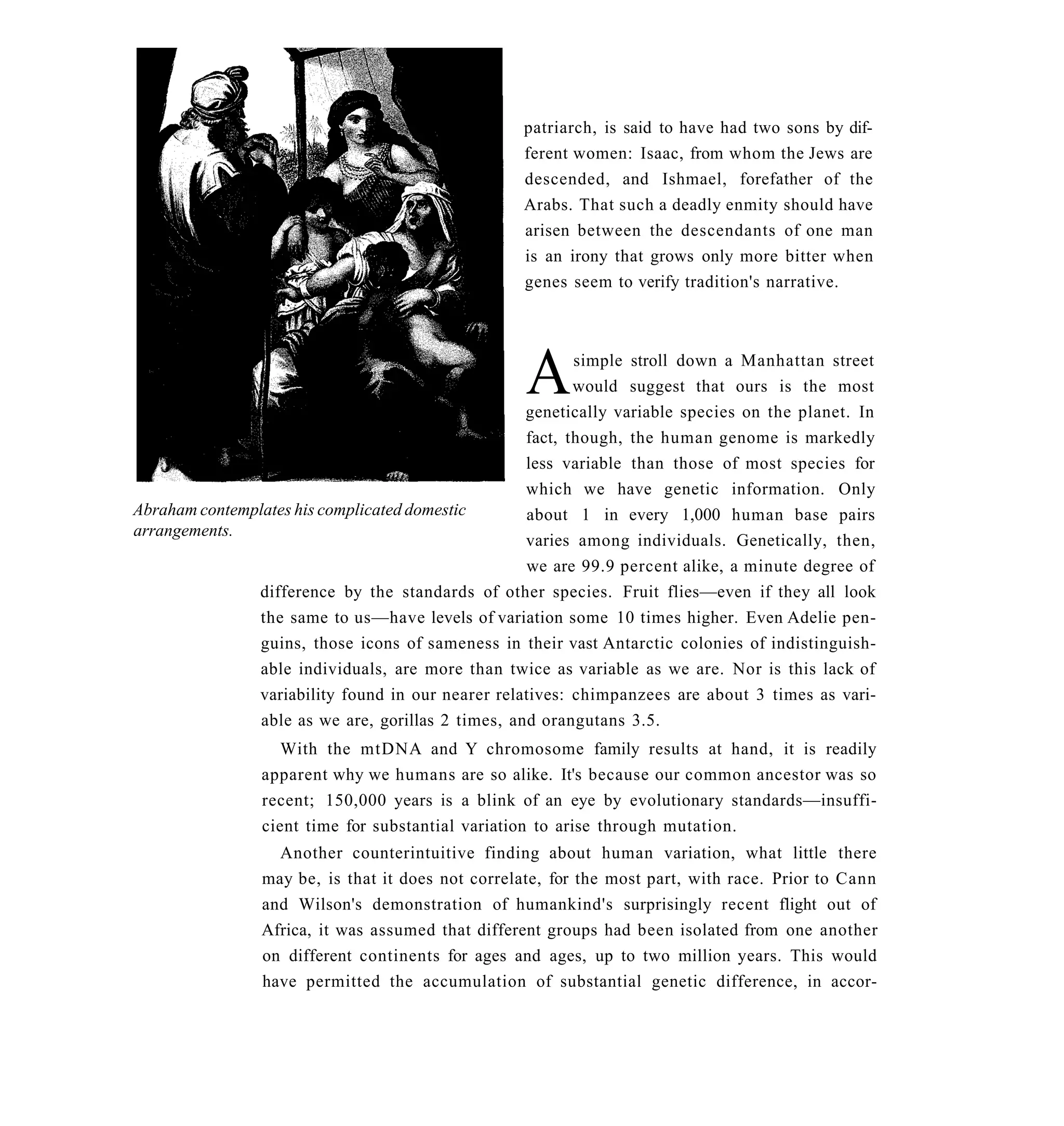
of many agricultural nostrums that Lysenko peddled, but it illustrates well his
overall strategy. A complete disregard for expert knowledge was de rigueur, as
was a refusal to conduct consistent and rigorous tests. Essentially, any idea
intuitively appealing to Lysenko was good enough to be implemented. What sci-
entific method he did espouse almost seems inspired by theological reasoning,
odd coming from the tool of a godless Communist state: "In order to obtain a
certain result, you must want to obtain precisely that result; if you want to
obtain a certain result, you will obtain it."
  Much more astutely reasoned was Lysenko's careful manipulation of the
media. His original brush with fame in Pravda had taught him that the state-


                                       367
Trofim Lysenko measuring
                                                       wheat plants in a rare burst
                                                       of empiricism on a collec-
                                                       tive farm near Odessa,
                                                       Ukraine


controlled press was a better venue for scientific self-promotion than the dusty
pages of academic or trade journals. In 1929 Pravda twice featured the barefoot
professor's success with vernalization, each time reporting in loving detail the
down-home contribution of Lysenko Senior.
   At that point the Soviet Union needed a Lysenko. The "agricultural reorgani-
zation," as Stalin preferred to call the collectivization of farms, was proving a
catastrophe. Even the official estimates, notorious for their rosy overstate-
ments, painted a grim picture of rural productivity during this period. Lysenko's
intuitive quick fixes made him the man of the hour, even if they wound up doing
more harm than good the morning after. He embodied an important Bolshevist
ideal, deistvennost—"action quality." No messing around with grand theories or
arcane academic concerns, Lysenko, the can-do barefoot professor, was all
about action and solving practical problems.
   Lysenko learned quickly how to play the Soviet system. His lectures made no
pretense to being scientific in any sense that we would recognize: they con-
sisted instead of ideological rants peppered with all the Marxist-Leninist jargon
du jour. Small wonder Stalin was a fan, leading the standing ovation (at a Con-
gress of Collective Farm Shock-Brigade Workers) with cries of "Bravo, Comrade
Lysenko!" In return, Lysenko astutely named his latest big idea, a variety of
branched wheat, for Stalin. Happily accepting the honor, the generalissimo for-
tunately never found out that the branched wheat was another bust: though


                                       368
Who We Are

inherently higher in yield, it requires such low-density planting as to more than
offset the advantage of its multiple seed heads.
   Sucking all of Soviet agriculture into a vast experiment each time he intro-
duced another hopelessly impractical new scheme, Lysenko was ultimately
responsible for the starvation of millions. But since Soviet records of the era—
especially those kept by Lysenko himself—are woefully self-serving, we will
probably never know the actual number of lives sacrificed on the altar of
Lysenko's career. Suffice it to say that at the time of Stalin's death in 1953, the
availability of meat and vegetables has been estimated by more objective ana-
lysts to have been no greater than in the darkest feudal days of Tsar Nicholas II.
Lysenko's pernicious influence, however, was not limited to agriculture.
   If Soviet farming had its homegrown principles, Soviet science too needed a
scientific credo of its own; it pained Lysenko and his followers to imagine the
new Soviet man following so meekly in the footsteps of "bourgeois" Western sci-
entists. And Lysenko's wild theories of agricultural development had boiled
down to the idea that you could transform any crop so long as you subjected it
to the right environment: winter wheat could become spring wheat through a
simple environmental manipulation. And it was no one-season fix, for, accord-
ing to Lysenko, such changes would then breed true—acquired traits would be
passed on to the next generation. Eventually Lysenko became a full-fledged
Lamarckist.* In an unusual fit of experimental enthusiasm, he even commis-
sioned experiments to "disprove" Mendelism—the basis of genetics in the deca-
dent Western tradition. In his mathematical incompetence, Lysenko actually
became convinced that the results refuted Mendel's ratios, even when a
reanalysis of the data by a distinguished Soviet mathematician showed that in
fact the ratios fitted Mendel's predictions exactly. Lysenko, then, was not above
doing an occasional experiment, but was never one to countenance a result con-
tradicting even the most outlandish hypothesis.
   The late 1930s saw a series of debates between Lysenko, backed by what have


*In 1801 Jean-Baptistc Lamarck first published his theory of inheritance of acquired characteris-
tics, erroneously suggesting that traits acquired during an individual's life could be passed on to
its offspring. Hawed though his idea was, Lamarck, unlike Lysenko, was at least trying to base his
inferences on observation.


                                               369
DNA

been described as his "hard core of militant ignoramuses," and the Soviet genet-
ics community—a distinguished group by the standards of the international sci-
ence of the day. H. J. Muller, one of T. H. Morgan's students (and my professor
in graduate school at Indiana University), went to Russia to participate in the
great social experiment of Communism and found himself instead embroiled in
bizarre, largely stage-managed public discussions about Larmarckian inheri-
tance. In this era of Stalin's purges, political truths carried much more weight
than mere scientific ones. To what extent Lysenko directly contributed to the
"repression"—to use the preferred Soviet euphemism for Stalin's purges—of the
geneticists who spoke against him will probably never be known but, no matter
who gave the orders, the fact remains that much of the opposition to Lysenko's
Lamarckian ideas simply disappeared as the 1930s drew to a close. Some geneti-
cists heroically stood their ground as outspoken critics. Muller was forced to flee
for his life. The doyen of Soviet genetics (and an ardent Soviet patriot), Nikolai
Vavilov, was arrested in 1940. He died in prison of malnutrition.
   In 1948, it was officially decreed that the debate was over: Mendelism was
out, Lysenkoism was in—an absurd and tragic outcome particularly when one
considers that it came four years after Avery's landmark experiment showing
DNA to be the transforming (Mendelian) factor. The Lysenkoite response to
the discovery of the double helix, incidentally, was characteristically obscuran-
tist: "It deals with the doubling, but not the division of a single thing into oppo-
sites, that is, with repetition, with increase, but not with development." I've no
idea what this means, but it seems to be consistent (in its meaninglessness)
with Lysenko's other writings on heredity:


   In our conception, the entire organism consists only of the ordinary body
   that everyone knows. There is in an organism no special substance apart
   from the ordinary body. But any little particle, figuratively speaking, any
   granule, any droplet of a living body, once it is alive, necessarily possesses
   the property of heredity, that is, the requirement of appropriate conditions
   for its life, growth and development.


  Darwin was next in line for the Lysenko treatment. The out-of-control peasant-
made-good denied the cardinal precept of Darwinism—competition among


                                        370
Who We Are

individuals within a species for access to limited resources—and postulated, as
perhaps a good Communist should, that individuals do not compete, but coop-
erate. He went further, combining his anti-Mendelian and anti-Darwinian
views in a bizarre unified theory of the origin of species: given that organisms
are molded by their environment, it should be possible, with the right environ-
mental conditions, to transform any one species into any other. Change a war-
bler's diet to caterpillars, to take his favorite example, and you can produce a
cuckoo. Ardent Lysenkoists from around the country were soon writing in with
reports of their own transformational successes: viruses turned into bacteria, a
rabbit into a chicken. Soviet biology was itself undergoing a transformation of
sorts: from science to joke.
   Lysenko's rejection of Darwin eventually put him in a position so awkward as
to tax even his own formidable skills of political survival. Stalin's final years wit-
nessed the "Great Stalin Plan for the Transformation of Nature." In part, this
involved planting a lot of trees to protect the steppes from the vicious east
winds, thus moderating the climate in general. It was not a bad idea in princi-
ple, but as one might expect, Lysenko had his notions about the best way to
grow trees: plant them in a cluster, he argued, and the individual seedlings will
not compete with each other for sunlight and nutrients but will rather cooperate
for the good of the community. In the late forties, armies of peasants fanned out
across the steppe planting oak trees in clusters in accordance with the Lysenko
method. The result? Intense competition among individual trees, which enfee-
bled all members of each cluster. By 1956 only 4 percent of the oaks planted
were thriving; only 15 percent had even survived. The Ministry of Agriculture
withdrew its endorsement of the Lysenko planting protocol, but only after a
sum estimated at over 1 billion rubles had been squandered.*
   It was a stunning setback, but so entrenched was Lysenko's authority, and so
crowded with his proteges were the ranks of Soviet biology, that it wasn't until
1964 that the Kremlin turned its back on him for good. The barefoot professor


*The modern dollar equivalent is difficult to compute because the official exchange rates of that
era generally reflected Communist wishful thinking rather than financial reality. To put the sum
in context, however, it can be noted that in 1956 one-sixth of the Soviet workforce earned an
annual wage of around three thousand rubles.


                                              371
DNA

had managed to persuade Stalin's successor that he was still the man to create a
Soviet agricultural miracle. Indeed, when Khrushchev was bundled ignomin¬
iously out of office by the Soviet Central Committee (and replaced with Brezh-
nev), it was rumored that one important reason for the intervention was a
general frustration with Khrushchev's continued reliance on Comrade Lysenko.
Lysenko himself died in 1976. His family requested that he be buried in the
most prestigious Russian national cemetery at the Novo-Devichi convent. The
request was denied.


I  would not for a moment wish to suggest, by telling the parable of Lysenko,
   that the fate of Soviet science under that fool's sway is remotely comparable
to the state of contemporary Western research in even the most politically
overpowering university setting. But the extreme instance should suffice to
demonstrate that ideology—of any kind—and science are at best inappropriate
bedfellows. Science may indeed uncover unpleasant truths, but the critical
thing is that they are truths. Any effort, whether wicked or well-meaning, to con-
ceal truth or impede its disclosure is destructive. Too often in our free society,
scientists willing to take on questions with political ramifications have been
made to pay an unjust price. When in 1975 E. O. Wilson of Harvard published
Sociobiology, a monumental analysis of the evolutionary factors underlying the
behavior of animals ranging from ants—his own particular subject of expert-
ise—to humans, he faced a firestorm of rebuke in the professional literature as
well as the popular media. An anti-Wilson book published in 1984 bore a title
that said it all: Not in Our Genes. Wilson was even attacked physically, when pro-
testers objecting to the genetic determinism they perceived in his work dumped
a jug of water on him during a public meeting. Similarly, Robert Plomin, whose
work on the genetics of human intelligence we shall presently address, found
the American academy so hostile that he decamped from Penn State to England.
    Passions inevitably run high when science threatens to unsettle or redefine
our assumptions about human society and our sense of ourselves—our identity
 as a species, and our identities as individuals. What could be a more radical
 question than this: Does the way I am owe more to a sequence of As, Ts, Gs,
 and Cs inherited from my parents, or to the experiences I've had ever since my
 father's sperm and mother's egg fused together many long years ago? It was

                                       372
Who We Are

Francis Galton, the father of eugenics, who was the first to frame the question
as one of nature versus nurture. And the implications spill over into less philo-
sophical, more practical areas. Are all math students born equal, for instance? If
the answer is no, it may well be a waste of time and money trying to force dif-
ferential equations down the throats of people like me who are simply not wired
to take the stuff on board. In a society built on an egalitarian ideal, the notion
that all men are not born equal is an anathema to many people. And not only is
there a lot at stake, but the issues are very difficult to resolve. An individual is a
product of both genes and environment: how can we disentangle the two fac-
tors to determine the extent of each one's contribution? If we were dealing with
laboratory rats, we could conduct a set of simple experiments, involving breed-
ing and rearing under specified uniform conditions. But, happily, humans are
not rats, so illuminating data are hard to come by. This combination of the
debate's importance and the near impossibility of satisfactorily resolving it
makes for perennially lively argument. But a free society should not shrink from
honest questions honestly asked. And what is critical is that the truths we dis-
cover are then applied only in ethical ways.


W       ith a lack of reliable data, the nature/nurture debate was entirely subject
        to the shifting winds of social change. Early in the twentieth century,
during the heyday of the eugenics movement, nature was king. But when the
fallacies of eugenics became apparent, culminating in its horrific applications
by the Nazis and others, nurture began to gain the upper hand. In 1924 John
Watson (no relation), the American father of an influential school of psychology
called "behaviorism," summarized his nurture-ist perspective as follows:


   Give me a dozen healthy infants, well-formed, and my own specified world
   to bring them up in and I'll guarantee to take any one at random and train
   him to become any type of specialist I might select: doctor, lawyer, artist,
   merchant-chief, and yes, even beggar-man and thief, regardless of his tal-
   ents, penchants, tendencies, abilities, vocations, and race of his ancestors.


   The notion of the child as tabula rasa—a blank slate upon which experience
and education can write any future—dovetailed nicely with the liberal agenda

                                         373
DNA

that grew out of the sixties. Genes (and the determinism they stood for) were
out. Discounting inheritance, psychiatrists preached that mental illness was
caused by varieties of environmental stress, an assertion that inspired endless
guilt and paranoia among the parents of the afflicted: where did we go wrong?
they asked. The tabula rasa remains the paradigm of choice among the politi-
cally entrenched defenders of some increasingly untenable views of human
development. Among some unregenerate hardliners of the women's movement,
for example, the notion of biological—genetic—differences in cognitive apti-
tudes between the sexes is simply unspeakable: men and women are equally
capable of learning any task, period. The fact that men are more common in
some fields and women in others is, these theorists would have it, purely a
result of divergent social pressures: the male slate is inscribed with one destiny,
the female with another, and it begins with our laying that pink blanket on the
baby girl and the blue one on the baby boy.
   Today we are seeing a swing away from the extreme nurture-ist position
embodied by the other Watson. And it is no coincidence that this drift away
from behaviorism is coinciding with our first glimpses of the genetics underpin-
ning behavior. As we saw in chapter 11, for years the genetics of humans has
lagged behind that of fruit flies and other creatures owing to a lack of genetic
markers and the impossibility of doing breeding experiments on people. But
since the introduction in 1980 of DNA-based genetic markers the analysis of
human traits through the mapping of related genes has advanced by leaps and
bounds. Most of the effort has understandably been expended on meeting the
most urgent human need genetics can address: diagnosis and treatment of
inherited disease. Nevertheless, some efforts have been directed toward non-
medical questions. Robert Plomin, for example, has used this approach to hunt
up genes influencing IQ, taking advantage of an annual gathering in Iowa of
superbright schoolchildren from across the nation. With an average IQ of 160,
these slightly scary kids were an obvious place to start to look for genes that
might affect IQ. Plomin compared their DNA to that of a sample of "normal"
kids with average range IQs like yours and mine*—and indeed he found a weak


*Mine is a respectable, but definitely not stellar, 122. I discovered it by sneaking a quick look at
a list on a teacher's desk when 1 was eleven.


                                               374
Who We Are

association between a genetic marker on chromosome 6 and stratospheric IQ.
Here was reason to suppose that a gene or several genes in that region might in
some way contribute to IQ. Of course, any mechanism governing such a com-
plex trait is apt to involve many genes.
   In chapter 11, we discussed the difficulty of mapping polygenic traits, like
heart disease, that are produced by multiple genes, each with a small individual
effect, each mediated by the environment. Behavioral traits generally fall in this
category. So far as we know, having the appropriate variant on chromosome 6
would not by itself a genius make: there are doubtless necessary variants in
genes as yet undiscovered. And even a solid genetic basis might not get you
there unless you were also reared in an environment in which learning and
thinking were honored over Nickleodeon. But the discovery, and the acknowl-
edgment, of any molecular basis for intelligence is a breakthrough such as only
the genetic revolution could foster.


B      efore DNA markers were available, the meat and potatoes of behavioral
       genetics was twin studies. Twins come in two varieties: dizygotic (DZ),
meaning two individuals develop from two separate eggs, each fertilized by a
different sperm; and monozygotic (MZ), meaning that both come from a single
fertilized egg, which in early development—usually the 8- or 16-cell stage—
splits into two balls of cells. DZ twins are no more genetically similar than any
two siblings, but MZ twins are genetically identical. MZ twins are therefore
always the same sex, while DZ twins may or may not be. Surprisingly, it hasn't
been very long since we first understood this fundamental difference between
twin types. In 1876, when Francis Galton first suggested that twins might be
useful in determining the relative contributions of heredity and upbringing, he
was unaware of the difference (whose basis had been worked out just two years
earlier), and assumed wrongly that it was possible for different-sex twins to be
derived from a single fertilized egg. From his later publications, however, it's
clear that the message eventually got through.
  MZ twinning occurs globally in about four of every thousand pregnancies and
seems to be nothing more than a random accident. DZ twinning, on the other


                                       375
DNA

hand, may run in families, and varies from population to population: a group in
Nigeria tops the list with DZ twins accounting for forty pregnancies per thou-
sand, while there are only three per thousand in Japan.
  The basic premise of the standard form of twin study is that both members of
a same-sex pair of twins, whether DZ or MZ, are raised the same way (i.e.,
receive similar "nurtures"). Suppose we are interested in a simply measurable
characteristic like height. It DZl and DZ2 were both raised on the same diet of
food, love, and so on, any difference in height between them would be attribut-
able to some combined effect of genetic differences and whatever subtle differ-
ences of nurture may have crept in (for instance, DZl always finishes her milk;
DZ2 never does). But if we follow the same program with MZ1 and MZ2, the
fact that these twins are genetically identical eliminates genetic variation as a
factor; any differences in height must be a function of only those subtle envi-
ronmental differences. All things being equal, MZ twins will then tend to be
more similar in height than DZ twins, and the extent to which this is true gives
us a measure of how much genetic factors influence height. Similarly, the
extent to which MZ twins have more similar IQs than DZ twins reflects the
effect of genetic variation on IQ.
   This kind of analysis is also applicable to the inheritance of genetic diseases.
We say that twins are "concordant" if they both have the disease. An increase in
concordance when we look from DZ twins to MZ twins would support the
claim of a strong genetic basis to the disease: for example, DZ twins are 25 per-
cent concordant for late-onset diabetes (if one twin has it, then there is a one in
four chance that the other does too), whereas MZ twins are 95 percent concor-
dant for the disease (if one twin has it, then nineteen out of twenty times the
other does too). The conclusion: late-onset diabetes has a strong genetic com-
ponent. Even here, though, the environment plays an obvious role: if it were not
so, we would see 100 percent concordance in MZ twins.
   A long-standing criticism of this kind of twin study addresses methodology:
MZ twins tend to be treated more alike by their parents than DZ twins. Parents
sometimes make a virtual fetish of identicalness: often, for instance, MZ twins
are even dressed exactly alike, a habit some weirdly carry into adulthood. This is
a legitimate criticism insofar as the more pronounced similarity of MZ twins (as
compared with DZs) is interpreted as evidence of genetic influence when in


                                       376
Who We Are

fact it could simply be a reflection of the more precisely similar nurtures shared
by MZs. And here is a further wrinkle in the same problem: how do we tell
whether a pair of same-sex twins is DZ or MZ? "It's easy," you say. "Just look at
them." Wrong. In a small but significant proportion of cases, parents mistake
their same-sex DZ twins for MZ twins (and thus tend to subject them to the
supersimilar nurture routine—the same frilly pink frock for each); and con-
versely a small proportion of parents with MZ twins wrongly take them for DZs
(dressing one in frilly pink and the other in bright green). Fortunately, DNA fin-
gerprinting techniques have rescued twin studies from this comedy of errors.
The test can determine for sure whether the pair are indeed as they were sup-
posed to be, whether DZ or MZ. The mistaken-identity groups then serve as the
perfect experimental control in the analysis: for example, height difference in
DZ twins cannot be put down to differences in nurture if the parents were rais-
ing them as MZs.
   Perhaps no form of twin study holds more popular appeal than analysis of
MZs separated at birth. In such cases, the rearing environments are often very
different, and so marked similarities are attributable to what the twins have in
common: genes. It makes good copy: you see reports of MZs separated at birth
who, it turns out, both have red velvet sofas and dogs called Ernest. Striking
though these similarities may be, however, chances are they are mere coinci-
dences. There is almost assuredly no gene coding for the red velvet upholstery
preference, or for impulses in dog naming. Statistically, if you list a thousand
attributes—make and model of car, favorite TV show, etc.—of any two people,
you will inevitably find ones that overlap, but in the press these are the ones
that get reported, usually in the Believe It or Not column. My coauthor and I
both drive Volvo station wagons and appreciate a cocktail or two, but we are
most definitely not related.
   Popular or no, twin studies have had a checkered history. Part of the ill repute
stems from the controversy surrounding Sir Cyril Burt, the distinguished British
psychologist who did much to establish the use of twins in studies of the genet-
ics of IQ. After his death in 1971, a detailed examination of his work suggested
that some of it was fraudulent—Sir Cyril, some alleged, was not above invent-
ing a few twins from time to time if he needed to bolster sample sizes. The truth
of these charges is still debated, but one thing is undeniable: the episode cast a


                                       377
DNA

shadow of suspicion over not only twin studies but all attempts to understand
the genetic basis of intelligence. In fact, the combination of the Burt affair and
hair-trigger political sensitivity to the topic have in effect stifled research by cut-
ting the flow of grant money. No money, no research. Tom Bouchard at the Uni-
versity of Minnesota, a distinguished scientist whose massive 1990 survey of
twins reared apart redefined twin studies, had such difficulty raising funds that
he was forced to go cap in hand to a right-wing organization that supports
behavioral genetics to further its own dubious political agenda. Founded in
 1937, the Pioneer Fund counts among its early luminaries Harry Laughlin, the
chicken geneticist we encountered in chapter 1 who turned his attentions to
humans and entered the vanguard of American scientific racism. The fund's
charter was "race betterment with special reference to the people of the United
States." That legitimate researchers like Bouchard should be faced with a
choice between seeking such a tainted sponsor or seeing their work perish rep-
resents a staggering indictment of the federal agencies that fund scientific
research. Tax dollars are being allocated according to political rather than sci-
entific merit.
   Bouchard's Minnesota twins study revealed that a host battery of personality
traits—as measured using standardized psychological tests—were substantially
affected by genes. In fact, more than 50 percent of the variability observed in a
range of characteristics—the tendency to be religious, to name one—was typi-
cally caused by underlying variation in genes. Bouchard concluded that one's
upbringing has surprisingly little effect upon personality: "On multiple meas-
ures of personality and temperament, occupational and leisure-time interests,
and social attitudes, MZ twins reared apart are about as similar as MZ twins
reared together." In other words, when it comes to measurable components of
personality, nature seems to trump nurture. This lack of impact of upbringing
on personality development has even Bouchard scratching his head. Upbring-
ing has little effect, and yet the data still show the environment's considerable
effect: MZ twins raised apart are as similar to each other as those raised
together, but there are nevertheless differences in both cases between members
of a pair. Could there be an aspect of environment distinguishable from
upbringing? One suggestion is that variation in prenatal experience, the life of a
fetus in utero, may be important; even small differences at this early develop-


                                          378
Who We Are

mental stage—when, after all, the brain is being assembled—may have a signif-
icant impact on who we become. Even MZ twins may find themselves in very
different uterine settings courtesy of the natural whims of implantation—the
lodging of the embryo in the wall of the uterus—and the development of the
placenta. The popular belief that all MZ twins share a single placenta (and
therefore have similar uterine environments) is wrong: 25 percent of MZ pairs
have separate placentas. Studies have shown that such twins differ more from
each other than do pairs who have shared a placenta.
  The elephant in the living room of all twin studies is the genetics of intelli-
gence. How much of our smarts is determined by our genes? Everyday experi-
ence suffices to prove there is a lot of variation out there. While teaching at
Harvard, I became intimately acquainted with the familiar pattern: in any pop-
ulation, there are a few who really aren't too bright, a few who are alarmingly
smart, and a vast majority who are middling. The fact that the setting was Har-
vard, where the population had been preselected in favor of intelligence, makes
no difference: the same proportions hold whatever the group. This "bell curve"
distribution of course can describe just about any trait that varies in humans:
most of us are medium tall, but there are a few super-tall and a few super-short
among us. But when used to describe variations in human intelligence the bell
curve has demonstrated powers to raise a dust storm of objection. The reason is
that in a land of equal opportunity, where we are each free to advance as far as
our wits will carry us, intelligence is a trait with profound socioeconomic impli-
cations: the measure of it is predictive of how one will fare in life. And so in this
matter the nature/nurture debate becomes entangled with the noble aspirations
of our meritocratic society. But given the complex interplay of the two factors,
how can we reliably judge their respective weights? Smart parents not only pass
on smart genes; they also tend to rear their children in ways that foster intellec-
tual growth, thus confounding the effects of genes and environment. This is the
reason careful twin studies are so valuable in permitting us to analyze the con-
stituents of intelligence.
   Bouchard's study and earlier ones as well have found that as much as 70 per-
cent of the variation in IQ is attributable to corresponding genetic variation: a
strong argument for the primacy of nature over nurture. But does this really
mean that our intellectual fate is largely sealed by our genes—that education


                                        379
DNA

(even our own free will) has little to do with who we are? Not at all. As with all
traits, it is nice to be blessed with favorable genes, but there is much that nur-
ture can do to influence the standing of any individual, at least in the bell
curve's vast midland, where variations in social circumstance are mainly deter-
mined.
   Take the case of one group within Japan, the Buraku. They are the descen-
dants of Japanese who by feudal custom had once been condemned to perform
society's "unclean" tasks, like slaughtering animals. Despite the modernization
of Japanese society, the Buraku remain impoverished and marginalized out-
siders, scoring on average ten to fifteen IQ points lower than the national Japa-
nese mean. Are they genetically inferior, or is their IQ simply a reflection of
their lowly status in Japan? It would seem to be the latter: Buraku who have
immigrated to the United States, where they are indistinguishable from other
Japanese Americans, have shown an increase in IQ and over time the fifteen-
point gap with their fellows in the homeland disappears. Education matters.
   In 1994, Charles Murray and Richard Herrnstein published The Bell Curve,
arguing that, despite the well-established effect of education, the discrepancies
in the average IQ scores of different races may themselves be attributable to
genes. It was a profoundly controversial claim, but not as simpleminded as
many have supposed. Murray and Herrnstein understood that the combined
observations of a genetic basis to IQ and of differences in average IQ among
groups do not lead directly to the conclusion that genes are responsible for the
intergroup differences. Imagine sowing the seeds of a particular plant species in
which height varies genetically. Put one set of seeds in a tray with high-grade
soil, and another in a tray of poor soil: in both trays we see variation in height;
some individuals are taller than others—as expected, given genetic variation.
But we also observe that the average height for plants in the tray of poor soil is
less than the average for those in the tray of rich earth. The environment, in the
form of soil quality, has affected the plants. While genetics is the dominant fac-
tor in determining height differences among plants within a tray—all other
factors being equal—genetics has nothing to do with the differences seen
between the two trays.
 Does this same argument apply to African Americans, who lag behind other
Americans in measures of IQ? Since poverty rates among African Americans are


                                       380
Who We Are

relatively high, with a large proportion of individuals finding themselves rooted
in the relatively poor educational soil of the inner city, environment surely does
contribute to their underperformance on IQ tests. Murray and Herrnstein's
point, however, was that the discrepancy was so great that environment likely
couldn't explain it all. Similarly, environmental factors alone may not account
for why, globally, Asians, have on average higher IQs than other racial groups.
The idea of measurable variations in average intelligence among ethnic groups
is not one, I admit, I want to live with. But though The Bell Curve's claims
remain questionable, we should not allow political anxieties to keep us from
looking into them further.
  There is perhaps no more heartening proof of the role of environment in
human intelligence than the Flynn effect, the worldwide phenomenon of
upwardly trending IQ, named for the New Zealand psychologist who first
described it. Since the early years of the twentieth century, gains have ranged
between nine and twenty points per generation in the United States, Britain,
and other industrialized nations for which reliable data-sets are available. With
our knowledge of evolutionary processes, we can be sure of one thing: we are
not seeing wholesale genetic change in the global population. No, these
changes must be recognized as largely the fruits of improvement in overall stan-
dards both of education and of health and nutrition. Other factors as yet not
understood doubtless play a role, but the Flynn effect serves nicely to make the
point that even a trait whose variation is largely determined by genetic differ-
ences is in the end significantly malleable. We are not mere puppets upon
whose strings our genes alone tug.


T     he finding that there is a substantial genetic component to our behavior
      should not surprise us; indeed, it would be far more surprising if this were
not the case. We are products of evolution: among our ancestors, natural selec-
tion indubitably exerted a strong influence over all traits that have figured in our
survival. The human hand, with its marvelous opposable thumb, is the product
of natural selection. In the past, therefore, there must have been varying forms
of the hand, with natural selection favoring the version we have today by pro-
moting the spread of the genetic variants underlying it; in this way, evolution


                                        381
DNA

                 ensured that every member of our species would be endowed with this
                 supremely valuable asset.
                    Behavior, too, has been critical to human survival, and therefore sternly gov-
                 erned by natural selection. Presumably our enthusiasm for fatty and sweet
                 foods evolved this way. Our ancestors were ever pressed to meet their nutri-
                 tional requirements; therefore the propensity to take full advantage of all
                 energy-rich foods whenever any became available was of huge benefit. Natural
                 selection would have favored any genetic variations that ensured a sweet tooth
                 since those with it survived better. Today those same genes are the scourge of
                 everyone who struggles to keep off the weight in parts of the world with abun-
                 dant food sources: what was adaptive in our ancestors is now maladaptive.
                      Ours is a strikingly social species; it is logical, therefore, to infer that natural
                   selection once favored genetic adaptations facilitating social interaction. Not
                   only would gestures, like smiling, have evolved as a means of signaling one's
                   state of mind to other members of the group, but presumably there would also
                   have been strong selective pressures in favor of psychological adaptations per-
                   mitting one to judge the intentions of others. Social groups are prey to para-
                   sitism; there are always individuals who seek to benefit from membership
                   without contributing to the general good. The capacity to detect such freeload-
                   ers is vital to the success of a cooperative social dynamic. And though we are
                   no longer hovering in small groups around one fire roasting the communal sup-
                   per, our gifts for sensing one another's moods and motivations may never-
                              theless come from those early phases of our development as a social
A Victorian illustration of   species.
a baby doing what comes
                                 Since the publication of E. O. Wilson's Sociobiology in 1975, evolu-
naturally
                                   tionary approaches to understanding human behavior have them-
                                       selves evolved, giving rise to the modern discipline of
                                         evolutionary psychology. In this field the search is for the
                                          common denominators of our behavior—human nature,
                                          the characteristics shared by all of us, whether New
                                          Guinea Highlander or Parisienne—which we seek to
                                          understand, trait by trait in relation to some past adaptive
                                          advantage conferred by each. Some such correlations are
                                          simple and relatively uncontroversial: the grasping reflex of


                                                            382
The cultural wonder that is Homo sapiens. Two contrasting notions of chic: Paris 1950s
and the highlands of Papua New Guinea. Evolutionary psychology seeks the common
denominators underlying all our widely divergent behavior.


a newborn, for instance, strong enough that a baby can use its hands and feet to
suspend its full body weight, is presumably a legacy from the time when the
ability to cling to a hirsute mother was important for infant survival.
   Evolutionary psychology does not, however, limit its scope to such mundane
faculties. Is the relatively low representation of women in the mathematical sci-
ences worldwide a universal fact of culture, or might eons of evolution have
selected male and female brains for different purposes? Can we understand in
strictly Darwinian terms the tendency of older men to marry younger women?
With a teenager likely to produce more children than a thirty-five-year-old,
might such men be seen as succumbing to the power of evolutionary hardwiring
that urges each of them to maximize the number of his offspring? Similarly, do
younger women go for wealthy older men because natural selection has oper-
ated in the past to favor such a preference: a powerful male with plenty of


                                         383
DNA

resources? For now any answers to these questions are mainly conjectural. As
we discover more of the genes underpinning behavior, however, I am confident
that evolutionary psychology will migrate from its current position on the
fringes of anthropology to the very heart of the discipline.


F     or now the power of genes to affect behavior is more evident in other
      species, whose nature we can actually manipulate using genetic tricks.
One of the oldest, and most effective, of those tricks is artificial selection,
which farmers have long used to increase milk yield in cows or wool quality in
sheep. But its applications have not been limited to agriculturally valuable traits
like these. Dogs are derived from wolves—possibly from wolf individuals that
tended to hang around human settlements looking for a scrap and thereby con-
veniently assisting in garbage disposal. It is thought that they first laid claim to
the title of "man's best friend" 10,000 years ago, roughly coinciding with the ori-
gin of agriculture. In the brief time since, the anatomical and behavioral diver-
sity engendered by dog breeders has become literally a thing to behold. Dog
shows are celebrations of the power of genes, with each breed effectively a
genetic isolate—a freeze frame in the spectacular feature film of canine genetic
diversity. Of course, the morphological differences are the most striking and fun
to consider: the fluff ball called Pekingese; the enormous shaggy English mas-
tiff, which sometimes weighs over 300 pounds; the stretched-out dachshund;
the face-flattened bulldog. But it is the behavioral differences that I find most
impressive.
   Of course, not all dogs within a breed behave alike (or look alike), but typi-
cally individuals in the same breed have much more in common with one
another than with specimens from other breeds. The Labrador retriever is
affectionate and pliant; the greyhound is twitchy; the border collie will round
up anything available if a flock of sheep is not to be had; the pit bull, as news
reports occasionally remind us, is the canine embodiment of aggression. Some
dog behaviors are so engrained as to have become stereotypes. Think of a
pointer's elaborate "pointing" stance: that is no "stupid pet trick" taught each
individual dog, but a hardwired part of the breed's genetic makeup. Despite
their diversity, all modern dogs remain members of one species—meaning that


                                        384
Who We Are

in principle even the most apparently dissimilar pair can produce offspring, as
one doughty male dachshund demonstrated in 1972 when he managed to
inseminate a sleeping Great Dane bitch. Thirteen
"Great Dachshunds" resulted.
   While the basis of most behavior is surely poly-
genic—affected by many genes—a number of sim-
ple genetic manipulations in mice reveal that
changing even a single gene can have a major behav-
ioral effect. In 1999, Princeton neurologist Joe
Tsien used sophisticated recombinant DNA tech-
niques to create a "smart mouse" with extra copies
of a gene producing a protein that acts as a receptor
for chemical signals in the nervous system. Tsien's
transgenic rodent performed better than normal
mice in a battery of tests of learning and memory;
for example, it was better at figuring out mazes and
at retaining that knowledge. Tsien named the mouse
strain "Doogie" after the precocious medic in the
television show Doogie Howser, M.D. In 2002
Catherine Dulac at Harvard discovered that by
deleting a gene from a mouse of her own she could The impact of just one gene. At lop, a normal
affect the processing of chemical information con- mouse mother is highly attentive to her
tained in pheromones, the odors mice use to com- offspring. The mother below, lacking a junc-
municate. Whereas male mice will typically attack tional fos-B gene, ignores her newborns.
other males and attempt to mate with females,
 Dulac's doctored males failed to distinguish between males and females and
attempted to mate with any mouse they encountered. Nurturing behavior in
 mice is also subject to a sex-specific manipulation of a single gene. Females
instinctively look after their newborns, but Jennifer Brown and Mike Greenberg
 at Harvard Medical School found a way to short-circuit this native sense by
 knocking out the function of a gene called fos-B. Otherwise entirely normal, a
 mouse so altered simply ignores her offspring.
  Rodents have even given us a glimpse of the mechanistic basis of what in
humans we call "love" (in rodents, it's less romantically termed "pair-bonding").


                                      385
DNA
                                       A recently pair-bonded prairie vole couple
                                       ponders the DNA sequence of the gene that
                                       maizes them so lovey-dovey.


                                       Mouselike voles are common throughout
                                       North America. Although they all look
                                       pretty much alike, different species have
                                       wildly different approaches to life. The
                                       prairie vole is monogamous, meaning that
                                       couples bond for life, but its close relative,
                                       the montane vole, is promiscuous: a male
                                       mates and moves on, and over the course
                                       of her life the female typically produces
                                       litters by several different males. What
                                        differences could underlie such widely
divergent sexual strategies? Hormones provide the first half of the answer. In all
mammals, oxytocin figures in many aspects of mothering: it stimulates both the
contractions in labor and the production of breast milk for the newborn; thus it
also plays a part in creating the nurturing bond between a mother and her
young. Could the same hormone also engender another kind of bond, one
between members of a prairie vole couple? In fact it does, together with another
garden-variety mammalian hormone, vasopressin, which is primarily known for
controlling urine production. But why is the montane vole, which also produces
both hormones, such a randy little critter compared with its prairie cousin? The
key, it turns out, is in the hormone receptors—the molecules that bind to circu-
lating hormones, initiating a cell's response to the hormone signal.
   Focusing on the vasopressin receptor, Tom Insel, a psychiatrist at Emory Uni-
versity, found a major difference between the vole species, not in the receptor
gene itself but in an adjacent DNA region that determines when and where the
gene is turned on. As a result the distribution of vasopressin receptors in the
brain is very different in the prairie vole and the montane vole. But does this dif-
ference in gene regulation alone explain why one species is, in human terms,
loving and the other cavalier? Apparently it does. Insel and his colleague Larry


                                        386
Who We Are

Young inserted the prairie vole vasopressin gene, complete with its next-door
regulatory region, into a regular lab mouse (a species that is typically promiscu-
ous, like the montane vole). Though the transgenic mice did not instantly
become romantic pair-bonders, Insel and Young observed a marked change in
their behavior. Rather than doing the typical mouse thing of mating with a
female and then hightailing it unceremoniously, the transgenic male appeared
in contrast tenderly solicitous of the female—in short, the addition of the gene,
while not a guarantee for everlasting love, did seem to make the affected mouse
less of a rat.
   We must not forget that human brain function remains a million miles
removed from that of a mouse. No rodent, whether from the mountains or the
prairies, has yet produced a major work of art. It nevertheless remains worth-
while to bear in mind that most sobering lesson of the Human Genome Project:
our genome and the mouse's are strikingly similar. The basic genetic software
governing both mice and men has not changed much over the 75 million years
of evolution since our lineages separated.


U     nable to target specific genes for inactivation or enhancement as mouse
      geneticists can, human geneticists must rely on what might be called
"natural experiments"—spontaneous genetic changes that affect brain func-
tion. Many of the best characterized genetic disorders affect mental perfor-
mance. Down syndrome, caused by having an extra copy of chromosome 21,
results in lowered IQ and, in many cases, a disarmingly sunny disposition. Peo-
ple with Williams syndrome, caused by the loss of a small portion of chromo-
some 7, also have low IQs but are often preternaturally talented as musicians.
    But these are instances in which the mental aspects of a given disorder are
effectively by-products of systemwide dysfunction. Thus they tell us relatively
little about the particular genetics of behavior. It's a bit like discovering that
your computer doesn't work during a power outage. OK, so you know now that
it requires electricity, but you've learned very little about the specifics of com-
puter function. To understand the genetics of behavior we need to look at dis-
orders that affect the mind directly.
   Among the mental scourges that have attracted close attention from gene map-


                                       387
DNA

pers, two of the most formidable are bipolar (or manic-depressive) disease (BPD)
and schizophrenia. Both diseases have strong genetic components (identical-twin
concordance for BPD is as high as 80 percent; for schizophrenia it is close to
50 percent), and both take a devastating toll on mental health worldwide. One
in every hundred people is schizophrenic, and the figure is about the same
for BPD.
   As we have seen, mapping polygenic traits is difficult because each individ-
ual gene has only a small incremental effect, and the trait as a whole is often
mediated strongly by the environment, as with both these afflictions. But the
overall difficulty has also bred a bad habit among researchers: they tend to pub-
lish only positive results, failing to notify the field of eliminated possibilities.
Compounding the problem is the converse: the understandable but ultimately
counterproductive impulse to publish any correlation that appears, after count-
less other genetic markers have proved a dead end. Ideally, spotting a correla-
tion should only be the beginning of more in-depth analysis to sort out
meaningful results from statistical coincidence—after all, if we try enough
markers, we should expect occasionally to see, even in the absence of genetic
linkage, a correlation produced by chance alone. Too often the pressure to get
results leads to premature pronouncements, which must later be withdrawn
sheepishly after other groups fail to replicate the finding.
   There are additional impediments to the gene hunt when mental illness is
the target. Diagnosis, however psychiatric manuals may try to standardize it, is
often more an art than a science. Cases may be identified on the basis of
ambiguous symptoms, and so a portion of the individuals in a pedigree may be
misdiagnosed; these false positives wreak havoc in the mapping analysis.
Another complicating factor is that the disorders are defined and diagnosed
according to their symptoms, and yet it is likely that a number of genetic causes
result in a similar set of symptoms. Thus the genes underlying schizophrenia
may differ from one case to the next. Even apparently clear differences between
syndromes can prove messy when viewed through the microscope of genetics.
Since 1957 we have known that BPD and unipolar disease (the condition char-
acterized by depression alone) are genetically distinct syndromes, but, confus-
ingly, there is some genetic overlap between the two: unipolar depression is
much more common among relatives of BPD patients than in the overall
population.

                                        388
Who We Are

   Partly for such reasons, the genetic culprits of mental illness have so far
proved particularly elusive. A recent study reveals that as many as twelve chro-
mosomes—half the total—have been shown through mapping analysis to con-
tain genes contributing to schizophrenia. It's the same story for BPD, in which
genes on ten chromosomes have been implicated. One interesting finding is
that there does seem to be some overlap between the gene regions identified in
the separate mapping studies of the two maladies. Perhaps, then, there are
some genes responsible for the overall organization and structure of our brains.
Malfunctions in these genes may be the cause of the delusional or hallucinatory
episodes common to both BPD and schizophrenia. The history of this research
is full of high hopes brought low. A study will identify a strong correlation in one
pedigree, and then subsequent research will fail to generalize the result in other
populations. Such was the case in 1987, with a much-publicized study of BPD
in the Amish: a promising connection with chromosome 11 did not fare well in
follow-up studies. Stanford geneticists Neil Bisch and David Botstein have
aptly articulated these disappointments:


   In no field has the difficulty [of mapping disease genes] been more frus-
   trating than in the field of psychiatric genetics. Manic depression (bipolar
   illness) provides a typical case in point. Indeed, one might argue that the
   recent history of genetic linkage studies for this disease is rivaled only by
   the course of the illness itself. The euphoria of linkage findings being
   replaced by the dysphoria of non-replication [in other populations] has
   become a regular pattern, creating a roller coaster-type existence for many
   psychiatric genetics practitioners as well as their interested observers.


   Without denying these difficulties I am extremely hopeful that we arc right
now entering an era of genetic analysis that will soon take us beyond this irritat-
ing game of "now we have it, now we don't." Two innovations hold the key First,
the "candidate gene" approach to finding the genes. With both the complete
human genome sequence and a rudimentary functional understanding of many
genes finally in hand, we can narrow our search as never before, homing in on
genes with functions related to a given disorder. In the case of BPD, for exam-
ple, a condition apparently connected with a fault in the mechanism by which
the brain regulates its concentration of certain chemical neurotransmitters like

                                        389
DNA

serotonin and dopamine, we might choose to concentrate on genes that pro-
duce neurotransmitters or their receptors. Having chosen our candidate gene,
we simply compare its sequence in affected and unaffected individuals to
determine whether or not a particular variant might correlate with the disorder.
In 2002, Eric Lander's team at MIT's Whitehead Institute surveyed seventy-six
BPD candidate genes. Only one—a gene encoding the brain-specific nerve
growth factor, the neurochemical tested as a possible treatment for Lou
Gehrig's disease (see chapter 5)—proved to correlate with the disorder. But one
truly relevant gene can be extremely valuable. The one found resides on chro-
mosome 11, apparently vindicating the original Amish study, which long ago
implicated the same region of the chromosome in BPD.
   Technological improvements underlie the other reason for my optimism
about the hunt for these elusive genes. To detect the subtle effect of a particu-
lar gene, we need extra-sensitive statistical analyses, which themselves require
very large data-sets. Only with the advent of high-throughput sequencing and
genetic-typing technologies have we had the capacity to collect appropriate
data for huge numbers of markers from huge numbers of people. Not surpris-
ingly, such industrial-scale genetic analysis is beyond the reach of most aca-
demic labs, so we will see biotech companies bankrolled by the
pharmaceutical industry come to play an increasingly prominent role in this
area. In 2002, two such companies, Genset in France and d e C O D E in Ice-
land, identified separate genes implicated in schizophrenia. These discoveries
are a major step forward: because we have now fingered actual genes—as
opposed to merely mapping an effect to a region of a chromosome—we can
study gene function to learn about the biochemical basis of the disorder. Strik-
ingly, both genes are involved in regulating the function of a particular neuro-
transmitter, glutamate.
   With these new approaches—candidate genes and super-powerful genetic
mapping—I am confident that we will soon uncover the major genes contribut-
ing to BPD and schizophrenia. Hopefully that will lead to improved treatments,
as well as to a better understanding of how genes govern the workings of our
brain.
   For traits about whose neurochemical basis we have no clue, however, the
roller-coaster ride of euphoric expectations dysphorically dashed is likely to con-


                                       390
Who We Are

tinue. This has often been the case in studies of nonpathological behavior. Dean
Harrier's 1993 analysis of the genetics of male homosexuality provides a case in
point. It caused quite a stir when he found a particular region on the X chromo-
some that seemed to correlate with being gay. If being gay were proven to be as
much a function of genes as is, say, skin color, then perhaps antidiscrimination
legislation applicable to skin color was equally applicable to gays. Hamer's find-
ing, however, has not withstood the test of time. Nevertheless, I suspect that as
we develop more statistically powerful means of analysis (and learn to recognize
and discount weaker correlations), we will indeed eventually identify some
genetic factors that predispose us to our respective sexual orientations. But this
should not be taken as purely determinist conjecture; environment is never to be
discounted and a predisposition does not a predetermination make. My pasty
complexion may predispose me to skin cancer but, absent the effects of ultravio-
let input from the environment, my genes are merely a matter of potential.
   Hamer's other high-profile discovery looks more robust. He looked into the
genetics underlying the urge for novelty, one of five key "personality dimen-
sions" identified by psychologists. Do you cower in a corner when your routine
gets disrupted? Or do you go out of your way to avoid a rut, subjecting yourself
to an ever-changing kaleidoscope of new adventures? These, of course, are the
extremes. Hamer's evidence pointed to a slight but significant effect of variation
in a gene underlying a receptor for the brain signal molecule dopamine. Some
attempts to replicate this result have failed, but others have extended it, finding
the same gene implicated in particular types of novelty seeking, including drug
abuse.
   Violence, too, can be viewed through the lens of genetics. Some people are
more violent than others. That's a fact. And violent behavior may be governed by
a single gene interacting with environmental factors. This does not, of course,
mean that we all carry a "violence gene" (though it's likely that most violent indi-
viduals do possess a Y chromosome), but we have identified at least one simple
genetic change that can lead to violent outbursts. In 1978, Dr. Hans Brunner, a
clinical geneticist at University Hospital in Nijmegen, Holland, learned of a
family whose men tended to border on mental retardation and were prone to
aggressive episodes. Thirty years earlier, in an attempt to document this "curse,"
a relative had compiled an extensive dossier on the family's woes. Brunner


                                        391
DNA

brought the survey up-to-date. He found eight men in the clan who, despite
coming from different nuclear families, evinced similar patterns of violence.
One had raped his sister and subsequently stabbed a prison guard; another used
his car to hit his boss after being mildly reprimanded for laziness; two others
were arsonists.
   That only men were affected suggested sex linkage. The inheritance pattern
was consistent with a gene likely on the X chromosome, and recessive, mean-
ing that it was typically unexpressed in women, in whom the other (normal)
copy on their second X would mask the faulty ones effect. In men, with their
single X, the recessive variant was automatically expressed. By comparing the
DNA of affected and unaffected members of the family, Brunner and his team
duly mapped the gene to the long arm of the X chromosome. In collaboration
with Xandra Breakficld at Massachusetts General Hospital, he found that the
eight violent men all had a mutated—and nonfunctional—copy of a gene cod-
ing for monoamine oxidase. This protein, found in the brain, regulates levels of
a class of neurotransmitters called "monoamines," which include adrenaline
and serotonin.
   The monoamine oxidase story does not end with the eight violent Dutchmen.
It turns out to provide an illuminating glimpse of the interaction between genes
and the environment, the complex duet of nature and nurture that informs all
our behavior. In 2002, Avshalom Caspi and others at London's Institute of Psy-
chiatry examined why some boys from abusive homes grow up normal while
others end up antisocial (in the technical sense of having a history of behavioral
problems—not in the sense of preferring to keep company with Web pages over
people or of tending to be found picking at the canapes in a lonely corner at par-
ties). The survey revealed a genetic predictor of development: the presence or
absence of a mutation in the region adjacent to the monoamine oxidase gene,
the switch regulating the amount of the enzyme produced. Maltreated boys
with high levels of the enzyme were less likely to become antisocial than those
with low levels. In the latter case, genes and the environment conspired to pre-
dispose the boys to lives punctuated by brushes with the law. Girls are less
likely to be affected because, with the gene located on the X chromosome, they
must inherit two copies of the low-level version rather than one. Girls who do
have two copies, however, are likely to have antisocial tendencies similar to


                                       392
Who We Are

those of affected boys. But again the causal relation is nowhere near 100 per-
cent in either boys or girls: growing up abused and having low monoamine oxi-
dase levels in no way guarantees a career in crime.
   Among the most surprising discoveries of a monogenic (single-gene) impact
on a complex form of human behavior is what the press have dubbed the "gram-
mar gene." As we discussed in the context of human evolution (chapter 9), in
2001 mutations detected by Tony Monaco at Oxford in the FOXP2 gene were
found to impair the ability to use and process language. Not only do those so
affected have difficulty articulating, but they are stymied by simple grammatical
reasoning that poses no trouble for the typical four-year-old: "Every day I wug;
yesterday I         ." FOXP2, remember, encodes a transcription factor—a
genetic switch—that apparently plays a crucial role in brain development.
Rather than exerting a simple direct behavioral impact (like that of monoamine
oxidase), FOXP2 affects behavior by shaping the very organ at the center of it
all. FOXP2 will prove, I believe, a model for momentous discoveries yet to be
made; if I am right, many of the most important genes governing behavior will
indeed turn out to be those involved in constructing that most extraordinary of
organs, that still supremely inscrutable mass of matter, the human brain. These
genes influence us by how they build the exquisite piece of hardware that medi-
ates all we do.


W       e are as yet in the early days of our attempts to understand the genetic
        underpinnings of our behavior, both that which we all have in com-
mon—human nature—and that which sets us apart, one person from another.
But this is a fast-moving area of research; I'm sure that what I've written will be
out-of-date by the time this book is published. The future promises a detailed
genetic dissection of personality, and it is hard to imagine that what we discover
will not tip the scales of the nature/nurture debate more and more in the direc-
tion of nature—a frightening thought for some, but only if we persist in being
held hostage to a static, ultimately meaningless dichotomy. To find that any
trait, even one with formidable political implications, has a mainly genetic basis
is not to find something set immutably in stone. It is merely to understand the
nature upon which nurture is ever acting, and those things we, as a society and


                                       393
DNA

as individuals, need to do if we are better to assist the process. Let us not allow
transient political considerations to set the scientific agenda. Yes, we may
uncover truths that make us uneasy in the light of our present circumstances,
but it is those circumstances, not nature's truth, to which policy makers ought
to address themselves. As those Irish children who packed the hedge schools
understood very well, knowledge, however awkwardly acquired, is still prefer-
able to ignorance.


                                        394
CODA


       OUR GENES AND OUR FUTURE


T         he event on which this fiction is founded has been supposed, by Dr.
          Darwin, and some of the physiological writers of Germany, as not of
          impossible occurrence."
   So begins Percy Bysshe Shelley's anonymous preface to his wife Mary Shel-
ley's novel Frankenstein, a story whose grip on the modern imagination has
exceeded by far that of anything the poet himself ever wrote. Perhaps no work
since Frankenstein has so hauntingly captured the terrifying thrill of science at
the point of discovering the secret of life. And probably none has dealt so pro-
foundly with the social consequences of having appropriated such godlike
power.
   The idea of animating the inanimate, and improving upon life as it occurs
naturally on earth, had captured the human imagination long before the publi-
cation of Mary Shelley's work in 1818. Greek mythology tells of the sculptor
Pygmalion, who successfully petitioned Aphrodite, goddess of love, to breathe
life into the statue of the beautiful woman he had carved from ivory. But it was
during the feverish burst of scientific progress following the Enlightenment that
it first dawned upon scientists that the secret of life might be within human
reach. Indeed, the Dr. Darwin to whom the preface refers is not the familiar
Charles but rather his grandfather Erasmus, whose experimental use of elec-
tricity to spark life back into dead body parts fascinated his acquaintance Shel-
ley. In retrospect we know that Dr. Darwin's exploration of what was called
"galvanism" was a red herring; the secret of life remained a secret until 1953.


                                      395
DNA

Only with the discovery of the double helix and the ensuing genetic revolution
have we had grounds for thinking that the powers held traditionally to be the
exclusive property of the gods might one day be ours. Life, we now know, is
nothing but a vast array of coordinated chemical reactions. The "secret" to that
coordination is the breathtakingly complex set of instructions inscribed, again
chemically, in our DNA.
   But we still have a long way to go on our journey toward a full understanding
of how DNA does its work. In the study of human consciousness, for example,
our knowledge is so rudimentary that arguments incorporating some element of
vitalism persist, even as these notions have been debunked elsewhere. Never-
theless, both our understanding of life and our demonstrated ability to manipu-
late it are facts of our culture. Not surprisingly, then, Mary Shelley has many
would-be successors: artists and scientists alike have been keen to explore the
ramifications of our newfound genetic knowledge.
   Many of these efforts are shallow and betray their creators' ignorance of what
is and is not biologically feasible. But one in particular stands out in my mind as
raising important questions, and doing so in a stylish and compelling way.
Andrew Niccols's 1997 film Gattaca carries to the present limits of our imagi-
nation the implications of a society obsessed with genetic perfection. In a
future world two types of humans exist—a genetically enhanced ruling class
and an underclass that lives with the imperfect genetic endowments of today's
humans. Supersensitive DNA analyses ensure that the plum jobs go to the
genetic elite while "in-valids" are discriminated against at every turn. Gattaca's
hero is the "in-valid" Vincent (Ethan Hawke), conceived in the heat of reckless
passion by a couple in the back of a car. Vincent's younger brother, Anton, is
later properly engineered in the laboratory and so endowed with all the finest
genetic attributes. As the two grow up, Vincent is reminded of his own inferior-
ity every time he tries, fruitlessly, to best his little brother in swim races.
Genetic discrimination eventually forces Vincent to accept a menial job as a
porter with the Gattaca Corporation.
   At Gattaca, Vincent nurtures an impossible dream: to travel into space. But
to qualify for the manned mission to Titan he must conceal his "in-valid" status.
He therefore assumes the identity of the genetically elite Jerome (Jude Law), a
one-time athlete, who, crippled in an accident, needs Vincent's help. Vincent
buys samples of Jerome's hair and urine and uses them to secure illicit admis-

                                       396
Our Genes and Our Future

sion into the flight-training program. All seems to be going well when he
encounters the statuesque Irene (Uma Thurman) and falls in love. But a week
before he is to fly off into space, disaster strikes: the mission director is mur-
dered and in the ensuing police investigation the hair of an "in-valid" is discov-
ered at the crime scene. An eyelash Vincent has lost threatens not only to dash
his desperate dream but to unjustly implicate him by DNA evidence as the
director's murderer. Vincent's unmaking seems foreordained, but he evades a
nightmarish genetic dragnet until another of Gattaca's directors is found to be
the actual murderer. The film's ending is only semi-happy: Vincent will fly off
into space but without Irene, who is found to carry certain genetic imperfec-
tions incompatible with long space missions. In real life, the two actors who
play Vincent and Irene have their futures more under their personal control.
Ethan Hawke and Uma Thurman later married and now live in New York City.
   Few, if any, of us would wish to imagine our descendants living under the sort
of genetic tyranny suggested by Gattaca. Setting aside the question of whether
the scenario foreseen is technologically feasible, we must address the central
issue raised by the film: Does DNA knowledge make a genetic caste system
inevitable? A world of congenital haves and have-nots? The most pessimistic
commentators foresee an even worse scenario: Might we one day go so far as to
breed a race of clones, condemned to servile lives mandated by their DNA?
Rather than strive to fortify the weak, would we aim to make the descendants of
the strong ever stronger? Most fundamentally, should we manipulate human
genes at all? The answers to these questions depend very much on our views of
human nature.
   Today much of the public paranoia surrounding the dangers of human
genetic manipulation is inspired by a legitimate recognition of our selfish side—
that aspect of our nature that evolution has hardwired to promote our own sur-
vival, if necessary at the expense of others. Critics envision a world in which
genetic knowledge would be used solely to widen the gap between the privi-
leged (those best positioned to press genetics into their own service) and the
downtrodden (those whom genetics can only put at greater disadvantage). But
such a view recognizes only one side of our humanity.
  If I see the consequences of our increasing genetic understanding and know-
how rather differently, it is because I acknowledge the other side as well. Dis-
posed though we might be to competition, humans are also profoundly social.

                                       397
DNA

Compassion for others in need or distress is as much a genetic element of our
nature as the tendency to smile when we're happy. Even if some contemporary
moral theorists are content to ascribe our unselfish impulses to ultimately self-
ish considerations—kindness to others seen as simply a conditioned way of
promoting the same benefit in return—the fact remains: ours is a uniquely
social species. Ever since our ancestors first teamed up to hunt a mammoth for
dinner, cooperation among individuals has been at the heart of the human suc-
cess story. Given the powerful evolutionary advantage of acting collectively in
this way, natural selection itself has likely endowed each of us with a desire to
see others (and therefore our society) do well rather than fail.


E      ven those who accept that the urge to improve the lot of others is part of
       human nature disagree on the best way to go about it. It is a perennial sub-
ject of social and political debate. The prevailing orthodoxy holds that the best
way we can help our fellow citizens is by addressing problems with their nur-
ture. Underfed, unloved, and uneducated human beings have diminished
potential to lead productive lives. But as we have seen, nurture, while greatly
influential, has its limits, which reveal themselves most dramatically in cases of
profound genetic disadvantage. Even with the most perfectly devised nutrition
and schooling, boys with severe fragile X disease will still never be able to take
care of themselves. Nor will all the extra tutoring in the world ever grant natu-
rally slow learners a chance to get to the head of the class. If, therefore, we are
 serious about improving education, we cannot in good conscience ultimately
 limit ourselves to seeking remedies in nurture. My suspicion, however, is that
 education policies are too often set by politicians to whom the glib slogan "leave
 no child behind" appeals precisely because it is so completely unobjectionable.
 But children will get left behind if we continue to insist that each one has the
 same potential for learning.
   We do not as yet understand why some children learn faster than others, and
I don't know when we will. But if we consider how many commonplace biolog-
ical insights, unimaginable fifty years ago, have been made possible through the
genetic revolution, the question becomes pointless. The issue rather is this: Are
we prepared to embrace the undeniably vast potential of genetics to improve
the human condition, individually and collectively? Most immediate, would we

                                        398
Our Genes and Our Future

want the guidance of genetic information to design learning best suited to our
children's individual needs? Would we in time want a pill that would allow frag-
ile X boys to go to school with other children, or one that would allow naturally
slow learners to keep pace in class with naturally fast ones? And what about the
even more distant prospect of viable germ-line gene therapy? Having identified
the relevant genes, would we want to exercise a future power to transform slow
learners into fast ones before they are even born? We are not dealing in science
fiction here: we can already give mice better memories. Is there a reason why
our goal shouldn't be to do the same for humans?
   One wonders what our visceral response to such possibilities might be had
human history never known the dark passage of the eugenics movement. Would
we still shudder at the term "genetic enhancement"? The reality is that the idea
of improving on the genes that nature has given us alarms people. When dis-
cussing our genes, we seem ready to commit what philosophers call the "natu-
ralistic fallacy," assuming that the way nature intended it is best. By centrally
heating our homes and taking antibiotics when we have an infection, we care-
fully steer clear of the fallacy in our daily lives, but mentions of genetic
improvement have us rushing to run the "nature knows best" flag up the mast.
For this reason, I think that the acceptance of genetic enhancement will most
likely come about through efforts to prevent disease.
   Germ-line gene therapy has the potential for making humans resistant to the
ravages of HIV. The recombinant DNA procedures that have let plant molecu-
lar geneticists breed potatoes resistant to potato viruses could equally well
make humans resistant to AIDS. But should this be pursued? There are those
who would argue that rather than altering people's genes, we should concen-
trate our efforts on treating those we can and impressing upon everyone else the
dangers of promiscuous sex. But I find such a moralistic response to be pro-
foundly immoral. Education has proven a powerful but hopelessly insufficient
weapon in our war. As I write, we are entering the third decade of the worldwide
AIDS crisis; our best scientific minds have been bamboozled by the virus's
remarkable capacity for eluding attempts to control it. And while the spread of
the disease has been slowed for the moment in the developed world, huge
swaths of the planet tick away as demographic time bombs. I am filled with
dread for the future of those regions, populated largely by people who are nei-
ther wealthy nor educated enough to mount an effective response. We may

                                       399
DNA

wishfully expect that powerful antiviral drugs or effective HIV vaccines will be
produced economically enough for them to be available to everyone every-
where. But given our record in developing therapies to date, the odds against
such dramatic progress occurring are high. And yet those who propose to use
germ-line gene modifications to fight AIDS may, sadly, need to wait until such
conventional hopes turn to despair—and global catastrophe—before being
given clearance to proceed.
   All over the world government regulations now forbid scientists from adding
DNA to human germ cells. Support for these prohibitions comes from a variety
of constituencies. Religious groups—who believe that to tamper with the
human germ line is in effect to play God—account for much of the strong knee-
jerk opposition among the general public. For their part, secular critics, as we
have seen, fear a nightmarish social transformation such as that suggested in
Gattaca—with natural human inequalities grotesquely amplified and any ves-
tige of an egalitarian society erased. But though this premise makes for a good
script, to me it seems no less fanciful than the notion that genetics will pave the
way to Utopia.
   But even if we allow hypothetically that gene enhancement could—like any
powerful technology—be applied to nefarious social ends, that only strengthens
the case for our developing it. Considering the near impossibility of repressing
technological progress, and the fact that much of what is now prohibited is well
on its way to becoming practicable, do we dare restrain our own research com-
munity and risk allowing some culture that does not share our values to gain the
upper hand? From the time the first of our ancestors fashioned a stick into a
spear, the outcomes of conflicts throughout history have been dictated by tech-
nology. Hitler, we mustn't forget, was desperately pressing the physicists of the
Third Reich to develop nuclear weapons. Perhaps one day, the struggle against
a latter-day Hitler will hinge on our mastery of genetic technologies.


I  see only one truly rational argument for delay in the advance of human
  genetic enhancement. Most scientists share this uncertainty: can germ-line
gene therapy ever be carried out safely? The case of Jesse Gelsinger has cast a
long shadow on gene therapy in general. It's worth pointing out, though, that


                                        400
Our Genes and Our Future

contrary to appearances, germ-line gene therapy should in principle be easier to
accomplish safely than somatic cell therapy. In the latter case, we are introduc-
ing genes into billions of cells, and there is always a chance, as in the recent
SCID case in France, that a crucial gene or genes will be damaged in one of
those cells, resulting in the nightmarish side effect of cancer. With germ-line
gene therapy, in contrast, we are inserting DNA into a single cell, and the whole
process can accordingly be much more tightly monitored. But the stakes are
even higher in germ-line therapy: a failed germ-line experiment would be an
unthinkable catastrophe—a human being born flawed, perhaps unimaginably
so, owing to our manipulation of his or her genes. The consequences would be
tragic. Not only would the affected family suffer, but all of humankind would
lose because science would be set back.
   When gene therapy experiments in mice run aground, no career is aborted,
no funding withdrawn. But should gene improvement protocols ever lead to
children with diminished rather than improved potential for life, the quest to
harness the power of DNA would surely be delayed for years. We should
attempt human experimentation only after we have perfected methods to intro-
duce functional genes into our close primate relatives. But even when monkeys
and chimpanzees (an even closer match) can be safely gene enhanced, the start
of human experimentation will require resolute courage; the promise of enor-
mous benefit won't be fulfilled except through experiments that will ultimately
put lives at some risk. As it is, conventional medical procedures, especially new
ones, require similar courage: brain surgery too may go awry, and yet patients
will undergo it if its potential positives outweigh the dangers.
   My view is that, despite the risks, we should give serious consideration to
germ-line gene therapy. I only hope that the many biologists who share my opin-
ion will stand tall in the debates to come and not be intimidated by the inevitable
criticism. Some of us already know the pain of being tarred with the brush once
reserved for eugenicists. But that is ultimately a small price to pay to redress
genetic injustice. If such work be called eugenics, then I am a eugenicist.
   Over my career since the discovery of the double helix, my awe at the majesty
of what evolution has installed in our every cell has been rivaled only by anguish
at the cruel arbitrariness of genetic disadvantage and defect, particularly as it
blights the lives of children. In the past it was the remit of natural selection—a


                                       401
DNA

process that is at once marvellously efficient and woefully brutal—to eliminate
those deleterious genetic mutations. Today, natural selection still often holds
sway: a child born with Tay-Sachs who dies within a few years is—from a dis-
passionate biological perspective—a victim of selection against the Tay-Sachs
mutation. But now, having identified many of those mutations that have caused
so much misery over the years, it is in our power to sidestep natural selection.
Surely, given some form of preemptive diagnosis, anyone would think twice
before choosing to bring a child with Tay-Sachs into the world. The baby faces
the prospect of three or four long years of suffering before death comes as a
merciful release. And so if there is a paramount ethical issue attending the vast
new genetic knowledge created by the Human Genome Project, in my view it is
the slow pace at which what we now know is being deployed to diminish human
suffering. Leaving aside the uncertainties of gene therapy, I find the lag in
embracing even the most unambiguous benefits to be utterly unconscionable.
That in our medically advanced society almost no women are screened for the
fragile X mutation a full decade after its discovery can attest only to ignorance or
intransigence. Any woman reading these words should realize that one of the
important things she can do as a potential or actual parent is to gather informa-
tion on the genetic dangers facing her unborn children—by looking for delete-
rious genes in her family line and her partner's, or, directly, in the embryo of a
child she has conceived. And let no one suggest that a woman is not entitled to
this knowledge. Access to it is her right, as it is her right to act upon it. She is
the one who will bear the immediate consequences.
   Two years ago, my views on this subject received a very cold reception in Ger-
many. The publication of my essay, "Ethical Implications of the Human
Genome Project," in the highly respected newspaper Frankfurter Allgemeine
Zeitung (FAZ), provoked a storm of criticism. Perhaps this was the editors'
intent: Without my knowledge, let alone consent, the paper had given my essay
a new title devised by the translator as "The Ethic of the Genome—Why We
Should Not Leave the Future of the Human Race to God." While I subscribe to
no religion and make no secret of my secular views, I would never have framed
my position as a provocation to those who do. A surprisingly hostile response
came from a man of science, the president of the German Federal Chamber of
Medical Doctors, who accused me of "following the logic of the Nazis who dif-


                                        402
Our Genes and Our Future

ferentiate between a life worth living and a life not worth living." A day later, an
editorial entitled "Unethical Offer" appeared in the same paper that had pub-
lished mine. The writer, Henning Ritter, argued with self-righteous conviction
that in Germany the decision to end the lives of genetically damaged fetuses
would never become a private matter. In fact, his grandstanding displayed a
simple ignorance of the nation's law; in Germany today, it is solely the right of a
pregnant woman, upon receipt of medical advice, to decide whether to carry
her fetus to term.
   The more honorable critics were those who argued openly from personal
beliefs, rather than exploiting the terrifying specter of the German past. The
respected German president, Johannes Rau, countered my views with an asser-
tion that "value and sense are not solely based on knowledge." As a practicing
Protestant, he finds truths in religious revelation while I, a scientist, depend
only on observation and experimentation. I therefore must evaluate actions on
the basis of my moral intuition. And I see only needless harm in denying women
access to prenatal diagnosis until, as some would have it, cures exist for the
defects in question. In a less measured comment, the Protestant theologian
Dietmar Mieth called my essay the "Ethics of Horror," taking issue with my
assertion that greater knowledge will furnish humans better answers to ethical
dilemmas. But the existence of a dilemma implies a choice to be made, and
choice to my mind is better than no choice. A woman who learns that her fetus
has Tay-Sachs now faces a dilemma about what to do, but at least she has a
choice, where before she had none. Though I am sure that many German sci-
entists agree with me, too many seem to be cowed by the political past and the
religious present: except for my longtime valued friend Benno Muller-Hill,
whose brave book on Nazi eugenics, Murderous Science (Todliche Wissenschaft),
still rankles the German academic establishment, no German scientist saw rea-
son to rise to my defense.


I do not dispute the right of individuals to look to religion for a private moral
  compass, but I do object to the assumption of too many religious people that
atheists live in a moral vacuum. Those of us who feel no need for a moral code
written down in an ancient tome have, in my opinion, recourse to an innate


                                        403
DNA

moral intuition long ago shaped by natural selection promoting social cohesion
in groups of our ancestors.
    The rift between tradition and secularism first opened by the Enlightenment
has, in more or less its present form, dictated biology's place in society since the
Victorian period. There are those who will continue to believe humans are cre-
ations of God, whose will we must serve, while others will continue to embrace
the empirical evidence indicating that humans are the product of many millions
of generations of evolutionary change. John Scopes, the Tennessee high school
teacher famously convicted in 1925 of teaching evolution, continues to be sym-
bolically retried in the twenty-first century; religious fundamentalists, having
their say in designing public school curricula, continue to demand that a reli-
gious story be taught as a serious alternative to Darwinism. With its direct con-
tradiction of religious accounts of creation, evolution represents science's most
direct incursion into the religious domain and accordingly provokes the acute
defensiveness that characterizes creationism. It could be that as genetic knowl-
edge grows in centuries to come, with ever more individuals coming to under-
 stand themselves as products of random throws of the genetic dice—chance
mixtures of their parents' genes and a few equally accidental mutations—a new
 gnosis in fact much more ancient than today's religions will come to be sancti-
 fied. Our DNA, the instruction book of human creation, may well come to rival
 religious scripture as the keeper of the truth.
   I may not be religious, but I still see much in scripture that is profoundly
true. In the first letter to the Corinthians, for example, Paul writes:


   Though I speak with the tongues of men and of angels, but have not love,
   I have become sounding brass or a clanging cymbal.
     And though I have the gift of prophecy, and understand all mysteries
   and all knowledge, and though I have all faith, so that I could remove
   mountains, but have not love, I am nothing.

  Paul has in my judgment proclaimed rightly the essence of our humanity.
Love, that impulse which promotes our caring for one another, is what has per-
mitted our survival and success on the planet. It is this impulse that I believe
will safeguard our future as we venture into uncharted genetic territory. So fun-


                                        404
Our Genes and Our Future

damental is it to human nature that I am sure that the capacity to love is
inscribed in our DNA—a secular Paul would say that love is the greatest gift of
our genes to humanity. And if someday those particular genes too could be
enhanced by our science, to defeat petty hatreds and violence, in what sense
would our humanity be diminished?
   In addition to laying out a misleadingly dismal vision of our future within the
film itself, the creators of Gattaca concocted a promotional tag line aimed at the
deepest prejudices against genetic knowledge: "There is no gene for the human
spirit." It remains a dangerous blind spot in our society that so many wish this
were so. If the truth revealed by DNA could be accepted without fear, we
should not despair for those who follow us.


                                       405
N O T E S


                    INTRODUCTION: THE SECRET OF LIFE

xiii "Today, we are"-. White House Press Release, available at: http://www.ornI.gov/hgmis/
      project/clinton 1 .html


                   CHAPTER        I:   B E G I N N I N G S OF G E N E T I C S

 6 "Hair, nails, veins": Anaxagoras as cited in F. Vogel and A. G. Motulsky, Human Genetics
    (Berlin, N.Y.: Springer, 1996), p. 11.
 9 "very difficult for me": Mendel as cited in R. Marantz Henig, A Monk and 'Two Peas (Lon-
    don: Weidenfeld & Nicolson, 2000), pp. 117-18.
15 "The elephant is": Charles Darwin, The Origin of Species (New York: Penguin, 1985),p. 117.
1 7 "I profess to be": Francis Galton, Narrative of an Explorer in Tropical South Africa (London:
    Ward Lock, 1889), pp. 5 3 - 4 .
19  "a devil": William Shakespeare, The Tempest (IV:i: 188-9).
19 "I have no patience": Francis Galton, Hereditary Genius (London: MacMillan, 1892), p. 12.
19 "It is easy": ibid., p. 1.
20 "there is now no": George Bernard Shaw as cited in Diane B. Paul, Controlling Human
    Heredity (Atlantic Highlands, N.J.: Humanities Press, 1995), p. 75.
22 "The Wyandotte is": ibid., p. 66.
24 "family with mechanical": C. B. Davenport, Heredity in Relation to Eugenics (New York:
    Henry Holt, 1911), p. 56.
25 "broad-shouldered, dark hair": ibid., p. 245.
26 "More children": Margaret Sanger as quoted in D. M. Kennedy, Birth Control in America
    (New Haven: Yale University Press, 1970), p. 115.
27 "criminals, idiots": Harry Sharp as cited in E. A. Carlson, The Unfit (Cold Spring Harbor,
    N.Y.: Cold Spring Harbor Laboratory Press, 2001), p. 218.
27 "It is better": Oliver Wendell Holmes as cited in ibid., p. 255.
28 "Under existing": Madison Grant, The Passing of the Great Race (New York: Scribner, 1916),
    p. 49.
29 "America must": Calvin Coolidge as cited in D. Kevles, In the Name of Eugenics (Cam-
    bridge, Mass.: Harvard University Press, 1995), p. 97.
29 "the farseeing": Harry Laughlin as cited in S. Kuhl, The Nazi Connection (New York: Oxford
    University Press, 1994), p. 88.


                                              407
Notes
31   "must declare": Adolf Hitler's Mein Kampf as cited in Paul, p. 86.
31   "those who": Adolf Hitler, Mein Kampf, trans. Ralph Manheim (Boston: Houghton Mifflin
      Company, 1971), p. 404.
31   "law for": Benno Mullcr-Hill, Murderous Science (Cold Spring Harbor, N.Y.: Cold Spring
    Harbor Laboratory Press, 1998), p. 35.
31 "extra-marital": ibid.
32 "simply the meddlesome": Alfred Russel Wallace as cited in A. Berry, Infinite tropics (New-
    York: Verso, 2002), p. 214.
32 "orthodox eugcnicists": Raymond Pearl as cited in D. Miklos and E. A. Carlson, "Engineer-
    ing American Society: The Lesson of Eugenics," Nature Genetics 1 (2000): 1 5 3 - 5 8 .


                        CHAPTER 2:        THE D O U B L E H E L I X

36 "Inheritance insures": Friedrich Miescher as cited in Franklin Portugal and Jack Cohen, A
    Century of DNA (Cambridge, Mass.: MIT Press, 1977), p. 107.
46 "stupid, bigoted": Rosalind Franklin as cited in Brenda Maddox, Rosalind Franklin (New-
    York: HarperCollins, 2002), p. 82.
55 "Nobody told me": Linus Pauling, interview, as cited at http://wwAv.achievemcnt.org/
    autodoc/page/pauOint-1
59   "The most beautiful experiment": John Cairns as quoted in Horace Judson, The Eighth Day
     of Creation (New York: Simon & Schuster, 1979), p. 188.


                        CHAPTER 3:        READING THE CODE

71   "That's when I saw": Sydney Brenner, My Life in Science (London: BiolMed Central, 2001),
    p. 26.
74 "We're the only two": Francis Crick as quoted in Horace Judson, The Eighth Day of Creation
    (New York: Simon & Schuster, 1979), p. 485.
81 "Without giving me": Francois Jacob as quoted in ibid., p. 385.


                            CHAPTER 4:        PLAYING GOD

88 "rivaled the importance": Jeremy Rifkin as quoted by Randall Rothenberg in "Robert A.
    Swanson: Chief Genetic Officer," Esquire, December 1984.
91 "from corned beef to": Stanley Cohen, http://vvwAv.accessexcellenee.org/ABAVlYV/cohen/
95 "She made": Paul Berg as quoted at http://www.ascb.org/profiles/9610.html
96 "scientists throughout": Paul Berg et al, "Potential Biohazards of Recombinant DNA Mole-
    cules," letter to Science 185 (1974): 303.
96 "until the potential": ibid.
97 "our concern": ibid.
97 "the molecular biologists had clearly reached": Michael Rogers, "The Pandoras Box Con-
    gress," Rolling Stone 189 (1975): 3 6 - 4 8 .


                                            408
Notes
100 "I felt": Leon Heppcl as quoted in James 1). Watson and J. Tooze, The DNA Story (San Fran-
     cisco: W. H. Freeman and Co., 1981), p. 204.
102 "In his cranberry": Arthur Lubow as cited in ibid., p. 121.
102 "In today's": Alfred Vellucci as cited in ibid., p. 206.
104 "Compared to": Watson as cited in James D. Watson, A Passion for DNA (Cold Spring Har-
     bor, N.Y.: Cold Spring Harbor Laboratory Press, 2001), p. 73.
108 "You get a nice medal": Fred Sanger as quoted by Anjana Ahuja, "The Double Nobel Laure-
     ate W h o Began the Book of Life," The Times (London), 1 2 January 2000.


                     CHAPTER 5: DNA, DOLLARS, AND DRUGS
113    "to become": Herb Boyer as quoted in Stephen Hall, Invisible Frontiers (New York: Oxford
        University Press, 2002), p. 65.
121    "a live human-made": Diamond vs. Chakrabarty et al. as cited in Nicholas Wade, "Court Says
       Lab-Made Life Can Be Patented," Science 208 (1980): 1445.
132 "I'll make it an issue": Jeremy Rifkin as cited in Daniel Charles, Lords of the Harvest (Cam-
     bridge, Mass.: Perseus, 2001), p. 94.


                     CHAPTER 6: TEMPEST IN A CEREAL BOX
1 35 "If man": http://www.nrdc.org/health/pesticides/hcarson.asp
138 "operating outside": Mary-Dell Chilton et al. as cited in Daniel Charles, Lords of the Harvest
     (Cambridge, Mass.: Perseus, 2001), p. 16.
138 "loved the smell": Rob Horsch as quoted in ibid., p. 1.
150 "Put a molecular": Bob Meyer as quoted in ibid., p. 132.
153 "I naively": Roger Beachy, Daphne Preuss, and Dean Dellapenna, "The Genomic Revolu-
     tion: EverythingYou Wanted to Know About Plant Genetic Engineering but Were Afraid to
     Ask," Bulletin of the American Academy of Arts and Sciences, Spring 2002, p. 31.
155 "After BSE": Friends of the Earth press release as cited in Charles, p. 214.
156 "this kind": Charles, Prince of Wales, "The Seeds of Disaster," Daily telegraph (London),
     8 June 1998.
161 "Where genetically": E. O. Wilson, The Future of Life (New York: Knopf, 2002), p. 163.


                          CHAPTER 7: THE H U M A N G E N O M E
167 "put Santa Cruz": Robert Sinsheimer as quoted in Robert Cook-Deegan, The Gene Wars
     (New York: W. W. Norton & Co., 1994), p. 79.
167    "DOE's program": David Botstein as cited in ibid., p. 98.
168    "the National Bureau": James Wyngaarden as quoted in ibid., p. 1 39.
168    "It means": David Botstein as quoted in ibid., p. 111.
169    "an incomparable": Walter Gilbert as cited in ibid., p. 88.
1 71    "from the very start": James Wyngaarden as cjuoted in ibid., p. 142.


                                               409
Notes
174 "The revelation": Kary B. Mullis, "The Unusual Origin of the Polymerase Chain Reaction,"
     Scientific American 262 (April 1990): 5 6 - 6 5 .
174 "Mullis had": Frank McCormick as quoted in Nicholas Wade, "After the Eureka, a Nobelist
     Drops Out," New York Times, 15 September 1998.
182 "If somebody": William Haseltine as quoted in Paul Jacobs and Peter G. Gosselin, "Experts
     Fret Over Effect of Gene Patents on Research," Los Angeles Times, 28 February 2000.
1 82 "We'd be entitled": William Haseltine as quoted in ibid.
1 84 "I was": Francis Collins as quoted in interview, Christianity Today, 1 October 2 0 0 1 .
185 "little more": John Sulston and Georgina Ferry, The Common 'Thread (London: Bantam
     Press), p. 123.
185 "After we'd invested": Bridget Ogilvie as quoted in ibid., p. 125.
188 "Fix it": President Clinton as quoted in Kevin Davies, Cracking the Code (New York: The
     Free Press, 2001), p. 238.
188 "I'd love": Rhoda Lander as quoted in Aaron Zitner, "The DNA Detective," Boston Globe
     Sunday Magazine, 10 October 1999.
188 "an isolated": Eric Lander as quoted in ibid.
188 "I pretty much": Eric Lander as quoted in ibid.
191 "Today, we are": White House Press Release, available at: http://www.ornl.gov/hgmis/
      project/clintonl .html


                          CHAPTER 8:      READING GENOMES

195   "seeing the surface": Mark Patterson as cited in Kevin Davies, Cracking the Code (New
     York: The Free Press, 2001), p. 194.
206 "Really trust": Barbara McClintock as paraphrased by Elizabeth Blackburn at
     http://www.cshl.edu/cgi-bin/ubb/library/ultimatebb.cgi?ubb=get_topic;f=l;t=00001 5
212 "had felt like an outcast": Claire Fraser as quoted in Ricki Lewis, "Exploring the Very
     Depths of Life," Rennselaer Magazine, March 2001.
212 "Well, young lady": Claire Fraser as quoted in ibid.
212 "We went to": Claire Fraser as quoted in ibid.
221 "a new kind": http://cmgm.stanford.edu/bioehem/brown.html
221 "We're toddlers": Pat Brown as quoted in Dan Cray, "Gene Detective," Time 1 58 (20 August
     2001): 3 5 - 3 6 .
221 "It was like thinking": Pat Brown as quoted in ibid.
225 "Because embryos are beautiful": Eric Wieschaus as quoted in Ethan Bier, The Coiled
     Spring (Cold Spring Harbor, N.Y: Cold Spring Harbor Laboratory Press, 2000), p. 64


                               CHAPTER 9: OUT OF AFRICA

231 "It was like": Ralf Schmitz as quoted in Steve Olson, Mapping Human History (Boston:
     Houghton Mifflin, 2002), p. 80.
232 "I can't": Matthias Krings as quoted in Patricia Kahn and Ann Gibbons, "DNA from an
      extinct human," Science 277 (1997): 176-78.


                                            410
Notes
232 "That's when": Matthias Krings as quoted in ibid.
235 "If everyone": Allan Wilson as quoted by Mary-Claire King at http://www.chemheritage.org/
     EducationalServices/pharm/chemo/readings/king.htm
240 "It turned out": Luigi Luca Cavalli-Sforza as quoted in Olson, p. 164.
249 "If we": Charles Darwin, The Origin of Species (New York, Penguin, 1985), p. 406.


                    CHAPTER       10:   GENETIC        FINGERPRINTING

261 "having a white woman": Brooke A. Masters, "For Trucker, the High Road to DNA Victory,"
     Washington Post, Saturday, 8 December 2001, p. B01.
262 "unwelcome precedent": the Director of the Virginia Department of Criminal Justice as
     quoted at http://www.innocenceproject.org/case/display_profile.php?id=99
263 "profile provides": Alec Jeffreys, Victoria Wilson, and Swee Lay Thein, "Hypervariable
     'minisatellite' regions in human DNA," Nature 314 (1985): 6 7 - 7 3 .
263 "In theory": Alec Jeffreys as quoted at http://www.dist.gov.au/events/ausprize/ap98/jeffreys.
     html
266 "must be sufficiently": Fryevs. United States, 293 F.2d 1013, at 104.
268 "The implementation": Eric Lander, "Population genetic considerations in the forensic use
     of DNA typing," in Jack Ballantyne, et al., DNA Technology and Forensic Science (Cold
     Spring Harbor, N.Y.: Cold Spring Harbor Laboratory Press, 1989), p. 153.
269 "mountain of evidence": Johnnie Cochran as quoted at http://simpson.walraven.org/sep27.
     htm]
272 "Where is": Barry Schcck as quoted at http://simpson.walraven.org/aprl 1 .html
275 "State of Wisconsin": Geraldine Sealey, "DNA Profile Charged in Rape," http://abcnews.
     go.com/sections/us/DailyNews/dna991007.html
275 "unknown male": Case Number 00F06871, The People of the State of California vs. John
     Doe, Aug. 2 1 , 2 0 0 0 .
276 "DNA appears": Judge Tani G. Cantil-Sakauye, Case Number 00F06871, The People of the
     State of California vs. Paul Robinson, Motion to Dismiss, reporter's transcript, p. 136, Feb.
     23,2001.
281 "My son": Jean Blassie as quoted in Pat McKenna, "Unknown, No More," http://www.af.
     mil/news/airman/0998/unknown.htm
289 "The D N A evidence": Lord Woolf, Case Number 199902010 S2, "Regina and James Han-
     ratty," Judgment, May 10, 2002, paragraph 2 1 1 .
289   "In hindsight": "DNA testing also proves guilt," editorial, St. Petersburg Times, 30 May 2002.
291   "DNA testing": Barry Scheck et al., Actual Innocence (New York: Doubleday, 2000), p. xv.


                             CHAPTER       II:   GENE     HUNTING

294 "Fifty-fifty": Milton Wexler as quoted in Alice Wexler, Mapping Fate (New York: Random
     House, 1995), p. 43.
294 "Over 50 years": George Huntington as cited in Charles Stevenson "A Biography of George
     Huntington, M.D.," Bulletin of the Institute of the History of Medicine 2 (1934).


                                                 4JJ
Notes
295 "gradually increase": ibid.
295 "As the disease": ibid.
295 "When either": ibid.
296 "without theater": Americo Negrette as quoted in Robert Cook-Deegan, The Gene Wars
     (New York: W. W. Norton & Co., 1994), p. 235.
298 "tends to think": ibid., p. 37.
302 "We would never": Ray White as quoted in Leslie Roberts, "Flap arises over genetic map,"
     Science 239 (1987): 7 5 0 - 5 2 .
309 "We own": Orrie Friedman as quoted in Richard Saltus, "Biotech Firms compete in Genetic
     Diagnosis," Science 234 (1986): 1318-20.
318 "committing": Rural Advancement Foundation International, at http://www.rafi.org/article.
     asp?newsid=207
319 "the creation": Althing (Icelandic Parliament), "Law on a Health Sector Database," at
     http://www.mannvernd.is/english/laws/law.HSD.html


                          CHAPTER       12:    DEFYING DISEASE

327 "So marked": John Langdon Down as quoted in Elaine Johansen Mange and Arthur P.
     Mange, Basic Human Genetics (Sunderland, Mass.: Sinauer Associates, 1999), p. 267
331 "ear-piercing": Kathleen McAulitfe, "The Hardest Choice," at http://blueprint.bluecrossmn.
     com/topic/hardestchoice
343 "Some people": Debbie Stevenson, "The Mystery Disease No One Tests For," Redbook, July
     2002: 137.
346 "biological Holocaust": Daniel Pollen, Hannahs Heirs (New York: Oxford University Press,
     1993), p. 14.
354 "informed consent": U.S. Department of Health and Human Services Press Release "New
     Initiatives to Protect Participants in Gene Therapy Trials," 7 March 2000. Available at
     http://www.fda.gov/bbs/topics/NEWS/NEW00717.html


                              C H A P T E R 1 3 : W H O W E ARE

362 "Whatever person": Penal Laws as cited at http://www.law.umn.edu/irishlaw/education.html
362 "They might as well": Arthur Young as cited in Julie Henigan, "For Want of Education: The
     Origins of the Hedge Schoolmaster Songs," Ulster Folklife 40 (1994): 2 7 - 3 8 .
362 "Still crouching": John O'Hagan as cited at http://www.in2it.co.Uk/history/2.htrnl
366 "barefoot professor": Vitaly Fyodorovich as cited in David Joravsky, The Lysenko Affair (Cam-
     bridge, Mass.: Harvard University Press, 1970), p. 189.
366 "Turkic peasant": Vitaly Fyodorovich as cited in Valery N. Soyfer, Lysenko and the Tragedy of
     Soviet Science (New Brunswick, N.J.: Rutgers University Press, 1994), p. 11.
366 "He didn't": Vitaly Fyodorovich as cited in ibid., p. 11.
367 "In order": Trofim Lysenko as cited in Joravsky, p. 1 1 0.
370 "hard core": ibid., p. 226
370 "It deals": K. Iu. Kostriukova as cited in ibid., p. 247.


                                               412
Notes
370 "In our": Trofim Lysenko as cited in ibid., p. 210.
373 "Give me": John B. Watson, Behaviorism (New York: W. W. Norton & Co., 1924), p. 104.
378 "On multiple": Thomas J. Bouchard et al., "Sources of Human Psychological Differences:
     The Minnesota Study of Twins Beared Apart," Science 250 (1990): 2 2 3 - 2 8 .
389 "In no field": Neil Risch and David Botstein, "A Manic Depressive History," Nature Genet-
     ics 12 (1996): 3 5 1 - 5 3 .


                                           CODA

395 "The event": Percy Bysshe Shelley, introduction to Mary Wollstonecraft Shelley, Franken-
     stein (New York: Oxford University Press, 1969), p. 13.
402   "Ethical Implications": James D. Watson in Frankfurter Allgemeine Zeitung, September 26,
      2000.
402 "following the logic": Jorg Dietrich Hoppe as cited in Benno Muller-Hill, "Speaking Out in
     Favor of the Right to Choose" Frankfurter Allgemeine Zeitung, December 5, 2000.
403 "value and sense": Johannes Rau as cited in ibid.
403 "Ethics of Horror": Dietmar Mieth in Frankfurter Allgemeine Zeitung as cited in ibid.
404 "Though I speak": 1 Corinthians 13: 1-2.


                                             413
F U R T H E R        R E A D I N G


                     CHAPTER I: BEGINNINGS OF GENETICS

Carlson, Elof Axel. The Unfit: A History of a Bad Idea. Cold Spring Harbor, N.Y.: Cold Spring Har-
     bor Laboratory Press, 2002. Discussion of eugenics beginning in biblical times and ending
     with contemporary clinical genetics.
Gillham, Nicholas Wright. A Life of Sir Francis Galton: From African Exploration to the Birth of
     Eugenics. New York: Oxford University Press, 2001. Engaging recent study of an extraordi-
     nary but neglected figure.
Jacob, Francois. The Logic of Life: A History of Heredity. Princeton: Princeton University Press,
     1993. Reflections by one of the founders of molecular genetics.
Kevles, Daniel J. In the Name of Eugenics: Genetics and the Uses of Human Heredity. New York:
     Alfred A. Knopf, 1985. Scholarly but readable account of eugenics.
Kohler, Robert E. Lords of the Fly: Drosophila Genetics and the Experimental Life. Chicago: Uni-
     versity of Chicago Press, 1994. Chronicle of the early days of fruit fly genetics.
Kuhl, Stefan. The Nazi Connection: Eugenics, American Racism, and German National Socialism.
    New York: Oxford University Press, 1994.
Mayr, Ernst. This Is Biology: The Science of the Living World. Cambridge, Mass.: Harvard Univer-
    sity Press, 1997. Fine overview from a biologist who has just celebrated the seventy-fifth
    anniversary of earning his Ph.D.
Muller-Hill, Benno. Murderous Science: Elimination by Scientific Selection of Jews, Gypsies, and
     Others in Germany, 1933—1945. Translated by Todliche Wissenschaft. New York: Oxford
     University Press, 1988. Reveals how German scientists and physicians were implicated in
     Nazi policies and how they resumed their academic positions after the war.
Olby, Robert C. Origins of Mendelism. Chicago: University of Chicago Press, 1985.
Orel, Vitezslav. Gregor Mendel: The First Geneticist. New York: Oxford University Press, 1996.
     The most complete biography to date.
Paul, Diane B. Controlling Human Heredity, 1865 to the Present. Atlantic Highlands, N.J.:
     Humanities Press, 1995. A succinct history of eugenics.


                          CHAPTER 2: THE DOUBLE HELIX
Crick, Francis H. C. What Mad Pursuit: A Personal View of Scientific Discovery. New York: Basic
     Books, 1988.


                                               415
Further Reading
Hager, Thomas. Force of Nature: The Life of Linus Pauling. New York: Simon & Schuster, 1995.
    An excellent biography of a scientific giant.
Holmes, Frederic Lawrence. Meselson, Stahl, and the Replication of DNA: A History of "The Most
    Beautiful Experiment in Biology." New Haven: Yale University Press, 2001.
McCarty, Maclyn. The Transforming Principle: Discovering That Genes are Made of DNA. New
   York: W. W. Norton & Co., 1995. Account of the experiments that showed DNA to be the
    hereditary material by one of the three scientists who carried them out.
Maddox, Brenda. Rosalind Franklin: The Dark Lady of DNA. New York: HarperCollins, 2002.
     Thorough biography that casts new light on Franklin.
Olby, Robert. The Path to the Double Helix: The Discovery of DNA. Foreword by Francis Crick.
     Dover Publishers, 1994. Scholarly historical perspective.
Watson, James D. The Double Helix: A Personal Account of the Discovery of the Structure of DNA.
     New York: Atheneum Press, 1968.


                         CHAPTER 3:        READING THE CODE

Brenner, Sydney. My Life in Science. London: BioMed Central Limited, 2001. A rare combina-
     tion: illuminating and funny.
Hunt, Tim, Steve Prentis, and John Tooze, ed. DNA Makes RNA Makes Protein. New York: Else-
     vier Biomedical Press, 1983. Collection of essays summarizing the state of molecular genet-
     ics in 1980.
Jacob, Francois. The Statue Within: An Autobiography Translated by Franklin Philip. Cold Spring
     Harbor, N.Y.: Cold Spring Harbor Laboratory Press, 1995. Lucid and beautifully written.
Judson, Horace Freeland. The Eighth Day of Creation: Makers of the Revolution in Biology
     Expanded edition. Cold Spring Harbor, N.Y.: Cold Spring Harbor Laboratory Press, 1996.
     Classic study on the origins of molecular biology.
Monod, Jacques. Chance and Necessity: An Essay on the Natural Philosophy of Modern Biology
     Translated by Austryn Wainhouse. New York: Alfred A. Knopf, 1971. Philosophical musings
     by a key figure in molecular genetics.
Watson, James D. Genes, Girls, and Gamow. New York: Alfred A. Knopf, 2001. Sequel to The
     Double Helix.


                              CHAPTER 4:        PLAYING GOD

Fredrickson, Donald S. The Recombinant DNA Controversy: A Memoir: Science, Politics, and the
     Public Interest 1974-1981. Washington, D . C : American Society for Microbiology Press,
     2001. Account of turbulent times in biomedical research by the then-director of the
     National Institutes of Health.
Krimsky, Sheldon. Genetic Alchemy: The Social History of the Recombinant DNA Controversy.
    Cambridge, Mass.: MIT Press, 1982. A critic's perspective.
Rogers, Michael. Biohazard. New York: Alfred A. Knopf, 1977. Expansion of Rogers's insightful
    account in Rolling Stone of the Asilomar meeting.


                                              416
Further Reading
Watson, James D. A Passion for DNA: Genes, Genomes, and Society. Cold Spring Harbor, N.Y.:
    Cold Spring Harbor Laboratory Press, 2000. Collection of essays drawn from newspapers,
    magazines, talks, and Cold Spring Harbor Laboratory reports.
Watson, James D., Michael Gilman, Jan Witkowski, and Mark Zoller. Recombinant DNA. New
    York: Scientific American Books, distributed by W. H. Freeman, 1992. Now out of date but
    still a sound introduction to the basic science underlying genetic engineering.
Watson, James D., and John Tooze. The DNA Stars': A Documentary History of Gene Cloning. San
    Francisco: W. H. Freeman and Co., 1981. The recombinant DNA debate recounted through
    contemporary' articles and documents.


                    CHAPTER 5: DNA, DOLLARS, AND DRUGS
Cooke, Robert. Dr. Folkman's War: Angiogenesis and the Struggle to Defeat Cancer. New York:
     Random House, 2001.
Hall, Stephen S. Invisible Frontiers: The Race to Synthesize a Human Gene. New York: Atlantic
     Monthly Press, 1987. Tells the insulin-cloning story with verve.
Kornberg, Arthur. The Golden Helix: Inside Biotech Ventures. Sausalito, Calif.: University Science
     Books, 1995. The foundcr of several companies describes the rise of the biotechnology
     industry.
Werth, Barry. The Billion-Dollar Molecule: One Company's Quest for the Perfect Drug. New York:
     Touchstone Books/Simon & Schuster, 1995. The story of Vertex, a company typifying the
     biotech approach to the pharmaceutical business.


                     C H A P T E R 6: T E M P E S T IN A C E R E A L BOX

Charles, Daniel. Lords of the Harvest: Biotech, Big Money, and the Future of Food. Cambridge,
    Mass.: Perseus Publishing, 2001. Fascinating account of the genetically modified food con-
    troversy, emphasizing the business side and focusing primarily on Monsanto.
McHughen, Alan. Pandora's Picnic Basket: The Potential and Hazards of Genetically Modified
    Foods. New York: Oxford University Press, 2000. Spotty introduction to some of the issues,
    including scientific ones, behind the controversy.


                         CHAPTER 7: THE HUMAN G E N O M E

Cook-Deegan, Robert M. The Gene Wars: Science, Politics, and the Human Genome. New York:
     W. W. Norton & Co., 1994. Brilliantly comprehensive account of the origins and early days
     of the Human Genome Project.
Davies, Kevin. Cracking the Genome: Inside the Race to Unlock Hitman DNA. New York: Free
     Press, 2001. Continuation of Cook-Dccgans story, bringing it up to the completion of the
     first draft of the human genome.
Sulston, John, and Georgina Ferry. The Common Thread: A Story of Science, Politics, Ethics, and
     the Human Genome. Washington, D.C.: Joseph Henry Press, 2002. Personal account of


                                               417
Further Reading
    research on the worm and of the British end of the Human Genome Project. Sulston's dis-
    dain for individuals and companies profiting from the human genome sequence drives his
    story and his science.


                          CHAPTER        8:   READING GENOMES

Bier, Ethan. The Coiled Spring: How Life Begins. Cold Spring Harbor, N.Y.: Cold Spring Harbor
      Laboratory Press, 2000.
Comfort, Nathaniel C. The Tangled Field: Barbara McClintock's Search for the Patterns of Genetic
      Control. Cambridge, Mass.: Harvard University Press, 2001. A scholarly but approachable
      account of the lite and work of Barbara McClintock.
Lawrence, Peter A. The Making of a Fly: The Genetics of Animal Design. Boston: Blackwcll Sci-
      entific Publications, 1992. Now out of date but still an excellent introduction to the excite-
      ment generated when genetics meets developmental biology.
Ridley, Matt. Genome: The Autobiography of a Species in 23 Chapters. New York: HarperCollins,
      1999. Hugely accessible introduction to modern studies of human genetics.


                              CHAPTER 9: OUT OF AFRICA

Cavalli-Sforza, L. L. (Luigi Luca). Genes, Peoples, and Languages. Translated by Mark Seielstad.
    New York: North Point Press, 2000. Personal account of human-evolution studies by the
    field's leader.
Olson, Steve. Mapping Human History: Discovering the Past Through Our Genes. Boston:
    Houghton Mifflin, 2002. Balanced and up-to-date account of human evolution and the
    impact that our past has on our present.
Sykes, Bryan. The Seven Daughters of Eve. New York: W. W. Norton & Co., 2001.


                     CHAPTER       10:   GENETIC       FINGERPRINTING

Massie, Robert K. The Romanovs: The Final Chapter. New York: Random House, 1995. The story
    of the Romanovs' murders and of how DNA fingerprinting established the authenticity of
    the remains and unmasked impostors.
Scheck, Barry, Peter Neufeld, and Jim Dwyer. Actual Innocence: Five Days to Execution and Other
    Dispatches from the Wrongly Convicted. New York: Doubleday, 2000. From the horses'
    mouths, an examination of the power of DNA fingerprinting to exonerate the wrongfully
    convicted.
Wambaugh, Joseph. The Blooding. New York: Bantam Books, 1989. Exciting account of the first
    use of DNA fingerprinting to apprehend a criminal.


                             CHAPTER 11: GENE HUNTING

Bishop, Jerry E., and Michael Waldholz. Genome: The Story of the Most Astonishing Scientific
    Adventure of Our Time—The Attempt to Map All the Genes in the Human Body: New York:


                                                418
Further Reading
     Simon & Schuster, 1990. Still one of the best accounts of the early days of hunting human
     disease genes.
Gelehrter, Thomas D., Francis Collins, and David Ginsburg. Principles of Medical Genetics. Bal-
     timore: Williams & Wilkins, 1998. A short and readable textbook on modern human molec-
     ular genetics.
Pollen, Daniel A. Hannah's Heirs: The Quest for the Genetic Origins of Alzheimer's Disease. New
     York: Oxford University Press, 1993. Captures the thrill of the chase and highlights the
     awfulness of the disease.
Wexler, Alice. Map-ping Fate: A Memoir of Family, Risk, and Genetic Research. New York: Random
     House, 1995. Searingly honest testimony from Nancy Wexler's sister.


                          CHAPTER 12:         DEFYING DISEASE

Davies, Kevin, with Michael White. Breakthrough: The Race to Find the Breast Gancer Gene. New
     York: John Wiley & Sons Inc., 1996. Story of immensely hard work, dedication, ambition,
     and greed.
Kitcher, Philip. The Lives to Come: The Genetic Revolution and Human Possibilities. New York:
      Simon & Schuster, 1997. Philosophical and ethical discussion about how to use what we
      have learned of human molecular genetics.
Lyon, Jeff, with Peter Corner. Altered Fates: Gene Therapy and the Retooling of Human Life. New
     York: W W. Norton & Co., 1995. Includes a good account of the treatment of the two girls
     with ADA deficiency.
Reilly, Philip R. Abraham Lincoln's DNA and Other Adventures in Genetics. Cold Spring Harbor,
    N.Y: Cold Spring Harbor Laboratory, 2000. Essays on topical issues written from the unusu-
    ally informed perspective of a physician-cum-lawyer.
Thompson, Larry. Correcting the Code: Inventing the Genetic Cure for the Human Body. New York:
    Simon & Schuster, 1994. Account of the development of gene therapy, including the Martin
    Cline episode.


                              C H A P T E R 1 3 : W H O W E ARE

Coppinger, Raymond, and Lorna Coppinger. Dogs: A Startling New Understanding of Canine Ori-
    gin, Behavior, and Evolution. New York: Scribner, 2 0 0 1 . Overview of the enormous differ-
    ences, in body and mind, among dogs.
Crick, Francis H. C. The Astonishing Hypothesis: The Scientific Search for the Soul. New York:
     Scribner, 1993. A materialist perspective on the problem of consciousness. Crick concludes
     that we are "no more than the behavior of a vast assembly of nerve cells and their associated
     molecules."
Herrnstein, Richard J., and Charles Murray. The Bell Curve: Intelligence and Class Structure in
     American Life. New York: Free Press, 1994. More talked about than read.
Jacoby, Russell, and Naomi Glauberman, ed. The Bell Curve Debate: History, Documents, Opin-
     ions. New York: Times Books, 1995. Collection of eighty essays about and reviews of The
     Bell Curve.


                                              419
Further Reading
Lewontin, R. C, Steven Rose, and Leon J. Kamin. Not in Our Genes: Biology, Ideology, and
    Human Nature. New York: Pantheon Books, 1984. The academic left's response to Wilson's
    Sociobiology.
Mendvedev, Zhores A. The Rise and fall of T. D. Lysenko. New York: Columbia University Press,
    1969. Firsthand account by a scientist who suffered from the Communist Party's control of
    Soviet science.
Pinker, Steven. The Blank Slate: The Modern Denial of Human Nature. New York: Viking Pen-
     guin, 2002.
Pinker, Steven. How the Mind Works. New York: W. W. Norton & Co., 1997. Evolutionary psy-
     chology outlined by one its most eloquent proponents.
Ridley, Matt. Nature via Nurture: Genes, Experience, and What Makes Us Human. New York:
     HarperCollins, 2003.
Soyfer, Valery N. Lysenko and the Tragedy of Soviet Science. Translated by Leo Gruliow and
     Rebecca Gruliow. New Brunswick, N.J.: Rutgers University Press, 1994. An account from
     someone who knew Lysenko.
Wilson, Edward O. Sociobiology: The New Synthesis. Cambridge, Mass.: Belknap Press of Har-
    vard University Press, 1975. Proposes an evolutionary explanation for much of our behavior.


                                             420

James d watson the secret of life[1]

  • 1.
    DNA THE S EC R E T OF LIFE J A M E S D. W A T S O N WITH A N D R E W BERRY A L F R E D A. K N O P F N E W YORK 2003
  • 2.
    T H IS IS A B O R Z O I B O O K P U B L I S H E D BY A L F R E D A. KNOPF Copyright © 2003 by DNA Show LLC All rights reserved under International and Pan-American Copyright Conventions. Published in the United States by Alfred A. Knopf, a division of Random House, Inc., New York, and simultaneously in Canada by Alfred A. Knopf Canada, Limited, Toronto. Distributed by Random House, Inc., New York. www. aaknopf. com Knopf, Borzoi Books, and the colophon are registered trademarks of Random House, Inc. Library of Congress Cataloging-in-Publication Data Watson, James D., 1928- DNA: the secret of life /James D. Watson, with Andrew Berry. p. cm. Includes bibliographical references and index. ISBN 0-375-41546-7 1. Genetics—Popular works. 2. DNA—Popular works. I. Berry, Andrew. II. Title. QH437W387 2003 576.5—dc21 2002190725 Manufactured in the United States of America First Edition
  • 3.
    A U TH O R S ' NOTE D NA: The Secret of Life was conceived over dinner in 1999. Under dis- cussion was how best to mark the fiftieth anniversary of the discovery the double helix. Publisher Neil Patterson joined one of us, James D. Watson, in dreaming up a multifaceted venture including this book, a television series, and additional more avowedly educational projects. Neil's presence was no accident: he published JDW's first book, The Molecular Biology of the Gene, in 1965, and ever since has lurked genielike behind JDW's writing projects. Doron Weber at the Alfred P. Sloan Foundation then secured seed money to ensure that the idea would turn into something more concrete. Andrew Berry was recruited in 2000 to hammer out a detailed outline for the TV series and has since become a regular commuter between his base in Cambridge, Massa- chusetts, and JDW's at Cold Spring Harbor Laboratory on the north coast of Long Island, close to New York City. From the start, our goal was to go beyond merely recounting the events of the past fifty years. DNA has moved from being an esoteric molecule only of inter- est to a handful of specialists to being the heart of a technology that is trans- forming many aspects of the way we all live. With that transformation has come a host of difficult questions about its impact—practical, social, and ethical. Taking the fiftieth anniversary as an opportunity to pause and take stock of where we are, we give an unabashedly personal view both of the history and of the issues. Moreover, it is JDW's personal view and is accordingly written in the first-person singular. The double helix was already ten years old when DNA was working its in utero magic on a fetal AB. ix
  • 4.
    Authors' Note We have tried to write for a general audience, intending that someone with zero biological knowledge should be able to understand the book's every word. Every technical term is explained when first introduced. Should you need to refresh your memory about a term when you come across one of its later appearances, you can refer to the index, where such words are printed in bold to make locating them easy; a number also in bold will take you to the page on which the term is defined. We have inevitably skimped on many of the tech- nical details and recommend that readers interested in learning more go to DNAi.org, the Web site of the multimedia companion project, DNA Interac- tive, aimed at high-schoolers and entry-level college students. Here you will find animations explaining basic processes and an extensive archive of inter- views with the scientists involved. In addition, the Further Reading section lists books relevant to each chapter. Where possible we have avoided the technical literature, but the titles listed nevertheless provide a more in-depth exploration of particular topics than we supply We thank the many people who contributed generously to this project in one way or another in the acknowledgments at the back of the book. Four individu- als, however, deserve special mention. George Andreou, our preternaturally patient editor at Knopf, wrote much more of this book—the good bits—than either of us would ever let on. Kiryn Hasfinger, our superbly efficient assistant at Cold Spring Harbor Lab, cajoled, bullied, edited, researched, nit-picked, mediated, wrote—all in approximately equal measure. The book simply would not have happened without her. Jan Witkowski, also of Cold Spring Harbor Lab, did a marvelous job of pulling together chapters 10, 11, and 12 in record time and provided indispensable guidance throughout the project. Maureen Berejka, J D W s assistant, rendered sterling service as usual in her capacity as the sole inhabitant of Planet Earth capable of interpreting J D W s handwriting. James D. Watson Cold Spring Harbor, New York Andrew Berry Cambridge, Massachusetts x
  • 5.
    I N TR O D U C T I O N THE S E C R E T OF LIFE A s was normal for a Saturday morning, I got to work at Cambridge Uni- versity's Cavendish Laboratory earlier than Franeis Crick on February 28, 1953. I had good reason for being up early. I knew that we were close—though I had no idea just how close—to figuring out the structure of a then little-known molecule called deoxyribonucleic acid: DNA. This was not any old molecule: DNA, as Crick and I appreciated, holds the very key to the nature of living things. It stores the hereditary information that is passed on from one generation to the next, and it orchestrates the incredibly complex world of the cell. Figuring out its 3-D structure—the molecule's architecture— would, we hoped, provide a glimpse of what Crick referred to only half-jokingly as "the secret of life." We already knew that DNA molecules consist of multiple copies of a single basic unit, the nucleotide, which comes in four forms: adenine (A), thymine (T), guanine (G), and cytosine (C). I had spent the previous afternoon making cardboard cutouts of these various components, and now, undisturbed on a quiet Saturday morning, I could shuffle around the pieces of the 3-D jigsaw puzzle. How did they all fit together? Soon I realized that a simple pairing scheme worked exquisitely well: A fitted neatly with T, and G with C. Was this it? Did the molecule consist of two chains linked together by A-T and G-C pairs? It was so simple, so elegant, that it almost had to be right. But I had made mistakes in the past, and before I could get too excited, my pairing scheme would have to survive the scrutiny of Crick's critical eye. It was an anxious wait. xi
  • 6.
    Introduction But I neednot have worried: Crick realized straightaway that my pairing idea implied a double-helix structure with the two molecular chains running in opposite directions. Everything known about DNA and its properties—the facts we had been wrestling with as we tried to solve the problem—made sense in light of those gentle complementary twists. Most important, the way the mol- ecule was organized immediately suggested solutions to two of biology's oldest mysteries: how hereditary information is stored, and how it is replicated. Despite this, Crick's brag in the Eagle, the pub where we habitually ate lunch, that we had indeed discovered that "secret of life," struck me as somewhat immodest, especially in England, where understatement is a way of life. Crick, however, was right. Our discovery put an end to a debate as old as the human species: Does life have some magical, mystical essence, or is it, like any chemical reaction carried out in a science class, the product of normal physical and chemical processes? Is there something divine at the heart of a cell that brings it to life? The double helix answered that question with a definitive No. Charles Darwin's theory of evolution, which showed how all of life is interre- lated, was a major advance in our understanding of the world in materialistic— physicochemical—terms. The breakthroughs of biologists Theodor Schwann and Louis Pasteur during the second half of the nineteenth century were also an important step forward. Rotting meat did not spontaneously yield maggots; rather, familiar biological agents and processes were responsible—in this case egg-laying flies. The idea of spontaneous generation had been discredited. Despite these advances, various forms of vitalism—the belief that physico- chemical processes cannot explain life and its processes—lingered on. Many biologists, reluctant to accept natural selection as the sole determinant of the fate of evolutionary lineages, invoked a poorly defined overseeing spiritual force to account for adaptation. Physicists, accustomed to dealing with a simple, pared-down world—a few particles, a few forces—found the messy complexity of biology bewildering. Maybe, they suggested, the processes at the heart of the cell, the ones governing the basics of life, go beyond the familiar laws of physics and chemistry. That is why the double helix was so important. It brought the Enlighten- ment's revolution in materialistic thinking into the cell. The intellectual journey that had begun with Copernicus displacing humans from the center of the uni- xii
  • 7.
    Introduction verse and continuedwith Darwin's insistence that humans are merely modified monkeys had finally focused in on the very essence of life. And there was noth- ing special about it. The double helix is an elegant structure, but its message is downright prosaic: life is simply a matter of chemistry. Crick and I were quick to grasp the intellectual significance of our discovery, but there was no way we could have foreseen the explosive impact of the dou- ble helix on science and society. Contained in the molecule's graceful curves was the key to molecular biology, a new science whose progress over the subse- quent fifty years has been astounding. Not only has it yielded a stunning array of insights into fundamental biological processes, but it is now having an ever more profound impact on medicine, on agriculture, and on the law. DNA is no longer a matter of interest only to white-coated scientists in obscure university laboratories; it affects us all. By the mid-sixties, we had worked out the basic mechanics of the cell, and we knew how, via the "genetic code," the four-letter alphabet of DNA sequence is translated into the twenty-letter alphabet of the proteins. The next explosive spurt in the new science's growth came in the 1970s with the introduction of techniques for manipulating DNA and reading its sequence of base pairs. We were no longer condemned to watch nature from the sidelines but could actu- ally tinker with the DNA of living organisms, and we could actually read life's basic script. Extraordinary new scientific vistas opened up: we would at last come to grips with genetic diseases from cystic fibrosis to cancer; we would rev- olutionize criminal justice through genetic fingerprinting methods; we would profoundly revise ideas about human origins—about who we are and where we came from—by using DNA-bascd approaches to prehistory; and we would improve agriculturally important species with an effectiveness we had previ- ously only dreamed of. But the climax of the first fifty years of the DNA revolution came on Monday, June 26, 2000, with the announcement by U.S. president Bill Clinton of the completion of the rough draft sequence of the human genome: "Today, we are learning the language in which God created life. With this profound new knowledge, humankind is on the verge of gaining immense, new power to heal." The genome project was a coming-of-age for molecular biology: it had become "big science," with big money and big results. Not only was it an extraordinary xiii
  • 8.
    Introduction technological achievement—the amountof information mined from the human complement of twenty-three pairs of chromosomes is staggering—but it was also a landmark in terms of our idea of what it is to be human. It is our DNA that distinguishes us from all other species, and that makes us the creative, conscious, dominant, destructive creatures that we arc. And here, in its entirety, was that set of DNA—the human instruction book. DNA has come a long way from that Saturday morning in Cambridge. How- ever, it is also clear that the science of molecular biology—what DNA can do for us—still has a long way to go. Cancer still has to be cured; effective gene therapies for genetic diseases still have to be developed; genetic engineering still has to realize its phenomenal potential for improving our food. But all these things will come. The first fifty years of the DNA revolution witnessed a great deal of remarkable scientific progress as well as the initial application of that progress to human problems. The future will see many more scientific advances, but increasingly the focus will be on DNA's ever greater impact on the way we live.
  • 9.
    C H AP T E R ONE BEGINNINGS OF GENETICS: FROM M E N D E L TO HITLER M y mother, Bonnie Jean, believed in genes. She was proud of her father's Scottish origins, and saw in him the traditional Scottish virtues of honesty, hard work, and thriftiness. She, too, possessed these qualities and felt that they must have been passed down to her from him. His tragic early death meant that her only nongenetic legacy was a set of tiny lit- tle girl's kilts he had ordered for her from Glasgow. Perhaps therefore it is not surprising that she valued her father's biological legacy over his material one. Growing up, I had endless arguments with Mother about the relative roles played by nature and nurture in shaping us. By choosing nurture over nature, I was effectively subscribing to the belief that I could make myself into whatever I wanted to be. I did not want to accept that my genes mattered that much, pre- ferring to attribute my Watson grandmother's extreme fatness to her having overeaten. If her shape was the product of her genes, then I too might have a hefty future. However, even as a teenager, I would not have disputed the evi- dent basics of inheritance, that like begets like. My arguments with my mother concerned complex characteristics like aspects of personality, not the simple attributes that, even as an obstinate adolescent, I could see were passed down over the generations, resulting in "family likeness." My nose is my mother's and now belongs to my son Duncan. Sometimes characteristics come and go within a few generations, but some- times they persist over many. One of the most famous examples of a long-lived trait is known as the "Hapsburg Lip." This distinctive elongation of the jaw and 3
  • 10.
    DNA At age eleven,with my sister Elizabeth and my father, James droopiness to the lower lip—which made the Hapsburg rulers of Europe such a nightmare assignment for generations of court portrait painters—was passed down intact over at least twenty-three generations. The Hapsburgs added to their genetic woes by intermarrying. Arranging mar- riages between different branches of the Hapsburg clan and often among close relatives may have made political sense as a way of building alliances and ensur- ing dynastic succession, but it was anything but astute in genetic terms. Inbreeding of this kind can result in genetic disease, as the Hapsburgs found out to their cost. Charles II, the last of the Hapsburg monarchs in Spain, not only boasted a prize-worthy example of the family lip—he could not even chew his own food—but was also a complete invalid, and incapable, despite two mar- riages, of producing children. Genetic disease has long stalked humanity. In some cases, such as Charles II's, it has had a direct impact on history. Retrospective diagnosis has suggested that George III, the English king whose principal claim to fame is to have lost the American colonies in the Revolutionary War, suffered from an inherited dis- ease, porphyria, which causes periodic bouts of madness. Some historians— mainly British ones—have argued that it was the distraction caused by George's illness that permitted the Americans' against-the-odds military success. While 4
  • 11.
    Beginnings of Genetics most hereditary diseases have no such geopolitical impact, they nevertheless have brutal and often tragic consequences for the afflicted families, sometimes for many generations. Understanding genetics is not just about understanding why we look like our parents. It is also about coming to grips with some of humankind's oldest enemies: the flaws in our genes that cause genetic disease. Our ancestors must have wondered about the workings of heredity as soon as evolution endowed them with brains capable of formulating the right kind of question. And the readily observable principle that close relatives tend to be similar can carry you a long way if, like our ancestors, your concern with the application of genetics is limited to practical matters like improving domes- ticated animals (for, say, milk yield in cattle) and plants (for, say, the size of fruit). Generations of careful selection—breeding initially to domesticate appropriate species, and then breeding only from the most productive cows and from the trees with the largest fruit—resulted in animals and plants tailor-made for human purposes. Underlying this enormous unrecorded effort is that simple rule of thumb: that the most productive cows will produce highly productive offspring and from the seeds of trees with large fruit large-fruited trees will grow. Thus, despite the extraordinary advances of the past hundred years or so, the twentieth and twenty-first centuries by no means have a monopoly on genetic insight. Although it wasn't until 1909 that the British biologist William Bateson gave the science of inheritance a name, genetics, and although the DNA revolution has opened up new and extraordinary vistas of potential progress, in fact the single greatest application of genetics to human well-being was carried out eons ago by anonymous ancient farmers. Almost everything we eat—cereals, fruit, meat, dairy products—is the legacy of that earliest and most far-reaching application of genetic manipulations to human problems. An understanding of the actual mechanics of genetics proved a tougher nut to crack. Gregor Mendel (1822—1884) published his famous paper on the sub- ject in 1866 (and it was ignored by the scientific community for another thirty- four years). Why did it take so long? After all, heredity is a major aspect of the natural world, and, more important, it is readily, and universally, observable: a dog owner sees how a cross between a brown and black dog turns out, and all
  • 12.
    DNA parents consciously orsubconsciously track the appearance of their own char- acteristics in their children. One simple reason is that genetic mechanisms turn out to be complicated. Mendel's solution to the problem is not intuitively obvi- ous: children are not, after all, simply a blend of their parents' characteristics. Perhaps most important was the failure by early biologists to distinguish between two fundamentally different processes, heredity and development. Today we understand that a fertilized egg contains the genetic information, con- tributed by both parents, that determines whether someone will be afflicted with, say, porphyria. That is heredity. The subsequent process, the development of a new individual from that humble starting point of a single cell, the fertilized egg, involves implementing that information. Broken down in terms of aca- demic disciplines, genetics focuses on the information and developmental biol- ogy focuses on the use of that information. Lumping heredity and development together into a single phenomenon, early scientists never asked the questions that might have steered them toward the secret of heredity. Nevertheless, the effort had been under way in some form since the dawn of Western history. The Greeks, including Hippocrates, pondered heredity. They devised a the- ory of "pangenesis," which claimed that sex involved the transfer of miniatur- ized body parts: "Hairs, nails, veins, arteries, tendons and their bones, albeit invisible as their particles are so small. While growing, they gradually separate from each other." This idea enjoyed a brief renaissance when Charles Darwin, desperate to support his theory of evolution by natural selection with a viable hypothesis of inheritance, put forward a modified version of pangenesis in the second half of the nineteenth century. In Darwin's scheme, each organ—eyes, kidneys, bones—contributed circulating "gemmules" that accumulated in the sex organs, and were ultimately exchanged in the course of sexual reproduction. Because these gemmules were produced throughout an organism's lifetime, Darwin argued any change that occurred in the individual after birth, like the stretch of a giraffe's neck imparted by craning for the highest foliage, could be passed on to the next generation. Ironically, then, to buttress his theory of natu- ral selection Darwin came to champion aspects of Jean-Baptiste Lamarck's the- ory of inheritance of acquired characteristics—the very theory that his evolutionary ideas did so much to discredit. Darwin was invoking only Lamarck's theory of inheritance; he continued to believe that natural selection 6
  • 13.
    Beginnings of Genetics was the driving force behind evolution, but supposed that natural selection operated on the variation produced by pangenesis. Had Darwin known about Mendel's work (although Mendel published his results shortly after The Origin of Species appeared, Darwin was never aware of them), he might have been spared the embarrassment of this late-career endorsement of some of Lamarck's ideas. Whereas pangenesis supposed that embryos were assembled from a set of minuscule components, another approach, "preformationism," avoided the assembly step altogether: either the egg or the sperm (exactly which was a con- tentious issue) contained a complete preformed individual called a homunculus. Development was therefore merely a matter of enlarging this into a fully formed being. In the days of preformationism, what we now recognize as genetic disease was variously interpreted: sometimes as a manifestation of the wrath of God or the mischief of demons and devils; sometimes as evi- dence of either an excess of or a deficit of the father's "seed"; sometimes as the result of "wicked thoughts" on the part of the mother during preg- nancy. On the premise that fetal malformation can result when a pregnant mother's desires are thwarted, leaving her feeling stressed and frustrated, Napoleon passed a law permitting expectant mothers to shoplift. None of these notions, needless to say, did much to advance our understanding of genetic disease. By the early nineteenth century, better microscopes had defeated pre- formationism. Look as hard as you like, you will never see a tiny homuncu- lus curled up inside a sperm or egg cell. Pangenesis, though an earlier misconception, lasted rather longer—the argument would persist that the gemmules were simply too small to visualize—but was eventually laid to rest by August Weismann, who argued that inheritance depended on the continuity of germ plasm between generations and thus changes to the body over an individual's lifetime could not be transmitted to subsequent generations. His simple experiment involved cutting the tails off several Genetics before Mendel: a homunculus, a preformed miniature person imagined to exist in the head of a sperm cell 7
  • 14.
    DNA generations of mice.According to Darwin's pangenesis, tailless mice would pro- duce gemmules signifying "no tail" and so their offspring should develop a severely stunted hind appendage or none at all. When Weismann showed that the tail kept appearing after many generations of amputees, pangenesis bit the dust. G regor Mendel was the one who got it right. By any standards, however, he was an unlikely candidate for scientific superstardom. Born to a farming family in what is now the Czech Republic, he excelled at the village school and, at twenty-one, entered the Augustinian monastery at Brunn. After proving a dis- aster as a parish priest—his response to the ministry was a nervous break- down—he tried his hand at teaching. By all accounts he was a good teacher, but in order to qualify to teach a full range of subjects, he had to take an exam. He failed it. Mendel's father superior, Abbot Napp, then dispatched him to the University of Vienna, where he was to bone up full-time for the retesting. Despite apparently doing well in physics at Vienna, Mendel again failed the exam, and so never rose above the rank of substitute teacher. Around 1856, at Abbot Napp's suggestion, Mendel undertook some scientific experiments on heredity. He chose to study a number of characteristics of the pea plants he grew in his own patch of the monastery garden. In 1865 he pre- sented his results to the local natural history society in two lectures, and, a year later, published them in the society's journal. The work was a tour de force: the experiments were brilliantly designed and painstakingly executed, and his analysis of the results was insightful and deft. It seems that his training in physics contributed to his breakthrough because, unlike other biologists of that time, he approached the problem quantitatively. Rather than simply noting that crossbreeding of red and white flowers resulted in some red and some white off- spring, Mendel actually counted them, realizing that the ratios of red to white progeny might be significant—as indeed they are. Despite sending copies of his article to various prominent scientists, Mendel found himself completely ignored by the scientific community. His attempt to draw attention to his results merely backfired. He wrote to his one contact among the ranking scien- tists of the day, botanist Karl Nageli in Munich, asking him to replicate the 8
  • 15.
    Beginnings of Genetics experiments, and he duly sent off 140 carefully labeled packets of seeds. He should not have bothered. Nageli believed that the obscure monk should be of service to him, rather than the other way around, so he sent Mendel seeds of his own favorite plant, hawkweed, challenging the monk to re-create his results with a different species. Sad to say, for various reasons, hawkweed is not well- suited to breeding experiments such as those Mendel had performed on the peas. The entire exercise was a waste of his time. Mendel's low-profile existence as monk-teacher-researcher ended abruptly in 1868 when, on Napp's death, he was elected abbot of the monastery Although he continued his research—increasingly on bees and the weather—administra- tive duties were a burden, especially as the monastery became embroiled in a messy dispute over back taxes. Other factors, too, hampered him as a scientist. Portliness eventually curtailed his fieldwork: as he wrote, hill climbing had become "very difficult for me in a world where universal gravitation prevails." His doctors prescribed tobacco to keep his weight in check, and he obliged them by smoking twenty cigars a day, as many as Winston Churchill. It was not his lungs, however, that let him down: in 1884, at the age of sixty-one, Mendel succumbed to a combination of heart and kidney disease. Not only were Mendel's results buried in an obscure journal, but they would have been unintelligible to most scientists of the era. He was far ahead of his time with his combination of careful experiment and sophisticated quantitative analysis. Little wonder, perhaps, that it was not until 1900 that the scientific community caught up with him. The rediscovery of Mendel's work, by three plant geneticists interested in similar problems, provoked a revolution in biol- ogy. At last the scientific world was ready for the monk's peas. M endel realized that there are specific factors—later to be called "genes"—that are passed from parent to offspring. He worked out that these factors come in pairs and that the offspring receives one from each parent. Noticing that peas came in two distinct colors, green and yellow, he deduced that there were two versions of the pea-color gene. A pea has to have two copies of the G version if it is to become green, in which case we say that it is GG for 9
  • 16.
    DNA the pea-color gene.It must therefore have received a G pea-color gene from both of its parents. However, yellow peas can result both from YY and YG com- binations. Having only one copy of the Y version is sufficient to produce yellow peas. Y trumps G. Because in the YG case the Y signal dominates the G signal, we call Y "dominant." The subordinate G version of the pea-color gene is called "recessive." Each parent pea plant has two copies of the pea-color gene, yet it contributes only one copy to each offspring; the other copy is furnished by the other parent. In plants, pollen grains contain sperm cells—the male contribution to the next generation—and each sperm cell contains just one copy of the pea-color gene. A parent pea plant with a YG combination will produce sperm that contain either a Y version or a G one. Mendel discovered that the process is random: 50 percent of the sperm produced by that plant will have a Y and 50 percent will have a G. Suddenly many of the mysteries of heredity made sense. Characteristics, like the Hapsburg Lip, that are transmitted with a high probability (actually 50 per- cent) from generation to generation are dominant. Other characteristics that appear in family trees much more sporadically, often skipping generations, may be recessive. When a gene is recessive an individual has to have two copies of it for the corresponding trait to be expressed. Those with one copy of the gene are carriers: they don't themselves exhibit the characteristic, but they can pass the gene on. Albinism, in which the body fails to produce pigment so the skin and hair are strikingly white, is an example of a recessive characteristic that is trans- mitted in this way. Therefore, to be albino you have to have two copies of the gene, one from each parent. (This was the case with the Reverend Dr. William Archibald Spooner, who was also—perhaps only by coincidence—prone to a peculiar form of linguistic confusion whereby, for example, "a well-oiled bicy- cle" might become "a well-boiled icicle." Such reversals would come to be termed "spoonerisms" in his honor.) Your parents, meanwhile, may have shown no sign of the gene at all. If, as is often the case, each has only one copy, then they are both carriers. The trait has skipped at least one generation. Mendel's results implied that things—material objects—were transmitted from generation to generation. But what was the nature of these things? At about the time of Mendel's death in 1884, scientists using ever-improving 10
  • 17.
    Beginnings of Genetics The human X chromo- some, as seen with an electron microscope optics to study the minute architecture of cells coined the term "chromosome" to describe the long stringy bodies in the cell nucleus. But it was not until 1902 that Mendel and chromosomes came together. A medical student at Columbia University, Walter Sutton, realized that chro- mosomes had a lot in common with Mendel's mysterious factors. Studying grasshopper chromosomes, Sutton noticed that most of the time they are dou- bled up—just like Mendel's paired factors. But Sutton also identified one type of cell in which chromosomes were not paired: the sex cells. Grasshopper sperm have only a single set of chromosomes, not a double set. This was exactly what Mendel had described: his pea plant sperm cells also only carried a single copy of each of his factors. It was clear that Mendel's factors, now called genes, must be on the chromosomes. In Germany Theodor Boveri independently came to the same conclusions as Sutton, and so the biological revolution their work had precipitated came to be called the Sutton-Boveri chromosome theory of inheritance. Suddenly genes were real. They were on chromosomes, and you could actually see chromo- somes through the microscope. N ot everyone bought the Sutton-Boveri theory. One skeptic was Thomas Hunt Morgan, also at Columbia. Looking down the microscope at those stringy chromosomes, he could not see how they could account for all the 11
  • 18.
    Notoriously camera shyT. H. Morgan was pho- tographed surreptitiously while at work in the fly room. changes that occur from one generation to the next. If all the genes were arranged along chromosomes, and all chromosomes were transmitted intact from one genera- tion to the next, then surely many charac- teristics would be inherited together. But since empirical evidence showed this not to be the case, the chromosomal theory seemed insufficient to explain the variation observed in nature. Being an astute exper- imentalist, however, Morgan had an idea how he might resolve such discrepancies. He turned to the fruit fly, Drosophila mela¬ nogaster, the drab little beast that, ever since Morgan, has been so beloved by geneticists. In fact, Morgan was not the first to use the fruit fly in breeding experi- ments—that distinction belonged to a lab at Harvard that first put the critter to work in 1901—but it was Morgan's work that put the fly on the scientific map. Drosophila is a good choice for genetic experiments. It is easy to find (as anyone who has left out a bunch of overripe bananas during the summer well knows); it is easy to raise (bananas will do as feed); and you can accommodate hundreds of flies in a single milk bottle (Morgan's students had no difficulty acquiring milk bottles, pinching them at dawn from doorsteps in their Manhattan neigh- borhood); and it breeds and breeds and breeds (a whole generation takes about ten days, and each female lays several hundred eggs). Starting in 1907 in a famously squalid, cockroach-infested, banana-stinking lab that came to be known affectionately as the "fly room," Morgan and his students ("Morgan's boys" as they were called) set to work on fruit flies. Unlike Mendel, who could rely on the variant strains isolated over the years by farmers and gardeners—yellow peas as opposed to green ones, wrinkled skin as opposed to smooth—Morgan had no menu of established genetic differ- 12
  • 19.
    Beginnings of Genetics ences in the fruit fly to draw upon. And you cannot do genetics until you have isolated some distinct characteristics to track through the generations. Mor- gan's first goal therefore was to find "mutants," the fruit fly equivalents of yellow or wrinkled peas. He was looking for genetic novelties, random variations that somehow simply appeared in the population. One of the first mutants Morgan observed turned out to be one of the most instructive. While normal fruit flies have red eyes, these had white ones. And he noticed that the white-eyed flies were typically male. It was known that the sex of a fruit fly—or, for that matter, the sex of a human—is determined chromosomally: females have two copies of the X chromosome, whereas males have one copy of the X and one copy of the much smaller Y. In light of this information, the white-eye result suddenly made sense: the eye-color gene is located on the X chromosome and the white-eye mutation, W, is recessive. Because males have only a single X chromosome, even recessive genes, in the absence of a dominant counterpart to suppress them, arc automatically expressed. White- eyed females were relatively rare because they typically had only one copy of W so they expressed the dominant red eye color. By correlating a gene—the one for eye color—with a chromosome, the X, Morgan, despite his initial reserva- tions, had effectively proved the Sutton-Boveri theory. He had also found an example of "sex-linkage," in which a particular characteristic is disproportion- ately represented in one sex. Like Morgan's fruit flies, Queen Victoria provides a famous example of sex- linkage. On one of her X chromosomes, she had a mutated gene for hemophilia, the "bleeding disease" in whose victims proper blood clotting fails to occur. Because her other copy was normal, and the hemophilia gene is recessive, she herself did not have the disease. But she was a carrier. Her daughters did not have the disease either; evidently each possessed at least one copy of the nor- mal version. But Victoria's sons were not all so lucky. Like all males (fruit fly males included), each had only one X chromosome; this was necessarily derived from Victoria (a Y chromosome could have come only from Prince Albert, Vic- toria's husband). Because Victoria had one mutated copy and one normal copy, each of her sons had a 50-50 chance of having the disease. Prince Leopold drew the short straw: he developed hemophilia, and died at thirty-one, bleeding to 13
  • 20.
    DNA death after aminor fall. Two of Victorias daughters, Princesses Alice and Beat- rice, were carriers, having inherited the mutated gene from their mother. They each produced carrier daughters and sons with hemophilia. Alice's grandson Alexis, heir to the Russian throne, had hemophilia, and would doubtless have died young had the Bolsheviks not gotten to him first. Morgan's fruit flies had other secrets to reveal. In the course of studying genes located on the same chromosome, Morgan and his students found that chromosomes actually break apart and re-form during the production of sperm and egg cells. This meant that Morgan's original objections to the Sutton-Boveri theory were unwarranted: the breaking and re-forming—"recombination," in modern genetic parlance—shuffles gene copies between members of a chro- mosome pair. This means that, say, the copy of chromosome 12 I got from my mother (the other, of course, comes from my father) is in fact a mix of my mother's two copies of chromosome 12, one of which came from her mother and one from her father. Her two 12s recombined—exchanged material—dur- ing the production of the egg cell that eventually turned into me. Thus my maternally derived chromosome 12 can be viewed as a mosaic of my grandpar- ents' 12s. Of course, my mother's maternally derived 12 was itself a mosaic of her grandparents' 12s, and so on. Recombination permitted Morgan and his students to map out the positions of particular genes along a given chromosome. Recombination involves break- ing (and re-forming) chromosomes. Because genes are arranged like beads along a chromosome string, a break is statistically much more likely to occur between two genes that are far apart (with more potential break points inter- vening) on the chromosome than between two genes that are close together. If, therefore, we see a lot of reshuffling for any two genes on a single chromosome, we can conclude that they are a long way apart; the rarer the reshuffling, the closer the genes likely are. This basic and immensely powerful principle under- lies all of genetic mapping. One of the primary tools of scientists involved in the Human Genome Project and of researchers at the forefront of the battle against genetic disease was thus developed all those years ago in the filthy, cluttered Columbia fly room. Each new headline in the science section of the newspaper these days along the lines of "Gene for Something Located" is a tribute to the pioneering work of Morgan and his boys. 14
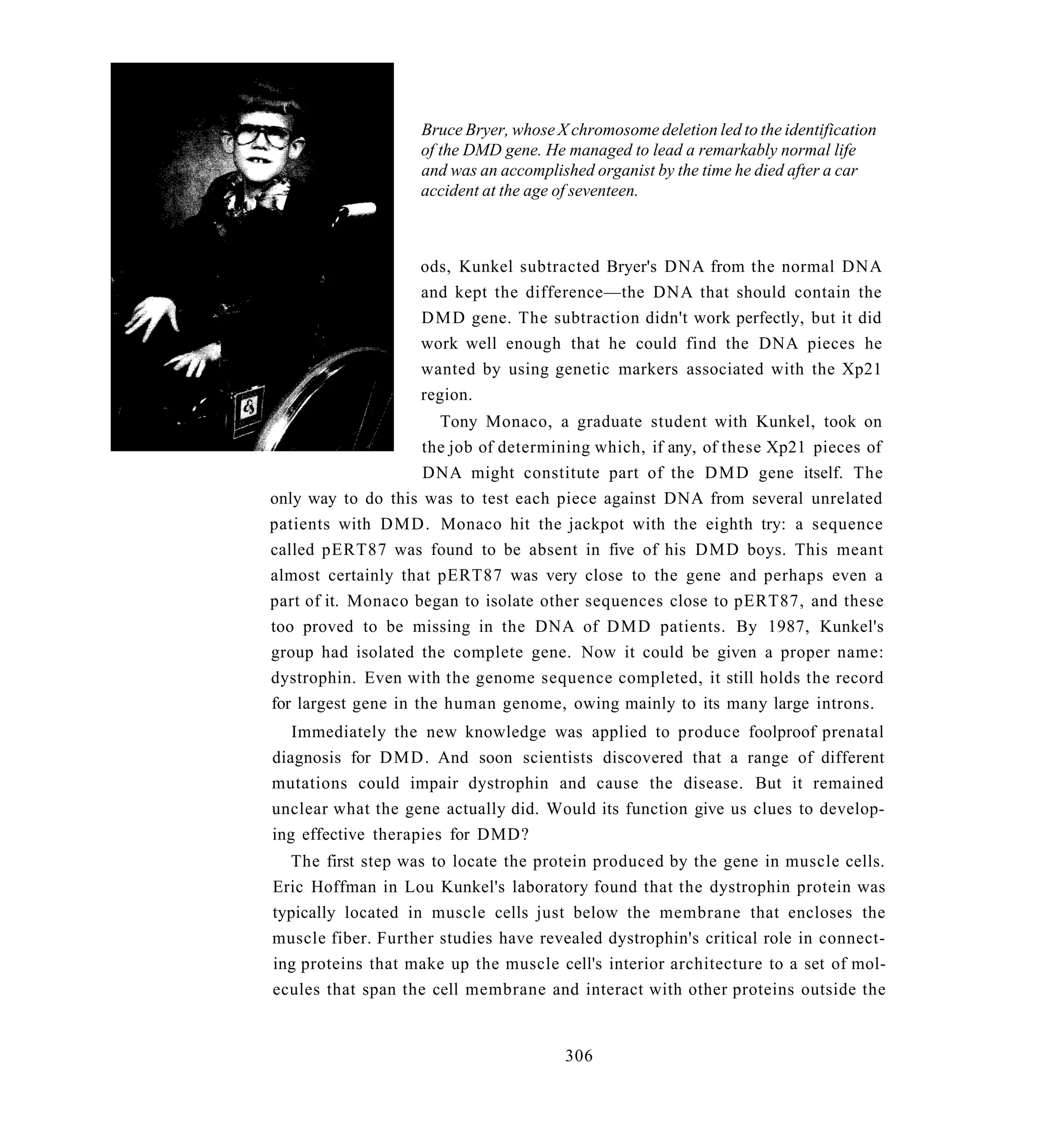
  • 21.
    Beginnings of Genetics T he rediscovery of Mendel's work, and the breakthroughs that followed it, sparked a surge of interest in the social significance of genetics. While scientists had been grappling with the precise mechanisms of heredity through the eighteenth and nineteenth centuries, public concern had been mounting about the burden placed on society by what came to be called the "degenerate classes"—the inhabitants of poorhouses, workhouses, and insane asylums. What could be done with these people? It remained a matter of controversy whether they should be treated charitably—which, the less charitably inclined claimed, ensured such folk would never exert themselves and would therefore remain forever dependent on the largesse of the state or of private institu- tions,—or whether they should be simply ignored, which, according to. the char- itably inclined, would result only in perpetuating the inability of the unfortunate to extricate themselves from their blighted circumstances. The publication of Darwin's Origin of Species in 1859 brought these issues into sharp focus. Although Darwin carefully omitted to mention human evolu- tion, fearing that to do so would only further inflame an already raging contro- versy, it required no great leap of imagination to apply his idea of natural selection to humans. Natural selection is the force that determines the fate of all genetic variations in nature—mutations like the one Morgan found in the fruit fly eye-color gene, but also perhaps differences in the abilities of human individuals to fend for themselves. Natural populations have an enormous reproductive potential. Take fruit flies, with their generation time of just ten days, and females that produce some three hundred eggs apiece (half of which will be female): starting with a single fruit fly couple, after a month (i.e., three generations later), you will have 150 X 150 X 1 50 fruit flies on your hands—that's more than 3 million flies, all of them derived from just one pair in just one month. Darwin made the point by choos- ing a species from the other end of the reproductive spectrum: The elephant is reckoned to be the slowest breeder of all known animals, and I have taken some pains to estimate its probable minimum rate of nat- ural increase: it will be under the mark to assume that it breeds when thirty years old, and goes on breeding till ninety years old, bringing forth three 15
  • 22.
    DNA pairsof young in this interval; if this be so, at the end of the fifth century there would be alive fifteen million elephants, descended from the first pair. All these calculations assume that all the baby fruit flies and all the baby ele- phants make it successfully to adulthood. In theory, therefore, there must be an infinitely large supply of food and water to sustain this kind of reproductive overdrive. In reality, of course, those resources are limited, and not all baby fruit flies or baby elephants make it. There is competition among individuals within a species for those resources. What determines who wins the struggle for access to the resources? Darwin pointed out genetic variation means that some indi- viduals have advantages in what he called "the struggle for existence." To take the famous example of Darwin's finches from the Galapagos Islands, those indi- viduals with genetic advantages—like the right size of beak for eating the most abundant seeds—are more likely to survive and reproduce. So the advantageous genetic variant—having a bill the right size—tends to be passed on to the next generation. The result is that natural selection enriches the next generation with the beneficial mutation so that eventually, over enough generations, every member of the species ends up with that characteristic. The Victorians applied the same logic to humans. They looked around and were alarmed by what they saw. The decent, moral, hardworking middle classes were being massively outreproduced by the dirty, immoral, lazy lower classes. The Victorians assumed that the virtues of decency, morality, and hard work ran in families just as the vices of filth, wantonness, and indolence did. Such char- acteristics must then be hereditary; thus, to the Victorians, morality and immorality were merely two of Darwin's genetic variants. And if the great unwashed were outreproducing the respectable classes, then the "bad" genes would be increasing in the human population. The species was doomed! Humans would gradually become more and more depraved as the "immorality" gene became more and more common. Francis Galton had good reason to pay special attention to Darwin's book, as the author was his cousin and friend. Darwin, some thirteen years older, had provided guidance during Galton's rather rocky college experience. But it was The Origin of Species that would inspire Galton to start a social and genetic cru- sade that would ultimately have disastrous consequences. In 1883, a year after his cousin's death, Galton gave the movement a name: eugenics. 16
  • 23.
    Beginnings of Genetics E ugenics was only one of Galton's many interests; Galton enthusiasts refer to him as a polymath, detractors as a dilettante. In fact, he made signifi- cant contributions to geography, anthropology, psychology, genetics, meteorol- ogy, statistics, and, by setting fingerprint analysis on a sound scientific footing, to criminology. Born in 1822 into a prosperous family, his education—partly in medicine and partly in mathe- matics—was mostly a chronicle of defeated expecta- tions. The death of his father when he was twenty-one simultaneously freed him from paternal restraint and yielded a handsome inheritance; the young man duly took advantage of both. After a full six years of being, what might be described today as a trust-fund dropout, however, Galton settled down to become a productive member of the Victorian establishment. He made his name leading an expedition to a then little known region of southwest Africa in 1850-52. In his account of his explorations, we encounter the first instance of the one strand that connects his many varied interests: he counted and measured everything. Galton was only happy when he could reduce a phenomenon to a set of numbers. At a missionary station he encountered a striking specimen of steatopygia—a condition of particularly protuberant buttocks, common among the indigenous A nineteenth-century exaggerated view of a Nama women of the region—and realized that this Nama woman woman was naturally endowed with the figure that was then fashionable in Europe. The only difference was that it required enormous (and costly) ingenuity on the part of European dressmakers to create the desired "look" lor their clients. I profess to be a scientific man, and was exceedingly anxious to obtain accurate measurements of her shape; but there was a difficulty in doing this. I did not know a word of Hottentot [the Dutch name for the Nama], and could never therefore have explained to the lady what the object of my 17
  • 24.
    DNA footrulecould be; and I really dared not ask my worthy missionary host to interpret for me. I therefore felt in a dilemma as I gazed at her form, that gift of bounteous nature to this favoured race, which no mantua-maker, with all her crinoline and stuffing, can do otherwise than humbly imitate. The object of my admiration stood under a tree, and was turning herself about to all points of the compass, as ladies who wish to be admired usu- ally do. Of a sudden my eye fell upon my sextant; the bright thought struck me, and I took a series of observations upon her figure in every direction, up and down, crossways, diagonally, and so forth, and 1 regis- tered them carefully upon an outline drawing for fear of any mistake; this being done, I boldly pulled out my measuring tape, and measured the distance from where I was to the place she stood, and having thus obtained both base and angles, I worked out the results by trigonometry and logarithms. Galton's passion for quantification resulted in his developing many of the fundamental principles of modern statistics. It also yielded some clever obser- vations. For example, he tested the efficacy of prayer. He figured that if prayer worked, those most prayed for should be at an advantage; to test the hypothesis he studied the longevity of British monarchs. Every Sunday, congregations in the Church of England following the Book of Common Prayer beseeched God to "Endue the king/queen plenteously with heavenly gifts; Grant him/her in health and wealth long to live." Surely, Galton reasoned, the cumulative effect of all those prayers should be beneficial. In fact, prayer seemed ineffectual: he found that on average the monarchs died somewhat younger than other members of the British aristocracy. Because of the Darwin connection—their common grandfather, Erasmus Darwin, too was one of the intellectual giants of his day—Galton was especially sensitive to the way in which certain lineages seemed to spawn disproportion- ately large numbers of prominent and successful people. In 1869 he published what would become the underpinning of all his ideas on eugenics, a treatise called Hereditary Genius: An Inquiry into Its Laws and Consequences. In it he purported to show that talent, like simple genetic traits such as the Hapsburg Lip, does indeed run in families; he recounted, for example, how some families 18
  • 25.
    Beginnings of Genetics had produced generation after generation of judges. His analysis largely ne- glected to take into account the effect of the environment: the son of a promi- nent judge is, after all, rather more likely to become a judge—by virtue of his father's connections, it nothing else—than the son of a peasant farmer. Galton did not, however, completely overlook the effect of the environment, and it was he who first referred to the "nature/nurture" dichotomy, possibly in reference to Shakespeare's irredeemable villain, Caliban, "a devil, a born devil, on whose nature/Nurture can never stick." The results of his analysis, however, left no doubt in Galton's mind. I have no patience with the hypothesis occasionally expressed, and often implied, especially in tales written to teach children to be good, that babies are born pretty much alike, and that the sole agencies in creating differ- ences between boy and boy, and man and man, are steady application and moral effort. It is in the most unqualified manner that I object to preten- sions of natural equality. A corollary of his conviction that these traits are genetically determined, he argued, was that it would be possible to "improve" the human stock by prefer- entially breeding gifted individuals, and preventing the less gifted from repro- ducing. It is easy . . . to obtain by careful selection a permanent breed of dogs or horses gifted with peculiar powers of running, or of doing anything else, so it would be quite practicable to produce a highly-gifted race of men by judicious marriages during several consecutive generations. Galton introduced the terms eugenics (literally "good in birth") to describe this application of the basic principle of agricultural breeding to humans. In time, eugenics came to refer to "self-directed human evolution": by making con- scious choices about who should have children, eugenicists believed that they could head off the "eugenic crisis" precipitated in the Victorian imagination by the high rates of reproduction of inferior stock coupled with the typically small families of the superior middle classes. 19
  • 26.
    DNA Eugenics asit was perceived during the first fart of the twentieth century: an opportunity for humans to control their own evolutionary destiny E ugenics these days is a dirty word, associated with racists and Nazis—a dark, best-forgotten phase of the history of genetics. It is important to appreciate, however, that in the closing years of the nineteenth and early years of the twentieth centuries, eugenics was not tainted in this way, and was seen by many as offering genuine potential for improving not just society as a whole but the lot of individuals within society as well. Eugenics was embraced with particular enthusiasm by those who today would be termed the "liberal left." Fabian socialists—some the era's most progressive thinkers—flocked to the cause, including George Bernard Shaw, who wrote that "there is now no rea- sonable excuse for refusing to face the fact that nothing but a eugenic religion can save our civilisation." Eugenics seemed to offer a solution to one of society's 20
  • 27.
    Beginnings of Genetics most persistent woes: that segment of the population that is incapable of exist- ing outside an institution. Whereas Galton had preached what came to be known as "positive eugen- ics," encouraging genetically superior people to have children, the American eugenics movement preferred to focus on "negative eugenics," preventing genetically inferior people from doing so. The goals of each program were basi- cally the same—the improvement of the human genetic stock—but these two approaches were very different. The American focus on getting rid of bad genes, as opposed to increasing fre- quencies of good ones, stemmed from a few influential family studies of "degeneration" and "feeblemindedness"—two peculiar terms characteristic of the American obsession with genetic decline. In 1875 Richard Dugdale pub- lished his account of the Juke clan of upstate New York. Here, according to Dugdale, were several generations of seriously bad apples—murderers, alco- holics, and rapists. Apparently in the area near their home in New York State the very name "Juke" was a term of reproach. Another highly influential study was published in 1912 by Henry Goddard, the psychologist who gave us the word "moron," on what he called "The Kallikak Family." This is the story of two family lines originating from a single male ancestor who had a child out of wedlock (with a "feebleminded" wench he met in a tavern while serving in the military during the American Revolutionary War), as well as siring a legitimate family. The illegitimate side of the Kallikak line, according to Goddard, was bad news indeed, "a race of defective degener- ates," while the legitimate side comprised respectable, upstanding members of the community. To Goddard, this "natural experiment in heredity" was an exem- plary tale of good genes versus bad. This view was reflected in the fictitious name he chose for the family. "Kallikak" is a hybrid of two Greek words, kalos (beautiful, of good repute) and kakos (bad). "Rigorous" new methods for testing mental performance—the first IQ tests, which were introduced to the United States from Europe by the same Henry Goddard—seemed to confirm the general impression that the human species was gaining downward momentum on a genetic slippery slope. In those early days of IQ testing, it was thought that high intelligence and an alert mind inevitably implied a capacity to absorb large quantities of information. Thus how much you 21
  • 28.
    DNA knew was considereda sort of index of your IQ. Following this line of reasoning, early IQ tests included lots of general knowledge questions. Here are a few from a standard test administered to U.S. Army recruits during World War I: Pick one of four: The Wyandotte is a kind of: 1) horse 2) fowl 3) cattle 4) granite The ampere is used in measuring: 1) wind power 2) electricity 3) water power 4) rainfall The number of a Zulu's legs is: 1) two 2) four 3) six 4) eight [Answers are 2, 2, 1] Some half of the nation's army recruits flunked the test and were deemed "feebleminded." These results galvanized the eugenics movement in the United States: it seemed to concerned Americans that the gene pool really was becom- ing more and more awash in low-intelligence genes. S cientists realized that eugenic policies required some understanding of the genetics underlying characteristics like feeblemindedness. With the rediscovery of Mendel's work, it seemed that this might actually be pos- sible. The lead in this endeavor was taken on Long Island by one of my prede- cessors as director of Cold Spring Harbor Laboratory. His name was Charles Davenport. In 1910, with funding from a railroad heiress, Davenport established the Eugenics Record Office at Cold Spring Harbor. Its mission was to collect basic information—pedigrees—on the genetics of traits ranging from epilepsy to criminality It became the nerve center of the American eugenics movement. Cold Spring Harbor's mission was much the same then as it is now: today we strive to be at the forefront of genetic research, and Davenport had no less lofty aspirations—but in those days the forefront was eugenics. However, there is no 22
  • 29.
    The staff ofthe Eugenics Record Office, pictured with members of the Cold Spring Harbor Laboratory. Davenport, seated in the very center, hired personnel on the basis of his belief that women were genetically suited to the task of gathering pedigree data. doubt that the research program initiated by Davenport was deeply flawed from the outset and had horrendous, albeit unintended, consequences. Eugenic thinking permeated everything Davenport did. He went out of his way, for instance, to hire women as field researchers because he believed them to have better observational and social skills than men. But, in keeping with the central goal of eugenics to reduce the number of bad genes, and increase the number of good ones, these women were hired for a maximum of three years. They were smart and educated, and therefore, by definition, the possessors of good genes. It would hardly be fitting for the Eugenics Record Office to hold them back too long from their rightful destiny of producing families and passing on their genetic treasure. Davenport applied Mendelian analysis to pedigrees he constructed of human characteristics. Initially, he confined his attentions to a number of simple traits—like albinism (recessive) and Huntington disease (dominant)—whose mode of inheritance he identified correctly. After these early successes he plunged into a study of the genetics of human behavior. Everything was fair game: all he needed was a pedigree and some information about the family his- tory (i.e., who in the line manifested the particular characteristic in question), 23
  • 30.
    Sound genetics: Davenport'spedigree showing how albinism is inherited and he would derive conclusions about the underlying genetics. The most cur- sory perusal of his 1911 book, Heredity in Relation to Eugenics, reveals just how wide-ranging Davenport's project was. He shows pedigrees of families with musical and literary ability, and of a "family with mechanical and inventive abil- ity, particularly with respect to boat-building." (Apparently Davenport thought that he was tracking the transmission of the boat-building gene.) Davenport even claimed that he could identify distinct family types associated with differ- 24
  • 31.
    Beginnings of Genetics ent surnames. Thus people with the surname Twinings have these characteris- tics: "broad-shouldered, dark hair, prominent nose, nervous temperament, tem- per usually quick, not revengeful. Heavy eyebrows, humorous vein, and sense of ludicrous; lovers of music and horses." The entire exercise was worthless. Today we know all the characteristics in question are readily affected by environmental factors. Davenport, like Galton, assumed unreasonably that nature unfailingly triumphed over nurture. In addi- tion, whereas the traits he had studied earlier, albinism and Huntington dis- ease, have a simple genetic basis—they are caused by a particular mutation in a particular gene—for most behavioral characteristics, the genetic basis, if any, is complex. They may be determined by a large number of different genes, each one contributing just a little to the final outcome. This situation makes the interpretation of pedigree data like Davenport's virtually impossible. Moreover, the genetic causes of poorly defined characteristics like "feeblemindedness" in one individual may be very different from those in another, so that any search for underlying genetic generalities is futile. Unsound genetics: Davenport's pedigree showing how boat-building skills are inherited. He fails to factor in the effect of the environment; a boat-builder's son is likely to follow his father's trade because he has been raised in that environment.
  • 32.
    DNA R egardless of the success or failure of Davenports scientific program, the eugenics movement had already developed a momentum of its own. Local chapters of the Eugenics Society organized competitions at state fairs, giving awards to families apparently free from the taint of bad genes. Fairs that had previously displayed only prize cattle and sheep now added "Better Babies" and "Fitter Families" contests to their programs. Effectively these were efforts to encourage positive eugenics—inducing the right kind of people to have chil- dren. Eugenics was even de rigueur in the nascent feminist movement. The feminist champions of birth control, Marie Stopes in Britain and, in the United States, Margaret Sanger, founder of Planned Parenthood, both viewed birth control as a form of eugenics. Sanger put it succinctly in 1919: "More children from the fit, less from the unfit—that is the chief issue of birth control." Altogether more sinister was the growth of negative eugenics—preventing the wrong kind of people from having children. In this development, a water- shed event occurred in 1899 when a young man called Clawson approached a "Large family" winner, Fitter Families Contest, Texas State Fair (1925)
  • 33.
    Beginnings of Genetics prison doctor in Indiana called Harry Sharp (appropriately named in light of his enthusiasm for the surgeon's knife). Clawson's problem—or so it was diagnosed by the medical establishment of the day—was compulsive masturbation. He reported that he had been hard at it ever since the age of twelve. Masturbation was seen as part of the general syndrome of degeneracy, and Sharp accepted the conventional wisdom (however bizarre it may seem to us today) that Clawson's mental shortcomings—he had made no progress in school—were caused by his compulsion. The solution? Sharp performed a vasectomy, then a recently invented procedure, and subsequently claimed that he had "cured" Clawson. As a result, Sharp developed his own compulsion: to perform vasectomies. Sharp promoted his success in treating Clawson (for which, incidentally, we have only Sharp's own report as confirmation) as evidence of the procedure's efficacy for treating all those identified as being of Clawson's kind—all "degen- erates." Sterilization had two things going for it. First, it might prevent degener- ate behavior, as Sharp claimed it had in Clawson. This, if nothing else, would save society a lot of money because those who had required incarceration, whether in prisons or insane asylums, would be rendered "safe" for release. Second, it would prevent the likes of Clawson from passing their inferior (degenerate) genes on to subsequent generations. Sterilization, Sharp believed, offered the perfect solution to the eugenic crisis. Sharp was an effective lobbyist, and in 1907 Indiana passed the first compul- sory sterilization law, authorizing the sterilization of confirmed "criminals, idiots, rapists, and imbeciles." Indiana's was the first of many: eventually thirty American states had enacted similar statutes, and by 1941 some sixty thousand individuals in the United States had duly been sterilized, half of them in Cali- fornia alone. The laws, which effectively resulted in state governments deciding who could and who could not have children, were challenged in court, but in 1927 the Supreme Court upheld the Virginia statute in the landmark case of Carrie Buck. Oliver Wendell Holmes wrote the decision: It is better for all the world if, instead of waiting to execute degenerate off- spring for crime, or to let them starve for their imbecility, society can pre- vent those who are manifestly unfit from continuing their kind . . . Three generations of imbeciles is enough. 27
  • 34.
    DNA Sterilization caught on outside the United States as well—and not only in Nazi Germany. Switzerland and the Scandinavian countries enacted similar leg- islation. R acism is not implicit to eugenics—good genes, the ones eugenics seeks to promote, can in principle belong to people of any race. Starting with Gal- ton, however, whose account of his African expedition had confirmed preju- dices about "inferior races," the prominent practitioners of eugenics tended to be racists who used eugenics to provide a "scientific" justification for racist views. Henry Goddard, of Kallikak family fame, conducted IQ tests on immi- grants at Ellis Island in 1913 and found as many as 80 percent of potential new Americans to be certifiably feebleminded. The IQ tests he carried out during World War I for the U.S. Army reached a similar conclusion: 45 percent of foreign-born draftees had a mental age of less than eight (only 21 percent of native-born draftees fell into this category). That the tests were biased—they were, after all, carried out in English—was not taken to be relevant: racists had the ammunition they required, and eugenics would be pressed into the service of the cause. Although the term "white supremacist" had yet to be coined, America had plenty of them early in the twentieth century. White Anglo-Saxon Protestants, Theodore Roosevelt prominent among them, were concerned that immigration was corrupting the WASP paradise that America, in their view, was supposed to be. In 1916 Madison Grant, a wealthy New Yorker and friend of both Daven- port and Roosevelt, published The Passing of the Great Race, in which he argued that the Nordic peoples are superior to all others, including other Europeans. To preserve the United States' fine Nordic genetic heritage, Grant campaigned for immigration restrictions on all non-Nordics. He championed racist eugenic policies, too: Under existing conditions the most practical and hopeful method of race improvement is through the elimination of the least desirable elements in the nation by depriving them of the power to contribute to future genera- tions. It is well known to stock breeders that the color of a herd of cattle 28
  • 35.
    Beginnings of Genetics can be modified by continuous destruction of worthless shades and of course this is true of other characters. Black sheep, for instance, have been practically obliterated by cutting out generation after generation all ani- mals that show this color phase. Despite appearances, Grant's book was hardly a minor publication by a mar- ginalized crackpot; it was an influential best-seller. Later translated into Ger- man, it appealed—not surprisingly—to the Nazis. Grant gleefully recalled having received a personal letter from Hitler, who wrote to say that the book was his Bible. Although not as prominent as Grant, arguably the most influential of the era's exponents of "scientific" racism was Davenport's right-hand man, Harry Laugh- lin. Son of an Iowa preacher, Laughlin's expertise was in racehorse pedigrees and chicken breeding. He oversaw the operations of the Eugenics Record Office, but was at his most effective as a lobbyist. In the name of eugenics, he fanatically promoted forced sterilization measures and restrictions on the influx of genetically dubious foreigners (i.e., non—northern Europeans). Particularly important historically was his role as an expert witness at congressional hear- ings on immigration: Laughlin gave full rein to his prejudices, all of them of course dressed up as "science." When the data were problematic, he fudged them. When he unexpectedly found, for instance, that immigrant Jewish chil- dren did better than the native-born in public schools, Laughlin changed the categories he presented, lumping Jews in with whatever nation they had come from, thereby diluting away their superior performance. The passage in 1924 of the Johnson-Reed Immigration Act, which severely restricted immigration from southern Europe and elsewhere, was greeted as a triumph by the likes of Madi- son Grant; it was Harry Laughlin's finest hour. As vice president some years ear- lier, Calvin Coolidge had chosen to overlook both Native Americans and the nation's immigration history when he declared that "America must remain American." Now, as president, he signed his wish into law. Like Grant, Laughlin had his fans among the Nazis, who modeled some of their own legislation on the American laws he had developed. In 1936 he enthusiastically accepted an honorary degree from Heidelberg University, which chose to honor him as "the farseeing representative of racial policy in 29
  • 36.
    Scientific racism: socialinadequacy in the United States analyzed by national group (1922). "Social inadequacy" is used here by Harry Laughlin as an umbrella term for a host of sins ranging from feeblemindedness to tuberculosis. Laughlin computed an institutional "quota" for each group on the basis of the proportion of that group in the U.S. population as a whole. Shown, as a percentage, is the number of institutionalized individuals from a particular group divided by the group's quota. Groups scoring over 100 percent are over- represented in institutions. 30
  • 37.
    Beginnings of Genetics America." In time, however, a form of late-onset epilepsy ensured that Laugh- lin's later years were especially pathetic. All his professional life he had cam- paigned for the sterilization of epileptics on the grounds that they were genetically degenerate. H itler's Mein Kampf is saturated with pseudoscientific racist ranting derived from long-standing German claims of racial superiority and from some of the uglier aspects of the American eugenics movement. Hitler wrote that the state "must declare unfit for propagation all who are in any way visibly sick or who have inherited a disease and can therefore pass it on, and put this into actual practice," and elsewhere, "Those who are physically and mentally unhealthy and unworthy must not perpetuate their suffering in the body of their children." Shortly after coming to power in 1933, the Nazis had passed a com- prehensive sterilization law—the "law for the prevention of progeny with hered- itary defects"—that was explicitly based on the American model. (Laughlin proudly published a translation of the law.) Within three years, 225,000 people had been sterilized. Positive eugenics, encouraging the "right" people to have children, also thrived in Nazi Germany, where "right" meant properly Aryan. Heinrich Himm- ler, head of the SS (the Nazi elite corps), saw his mission in eugenic terms: SS officers should ensure Germany's genetic future by having as many children as possible. In 1936, he established special maternity homes for SS wives to guar- antee that they got the best possible care during pregnancy. The proclamations at the 1935 Nuremberg Rally included a "law for the protection of German blood and German honor," which prohibited marriage between Germans and Jews and even "extra-marital sexual intercourse between Jews and citizens of German or related blood." The Nazis were unfailingly thorough in closing up any reproductive loopholes. Neither, tragically, were there any loopholes in the U.S. Johnson-Reed Immi- gration Act that Harry Laughlin had worked so hard to engineer. For many Jews fleeing Nazi persecution, the United States was the logical first choice of desti- nation, but the country's restrictive—and racist—immigration policies resulted in many being turned away. Not only had Laughlin's sterilization law provided Hitler with the model for his ghastly program, but his impact on immigration 31
  • 38.
    DNA legislation meant thatthe United States would in effect abandon German Jewry to its fate at the hands of the Nazis. In 1939, with the war under way, the Nazis introduced euthanasia. Steriliza- tion proved too much trouble. And why waste the food? The inmates of asylums were categorized as "useless eaters." Questionnaires were distributed among the mental hospitals where panels of experts were instructed to mark them with a cross in the cases of patients whose lives they deemed "not worth living." Seventy-five thousand came back so marked, and the technology of mass murder—the gas chamber—was duly developed. Subsequently, the Nazis expanded the definition of "not worth living" to include whole ethnic groups, among them the Gypsies and, in particular, the Jews. What came to be called the Holocaust was the culmination of Nazi eugenics. E ugenics ultimately proved a tragedy for humankind. It also proved a disas- ter for the emerging science of genetics, which could not escape the taint. In fact, despite the prominence of eugenicists like Davenport, many scientists had criticized the movement and dissociated themselves from it. Alfred Russel Wallace, the co-discoverer with Darwin of natural selection, condemned eugenics in 1912 as "simply the meddlesome interference of an arrogant, scien- tific priestcraft." Thomas Hunt Morgan, of fruit fly fame, resigned on "scientific grounds" from the board of scientific directors of the Eugenics Record Office. Raymond Pearl, at Johns Hopkins, wrote in 1928 that "orthodox eugenicists are going contrary to the best established facts of genetical science." Eugenics had lost its credibility in the scientific community long before the Nazis appropriated it for their own horrific purposes. The science underpinning it was bogus, and the social programs constructed upon it utterly reprehensible. Nevertheless, by midcentury the valid science of genetics, human genetics in particular, had a major public relations problem on its hands. When in 1948 I first came to Cold Spring Harbor, former home of the by-then-defunct Eugen- ics Record Office, nobody would even mention the "E word"; nobody was will- ing to talk about our science's past even though past issues of the German Journal of Racial Hygiene still lingered on the shelves of the library. Realizing that such goals were not scientifically feasible, geneticists had long 32
  • 39.
    Beginnings of Genetics since forsaken the grand search for patterns of inheritance of human behavioral characteristics—whether Davenport's feeblemindedness or Galton's genius— and were now focusing instead on the gene and how it functioned in the cell. With the development during the 1930s and 1940s of new and more effective technologies for studying biological molecules in ever greater detail, the time had finally arrived for an assault on the greatest biological mystery of all: what is the chemical nature of the gene? 33
  • 40.
    CHAPTER TWO THE D O U B L E H E L I X : T H I S I S LIFE I got hooked on the gene during my third year at the University of Chicago. Until then, I had planned to be a naturalist and looked forward to a career far removed from the urban bustle of Chicago's South Side, where I grew up. My change of heart was inspired not by an unforgettable teacher but a little book that appeared in 1944, What Is Life?, by the Austrian-born father of wave mechanics, Erwin Schrodinger. It grew out of several lectures he had given the year before at the Institute for Advanced Study in Dublin. That a great physicist had taken the time to write about biology caught my fancy. In those days, like most people, I considered chemistry and physics to be the "real" sciences, and theoretical physicists were science's top dogs. Schrodinger argued that life could be thought of in terms of storing and pass- ing on biological information. Chromosomes were thus simply information bearers. Because so much information had to be packed into every cell, it must be compressed into what Schrodinger called a "hereditary code-script" embed- ded in the molecular fabric of chromosomes. To understand life, then, we would have to identify these molecules, and crack their code. He even specu- lated that understanding life—which would involve finding the gene—might take us beyond the laws of physics as we then understood them. Schrodinger's book was tremendously influential. Many of those who would become major players in Act 1 of molecular biology's great drama, including Francis Crick (a former physicist himself), had, like me, read What Is Life? and been impressed. In my own case, Schrodinger struck a chord because I too was intrigued by
  • 41.
    DNA the essence of life. A small minority of scientists still thought life depended upon a vital force emanating from an all-powerful god. But like most of my teachers, I disdained the very idea of vitalism. If such a "vital" force were calling the shots in nature's game, there was little hope life would ever be understood through the methods of science. On the other hand, the notion that life might be perpetuated by means of an instruction book inscribed in a secret code appealed to me. What sort of molecular code could be so elaborate as to convey all the multitudinous wonder of the living world? And what sort of molecular trick could ensure that the code is exactly copied every time a chromosome duplicates? The physicist Erwin At the time of Schrodinger's Dublin lectures, most biologists sup- Schrodinger, whose book posed that proteins would eventually be identified as the primary What Is Life? turned me bearers of genetic instruction. Proteins are molecular chains built up on to the gene from twenty different building blocks, the amino acids. Because per- mutations in the order of amino acids along the chain are virtually infinite, pro- teins could, in principle, readily encode the information underpinning life's extraordinary diversity. DNA then was not considered a serious candidate for the bearer of code-scripts, even though it was exclusively located on chromo- somes and had been known about for some seventy-five years. In 1869, Friedreich Miescher, a Swiss biochemist working in Germany, had isolated from pus-soaked bandages supplied by a local hospital a substance he called "nuclein." Because pus consists largely of white blood cells, which, unlike red blood cells, have nuclei and therefore DNA-containing chromosomes, Miescher had stumbled on a good source of DNA. When he later discovered that "nuclein" was to be found in chromosomes alone, Miescher understood that his discovery was indeed a big one. In 1893, he wrote: "Inheritance insures a continuity in form from generation to generation that lies even deeper than the chemical molecule. It lies in the structuring atomic groups. In this sense, I am a supporter of the chemical heredity theory." Nevertheless, for decades afterward, chemistry would remain unequal to the task of analyzing the immense size and complexity of the DNA molecule. Only in the 1930s was DNA shown to be a long molecule containing four different chemical bases: adenine (A), guanine (G), thymine (T), and cytosine (C). But 36
  • 42.
    The Double Helix at the time of Schrodinger's lectures, it was still unclear just how the subunits (called deoxynucleotides) of the molecule were chemically linked. Nor was it known whether DNA molecules might vary in their sequences of the four dif- ferent bases. If DNA were indeed Schrodinger's code-script, then the molecule would have to be capable of existing in an immense number of different forms. But back then it was still considered a possibility that one simple sequence like AGTC might be repeated over and over along the entire length of DNA chains. DNA did not move into the genetic limelight until 1944, when Oswald Avery's lab at the Rockefeller Institute in New York City reported that the com- position of the surface coats of pneumonia bacteria could be changed. This was not the result he and his junior colleagues, Colin MacLeod and Maclyn McCarty, expected. For more than a decade Avery's group had been following up on another most unexpected observation made in 1928 by Fred Griffith, a scientist in the British Ministry of Health. Griffith was interested in pneumonia and studied its bacte- rial agent, Pneumococcus. It was known that there were two strains, designated "smooth" (S) and "rough" (R) according to their appearance under the micro- scope. These strains differed not only visually but also in their virulence. Inject S bacteria into a mouse, and within a few days the mouse dies; inject R bacteria and the mouse remains healthy. It turns out that S bacterial cells have a coating that prevents the mouse's immune system from recognizing the invader. The R cells have no such coating and are therefore readily attacked by the mouse's immune defenses. A view through the microscope of blood cells treated with a chemical that stains DNA. In order to maximize their oxygen-transporting capacity, red blood cells have no nucleus and therefore no DNA. But white blood cells, which patrol the bloodstream in search of intruders, have a nucleus containing chromosomes. 37
  • 43.
    DNA Through his involvement with public health, Griffith knew that multiple strains had sometimes been isolated from a single patient, and so he was curi- ous about how different strains might interact in his unfortunate mice. With one combination, he made a remarkable discovery: when he injected heat- killed S bacteria (harmless) and normal R bacteria (also harmless), the mouse died. How could two harmless forms of bacteria conspire to become lethal? The clue came when he isolated the Pneumococcus bacteria retrieved from the dead mice and discovered living S bacteria. It appeared the living innocuous R bacteria had acquired something from the dead S variant; whatever it was, that something had allowed the R in the presence of the heat-killed S bacteria to transform itself into a living killer S strain. Griffith confirmed that this change was for real by culturing the S bacteria from the dead mouse over several generations: the bacteria bred true for the S type, just as any regular S strain would. A genetic change had indeed occurred to the R bacteria in- jected into the mouse. Though this transformation phenomenon seemed to defy all understanding, Griffith's observations at first created little stir in the scientific world. This was partly because Griffith was intensely private and so averse to large gatherings that he seldom attended scientific conferences. Once, he had to be virtually forced to give a lecture. Bundled into a taxi and escorted to the hall by col- leagues, he discoursed in a mumbled monotone, emphasizing an obscure corner of his microbiological work but making no mention of bacterial transformation. Luckily, however, not everyone overlooked Griffith's breakthrough. Oswald Avery was also interested in the sugarlike coats of the Pneumococcus. He set out to duplicate Griffith's experiment in order to isolate and characterize whatever it was that had caused those R cells to change to the S type. In 1944 Avery, MacLeod, and McCarty published their results: an exquisite set of exper- iments showing unequivocally that DNA was the transforming principle. Cul- turing the bacteria in the test tube rather than in mice made it much easier to search for the chemical identity of the transforming factor in the heat-killed S cells. Methodically destroying one by one the biochemical components of the heat-treated S cells, Avery and his group looked to see whether transformation was prevented. First they degraded the sugarlike coat of the S bacteria. Trans- formation still occurred: the coat was not the transforming principle. Next they 38
  • 44.
    The Double Helix used a mixture of two protein-destroying enzymes, trypsin and chymotrypsin, to degrade virtually all the proteins in the S cells. To their surprise, transformation was again unaffected. Next they tried an enzyme (RNase) that breaks down RNA (ribonucleic acid), a second class of nucleic acids similar to DNA and possibly involved in protein synthesis. Again transformation occurred. Finally, they came to DNA, exposing the S bacterial extracts to the DNA-destroying enzyme, DNase. This time they hit a home run. All S-inducing activity ceased completely. The transforming factor was DNA. In part because of its bombshell implications, the resulting February 1944 paper by Avery, MacLeod, and McCarty met with a mixed response. Many geneticists accepted their conclusions. After all, DNA was found on every chro- mosome; why shouldn't it be the genetic material? By contrast, however, most biochemists expressed doubt that DNA was a complex enough molecule to act as the repository of such a vast quantity of biological information. They contin- ued to believe that proteins, the other component of chromosomes, would prove to be the hereditary substance. In principle, as the biochemists rightly noted, it would be much easier to encode a vast body of complex information using the twenty-letter amino-acid alphabet of proteins than the four-letter nucleotide alphabet of DNA. Particularly vitriolic in his rejection of DNA as the genetic substance was Avery's own colleague at the Rockefeller Institute, the protein chemist Alfred Mirsky. By then, however, Avery was no longer scientifically active. The Rockefeller Institute had mandatorily retired him at age sixty-five. Avery missed out on more than the opportunity to defend his work against the attacks of his colleagues: He was never awarded the Nobel Prize, which was certainly his due, for identifying DNA as the transforming principle. Because the Nobel committee makes its records public fifty years following each award, we now know that Avery's candidacy was blocked by the Swedish physical chemist Einar Hammarsten. Though Hammarsten's reputation was based largely on his having produced DNA samples of unprecedented high quality, he still believed genes to be an undiscovered class of proteins. In fact, even after the double helix was found, Hammarsten continued to insist that Avery should not receive the prize until after the mechanism of DNA transformation had been completely worked out. Avery died in 1955; had he lived only a few more years, he would almost certainly have gotten the prize. 39
  • 45.
    DNA W hen I arrived at Indiana University in the fall of 1947 with plans to pur- sue the gene for my Ph.D. thesis, Avery's paper came up over and over in conversations. By then, no one doubted the reproducibility of his results, and more recent work coming out of the Rockefeller Institute made it all the less likely that proteins would prove to be the genetic actors in bacterial transforma- tion. DNA had at last become an important objective for chemists setting their sights on the next breakthrough. In Cambridge, England, the canny Scottish chemist Alexander Todd rose to the challenge of identifying the chemical bonds that linked together nucleotides in DNA. By early 1951, his lab had proved that these links were always the same, such that the backbone of the DNA molecule was very regular. During the same period, the Austrian-born refugee Erwin Chargaff, at the College of Physicians and Surgeons of Columbia University, used the new technique of paper chromatography to measure the relative amounts of the four DNA bases in DNA samples extracted from a variety of vertebrates and bacteria. While some species had DNA in which adenine and thymine predominated, others had DNA with more guanine and cytosine. The possibility thus presented itself that no two DNA molecules had the same com- position. At Indiana I joined a small group of visionary scientists, mostly physicists and chemists, studying the reproductive process of the viruses that attack bacteria (bacteriophages—"phages" for short). The Phage Group was born when my Ph.D. supervisor, the Italian-trained medic Salvador Luria and his close friend, the German-born theoretical physicist Max Delbrück, teamed up with the American physical chemist Alfred Hershey. During World War II both Luria and Delbruck were considered enemy aliens, and thus ineligible to serve in the war effort of American science, even though Luria, a Jew, had been forced to leave France for New York City and Delbriick had fled Germany as an objector to Nazism. Thus excluded, they continued to work in their respective university labs—Luria at Indiana and Delbruck at Vanderbilt—and collaborated on phage experiments during successive summers at Cold Spring Harbor. In 1943, they joined forces with the brilliant but taciturn Hershey, then doing phage research of his own at Washington University in St. Louis. The Phage Group's program was based on its belief that phages, like all 40
  • 46.
    The Double Helix viruses, were in effect naked genes. This concept had first been proposed in 1922 by the imaginative American geneticist Herman J. Muller, who three years later demonstrated that X rays cause mutations. His belated Nobel Prize came in 1946, just after he joined the faculty of Indiana University. It was his pres- ence, in fact, that led me to Indiana. Having started his career under T. H. Mor- gan, Muller knew better than anyone else how genetics had evolved during the first half of the twentieth century, and I was enthralled by his lectures during my first term. His work on fruit flies (Drosophila), however, seemed to me to belong more to the past than to the future, and I only briefly considered doing thesis research under his supervision. I opted instead for Luria's phages, an even speedier experimental subject than Drosophila: genetic crosses of phages done one day could be analyzed the next. For my Ph.D. thesis research, Luria had me follow in his footsteps by study- ing how X rays killed phage particles. Initially I had hoped to show that viral death was caused by damage to phage DNA. Reluctantly, however, I eventually had to concede that my experimental approach could never give unambiguous answers at the chemical level. I could draw only biological conclusions. Even though phages were indeed effectively naked genes, I realized that the deep answers the Phage Group was seeking could be arrived at only through advanced chemistry. DNA somehow had to transcend its status as an acronym; it had to be understood as a molecular structure in all its chemical detail. Upon finishing my thesis, I saw no alternative but to move to a lab where I could study DNA chemistry. Unfortunately, however, knowing almost no pure chemistry, I would have been out of my depth in any lab attempting difficult experiments in organic or physical chemistry. I therefore took a postdoctoral fel- lowship in the Copenhagen lab of the biochemist Herman Kalckar in the fall of 1950. He was studying the synthesis of the small molecules that make up DNA, but I figured out quickly that his biochemical approach would never lead to an understanding of the essence of the gene. Every day spent in his lab would be one more day's delay in learning how DNA carried genetic information. My Copenhagen year nonetheless ended productively. To escape the cold Danish spring, I went to the Zoological Station at Naples during April and May. During my last week there, I attended a small conference on X-ray diffraction methods for determining the 3-D structure of molecules. X-ray diffraction is a 41
  • 47.
    DNA way of studying the atomic structure of any molecule that can be crystallized. The crystal is bombarded with X rays, which bounce off its atoms and arc scat- tered. The scatter pattern gives information about the structure of the mole- cule but, taken alone, is not enough to solve the structure. The additional information needed is the "phase assignment," which deals with the wave properties of the molecule. Solving the phase problem was not easy, and at that time only the most audacious scientists were willing to take it on. Most of the successes of the diffraction method had been achieved with relatively simple molecules. My expectations for the conference were low. I believed that a three- dimensional understanding of protein structure, or for that matter of DNA, was more than a decade away. Disappointing earlier X-ray photos suggested that DNA was particularly unlikely to yield up its secrets via the X-ray approach. These results were not surprising since the exact sequences of DNA were expected to differ from one individual molecule to another. The resulting irregularity of surface configurations would understandably pre- vent the long thin DNA chains from lying neatly side by side in the regular repeating patterns required for X-ray analysis to be successful. It was therefore a surprise and a delight to hear the last-minute talk on DNA by a thirty- four-year-old Englishman named Maurice Wilkins from the Biophysics Lab of King's College, London. Wilkins was a physicist who during the war had worked on the Man- hattan Project. For him, as for many of the other scientists involved, the actual deploy- ment of the bomb on Hiroshima and Nagasaki, supposedly the culmination of all their work, was profoundly disillusioning. Maurice Wilkins in his lab at King's College, London He considered forsaking science altogether 42
  • 48.
    The Double Helix to become a painter in Paris, but biology intervened. He too had read Schrodinger's book, and was now tackling DNA with X-ray diffraction. He displayed a photograph of an X-ray diffraction pattern he had recently obtained, and its many precise reflections indicated a highly regular crystalline packing. DNA, one had to conclude, must have a regular structure, the eluci­ dation of which might well reveal the nature of the gene. Instantly I saw myself moving to London to help Wilkins find the structure. My attempts to converse with him after his talk, however, went nowhere. All I got for my efforts was a declaration of his conviction that much hard work lay ahead. While I was hitting consecutive dead ends, back in America the world's pre­ eminent chemist, Caltech's Linus Pauling, announced a major triumph: he had found the exact arrangement in which chains of amino acids (called polypep­ tides) fold up in proteins, and called his structure the α-helix (alpha helix). That it was Pauling who made this breakthrough was no surprise: he was a scientific superstar. His book The Nature of the Chemical Bond essentially laid the foun­ dation of modern chemistry, and, for chemists of the day, it was the Bible. Paul­ ing had been a precocious child. When he was nine, his father, a druggist in Oregon, wrote to the Oregonian newspaper requesting suggestions of reading matter for his bookish son, adding that he had already read the Bible and Dar­ win's Origin of Species. But the early death of Pauling's father, which brought the family to financial ruin, makes it remarkable that the promising young man managed to get an education at all. As soon as I returned to Copenhagen I read about Pauling's α-helix. To my surprise, his model was not based on a deductive leap from experimental X-ray diffraction data. Instead, it was Pauling's long experience as a structural chemist that had emboldened him to infer which type of helical fold would be most compatible with the underlying chemical features of the polypeptide chain. Pauling made scale models of the different parts of the protein molecule, working out plausible schemes in three dimensions. He had reduced the prob­ lem to a kind of three-dimensional jigsaw puzzle in a way that was simple yet brilliant. Whether the α-helix was correct—in addition to being pretty—was now the question. Only a week later, I got the answer. Sir Lawrence Bragg, the English inventor of X-ray crystallography and 1915 Nobel laureate in Physics, came to 43
  • 49.
    DNA Lawrence Bragg (left)with Linus Pauling, who is carrying a model of the α-helix Copenhagen and excitedly reported that his junior colleague, the Austrian-born chemist Max Perutz, had ingeniously used synthetic polypeptides to confirm the correctness of Pauling's α-helix. It was a bittersweet triumph for Bragg's Cavendish Laboratory. The year before, they had completely missed the boat in their paper outlining possible helical folds for polypeptide chains. By then Salvador Luria had tentatively arranged for me to take up a research 44
  • 50.
    The Double Helix position at the Cavendish. Located at Cambridge University, this was the most famous laboratory in all of science. Here Ernest Rutherford first described the structure of the atom. Now it was Bragg's own domain, and I was to work as apprentice to the English chemist John Kendrew, who was interested in deter- mining the 3-D structure of the protein myoglobin. Luria advised me to visit the Cavendish as soon as possible. With Kendrew in the States, Max Perutz would check me out. Together, Kendrew and Perutz had earlier established the Med- ical Research Council (MRC) Unit for the Study of the Structure of Biological Systems. A month later in Cambridge, Perutz assured me that I could quickly master the necessary X-ray diffraction theory and should have no difficulty fitting in with the others in their tiny MRC Unit. To my relief, he was not put off by my biology background. Nor was Lawrence Bragg, who briefly came down from his office to look me over. I was twenty-three when I arrived back at the MRC Unit in Cambridge in early October. I found myself sharing space in the biochemistry room with a thirty-five-year-old ex-physicist, Francis Crick, who had spent the war working on magnetic mines for the Admiralty. When the war ended, Crick had planned to stay on in military research, but, on reading Schrödinger's What Is Life?, he had moved toward biology. Now he was at the Cavendish to pursue the 3-D structure of proteins for his Ph.D. Crick was always fascinated by the intricacies of impor- tant problems. His endless questions as a child compelled his weary parents to buy him a children's encyclopedia, hop- ing that it would satisfy his curiosity. But it only made him insecure: he confided to his mother his fear that everything would have been discovered by the time he grew up, leaving him nothing to do. His mother reassured him (correctly, as it happened) that there would still be a thing or two for him to figure out. A great talker, Crick was invariably the center of attention in any gathering. His booming laugh was forever echoing Francis Crick with the down the hallways of the Cavendish. As the MRC Unit's res- Cavendish X-ray tube
  • 51.
    DNA ident theoretician, heused to come up with a novel insight at least once a month, and he would explain his latest idea at great length to anyone willing to listen. The morning we met he lit up when he learned that my objective in com- ing to Cambridge was to learn enough crystallography to have a go at the DNA structure. Soon I was asking Crick's opinion about using Pauling's model- building approach to go directly for the structure. Would we need many more years of diffraction experimentation before modeling would be practicable? To bring us up to speed on the status of DNA structural studies, Crick invited Maurice Wilkins, a friend since the end of the war, up from London for Sunday lunch. Then we could learn what progress Wilkins had made since his talk in Naples. Wilkins expressed his belief that DNA's structure was a helix, formed by sev- eral chains of linked nucleotides twisted around each other. All that remained to be settled was the number of chains. At the time, Wilkins favored three on the basis of his density measurements of DNA fibers. He was keen to start model-building, but he had run into a roadblock in the form of a new addition to the King's College Biophysics Unit, Rosalind Franklin. A thirty-one-year-old Cambridge-trained physical chemist, Franklin was an obsessively professional scientist; for her twenty-ninth birthday all she requested was her own subscription to her field's technical journal, Acta Crys¬ tallographica. Logical and precise, she was impatient with those who acted oth- erwise. And she was given to strong opinions, once describing her Ph.D. thesis adviser, Ronald Norrish, a future Nobel Laureate, as "stupid, bigoted, deceitful, ill-mannered and tyrannical." Outside the laboratory, she was a determined and gutsy mountaineer, and, coming from the upper echelons of London society, she belonged to a more rarefied social world than most scientists. At the end of a hard day at the bench, she would occasionally change out of her lab coat into an elegant evening gown and disappear into the night. Just back from a four-year X-ray crystallographic investigation of graphite in Paris, Franklin had been assigned to the DNA project while Wilkins was away from King's. Unfortunately, the pair soon proved incompatible. Franklin, direct and data-focused, and Wilkins, retiring and speculative, were destined never to collaborate. Shortly before Wilkins accepted our lunch invitation, the two had had a big blowup in which Franklin had insisted that no model-building could 46
  • 52.
    Rosalind Franklin on oneof the mountain hiking vacations she loved commence before she collected much more extensive diffraction data. Now they effectively didn't communicate, and Wilkins would have no chance to learn of her progress until Franklin presented her lab seminar scheduled for the beginning of November. If we wanted to listen, Crick and I were welcome to go as Wilkins's guests. Crick was unable to make the seminar, so I attended alone and briefed him later on what I believed to be its key take-home messages on crystalline DNA. 47
  • 53.
    DNA In particular, Idescribed from memory Franklin's measurements of the crystal¬ lographic repeats and the water content. This prompted Crick to begin sketch- ing helical grids on a sheet of paper, explaining that the new helical X-ray theory he had devised with Bill Cochran and Vladimir Vand would permit even me, a former bird-watcher, to predict correctly the diffraction patterns expected from the molecular models we would soon be building at the Cavendish. As soon as we got back to Cambridge, I arranged for the Cavendish machine shop to construct the phosphorous atom models needed for short sections of the sugar phosphate backbone found in DNA. Once these became available, we tested different ways the backbones might twist around each other in the center of the DNA molecule. Their regular repeating atomic structure should allow the atoms to come together in a consistent, repeated conformation. Fol- lowing Wilkins's hunch, we focused on three-chain models. When one of these appeared to be almost plausible, Crick made a phone call to Wilkins to announce we had a model we thought might be DNA. The next day both Wilkins and Franklin came up to see what we had done. The threat of unanticipated competition briefly united them in common pur- pose. Franklin wasted no time in faulting our basic concept. My memory was that she had reported almost no water present in crystalline DNA. In fact, the opposite was true. Being a crystallographic novice, I had confused the terms "unit cell" and "asymmetric unit." Crystalline DNA was in fact water-rich. Con- sequently, Franklin pointed out, the backbone had to be on the outside and not, as we had it, in the center, if only to accommodate all the water molecules she had observed in her crystals. That unfortunate November day cast a very long shadow. Franklins opposi- tion to model-building was reinforced. Doing experiments, not playing with Tinkertoy representations of atoms, was the way she intended to proceed. Even worse, Sir Lawrence Bragg passed down the word that Crick and I should desist from all further attempts at building a DNA model. It was further decreed that DNA research should be left to the King's lab, with Cambridge continuing to focus solely on proteins. There was no sense in two MRC-fundcd labs compet- ing against each other. With no more bright ideas up our sleeves, Crick and I were reluctantly forced to back off, at least lor the time being. It was not a good moment to be condemned to the DNA sidelines. Linus 48
  • 54.
    The Double Helix Pauling had written Wilkins to request a copy of the crystalline DNA diffraction pattern. Though Wilkins had declined, saying he wanted more time to interpret it himself, Pauling was hardly obliged to depend upon data from King's. If he wished, he could easily start serious X-ray diffraction studies at Caltech. The following spring, I duly turned away from DNA and set about extend- ing prewar studies on the pencil-shaped tobacco mosaic virus using the Cavendish's powerful new X-ray beam. This light experimental workload gave me plenty of time to wander through various Cambridge libraries. In the zool- ogy building, I read Erwin Chargaff's paper describing his finding that the DNA bases adenine and thymine occurred in roughly equal amounts, as did the bases guanine and cytosine. Hearing of these one-to-one ratios Crick wondered whether, during DNA duplication, adenine residues might be attracted to thymine and vice versa, and whether a corresponding attraction might exist between guanine and cytosine. If so, base sequences on the "parental" chains (e.g., ATGC) would have to be complementary to those on "daughter" strands (yielding in this case TACG). These remained idle thoughts until Erwin Chargaff came through Cam- bridge in the summer of 1952 on his way to the International Biochemical Con- gress in Paris. Chargaff expressed annoyance that neither Crick nor I saw the need to know the chemical structures of the four bases. He was even more upset when we told him that we could simply look up the structures in text- books as the need arose. I was left hoping that Chargaff's data would prove irrelevant. Crick, however, was energized to do several experiments looking for molecular "sandwiches" that might form when adenine and thymine (or alter- natively, guanine and cytosine) were mixed together in solution. But his experi- ments went nowhere. Like Chargaff, Linus Pauling also attended the International Biochemical Congress, where the big news was the latest result from the Phage Group. Alfred Hershey and Martha Chase at Cold Spring Harbor had just confirmed Avery's transforming principle: DNA was the hereditary material! Hershey and Chase proved that only the DNA of the phage virus enters bacterial cells; its protein coat remains on the outside. It was more obvious than ever that DNA must be understood at the molecular level if we were to uncover the essence of the gene. With Hershey and Chase's result the talk of the town, I was sure that Pauling 49
  • 55.
    DNA would now bringhis formidable intellect and chemical wisdom to bear on the problem of DNA. Early in 1953, Pauling did indeed publish a paper outlining the structure of DNA. Reading it anxiously I saw that he was proposing a three-chain model with sugar phosphate backbones forming a dense central core. Superficially it was similar to our botched model of fifteen months earlier. But instead of using positively charged atoms (e.g., Mg 2+ ) to stabilize the negatively charged back- bones, Pauling made the unorthodox suggestion that the phosphates were held together by hydrogen bonds. But it seemed to me, the biologist, that such hydrogen bonds required extremely acidic conditions never found in cells. With a mad dash to Alexander Todd's nearby organic chemistry lab my belief was con- firmed: The impossible had happened. The world's best-known, if not best, chemist had gotten his chemistry wrong. In effect, Pauling had knocked the A off of DNA. Our quarry was deoxyribonucleic acid, but the structure he was proposing was not even acidic. Hurriedly I took the manuscript to London to inform Wilkins and Franklin they were still in the game. Convinced that DNA was not a helix, Franklin had no wish even to read the article and deal with the distraction of Pauling's helical ideas, even when I offered Crick's arguments for helices. Wilkins, however, was very interested indeed in the news I brought; he was now more certain than ever that DNA was helical. To prove the point, he showed me a photograph obtained more than six months earlier by Franklin's graduate student Raymond Gosling, who had X-rayed the so-called B form of DNA. Until that moment, I didn't know a B form even existed. Franklin had put this picture aside, prefer- ring to concentrate on the A form, which she thought would more likely yield useful data. The X-ray pattern of this B form was a distinct cross. Since Crick and others had already deduced that such a pattern of reflections would be cre- ated by a helix, this evidence made it clear that DNA had to be a helix! In fact, despite Franklin's reservations, this was no surprise. Geometry itself suggested that a helix was the most logical arrangement for a long string of repeating units such as the nucleotides of DNA. But we still did not know what that helix looked like, nor how many chains it contained. The time had come to resume building helical models of DNA. Pauling was bound to realize soon enough that his brainchild was wrong. I urged Wilkins to 50
  • 56.
    The Double Helix X-ray photos of the A and B forms of DNA from, respectively, Maurice Wilkins and Rosalind Franklin. The differences in molecular structure are caused by differences in the amount of water associated with each DNA molecule. waste no time. But he wanted to wait until Franklin had completed her sched- uled departure for another lab later that spring. She had decided to move on to avoid the unpleasantness at King's. Before leaving, she had been ordered to stop further work with DNA and had already passed on many of her diffraction images to Wilkins. When I returned to Cambridge and broke the news of the DNA B form, Bragg no longer saw any reason for Crick and me to avoid DNA. He very much wanted the DNA structure to be found on his side of the Atlantic. So we went back to model-building, looking for a way the known basic components of DNA—the backbone of the molecule and the four different bases, adenine, thymine, guanine, and cytosine—could fit together to make a helix. I commis- sioned the shop at the Cavendish to make us a set of tin bases, but they couldn't produce them fast enough for me: I ended up cutting out rough approximations from stiff cardboard. By this time I realized the DNA density-measurement evidence actually slightly favored a two-chain, rather than three-chain, model. So I decided to search out plausible double helices. As a biologist, I preferred the idea of a genetic molecule made of two, rather than three, components. After all, chro- mosomes, like cells, increase in number by duplicating, not triplicating. 51
  • 57.
    DNA The chemical backboneof DNA I knew that our previous model with the backbone on the inside and the bases hanging out was wrong. Chemical evidence from the University of Nottingham, which I had too long ignored, indicated that the bases must be hydrogen-bonded to each other. They could only form bonds like this in the reg- ular manner implied by the X-ray diffraction d a t a if they were in the center of the molecule. But how could they come together in pairs? For two weeks I got nowhere, misled by an error in my nucleic acid chemistry textbook. Happily, on February 27, Jerry Donahue, a theoretical chemist visiting the Cavendish from Caltech, pointed out that the textbook was wrong. So I changed the locations of the hydrogen atoms on my cardboard cutouts of the molecules. The next morning, February 28, 1953, the key features of the DNA model all fell into place. The two chains were held together by strong hydrogen bonds between adenine-thymine and guanine-cytokine base pairs. The inferences Crick had drawn the year before based on Chargaff's research had indeed been correct. Adenine does bond to thymine and guanine does bond to cytosine, but not through flat surfaces to form molecular sandwiches. When Crick arrived, he took it all in rapidly, and gave my base-pairing scheme his blessing. He real- ized right away that it would result in the two strands of the double helix run- ning in opposite directions. 52
  • 58.
    The Double Helix It was quite a moment. We felt sure that this was it. Anything that simple, that elegant just had to be right. What got us most excited was the complemen- tarity of the base sequences along the two chains. If you knew the sequence— the order of bases—along one chain, you automatically knew the sequence along the other. It was immediately apparent that this must be how the genetic messages of genes are copied so exactly when chromosomes duplicate prior to cell division. The molecule would "unzip" to form two separate strands. Each separate strand then could serve as the template for the synthesis of a new strand, one double helix becoming two. In What is Life? Schrodinger had suggested that the language of life might be like Morse code, a series of dots and dashes. He wasn't far off. The language of DNA is a linear series of As, Ts, Gs, and Cs. And just as transcribing a page out The insight that made it all come together: complemen- tary pairing of the bases 53
  • 59.
    DNA Bases and backbone in place:the double helix. (A) is a schematic showing the system of base- pairing that binds the two strands together. (B) is a "space- filling" model showing, to scale, the atomic detail of the molecule. of a book can result in the odd typo, the rare mistake creeps in when all these As, Ts, Gs, and Cs are being copied along a chromosome. These errors are the mutations geneticists had talked about for almost fifty years. Change an "i" to an "a" and "Jim" becomes "Jam" in English; change a T to a C and "ATG" becomes "ACG" in DNA. The double helix made sense chemically and it made sense biologically. Now there was no need to be concerned about Schrodinger's suggestion that new laws of physics might be necessary for an understanding of how the hereditary code-script is duplicated: genes in fact were no different from the rest of chem- istry. Later that day, during lunch at the Eagle, the pub virtually adjacent to the Cavendish Lab, Crick, ever the talker, could not help but tell everyone we had just found the "secret of life." I myself, though no less electrified by the 54
  • 60.
    The Double Helix thought, would have waited until we had a pretty three-dimensional model to show off. Among the first to see our demonstration model was the chemist Alexander Todd. That the nature of the gene was so simple both surprised and pleased him. Later, however, he must have asked himself why his own lab, having estab- lished the general chemical structure of DNA chains, had not moved on to ask- ing how the chains folded up in three dimensions. Instead the essence of the molecule was left to be discovered by a two-man team, a biologist and a physi- cist, neither of whom possessed a detailed command even of undergraduate chemistry. But paradoxically, this was, at least in part, the key to our success: Crick and I arrived at the double helix first precisely because most chemists at that time thought DNA too big a molecule to understand by chemical analysis. At the same time, the only two chemists with the vision to seek DNA's 3-D structure made major tactical mistakes: Rosalind Franklin's was her resistance to model-building; Linus Pauling's was a matter of simply neglecting to read the existing literature on DNA, particularly the data on its base composition pub- lished by Chargaff. Ironically, Pauling and Chargaff sailed across the Atlantic on the same ship following the Paris Biochemical Congress in 1952, but failed to hit it off. Pauling was long accustomed to being right. And he believed there was no chemical problem he could not work out from first principles by himself. Usually this confidence was not misplaced. During the Cold War, as a prominent critic of the American nuclear weapons development program, he was questioned by the FBI after giving a talk. How did he know how much plutonium there is in an atomic bomb? Pauling's response was "Nobody told me. I figured it out." Over the next several months Crick and (to a lesser extent) I relished show- ing off our model to an endless stream of curious scientists. However, the Cam- bridge biochemists did not invite us to give a formal talk in the biochemistry building. They started to refer to it as the "WC," punning our initials with those used in Britain for the toilet or water closet. That we had found the double helix without doing experiments irked them. The manuscript that we submitted to Nature in early April was published just over three weeks later, on April 25, 1953. Accompanying it were two longer papers by Franklin and Wilkins, both supporting the general correctness of our model. In June, I gave the first presentation of our model at the Cold Spring 55
  • 61.
  • 62.
    Short and sweet:our Nature paper announcing the discovery. The same issue also carried longer articles by Rosalind Franklin and Maurice Wilkins. Unveiling the double helix: my lecture at Cold Spring Harbor Laboratory, June 1953 Harbor symposium on viruses. Max Del- brück saw to it that I was offered, at the last minute, an invitation to speak. To this intellectually high-powered meeting I brought a three-dimensional model built in the Cavendish, the adenine- thymine base pairs in red and the guanine-cytosine base pairs in green. In the audience was Seymour Ben- zer, yet another ex-physicist who had heeded the clarion call of Schrödinger's book. He immediately understood what our breakthrough meant for his studies of mutations in viruses. He realized that he could now do for a short stretch of bacteriophage DNA what Morgan's boys had done forty years earlier for fruit fly chromosomes: he would map mutations—determine their order—along a gene, just as the fruit fly pioneers had mapped genes along a chromosome. Like Mor- gan, Benzer would have to depend on recombination to generate new genetic combinations, but, whereas Morgan had the advantage of a ready mechanism of recombination—the production of sex cells in a fruit fly—Benzer had to induce recombination by simultaneously infecting a single bacterial host cell with two different strains of bacteriophage, which differed by one or more mutations in the region of interest. Within the bacterial cell, recombination—the exchange of segments of molecules—would occasionally occur between the different viral DNA molecules, producing new permutations of mutations—so-called "recombinants." Within a single astonishingly productive year in his Purdue 57
  • 63.
    DNA Universitylab, Benzer produced a map of a single bacterio- phage gene, rII, showing how a series of mutations—all errors in the genetic script—were laid out linearly along the virus DNA. The language was simple and linear, just like a line of text on the written page. The response of the Hungarian physicist Leo Szilard to my Cold Spring Harbor talk on the double helix was less aca- demic. His question was, "Can you patent it?" At one time Szilard's main source of income had been a patent that he held with Einstein, and he had later tried unsuccessfully to patent with Enrico Fermi the nuclear reactor they built at the University of Chicago in 1942. But then as now patents were given only for useful inventions and at the time no one could conceive of a practical use for DNA. Perhaps then, Szilard suggested, we should copyright it. T here remained, however, a single missing piece in the double helical jigsaw puzzle: our unzipping idea for DNA replication had yet to be experimentally verified. Max Delbrück, for example, was unconvinced. Though he liked the double helix as a model, he worried that unzipping it might generate horrible knots. Five years later, a former stu- dent of Pauling's, Matt Meselson, and the equally bright young phage worker Frank Stahl put to rest such fears when they published the results of a single elegant experiment. They had met in the summer of 1954 at the Marine Bio- logical Laboratory at Woods Hole, Massachusetts, where I was then lecturing, and agreed—over a good many gin marti- nis—that they should get together to do some science. The DNA replication: the double helix is unzipped and each strand copied. 58
  • 64.
    The Double Helix The Meselson-Stahl experiment result of their collaboration has been described as "the most beautiful experi- ment in biology." They used a centrifugation technique that allowed them to sort molecules according to slight differences in weight; following a centrifugal spin, heavier molecules end up nearer the bottom of the test tube than lighter ones. Because nitrogen atoms (N) are a component of DNA, and because they exist in two dis- tinct forms, one light and one heavy, Meselson and Stahl were able to tag seg- ments of DNA and thereby track the process of its replication in bacteria. Initially all the bacteria were raised in a medium containing heavy N, which was thus incorporated in both strands of the DNA. From this culture they took a sample, transferring it to a medium containing only light N, ensuring that the next round of DNA replication would have to make use of light N. If, as Crick and I had predicted, DNA replication involves unzipping the double helix and 59
  • 65.
    DNA copying each strand, the resultant two "daughter" DNA molecules in the experiment would be hybrids, each consisting of one heavy N strand (the template strand derived from the "parent" molecule) and one light N strand (the one newly fabricated from the new medium). Meselson and Stahl's cen¬ trifugation procedure bore out these expectations precisely. They found three discrete bands in their centrifuge tubes, with the heavy-then-light sample halfway between the heavy-heavy and light-light samples. DNA replication works just as our model supposed it would. The biochemical nuts and bolts of DNA replica- tion were being analyzed at around the same time in Arthur Kornberg's laboratory at Washington Univer- sity in St. Louis. By developing a new, "cell-free" sys- tem for DNA synthesis, Kornberg discovered an enzyme (DNA polymerase) that links the DNA components and makes the chemical bonds of the DNA backbone. Kornberg's enzymatic synthesis of DNA was such an unanticipated and important Matt Meselson beside an ultra-centrifuge, the event that he was awarded the 1959 Nobel Prize in hardware at the heart of "the most beautiful experiment in biology" Physiology or Medicine, less than two years after the key experiments. After his prize was announced, Kornberg was photographed holding a copy of the double helix model I had taken to Cold Spring Harbor in 1953. It was not until 1962 that Francis Crick, Maurice Wilkins, and I were to receive our own Nobel Prize in Physiology or Medicine. Four years earlier, Ros- alind Franklin had died of ovarian cancer at the tragically young age of thirty- seven. Before then Crick had become a close colleague and a real friend of Franklin's. Following the two operations that would fail to stem the advance of her cancer, Franklin convalesced with Crick and his wife, Odile, in Cambridge. It was and remains a long-standing rule of the Nobel Committee never to split a single prize more than three ways. Had Franklin lived, the problem 60
  • 66.
    The Double Helix would have arisen whether to bestow the award upon her or Maurice Wilkins. The Swedes might have resolved the dilemma by awarding them both the Nobel Prize in Chemistry that year. Instead, it went to Max Perutz and John Kendrew, who had elucidated the three-dimensional structures of hemoglobin and myo- globin respectively. T he discovery of the double helix sounded the death knell for vitalism. Serious scientists, even those religiously inclined, realized that a complete under- standing of life would not require the revelation of new laws of nature. Life was just a matter of physics and chemistry, albeit exquisitely organized physics and Arthur Kornberg at the time of winning his Nobel Prize chemistry. The immediate task ahead would be to figure out how the DNA-encoded script of life went about its work. How does the molecular machinery of cells read the messages of DNA molecules? As the next chapter will reveal, the unexpected complexity of the reading mechanism led to profound insights into how life first came about.
  • 67.
    CHAPTER THREE R E A D I N G THE CODE: BRINGING DNA TO LIFE L ong before Oswald Avery's experiments put DNA in the spotlight as the "transforming principle," geneticists were trying to understand just how the hereditary material—whatever it might be—was able to influence the characteristics of a particular organism. How did Mendel's "factors" affect the form of peas, making them either wrinkled or round? The first clue came around the turn of the century, just after the rediscovery of Mendel's work. Archibald Garrod, an English physician whose slow progress through medical school and singular lack of a bedside manner had ensured him a career in research rather than patient care at St. Bartholomew's Hospital in London, was interested in a group of rare diseases of which a common marked symptom was strangely colored urine. One of these diseases, alkaptonuria, has been dubbed "black diaper syndrome" because those afflicted with it pass urine that turns black on exposure to air. Despite this alarming symptom, the disease is usually not lethal, though it can lead in later life to an arthritis-like condition as the black-urine pigments accumulate in the joints and spine. Contemporary science attributed the blackening to a substance produced by bacteria living in the gut, but Garrod argued that the appearance of black urine in newborns, whose guts lack bacterial colonies, implied that the substance was produced by the body itself. He inferred that it was the product of a flaw in the body's chem- ical machinery, an "error in metabolism" in his words, suggesting there might be a critical glitch in some biochemical pathway. Garrod further observed that alkaptonuria, though very rare in the population 63
  • 68.
    DNA as a whole,occurred more frequently among children of marriages between blood relatives. In 1902, he was able to explain the phenomenon in terms of Mendel's newly rediscovered laws. Here was the pattern of inheritance to be expected of a rare recessive gene: two first cousins, say, have both received a copy of the "alkaptonuria" gene from the same grandparent, creating a one-in- four chance that their union will produce a child homozygous for the gene (i.e., a child with two copies of the recessive gene) who will therefore develop alkap- tonuria. Combining his biochemical and genetic analyses, Garrod concluded that alkaptonuria is an "inborn error in metabolism." Though nobody really appreciated it at the time, Garrod was thus the first to make the causal connec- tion between genes and their physiological effect. Genes in some way governed metabolic processes, and an error in a gene—a mutation—could result in a defective metabolic pathway. The next significant step would not occur until 1941, when George Beadle and Ed Tatum published their study of induced mutations in a tropical bread mold. Beadle had grown up outside Wahoo, Nebraska, and would have taken over the family farm had a high-school science teacher not encouraged him to consider an alternative career. Through the thirties, first at Caltech in associa- tion with T. H. Morgan of fruit fly fame and then at the Institut de Biologie Physico-Chimique in Paris, Beadle had applied himself to discovering how genes work their magic in affecting, for example, eye color in fruit flies. Upon his arrival at Stanford University in 1937, he recruited Tatum, who joined the effort against the advice of his academic advisers. Ed Tatum had been both an undergraduate and graduate student at the University of Wisconsin, doing stud- ies of bacteria that lived in milk (of which there was no shortage in the Cheese State). Though the job with Beadle might be intellectually challenging, Tatum's Wisconsin professors counseled in favor of the financial security to be found in a career with the dairy industry. Fortunately for science, Tatum chose Beadle over butter. Beadle and Tatum came to realize that fruit flies were too complex for the kind of research at hand: finding the effect of a single mutation in an animal as complicated as Drosophila would be like looking for a needle in a haystack. They chose instead to work with an altogether simpler species, Neurospora crassa, the orange-red mold that grows on bread in tropical countries. The plan was simple: subject the mold to X rays to cause mutations—just as Muller had 64
  • 69.
    Reading the Code donewith fruit flies—and then try to determine the impact of the resulting mutations on the fungi. They would track the effects of the mutations in this way: Normal (i.e., unmutated) Neurospora, it was known, could survive on a so- called minimal culture medium; on this basic "diet" they could evidently syn- thesize biochemically all the larger molecules they required to live, constructing them from the simpler ones in the nutrient medium. Beadle and Tatum theo- rized that a mutation that knocked out any of those synthetic pathways would result in the irradiated mold strain being unable to grow on minimal medium; that same strain should, however, still manage to thrive on a "complete" medium, one containing all the molecules necessary for life, like amino acids and vitamins. In other words, the mutation preventing the synthesis of a key nutrient would be rendered harmless if the nutrient were available directly from the culture medium. Beadle and Tatum irradiated some five thousand specimens, then set about testing each one to see whether it could survive on minimal medium. The first survived fine; so did the second, and the third . . . It was not until they tested strain number 299 that they found one that could no longer exist on minimal medium, though as predicted it could survive on the complete version. Number 299 would be but the first of many mutant strains that they would analyze. The next step was to see what exact capacity the mutants had lost. Maybe 299 could not synthesize essential amino acids. Beadle and Tatum tried adding amino acids to the minimal medium, but still 299 failed to grow. What about vitamins? They added a slew of them to the minimal medium, and this time 299 thrived. Now it was time to narrow the field, adding each vitamin individually and then gauging the growth response of 299. Niacin didn't work, nor riboflavin, but when they added vitamin B 6 , 299 was able to survive on minimal medium. 299s X-ray-induced mutation had somehow disrupted the synthetic pathway involved in the production of B 6 . But how? Knowing that biochemical syntheses of this kind are governed by protein enzymes that promote the individual incre- mental chemical reactions along the pathway, Beadle and Tatum suggested that each mutation they discovered had knocked out a particular enzyme. And since mutations occur in genes, genes must produce enzymes. When it appeared in 1941, their study inspired a slogan that summarized what had become the understanding of how genes work: "One gene, one enzyme." But since all enzymes were then thought to be proteins, the question soon 65
  • 70.
    DNA arose whether genesalso encoded the many cellular proteins that were not enzymes. The first suggestion that genes might provide the information for all proteins came from Linus Pauling's lab at Caltech. He and his student Harvey Itano studied hemoglobin, the protein in red blood cells that transports oxygen from the lung to metabolically active tissues, like muscle, where it is needed. In particular, they focused on the hemoglobin of people with sickle-cell disease, also known as sickle-cell anemia, a genetic disorder common in Africans, and therefore among African Americans as well. The red blood cells of sickle-cell victims tend to become deformed, assuming a distinctive "sickle" shape under the microscope, and the resulting blockages in capillaries can be horribly painful, even lethal. Later research would uncover an evolutionary rationale for the disease's prevalence among Africans: because part of the malaria parasite's life cycle is spent in red blood cells, people with sickle-cell hemoglobin suffer less severely from malaria. Human evolution seems to have struck a Faustian bargain on behalf of some inhabitants of tropical regions: the sickle-cell afflic- tion confers some protection against the ravages of malaria. Itano and Pauling compared the hemoglobin proteins of sickle-cell patients with those of non-sickle-cell individuals and found that the two molecules dif- fered in their electrical charge. Around that time, the late forties, geneticists determined that sickle-cell disease is transmitted as a classical Mendelian recessive character. Sickle-cell disease, they therefore inferred, must be caused by a mutation in the hemoglobin gene, a mutation that affects the chemical composition of the resultant hemoglobin protein. And so it was that Pauling was able to refine Garrod's notion of "inborn errors of metabolism" by recognizing some to be what he called "molecular diseases." Sickle-cell was just that, a molecular disease. In 1956, the sickle-cell hemoglobin story was taken a step further by Vernon Ingram, working in the Cavendish Laboratory where Francis Crick and I had found the double helix. Using recently developed methods of identifying the specific amino acids in the chain that makes up a protein, Ingram was able to specify precisely the molecular difference that Itano and Pauling had noted as affecting the overall charge of the molecule. It amounted to a single amino acid: Ingram determined that glutamic acid, found at position 6 in the normal protein chain, is replaced, in sickle-cell hemoglobin, by valine. Here, conclusively, was 66
  • 71.
    The impact ofmutation. A single base change in the DNA sequence of the human beta hemoglobin gene results in the incorporation of the amino acid valine rather than glu- tamic acid into the protein. This single difference causes sickle-cell disease, in which the red blood cells become distorted into a characteristic sickle shape. evidence that genetic mutations—differences in the sequence of As, Ts, Gs, and Cs in the DNA code of a gene—could be "mapped" directly to differences in the amino acid sequences of proteins. Proteins are life's active molecules: they form the enzymes that catalyze biochemical reactions, and they also pro- vide the body's major structural components, like keratin, of which skin, hair, and nails are composed. And so the way DNA exerts its controlling magic over cells, over development, over life as a whole, is through proteins. But how is the information encoded in DNA—a molecular string of nucleotides, As, Ts, Gs, and Cs—converted into a protein—a string of amino acids? S hortly after Francis Crick and I published our account of the double helix, we began to hear from the well-known Russian-born theoretical physicist George Gamow. His letters—invariably handwritten and embellished with car- toons and other squiggles, some quite relevant, others less so—were always 67
  • 72.
    DNA signed simply "Geo"(pronounced "Jo," as we would later discover). He'd become interested in DNA and, even before Ingram had conclusively demon­ strated the connection between the DNA base sequence and the amino acid sequence of proteins, in the relationship between DNA and protein. Sensing that biology was at last becoming an exact science, Gamow foresaw a time when every organism could be described genetically by a very long number rep­ resented exclusively by the numerals 1,2,3, and 4, each one standing for one of the bases, A, T, G, and C. At first, we took him for a buffoon; we ignored his first letter. A few months later, however, when Crick met him in New York City, the magnitude of his gifts became clear and we promptly welcomed him aboard the DNA bandwagon as one of its earliest recruits. Gamow had come to the United States in 1934 to escape the engulfing tyranny of Stalin's Soviet Union. In a 1948 paper, he explained the abundance of different chemical elements present throughout the universe in relation to thermonuclear processes that had taken place in the early phases of the Big Bang. The research, having been carried out by Gamow and his graduate stu­ dent Ralph Alpher, would have been published with the byline of "Alpher and Gamow" had Gamow not decided to include as well the name of his friend Hans Bethe, an eminently talented physicist to be sure, but one who had con­ tributed nothing to the study. It delighted the inveterate prankster Gamow that the paper appeared attributed to "Alpher, Bethe, and Gamow," no less than that its publication date was, fortuitously, April 1. To this day, cosmologists still refer to it as the αßy (Alpha-Beta-Gamma) paper. By the time I first met Gamow in 1954, he had already devised a formal scheme in which he proposed that overlapping triplets of DNA bases served to specify certain amino acids. Underlying his theory was a belief that there existed on the surface of each base pair a cavity that was complementary in shape to part of the surface of one of the amino acids. I told Gamow I was skep- tical: DNA could not be the direct template along which amino acids arranged themselves before being connected into polypeptide chains, as lengths of linked amino acids are called. Being a physicist, Gamow had not, I supposed, read the scientific papers refuting the notion that protein synthesis occurs where DNA is located—in the nucleus. In fact, it had been observed that the removal of the nucleus from a cell has no immediate effect on the rate at which 68
  • 73.
    Reading the Code proteinsare made. Today we know that amino acids are actually assembled into proteins in ribosomes, small cellular particles containing a second form of nucleic acid called RNA. RNA's exact role in life's biochemical puzzle was unclear at that time. In some viruses, like tobacco mosaic virus, it seemed to play a role similar to DNA in other species, encoding the proteins specific to that organism. And in cells, RNA had to be involved somehow in protein synthesis, since cells that made lots of proteins were always RNA-rich. Even before we found the double helix, I thought it likely that the genetic information in chromosomal DNA was used to make RNA chains of complementary sequences. These RNA chains might in turn serve as the templates that specified the order of amino acids in their respective proteins. If so, RNA was thus an intermediate between DNA and protein. Francis Crick would later refer to this DNA —> RNA —> protein flow of information as the "central dogma." The view soon gained support with the dis- covery in 1959 of the enzyme RNA polymerase. In virtually all cells, it catalyzes the production of single-stranded RNA chains from double-stranded DNA templates. It appeared the essential clues to the process by which proteins are made would come from further studies of RNA, not DNA. To advance the cause of "cracking the code"—deciphering that elusive relationship between DNA sequence and the amino acid sequence of proteins—Gamow and I formed the RNA Tie Club. Its members would be limited to twenty, one for each of the twenty different amino acids. Gamow designed a club necktie and commis- sioned the production of the amino-acid-specific tiepins. These were badges of office, each bearing the standardized three-letter abbreviation of an amino acid, the one the member wearing the pin was responsible for studying. I had PRO for proline and Gamow had ALA for alanine. In an era when tiepins with letters usually advertised one's initials, Gamow took pleasure in confusing people with his ALA pin. His joke backfired when a sharp-eyed hotel clerk refused to honor his check, noting that the name printed on the check bore no relation to the ini- tials on the gentleman's jewelry. The fact that most of the scientists interested in the coding problem at that time could be squeezed into the club's membership of twenty showed how small the DNA-RNA world was. Gamow easily found room for a nonbiologist 69
  • 74.
    The RNA TieClub: Geo Gamow's characteristic scrawl in a letter; the man himself; a 1955 club meeting, with ties in evidence (Francis Crick, Alex Rich, Leslie Orgel, and me)
  • 75.
    Reading the Code friend,the physicist Edward Teller (LEU—leucine), while I inducted Richard Feynman (GLY—glycine), the extraordinarily imaginative Caltech physicist who, when momentarily frustrated in his exploration of inner atomic forces, often visited me in the biology building where I was then working. One element of Gamow's 1954 scheme had the virtue of being testable: because it involved overlapping DNA triplets, it predicted that many pairs of amino acids would in fact never be found adjacent in proteins. So Gamow eagerly awaited the sequencing of additional proteins. To his disappointment, more and more amino acids began to be found next to each other, and his scheme became increasingly untenable. The coup de grâce for all Gamow-type codes came in 1956 when Sydney Brenner (VAL—valine) analyzed every amino acid sequence then available. Brenner had been raised in a small town outside Johannesburg, South Africa, in two rooms at the back of his father's cobbler's shop. Though the elder Bren- ner, a Lithuanian immigrant, was illiterate, his precocious son discovered a love of reading at the age of four and, led by this passion, would be turned on to biol- ogy by a textbook called The Science of Life. Though he was one day to admit having stolen the book from the public library, neither larceny nor poverty could slow Brenner's progress: he entered the University of Witwatersrand's under- graduate medical program at fourteen, and was working on his Ph.D. at Oxford when he came to Cambridge a month after our discovery of the double helix. He recalls his reaction to our model: "That's when I saw that this was it. And in a flash you just knew that this was very fundamental." Gamow was not the only one whose theories were biting the dust: I had my own share of disappointments. Having gone to Caltech in the immediate after- math of the double helix, I wanted to find the structure of RNA. To my despair, Alexander Rich (ARG—arginine) and I soon discovered that X-ray diffraction of RNA yielded uninterpretable patterns: the molecule's structure was evidently not as beautifully regular as that of DNA. Equally depressing, in a note sent out early in 1955 to all Tie Club members, Francis Crick (TYR—tyrosine) pre- dicted that the structure of RNA would not, as I supposed, hold the secret of the DNA —> protein transformation. Rather, he suggested that amino acids were likely ferried to the actual site of protein synthesis by what he called "adaptor molecules," of which there existed one specific to every amino acid. 71
  • 76.
    DNA He speculated thatthese adaptors themselves might be very small RNA mole- cules. For two years I resisted his reasoning. Then a most unexpected biochem- ical finding proved that his novel idea was right on the mark. It came from work at the Massachusetts General Hospital in Boston, where Paul Zamecnik had for several years been developing cell-free systems for studying protein synthesis. Cells are highly compartmentalized bodies, and Zamecnik correctly saw the need to study what was going on inside them with- out the complications posed by their various membranes. Using material derived from rat liver tissue, he and his collaborators were able to re-create in a test tube a simplified version of the cell interior in which they could track radioactively tagged amino acids as they were assembled into proteins. In this way Zamecnik was able to identify the ribosome as the site of protein synthesis, a fact that George Gamow did not accept initially. Soon, with his colleague Mahlon Hoagland, Zamecnik made the even more unexpected discovery that amino acids, prior to being incorporated into polypeptide chains, were bound to small RNA molecules. This result puzzled them until they heard from me of Crick's adaptor theory. They then quickly con- firmed Crick's suggestion that a specific RNA adaptor (called transfer RNA) existed for each amino acid. And each of these transfer RNA molecules also had on its surface a specific sequence of bases that permitted it to bind to a cor- responding segment of the RNA template, thereby lining up the amino acids for protein synthesis. Until the discovery of transfer RNA, all cellular RNA was thought to have a template role. Now we realized RNA could come in several different forms, though the two major RNA chains that comprised the ribosomes predominated. Puzzling at the time was the observation that these two RNA chains were of constant sizes. If these chains were the actual templates for protein synthesis, we would have expected them to vary in length in relation to the different sizes of their protein products. Equally disturbing, these chains proved very stable metabolically: once synthesized they did not break down. Yet experiments at the Institut Pasteur in Paris suggested that many templates for bacterial protein synthesis were short-lived. Even stranger, the sequences of the bases in the two ribosomal RNA chains showed no correlation to sequences of bases along the respective chromosomal DNA molecules. 72
  • 77.
    Reading the Code Resolution of these paradoxes came in 1960 with discovery of a third form of RNA, messenger RNA. This was to prove the true template for protein synthe- sis. Experiments done in my lab at Harvard and at both Caltech and Cambridge by Matt Meselson, François Jacob, and Sydney Brenner showed that ribosomes were, in effect, molecular factories. Messenger RNA passed between the two ribosomal subunits like ticker tape being fed into an old-fashioned computer. Transfer RNAs, each with its amino acid, attached to the messenger RNA in the ribosome so that the amino acids were appropriately ordered before being chemically linked to form polypeptide chains. Still unclear was the genetic code, the rules for translating a nucleic acid sequence into an ordered polypeptide sequence. In a 1956 RNA Tie Club man- uscript, Sydney Brenner laid out the theoretical issues. In essence they boiled down to this: how could the code specify which one of 20 amino acids was to be incorporated into a protein chain at a particular point when there are only four DNA letters, A, T, G, C? Obviously a single nucleotide, with only four possible identities, was insufficient, and even two—which would allow for 16 ( 4 x 4 ) possible permutations—wouldn't work. It would take at minimum three nucleotides, a triplet, to code for a single amino acid. But this also supposed a puzzling redundant capacity. With a triplet, there could exist 64 permutations (4 X 4 X 4); since the code needed only 20, was it the case that most amino acids could be encoded by more than one triplet? If that were so, in principle, a "quadruplet" code ( 4 x 4 x 4 x 4 ) yielding 256 permutations was also perfectly feasible, though it implied even greater redundancy. In 1961 at Cambridge University, Brenner and Crick did the definitive exper- iment that demonstrated that the code was triplet-based. By a clever use of chemical mutagens they were able to delete or insert DNA base pairs. They found that inserting or deleting a single base pair results in a harmful "frameshift" because the entire code beyond the site of the mutation is scram- bled. Imagine a three-letter word code as follows: JIM ATE T H E FAT CAT. Now imagine that the first "T" is deleted. If we are to preserve the three-letter word structure of the sentence, we have JIM AET H E F ATC AT—gibberish beyond the site of the deletion. The same thing happens when two base pairs are deleted or inserted: removing the first "T" and "E," we get JIM ATH EFA TCA T—more gibberish. Now what happens if we delete (or insert) three let- 73
  • 78.
    DNA ters? Removing thefirst "A," "T," and "E," we get JIM T H E FAT CAT; although we have lost one "word"—ATE—we have nevertheless retained the sense of the rest of the sentence. And even if our deletion straddles "words"—say we delete the first "T" and "E," and the second "T"—we still lose only those two words, and are again able to recover the intended sentence beyond them: JIM AHE FAT CAT. So it is with DNA sequence: a single insertion/deletion massively disrupts the protein because of the frameshift effect, which changes every sin- gle amino acid beyond the insertion/deletion point; so does a double inser- tion/deletion. But a triple insertion/deletion along a DNA molecule will not necessarily have a catastrophic effect; they will add/eliminate one amino acid but this does not necessarily disrupt all biological activity. Crick came into the lab late one night with his colleague Leslie Barnett to check on the final result of the triple-deletion experiment, and realized at once the significance of the result, telling Barnett, "We're the only two who know it's a triplet code!" With me, Crick had been the first to glimpse the double helical secret of life; now he was the first to know for sure that the secret is written in three-letter words. S o the code came in threes, and the links from DNA to protein were RNA- mediated. But we still had to crack the code. What pair of amino acids was specified by a stretch of DNA with, say, sequence ATA TAT or GGT CAT? The first glimpse of the solution came in a talk given by Marshall Nirenberg at the International Congress of Biochemistry in Moscow in 1961. After hearing about the discovery of messenger RNA, Nirenberg, working at the U.S. National Institutes of Health, wondered whether RNA synthesized in vitro would work as well as the naturally occurring messenger form when it came to protein synthesis in cell-free systems. To find out, he used RNA tai- lored according to procedures developed at New York University six years earlier by the French biochemist Marianne Grunberg-Manago. She had discovered an RNA-specific enzyme that could produce strings like AAAAAA or GGGGGG. And because one key chemical difference between RNA and DNA is RNA's substitution of uracil, "U," for thymine, "T," this enzyme would also produce strings of U, UUUUU . . . —poly-U, in the biochemical jargon. It was poly-U 74
  • 79.
    Reading the Code thatNirenberg and his German collaborator, Heinrich Matthaei, added to their cell-free system on May 22, 1961. The result was striking: the ribosomes started to pump out a simple protein, one consisting of a string of a single amino acid, phenylalanine. They had discovered that poly-U encodes polyphenylala¬ nine. Therefore, one of the three-letter words by which the genetic code speci- fied phenylalanine had to be UUU. The International Congress that summer of 1961 brought together all the major players in molecular biology. Nirenberg, then a young scientist nobody had heard of, was slated to speak for just ten minutes, and hardly anyone, The genetic code, showing the triplet sequences for messenger RNA. An important difference between DNA and RNA is that DNA uses thymine and RNA uracil. Both bases are complementary to adenine. Stop codons do what their name suggests: they mark the end of the coding part of a gene. 75
  • 80.
    DNA including myself, attended his talk. But when news of his bombshell began to spread, Crick promptly inserted him into a later session of the conference so that Nirenberg could make his announcement to a now-expectant capacity audi- ence. It was an extraordinary moment. A quiet, self-effacing young no-name speaking before a who's who crowd of molecular biology had shown the way toward finding the complete genetic code. Practically speaking, Nirenberg and Matthaei had solved but one sixty-fourth of the problem— all we now knew was what UUU codes for phen- ylalanine. There remained sixty-three other three-letter triplets (codons) to figure out, and the following years would see a frenzy of research Francis Crick (center) with Gobind Khorana as we labored to discover what amino acids these and Marianne Grunberg-Manago. Khorana other codons represented. The tricky part was unraveled much of the genetic code after Niren¬ berg's initial breakthrough, which was based on synthesizing the various permutations of RNA: Grunberg-Manago's pioneering research. poly-U was relatively straightforward to produce, but what about AGG? A lot of ingenious chem- istry went into solving these problems, much of it done at the University of Wis- consin by Gobind Khorana. By 1966, what each of the sixty-four codons specifies (in other words, the genetic code itself) had been established; Khorana and Nirenberg received the Nobel Prize for Physiology or Medicine in 1968. L et's now put the whole story together and look at how a particular protein, hemoglobin, is produced. Red blood cells are specialized as oxygen transporters: they use hemoglobin to transport oxygen from the lungs to the tissues where it is needed. Red blood cells are produced in the bone marrow by stem cells—at a rate of about two and a half million per second. When the need arises to produce hemoglobin, the relevant segment of the 76
  • 81.
    From DNA toprotein. DNA is transcribed in the nucleus into messenger RNA, which is then exported to the cytoplasm for translation into protein. Translation occurs in ribo¬ somes: transfer RNAs complementary to each base pair triplet codon in the messenger RNA deliver amino acids, which are bonded together to form a protein chain. 77
  • 82.
    DNA bone-marrow DNA—the hemoglobingene—unzips just as DNA unzips when it is replicating. This time, instead of copying both strands, only one is copied or, to use the technical term, transcribed; and rather than a new strand of DNA, the product created with the help of the enzyme RNA polymerase is a new sin- gle strand of messenger RNA, which corresponds to the hemoglobin gene. The DNA from which the RNA has been derived now zips itself up again. The messenger RNA is transported out of the nucleus and delivered to a ribosome, itself composed of RNA and proteins, where the information in the sequence of the messenger RNA will be used to generate a new protein mole- cule. This process is known as translation. Amino acids are delivered to the scene attached to transfer RNA. At one end of the transfer RNA is a particular triplet (in the case given in the diagram, CAA) that recognizes its opposite cor- responding triplet in the messenger RNA, GUU. At its other end the transfer RNA is towing its matching amino acid, in this case valine. At the next triplet along the messenger RNA, because the DNA sequence is TTC (which speci- fies lysine), we have a lysine transfer RNA. All that remains now is to glue the two amino acids together biochemically. Do that 100 times, and you have a pro- tein chain 100 amino acids long; the order of the amino acids has been speci- fied by the order of As, Ts, Gs, and Cs in the DNA from which the messenger RNA was created. The two kinds of hemoglobin chains are 141 and 146 amino acids in length. Proteins, however, are more than just linear chains of amino acids. Once the chain has been made, proteins fold into complex configurations, sometimes by themselves, sometimes assisted by "helper" molecules. It is only once they assume this configuration that they become biologically active. In the case of hemoglobin, it takes four chains, two of one kind and two of a slightly different kind, before the molecule is in business. And loaded into the center of each twisted chain is the key to oxygen transport, an iron atom. I t has been possible to use today's molecular biological tricks to go back and reconsider some of the classic examples of early genetics. For Mendel, the mechanism that caused some peas to be wrinkled and others round was myste- rious; as far as he was concerned, these were merely characteristics that obeyed 78
  • 83.
    Reading the Code thelaws of inheritance he had worked out. Now, however, we understand the difference in molecular detail. In 1990, scientists in England found that wrinkled peas lack a certain enzyme involved in the processing of starch, the carbohydrate that is stored in seeds. It turns out that the gene for that enzyme in wrinkled-pea plants is non- functional owing to a mutation (in this case an intrusion of irrelevant DNA into the middle of the gene). Because wrinkled peas contain, as a result of this mutation, less starch and more sugar, they tend to lose more water as they are maturing. The outside seed coat of the pea, however, fails to shrink as the water escapes (and the volume of the pea decreases), and the result is the character- istic wrinkling—the contents being too little to fill out the coat. Archibald Garrod's alkaptonuria has also entered the molecular era. In 1995, Spanish scientists working with fungi found a mutated gene that resulted in the accumulation of the same substance that Garrod had noted in the urine of al¬ kaptonurics. The gene in question ordinarily produces an enzyme that turns out to be a basic feature of many living systems, and is present in humans. By com- paring the sequence of the fungal gene to human sequences, it was possible to find the human gene, which encodes an enzyme called homogentisate dioxy- genase. The next step was to compare the gene in normal individuals with the one in alkaptonurics. Lo and behold, the alkaptonurics' gene was nonfunc- tional, courtesy of single base pair mutations. Garrod's "inborn error in metabo- lism" is caused by a single difference in DNA sequence. At the 1966 Cold Spring Harbor Symposium on the genetic code, there was a sense that we had done it all. The code was cracked, and we knew in outline how DNA exerted control of living processes through the proteins it specifies. Some of the old hands decided that it was time to move beyond the study of the gene per se. Francis Crick decided to move into neurobiology; never one to shy away from big problems, he was particularly interested in fig- uring out how the human brain works. Sydney Brenner turned to developmen- tal biology, choosing to concentrate on a simple nematode worm in the belief that precisely so simple a creature would most readily permit scientists to unravel the connections between genes and development. Today, the worm, as 79
  • 84.
    DNA it is knownin the trade, is indeed the source of many of our insights into how organisms are put together. The worm's contribution was recognized by the Nobel Committee in 2002 when Brenner and two longstanding worm stalwarts, John Sulston at Cambridge and Bob Horvitz at MIT, were awarded the Nobel Prize in Physiology or Medicine. Most of the early pioneers in the DNA game, however, chose to remain focused on the basic mechanisms of gene function. Why are some proteins much more abundant than others? Many genes are switched on only in specific cells or only at particular times in the life of a cell; how is that switching achieved? A muscle cell is hugely different from a liver cell, both in its function and in its appearance under the microscope. Changes in gene expression create this cellular diversity and differentiation: in essence, muscle cells and liver cells produce different sets of proteins. The simplest way to produce different pro- teins is to regulate which genes are transcribed in each cell. Thus some so-called housekeeping proteins—the ones essential for the functioning of the cell, such as those involved in the replication of DNA—are produced by all cells. Beyond that, particular genes are switched on at particular moments in particular cells to produce appropriate proteins. It is also possible to think of development—the process of growth from a single fertilized egg into a stagger- ingly complex adult human—as an enormous exercise in gene-switching: as tis- sues arise through development, so whole suites of genes must be switched on and off. The first important advances in our understanding of how genes are switched on and off came from experiments in the 1960s by Francois Jacob and Jacques Monod at the Institut Pasteur in Paris. Monod had started slowly in science because, poor fellow, he was talented in so many fields that he had difficulty focusing. During the thirties, he spent time at Caltech's biology department under T. H. Morgan, father of fruit fly genetics, but not even daily exposure to Morgan's no-longer-so-boyish "boys" could turn Monod into a fruit fly convert. He preferred conducting Bach concerts at the university—which later offered him a job teaching undergraduate music appreciation—and in the lavish homes of local millionaires. Not until 1940 did he complete his Ph.D. at the Sorbonne in Paris, by which time he was already heavily involved in the French Resis- tance. In one of the few instances of biology's complicity in espionage, Monod 80
  • 85.
    Reading the Code wasable to conceal vital secret papers in the hollow leg bones of a giraffe skeleton on display outside his lab. As the war progressed, so did his importance to the Resistance (and with it his vulnerability to the Nazis). By D-day he was playing a major role in facil- itating the Allied advance and harrying the German retreat. Jacob too was involved in the war effort, having escaped to Britain and joined General de Gaulle's Free French Army. He served in North Africa and participated in the D-day landings. Shortly there- after, he was nearly killed by a bomb; twenty pieces Francois Jacob, Jacques Monod, and Andre of shrapnel were removed, but he retains to this day Lwoff another eighty. Because his arm was damaged, his injuries ended his ambition to be a surgeon, and, inspired like so many of our generation by Schrödinger's What Is Life?, he drifted toward biology. His attempts to join Monod's research group were, however, repeatedly rebuffed. But after seven or eight tries, by Jacob's own count, Monod's boss, the microbi- ologist Andre Lwoff, caved in in June 1950: Without giving me a chance to explain anew my wishes, my ignorance, my eagerness, [Lwoff] announced, "You know, we have discovered the induc- tion of the prophage!" [i.e., how to activate bacteriophage DNA that has been incorporated into the host bacterium's DNA]. I said, "Oh!" putting into it all the admiration I could and thinking to myself, "What the devil is a prophage?" Then he asked, "Would it interest you to work on phage?" I stammered out that that was exactly what I had hoped. "Good; come along on the first of September." Jacob apparently went straight from the interview to a bookshop to find a dic- tionary that might tell him what he had just committed himself to. Despite its inauspicious beginnings, the Jacob-Monod collaboration pro- duced science of the very highest caliber. They tackled the gene-switching 81
  • 86.
    DNA problem in E.coli, the familiar intestinal bacterium, focusing on its ability to make use of lactose, a kind of sugar. In order to digest lactose, the bacterium produces an enzyme called beta-galactosidase, which breaks the nutrient into two subunits, simpler sugars called galactose and glucose. When lactose is absent in the bacterial medium, the cell produces no beta-galactosidase; when, however, lactose is introduced, the cell starts to produce the enzyme. Conclud- ing that it is the presence of lactose that induces the production of beta- galactosidase, Jacob and Monod set about discovering how that induction occurs. In a series of elegant experiments, they found evidence of a "repressor" mole- cule that, in the absence of lactose, prevents the transcription of the beta- galactosidase gene. When, however, lactose is present, it binds to the repressor, thereby keeping it from blocking the transcription; thus the presence of lactose enables the transcription of the gene. In fact, Jacob and Monod found that lac- tose metabolism is coordinately controlled: it is not simply a matter of one gene being switched on or off at a given time. Other genes participate in digesting lactose, and the single repressor system serves to regulate all of them. While E. coli is a relatively simple system in which to investigate gene-switching, subse- quent work on more complicated organisms, including humans, has revealed that the same basic principles apply across the board. Jacob and Monod obtained their results by studying mutant strains of E. coli. They had no direct evidence of a repressor molecule: its existence was merely a logical inference from their solution to the genetic puzzle. Their ideas were not validated in the molecular realm until the late sixties, when Walter (Wally) Gilbert and Benno Muller-Hill at Harvard set out to isolate and analyze the repressor molecule itself. Jacob and Monod had only predicted its existence; Gilbert and Muller-Hill actually found it. Because the repressor is normally present only in tiny amounts, just a few molecules per cell, gathering a sample large enough to analyze proved technically challenging. But they got it in the end. At the same time, Mark Ptashne, working down the hall in another lab, managed to isolate and characterize another repressor molecule, this one in a bacteriophage gene-switching system. Repressor molecules turn out to be pro- teins that can bind to DNA. In the absence of lactose, then, that is exactly what the beta-galactosidase repressor does: by binding to a site on the E. coli DNA 82
  • 87.
    Reading the Code closeto the point at which transcription of the beta-galactosidase gene starts, the repressor prevents the enzyme that produces messenger RNA from the gene from doing its job. When, however, lactose is introduced, that sugar binds to the repressor, preventing it from occupying the site on the DNA molecule close to the beta-galactosidase gene; transcription is then free to proceed. The characterization of the repressor molecule completed a loop in our understanding of the molecular processes underpinning life. We knew that DNA produces protein via RNA; now we also knew that protein could interact directly with DNA, in the form of DNA-binding proteins, to regulate a gene's activity. T he discovery of the central role of RNA in the cell raised an interesting (and long-unanswered) question: why does the information in DNA need to go through an RNA intermediate before it can be translated into a polypep- tide sequence? Shortly after the genetic code was worked out, Francis Crick proposed a solution to this paradox, suggesting that RNA predated DNA. He imagined RNA to have been the first genetic molecule, at a time when life was RNA-based: there would have been an "RNA world" prior the familiar "DNA world" of today (and of the past few billion years). Crick imagined that the dif- ferent chemistry of RNA (based on its possession of the sugar ribose in its back- bone, rather than the deoxyribose of DNA) might endow it with enzymatic properties that would permit it to catalyze its own self-replication. Crick argued that DNA had to be a later development, probably in response to the relative instability of RNA molecules, which degrade and mutate much more easily than DNA molecules. If you want a good stable, long-term storage molecule for genetic data, then DNA is a much better bet than RNA. Crick's ideas about an RNA world preceding the DNA one went largely unnoticed until 1983. That's when Tom Cech at the University of Colorado and Sidney Altman at Yale independently showed that RNA molecules do indeed have catalytic properties, a discovery that earned them the Nobel Prize in Chemistry in 1989. Even more compelling evidence of a pre-DNA RNA world came a decade later, when Harry Noller at the University of California, Santa Cruz, showed that the formation of peptide bonds, which link amino acids 83
  • 88.
    DNA Harry Noller grap- pling with the ribosome together in proteins, is not catalyzed by any of the sixty different proteins found associated with the ribosome, the site of protein synthesis. Instead, peptide bond formation is catalyzed by RNA. He arrived at this conclusion by stripping away all the proteins from the ribosome and finding that it was still capable of forming peptide bonds. Exquisitely detailed analysis of the 3-D structure of the ribosome by Noller and others shows why: the proteins are scattered over the surface, far from the scene of action at the heart of the ribosome. These discoveries inadvertently resolved the chicken-and-egg problem of the origin of life. The prevailing assumption that the original life-form consisted of a DNA molecule posed an inescapable contradiction: DNA cannot assemble itself; it requires proteins to do so. Which came first? Proteins, which have no known means of duplicating information, or DNA, which can duplicate infor- mation but only in the presence of proteins? The problem was insoluble: you cannot, we thought, have DNA without proteins, and you cannot have proteins without DNA. RNA, however, being a DNA equivalent (it can store and replicate genetic information) as well as a protein equivalent (it can catalyze critical chemical 84
  • 89.
    Reading the Code Theevolution of life post—Big Bang. Exactly when life originated will likely never he known for sure but the first life-forms were probably entirely RNA based. reactions) offers an answer. In fact, in the "RNA world" the chicken-and-egg problem simply disappears. RNA is both the chicken and the egg. RNA is an evolutionary heirloom. Once natural selection has solved a prob- lem, it tends to stick with that solution, in effect following the maxim "If it ain't broke, don't fix it." In other words, in the absence of selective pressure to change, cellular systems do not innovate and so bear many imprints of the evolutionary past. A process may be carried out in a certain way simply because it first evolved that way, not because that is absolutely the best and most effi- cient way. M olecular biology had come a long way in its first twenty years after the discovery of the double helix. We understood the basic machinery of life, and we even had a grasp on how genes are regulated. But all we had been doing so far was observing; we were molecular naturalists for whom the rain forest was the cell—all we could do was describe what was there. The time had come to become proactive. Enough observation: we were beckoned by the prospect of intervention, of manipulating living things. The advent of recombinant DNA technologies, and with them the ability to tailor DNA molecules, would make all this possible. 85
  • 90.
    C H AP T E R FOUR P L A Y I N G GOD: CUSTOMIZED DNA MOLECULES D NA molecules are immensely long. Only one continuous DNA double helix is present in any given chromosome. Popular commentators like to evoke the vastness of these molecules through comparisons to the number of entries in the New York City phone book or the length of the River Danube. Such comparisons don't help me—I have no sense of how many phone numbers there are in New York City, and mention of the Danube more readily suggests a Strauss waltz than any sense of linear distance. Except for the sex chromosomes, X and Y, the human chromosomes are numbered according to size. Chromosome 1 is the largest and chromosomes 21 and 22 are the smallest. In chromosome 1 there resides 8 percent of each cell's total DNA, about a quarter of a billion base pairs. Chromosomes 21 and 22 contain some 40 and 45 million base pairs respectively. Even the smallest DNA molecules, those from small viruses, have no fewer than several thousand base pairs. The great size of DNA molecules posed a big problem in the early days of molecular biology. To come to grips with a particular gene—a particular stretch of DNA—we would have to devise some way of isolating it from all the rest of the DNA that sprawled around it in either direction. But it was not only a mat- ter of isolating the gene; we also needed some way of "amplifying" it: obtaining a large enough sample of it to work with. In essence we needed a molecular editing system: a pair of molecular scissors that could cut the DNA text into manageable sections; a kind of molecular glue pot that would allow us to A P4 laboratory, the ultrasafe facility required for biomedical research on lethal bugs like the Ebola virus or for developing biological weapons. During the late 1970s, scientists using genetic engineering methods to do research on human DNA were also required to use a P4 laboratory'.
  • 91.
    DN A manipulate thosepieces; and finally a molecular duplicating machine to amplify the pieces that we had cut out and isolated. We wanted to do the equiv- alent of what a word processor can now achieve: to cut, paste, and copy DNA. Developing the basic tools to perform these procedures seemed a tall order even after we cracked the genetic code. A number of discoveries made in the late sixties and early seventies, however, serendipitously came together in 1973 to give us so-called "recombinant DNA" technology—the capacity to edit DNA. This was no ordinary advance in lab techniques. Scientists were suddenly able to tailor DNA molecules, creating ones that had never before been seen in nature. We could "play God" with the molecular underpinning of all of life. This was an unsettling idea to many people. Jeremy Rifkin, an alarmist for whom every new genetic technology has about it the whiff of Dr. Frankenstein's mon- ster, had it right when he remarked that recombinant DNA "rivaled the impor- tance of the discovery of fire itself." A thur Kornberg was the first to "make life" in a test tube. In the 1950s, as we have seen, he discovered DNA polymerase, the enzyme that replicates DNA through the formation of a complementary copy from an unzipped "par- ent" strand. Later he would work with a form of viral DNA; he was ultimately able to induce the replication of all of the virus's 5,300 base pairs of DNA. But the product was not "alive"; though identical in DNA sequence to its parent, it was biologically inert. Something was missing. The missing ingredient would remain a mystery until 1967, when Martin Gellert at the National Institutes of Health and Bob Lehman at Stanford simultaneously identified it. This enzyme was named "ligase." Ligase made it possible to "glue" the ends of DNA mole- cules together. Kornberg could replicate the viral DNA using DNA polymerase and, by adding ligase, join the two ends together so that the entire molecule formed a continuous loop, just as it did in the original virus. Now the "artificial" viral DNA behaved exactly as the natural one did: the virus normally multiplies in E. coli, and Kornberg's test-tube DNA molecule did just that. Using just a couple of enzymes, some basic chemical ingredients, and viral DNA from which to make the copy, Kornberg had made a biologically active molecule. The media 88
  • 92.
    Playing God reported thathe had created life in a test tube, inspiring President Lyndon Johnson to hail the breakthrough as an "awesome achievement." The contributions of Werner Arber in the 1960s to the development of recombinant DNA technology were less expected. Arber, a Swiss biochemist, was interested not in grand questions about the molecular basis of life but in a puzzling aspect of the natural history of viruses. He studied the process whereby some viral DNAs are broken down after insertion into bacterial host cells. Some, but not all (otherwise viruses could not reproduce), host cells rec- ognized certain viral DNAs as foreign, and selectively attacked them. But how—and why? All DNA throughout the natural world is the same basic mole- cule, whether found in bacteria, viruses, plants, or animals. What kept the bac- teria from attacking their own DNA even as they went after the virus's? The first answer came from Arber's discovery of a new group of DNA- degrading enzymes, restriction enzymes. Their presence in bacterial cells restricts viral growth by cutting foreign DNA. This DNA-cutting is a sequence- specific reaction: a given enzyme will cut DNA only when it recognizes a par- ticular sequence. EcoRl, one of the first restriction enzymes to be discovered, recognizes and cuts the specific sequence of bases GAATTC. But why is it that bacteria do not end up cutting up their own DNA in every place where the sequence GAATTC appears? Here Arber made a second big discovery. While making the restriction enzyme that targets specific sequences, the bacterium also produces a second enzyme that chemically modifies those very same sequences in its own DNA wherever they may occur.* Modified GAATTC sequences present in the bacterial DNA will pass unrecognized by EcoRl, even as the enzyme goes its marauding way, snipping the sequence wherever it occurs in the viral DNA. The next ingredient of the recombinant DNA revolution emerged from stud- ies of antibiotic resistance in bacteria. During the sixties, it was discovered that many bacteria developed resistance to an antibiotic not in the standard way (through a mutation in the bacterial genome) but by the import of an otherwise extraneous piece of DNA, called a "plasmid." Plasmids are small loops of DNA that live within bacteria and are replicated and passed on, along with the rest of *The enzyme achieves this chemical modification by adding methyl groups, C H 3 to the bases. 89
  • 93.
    DNA the bacterial genome, during cell division. Under certain circum- stances plasmids may also be passed from bacterium to bacterium, allowing the recipient instantly to acquire a whole cassette of genetic information it did not receive "at birth." That information often encompasses the genes conferring antibiotic resistance. Natural selection imposed by antibiotics favors those bacterial cells that have the resistance factor (the plasmid) on board. Stanley Cohen, at Stanford University, was a plasmid pioneer. Thanks to the encouragement of his high-school biology teacher, Cohen opted for a medical career. Upon graduation from medical school, his plans to practice internal medicine were shelved when the prospect of being drafted as an army doctor inspired him to accept a research position at the National Institutes of Health. He soon found that he preferred research over practicing medicine. His big break- through came in 1971, when he devised a method to induce E. coli bacterial cells to import plasmids from outside the cell. Cohen was, in effect, "transforming" the E. coli as Fred Griffith, forty years before, had converted strains of nonlethal pneumonia bacteria into A plasmid as viewed by the electron microscope lethal ones through the uptake of DNA. In Cohen's case, however, it was the plasmid, with its antibiotic resistance genes, that was taken up by a strain that had previously been susceptible to the antibiotic. The strain would remain resistant to the antibiotic over subsequent generations, with copies of the plasmid DNA passed along intact during every cell division. B y the early seventies, all the ingredients to make recombinant DNA were in place. First we could cut DNA molecules using restriction enzymes and isolate the sequences (genes) we were interested in; then, using ligase, we could "glue" that sequence into a plasmid (which would thus serve as a kind of floppy disk containing our desired sequence); finally, we could copy our piece of DNA by inserting that same plasmid floppy into a bacterial cell. Ordinary bac- terial cell division would take care of replicating the plasmid with our piece of DNA just as it would the cell's own inherited genetic materials. Thus, starting with a single plasmid transplanted into a single bacterial cell, bacterial repro- 90
  • 94.
    Playing God duction couldproduce enormous quantities of our selected DNA sequence. As we let that cell reproduce and reproduce, ultimately to grow into a vast bacterial colony consisting of billions of bacteria, we would be simultaneously creating billions of copies of our piece of DNA. The colony was thus our DNA factory. The three components—cutting, pasting, and copying—came together in November 1972, in Honolulu. The occasion was a conference on plasmids. Herb Boyer, a newly tenured young professor at the University of California, San Francisco, was there, and, not surprisingly, so was Stanley Cohen, first among plasmid pioneers. Boyer, like Cohen, was an East Coast boy. A former high-school varsity lineman from west- ern Pennsylvania, Boyer was perhaps fortunate that his foot- ball coach was also his science teacher. Like Cohen, he would be part of a new generation of scientists who were reared on the double helix. His enthusiasm for DNA even inspired him to name his Siamese cats Watson and Crick. No one, certainly not the coach, was surprised when after college he took up graduate work in bacterial genetics. Though Boyer and Cohen both now worked in the San Francisco Bay Area, they had not met before the Hawaii conference. Boyer was already an expert in restriction Herb Boyer and Stanley Cohen, the enzymes in an era when hardly anyone had even heard of world's first genetic engineers them: it was he and his colleagues who had recently figured out the sequence of the cut site of the EcoRl enzyme. Boyer and Cohen soon realized that between them they had the skills to push molec- ular biology to a whole new level, the world of cut, paste, and copy. In a deli near Waikiki, they set about late one evening dreaming up the birth of recombi- nant DNA technology, jotting their ideas down on napkins. That visionary map- ping of the future has been described as "from corned beef to cloning." Within a few months, Boyer's lab in San Francisco and Cohen's forty miles to the south in Palo Alto were collaborating. Naturally Boyer's carried out the restriction enzyme work and Cohen's the plasmid procedures. Fortuitously a technician in Cohen's lab, Annie Chang, lived in San Francisco and was able to ferry the precious cargo of experiments in progress between the two sites. The 91
  • 95.
    DNA first experiment intendedto make a hybrid, "a recombinant," of two different plasmids, each of which was known to confer resistance to a particular antibi- otic. On one plasmid there was a gene, a stretch of DNA, for resistance to tetra- cycline, and on the other a gene for resistance to kanamycin. (Initially, as we might expect, bacteria carrying the first type of plasmid were killed by kanamycin while those with the second were killed by tetracycline.) The goal was to make a single "super-plasmid" that would confer resistance to both. First, the two types of unaltered plasmid were snipped with restriction enzymes. Next the plasmids were mixed in the same test tube and ligase added to prompt the snipped ends to glue themselves together. For some molecules in the mix, the ligase would merely cause a snipped plasmid to make itself whole again—the two ends of the same plasmid would have been glued together. Sometimes, however, the ligase would cause a snipped plasmid to incorporate pieces of DNA from the other type of plasmid, thus yielding the desired hybrid. With this accomplished, the next step was to transplant all the plasmids into bacteria by using Cohen's plasmid-importing tricks. Colonies thus generated were then cultured on plates coated with both tetracycline and kanamycin. Plasmids that had simply re-formed would still confer resistance to only one of the antibiotics; bacteria carrying such plasmids would therefore not survive on the double-antibiotic medium. The only bacteria to survive were those with recombinant plasmids—those that had reassembled themselves from the two kinds of DNA present, the one coding for tetracycline resistance and the one coding for resistance to kanamycin. The next challenge lay in creating a hybrid plasmid using DNA from a com- pletely different sort of organism—a human being, for example. An early suc- cessful experiment involved putting a gene from the African clawed toad into an E. coli plasmid and transplanting that into bacteria. Every time cells in the bac- terial colony divided, they duplicated the inserted segment of toad DNA. We had, in the rather confusing terminology of molecular biology, "cloned" the toad DNA.* Mammal DNA, too, proved eminently clonable. This is not terribly sur- * "Cloning" is the term applied to producing multiple identical pieces of a piece of DNA inserted into a bacterial cell. The term is confusingly also applied to the cloning of whole animals, most notably Dolly the sheep. In the first type we are copying just a piece of DNA; in the other, we are copying an entire genome. 92
  • 96.
  • 97.
    DNA prising, in retrospect: a piece of DNA after all is finally still DNA, its chemical properties the same irrespective of its source. It was soon clear that Cohen and Boyer's protocols for cloning fragments of plasmid DNA would work just fine with DNA from any and every creature. Phase 2 of the molecular biology revolution was thus under way. In phase 1 we aimed to describe how DNA works in the cell; now, The gut microbe E. coli. with recombinant DNA,* we had the tools to intervene, to manip- Should you care to look, ulate DNA. The stage was set for rapid progress, as we spied the about 10 million of these can chance to "play God." It was intoxicating: the extraordinary poten- he found in every gram of human feces. tial for delving deep into the mysteries of life and the opportunities for making real progress in the fight against diseases like cancer. But while Cohen and Boyer may indeed have opened our eyes to extraordinary scientific vistas, had they also opened a Pandora's box? Were there undiscov- ered perils in molecular cloning? Should we go on cheerfully inserting pieces of human DNA into E. coli, a species predominant in the microbial jungle in our guts? What if the altered forms should find their way into our bodies? In short, could we in good conscience simply turn a deaf ear to the cry of the alarmists, that we were creating bacterial Frankensteins? I n 1961 a monkey virus called SV40 ("SV" stands for "simian virus") was iso- lated from rhesus monkey kidneys being used for the preparation of polio vaccine. Although the virus was believed to have no effect on the monkeys in which it naturally occurs, experiments soon showed that it could cause cancer in rodents and, under certain laboratory conditions, even in human cells. Because the polio vaccination program had, since its inception in 1955, infected millions of American children with the virus, this discovery was alarm- ing indeed. Had the polio prevention program inadvertently condemned a gen- *The term "recombinant DNA'' may present a little confusion in light of our encounter with "recombination" in the context of classical genetics. In Mendelian genetics, recombination involved the breaking and re-forming of chromosomes, with the result of a "mixing and matching" of chromosomal segments. In the molecular version, "mixing and matching" occurs on a much smaller scale, recombining two stretches of DNA into a single composite molecule. 94
  • 98.
    Paul Berg withhis viral Honda eration to cancer? The answer, fortu- nately, seems to be "no"; no epidemic of cancer has resulted, and SV40 seems to be no more pernicious in living humans than it is in monkeys. Nevertheless, even as SV40 was becoming a fixture in molecular biol- ogy laboratories, there remained doubts about its safety. I was particularly con- cerned since I was by this time head of the Cold Spring Harbor Laboratory, where growing ranks of young scientists were working with SV40 to probe the genetic basis of cancer. Meanwhile, at Stanford University Medical School, Paul Berg was more excited by the promise than by the dangers of SV40; he foresaw the possibility of using the virus to introduce pieces of DNA—foreign genes—into mam- malian cells. The virus would work as a molecular delivery system in mammals, just as plasmids had been put to work in bacteria by Stanley Cohen. But whereas Cohen used bacteria essentially as copy machines, which could amplify up a particular piece of DNA, Berg saw in SV40 a means to introduce corrective genes into the victims of genetic disease. Berg was ahead of his time. He aspired to carry out what today is called gene therapy: introducing new genetic material into a living person to compensate for inherited genetic flaws. Berg had come to Stanford as a junior professor in 1959 as part of the pack- age deal that also brought the more eminent Arthur Kornberg there from Wash- ington University in St. Louis. In fact, Berg's connections to Kornberg can be traced all the way back to their common birthplace of Brooklyn, New York, where each in his time was to pass through the same high-school science club run by a Miss Sophie Wolfe. Berg recalled: "She made science fun, she made us share ideas." It was an understatement really: Miss Wolfe's science club at Abraham Lincoln High School would produce three Nobel laureates—Korn- berg (1959), Berg (1980), and the crystallographer Jerome Karle (1985)—all of whom have paid tribute to her influence. While Cohen and Boyer, and by now others, were ironing out the details of 95
  • 99.
    DNA how to cutand paste DNA molecules, Berg planned a truly bold experiment: he would see whether SV40, implanted with a piece of DNA not its own, could be made to transport that foreign gene into an animal cell. For convenience he would use as the source of his non-SV40 DNA a readily available bacterial virus, a bacteriophage. The aim was to see whether a composite molecule con- sisting of SV40 DNA and the bacteriophage DNA could successfully invade an animal cell. If it could, as Berg hoped, then the possibility existed that he could ultimately use this system to insert useful genes into human cells. At Cold Spring Harbor Laboratory in the summer of 1971, a graduate stu- dent of Berg's gave a presentation explaining the planned experiment. One sci- entist in the audience was alarmed enough to phone Berg straightaway. What if, he asked, things happened to work in reverse? In other words, what if the SV40 virus, rather than taking up the viral DNA and then inserting it into the animal cell, was itself manipulated by the bacteriophage DNA, which might cause the SV40 DNA to be inserted into, say, an E. coli bacterial cell? It was not an unre- alistic scenario: after all, that is precisely what many bacteriophages are pro- grammed to do—to insert their DNA into bacterial cells. Since E. coli is both ubiquitous and intimately associated with humans, as the major component of our gut flora, Berg's well-meaning experiment might result in dangerous colonies of E. coli carrying SV40 monkey virus, a potential cancer agent. Berg heeded his colleague's misgivings, though he did not share them: he decided to postpone the experiments until more could be learned about SV40's potential to cause human cancer. Biohazard anxieties followed hard on the heels of the news of Boyer and Cohen's success with their recombinant DNA procedures. At a scientific con- ference on nucleic acids in New Hampshire in the summer of 1973, a majority voted to petition the National Academy of Sciences to investigate without delay the dangers of the new technology. A year later a committee appointed by the National Academy and chaired by Paul Berg published its conclusions in a let- ter to the journal Science. I myself signed the letter, as did many of the others— including Cohen and Boyer—who were most active in the relevant research. In what has since come to be known as the "Moratorium Letter" we called upon "scientists throughout the world" to suspend voluntarily all recombinant studies "until the potential hazards of such recombinant DNA molecules have been 96
  • 100.
    Playing God better evaluatedor until adequate methods are developed for preventing their spread." An important element of this statement was the admission that "our concern is based on judgements of potential rather than demonstrated risk since there are few experimental data on the hazards of such DNA molecules." All too soon, however, I found myself feeling deeply frustrated and regretful of my involvement in the Moratorium Letter. Molecular cloning had the obvi- ous potential to do a fantastic amount of good in the world, but now, having worked so hard and arrived at the brink of a biological revolution, here we were conspiring to draw back. It was a confusing moment. As Michael Rogers wrote in his 1975 report on the subject for Rolling Stone, "The molecular biologists had clearly reached the edge of an experimental precipice that may ultimately prove equal to that faced by nuclear physicists in the years prior to the atom bomb." Were we being prudent or chickenhearted? I couldn't quite tell yet, but I was beginning to feel it was the latter. The "Pandora's Box Congress": that's how Rogers described the February 1975 meeting of 140 scientists from around the world at the Asilomar confer- ence center in Pacific Grove, California. The agenda was to determine once and for all whether recombinant DNA really held more peril than promise. Should the moratorium be permanent? Should we press ahead regardless of potential risk, or wait for the development of certain safeguards? As chair of the organiz- ing committee, Paul Berg was also nominal head of the conference, and so had the almost impossible task of drafting a consensus statement by the end of the meeting. The press was there, scratching its collective head as scientists bandied about the latest jargon. The lawyers were there, too, just to remind us that there were also legal issues to be addressed: for example, would I, as head of a lab doing recombinant research, be liable if a technician of mine developed cancer? As to the scientists, they were by nature and training averse to hazarding pre- dictions in the absence of knowledge; they rightly suspected that it would be impossible to reach a unanimous decision. Perhaps Berg was equally doubtful; in any case, he opted for freedom of expression over firm leadership from the chair. The resulting debate was therefore something of a free-for-all, with the proceedings not infrequently derailed by some speaker intent only on rambling irrelevantly and at length about the important work going on in his or her lab. 97
  • 101.
    DNA Debating DNA: Maxine Singer, Norton Zinder, Sydney Brenner, and Paul Berg grapple with the issues during the Asilomar conference. Opinions ranged wildly, from the timid—"prolong the moratorium"—to the gung ho—"the moratorium be damned, let's get on with the science." I was def- initely on the latter end of the spectrum. I now felt that it was more irresponsi- ble to defer research on the basis of unknown and unquantified dangers. There were desperately sick people out there, people with cancer or cystic fibrosis— what gave us the right to deny them perhaps their only hope? Sydney Brenner, then based in the United Kingdom, at Cambridge, offered one of the very few pieces of relevant data. He had collected colonies of the E. coli strain known as K-12, the favorite bacterial workhorse for this kind of molecular cloning research. Particular rare strains of E. coli occasionally cause outbreaks of food poisoning, but in fact the vast majority of E. coli strains are harmless, and Brenner assumed that K-12 was no exception. What interested him was not his own health but K-12's: could it survive outside the laboratory? He stirred the microbes into a glass of milk (they were rather unpalatable served up straight), and went on to quaff the vile mixture. He monitored what came out the other end to see whether any K-12 cells had managed to colonize his intestine. His finding was negative, suggesting that K-12, despite thriving in a petri dish, was not viable in the "natural" world. Still, others questioned the inference: even if the K-12 bacteria were themselves unable to survive, this was no proof they could not exchange plasmids—or other genetic information— 98
  • 102.
    Playing God with strainsthat could live perfectly well in our guts. Thus "genetically engi- neered" genes could still enter the population of intestine-dwelling bacteria. Brenner then championed the idea that we should develop a K-12 strain that was without question incapable of living outside the laboratory. We could do this by a genetic alteration that would ensure the strain could grow only when supplied with specialized nutrients. And of course we would specify a set of nutrients that would never be available in the natural world; the full comple- ment of nutrients would occur together only in the lab. A K-12 thus modified would be a "safe" bacterium, viable in our controlled research setting, but doomed in the real world. With Brenner's urging, this middle-ground proposal carried the day. There was plenty of grumbling from both extremes, of course, but the conference ended with coherent recommendations allowing research to continue on dis- abled, non-disease-causing bacteria and mandating expensive containment facilities for work involving the DNA of mammals. These recommendations would form the basis for a set of guidelines issued a year later by the National Institutes of Health. I departed feeling despondent, isolated from most of my peers. Stanley Cohen and Herb Boyer found the occasion disheartening as well; they believed, as I did, that many of our colleagues had compromised their better judgment as scientists just to be seen by the assembled press as "good guys" (and not as potential Dr. Frankensteins). In fact, the vast majority had never worked with disease-causing organisms and little understood the implications of the research restrictions they wanted to impose on those of us who did. I was irked by the arbitrariness of much of what had been agreed: DNA from cold-blooded vertebrates was, for instance, deemed acceptable, while mammalian DNA was ruled off-limits for most scientists. Apparently it was safe to work with DNA from a toad but not with DNA from a mouse. Dumbstruck by such nonsense, I offered up a bit of my own: didn't everyone know that toads cause warts? But my facetious objections were in vain. T he guidelines led many participants in the Asilomar conference to expect clear sailing for research based on cloning in "safe bacteria." But anyone who set off under such an impression very soon hit choppy seas. According to 99
  • 103.
    DNA the logic peddledby the popular press, if scientists themselves saw cause for concern, then the public at large should really be alarmed. These were, after all, still the days, though waning, of the American counterculture. Both the Viet- nam War and Richard Nixon's political career had only recently petered out; a suspicious public, ill-equipped to understand complexities that science itself was only beginning to fathom, was only too eager to swallow theories of evil conspiracies perpetrated by the Establishment. For our part, we scientists were quite surprised to see ourselves counted among this elite, to which we had never before imagined we belonged. Even Herb Boyer, the veritable model of a hippie scientist, would find himself named in the special Halloween issue of the Berkeley Barb, the Bay Area's underground paper, as one of the region's "ten biggest bogeymen," a distinction otherwise reserved for corrupt pols and union- busting capitalists. My greatest fear was that this blooming public paranoia about molecular biology would result in draconian legislation. Having experimental dos and don'ts laid down for us in some cumbersome legalese could only be bad for sci- ence. Plans for experiments would have to be submitted to politically minded review panels, and the whole hopeless bureaucracy that comes with this kind of territory would take hold like the moths in Grandmother's closet. Meanwhile, our best attempts to assess the real risk potential of our work continued to be dogged by a complete lack of data and by the logical difficulty of proving a neg- ative. No recombinant DNA catastrophe had ever occurred, but the press con- tinued to outdo itself imagining "worst case scenarios." In his account of a meeting in Washington, D.C., in 1977, the biochemist Leon Heppel aptly summed up the absurdities scientists perceived in the controversy. I felt the way I would feel if I had been selected for an ad hoc committee convened by the Spanish Government to try to evaluate the risks assumed by Christopher Columbus and his sailors, a committee that was supposed to set up guidelines for what to do in case the earth was flat, how far the crew might safely venture to the earth's edge, etc. Even withering irony, however, could little hinder those hell-bent on counter- ing what they saw as science's Promethean hubris. One such crusader was Hearings in Cambridge, Massachusetts, that resulted in a citywide ban on recombinant DNA research
  • 105.
    DNA Alfred Vellucci, themayor of Cambridge, Massachusetts. Vellucci had earned his political chops championing the common man at the expense of his town's elite institutions of learning, namely, MIT and Harvard. The recombinant DNA tempest provided him with a political bonanza. A contemporary account cap- tures nicely what was going on. In his cranberry doubleknit jacket and black pants, with his yellow-striped blue shirt struggling to contain a beer belly, right down to his crooked teeth and overstuffed pockets, Al Vellucci is the incarnation of middle-American frustration at these scientists, these technocrats, these smartass Harvard eggheads who think they've got the world by a string and wind up dropping it in a puddle of mud. And who winds up in the puddle? Not the eggheads. No, it's always Al Vellucci and the ordinary working people who are left alone to wipe themselves off. Whence this heat? Scientists at Harvard had voiced a desire to build an on- campus containment facility for doing recombinant work in strict accordance with the new NIH guidelines. But, seeing his chance and backed by a left-wing Harvard-MIT cabal with its own anti-DNA agenda, Vellucci managed to push through a several months' ban on all recombinant DNA research in Cambridge. The result was a brief but pronounced local brain drain, as Harvard and MIT biologists headed off to less politically charged climes. Vellucci, meanwhile, began to enjoy his newfound prominence as society's scientific watchdog. In 1977 he would write to the president of the National Academy of Sciences: In today's edition of the Boston Herald American, a Hearst Publication, there are two reports which concern me greatly. In Dover, MA, a "strange, orange-eyed creature" was sighted and in Hollis, New Hampshire, a man and his two sons were confronted by a "hairy, nine foot creature." I would respectfully ask that your prestigious institution investigate these findings. I would hope as well that you might check to see whether or not these "strange creatures" (should they in fact exist), are in any way connected to recombinant DNA experiments taking place in the New England area. 102
  • 106.
    Playing God T hough much debated, attempts to enact national legislation regulating recombinant DNA experiments fortunately never came to fruition. Sena- tor Ted Kennedy of Massachusetts entered the fray early on, holding a Senate hearing just a month after Asilomar. In 1976, he wrote President Ford to advise that the federal government should control industrial as well as academic DNA research. In March of 7 7 , I testified before a hearing of the California state leg- islature. Governor Jerry Brown was in attendance, and so I had the occasion to advise him in person that it would be a mistake to consider any legislative action except in the event of unexplained illnesses among the scientists at Stanford. If those actually handling recombinant DNA remained perfectly healthy, the pub- lic would be better served if lawmakers focused on more evident dangers to public health, like bike riding. As more and more experiments were performed, whether under NIH guide- lines or under those imposed by regulators in other countries, it became more and more apparent that recombinant DNA procedures were not creating Frankenbugs (much less—pace Mr. Vellucci—"strange orange-eyed crea-
  • 107.
    DNA tures"). By 1978I could write, "Compared to almost any other object that starts with the letter D, DNA is very safe indeed. Far better to worry about daggers, dynamite, dogs, dieldrin, dioxin, or drunken drivers than to draw up Rube Gold- berg schemes on how our laboratory-made DNA will lead to the extinction of the human race." Later that year, in Washington, D.C., the Recombinant DNA Advisory Com- mittee (RAC) of the NIH proposed much less restrictive guidelines that would permit most recombinant work—including tumor virus DNA research—to go forward. And in 1979, Joseph Califano, Secretary of Health, Education, and Welfare, approved the changes, thus ending a period of pointless stagnation for mammalian cancer research. In practical terms, the outcome of the Asilomar consensus was ultimately nothing more than five sad years of delay in important research, and five frus- trating years of disruption in the careers of many young scientists. As the 1970s ended, the issues raised by Cohen and Boycr's original experi- ments turned gradually into non-issues. We had been forced to take an unprof- itable detour, but at least it showed that molecular scientists wanted to be socially responsible. M olecular biology during the second half of the 1970s, however, was not completely derailed by politics; these years did in fact see a number of important advances, most of them building upon the still controversial Boyer- Cohen molecular cloning technology. The most significant breakthrough was the invention of methods for reading the sequence of DNA. Sequencing depends on having a large quantity of the particular stretch of DNA that you are interested in, so it was not feasible—except in the case of small viral DNA— until cloning technologies had been developed. As we have seen, cloning, in essence, involves inserting the desired piece of DNA into a plasmid, which is then itself inserted into a bacterium. The bacteria, allowed to divide and grow, will then produce a vast number of copies of the DNA fragment. Once har- vested from the bacteria, this large quantity of the DNA fragment is then ripe for sequencing. Two sequencing techniques were developed simultaneously, one by Wally 104
  • 108.
    Gilbert in Cambridge,Massachusetts (Harvard), and the other by Fred Sanger in Cambridge, Eng- land. Gilbert's interest in sequencing DNA stemmed from his having isolated the repressor pro- tein in the E. coli beta-galactosidase gene regulation system. As we have seen, he had shown that the repressor binds to the DNA close to the gene, pre- venting its transcription into RNA chains. Now he wanted to know the sequence of that DNA region. A fortuitous meeting with the brilliant Soviet chemist Andrei Mirzabekov suggested to Gilbert a way— using certain potent combinations of chemicals—to break DNA chains at just the desired, base-specific sites. As a high-school senior in Washington, D.C., Gilbert used to cut class to read up on physics at the Library of Congress. He was then pursuing the Holy Grail of all high-school science prodigies: a prize in the Westinghouse Talent Search.* He duly won his prize in 1949. (Years later, in 1980, he would receive a call from the Swedish Academy in Stockholm, Wally Gilbert (top) and Fred Sanger, sequence kings adding to the statistical evidence that winning the Westinghouse is one of the best predictors of a future Nobel.) Gilbert stuck with physics as an undergraduate and graduate student, and a year after I arrived at Harvard in 1956 he joined the physics fac- ulty. But once I got him interested in my lab's work on RNA, he abandoned his field for mine. Thoughtful and unrelenting, Gilbert has ever since been at the forefront of molecular biology. Of the two sequencing methods, however, it is Sanger's that has better with- stood the test of time. Some of the DNA-breaking chemicals required by Gilbert's are difficult to work with; given half a chance, they will start breaking up the researcher's own DNA. Sanger's method, on the other hand, uses the *In 1998, as the Old Economy gave way to the New, the honor was renamed the Intel Prize. 105
  • 109.
    DNA same enzyme thatcopies DNA naturally in cells, DNA polymerase. His trick involves making the copy out of base pairs that have been slightly altered. Instead of using only the normal "deoxy" bases (As, Ts, Gs, and Cs) found nat- urally in DNA (deoxyribonucleic acid), Sanger also added some so-called "dideoxy bases." Dideoxy bases have a peculiar property: DNA polymerase will happily incorporate them into the growing DNA chain (i.e., the copy being assembled as the complement of the template strand), but it cannot then add any further bases to the chain. In other words, the duplicate chain cannot be extended beyond a dideoxy base. Imagine a template strand whose sequence is GGCCTAGTA. There are many, many copies of that strand in the experiment. Now imagine that the strand is being copied using DNA polymerase, in the presence of a mixture of normal A, T, G, and C plus some dideoxy A. The enzyme will copy along, adding first a C (to correspond to the initial G), then another C, then a G, and another G. But when the enzyme reaches the first T, there are two possibilities: either it can add a normal A to the growing chain, or it can add a dideoxy A. If it picks up a dideoxy A, then the strand can grow no further, and the result is a short chain that ends in a dideoxy A (ddA): CCGGddA. If it happens to add a normal A, however, then DNA polymerase can continue adding bases: T, C, etc. The next chance for a dideoxy "stop" of this kind will not come until the enzyme reaches the next T Here again it may add either a normal A or a ddA. If it adds a ddA, the result is another truncated chain, though a slightly longer one: this chain has a sequence of CCGGATCddA. And so it goes every time the enzyme encounters a T (i.e., has occasion to add an A to the chain); if by chance it selects a normal A, the chain continues, but in the case of a ddA the chain ter- minates there. Where does this leave us? At the end of this experiment, we have a whole slew of chains of varying lengths copied from the template DNA; what do they all have in common? They all end with a ddA. Now, imagine the same process carried out for each of the other three bases: in the case of T, for instance, we use a mix of normal A, T, G, and C plus ddT; the resultant molecules will be either CCGGAddT or CCGGATCAddT Having staged the reaction all four ways—once with ddA, once with ddT, once with ddG, and once with ddC—we have four sets of DNA chains: one consists of chains ending in ddA, one with chains ending with ddT, and so on. 106
  • 110.
    The Sanger methodof DNA sequencing Now if we could only sort all these mini-chains according to their respective, slightly varying lengths, we could infer the sequence. How? A moment, please. First, let's see how we could do the sorting. We can place all the DNA frag- ments on a plate full of a special gel, and place the plate of gel in an electric field. In the pull of the electric field the DNA molecules will be forced to migrate through the gel, and the speed with which a particular mini-chain will travel is a function of its size: short chains travel faster than long ones. Within a fixed interval of time, the smallest mini-chain, in our case a simple ddC, will travel furthest; the next smallest, CddC, will travel a slightly shorter distance; 107
  • 111.
    DNA and the nextone, CCddG, a slightly shorter one still. Now Sanger's trick should be clear: by reading off the relative positions of all these mini-chains after a timed race through our gel, we can infer the sequence of our piece of DNA: first is a C, then another C, then a G, and so on. In 1980, Sanger shared the Nobel Prize in Chemistry with Gilbert and with Paul Berg, who was recognized for his contribution to the development of the recombinant DNA technologies. (Inexplicably neither Stanley Cohen nor Herb Boyer has been so honored.) For Sanger, this was his second Nobel.* He had received the chemistry prize in 1958 for inventing the method by which proteins are sequenced—that is, by which their amino acid sequence is determined—and applying it to human insulin. But there is absolutely no relation between Sanger's method for protein sequencing and the one he devised for sequencing DNA; neither technically nor imaginatively did the one give rise to the other. He invented both from scratch, and should perhaps be regarded as the presiding technical genius of the early history of molecular biology. Sanger is not what you might expect of a double Nobel laureate. Born to a Quaker family, he became a socialist and was a conscientious objector during the Second World War. More improbably, he does not advertise his achieve- ments, preferring to keep the evidence of his Nobel honors in storage: "You get a nice gold medal, which is in the bank. And you get a certificate, which is in the loft." He has even turned down a knighthood: "A knighthood makes you dif- ferent, doesn't it? And I don't want to be different." Having retired, Sanger is content these days to tend his garden outside Cambridge, though he still makes the occasional self-effacing and cheerful appearance at the Sanger Centre, the genome-sequencing facility near Cambridge that opened in 1993. S equencing would confirm one of the most remarkable findings of the 1970s. We already knew that genes were linear chains of As, Ts, Gs, and *As a double Nobelist, Sanger is in exalted company. Marie Curie received the prize in physics (1903) and then in chemistry (1911); John Bardeen received the physics prize twice, for the dis- covery of transistors (1956) and for superconductivity (1972); and Linus Pauling received the chemistry prize (1954) and the peace prize (1962). 108
  • 112.
    Playing God Introns and exons. Noncoding introns are edited out of the messenger RNA prior to protein production. Cs, and that these bases were translated three at a time, in accordance with the genetic code, to create the linear chains of amino acids we call proteins. But remarkable research by Richard Roberts, Phil Sharp, and others revealed that, in many organisms, genes actually exist in pieces, with the vital coding DNA broken up by chunks of irrelevant DNA. Only once the messenger RNA has been transcribed is the mess sorted out by an "editing" process that eliminates the irrelevant parts. It would be as though this book contained occasional extra- neous paragraphs, apparently tossed in at random, about baseball or the history of the Roman Empire. Wally Gilbert dubbed the intrusive sequences "introns" and the ones responsible for actual protein-coding (i.e., functionally part of the 109
  • 113.
    DNA gene) he named"exons." It turns out that introns are principally a feature of sophisticated organisms; they do not appear in bacteria. Some genes are extraordinarily intron-rich. For example, in humans, the gene for blood clotting factor VIII (which may be mutated in people with hemo- philia) has twenty-five introns. Factor VIII is a large protein, some two thousand amino acids long, but the exons that code for it constitute a mere 4 percent of the total length of the gene. The remaining 96 percent of the gene is made up of introns. Why, then, do introns exist? Obviously their presence vastly complicates cel- lular processes, since they always have to be edited out to form the messenger RNA; and that editing seems a tricky business, especially when you consider that a single error in excising an intron from the messenger RNA for, say, clot- ting factor VIII would likely result in a frameshift mutation that would render the resulting protein useless. One theory holds that these molecular intruders are merely vestigial, an evolutionary heirloom, left over from the early days of life on earth. Still it remains a much-debated issue how introns came to be and what if any use they may have in life's great code. O nce we became aware of the general nature of genes in eukaryotes (organ- isms whose cells contain a compartment, the nucleus, specialized for storing the genetic material; prokaryotes, such as bacteria, lack nuclei), a scien- tific gold rush was launched. Teams of eager scientists armed with the latest technology raced to be the first to isolate (clone) and characterize key genes. Among the earliest treasures to be found were genes in which mutations give rise to cancers in mammals. Once scientists had completed the DNA sequenc- ing of several well-studied tumor viruses, SV40 for one, they could then pinpoint the exact cancer-causing genes. These genes were capable of trans- forming normal cells into cells with cancerlike properties, with for instance a propensity for the kind of uncontrolled growth and cell division that results in tumors. It was not long until molecular biologists began to isolate genes from human cancer cells, finally confirming that human cancer arises because of changes at the DNA level and not from simple nongenetic accidents of growth, as had been supposed. We found genes that accelerate or promote cancer 110
  • 114.
    Playing God growth andwe found genes that slow or inhibit it. Like an automobile, a cell, it seems, needs both an accelerator and a brake to function properly. The treasure hunt for genes took over molecular biology. In 1981, Cold Spring Harbor Laboratory started an advanced summer course that taught gene-cloning techniques. Molecular Cloning, the lab manual that was devel- oped out of this course, sold more than eighty thousand copies over the follow- ing three years. The first phase of the DNA revolution (1953—72)—the early excitement that grew out of the discovery of the double helix and led to the genetic code—eventually involved some three thousand scientists. But the sec- ond phase, inaugurated by recombinant DNA and DNA sequencing technolo- gies, would see those ranks swell a hundredfold in little more than a decade. Part of this expansion reflected the birth of a brand new industry: biotechnol- ogy. After 1975, DNA was no longer solely the concern of biologists trying to understand the molecular underpinnings of life. The molecule moved beyond the academic cloisters inhabited by white-coated scientists into a very different world populated largely by men in silk ties and sharp suits. The name Francis Crick had given his home in Cambridge, the Golden Helix, now had a whole new meaning. 111
  • 116.
    C H AP T E R FIVE DNA, DOLLARS, AND DRUGS: BIOTECHNOLOGY H erb Boyer has a way with meetings. We have seen how his 1972 chat with Stanley Cohen in a Waikiki deli led to the experiments that made recombinant DNA a reality. In 1976, lightning struck a second time: the scene was San Francisco, the meeting was with a venture capitalist named Bob Swanson, and the result was a whole new industry that would come to be called biotechnology. Only twenty-seven when he took the initiative and contacted Boyer, Swanson was already making a name for himself in high-stakes finance. He was looking for a new business opportunity, and with his background in science he sensed one in the newly minted technology of recombinant DNA. Trouble was, every- one Swanson spoke to told him that he was jumping the gun. Even Stanley Cohen suggested that commercial applications were at least several years away. As for Boyer himself, he disliked distractions, especially when they involved men in suits, who always look out of place in the jeans-and-T-shirt world of aca- demic science. Somehow, though, Swanson cajoled him into sparing ten min- utes of his time one Friday afternoon. Ten minutes turned into several hours, and then several beers when the meeting was adjourned to nearby Churchill's Bar, where Swanson discovered he had succeeded in rousing a latent entrepreneur. It was in Derry Borough High School's 1954 yearbook that class president Boyer had first declared his ambition "to become a successful businessman." The basic proposition was extraordinarily simple: find a way to use the Time magazine marks the birth of the biotechnol- ogy business (and looks forward to a royal wedding).
  • 117.
    DNA Cohen-Boyer technology toproduce proteins that are marketable. A gene for a "useful" protein—say, one with therapeutic value, such as human insulin— could be inserted into a bacterium, which in turn would start manufacturing the protein. Then it would just be a matter of scaling up production, from petri dishes in the laboratory to vast industrial-size vats, and harvesting the protein as it was produced. Simple in principle, but not so simple in practice. Neverthe- less, Boyer and Swanson were optimistic: each plunked down $500 to form a partnership dedicated to exploiting the new technology. In April 1976 they formed the world's first biotech company. Swanson's suggestion that they call the firm "Her-Bob," a combination of their first names, was mercifully rejected by Boyer, who offered instead "Genentech," short for "genetic engineering tech- nology." Insulin was an obvious commercial first target for Genentech. Diabetics require regular injections of this protein since their bodies naturally produce either too little of it (Type II diabetes) or none at all (Type I). Before the discov- ery in 1921 of insulin's role in regulating blood-sugar levels, Type I diabetes was lethal. Since then, the production of insulin for use by diabetics has become a major industry. Because blood-sugar levels are regulated much the same way in all mammals, it is possible to use insulin from domestic animals, mainly pigs and cows. Pig and cow insulins differ slightly from the human version: pig insulin by 1 amino acid in the 51-amino-acid protein chain, and cow insulin by 3. These differences can occasionally cause adverse effects in patients; diabet- ics sometimes develop allergies to the "foreign" protein. The biotech way around these allergy problems would be to provide diabetics with the real McCoy, human insulin. With an estimated 8 million diabetics in the United States, insulin promised a biotech gold mine. Boyer and Swanson, however, were not alone in recogniz- ing its potential. A group of Boyer's colleagues at the University of California, San Francisco (UCSF), as well as Wally Gilbert at Harvard, had also realized that cloning human insulin would prove both scientifically and commercially valuable. In May 1978, the stakes were raised when Gilbert and several others from the United States and Europe formed their own company, Biogen. The contrasting origins of Biogen and Genentech show just how fast things were moving: Genentech was envisioned by a twenty-seven-year-old willing to work 114
  • 118.
    DNA, Dollars, and Drugs the phones; Biogen was put together by a consortium of seasoned venture capi- talists who head-hunted top scientists. Genentech was born in a San Francisco bar, Biogen in a fancy European hotel. Both companies, however, shared the same vision, and insulin was part of it. The race was on. I nducing a bacterium to produce a human protein is tricky. Particularly awk- ward is the presence of introns, those noncoding segments of DNA found in human genes. Since bacteria have no introns, they have no means for dealing with them. While the human cell carefully "edits" the messenger RNA to remove these noncoding segments, bacteria, with no such capacity, cannot pro- duce a protein from a human gene. And so, if E. coli were really going to be har- nessed to produce human proteins from human genes, the intron obstacle needed to be overcome first. The rival start-ups approached the problem in different ways. Genentech's strategy was to chemically synthesize the intron-free portions of the gene, which could then be inserted into a plasmid. They would in effect be cloning an artificial copy of the original gene. Nowadays, this cumbersome method is seldom used, but at the time Genentech's was a smart strategy. The Asilomar biohazard meeting had occurred only a short time earlier, and genetic cloning, particularly when it involved human genes, was still viewed with great suspicion and fell under heavy regulation. However, by using an artificial copy of the gene, rather than one actually extracted from a human being, Genentech had found a loophole. The company's insulin hunt could proceed unimpeded by the new rules. Genentech's competitors followed an alternative approach—the one gener- ally used today—but, working with DNA taken from actual human cells, they would soon find themselves stumbling into a regulatory nightmare. Their method employed one of molecular biology's most surprising discoveries to date: that the central dogma governing the flow of genetic information—the rule that DNA begets RNA, which in turn begets protein—could occasionally be violated. In the 1950s scientists had discovered a group of viruses that con- tain RNA but lack DNA. HIV, the virus that causes AIDS, is a member of this group. Subsequent research showed that these viruses could nevertheless 115
  • 119.
    DNA convert their RNA into DNA after inserting it into a host cell. These viruses thus defy the central dogma with their backward RNA —> DNA path. The critical trick is performed by an enzyme, reverse transcriptase, that converts RNA to DNA. Its discovery in 1970 earned Howard Temin and David Baltimore the 1975 Nobel Prize in Physiology or Medicine. Reverse transcriptase suggested to Biogen and others an elegant way to create their own intron-free human insulin gene for insertion in bacteria. The first step was to isolate the mes- senger RNA produced by the insulin gene. Because of the editing process, the messenger RNA lacks the introns in the DNA from which it is copied. The RNA itself is not especially useful because RNA, unlike DNA, is a delicate molecule liable to degrade rapidly; also the Cohen-Boyer system calls for inserting DNA— not RNA—into bacterial cells. The goal, there- fore, was to make DNA from the edited messenger RNA molecule using reverse tran- scriptase. The result would be a piece of DNA without the introns but with all the information that bacteria would require to make the human insulin protein—a cleaned-up insulin gene. In the end Genentech would win the race, but just barely. Using the reverse transcriptase method, Gilbert's team had succeeded in cloning the rat gene for insulin and then coaxing a bacterium into producing the rat protein. All that remained was to repeat the process with the human gene. Here, however, is where Biogen met its regulatory Waterloo. To clone human DNA, Gilbert's team had to find a P4 containment facility—one with the highest level of con- tainment, the sort required for work on such unpleasant beasts as the Ebola virus. They managed to persuade the British military to grant them access to Porton Down, a biological warfare laboratory in the south of England. 116
  • 120.
    DNA, Dollars, and Drugs In his book about the race to clone insulin, Stephen Hall records the almost surreal indignities suffered by Gilbert and his colleagues. Merely entering the P4 lab was an ordeal. After removing all clothing, each researcher donned government-issue white boxer shorts, black rubber boots, blue pajama-like garments, a tan hospital-style gown open in the back, two pairs of gloves, and a blue plastic hat resembling a shower cap. Everything then passed through a quick formaldehyde wash. Everything. All the gear, all the bottles, all the glassware, all the equipment. All the sci- entific recipes, written down on paper, had to pass through the wash; so the researchers slipped the instructions, one sheet at a time, inside plastic Ziploc bags, hoping that formaldehyde would not leak in and turn the paper into a brown, crinkly, parchment-like mess. Any document exposed to lab air would ultimately have to be destroyed, so the Harvard group could not even bring in their lab notebooks to make entries. After stepping through a basin of formaldehyde, the workers descended a short flight of steps into the P4 lab itself. The same hygienic rigmarole, including a shower, had to be repeated whenever anyone left the lab. All this for the simple privilege of cloning a piece of human DNA. Today, in our less paranoid and better informed times, the same procedure is often per- formed in rudimentary labs by undergraduates taking introductory molecular biology. The whole episode was a bust for Gilbert and his team as they failed to clone the insulin gene. Not surprisingly they blamed their P4 nightmare. The Genentech team faced no such regulatory hurdles, but their technical challenges in inducing E. coli to produce insulin from their chemically synthe- sized gene were considerable all the same. For Swanson the businessman, the problems were not merely scientific. Since 1923, the U.S. insulin market had been dominated by a single producer, Eli Lilly, which by the late seventies was a $3 billion company with an 85 percent share of the insulin market. Swanson knew Genentech was in no position to compete with the 800-pound gorilla, even with a genetically engineered human insulin, a product patently superior to Lilly's farm-animal version. He decided to cut a deal and approached Lilly, offering an exclusive license to Genentech's insulin. And so as his scientist partners beavered away in the lab, Swanson hustled away in the boardroom. 117
  • 121.
    DNA Lilly, he wassure, would agree; even such a giant could ill afford to miss out on what recombinant DNA technology represented, namely the very future of pharmaceutical production. But Swanson wasn't the only one with a proposal, and Lilly was actually funding one of the competing efforts. A Lilly official had even been dispatched to Strasbourg, France, to oversee a promising attempt to clone the insulin gene using methods similar to Gilbert's. However, when the news came through that Genentech had gotten there first, Lilly's attention was instantly diverted to Cal- ifornia. Genentech and Lilly signed an agreement on August 25, 1978, one day after the final experimental confirmation. The biotech business was no longer just a dream. Genentech would go public in September 1980. Within minutes its shares rose from a starting price of $35 to $89. At the time, this was the most rapid escalation in value in the history of Wall Street. Boyer and Swanson sud- denly found themselves worth some $66 million apiece. Traditionally in academic biology, all that mattered was precedence: who made the discovery first. One was rewarded in kudos, not cash. There were exceptions—the Nobel Prize, for instance, does come with a hefty financial award—but in general we did biology because we loved it. Our meager aca- demic salaries certainly did not offer much of an inducement. With the advent of biotechnology, all that changed. The 1980s would see changes in the relationship of science and commerce that were unimaginable a decade before. Biology was now a big-money game, and with the money came a whole new mind-set, and new complications. For one thing, the founders of biotech companies were typically university professors, and not surprisingly the research underpinning their companies' commercial prospects typically originated in their university labs. It was in his Zurich University lab, for instance, that Charles Weissmann, one of Biogen's founders, cloned human interferon, which, as a treatment for multiple sclero- sis, has since become the company's biggest moneymaker. And Harvard Univer- sity hosted Wally Gilbert's ultimately unsuccessful attempt to add recombinant insulin to Biogen's roster of products. Certain questions were soon bound to be asked: Should professors be permitted to enrich themselves on the basis of work done in their university's facilities? Would the commercialization of aca- demic science create irreconcilable conflicts of interest? And the prospect of a 118
  • 122.
    D N A, Dollars, and Drugs new era of industrial-scale molecular biology fanned the still-glowing embers of the safety debate: with big money at stake, just how far would the captains of this new industry push the safety envelope? Harvard's initial response was to form a biotech company of its own. With plenty of venture capital and the intellectual capital of two of the university's star molecular biologists, Mark Ptashne and Tom Maniatis, the business plan seemed a sure thing; a major player was about to enter the biotech game. In the fall of 1980, however, the plan fell apart. When the measure was put to a vote, the faculty refused to allow Fair Harvard to dip its lily-white academic toes into the murky waters of commerce. There were concerns that the enterprise would create conflicts of interest within the biology department: with a profit center in place, would faculty continue to be hired strictly on the basis of academic merit or would their potential to contribute to the firm now come into consideration? Ultimately, Harvard was forced to withdraw, giving up its 20 percent stake in the company. Sixteen years later, the cost of that call would become apparent when the firm was sold to the pharmaceutical giant Wyeth for $1.25 billion. And to this day, Harvard's Department of Molecular and Cellular Biology lacks a designated endowment to support research above the cost of salaries. The decision of Ptashne and Maniatis to press on regardless precipitated a fresh set of obstacles. Mayor Vellucci's moratorium on recombinant DNA research in Cambridge was a thing of the past, but anti-DNA sentiment lin- gered on. Carefully avoiding a flashy high-tech name like Genentech or Biogen, Ptashne and Maniatis named their company Genetics Insti- tute, hoping to evoke the less threatening fruit fly era of biol- ogy, rather than the brave new world of DNA. In the same spirit, the fledgling company decided to hang its shingle not in Cambridge but in the neighboring city of Somerville. A stormy hearing in Somerville City Hall, however, demon- strated that the Vellucci effect extended beyond the Cam- bridge city limits: Genetics Institute was denied a license to operate. Fortunately the city of Boston, just across the Charles River from Cambridge, proved more receptive, and the new firm set up shop in an empty hospital building in Boston's Mission Hill district. As it became more and more 119
  • 123.
    DNA apparent that recombinantmethods posed no health or environmental risk, the Vellucci brand of antibiotech fanaticism could not endure. Within a few years, Genetics Institute would move to North Cambridge, just down the road from the university parent that had abandoned it at birth. Over the past twenty years, the suspicion and sanctimoniousness attending the early days of the relationship between academic and commercial molecular biology has given way to something approaching a productive symbiosis. For their part universities now actively encourage their faculty to cultivate commer- cial interests. Learning from Harvard's mistake with Genetics Institute, they have developed ways to cash in on the lucrative applications of technology invented on campus. New codes of practice aim to prevent conflicts of interest for professors straddling both worlds. In the early days of biotech, academic sci- entists were all too often accused of "selling out" when they became involved with a company. Now involvement in commercial biotech is a standard part of a hotshot DNA career. The money is handy, and there are intellectual rewards as well because, for good business reasons, biotech is invariably on the scientific cutting edge. Stanley Cohen proved himself a forerunner not only in technology but also in the evolution from a purely academic mind-set to one adapted to the age of big- bucks biology. He had known from the beginning that recombinant DNA had potential for commercial applications, but it had never occurred to him that the Cohen-Boyer cloning method should be patented. It was Niels Reimers in Stanford's technology licensing office who suggested that a patent might be in order when he read on the front page of the New York Times about the home team's big win. At first Cohen was dubious; the breakthrough in question, he argued, was dependent on generations of earlier research that had been freely shared, and so it seemed inappropriate to patent what was merely the latest development. But every invention builds on ones that have come before (the steam locomotive could only come after the steam engine); and patents rightly belong to those innovators who extend the achievements of the past in decisive and influential ways. In 1980, six years after Stanford first submitted the appli- cation, the Cohen-Boyer process was granted its patent. In principle the patenting of methods could stifle innovation by restricting the application of important technologies, but Stanford handled the matter wisely, and there were no such negative consequences. Cohen and Boyer (and 120
  • 124.
    DNA, Dollars, and Drugs their institutions) were rewarded for their commercially significant contribu- tion, but not at the expense of academic progress. In the first place, the patent ensured that only corporate entities would be charged for use of the technology; academic researchers could use it free of charge. Second, Stanford resisted the temptation to impose a very high licensing fee, which would have prevented all but the wealthiest companies and institutions from using recombinant DNA. For a relatively modest $ 10,000 a year with a maximum 3 percent royalty on the sales of products based on the technology, the Cohen-Boyer method was avail- able to anyone who wanted to use it. This strategy, good for science, proved to be good for business as well: the patent has contributed some quarter of a bil- lion dollars to the coffers of UCSF and Stanford. And both Boyer and Cohen generously donated part of their shares of the proceeds to their universities. It was only a matter of time before organisms genetically altered by technol- ogy would themselves be patented. The test case had in fact originated in 1972; it involved a bacterium that had been modified using not recombinant DNA technology but traditional genetic methods. The implications for the biotech business were clear nevertheless: if bacteria modified with conventional tech- niques were patentable, then those modified by the new recombinant methods would be too. In 1972, Ananda Chakrabarty, a research scientist at General Electric, applied for a patent on a Pseudomonas bacteria strain he had developed as an all-in-one oil-slick degrader. Before this, the most efficient way to break down an oil spill was to use a number of different bacteria, each of which degraded a different component of the oil. By combining different plasmids, each coding for a different degradation pathway, he managed to produce a superdegrader strain of Pseudomonas. Chakrabarty's initial patent application was turned down, but after wending its way through the legal system for eight years it was finally granted in 1980, when the Supreme Court ruled five to four in his favor, concluding that "a live, human-made micro-organism is patentable subject mat- ter" if, as in this case, it "is the result of human ingenuity and research." Despite the clarification supplied by the Chakrabarty case, the early encoun- ters between biotechnology and the law were inevitably messy. The stakes were high and—as we shall see in the case of DNA fingerprinting in chapter 10— lawyers, juries, and scientists too often speak different languages. By 1983, both Genentech and Genetics Institute had successfully cloned the gene for 121
  • 125.
    DNA tissue plasminogen activator(t-PA), which is an important weapon against the blood clots that cause strokes and heart attacks. Genetics Institute did not, however, apply for a patent, deeming the science underlying the cloning of t-PA "obvious"—in other words, unpatentable. Genentech, however, applied for and was granted a patent, on which, by definition, Genetics Institute had infringed. The case first came to court in England. The presiding judge, Mr. Justice Whitford, sat behind a large stack of books for much of the trial, appearing to be asleep. The basic question was whether the first party to clone a gene should be granted all subsequent rights over the production and use of the protein. In finding for Genetics Institute and its backers, the drug company Wellcome, Jus- tice Whitford concluded that Genentech could justify a narrow claim for the limited process used by them to clone t-PA but could not justify broad claims for the protein product. Genentech appealed. In England when such esoteric technical cases are appealed they are heard by three specialist judges, who are led through the issues by an independent expert—in this instance, Sydney Brenner. The judges turned down Genentech's appeal, agreeing with Genetics Institute that the "discovery" was indeed obvious, and therefore the Genentech patent was invalid. In the United States, such cases are argued in front of a jury. Genentech's lawyers ensured that no member of the jury had a college education. Thus what might be obvious to a scientist or to legal experts trained in science was not obvious to members of that jury. The jury found against Genetics Institute, deeming the broad-based Genentech patent valid. Not, perhaps, American jus- tice's finest hour, but the case did nevertheless establish a precedent: from then on, people applied for patents on their products regardless of whether or not the science was "obvious." In future disputes, all that would matter was who cloned the gene first. Good patents, I would suggest, strike a balance: they recognize and reward innovative work and protect it from being ripped off, but they also make new technology available to do the most good. Unfortunately, Stanford's wise exam- ple has not been followed in every case of important new DNA methodology. The polymerase chain reaction (PCR), for instance, is an invaluable technique for amplifying small quantities of DNA. Invented in 1983 at the Cetus Corpo- ration, PCR—about which we shall hear more in chapter 7, in connection with 122
  • 126.
    D N A, Dollars, and Drugs the Human Genome Project—quickly became one of the workhorses of aca- demic molecular biology. Its commercial applications, however, have been much more limited. After granting one commercial license to Kodak, Cetus sold PCR for $300 million to the Swiss giant Hoffmann-LaRoche, makers of chemical, pharmaceutical, and medical diagnostic products. Hoffmann- LaRoche in turn decided that, rather than granting further licenses, the way to maximize the return on their investment was to establish a monopoly on PCR- based diagnostic testing. As part of this strategy, it cornered the AIDS testing business. And only as the patent expiration date drew near did the firm grant any licenses for the technology; those granted have generally been to other major diagnostic companies that can afford the commensurably large fees. To create a subsidiary revenue stream from the same patent, Hoffmann-LaRoche has also levied hefty charges on producers of machines that carry out PCR. And so, to market a simple device for schoolchildren to use, the Cold Spring Harbor Dolan DNA Learning Center must pay the company a 15 percent royalty. An even more pernicious effect on the productive availability of new tech- nologies has been exerted by lawyers moving aggressively to patent not only new inventions but also the general ideas underpinning them. The patent on a genetically altered mouse created by Phil Leder is a case in point. In the course of their cancer research, Leder's group at Harvard produced a strain of mouse that was particularly prone to developing breast cancer. They did this using established techniques for inserting a geneti- cally engineered cancer gene into a fertilized mouse egg cell. Because the factors inducing cancer in mice may be similar to those at work in humans, this "onco-mouse" was expected to help us understand human cancer. But instead of applying for a patent limited to the specific mouse Leder's team had produced, Harvard's lawyers sought one that covered all cancer- prone transgenic animals—they didn't even draw the line at mice. This umbrella patent was granted in 1988, and so was born the cancerous little rodent dubbed the "Harvard Phil Leder with his "Harvard" onco-mouse 123
  • 127.
    DNA mouse.'' In fact,because the work in Leder's laboratory was underwritten by Du Pont, the commercial rights resided not with the university but with the chemical giant. The "Harvard mouse" might have been more aptly called the "Du Pont mouse." But whatever its name, the impact of the patent on cancer research has been profound and counterproductive. Companies interested in developing new forms of cancer-prone mice have been put off by the fees demanded by Du Pont, and those keen to use existing cancer mouse strains to screen experimental drugs have likewise curtailed their programs. Du Pont has begun demanding that academic institutions disclose what experiments are being performed using the company's patented onco- mice. This represents an unprecedented, and unacceptable, intrusion of big business into academic laboratories. UCSF, MIT's Whitehead Institute, and Cold Spring Harbor Laboratory, among other research institutions, have refused to cooperate. When patents involve "enabling technologies" that are fundamental to carry- ing out the necessary molecular manipulations, the patent holders can literally hold an entire area of research for ransom. And while every patent application should be treated on its particular merits, there are nevertheless some general rules that should be observed. Patents on methods clearly vital to scientific progress should follow the precedent set by the Cohen-Boyer case: the technol- ogy should be generally available (not controlled by a single licensee) and should be reasonably priced. These limitations by no means go against the ethic of free enterprise. If a new method is a genuine step forward, then it will be extensively used and even a modest royalty will result in substantial revenue. Patents on products, however—drugs, transgenic organisms—should be limited to the specific product created, not the entire range of additional products the new one might suggest. G enentech's insulin triumph put biotechnology on the map. A quarter of a century later, genetic engineering with recombinant DNA technology is a routine part of the drug-discovery industry. These procedures permit the pro- duction in large quantities of human proteins, which are otherwise difficult to acquire. In many cases, the genetically engineered proteins are safer for thera- peutic and diagnostic uses than their predecessors. Extreme short stature, 124
  • 128.
    DNA, Dollars, and Drugs dwarfism, often stems from a lack of human growth hormone (HGH). In 1959, doctors first started treating dwarfism with H G H , which then could be obtained only from the brains of cadavers. The treatment worked fine, but it was later recognized to carry the risk of a terrible infection: patients sometimes devel- oped Creutzfeldt-Jakob disease, a ghastly brain-wasting affliction, similar to so- called mad cow disease. In 1985, the FDA banned the use of H G H derived from cadavers. By happy coincidence, Genentech's recombinant HGH—which carries no risk of infection—was approved for use that same year. During the biotech industry's first phase, most companies focused on proteins of known function. Cloned human insulin was bound to succeed; after all, peo- ple had already been injecting themselves with some form of insulin for more than fifty years when Genentech introduced its product. Another example was epoetin alpha (EPO), a protein that stimulates the body to produce red blood cells. The target population for EPO is patients undergoing kidney dialysis who suffer from anemia caused by loss of red blood cells. To meet the need for this product, Amgen, based in Southern California, and Genetics Institute both developed a recombinant form of EPO. That EPO was a useful and commercially viable product was a given; the only unknown was which company would come to dominate the market. Despite being trained in the arcane subtleties of physical chemistry, Amgen C E O George Rathmann has adapted well to the rough and tumble of the business world. Competition brings out a decidedly unsubtle side in him: negotiating with him is like wrestling with a large bear whose twinkling eye assures you that it is only mauling you because it is obliged to. Amgen and its backer, Johnson & Johnson, duly won the court battle with Genetics Institute, and EPO is now worth $2 billion a year to Amgen alone. Amgen is accordingly today the biggest player in the biotech stakes, worth some $64 billion. After biotech's pioneers had rounded up the "obvious" products, proteins with known physiological function like insulin, t-PA, H G H , and EPO, a sec- ond, more speculative phase in the industry got under way. Having run out of surefire winners, companies hungry for further bonanzas began to back possible contenders, even long shots. From knowing that something worked, they went to merely hoping that a potential product would work. Unfortunately, the com- bination of longer odds, technical challenges, and regulatory hurdles to be cleared before a drug is approved by the FDA has taken its toll on many a bright-eyed biotech start-up. 125
  • 129.
    DNA The discovery of growth factors—proteins that promote cell proliferation and survival—provoked a proliferation of new biotech companies. Among them, both New York—based Regeneron and Synergen, located in Colorado, hoped to find a treatment for ALS (amyotrophic lateral sclerosis or Lou Gehrig's disease), the awful degenerative affliction of nerve cells. Their idea was fine in principle, but in practice there was simply too little known at the time about how nerve growth factors act for these efforts to be anything more than shots in the dark. Trials on two groups of ALS patients failed, and the disease remains untreatable today. The experiments did, however, reveal an interesting side effect: those taking the drugs lost weight. In a twist that illustrates just how serendipitous the biotech business can be, Regeneron is today developing a modified version of its drug as a weight-loss therapy. Another initially speculative enterprise that has seen more than its fair share of dashed commercial hopes is monoclonal antibody (MAb) technology. When they were invented in the mid-1970s at the MRC Laboratory of Molecular Biol- ogy at Cambridge University by Cesar Milstein and Georges Kohler, MAbs were hailed as the silver bullets that would quickly change the face of medicine. Nevertheless, in an oversight that would today be unthinkable, the MRC failed to patent them. Silver bullets they proved not to be, but, after decades of disap- pointment, they are just now coming into their own. Antibodies are molecules produced by the immune system to bind to and identify invading organisms. Derived from a single line of antibody-producing cells, MAbs are antibodies programmed to bind to a unique target. They can be readily produced in mice by injecting animals with the target material, inducing an immune response, and culturing the blood cells from the mouse that pro- duced the MAb. Because MAbs can recognize and bind to specific molecules, it was hoped that they could be used with pinpoint accuracy against any number of pernicious intruders—tumor cells, for instance. Such optimism prompted the founding of a slew of MAb-based companies, but they quickly ran into obstacles. Ironically, the most significant of these was the human body's own immune system, which identified the mouse MAbs as foreign and duly destroyed them before they could act on their targets. A variety of methods have since been devised to "humanize" MAbs—to replace as much as possible of the mouse antibodies with human components. And the latest generation of MAbs represents the biggest growth area in biotech today. 126
  • 130.
    DNA, Dollars, and Drugs Centocor, based near Philadelphia, now owned by Johnson & Johnson, has developed ReoPro, an MAb specific to a protein on the surface of platelets, which promote the formation of blood clots. By preventing platelets from sticking together, ReoPro reduces the chance of lethal clot formation in patients undergo- ing angioplasty, for instance. Genentech, never one to lag in the biotech stakes, now markets Herceptin, an MAb that targets certain forms of breast cancer. Immunex in Seattle produces an MAb-based drug called Enbrel, which fights rheumatoid arthritis, a condition associated with the presence of excessive amounts of a partic- ular protein, tumor necrosis factor (TNF), involved in regulating the immune sys- tem. Enbrel works by capturing the excess T N F molecules, preventing them from provoking an immune reaction against the tissue in our joints. Still other biotech companies are interested in cloning genes whose protein products are potential targets for new pharmaceuticals. Among the most eagerly sought are the genes for proteins usually found on cell surfaces that serve as receptors for neurotransmitters, hormones, and growth factors. It is through such chemical messengers that the human body coordinates the actions of any individual cell with the actions of trillions of others. Drugs developed blindly in the past through trial and error have recently been found to operate by affecting these receptors. And that same new molecular understanding has also explained why so many of these drugs have side effects. Receptors often belong to large families of similar proteins. A drug may indeed effectively target a receptor rele- vant to the disease in question, but it also may wind up inadvertently targeting similar receptors, thus producing side effects. Intelligent drug design should permit more specific targeting of the receptors so that only the relevant one is blocked. However, as with MAbs, what seems a great idea on paper is too often hard to apply in practice, and even harder to make big bucks from. This depressing lesson was learned by SIBIA, a San Diego start-up associated with the Salk Institute. The discovery of membrane receptors for the neuro- transmitter nicotinic acid promised a breakthrough treatment for Parkinson dis- ease, but as so often in biotech a good idea was only the beginning of a long scientific process. Ultimately, after giving promising results in monkeys, SIBIA's drug candidate failed in humans. Like the unexpected weight loss associated with Regeneron's nerve growth factor, breakthroughs in this area too are often born of pure luck rather than the scientific calculus of rational drug design. In 1991, for instance, a Seattle-based 127
  • 131.
    DNA company, ICOS, ledby George Rathmann of Amgen fame, was working with a class of enzymes called "phosphodiesterases," which degrade cell-signaling molecules. Their quarry was new drugs to lower blood pressure, but one of their test drugs had a surprising side effect. They had stumbled onto a Viagra-like therapy for erectile dysfunction, which may well yield a bigger jackpot than any they previously dreamed of.* T he market for easier erections notwithstanding, the search for cancer ther- apies has, not surprisingly, become the single greatest driving force for the biotech industry. The classic "cell-killing" approach to attacking cancer, using radiation or chemotherapy, invariably also kills healthy normal cells, typically with dreadful side effects. With developing DNA methodologies researchers are finally closing in on drugs that can target only those key proteins—many of them growth factors and their receptors on the cell surface—that promote can- cer cell growth and division. Developing a drug that inhibits a desired target without disabling other vital proteins is a formidable challenge even for the best of medicinal chemists. And the uncertain journey from a successfully cloned drug target gene to the widespread availability of an FDA-approved pharmaceu- tical is a veritable odyssey that seldom takes less than ten years. Success stories are hard to come by, but will, I am sure, become more com- mon. Discovered by chemists at the Swiss company Novartis, Gleevec works against a blood cancer called chronic myeloid leukemia (CML) by specifically blocking the growth-stimulating activity of membrane receptor proteins that are overproduced by cancerous cells of this type. If given early in the course of CML, Gleevec generally leads to long disease-free remissions, and hopefully in many cases to true cures. For some unlucky individuals, though, the disease reappears when new mutations in the gene encoding the membrane-receptor proteins render Gleevec ineffective. One of the most important anticancer-drug target proteins may be the recep- tor for epidermal growth factor (EGFR). This receptor frequently shows up in *Viagra itself has a similar history. Also originally developed to combat high blood pressure, trials on male medical students convinced researchers that it had other properties. 128
  • 132.
    DNA, Dollars, and Drugs much higher quantities in cancer cells (particularly in breast and lung cancers) than in normal ones, which suggests that it may well be a winner as a drug tar- get. Several potent drugs that specifically block EGFR action are now in late- stage clinical testing. But while the arrival of target-specific drugs will certainly introduce big new guns in the war against cancer, the likelihood is that, after initial remission, many patients will suffer a relapse as resistance to the new drugs evolves among the cancer cells colonizing the body. For this reason, many have come to believe that a better long-term way of fighting cancer cells may involve targeting their nutritional lifelines. They, like all cells in the body, need nutrients to grow, and they receive these nutrients from blood vessels that grow near them. If you block the growth of blood vessels into tumors, you can eventually starve to death the cancer cells they serve. The idea that small tumors become dangerous only once they are infiltrated by newly formed blood vessels (a process called "angiogenesis") first occurred to Judah Folkman in the early 1960s while he was doing his military service in the Naval Medical Research Institute outside Washington, D.C. The precocious son of an Ohio rabbi, Folkman was the first graduate of Ohio State University to enter Harvard Medical School. By the time he went to high school he had already assisted in surgery on a dog, and in college he invented a surgical device to cool the liver when its blood supply was temporarily cut off. At thirty-four, he became the youngest professor of surgery in the history of Harvard University. Folkman's anti-angiogenesis ideas could not, however, be explored therapeuti- cally until the recent discovery of three specific growth factors that play vital roles in the growth of "endothelial" cells, those that line blood vessels. Inhibitors developed against these growth factors—anti-angiogenesis drugs— might very well prove effective against many forms of cancer. Some forty years after Folkman's original insight, we may at last be able in the foreseeable future to cure most cancers, including those that have become resistant to the best conventional anticancer drugs. Already Sugen, a firm outside San Francisco, has developed two highly spe- cific small-molecule drugs that work against distinct angiogenesis growth fac- tors and inhibit tumors in model animal systems. Neither drug given separately has yet proved effective against advanced human cancers. However, prelimi- nary data from experiments with cancer-prone mice done by Doug Hanahan at 129
  • 133.
    DNA UCSF suggest theSugen drugs might have worked had they been administered in tandem. Unfortunately the future of onco-mouse experiments at UCSF and elsewhere is jeopardized by the ongoing dispute provoked by Du Ponts aggres- sive onco-mouse licensing policies. Blood vessel infiltration into mouse tumors has also been prevented by a newly discovered group of proteins that are likely naturally occurring inhibitors of blood vessel formation. Two such proteins, angiostatin and endostatin, iso- lated by Michael O'Reilly in Judah Folkman's lab, are currently in clinical trials. While neither is present in blood in amounts large enough to be extracted for human testing, recombinant DNA procedures permit both proteins to be made in yeast cells in quantities sufficient for clinical use. And while neither angio- statin nor endostatin alone has yet demonstrated miracle-like anticancer effects in humans, mouse experiments suggest that, as with Sugen's drugs, an effica- cious combination of the two may soon be discovered. Over the next decade, a virtual armada of small-molecule and protein inhibitors will probably be ready to sail through the systems of cancer sufferers, thwarting blood vessel formation before tumors have a chance to become lethal. And if tumor growth can indeed be curtailed in this way, we may come to regard cancer as we do diabetes, as a disease that can be controlled rather than completely cured outright. S ince recombinant technologies allow us to harness cells to produce virtu- ally any protein, the question has logically arisen: Why limit ourselves to pharmaceuticals? Consider the example of spider silk. So-called dragline silk, which forms the radiating spokes of a spider web, is an extraordinarily tough fiber. By weight, it is five times as strong as steel. Though there are ways spiders can be coaxed to spin more than their immediate needs require, unfortunately, attempts to create spider farms have foundered because the creatures are too territorial to be reared en masse. Now, however, the silk-protein-producing genes have been isolated and can be inserted into other organisms, which can thus serve as spider-silk factories. This very line of research is being funded by the Pentagon, which sees Spiderman in the U.S. Army's future: soldiers may one day be clad in protective suits of spider-silk body armor. Another exciting new frontier in biotechnology involves improving on natural 130
  • 134.
    DNA, Dollars, and Drugs proteins. Why be content with nature's design, arrived at by sometimes arbitrary and now irrelevant evolutionary pressures, when a little manipulation might yield something more useful? Starting with an existing protein, we now have the ability to make slight alterations in its amino acid sequence. The limitation, unfortunately, is in our knowledge of what effect altering even a single amino acid in the chain is likely to have on the protein's properties. Here we can return to nature's example for a solution: a procedure known as "directed molecular evolution" effectively mimics natural selection. In natural selection new variants are generated at random by mutation and then win- nowed by competition among individuals; successful—better adapted—vari- ants are more likely to live and contribute to the next generation. Directed molecular evolution stages this process in the test tube. After using biochemical tricks to introduce random mutations into the gene for a protein, we can then mimic genetic recombination to shuffle the mutations to create new sequences. From among the resulting new proteins our system selects the ones that per- form best under the conditions specified. The whole cycle is repeated several times, each time with the "successful" molecules from the previous cycle com- peting in the next. For a nice example of how directed molecular evolution can work, we need look no farther than the laundry room. Here disasters occur when a single col- ored item finds its way accidentally into a load of whites: some of the dye inevitably leaches out of that red T-shirt and before you know it every sheet in the house is a pale pink. It so happens that a peroxidase enzyme naturally pro- duced by a toadstool—the inkcap mushroom, to be specific—has the property of decolorizing the dyes that have leached out of clothing. The problem, how- ever, is that the enzyme cannot function in the hot soapy environment of a washing machine. By using directed molecular evolution, however, it has been possible to improve the enzyme's capacity for coping with these conditions: one specially "evolved" enzyme, for instance, demonstrated an ability to withstand high temperatures 174 times greater than that of the toadstool's own enzyme. And such useful "evolutions" do not take long. Natural selection takes eons, but directed molecular evolution in the test tube does the job in just hours or days. Genetic engineers realized early that their technologies could also have a positive impact on agriculture. As the biotech world now knows all too well, the 131
  • 135.
    DNA resulting genetically modified(GM) plants are now at the center of a firestorm of controversy. So it's interesting to note that an earlier contribution to agricul- ture—one that increased milk production—also led to an outcry. Bovine growth hormone (BGH) is similar in many ways to human growth hormone, but it has an agriculturally valuable side effect: it increases milk pro- duction in cows. Monsanto, the St. Louis—based agricultural chemical com- pany, cloned the BGH gene and produced recombinant BGH. Cows naturally produce the hormone, but, with injections of Monsanto's BGH, their milk yields increased by about 10 percent. In late 1993 the FDA approved the use of BGH, and by 1997 some 20 percent of the nation's 10 million cows were receiv- ing BGH supplements. The milk produced is indistinguishable from that pro- duced by nonsupplemented cows: they both contain the same small amounts of BGH. In fact, a major argument against labeling milk as "non-BGH- supplemented" versus "BGH-supplemented" is that it is impossible to distin- guish between milk from supplemented and nonsupplemented cows, so there is no way to determine whether or not such advertising is fraudulent. Because BGH permits farmers to reach their milk production targets with fewer cattle, it is in principle beneficial to the environment because it could result in a reduc- tion in the size of dairy herds. Because methane gas produced by cattle con- tributes significantly to the greenhouse effect, herd reduction may actually have a long-term effect on global warming. Methane is twenty-five times more effec- tive at retaining heat than carbon dioxide, and on average a grazing cow pro- duces six hundred flatulent liters of the stuff a day—enough to inflate forty party balloons. At the time I was surprised that BGH provoked such an outburst from the anti-DNA lobby. Now, as the GM food controversy drags on, I have learned that professional polemicists can make an issue out of anything. Jeremy Rifkin, biotechnology's most obsessive foe, was launched on his career in naysaying by the U.S. Bicentennial in 1976. He objected. After that he moved on to object- ing to DNA. His response in the mid-1980s to the suggestion that BGH would not likely inflame the public was, "I'll make it an issue! I'll find something! It's the first product of biotechnology out the door, and I'm going to fight it." Fight it he did. "It's unnatural" (but it's indistinguishable from "natural" milk). "It con- tains proteins that cause cancer" (it doesn't, and in any case proteins are broken 132
  • 136.
    DNA, Dollars, and.Drugs Jeremy Rifkin, professional naysayer. you name it, he has tried to stop it. down during digestion). "It'll drive the small farmer out of business" (but, unlike with many new technologies, there are no up-front capital costs, so the small farmer is not being discriminated against). "It'll hurt the cows" (nearly nine years of commercial experience on millions of cows has proved this not to be the case). In the end, rather like the Asilomar-era objections to recombinant techniques, the issue petered out when it became clear that none of Rifkin's gloom-and-doom scenarios were realistic. The spat over BGH was a taste of what was to come. For Rifkin and like- minded DNA-phobes, BGH was merely the appetizer: genetically modified foods would be the protesters' main course. 133
  • 138.
    C H AP T E R SIX T E M P E S T IN A CEREAL B O X : GENETICALLY MODIFIED AGRICULTURE I n June 1962, Rachel Carson's book Silent Spring created a sensation when it was serialized in The New Yorker. Her terrifying claim was that pesticides were poisoning the environment, contaminating even our food. At that time I was a consultant to John Kennedy's President's Scientific Advisory Committee (PSAC). My main brief was to look over the military's biological warfare pro- gram, so I was only too glad to be diverted by an invitation to serve on a sub- committee that would formulate the administration's response to Carson's concerns. Carson herself gave evidence, and I was impressed by her careful exposition and circumspect approach to the issues. In person, too, she was nothing like the hysterical ecofreak she was portrayed as by the pesticide indus- try's vested interests. An executive of the American Cyanamid Company, for instance, insisted that "if man were to faithfully follow the teachings of Miss Carson, we would return to the Dark Ages, and the insects and diseases and vermin would once again inherit the earth." Monsanto, another giant pesticide producer, published a rebuttal of Silent Spring, called The Desolate Year, and distributed five thousand copies free to the media. My most direct experience of the world Carson described, however, came a year later when I headed a PSAC panel looking into the threat posed to the nation's cotton crop by herbivorous insects, especially the boll weevil. Touring the cotton fields of the Mississippi Delta, West Texas, and the Central Valley of California, one could hardly fail to notice the utter dependence of cotton grow- ers on chemical pesticides. En route to an insect research laboratory near The British press made a meal of the genetically modified foods issue
  • 139.
    Rachel Carson testifyingin 1962 before a congres- sional subcommittee appointed to look into her claims about the dangers posed by pesticides. Before she rang the alarm, DDT (right) was seen as every- one's best friend. Brownsville, Texas, our car was inadvertently doused from above by a crop duster. Here billboards featured not the familiar Burma-Shave ads but pitches for the latest and greatest insect-killing compounds. Poisonous chemicals seemed to be a major part of life in cotton country. Whether Carson had gauged the threat accurately or not, there had to be a better way to deal with the cotton crop's six-legged enemies than drenching huge tracts of country with chemicals. One possibility promoted by the U.S. Department of Agriculture scientists in Brownsville was to mobilize the insects' own enemies—the polyhedral virus, for instance, which attacks the bollworm (soon to become a greater threat to cotton than the boll weevil)—but such strategies proved impracticable. Back then, I could not have conceived of a solution that would involve creating plants with built-in resistance to pest 136
  • 140.
    Tempest in aCereal Box insects: such an idea would simply have seemed too good to be true. But these days that is exactly how farmers are beating the pests while at the same time reducing dependence on noxious chemicals. Genetic engineering has produced crop plants with onboard pest resistance. The environment is the big winner because pesticide use is decreased, and yet paradoxically organizations dedicated to protecting the environment have been the most vociferous in opposing the introduction of these so-called genetically modified (GM) plants. A s with genetic engineering in animals, the tricky first step in plant biotechnology is to get your desired piece of DNA (the helpful gene) into the plant cell, and afterwards into the plant's genome. As molecular biologists frequently discover, nature had devised a mechanism for doing this eons before biologists even thought about it. Crown gall disease results in the formation of an unattrac- tive lumpy "tumor," known as a gall, on the plant stem. It is caused by a common soil bacterium called Agrobacterium tumefaciens, which opportunistically infects plants where they are damaged by, say, the nibbling of a herbivorous insect. How the bacterial parasite carries out the attack is remarkable. It constructs a tunnel through which it delivers a parcel of its own genetic material into the plant cell. The parcel consists of a stretch of DNA that is carefully excised from a special plasmid and then wrapped in a protective pro- tein coat before being shipped off through the tunnel. Once the DNA parcel is delivered, it becomes integrated, as a virus's DNA would be, into the host cell's DNA. Unlike a virus, however, this stretch of DNA, once lodged, does not crank out more copies of itself. Instead, it produces both A plant with crown gall disease, plant growth hormones and specialized proteins, which caused by Agrobacterium tumefa- serve as nutrients for the bacterium. These promote simulta- ciens. The lumpy tumor is the bacterium's ingenious way of ensur- neous plant cell division and bacterial growth by creating a ing that the plant produces plenty of positive feedback loop: the growth hormones cause the plant what the bacterium needs. 137
  • 141.
    DNA cells to multiplymore rapidly, with the invasive bacterial DNA being copied at each cell division along with the host cell's, so that more and more bacterial nutrients and plant growth hormones are produced. For the plant the result of this frenzy of uncontrolled growth is a lumpy cell mass, the gall, which for the bacterium serves as a kind of factory in which the plant is coerced into producing precisely what the bacterium needs, and in ever greater quantities. As parasitic strategies go, Agrobacterium's is brilliant: it has raised the exploitation of plants to an art form. The details of Agrobacterium's parasitism were worked out during the 1970s by Mary-Dell Chilton at the University of Washington in Seattle and by Marc van Montagu and Jeff Schell at the Free University of Ghent, Belgium. At the time the recombinant DNA debate was raging at Asilomar and elsewhere. Chilton and her Seattle colleagues later noted ironically that, in transferring DNA from one species to another without the protection of a P4 containment facility, Agrohacterium was "operating outside the National Institutes of Health guidelines." Chilton, van Montagu, and Schell soon were not alone in their fascination with Agrohacterium. In the early eighties Monsanto, the same company that had condemned Rachel Carson's attack on pesticides, realized that Agrohac- terium was more than just a biological oddity. Its bizarre parasitic lifestyle might hold the key to getting genes into plants. When Chilton moved from Seattle to Washington University, St. Louis, Monsanto's hometown, she found that her new neighbors took a more than passing interest in her work. Monsanto may have made its entry late in the Agrohacterium stakes, but it had the money and other resources to catch up fast. Before long both the Chilton and the van Montagu/Schell laboratories were being funded by the chemical giant in return for a promise to share their findings with their benefactor. Monsanto's success was built on the scientific acumen of three men, Rob Horsch, Steve Rogers, and Robb Fraley, all of whom joined the company in the early eighties. Over the next two decades they would engineer an agricultural revolution. Horsch always "loved the smell of [the soil], the heat of it" and, even as a boy, wanted "always to grow things better than what I could find at the gro- cery store." He instantly saw a job at Monsanto as an opportunity to follow that dream on an enormous scale. By contrast, Rogers, a molecular biologist at Indi- ana University, initially discarded the company's letter of invitation, viewing the 138
  • 142.
    Tempest in aCereal Box prospect of such work as "selling out" to industry. Upon visiting, however, he discovered not only a vigorous research environment but also an abundance of one key element that was always in short supply in academic research: money. He was converted. Fraley was possessed early on by a vision for agricultural biotechnology. He came to the company after approaching Ernie Jaworski, the executive whose bold vision had started Monsanto's biotechnology program. Jaworski proved not only a visionary but also an affable employer. He was unfazed by his first encounter with the new man when they were both passing through Boston's Logan Airport: Fraley announced that one of his goals was to take over Jaworski's job. All three Agrobacterium groups—Chilton's, van Montagu and Schell's, and Monsanto's—saw the bacterium's strategy as an invitation to manipulate the genetics of plants. By then it wasn't hard to imagine using the standard cut-and- paste tools of molecular biology to perform the relatively simple act of inserting into Agrobacterium's plasmid a gene of one's choice to be transferred to the plant cell. Thereafter, when the genetically modified bacterium infected a host, it would insert the chosen gene into the plant cell's chromosome. Agrobacterium is a ready-made delivery system for getting foreign DNA into plants; it is a nat- ural genetic engineer. In January 1983, at a watershed conference in Miami, Chilton, Horsch (for Monsanto), and Schell all presented independent results confirming that Agrobacterium was up to the task. And by this time, each of the three groups had also applied for patents on Agrobacterium-based methods of genetic alteration. Schell's was recognized in Europe, but in the United States, a falling-out between Chilton and Monsanto would rumble through the courts until 2000, when a patent was finally awarded to Chilton and her new employer, Syngenta. But having now seen a bit of the Wild West show that is intellectual property patents, one shouldn't be surprised to hear that the story does not end so neatly there: as I write, Syngenta is in court suing Monsanto for patent infringement. A t first Agrobacterium was thought to work its devious magic only on cer- tain plants. Among these, we could not, alas, count the agriculturally important group that includes cereals such as corn, wheat, and rice. However, in the years since it gave birth to plant genetic engineering, Agrobacterium has 139
  • 143.
    itself been thefocus of genetic engineers, and technical advances have extended its empire to even the most recalcitrant crop species. Before these innovations, we had to rely upon a rather more haphazard, but no less effective, way of getting our DNA selection into a corn, wheat, or rice cell. The desired gene is affixed to tiny gold or tungsten pellets, which are literally fired like bul- lets into the cell. The trick is to fire the pellets with enough force to enter the cell, but not so much that they will exit the other side! The method lacks Agrobacterium's finesse, but it does get the job done. This "gene gun" was developed during the early 1980s by John Sanford at Cornell's Agricultural Research Station. Sanford chose to experiment with onions because of their conveniently large cells; he recalls that the combination of blasted onions and gunpowder made his lab smell like a McDonald's franchise on a firing range. Ini- tial reactions to his concept were incredulous, but in 1987 Sanford unveiled his botanical firearm in the pages of Nature. By 1990, scien- A "gene gun" for shooting tists had succeeded in using the gun to shoot new genes into corn, DNA into plant cells America's most important food crop, worth $19 billion in 2001 alone. C orn is not only a valuable food crop; unique among major American crops, it also has long been a valuable seed crop. The seed business has tradition- ally been something of a financial dead-end: a farmer buys your seed, but then for subsequent plantings he can take seed from the crop he has just grown, so he never needs to buy your seed again. American corn seed companies solved the problem of nonrepeat business in the twenties by marketing hybrid corn, each hybrid the product of a cross between two particular genetic lines of corn. The hybrid's characteristic high yield makes it attractive to farmers. Because of the Mendelian mechanics of breeding, the strategy of using seed from the crop itself (i.e., the product of a hybrid X hybrid cross) fails because most of the seed will lack those high-yield characteristics of the original hybrid. Farmers there- fore must return to the seed company every year for a new batch of high-yield hybrid seed. 140
  • 144.
    Hybrid corn compa- nieshave for years hired an army of "detasselers" to re- move the male flowers, tassels, from corn plants. This prevents self- pollination, ensuring that the seeds pro- duced are indeed hybrid—the product of the cross between two separate strains. America's biggest hybrid corn seed company, Pioneer Hi-Bred International (now owned by Du Pont), has long been a midwestern institution. Today it con- trols about 40 percent of the U.S. corn seed market, with $1 billion in annual sales. Founded in 1926 by Henry Wallace, who went on to become Franklin D. Roosevelt's vice president, the company used to hire as many as forty thousand high-schoolers every summer to ensure the hybridity of its hybrid corn. The two parental strains were grown in neighboring stands, and then these "detasselers" removed by hand the male pollen-producing flowers (tassels) before they became mature from one of the two strains. Therefore, only the other strain could serve as a possible source of pollen, so all the seed produced by the detas- seled strain was sure to be hybrid. Even today, detasseling provides summer work for thousands: in July 2002, Pioneer hired thirty-five thousand temps for the job. One of Pioneer's earliest customers was Roswell Garst, an Iowa farmer who, impressed by Wallace's hybrids, bought a license to sell Pioneer seed corn. On September 23, 1959, in one of the less frigid moments of the Cold War, the Soviet leader Nikita Khrushchev visited Garst's farm to learn more about the American agricultural miracle and the hybrid corn behind it. The nation Khrushchev had inherited from Stalin had neglected agriculture in the drive 141
  • 145.
    The Cold WarCorn Summit: Soviet leader Khrushchev with Iowa farmer Roswell Garst (right) in 1959 toward industrialization, and the new premier was keen to make amends. In 1961, the incoming Kennedy administration approved the sale to the Soviets of corn seed, agricultural equipment, and fertilizer, all of which contributed to the doubling of Soviet corn production in just two years. As the GM food debate swirls around us, it is important to appreciate that our custom of eating food that has been genetically modified is actually thousands of years old. In fact, both our domesticated animals, the source of our meat, and the crop plants that furnish our grains, fruits, and vegetables, are very far removed genetically from their wild forebears. Agriculture did not suddenly arise, fully fledged, ten thousand years ago. Many of the wild ancestors of crop plants, for example, offered relatively little to the early farmers: they were low-yield and hard to grow. Modification was necessary if agriculture was to succeed. Early farmers understood that modifi- cation must be bred in ("genetic," we would say) if desirable characteristics were to be maintained from generation to generation. Thus began our agrarian ancestors' enormous program of genetic modification. And in the absence of 142
  • 146.
    Tempest in aCereal Box The effect of eons of artificial selection: corn and its wild ancestor, teosinte (left) gene guns and the like, this activity depended on some form of arti- ficial selection, whereby farmers bred only those individuals exhibit- ing the desired traits—the cows with the highest milk yield, for example. In effect, the farmers were doing what nature does in the course of natural selection: picking and choosing from among the range of available genetic variants to ensure that the next generation would be enriched with those best adapted for consumption, in the case of farmers; for survival, in the case of nature. Biotechnology has given us a way to generate the desired variants, so that we do not have to wait for them to arise naturally; as such, it is but the latest in a long line of methods that have been used to genetically modify our food. W eeds are difficult to eliminate. Like the crop whose growth they inhibit, they are plants too. How do you kill weeds without killing your crop? Ide- ally, there would be some kind of pass-over system whereby every plant lacking a "protective mark"—the weeds, in this case—would be killed, while those pos- sessing the mark—the crop—would be spared. Genetic engineering has fur- nished farmers and gardeners just such a system in the form of Monsanto's "Roundup Ready" technology. "Roundup" is a broad-spectrum herbicide that can kill almost any plant. But through genetic alteration Monsanto scientists have also produced "Roundup Ready" crops that possess built-in resistance to the herbicide, and do just fine as all the weeds around them are biting the dust. Of course, it suits the company's commercial interests that farmers who buy Monsanto's adapted seed will buy Monsanto's herbicide as well. But such an approach is also actually beneficial to the environment. Normally a farmer must use a range of different weed killers, each one toxic to a particular group of weeds but safe for the crop. There are many potential weed groups to guard against. Using a single herbicide for all the weeds in creation actually reduces 143
  • 147.
    DNA the environmental levelsof such chemicals, and Roundup itself is rapidly degraded in the soil. Unfortunately, the rise of agriculture was a boon not only to our ancestors but to herbivorous insects as well. Imagine being an insect that eats wheat and related wild grasses. Once upon a time, thousands of years ago, you had to for- age far and wide for your dinner. Then along came agriculture, and humans conveniently started laying out dinner in enormous stands. It is not surprising that crops have to be defended against insect attack. From the elimination point of view at least, insects pose less of a problem than weeds because it is possible to devise poisons that target animals, not plants. The trouble is that humans and other creatures we value are animals as well. The full extent of the risks involved with the use of pesticides was not widely apparent until Rachel Carson first documented them. The impact on the envi- ronment of long-lived chlorine-containing pesticides like DDT (banned in Europe and North America since 1972) has been devastating. In addition, there is a danger that residues from these pesticides will wind up in our food. While these chemicals at low dosage may not be lethal—they were, after all, designed to kill animals at a considerable evolutionary remove from us—there remain concerns about possible mutagenic effects, resulting in human cancers and birth defects. An alternative to DDT came in the form of a group of organophos¬ phate pesticides, like parathion. In their favor, they decompose rapidly once applied and do not linger in the environment. On the other hand, they are even more acutely toxic than DDT; the sarin nerve gas used in the terrorist attack on the Tokyo subway system in 1995, for instance, is a member of the organophos¬ phate group. Even solutions using nature's own chemicals have produced a backlash. In the mid-1960s, chemical companies began developing synthetic versions of a natural insecticide, pyrethrin, derived from a small daisylike chrysanthemum. These helped keep farm pests in check for more than a decade until, not sur- prisingly, their widespread use led to the emergence of resistant insect popula- tions. Even more troubling, however, pyrethrin, though natural, is not necessarily good for humans; in fact, like many plant-derived substances it can be quite toxic. Pyrethrin experiments with rats have produced Parkinson-like symptoms, and epidemiologists have noted that this disease has a higher inci- 144
  • 148.
    Tempest in aCereal Box dence in rural environments than in urban ones. Overall—and there is a dearth of reliable data—the Environmental Protection Agency estimates that there may be as many as 300,000 pesticide-related illnesses among U.S. farmworkers every year. Organic farmers have always had their tricks for avoiding pesticides. One ingenious organic method relies on a toxin derived from a bacterium—or, often, the bacterium itself—to protect plants from insect attack. Bacillus thuringiensis (Bt) naturally assaults the cells of insect intestines, feasting upon the nutrients released by the damaged cells. The guts of the insects exposed to the bacterium are paralyzed, causing the creatures to die from the combined effects of star- vation and tissue damage. Originally identified in 1901, when it decimated Japan's silkworm population, Bacillus thuringiensis was not so named until 1911, during an outbreak among flour moths in the German province of Thuringia. First used as a pesticide in France in 1938, the bacterium was origi- nally thought to work only against lepidopteran (moth/butterfly) caterpillars, but different strains have subsequently proved effective against the larvae of beetles and flies. Best of all, the bacterium is insect-specific: most animal intes- tines are acidic—that is, low pH—but the insect larval gut is highly alkaline— high pH—just the environment in which the pernicious Bt toxin is activated. In the age of recombinant DNA technology the success of Bacillus thuringiensis as a pesticide has inspired genetic engineers. What if, instead of applying the bacterium scattershot to crops, the gene for the Bt toxin were engi- neered into the genome of crop plants? The farmer would never again need to dust his crops because every mouthful of the plant would be lethal to the insect ingesting it (and harmless to us). The method has at least two clear advantages over the traditional dumping of pesticides on crops. First, only insects that actually eat the crop will be exposed to the pesticide; non-pests are not harmed, as they would be with external application. Second, implanting the Bt toxin gene into the plant genome causes it to be produced by every cell of the plant; traditional pesticides are typically applied only to the leaf and stem. And so bugs that feed on the roots or that bore inside plant tissues, formerly immune to externally applied pesticides, are now also condemned to a Bt death. Today we have a whole range of Bt designer crops, including "Bt corn," "Bt potato," "Bt cotton," and "Bt soybean," and the net effect has been a massive 145
  • 149.
    DNA Bt cotton: cottongenetically engineered to produce insecticidal Bt toxin (right) thrives while a non-Bt crop is trashed by pest insects. reduction in the use of pesticides. In 1995 cotton farmers in the Mississippi Delta sprayed their fields an average of 4.5 times per season. Just one year later, as Bt cotton caught on, that average—for all farms, including those planting non- Bt cotton varieties—dropped to 2.5 times. It is estimated that since 1996 the use of Bt crops has resulted in an annual reduction of 2 million gallons of pesticides in the United States. I have not visited cotton country lately but I would wager that billboards there are no longer hawking chemical insect-killers; in fact, I sus- pect that Burma-Shave ads are more likely to make a comeback than ones for pesticides. And other countries are starting to benefit as well: in China in 1999 the planting of Bt cotton reduced pesticide use by an estimated 1,300 tons. Biotechnology has also fortified plants against other traditional enemies in a surprising form of disease prevention superficially similar to vaccination. We inject our children with mild forms of various pathogens to induce an immune response that will protect them against infection when they are subsequently exposed to the disease. Remarkably when a plant, which has no immune system 146
  • 150.
    Tempest in aCereal Box properly speaking, has been exposed to a particular virus, it often becomes resistant to other strains of the same virus. Roger Beachy at Washington Uni- versity, in St. Louis, realized that this phenomenon of "cross-protection" might allow genetic engineers to "immunize" plants against threatening diseases. He tried inserting the gene for the virus's protein coat into the plants to see whether this might induce cross-protection without exposure to the virus itself. It did indeed. Somehow the presence in the cell of the viral coat protein prevents the cell from being taken over by invading viruses. Beachy's method saved the Hawaiian papaya business. Between 1993 and 1997, production declined by 40 percent thanks to an invasion of the papaya ringspot virus; one of the islands' major industries was thus threatened with extinction. By inserting a gene for just part of the virus's coat protein into the papaya's genome, scientists were able to create plants resistant to attacks by the virus. Hawaii's papayas lived to fight another day. Scientists at Monsanto later applied the same harmless method to combat a common disease caused by potato virus X. (Potato viruses are unimaginatively named. There is also a potato virus Y.) Unfortunately, McDonald's and other major players in the burger business feared the use of such modified spuds would lead to boycotts organized by the anti-GM food partisans. Consequently, the fries they now serve cost more than they should. N ature conceived onboard defense systems hundreds of millions of years before human genetic engineers started inserting Bt genes into crop plants. Biochemists recognize a whole class of plant substances, so-called sec- ondary products, that are not involved in the general metabolism of the plant. Rather, they are produced to protect against herbivores and other would-be attackers. The average plant is, in fact, stuffed full of chemical toxins developed by evolution. Over the ages, natural selection has understandably favored those plants containing the nastiest range of secondary products because they are less vulnerable to damage by herbivores. In fact, many of the substances that humans have learned to extract from plants for use as medicine (digitalis from the foxglove plant, used in precise doses, can treat heart patients), stimulants (cocaine from the coca plant), or pesticides (pyrethrin from chrysanthemums) 147
  • 151.
    DNA belong to thisclass of secondary products. Poisonous to the plant's natural ene- mies, these substances constitute the plants meticulously evolved defensive response. Bruce Ames, who devised the Ames test, a procedure widely relied upon for determining whether or not a particular substance is carcinogenic, has noted that the natural chemicals in our food are every bit as lethal as the noxious chemicals we worry about. Referring to tests on rats, he takes coffee as an example: There are more rodent carcinogens in one cup of coffee than pesticide residues you get in a year. And there's still a thousand chemicals left to test in a cup of coffee. So it just shows our double standard: If it's synthetic we really freak out, and if it's natural we forget about it. One ingenious set of chemical defenses in plants involves furanocoumarins, a group of chemicals that become toxic only when directly exposed to ultravio- let light. By this natural adaptation, the toxins are activated only when a herbi- vore starts munching on the plants, breaking open the cells and exposing their contents to sunlight. Furanocoumarins present in the peel of limes were responsible for a bizarre plague that struck a Club Med resort in the Caribbean. The guests who found themselves afflicted with ugly rashes on their thighs had all participated in a game that involved passing a lime from one person to the next without using hands, feet, arms, or head. In the bright Caribbean sunlight the activated furanocoumarins in the humiliated lime had wreaked a terrible revenge on numerous thighs. Plants and herbivores are involved in an evolutionary arms race: nature selects plants to be ever more toxic, and herbivores to be ever more efficient at detoxifying the plant's defensive substances while metabolizing the nutritious ones. In the face of furanocoumarins, some herbivores have evolved clever countermeasures. Some caterpillars, for example, roll up a leaf before starting to munch. Sunlight does not penetrate the shady confines of their leaf roll, and thus the furanocoumarins are not activated. Adding a particular Bt gene to crop plants is merely one way the human species as an interested party can give plants a leg up in this evolutionary arms 148
  • 152.
    Tempest in aCereal Box race. We should not be surprised, however, to see pest insects eventually evolve resistance to that particular toxin. Such a response, after all, is the next stage in the ancient conflict. When it happens, farmers will likely find that the multi- plicity of available Bt toxin strains can furnish them yet another exit from the vicious evolutionary cycle: as resistance to one type becomes common, they can simply plant crops with an alternative strain of Bt toxin onboard. I n addition to defending a plant against its enemies, biotechnology can also help bring a more desirable product to market. Unfortunately, however, sometimes the cleverest biotechnologists can fail to see the forest for the trees (or the crop for the fruits). So it was with Calgene, an innovative California- based company. In 1994 Calgene earned the distinction of producing the very first GM product to reach supermarket shelves. Calgene had solved a major problem of tomato growing: how to bring ripe fruit to market instead of picking them when green, as is customary. But in their technical triumph they forgot fundamentals: their rather unfortunately named "Flavr-Savr" tomato was nei- ther tasty nor cheap enough to succeed. And so it was that the tomato had the added distinction of being one of the first GM products to disappear from supermarket shelves. Still, the technology was ingenious. Tomato ripening is naturally accompa- nied by softening, thanks to the gene encoding an enzyme called polygalact- uronase (PG), which softens the fruit by breaking down the cell walls. Because soft tomatoes do not travel well, the fruit are typically picked when they are still green (and firm) and then reddened using ethene gas, a ripening agent. Calgene researchers figured that knocking out the PG gene would result in fruit that stayed firm longer, even after ripening on the vine. They inserted an inverted copy of the PG gene, which, owing to the affinities between complementary base pairs, had the effect of causing the RNA produced by the PG gene proper to become "bound up" with the RNA produced by the inverted gene, thus neu- tralizing the former's capacity to create the softening enzyme. The lack of PG function meant that the tomato stayed firmer, and so it was now possible in principle to deliver fresher, riper tomatoes to supermarket shelves. But Cal- gene, triumphant in its molecular wizardry, underestimated the trickiness of 149
  • 153.
    DNA basic tomato farming.(As one grower hired by the company commented, "Put a molecular biologist out on a farm, and he'd starve to death.") The strain of tomato Calgene had chosen to enhance was a particularly bland and tasteless one: there simply was not much "flavr" to save, let alone savor. The tomato was a technological triumph but a commercial failure. Overall, plant technology's most potentially important contribution to human well-being may involve enhancing the nutrient profile of crop plants, compen- sating for their natural shortcomings as sources of nourishment. Because plants are typically low in amino acids essential for human life, those who eat a purely vegetarian diet, among whom we may count most of the developing world, may suffer from amino acid deficiencies. Genetic engineering can ensure that crops contain a fuller array of nutrients, including amino acids, than the unmodified versions that would otherwise be grown and eaten in these parts of the world. To take an example, in 1992 U N I C E F estimated that some 124 million chil- dren around the world were dangerously deficient in vitamin A. The annual result is some half million cases of childhood blindness; many of these children will even die for want of the vitamin. Since rice does not contain vitamin A or its biochemical precursors, these deficient populations are concentrated in parts of the world where rice is the staple diet. An international effort, funded largely by the Rockefeller Foundation (a non- profit organization and therefore protected from the charges of commercialism or exploitation often leveled at producers of GM foods), has developed what has come to be called "golden rice." Though this rice doesn't contain vitamin A per se, it yields a critical precursor, beta-carotene (which gives carrots their bright orange color and golden rice the fainter orange tint that inspired its name). As those involved in humanitarian relief have learned, however, malnu- trition can be more complex than a single deficiency: the absorption of vitamin A precursors in the gut works best in the presence of fat, but the malnourished whom the golden rice was designed to help often have little or no fat in their diet. Nevertheless golden rice represents at least one step in the right direction. It is here that we see the broader promise of GM agriculture to diminish human suffering. We are merely at the beginning of a great GM plant revolution, only starting to see the astonishing range of potential applications. Apart from delivering nutrients where they are wanting, plants may also one day hold the key to dis- 150
  • 154.
    Tempest in aCereal Box tributing orally administered vaccine proteins. By simply engineering a banana that produces, say, the polio vaccine protein—which would remain intact in the fruit, which travels well and is most often eaten uncooked—we could one day distribute the vaccine to parts of the world that lack public health infrastruc- ture. Plants may also serve less vital but still immensely helpful purposes. One company, for example, has succeeded in inducing cotton plants to produce a form of polyester, thereby creating a natural cotton-polyester blend. With such potential to reduce our dependence on chemical manufacturing processes (of which polyester fabrication is but one) and their polluting by-products, plant engineering will provide ways as yet unimagined to preserve the environment. M onsanto was definitely the leader of the GM food pack, but naturally its primacy was challenged. The German pharmaceutical company Hoechst developed its own Roundup equivalent, an herbicide called Basta (or Liberty in the United States), with which they marketed "LibertyLink" crops genetically engineered for resistance. Another European pharmaceutical giant, Aventis, produced a version of Bt corn called "Starlink." But Monsanto, aiming to capitalize on being biggest and first, aggressively lobbied the big seed companies, notably Pioneer, to license Monsanto's prod- ucts. But Pioneer was still wed to its long-established hybrid corn methods so its response to the heated courtship was frustratingly lukewarm and, in deals made in 1992 and 1993, Monsanto looked inept when it was able to exact from the seed giant only a paltry $500,000 for rights to Roundup Ready soybeans and $38 million for Bt corn. When he became C E O of Monsanto in 1995, Robert Shapiro aimed to redress this defeat by positioning the company for all-out domination of the seed market. For a start, he broadened the attack on the old seed-business problem of farmers who replant using seed from last year's crop rather than paying the seed company a second time. The hybrid solution that worked so well for corn was unworkable for other crops. Shapiro, therefore, pro- posed that farmers using Bt seed sign a "technology agreement" with Monsanto, obliging them both to pay for use of the gene and to refrain from replanting with seed generated by their own crops. What Shapiro had engineered was a hugely effective way to make Monsanto anathema in the farming community. Shapiro was an unlikely C E O for a midwestern agrichemical company. Work- 151
  • 155.
    DNA ing as alawyer at the pharmaceutical outfit Searle, he had the marketing equiv- alent of science's "Eureka!" moment. By compelling Pepsi and Coca-Cola to put the name of Searle's brand of chemical sweetener on their diet soft drink con- tainers, Shapiro made NutraSweet synonymous with a low-calorie lifestyle. In 1985, Monsanto acquired Searle and Shapiro started to make his way up the parent company's corporate ladder. Naturally, once he was appointed C E O , Mr. NutraSweet had to prove he was no one-trick pony. In an $8 billion spending spree in 1997—98, Monsanto bought a number of major seed companies, including Pioneer's biggest rival, Dekalb, as Shapiro schemed to make Monsanto into the Microsoft of seeds. One of his intended purchases, the Delta and Pine Land Company, controlled 70 percent of the U.S. cottonseed market. Delta and Pine also owned the rights to an interesting biotech innovation invented in a U.S. Department of Agriculture research lab in Lubbock, Texas: a technique for preventing a crop from producing any fertile seeds. The ingenious molecular trick involves flipping a set of genetic switches in the seed before it is sold to the farmer. The crop develops normally but produces seeds incapable of germinating. Here was the real key to making money in the seed business! Farmers would have to come back every year to the seed company. Though it might seem in principle counterproductive and something of an oxymoron, nongerminating seed is actually of general benefit to agriculture in the long run. If farmers buy seed every year (as they do anyway, in the case of hybrid corn), then the improved economics of seed production promote the development of new (and better) varieties. Ordinary (germinating) forms would always be available for those who wished them. Farmers would buy the nonger- minating kind only if it were superior in yield and other characteristics farmers care about. In short, nongerminating technology, while closing off one option, provides farmers with more and ever improved seed choices. For Monsanto, however, this technology precipitated a public relations disas- ter. Activists dubbed it the "terminator gene." They evoked visions of the down- trodden third world farmer, accustomed by tradition to relying on his last crop to provide seeds to sow for the new one. Suddenly finding his own seeds use- less, he would have no choice but to return to the greedy multinational and, like Oliver Twist, beg pathetically for more. Monsanto backed off, a humiliated Shapiro publicly disavowed the technology, and the terminator gene remains out of commission to this day. Through the public relations fallout, its only real 152
  • 156.
    Tempest in aCereal Box impact to date has been the termination of Monsanto's grandiose ambitions of the late 1990s. Much of the hostility to GM foods, as we saw in the last chapter with bovine growth hormone, has been orchestrated by professional alarmists like Jeremy Rifkin. His counterpart in the United Kingdom, Lord Peter Melchett, was equally effective until he lost credibility in the environmental movement by quitting Greenpeace to join a public relations firm that has in the past worked for Monsanto. Rifkin, the son of a self-made plastic-bag manufacturer from Chicago, may differ in style from Melchett, a former Eton boy from a grand family, but they share a vision of corporate America as conspiratorial juggernaut pitted against the helpless common man. Nor has the reception of GM foods been aided by the knee-jerk, politically craven attitudes and even scientific incompetence typical of governmental reg- ulatory agencies—in this country the Food and Drug Administration (FDA) and the Environmental Protection Agency (EPA)—when they have been confronted with these new technologies. Roger Beachy, who first identified the "cross- protection" phenomenon that saved Hawaii's papaya farmers from ruin, remem- bers how the EPA responded to his breakthrough: I naively thought that developing virus-resistant plants in order to reduce the use of insecticides would be viewed as a positive advance. However the EPA basically said, "If you use a gene that protects the plant from a virus, which is a pest, that gene must be considered a pesticide." Thus the EPA considered the genetically transformed plants to be pesticidal. The point of the story is that as genetic sciences and biotech developed, the federal agencies were taken somewhat by surprise. The agencies did not have the background or expertise to regulate the new varieties of crop plants that were developed, and they did not have the background to regu- late the environmental impacts of transgenic crops in agriculture. An even more glaring instance of the government regulators' ineptitude came in the so-called Starlink episode. Starlink, a Bt corn variety produced by the European multinational Aventis, had run afoul of the EPA when its Bt protein was found not to degrade as readily as other Bt proteins in an acidic environ- ment, one like that of the human stomach. In principle, therefore, eating Star- 153
  • 157.
    DNA link corn mightcause an allergic reaction, though there was never any evidence that it actually would. The EPA dithered. Eventually it decided to approve Star- link for use in cattle feed, but not for human consumption. And so under EPA "zero-tolerance" regulations, the presence of a single molecule of Starlink in a food product constituted illegal contamination. Farmers were growing Starlink and non-Starlink corn side by side, and non-Starlink crops inevitably became contaminated: even a single Starlink plant that had inadvertently found its way into the harvest from whole fields of non-Starlink was enough. Not surprisingly, Starlink began to show up in food products. The absolute quantities were tiny, but genetic testing to detect the presence of Starlink is supersensitive. In late September 2000, Kraft Foods launched a recall of taco shells deemed to be tainted with Starlink, and a week later Aventis began a buy-back program to recover Starlink seed from the farmers who had bought it. The estimated cost of this "cleanup" program: $100 million. Blame for this debacle can only be laid at the door of an overzealous and irra- tional EPA. Permitting the use of corn for one purpose (animal feed) and not another (human consumption), and then mandating absolute purity in food is, as is now amply apparent, absurd. Let us be clear that if "contamination" is defined as the presence of a single molecule of a foreign substance, then every morsel of our food is contaminated! With lead, with DDT, with bacterial toxins, and a host of other scary things. What matters, from the point of view of public health, is the concentration levels of these substances, which can range from the negligible to the lethal. It should also be considered a reasonable require- ment in labeling something a contaminant that there be at least minimal evi- dence of demonstrable detriment to health. Starlink has never been shown to harm anyone, not even a laboratory rat. The only positive outcome of this whole sorry episode has been a change in EPA policy abolishing "split" permits: an agricultural product will hereafter be approved for all food-related uses or not. T hat the anti-GM food lobby is most powerful in Europe is no accident. Europeans, the British in particular, have good reason both to be suspi- cious about what is in their food and to distrust what they are told about it. In 1984, a farmer in the south of England first noticed that one of his cows was 154
  • 158.
    Tempest in aCereal Box behaving strangely; by 1993, 100,000 British cattle had died from a new brain disease, bovine spongiform encephalopathy (BSE), commonly known as mad cow disease. Government ministers scrambled to assure the public that the dis- ease, probably transmitted in cow fodder derived from remnants of slaughtered animals, was not transmissible to humans. By February 2002, 106 Britons had died from the human form of BSE. They had been infected by eating BSE- contaminated meat. The insecurity and distrust generated by BSE has spilled over into the dis- cussion of GM foods, dubbed by the British press "Frankenfoods." As Friends of the Earth announced in a press release in April 1997, "After BSE, you'd think the food industry would know better than to slip 'hidden' ingredients down peo- ple's throats." But that, more or less, is exactly what Monsanto was planning to do in Europe. Certain the anti-GM food campaign was merely a passing dis- traction, management pressed ahead with its plans to bring GM products to European supermarket shelves. It was to prove a major miscalculation: through 1998, the consumer backlash gained momentum. Headline writers at the British tabloids had a field day: "GM Foods Are Playing Games with Nature: If Cancer Is the Only Side-Effect We Will Be Lucky"; "Astonishing Deceit of GM Food Giant"; "Mutant Crops." Prime Minister Tony Blair's halfhearted defense merely provoked tabloid scorn: "The Prime Monster; Fury As Blair Says: I Eat Frankenstein Food and It's Safe." In March 1999, the British supermarket chain Marks and Spencer announced that it would not carry GM food prod- ucts, and soon Monsanto's European biotech dreams were in jeopardy. Not sur- prisingly other food retailers took similar actions: it made good sense to show supersensitivity to consumer concerns, and no sense at all to stick one's neck out in support of an unpopular American multinational. It was around this time of the Frankenfood maelstrom in Europe that news of the terminator gene and Monsanto's plans to dominate the global seed market began to circulate on the home front. With much of the opposition orchestrated by environmental groups, the company's attempts to defend itself were ham- strung by its own past. Having started out as a producer of pesticides, Mon- santo was loath to incur the liability of explicitly renouncing these chemicals as environmental hazards. Yet one of the greatest virtues of both Roundup Ready and Bt technologies is the extent to which they reduce the need for herbicides 155
  • 159.
    DNA and insecticides. Theofficial industry line since the 1950s had been that proper use of the right pesticides harmed neither the environment nor the farmer applying them: Monsanto still could not now admit that Rachel Carson had been right all along. Unable to simultaneously condemn pesticides and sell them, the company could not make use of one of the most compelling of argu- ments in defense of the use of biotechnology on the farm. Monsanto was never able to reverse this unfortunate momentum. In April 2000, the company effected a merger but its partner, the pharmaceutical giant Pharmacia & Upjohn, was primarily interested in acquiring Monsanto's drug division, Searle. The agricultural business, later spun off as an independent entity, still exists today under the name Monsanto. Gone, however, are the com- pany's pioneering bravado and aura of invincibility. T he GM foods debate has conflated two distinct sets of issues. First, there have been the purely scientific questions of whether GM foods pose a threat to our health or to the environment. Second, there are economic and political questions centered on the practices of aggressive multinational compa- nies and the effects of globalization. Much of the rhetoric has focused on agribusiness, Monsanto in particular. Having seemed throughout the 1990s to view the technology as little more than a means of dominating the world food supply, the company may indeed have harbored unwholesome dreams of becoming the Microsoft of the food industry, but since its stunning reversal of fortunes, this aspect of the controversy has been rendered largely baseless. It is not likely that another company with as much to lose will stumble into the same minefield. A meaningful evaluation of GM food should be based on scientific considerations, not political or economic ones. Let us therefore review some of the common claims. It ain't natural. Virtually no human being, save the very few remaining genuine hunter-gatherers, eats a strictly "natural" diet. Pace Prince Charles, who famously declared in 1998 that "this kind of genetic modification takes mankind into realms that belong to God," our ancestors have in fact been fid- dling in these realms for eons. 156
  • 160.
    Tempest in aCereal Box Early plant breeders often crossed different species, bringing into existence entirely new ones with no direct counterparts in nature. Wheat, for example, is the product of a whole series of crosses. Einkorn wheat, a naturally occurring progenitor, crossed with a species of goat grass, produced emmer wheat. And the bread wheat we know was produced by a subsequent crossing of emmer with yet another goat grass. Our wheat is thus a combination—perhaps one nature would have never devised—of the characteristics of all these ancestors. Furthermore, crossing plants in this way results in the wholesale generation of genetic novelty: every gene is affected, often with unforeseeable effects. Biotechnology, by contrast, allows us to be much more precise in introducing new genetic material into a plant species, one gene at a time. It is the difference Detail of Brueghel's painting The Harvesters shows wheat as it was in the sixteenth century—five feet high. Artificial selection has since halved its height, making it easier to harvest; because the plant puts less energy into growing its stem, its seed heads are larger and more nutritious.
  • 161.
    DNA between traditional agriculture'sgenetic sledgehammer and biotech's genetic tweezers. It will result in allergens and toxins in our food. Again, the great advantage of today's transgenic technologies is the precision they allow us in determining how we change the plant. Aware that certain substances tend to provoke aller- gic reactions, we can accordingly avoid them. But this concern persists, stem- ming to some degree from an oft-told tale about the addition of a Brazil nut protein to soybeans. It was a well-intentioned undertaking: the West African diet is often deficient in methionine, an amino acid abundant in a protein pro- duced by Brazil nuts. It seemed a sensible solution to insert the gene for the protein into West Africa's soybean, but then someone remembered that there is a common allergic reaction to Brazil nut proteins that can have serious conse- quences, and so the project was shelved. Obviously the scientists involved had no intention of unleashing a new food that would promptly send thousands of people into anaphylactic shock; they halted the project once the serious draw- backs were appreciated. But for most commentators it was an instance of molecular engineers playing with fire, heedless of the consequences. In princi- ple, genetic engineering can actually reduce the instance of allergens in food: perhaps the Brazil nut itself will one day be available free of the protein that was deemed unsafe to import into the soybean. It is indiscriminate, and will result in harm to nontarget species. In 1999 a now-famous study showed that monarch butterfly caterpillars feeding on leaves heavily dusted with pollen from Bt corn were prone to perish. This was scarcely surprising: Bt pollen contains the Bt gene, and therefore the Bt toxin, and the toxin is intentionally lethal to insects. But everyone loves butterflies, and so environmentalists opposed to GM foods had found an icon. Would the monarch, they wondered, be but the first of many inadvertent victims of GM technology? Upon examination, the experimental conditions under which the caterpillars were tested were found to be so extreme—the levels of the Bt pollen so high—as to tell us virtually nothing of practical value about the likely mortality of caterpillar populations in nature. Indeed, further study has sug- gested that the impact of Bt plants on the monarch (and other nontarget insects) is trivial. But even if it were not, we should ask how it might compare 158
  • 162.
    Re-ports of theimpact of Bt corn pollen on the caterpillars of monarch butterflies galva- nized opponents of agricultural biotechnology. In 2000, this protester dressed as a monarch attracted the interest of Boston's finest. with the effects of the traditional non-GM alternative: pesticides. As we have seen, in the absence of GM methods, these substances must be applied liber- ally if we are to have agriculture that is as productive as modern society requires. Whereas the toxin built into Bt plants affects only those insects that actually feed off the plant tissue (and to some lesser degree, insects exposed to Bt pollen), pesticides unambiguously affect all insects exposed, pest and non- pest alike. The monarch butterfly, were it capable of weighing in on the debate, would assuredly cast its vote in favor of Bt corn. It will lead to an environmental meltdown with the rise of "superweeds." The worry here is that genes for herbicide resistance (like those in Roundup Ready plants) will migrate out of the crop genome into that of the weed population 159
  • 163.
    DNA through interspecies hybridization.This is not inconceivable, but it is unlikely to occur on a wide scale for the following reason: interspecies hybrids tend to be feeble creations, not well equipped for survival. This is especially true when one of the species is a domesticated variety bred to thrive only when mollycoddled by a farmer. But let us suppose, for argument's sake, that the resistance gene does enter the weed population and is sustained there. It would not actually be the end of the world, or even of agriculture, but rather an instance of something that has occurred frequently in the history of farming: resistance arising in pest species in response to attempts to eradicate them. The most famous example is the evolution of resistance to DDT in pest insects. In applying a pesticide, a farmer is exerting strong natural selection in favor of resistance, and evolution, we know, is a subtle and able foe: resistance arises readily. The result is that the scientists have to go back to the drawing board and come up with a new pesti- cide or herbicide, one to which the target species is not resistant; the whole evolutionary cycle will then run its course before culminating once more in the evolution of resistance in the target species. The acquisition of resistance, therefore, is the potential undoing of virtually all attempts to control pests; it is by no means peculiar to GM strategies. It's simply the bell that signals the next round, and summons human ingenuity to invent anew. Despite her concern about the impact of multinational corporations on farm- ers in countries like India, Suman Sahai of the New Delhi—based Gene Cam- paign has pointed out that the GM food controversy is a feature of societies for which food is not a life-and-death issue. In India, where people literally starve to death, as Sahai points out, up to 60 percent of fruit grown in hill regions rots before it reaches market. Just imagine the potential good of a technology that delays ripening, like the one used to create the Flavr-Savr tomato. The most important role of GM foods may lie in the salvation they offer developing regions, where surging birthrates and the pressure to produce on the limited available arable land lead to an overuse of pesticides and herbicides with devas- tating effects upon both the environment and the farmers applying them; where nutritional deficiencies are a way of life and, too often, of death; and where the destruction of one crop by a pest can be a literal death sentence for farmers and their families. As we have seen, the invention of recombinant DNA methods in the early 160
  • 164.
    Tempest in aCereal Box 1970s resulted in a round of controversy and soul-searching centered on the Asilomar conference. Now it is happening all over again. At the time of Asilo¬ mar, it may at least be said, we were facing several major unknowns: we could not then say for certain that manipulating the genetic makeup of the human gut bacterium, E. coli, would not result in new strains of disease-causing bacteria. But our quest to understand and our pursuit of potential for good proceeded, however haltingly. In the case of the present controversy, anxieties persist despite our much greater understanding of what we are actually doing. While a considerable proportion of Asilomar's participants urged caution, today one would be hard-pressed to find a scientist opposed in principle to GM foods. Recognizing the power of GM technologies to benefit both our species and the natural world, even the renowned environmentalist E. O. Wilson has endorsed them: "Where genetically engineered crop strains prove nutritionally and envi- ronmentally safe upon careful research and regulation . . . they should be employed." The opposition to GM foods is largely a sociopolitical movement whose argu- ments, though couched in the language of science, are typically unscientific. Indeed, some of the anti-GM pseudoscience propagated by the media— whether in the interests of sensationalism or out of misguided but well- intentioned concern—would be actually amusing were it not evident that such gibberish is in fact an effective weapon in the propaganda war. Monsanto's Rob Horsch has had his fair share of run-ins with protesters: I was once accused of bribing farmers by an activist at a press conference in Washington, D.C. I asked what they meant. The activist answered that by giving farmers a better performing product at a cheaper price those farmers profited from using our products. I just looked at them with my mouth hanging open. Let me be utterly plain in stating my belief that it is nothing less than an absurdity to deprive ourselves of the benefits of GM foods by demonizing them; and, with the need for them so great in the developing world, it is nothing less than a crime to be governed by the irrational suppositions of Prince Charles and others. 161
  • 165.
    Experimental plots vandalizedat Cold Spring Harbor Laboratory, 2000
  • 166.
    Tempest in aCereal Box In fact, a few years from now, when the West inevitably regains its senses and throws off the shackles of Luddite paranoia, it may find itself seriously lagging in agricultural technology. Food production in Europe and the United States will come to be more expensive and less efficient than elsewhere in the world. Meanwhile, countries like China, which can ill afford to entertain illogical mis- givings, will forge ahead. The Chinese attitude is entirely pragmatic: With 23 percent of the world's population but only 7 percent of its arable land, China needs the increased yields and added nutritional value of GM crops if it is to feed its population. On reflection, we erred too much on the side of caution at Asilomar, quailing before unquantified (indeed, unquantifiable) concerns about unknown and unforeseeable perils. But after a needless and costly delay, we resumed our pur- suit of science's highest moral obligation: to apply what is known for the great- est possible benefit of humankind. In the current controversy, as our society delays in sanctimonious ignorance, we would do well to remember how much is at stake: the health of hungry people and the preservation of our most precious legacy, the environment. In July 2000 anti-GM-food protesters vandalized a field of experimental corn at Cold Spring Harbor Lab. In fact there were no GM plants in the field; all the vandals managed to destroy was two years' hard work on the part of two young scientists at the lab. But the story is instructive all the same. At a time in which the destruction of GM crops has become positively fashionable in parts of Europe, when even the pursuit of knowledge on that continent and this one can come under attack, those in the vanguard of the cause might do well to ask themselves: what are we fighting for? 163
  • 168.
    C H AP T E R SEVEN THE H U M A N G E N O M E : LIFE'S SCREENPLAY T he human body is bewilderingly complex. Traditionally biologists have focused on one small part and tried to understand it in detail. This basic approach did not change with the advent of molecular biology. Scientists tor the most part still specialize on one gene or on the genes involved in one biochemical pathway. But the parts of any machine do not operate inde- pendently. If I were to study the carburetor of my car engine, even in exquisite detail, I would still have no idea about the overall function of the engine, much less the entire car. To understand what an engine is for, and how it works, I'd need to study the whole thing—I'd need to place the carburetor in context, as one functioning part among many. The same is true of genes. To understand the genetic processes underpinning life, we need more than a detailed knowledge of particular genes or pathways; we need to place that knowledge in the context of the entire system—the genome. The genome is the entire set of genetic instructions in the nucleus of every cell. (In fact, each cell contains two genomes, one derived from each parent: the two copies of each chromosome we inherit furnish us with two copies of each gene, and therefore two copies of the genome.) Genome sizes vary from species to species. From measurements of the amount of DNA in a single cell, we have been able to estimate that the human genome—half the DNA contents of a sin- gle nucleus—contains some 3.1 billion base pairs: 3,100,000,000 As, Ts, Gs, and Cs. Genes figure in our every success and woe, even the ultimate one: they are 165
  • 169.
    DNA implicated to someextent in all causes of mortality except accidents. In the most obvious cases, diseases like cystic fibrosis and Tay-Sachs are caused directly by mutations. But there are many other genes whose work is just as deadly, if more oblique, influencing our susceptibility to common killers like cancer and heart disease, both of which may run in families. Even our response to infectious diseases like measles and the common cold has a genetic compo- nent since the immune system is governed by our DNA. And aging is largely a genetic phenomenon as well: the effects we associate with getting older are to some extent a reflection of the lifelong accumulation of mutations in our genes. Thus, if we are to understand fully, and ultimately come to grips with, these life¬ or-death genetic factors, we must have a complete inventory of all the genetic players in the human body. Above all, the human genome contains the key to our humanity. The freshly fertilized egg of a human and that of a chimpanzee are, superficially at least, indistinguishable, but one contains the human genome and the other the chimp genome. In each, it is the DNA that oversees the extraordinary transfor- mation from a relatively simple single cell to the stunningly complex adult of the species, comprised, in the human instance, of 100 trillion cells. But only the chimp genome can make a chimp, and only the human genome a human. The human genome is the great set of assembly instructions that governs the development of every one of us. Human nature itself is inscribed in that book. Understanding what is at stake, one might imagine that to champion a proj- ect seeking to sequence all the human genome's DNA would be no more con- troversial than sticking up for Mom and apple pie. Who in his right mind would object? In the mid-1980s, however, when the possibility of sequencing the genome was first discussed, this was viewed by some as a decidedly dubious idea. To others it simply seemed too preposterously ambitious. It was like sug- gesting to a Victorian balloonist that we attempt to put a man on the moon. I t was a telescope, of all things, that inadvertently helped inaugurate the Human Genome Project (HGP). In the early 1980s, astronomers at the Uni- versity of California proposed to build the biggest, most powerful telescope in the world, with a projected cost of some $75 million. When the Max Hoffman 166
  • 170.
    The Human Genome Foundation pledged $36 million, a grateful UC agreed to name the project for its generous benefactor. Unfortunately, this way of saying thank-you compli- cated the business of raising the remaining money. Other potential donors were reluctant to put up funds for a telescope already named for someone else, so the project stalled. Eventually, a second, much wealthier California philanthropy, the W. M. Keck Foundation, stepped in with a pledge to underwrite the entire project. UC was happy to accept, Hoffman or no. (The new Keck telescope, on the summit of Mauna Kea in Hawaii, would be fully operational by May 1993.) Unprepared to play second fiddle to Keck, the Hoffman Foundation withdrew its pledge, and UC administrators sensed a $36 million opportunity. In particu- lar, Robert Sinsheimer, chancellor of UC Santa Cruz, realized that the Hoffman money could bankroll a major project that would "put Santa Cruz on the map." Sinsheimer, a biologist by training, was keen to see his field enter the major leagues of big-money sciences. Physicists had their pricey supercolliders, astronomers their $75 million telescopes and satellites; why shouldn't biologists have their own high-profile, big-money project? So he suggested that Santa Cruz build an institute dedicated to sequencing the human genome; in May 1985, a conference convened at Santa Cruz to discuss Sinsheimer's idea. Over- all it was deemed too ambitious and the participants agreed that the initial emphasis should instead be on exploring particular regions of the genome that were of medical importance. In the end, the discussion was moot because the Hoffman money did not actually make its way into the University of California's coffers. However, the Santa Cruz meeting had sown the seed. The next step toward the Human Genome Project also came from deep in left field: the U.S. Department of Energy (DOE). Though its brief naturally concentrated on the nation's energy needs, the DOE did have at least one bio- logical mandate: to assess the health risks of nuclear energy. In this connection, it had funded monitoring of long-term genetic damage in survivors of the atomic blasts at Nagasaki and Hiroshima and their descendants. What could be more useful in identifying mutations caused by radiation than a full reference sequence of the human genome? In the fall of 1985, the DOE's Charles DeLisi called a meeting to discuss his agency's genome initiative. The biological estab- lishment was skeptical at best: Stanford geneticist David Botstein condemned the project as "DOE's program for unemployed bomb-makers," and James Wyn- 167
  • 171.
    DNA gaarden, then headof the National Institutes of Health (NIH), likened the idea to "the National Bureau of Standards proposing to build the B-2 bomber." Not surprisingly, the NIH itself was eventually to become the most prominent mem- ber of the Human Genome Project coalition; nevertheless, the DOE played a significant role throughout the project, and, in the final reckoning, would be responsible for some 11 percent of the sequencing. By 1986 the genome buzz was getting stronger. That June, I organized a spe- cial session to discuss the project during a major meeting on human genetics at Cold Spring Harbor Laboratory. Wally Gilbert, who had attended Sinsheimer's meeting the year before in California, took the lead by making a daunting cost projection: 3 billion base pairs, 3 billion dollars. This was big-money science for sure. It was an inconceivable sum to imagine without public funding, and some at the meeting were naturally concerned that the megaproject, whose success was hardly assured, would inevitably suck funds away from other critical research. The Human Genome Project, it was feared, would become scientific research's ultimate money pit. And at the level of the individual scientific ego, there was, even in the best case, relatively little career bang for the buck. While the H G P promised technical challenges aplenty, it failed to offer much in the way of intellectual thrill or fame to those who actually met them. Even an impor- tant breakthrough would be dwarfed by the size of the undertaking as a whole and who was going to dedicate his life to the endless tedium of sequencing, sequencing, sequencing? Stanford's David Botstein, in particular, demanded extreme caution: "It means changing the structure of science in such a way as to indenture us all, especially the young people, to this enormous thing like the Space Shuttle." Despite the less than overwhelming endorsement, that meeting at Cold Spring Harbor Laboratory convinced me that sequencing the human genome was destined soon to become an international scientific priority, and that, when it did, the NIH should be a major player. I persuaded the James S. McDonnell Foundation to fund an in-depth study of the relevant issues under the aegis of the National Academy of Sciences (NAS). With Bruce Alberts of UC San Fran- cisco chairing the committee, I felt assured that all ideas would be subject to the fiercest scrutiny. Not long before, Alberts had published an article warning that the rise of "big science" threatened to swamp traditional research's vast 168
  • 172.
    Genesis of thegenome project: Wally Gilbert and David Botstein at logger- heads at Cold Spring Harbor Laboratory, 1986 archipelago of innovative contributions from individual labs the world over. Without knowing for sure what our group would find, I took my place, along with Wally Gilbert, Sydney Brenner, and David Botstein, on the fifteen- member committee that during 1987 would hammer out the details of a poten- tial genome project. In those early days, Gilbert was the Human Genome Project's most forceful proponent. He rightly called it "an incomparable tool for the investigation of every aspect of human function." But having discovered the allure of the heady biotech mix of science and business at Biogen, the company he had helped found, Gilbert saw in the genome an extraordinary new business opportunity. And so, after serving briefly, he ceded his spot on the committee to Washington University's Maynard Olson to avoid any possible conflict of interest. Molecular biology had already proved its potential as big business, and Gilbert saw no need to go begging at the public trough. He reasoned that a private company with its own enormous sequencing laboratory could do the job and then sell genome information to pharmaceutical manufacturers and other interested par- ties. In spring 1987, Gilbert announced his plan to form Genome Corporation. Deaf to the howls of complaint at the prospect of genome data coming under private ownership (thus possibly limiting its application for the general good), Gilbert set about trying to raise venture capital. Unfortunately, he was handi- capped at the outset by his own less-than-golden track record as a C E O . Fol- lowing his resignation in 1982 from the Harvard faculty to take the reins of 169
  • 173.
    DNA Biogen, the companypromptly lost $11.6 million in 1983 and $13 million in 1984. Understandably, Gilbert took refuge behind ivy-covered walls, returning to Harvard in December 1984, but Biogen continued to lose money after his departure. It was hardly the stuff of a mouth-watering investment prospectus, but ultimately Gilbert's grand plan foundered owing more to circumstances beyond his control than to any managerial shortcoming: the stock market crash of October 1987 abruptly terminated Genome Corp.'s gestation. In fact, Gilbert was guilty of nothing as much as being ahead of his time. His plan was not so different from the one Celera Genomics would implement so successfully a full ten years after Genome Corp. was stillborn. And the con- cerns his venture provoked about the private ownership of DNA sequence data would come into ever sharper focus as the H G P progressed. The plan our Gilbert-less NAS committee devised under Alberts made sense at the time—and indeed the Human Genome Project has been carried out more or less according to its prescriptions. Our cost and timing projections have also proved respectably close to the mark. Knowing, as any PC owner has learned, that over time technology gets both better and cheaper, we recom- mended that the lions share of actual sequencing work be put off until the techniques reached a sensibly cost-effective level. In the meanwhile, the improvement of sequencing technologies should have high priority. In part toward this end, we recommended that the (smaller) genomes of simpler organ- isms be sequenced as well. The knowledge gained thereby would be valuable both intrinsically (as a basis for enlightening comparisons with the eventual human sequence) and as a means for honing our methods before attacking the big enchilada. (Of course the obvious nonhuman candidates were the geneti- cists' old flames: E. coli, baker's yeast, C. elegans [the nematode worm popular- ized for research by Sydney Brenner], and the fruit fly.) Meanwhile, we should concentrate on mapping the genome as accurately as possible. Mapping would be both genetic and physical. Genetic mapping entails determining relative positions, the order of genetic landmarks along the chromosomes, just as Morgan's boys had originally done for the chromosomes of fruit flies. Physical mapping entails actually identifying the absolute posi- tions of those genetic landmarks on the chromosome. (Genetic mapping tells you that gene 2, say, lies between genes 1 and 3; physical mapping tells you that 170
  • 174.
    The Human Genome gene 2 is 1 million base pairs from gene 1, and gene 3 is located 2 million base pairs further along the chromosome.) Genetic mapping would lay out the basic structure of the genome; physical mapping would provide the sequencers, when eventually they were let loose on the genome, with fixed positional anchors along the chromosomes. The location on a chromosome of each sepa- rate chunk of sequence could then be determined by reference to those anchors. We estimated that the entire project would take about fifteen years and cost about $200 million per year. We did a lot more fancy arithmetic, but there was no getting away from Gilbert's $1 per base pair estimate. Each space shuttle mission costs some $470 million. The Human Genome Project would cost six space shuttle launches. Our report was published in February 1988. The rough draft of the genome was published in 2001. The gaps continue to be filled in by sequencing labs around the world as I write, and in 2003—the fiftieth anniversary of the discov- ery of the double helix and the fifteenth of the committee's report—we will see the completion of the sequence. While the NAS committee was still deliberating, I went to see key members of the House and Senate subcommittees on health that oversee the NIH's budget. James Wyngaarden, head of NIH, was in favor of the genome project "from the very start," as he put it, but less farsighted individuals at NIH were opposed. In my pitch for $30 million to get NIH on the genome track, I empha- sized the medical implications of knowing the genome sequence. Lawmakers, like the rest of us, have all too often lost loved ones to diseases like cancer that have genetic roots, and could appreciate how knowing the sequence of the human genome would facilitate our fight against such diseases. In the end we got $18 million. Meanwhile the DOE was able to secure $12 million for its own effort, mainly by playing up the project as a technological feat. This, one must remember, was the era of Japanese dominance in manufacturing technology; Detroit was in peril of being run over by Japan's automobile industry, and many feared the American edge in high-tech would be the next domino to fall. Rumor had it that three giant Japanese conglomerates (Matsui, Fuji, and Seiko) had combined forces to produce a machine capable of sequencing 1 million base pairs a day. It 171
  • 175.
    DNA turned out tobe a false alarm, but such anxieties ensured that the U.S. genome initiative would be pursued with the sort of fervor that put Americans on the moon before the Soviets. In May 1988 Wyngaarden asked me to run NIH's side of the project. When I expressed reluctance to forsake the directorship of the Cold Spring Harbor Laboratory, he was able to arrange for me to do the NIH job on a part-time basis. I couldn't say no. Eighteen months later, with the H G P fast becoming an irresistible force, NIH's genome office was upgraded to the National Center for Human Genome Research; 1 was appointed its first director. It was my job both to pry the cash away from Congress and to ensure that it was wisely spent. A major concern of mine was that the HGP's budget be sepa- rate from that of the rest of NIH. I thought it vitally important that the Human Genome Project not jeopardize the livelihood of non-HGP science; we had no right to succeed if by our success other scientists could legitimately charge that their research was being sacrificed on the altar of the megaproject. At the same time, I felt that we, the scientists embarking on this unprecedented enterprise, ought to signal somehow our awareness of its profundity. The Human Genome Project is much more than a vast roll call of As, Ts, Gs, and Cs: it is as precious a body of knowledge as humankind will ever acquire, with a potential to speak to our most basic philosophical questions about human nature, for purposes of good and mischief alike. I decided that 3 percent of our total budget (a small proportion, but a large sum nevertheless) should be dedicated to exploring the ethical, legal, and social implications of the Human Genome Project. Later at Senator Al Gore's urging, this was increased to 5 percent. It was during these early days of the project that a pattern of international collaboration was established. The United States was directing the effort and carrying out more than half the work; the rest would be done mainly in the United Kingdom, France, Germany, and Japan. Despite a long tradition in genetics and molecular biology, the U.K.'s Medical Research Council was only a minor contributor. Like the whole of British science, it was suffering from Mrs. Thatcher's myopically stingy funding policies. Fortunately, the Wellcome Trust, a private biomedical charity, came to the rescue: in 1992 it established a purpose-built sequencing facility outside Cambridge—the Sanger Centre named, as we have seen, for Fred Sanger. In managing the international effort, 172
  • 176.
    The Human Genome I decided to assign distinct parts of the genome to different nations. In this way, I figured, a participating nation would feel that it was invested in something concrete, say, a particular chromosome arm, rather than laboring on a nameless collection of anonymous clones. The Japanese effort, for example, focused largely on chromosome 21. Sad to say, in the rush to finish, this tidy order broke down, and it proved to be not so easy after all to superimpose the genome map on a map of the world. From the start I was certain that the Human Genome Project could not be accomplished through a large number of small efforts—a combination of many, many contributing labs. The logistics would be hopelessly messy, and the bene- fits of scale and automation would be lost. Early on, therefore, genome mapping centers were established at Washington University in St. Louis, Stanford and UCSF in California, the University of Michigan at Ann Arbor, MIT in Cam- bridge, and Baylor College of Medicine in Houston. The DOE's operations, first centered at their Los Alamos and Livermore National Laboratories, in time came to be centralized in Walnut Creek, California. The next order of business was to investigate and develop alternative sequencing technologies with a view to reducing overall cost to about 50 cents a base pair. Several pilot projects were launched. Ironically, the method that eventually paid off, fluorescent dye-based automated sequencing, did not fare especially well during this phase. In retrospect, the pilot automated machine effort should have been carried out by Craig Venter, an NIH staff researcher who had already proved adept at getting the most out of the procedure. He had applied to do it, but Lee Hood, as the technology's original developer, was pre- ferred. This early rebuff of Venter was to have repercussions later. I n the end, the HGP did not involve the wholesale invention of new methods of analyzing DNA; rather, it was the improvement and automation of familiar methods that ultimately enabled a progressive scaling up from hundreds to thousands and then to millions of base pairs of sequence. Critical to the proj- ect, however, was a revolutionary technique for generating large quantities of particular DNA segments (you need large quantities of a given segment, or gene, if you are going to sequence it). Until the mid-eighties, amplifying a 173
  • 177.
    particular DNA regiondepended on the Cohen-Boyer method of molecular cloning: you would cut out your piece of DNA, insert it into a plasmid, and then insert the modi- fied plasmid into a bacterial cell. The cell would then replicate, duplicating each time your inserted DNA segment. Once suffi- cient bacterial growth had occurred, you would purify your DNA segment out from the total mass of DNA in the bacterial pop- ulation. This procedure, though refined since Boyer and Cohen's original experi- Kary Mullis, inventor of PCR ments, was still cumbersome and time- consuming. The development of the poly- merase chain reaction (PCR) was therefore a great leap forward: it achieves the same goal, selective amplification of your piece of DNA, within a couple of hours, and without any need to mess around with bacteria. PCR was invented by Kary Mullis, then an employee of Cetus Corporation. By his own account, "The revelation came to me one Friday night in April, 1983, as I gripped the steering wheel of my car and snaked along a moonlit mountain road into northern California's redwood country." It is remarkable that he should have been inspired in the face of such peril. Not that the roads in Northern California are particularly treacherous, but as a friend—who once saw the daredevil Mullis in Aspen skiing down the center of an icy road through speeding two-way traffic—explained to the New York Times: "Mullis had a vision that he would die by crashing his head against a redwood tree. Hence he is fearless wherever there are no redwoods." Mullis received the Nobel Prize in Chemistry for his invention in 1993 and has since become ever more eccentric. His advocacy of the revisionist theory that AIDS is not caused by HIV has dam- aged both his credibility and public health efforts. PCR is an exquisitely simple process. By chemical methods, we synthesize two primers—short stretches of single-stranded DNA, usually about twenty base pairs in length—that correspond in sequence to regions flanking the piece of DNA we are interested in. These primers bracket our gene. We add the 174
  • 178.
    The Human Genome Amplifying the DNA region you're interested in: the polymerase chain reaction primers to our template DNA, which has been extracted from a sample of tis- sue. The template effectively consists of the entire genome, and the goal is to massively enrich our sample for the target region. When DNA is heated up to 95°C, the two strands come apart. This allows each primer to bond to the twenty-base-pair stretches of template whose sequences are complementary to the primer's. We have thus formed two small twenty-base-pair islands of double-stranded DNA along the single strands of the template DNA. DNA polymerase—the enzyme that copies DNA by incorporating new base pairs in complementary positions along a DNA strand—will only start at a site where the DNA is already double-stranded. DNA polymerase therefore starts its work at the double-stranded island made by the union of the primer and the comple- mentary template region. The polymerase makes a complementary copy of the template DNA starting from each primer, and therefore copying the target region. At the end of this process, the total amount of target DNA will have 175
  • 179.
    DNA doubled. Now werepeat the heating step, and the whole process occurs again; once more, the number of copies of the DNA bracketed by the two primers doubles. Each cycle of this process results in a doubling of the target region. After twenty-five cycles of PCR—which means in less than two hours—we have a 225 (about a 34 million—fold) increase in the amount of our target DNA. In effect, the resulting solution, which started off as a mixture of template DNA, primers, DNA polymerase enzyme, and free As, Ts, Gs, and Cs, is a con- centrated solution of the target DNA region. A major early problem with PCR is that DNA polymerase, the enzyme that does the work, is destroyed at 95°C. It was therefore necessary to add it afresh in each of the process's twenty-five cycles. Polymerase is expensive, and so it was soon apparent that PCR, for all its potential, would not be an economically practical tool if it involved literally burning huge quantities of the stuff. Happily Mother Nature came to the rescue. Plenty of organisms live at temperatures much higher than the 37°C that is optimal for E. coli, the original source of the enzyme; and these creatures' proteins—including enzymes like DNA poly- merase—have adapted over cons of natural selection to cope with serious heat. Today PCR is typically performed using a form of DNA polymerase derived from Thermns aquaticus, a bacterium that lives in the hot springs of Yellowstone National Park. PCR quickly became a major workhorse of the Human Genome Project. The process is basically the same as that developed by Mullis, but it has been auto- mated. No longer dependent on legions of bleary-eyed graduate students to effect the painstaking transfer of tiny quantities of fluid into plastic tubes, a state-of-the-art genome lab features robot-controlled production lines. PCR robots engaged in a project on the scale of sequencing the human genome inevitably churn through vast quantities of the heat-resistant polymerase enzyme. H G P scientists therefore especially resented the unnecessarily hefty royalties added to the cost of the enzyme by the owner of the PCR patent, the European industrial-pharmaceutical giant Hoffmann-LaRoche. The other workhorse was the DNA sequencing method itself. Again, the underlying chemistry was not new: the H G P used the same method worked out by Fred Sanger in the mid-seventies. Innovation came as a matter of scale, through the mechanization of sequencing. 176
  • 180.
    Genomes Sequencing automation was initially developed in Lee Hood's Cal- tech lab. As a high-school quarterback in Montana, Hood led his team to successive state championships; he would carry the lesson of team- work into his academic career. Peopled by an eclectic mixture of chemists, biologists, and engineers, Hood's lab became a leader in technological innovation. Automated sequencing was actually the brainchild of Lloyd Smith and Mike Hunkapiller. Then in Hood's lab, Hunkapillcr approached Smith about a sequencing method using a different colored dye for each base type. In principle the idea promised to make the Sanger process four times more efficient: instead of four separate sets of sequencing reactions, each run in a separate gel lane, color-coding would make it possible to do everything with a single set of reactions, and run the result in a single gel lane. Smith was initially pessimistic, fearing the quantities of dye implied by the method would be too small to detect. But being an expert in laser applications, he soon conceived a solution using special dyes that fluoresce under a laser. Following the standard Sanger method, a procession of DNA frag- ments would be created and sorted by the gel according to size. Each fragment would be tagged with a fluorescent dye corresponding to its chain-terminating dideoxy nucleotide (see page 106); the color emit- ted by that fragment would thereby indicate the identity of that base. A laser would then scan across the bottom of the gel, activating the fluorescence, and an electric eye would be in place to detect the color being emitted by each piece of DNA. This information would be fed straight into a computer, obviating the excruciating data-entry process that dogged manual sequencing. Hunkapiller left Hood's lab in 1983 to join a recently formed instru- Read the fine print: DNA sequence outputt from an ment manufacturer, Applied Biosystems, Inc. (AB1). It was ABI automated sequencing that produced the first commercial Smith-Hunkapiller sequencing machine. Each color machine. Since then, the efficiency of the process has been enor- represents one of the mously improved: gels—unwieldy and slow—have been discarded four bases. and replaced with high-throughput capillary systems—thin tubes in which the DNA fragments are size-sorted very rapidly. Today, the lat- 177
  • 181.
    DNA est generation ofABI's sequencing machines is phenomenally fast, some thou- sand times speedier than the prototype. With minimal human intervention (about fifteen minutes every twenty-four hours), these machines can produce as much as half a million base pairs of sequence per day. It was ultimately this technology that made the genome project doable. While DNA sequencing strategies were being optimized during the first part of the Human Genome Project, the mapping phase forged ahead. The immedi- ate goal was a rough outline of the entire genome that would guide us in deter- mining where each block of eventual sequence was located. The genome had to be broken up into manageable chunks, and it would be those chunks that would be mapped. Initially we pursued this objective using yeast artificial chromo- somes (YACs), a means devised by Maynard Olson of importing large pieces of human DNA into yeast cells. Once implanted, YACs are replicated together with the normal yeast chromosomes. But attempts to load up to a million base pairs of human DNA into a single YAC exposed methodological problems. Segments, it was discovered, were getting shuffled, and since mapping is all about the order of genes along the chromosome, this shuffling of sequences was just about the worst thing that could happen. BACs (bacterial artificial chromosomes), developed by Pieter de Jong in Buffalo, came to the rescue. These are smaller, just 100,000 to 200,000 base pairs long, and much less prone to shuffling. The team at the heart of Trance's contribution to the genome project. Jean Weissenbach is third from left and Daniel Cohen is on the right. Next to Cohen is Jean Dausset, the visionary immunologist who launched the effort.
  • 182.
    The Human Genome For those attacking the human genome map head on—groups in Boston, Iowa, Utah, and France—the critical first steps involved finding genetic mark- ers—locations where the same stretch of DNA drawn from two different indi- viduals differed by one or more base pairs. These sites of variation would serve as landmarks for orienting our efforts throughout the genome. In short order the French effort, under Daniel Cohen and Jean Weissenbach, produced excellent maps at Généthon, a factorylike genomic research institute funded by the French Muscular Dystrophy Association. Like the Wellcome Trust across the English Channel, the French charity took up some of the slack created by insufficient government support. When, in the final push, detailed physical mapping of BACs became necessary, John McPherson's program at the genome center at Washington University was the major contributor. A s the HGP lurched into high gear, the debate persisted about the best way to proceed. Some pointed out that a large portion of the human genome is what we in the trade call "junk," stretches of DNA that apparently don't code for anything. Indeed those stretches that encode proteins—genes—constitute only a small traction of the total. Why therefore, these critics asked, should we sequence the entire genome—why bother with the junk? There is actually an extremely quick-and-dirty way to secure a snapshot of all the coding genes in the genome, using the reverse transcriptase technology described in chapter 5. Purify a sample of messenger RNA from any type of tissue; if your source is the brain, you will have a sample of RNA for all the genes expressed in the brain. Using reverse transcriptase, you can then create DNA copies (known as cDNAs) of these genes and the cDNAs can then be sequenced. This quick and dirty approach, however, was no substitute for doing the whole thing. As we now know, many of the most interesting parts of the genome lie outside genes, constituting the control mechanisms that switch the genes on and off. And so, in the case of the cDNA analysis of brain tissue just described, you will have an overview of the genes switched on in the brain but no idea how they arc switched on: the hugely important regulatory regions of DNA are not transcribed into RNA by the RNA polymerase enzyme that copies the DNA strand into messenger RNA. 179
  • 183.
    DNA Workingat the relatively cash-strapped Medical Research Council (MRC) in Britain, Sydney Brenner pioneered this cDNA-based approach to large-scale gene discovery. With limited research funds, he figured that sequencing cDNAs was the most cost-etfective way of using what little money he had. Keen to reap the commercial benefits of the sequences, the MRC prevented Brenner from publishing them until British pharmaceutical firms had a chance to position themselves to profit from them. On a visit to Sydney Brenner's lab, Craig Venter was impressed by this cDNA strategy. He could hardly wait to return to his NIH lab outside Washington, D.C., where he would apply the technique himself to produce a treasure trove of new genes. By sequencing even a small part of each one, Venter could deter- mine whether or not it was new to science. In June 1991 an NIH official urged him to apply for patents on 337 of these new genes, although he had, in many instances, no clue about their function. A year later, having applied the tech- nique more broadly, Venter added 2,421 sequences to the list submitted to the patent office. In my judgment, the very notion of blindly patenting sequences without knowledge of what they do was outrageous: what precisely was one pro- tecting? This conduct could only be seen as a preemptive financial claim on a truly meaningful discovery someone else might yet make. I expounded my objections to the higher-ups at NIH, but to no avail. And the agency's persis- tence in endorsing the practice—a policy that was later reversed—spelled the beginning of the end of my career as a government bureaucrat. I had mixed feel- ings when Bernadine Healy, head of NIH, forced me to resign in 1992. Four years in the Washington pressure cooker had been enough. But what really mat- tered to me was that by the time of my departure, the Human Genome Project was undeflectably on course. V enter's taste of the commercial possibilities of patenting chunks of the genome whetted his appetite for more. But he wanted it both ways: to remain a part of the academic community, in which information was freely shared and salaries were small; and also to enter the business arena, in which his discoveries could be kept under wraps until the patent cleared and he could cash in. With the help of a fairy godfather, venture capitalist Wallace 180
  • 184.
    The Human Genome Steinberg (the inventor of the Reach toothbrush), Venter got his wish in 1992. Steinberg supplied $70 million to set up not one but two organizations: a non- profit, The Institute for Genomic Research (TIGR, pronounced "tiger"), to be headed by Venter, and a sister company, Human Genome Sciences (HGS), to be headed by commercially inclined molecular biologist William Haseltine. It would work this way: TIGR, the research engine, would crank out cDNA sequences, and HGS, the business arm, would market the discoveries. HGS would always have six months to review TIGR's data prior to publication, except when the findings indicated potential to develop a drug, in which case HGS would have a year. Having grown up in California, Venter initially chose surfing over higher education. But a traumatic yearlong tour as a medical assistant in Vietnam dur- ing the war seemed to focus his mind, and on his return to the United States he acquired in short order an undergraduate degree and a Ph.D. in phys- iology and pharmacology from the University of Cal- ifornia, San Diego. His migration from academia into the commercial sector made sense viewed in relation to his personal finances: by his own reckon- ing, he had $2,000 in the bank when he founded TIGR. But he was quick to turn his fortunes around: The genome project goes commercial: early in 1993 the British pharmaceutical company William Haseltine and Craig Venter. SmithKline Beecham, anxious for a stake in the genome gold rush, paid $125 million for the exclu- sive commercial rights to Venter's growing list of new genes. And a year later, the New York Times revealed that Venter's 10 percent share of HGS was itself worth $13.4 million. Not afraid to spend it, he dropped $4 million on an eighty- two-foot racing yacht, whose spinnaker he adorned with a twenty-foot image of himself. In the 1970s William Haseltine had been at Harvard as a graduate student under the joint direction of Wally Gilbert and myself. Alterward, he would run 181
  • 185.
    DNA an innovative HIVresearch center at the medical school's Dana Farber Cancer Center. But it was his marriage to the multimillionaire socialite Gale Hayman (creator of the 1980s must-have perfume Giorgio Beverly Hills) that gave him the most visibility and ensured Haseltine had rather more than $2,000 in the bank when he set up HGS. Even before he went corporate, his jet-setting had provoked comment from members of his Harvard Medical School laboratory. "What's the difference between Bill Haseltine and God?" Answer: "God is everywhere; Haseltine is everywhere but Boston, where he's supposed to be." Precious little skill or ingenuity was involved in Venter and Haseltine's scramble to patent every human gene they could find on the basis of cDNA sequencing. TIGR and HGS were simply the biotech equivalent of the kids who round up all the toys at the playground just so no other kid can play with them. In 1995, HGS filed a patent for a gene called CCR5. HGS's preliminary sequence analysis suggested that the gene encoded a cell-surface protein in the immune system, and was therefore worth "owning" since such proteins may potentially serve as targets for drugs affecting the immune system. CCR5 was one of a batch of 140 patents for similar genes that HGS applied for. But in 1996 researchers discovered the role of CCR5 in the pathway by which HIV, the virus that causes AIDS, invades the immune system's T cells. They also found that mutations in CCR5 were responsible for AIDS resistance: it had been observed that some gay men—who turned out to have mutated CCR5 genes—never contracted the disease despite repeated exposure to HIV. Thus CCR5 was and remains clearly destined to play an important part in our assault on HIV. But although it made no contribution whatsoever to the hard work and solid science that determined CCR5's central role in AIDS infection, HGS stands to profit enormously from simply having got its hands on the gene first; and by exacting a fee for every attempted application of the knowledge, its CCR5 patent will sorely tax an area of medical research that desperately needs every penny it has. Haseltine's response is by turns unapologetic—"If somebody uses this gene in a drug discovery program after the patent has been issued . . . and does it for commercial purposes, they have infringed the patent"—and indignant: "We'd be entitled not just to damages, but to double and triple damages." 182
  • 186.
    The Human Genome This kind of speculative gene patenting creates a terrible drag on medical research and development, leading in the long run to fewer and poorer treat- ment options. The trouble is that the speculators are in effect patenting poten- tial drug targets—the proteins upon which any drug or treatment yet to be invented might act. For most big pharmaceutical firms gene patents on drug tar- gets, filed by biotech companies with little or no biological information on func- tion, become a poison pill. The large royalties demanded by gene-finding monopolies tip the economic balance against drug development; cloning a drug target is at most 1 percent of the way to an approved drug. Furthermore, if a company produces a drug with a particular target for which it also holds the patent on the underlying gene, that company has no immediate incentive to develop better drugs for that target. Why invest in R&D when your patent makes it prohibitively costly—if not simply illegal—for other companies to get in on the act? The prospect of the TIGR/HGS/SmithKline Beecham triumvirate having a commercial stranglehold on human gene sequences alarmed both the academic and commercial molecular biology communities. In 1994 Merck, one of SmithKline Beecham's traditional rivals in the pharmaceutical business, pro- vided the genome center at Washington University with $10 million to sequence human cDNAs and publish them openly, thus delivering an open- access riposte to HGS. At about the time that T1GR and HGS were taking their first steps to com- mercialize the genome, Francis Collins was appointed to succeed me as the director of the NIH's genome effort. Collins was an excellent choice. He had proven himself a top-notch gene mapper, with several major disease genes under his belt, including the ones for cystic fibrosis, neurofibromatosis (the so- called Elephant Man disease), and, as part of a multipronged effort, Hunting- ton disease. Had prizes been awarded in the early matches of the H G P tournament—those contests for the mapping and characterization of important genes—the palm would surely have gone to Collins. He did himself keep score after his own fashion: a Honda Nighthawk motorcycle being his preferred mode of transport, his colleagues added a decal to his helmet every time a new gene was mapped in his lab. Collins was raised in Virginia's Shenandoah Valley on a ninety-five-acre farm 183
  • 187.
    DNA without plumbing. Initiallyhome-schooled by his parents, a drama professor and a playwright, he wrote and directed his own stage production of The Wizard of Oz at age seven. The wicked witch of science, however, dragged Collins away from a career in the theater; after completing a Ph.D. in physical chemistry at Yale, he went to medical school and from there into a research career in medical genetics. Collins is a member of a rare species, the devoutly religious scientist. In college, he recalls, "I was a pretty obnoxious atheist," but that changed in medical school, when "I watched people in terrible medical circumstances who were engaged in battles for survival, which many of them lost. I watched how some people leaned on their faith and saw what strength it gave them." To the Human Genome Project Collins brought scientific excellence as well as a spir- itual dimension singularly lacking in his predecessor. B y the mid-nineties, with the initial mapping of the human genome accomplished and sequencing technologies fast developing, it was time to get down to the nitty-gritty of As, Ts, Gs, and Cs—time to start sequencing. Sticking to the game plan outlined at the outset by our NAS committee, we would first attack an array of model organisms: bacteria to start with, and then on to more complicated creatures (with more complicated genomes). The lowly nematode worm, C. elegans, was the first big nonbacterial challenge, and as the joint achievement of John Sulston at Britain's Sanger Centre and Bob Waterston at Washington University it provided an excellent model of interna- tional collaboration. The worm's sequence was published in December 1998, all 97 million base pairs of it. No bigger than a comma on this page, and com- prising a fixed number of cells, just 959, the worm nevertheless has some 20,000 genes. At first sight, Sulston appeared ill-suited to a leadership role in Big Science. He had spent most of his professional life staring down a microscope in order to produce in astonishing detail a complete description, cell by cell, of the devel- opment of the worm. Bearded and avuncular, he is the son of a Church of Eng- land vicar and also a lifelong socialist who believes passionately that business and the human genome should have nothing in common. Like Francis Collins, he is a motorcycle enthusiast; he used to commute on his 550cc machine from 184
  • 188.
    International collaboration (right):British and American scientists were the first to complete the sequencing of the genome of a complex organism, the nematode, C. elegans. The project's leaders (below), Bob Waterston and John Sulston, still found time to relax. his home outside Cambridge to the Sanger Centre until, just as the H G P was gathering speed, an accident left him severely injured and his bike, as he put it, "little more than nuts and bolts." The Wellcome Trust, which was funding the Sanger Centre, was horri- fied to learn that the project's scientific leader was taking his life in his hands every time he came to work: "After we'd invested all that money in this bloke!" complained Bridget Ogilvie, then the trust's director. Sulston's U.S. partner, Waterston, was an engineering major at Princeton and imported plenty of engineering savvy to the big sequencing center he ran at Washington University. Waterston has the capacity to extrapolate—to start small and finish big. Accompanying his daughter on a jog, he found he liked running, and is now an accomplished marathon runner. Dur- ing its first year of operation, his sequencing group produced just forty thousand base pairs of worm sequence, but within a few years it was cranking out enor- mous amounts, and Waterston was one of the earliest to urge an all-out human sequencing effort. B ut even as those in the international H G P collaboration began to sequence model organisms, gearing up for the big one, the molecular bio- logical equivalent of an earthquake shook the whole enterprise. 185
  • 189.
    D NA Craig Venter and TIGR had been doing well. Having milked his cDNA gene discovery strategy lor several years, Venter became interested in sequencing whole genomes. In this, too, he was persuaded of the superiority of his own approach. The H G P had been carefully mapping the location of the different chunks of DNA on the chromosomes before actually sequencing them. That way, you already knew that chunk A was adjacent to chunk B and could look for overlaps between them when it came to knitting together the final sequence. Venter preferred a "whole genome shotgun" (WGS) approach, in which there was no initial mapping: you simply broke the genome up into random chunks, sequenced them all, fed all the sequences into a computer, and relied upon the computer to put them all in the right order on the basis of overlaps, without benefit of any prior positional information. Venter and his team at TIGR showed that this brute force method could indeed work, at least for simple genomes: in 1995 they published the genome sequence of a bacterium, Haemophilus influenzae, using this method. It remained problematic, however, whether WGS would work for a large and complex genome like the human one. The problem is repeats—segments of the same sequence occurring in different places in the genome—which could in principle scupper a WGS sequencing attempt. These repeats might well mis- lead even the most sophisticated computer algorithm. If, for instance, a repeat occurs in chunks A and P, the computer could mistakenly situate A next to Q rather than in its proper position, next to B. For its part, the HGP itself had dis- cussed this scenario when it considered using a W G S approach, and, based on careful calculations by Phil Green in Seattle, the consortium concluded that such an effort would likely be confounded by the human genome's massive amount of long-repeating sequences of junk DNA. In January 1998, Alike Hunkapiller of ABI, maker of automated sequencing machines, invited Venter to cheek out his newest model, the PRISM 3700. Venter was impressed, but nothing could have prepared him for what was to fol- low. Hunkapiller suggested that Venter form a new company, funded by ABI's parent company, PerkinElmer, to sequence the human genome. Venter had no misgivings about forsaking TIGR—relations had long since soured with Hasel- tine at HGS. And so he wasted no time in founding the firm that was later to be called Celera Genomics. The company motto: "Speed matters. Discovery can't 186
  • 190.
    The Human Genome wait." The plan: to sequence the entire human genome by WGS using three hundred of Hunkapiller's machines and the single greatest concentration of computing power outside the Pentagon. The project would take two years and cost between $200 million and $500 million. The news broke just before the leaders of what would come to be called the public (as opposed to private) Human Genome Project were meeting at Cold Spring Harbor Laboratory. To put it mildly, the news was not well received. The worldwide public project had already spent some $1.9 billion (of public money), and now, as the New York Times was spinning it, we might have nothing to show for the money except for the sequence of the mouse genome, while Venter waltzed off with the holy grail, the human genome. What was especially galling was Venter's flouting of what had come to be known as the Bermuda principles. In 1996, at an H G P conference in Bermuda—a meeting Venter attended—the HGP had agreed that sequence data should be released as soon as it was gener- ated. The genome sequence, we all concurred, should be public property. Now a renegade, Venter had different ideas: he claimed he would defer releasing new sequence data for three months, selling licenses to pharmaceutical companies and any other parties seriously interested in buying a preview. Fortuitously, the Wellcome Trust's Michael Morgan was able to give the pub- lic project a welcome boost just days after Venter's announcement by declaring that it would be doubling its support for the Sanger Centre, bringing the total up to around $350 million. Though the timing of the announcement made this look like a direct response to Venter's challenge, the increase in funding had in fact been in the works for quite some time. Shortly afterwards the U.S. Con- gress beefed up its own contribution to the public HGP's coffers. The race was on. In fact, from the outset there were always going to be at least two winners. Science only stood to benefit from two human genome sequences, one against which to check the other. (With over 3 billion base pairs involved, there was bound to be a typo or two.) Another winner would surely be ABI: they stood to sell a lot more PRISM sequencing machines, which most labs in the public project would now have to buy to keep up with Venter! The acrimonious exchanges between the leaders of the private and public projects would become a fixture of newspaper science pages for the next couple of years. The back and forth got to a pitch that moved President Clinton to 187
  • 191.
    DNA direct his scienceadviser, "Fix it . . . make these guys work together." But through it all, the sequencing moved ahead, and Venter did demonstrate that a WGS approach could work on a respectably sized genome when, in collabora- tion with the fruit fly wing of the public consortium, he announced the comple- tion of an advanced draft of the Drosophila genome early in 2000. It, however, contains relatively little repetitive junk DNA, and Celera's success in assem- bling it in no way guaranteed WGS would work on the human genome. No individual was more vital to meeting the Celera challenge than Eric Lan- der. It was he who envisioned an almost entirely automated sequencing process in which robots would take the place of technicians, and it was he who had the drive to make this vision a reality. Lander's resume indeed shows he knew a thing or two about drive. A Brooklyn boy, he was a curve-busting math whiz at Stuyvesant High in Manhattan who went on to win first prize in the Westing- house Talent Search; he then became valedictorian of his class at Princeton ('78) before earning his Ph.D. at Oxford on a Rhodes fellowship. A MacArthur "genius" award in 1987 seemed almost redundant. His mother, incidentally, has no idea how it all happened: "I'd love to say I'm responsible, but it's not true. . . . I'd have to say it was dumb luck." Ultimately finding pure mathematics "an isolated, monastic kind of field," Lander, notably gregarious by the standards of his discipline, joined the jollier faculty of the Harvard Business School, but he soon found himself distracted and intrigued by the labors ol his younger brother, a neuroscientist. Inspired, Lander taught himself biology by moonlighting in Harvard's and MIT's biology departments, all the while scarcely missing a beat on his day job at the B-school: "I pretty much picked up molecular biology on street corners," he says. "But around here, there are a lot of very good street corners." In 1989 he became a professor of biology on one of those street corners, MIT's Whitehead Institute. Even among the so-called G5—the public effort's five major centers, which also included the Sanger Centre, Washington University's Genome Sequencing Center, Baylor College of Medicine, and the DOE in Walnut Creek—Lander's lab would be the largest single contributor of DNA sequences. His team at MIT would also be responsible for much of the enormous acceleration of productiv- ity in the home stretch leading up to the release of the draft genome. On November 17, 1999, the public project celebrated its billionth base pair, with 188
  • 192.
    Mass production meetsDNA sequencing: MIT's Whitehead Institute. the sequencing of a G. Just four months later, on March 9, 2000, a T was base number 2 billion. The G5 was cranking. Because Celera was using the public project's data, which were posted immediately on the Internet and were now pouring in thick and fast, Venter, perhaps finally breaking a sweat, halved the amount of sequencing he had originally projected Celera would do. As the public/private race reached a climax in the media, behind the barri- cades the focus was increasingly shifting to the effort's mathematical brain trust, scientists hidden in back rooms among banks of computers. They were the ones who had to make sense of all those As, Ts, Gs, and Cs of crude sequence. They had two major tasks. First: To assemble a whole final sequence from the many, many discrete chunks on hand. Most parts had been sequenced numerous times, so there were several genomes' worth of sequence to sort out, all of which had to be distilled down into a single canonical genome sequence. Computationally, this was an enormous undertaking. Second: To figure out what was what in the final sequence, and above all where the genes were. Iden- tifying the genome's components—distinguishing between one stretch of As, Ts, Gs, and Cs that encoded nothing but junk and another that encoded a pro- tein—depended on extremely computer-intensive approaches. 189
  • 193.
    DNA At the heart of Celera's computer operations was Gene Myers, the computer scientist who had been the WGS approach's first and most forceful advocate. With James Weber of the Mlarshfield Medical Research Foundation in Wiscon- sin, he had proposed that the public effort adopt WGS long before Celera even came into existence. And so for Myers, the success of Celera's bid was a point of pride and vindication. Anchored as it was by previously mapped genetic landmarks, the public proj- ect's job in assembling the sequence, though immense, seemed less daunting than the one confronting Myers in the landmark-free world of WGS. (In its final analysis, Celera used the public project's freely available map informa- tion.) In fact, in counting on these very landmarks, the public project had rather underestimated its own computational challenge, so, as Celera added computer muscle, the public project stayed focused on gearing up its sequencing operation. Only very late in the day did the leaders of the public project realize that, despite the map, they, too, like the proverbial father fac- ing the parts of a new bike on Christmas Eve, had a major assembly problem on their hands. A date for completion (and assembly) of the "rough draft" had been fixed for the end of June. But at the beginning of May, the public project still had no working means of assembling all their sequences. Their deus ex machina took a strange form: a graduate student from UC Santa Cruz. His name was Jim Kent, and he looked like a member of the Grateful Dead. He had been programming computers since the beginning of the PC era, writing code for graphics and animations, but then decided on graduate school so he could be a part of bioinformatics, the new field dedicated Jim Kent used a hundred PCs to to analyzing DNA and protein sequences. He realized that assemble the rough draft of the genome for the public project. he was through with commercial programming when he received Microsoft's bulky twelve-CD-ROM package for developers of programs for Windows 95: "I was thinking to myself that the whole human genome could fit on one CD-ROM and didn't change every three months." Confident in May that he had a good way to crack 190
  • 194.
    The Human Genome the much-talked-about assembly problem, he induced his university to let him "borrow" 100 PCs recently bought for teaching purposes. He then embarked on a four-week programming marathon, icing his wrists at night to prevent them from seizing up as he churned out computer code by day. His deadline was June 26, when the completion of the rough draft was to be announced. The program finished, he set his 100 PCs to work, and, on June 22, his gang of PCs solved the public project's assembly problem. Myers at Celera cut it even closer, completing his assembly on the night of June 25. T hen came June 26, 2000. Bill Clinton at the White House and Tony Blair at 10 Downing Street simultaneously proclaimed the first draft of the HGP complete. The race was called as a tie, the honors to be shared equally. Happily the opposing parties managed to put the bad feelings behind them, for the morning at least. Clinton declared, "Today, we are learning the language in which God created life. With this profound new knowledge, humankind is on the verge of gaining immense, new power to heal." Grand words for a grand occasion. It was impossible not to feel some pride in an accomplishment that the press promptly compared to the first Apollo moon landing, even if the "offi- cial" date of the triumph was somewhat arbitrary. The sequencing was by no means over, and it would be more than six months before the scientific papers summarizing the genome were published. It has been suggested that the timing was dictated not by the HGP's timetable but by Clinton's and Blair's schedules. Overlooked in the blaze of White House publicity was the fact that the object of celebration was but a rough draft of the human genome. Much work remained to be done. In fact, the sequences of only two of the smallest chromosomes, 21 and 22, were reasonably complete and had been published. And even these could not boast unbroken chromosome-tip-to-chromosome-tip sequences. As to the other chromosomes, some of their sequences were riddled with gaps. Since that big announcement, sights have been set on a new deadline of April 2003 for filling in the gaps and securing a full, accurate sequence. Some small regions, however, have proved literally unsequenceable, and in practice the goal has become to obtain an "essentially complete" sequence: at least 95 percent of the sequence finished with an error rate of less than 1 in 10,000 bases. 191
  • 195.
    June 26, 2000:With a rough draft in hand, Craig Venter and Francis Collins tem- porarily set rivalries aside to hash in the presidential limelight. Outside the White House: me with Eric Lander (Whitehead, MIT), Richard Gibbs (Baylor, Houston), Bob Waterston (St. Louis), Rick Wilson (St. Louis)
  • 196.
    The Human Genome One of those responsible for coaxing the international herd of sequencing centers over the final hurdles was Rick Wilson, the bluff midwestcrncr who succeeded Bob Waterston as head of the Washington University center. Quality control is the name of the game, so each chromosome has been assigned a coor- dinator to oversee progress and ensure that his or her charge meets the project's overall specifications. Occasional glitches occur—for example, an errant piece of rice sequence crept mysteriously into one submission to the database—but screening procedures have proved effective in removing such contaminants. As I write this, the Human Genome Project is well on course to being "essentially complete" by the April 2003 deadline, which is also the fiftieth anniversary of the publication of the double helix. T he Human Genome Project is an extraordinary technological achieve- ment. Had anyone suggested in 1953 that the entire human genome would be sequenced within fifty years, Crick and 1 would have laughed and bought them another drink. And such skepticism would have still seemed valid more than twenty years later when the first methods for sequencing DNA were finally devised. Those methods were, to be sure, a technical breakthrough but sequencing was a painfully slow business all the same—in those days it was a major undertaking to generate the sequence of even one small gene a few hun- dred base pairs in length. And now there we were, just another twenty-five years further on, celebrating the completion of some 3.1 billion base pairs of sequence. But we must also bear in mind that the genome is much more than a monument to our technological wizardry, astonishing though that may be: what- ever its immediate political motivation, that White House celebration was per- fectly justified in hailing the possibilities of a marvelous new weapon in our fight against disease and, even more, a whole new era in our understanding of how organisms arc put together and how they operate, and of what it is that sets us apart biologically from other species—what, in other words, makes us human. 193
  • 198.
    C H AP T E R E I G H T READING GENOMES: E V O L U T I O N IN A C T I O N I used to wish that when the human genome was finally completely sequenced it would turn out to contain 72,415 genes. My enthusiasm for this obscure number stemmed from the Human Genome Project's first big surprise. In December 1999, sandwiched between two major sequencing land- marks—billions one and two—came the first completed chromosome, number 22. Although a small one, constituting only 1.1 percent of the total genome, chromosome 22 was still 33.4 million base pairs long. This was our first glimpse of what the genome as a whole might look like; as one commentator for Nature wrote, it was like "seeing the surface or the landscape of a new planet for the first time." Most interesting was the density of genes along the chromosome. We had no reason to believe that chromosome 22 would not be representative of the entire genome, so we expected to find about 1.1 percent of all human genes in its sequence. That is to say, given the standard textbook estimate of about 100,000 human genes in total, we should have expected to see about 1,100 of them on chromosome 22. Almost exactly half that number were found: 545. Here was the first big hint that the human genome was not as gene-rich as we had supposed. Suddenly the human gene count was a hot topic. At the Cold Spring Harbor Laboratory conference on the genome in May 2000, Ewan Birney, who was spearheading the Sanger Centre's computer analysis of the sequence, organized a contest he called Genesweep. It was a lottery based on estimating the correct gene count, which would finally be determined with the completion of the 195
  • 199.
    DNA sequence in 2003;the winner would be the one who had come closest to the right answer. (That Birney should have become the HGP's unofficial bookie wasn't entirely surprising: numbers are his thing. After Eton, he took a year to tackle quantitative problems in biology while living in my house on Long Island—a far cry from trekking in the Himalayas or tending bar in Rio, just two of the more likely ways a young Briton might spend the "gap year" before uni- versity. Birney's CSHL work yielded two important research papers before he even set foot in Oxford.) Originally Birney charged $ 1 per entry, but the price of admission to the pool increased with every published estimate that brought us closer to a final count. 1 was able to get in on the ground floor, putting $ 1 down on 72,415. My bet was a calculated attempt to reconcile the textbook figure, 100,000, and the new- best guess of around 50,000, based on the chromosome 22 result. The exact count is unknown as I write, but with every passing month, my bet appears more and more wildly over the mark. Looks like I will be a dollar down on the genome. Perhaps the only question to generate as much idle speculation as the gene count was that of whose genes we were sequencing. The information was in principle confidential, so money was not going to change hands on this one, but many wondered all the same. In the case of the public project, the DNA sample we sequenced had come from a number of randomly selected individuals from around Buffalo, New York, the same area where the processing work—isolating the DNA and inserting it into bacterial artificial chromosomes for mapping and sequencing—was taking place. Initially Celera claimed that its material too had been derived from six anonymous donors, a multicultural group, but in 2002 Craig Venter could not resist letting the world know that the main genome
  • 200.
    Reading Genomes sequenced was actually his own. Today that sequence is Venter's last remaining connection to the company. Concerned that sequencing genomes, though glamorous and newsworthy, was not proving viable from a business perspective, Celera reinvented itself as a drug company and bid farewell to its founder in 2002. As for Venter, he has established two new institutes, one to study the eth- ical issues raised by modern genetics, and the other to use the genomes of bac- teria to find fresh sources of renewable energy. W ith the whole rough draft in hand, it is now confirmed that there is noth- ing atypical about the gene density on chromosome 22. If anything, in fact, chromosome 22 with its 545 genes was for its size gene-rich rather than gene-poor. Only 236 genes have been definitively located on chromosome 21, which is about the same size. To date we have found only about 35,000 genes in total from the entire complement of 24 human chromosomes (22 + X + Y ) . And while we should stress that the final number can only rise as we make more dis- coveries, we are all but certain to end well below the 50,000 mark, never mind the 100,000 one. As to how far below, only time will tell. Finding genes is not actually such a straightforward task: protein-coding regions are but strings of As, Ts, Gs, and Cs embedded among all the other As, Ts, Gs, and Cs of the genome—they do not stand out in any obvious way. And remember, only about 2 percent of the human genome actually codes for proteins; the rest, unflatteringly referred to as "junk,'' is made up of apparently functionless stretches of varying length, many of which occur repeatedly. And junk can even be found strewn within the genes themselves; studded with noncoding segments (introns), genes can sometimes The genes on human chromosome 2: 255,000,000 base pairs long
  • 201.
    straddle enormous expansesof DNA, the coding parts like so many towns iso- lated between barren stretches of molecular highway. The longest human gene found so far, dystrophin (in which mutations cause muscular dystrophy), sprawls over some 2.4 million base pairs. Of these, a mere 11,055 (0.5 percent of the gene) encode the actual protein; the rest consists of the gene's seventy- nine introns (a typical human gene has eight). It is this awkward architecture of the genome that makes gene identification so difficult. But human gene spotting has become less tricky now that the genome of the mouse is better known. The credit goes to evolution: in their functional parts Comparison of mouse and human DNA for the same gene. Included is an intron—a noncoding region within the gene (shown in a box)—and parts of two exons—regions that code for the protein produced by the gene. The highlighted bases are where there has been no change over evolution between the two sequences. A dash implies the loss of a base in one species. The overall similarity of the mouse and human sequences suggests that natural selection has been tremendously effective in eliminating mutations. In the intron, where mutations are typically inconsequential, we see much more divergence than in the exons, where a change may impair the junction of the protein.
  • 202.
    the human andmouse genomes, like the genomes of all mammals, are remark- ably similar, having diverged relatively little over the eons intervening since the two species' common ancestor. The junk DNA regions, by contrast, have been evolution's wild frontier; without natural selection to keep mutation in check, as it does in coding segments, mutations aplenty have accumulated so that there is substantial genetic divergence between the two species in these regions. Look- ing for similarity in sequence between the human and mouse data is therefore an effective way of identifying functional areas, like genes. Identifying human genes has also been facilitated by the completion of a rough draft of the puffer fish genome. Fugu, as it is better known to aficionados of Japanese cuisine, contains a potent neurotoxin; a competent chef removes the poison-containing organs, so dinner should produce only a little numbness in the mouth. But some eighty people die each year from poorly prepared fugu, and the Japanese imperial family is forbidden by law from enjoying this deli- cacy. More than a decade ago, Sydney Brenner developed a taste tor the puffer, at least as an object of genetic inquiry. Its genome, just one-ninth the size of the human one, contains much less junk than ours: approximately one-third of it encodes proteins. Under Brenner's leadership, the fugu genome rough draft was completed for some $ 12 million, a genuine bargain by genome-sequencing standards. The gene count at present seems to fall between 32,000 and 40,000, in the same ballpark as humans. Interestingly, though, while fugu genes have roughly the same number OLE introns as human and mouse genes, the fugu introns are typically much shorter. Even at 35,000, the present working estimate of the human gene count gives a somewhat exaggerated impression of our essential genetic complexity. Over evolution, certain genes have spun off sets of related ones, resulting in groups of 199
  • 203.
    DNA similar genes oflike, but subtly different, function. These so-called gene fami- lies originate by accident when, in the course of producing egg or sperm cells, a chunk within a chromosome is inadvertently duplicated, so that there are now two copies of a particular gene on that chromosome. As long as one copy con- tinues to function, the other is unchecked by natural selection, free to diverge in whatever direction evolution may choose as mutations accumulate. Occa- sionally the mutations will result in the gene acquiring a new function, usually one closely related to that of the original gene. In fact, many of our human genes consist of slight variations upon a relatively few genetic themes. Con- sider, for example, that 575 of our genes (nearly 2 percent of our total comple- ment) are responsible for encoding different forms of protein kinase enzymes, chemical messengers that pass signals around the cell. Then, there are the 900 human genes underlying your nose's capacity to smell: the proteins encoded are odor receptors, each one recognizing a different smell molecule or class of mol- ecules. Roughly these same 900 genes are present in the mouse as well. But here is the difference: the mouse, having adapted to a mainly nocturnal exis- tence, has greater need of its sense of smell—natural selection has favored the keener sniffer and kept most of the 900 odor-detecting genes in service. In the human case, however, some 60 percent of these genes have been allowed to deteriorate over evolution. Presumably, as we became more dependent on sight, we have needed fewer smell receptors, so natural selection did not intervene when mutations caused many of our smell genes to be incapable of producing functioning proteins, making us relatively inept smellers compared with other warm-blooded creatures. How does our gene number compare with that of other organisms? COMMON NAME SPECIES NAME NUMBER OF GENES Human Homo sapiens 35,000 Mustard plant Arabidopsis thaliana 27,000 Nematode worm Caenorhabditis elegans 20,000 Fruit fly Drosophila melanogaster 14,000 Baker's yeast Saccharomyces cerevisiae 6,000 Gut bacterium Escherichia coli 4,000 200
  • 204.
    Reading Genomes In terms of gene complement, then, we are only fractionally more complex than a weedy little plant. Even more sobering is the comparison with the nema- tode, a creature composed of only 959 cells (against our own estimated 100 tril- lion), of which some 302 are nerve cells that form the worm's decidedly simple brain (ours consists of 100 billion nerve cells)—orders of magnitude difference in structural complexity and yet we have not even double the worm's gene com- plement. How can we account for this embarrassing discrepancy? It's no cause for embarrassment at all: humans, it would appear, are simply able to do more with their genetic hardware. In fact, I would propose there is a correlation between intelligence and low gene count. My guess is that being smart—having a decent nerve center like ours or even the fruit fly's—permits complex functioning with relatively few genes (if indeed "few" has any real meaning in relation to the number 35,000). Our brain gives us sensory and neuromotor capabilities far beyond those of the eyeless, inching nematode, and thus a greater range of behavioral response options. And the plant, being rooted, has fewer options still: it requires a full onboard set of genetic resources for dealing with every environmental contin- gency. A brainy species by contrast can respond to, say, a cold snap by using its nerve cells to seek out more favorable conditions (a warm cave will do). Vertebrate complexity may also be enhanced by sophisticated genetic switches that are typically located near genes. With the genome sequencing accomplished, we can now analyze in detail these regions flanking genes. It is here that regulation occurs, with regulatory proteins binding to the DNA to turn the adjacent gene on or off. Vertebrate genes seem to be governed by a much more elaborate set of switching mechanisms than those of simpler organ- isms. It is this nimble and complicated coordination of genes that permits the complexities of vertebrate life. Moreover, a given gene may in addition yield many different proteins, either because different exons are coupled together to create slightly different proteins (a process known as "alternative splicing") or because biochemical changes are made to the proteins after they have been produced. The unexpectedly low human gene count provoked several op-ed page rumi- nations on its significance. These tended toward a common theme. Stephen Jay Gould (whose recent premature death tragically silenced an impassioned 201
  • 205.
    DNA voice), writing inthe New York limes, hailed the low count as the death knell of reductionism, the reigning doctrine of virtually all biological inquiry. This doc- trine holds that complex systems are built from the bottom up. Put another way: To understand events at complex levels of organization, we must first under- stand them at simpler levels and piece together these simpler dynamics. And so it follows that by understanding the workings of the genome, we will ultimately understand how organisms are assembled. Gould and others took the surpris- ingly small human gene count as evidence that such a bottom-up approach is not only unworkable but also invalid. In light of its unexpected genetic simplic- ity, the human organism, argued the antireductionists, was living proof that we cannot begin to understand ourselves in relation to a sum of smaller processes. To them, our low gene number implied that nurture, not nature, must be the primary determinant of who each one of us is. It was, in short, a declaration of independence from the tyranny supposedly exercised by our genes. Like Gould, I well appreciate that nurture plays an important part in shap- ing each of us. His evaluation of nature's role, however, is utterly wrong: our low gene count by no means invalidates a reductionist approach to biological systems; nor does it justify any logical inference that we are not determined by our genes. A fertilized egg containing a chimp genome still inevitably produces a chimp, while a fertilized egg containing a human genome produces a human. No amount of exposure to classical music or violence on TV could make it oth- erwise. Yes, we have a long way to go in developing our understanding of just how the information in those two remarkably similar genomes is applied to the task of producing two apparently very different organisms, but the fact remains that the greatest part of what each individual organism will be is programmed ineluctablv into its every cell, in the genome. In fact, I see our discovery of a low human gene count as good news for standard reductionist approaches to biology: it's much easier to sort through the effects of 35,000 genes than 100,000. W hile humans may not have an enormous number of genes, we do have, as the sprawling dystrophin gene illustrates, a large, messy genome. Returning again to the worm comparison: while we have not even 202
  • 206.
    Reading Genomes twice as many genes, our genome is thirtv-three times larger. Why the dis- crepancy? Gene mappers describe the human genome as a desert spotted with occasional genetic oases—genes. Fifty percent of the genome is consti- tuted of repetitive junklike sequences of no apparent function; a full 10 per- cent of our DNA consists of a million scattered copies of a single sequence, called Alu: GGCCGGGCGCGGTGGCTCACGCGTGTAATGCCAGCACTTTGG GAGGCCGAGGCGGCGGGATCACCTCAGGTCAGGAGTTCGAGA CCAGCCTGGCCAACATCCTGAAACGCCGTCTCTACTAAAAATA CAAAAATTAGCCGGGCGTGGTGGCGCGGGCCTGTAATCCGAG CTACTCGGGAGGCTGAGGGAGGAGAATCGCTTGAACGCGGGA GGCGGAGGTTGCAGTGAGCCGAGATCGCGCCACTGCACTCCA GCCTGGGCGACAGAGCGAGAGTCCGTGTCAAAAAA Writing it out a million times would give a sense of the scale of the Alu pres- ence in our DNA. In fact, levels of repetitive sequence are even higher than they would appear: sequences that would once have been instantly identifiable as repeats have, over many generations of mutation, diverged beyond recogni- tion as members of a particular class of repetitive DNA. Imagine a set of three short repeats: ATTG ATTG ATTG. Over time mutation will change them, but if the period is short, we can still see where they came from: AGTG ATGG GTTG. Over a longer period, their original identity is completely lost in the wel- ter of mutation: ACCT C G G G GTCG. Proportions of repetitive DNA are much lower in many other species: 11 percent of the mustard weed genome is repetitive, 7 percent of the nematode worms, and just 3 percent of the fruit fly's. The large size of our genome is mostly due to its containing more junk than that of many other species. These differences in the amounts of junk DNA explain a long-standing evo- lutionary conundrum. The basic expectation is that more complex organisms should have bigger genomes—they need to encode more information—than simple ones. There is indeed a correlation between genome size and an organ- ism's level of complexity: the yeast genome is bigger than that of E. coli but smaller than ours. It is, however, only a weak correlation. 203
  • 207.
    DNA APPROX. GENOME SIZE (MILLIONS OF COMMON NAME SPECIES NAME BASE PAIRS) Fruit Fly Drosophila melanogaster 180 Fugu (puffer) Fugu rubripes 400 Snake Boa constrictor 2,100 Human Homo sapiens 3,100 Locust Schistocerca gregaria 9,300 Onion Allium cepa 18,000 Newt Amphinma means 84,000 Lungfish Protopierns aethiopicus 140,000 Fern Ophioglossum petiolatum 160,000 Amoeba Amoeba cliilria 670,000 It is reasonable to suppose that natural selection operates to keep genome size as low as possible. After all, every time a cell divides, it must replicate all its DNA; the more it has to copy, the greater the room for error, and the more Onions on top: the genome of one oj his onions is six times larger than the onion vendor's.
  • 208.
    Reading Genomes energy and time the process requires. It is quite an undertaking for the amoeba (or newt, or lungfish). So what could have caused the amount of DNA in these species to get so out of hand? In cases of unusually large genomes, we can only infer that some other selective forces must have negated the selection-driven impulse to keep the genome slim. It could be, for instance, that large genomes are advantageous to species likely to be exposed to environmental extremes. Lungfish live at the interface of land and water, and they can survive protracted periods of drought by burying themselves in mud; it could be they need more genetic hardware than a species adapted to a single medium. Two major evolutionary mechanisms account for this DNA excess: genome doubling, and the proliferation of particular sequences within a genome. Many species, particularly in the plant kingdom, are actually the product of a cross between two preexisting ones. The new species often simply combines the DNA complement from each of its parent species, yielding a double genome. Alternatively, through some kind of genetic accident, a genome may get doubled with- out input from another species. For example, one of the standbys of molecular biology, baker's yeast, has about 6,000 genes. But close inspection reveals that a large pro- portion of those genes are duplicates—baker's yeast often has two divergent copies of many of its genes. At some early stage in its evolutionary history, the yeast genome apparently got doubled. Initially the gene copies would have been identical, but, over time, they have diverged. An even richer source of excess DNA has arisen from the multiplication of genetic sequences capable of repli- cating and inserting themselves at more than one site in a given genome. These so-called mobile elements have been found to come in many varieties. But when their dis- Barbara McClintock, discoverer of mobile genetic elements covery was first announced by Barbara McClintock in 1950, the very idea of "jumping" genes was too far-fetched for most scientists accustomed to the simple logic of Mendel. McClintock, a superb corn geneti- cist, had already endured something of a bumpy career ride. When it became 205
  • 209.
    DNA clear in 1941that she would not be granted tenure at the University of Mis- souri, she came to Cold Spring Harbor Laboratory, where she would remain an active member of the stall until her death in 1992, at the age of ninety. McClin¬ tock once told a colleague, "Really trust what you see." This was exactly how she did her science: her revolutionary idea that some genetic elements could move around genomes followed simply from observable facts. She had been studying the genetics underlying the development of diflerent-colored kernels in corn, and noticed that sometimes, part way through the development of an individual kernel, the color would switch. A single kernel might then turn out variegated, with both patches of the expected yellow cells and patches of purple ones. How to account for this sudden switch? McClintock inferred that a genetic ele- ment—a mobile element—had hopped into or out of the pigment gene. Only with the advent of recombinant DNA technologies have we come to appreciate just how common mobile elements are; we now recognize them as major components of many, if not most, genomes, including our own. And some of the most common mobile elements, those that appear again and again in dif- ferent sites in the same genome, have earned names reflecting their itinerant lifestyles: two fruit fly mobile elements, for example, are called "gypsy" and "hobo." And among those who study a simple plant called Volvox one mobile element is honored for its extraordinary capacity to jump around the genome: it is known as the "(Michael) Jordan element." Mobile elements contain DNA sequences that code for enzymes that, through their capacity to cut and paste chromosomal DNA, work to ensure that copies of their particular element are inserted into new chromosomal sites. If a jump carries a mobile element into a junk sequence, the functioning of the organism is unaffected, and the only result is more junk DNA. But when the jump lands the mobile element in a vital gene, thereby disabling its function, then selection intervenes: the organism may die or otherwise be prevented from passing on the new jumped-in gene. Very rarely the movements of mobile ele- ments may either create new genes or alter old ones in a way that benefits the host organism. Over the course of evolution, therefore, the effect of mobile ele- ments seems mainly to have been the generation of novelty. And curiously, in recent human history, there is little evidence of active jumping: most of our junk DNA, it appears, was generated long ago. In contrast, the mouse genome con- 206
  • 210.
    Reading Genomes tains many actively reinserting mobile elements, making for a much more dynamic genome. But this seems not to trouble the mouse species unduly; the intrinsically high reproductive potential of mice likely helps the species as a whole tolerate the genetic disasters attending frequent jumps into vitally func- tioning genetic regions. What our genome looks like: the major features of a small human chromosome, number 20 H aving been used to establish many of the basic facts about how DNA functions, E. coli's track record as a model organism was unparalleled. Not surprisingly, its genome therefore ranked high on the Human Genome Project's early "to do" list. It was Fred Blattner of the University of Wisconsin who was most eager to start sequencing E. coli. But his grant proposals went nowhere until the H O P got funded and he was awarded one of the first sub- stantial sequencing grants. Were it not lor his initial reluctance to adopt auto- mated sequencing, his lab would have been the first to sequence a complete bacterial genome. But in 1991 his strategy for scaling up the operation was an 207
  • 211.
    An entire genome.The genetic map of Haemophilus influenzae: 1,727 genes in 1.8 million base pairs. old-fashioned one: employ more undergraduates. Another latecomer to automa- tion was Wally Gilbert, whom I had urged two years before to have a go at the smallest known bacterial genomes, those of the parasitic Mycoplasma—tiny bacteria that live within cells. Sadly, when a clever new manual sequencing strategy of his came to naught, his Mycoplasma project died with it. Blattner did, however, accept automation in time to establish in 1997 that the E. coli genome contains some 4,100 genes. But the broader race to complete the first bacterial genome had been won two years before at The Institute for Genomic Research (TIGR) by a large team led by Hamilton Smith, Craig Venter, and his wife, Claire Fraser. And the bac- terium they sequenced was Haemophilus influenzae, from which twenty years 208
  • 212.
    Reading Genomes earlier Smith—a towering six-foot-six one-time math major who had gone on to medical school—had isolated the first useful DNA cutting (restriction) enzymes, a feat that won him the Nobel Prize in Physiology or Medicine in 1978. With Haemophilus DNA prepared by Smith, Venter and Fraser used a whole genome shotgun approach to sequence its 1.8 million base pairs. Just documenting the first "small" genome was enough to suggest the awesome size of the awaiting larger ones: if all the As, Ts, Gs, and Cs of the Haemophilus genome were printed on paper of this size, the resulting book would run some four thousand pages. Two pages on average would be needed for each of its 1,727 genes. Of these, only 55 percent have readily identifiable functions: for example, energy production involves at least 112 genes, and DNA replication, repair, and recombination requires a minimum of 87. We can tell from their sequences that the remaining 45 percent are functioning genes, but we simply can't at this stage be sure what it is they do. By bacterial standards, the Haemophilus genome is pretty small. The size of a bacterial genome is related to the diversity of environments a particular species is likely to encounter. A species that leads a dull life in a single uniform setting—say, the gut of another creature—can well get by with a relatively small genome. One that hopes to see the world, however, and is apt to encounter more varied conditions, must be equipped to respond, and flexibility of response usually depends on having alternative sets of genes, each tailored to particular conditions, and ready at all times to be switched on. Pseudomonas aeruginosa, a bacterium that can cause infections in humans (and poses a particular danger for cystic fibrosis [CF] patients), lives in many different environments. We saw in chapter 5 how a genetically doctored form of a related species became the first living organism to be patented; in that case, it was adapted to life in an oil slick, an environment notably different from the human lung. The Pseudomonas aeruginosa genome contains 6.4 million base pairs and 5,570 genes. About 7 percent of those genes encode transcription fac- tors, proteins that switch genes on or off; a respectable proportion of its entire genetic complement is thus devoted to regulation. The E. coli "repressor"' whose existence was predicted by Jacques Monod and Francois Jacob in the early sixties (see chapter 3) is just such a transcription factor. A rule of thumb then would go as follows: The greater the range of environments potentially 209
  • 213.
    DNA encountered by abacterial species, the larger its genome, and the greater the proportion of that genome dedicated to gene-switching. TIGR did not stop at Haemophilus. In 1995, collaborating with Clyde Hutchison at the University of North Carolina, the institute sequenced the genome of Mycoplasma genitalium as part of what has been dubbed the "mini- mal genome project." M. genitalium (which, despite its ominous name, is a benign inhabitant of human plumbing) has the smallest known nonviral genome, some 580,000 base pairs. (Viruses have smaller genomes but, by co-opting the genomes of their hosts, can get away with not having the genetic wherewithal for many fundamental processes.) And that relatively short sequence was found to comprise 517 genes. So a question naturally arose: Is that the minimal gene complement necessary to sustain life. Subsequent research has set about knocking out M. genitalium's genes to see which are absolutely vital and which are not. Currently it appears that the minimal genome contains no more than 350 genes and possibly as few as 260. Admit- tedly, this is a somewhat artificially defined "minimum" since the enfeebled bugs are supplied through their growth medium with every substance they could conceivably need. It's a bit like claiming kidneys are not necessary for life because patients can survive on dialysis machines. Will we ever be able to construct a functioning minimal cell from scratch, by artificially combining its separate purified components? Considering there are more than a hundred Mycoplasma genitalium proteins whose functions remain a mystery, the achievement of such a goal seems for now a long way off. Even the five hundred proteins of Mycoplasma, some represented in the cell by a huge number of molecules, some by just a handful, constitute an enormously complex living system. I, for one, have enough difficulty following a movie like Gosford Park in which there are more than four or five major characters; the thought of blocking out the complexity of interactions among the vital players inside a living cell is nothing short of mind-blowing. For the living cell is no neat miniature machine; it is rather, as Sydney Brenner put it, "a snake pit of writhing molecules." Still, Craig Venter is confident that the era of the artificial cell is just around the corner, and he has wasted no time in assembling a panel of bioethicists to counsel him on whether to venture forth. They, like me, see no moral dilemma in trying to "create life" in this way. If such a feat were ever
  • 214.
    Reading Genomes achieved, it would merely reaffirm what most of us in molecular biology have long known to be the truth: the essence of life is complicated chemistry and nothing more. Such a finding would have made headlines a century ago; today it's no big deal. Only the opposite conclusion—that there is more to the life of the cell than the sum of its basic components and processes—could generate deep excitement in today's scientific world. D NA analysis has already changed the face of microbiology. Before DNA techniques were broadly applied, methods of identifying bacterial species were extremely limited in their powers of resolution: you could note the form of colonies growing in a petri dish, view the shape of individual cells through the microscope, or use such relatively crude biochemical assays as the Gram test, by which species can be sorted as either "negative" or "positive" depending on features of their cell wall. With DNA sequencing, microbiologists suddenly had an identification factor that was discernibly, definitively different in every species. Even species, like those inhabiting the ocean depths, that cannot be cultured in a laboratory because of the difficulty of mimicking their natural growing conditions are amenable to DNA analysis, providing a sample can be collected from the deep. Now led by Claire Fraser, TIGR remains the leader of the bacterial genomics pack. In short order they have polished off the genomes of more than twenty different bacteria, including that of an ulcer-causing Helicobacter, a cholera- causing Vibrio, a meningitis-causing Neisseria, and a respiratory-disease- inducing Chlamydia. Their biggest competitor is a group at the Sanger Centre. The British contingent is led by Bart Barrell, who had the luck not to be in the United States, where his limited academic credentials would have barred him from top-gun status: he has no Ph.D., having come into science straight out of high school to work as Fred Sanger's assistant long before DNA sequencing became a reality. Before moving on to bacteria, Barrell made his name as an automation pioneer, having used several ABI sequencing machines to crank out some 40 percent of the baker's yeast genome of 14 million bases while the largely European yeast-sequencing consortium remained wedded to manual methods. Barrell's group later had the satisfaction of being the first to complete 211
  • 215.
    DNA the sequence of Mycobacterium tuberculosis, the agent of the fearsome afflic- tion once known as consumption. In high school, Claire Fraser "had felt like an outcast because it wasn't cool to be a woman taking so many science courses. "After studying at Rensselaer Poly- technic Institute, where she first became interested in microbes, she applied to medical school. Rather than accepting a place at prestigious Yale, she opted for SUNY Buffalo because her boyfriend was moving to Toronto. The director of admissions at Yale was nonplussed: "Well, young lady, I hope you know what you're doing." The Toronto connection would, alas, prove ephemeral; in 1981 Fraser married Venter, then a young assistant professor at SUNY Buffalo. "We went to a [scientific] meeting for our honeymoon," she recalled, "and wrote a grant proposal there." The power of DNA analysis of microbes has been har- nessed with great success in medical diagnostics: to treat an infection effectively, doctors must first identify' the microbe causing it. Traditionally the identification has required cul- turing the bacteria from infected tissue—a process that is maddeningly slow, particularly in cases when time is of the essence. Using a fast, simple, and more accurate DNA test to recognize the microbe, doctors can start appropriate treatment that much sooner. And recently the same technol- ogy was pressed into service to deal with a national emer- gency: the hunt for the perpetrator of the anthrax outrage in Claire Fraser, TIGR's guide through the United States in the fall of 2001. By sequencing the the genomic jungle anthrax bacteria from the first victim, TIGR investigators obtained a genetic fingerprint of the precise strain used. The hope is that this precise information on the source of the anthrax will lead even- tually to the culprit. As we learn more about microbial genomes, a striking pattern is emerging. As we have seen, vertebrate evolution is a story of progressive genetic economy: through a widening array of mechanisms for gene regulation, it has become pos- sible to do more and more with the same genes. And even when new genes do appear, they tend to be merely variations on an existing genetic theme. Bacte- 212
  • 216.
    Reading Genomes rial evolution, by contrast, is proving itself a saga of far more radical transforma- tion, a dizzying process that favors the importation or generation of whole new genes, as opposed to merely tinkering with what already exists. Indeed, recombinant technology owes its very existence to the extraordinary ability of bacteria to incorporate new pieces of DNA (usually plasmids). Not surprisingly, then, microbial evolution too bears the footprint of dramatic gene- importing events of the past. E. coli, normally a benign inhabitant of our intes- tines (and of petri dishes), has morphed through gene importation into a killer variant. The toxins produced by one strain that occasionally causes outbreaks of food poisoning (killing twenty-one people in Scotland in 1996—97) and head- lines about "Killer Burgers" are attributable to massive genetic "borrowing" from other species. Genetic material normally moves vertically down a lineage—from ancestor to descendant—so this importation of DNA from outside is known as "horizontal transfer." Comparison of the genome sequence of normal E. coli to that of the pathogenic strain has revealed a shared genetic "backbone," identifying both strains as members of a common species, but there are many "islands" of diver- gent DNA unique to the pathogen. Overall, the pathogen lacks 528 of the nor- mal strain's genes and has instead a staggering 1,387 genes not present in the normal strain. In that 528-for-1,387 exchange lies the key to the transformation of one of natures most innocuous products into a killer. Other bacterial nasties also show similar evidence of wholesale horizontal transfer. Vibrio cholerae, the agent of cholera, is unusual for a bacterium in that it has two separate chromosomes. The larger one (about 3 million base pairs in length) appears to be the microbe's original equipment, containing most of the genes essential to the functioning of the cell. The smaller one (about 1 million base pairs in length) seems to be a mosaic, made up of bits and pieces of DNA imported from other species. Complex organisms, especially large ones like humans, are by design fairly inviolable gatekeepers of their own internal biochemistry: in most cases, if we don't ingest or inhale a substance, it cannot alter us profoundly. And so the bio- chemical processes of all vertebrates have tended over time to remain very sim- ilar. Bacteria, on the other hand, are much more exposed to the chemical vagaries of the environment; a colony may find itself suddenly awash in a nox- 213
  • 217.
    DNA ious chemical—say, adisinfectant like household bleach. Little wonder these highly vulnerable organisms have evolved a stunning variety of chemistries. Indeed bacterial evolution has been driven by chemical innovation, the inven- tion of enzymes (or the retrofitting of old ones) to do new chemical tricks. One of the most fascinating and instructive instances of this evolutionary pattern occurs among bacteria whose secrets we have only recently begun to learn about, a group known collectively as the "extremophilcs" because of its mem- bers' predilection for the most inhospitable environments. Bacteria have been found in Yellowstone hot springs {Pyrococcus furiosus thrives in boiling water and freezes to death at temperatures below 70°C [158°F]) and in the superheated water of deep-sea vents (where the high pres- sure at depth prevents the water from boiling). They have been found living in environments as acidic as concentrated sulfuric acid and in acutely alkaline environments as well. Thermophila acidophilum is an all-around extremophile, withstanding, as its name suggests, both high temperatures and low pH. Some species have been discovered in rocks associated with oil deposits, converting oil and other organic material into sources of cellular energy, rather like so many tiny sophisticated automobiles. One of these species inhabits rocks a mile or more down and dies in the presence of oxygen; appropriately, it is named Bacil- lus infernus. Perhaps the most remarkable microbes discovered in recent years are the ones that subvert what was once considered a key dogma of biological sci- ence—that all energy lor living processes comes ultimately from the sun. Whereas even Bacillus infernus and oil-consuming bacteria found in sedimen- tary rocks are connected to the organic past—the sun shone eons ago on the plants and animals whose remains are today's fossil fuels—so-called lithoau- totrophs are capable of extracting the nutrients they need from rocks created de novo by volcanoes. These rocks—granite is an example—bear no traces of organic material; they contain no vestige of the energy of sunny prehistoric days. Lithoautotrophs have to construct their own organic molecules out of these inorganic materials. They live, literally, on a diet of rock. There has been no more persuasive indicator of our general ignorance of the microbial universe than our belated discovery of the bacterial genus Prochloro- coccus, whose planktonic cells photosynthesize as they float in the open ocean. 214
  • 218.
    Reading Genomes As many as 200,000 may inhabit a single milliliter of seawater, making this arguably the most abundantly represented species on the planet. It is certainly responsible for a huge proportion of the ocean's contribution to the global food chain. And yet Prochlorococcus was unknown to us until 1988. The extraordinary microbial universe around us reflects the phenomenal power of eons of natural selection. Indeed the history of life on our planet can be told mostly as a tale of bacteria; more complicated organisms, ourselves included, are embarrassingly late arrivals—a virtual afterthought. Life appears to have originated as bacteria some 3.5 billion years ago. The first eukaryotes— cells whose genes are enclosed within nuclei—arose around 800 million years later, but they remained single-celled for about a billion years after that. Only about half a billion years ago did the breakthroughs occur that would ultimately give rise to the likes of the earthworm, the fruit fly, and Homo sapiens. The pre- dominance of bacteria is reflected in the DNA-based reconstruction of the tree of life first carried out by Carl Woese at the University of Illinois: the tree of life is a bacterial tree, with a few multicellular beings forming a late-growth twig. Now generally accepted, Woese's ideas were at first strenuously opposed within the biological establishment. Still some of the implications of the DNA-based approach to the tree of life have been difficult to take: they have shown, for instance, that animals are not, as was once supposed, closely related to plants; rather, the closest relatives of animals are fungi. Humans and mushrooms stem from the same evolutionary root. T he Human Genome Project has proved Darwin more right than Darwin himself would ever have dared dream. Molecular similarities stem ulti- mately from the way in which all organisms are related through common descent. A successful evolutionary "invention" (a mutation or set of mutations that is favored by natural selection) is passed down from one generation to the next. As the tree of life diversifies—existing lineages splitting to produce new ones (reptiles persist as such, but also bud off into both bird and mammal line- ages)—that invention may eventually appear in a huge range of descendant species. Some 46 percent of the proteins we sec in yeast, for example, also appear in humans. The yeast (fungal) lineage and the one that ultimately gave 215
  • 219.
    DNA rise to humansprobably split about 1 billion years ago. Since each has subse- quently developed independently, free to follow its own evolutionary trajectory, there have been in effect 1 billion years of evolutionary activity since that yeast/human common ancestor; and yet, through all that time, that set of pro- teins that existed in the common ancestor has changed only minimally. Once evolution solves a particular problem—for example, designing an enzyme to catalyze a particular biochemical reaction—it tends to stick with that solution. We have seen how this kind of evolutionary inertia is responsible for the cen- trality of RNA in cellular processes: life started in an "RNA world," and the legacy remains with us to this day. And the inertia extends to the biochemical details: 43 percent of worm proteins, 61 percent of fruit fly proteins, and 75 percent of fugu proteins have marked sequence similarities to human proteins. Comparing genomes has also revealed how proteins evolve. Protein mole- cules can typically be envisioned as collections of distinct domains—stretches of amino acid chains that have a particular function, or form a particular three- dimensional structure—and evolution seems to operate by shuffling domains, creating new permutations. Presumably most new permutations are as useless as they are random, doomed to be eliminated by natural selection; but in the rare instance that a new permutation proves beneficial, a new protein is born. Some 90 percent of the domains that have been identified in human proteins are also present in fruit fly and worm proteins. In effect, therefore, even a pro- tein unique to humans is likely nothing more than a reshuffled version of one found in Drosophila. There is no better demonstration of this fundamental biochemical similarity among organisms than so-called rescue experiments, the aim of which is to eliminate a particular protein in one species and then use the corresponding protein from another species to "rescue" the missing function. We have already seen this strategy implemented in the case of insulin. Because human and cow- insulins are so similar, diabetics who fail to produce their own can be given the cow version as a substitute. In an example evocative of B-movie science fiction, researchers have been able to induce fruit flies to grow eyes on their legs by manipulating a particular gene that specifies where an eye should go. That gene then induces the many- genes involved in producing a complete eye to go to work in that designated 216
  • 220.
    Reading Genomes location. The mouse's corresponding gene is so similar to the fruit fly's that it will perform the same function when situated—by the genetic engineer's sleight of hand—in a fruit fly whose gene has been eliminated. That this can be done is nothing less than remarkable. Fruit flies and mice have been separated by evolution for at least half a billion years, so—following the logic applied above to humans and yeast evolving simultaneously along independent lines— the gene has in fact been conserved over a billion years of evolution. This is all the more astonishing when we consider that fruit fly and mouse eyes have fun- damentally different structures and optics. Presumably each lineage perfected an eye appropriate for its respective purposes, but the basic machinery for determining the location of that eye, needing no improvement, stayed the same. T he most humbling aspect of the Human Genome Project so far has been the realization that we know remarkably little about what the vast majority of human genes do. To use the hard-won information properly requires us to devise methods for studying the function of genes on a genomewide scale. In the wake of the HGP, two new postgenomic fields have duly emerged, both of them burdened with unimaginative names incorporating the "-omic" of their ancestor: proteomics and transcriptomics. Proteomics is the study of the proteins encoded by genes. Transcriptomics is devoted to determining where and when genes are expressed—that is, which genes are transcriptionally active in a given cell. If the genome is ultimately to be understood in its more dynamic reality, not as a mere set of instructions for life's assembly but as the screenplay for life's movie—all the drama described in the precise order it is meant to occur—then proteomics and transcriptomics provide the keys to glimpsing the live action. The more we learn, the more we see of Life, the Movie. We have long appreciated that a protein is a great deal more in biological terms than the linear string of amino acids that compose it. How the string folds up to produce a distinctive three-dimensional configuration is really the key to its function—what proteomics seeks to know. Structural analysis is still done using X-ray diffraction: the molecule is bombarded with X rays that bounce off its atoms and scatter in a pattern from which the three-dimensional shape may be inferred. In 1962, my one-time colleagues at the Cavendish Lab at Cam- 217
  • 221.
    DNA Proteomics: the 3-Dstructure of a cancer-causing protein, BCR-ABL. The fusion of the two genes caused by a chromosomal abnormality leads to the production of this protein, which stimulates cell proliferation and may cause a form of leukemia. Shown in purple is a small molecule drug, Gleevec, which inhibits BCR-ABL function (see chapter 5). It is with 3-D information like this that drugs will in the future be designed to target particu- lar proteins. This representation of BCR-ABL's structure does not show the details of the atoms or individual amino acids, but nevertheless accurately reflects the protein's layout. bridge University, John Kendrew and Max Perutz, received the Nobel Prize in Chemistry for their elucidation of the structures of, respectively, myoglobin (which stores oxygen in muscle) and hemoglobin (which transports oxygen in the bloodstream). Theirs was a monumental effort. The complexity of the X-ray diffraction images they had to interpret made me appreciate the relative sim- plicity of DNA! Knowledge of a protein's three-dimensional structure greatly assists the work of medical chemists in their hunt for new drugs that work, as many do, by inhibiting protein functioning. In the ever more specialized and automated world of pharmaceutical research, several companies now offer to determine 218
  • 222.
    Reading Genomes the structure of proteins as if they were production-line commodities. And the work is now immeasurably easier than it was in the day of Perutz and Kendrew: with more powerful X-ray sources, automated data recording, and faster com- puters driven by increasingly clever software, the time needed for solving a structure can be reduced from many years to a matter of weeks. All too often, however, the three-dimensional structure itself provides no par- ticular indication of that protein's function. Important clues may come instead from studying how the mystery protein interacts with other known ones. A sim- ple way to identify such interactions involves spotting out samples of a set of known proteins on a microscope slide and then dousing them with the mystery protein, which has been previously treated so it will fluoresce under UV light. Where our test protein "sticks" to a particular spot on the slide's protein grid, it has become bound to the protein in that spot, causing it too to become fluores- cent. Presumably, then, these two proteins are engineered to interact within the cell. Ideally, to know life's screenplay, to "see" life's movie, we need to discover all the precise changes in protein composition that occur over the individual's development, from the moment of fertilization all the way through to adult- hood. Though many proteins will be found to be active throughout the process, some will prove specific to a particular developmental stage, so in each growth phase we should expect to see different sets of proteins. Adult and fetal hemo- globins, for example, are subtly different. Similarly, each variety of tissue pro- duces its own profile of proteins. The most reliable way to sort out the various proteins from a given tissue sample is still the long-established method that uses two-dimensional gels to separate protein molecules on the basis of differences in their electrical charge and molecular weight. The several thousand protein spots thus differentiated can then be analyzed with a mass spectrometer, an instrument that can deter- mine each one's amino acid sequence. Unfortunately, to apply proteomics like this to the vast number of proteins coded by an entire genome requires more funding than academic scientists typically have. For the most part, such expen- sive enterprises are left to the better-endowed researchers of large pharmaceu- tical companies. But because of the method's limitations, even their labs can't routinely find proteins that are present in very small amounts. 219
  • 223.
    DNA This type of high-throughput proteomics, with all its expensive hardware and industrial-scale automation of complicated procedures, is therefore not the way most scientists nowadays study gene function at the genome level. Instead, methods of transcriptomics have been adopted, because they are cheaper and easier to apply: the functioning of all genes in a genome can be tracked by measuring the relative amounts of their respective messenger RNA (mRNA) products. If you are interested in the genes being expressed in, say, a human liver cell, you isolate a sample of mRNAs from liver tissue. This represents a snapshot of the mRNA population in the liver cell: very active genes, those most heavily transcribed and that produce many mRNA molecules, will be more abundantly represented, whereas genes that are rarely transcribed will contribute only a few copies to the mRNA sample. The key to transcriptomics is a surprisingly simple invention known as a DNA microarray. Imagine a microscope slide with a grid of 35,000 tiny dot- shaped wells etched onto it. Using precise micropipetting techniques, DNA sequences from just one gene are deposited in each well so that the grid con- tains every gene in the human genome. Critically, the location on the micro- scope slide of each gene's DNA is known. Affymetrix, a company near Stanford, has managed to miniaturize these arrays even further by etching them onto a sliver of silicon the size of a small computer chip, yielding a "DNA chip." Using standard biochemical techniques, you can tag your liver mRNAs with a chemical marker so, like the proteins mentioned above, they will fluoresce obligingly under UV light. Then comes the step where the power and simplicity of the technique becomes wonderfully apparent: you simply dump your sample of mRNAs onto the microarray with its minuscule chessboard of 35,000 gene- filled wells. The very same base-pairing bonds that hold together the two strands of the double helix will compel each mRNA molecule to pair off with the gene from which it was derived. The complementarity is precise and fool- proof: the mRNA from gene X will bond only to the very spot occupied by gene X on the microarray. The next step is merely to observe which spots have picked up the fluorescent mRNAs. One spot on the microarray may show no fluores- cence, implying that there was no complementary mRNA in the sample—and thus, we may infer, no active transcription of that gene in the liver cell. On the other hand, a number of spots do fluoresce, some with particular intensity; this indicates that many mRNA molecules have bound to it. Conclusion: a very 220
  • 224.
    Reading Genomes active gene. Thus, with a single simple experimental assay, you have identified every one of the genes active in the liver. And such molecular panoramas have been made possible thanks to the success of the Human Genome Project and the new mind-set it has ushered into biology: we no longer need be content to study bits and pieces—we can now see the whole picture in all its spectacular glory. It is hardly surprising that Stanford's Pat Brown, one of the method's leading practitioners, sees DNA microarrays as "a new kind of microscope." Marveling at the technology's potential to reveal a whole new genetic universe, he has declared: "We're toddlers now just starting to discover our world." Transcriptomics is more than just another brilliant technical innovation. It promises to take us to a new level in the hunt for the genes that cause illness: using microarray technology we can discover the chemical basis for particular afflictions by studying the differences between healthy and diseased tissue as a function of gene expression. The logic is simple. We carry out microarray gene expression analysis on both normal and cancerous tissue, and spot the difference between the two, the genes being expressed in one and not the other. Once we can identify which genes are malfunctioning—either over- or underexpressing them- selves in the cancerous tissue, tor instance—we may be able to establish a target that can be attacked with pinpoint molecular therapies as opposed to broadly toxic radio- and chemotherapies that destroy healthy as well as diseased cells. And we can apply the same technologies to distinguish among different forms of the same disease. Standard microscopy has offered limited assistance in this task: cancers that look alike to the pathologist peering through the eye- piece can in fact be critically different at the molecular level. Lymphoma cells, for instance, come in varieties that are hard to tell apart visually, even with the highest powers of resolution, but the differences in their gene expression pro- files are clear, and vitally important in devising the most effective treatment. Referring to the earlier tendency to assume all cancers of a particular tissue have the same root, Brown said, "It was like thinking a stomachache has only one cause. Recognizing the distinctions makes it possible for us to do a better job of treating these cancers." At Cold Spring Harbor Laboratory, Michael Wigler is using the method in yet another way: rather than adding RNA to a microarray and looking for gene expression, he is adding DNA from cancer cells to create a profile of the genetic 221
  • 225.
    DNA diversity present intumors. Many cancers are caused by chromosomal rearrangements—such as might occur when segments of a chromosome are inadvertently duplicated, leading to an excess in the number of genes that code for growth-promoting proteins. Other cancers arise due to the loss of genes cod- ing for proteins that repress cell growth. Applying Wigler's technique, clinicians biopsy cancerous and healthy tissues from the same person. DNA from the cancerous tissue is chemically tagged with a red dye while the DNA from the normal tissue is tagged green. DNA microarrays, containing all 35,000 of the known human genes, are exposed to a mixture of the two samples. Like mRNA in a standard microarray experiment, the labeled DNA molecules bind base pair to base pair to their complementary sequences in the array. Genes amplified in cancer cells are marked by red spots (because there are many more red-tagged molecules binding to that spot than green-tagged ones) while genes deleted in cancer cells show up as green spots on the microarray (because there is no red-tagged molecule to bind there). Such experiments have already greatly expanded the list of genes known to contribute to breast cancer. Whenever we tackle a specific human disease, we realize the extent to which we are probing in the dark. We could move so much more quickly to the heart of the problem—know the exact nature of what is wrong and how we might fix it—if only we had a more detailed knowledge of how our genes express them- selves when all is well. With a fully formed dynamic understanding of when and where each of our 35,000-plus genes functions during normal development from fertilized egg to functioning adult, we would have a basis of comparison by which to understand every affliction: what we need is the complete human "transcriptome." This is the next holy grail of genetics, the next big quest in need of superfunding. In the short term, a likelier, even more important objec- tive will be to obtain the complete transcriptome for the mouse, whose advan- tage over humans is that we can both observe and intervene experimentally during the course of prenatal development. Even collecting all such relevant data from the mouse will require major investments of money and time. And, as proved by the experience of DNA sequencing, we will be well served to take the time to gain what expertise we can by completing transcriptomes for simpler model organisms before taking on the mouse, much less the human. Microarray studies of gene expression during the yeast cell cycle have already 222
  • 226.
    Cell division: acell's chromosomes (blue) are duplicated and then lined up along a special "spindle" (green) prior to being assigned to each daughter cell. High-tech imaging tech- niques help bring to life the extraordinary chromosomal waltz underpinning life's ability to perpetuate itself. revealed the staggering complexity inherent in the molecular dynamics of cell division alone. More than eight hundred genes are involved, each called into action at its precisely specified time in the cell cycle. Here too we may depend on evolution's reluctance to fix what ain't broke: a biological process, once suc- cessfully evolved, will likely continue to employ the same basic molecular actors for as long as life persists on earth. As far as we can tell, those same pro- teins that direct development through the course of the yeast cell cycle carry out similar roles in the human cell. U ltimately the goal of all three "-omics" (gen-, prote-, and transcript-) is to create a full picture, detailed right down to the level of the individual mol- ecule, of how living things are assembled and operate. As we have seen, in even the simplest cases, the complexity is bewildering, and, despite the spectacular progress of the last decade, there remain many daunting challenges. As they relate to complex organisms, the molecular underpinnings of development— that extraordinary egg-to-adult journey that is governed by a linear code strand composed of just four letters—are for now best understood in the case of the fruit fly. 223
  • 227.
    DNA The fly has, of course, been the focus of intensive genetic investigation ever since its adoption by T. H. Morgan, and through the ensuing years of continual innovation Drosophila melanogaster has remained a genetic gold mine. In the late seventies at the European Molecular Biology Laboratory in Heidelberg, Germany, Christiane "Janni" Nusslein-Volhard and Eric Wieschaus undertook a spectacularly ambitious fruit fly project. They used chemicals to induce muta- tions and then looked for disruptions in the very early embryonic stages of the flies' progeny. Classically, the quarry of the fruit fly geneticist was mutations affecting adults, like the one Morgan found to produce white (rather than red) eyes. In focusing on embryos, Nusslein-Volhard and Wieschaus were not only condemning themselves to years of eyestrain as they stared down microscopes in pursuit of those elusive mutants, they were also venturing into utterly uncharted territory. The payoff, however, was spectacular. Their analysis uncov- ered several suites of genes that lay out the fundamental body plan of the devel- oping fly larva. The more universal message of their work is that genetic information is hier- archically organized. Nusslein-Volhard and Wieschaus noticed that some of their mutants showed very broad effects while others evinced more restricted ones; from this they inferred correctly that the broad-effect genes operate early in development—at the top of a switching hierarchy—while the restricted- effect genes operated later. What they had found was a cascade of transcription factors: genes switching on other genes that in turn switch on others still, and so on. Indeed, hierarchical gene-switching of this kind is the key to the con- struction of complex bodies. A gene producing the biological equivalent of a brick will, left to its own devices, produce a pile of bricks; with proper coordi- nation, however, it can produce a wall, and ultimately a building. Normal development depends on cells "knowing" where they are in a body. A cell in the tip of a fly's wing, after all, should develop along very different lines than one located in the region that will give rise to the fly's brain. The first piece of essential positional information is the simplest: How does the developing fruit fly embryo know which end is which? Where should the head go? Bicoid, a protein produced by a gene in the mother, is distributed in varying concentra- tions through the embryo. The effect is called a "concentration gradient": the protein levels are highest at the head end and fall off as you travel toward 224
  • 228.
    Reading Genomes the rear. Thus the bicoid concentration gradient instructs all cells within the embryo as to where they fall on the head-to-tail axis. Fruit fly development is segmental, meaning that the body is organized into compartments, all of which have much in common but each of which has some features unique to it. In many respects, a head segment is organized just like one in the thorax (the mid- dle part of the insect body), but the former has head-specific organs, like eyes, and the latter thorax-specific ones, like legs. Nusslein-Volhard and Wieschaus found groups of genes that specify the identities of different segments. For instance, "pair-rule" genes encode transcription factors—genetic switches— expressed in alternating segments. Pair-rule gene mutants result in an embryo with developmental problems in every second segment. In 1995, Nusslein-Volhard and Wieschaus received the Nobel Prize in Phys- iology or Medicine for their pioneering work. Unlike most laureates, both have remained active lab scientists—not for them the retreat into a big diploma- festooned office. For Wieschaus, science is still irresistible: "Because embryos are beautiful and because cells do remarkable things, I still go into the lab every Fruit fly faces. On the left is a normal individual, with a fair of feathery antennae pro- truding from its forehead. On the right is an antennapedia mutant, in which the antennae have been replaced by fully formed legs.
  • 229.
    DNA day with greatenthusiasm." As a child in Birmingham, Alabama, he dreamed of becoming an artist. Short of money as a sophomore at the University of Notre Dame, however, he took on one of the smelliest and most menial jobs in all of science: making the "fly food" (a noxious gelatinous concoction consisting largely of molasses) for a research lab's experimental population of fruit flies. Most people who serve as chef to a few hundred thousand messy and unappre- ciative insects would likely develop a lifelong aversion to the critters. For Wieschaus the result was the opposite: a lifelong commitment to the fruit fly and the mysteries of its development. Born into an artistic German family, Nusslein-Volhard was one of those stu- dents who excels at everything that interests them but puts absolutely no effort into anything else. Her hard work in illuminating the fruit fly's developmental genetics would have been achievement enough to justify two careers, but in the wake of her Nobel she has redirected her formidable attention to the develop- ment of another species altogether, the zebra fish: new work that promises to unlock many of the secrets of vertebrate development. At the 2001 event mark- ing the centenary of the Nobel Prize it struck me that she was the only woman scientist present among the throngs of gray-haired males. Indeed, she is one of only ten women ever to win a Nobel in science. One of those no-longer-youthful men was Caltech's Ed Lewis, an old fruit fly hand who shared the prize with Nusslein-Volhard and Wieschaus. Actually Lewis doesn't much fit the gray-hair stereotype: though in his eighties at that Stockholm event, when he wasn't obliged to wear tails he was often seen in run- ning gear! He too had long been concerned with the genetic control of fruit fly development, but his special interest was "homeotic mutations." These produce a most bizarre result: one developing segment mistakenly acquires the identity of a neighboring segment. His long and painstaking dedication to the Hox genes, in which these mutations occur, exemplifies values vanishing in an era when fads too often set science's agenda. Homeotic mutations—which we now know disrupt transcription factor- encoding genes (the genetic switches)—can have drastic effects. The "antenna- pedia" mutation results in the fly's growing legs where its antennae belong: a fully formed pair of legs protruding from its forehead. The "bithorax" mutation is almost as weird. Normally one of the segments making up the thorax pro- 226
  • 230.
    Reading Genomes duces the fly's pair of wings while the next thoracic segment toward the rear generates a pair of small stabilizing structures called "halteres." In a bithorax fly, the haltere segment mistakenly produces wings, so a fly that should have two wings in fact has four, the second pair just as perfectly formed as the first. When they function properly, the genes regulating segment identity ensure that each body section acquires organs appropriate to its position: a head seg- ment acquires antennae, and a thoracic segment acquires wings and legs. In the event of homeotic mutations, however, there is a confusion of segment identity. Thus, in the case of antennapedia, a head segment imagines itself a thoracic one and duly produces a leg rather than an antenna. Note, though, that while the leg is in the wrong place, it's still a perfectly good leg. Implication: The antennapedia positional gene switches on a whole suite of genes, typically those that produce an antenna, or, aberrantly, those that produce a leg; but the coor- dination within the suite is unhindered even when these genes are activated in the wrong place at the wrong time. Here again we see how genes high up in the developmental hierarchy control the fate of many, many genes farther down the line. As any librarian knows, hierarchical organization is an efficient way in which to store and retrieve information. With such a cascade arrangement, a surprisingly few genes can take you a long way. N ow that we are in the new era of comprehensiveness in biology ushered in by the once-unimaginable feat of the Human Genome Project, it may seem curious that we should find ourselves following the cutting edge of one of the next frontiers—that of developmental genetics—back into the realm of the fruit fly. But there is nowhere for us to go but back to the future, for even with the entire human genome in hand, the program and cues according to which its instructions are carried out remain a colossal mystery. Eventually we shall know the screenplay of human life as well as we know that of the fly. A comprehensive description of the patterns of human gene expression (the transcriptome) will be developed. A full inventory of the actions of all our proteins (the proteome) will be produced. And we will have a full and spectacularly complex picture of how each one of us is put together, and how each one of the multitudinous mol- ecules we are made of figures in the functioning of you and me. 227
  • 232.
    CHAPTER NINE OUT OF AFRICA: DNA AND THE H U M A N PAST I n August 1856 German quarry workers discovered part of a skeleton as they blasted their way into a limestone cave in the Neander Valley outside Dus- seldorf. At first the remains appeared to be those of an extinct bear species whose bones often showed up in caves, but a local schoolteacher realized that the creature in fact belonged to a species much closer to our own. The exact identity of the owner of the bones, however, would prove a point of controversy. Particularly puzzling was the skull's thick brow ridge. One bizarre suggestion was that the bones belonged to an injured Cossack cavalryman who had crawled into the cave to die during the Napoleonic wars. Chronic pain from a preexisting condition, so the crackpot theory went, had produced a permanent furrow in the poor fellow's brow, deforming the bones of the skull to create the distinctive ridge. In 1863, in the midst of the debate about human origins pro- voked by the publication of Darwin's Origin of Species four years earlier, the original owner of the bones was given a name: Homo neanderthalensis. The bones belonged to a species distinct from, but similar to, Homo sapiens. Though the German bones were the first to be officially designated Nean- derthal, others found earlier in Belgium and Gibraltar were now recognized as being from members of the same species. More than a century later, many more specimens of H. neanderthalensis have been unearthed, and we now believe that Neanderthals settled throughout Europe, the Middle East, and parts of North Africa until about 30,000 years ago. French paleontologist Marcellin Boule is largely responsible for the popular image of Neanderthals as dim- Barbecues, ancient and modern: an artist's reconstruction (top) of a Neanderthal encampment in southern Europe about 35,000 years ago, with the equivalent scene from the more recent past (bottom). Are we descended from Neanderthals? DNA evidence suggests not.
  • 233.
    DNA witted and hulking.But his reconstruction, which used material from a French site at La Chapelle-aux-Saints, was based on a single individual who turns out to have been elderly and arthritic. In fact, Neanderthal brains were slightly larger than ours (and of a different shape due to a flatter cranium) and evidence from burial sites suggests that Neanderthals were culturally sophisticated enough to engage in funeral rituals; they may then have even believed in an afterlife. The biggest debate triggered by the discovery of Neanderthals, however, cen- tered not on how smart they were but on how they might be related to us. Are we descended from them? Paleontology suggests that modern humans arrived in Europe at roughly the same time as the last of the Neanderthals disappeared. Did the two groups interbreed or were the Neanderthals simply eliminated? Because the events in question happened in the ancient past and the surviving evidence is fragmentary—little beyond the odd bone—debates like this can drag on and on, keeping academic paleontologists and anthropologists endlessly entertained. Is a particular bone specimen perhaps intermediate between the thick bones typical of Neanderthals and the lighter bones of modern humans? Such specimens may have belonged to a hybrid individual produced by inter- breeding between the two groups—a missing link. But then again they might just as well have come from a full Neanderthal with atypically light bones, or, for that matter, a fully modern human with unusually thick ones. To everyone's surprise, the debate has been resolved by DNA: 30,000-year- old DNA extracted in 1997 from the very bones that started it all in 1856. Hav- ing evolved in order to store information securely and transmit it from one generation to the next, DNA, no surprise, shows great chemical stability. It doesn't degrade spontaneously or react readily with other molecules. But it is not impervious to chemical damage. At the moment of death, the body's genetic materials, like all its other constituents, become susceptible to a horde of would-be degraders: reactive chemicals, and enzymes that break down the molecular fabric. These chemical reactions require the presence of water, so DNA may be preserved if a corpse dehydrates fast enough. But even under ideal preservation conditions, the molecule is likely to survive perhaps 50,000 years at the absolute maximum. To obtain a legible DNA sequence from 30,000-year-old Neanderthal remains, preserved imperfectly, was therefore a tall order at best. 230
  • 234.
    Out of Africa But Svante Paabo, a tall, laconic Swede at the University of Munich, decided to have a crack at the problem. If anyone could do it, he was the one. Paabo had pioneered work on the retrieval of so-called ancient DNA; he had scored sequences from Egyptian mummies, frozen mammoths, and the 5,000-year-old "Ice Man" who melted out of an Alpine glacier in 1991. Despite this impressive resume, though, the prospect of drilling into a precious Neanderthal relic to look for intact DNA, if indeed any was to be found inside, was daunting. As his archaeologist colleague Ralf Schmitz recalls, "It was like getting permission to cut into the Mona Lisa." Matthias Krings, Paabo's graduate student, took on the project. He was pes- simistic at first, but favorable early analyses to assess the bones' state of preser- vation emboldened Krings to press ahead. His search for viable DNA was focused not in the cells' nuclei, as one might expect, but in the little bodies called mitochondria, which are scattered throughout the cell outside the nucleus and produce the cell's energy. Each mitochondrion contains a small loop of DNA, some 16,600 base pairs in length. And because there are from 500 to 1,000 mitochondria in every cell, but only two copies of the genome proper (in the nucleus), Krings knew that those decaying Neanderthal bones were much more likely to yield intact mitochondrial sequences than intact nuclear ones. Furthermore, since mitochondrial DNA (mtDNA) had long been a staple of studies of human evolution, Krings would have plenty of modern human sequences against which to make comparisons. A major worry for Krings and Paabo was contamination. In the past a number of claimed successes at sequencing ancient DNA had proved to be erroneous when the sequence turned out to be from a modern source that had contami- nated the sample. Every day each of us sloughs off a vast number of dead skin cells, showering our DNA into the environment to wind up we know not where. The polymerase chain reaction (PCR), with which Krings expected to amplify the stretch of mtDNA he hoped to find, is so sensitive that it can act upon a single molecule, amplifying any DNA it might encounter regardless of whether the source is ancient or still kicking. What if the Neanderthal DNA was too degraded for PCR to work, but the reaction proceeded nevertheless, amplifying a DNA sequence from an invisible contaminating particle that had flaked off Krings himself? Krings might then have to explain how he and the Neanderthal happened to have the same mtDNA sequence—a result unlikely to please the 231
  • 235.
    DNA young man's boss,and even less his parents. To insure against this possibility, Krings and Paabo arranged for a separate laboratory, Mark Stoneking's at Penn- sylvania State University, to replicate the study. Contamination might occur there, too, but probably not with DNA from Krings, a continent away. And if both labs obtained the same result from the sample, it would be reasonable to suppose they had found a bona fide Neanderthal sequence. "I can't describe how exciting it was,'' says Krings of the moment he first glimpsed the sequencing results. "Something started to crawl up my spine." Although, as feared, some sequences showed evidence of contamination, in others he could see something wondrous: a collection of intriguing similarities to, and differences from, the modern human sequence. Piecing together seg- ments, he was able to reconstruct a Neanderthal mtDNA stretch running 379 base pairs. But the results weren't yet in from Penn State. Those sequences, however, proved to be the same: the identical 379 base pairs. "That's when we opened the champagne," Krings recalls. The Neanderthal sequence had more in common with modern human mtDNA sequences than with those of chimpanzees, telling us that Nean- derthals were unquestionably part of the human evolutionary lineage. At the same time, however, there were dramatic differences between the Neanderthal sequences and all 986 available sequences of modern human mtDNA to which Krings compared his sample. And even the most similar of those 986 sequences still differed from the Neanderthal one by at least 20 base pairs (or 5 percent). Subsequently, mtDNA has been sequenced from two other Neanderthals, one found in southwest Russia, the other in Croatia. The sequences, as expected, are not identical to the original one—we would expect to see variation among Neanderthal individuals just as we would among modern humans—but they are similar. The sum of the genetic evidence leads us to conclude that while Neanderthals do have their place on the evolutionary tree of humans and their relatives, the Neanderthal branch is a long way from the modern human limb. If, when they encountered each other in Europe 30,000 years ago, Neanderthals and moderns had indeed interbred, Neanderthal mtDNA sequences would have entered the modern human gene pool. That we see no evidence of such Neanderthal input implies that modern humans eliminated the Neanderthals rather than interbreeding with them. But whether they achieved the lethal 232
  • 236.
    Out of Africa result by direct confrontation or by more subtle means is something the DNA can't tell us. S tudies of Neanderthal DNA have shown that we are genetically distinct from Neanderthals. But the overall lesson of molecular studies of human evolution has tended to run in the opposite direction, revealing just how aston- ishingly close we are genetically to the rest of the natural world. In fact, molec- ular data have often challenged (and overthrown) long-held assumptions about human origins. The great chemist Linus Pauling was the father of modern molecular approaches to evolution. During the early 1960s, he and Emile Zuckerkandl compared the amino acid sequences of corresponding proteins from several species. These were the early days of protein sequencing, and their data were inevitably limited. Nevertheless, the pair noticed a striking pattern: the more closely related two species are in evolutionary terms, the more similar are the sequences of their corresponding proteins. For example, comparing one of the protein chains of hemoglobin molecules, Pauling and Zuckerkandl noted that over its total length of 141 amino acids, there is only one difference between the human version and the chimpanzee, but the difference between humans and horses is 18 amino acids. The molecular sequence data reflect the fact that horses have been evolutionarily separated from humans longer than chim- panzees. Unearthing evolutionary history buried in biological molecules is now common practice; at the time, however, the idea was novel and controversial. Molecular approaches to studying evolution depend on the correlation of two variables: the length of time two species (or populations) have been separated and the extent of molecular divergence between them. The logic of this "molec- ular clock" is simple. To illustrate it, let us imagine some matchmaking between two pairs of identical twins, one of genetically identical females and one of identical males. Each female is wed to one of the males, and each couple is then placed on its own otherwise uninhabited island. From a genetic perspec- tive, the populations of the two islands are at the outset indistinguishable. Now leave each couple and its descendants alone for a few million years. At the end of this period, mutations will have occurred in the population on one island that 233
  • 237.
    DNA will not haveoccurred in the population on the other. And vice versa. Because mutations occur at a low rate and because individual genomes, being large, offer huge numbers of possible sites where mutations might occur, it is incon- ceivable that both populations will have acquired the same set of mutations. So when we sequence DNA from the descendants of each couple, we will find that many differences between the once-identical genomes have accumulated. We say that the populations have "diverged" genetically. The longer they have been separated, the more divergent they will be. But how do we tell time, so to speak, by looking at this "molecular clock"? Put another way, how can we measure the genetic divergence between ourselves, say, and the rest of the natural world? In the late sixties, long before the advent of DNA sequencing, Allan Wilson, a whimsical New Zealander at UC Berkeley, together with his colleague Vince Sarich, set about applying the Pauling- Zuckerkandl logic to humans and their closest relatives. But at a time when pro- tein sequencing was still a dauntingly cumbersome and laborious affair, Wilson and Sarich found an ingenious shortcut. The strength of an immune reaction to a foreign protein reflects how foreign the protein is: if it is relatively similar to the body's own protein, then the immune reaction is relatively weak, but if it is very different the reaction is pro- portionately stronger. Wilson and Sarich compared reaction strengths by taking a protein from one species and measuring the immune responses it triggered in others. This gave them an index of the molecular divergence between two species, but to introduce a time dimension to this "molecular clock" they needed to calibrate it. Fossil evidence implied that New and Old World mon- keys (the two major groups of monkeys) separated from their common ancestor around 30 million years ago—and so Wilson and Sarich set the immunological "distance" between New and Old World monkeys as equivalent to 30 million years' separation. Where did this put humans in relation to their closest evolu- tionary kin, chimpanzees and gorillas? In 1967 Wilson and Sarich published their estimate that the human lineage had separated from that of the great apes about 5 million years ago. Their claim provoked an uproar: in paleoanthropolog¬ ical circles conventional wisdom held that the divergence had occurred around 25 million years ago. Between humans and apes, the establishment insisted, there is clearly much more than 5 million years' worth of difference. It was, for many, cause enough to dismiss the Berkeley team's newfangled genetic method 234
  • 238.
    Out of Africa as untrustworthy, and, to declare that, anyway, geneticists should stick to their fruit flies, and leave humans to the anthropologists! Wilson and Sarich, how- ever, weathered the storm. And subsequent research has shown that their dat- ing of the human/great ape split was remarkably accurate. When the time came to extend his analysis of the human/ape divide from proteins to DNA, Wilson entrusted the effort to his graduate student Mary- Claire King. The product, in 1975, was one of the outstanding scientific papers of the twentieth century. For a long time, though, such a triumphant outcome seemed unlikely, especially from King's perspective. Her work had not been going well, owing in part to the enormous distraction created at Berkeley by the anti—Vietnam War move- ment in the early 1970s. King considered going off to Washington, D.C., to work for Ralph Nader, but fortunately she sought Wilson's advice. "If everyone whose experiments failed stopped doing science," he wisely counseled, "there wouldn't be any sci- ence." King stuck with it. King and Wilson's comparison of the chimpanzee and human genomes combined a number of meth- ods, including a clever technique called "DNA hybridization." When two complementary strands of DNA come together to form a double helix, they can be separated by heating the sample to 95°C—a phenomenon called "melting" in the molecular Mary-Claire King geneticist's jargon. What happens when the two strands are not perfectly complementary—when there are mutations in one of them? It turns out that two such strands will melt apart at a temperature lower than 95°C. How much lower will depend upon the degree of difference between the two strands: the greater the difference, the less the heat required to pry them apart. King and Wilson used this princi- ple to compare human and chimpanzee DNAs. The closer the two were in sequence, the closer the double helix's melting point would be to the perfect- match standard of 95°C. The closeness observed was surprising indeed: King was able to infer that human and chimpanzee DNA differ in sequence by a mere 1 percent. In fact humans have more in common with chimpanzees than 235
  • 239.
    DNA chimpanzees do withgorillas, the genomes of the latter two differing by about 3 percent. So striking was the result that King and Wilson felt obliged to put forward an explanation for the apparent discrepancy between the rates of genetic evolu- tion—slow—and of anatomical and behavioral evolution—fast. How could so little genetic change account for the substantial difference we see between the chimpanzee at the zoo and the species on the other side of the glass? They suggested that most of the important evolutionary changes had occurred in the pieces of DNA that control the switching on and off of genes. This way, a small genetic change could have a major effect by changing, say, the timing of the expression of a gene. In other words, nature can create two very different- looking creatures by orchestrating the same genes to work in different ways. T he next, and biggest, bombshell from Wilson's Berkeley lab came in 1987. Using patterns of DNA sequence variation, he and his colleague Rebecca Cann figured out the family tree for our entire species. It was one of the very few pieces of science ever to make the cover of Newsweek. As Krings would in his analysis of Neanderthals a decade later, Cann and Wilson relied on mitochondrial DNA. There were several reasons for using mtDNA, but as usual the practical ones were most important. In the days before PCR technology had entered the research mainstream, getting enough DNA to probe a particular gene or region could be quite a headache. And Cann and Wilson's study called for analyzing not one but 147 samples. They therefore needed as much DNA as they could get their hands on. A human tissue sample is massively rich in mtDNA compared with the chromosomal DNA found in cell nuclei. Still, Cann and Wilson would need plenty of tissue if they were to have any hope of extracting even mtDNA in sufficient quantities. Their solu- tion: placentas. Usually discarded by hospitals after babies arc delivered, these are a rich source of mtDNA. All Cann and Wilson had to do was persuade 147 pregnant women to donate their babies' placentas to science—146, actually, because Mary-Claire King was more than willing to contribute her daughter's placenta. And they knew that to reconstruct the human family as completely as possible they would need tissue from the most genetically diverse range of donors they could assemble. Here America's melting-pot population offered a 236
  • 240.
  • 241.
    DNA distinct advantage: theywould not have to travel to Africa to get hold of African DNA—the slave trade had brought African genes to our shores. But Cann and Wilson would have to depend on collaborators in New Guinea and Australia to find Aboriginal women (not much represented in the U.S. gene pool) who were willing to participate. Your mtDNA is inherited from your mother. Your fathers genetic contribu- tion, contained in the head of a single sperm, did not include mitochondrial material. The sperm's DNA is injected into an egg cell that already contains mitochondria derived from the mother. Cann and Wilson would therefore be tracing the history of the human female line. Inherited from just one parent, mtDNA never gets an opportunity to undergo recombination, the process by which segments of chromosome arms are exchanged so that mutations are shuffled from one chromosome to another. The absence of recombination in mtDNA is a major advantage when we come to reconstruct the family tree based on similarity of DNA sequences. If two sequences have the same muta- tion, we know that they must be descended from a common ancestor (in whom that mutation originally arose). Were recombination occurring, however, one of the lineages could have acquired the mutation just recently through a recombi¬ national shuffling event, so having a mutation in common would not necessar- ily indicate common ancestry. Now the logic for using mtDNA to make the family tree is simple. Similar sequences—those with plenty of mutations in common—indicate close relationship; sequences with many differences indi- cate a more distant relationship. In visual terms, close relatives—those that derive from a relatively recent common ancestor—will cluster close together on the family tree; distant relatives are more spread out, because their common ancestor is relatively far back. Cann and Wilson found that the human family tree has two major branches, one comprising only various groups within Africa and the other consisting of some African groups plus everyone else. This implies that modern humans arose in Africa—that is where the ancestors common to all of us lived. This idea was hardly new. Noting that both our closest relatives, chimpanzees and goril- las, are native to Africa, Charles Darwin himself inferred that humans had evolved there too. The most striking, and controversial, aspect of Cann and Wil- son's family tree is how far back it goes in time. By making a number of simple assumptions about the rate at which mutations accumulate through evolution, 238
  • 242.
    Out of Africa it is possible to calculate the age of the family tree—the time back to the great- great-great-great- . . . -grandmother of us all. Cann and Wilson came up with an estimate of about 150,000 years. Even the most distantly related currently liv- ing humans shared a common ancestor as recently as 150,000 years ago. Like Sarich and Wilson's result two decades earlier, Cann and Wilson's was greeted by many in the anthropological community with outraged disbelief. One widely accepted view of human evolution held that our species was descended from individuals who left Africa about 2 million years ago before settling throughout the Old World. Such a model implied that the family tree should be about thirteen times deeper. Cann and Wilson's alternative, dubbed by the media "The Eve Hypothesis" or, less misleadingly, "Out of Africa," did not deny the more ancient migration, but rather implied that when modern humans arrived in Europe they displaced those populations of early hominids derived from the original exodus nearly 2 million years before. Homo erectus, the species that spread out from Africa 2 million years ago, migrated through the Old World and gave rise, about 700,000 years ago, to Neanderthals, who were thus in effect their European descendants. Then, no more than about 150,000 years ago, another group, Homo sapi- ens or modern humans—also descendants of Homo erectus but a group that had evolved without ever having left the mother continent—now chose to Mitochondrial Eve as cover girl repeat the odyssey out of Africa made eons before by their H. erectus ancestors. We have seen how the Neanderthals failed to inter- breed with the new arrivals in Europe, and the same seems to have been true whenever H. sapiens encountered H. erectus. Wherever they met, the former displaced the latter. And the disappearance of the last Neanderthal, around 29,000 years ago, represents the extinction of the last of the nonmodern descendants of H. erectus. Cann, Wilson, and their colleagues had changed fundamentally the way we understand our human past. 239
  • 243.
    DNA S ubsequent research has confirmed Cann and Wilson's conclusion. Much of the newer work has come out of the Stanford laboratory of Luigi Luca Cavalli-Sforza, who pioneered the application of genetic approaches to anthro- pological problems. Raised in a distinguished Milanese family, Cavalli-Sforza was fascinated with microscopes. And in 1938, he enrolled as a precocious sixteen-year-old in medical school at the University of Pavia. "It turned out to be a very lucky choice," he notes: the alternative would have been service in Mus- solini's army. When I first met him in 1951, Cavalli-Sforza was still an up-and- coming bacterial geneticist. But a chance remark made by a graduate student would inspire a turn away from the genetics of bacteria toward the genetics of humans. The graduate student, who had trained to be a priest, mentioned that the Catholic Church had kept detailed records of marriages over the past three centuries. Realizing that in these records there lurked a wealth of research pos- sibilities, Cavalli-Sforza began to apply himself more and more to human genet- ics, and he probably remains one of a very few human geneticists who can legitimately claim to have found their vocation via the Church. Cavalli-Sforza understood that the most convincing confirmation of Cann and Wilson's assertions about human evolution would ideally come from genes only transmitted from father to son, i.e., some component of the human genome passed down through the male line. If one could arrive at their conclu- sions tracking the male lineage—taking a patrilineal route as opposed to the matrilineal path Cann and Wilson found through mtDNA analysis—one could be assured of a truly independent corroboration. The male-specific component of the genome is, of course, the Y chromosome. By definition, the possessor of a Y is male (the Y chromosome, remember, is inherited by men from their fathers, whose sperm cells can contain cither an X or a Y; upon fusing with the egg cell, which always contains an X, the sperm thus determines our sex, XX combina- tions producing females and XY males). The Y chromosome, then, holds the key to the genetic history of men. In addition, because recombination occurs only between paired chromosomes, the use of the Y allows us to avoid that dreaded pitfall of evolutionary analysis, recombination: a Y is unique whenever it is pres- ent, and so there is never a matching Y with which it might trade material. In a blockbuster paper published in 2000, Cavalli-Sforza's colleague Peter 240
  • 244.
    Out of Africa Underhill did for the Y chromosome what Cann and Wilson had done for mtDNA. The findings were strikingly similar. Again the family tree was found to be rooted in Africa, and again it was shown to be remarkably shallow: not the ancient mighty oak imagined by anthropologists, but the shrub of Cann and Wilson's analysis, around 150,000 years old. The existence of two independent data-sets yielding a similar picture of the human past is extremely compelling. When only one region, say mtDNA, is studied, the results, while suggestive, are still inconclusive; the pattern may simply reflect the peculiarities of the history of that particular region of DNA, rather than the impact of some major historical event on our species as a whole. Critically, the point at which a family tree converges—the most recent common ancestor of all the sequences in the study, that great-great- . . . -grandfather/ mother of us all—is not necessarily associated with any particular event in human history. Though it may connote the origin of our species or some other historically significant demographic episode, it may just as likely signify some- thing much more trivial from the point of view of human history—perhaps nothing more, say, than the effect of past natural selection on mtDNA. If, how- ever, the same pattern of change can be observed in more than one region of the genome, the chances are that one has indeed found the genetic footprint of an important past event. To better understand how natural selection can affect patterns of genetic variation (and the overall age of a family tree), imagine the following scenario: 150,000 years ago, the tribe of protohumans boasted a plethora of mtDNA sequences, just as our species does today, but then a beneficial mutation—one favored by natural selection—arose on one of those sequences. The mutation would increase in frequency until, after many generations, every member of the species would have it. Because there is no recombination in mitochondria, no exchange between mtDNAs, the selective process would affect the entire sequence in which a favored mutation first appeared, so every member of the species would end up with the same mtDNA sequence. So by the time that nat- ural selection has finished its job and every individual possesses the favored mutation, there would be no mtDNA genetic variation in the species. Gradually over subsequent years, though, mutations would occur and variation would build up again, but all these new mtDNA sequences would ultimately be 241
  • 245.
    DNA descended from thatsingle sequence: the family tree's convergence point, the most recent common ancestor of all the sequences. The pattern would be exactly what Cann and Wilson found, but in this case the convergence point represents nothing more than an episode of evolution's fine-tuning of mtDNA. This was the ambiguity that dogged Cann and Wilson's result: Was it pro- duced by evolutionary tinkering, or by something much more significant in the overall scheme of human prehistory? But when Underhill observed a similar pattern for the Y chromosome, that ambiguity vanished. The coincidence sug- gested forcefully that at the moment in question (150,000 years ago), human populations did indeed undergo a radical genetic alteration, one capable of affecting mtDNAs and Y chromosomes simultaneously. The phenomenon involved, to which we shall turn in a moment, is called a "genetic bottleneck." How can demographic factors affect a family tree"? Any genealogy is the out- come of the waxing and waning of the lineages composing it: over time, some will thrive and others become extinct. Think of surnames. Assume that a thou- sand years ago on some remote island everyone had one of three surnames: Smith, Brown, and Watson. Assume, too, that small errors of transcription— "mutations"—occasionally occurred when the names of newborns were inscribed in the birth registers. The errors are infrequent and slight, so we can still tell which of the original names the altered forms derived from: "Browne" is clearly a mutation of "Brown." Now let us imagine that in the population today, a thousand years later, we find that everyone is called Brown, Browne, Bowne, Frown, or Broun. Smith and Watson have gone extinct while the Brown line has thrived (and diversified through mutation). What has happened? Pure chance has led to the loss of the Smith and Watson lines. Perhaps, for instance, several Mr. & Mrs. Smiths of one generation managed to produce mainly daughters. Assume (in accordance with tradition, though not the modern alternative con- vention) that surnames are transmitted along the male line; the bumper crop of daughters would thus have the effect of reducing the representation of Smiths in the next generation. Now say that the new generation of Smiths also over- produced daughters, and the demographic effect was heightened once again— well, you get the picture: eventually, the Smith name disappeared altogether. So did Watson. This kind of random extinction is, in fact, statistically inevitable. Usually, however, it happens so slowly that its impact can be felt only over huge periods 242
  • 246.
    Out of Africa of time. Sometimes, though, a bottleneck—a period of very much reduced pop- ulation size—will massively accelerate the process. With only three couples (six individuals) on the island at the beginning of its population history, it was rea- sonably likely that we would lose Smith and Watson within a single generation, the chances being fairly good that both the Smiths and the Watsons would have only daughters, or fail to procreate at all. In a large population, such abrupt dis- appearances of lines cannot occur; it is statistically inconceivable, given a pop- ulation with many Smith couples, that they could all wind up producing only girls or simply fail to have children. Only over the course of many generations would the effects of the dwindling ranks gradually mount up. Indeed a real-life example of this hypothetical name-extinction process actually occurred in the South Pacific, when the six Bounty mutineers colonized Pitcairn Island with their thirteen Tahitian brides. Within seven generations, the number of sur- names had dwindled to three. When we look today at the surnames in our theoretical population, Brown, Browne, Bowne, Frown, or Broun, we can infer that they are all descended from just one of the three starting lineages, Brown. And so the implication of the human mtDNA and Y chromosome data should hardly surprise us: 150,000 years ago there were many different mtDNA sequences and many different Y chromosome sequences, but today's sequences are all descended from just one of each. All the others went extinct, most probably disappearing during some ancient bottleneck event—a population crash caused by plague, a change in climate, what have you. But whatever this cataclysmic event in our early his- tory, one thing is clear: some time afterward, groups of our ancestors started to head out of Africa, beginning the epic saga of the human colonization of the planet. A nother interesting finding confirmed by both the mtDNA and Y chromo- some data is the position on the human family tree of the San of southern Africa.* Theirs is the longest, and therefore the oldest, branch on the tree. This by no means implies that they are more "primitive" than the rest of us: every T h e San are also known as Bushmen (Sanqua, in Dutch), a derogatory term given to them by Dutch settlers in the late seventeenth century. 243
  • 247.
    human is atthe same evolutionary and molecular remove from our closest relatives among the great apes. If we trace lineages back to the last common ancestor of both chimpanzees and humans, my lineage is about 5 million years old, and so is a San's. In fact, our two lineages are the same for most of those eons; only 150,000 years ago did the San lineage separate from other human lines. It appears, from the genetic evidence, that after an initial migration into southern and eastern Africa, the San remained relatively isolated throughout history. This pattern is borne out by sociolinguistics when we consider the distribution of the San's unusual (at least to my ears) "click" languages. Their current distribution is extremely limited owing to the expansion of Bantu-speaking people from west central Africa starting about 1,500 years ago. The Bantu expansion displaced the San to marginal environments like the Kala- San hunters hari Desert. Given their relatively stable history, do the San provide a snapshot of what the ancestors of all modern humans were like? Possibly, but not necessarily—substantial change may well have occurred along the San lineage over the past 150,000 years. Even inferences from the San about our early ancestors' ways of living are question- able: the San's present lifestyle is an adaptation to the harsh desert environment to which they have been confined since the relatively recent arrival of the Bantu speakers. In 2000 I experienced the unique thrill of living for several days in a San community in the Kalahari. I was struck by their remarkable pragmatism, their efficient no-nonsense way of taking on all tasks before them, even those outside their normal experience, like fixing a flat tire. I found myself wishing that more of my colleagues were likewise adaptable. And if, in genetic terms, these people are as genetically "different" from me as any on the planet, I could not fail to be impressed by just how like-minded we were.
  • 248.
    Out of Africa The genetic and cultural uniqueness of the San will disappear shortly. Young people in the Kalahari show little desire to continue the simple hunter-gatherer lifestyle of their nomadic parents. When, for instance, the group I visited staged a traditional "trance dance," the younger members were visibly embarrassed by their elders' antics. They will move away from their communities and marry into other groups. In fact, history has already recorded a trend toward mixture between the San and other groups. Nelson Mandela's Xhosa tribe, for one, represents a biological mix of Bantu and San peoples, as the Xhosa language, though Bantu-based, reveals in its many typically San clicks. In our technologically accelerated day and age, it is unlikely that the genetic and cultural integrity of the San will sur- vive much longer. It is, therefore, fortunate indeed that considerable efforts have been made over the past few decades to understand and document this unique people and their way of life. Philip Tobias of the University of Witwatersrand in Johannesburg both initiated these studies and, for many years, championed the San as an unofficial spokesman during the dark days of apartheid. And Trefor Jenkins, a voluble Welshman who arrived in South Africa after working as a doctor in Zambian copper-mining towns, has long spear- headed genetic studies of the San and other indigenous groups. S adly it currently remains beyond the reach of even the most sophisticated genetic methods to elucidate the origins of human culture. Archaeological evidence shows that our ancestors were up to much the same activities as other hominids, Neanderthals included, during the first phase of their evolution. Indeed, a cave site at Skhul in Israel offers proof that about 100,000 years ago populations of Homo sapiens and Homo neanderthalensis coexisted, neither apparently endangering the other. But, as we have seen, modern humans sub- sequently wiped out their heavy-browed cousins around 30,000 years ago. It therefore seems likely that in the intervening 70,000-year period modern humans, through technological and/or cultural advances, somehow acquired the edge. Independent archaeological information supports this hypothesis. It would appear that, around 50,000 years ago, modern humans suddenly became cul- 245
  • 249.
    Out of Africaand beyond: Our species originated in Africa and spread out from there. Estimated colonization dates are based on mtDNA data. turally modern: we see in the remains from this time the first indisputable orna- ments, the first routine use of bone, ivory, and shell to produce familiar useful artifacts, and the first of many improvements in hunting and gathering technol- ogy. What happened? We shall probably never know. But one is tempted to speculate that it was the invention of language that made all of this—and all we have accomplished since—possible. P rehistory by definition refers to the period prior to written records, and yet we find written in every individual's DNA sequences a record of our ancestors' respective journeys. The new science of molecular anthropology uses patterns of genetic variation among different groups to reconstruct this history of human colonization. Human "prehistory" has thus become accessible. Studies of the distribution of genetic variation across the continents com- bined with archaeological information have revealed some details of our ances- tors' global expansion. The journey along the fringes of Asia and through the 246
  • 250.
    Out of Africa archipelagoesof modern Indonesia to New Guinea and Australia was accom- plished by about 60,000 years ago. Getting to Australia required crossing sev- eral substantial bodies of water, suggesting that our ancestors were already using boats at that early stage. Modern humans arrived in Europe around 40,000 years ago, and penetrated northern Asia, including Japan, some 10,000 years later. Like so many other leaders in this field (including Rebecca Cann and Svante Paabo), Michael Hammer, at the University of Arizona, received his training in Allan Wilson's Berkeley lab. And though Hammer's initial interest was mice, the publication of Cann and Wilson's mtDNA study diverted him from rodents to the human past. He was among the first to realize that information from the Y chromosome would provide the crucial test of Cann and Wilson's overall hypothesis. But the Y proved reluctant at first to yield its secrets. One study (done in Wally Gilbert's lab) sequenced the same chunk of DNA drawn from multiple individuals, only to find the sequence identical in every instance—a laborious effort that yielded zero information about genetic interrelations. Hammer persisted, however, and eventually he and others turned the Y chro- mosome into an anthropological gold mine, whose payoff culminated in Under- bill's landmark paper. A major vein in the Y chromosome mine has enriched our attempts to recon- struct the human colonization of the New World, a relatively late development. The identity of the oldest human settlement in the Americas remains con- tentious: a site in Clovis, New Mexico, is the traditional titleholder, dating back some 11,200 years; but fans of a site in Monte Verde, Chile, claim it to be at least 12,500 years old. It is also debated whether the first Amerindians crossed a land bridge across the Bering Strait during the last Ice Age or took a more southerly route in boats. What the genetic data make clear, however, is that the founding group was small: with only two major classes of Y chromosome sequences detected, there appear to have been just two distinct arrivals, each perhaps involving no more than a single family. Among Amerindians mtDNA variation is much more extensive than Y chromosome variation, suggesting that there were more women than men in each founding group. Probably the more common of the two Y chromosome sequences represents the first arrival; the descendant population would then already have been established before the arrival of the second group, which included the ancestors of today's Navajo and 247
  • 251.
    DNA Apache. The morecommon sequence also boasts another distinction: the pres- ence (first noted in 2002) of a mutation that is rarely found elsewhere on the planet. Giving further evidence of its bearers' precedence as pioneers, this mutation is calculated to be about 15,000 years old, not much older than the earliest known archaeological sites. Genetic analyses have permitted the reconstruction of more recent phases of prehistory as well. Hammer, for example, has shown that modern Japanese are a mix of the Jomon ancient hunter-gatherers, currently represented by Japan's aboriginal Ainu population, and relatively recent immigrants, the Yayoi, who arrived about 2,500 years ago from the Korean peninsula, bringing with them weaving, metalworking, and rice-based agriculture. In Europe, too, we see evi- dence of waves of migration, often associated with advances in agricultural technology. Groups like the Basques (who live in the mountainous Pyrenees on the French-Spanish border) and the Celts (who arrived later and are found throughout the northwest margin of Europe, from Brittany in France through Ireland and western Britain) are genetically distinct from the rest of Europe. One explanation is that each of these groups was displaced to relatively far- flung regions by more recent arrivals. Bryan Sykes at Oxford has done much to reveal the complexity of the genetic map of modern Europe. Conventional wisdom had held that modern Euro- peans were largely derived from the Middle Eastern populations that invented agriculture in the Fertile Crescent, between the Mediterranean and the Persian Gulf. Sykes, however, has found that most European ancestry can be traced not to the Fertile Crescent but to older indigenous lines predating the incursions of Middle Easterners and to migrant groups from Central Eurasia. Such groups include the Celts and the Huns, who swept into Europe from the East around 500 B.C. and A.D. 400 respectively. And taking his analysis of mtDNA a step fur- ther, Sykes has argued as well that virtually all Europeans are descended from one of seven "daughters of Eve," his term for the surprisingly few major ances- tral nodes in the European mtDNA family tree. A company he founded, called Oxford Ancestors, will, for a fee, sequence part of your mtDNA to determine from which of the seven "daughters" you are descended. Another key to understanding the human past may rest with an observation fruitfully exploited by Cavalli-Sforza and others: patterns of genetic evolution often correlate with those of linguistic evolution. There are, of course, the obvi- 248
  • 252.
    Out of Africa ous parallels between genes and words. Both are transmitted from one genera- tion to the next; both undergo change, which in the case of language can be par- ticularly fast, as any parent of a teenager knows. Likewise, American English is similar to but distinct from British English even though the two have been evolving separately for only a few hundred years. On the basis of the similarities and differences, then, the family tree of languages can be reconstructed in much the same way the genetic family tree can. But even more important, in many cases, as Darwin himself first predicted,* we can identify instructive cor- respondences between the two trees, such that what we learn about the one can deepen our understanding of the other. Both the Celts and the Basques offer dramatic cases in point: each people is genetically isolated from the rest of Europe, and each one's languages are correspondingly distinct from those of the rest of the continent. As for the New World, a controversial linguistic theory proposes that there are but three major language groups native to the Americas, and two of these correlate with the two early immigration events discerned in the Amerindian Y chromosome data. The third, by far the smallest, involves the isolated Inuit. T he availability of sex-specific genetic data—mtDNA for women, Y chro- mosomes for men—invites comparisons between male and female history. Mark Seielstad, a graduate student of Cavalli-Sforza's, chose to compare pat- terns of migration between the sexes. The logic is simple. Imagine a mutation that arises on a Y chromosome in Cape Town, South Africa. The speed with which it reaches, say, Cairo, is an index of rates of male migration. Similarly, the speed with which a Cape Town mutation in mtDNA reaches Cairo can be said to measure the rates of female migration. For good or ill, history has been much more the chronicle of men, rather than women, on the move. Typically they were in search of plunder or empire: think of Alexander the Great's march from Macedonia into the northern reaches of India; of the Vikings and their sea-borne rampages from Scandinavia to Iceland *In The Origin of Species, Darwin notes: "If we possessed a perfect pedigree of mankind, a genealogical arrangement of the races of man would afford the best classification of the various languages now spoken throughout the world." 249
  • 253.
    DNA and America beyond;or of Genghis Khan and his horsemen pouring across the steppe of Central Asia. But even without warfare as an excuse for travel, we still think of men as the more mobile members of human society. Men traditionally do the hunting, an activity that can often take them a long way from the hearth, whereas women in traditional hunter-gatherer societies stay close to home, gleaning food locally and raising the children. Therefore, Seielstad had reason to expect that men would be our species's genetic prime movers. The data proved him startlingly wrong. Women, on average, are eight times more mobile than men. In fact, counterintuitive though it may be, the pattern can be simply explained. Almost universally, across all traditional societies, we humans engage in something anthropologists call "patrilocality": when individuals from two different villages get married, the woman moves to the man's village, and not vice versa. Imagine that a woman from village A has married a man from vil- lage B, and she moves to B. They have a daughter and a son. The daughter mar- ries a man from village C and moves to C; the son marries a woman from village D and she moves to join him in B. Thus the male line stays put in B whereas the female line has moved, in two generations, from A to C via B. This process is carried out generation after generation, and as a result female migration proves extensive, but male migration does not. Men do indeed occasionally rush off to conquer distant lands, but these events are unimportant in the grand scheme of human migratory patterns: it's actually that step-by-step village-to- village migration of women that has shaped human history, at least on the genetic level. Detailed regional studies of Y chromosome and mtDNA variation may also reveal something of the patterns of sexual relations and mating customs pro- moted in the course of colonization. In Iceland, for instance, which was unin- habited before the arrival of the Vikings, we find a marked asymmetry when we compare mtDNA and Y chromosomes. Most Ys are predictably Norse, but a large proportion of the mtDNA types are derived from Ireland. Apparently, the Norsemen colonizing Iceland took Irish women with them. Unfortunately, how the Irish women felt about this cannot be extracted from the mtDNA data. A recent study of Y chromosome and mtDNA variation in Colombia shows a similar effect. In most segments of society, Colombian Y chromosomes are Spanish Y chromosomes, a direct biological legacy of the European conquest of 250
  • 254.
    Out of Africa the Spanish Main. In fact, approximately 94 percent of the Y chromosomes studied have a European origin. Interestingly, however, the mitochondrial pat- tern is quite different: modern Colombians have a range of Amerindian mtDNA types. The implication is clear: the invading Spaniards, who were men, took local women for their wives. The virtual absence of Amerindian Y chromosome types reveals the tragic story of colonial genocide: indigenous men were elimi- nated, while local women were sexually "assimilated" by the conquistadors. Sometimes, however, enduring asymmetries are more a matter of cultural continuity than violent clash of cultures. The Parsees, a minority group in India, believe themselves to be descended from the Zoroastrians, an Indo-European Aryan people who fled religious persecution in Iran in the seventh century. Genetic analysis of modern Parsees indeed reveals that they have retained "Iranian" Y chromosomes, but their mtDNA tends to be of the "Indian" type. In this case the asymmetry is maintained by tradition. To be accepted as a true Zoroastrian Parsee, one has to have a Zoroastrian Parsee father. Thus member- ship in the Parsee community is paternally transmitted together with a Y chro- mosome. Here genetics confirms the hold of tradition. Tradition has informed patterns of genetic variation among Jews as well. A recent study has shown that members of the priestly caste, the kohanim (and their descendants, usually identifiable today by the surname Cohen), have a Y chromosome distinctive enough to set them apart from all other groups. Even among the most obscure populations, those flung farthest by the Jewish Dias- pora, such as South Africa's Lemba, the Cohen Y has been preserved—almost like a sacred religious text. Its source is thought to be Aaron, according to Scrip- ture the founder of the kohanim caste and the brother of Moses. It is certainly not impossible that the kohanim Y chromosome sequence was indeed his and that it has been passed down intact, father to son, in every generation since. Such have been the rigors of tradition over the course of Jewish history. Hammer and others have been able to use Y chromosomes to track the entire Diaspora with interesting results. The Ashkenazim, for example, who have lived in Europe for the past twelve hundred years (and now the United States and elsewhere), have nevertheless maintained the genetic indications of their Mid- dle Eastern origins. In fact, molecular studies have made plain that the Jews, genetically at least, are virtually indistinguishable from all other Middle Eastern groups, including the Palestinians. So, too, is it written. Abraham, the great 251
  • 255.
    patriarch, is saidto have had two sons by dif- ferent women: Isaac, from whom the Jews are descended, and Ishmael, forefather of the Arabs. That such a deadly enmity should have arisen between the descendants of one man is an irony that grows only more bitter when genes seem to verify tradition's narrative. A simple stroll down a Manhattan street would suggest that ours is the most genetically variable species on the planet. In fact, though, the human genome is markedly less variable than those of most species for which we have genetic information. Only Abraham contemplates his complicated domestic about 1 in every 1,000 human base pairs arrangements. varies among individuals. Genetically, then, we are 99.9 percent alike, a minute degree of difference by the standards of other species. Fruit flies—even if they all look the same to us—have levels of variation some 10 times higher. Even Adelie pen- guins, those icons of sameness in their vast Antarctic colonies of indistinguish- able individuals, are more than twice as variable as we are. Nor is this lack of variability found in our nearer relatives: chimpanzees are about 3 times as vari- able as we are, gorillas 2 times, and orangutans 3.5. With the mtDNA and Y chromosome family results at hand, it is readily apparent why we humans are so alike. It's because our common ancestor was so recent; 150,000 years is a blink of an eye by evolutionary standards—insuffi- cient time for substantial variation to arise through mutation. Another counterintuitive finding about human variation, what little there may be, is that it does not correlate, for the most part, with race. Prior to Cann and Wilson's demonstration of humankind's surprisingly recent flight out of Africa, it was assumed that different groups had been isolated from one another on different continents for ages and ages, up to two million years. This would have permitted the accumulation of substantial genetic difference, in accor-
  • 256.
    Out of Africa dancewith the Pauling-Zuckerkandl model, whereby the extent of genetic divergence between isolated populations is a function of the time over which they have been isolated. In light of Cann and Wilson's conclusion that we all share a much more recent common ancestor, it is clear that there has simply not been time enough for geographically separate populations to diverge signifi- cantly. Thus, though genetic differences, like skin color, are manifest across groups, race-specific genetic differences tend to be very limited. Most of our scant variation is actually spread rather uniformly across populations: one is as likely to find a particular genetic variant in an African population as in a Euro- pean one. One is left to surmise that much of the genetic variation in our species arose in Africa before the out-of-Africa event, and so was already present in the groups that went forth to colonize the rest of the world. As a final blow to any pride we may take in our own genetic variety: the Human Genome Project's conclusion that only about 2 percent of our DNA encodes genes would suggest that at least 98 percent of our variation falls in regions of the genome where it has no effect. And because natural selection very efficiently eliminates mutations that affect functionally important parts of the genome (such as genes), variation accumulates preferentially in noncoding (junk) regions. The difference between us is small; the difference it makes is even smaller. B ecause of the short evolutionary timescales involved, most of the consis- tent differences we do see among groups are probably products of natural selection: skin color, for one. Under their dense matted hair, the skin of our closest relatives, the chim- panzee, is largely unpigmented. (Chimpanzees, you might say, are white.) And presumably the common ancestor of chimpanzees and humans from which the human lineage spun off five million years ago was similar. And so we infer that the heavy skin pigmentation characteristic of Africans (and of the earliest mod- ern humans, in Africa born) arose in the course of subsequent human evolu- tion. With the loss of body hair, pigment became necessary to protect skin cells from the sun's damaging ultraviolet (UV) radiation. We now know at a molecu- lar level how UV rays can cause skin cancer: they make the thymine bases of 253
  • 257.
    DNA the double helixstick to one another, creating a kink, so to speak, in the DNA molecule. When that DNA replicates itself, this kink often promotes the inser- tion of a wrong base, producing a mutation. If, by chance, that mutation is in a gene that regulates patterns of cell growth, cancer may result. Melanin, the pig- ment produced by skin cells, reduces UV damage. As anyone with as hopelessly fair a complexion as mine knows too well, sunburn, though typically not lethal, can be a much more immediate health threat than skin cancer. Thus it is easy to imagine natural selection favoring the acquisition of dark skin in order to pre- vent not only cancer, but also the infections that can easily result from a severe sunburn. Why did people living in higher latitudes lose melanin? The best explanation involves vitamin D 3 synthesis, a process carried out in the skin and requiring UV light. D3 is essential for calcium uptake, which in turn is a critical ingredi- ent of strong bones. (A deficiency of D 3 can result in rickets and osteoporosis.) It is possible that, as our ancestors moved out of Africa into highly seasonal environments, with less year-round UV radiation, natural selection favored pale-skinned variants because they, with less sun-blocking pigment in their skin, synthesized D 3 more efficiently with the limited UV available. The same logic may apply to the movements of our ancestors within Africa. The San, for instance, in South Africa, where UV intensities are similar to those of the Mediterranean, have a strikingly pale skin. But what about the Inuit peoples, who live in or close to the hardly sunny Arctic but are surprisingly dark? Their opportunities for producing the vitamin would appear to be further limited by the need to be fully clothed all the time in their climate. In fact, the selective pressure favoring lightness seems not to have asserted itself among them, and the reason appears to be that they have solved the D 3 problem in their own way: a diet with plenty of fish, a rich source of the essential nutrient. Given what a powerful determinant, mostly for ill, skin color has been in human history and individual experience, it is surprising indeed how little we know about its underlying genetics. This deficit, however, may have less to do with the limitations of our science and more with the intrusion of politics into science; in an academic world tyrannized by political correctness, even to study the molecular basis of such a characteristic has been something of a taboo. What little we understand about it depends on old studies of mixed-race chil- dren, which established that several genes contribute to pigmentation. But our 254
  • 258.
    Evolutionary response ofbody shape to climate: a heat-adapted Masai in Kenya and cold- adapted Inuit in Greenland knowledge of other species and the similarity of basic biochemical processes among all mammals suggest a more complicated picture. We know, for instance, that many genes affect coat color in mice, and it is likely that these have direct human equivalents. So far, though, we have managed to identify only two genes involved in human pigmentation: the one that, when mutated, causes albinism, and the other, the "melanocortin receptor," associated with red hair and a pale (often freckled) complexion. The melanocortin receptor gene is variable among Europeans and Asians, but invariant among Africans, suggesting that there has been strong natural selection in Africa against mutations in the gene, i.e., against red-haired, fair-skinned individuals. Albinos, who lack pig- ment altogether, occasionally appear today in African populations (probably through de novo mutation) but their acute sensitivity to sunlight puts them at a severe disadvantage. Another morphological trait likely determined by natural selection is body shape. In hot climates, where dissipating body heat is a priority, two basic types have evolved. The "Nilotic form," represented by the East African Masai, is tall 255
  • 259.
    DNA and slender, maximizingthe surface-area-to-volume ratio and thus facilitating heat loss. The Pygmy form, on the other hand, though still lightly built, is very short. In this case, a physically strenuous hunter-gather lifestyle has selected for small size to minimize the energy expended in movement—why lug a big body around to look for food? In high latitudes, by contrast, selection has favored body forms that promote heat retention: those with the lower ratios of surface area to volume. Neanderthals from Northern Europe were therefore heavily built, and so too on average are today's inhabitants of the same boreal climes. Some of the variation in athletic performance we see among groups is presumably attributable to these body-form differences. It should come as no surprise that in the high jump, for instance, a tall Nilotic body is better adapted than a short robust one. If there is a trait whose distribution among human populations is hard to fathom, it is lactose intolerance. Mammalian milk, including the human variety, is rich in a sugar called lactose, and newborn mammals typically produce a spe- cial enzyme, lactase, to break it down in the intestine. Upon weaning, however, most mammals, including humans—at least, most Africans, Native Americans, and Asians—stop making lactase and so as adults cannot digest lactose. "Lac- tose intolerance" means that drinking a glass of milk can have unpleasant con- sequences, including diarrhea, gas, and abdominal bloating. Most Caucasians and the members of a few other groups, on the other hand, continue to produce lactase throughout their lives, and can therefore handle a lifelong dairy diet. The explanation has been advanced that lactose tolerance evolved in those groups historically most dependent upon dairy products, but the pattern of the trait is by no means fully convincing; there are, for example, groups of Central Asian animal herders—cheese for everyone—who are lactose intolerant. And despite belonging to an ethnic group that is typically lactose tolerant, I am intol- erant. If natural selection had favored tolerance in a particular group, why would it leave its job undone? The most compelling evidence yet in support of the standard explanation is the presence of lactose tolerance in African groups traditionally associated with livestock. We may never fully understand the adap- tive dimension of this trait, but molecular biologists working on a Finnish pop- ulation have recently identified the mutation responsible for it. And so while we are by no means fighting a killer here, it is now possible, with a simple genetic 256
  • 260.
    Out of Africa test, to determine whether a newborn will grow up to face a choice between ice- cream deprivation and chronic gastric cramps. M ore interesting than the relatively few differences we see among the races is what we all have in common—what it is that makes us so differ- ent from our closest relatives. As we have seen, our lineal split from the chim- panzee about 5 million years ago has barely given us enough time apart to evolve a 1 percent genetic difference. But in that 1 percent lie the critical mutations that make us the remarkable thinking, speaking creatures we are. It may be debated whether other species possess some limited form of consciousness, but clearly none of them has produced a Leonardo da Vinci or a Francis Crick. The chromosomes of humans and chimpanzees are very similar. Chim- panzees, however, have 24 pairs whereas we have 23. It turns out that our chro- mosome 2 was produced by the fusion of two chimpanzee chromosomes. There are also differences in the human and chimpanzee versions of chromosomes 9 (bigger in humans) and 12 (bigger in chimpanzees) and several examples of inversions (or flips) within chromosomes that differ in humans and chim- panzees. Whether these chromosomal differences will prove significant is hard to say. The relative merits are not much clearer at the biochemical level, where so far we know of only two differences between humans and chimpanzees. Difference 1: In both species a sugar molecule called sialic acid appears on the outside of every cell. But while the molecule is subtly modified in chimpanzees through the action of an enzyme, in humans, the gene encoding that enzyme is always mutated: no enzyme is produced, and human cell-surface sialic acid is unmodi- fied. We have no clue at all as to whether this is significant. Difference 2: This one, discovered in 2002 by Svante Paabo's group, is more suggestive: a differ- ence in FOXP2, a gene known to be involved somehow in human language. (Because mutations in the human version have been found to cause linguistic impairment, FOXP2 has been misleadingly dubbed by the media as "the gram- mar gene.") Out of a chain running 715 amino acids, just two changes distin- guish humans from chimpanzees and gorillas, whose FOXP2 proteins are identical. In fact, these amino acids are identical in all mammals tested except 257
  • 261.
    DNA for humans. Moreover,statistical analysis of the pattern of DNA variation in and around the gene suggests that natural selection may have had a role in shaping the protein during human evolution. It is therefore tempting (but premature) to suggest that FOXP2 is the evolutionary equivalent of a smoking gun—a glimpse of a critical step in the origin of language. Paabo's lab has also pioneered a promising and original approach to identify- ing other genes that may encode the critical difference(s). Using DNA micro- arrays, which determine what genes are switched on in a particular tissue (see chapter 8), Paabo has compared patterns of gene expression—which genes are switched on—in humans, chimpanzees, and macaque monkeys for three differ- ent tissues: white blood cells, liver, and brain. As would be expected on the basis of their close relationship, humans and chimpanzees fall out close to each other for both blood cells and liver. However, the pattern of gene expression in the brain tells a totally different story: the human brain is very different from those of the chimpanzee and macaque. Perhaps this is not entirely surprising: most of us would not need a laboratory full of equipment to figure out that human brains are distinct from chimpanzee brains. The research's significance lies instead in its ability to provide us with an inventory of the genes whose expression differs between human and chimpanzee brains. Even that will be only a start at best. It is unlikely that, even once we have a full catalog of the underlying mechanisms, we shall understand precisely how they set us apart. Our humanness is likely much more difficult to describe than even a precisely detailed list of controlled molecular events. But in our search for its genetic underpinning we are now at least beginning to assemble a list of suspects. As I write this, the chimpanzee genome project is beginning to gain momen- tum. When it is done, the DNA making up the 1 percent difference that King and Wilson identified will be revealed. My guess is that they will be proved right: the critical differences will lie not in the genes themselves but in their regulation. Humans, I suspect, are simply great apes with a few unique—and special—genetic switches. M olecular biology's grandest mission is surely to answer questions about ourselves and our origins as a species. But each human soul yearns to know its own story as well as that of its kind. DNA can provide a more individ- 258
  • 262.
    Out of Africa ualized account of ancestry as well. In a sense, written in my DNA molecules is the history of my evolutionary lineage, a narrative that can be viewed at differ- ent levels. I can situate the sequence of my mtDNA into Cann and Wilson's human family tree, or I can look in greater detail at my known family's past. My Y chromosome and mtDNA will tell different stories—my mother's side, and my father's. I was never interested in genealogy. But my family—like many, I suspect— had its own in-house archivist in the form of my aunt Betty, who spent a lifetime worrying about who was related to whom and how. It was she who found that the Watsons—of lowland Scots stock—first appeared in the United States in 1795 in Camden, New Jersey. And it was she who insisted that some paternal ancestor of mine designed Abe Lincoln's house in Springfield, Illinois. But I've always been more interested in my Irish side, my maternal grandmother's fam- ily. My mother's grandparents fled Ireland during the great potato famine of the 1840s, ending up in Indiana, where her grandfather, Michael Gleason, died in 1899, the year my mother was born. On his gravestone it says he had come from a town in Ireland called Glay. On a visit to Ireland, I tried to find out more about my great-grandfather at the County Tipperary Records Office, whose quarters in Neneagh, twenty miles from Limerick, had formerly been a prison. My sleuthing was singularly unsuccessful. Finding no record at all of "Glay," I could only conclude that name as spelled on the tombstone of my probably illiterate ancestor was fanci- ful. Thus ended my only brush with genealogical research, until recently. Now that the framework of the human family tree has been laid out by Cann and oth- ers, I am keen to see where I fit in. Companies like Bryan Sykes's Oxford Ances- tors represent the new face of genealogical research, with high-tech laboratories to replace dusty archives. With a sample of my DNA, Oxford Ancestors has conducted both mtDNA and Y chromosome analysis. Sadly the tests revealed nothing romantic, no exotic ancestry. I really am, as I feared, largely the product of generic Scots-Irish stock. I cannot even blame my more brutish attributes on ancient Viking incursions into my bloodline. 259
  • 263.
    Barry Scheck (left)and Peter Neufeld (second from left) in action on their biggest case
  • 264.
    C H AP T E R TEN GENETIC FINGERPRINTING: D N A ' S DAY IN COURT I n 1998 Marvin Lamont Anderson, thirty-four years old, was released from the Virginia State Penitentiary. He'd been there for fifteen years, almost all his adult life, convicted of a horrific crime: the brutal rape of a young woman in July 1982. The prosecution had presented an unambiguous case: the victim recognized Anderson from a photograph; she picked him out in a lineup; and she identified him in court. Found guilty on all counts, he was given con- secutive sentences totaling over two hundred years. A clear-cut case. A better defense attorney, however, might have been more effective in countering the prosecution's efforts to stack the deck against the defendant. Anderson was picked up based exclusively on the (white) victim's report to the police that her (black) assailant had boasted of "having a white woman"; so far as the authorities knew, Anderson was the only local black man with a white girlfriend. Among the mug shots the victim looked at, only Ander- son's was a color photograph. And of the men whose pictures she was shown, he alone was placed in the lineup. And although another man, John Otis Lincoln, was shown to have stolen, about thirty minutes before the attack took place, the bicycle used by the assailant, Anderson's attorney failed to call Lincoln as a witness. Five years after Anderson's trial, Lincoln confessed under oath to the crime, but the trial judge declared him a liar and refused to act. Anderson meanwhile continued to protest his innocence and requested that DNA analysis be done on the physical evidence from the crime scene. But he was told that it had all 261
  • 265.
    DNA been destroyed inaccordance with standard procedure. It was then that Ander- son contacted the lawyers of the Innocence Project, a group that had gained national attention using DNA analysis to establish definitive evidence of guilt or innocence in criminal proceedings. While the Innocence Project worked on Anderson's request, he was released on parole; assuming no violations, he would remain a parolee until 2088, easily the rest of his life. In the end, Anderson's salvation was the sloppiness of the police technician who had performed the inconclusive blood group analysis on the crime scene material in 1982. She had failed to return the samples to the proper authorities for routine destruction, and so they still existed when Anderson asked for a reexamination. The director of the Virginia Department of Criminal Justice, however, refused the request, arguing it might establish an "unwelcome prece- dent." But under a new statute, the Innocence Project attorneys won a court order calling for the tests to be performed, and, in December 2001, the results proved categorically that Anderson could not have been the assailant. The DNA "fingerprint" matched Lincoln's. Lincoln has since been indicted and Anderson pardoned by Governor Mark Warner of Virginia. DNA fingerprinting—the technique that rescued Marvin Anderson from an undeserved life sentence—was discovered by accident by a British geneticist, Alec Jeffreys. From the earliest days of the recombinant DNA revolution, Jef- freys had been interested in genetic differences among species. His research at Leicester University focused on the myoglobin gene, which produces a protein similar to hemoglobin, found mainly in muscle. It was in the course of this "molecular dissection" that Jeffreys found something very strange: a short piece of DNA that repeated over and over again. A similar phenomenon had been observed in 1980 by Ray White and Arlene Wyman, who, looking at a different gene, had shown that such repeats varied in number from individual to individ- ual. Jeffreys determined that his repeats were junk DNA, not involved in coding for protein, but he was soon to discover that this particular junk could be put to good use. Jeffreys found that this short stretch of repeating DNA existed not only in the myoglobin gene but was scattered throughout the genome. And although the stretches varied somewhat from one repetition to the next, all of them shared one short, virtually identical sequence of some fifteen nucleotides. 262
  • 266.
    Alec Jeffreys, fatherof DNA fingerprinting Jeffreys decided to apply this sequence as a "probe": using a purified sample of the sequence tagged with a radio- active molecule, he could hunt for the sequence genomewide. With DNA from the genome laid out on a special nylon sheet, the probe would stick down, by base-pairing, wherever it encountered its complementary sequence. By placing the nylon on a piece of X-ray film, Jeffreys could then record the pattern of radioac- tive spots. When he developed the film from the experiment, he was astonished by what he saw. The probe had detected many similar sequences across a range of DNA samples. But there was still so much variability from one sample to the next that even among ones taken from members of the same family you could tell the individuals apart. As he wrote in the resulting paper in Nature in 1985, the "profile provides an individual-specific DNA 'fingerprint.'" Jeffreys's choice of the term "DNA fingerprint" was quite deliberate. This technology clearly had the power to identify an individual, just like traditional fingerprinting. Jeffreys and his staff obtained DNA samples from their own blood and subjected them to the same procedure. The images on X-ray film, as expected, made it possible to distinguish unambiguously between people. He realized the range of potential uses was extensive: In theory, we knew it could be used for forensic identification and for pater- nity testing. It could also be used to establish whether twins were identi- cal—important information in transplantation operations. It could be applied to bone marrow grafts to see if they'd taken or not. We could also see that the technique [would work] on animals and birds. We could figure out how creatures are related to one another—if you want to understand the natural history of a species, this is basic information. We could also see it being applied to conservation biology. The list of applications seemed endless. 263
  • 267.
    The first applicationof DNA fingerprinting: the gel used by Alec Jeffreys to determine Andrew Sarbah's true parentage But the procedure's first practical application was stranger than any Jeffreys had anticipated. In the summer of 1985, Christiana Sarbah was at her wits' end. Two years before, her son, Andrew, had returned to England after visiting his father in Ghana. But at Heathrow, British immigration authorities had refused to admit the boy, though he had been born in Britain and was a British subject. Denying that Sarbah was his mother, they alleged that Andrew was, in fact, the son of one of Sarbah's sisters and was trying to enter the country illegally on a forged passport. After reading a newspaper report about Jeffreys's work, a lawyer famil- iar with the case asked the geneticist for help. Could this new DNA test prove that Andrew was Mrs. Sarbah's son and not her nephew? The analysis was complicated by the fact that neither the father nor Sarbah's sisters were available to give samples. Jeffreys prepared DNA from samples taken from the mother and three of her undisputed children. The analysis showed that Andrew had the same father as the other children, and that Sarbah was his mother. Or more specifically, that chances were less than 1 in 6 million that one of her sisters was his mother. The immigration authorities did not chal- lenge Jeffreys's results but avoided formally admitting the error by simply drop- 264
  • 268.
    Genetic Finger-printing ping the case. Andrew was reunited with his mother. Jeffreys saw them after- ward: "The look of relief on her lace was pure magic!" But would the technique work with blood, semen, and hair, the body tissues typically found at crime scenes? Jeffreys was quick to prove that it could indeed, and soon his DNA fingerprints would gain worldwide attention, revolu- tionizing forensic science. O n a Tuesday morning in November 1983, the body of a fifteen-year-old schoolgirl named Lynda Mann was found on the Black Pad, a footpath outside the village of Narborough, near Leicester in England. She had been sex- ually assaulted. Three years passed with no arrest in the case. Then, it hap- pened again: on a Saturday in August 1986 the body of Dawn Ashworth, another fifteen-year-old, was found on Ten Pond Lane, another footpath in Nar- borough. The police were convinced that the same man had committed both murders and soon accused a seventeen-year-old kitchen assistant. But, while confessing to the Ashworth murder, the suspect denied involvement in the ear- lier case. So it was that the police consulted Alec Jeffreys to confirm that their suspect had killed both girls. Jeffreys's fingerprint analysis contained both good and bad news for the authorities: Comparison of samples from the two victims showed that the same man had indeed carried out both murders, as the police believed. Unfortunately (for the police) the same test also proved that the kitchen worker in custody had not murdered either girl, a result confirmed by other experts the police called in. The suspect was released. With their only lead now blown, and worries rising in the local community, the police took an extraordinary step. Confident that DNA fingerprinting would yet prove the key to success, they decided to request DNA samples from all adult males in and around Narborough. They set up stations to collect blood samples and were able to eliminate a great many candidates by the traditional, and cheaper, test for blood type. The remaining samples were sent for DNA fin- gerprinting. A good Hollywood version of the story would, of course, have Jef- freys identifying the true killer. And it did happen that way, but not without a further plot twist, also worthy of Tinseltown. The culprit initially eluded the 265
  • 269.
    DNA genetic dragnet. Whenfaced with providing the mandatory sample, Colin Pitchfork, pleading a terror of needles, persuaded a friend to furnish a sample in his stead. It was only later, when the friend was overheard telling of what he had done, that Pitchfork was picked up and thus gained the dubious honor of being the first criminal ever apprehended on the basis of DNA fingerprints. The Narborough case showed law enforcement agencies worldwide that DNA fingerprinting was indeed the future of criminal prosecution. And it would not be long before such evidence was first adduced in an American legal proceeding. P erhaps the British are, culturally, more accepting of authority, or perhaps recondite molecular mumbo jumbo was just more likely to rub Americans the wrong way, but in any case the introduction of DNA fingerprinting into the United States was highly controversial. The law has always had difficulty assimilating the implications, if not the very idea, of scientific evidence. Even the most intelligent lawyers, judges, and juries have customarily found it difficult to understand at first. In one famous early instance of forensic courtroom drama, blood-typing had unequivocally ruled out Charlie Chaplin as the father of a child whose mother had slapped a paternity suit on the silent-screen legend. The jury nevertheless ruled in the mother's favor. American courts had long applied the Frye test as their standard for admissi- bility of scientific evidence. Based on one of the first trials to introduce forensic proof, it tries to keep out unreliable evidence by requiring that the science on which it is based "must be sufficiently established to have gained general acceptance in the particular field in which it belongs." But being based on a poor understanding of what constitutes well-established science, the test proved an ineffective way of determining the credibility of "expert" testimony. It was not until 1993, in Daubert vs. Merrell Dow Pharmaceuticals that the Supreme Court ruled the Federal Rules of Evidence should be used: the judge in a trial should determine whether the proffered evidence is reliable (i.e., whether it can be trusted as scientifically valid). Nowadays, with Court TV an established part of the television landscape, 266
  • 270.
    Genetic Fingerprinting and with prime-time series focusing on forensic investigations a staple of the networks, it may be hard to appreciate how difficult it was for the American legal system to swallow DNA. Though everyone had been hearing about it since our landmark discovery in 1953, it still had about it an impenetrable scientific aura. Indeed, the field of genetics seemed only more arcane every time the pop- ular media hailed a new advance. Perhaps worst of all was the fact that DNA- supported charges were presented not as dead certainties but as probabilities. And what probabilities they were! With figures like "1 in 50 billion" bandied about to establish the guilt or innocence of the accused, little wonder some questioned the value of lawyers, judges, juries, and expensive trials when a geneticist, wrapped in the authority of science, could settle a case. But at all events, most trials depend on more than the comparison of two DNA samples. Meanwhile, the acceptance of the new methods progressed slowly but ineluctably. In some sense the cause of broader understanding and acceptance was aided by lawyers who made their name challenging the very cases that depended on DNA evidence. Skilled attorneys like Barry Scheck and Peter Neufeld became as knowledgeable as the experts they were cross- examining. Scheck—short, messy, and pugnacious—and Neufeld—tall, tidy, and pugnacious—gained attention searching for technical flaws in cases pre- sented during the early days of genetic fingerprinting. The two first met in 1977 as colleagues at the office of the Bronx Legal Aid Society, a local center of legal advocacy for the indigent. After growing up in New York City, the son of a suc- cessful impresario who managed stars like Connie Francis, Scheck found his political calling when he went to college at Yale, taking part in the national stu- dent strike that followed the Kent State shootings in 1970. Ever suspicious of entrenched authority and the abuse of power, he volunteered to assist Bobby Seale's defense team during the Black Panther's trial in New Haven. Peter Neufeld grew up in suburban Long Island, where his mother still lives, not far from Cold Spring Harbor Laboratory. He was no less precocious in his leftward leanings, having been reprimanded in the eleventh grade for organizing antiwar protests. It was little surprise when the two young bred-in-the-bone social progressives became crusading lawyers manning the barricades of legal aid in New York City—at a tumultuous moment in the life of the city, when rising crime rates 267
  • 271.
    DNA made "justice forall" seem to some an ideal endangered in the pursuit of public safety. A decade later, Scheck would be professor at Cardozo School of Law, and Neufeld would be in private practice. I first met Scheck and Neufeld at an historic conference on DNA finger- printing held at Cold Spring Harbor Laboratory. The controversy was at its height in part because the forensic technology was being applied more and more broadly despite still being done with Jeffreys's as-yet-unrefined original technique, the arcane-sounding analysis of restriction fragment length poly- morphisms, or RFLPs. Inevitably some results were difficult to interpret, and so DNA fingerprinting was being challenged on technical and legal grounds. The Cold Spring Harbor gathering was actually the first occasion on which molecu- lar geneticists—including Alec Jeffreys—would confront the forensic special- ists and lawyers now using DNA in the courtroom. The discussions were heated. The molecular geneticists accused the forensic scientists of sloppy lab- oratory techniques, of simply not doing the testing carefully enough. Indeed, in those days DNA fingerprinting in forensic laboratories was subject to little, if any, regulation or oversight. There were also challenges to the statistical assumptions, likewise unstandardized, used to calculate those imposing num- bers suggesting virtual certainty. The geneticist Eric Lander spoke for more than a few concerned participants when he proclaimed bluntly: "The imple- mentation [of DNA fingerprinting] has been far too hasty." These practical problems were typified in a case Scheck and Neufeld were working on in New York. Joseph Castro was accused of murdering a pregnant woman and her two-year-old daughter. RFLP analysis, performed by a company called Lifecodes, had established that a bloodstain on his wristwatch was from the murdered mother. After a sustained examination of the DNA data, however, the expert witnesses of both the prosecution and defense jointly informed the judge in a pretrial hearing that, in their view, the DNA tests had not been done competently. The judge excluded the DNA evidence as inadmissible. The case never came to trial because Castro pleaded guilty to the murders in late 1989. Despite the exclusion of the DNA evidence, the Castro case helped establish the legal standards for genetic forensics. These were the standards that would be applied in a much more prominent case Scheck and Neufeld were to take on, one that would make DNA fingerprinting a household term in America and 268
  • 272.
    Genetic Fingerprinting indeed everywhere one could find a television: the trial of O. J. Simpson in 1994. The former sports icon was facing a possible death penalty if convicted of the heinous crimes he was charged with by the Los Angeles district attorney: the gory murder of Simpson's ex-wife, Nicole Brown Simpson, and her friend, Ronald Goldman. As part of the legal "dream team" assembled by the accused, Scheck and Neufeld would make critical contributions to Simpson's defense and acquittal. Forensic detectives had collected bloodstains from the crime scene at Nicole Brown Simpson's house, from O. J. Simpson's house, from an infamous glove and sock, and from Simpson's equally infamous white Bronco. The DNA evidence—forty-five blood specimens in all—contributed, according to the prosecution's case, a "mountain of evidence" pointing to Simpson's guilt. But Simpson had in his corner the most skillful mountaineers money could buy. The challenges from the defense came thick and fast, and as the whole world watched on TV, these counterclaims would bring some of the central contro- versies that had been simmering for years in forensic science up to a full- blown boil. A decade before the Simpson trial, back in the days when prosecutors first began presenting DNA evidence, and only prosecutors commissioned the application of genetic technology, defense attorneys were quick to raise an obvi- ous question: By what standard could one define a match between a DNA sam- ple found at a crime scene and one derived from blood taken from the suspect? It was a particularly contentious issue when the technology still depended on RFLPs. In this method, the DNA fingerprint appears as a series of bands on an X-ray film. If bands produced by the crime scene DNA were not identical to those produced by the suspect's, just how much difference could be legiti- mately tolerated before one had to exclude the possibility of a match? Or how same does "the same" have to be? Technical competence came into question as well. Initially, when DNA fingerprinting was done in forensic laboratories with- out special expertise in handling and analyzing DNA, critical mistakes were not uncommon. Law enforcement agencies understood that if their powerful new weapon were to remain in commission, these questions would have to be answered. A new form of genetic marker—short tandem repeats (STRs)— replaced the RFLP method. The size of these STR genetic markers can be measured very accurately, doing away with the subjective assessment of RFLP 269
  • 273.
    DNA bands on anX-ray film. The forensic science community itself dealt with the problem of variable technical competence by establishing a uniform code of procedures for doing DNA fingerprinting, as well as a system of accreditation. Perhaps the toughest attacks, however, were launched against the numbers. While prosecutors were given to presenting DNA evidence in terms of dispas- sionate, seemingly incontrovertible statistics, sometimes, as defense lawyers began to argue, tendentious assumptions had been made in calculating the state's one-in-a-billion margins of certitude. If you have a DNA fingerprint from the crime scene, on what basis do you calculate the likelihood (or, more often, the unlikelihood) that it might belong to someone other than prime suspect A? Should you compare the DNA to that of a random cross-section of individuals? Or, if prime suspect A is, for instance, Caucasian, should your sample be com- pared only to DNA from other Caucasians (since genetic similarity tends to run higher among members of the same racial group than in a random cross-section of people)? The odds will vary depending on what one deems a reasonable assumption. And an effort to defend a conclusion founded on the arcane principles of population genetics can backfire, confusing jurors or putting them to sleep. The sight of someone struggling manfully to put on a glove that simply doesn't fit is worth more—much more, experience tells us—than a mountain of statistics. In fact, DNA fingerprinting evidence presented in the Simpson trial pointed to the accused. A blood drop collected close to Nicole Brown Simpson's body, as well as other drops found on the walkway at the crime scene, were shown with virtual certainty to be his. With an equal lack of doubt, the blood staining the glove retrieved from his home was determined to be a mixture of Simpson's and that of the two victims; the blood found on the socks and in the Bronco proved to match the blood of Simpson and that of his ex-wife. No, finally, in the eyes of the jury, the undoing of the forensic case against Simpson had less to do with a failure to explain the arcana of population genet- ics than with the old charge of police incompetence. DNA is such a stable mol- ecule that it can be extracted from semen stains several years old or from bloodstains scraped off sidewalks or from the steering wheel of an SUV. But it is also true that DNA can degrade, especially in moist conditions. Like any type of evidence, however, DNA is only as credible as the procedures for collecting, 270
  • 274.
    DNA fingerprinting usingSTRs.The DNA of two suspects is compared to DNA recovered from the crime scene. The fingerprint of B matches that of the crime scene DNA. Today short tandem repeats (STRs) have replaced the other. This is not to say, however, that an individual RFLPs as the keys to genetic identification. STRs, in cannot be homozygous for a particular repeat count which sequences of two to four bases recur as many as (e.g., 11 and 11). If we carry out DNA fingerprint seventeen times, are the segments routinely amplified analysis on a crime-scene blood sample and find it by PCR. For example, D7S820 is a region on chromo- matches a suspect's fingerprint for D7S820 (say, 8 and some 7 where the sequence AGAT can occur between 11 repeats), we have one indication of a match but not 7 and 14 times. It happens that DNA polymerase, the conclusive proof. After all, many others also have an enzyme that copies DNA, does a bad job of copying 8/11 genotype for D7S820. It's therefore necessary to these repeating chunks of DNA—it tends to get the look at multiple regions; the more regions in which the count wrong—so there is a high mutation rate in copy crime scene DNA matches a suspect's, the greater the number of the AGAT sequence at D7S820. To put it probability of a match, and the more remote the another way, there is a great deal of variation in the chances that the crime scene DNA could have come number of AGAT copies among individual humans. With from anyone else. Under the FBI's system, a DNA two copies of chromosome 7 (one from our father, the fingerprint is produced from the analysis of twelve such other from our mother), we typically have a different regions, plus a marker that determines the sex of the AGAT repeat count on each—say, 8 on one and 11 on individual from whom the DNA sample is derived.
  • 275.
    DNA sorting, and presentingit. Criminal trials always include the formality of estab- lishing the "chain of evidence," verifying that what the police say was found in such-and-such a location did indeed start there before winding up in a Ziploc bag as Exhibit A. Keeping track of molecular evidence, as opposed to knives and guns, can be an especially demanding chore: scrapings from a sidewalk may be visually indistinguishable from scrapings from a gatepost, and the subsequently extracted DNA samples will doubtless look even more alike when placed in small plastic test tubes. Simpson's defense team was able to point to a number of instances when it seemed at least possible, if not probable, that samples had been confused or, even worse, contaminated. There was, for example, the question of the bloodstain on the back gate of Nicole Brown Simpson's house. This was somehow missed in the early survey of the crime scene and not collected until three weeks after the murders. Forensic scientist Dennis Fung presented a photograph of the stain, but Barry Scheck countered it with another photograph taken the day after the murder, in which no stain appeared. "Where is it, Mr. Fung?" Scheck asked with a rhetori- cal flourish worthy of Perry Mason. There was no answer. The defense was able raise sufficient doubt in the minds of the jurors about the handling and sources of the DNA samples that the DNA evidence became irrelevant. As we saw in the last chapter, sample contamination is one of the foremost banes of efforts to establish identity by genetic methods. Because it can yield a DNA fingerprint from even the tiniest sample, the polymerase chain reaction (PCR) is the modern forensic scientist's method of choice for amplifying partic- ular segments of DNA. In the Simpson trial, for instance, crucial evidence included a single blood drop scraped from the sidewalk. But sufficient DNA for PCR can be extracted from cells in the saliva left on a cigarette butt. In fact, PCR can successfully amplify DNA from a single molecule, so if even the slightest trace of DNA from another source—someone handling the samples, for example—contaminates the evidence sample, the results are at best con- fused and at worst useless. I n the past decade, with the broadening application and acceptance of the DNA fingerprint as proof of identity, the law enforcement community had a 272
  • 276.
    Genetic Fingerprinting flash of inspiration: Doesn't it make sense to DNA fingerprint, well, everyone— at least everyone who might be a criminal? Surely, the argument goes, the FBI should have a central database of DNA records, rather as it does for conven- tional fingerprints. Indeed, a number of states have passed laws requiring that DNA samples be taken from anyone convicted of a violent felony, like rape or murder. For example, in 1994 North Carolina passed legislation that authorizes taking blood samples from imprisoned felons, by force if necessary. And some of those states have since extended the mandate to cover all individuals who are arrested, whether they are ultimately found guilty of a crime or not. The outcry from civil libertarians has been intense, and not without reason: DNA fingerprints are not like finger fingerprints. A DNA sample taken for fin- gerprinting purposes can, in principle, be used for a lot more than merely prov- ing identity: it can tell you a lot about me—whether I carry mutations for disorders like cystic fibrosis, sickle-cell disease, or Tay-Sachs disease. Some time in the not so distant future, it may even tell you whether I carry the genetic variations predisposing me to schizophrenia or alcoholism—or traits even more likely to disturb the peace. Might the authorities, for instance, one day subject me to a more intensive scrutiny than would otherwise be the case simply because I have a mutation in the monoamine oxidase gene that reduces the activity of the enzyme? Some research suggests that this mutation may predispose me to antisocial behavior under certain circumstances. Could genetic profiling indeed become a new tool for preemptive action in law enforcement? Philip K. Dicks 1956 story (which inspired the 2002 movie) "The Minority Report" may not be such far-fetched science fiction as we like to imagine. Whatever the outcome of the ongoing debate about who should be com- pelled to provide DNA samples and under what safeguards these ought to be maintained, the fact is that as I write there is a huge amount of DNA finger- printing going on. In 1990, the FBI established its DNA database, CODIS (Combined DNA Index System), and by June 2002 it contained 1,013,746 DNA fingerprints. Of these, 977,895 are from convicted offenders and 35,851 are forensic crime scene samples for unsolved cases. Since its inception, C O D I S has been used to make some 4,500 identifications that would not oth- erwise have been made. 273
  • 277.
    DNA One major justification for a national database is the potential for making "cold hits." Suppose investigators find some DNA—blood on a broken window, semen on underwear—at the crime scene and a fingerprint is made. Now sup- pose they have no leads by conventional investigative means, but when the fin- gerprint is entered into CODIS a match is found. That is what happened in St. Louis in 1996. The police were investigating the rapes of two young girls at opposite sides of the city, and although the two samples of semen revealed under RFLP fingerprint analysis that the same man had committed both crimes, a suspect could not be identified. Three years later, the samples were reanalyzed using STRs and the data compared with the entries in C O D I S . In 2001, they found the rapist, Dominic Moore, whose DNA fingerprint was in CODIS because he had confessed to committing three other rapes in 1999. The interval between a crime and a cold hit can be even more dramatic, and some malefactors have been shocked to face the molecular "j'accuse" of victims long buried. In Britain, fourteen-year-old Marion Crofts was raped and mur- dered in 1981, long before DNA fingerprinting was in use. Fortunately, some physical evidence was preserved, so it was possible to make a DNA fingerprint in 1999. The authorities and Crofts's bereaved family were disappointed again, this time in learning there was no match in the United Kingdom National DNA Database. In April 2001, however, when Tony Jasinskyj was arrested for assault- ing his wife, a DNA sample was taken from him as a matter of routine proce- dure. When it was entered into the database, a match came up: Jasinskyj was found to be the unknown rapist of twenty years before. In the United States, crimes like rape have customarily been subject to statutes of limitations in many states. In Wisconsin, for example, a warrant for the arrest of an alleged rapist cannot be issued more than six years after the crime has taken place. Although such statutes may seem devastatingly unfair to victims—after all, does the horror of a crime simply disappear after six years?— they have by tradition served the interests of due process. Eyewitness accounts in particular are notoriously unreliable, and all memories grow hazier over time; statutes of limitations are intended to prevent miscarriages of justice. But DNA is a witness of quite a different order. Samples stored properly remain stable for many years, and the DNA fingerprints themselves lose none of their authority to incriminate. 274
  • 278.
    Genetic Fingerprinting In 1997, Wisconsin's State Crime Laboratory established a DNA fingerprint registry and that same year the Milwaukee Police Department began reviewing all unsolved rape cases with physical evidence available for possible matching. They found fifty-three, and in six months they had scored eight cold hits against DNA fingerprints from felons already serving time. In one case, the identifica- tion was made so late the arrest warrant was issued only eight hours before the statute of limitations kicked in. Among the cold cases, the State Police Department was also to establish evi- dence of a serial rapist—three separate assaults, three separate semen samples, the DNA fingerprints of all of them pointing to the same man. With the statute of limitations soon to take effect, Norm Gahn, an assistant district attorney, faced a dilemma. There was not enough time to identify the assailant in the database, but he could not draft a warrant without the suspects name. Gahn hit on a clever strategy. The Wisconsin criminal code held that in the event a sus- pect's name was unknown, a valid warrant could be issued on the basis of "any description by which the person to be arrested can be identified with reason- able certainty." Surely, Gahn reasoned, any court would accept a DNA finger- print as identifying someone by that standard. He made out the warrant: "State of Wisconsin vs. John Doe, unknown male with matching deoxyribonucleic acid (DNA) profile at genetic locations D1S7, D2S44, D5S110, D10S28, and D17S79." Despite Gahn's ingenuity, though, this John Doe still has not been caught. Meanwhile the first challenge in court of a John Doe DNA warrant came in Sacramento, where one man, called the "Second Story Rapist," was believed to have committed three rapes over several years. Anne Marie Schubert, a local prosecutor, followed Gahn's lead in filing a John Doe DNA warrant just three days before the statute of limitations was to take effect. But she had to satisfy the requirements of her own jurisdiction, in particular the California law requir- ing that a warrant identify the suspect with "reasonable particularity"; toward this end she specified: "unknown male . . . with said genetic profile being unique, occurring in approximately 1 in 21 sextillion of the Caucasian popula- tion, 1 in 650 quadrillion of the African American population, 1 in 420 sextillion of the Hispanic population." Shortly after the warrant was issued, when John Doe's DNA fingerprint was entered into the state database, it turned out to 275
  • 279.
    DNA match that ofone Paul Eugene Robinson, who had been arrested in 1998 for violating parole. The warrant was amended with "Paul Eugene Robinson" in the place of John Doe and his STR markers, and Robinson was duly arrested. His attorney argued that the first warrant was invalid as it did not name Robinson. Fortunately, the judge upheld the validity of the warrant, remarking that "DNA appears to be the best identifier of a person that we have." In the wake of the publicity stirred by these successful "John Doe DNA" war- rants, many states have amended their rape statutes to permit an exception when DNA evidence is available. T he reach of DNA fingerprinting now even extends beyond the grave. In 1973, Sandra Newton, Pauline Floyd, and Geraldine Hughes, all teenagers, were raped and murdered in South Wales. Twenty-six years later, DNA fingerprints were prepared from samples saved from the crime scenes, but unfortunately the National DNA Database yielded no matches. So, rather than looking for an exact match, the forensic scientists looked for individuals whose DNA fingerprints indicated that they might be related to the murderer. They thus identified a hundred men, furnishing the police with a wealth of leads in light of which to reassess the masses of information that they had col- lected during the original investigation. Through a combination of state-of-the- art DNA forensics and good old-fashioned detective work they found a trail leading to one suspect, Joe Kappen. The only trouble was that Mr. Kappen had died of cancer in 1991—what was to be done. In 1999 Kappen was exhumed and fingerprinted. And the fingerprints indeed matched those from DNA recovered from the three victims. Cancer may have exacted the ultimate price before the law could find him, but at least the girls' families had the long-postponed satisfaction of knowing his name. D NA fingerprinting has solved mysteries involving bodies much more illus- trious than Joe Kappen's. Take the extraordinary story of the Russian royal family, the Romanovs. In July 1991, a small group of detectives, forensic experts, and police assem- 276
  • 280.
    Genetic Fingerprinting bled in a muddy, rain-soaked clearing in the forest at Koptyaki, Siberia. Here, in July 1918, eleven bodies had been hurriedly buried. They were the remains of Tsar Nicholas II and Tsarina Alexandra; their son, Alexis, heir to the throne; their four daughters, Olga, Tatiana, Marie, and Anastasia; and four compan- ions—all of whom had been brutally murdered a few days before, Anastasia still holding Jemmy, her pet King Charles spaniel, as she met her end in a hail of bullets. The killers initially tossed the bodies down a mine but, fearing discov- ery, recovered them the next day before finally burying them in that pit in the forest. The grave had first been discovered in 1979 thanks to the detective work of Alexander Avdonin, a geologist obsessed with learning the fate of the tsar's fam- ily, and the filmmaker Geli Ryabov, who, having earned the privilege of making an official documentary of the Revolution, had gained access to relevant secret archives. In fact, it was a report written by the chief murderer for his bosses in Moscow that led Avdonin and Ryabov to the gravesite. They found three skulls and other bones. But as the chokehold of the Communist Party was then as tight as ever, they rightly realized they would do themselves no favors by draw- ing attention to the Bolsheviks' butchery of the royal family. They reburied the remains. With the thawing of the political climate that culminated in the demise of the Soviet Union came the opportunity Avdonin and Ryabov had been waiting for. So it was that picks and shovels were again wielded in the forest clearing. The exhumed remains—a total of more than one thousand pieces of skull and bone—were taken to a Moscow morgue, where the painstaking process of reassembling and identifying the skeletons began. There was an immediate sur- prise. The murdered were known to have numbered eleven, six females and five males, but the grave contained the bones of only nine bodies—five female and four male. It was clear from the skeletal remains that the missing bodies were those of Alexis (fourteen at his death) and Anastasia (who had been seventeen). The claims of identification were viewed with some skepticism, especially as there had been disagreement between the Russian scientists and an American team that had come to assist. And so in September 1992, Dr. Pavel Ivanov brought nine bone samples to Peter Gill's laboratory at the British Forensic Science Service. Gill and his colleague David Werrett had been coauthors of 277
  • 281.
    The Romanovs andtheir genetically certified remains the first paper Alec Jeffreys published in this field and had since established the Forensic Science Service as the UK's premier laboratory for DNA finger- printing. Gill had developed a DNA fingerprinting method using mitochondrial DNA (mtDNA), which, as we saw in the analysis of Neanderthal mtDNA, has a spe- cial advantage in cases when DNA is old or difficult to obtain: it is far more abundant than the chromosomal DNA from the nucleus. 278
  • 282.
    Genetic Fingerprinting Gill and Ivanov's first task was the delicate job of extracting both nuclear and mtDNA from the bone samples. The analysis showed that five of the bodies were related and that three were female siblings. But were these the bones of the Romanovs? In the case of the Empress Alexandra at least, an answer could be found by comparing the mtDNA fingerprint from the bones thought to be hers with an mtDNA fingerprint from her grandnephew, Prince Phillip, the Duke of Edinburgh. The fingerprints matched. It was rather more difficult to find a relative for the tsar. The body of the Grand Duke Georgij Romanov, his younger brother, dwelt in an exquisite mar- ble sarcophagus deemed too precious to open. The tsar's nephew refused to help, still bitter over the British government's refusal to grant his family refuge at the onset of the Revolution. A bloodstained handkerchief was known to exist in Japan, one the tsar had used when he was attacked by a sword-wielding assassin in 1892. Gill and Ivanov secured a narrow strip of it but found that over the years the relic had been contaminated beyond usefulness with the DNA of others. It wasn't until two distant relatives were finally found that the mtDNA fingerprint was confirmed as the tsar's. But the analysis had yet one more surprise in store: the mtDNA sequences from the presumed tsar and his modern relatives were similar but not identical. Specifically, at position 16,169, where the tsar's mtDNA had a C, that of the two relatives showed a T. And further testing revealed only further complica- tions. The tsar's mitochondrial DNA was actually a mix of two types, both C and T. This unusual condition is called "heteroplasmy"—the coexistence within a single individual of more than one mtDNA type. A few years later the worries of all but the most committed conspiracy theo- rists were finally put to rest. The Russian government finally agreed to crack the sarcophagus and provide Ivanov with a tissue sample from Georgij Romanov, the tsar's brother. The grand duke's mitochondria showed the very same hetero- plasmy as those found in the bones from the pit. Those bones were without question the tsars. But what of the legendary Anastasia, whose skeleton was never recovered from the grave in the forest? There has been no lack of pretenders to the Romanov line, and among these none was more persistent than one Anna Anderson, who asserted for a lifetime that she was the lost grand duchess. 279
  • 283.
    DNA Pretender Anna Andersonin 1955, and Ingrid Bergman in the title role of Anastasia (1956), the movie inspired by Anderson's claims She'd first made the claim as early as 1920 and went on to become the subject of many books as well as the film Anastasia, in which, played by Ingrid Bergman, she was indeed found to be the grand duchess. When Anderson died in 1984, her identity was still in dispute, but as the claims and counterclaims of her supporters and critics continued, the means for a resolution were at hand. Anna Manahan (Anna Anderson's married name) had been cremated, mak- ing tissue retrieval from her remains impossible. But an alternative source of her DNA was discovered: in August 1970, she had undergone emergency abdominal surgery at the Martha Jefferson Hospital in Charlottesville. Tissue removed during the operation had been sent to a pathology laboratory where it was prepared for microscopy, and where, twenty-four years later, it was still filed away. After an appropriately Byzantine series of court cases over access to the specimen, Peter Gill traveled to Charlottesville in June 1994 and departed with a little preserved slice of Anna Manahan. The results were crystal clear. Anna Anderson was related neither to Tsar Nicholas II nor to the Empress Alexandra. But in the wake of such a long 280
  • 284.
    Genetic Fingerprinting odyssey, it is perhaps not surprising that some chose to ignore the DNA and believe what they would: the myth that Anna was Anastasia still lives on. T he fate of the Romanovs and Anna Anderson may be the stuff of fairy tales, remote from most of our lives, but DNA fingerprinting is ordinarily applied to grim realities painfully all too close. One of the most awful tasks fac- ing investigators after a violent catastrophe like a plane crash is the identifica- tion of bodies. For various reasons—to permit the issuing of a death certificate, for instance—the law requires that it be done. And no one should underesti- mate the desperate emotional need of families to bury their loved ones with proper ceremony; for most of us, respect for the dead requires the recovery of their remains, however fragmented, and this task depends on positive identifi- cation. In 1972, an American warplane believed to have been piloted by Michael Blassie was shot down during the Battle of An Loc in Vietnam. Remains were recovered from the crash site, but an inadequate forensic examination in 1978 based on blood type and analysis of the bones indicated that they were not Blassie's. The anonymous bones were labeled "X-26, Case 1853," and in a solemn ceremony attended by President Reagan, they were laid to rest in the Tomb of the Unknowns at Arlington National Cemetery. In 1994, CBS News picked up a story by Ted Sampley in the U.S. Veteran Dispatch, claiming that X- 26 was Blassie. When the subsequent investigation by CBS uncovered evi- dence corroborating Sampley's claim, Blassie's family petitioned the Department of Defense to examine it. This time mtDNA fingerprints from the unknown's bones were found to match those of Blassie's mother and sister. Twenty years after his death, Blassie came back to St. Louis. Standing beside the gravestone, his mother was able to say, "My son is home. My son is finally home." The Department of Defense has since established the Armed Forces Reposi- tory of Specimen Samples for the Identification of Remains. Blood samples are taken and DNA isolated from all new members of the military, both those on active duty and reservists. By March 2001, the repository contained more than 3 million samples. 281
  • 285.
    DNA I was onmy way to my office when I heard that a plane had crashed into one of the World Trade Center towers. Like many others, I assumed initially it was an accident—anything else was unimaginable. But all too soon, when the sec- ond plane hit the other tower, it was apparent that a criminal act of the most ghastly kind had been perpetrated against thousands of innocent people. No one who watched that day is likely ever to forget the images of people leaning out of windows high on the towers, or falling to their deaths. And we were not shielded from the tragedy's immediate toll even on the tranquil campus of Cold Spring Harbor Laboratory, thirty miles from Manhattan: two of our staff lost sons that day. The final loss of life has been reckoned at 2,792—an extraordinarily low number considering that as many as 50,000 may have been in the towers at the time of the attack. Nevertheless, given an event of such cataclysmic force, one can expect to find few bodies intact, much less alive. And so the search for sur- vivors was transformed with a tragic inevitability into the hunt for remains; a million tons of mangled steel, pulverized concrete, and crushed glass were sifted for any human part they might yield. Some 20,000 were found and taken to twenty refrigerated semi trucks arrayed near the medical examiner's office. Since the beginning of this herculean forensic effort, many identifications have been made using dental records and conventional fingerprints, but as the easy cases are closed, increasingly the load shifts to DNA analysis. For comparison with all genetic traces from the site, relatives have supplied either samples of their own blood or items like the toothbrushes and hairbrushes of the dead, any possession that may have picked up even a few of its owner's cells from which DNA could be extracted. The task of carrying out the DNA fingerprinting has fallen to Myriad Genetics in Salt Lake City and Celera Genomics, both of which are accustomed to analyzing DNA on an enormous scale. But even with the very latest technology, this is a slow and painstaking process. I t is a common human desire to know one's forebears: who they were and where they came from. In the United States, a nation built by generation after generation of immigrants, the longing is especially intense. In recent years, 282
  • 286.
    Genetic Fingerprinting the genealogical craze has been aided by the World Wide Web, which also sup- plies us with an informal measure of the phenomenon's dimensions: a Google search for "genealogy" yields over 10 million hits (a search for "DNA" gets you only 5 million). By comparing the fingerprints of individuals, DNA makes pos- sible the highly specific sort of genealogical inquiry that Gill and Ivanov carried out to uncover, for instance, Anna Anderson's relationship to the Romanovs (none). But genealogies can also be constructed at a broader level, finding con- nections by comparing the DNA fingerprint of an individual with those of whole populations. At Oxford, Brian Sykes used DNA analysis to delve into his own genetic his- tory. Knowing that both surnames and Y chromosomes are transmitted down the male line, he surmised that all men born with the same surname should also have the same Y chromosome—the one belonging to the very first man to take that name. Of course, this linkage of Y chromosome and surname breaks down if a name should arise independently more than once, if men change the family name for one reason or another, or if many boys take the name of a man other than their biological father (a lad secretly sired by the milkman, for instance, would likely wind up with the surname of his mother's husband). After contacting 269 men called Sykes, Professor Sykes managed to collect 48 samples for analysis. He found that about 50 percent of the Y chromosomes were indeed identical to his own "Sykes" chromosome; the rest bore evidence of conjugal lapses on the part of more than one Mrs. Sykes of generations gone by. Because the origin of the name is documented and can be dated to around seven hundred years ago, it is possible to work out the per-generation rate of infidelity. It averages out to a perfectly respectable 1 percent, suggesting that 99 percent of Sykes wives in every generation managed to resist extramarital temptation. When Sykes set up a company to market genealogical DNA fingerprinting services, one of his first clients was the John Clough Society, whose members trace their ancestry back to a Briton of the same name who emigrated to Massa- chusetts in 1635. The society even knew that an ancestor of his, Richard, from the Welsh line of the family, had been knighted for his deeds on a crusade to the Holy Land. What they lacked, however, was any historical proof to link their families to those on the other side of the Atlantic. Sykes's company analyzed Y 283
  • 287.
    DNA chromosome DNA fromthe Massachusetts Cloughs and from a direct male descendant of Sir Richard; the two were indeed identical—vindication for the Massachusetts branch. But not all the American Cloughs were as lucky; society members from Alabama and North Carolina were found to be unrelated not only to Sir Richard but to the Massachusetts Cloughs as well. O n The Montel Williams Show, or Ricki Lake, or Jenny Jones, you can see the young women and men looking nervous. The host opens an envelope, gives the couple a meaningful look, and then reads the card. The woman covers her face with her hands and bursts into tears, while the man leaps into the air, pumping his fist. Alternatively, the woman leaps to her feet, pointing tri- umphantly at the man who remains slumped, shoulders bowed, in his seat. In either case, we have just seen one of the more outlandish applications of DNA fingerprinting—the ultimate in infotainment. Daytime television may make theater of the subject, but paternity testing is a serious business with a long tradition. Since the beginning of human history, much of one's life—its psychological, social, and legal realities—has depended on the identity of one's father. So, quite naturally, science has been drafted into the service of paternity testing ever since genetic techniques for distinguishing individuals were first developed. Until the advent of molecular genetics, blood itself was the most scientific clue to paternity. The patterns of inheritance were reliable and well understood, but with only a handful of blood groups to test for, the trait's power to discriminate was limited. Practically speaking, a test for blood type has limited power to exclude wrongly accused fathers, and it can never provide definitive affirmation of the right one. If our blood types are not compatible, I am assuredly not your father; but if they are, it's no certain proof
  • 288.
    Genetic Fingerprinting that I am—the same will be true of any number of men who have the same blood type I have. Using other markers in addition to the familiar ABO blood group markers improves the resolving power of this kind of test but it still can- not match the statistical muscle of STR-typing: an STR-based genetic finger- print can establish proof positive of paternity. And in the era of PCR, it is convenient enough to use. So convenient, in fact, that mail-order paternity testing companies do a thriv- ing business. In some cities huge roadside billboards advertise a local paternity testing service with the none-too-subtle pitch line: "Who's the Daddy?" For a fee, these companies will mail you a DNA sampling kit that includes a swab to scrape some cells from the interior of the mouth. (Samples collected this way would not stand up in court. To be admissible, a DNA fingerprint must be based on a sample collected by a certified lab, which must verify the chain of evidence so as to prevent the sort of genetic switcheroo we saw in the Pitchfork case.) The tissue samples are sent by overnight courier to the testing laboratory, where the DNA is extracted. The child's DNA fingerprint is compared with that of the mother; any STR repeats present in the child but not in the mother are presumed to have come from the father, whoever he may be. If the fingerprint of a supposed father lacks any of these repeats, he must be excluded. If none are missing, the number of repeats allows us to quantify the likelihood that a match is definitive by the so- called Paternity Index (PI). This measures the chances that some man other than the actual father could have contributed a particular STR, and it varies in relation to how common a given STR is in the population. The PIs for all STRs are multiplied together to give a Combined Paternity Index. Most paternity tests are, of course, handled with the utmost discretion (unless you happen to be on a talk show), but one recent analysis drew many headlines owing to the great historical interest in the alleged father. It had long been suspected that Thomas Jefferson, third president of the United States and the principal author of the Declaration of Independence, was more than a founding father: he was thought to have had one or more children by his slave Sally Hemings. The first accusation was made in 1802, just twelve years after the birth of a boy, Tom, who later took the last name of one of his subsequent masters, Woodson. In addition a strong resemblance to Jefferson had been 285
  • 289.
    DNA widely remarked inHemings's last son, Eston. DNA was destined to set the record straight. Jefferson had no legitimate male descendants so it is impossible to determine the markers on his Y chromosome. Instead, researchers took DNA samples from male descendants of Jefferson's paternal uncle, Field Jefferson (whose Y chromosome would have been identical to the president's), and compared them with samples from the male descendants of Tom and Eston. The results showed a distinct Jefferson fingerprint for the Y chromosome, but this DNA fingerprint was not present in the descendants of Tom Woodson. Jefferson's reputation had dodged that bullet. In Eston Hemings's descendants, however, the Jeffersonian Y chromosome signature came through loud and clear. But what the DNA can- not confirm beyond reasonable doubt is the source of that chromosome. We cannot say with certainty whether Eston's father was in fact Thomas Jefferson or some other male in the Jefferson lineage who might also have had access to Sally Flemings. Indeed, some suspicions have been cast on Isham Jefferson, the president's nephew. Centuries of national reverence, then, are no protection against the harsh revealing light of DNA evidence. Nor, it seems, is any amount of celebrity or money. When the Brazilian model Luciana Morad claimed that Mick Jagger was the father of her son (whom she named Lucas Morad Jagger), the Rolling Stone denied it and demanded DNA testing. Perhaps Jagger was bluffing, hop- ing that the threat of a forensic denouement would weaken Ms. Morad's resolve and induce her to drop the case. But she did not. The tests were positive, and Jagger found himself legally obliged to contribute to the upbringing of his son. Boris Becker, too, submitted to a paternity test over a girl born to Russian model Angela Ermakova. The tabloids had a field day with stories that the tennis star believed himself the victim of a blackmail scheme contrived by the Russian mafia—the lurid details of how this plot was supposedly perpetrated are best left in the pages of the tabloids. Suffice it to say that when the DNA results were in, the swaggering Becker acknowledged his deed and pledged to support his daughter. DNA fingerprinting to identify a child's biological relatives has been applied to causes rather more uplifting than those of Messrs. Jagger and Becker. In Argentina, between 1975 and 1983, 15,000 people were quietly eliminated for 286
  • 290.
    Genetic Fingerprinting holding opinions unpopular with the ruling military junta. Many of the children of the "disappeared" were subsequently placed in orphanages or adopted ille- gally by military officers. Having lost their own children to the regime, the mothers of the disappeared then set about finding their children's children—to reclaim their grandchildren. Las Abuelas (grandmothers) drew attention to their nationwide quest by marching every Thursday in the central square in Buenos Aires. They continue their search to this day. Once a child has been located, genetic fingerprinting methods can be used to determine who is related. Since 1984, Mary-Claire King—whom we encountered earlier grap- pling with another set of relationships, that between humans and chim- panzees—has provided Las Abuelas with the genetic analysis needed to reunite families torn apart by eight nightmarish years of misrule. D NA fingerprinting has come a long way since its first forensic applications. It is now a staple of our popular culture, a consumer good for the genealogically curious; a mousetrap in the ongoing spectacle of "gotcha" we play with celebrities and with those ordinary folk who wish only to be on television. But its most serious application remains in the resolution of legal questions involving life and death. The United States is the only nation in the Western world that still imposes the death penalty. Between 1976, when the Supreme Court reinstated capital punishment after a ten-year hiatus, and 2001, 749 con- victs were put to death, and by the end of that period there were 3,593 prison- ers on death row. It is against this background that we need to examine the work of the Innocence Project, and its founders, Barry Scheck and Peter Neufeld, some of the earliest and staunchest critics of DNA fingerprinting, at least as it was first practiced. Since the early days, Scheck, Neufeld, and other defense attorneys have come to realize that the forensic technology they opposed is actually a powerful tool for justice—more capable, in fact, of exculpating the innocent than of convicting the guilty. Proving innocence merely requires find- ing a single mismatch between a defendants DNA fingerprint and that taken from the crime scene; proving guilt, on the other hand, requires demonstrating statistically that the chances of someone other than the accused having the specified fingerprint are negligible. 287
  • 291.
    DNA As of November 2002, the work of lawyers and students in Innocence Proj- ects (there is now a whole network of them, based at law schools throughout the country) has led to the exoneration of 117 wrongfully convicted individuals. In Illinois, six of these mistaken convictions had resulted in death sentences, leading Governor George Ryan to take a remarkable and—given popular sup- port for law-and-order palliatives like capital punishment—politically danger- ous step of imposing an indefinite moratorium on executions in the state. In addition, Ryan appointed a special commission to review the handling of capital cases; published in April 2002, this com- mission's report listed among its strongest recommendations that provision be made to facilitate DNA testing of all defen- dants and convicts in the state's criminal justice system. By no means has all DNA testing of those who insist on their innocence led to the overturning of convictions. James Hanratty was convicted of one of the most notorious mur- ders in twentieth-century Britain. He accosted a young cou- ple, shot the man fatally, and raped the woman before shooting her five times and leaving her for dead. Despite his insistence that he'd been miles away when the crime occurred, Hanratty was found guilty and sentenced to hang. In 1962, he became one of the last criminals to be executed in Britain. Hanratty died proclaiming his innocence, and his family began a posthumous campaign to clear his name. Their efforts became a cause celebre: they succeeded in com- pelling the authorities to have DNA extracted from the female victim's semen-stained underwear and from the handkerchief that had masked the assailant's face; both samples were then compared with DNA fingerprints from Hanratty's brother and mother. To their chagrin, it was A father's lonely and ultimately determined that the crime scene DNA had indeed come forlorn crusade: The long-running from a member of the Hanratty family. Still unsatisfied, the campaign to clear fames Hanratty's name ran aground on DNA evi- Hanrattys had their black sheep's body exhumed in 2000 in dence. order to retrieve tissue samples for DNA extraction. That 288
  • 292.
    Genetic Fingerprinting more direct analysis showed it was unequivocally Hanratty's DNA on the underwear and the handkerchief. Finally, grasping for straws, the family argued, following the recently successful Simpson defense, that the sample sources had been handled improperly and become contaminated. But the Lord Chief Jus- tice proved less distractable than the Simpson jury. He rejected this claim out of hand: "The DNA evidence establishes beyond doubt that James Hanratty was the murderer.'' Usually the strongest objection to reopening a case comes from the district attorney, who is understandably reluctant to see a hard-won conviction subject to post-trial scrutiny. But sometimes such rigidity can be self-defeating, and if prosecutors have now learned that genetic evidence can nail a case, they should also recognize that DNA may also be the surest way to keep one shut. The example of Benjamin LaGuer illustrates the point. Sentenced in 1984 to forty years in prison for a rape in Worcester, Massachusetts, he never stopped protesting his innocence. Like Hanratty, he attracted a retinue of rich and famous sympathizers, who in 2001 arranged and paid for samples of DNA to be analyzed. The results must have surprised them all: LaGuer was the rapist. One can imagine that a man facing forty years behind bars rightly imagined he had nothing to lose in making such a demand. But ironically, it had taken two years to get the district attorney's office to agree to the DNA fingerprinting. As an edi- torial in the St. Petersburg Times sensibly remarked, "In hindsight, the prosecu- tor could have wasted less time arguing and gotten the pleasure of saying 'I told you so' much sooner had he consented early on to the DNA test." C ivil libertarians will always object to the broad application of DNA finger- printing in society as a whole. But it is hard to argue with the social utility of applying the technology to those who, for whatever reason, pass through the criminal justice system; for the chances are, sadly, that those who pass through once will pass through again. Criminological data indicate that those convicted of minor crimes are likely to commit more serious offenses; 28 percent of homi- cides and 12 percent of sexual assaults in Florida have been linked to individu- als previously convicted of burglary. And such patterns of recidivism can be detected among white-collar criminals as well: of twenty-two who had been 289
  • 293.
    DNA convicted for forgeryin Virginia, ten were linked through DNA fingerprinting to murders or sexual assaults. It would seem prudent to make the corporate bosses of Enron, ImClone, and Adelphia Communications provide DNA samples. Efforts are under way to broaden DNA fingerprint databases. Recently, the British government has proposed allowing the police to keep DNA samples taken both from acquitted defendants and from those arrested but never charged. The same rule would permit the authorities to keep samples given vol- untarily (when, for example, the police test everyone in a location, as they did in Narborough). These changes in collection rules will triple the number of entries in the police database within three years. In the United States, nineteen states now collect DNA samples from all felons, not just those involved in vio- lent crime. I think everyone should give a DNA sample. It is not that I am insensitive to the concerns about individual privacy or to the potential for inappropriate use of genetic information; as I have said earlier, in my role as the first director of the Human Genome Project, I set aside a substantial chunk of our funding to examine such questions in relation to clinically applied genetic information. But criminal justice is a different matter. Here by my calculation the potential for the greater social good far outweighs the risks of abuse. And since we must all surrender something for the benefit of living in a free society, the sacrifice of this particular form of anonymity does not seem an unreasonable price to pay, provided our laws see to a strict and judicious control over access to databases. Frankly, the remote possibility that Big Brother will one day be perusing my genetic fingerprint for some nefarious end worries me less than the thought that tomorrow a dangerous criminal may go free—perhaps only to do further evil— or an innocent individual may languish in prison for want of a simple DNA test. But objections to DNA collection in general continue to be heard, and often from the most surprising and far-flung quarters. In both New York City and the Australian state of Tasmania, lawmakers have proposed that the entire police force be fingerprinted. The logic is simple: keep the police on file so their DNA can readily be excluded from any crime they might investigate. Remarkably, the measures were denounced by law enforcement bodies in both jurisdictions: those presumed to be the most law-upholding of citizens, those whose work only promises to be facilitated by the widespread availability of DNA finger- 290
  • 294.
    Genetic Fingerprinting printing, want no part of it where their own DNA is concerned. My suspicion is that there is something of the irrational at play here. As in the case of genetically modified foods, DNA has in the popular imagination a voodoo quality: there's something scary, mysterious about it. And a lack of understanding of genetic complexities leaves one susceptible to the worst anxieties and conspiracy theo- ries. Once people understand the issues, I hope this hesitation in making the most of a new and powerful beneficial technology will vanish. Barry Scheck and Peter Neufeld put it well in the preface to their book Actual Innocence: "DNA testing is to justice what the telescope is for the stars; not a lesson in biochemistry, not a display of the wonders of magnifying glass, but a way to see things as they really are." What could be wrong with that? 291
  • 295.
    Nancy Wexler holdinga child with early-onset Huntington disease, Lake Maracaibo, Venezuela
  • 296.
    C H AP T E R E L E V E N GENE HUNTING: THE G E N E T I C S O F H U M A N D I S E A S E I t was too early in the day for anyone, let alone an impeccably dressed middle-aged woman, to be drunk. But as she swayed unsteadily across the street, drunk is what she seemed, even to the cop on duty near the court- house, who reprimanded her for creating a public spectacle. In fact, Leonore Wexler wasn't drunk at all. She was beginning to succumb to a ghastly fate that had already destroyed several close relatives before her eyes, a fate she had hoped would pass her by. Not long thereafter, in 1968, Wexler's ex-husband, Milton, was to celebrate his sixtieth birthday in Los Angeles with their two daughters, Alice, 26, and Nancy, 23. But celebration, as it turned out, was not the order of the day. Mil- ton told his daughters that their mother, 53, was suffering from Huntington dis- ease (HD), a devastating neurological disorder that causes a progressive deterioration in brain function such that those afflicted gradually lose all knowledge of themselves and their loved ones. They also lose control of their arms and legs; at first walking is affected, as in Leonore's case, but as the decline continues patients also experience involuntary, jerky movements. There was no cure and no treatment to delay the relentless slide toward death. Now Alice and Nancy could make sense of some disquieting facts about their mother's relatives as well as hints she herself had dropped that all was not right in the family. They knew that their uncles, Leonore's three brothers, had all died young; before his end, each had developed the same strange grimace, unsteady walk, and slurred speech. They knew that Leonore's father, their grandfather, Abraham Sabin, had also died young, though Leonore had carefully 293
  • 297.
    DNA never mentioned hetoo had shown those symptoms. Huntington disease, it was becoming clear to them, ran in the family. It was Milton's grim task to answer their immediate question: What was the risk that Alice or Nancy might suc- cumb? "Fifty-fifty," their father told them. The disease that would afflict Abraham Sabin and his descendants was first identified by George Huntington. Born into a medical family, Huntington grew up in East Hampton, Long Island, where as a young boy he accompanied his father on his rounds. After qualifying as a physician at Columbia University, Huntington returned to the family practice on Long Island for a few years before moving to Pomeroy, Ohio. In 1872, he presented a paper at the Meigs and Mason Academy of Medicine in nearby Middleport entitled "On Chorea." Derived from the Greek word for dance, "chorea" was the name physicians had since the seventeenth century given to illnesses that produced jerky movements in their victims. Late in life Huntington would recount how he had come to be fascinated by the mysterious malady: Over 50 years ago, in riding with my father on his rounds I saw my first case of "that disorder," which was the way the natives always referred to the dreaded disease. I recall it as vividly as though it had occurred but yes- terday. It made a most enduring impression upon my boyish mind, an impression which was the very first impulse to my choosing chorea as my virgin contribution to medical lore. Driving with my father through a wooded road leading from East Hampton to Amagansett, we suddenly came upon two women both bowing, twisting, grimacing. I stared in won- derment, almost in fear. What could it mean? My father paused to speak with them and we passed on. Then my Gamaliel-like* instruction began; my medical instruction had its inception. From this point on my interest in the disease has never wholly ceased. Drawing on his own observations as well as the clinical notes of both his father and grandfather (the original manuscript has annotations penciled in by *Gamaliel, a famous rabbi and teacher of St. Paul (Acts 22:3), believed in integrating book learn- ing with everyday experience. 294
  • 298.
    Gene Hunting his father), the young physician's paper offered a masterful description of what became known as Huntington's chorea and is now called Huntington disease. The "chorea" movements, he explained, "gradually increase when muscles hith- erto unaffected take on the spasmodic action, until every muscle in the body becomes affected." He noted the attendant mental deterioration: "As the dis- ease progresses the mind becomes more or less impaired, in many amounting to insanity, while in others mind and body gradually fail until death relieves them of their suffering." And he recognized that the disorder was inherited: "When either or both the parents have shown manifestations of the disease, one or more of the offspring invariably suffer from the condition. It never skips a gen- eration to again manifest itself in another. Once having yielded its claims, it never regains them." Huntington correctly identified the key features of this kind of genetic disorder. He recognized that it affected both males and females and understood that it passed from generation to generation. Each child of a parent with Huntington dis- ease has a 50-50 chance of inheriting it. By the luck of the draw, in some families everyone is affected; in others, none are. If a person does not inherit the abnormal gene from a parent, he or she cannot pass on the gene to the next generation. Today we know Huntington disease is caused by a mutation and since the gene is not preferentially expressed in one sex over the other (i.e., is not sex-linked), we have inferred that the affected gene is on neither the X nor Y sex chromosome. Let's call the normal version of the gene H and the mutant version h. We have two copies of each non-sex chromosome (called "autosomes") and so two copies of the Huntington gene. Individuals with the two copies of the normal gene (HH) are, predictably, disease free. But individuals with two (hh) or even one copy of the mutated gene (Hh) are bound to develop the disease. We call this pattern "autosomal dominant inheritance." ("Dominant" means that only one copy of a mutated gene is sufficient to cause disease—the abnormal gene dominates its normal partner.) Since it is far likelier that a person will acquire one rather than two copies of the mutant form, most Huntington sufferers are Hh. Such individuals could pass on H or h to their children, yielding a 50 percent chance that a particular child would be affected, just as Milton Wexler told Alice and Nancy. Back in 1968, not much was known about Huntington disease beyond 295
  • 299.
    DNA these facts: itis heritable, and it makes its irreversible progress by killing nerve cells in specific areas of the brain. Milton Wexler resolved that he would take on the terror striking his family: he established the Hereditary Disease Foun- dation (HDF) to raise money and press for more government funding for Hun- tington disease research. His daughter Nancy was drawn in as well. While completing a doctorate in psychology at the University of Michigan—her the- sis fittingly concerned the psychology of being at risk—she found herself increasingly involved in the affairs of the foundation. In the 1970s, when it became apparent that real progress would depend upon a better understanding of the genetics of the disease, Nancy Wexler began to reinvent herself as a geneticist. On the shores of Lake Maracaibo, Venezuela, the burden of grinding poverty is compounded by a remarkably high incidence of Huntington disease. If Hun- tington were to divulge its genetic secrets anywhere, Lake Maracaibo seemed a likely place. In 1979, Wexler began to collect DNA samples and to record fam- ily histories with the goal of preparing a genealogy of all affected people. For the geneticist it was a great labor, but for Wexler, the daughter of a Huntington vic- tim with the possibility of the disease in her own future, it was more than that. It involved seeing the familiar in such unfamiliar surroundings: people who lived in tin-roofed wooden huts on poles above the waters of the lake yet walked with that same drunken stagger that had overtaken her mother. Since her first trip to Lake Maracaibo in 1979, Wexler has returned annually to continue the work there. The people she works with have come to call her La Catira for her long blond hair. As Americo Negrette, her Venezuelan colleague and the scien- tist who first reported the occurrence of Huntington at Lake Maracaibo, describes it, she has made of them an extended family, greeting them each time "without theater, without simulation, without pose. With a tenderness that jumps from her eyes." But tenderness could only mitigate the devastation Huntington disease had visited upon so many. The goal of Wexler's expeditions was ultimately to find the gene responsible for the disease. But how could her Maracaibo genealogies help to identify the culprit? The key lay in advances in human genetics. If they were to home in on the Huntington gene, Wexler and others inter- ested in genetic disease knew they would have to do for humans what Morgan 296
  • 300.
    Gene Hunting and his students had started doing for fruit flies more than half a century earlier. As we have seen (in chapter 1), Morgan compared rates at which particular genetic markers—white (as opposed to red) eye color, say, and curly (as opposed to straight) wings—coincided in the offspring of crosses between par- ents showing various combinations of these traits; from these data he was able to determine how near each other on a chromosome were the genes governing those traits. But human genetics had lagged behind the fruit fly's for two major reasons. First was the impossibility—on moral and practical grounds—of doing the kind of experiments that were still the mainstay of genetic analysis: you can't simply breed two human beings you're interested in and then analyze the progeny two weeks later. Second, even if humans could be crossed at will, they were still lacking in genetic markers. Morgan was able to track a number of sim- ple and obvious differences in appearance caused by specific mutations in indi- vidual genes. Humans unfortunately don't possess many easily analyzed traits that are inherited in this simple way; even the canonical example, eye color, turns out to be governed by several genes, not just one. Furthermore, with fruit flies, you can increase levels of genetic variation by subjecting individuals to X rays, or to other mutagenic agents: such options, happily, are not available in dealing with humans. Only with the advent of recombinant DNA did solutions to the two major obstacles present themselves. In the age of DNA sequencing, genetic markers need no longer be visible, like white eyes in a fruit fly; a variation in the sequence itself will suffice, and you can track such a DNA marker through a family tree—that is, through a number of genetic crosses—simply by analyzing DNA from several generations. The revolution had begun the year before Wexler started her genealogical research. And, as with so many advances in science, a measure of serendipity was involved. I t had become an annual ritual: a small group of graduate students from the University of Utah would accompany their advisers to the Wasatch Mountain ski resort of Alta for an intensive workshop on their research (and, well, a little skiing on the side). Typically, a couple of big-shot scientists from other institu- tions would be invited, to cast a critical eye over the data presented by each 297
  • 301.
    DNA nervous student. In1978, the big shots included David Botstein from MIT and Ron Davis from Stanford. David Botstein, it's been noted, "tends to think and talk excessively fast, and often at the same time." Ron Davis is quiet and retiring. That April in Utah, despite their contrasting styles, Botstein and Davis shared an epiphany. As they listened to Mark Skolnick's graduate students discuss genetic disorders traced in the very large pedigrees of Mormon families, Botstein's and Davis's eyes sud- denly met as both registered simultaneously the same insight. Though both were experts on yeast, they saw a way to locate human genes! What they saw was that cutting-edge recombinant DNA techniques would allow them to apply to humans the very sort of genetic analysis first used by Morgan to study the fruit fly. In fact, DNA markers had already been used to map genes in a number of other species, but Botstein and Davis would be the first to develop the tech- nique's potential in humans. The technique, called "linkage analysis," determines the position of a gene in relation to the known positions of particular genetic landmarks. The principle is simple: it would be difficult for you, given no other information, to find Spring- field on a map of the United States, but if I tell you that Springfield lies about halfway between New York and Boston—two landmarks labeled on the map— then your task is made very much easier. Linkage analysis aims to do this with genes: it establishes links between known genetic markers and unknown genes. It was a very successful method with the fruit fly, but, as we have seen, the dearth of known genetic markers in human beings prevented its application to human diseases—until Botstein and Davis recognized that advances in molec- ular biology had solved the problem. The DNA markers that caught their eye were restriction fragment length polymorphisms (RFLPs). They occur when a DNA sequence cut by a particular restriction enzyme in one individual has changed in another so that it can no longer be cut by that enzyme. (Remember that restriction enzymes are sequence-specific: enzyme EcoRl cuts only when it encounters GAATTC. That sequence occurs at a given location in the genome, but through mutation some individuals may have a variant form of that segment—say, GAAGTC. The enzyme will be able to cut only unchanged sequences, not the altered version.) These are naturally occurring differences in DNA sequence; they occur most 298
  • 302.
    Genetic mapping ofa disease gene. For convenience, only two generations and a few individuals are shown. If the analysis is to he statistically powerful, information is required from a large num- ber of related individuals. often in junk DNA, and so there is no functional effect. Still, literally millions of them are scattered through our genome. In the months following the Alta meeting, Botstein, Davis, and Skolnick, together with Ray White, then at the University of Massachusetts, pursued the RFLP concept. In 1980, a landmark paper that grew out of this collaboration heralded the new age of molecular human genetics. They laid out a clear plan showing how RFLPs could be used, and they worked out the math concerning how many would be needed to ensure that every point in the human genome 299
  • 303.
    DNA was within reasonableproximity of at least one RFLP marker—conditions that would in principle permit the mapping of the entire genome. It would be like having enough U.S. cities fixed on a map of North America to allow any unmarked place to be located with respectable accuracy using only information about how close it was to the labeled cities. But, for the genetic map, what was "reasonable" proximity? Botstein and his colleagues calculated that 150 RFLPs spread uniformly across the entire human genome would be enough. The most immediate benefit of the system was a new strategy for identifying genes that cause disease. Using families in which a disorder spanned several generations, they would take DNA samples from both affected and unaffected individuals. Then they would use recombinant methods to test RFLPs one after another, looking for ones that tracked the disease through the families. In 1979, before the publication of the paper, White presented these ideas at a Cold Spring Harbor Laboratory conference. He noted that "among the more kosher molecular biologists, there was a lot of bitching and grumbling." What he was hearing was great skepticism as to whether the method would work at all; even those who thought it would couldn't agree on the best way to go about using it. These disagreements came into the open during a later meeting to dis- cuss how RFLP linkage analysis could be used to find the gene involved in Huntington disease. Nancy Wexler wanted her Lake Maracaibo genealogy to be considered immediately for linkage studies, but Botstein and White thought it was far too early to use RFLP linkage analysis to look for the Huntington gene or any other. They argued that much groundwork needed to be done first—the markers themselves had to be found and mapped—before the technique could be applied for such a specific purpose. In the end, Wexler's determination resulted in a parting of ways: while the Hereditary Disease Foundation pressed on with the hunt for the Huntington gene, Botstein and White pushed for a complete map of the human genome. The latter goal required finding RFLP markers on every chromosome, and finding enough of them to ensure that at least one was close to every point in the genome. It was soon necessary to make an upward revision of the initial estimate of 150. But, undeterred, academic laboratories like White's began to isolate RFLPs, and soon commercial biotechnology was getting in on the action as well. 300
  • 304.
    Gene Hunting In 1983 Helen Donis-Keller, an experienced molecular biologist and in those days David Botstein's wife, established the Human Genetics Department at Collaborative Research, Inc., a Boston-area company. She aimed to produce an RFLP linkage map of the whole human genome, with sufficient markers to locate disease genes on any chromosome. The fruits of the effort were pub- lished four years later, in a paper aptly entitled "A Genetic Linkage Map of the Human Genome." The map included 403 loci—many more than Botstein's original estimate—and calculations showed that 95 percent of the genome was within reasonable proximity (or "linked") to a marker. It was a great day for genome mapping, but by 1987 rifts and rivalries were appearing once more among the researchers. For one thing, there was resentment in academic quarters that Collaborative had incorporated freely available data from university labs while disclosing none of its own. (In this respect, Collaborative was pioneering the best-of-both- worlds strategy that Craig Venter and other would-be genome profiteers were soon to follow in the sequencing sweepstakes.) The French immunologist Jean Dausset, for instance, had been following a somewhat different course. His 1980 Nobel Prize in Physiology or Medicine attracted a generous benefactor, whose substantial gift allowed Dausset to pursue his own strategy for preparing a human linkage map. He realized the task would be much easier if all researchers worldwide were working with a standard set of pedigrees—DNA samples from the same families. So, Dausset created the Centre d'Etude Poly¬ morphisme Humain (CEPH) in Paris to collect pedigrees optimal for genetic analysis: large families with three living generations from which to draw sam- ples. The C E P H collection eventually contained DNA from sixty-one families, including many of the Mormons studied by Ray White, Nancy Wexler's Lake Maracaibo families, and Amish families catalogued by Victor McKusick of the Johns Hopkins Medical School. C E P H made DNA samples from all these fam- ilies freely available to researchers, with the sole proviso that recipients give their analyses to C E P H for integration into the worldwide database. Collabora- tive Research took full and fair advantage of this resource. By far the most serious criticism of the Collaborative map, however, was the patchiness of the distribution of its markers. Chromosome 7—linked to cystic fibrosis, one of Collaborative's targets—had 63 markers, but on chromosome 14 only 6 were identified. The distance between markers on the marker-poor chro- 301
  • 305.
    DNA mosomes was verymuch greater than the average for the genome as a whole. Ray White was particularly upset by Collaborative's claims. He himself had found over 470 markers but had been publishing his data chromosome by chro- mosome as each was filled in with the required density of RFLPs. "We would never have dreamed of making such a publication with our data set, which is substantially larger than theirs, because we still have significant gaps," he remarked, rejecting Collaborative's grandiose claim. Whether the claims were grandiose or not, though, Collaborative's map had proved the feasibility of genome-wide mapping and was a significant advance. But as we have noted, some, like Nancy Wexler, had seen another path open- ing up in the wake of the breakthrough 1980 RFLP paper. As efforts to produce a comprehensive map gathered steam, David Housman at MIT was gearing up for what David Botstein had declared to be mission impossible at this stage of the game: to discover the location of the Huntington disease gene. He placed this tall order in the hands of Jim Gusella, who had just completed his Ph.D. in Housman's lab. Now the mapping work would surge ahead on another front. Botstein's initial pessimism stemmed from the lack of markers: RFLPs looked good on paper, but the work of actually collecting them had only just begun. Indeed, it would take years of effort on the part of White, Donis-Keller, and others for the number of known markers to creep up into the hundreds. Starting out in the dawn of the RFLP era, Gusella had his work cut out for him. By 1982, he had a total of only twelve markers, five he had found himself and seven supplied by others. Wexler meanwhile was back at Lake Maracaibo, try- ing to fine-tune her genealogy: working out who was married to whom, what children they had, who was whose cousin. Local custom was sometimes a hin- drance: some names were quite common, and many individuals were known by more than one. The tree Wexler managed to construct for one family neverthe- less wound up with seventeen thousand names on it! Periodically she and her colleagues would set aside a whole day just to collect blood; samples had to be dispatched to Boston all together lest the tropical heat of Lake Maracaibo accelerate the degradation of the DNA. As for Gusella, he wasn't waiting for the Lake Maracaibo samples. I remem- ber a meeting at Cold Spring Harbor in October 1982 at which he presented his earliest data. With a small Huntington-afflicted family from Iowa as his sample, he had tested just five of his twelve RFLPs, checking each to see whether it cor- 302
  • 306.
    Gene Hunting related with the disease. None did, and I couldn't help thinking that having set out to find a needle in a haystack, he was making rather much of having lifted out a few straws. Only with careful analysis of the whole haystack—the vast genome in its entirety—or, alternatively, with a lot of luck could anyone hope to find what Gusella was looking for. And so when he closed his talk by saying that the "localization of the HD gene is now just a matter of time," I said to myself, ''Yes, a very long time." But fortune favors the brave. Gusella returned to his laboratory and tried more RFLP markers. To his astonishment, the twelfth, called G8, seemed to show linkage with Huntington disease in the Iowa family. But the statistical cor- relation wasn't very strong. And so he eagerly awaited samples from Lake Mara¬ caibo, testing them for G8 as soon as he received them. Now excitement was irrepressible: G8 indeed tracked with Huntington disease. By the summer of 1983, against all the odds, Gusella had discovered a linkage after trying only twelve RFLPs. But this was no ordinary stroke of luck: for the first time, the gene for a human disorder had been located on a chromosome without the helping hand of sex linkage and without any prior knowledge of the illness's bio- chemical basis. Suddenly a new scientific vista was opening up: it seemed we would finally be able to analyze rigorously all those genetic defects that have plagued our species for as long as it has existed. RFLPs had proved they were indeed an effective tool. And having traced the Huntington disease gene to a manageable portion of the human genome, it was surely just a matter of time before our powerful gene cloning techniques would lead to the isolation of the gene itself. H untington disease strikes its terrible blow in adulthood. But genetic disor- ders that strike in childhood have an added awfulness, afflicting those who have hardly had a chance to live. Following a diagnosis, it is often possible to predict with grim certainty the course of the child's life. Such is the case with Duchenne muscular dystrophy (DMD), a progressive muscle-wasting disease. DMD is a sex-linked disorder: the mutation responsible occurs in a gene car- ried on the X chromosome. Women may carry the mutation on one of their two X chromosomes, but they are usually protected by the presence of a normal ver- sion of the gene on their other X chromosome. It's highly unlikely a female will 303
  • 307.
    DNA receive two defectivecopies since males carrying the mutation almost never survive to have children. If, however, the chromosome with the mutated gene is passed to a son, the boy will develop DMD because he has no other X chromo- some to supply a normal copy of the gene. When he is about five years old, his parents will notice he has difficulty getting up from the floor or climbing stairs. By about ten he will need a wheelchair. He will probably die in his late teens or early twenties. D M D is not rare: it affects 1 in every 5,000 male children. The hunt for genes involved in human disorders is a story dominated less by great research institutions and plucky entrepreneurs than by groups like the Hereditary Disease Foundation, organizations founded by those with firsthand experience of the devastation a particular genetic illness can bring. Led by peo- ple with something very precious at stake, these groups are by nature more will- ing to back risky or novel research, going where universities or biotech companies may fear to tread. The Muscular Dystrophy Association of America and its counterparts in Europe had long supported laboratory research directed at understanding the basic biology of Duchenne muscular dystrophy. In the late seventies cytogeneti¬ cists (who study chromosomes microscopically) provided the first genetic clue. Among the very small number of girls who do develop D M D an abnormality was found on the short arm of one of their X chromosomes, at a location called Xp21. Could this be the location of the D M D gene? Not long thereafter, Bob Williamson at St. Mary's Hospital Medical School in London initiated RFLP-based searches for both the gene causing cystic fibrosis and the one involved in DMD. His colleague Kay Davies hunted up RFLPs on the X chromosome and tested them for linkage to Duchenne. She was successful, and the clincher was their location: they were in the Xp21 region, just as would have been expected given those strange X chromosomes in the women with DMD. While the gene hunters pushed ahead trying to isolate the genes involved in Huntington disease and D M D , a revolution of a quieter kind was taking place in the offices of clinical geneticists. From the first, Nancy Wexler and David Housman realized that RFLPs linked to a disease gene could be used not only to localize the gene itself but also as a diagnostic test to determine which mem- bers of a particular family were carrying the mutation. They could be used to 304
  • 308.
    Gene Hunting test even an unborn child. Consider the case of a hypothetical family with DMD. At least one boy will be diagnosed—the "index case" that first reveals the presence of a D M D mutation in the family His mother, the carrier of a mutated gene, also has one normal copy Her sisters may also be carriers, so any sons they may have are at risk. Now suppose the mother becomes pregnant once again with a male fetus; the chances are 50-50 that the second son will be affected. But with RFLPs her physician can tell her what fate awaits that fetus if carried to term. First, the affected son's X chromosome is analyzed to identify the particular RFLPs linked to the D M D gene in this family. Next, DNA is taken from the fetus, either a sample of the placenta or of the amniotic fluid, which contains fetal cells. If the fetus's RFLPs match those of the affected boy, then we can be pretty certain that the unborn fetus will also be affected. Why only pretty cer- tain? As we saw in chapter 1, when egg cells are produced, the chromosome pairs undergo recombination, exchanging DNA: the two copies of chromo- some 1 trade with each other, as do the two copies of chromosome 2, the two copies of the X chromosome, and so on. If this swap should occur at a point on the X chromosome between the RFLP markers and the D M D gene, the RFLPs we have found to be associated with the normal version could possibly wind up associated with the mutated (DMD) copy. Experience taught us that with the first RFLPs for D M D this happens about 5 percent of the time, and so RFLP- based diagnosis has only a 95 percent chance of being accurate. This degree of imprecision is an unavoidable consequence of recombination. So while such diagnosis represented a tremendous advance, absolute certainty depended on identifying the gene itself, not merely the markers associated with it. The key to isolating the D M D gene was a young boy named Bruce Bryer, whose X chromosome was missing a very large piece from the short arm. The piece was so large that Bruce suffered from three other genetic disorders in addition to DMD. In 1985 Lou Kunkel at Harvard Medical School reasoned he could use Brace's DNA to "fish out" a normal gene from the DNA of an unaf- fected boy. Brace's case was special because the disease was caused not by a defective copy of the gene but by its complete absence. Kunkel realized that all of Bruce's DNA should be present in a normal boy's, but whatever sequences the latter had and Bruce lacked would hold the key. Using recombinant meth- 305
  • 309.
    Bruce Bryer, whoseX chromosome deletion led to the identification of the DMD gene. He managed to lead a remarkably normal life and was an accomplished organist by the time he died after a car accident at the age of seventeen. ods, Kunkel subtracted Bryer's DNA from the normal DNA and kept the difference—the DNA that should contain the D M D gene. The subtraction didn't work perfectly, but it did work well enough that he could find the DNA pieces he wanted by using genetic markers associated with the Xp21 region. Tony Monaco, a graduate student with Kunkel, took on the job of determining which, if any, of these Xp21 pieces of DNA might constitute part of the D M D gene itself. The only way to do this was to test each piece against DNA from several unrelated patients with D M D . Monaco hit the jackpot with the eighth try: a sequence called pERT87 was found to be absent in five of his D M D boys. This meant almost certainly that pERT87 was very close to the gene and perhaps even a part of it. Monaco began to isolate other sequences close to pERT87, and these too proved to be missing in the DNA of D M D patients. By 1987, Kunkel's group had isolated the complete gene. Now it could be given a proper name: dystrophin. Even with the genome sequence completed, it still holds the record for largest gene in the human genome, owing mainly to its many large introns. Immediately the new knowledge was applied to produce foolproof prenatal diagnosis for D M D . And soon scientists discovered that a range of different mutations could impair dystrophin and cause the disease. But it remained unclear what the gene actually did. Would its function give us clues to develop- ing effective therapies for DMD? The first step was to locate the protein produced by the gene in muscle cells. Eric Hoffman in Lou Kunkel's laboratory found that the dystrophin protein was typically located in muscle cells just below the membrane that encloses the muscle fiber. Further studies have revealed dystrophin's critical role in connect- ing proteins that make up the muscle cell's interior architecture to a set of mol- ecules that span the cell membrane and interact with other proteins outside the 306
  • 310.
    Gene Hunting cell. The linking of the interior molecules to those in the membrane somehow secures the cell membrane when muscles contract and relax. Without dys- trophin, the membrane suffers damage and the muscle dies cell by cell. Given our new and detailed knowledge of dystrophin and its function, it may seem remarkable that there is still no cure for DMD. This is the central frustration inherent in the current state of the art: genetics has made it possible to identify and understand disease, without yet permitting us in most cases to right the genetic wrong. Kunkel's approach typifies the modern mapping-based approach to dissect- ing a disorder. Though now common practice, when Kunkel applied it the method was far enough beyond the bounds of research orthodoxy that the Mus- cular Dystrophy Association was taking something of a gamble in supporting four years of his efforts—a gamble that paid off handsomely. In the old days you tried to use biochemical analyses of a disease's symptoms to identify the disease gene; these days, following Kunkel, you map the gene, and then interpret the symptoms in the light of the gene's function. One of the strongest arguments in favor of the mapping approach was that the work produced was useful even before the gene had finally been identified. The hunt for the Huntington disease and Duchenne muscular dystrophy genes yielded genetic markers that could be applied in diagnosis before the genes themselves were found. So it was too with one of the most prevalent genetic disorders, cystic fibrosis (CF). But the hunt for the CF gene would prove par- ticularly notable for two reasons: it marked the first time that a company became involved in mapping a human disease gene, and the first instance of brutal competition among the scientists involved in such an endeavor. In cystic fibrosis patients, a thick mucus accumulates in the lungs, making it difficult to breathe. The cells lining the tubes of the lungs can't clear out the mucus in which bacteria thrive, producing pulmonary infections. Before antibi- otics those afflicted had a life expectancy of just ten years; today survival rates are substantially better. CF is also one of the most common genetic disorders, with about 1 in 2,500 individuals of northern European descent affected. It fol- lows a recessive pattern of inheritance: you need two mutant versions of the gene to be affected. But since as many as 1 in 25 people of northern European descent carry a single mutant version (though are themselves protected because 307
  • 311.
    DNA they have onenormal copy), there is a relatively high risk that two carriers will get together and both pass it on to their children. It therefore became a medical priority to devise a diagnostic test as soon as this became a realistic goal. B orn in Shanghai, and raised and educated in Hong Kong, Lap-Chee Tsui came to the United States as a graduate student in 1974. Tsui learned his molecular genetics doing research on viruses before moving in 1981 to Manuel Buchwald's laboratory in Toronto to work on cystic fibrosis. Tsui is a quiet, pleasant man who is nevertheless intense and passionate about his goals. Plan- ning to track down the gene via RFLP linkage analysis, he spent the first couple of years finding CF families before starting the painstaking process of testing their DNA with every RFLP he could lay his hands on. But the luck that had smiled upon Jim Gusella in his pursuit of the Huntington disease gene did not favor Tsui: after about a year all he had managed to do was eliminate a lot of RFLPs. He needed more, and was thrilled when Collaborative Research offered to share its RFLP markers with him. Tsui's Toronto group was not alone in pursuing the CF gene: Bob Williamson in London, who had worked on DMD, also took up the hunt, as did Ray White, now in Utah, attracted by access to the very extensive pedigrees assembled by the Mormon church. These records, the Ancestral File, permit present-day members of the church to make provision for deceased forebears, who lived their lives outside the fold or died before the church was founded in 1830. The aim is to unite families for eternity. Seldom have the needs of religion and genetics been so happily aligned. But it was the Toronto group that would notch the first success, when it found in 1985 a linkage between one of Collaborative Research's RFLPs and the CF gene. At the time, the location of that RFLP was unknown, but, seeing its potential as a golden egg, Collaborative Research quickly set about locating it. They soon determined that it was on chromosome 7 but did not immediately inform Tsui, their collaborator. Nor did they mention the chromosomal location when they announced the discovery in the November 22 issue of the presti- gious journal Science. Clearly they were trying to preserve their monopoly on the new information, but secrecy and science often don't mix well: word soon spread on the grapevine that 7 was the place to be. 308
  • 312.
    Gene Hunting As Collaborative kept quiet, Williamson and White were just days away from the same discovery. Their own two papers, published in Nature, Science's British rival, both mentioned that the key RFLPs were on 7. Tsui was incensed: he was about to lose his claim to the linkage discovery thanks to his partners' shenanigans—in science there are no prizes for coming in second—but Helen Donis- Keller persuaded Nature to accept a paper from the Toronto-Collaborative team announcing the location. So it was that three papers appeared in the November 28 issue of Nature, along with an editorial explaining how it had all come about. The Toronto-Collaborative partnership did not sur- vive the clash of academic and commercial cultures. Collaborative Research would find that the academic world had become wary of collaborating with them, a situation hardly helped by the crass and not very sturdy claim made by Orrie Friedman, Collaborative's C E O , Lap-Gh.ee Tsui, gene tracker that "we own chromosome 7." Fortunately, this soap opera saw its final episode in December 1985, when all the research groups agreed to pool their resources in order to test 211 families for linkage to chromosome 7 RFLPs. The results were spectacular. The RFLPs were very close to the gene, within 1 million base pairs—which made them use- ful in diagnosis, one of the major goals of the CF research. The next step promised to be even more difficult. Learning that New York is halfway between Washington, D.C., and Boston is better than merely knowing it is somewhere in the United States. But when one must set out on foot from Washington to Boston, looking yard by yard for a sign that reads "Welcome to New York," the clue may seem not so helpful after all. One million base pairs might be close by the standards of linkage analysis, but it is a very long way by the standards of gene cloners who analyze regions one base pair at a time. To go the distance from the two RFLPs nearest the CF gene, Tsui teamed up with Francis Collins, who was then at the University of Michigan and would later succeed me as director of the Human Genome Project. Collins had developed "jumping" techniques to facilitate the cloning of a gene between a pair of known RFLPs, but he was under no more illusion than 309
  • 313.
    DNA Tsui about themagnitude of the problems facing them. After two years of work, they managed to localize the CF gene to a 280,000-base-pair segment of DNA, within which they found the sequence of a gene known to play an important role in human sweat glands, which are dysfunctional in cystic fibrosis patients. It seemed the complete CF gene might finally have been corralled. The only way to be sure they had got it right was to sequence the cDNA and search for the disease-causing mutations. Given a region 6,500 base pairs long, this was quite a challenge in 1989, and it had to be done twice: once using DNA from a CF patient and once with DNA from a healthy individual. The result, however, was clear-cut: the patient's DNA was missing a stretch of three base pairs, resulting in the absence of just one amino acid in the protein. This one mutation accounts for about 70 percent of CF cases, but over a thousand others found in the CF gene also cause the disease. This multiplicity of harmful variants has greatly complicated the task of DNA-based diagnosis. L et us now return to Nancy Wexler, David Housman, Jim Gusella, and their colleagues, whom we left back in 1983 at the triumphant moment when a particular RFLP, G8, had been linked to the gene for Huntington disease. If it seemed up until then that they had enjoyed more than their collective share of good luck in locating the HD gene with astonishing speed, the gods were soon to redress the imbalance. Finding the gene had taken a mere three years; isolat- ing it for detailed analysis would take ten years and an international team of 150 scientists. In this case, the region where the gene had been localized was 4 mil- lion base pairs long. The Huntington disease geneticists worked hard to narrow that window, but genetic mapping gets more difficult as the genetic distance gets smaller, and finally these efforts were rewarded only with ambiguous data. Imagine the foot journey from Washington to Boston, in search of New York. Now imagine arriving at an intersection in Philadelphia to find a signpost indi- cating New York in both directions. Giving up on the contradictory linkage analysis, the Huntington gene hunters devised an alternative strategy, focusing on the region that was most similar among Huntington disease patients. This approach eventually reduced the region to only 500,000 base pairs, and the time had come to turn to gene- 310
  • 314.
    Gene Hunting cloning techniques. The first results were disappointing: they found three genes in the right-hand half of the region, but none showed any abnormalities in patients with Huntington. Undaunted, they explored the left-hand side and found a single gene, with the prosaic name IT15. Finally, after ten years and many losing lottery tickets, luck had begun to smile on them once more. The gene contained a short sequence, CAG, that repeated over and over again, like the short tandem repeats (STRs) used in DNA fingerprinting. It turned out that unaffected people have fewer than thirty-five CAGs, while people with more than forty will develop Huntington as adults; in the rare instance of more than sixty, a severe form of Huntington develops before the age of twenty. CAG is the genetic code for the amino acid glutamine, so each of the CAG repeats adds an extra glutamine to the protein. In the case of Huntington sufferers, the protein coded by the HD gene—the rather difficult-to-say huntingtin—contains extra glutamines. This difference likely affects the behavior of the protein in brain cells, probably by causing molecules to stick together in gluey lumps within the cell, somehow causing its death. It had been a tremendous effort by all the laboratories in the Hereditary Disease Foundation's team, and in recognition that it was truly a collabora- tion, the only name appearing as the author of the article was that of the Huntington Disease Collaborative Research Group. The same strange type of mutation—repeats of the three-base-pair sequence—had already been impli- cated in three other disorders, remarkably all of them also neurological dis- eases. We now know of fourteen of these "trinucleotide repeat disorders," but we still are no closer to understanding why brain cells are so susceptible to this kind of mutation. I t may be depressing to know that despite the substantial time it has taken to hunt down their respective genes, these disorders—Huntington, Duchenne, and cystic fibrosis—are, by the standards of geneticists, "simple." They are caused by mutations in a single gene and not much affected by environment. If you have the three-base-pair deletion in both your cystic fibrosis genes or more than forty CAG repeats in one of your Huntington disease genes, you will develop those disorders no matter where you live or what you eat or drink. 311
  • 315.
    DNA There is alarge number of single-gene disorders—the current genetic disease database lists several thousand—but the majority are extremely rare, each occurring in just a few families. Much more common are "complex" or "polygenic" disorders, which include many of our most common ills: asthma, schizophrenia, depression, congenital heart disease, hypertension, diabetes, and cancer. These are caused by the interaction of several—perhaps many—genes, each of which alone has only a small effect and perhaps no detectable effect at all. And typically in polygenic disorders, there is a further complication: these sets of interacting genes may create a predisposition to a particular disease, but whether you actually develop a case of it depends on environmental factors. Suppose that you have a set of gene variants that predisposes you to alcoholism. Whether or not you actually become an alcoholic depends on your exposure to the environmental trigger, alcohol. Your fate may be quite different growing up in a dry county in Texas as compared with Manhattan. The same principle holds for asthma; in a "good" summer, when the pollen and spore counts are low, you may develop no symp- toms despite being genetically disposed to the disease. The complex interplay of genes and environment is nowhere more evident than in cancer. Cancer is fundamentally a genetic disorder caused by mutations in several genes. Each mutation alters one more element in the cell's behavior until it acquires all the characteristics of a fully malignant cell. Cancer muta- tions arise in two ways. Some are inherited. We have all heard the phrase "it runs in the family," and while some traits described this way—Catholicism for one—are not necessarily heritable, some kinds of cancer are. Still, the disease is so lamentably common that it is not so unusual to have two or even three cases in one family even without a hereditary component. (Geneticists studying "cancer families" therefore apply very strict criteria in deciding whether a can- cer is inherited.) Plenty of cancer mutations also arise in the normal course of living. DNA can become damaged owing to errors the enzymes make in the course of duplicating or repairing the genetic molecule, or as a consequence of the side effects of the normal chemical reactions within the cell. And many can- cers arise thanks to our own foolishness. Ultraviolet rays in sunlight are potent mutagenic agents to which sun worshippers willingly expose themselves, and cigarettes are a very efficient way to deliver carcinogens straight into your lungs, 312
  • 316.
    Gene Hunting where they cause lung cancer. Other environmental factors, for instance asbestos in the workplace, have also been shown to promote cancer. The point is that DNA can get damaged quite naturally, but it is up to us to minimize the damage through informed social and personal choices. I n 1974, Mary-Claire King (of human/chimpanzee and Las Abuelas fame) moved to UC San Francisco to work in a laboratory studying breast cancer, where she decided to commit herself to the hunt for a breast cancer gene. At the time, the RFLP linkage approach was still six years away, but King knew that there would be clues in pedigrees, so she set about collecting families. She looked for families in which members had developed breast cancer at an early age, and in which there was also ovarian cancer, reasoning the odds favored a hereditary culprit in such cases. The only genetic markers available to her were protein markers, and after a few years she published her first breast cancer paper, describing unsuccessful tests for linkage with cell surface proteins. This was followed by other papers showing similarly negative results. Naysayers were equally negative: breast cancer is too heavily affected by the environment to permit genetic analysis, they said, referring predictably to needles and haystacks. Undeterred, King continued to refine her data-set, and by 1988, with an analysis of 1,579 families, she thought she had good evidence for a breast cancer gene in these high-risk families. The medical world was astonished when in 1990 she reported that she had found an RFLP on chromosome 17 linked to breast cancer in a subset of 23 of her families, involving a total of 146 cases of breast cancer over three genera- tions. She checked factors that might have confounded the analysis—perhaps these women had been exposed to more X rays, or they differed from others in their pregnancy histories—but her data held up. There was a gene at chromo- some location 17q21 that when mutated greatly increased a woman's risk. King's paper set off a race to isolate the gene itself, called BRCA1 (for Breast Cancer 1), and an ongoing controversy about the commercial exploitation of genes. Isolating the BRCAl gene would inevitably be a big event. Even if it was important only in a small subset of high-risk families (i.e., it would only be responsible for a small proportion of all breast cancers), the insights that might 313
  • 317.
    DNA come from knowingwhat the gene did would be cause enough for excitement. King teamed up with Francis Collins, whose gene-hunting credentials were impeccable, but the pair had tough competition. Mark Skolnick, the Utah pop- ulation geneticist involved in the RFLP linkage breakthrough, formed a com- pany, Myriad Genetics, with Wally Gilbert, whose entrepreneurial spirit had survived his uneasy tenure at the helm of Biogen. Myriad's business plan was to use the power of the Mormon family pedigrees to map and clone genes, and BRCA1 came within their crosshairs very soon. In 1994, a consortium of geneticists from Myriad, the University of Utah, NIH, McGill University, and Eli Lilly beat the rest of the world, announcing what they rather coyly called a "strong candidate" for the BRCAl gene. They had found it. Everyone involved filed for a patent (although Myriad initially saw to the exclusion of the NIH sci- entists). In 1997, Myriad's application was approved. At the moment BRCAl was being cloned, a different consortium of geneti- cists, including scientists from Myriad and the Institute for Cancer Research in England, reported they had located a second breast cancer gene, BRCA2, on human chromosome 13. Once again a race began, and within a year the English group claimed success in isolating BRCA2. They knew they had bagged their quarry once they had determined about two-thirds of the gene's DNA sequence and shown it to be defective in six different families. Not to be outdone, Myriad formed yet another consortium, this one comprising institutes in Canada and France; soon they would publish the complete sequence of BRCA2, a very large gene. Of course both Myriad and the Institute for Cancer Research filed patent claims. It was clear that these were going to be commercially important genes. Muta- tions in them have very serious consequences for women. The risk of a woman developing breast cancer by age seventy because of a mutated copy of either BRCAl or BRCA2 can be as high as 80 percent. And it has been established that the same mutations also raise the risk of ovarian cancer to as high as 45 percent. Women in whose families these mutations run need to be informed as early as possible whether they are carrying a defective variant of either gene. There are difficult but potentially life-saving choices to be made: an elective bilateral mastectomy in high-risk women reduces cancer incidence by 90 per- cent. At the same time, genetic screening can identify individuals in these fam- 314
  • 318.
    Gene Hunting ilies who have normal genes; this affords them the comfort of knowing they are not at increased risk. It sounds like a worthy thing to have brought to market: a genetic test for a very serious disease, a means to help women make informed decisions about their health. Why, then, is Myriad frequently portrayed as exemplifying all that is wrong when commerce is married to science? Myriad now has nine U.S. patents covering BRCA1 and BRCA2, and in 2001 it was granted one in the European Union, one in New Zealand, four in Canada, and two in Australia. In effect, the company now enjoys a global monopoly on these genes and world- wide control over how they are used. It is entirely reasonable that Myriad should make money from testing for BRCA1 and BRCA2 mutations—the com- pany provides a valuable service and has invested a great deal of money to develop the test. But how much money should the company reasonably be mak- ing? Today each test costs more than $2,700. At the same time, Myriad restricts academic researchers from using the BRCA gene sequences to develop alterna- tive tests. And information about BRCA mutations gleaned from DNA sequencing among patients enrolled in academic research projects is withheld even from the patients themselves; to do otherwise would be a diagnostic clini- cal use, infringing the Myriad patents. Myriad has lately made some concessions. A government deal now permits scientists doing NIH-funded research to use the test at a cut rate of $1,400. But critics have viewed this as a token gesture and remain particularly vocal in Canada and Europe. The European Parliament has passed a resolution express- ing "dismay" at the actions of the European Patent Office and instructing the Parliament's staff to prepare challenges to Myriad's patents on both genes. Myr- iad's French partners in the BRCA2 sequencing—the Institut Curie and the Institut Gustave-Roussy—were particularly incensed about Myriad's BRCA2 patent and have filed a joint complaint to the European Patent Office. In any case, Myriad's monopoly may not be good for patients. The company's test fails to detect all possible cancer-causing changes affecting the gene, so people who test negative for the screened mutations may nevertheless still be at risk. Now when you're tested Myriad has you sign a waiver to the effect that a negative result does not necessarily indicate a clean bill of genetic health. Developing a more comprehensive test is difficult for technical reasons, but more breast can- 315
  • 319.
    DNA cer labs aroundthe world would likely be trying it right now if not for Myriad's research-stifling patent. Over the past dozen or so years, linkage analysis has also zeroed in on several other important cancer genes, including ones involved in neurofibromatosis ("Elephant Man disease," not commonly understood to be a form of cancer), colorectal cancer, and prostate cancer. But while effective, the gene-by-gene approach is slow and painstaking, with each study being dependent upon find- ing appropriate families for analysis. It is here that the Human Genome Project will prove its tremendous value. The DNA and protein microarrays we looked at in chapter 8 will furnish cancer-gene hunters with a powerful high-caliber weapon. When I first became interested in cancer research in the 1960s, we knew so little about the underlying genetics and relied on such primitive tools that I turned to viruses that cause cancer in animals. It was my hope that by studying such viruses—which, having very few genes, were manageable even then—we might glean some insight into human cancer. Nowadays, cancer research is no longer confined to viruses; the tens of thousands of genes in actual human tumors are within our powers to map and clone. An enormous wealth of knowledge awaits us as we discover, in greater and greater detail, all the minute biochemical deviations that contribute to turning a normal cell into a cancerous one. M ost linkage analysis studies depend on tracking one's genetic quarry through as large a pedigree as possible. But there is another strategy that looks at small populations with a high incidence of a disorder. And you can't get much smaller than the population of Tristan da Cunha. A volcanic island rising steeply and inhospitably out of the sea, Tristan da Cunha is a speck of land—just forty square miles—in the middle of the South Atlantic, among the most remote places on the planet. The first permanent set- tlement was a British garrison established there in 1816 to prevent the French from using the island as a base from which to spring Napoleon from his exile on St. Helena, an island 1,200 miles to the north. Subsequent population growth was sporadic—a few settlers here, a few survivors of shipwrecks there—and as of the unofficial census of 1993, the total was only 301. That year a team from 316
  • 320.
    Arguably the remotest inhabitedspot on the planet: Tristan da Cunha viewed from an uninhab- ited island nearby the University of Toronto went to the island to follow up on medical studies done on the islanders in 1961, when the entire population was evacuated to England because the island's dormant volcano had become temporarily active. The most surprising finding had been that about half of the evacuees had a his- tory of asthma. When the Toronto Genetics of Asthma Program examined 282 of the inhabi- tants in 1993, they found that 161 (57 percent) showed some symptoms of asthma. The Canadians prepared a genealogy of all the local families; it wasn't overly difficult since all the islanders are descendants of fifteen early settlers and so their lineages are closely interrelated. Asthma was apparently introduced into the island by two women who settled there in 1827. A population like this is a boon for gene hunters: the island is essentially an extended family, and so the genes causing any observable disorder are likely to be the same throughout the population—a best-case scenario for linkage analysis. In a larger, more mixed population, some people's asthma may be caused by one set of genes while that of others is caused by another set. Such heterogeneity is what makes nailing the genetic determinants of complex diseases so difficult. The Toronto team collected blood samples and prepared DNA, but needed major funding to complete the study. It was then that they heard from Sequana, a company founded to hunt down disease genes. Sequana financed the study, immediately provoking charges that the company was exploiting the islanders, who did not perhaps fully appreciate their role in Sequana's business strategy. 317
  • 321.
    DNA Canadian activists callingthemselves the Rural Advancement Foundation International claimed that Sequana was "committing an act of biopiracy . . . violating the fundamental human rights of the people from whom the DNA samples are taken." Sequana claimed—in a move that was guaranteed to pro- voke more accusations of "biopiracy"— to have found two genes conferring sus- ceptibility to asthma but refused to reveal them publicly until the European patent application was filed. The genes are located on chromosome 11, and subsequent studies of heterogeneous mainland populations have confirmed a role for chromosome 11 in asthma. It would thus seem that the genetic factors underlying the high incidence of asthma on Tristan da Cunha are not relevant solely to the isolated inhabitants of South Atlantic islands. The storm over Sequana's "biopiracy" was nothing compared to the hurricane that was to envelop Kari Stefansson and his company, d e C O D E Genetics, a few years later. Recognizing that it was tedious and inefficient to look for a different Tristan da Cunha—like micropopulation for every disorder, Stefansson reasoned that what he needed was an isolated island but one with a much larger popula- tion, among whose members one could look for a number of disease genes at once. It just so happened that Kari Stefansson was born on such an island. Iceland is about the size of Kentucky but its population of only 272,512 is one-fifteenth that of the Bluegrass State. The island was settled in the ninth and tenth centuries by the Vikings, who brought with them women kidnapped from Ireland during the voyage. Iceland offers several advantages for the enter- prising gene hunter. First, the population is very homogeneous, derived almost entirely from the original settlers; there has been very little immigration since Viking days. Second, there are detailed genealogical records going back many generations; many Icelanders can trace their ancestry back five hundred years. This handy resource is supplemented by a detailed register of births begun in 1840 at the University of Iceland. Third, Iceland has had a nationalized health care service since 1914, so the entire nation's medical records are uniformly ordered and readily accessible—at least in principle. A Harvard neurologist, Stefansson was interested in genetically complex dis- orders such as multiple sclerosis and Alzheimer disease. Recognizing his own people as a nearly perfect population for genetic research, he devised a project to link the genealogical and medical records to create a database for gene- 318
  • 322.
    Gene Hunting hunting. Despite the project's worthy purpose, local privacy statutes stood in the way until the Althingi (the Icelandic Parliament, founded in A.D. 930) passed the Law on a Health Sector Database in 1998. The legislation author- ized "the creation and operation of a centralized database of non-personally identifiable health data with the aim of increasing knowledge in order to improve health and health services." In 2000, deCODE was awarded a twelve-year license to build and run the Icelandic Healthcare Database at its own expense in exchange for an annual fee payable to the national government. The genealogical component of the data- base contains information in the public domain, but access to the medical records database is more restrictive, operating on a basis of "presumed con- sent"—information about people's health is entered into the database unless they take the initiative to opt out. The genotype component is most restrictive, relying on informed consent—individuals must actively agree to give tissue samples for DNA extraction. Here's the hot spot: although d e C O D E has a sys- tem in place to protect donor privacy, critics argue it is inadequate. Since a per- son's DNA must be correlated with genealogical and medical records, samples are not taken anonymously; instead the source's identity is encrypted. In theory such encryption could be broken. Word might get around, especially in such a small population, that one family or another is carrying "bad" genes, opening up the possibility of gene-based discrimination. The deCODE project crystallized in microcosm many of the issues concerning genetic privacy that had been dis- cussed rather more hypothetically elsewhere. Nevertheless, despite the contro- versy, most Icelanders were in favor of the company, viewing it as a means of combining a noble mission—fighting genetic disease—with the happy prospect of serious money swelling the country's small economy. Caught up in the excite- ment, many Icelanders invested heavily in the company, snapping up shares for as much as sixty-five dollars long before deCODE was officially floated on NASDAQ. But the economic downturn has not been kind to biotech in gen- eral, or to deCODE in particular. At the time of writing, shares arc worth around two dollars. Many Icelanders have been left to rue those heady buy!- buy!-buy! days. Still, deCODE has undeniably brought money into Iceland through its lucrative collaborations with both Hoffmann—La Roche and with Merck. But with the government of Iceland willing to provide a $200 million 319
  • 323.
    DNA loan guarantee andthe company forced to lay off a substantial proportion of its workforce, the financial reality is that deCODE may yet prove to be less of an economic boon to the country than had been hoped. The real test of deCODE, however, lies not in the vagaries of the stock mar- ket, but in the science it produces. Here unfortunately the commercial impera- tive of non- or delayed disclosure makes evaluation difficult. The company, we learn via press releases, is now carrying out linkage analysis on forty-six disor- ders, including asthma, depression, cancer, osteoporosis, and hypertension. It has found linkage markers for twenty-three of these disorders, and it has iso- lated genes contributing to peripheral blood disease, stroke, and schizophrenia. But with few of the details published in scientific journals, it is too often diffi- cult to distinguish science from hype. Still, deCODE has certainly shown itself capable of making useful contributions: in June 2002, deCODE researchers published a new map of the human genome with significantly higher resolution than that of the old C E P H map. In addition, the long-anticipated publication of the company's research on schizophrenia hints at a scientifically—and commer- cially—productive future for the company. Whatever the years to come hold for deCODE, it's clear that its overall approach—a three-way marriage of medical, genealogical, and genetic records for a well-defined population—has great potential. The company is, therefore, not alone in subjecting the population of a whole country to genetic scrutiny. Finland, for example, has a population of 6 million and notable incidence of some thirty-five genetic disorders, some unique, others simply more common there than in other European countries. The Finns have duly attracted consid- erable interest among human geneticists. Other countries, too, are leaping on the genetic database bandwagon. In April 2002, Britain launched its "Biobank" program, and the government of Estonia is promoting a comparable nationwide effort as well. Large-scale population studies like these will ultimately help us track down even the most elusive of genes. H uman genetics has a long history, starting with our early ancestors' curios- ity about how certain characteristics were passed down through genera- tions. But for virtually all of that history, the scientific foundation of the inquiry 320
  • 324.
    Gene Hunting was weak at best. Charles Davenport's attempts to bolster his eugenics program by searching for the genetic basis of what he called "feeblemindedness" scarcely rate as science. As a measure of just how slow the field was to develop, it's worth noting that for a long time the accepted figure for a fundamental genetic parameter defining our species was wrong. It was not until 1956, three years after the discovery of the double helix, that the number of human chro- mosomes was determined correctly to be forty-six, and not forty-eight, as had been supposed without question since 1935. But the flood of knowledge let loose in the twenty years since RFLP linkage studies began has, with fantastic speed, created a fertile field from formerly barren ground. Having completed the sequencing of the human genome, we will likely soon find the genes under- lying virtually all important genetic diseases. The question then becomes: What do we do with them?
  • 325.
    David Vetter, whoseinherited immune system disorder made him susceptible to the slight- est infection, was raised in a sterile world and became the original "bubble boy."
  • 326.
    C H AP T E R TWELVE DEFYING D I S E A S E : TREATING AND PREVENTING GENETIC DISORDERS F rom the moment he was born, David Vetter never felt the direct touch of another human being. David suffered from an inherited condition called severe combined immunodeficiency disorder (SCID). The fail- ure of his body to develop B and T cells, both crucial elements in the immune response to disease, left him susceptible to the slightest infection. David's parents knew before he was born that he might have SCID: their firstborn son had died of it. The Vetters and the doctors were ready. They decided early on that if the infant should prove to have SCID, he would be iso- lated in a germ-free environment until a treatment could be developed—surely it would not be long given the rate of progress in medicine. David was delivered by cesarean section in September 1971 and immediately placed in a sterile incubator. All contact with him was made using latex gloves built into the little chamber. As he grew older he was transferred into larger and larger sterile envi- ronments, plastic "bubbles," but one constant remained: the gloves. They would continue to be his only way of feeling anyone or anything in the outside world. The hoped-for cure proved elusive. David remained in his bubble, where he drew national attention. NASA tried to help him with a Mobile Biologistical Iso- lation System, essentially a space suit permitting the boy the freedom to venture beyond the bubble. But a space suit is really only a bubble of a different kind. Advances in transplantation methods looked promising, and in October 1983, a month after his twelfth birthday, David received a bone marrow trans- plant from his older sister. Unfortunately, her marrow proved to contain a virus 323
  • 327.
    DNA that caused apernicious lymphoma to develop in David's defenseless system. By February 1984, he had to forsake his bubble and be placed in intensive care. He died soon after, but at least in those final days he was able to experience at last the warmth of human touch. We can be thankful that SCID is rare, but genetic disorders are surprisingly common among children. In fact, about 2 percent of all babies are born with some kind of serious genetic abnormality. It's estimated that genes are directly responsible for one-tenth of admissions to children's hospitals, and indirectly implicated in about half. David Vetter's case is sadly representative of where our knowledge stands regarding most genetic diseases: we can understand what's wrong and we can diagnose them, but there is relatively little we can do to treat, much less cure, them. It is interesting to chart the image of SCID in popular culture. In the seven- ties the condition inspired a made-for-television tearjerker called The Boy in the Plastic Bubble. By the nineties, the Bubble Boy had become a figure of fun in the sitcom Seinfeld. And in 2001, Disney released a tasteless film reimagining as a series of goofy adventures the life of a boy confined in a bubble on account of an unnamed but unmistakable condition.* This enduring powerlessness of science in the face of such a horrific illness must to some degree account for this trajectory from sentimentalism to farce. But the same powerlessness makes the diseases only harder to bear for the afflicted and their families. Especially with diseases that cause a progressive and inexorable decline, a diagnosis is vir- tually a death sentence. In the absence of treatment, some would prefer not to know their awful fate, particularly if they have witnessed its ravages in loved ones. In the previous chapter we met Nancy Wexler; with a 50 percent chance of developing Huntington disease, the scourge that had claimed her mother and uncles, Wexler worked so long and so hard at Lake Maracaibo and in genetics laboratories in the United States to track down the genetic culprit. But even though her extraordinary crusade resulted in isolating the gene and identifying the lethal mutations, a cure is still nowhere in sight. And although she has done so much to make a diagnostic genetic test available, Wexler herself has said that she will not be tested—at least, not until a viable treatment seems near. She T h e Disney ending: The movie's bubble inhabitant turns out to be healthy alter all. 324
  • 328.
    Defying Disease would prefer to live with a huge uncertainty than discover the truth in a 50-50 gamble: the odds are even that she will face a mental and physical decline leav- ing her a shell of the dynamic woman she is now. Sometimes it is almost more unbearable to care for a sufferer than to become one. Carol Carr of Hampton, Georgia, watched her husband, Hoyt, develop Huntington disease in his thirties. His sister Roslyn died of it, and his brother George committed suicide soon after being diagnosed. Carol quit her job and became Hoyt's full-time nurse for the next twenty years, as he fell apart. They already had three sons by the time Hoyt was diagnosed, and when he died in 1995, Carol was already nursing her two eldest, Randy and Andy, as she had her husband—feeding and bathing them, giving them their medicine, helping them to the bathroom. Soon James, her youngest, was also developing symptoms. In despair, Carol reluctantly placed Randy and Andy in a nursing home, where, on June 8, 2002, she shot them both dead. The New York Times reported James's opinion that Huntington had killed his brothers long before his heartbroken mother ever pulled the trigger. N ot all genetic diseases are tragedies of medical helplessness. Perhaps the best example to the contrary is the disorder responsible for that strange fine-print warning appearing on some food products, especially soft drinks: "Contains Phenylalanine." Phenylalanine is an amino acid—a common compo- nent of proteins—that cannot be processed by people with a genetic disorder called phenylketonuria (PKU). The story starts in Norway in 1934. A young mother was determined to find out what was wrong with her two children, ages four and seven, both of whom had seemed perfectly normal at birth. The elder was not fully toilet trained and was barely capable of speaking a few words, let alone forming a complete sen- tence. The case came to the attention of Asbjørn Følling, a biochemist and physician. After conducting a battery of tests, Følling found a biochemical abnormality he linked to their condition: they had too much phenylalanine in their urine. But he also learned that theirs was no isolated case: he discovered thirty-four others in twenty-two families across Norway, and realized that he had stumbled across a genetic disease. 325
  • 329.
    DNA We know now that PKU is caused by a mutation in the gene for phenylala- nine hydroxylase, an enzyme that converts phenylalanine to another amino acid, tyrosine. It is a rare disorder, affecting about 1 in 10,000 people in North America, and shows a recessive pattern of inheritance: you must have two mutated copies of the gene, one from each parent, to develop PKU. In the chil- dren affected, who lack a functioning enzyme, phenylalanine accumulates in the blood, impairing brain development and leading to severe mental handicap. Prevention is simple: PKU children raised from birth on a diet low in phenyl- alanine—with minimal protein and no artificially sweetened soft drinks, the two principal sources—grow up normal. Nutrition alone can make the differ- ence between normal brain development and profound disability. Clearly it is important to know a child's PKU status as soon after birth as possible. Robert Guthrie devised a simple diagnostic test for blood levels of phenylalanine and tirelessly promoted its use until it became standard neonatal practice. Since 1966, a heel-prick blood sample has been taken from every newborn and ana- lyzed for phenylalanine levels. Thus without ever examining a single base pair of DNA, the Guthrie test screens for a genetic disease in millions of babies every year. Prior to this testing program, as much as 1 percent of mental retardation in the United States was attributable to PKU; now there are only a handful of cases a year. T he 1950s saw the development of cytogenetics, the study of chromosomes through the microscope. Employed diagnostically, this approach soon revealed that abnormalities in chromosome number—usually one too many or one too few—invariably cause profound dysfunction. These problems stem from an imbalance in the number of genes, a departure from the norm of two of each. Such conditions do not run in families like Duchenne muscular dystro- phy (DMD) or cystic fibrosis (CF), but they are still very much genetic; they arise spontaneously through accidents in the cell divisions leading to the gener- ation of sperm and egg cells. The best known is Down syndrome, named for John Langdon Down, who in 1866, as the medical superintendent of a home for the retarded, was first to describe its characteristic clinical features. He noted that 10 percent of the res- 326
  • 330.
    Defying Disease The karyotype—the full set of chromosomes—from a male with Down syndrome. Note the extra copy of chromosome 21. idents of his institution resembled one another: "So marked is this, that when placed side to side, it is difficult to believe that the specimens compared are not children of the same parents." But the first insight into the condition's biologi- cal basis did not come until ninety years later, when the French physician Jerome Lejeune found that children with Down syndrome have three copies of one chromosome, later shown to be chromosome 21. The normal condition, two copies of a chromosome, is called "disomy"; so Down syndrome is known in genetic parlance as "trisomy 21." The incidence of Down syndrome increases with the age of the mother. At age 20, a woman's chance of producing a Down baby is about 1 in 1,700; but at 35, it jumps to 1 in 400; and at 45 shoots to 1 in just 30. For this reason, many older pregnant women choose to have prenatal diagnosis performed on their fetus to determine whether it might possess 21 in triplicate. The test was first done in 1968, and today it is routinely offered to all pregnant women over 35. 327
  • 331.
    DNA Fluorescent staining for chromosome number. A cell nucleus {dark blue) is probed for chromosome 10 (light blue) and chromosome 21 (pink). The image on the far left shows a normal karyotype with two copies of each chromosome; in the other, we see a Down karyotype, which has an extra copy of chromosome 21. Because the developing fetus must be big enough to withstand safely the extraction of a tissue sample, such diagnosis cannot be performed in the very early stages of pregnancy. Typically it is done in the fifteenth to eighteenth week using amniocentesis, a procedure that entails drawing some amniotic fluid (which naturally contains cells from the fetus). An alternative test, which may be done as early as the tenth week, gathers cells from the chorionic villus, the part of the placenta that attaches to the uterine wall, but this method is less reliable. Because both procedures are mildly risky—amniocentesis results in a 1 percent rate of miscarriage, and chorionic villus sampling in a 2 percent rate—younger women are usually advised to avoid them: the probability that their fetus has a genetic defect is actually lower than the probability that it will be damaged by the procedure. At one time, extracted fetal cells had to be grown in petri dishes before being processed for chromosome analysis. Nowadays, a more rapid diagnosis can be done using fluorescence in situ hybridization (FISH); in this method, a small fluorescent molecule is attached to a stretch of DNA sequence specific to chromosome 21 and introduced to the sample, where it binds to the fetal chromosome 21 DNA. If two fluorescent patches appear in the nucleus of a cell, the fetus is normal; if three, the fetus has Down syndrome. In Britain, 30 percent of Down pregnancies are detected by routinely testing the oldest 5 percent of women bearing children. This method boasts a clear efficiency in simple terms of detections per pound spent (Britain's National Health Service has been subject to such a calculus ever since Mrs. Thatcher's assault on health spending), but what of the remaining 70 percent of Down 328
  • 332.
    Defying Disease cases? Down is rarer in the babies of younger mothers, but these women account for the vast majority of all pregnancies. Since the standard tests are sta- tistically not worth their attendant risks, there have been attempts to find alter- native, noninvasive, indicators. It turns out that substances detectable in the mother's blood yield useful information. Low levels of alpha-fetoprotein and high levels of chorionic gonadotropin correlate to a significant degree with Down (though they are by no means ironclad indicators of trisomy). Modern practice, then, is to offer younger women the blood test, and, if it suggests the possibility of Down, they are then counseled to undergo amniocentesis or chorionic villus sampling for a definitive diagnosis. Sadly, today a woman who learns that her fetus has Down syndrome has only two choices: to become the mother of a Down baby or to abort the fetus. It is a painful decision that is made no easier by the vari- able severity of the affliction. People with Down all share the characteristic facial features identified by Dr. Down—a broad flat face, a small nose, and nar- row slanting eyelids*—but they range considerably in IQ, scoring between 20 and 85 (i.e., from severely handicapped to low normal). They are especially prone to a range of ailments, including heart disease (which claims about 15 percent in the first year of life), gastrointestinal anomalies, leukemia, and, with increasing age, cataracts and Alzheimer; but it's also perfectly possible that an individual will have rela- ]D, six, with his father. JD has Down syndrome. tively few health problems. With improved care, and better knowledge of medical hazards posed by possession of that extra chromo- some, life expectancy has increased substantially: 50 percent of affected indi- viduals today survive into their fifties. Despite typically acquiring over time * Dr. Down originally called the disorder "mongolism" on the basis of these characteristics, enti- tling his 1866 paper "Observations of an Ethnic Classification of Idiots." Subscribing to the racist evolutionary views of his day, he believed that Down represented an evolutionary step backward from the exalted Caucasian state to the "inferior" Mongoloid one. To give him his due, though, he concluded that what he called "retrogression" undermined the claims of those who refused to accept that Caucasians and non-Caucasians were members of the same species. 329
  • 333.
    DNA what most wouldconsider a depressing familiarity with the insides of hospitals, people with Down generally enjoy life, and have brightened many a family. The condition is perhaps tougher on their parents, who must adjust to caring for someone with special medical needs, as well as to the knowledge that their child will, in many ways, never really grow up. In general, women who learn that they are carrying a Down fetus choose to terminate the pregnancy.* As a result, in countries with routine prenatal screen- ing, the number of Down babies born is declining. Statistically, however, this claim is more complicated than it sounds: the trend toward deferring mother- hood—often for professional reasons—has actually increased the ranks of women at risk for a Down pregnancy. In Britain, therefore, the efficacy of screening programs is measured relative to the expected number of Down babies given the ages of the women having children that year. We are seeing an ever-decreasing proportion of Down babies; in 1994, for instance, screening programs reduced the incidence of Down by about 40 percent. Trisomies can also occur for other chromosomes, but these result in abnor- malities so severe that the pregnancies abort spontaneously in all cases except trisomies of chromosomes 13 and 18. But children with trisomy 13 seldom live more than a few weeks, and those with trisomy 18 usually die before their first birthday. Chromosomal abnormalities, trisomies included, are probably very common. While many are lethal—a current estimate is that as many as 30 per- cent of conceptions end in spontaneous abortion, and in about half of these there is some form of chromosomal aberration—some have little or no effect. Alterations may be far less drastic than the loss or gain of an entire chromo- some, involving the rearrangement of segments within a chromosome or the transfer of part of one chromosome to another. If there has been a net loss or gain of genetic material, then, as in the case of a whole extra chromosome, the resulting imbalance will usually prove deleterious. Unfortunately, standard cytological analysis of fetal chromosomes can detect only gross imbalances, and yet even minor ones can have disastrous effects. *In the United Kingdom, 92 percent of fetuses diagnosed with Down are currently aborted. Typ- ically only women who are willing to consider an abortion undergo prenatal testing (there's no point subjecting a fetus to the risks associated with testing if the mother intends to carry the preg- nancy to term whatever the result), so we would expect this figure to be high. 330
  • 334.
    Defying Disease After struggling to become pregnant for the first time at thirty-seven, Kath- leen McAuliffe was relieved to learn that only two chromosome 21s had shown up in her amniocentesis. But what she had not realized was that the test could reveal other chromosomal abnormalities as well. The cytogeneticist had spotted an inversion in the fetus's chromosome 2: it was as though a segment had been popped out of the chromosome, flipped, and reinserted the other way around. The information was not accompanied by any useful advice: there was a chance that the inversion might create a problem—it might, for example, have resulted in a genetic imbalance—but then again it might have no effect. One way to find out more was to look at McAuliffe's own second chromosome, and that of her husband. If either parent had the inversion (i.e., if it was not a spontaneous alteration in their child), one could infer it would have little or no impact since both parents were normal. But neither McAuliffe nor her husband had an inverted chromosome 2, implying that it had arisen de novo in the sperm or egg. What would the inversion do to the baby? McAuliffe suddenly found herself confronting a life or death decision. After agonizing at length, she decided that the uncertainty was too great and she terminated the pregnancy. Despite a spe- cific request that she not be informed of the autopsy results—she was sad and guilt-ridden over the loss of her fetus—by some administrative gaffe the report was sent to her home and she discovered that the fetus had indeed been pro- foundly abnormal. But this was cold comfort, and McAuliffe still keeps the ultrasound image tucked away in a drawer. Happily, subsequent pregnancies have met with no such complications, and McAuliffe is now blessed with two young children in, as she puts it, "ear-piercing good health." Genetic knowledge creates ethical dilemmas. McAuliffe had never been warned that her amniocentesis might detect problems other than trisomy 21; perhaps the cytogeneticist overstepped the bounds of duty and should have reported only the results for the test that had been ordered. Certainly there would have been no choice had the clinician used the FISH method, which reveals only the number of 21s present. As it grows more sophisticated, genetic testing becomes a Pandora's box, its consequences going far beyond the original issues motivating the test, sometimes spreading to lives beyond those of the tested individuals. Nowhere is this more evident than in genetic testing con- ducted among families with histories of an inherited condition like D M D , 331
  • 335.
    DNA Huntington disease, orcystic fibrosis. In these cases, diagnosis is carried out not by a cytogeneticist but by a molecular biologist, who analyzes not chunks of chromosomes but specified stretches of DNA. DNA is extracted from a sample of tissue, which is obtained from a fetus by amniocentesis, or from a child or adult by taking blood or harvesting cheek cells from inside the mouth with the scrape of a spatula. These days tests usually involve PCR amplification of the critical region—the suspect gene—from the DNA sample, followed by sequence analysis to determine whether or not it carries the mutation. And the test results for any individual may tell us something about the genetic status of his or her relatives. Let's take, for example, a test for Huntington disease. In a recent case, a man in his twenties came into a genetics clinic to request that he be tested for Hunt- ington. His paternal grandfather had died of the disease, and his father, in his forties, had decided not to be tested, preferring, like Nancy Wexler, to live with 50-50 uncertainty over knowing for sure. Because Huntington strikes relatively late in life, it was possible that the father was in fact carrying the mutation even though symptoms had not yet appeared. The young man knew that the proba- bility of his having the mutation—and therefore the disease in his future—was 1 in 4.* But he wanted to know for sure. The problem is this: if he found out that he did indeed have the mutation, then he must have received it from his father, meaning that his father, too, would definitely develop the disease. The son's quest for genetic knowledge would directly contravene the father's desire to avoid it. A family feud developed, and in the end, only intervention by the young man's mother prevented him from proceeding with the test. His desire to know, she argued, surely paled beside her husband's right to be shielded from what may be a devastating death sentence. This dramatic example illustrates the difference between genetic diagnosis and any other kind. What I might learn about my genes has implications for my biological relatives, whether they care to know or not. Sometimes the implications may not bear on the present generation but rather on generations to come. Fragile X is the commonest form of inherited T h e r e is a 1 in 2 chance that the father had received the mutation from the grandfather, and then, if the father has it, another 1 in 2 chance of his having passed it on to the son. The proba- bility for the son is the product of these independent events, a 1 in 4 or 25 percent chance. 332
  • 336.
    Defying Disease mental retardation. (Down syndrome is more frequent, but, occurring sponta- neously, it is not usually inherited.) In addition to a low IQ, symptoms typically include a notably long face with an outsize jaw and ears, and a hyperactive, occasionally irritable temperament. Like DMD, it is a sex-linked disorder (the gene responsible is on the X chromosome), but, unlike D M D , it affects females as well as males. One normal copy of the gene is evidently not enough to render the effect of a mutated one negligible; still, women tend to suffer less severe symptoms, and their incidence is 1 in 8,300, compared with 1 in 5,000 for males. Fragile X is caused by a mutation similar to the one responsible for Huntington disease: a DNA triplet, CGG, is repeated over and over again. Nor- mal individuals have about 30 while carriers of fragile X have at least 50 and sometimes as many as 90. For reasons we do not fully understand, the number of repeats tends to increase with each generation; and once there are about 230 C G G triplets, the gene can no longer make mRNA and therefore ceases to function. The condition gets its name from a discernible structural weakness in the X chromosome caused by all these repeats. As the number of repeats increases from one generation to the next, so the severity of the condition increases, and the age of onset decreases in each fam- ily line. The latest descendants in a fragile X pedigree have the largest numbers of repeats and are typically affected earlier in life and more severely than those from whom they inherited the mutation. Geneticists may therefore identify individuals carrying a "premutation"—too few repeats to cause problems at present, but sufficient to result in fragile X in subsequent generations, given the likely expansion next time around. We do not yet know exactly what the protein produced by the affected gene does, but it seems to bind to messenger RNA molecules in the connections—synapses—between nerve cells. Like ongoing research into Huntington, D M D , and many other genetic afflictions, studies of fragile X have been galvanized by those most directly affected: the families and loved ones of sufferers. FRAXA, the Fragile X Associ- ation, has been hugely effective in raising money and in inducing Congress to support fragile X research. Though some scientists may cynically view such groups merely as agencies that offer individuals in dire straits the comforting illusion that they are not entirely powerless, experience shows that dedicated, resourceful, and, above all, motivated organizations like FRAXA sometimes do 333
  • 337.
    DNA hold the keyto cracking these diseases against the long odds. To those who take the biggest gambles—financial and scientific—sometimes, with luck, go the biggest rewards. M any women reading this may be asking themselves the question: Why wasn't I tested during my pregnancy for cystic fibrosis, or fragile X, or DMD? Sadly, some of them may even have children with one of these afflic- tions. In the wake of the genetic revolution that has transformed medical tech- nology, one notes a singularly depressing and senseless fact: the uncoupling of scientific progress and patient care. Actually, it might be more accurate to say that due attention never was paid to coupling them properly in the first instance. In any event, many women are simply not informed of their options, and tests now readily available are hugely underused. As a head of the Human Genome Project, I made sure to fund efforts to pro- mote understanding of how the knowledge that would soon be pouring out of the sequencing machines would affect, for good or ill, the lives of countless people. Having set aside initially 3 percent of our total budget (and later 5 per- cent) for this purpose, I appointed Nancy Wexler, the Huntington expert, to run a panel called ELSI charged with exploring the ethical, legal, and social impli- cations of our research. One of ELSI's major initiatives was a series of pilot studies of genetic screening. At a time when every newborn was screened for PKU, it was necessary to ask whether medicine could responsibly fail to offer at least the option of screening for cystic fibrosis, DMD, fragile X, and every other grave human ill that was within the power of science to predict. That was in the early nineties. Today, things have scarcely advanced beyond the pilot stage: small-scale studies are still carried out here or there. The reasons for this paral- ysis are varied, ranging from dollars-and-cents practicality to profound philo- sophical disagreements about the essence of human life and dignity. In short, they encompass the gamut of social phenomena, from jockeying for funds to collective soul-searching, that have attended the genetic revolution. Testing for D M D and Huntington is ordinarily done only in families that already have an affected member. The rationale for the limitation is that these disorders are rare and the tests are costly. This social calculus is debatable, but 334
  • 338.
    Defying Disease the same reasoning does not hold in the case of cystic fibrosis, for which testing is nevertheless also limited. Cystic fibrosis, remember, affects about 1 in 2,500 people, making it one of the most prevalent genetic disorders. It is especially common among people of northern European descent. The high incidence seems all the more remarkable when we consider that the underlying defect, which occurs in a gene on chromosome 7, follows a recessive pattern of inheri- tance, meaning that in order to develop cystic fibrosis one must receive two mutated copies. People with just one are unaffected but being carriers they can pass the mutation on to their children. Epidemiological surveys and calcula- tions tell us that 1 in 25 Americans of European ancestry are carriers. One difficulty with cystic fibrosis testing is technical, having to do with vari- ability in the underlying defect. One specific form of mutation accounts for about 70 percent of cases: a deletion called ^F508, which eliminates three bases, CTT.* If just a few other mutations accounted for the remaining 30 per- cent, then general population screening for CF carriers would not be impracti- cal. But most of the other causative mutations occur in just a single family line and more than a thousand different CF-causing mutations have been discov- ered to date. What does this mean for population screening? In practice any test could screen for at most twenty-five different mutations, but those twenty- five most common forms would still account for only about 85 percent of all cases. As a result, we'd be missing about one in six mutations—not a very good batting average for a diagnostic. Now, say we have a couple, both of whom have tested negative for CF mutations according to our highly imperfect screen. We could hardly tell them with any confidence that there was no danger of their producing a child with cystic fibrosis. Why bother, the argument goes, with an inconclusive test that typically costs $300? But, despite the technical difficulties, prenatal screening for cystic fibrosis can still identify a large proportion of all affected fetuses. Why isn't it more widely adopted? Paradoxically, cystic fibrosis advocacy groups have played a major part in limiting CF testing to families already affected. Broader testing, it *The 70 percent figure applies to people of northern European ancestry, the population in which cystic fibrosis is most common. However, AF508 only accounts for around 35 percent of CF mutations in both the African American and Ashkenazi Jewish populations. Ancestral differences like these complicate the design of screening programs. 335
  • 339.
    DNA is feared, woulddivert limited resources away from the ultimate goal of finding a cure. That concern is understandable, particularly at this moment. An esti- mated thirty thousand Americans have cystic fibrosis. Treatment advances have already extended life expectancies considerably, and it is conceivable that a cure will be in hand before long. Having said that, it would be irresponsible to suggest that a cure is around the corner: babies born today with cystic fibrosis still face the prospect of a lifelong struggle against a debilitating disease. Though curing cystic fibrosis is definitely a top priority, there should still be room to permit an expectant mother to have access, if she wants, to testing. Then, fully informed about the status of her fetus, she has the freedom to make whatever choices she sees fit. Broader testing is also resisted for less material reasons. There are those who view screening as an admission of defeat, the wrong manner of solution. Advo- cacy groups are in the business of ensuring that people with the disease feel that they belong to a community and are valued by society—how does one rec- oncile that mission with testing, which, to put it in bluntest possible terms, is promoting the abortion of affected fetuses? Cystic fibrosis advocates are anxious that people with CF do not become stig- matized, and they worry that indirectly testing does just that. In fact, there is an unfortunate precedent in the history of genetic testing that haunts all patient advocacy groups. Long before the advent of DNA screening, one of the earliest diagnostics for a genetic disease was developed to detect sickle-cell anemia, which in the United States affects primarily African Americans. As we saw in chapter 3, those with two copies of the mutated "sickle" hemoglobin gene will suffer painful, debilitating symptoms, while those with only a single copy—car- riers—will notice little effect. Following the development of simple blood tests in the 1960s, screening pro- grams were hastily established across the country. Despite the best of inten- tions they did more harm than good. Screeners generally failed to counsel test subjects properly as to the significance of the test or its results. Many diagnosed as carriers mistakenly assumed that they themselves had the disease; some were even denied jobs or health insurance on the basis of the test; and couples who were at risk of producing sickle-cell children were advised rather heavy- handedly to think twice. The tests—some programs were mandatory—were 336
  • 340.
    Defying Disease coercive in effect, suggesting to some that the United States was entering a renaissance of racist eugenics, stigmatizing all who tested positive. The sad irony is that, from a purely medical point of view, the campaign was in fact sen- sibly conceived: despite advances in treatment, sickle-cell anemia remains a chronic, painful condition. Screening is the best remedy for a disease that is far more easily avoided than confronted, but the first mechanisms designed to eradicate it were so badly managed as to have rightly angered many intended beneficiaries. Fortunately in 1972 new federal guidelines redesigned the sickle-cell screen- ing program, allowing it to be effective without the widespread concern raised by the initial effort. Harder to repair has been the trust of advocacy groups for genetic diseases in general; the experience of the community of those affected by sickle-cell disease has left them ever leery of screening programs, and the fear of stigma persists, sometimes, alas, at the expense of better public health. I n so many ways, genetic testing, despite its incontrovertible usefulness, proves to be flypaper for controversy. Randi Hagerman, then at Denver Chil- dren's Hospital, decided to apply a DNA test for fragile X to children in special education classes in Denver. The reasoning was simple: children whose learn- ing was impaired by that disorder would be better served if they were identified, whereupon their schooling could be tailored to their particular needs. Of 439 students tested, 5 with fragile X mutations were discovered. (A more extensive survey of schools in Holland had found 11 previously undiagnosed cases of frag- ile X in a group of 1,531 students.) Perhaps the most interesting part of the Denver study was the response of the parents and guardians to Hagerman's offer. Most recognized the benefit of a diagnosis, both for the potential to improve their child's education and for the identification of the presence of the disorder in the family line. But fully a third refused the test, citing either a certainty that their children did not have fragile X or a concern that their children might find the test too stressful. Hagerman has been criticized for her efforts; it was a field day for those who insist upon seeing the menace of a totalitarian genetic future in every attempt at harnessing DNA to address a social problem. 337
  • 341.
    DNA The issue is indeed social as well as personal. The high incidence of the frag- ile X premutation—it is on perhaps as many as 1 in 200 X chromosomes—may warrant population screening. In the United States, it is estimated that just one reasonably severe case will cost, over a lifetime of nonwork and institutionaliza- tion, some $2 million in current dollar value. The ever-increasing challenge of providing affordable health care should itself suggest a potent argument for giv- ing every mother the opportunity to be tested. The logic of hard realities is not lost on smaller countries, where the margins for policy error are not as great. A pilot study in Israel screened 14,334 women; 207 were found to have a premu- tation. Prenatal diagnosis was made available upon request, identifying five fetuses with extended C G G repeats. The fate of those pregnancies was rightly the choice of the expectant mother: a free society should no more require a woman to abort a fetus with a genetic disorder than it should require her to carry it to term. But not every woman is prepared to raise a disabled child, nor is every woman prepared to terminate a pregnancy on account of the child's fore- seeable quality of life. Whatever the individual choice, however, the fact remains that screening can only reduce the incidence of affliction, and that is an unambiguous social good. D espite the frustrating reluctance to take advantage of genetic screening on a broad scale, the short history of the practice hasn't been entirely one of small-scale pilot studies and damning controversy. There are some happy and illuminating stories to tell about the triumphs of screening programs for genetic disorders in high-risk populations. Hemoglobinopathies are diseases caused by some malfunction in the hemo- globin molecule. Including the various thalassemias and sickle-cell disease, they are thought to make up the most common class of genetic disorders, with about 4.5 percent of the world's population carrying a mutation for one of them. As we have seen, the sickle-cell gene carried with it antimalarial properties, and so was promoted by natural selection in areas where malaria was prevalent. As a result, the mutation was originally at high frequency only in such parts of the world. The same adaptive advantage accounts for the similar distribution pat- tern of other hemoglobinopathies as well. Medicine has for some time under- 338
  • 342.
    Defying Disease stood that certain mutations therefore tend to be much more common in some ethnic groups than others, wherever the individuals may now find themselves. Among the population of Greek Cypriot immigrants in London, thalassemia carriers represent a remarkable 17 percent. In its severe form the condition is the most pernicious of the hemoglobinopathies, resulting in misshapen and sometimes nucleated red blood cells that cause enlargement of the liver and spleen, often leading to death before adulthood. A systematic screening pro- gram begun in 1974 by Bernadette Modell of the Royal Free Medical School was welcomed enthusiastically by London's Cypriots, who were only too well aware of the seriousness of the disorder that had long blighted their community. A similar program in Sardinia, also begun in 1974, has dramatically reduced the incidence of thalassemia from 1 in 250 to 1 in 4,000. Ashkenazi Jews are another group with a bitter awareness of what a deadly mutation can do to a genetically isolated population. Tay-Sachs (TS) is a ghastly disease 100 times more common in this group than in most non-Jewish ones. TS babies are born apparently healthy, but gradually their development slows and they begin to go blind. By about two, they are stricken with seizures. Dete- rioration continues until they die usually by the age of four, blind and paralyzed. Unlike hemoglobinopathies, whose relative commonness in certain populations can usually be explained by the concomitant adaptive protection against malaria, the high frequency of TS among the Ashkenazim remains a mystery. Perhaps a genetic bottleneck is to blame: the mutation may have been present among the relatively small segment who branched off to become the Ashke- nazim during the second Diaspora. A similar phenomenon might also account for why the mutation is also anomalously common among the French Canadi- ans of southwest Quebec as well as the Cajuns in Louisiana: the chance pres- ence of an unfortunate mutation in the small founding populations. An alternative explanation holds that being a carrier of this recessive gene (having one copy of the TS mutation) may confer some resistance to tuberculosis, an advantage perhaps for European Jews who historically tended to live in densely populated urban centers. The cause of Tay-Sachs was discovered in 1968 when it was recognized that the red blood cells of patients were overloaded with ganglioside GM2. This chemical is an essential component of the cell membrane, and in normal indi- 339
  • 343.
    DNA viduals any excessis broken down into related compounds by a key enzyme, which is lacking in TS sufferers. In 1985, Rachel Myerowitz and her colleagues at NIH isolated the gene coding for that enzyme and showed that it was indeed mutated in Tay-Sachs patients. Thereafter we had the basis for a foolproof prenatal test and a well-defined target population—conditions tailor-made for the implementation of a success- ful screening program. But prenatal screening effectively offers only one rem- edy in the event of a positive diagnosis: abortion, which, at least among the observant Orthodox segment of the Ashkenazim, is forbidden. Fortunately, it is also possible to screen prospective parents and so the solution morally accept- able to the devout was a program aimed at couples. Rabbi Yosef Eckstein of New York saw four of his ten children die from Tay-Sachs. In 1985, he estab- lished Dor Yeshorim, the "generation of the righteous," a program to carry out TS testing in the local Orthodox Jewish community. Young people are encour- aged to take advantage of free-testing days at high schools and colleges. An unusual aspect of this program is its extreme confidentiality: not even those tested are informed whether they are carriers; instead, each is given a code number. Later, when two people are contemplating marriage, they each phone Dor Yeshorim and give their numbers. Only in the event of both being carriers is the status of either partner revealed, together with an offer of counseling. This disclosure on a need-to-know basis is intended to avoid stigmatization of carri- ers, while still countering the threat of Tay-Sachs. To date, the Dor Yeshorim program has tested more than seventy thousand individuals and detected more than a hundred couples at risk. Steadily reducing the incidence of Tay-Sachs, it would appear an unqualified success, yet there are those within the Jewish community who find fault with it. Some see coer- cion in the program's call for all young people to be tested, and intimidation in its strong recommendation that some individuals reconsider their decision to marry. Opponents have labeled Rabbi Eckstein's crusade "eugenics'' (a word whose resonance is nowhere more painful than in the Jewish community), but such demagoguery hardly alters the central fact of the matter: the program clearly enjoys strong support within the community it serves, a community that understands the horrors of Tay-Sachs. Indeed, Dor Yeshorim has demonstrated that a screening program can be both effective and culturally responsive, work- 340
  • 344.
    Defying Disease ing even in a situation where social mores and religious precepts seem to be at odds with genetic testing in principle. P renatal screening offers a stark choice for any woman carrying a fetus that has tested positive for a genetic disorder: to terminate or not to terminate the pregnancy. The fact that amniocentesis cannot be performed until a fetus is at least fifteen weeks old makes the option of termination only more traumatic. At this stage an abortion does not eliminate a featureless ball of cells, but a tiny being—real enough that a parental bond may have already formed with the developing fetus, thanks to the power of ultrasound imaging. Most parents—at least those who do not oppose all abortion on principle—would infinitely prefer to make hard choices presented by genetic testing at an earlier stage of development. Such was the inspiration for the invention of preimplantation diagnosis. Robert Winston at the Hammersmith Hospital in London is a leading gyne- cological microsurgeon, an expert in such procedures as the correction of Fal- lopian tube defects that prevent a woman from conceiving. He has also become one of British television's leading popularizers of science and biomedical research and even finds time, as Lord Winston of Hammersmith, to sit in Par- liament advising the government on such matters. By combining two state-of- the-art technologies—in vitro fertilization (IVF)* and PCR-based DNA diagnosis—Winston pioneered a method for checking the genetic status of an embryo before it is implanted in a woman's uterus and begins to develop. After in vitro fertilization, the several conceptuses are grown in the laboratory until each fertilized egg has divided three or four times to produce a ball of eight to sixteen cells. One or two cells are carefully removed from each for DNA extrac- tion and then PCR is used to amplify the relevant sequences to determine in each case whether or not a mutation is present. It is the astonishing capacity of PCR to amplify even the tiniest quantities of target DNA that makes possible *IVF is a method of assisted reproduetion in which sperm and egg are fused in a laboratory dish. The resulting embryo—rather ominously called a "test-tube baby" in the early days of the tech- nology—is then transferred to the uterus to develop naturally. 341
  • 345.
    Eight-cell embryo this methodof ultra-early diagnosis. Parents are then free to implant only those embryos that test negative for genetic disease. The first preimplantation tests performed in 1989 screened for the sex of the fetus—important information when the risk is for a sex-linked disorder such as D M D . A mother who is a carrier may select only female embryos on the prem- ise that they will not be affected by the disorder, though they may be carriers. It was Winston's colleague, Alan Handyside, and others who subsequently extended preimplantation diagnosis beyond simple sex determination to the detection of specific mutations: in 1992, they first applied the technique to screen for cystic fibrosis, which is not sex-linked. As we have seen, despite being sex-linked, fragile X can affect both males and females. The disorder is therefore a natural target for gene-specific preimplan- tation diagnosis, but it still took impassioned parents familiar with the difficul- ties of raising a fragile X child to mobilize doctors to do it. Debbie Stevenson, a C N B C television news reporter, has a son, Taylor, whose fragile X was only diagnosed after the birth of a second son, James. Though James fortunately beat the 50-50 odds of being affected, the Stevensons were unwilling to trust their 342
  • 346.
    third child tofate. They decided to seek preimplan- tation diagnosis: "Some people think it's unethical to select for healthy embryos," says Debbie Stevenson, "but I think it's better than having to make the wrenching decision about whether to terminate or continue a pregnancy after learning that your baby has a significant disorder." In 2000, at the end of the family's frustrating yearlong search for a lab willing to carry out the procedure, the newest member of the Stevenson family was conceived and, just days later, tested for fragile X. Like James, Samantha is free of Taylor's debilitating disorder. In our culture human reproductive biology seems an inexhaustible source of controversy, and a proce- dure involving the manipulation of human embryos for any purpose is sure to become a lightning rod. Preimplantation diagnosis has been no exception. Ethical considerations aside, however, the proce- Debbie Stevenson's family. The oldest boy, dure still has two major drawbacks: it requires a Taylor, has fragile X. Preimplantation diagno- huge commitment on the part of the couple under- sis ensured that Samantha, the baby, was free of the disorder. taking it, and, like all forms of IVF, it is very expen- sive. But the method is so powerful in principle, and so much less traumatic than abortion, one can only hope that with time we shall see improved tech- niques, and with them diminished cost—the usual pattern with developing technology. Preimplantation diagnosis has the potential to become an extremely important weapon in our war on genetic disease. T he disorders we have discussed so far are all "simple" in the genetic sense: they are caused by a mutation in a single gene, and environment has no bearing on whether or not you will get one of these diseases. The situation is rather more complicated in the case of illnesses like cancer, which, as we've seen, may be triggered by a combination of hereditary and environmental influ- ences. But even with cancer, there are some individual genes that have a major 343
  • 347.
    DNA effect, regardless ofthe environment. Though BRCA1, one of the genes impli- cated in breast cancer, only accounts for about 5 percent of all cases, women with mutations in the gene have an estimated 90 percent chance of developing the disease by the age of sixty. In the early 1990s, Francis Collins, then at the University of Michigan, joined forces with Mary-Claire King at UC Berkeley in the hunt for BRCA1. They took the standard approach: collecting families, preparing DNA samples, and testing markers, all with a view to homing in on the gene. One family of more than fifty members included multiple cases of breast cancer—a clear instance of an inherited predisposition to the disease. In September 1992, one member of that family—I'll call her Anne—revealed to Barbara Weber, an asso- ciate of Collins's, that she had scheduled a bilateral mastectomy the following week, even though there was no sign that she had cancer. Anne had decided that she could no longer tolerate the uncertainty, the question mark hanging over her future, and preferred to take this drastic preemptive step. Weber, how- ever, had concluded from the DNA analysis that Anne was actually not in par- ticular danger: her risk of breast cancer was no greater than that of a woman without a family history of the disease. But this inference was made in the con- text of a research project and it had been agreed long in advance that as a rule such preliminary data should not be used for clinical diagnosis. Weber and Collins, however, decided that Anne's plight outweighed the rule book: they informed Anne that her risk was low, and with great relief she can- celed the surgery. But having disclosed their findings to one member of the fam- ily, the researchers felt obliged to offer the same benefit to others who asked for it; and so Weber and Collins set up an ad hoc breast cancer genetic counseling program. One family member who also proved to be at no special risk had already undergone a prophylactic bilateral mastectomy five years before. She received the belated diagnosis philosophically: the surgery, she figured, had bought her five years' peace of mind. But had she tested positive for the muta- tion, the radical course might in fact have bought her more than peace of mind. For years, prophylactic mastectomy had been recommended by clinicians, even though no surgery can feasibly remove all the breast tissue and there were no solid data showing that the measure was saving lives. Today, however, there is proof that the extreme approach does indeed reduce mortality rates among 344
  • 348.
    Defying Disease women at high risk; in one group of 639 who had the surgery, only 2, rather than the 20 to 40 statistically expected, actually died of breast cancer. Similarly, removal of the ovaries before age forty (but after a woman has finished having children) reduces the risk of both ovarian and breast cancers. Genetic analysis can give women the power to make decisions that can literally make the differ- ence between life and death. But the keyhole view into the future that DNA analysis permits can also cre- ate opportunities to defeat breast cancer by less extreme means, as another story from the Michigan study reveals. A cousin of Anne's was told that she was in all likelihood carrying the BRCA1 mutation that was devastating her family. Since she had not had a mammogram in years—a fear-based negligence ironi- cally not uncommon in high-risk families—she panicked. Weber scheduled one for later that day and a tiny incipient tumor was found; it was easily removed but would almost certainly have been missed in a routine examination. Self- examination and regular mammography have doubtless saved many lives, but the campaign to universalize these procedures may have had the unintended consequence of creating a false sense of security in some cases. Screening for genetic risk allows us to find those individuals whose imaging examinations merit extra-high scrutiny. Greater risk demands greater surveillance. And in the long run more needles will be found the smaller we make the haystack. N ancy Wexler, as a member of a Huntington family, and Anne, as a member of a breast cancer family, are both part of a new generation for whom newly available screening tests can provide glimpses of genetic destiny. And as we learn more about the genetic basis of relatively common adult afflictions, from diabetes to heart disease, the biological crystal ball will become ever more powerful, telling the genetic fortunes relevant to us all. In the past decade, few diseases have struck terror in as many hearts as Alzheimer, which each year draws ever greater numbers into its grip of awful mental and physical debilitation—the disease affects more than 4 million Americans. Family and friends of sufferers may notice first some minor lapses of memory—trouble recalling recent events or finding the right word—which they might hopefully attribute to the ordinary effects of getting on in years. The 345
  • 349.
    DNA afflicted may thenbegin to show evidence of mood swings, also not altogether unnatural among the elderly. But as the disease progresses, the symptoms become more pronounced and unmistakable; the memory loss soon grows unnaturally severe, making the familiar challenges at work and even simple household tasks unmanageable. Speech becomes more labored; sentences go unfinished as the victim loses the train of thought. And the person's awareness of these changes may lead to depression, which in turn intensifies the effect of other increasingly distressing changes in personality. Advanced Alzheimer patients do not know who or where they are; they cannot recognize even their closest kin. With the inexorable erosion of memory and personality, their very essence as individuals is gradually destroyed. Alzheimer typically first appears at around age sixty, but a rarer form, accounting for about 5 percent of all cases, strikes individuals in their forties. This early-onset form of the disease puts families through the same kind of hell as Huntington disease does, seizing its victims in the prime of life and gradually, relentlessly destroying them. One family with multiple affected members over several generations was described as having been struck by its own "biological Holocaust." Following the argument first advanced by Mary-Claire King in her breakthrough study of breast cancer, that any early-onset version of a disease is likelier than the ordinary form to have a clear genetic basis, most initial Alzheimer research focused on the early-onset form. By 1995 three genes had been found, all of them involved in some way with the processing of amyloid protein deposits, whose accumulation in the brains of patients was noted as early as 1906, in Dr. Alois Alzheimer's original description of the disease. Early-onset Alzheimer is, then, clearly inherited. But what of the more common variety? Allen Roses at Duke University preferred to ignore the wisdom of the major- ity, and set out straightaway to tackle the much more familiar late-onset form, which only occasionally runs in families. Ronald Reagan, for instance, who announced his affliction in 1994, lost his brother Neil to late-onset Alzheimer two years later. Their mother had died of it as well. With training as a neurologist and a background in muscle disorders like DMD, Roses began his search in 1984. His claim in 1990 that a gene on chro- mosome 19 appeared to correlate with the disease was met by skepticism. 346
  • 350.
    Defying Disease Nothing, however, gives Roses more pleasure than an opportunity to prove everyone else wrong. Two years later, he had actually identified the critical gene. It turned out to code for apolipoprotein E (APOE), a protein involved in processing cholesterol. The gene comes in three forms (alleles), APOEe2, APOEE3, and APOEE4, but it was A P O E E 4 that proved the crucial one: a sin- gle copy of that variant increased fourfold one's risk of developing Alzheimer. And individuals with two copies were at a risk ten times greater than that of per- sons with no APOEe4 allele. Roses found that 55 percent of those with two copies of APOEe4 will have developed Alzheimer by age eighty. Could this cor- relation be the basis for a genetic test? Probably not. Despite being correlated with the disease, the APOEe4 allele is common and is not a good enough pre- dictor of Alzheimer for testing purposes: though their risk is higher, plenty of people with two APOEe4 alleles never develop Alzheimer. But the use of APOEe4 screens in conjunction with clinical evaluations does improve the accuracy of Alzheimer diagnosis. And perhaps once we understand the correla- tion in causal terms, the genetic analysis can be refined. Recent work that induced Alzheimer-like symptoms in mice has suggested APOE is involved in the metabolism of the protein that causes nerve cell death in human Alzheimer sufferers. W hat of treatment? Most genetic diseases present us with much the same heartrending frustration that comes with Huntington: we know enough to diagnose them, perhaps to evade them, but not to treat them. Happily, there are a few cases in which our genetic understanding has taken us the rest of the way, providing therapies that work. Unfortunately, few of these remedies are as simple and effective as that for PKU, from which a normal life can be retrieved through a few dietary restrictions. Too often genetic disorders result in the cell-by-cell decimation of particular tissues: muscles in D M D , nerve cells in Huntington and Alzheimer. There is no quick fix to this kind of insidious decay. But though these are early days yet, I think there is a realistic chance that we will eventually be able to treat diseases like these using stem cells. Most cells in the body are capable only of reproduc- ing themselves—a liver cell, for instance, produces only liver cells—but stem 347
  • 351.
    DNA cells can generatea variety of specialized cell types. In the simplest case, a newly fertilized egg—the stem cell with maximum potential—will ultimately give rise to every one of the 216 recognized human cell types. Stem cells are accordingly most readily derived from embryos; they can also be found in adults, but such cells tend to lack that embryonic ability to differentiate into any cell type. We are beginning to learn how to induce stem cells to produce particular cell types, and someday, I hope, we will be able to replace the lost brain cells in people with Huntington and Alzheimer with new healthy cells. But I caution that we have a long way to go before we have a thorough under- standing of the molecular triggers that cause a cell to develop in one direction rather than another. It will take ten years or so of grappling with this fundamen- tal problem in developmental biology before we are in a position to explore properly the therapeutic value of stem cells. I think it would be a tragedy for sci- ence, and for all people who may eventually benefit from stem-cell therapy, if research is hindered by religious considerations. Polls consistently show that the majority of Americans favor research using embryonic stem cells, and yet politicians continue to pander to the outspoken religious minority that opposes it. The result is restrictive legislation in the United States that is hampering efforts to develop this potentially valuable technology. For now, treating genetic disorders does not extend to the wholesale replace- ment of cells a la stem-cell therapy, but it may involve replacement of a missing protein. Striking 1 in 40,000 individuals, Gaucher disease is a rare condition resulting from a mutation in the gene for glucocerebrosidase, an enzyme that helps break down a particular kind of fat molecule, which otherwise accumu- lates harmfully in the body's cells. The disorder can be devastating, with a suite of symptoms including bone pain and anemia. Initial attempts to supply the missing enzyme directly were made as early as 1974. The results were promis- ing but the logistics were nightmarish: the replacement enzyme had to be extracted from human placentas, and twenty thousand placentas were needed to furnish a year's supply for a single patient. A big breakthrough came in the early 1990s, when researchers synthesized a modified form of the enzyme, one that was taken up more efficiently by the cells that most needed it. In 1994, Genzyme, a biotech company, started to produce the modified form using recombinant methods. Treatment of Gaucher does not combat the genetic root 348
  • 352.
    Defying Disease of the disorder but rather the effect of the mutation: it provides the patient with the vital protein that the faulty gene cannot. Righting the genetic abnormality via this biochemical route is evidently feasi- ble and effective. But even given the remarkable efficiency of recombinant methods, the treatment is expensive—$175,000 per year—and the need for continual infusions imposes a burden on patients. Naturally, therefore, geneti- cists have long dreamed of a practical way to fix the cause of the problem rather than compensate for its effects. The ideal treatment for genetic disorders would be a form of genetic alteration, a correction of the genes that cause the prob- lem. And the benefit of such gene therapy would last the patient's whole life; once fixed, it's fixed for good. There arc, at least in principle, two approaches: somatic gene therapy, by which we change the genes within a patient's body cells; or germ-line therapy, by which we alter the genes in a patient's sperm or egg cells, preventing the transmission of the harmful mutation to the next generation. Such solutions to the ravages of genetic defects might be obvious, but the idea of gene therapy has not met with the warmest of professional or public receptions. Such reactions are not altogether surprising: a culture wary of genetic modification in a corn plant might be expected to be averse to trans- genic people—GM humans, if you prefer—however great the potential benefit. And more vociferous objections are made, also not unexpectedly, to the germ- line approach, because of the risk of causing genetic damage when manipulat- ing the DNA. In somatic gene therapy, such damage may be limited in its effect; in germ-line therapy the possibility exists of accidentally producing impaired people. Even its proponents—of whom I count myself one—would never suggest that such a procedure should be carried out until our techniques are good enough for us to be confident that we will not inadvertently cause damage. Many scientists are convinced, though, that we should never attempt germ-line gene therapy. Whether based in ethics or unfounded fears of the unknown, such arguments are ultimately not compelling in my judgment. Germ-line therapy is in principle simply putting right what chance has put hor- ribly wrong. But for now the controversy is academic: germ-line therapy is still way beyond our technical powers. Until it is in reach, we should concentrate our efforts on making somatic gene therapy a powerful tool in its own right. 349
  • 353.
    DNA T he first apparently successful gene therapy was carried out by French Anderson, Michael Blaese, and Ken Culver at the National Institutes of Health in 1990. They chose a very rare disorder called adenosine deaminase deficiency (ADA), in which the lack of an enzyme disables the immune system, leaving one as defenseless as David Vetter, the boy in the plastic bubble. The experimental subjects were two young girls, four-year-old Ashanti DeSilva and nine-year-old Cindy Cutshall. How do you shoot a new gene into a patient? At that time, retroviruses sug- gested themselves as the logical weapon of choice. In general, viruses are effi- cient genetic vectors; they make their living by injecting DNA into other cells. Retroviruses, a special group, have RNA, rather than DNA, as their genetic material. But while most viruses infect a cell, reproduce, and then kill the host cell as the "daughter" viruses escape to infect others, retroviruses are typically kinder and gentler, at least to the host cell: new viral copies are dispatched with- out destroying it. This does not necessarily mean that a retrovirus is any easier on the host organism; sometimes it is quite the contrary, as demonstrated by the effects of HIV, perhaps the best-known retrovirus. But it does mean that the viral genes—and any extra gene the virus may be induced to ferry—will become a permanent part of the undestroyed cell's genome. Genetic engineering has produced retroviruses that are as safe as possible for gene therapy; stripped of all the viral genes that aren't essential for invading the host cell's genome—and their means for accomplishing this purpose are formidable—retroviruses become the ideal gene vector. But we are still left with the problem of how to target only the cells affected by the mutation, the ones that need the replacement gene. Today this remains the greatest challenge facing gene therapy: how do you get the good gene into muscle cells to treat DMD, lung cells to treat cystic fibrosis, or brain cells to treat Huntington disease? The choice of the obscure disease ADA was there- fore a very sensible one for the first gene therapy trial: the target cells for ADA are readily available—immune-system cells circulating in the blood. Anderson's team was able to extract millions and millions of immune cells from the girls' blood and grow them in petri dishes, where they could be infected with a retro- virus carrying a functional copy of the gene. Once the cell's natural DNA had 350
  • 354.
    Defying Disease Cindy Cutshall,pioneering gene-therapy patient. After a visit to Cold Spring Harbor, she sent me her portrait of me in action. 351
  • 355.
    DNA incorporated the viralgenome carrying the replacement gene, the cells were ready to be fed back into the patients' blood. In September 1990, Ashanti DeSilva was the first to undergo the procedure; Cindy Cutshall's therapy followed four months later. Each received infusions of genetically doctored immune cells every few months. At the same time, each was continued on the non-gene therapy of enzyme replacement, the same man- ner in which Gaucher disease patients are treated, but in lower doses. This pre- caution was required by the NIH's Human Gene Therapy Subcommittee, which argued reasonably that it was too dangerous to expose the girls to a new therapy without a safety net. The experiment, though not a perfectly controlled one, did seem to work: the immune systems of both girls improved, and they were better able to fight off minor infections. I personally can attest that Cut- shall seemed a very healthy eleven-year-old when she and her family visited Cold Spring Harbor in 1992. Eleven years later, however, the results are not entirely conclusive. DeSilva's immune system is now approaching normal func- tion, but only about one-quarter of her T cells are derived from the gene ther- apy. Cutshall's blood contains an even smaller proportion of gene-therapy T cells, though her immune system is working well. It is, however, difficult to say exactly how much of the girls' improvement is due to the gene therapy and how much to the continuing enzyme treatment. The result is therefore too ambigu- ous to be understood without reservation as a clear gene-therapy success. The Cutshall/DeSilva trials were not the first time the NIH had thrown its weight around in the world of gene therapy. In fact, the Human Gene Therapy Subcommittee was formed at the NIH in 1980 in response to the first gene- therapy experiment ever performed. The trial was a failure and stirred up such a controversy that the government almost moved to strangle the newborn enter- prise in its cradle. By all accounts, the man at the center of the storm, Martin Cline, was a clever, ambitious clinician, devoted to the relief of his patients' woes. His special interest was beta-thalassemia, the hemoglobinopathy Bernadette Modell had screened for among London's Cypriot community. After successful animal experiments, Cline applied to the review board of the Uni- versity of California Los Angeles, where he worked, for permission to try the gene therapy on humans using nonrecombinant DNA. While the application was still being reviewed, an overzealous Cline had arranged to treat two women 352
  • 356.
    Defying Disease outside the United States, one in Israel and one in Italy, but he used recombi- nant genes, whose use was still prohibited under NIH guidelines. On returning to Los Angeles, Cline found that his application had been rejected; the review board ruled that more animal data would have to be presented before an attempt with humans could be sanctioned. Cline had broken just about every rule in the book: not only had he proceeded to treat human subjects without authorization, but he had also used an unequivocally prohibited method. Cline suffered the consequences: he lost his federal funding and was forced to resign as chairman of his department. Gene therapy had lost its first practitioner. T he Cline episode was by no means the last time that scientists attempting gene therapy found themselves in hot water with regulators. Tragically, it took the death of a patient in a gene-therapy trial to bring home the sobering message: gene therapy—that complicated cocktail of viruses, growth factors, and patients—is dangerous. But the message was more than that: because there are so many unknowns in the gene-therapy equation, strict oversight of all procedures involving humans is absolutely necessary. Jesse Gelsinger died both because we do not know enough to predict with complete confidence an individual's response to gene therapy and because scientists took inexcusable shortcuts. In 1999, Gelsinger, an Arizona teenager, heard about an experiment being conducted by James Wilson, director of the Institute for Human Gene Therapy at the University of Pennsylvania. Gelsinger was suffering from ornithine trans- carbamylase deficiency (OTC), a hereditary impairment of the liver's ability to process urea, a natural product of protein metabolism. Untreated, the disease can be lethal, and though, like PKU, it can be managed with simple medication and an appropriate diet, OTC does leave its victims particularly vulnerable to other ailments. The eighteen-year-old Gelsinger had only a mild case, but a childhood brush with death precipitated by his condition emboldened him to volunteer in the hope of helping to find a cure for himself and others like him. The Pennsylvania therapy aimed to use an adenovirus (a member of the group that causes the common cold) as the vector of the corrected gene. But a few hours after the viruses carrying a normal version of the OTC gene had been 353
  • 357.
    DNA injected into hisliver, Gelsinger developed a fever. A rampant infection fol- lowed, accompanied by blood clots and liver hemorrhaging. Three days after the injection, Jesse Gelsinger was dead. The teenager's death was a shock not only to his family but to the research community as well. A detailed investigation revealed serious procedural lapses. Most glaring perhaps was this: although two patients had shown signs of liver toxicity earlier in the same study, the cases had gone unreported to any regula- tory authority and were never disclosed to the volunteers in the study. Had the Gelsingers been informed, Jesse would likely not have been so quick to volun- teer, and he might well be alive today. The tragedy dealt a serious blow to the progress of gene therapy. For a time, the FDA halted all such experiments at the university and at several other programs across the country. Bill Frist of Ten- nessee, the Senate's sole physician, conducted an investigation into reporting procedures in human trials; President Clinton called for improvement in stan- dards of "informed consent," championing the right of experimental subjects to be apprised of all potential risks. If any good has come from Jesse Gelsingers death, it is that federal oversight of human trials has been tightened. The gene-therapy community was still reeling from the shock wave caused by Gelsingers death when heartening news of a success story came from France. The disorder targeted was SCID, the immune deficiency that condemned David Vetter to life in a bubble. Though bone marrow transplants can effect a cure—the recipient of the first transplant, done in 1968, is still healthy today— the success rate is only about 40 percent and even successful transplants fre- quently lead to grim complications, as in Vetter's sad case. In 2000 a team under Alain Fischer at the Necker Hospital in Paris carried out gene therapy on two infants who, like David, had been kept in sterile isolation since birth. As with the treatment for ADA, a retrovirus was used to ferry the needed gene into cells extracted from the babies; the cells were then reintroduced. But, in a notable innovation, the French group harvested the cells to be modified from the infants' bone marrow. By using the marrow's immune stem cells rather than ordinary T cells found in the blood, the method, if successful, promised to fur- nish a self-perpetuating genetic fix. When stem cells reproduce, they increase not only their own numbers but also the numbers of the specialized somatic cells into which they naturally differentiate. Therefore any T cells produced 354
  • 358.
    When all thenews was good: Alain Fischer and Marina Cavazzana-Calvo announce their breakthrough gene- therapy triumph in April 2000. from altered stem cells would also carry the inserted gene, making the repeated infusions of modified cells unnecessary. And that is exactly what happened: ten months later, T cells containing a working copy of the missing gene were found in both patients, and their immune systems were performing as well as those of any normal children. Fi- scher's method has since been applied to other SCID children. After a long and not altogether auspicious start, gene therapy had finally notched an unequivocal success. But the champagne celebration did not last long. In October 2002, doctors found that one of the two original patients was suffering from leukemia, a cancer of the bone marrow in which certain types of cell are overproduced. Though it has not been established for sure that the genetic procedure was responsible, the circumstantial evidence is mighty strong. Gene therapy seems to have cured the baby's SCID but caused leukemia as a side effect. Side effects have always dogged medicine. Drugs may affect more than just their intended target, or surgical procedures may end up causing complications. Though in many ways a departure from conventional medicine, genetic medi- cine, we now know, is also subject to the same law of unintended conse- quences. Fischer's SCID treatment probably inadvertently created new problems in the process of fixing the original one. After all, any treatment requiring the insertion of viral DNA into the DNA of patients'cells is inherently risky because the foreign DNA may by chance disrupt the functioning of a crit- ical gene. Because typically the cell in which this has occurred will die, such events usually have no impact. But it is possible that the disrupted gene is one whose elimination does not kill the cell, but rather unlocks its capacity to mul- 355
  • 359.
    DNA tiply unchecked: theviral insertion can cause cancer. This seems to be what happened to the SCID baby. Gene therapy may yet be a long way from delivering the miracles foreseen at the dawn of the genetic revolution. Jesse Gelsinger's death was a severe set- back. The leukemia side effect of the SCID treatment, however, is even more damaging. In Gelsinger's case, it seems that unpardonable mismanagement was largely responsible—a problem that has hopefully been fixed by tighter regula- tion. But there is no ready solution to the side-effect problem. Probably we will have to rely on the depressing calculus that applies in this case: that gene ther- apy has at least cured a condition, SCID, worse than the one it has caused, leukemia. The good news is that the baby boy in question is apparently responding well to the chemotherapy used to treat the leukemia. However, between them the Gelsinger and leukemia incidents have crystallized many of the difficult issues that need yet to be resolved if somatic gene therapy is to enter the medical mainstream. And I am not so naive as to deny that future tri- als will likely uncover yet more difficulties. It may be some time before we can claim beyond doubt to have neutralized every conceivable danger, but I never- theless believe that the potential of this technology to lift the curse of genetic disease is simply too great for medicine to turn away from it. Y our DNA can tell someone a lot about you. As we've seen, if Huntington runs in your family, your DNA can literally reveal your future; soon, depending on whether you possess a particular variant of a gene (or combina- tion of genes), DNA may also speak to your relative risk of succumbing to com- mon killers like heart disease. What version you have of the APOE gene can already serve as a predictor of Alzheimer. But should you worry that this pro- foundly personal information might be used against you? Not surprisingly, for many Americans the greatest concern is that genetic profiling may one day lead to their being denied health-care insurance. In 2000 the American Journal of Human Genetics published the results of a survey that had asked health insurers whether they would adjust rates to take account of genetic information if it were available to them. Would they, in prin- ciple, be prepared to charge more for a customer in perfect health who carried 356
  • 360.
    Defying Disease a mutation predisposing him or her to a disorder? About two-thirds admitted they would. The other third were in all likelihood lying. Insurance companies are not philanthropies, but businesses, with shareholders to please. There is no reason to suppose that, left to their own devices, they wouldn't do what they have always done: maximize the premiums of those at risk, and where possible avoid altogether those customers most likely to collect. The same report described a case where an insurance company raised an individual's rates based on a suspicion of a genetic disorder, merely because this individual had requested a diagnostic test for Huntington disease. As we come to know ourselves at the molecular level, is it inevitable that those of us who have drawn the short straws in the genetic lottery will be made to pay a price, in this way and others? And why presume such abuse would begin and end with insurers? My DNA profile might show that I am likely to have a heart attack or stroke, become an alcoholic, or suffer clinical depression. Might such information cause a prospective employer to think twice about hir- ing me? Such questions suggest that Brave New World may be upon us well before the twenty-fifth century of Huxley's imagination. DNA is a potent fact of twenty-first-century life—a genie that will never be put back in the bottle. What we allow to be done with it, however, is something we must decide as a democratic society. Unfortunately, in such societies, laws tend to lag behind the need for them: a traffic light isn't typically installed at a dangerous intersection until after a few accidents have occurred. It may require a few horror stories of gross injustice, of individuals made the victims of their own genomes, to moti- vate the passage of appropriate legislation. What should it look like? Genetic privacy should be a touchstone, but not necessarily the ultimate objective. Bal- ances will need to be struck with society's other priorities, not least the fight against disease, an effort whose progress will more and more depend upon giv- ing medical researchers access to as much genetic data as can be collected from the general population. While legislation ought not defeat our ambition to exploit the full potential of DNA to alleviate human suffering, or to tell us about ourselves and our origins, or to identify those among us guilty of crimes, it must minimally ensure that no citizen be deprived of civil or human rights on the basis of what might be inscribed in his or her genes. 357
  • 361.
    DNA Meanwhile, it may be a comfort to know that despite a wealth of genetic information already at the industry's disposal and regardless of what they tell pollsters, insurance companies have, on the whole, shown little impulse toward factoring genetic considerations into their calculations for setting rates. The wretched pale skin I inherited has already proved its susceptibility to cancer, but the last time I looked, I still wasn't being charged a higher premium for it. Again, the rationale is business, not charity. Insurers have traditionally set rates using actuarial tables that estimate overall health and longevity mainly on the basis of how we live. I suspect that even if genetic data were universally avail- able, insurers would still find such lifestyle factors—whether one smokes or not, whether one works in a coal mine as opposed to a flower shop—vastly more predictive of one's health risk than the overwhelming majority of relatively sub- tle differences determined by genetic variation from one person to another. It's indisputable that those whose DNA reveals an unavoidable destiny of debilita- tion need special protection under the law, but the propensity toward ailments like heart disease and cancer are certain to prove so widespread and compli- cated as to make them an impractical basis for cost-cutting discriminations. The essential premise of insurance, that payments of the happy many who never have cause to collect will underwrite the relief of the unfortunate few, is not likely to be abolished owing to the accumulation of any amount of genetic information. B ut even if our individual rights can be secured against what our DNA may disclose, our peace of mind may not be so easily restored; as Nancy Wexler well knows, genetic knowledge can be a scary prospect. And I agree with her: there is no point in knowing about something that we are powerless to rem- edy or ameliorate. Alzheimer is a major concern of people my age, but in the absence of proven treatment possibilities, I have no desire to be tested for the presence of the APOEe4 allele. Craig Venter, incidentally, does indubitably have one copy of it. We know this because he insisted on disclosing that the genome sequenced by Celera was his own. And this allele, through its role in cholesterol processing, is associated not only with a higher risk of Alzheimer but of heart disease as well. (APOEe4 is not an asset in any respect.) Stuck with 358
  • 362.
    Defying Disease this genetic self-awareness, Venter is wisely trying to respond prophylactically as best he can: he is taking drugs called statins, which lower cholesterol levels and may retard or prevent the onset of Alzheimer. Even without knowledge of my APOE alleles, I'm also taking statins, figuring that a little preemptive med- ication can't do any harm. If statins are as effective as some claim them to be, we can look forward to many more years of Venter-generated (and, hopefully, Watson-generated) controversy. Genetic knowledge will remain frightening so long as we remain in the pres- ent intermediate stage, possessing in general the power to diagnose but not to cure. But ours is not an unprecedented medical predicament. Think back to the early years of the twentieth century: a diagnosis of infant diabetes was a death sentence. Today, with insulin therapy, such a child can expect to live to a ripe old age. The hope of our research efforts is that one day soon a diagnosis of dis- eases like Huntington will be transformed in the same way—from death sen- tence to prescription. Already, we are in a far stronger position to deal with bad rolls of the genetic dice than we were even twenty years ago; the ever-increasing life expectancies of people with, for example, Down syndrome and cystic fibrosis attest to this progress. But for now our most powerful weapons are diagnostics. The choice of whether to be tested is one best left to each individual or parent, those who will most directly bear the burden of genetic knowledge. In the case of prenatal diagnosis, it is the prospective mother who should make the decisions. That is not to say that others shouldn't participate, but ultimately the choices should lie with the woman: not only is she the one having the baby, but, like it or not, our world is still one in which women are expected to bear the brunt of the day-to- day care of children. Regardless of the specifics of decision making, however, one thing is completely clear to me: over the ages genetic disorders have rained unthinkable misery upon countless families such as Carol Carr's, which has been ravaged by Huntington disease. Testing holds the power to reduce misery by preventing it. Having developed the tests, it unconscionable not to make their existence known to those who might want to use them, inexcusable not to make them universally available. 359
  • 364.
    C H AP T E R T H I R T E E N WHO WE A R E : NATURE VS. NURTURE G rowing up, I worried quietly about my Irish heritage, my mother's side of the family. My ambition was to be the smartest kid in the class, and yet the Irish were the butt of all those jokes. Moreover I was told that in the old days signs announcing the availability of jobs often ended with "No Irish Need Apply." I wasn't yet equipped to understand that such discrimination might have to do with more than an honest assessment of Irish aptitudes. I knew only that though I myself possessed lots of Irish genes there was no evi- dence that I was slow-witted. So I figured that the Irish intellect, and the short- comings for which it was known, must have been shaped by the Irish environment, not by those genes: nurture, not nature, was to blame. Now, knowing some Irish history, I can see that my juvenile conclusion was not far from the truth. The Irish aren't in the least stupid, but the British tried mightily to make them so. Oliver Cromwell's conquest of Ireland surely ranks high among history's most brutal episodes. It culminated in banishing the native Irish population to the country's undeveloped and inhospitable western regions like Connaught while the spoils of the more salubrious east were divided up among the lord protec- tor's supporters, who would start to Anglicize the vanquished province. With the incoming Protestants believing the heresies of Catholicism to be a one-way ticket to perdition, Cromwell duly proclaimed in 1654 that the Irish had a choice: they could "Go to Hell or Connaught." At the time, it probably wasn't clear which was worse. Seeing Catholicism as the root of the "Irish Problem," Identical twins attending an annual convention held at Twinsburg, Ohio
  • 365.
    DNA the British tookdraconian measures to suppress the religion, and with it, they hoped, Irish culture and Irish national identity. The ensuing period of Irish his- tory was thus characterized by a form of apartheid every bit as severe as that so infamously practiced in South Africa, with the principal difference being the basis of discrimination: religion rather than skin color. Among the "Penal Laws" passed to "Prevent the Further Growth of Popery," education was a particular target. One statute of 1709 included the following provisions: Whatever person of the popish religion who shall publickly teach school or instruct youth in learning in any private house, or as an usher or assistant to any protestant schoolmaster, shall be prosecuted. For discovering, so to lead to the apprehension and conviction of any popish archbishop, bishop, vicar general, Jesuit, monk, or other person exercising foreign ecclesiastical jurisdiction, a reward of 50 pounds, and 20 pounds for each regular clergyman or non-registered secular clergyman so discovered, and 10 pounds for each popish schoolmaster, usher or assis- tant; said reward to be levied on the popish inhabitants of the county where found. The British hoped that the Irish young attending British-sponsored Protes- tant schools would wean themselves off Catholicism. But they hoped in vain: it would take more than oppression or even bounty to prise apart the Irish and their religion. The result was a spontaneous underground educational move- ment, the "hedge schools," with itinerant Catholic teachers leading secret classes in ever-changing outdoor locations. Often conditions were appalling, as a visitor noticed in 1776: "They might as well be termed ditch schools, for I have seen many a ditch full of scholars." But by 1826, of the entire student body of 550,000 an estimated 403,000 were enrolled in hedge schools. Increasingly a romantic symbol of Irish resistance, the schools inspired the poet John O'Hagan to write: Still crouching 'neath the sheltering hedge, Or stretched on mountain fern, The teacher and his pupils met feloniously to learn. 362
  • 366.
    Who We Are But if the British had failed in their goal to enforce religious conversion, they had, despite the heroic efforts of the hedge schoolteachers, successfully impaired the quality of education for generations of Irish. The resulting arche- type of the "stupid" Irishman would have been more aptly identified as the "ignorant" Irishman, a direct legacy of the anti-Catholic policies of Cromwell and his successors. And in this way my boyish conclusion was not off the mark: the so-called curse of the Irish was indeed the result of nurture—development in an environ- ment of substandard educational opportunities—rather than nature—Irish genes. Today, of course, nobody, not even the most bigoted Englishman, can legitimately claim that the Irish aren't as smart as other people. Ireland's mod- ern education system has more than undone the damage of the hedge school era: the Irish population is today one of the best educated on the planet. My youthful reasoning on the subject, however absurdly misinformed, nevertheless taught me a very valuable lesson: the danger of assuming that genes are respon- sible for differences we see among individuals or groups. We can err mightily unless we can be confident that environmental factors have not played the more decisive role. This tendency to prefer explanations grounded in "nurture" over ones rooted in "nature" has served a useful social purpose in redressing generations of big- otry. Unfortunately, we have now cultivated too much of a good thing. The cur- rent epidemic of political correctness has delivered us to a moment when even the possibility of a genetic basis for difference is a hot potato: there is a funda- mentally dishonest resistance to admitting the role our genes almost surely play in setting one individual apart from another. S cience and politics are to a degree inseparable. The connection is obvious in countries like the United States, where a considerable proportion of the scientific research budget depends on the appropriations of the democratically elected government. But politics intrudes upon the pursuit of knowledge in more subtle ways as well. The scientific agenda reflects society's preoccupa- tions, and all too often social and political considerations end up outweighing purely scientific ones. The rise of eugenics, a response on the part of some geneticists to prevailing social concerns of the era, is a case in point. With a sci- 363
  • 367.
    DNA entific basis weakto the point of vanishing, the movement progressed mainly as a pseudoscientific vehicle for the notably unscientific prejudices of men like Madison Grant and Harry Laughlin. Modern genetics has taken to heart the lessons of the eugenics experience. Scientists are typically careful to avoid questions with overtly political implica- tions and even those whose potential as political fodder is less clear. We have seen, for instance, how such an obvious human trait as skin color has been ne- glected by geneticists. It's hard to blame them: after all, with any number of interesting questions available for investigation, why choose one that might land you in hot water with the popular press or, worse, earn you an honorable mention in white supremacist propaganda? But the aversion to controversy has an even more practical—and more insidious—political dimension. It happens that scientists, like most academics, tend to be liberal and vote Democratic. While no one can tell how much of this affiliation is principled and how much is pragmatic, it's certainly the case that Democratic administrations are assumed to be invariably more generous toward research than Republican ones.* And so having signed on to the liberal end of the political spectrum, and finding themselves in a climate intolerant of truths that don't conform to ideol- ogy, most scientists carefully steer clear of research that might uncover such truths. The fact that they duly hew to the prevailing line of liberal orthodoxy— which seeks to honor and entitle difference while shunning any consideration of its biochemical basis—is, I think, bad for science, for a democratic society, and ultimately for human welfare. Knowledge, even that which may unsettle us, is surely to be preferred to ignorance, however blissful in the short term the latter may be. All too often, however, political anxiousness favors ignorance and its apparent safety: we had better not learn about the genetics of skin color, goes the unspoken fear, lest such information be marshaled somehow by hatemongers opposed to mixing among the races. But that same genetic knowledge may actually be vitally use- ful to people like me, whose Irish-Scots complexion is vulnerable to skin cancer in climes sunnier than Tipperary and the Isle of Skye, where my mother's ances- tors hailed from. Similarly, research into the genetics of difference in mental *Wrongly, it turns out. The stingiest science budget in recent history was Jimmy Carter's. 364
  • 368.
    Who We Are abilityamong people may raise awkward questions, but that knowledge would also be a boon to educators, allowing them to develop an individual's educa- tional experience with his or her strengths in mind. The tendency is to focus on the worst-case scenario and to shy away from potentially controversial science; it is time, I think, we looked instead at the benefits. There is no legitimate rationale for modern genetics to avoid certain ques- tions simply because they were of interest to the discredited eugenics move- ment. The critical difference is this: Davenport and his like simply had no scientific tools with which to uncover a genetic basis for any of the behavioral traits they studied. Their science was not equipped to reveal any material reali- ties that would have confirmed or refuted their speculations. As a consequence, all they "saw" was what they wished to see—a practice that really doesn't merit the name science—and often they came to conclusions manifestly at odds with the truth: for instance that "feeblemindedness" is transmitted as an autosomal recessive. Whatever the implications of modern genetics may be, they simply bear no relation to this manner of reasoning. Now, if we find a certain mutation in the gene associated with Huntington disease, we can be sure that its posses- sor will develop the disease. Human genetics has moved from speculation to fact. Differences in DNA sequence are unambiguous; they're not open to inter- pretation. It is ironic that those who worry most about what unchecked genetics might reveal should lead the way in politicizing the field's most basic insights. Take, for example, the discovery that the history of our species implies that there are no major genetic differences among the groups traditionally distinguished as "races": it has been suggested that as a matter of general practice our society should accordingly cease to recognize the category "race" in any context, elimi- nating it, for instance, from medical records. The theory here goes that the quality of treatment you receive in a hospital may vary depending on how you identify your ethnicity on the admission form. Racism can surely be found in the ranks of any profession, medicine included. But it's not altogether apparent how much protection your ethnic anonymity on the form will confer once you are face-to-face with a doctor who is a bigot. What is more apparent, however, is the danger of withholding information that might be diagnostically important. It is a fact that some diseases have higher rates of incidence within certain eth- 365
  • 369.
    DNA nic groups ascompared with the human population as a whole: Native Ameri- cans of the Pima tribe have a particular propensity to Type II diabetes; African Americans are much more likely to suffer from sickle-cell anemia than Irish Americans; cystic fibrosis affects mainly people of northern European origin; Tay-Sachs is much more common among Ashkenazi Jews than others. This is not fascism, racism, or the unwelcome intrusion of Big Brother. This is simply a matter of making the best possible use of whatever information is available. F or such a young science, genetics has played a central role in a remarkable number of notably ugly political episodes. Eugenics, as we have seen, was partly of the geneticists' own making. The pseudoscience known as Lysenko¬ ism, which flourished in the Soviet Union in the middle of the twentieth cen- tury, however, was visited upon genetics from on high—literally: Stalin had plenty to say on the matter. Lysenkoism represents the most egregious incur- sion of politics into science since the Inquisition. In the late 1920s, the Soviet Union was still finding its feet. Stalin had won the battle of succession after Lenin's death and was consolidating power. The collectivization of agriculture was under way. And in an obscure agricultural research station in distant Azerbaijan, an uneducated but ambitious peasant was making a name for himself. Trofim Lysenko, born in the Ukraine in 1898, appeared an unlikely choice to oversee Stalin's agricultural revolution. Barely literate, he was working as a minor technician at Gandzha at the Ordzhonikidze Central Plant-Breeding Experiment Station when, in 1927, he was catapulted from obscurity by a visiting Pravda correspondent who, perhaps at a loss for good copy, was inspired by the sight of Lysenko: here was the "barefoot profes- sor" solving agricultural problems so that the local "Turkic peasant can live through the winter without trembling at the thought of the morrow." Critically, the article painted Lysenko as a problem solver, not a highfalutin academic: "He didn't study the hairy legs of [fruit] flies, but went to the root of things." The image of the barefoot professor was irresistible to Soviet apparatchiks. Here was a son of the soil, the true flowering of the Soviet man, of the rural peasant class; his agricultural intuition was surely worth more than all the book learning of the shiftless intellectuals. Not to disappoint, Lysenko was quick to 366
  • 370.
    Who We Are capitalizeon his newfound prominence by proposing that winter wheat be "ver- nalized." Winter wheat is normally planted in the fall; it overwinters as a shoot, with some of the crop perishing, the rest maturing during the spring. Through "vernalization," Lysenko suggested, the losses of winter could be avoided. He claimed that you could fool the wheat seeds into germinating in the spring sim- ply by chilling and wetting them, and that increased yields would be achieved in the bargain. The definitive experimental demonstration of the method was car- ried out by none other than Lysenko's father in his own fields. Indeed, the yield was some three times greater than that of conventional unvernalized wheat planted in the same district. Vernalization did not in fact originate with Lysenko; wherever he may have picked it up, the procedure dates back to the preceding century at least, appear- ing, for example, in the Ohio agricultural literature of the 1850s. But here Lysenko's lack of education (and therefore ignorance of what had been accom- plished elsewhere) stood him in good stead when it came to claiming originality. The same, however, could not be said for every further attempt to apply the method, whose results can vary a good deal depending on local conditions— something the Ohio farmers knew but the barefoot professor apparently did not. Within a couple of years, beset by failures, Lysenko stopped advocating the vernalization of winter wheat and was pushing instead the vernalization of spring wheat—a ploy worthy of the sharpest Soviet satire, considering that the crop is indeed named after the season in which it is normally planted. Later, his wheat yield policy did another U-turn when Lysenko called for warming (instead of cooling) the seed prior to planting. Wheat vernalization was but one of many agricultural nostrums that Lysenko peddled, but it illustrates well his overall strategy. A complete disregard for expert knowledge was de rigueur, as was a refusal to conduct consistent and rigorous tests. Essentially, any idea intuitively appealing to Lysenko was good enough to be implemented. What sci- entific method he did espouse almost seems inspired by theological reasoning, odd coming from the tool of a godless Communist state: "In order to obtain a certain result, you must want to obtain precisely that result; if you want to obtain a certain result, you will obtain it." Much more astutely reasoned was Lysenko's careful manipulation of the media. His original brush with fame in Pravda had taught him that the state- 367
  • 371.
    Trofim Lysenko measuring wheat plants in a rare burst of empiricism on a collec- tive farm near Odessa, Ukraine controlled press was a better venue for scientific self-promotion than the dusty pages of academic or trade journals. In 1929 Pravda twice featured the barefoot professor's success with vernalization, each time reporting in loving detail the down-home contribution of Lysenko Senior. At that point the Soviet Union needed a Lysenko. The "agricultural reorgani- zation," as Stalin preferred to call the collectivization of farms, was proving a catastrophe. Even the official estimates, notorious for their rosy overstate- ments, painted a grim picture of rural productivity during this period. Lysenko's intuitive quick fixes made him the man of the hour, even if they wound up doing more harm than good the morning after. He embodied an important Bolshevist ideal, deistvennost—"action quality." No messing around with grand theories or arcane academic concerns, Lysenko, the can-do barefoot professor, was all about action and solving practical problems. Lysenko learned quickly how to play the Soviet system. His lectures made no pretense to being scientific in any sense that we would recognize: they con- sisted instead of ideological rants peppered with all the Marxist-Leninist jargon du jour. Small wonder Stalin was a fan, leading the standing ovation (at a Con- gress of Collective Farm Shock-Brigade Workers) with cries of "Bravo, Comrade Lysenko!" In return, Lysenko astutely named his latest big idea, a variety of branched wheat, for Stalin. Happily accepting the honor, the generalissimo for- tunately never found out that the branched wheat was another bust: though 368
  • 372.
    Who We Are inherentlyhigher in yield, it requires such low-density planting as to more than offset the advantage of its multiple seed heads. Sucking all of Soviet agriculture into a vast experiment each time he intro- duced another hopelessly impractical new scheme, Lysenko was ultimately responsible for the starvation of millions. But since Soviet records of the era— especially those kept by Lysenko himself—are woefully self-serving, we will probably never know the actual number of lives sacrificed on the altar of Lysenko's career. Suffice it to say that at the time of Stalin's death in 1953, the availability of meat and vegetables has been estimated by more objective ana- lysts to have been no greater than in the darkest feudal days of Tsar Nicholas II. Lysenko's pernicious influence, however, was not limited to agriculture. If Soviet farming had its homegrown principles, Soviet science too needed a scientific credo of its own; it pained Lysenko and his followers to imagine the new Soviet man following so meekly in the footsteps of "bourgeois" Western sci- entists. And Lysenko's wild theories of agricultural development had boiled down to the idea that you could transform any crop so long as you subjected it to the right environment: winter wheat could become spring wheat through a simple environmental manipulation. And it was no one-season fix, for, accord- ing to Lysenko, such changes would then breed true—acquired traits would be passed on to the next generation. Eventually Lysenko became a full-fledged Lamarckist.* In an unusual fit of experimental enthusiasm, he even commis- sioned experiments to "disprove" Mendelism—the basis of genetics in the deca- dent Western tradition. In his mathematical incompetence, Lysenko actually became convinced that the results refuted Mendel's ratios, even when a reanalysis of the data by a distinguished Soviet mathematician showed that in fact the ratios fitted Mendel's predictions exactly. Lysenko, then, was not above doing an occasional experiment, but was never one to countenance a result con- tradicting even the most outlandish hypothesis. The late 1930s saw a series of debates between Lysenko, backed by what have *In 1801 Jean-Baptistc Lamarck first published his theory of inheritance of acquired characteris- tics, erroneously suggesting that traits acquired during an individual's life could be passed on to its offspring. Hawed though his idea was, Lamarck, unlike Lysenko, was at least trying to base his inferences on observation. 369
  • 373.
    DNA been described ashis "hard core of militant ignoramuses," and the Soviet genet- ics community—a distinguished group by the standards of the international sci- ence of the day. H. J. Muller, one of T. H. Morgan's students (and my professor in graduate school at Indiana University), went to Russia to participate in the great social experiment of Communism and found himself instead embroiled in bizarre, largely stage-managed public discussions about Larmarckian inheri- tance. In this era of Stalin's purges, political truths carried much more weight than mere scientific ones. To what extent Lysenko directly contributed to the "repression"—to use the preferred Soviet euphemism for Stalin's purges—of the geneticists who spoke against him will probably never be known but, no matter who gave the orders, the fact remains that much of the opposition to Lysenko's Lamarckian ideas simply disappeared as the 1930s drew to a close. Some geneti- cists heroically stood their ground as outspoken critics. Muller was forced to flee for his life. The doyen of Soviet genetics (and an ardent Soviet patriot), Nikolai Vavilov, was arrested in 1940. He died in prison of malnutrition. In 1948, it was officially decreed that the debate was over: Mendelism was out, Lysenkoism was in—an absurd and tragic outcome particularly when one considers that it came four years after Avery's landmark experiment showing DNA to be the transforming (Mendelian) factor. The Lysenkoite response to the discovery of the double helix, incidentally, was characteristically obscuran- tist: "It deals with the doubling, but not the division of a single thing into oppo- sites, that is, with repetition, with increase, but not with development." I've no idea what this means, but it seems to be consistent (in its meaninglessness) with Lysenko's other writings on heredity: In our conception, the entire organism consists only of the ordinary body that everyone knows. There is in an organism no special substance apart from the ordinary body. But any little particle, figuratively speaking, any granule, any droplet of a living body, once it is alive, necessarily possesses the property of heredity, that is, the requirement of appropriate conditions for its life, growth and development. Darwin was next in line for the Lysenko treatment. The out-of-control peasant- made-good denied the cardinal precept of Darwinism—competition among 370
  • 374.
    Who We Are individualswithin a species for access to limited resources—and postulated, as perhaps a good Communist should, that individuals do not compete, but coop- erate. He went further, combining his anti-Mendelian and anti-Darwinian views in a bizarre unified theory of the origin of species: given that organisms are molded by their environment, it should be possible, with the right environ- mental conditions, to transform any one species into any other. Change a war- bler's diet to caterpillars, to take his favorite example, and you can produce a cuckoo. Ardent Lysenkoists from around the country were soon writing in with reports of their own transformational successes: viruses turned into bacteria, a rabbit into a chicken. Soviet biology was itself undergoing a transformation of sorts: from science to joke. Lysenko's rejection of Darwin eventually put him in a position so awkward as to tax even his own formidable skills of political survival. Stalin's final years wit- nessed the "Great Stalin Plan for the Transformation of Nature." In part, this involved planting a lot of trees to protect the steppes from the vicious east winds, thus moderating the climate in general. It was not a bad idea in princi- ple, but as one might expect, Lysenko had his notions about the best way to grow trees: plant them in a cluster, he argued, and the individual seedlings will not compete with each other for sunlight and nutrients but will rather cooperate for the good of the community. In the late forties, armies of peasants fanned out across the steppe planting oak trees in clusters in accordance with the Lysenko method. The result? Intense competition among individual trees, which enfee- bled all members of each cluster. By 1956 only 4 percent of the oaks planted were thriving; only 15 percent had even survived. The Ministry of Agriculture withdrew its endorsement of the Lysenko planting protocol, but only after a sum estimated at over 1 billion rubles had been squandered.* It was a stunning setback, but so entrenched was Lysenko's authority, and so crowded with his proteges were the ranks of Soviet biology, that it wasn't until 1964 that the Kremlin turned its back on him for good. The barefoot professor *The modern dollar equivalent is difficult to compute because the official exchange rates of that era generally reflected Communist wishful thinking rather than financial reality. To put the sum in context, however, it can be noted that in 1956 one-sixth of the Soviet workforce earned an annual wage of around three thousand rubles. 371
  • 375.
    DNA had managed topersuade Stalin's successor that he was still the man to create a Soviet agricultural miracle. Indeed, when Khrushchev was bundled ignomin¬ iously out of office by the Soviet Central Committee (and replaced with Brezh- nev), it was rumored that one important reason for the intervention was a general frustration with Khrushchev's continued reliance on Comrade Lysenko. Lysenko himself died in 1976. His family requested that he be buried in the most prestigious Russian national cemetery at the Novo-Devichi convent. The request was denied. I would not for a moment wish to suggest, by telling the parable of Lysenko, that the fate of Soviet science under that fool's sway is remotely comparable to the state of contemporary Western research in even the most politically overpowering university setting. But the extreme instance should suffice to demonstrate that ideology—of any kind—and science are at best inappropriate bedfellows. Science may indeed uncover unpleasant truths, but the critical thing is that they are truths. Any effort, whether wicked or well-meaning, to con- ceal truth or impede its disclosure is destructive. Too often in our free society, scientists willing to take on questions with political ramifications have been made to pay an unjust price. When in 1975 E. O. Wilson of Harvard published Sociobiology, a monumental analysis of the evolutionary factors underlying the behavior of animals ranging from ants—his own particular subject of expert- ise—to humans, he faced a firestorm of rebuke in the professional literature as well as the popular media. An anti-Wilson book published in 1984 bore a title that said it all: Not in Our Genes. Wilson was even attacked physically, when pro- testers objecting to the genetic determinism they perceived in his work dumped a jug of water on him during a public meeting. Similarly, Robert Plomin, whose work on the genetics of human intelligence we shall presently address, found the American academy so hostile that he decamped from Penn State to England. Passions inevitably run high when science threatens to unsettle or redefine our assumptions about human society and our sense of ourselves—our identity as a species, and our identities as individuals. What could be a more radical question than this: Does the way I am owe more to a sequence of As, Ts, Gs, and Cs inherited from my parents, or to the experiences I've had ever since my father's sperm and mother's egg fused together many long years ago? It was 372
  • 376.
    Who We Are FrancisGalton, the father of eugenics, who was the first to frame the question as one of nature versus nurture. And the implications spill over into less philo- sophical, more practical areas. Are all math students born equal, for instance? If the answer is no, it may well be a waste of time and money trying to force dif- ferential equations down the throats of people like me who are simply not wired to take the stuff on board. In a society built on an egalitarian ideal, the notion that all men are not born equal is an anathema to many people. And not only is there a lot at stake, but the issues are very difficult to resolve. An individual is a product of both genes and environment: how can we disentangle the two fac- tors to determine the extent of each one's contribution? If we were dealing with laboratory rats, we could conduct a set of simple experiments, involving breed- ing and rearing under specified uniform conditions. But, happily, humans are not rats, so illuminating data are hard to come by. This combination of the debate's importance and the near impossibility of satisfactorily resolving it makes for perennially lively argument. But a free society should not shrink from honest questions honestly asked. And what is critical is that the truths we dis- cover are then applied only in ethical ways. W ith a lack of reliable data, the nature/nurture debate was entirely subject to the shifting winds of social change. Early in the twentieth century, during the heyday of the eugenics movement, nature was king. But when the fallacies of eugenics became apparent, culminating in its horrific applications by the Nazis and others, nurture began to gain the upper hand. In 1924 John Watson (no relation), the American father of an influential school of psychology called "behaviorism," summarized his nurture-ist perspective as follows: Give me a dozen healthy infants, well-formed, and my own specified world to bring them up in and I'll guarantee to take any one at random and train him to become any type of specialist I might select: doctor, lawyer, artist, merchant-chief, and yes, even beggar-man and thief, regardless of his tal- ents, penchants, tendencies, abilities, vocations, and race of his ancestors. The notion of the child as tabula rasa—a blank slate upon which experience and education can write any future—dovetailed nicely with the liberal agenda 373
  • 377.
    DNA that grew outof the sixties. Genes (and the determinism they stood for) were out. Discounting inheritance, psychiatrists preached that mental illness was caused by varieties of environmental stress, an assertion that inspired endless guilt and paranoia among the parents of the afflicted: where did we go wrong? they asked. The tabula rasa remains the paradigm of choice among the politi- cally entrenched defenders of some increasingly untenable views of human development. Among some unregenerate hardliners of the women's movement, for example, the notion of biological—genetic—differences in cognitive apti- tudes between the sexes is simply unspeakable: men and women are equally capable of learning any task, period. The fact that men are more common in some fields and women in others is, these theorists would have it, purely a result of divergent social pressures: the male slate is inscribed with one destiny, the female with another, and it begins with our laying that pink blanket on the baby girl and the blue one on the baby boy. Today we are seeing a swing away from the extreme nurture-ist position embodied by the other Watson. And it is no coincidence that this drift away from behaviorism is coinciding with our first glimpses of the genetics underpin- ning behavior. As we saw in chapter 11, for years the genetics of humans has lagged behind that of fruit flies and other creatures owing to a lack of genetic markers and the impossibility of doing breeding experiments on people. But since the introduction in 1980 of DNA-based genetic markers the analysis of human traits through the mapping of related genes has advanced by leaps and bounds. Most of the effort has understandably been expended on meeting the most urgent human need genetics can address: diagnosis and treatment of inherited disease. Nevertheless, some efforts have been directed toward non- medical questions. Robert Plomin, for example, has used this approach to hunt up genes influencing IQ, taking advantage of an annual gathering in Iowa of superbright schoolchildren from across the nation. With an average IQ of 160, these slightly scary kids were an obvious place to start to look for genes that might affect IQ. Plomin compared their DNA to that of a sample of "normal" kids with average range IQs like yours and mine*—and indeed he found a weak *Mine is a respectable, but definitely not stellar, 122. I discovered it by sneaking a quick look at a list on a teacher's desk when 1 was eleven. 374
  • 378.
    Who We Are associationbetween a genetic marker on chromosome 6 and stratospheric IQ. Here was reason to suppose that a gene or several genes in that region might in some way contribute to IQ. Of course, any mechanism governing such a com- plex trait is apt to involve many genes. In chapter 11, we discussed the difficulty of mapping polygenic traits, like heart disease, that are produced by multiple genes, each with a small individual effect, each mediated by the environment. Behavioral traits generally fall in this category. So far as we know, having the appropriate variant on chromosome 6 would not by itself a genius make: there are doubtless necessary variants in genes as yet undiscovered. And even a solid genetic basis might not get you there unless you were also reared in an environment in which learning and thinking were honored over Nickleodeon. But the discovery, and the acknowl- edgment, of any molecular basis for intelligence is a breakthrough such as only the genetic revolution could foster. B efore DNA markers were available, the meat and potatoes of behavioral genetics was twin studies. Twins come in two varieties: dizygotic (DZ), meaning two individuals develop from two separate eggs, each fertilized by a different sperm; and monozygotic (MZ), meaning that both come from a single fertilized egg, which in early development—usually the 8- or 16-cell stage— splits into two balls of cells. DZ twins are no more genetically similar than any two siblings, but MZ twins are genetically identical. MZ twins are therefore always the same sex, while DZ twins may or may not be. Surprisingly, it hasn't been very long since we first understood this fundamental difference between twin types. In 1876, when Francis Galton first suggested that twins might be useful in determining the relative contributions of heredity and upbringing, he was unaware of the difference (whose basis had been worked out just two years earlier), and assumed wrongly that it was possible for different-sex twins to be derived from a single fertilized egg. From his later publications, however, it's clear that the message eventually got through. MZ twinning occurs globally in about four of every thousand pregnancies and seems to be nothing more than a random accident. DZ twinning, on the other 375
  • 379.
    DNA hand, may runin families, and varies from population to population: a group in Nigeria tops the list with DZ twins accounting for forty pregnancies per thou- sand, while there are only three per thousand in Japan. The basic premise of the standard form of twin study is that both members of a same-sex pair of twins, whether DZ or MZ, are raised the same way (i.e., receive similar "nurtures"). Suppose we are interested in a simply measurable characteristic like height. It DZl and DZ2 were both raised on the same diet of food, love, and so on, any difference in height between them would be attribut- able to some combined effect of genetic differences and whatever subtle differ- ences of nurture may have crept in (for instance, DZl always finishes her milk; DZ2 never does). But if we follow the same program with MZ1 and MZ2, the fact that these twins are genetically identical eliminates genetic variation as a factor; any differences in height must be a function of only those subtle envi- ronmental differences. All things being equal, MZ twins will then tend to be more similar in height than DZ twins, and the extent to which this is true gives us a measure of how much genetic factors influence height. Similarly, the extent to which MZ twins have more similar IQs than DZ twins reflects the effect of genetic variation on IQ. This kind of analysis is also applicable to the inheritance of genetic diseases. We say that twins are "concordant" if they both have the disease. An increase in concordance when we look from DZ twins to MZ twins would support the claim of a strong genetic basis to the disease: for example, DZ twins are 25 per- cent concordant for late-onset diabetes (if one twin has it, then there is a one in four chance that the other does too), whereas MZ twins are 95 percent concor- dant for the disease (if one twin has it, then nineteen out of twenty times the other does too). The conclusion: late-onset diabetes has a strong genetic com- ponent. Even here, though, the environment plays an obvious role: if it were not so, we would see 100 percent concordance in MZ twins. A long-standing criticism of this kind of twin study addresses methodology: MZ twins tend to be treated more alike by their parents than DZ twins. Parents sometimes make a virtual fetish of identicalness: often, for instance, MZ twins are even dressed exactly alike, a habit some weirdly carry into adulthood. This is a legitimate criticism insofar as the more pronounced similarity of MZ twins (as compared with DZs) is interpreted as evidence of genetic influence when in 376
  • 380.
    Who We Are factit could simply be a reflection of the more precisely similar nurtures shared by MZs. And here is a further wrinkle in the same problem: how do we tell whether a pair of same-sex twins is DZ or MZ? "It's easy," you say. "Just look at them." Wrong. In a small but significant proportion of cases, parents mistake their same-sex DZ twins for MZ twins (and thus tend to subject them to the supersimilar nurture routine—the same frilly pink frock for each); and con- versely a small proportion of parents with MZ twins wrongly take them for DZs (dressing one in frilly pink and the other in bright green). Fortunately, DNA fin- gerprinting techniques have rescued twin studies from this comedy of errors. The test can determine for sure whether the pair are indeed as they were sup- posed to be, whether DZ or MZ. The mistaken-identity groups then serve as the perfect experimental control in the analysis: for example, height difference in DZ twins cannot be put down to differences in nurture if the parents were rais- ing them as MZs. Perhaps no form of twin study holds more popular appeal than analysis of MZs separated at birth. In such cases, the rearing environments are often very different, and so marked similarities are attributable to what the twins have in common: genes. It makes good copy: you see reports of MZs separated at birth who, it turns out, both have red velvet sofas and dogs called Ernest. Striking though these similarities may be, however, chances are they are mere coinci- dences. There is almost assuredly no gene coding for the red velvet upholstery preference, or for impulses in dog naming. Statistically, if you list a thousand attributes—make and model of car, favorite TV show, etc.—of any two people, you will inevitably find ones that overlap, but in the press these are the ones that get reported, usually in the Believe It or Not column. My coauthor and I both drive Volvo station wagons and appreciate a cocktail or two, but we are most definitely not related. Popular or no, twin studies have had a checkered history. Part of the ill repute stems from the controversy surrounding Sir Cyril Burt, the distinguished British psychologist who did much to establish the use of twins in studies of the genet- ics of IQ. After his death in 1971, a detailed examination of his work suggested that some of it was fraudulent—Sir Cyril, some alleged, was not above invent- ing a few twins from time to time if he needed to bolster sample sizes. The truth of these charges is still debated, but one thing is undeniable: the episode cast a 377
  • 381.
    DNA shadow of suspicionover not only twin studies but all attempts to understand the genetic basis of intelligence. In fact, the combination of the Burt affair and hair-trigger political sensitivity to the topic have in effect stifled research by cut- ting the flow of grant money. No money, no research. Tom Bouchard at the Uni- versity of Minnesota, a distinguished scientist whose massive 1990 survey of twins reared apart redefined twin studies, had such difficulty raising funds that he was forced to go cap in hand to a right-wing organization that supports behavioral genetics to further its own dubious political agenda. Founded in 1937, the Pioneer Fund counts among its early luminaries Harry Laughlin, the chicken geneticist we encountered in chapter 1 who turned his attentions to humans and entered the vanguard of American scientific racism. The fund's charter was "race betterment with special reference to the people of the United States." That legitimate researchers like Bouchard should be faced with a choice between seeking such a tainted sponsor or seeing their work perish rep- resents a staggering indictment of the federal agencies that fund scientific research. Tax dollars are being allocated according to political rather than sci- entific merit. Bouchard's Minnesota twins study revealed that a host battery of personality traits—as measured using standardized psychological tests—were substantially affected by genes. In fact, more than 50 percent of the variability observed in a range of characteristics—the tendency to be religious, to name one—was typi- cally caused by underlying variation in genes. Bouchard concluded that one's upbringing has surprisingly little effect upon personality: "On multiple meas- ures of personality and temperament, occupational and leisure-time interests, and social attitudes, MZ twins reared apart are about as similar as MZ twins reared together." In other words, when it comes to measurable components of personality, nature seems to trump nurture. This lack of impact of upbringing on personality development has even Bouchard scratching his head. Upbring- ing has little effect, and yet the data still show the environment's considerable effect: MZ twins raised apart are as similar to each other as those raised together, but there are nevertheless differences in both cases between members of a pair. Could there be an aspect of environment distinguishable from upbringing? One suggestion is that variation in prenatal experience, the life of a fetus in utero, may be important; even small differences at this early develop- 378
  • 382.
    Who We Are mentalstage—when, after all, the brain is being assembled—may have a signif- icant impact on who we become. Even MZ twins may find themselves in very different uterine settings courtesy of the natural whims of implantation—the lodging of the embryo in the wall of the uterus—and the development of the placenta. The popular belief that all MZ twins share a single placenta (and therefore have similar uterine environments) is wrong: 25 percent of MZ pairs have separate placentas. Studies have shown that such twins differ more from each other than do pairs who have shared a placenta. The elephant in the living room of all twin studies is the genetics of intelli- gence. How much of our smarts is determined by our genes? Everyday experi- ence suffices to prove there is a lot of variation out there. While teaching at Harvard, I became intimately acquainted with the familiar pattern: in any pop- ulation, there are a few who really aren't too bright, a few who are alarmingly smart, and a vast majority who are middling. The fact that the setting was Har- vard, where the population had been preselected in favor of intelligence, makes no difference: the same proportions hold whatever the group. This "bell curve" distribution of course can describe just about any trait that varies in humans: most of us are medium tall, but there are a few super-tall and a few super-short among us. But when used to describe variations in human intelligence the bell curve has demonstrated powers to raise a dust storm of objection. The reason is that in a land of equal opportunity, where we are each free to advance as far as our wits will carry us, intelligence is a trait with profound socioeconomic impli- cations: the measure of it is predictive of how one will fare in life. And so in this matter the nature/nurture debate becomes entangled with the noble aspirations of our meritocratic society. But given the complex interplay of the two factors, how can we reliably judge their respective weights? Smart parents not only pass on smart genes; they also tend to rear their children in ways that foster intellec- tual growth, thus confounding the effects of genes and environment. This is the reason careful twin studies are so valuable in permitting us to analyze the con- stituents of intelligence. Bouchard's study and earlier ones as well have found that as much as 70 per- cent of the variation in IQ is attributable to corresponding genetic variation: a strong argument for the primacy of nature over nurture. But does this really mean that our intellectual fate is largely sealed by our genes—that education 379
  • 383.
    DNA (even our ownfree will) has little to do with who we are? Not at all. As with all traits, it is nice to be blessed with favorable genes, but there is much that nur- ture can do to influence the standing of any individual, at least in the bell curve's vast midland, where variations in social circumstance are mainly deter- mined. Take the case of one group within Japan, the Buraku. They are the descen- dants of Japanese who by feudal custom had once been condemned to perform society's "unclean" tasks, like slaughtering animals. Despite the modernization of Japanese society, the Buraku remain impoverished and marginalized out- siders, scoring on average ten to fifteen IQ points lower than the national Japa- nese mean. Are they genetically inferior, or is their IQ simply a reflection of their lowly status in Japan? It would seem to be the latter: Buraku who have immigrated to the United States, where they are indistinguishable from other Japanese Americans, have shown an increase in IQ and over time the fifteen- point gap with their fellows in the homeland disappears. Education matters. In 1994, Charles Murray and Richard Herrnstein published The Bell Curve, arguing that, despite the well-established effect of education, the discrepancies in the average IQ scores of different races may themselves be attributable to genes. It was a profoundly controversial claim, but not as simpleminded as many have supposed. Murray and Herrnstein understood that the combined observations of a genetic basis to IQ and of differences in average IQ among groups do not lead directly to the conclusion that genes are responsible for the intergroup differences. Imagine sowing the seeds of a particular plant species in which height varies genetically. Put one set of seeds in a tray with high-grade soil, and another in a tray of poor soil: in both trays we see variation in height; some individuals are taller than others—as expected, given genetic variation. But we also observe that the average height for plants in the tray of poor soil is less than the average for those in the tray of rich earth. The environment, in the form of soil quality, has affected the plants. While genetics is the dominant fac- tor in determining height differences among plants within a tray—all other factors being equal—genetics has nothing to do with the differences seen between the two trays. Does this same argument apply to African Americans, who lag behind other Americans in measures of IQ? Since poverty rates among African Americans are 380
  • 384.
    Who We Are relativelyhigh, with a large proportion of individuals finding themselves rooted in the relatively poor educational soil of the inner city, environment surely does contribute to their underperformance on IQ tests. Murray and Herrnstein's point, however, was that the discrepancy was so great that environment likely couldn't explain it all. Similarly, environmental factors alone may not account for why, globally, Asians, have on average higher IQs than other racial groups. The idea of measurable variations in average intelligence among ethnic groups is not one, I admit, I want to live with. But though The Bell Curve's claims remain questionable, we should not allow political anxieties to keep us from looking into them further. There is perhaps no more heartening proof of the role of environment in human intelligence than the Flynn effect, the worldwide phenomenon of upwardly trending IQ, named for the New Zealand psychologist who first described it. Since the early years of the twentieth century, gains have ranged between nine and twenty points per generation in the United States, Britain, and other industrialized nations for which reliable data-sets are available. With our knowledge of evolutionary processes, we can be sure of one thing: we are not seeing wholesale genetic change in the global population. No, these changes must be recognized as largely the fruits of improvement in overall stan- dards both of education and of health and nutrition. Other factors as yet not understood doubtless play a role, but the Flynn effect serves nicely to make the point that even a trait whose variation is largely determined by genetic differ- ences is in the end significantly malleable. We are not mere puppets upon whose strings our genes alone tug. T he finding that there is a substantial genetic component to our behavior should not surprise us; indeed, it would be far more surprising if this were not the case. We are products of evolution: among our ancestors, natural selec- tion indubitably exerted a strong influence over all traits that have figured in our survival. The human hand, with its marvelous opposable thumb, is the product of natural selection. In the past, therefore, there must have been varying forms of the hand, with natural selection favoring the version we have today by pro- moting the spread of the genetic variants underlying it; in this way, evolution 381
  • 385.
    DNA ensured that every member of our species would be endowed with this supremely valuable asset. Behavior, too, has been critical to human survival, and therefore sternly gov- erned by natural selection. Presumably our enthusiasm for fatty and sweet foods evolved this way. Our ancestors were ever pressed to meet their nutri- tional requirements; therefore the propensity to take full advantage of all energy-rich foods whenever any became available was of huge benefit. Natural selection would have favored any genetic variations that ensured a sweet tooth since those with it survived better. Today those same genes are the scourge of everyone who struggles to keep off the weight in parts of the world with abun- dant food sources: what was adaptive in our ancestors is now maladaptive. Ours is a strikingly social species; it is logical, therefore, to infer that natural selection once favored genetic adaptations facilitating social interaction. Not only would gestures, like smiling, have evolved as a means of signaling one's state of mind to other members of the group, but presumably there would also have been strong selective pressures in favor of psychological adaptations per- mitting one to judge the intentions of others. Social groups are prey to para- sitism; there are always individuals who seek to benefit from membership without contributing to the general good. The capacity to detect such freeload- ers is vital to the success of a cooperative social dynamic. And though we are no longer hovering in small groups around one fire roasting the communal sup- per, our gifts for sensing one another's moods and motivations may never- theless come from those early phases of our development as a social A Victorian illustration of species. a baby doing what comes Since the publication of E. O. Wilson's Sociobiology in 1975, evolu- naturally tionary approaches to understanding human behavior have them- selves evolved, giving rise to the modern discipline of evolutionary psychology. In this field the search is for the common denominators of our behavior—human nature, the characteristics shared by all of us, whether New Guinea Highlander or Parisienne—which we seek to understand, trait by trait in relation to some past adaptive advantage conferred by each. Some such correlations are simple and relatively uncontroversial: the grasping reflex of 382
  • 386.
    The cultural wonderthat is Homo sapiens. Two contrasting notions of chic: Paris 1950s and the highlands of Papua New Guinea. Evolutionary psychology seeks the common denominators underlying all our widely divergent behavior. a newborn, for instance, strong enough that a baby can use its hands and feet to suspend its full body weight, is presumably a legacy from the time when the ability to cling to a hirsute mother was important for infant survival. Evolutionary psychology does not, however, limit its scope to such mundane faculties. Is the relatively low representation of women in the mathematical sci- ences worldwide a universal fact of culture, or might eons of evolution have selected male and female brains for different purposes? Can we understand in strictly Darwinian terms the tendency of older men to marry younger women? With a teenager likely to produce more children than a thirty-five-year-old, might such men be seen as succumbing to the power of evolutionary hardwiring that urges each of them to maximize the number of his offspring? Similarly, do younger women go for wealthy older men because natural selection has oper- ated in the past to favor such a preference: a powerful male with plenty of 383
  • 387.
    DNA resources? For nowany answers to these questions are mainly conjectural. As we discover more of the genes underpinning behavior, however, I am confident that evolutionary psychology will migrate from its current position on the fringes of anthropology to the very heart of the discipline. F or now the power of genes to affect behavior is more evident in other species, whose nature we can actually manipulate using genetic tricks. One of the oldest, and most effective, of those tricks is artificial selection, which farmers have long used to increase milk yield in cows or wool quality in sheep. But its applications have not been limited to agriculturally valuable traits like these. Dogs are derived from wolves—possibly from wolf individuals that tended to hang around human settlements looking for a scrap and thereby con- veniently assisting in garbage disposal. It is thought that they first laid claim to the title of "man's best friend" 10,000 years ago, roughly coinciding with the ori- gin of agriculture. In the brief time since, the anatomical and behavioral diver- sity engendered by dog breeders has become literally a thing to behold. Dog shows are celebrations of the power of genes, with each breed effectively a genetic isolate—a freeze frame in the spectacular feature film of canine genetic diversity. Of course, the morphological differences are the most striking and fun to consider: the fluff ball called Pekingese; the enormous shaggy English mas- tiff, which sometimes weighs over 300 pounds; the stretched-out dachshund; the face-flattened bulldog. But it is the behavioral differences that I find most impressive. Of course, not all dogs within a breed behave alike (or look alike), but typi- cally individuals in the same breed have much more in common with one another than with specimens from other breeds. The Labrador retriever is affectionate and pliant; the greyhound is twitchy; the border collie will round up anything available if a flock of sheep is not to be had; the pit bull, as news reports occasionally remind us, is the canine embodiment of aggression. Some dog behaviors are so engrained as to have become stereotypes. Think of a pointer's elaborate "pointing" stance: that is no "stupid pet trick" taught each individual dog, but a hardwired part of the breed's genetic makeup. Despite their diversity, all modern dogs remain members of one species—meaning that 384
  • 388.
    Who We Are inprinciple even the most apparently dissimilar pair can produce offspring, as one doughty male dachshund demonstrated in 1972 when he managed to inseminate a sleeping Great Dane bitch. Thirteen "Great Dachshunds" resulted. While the basis of most behavior is surely poly- genic—affected by many genes—a number of sim- ple genetic manipulations in mice reveal that changing even a single gene can have a major behav- ioral effect. In 1999, Princeton neurologist Joe Tsien used sophisticated recombinant DNA tech- niques to create a "smart mouse" with extra copies of a gene producing a protein that acts as a receptor for chemical signals in the nervous system. Tsien's transgenic rodent performed better than normal mice in a battery of tests of learning and memory; for example, it was better at figuring out mazes and at retaining that knowledge. Tsien named the mouse strain "Doogie" after the precocious medic in the television show Doogie Howser, M.D. In 2002 Catherine Dulac at Harvard discovered that by deleting a gene from a mouse of her own she could The impact of just one gene. At lop, a normal affect the processing of chemical information con- mouse mother is highly attentive to her tained in pheromones, the odors mice use to com- offspring. The mother below, lacking a junc- municate. Whereas male mice will typically attack tional fos-B gene, ignores her newborns. other males and attempt to mate with females, Dulac's doctored males failed to distinguish between males and females and attempted to mate with any mouse they encountered. Nurturing behavior in mice is also subject to a sex-specific manipulation of a single gene. Females instinctively look after their newborns, but Jennifer Brown and Mike Greenberg at Harvard Medical School found a way to short-circuit this native sense by knocking out the function of a gene called fos-B. Otherwise entirely normal, a mouse so altered simply ignores her offspring. Rodents have even given us a glimpse of the mechanistic basis of what in humans we call "love" (in rodents, it's less romantically termed "pair-bonding"). 385
  • 389.
    DNA A recently pair-bonded prairie vole couple ponders the DNA sequence of the gene that maizes them so lovey-dovey. Mouselike voles are common throughout North America. Although they all look pretty much alike, different species have wildly different approaches to life. The prairie vole is monogamous, meaning that couples bond for life, but its close relative, the montane vole, is promiscuous: a male mates and moves on, and over the course of her life the female typically produces litters by several different males. What differences could underlie such widely divergent sexual strategies? Hormones provide the first half of the answer. In all mammals, oxytocin figures in many aspects of mothering: it stimulates both the contractions in labor and the production of breast milk for the newborn; thus it also plays a part in creating the nurturing bond between a mother and her young. Could the same hormone also engender another kind of bond, one between members of a prairie vole couple? In fact it does, together with another garden-variety mammalian hormone, vasopressin, which is primarily known for controlling urine production. But why is the montane vole, which also produces both hormones, such a randy little critter compared with its prairie cousin? The key, it turns out, is in the hormone receptors—the molecules that bind to circu- lating hormones, initiating a cell's response to the hormone signal. Focusing on the vasopressin receptor, Tom Insel, a psychiatrist at Emory Uni- versity, found a major difference between the vole species, not in the receptor gene itself but in an adjacent DNA region that determines when and where the gene is turned on. As a result the distribution of vasopressin receptors in the brain is very different in the prairie vole and the montane vole. But does this dif- ference in gene regulation alone explain why one species is, in human terms, loving and the other cavalier? Apparently it does. Insel and his colleague Larry 386
  • 390.
    Who We Are Younginserted the prairie vole vasopressin gene, complete with its next-door regulatory region, into a regular lab mouse (a species that is typically promiscu- ous, like the montane vole). Though the transgenic mice did not instantly become romantic pair-bonders, Insel and Young observed a marked change in their behavior. Rather than doing the typical mouse thing of mating with a female and then hightailing it unceremoniously, the transgenic male appeared in contrast tenderly solicitous of the female—in short, the addition of the gene, while not a guarantee for everlasting love, did seem to make the affected mouse less of a rat. We must not forget that human brain function remains a million miles removed from that of a mouse. No rodent, whether from the mountains or the prairies, has yet produced a major work of art. It nevertheless remains worth- while to bear in mind that most sobering lesson of the Human Genome Project: our genome and the mouse's are strikingly similar. The basic genetic software governing both mice and men has not changed much over the 75 million years of evolution since our lineages separated. U nable to target specific genes for inactivation or enhancement as mouse geneticists can, human geneticists must rely on what might be called "natural experiments"—spontaneous genetic changes that affect brain func- tion. Many of the best characterized genetic disorders affect mental perfor- mance. Down syndrome, caused by having an extra copy of chromosome 21, results in lowered IQ and, in many cases, a disarmingly sunny disposition. Peo- ple with Williams syndrome, caused by the loss of a small portion of chromo- some 7, also have low IQs but are often preternaturally talented as musicians. But these are instances in which the mental aspects of a given disorder are effectively by-products of systemwide dysfunction. Thus they tell us relatively little about the particular genetics of behavior. It's a bit like discovering that your computer doesn't work during a power outage. OK, so you know now that it requires electricity, but you've learned very little about the specifics of com- puter function. To understand the genetics of behavior we need to look at dis- orders that affect the mind directly. Among the mental scourges that have attracted close attention from gene map- 387
  • 391.
    DNA pers, two ofthe most formidable are bipolar (or manic-depressive) disease (BPD) and schizophrenia. Both diseases have strong genetic components (identical-twin concordance for BPD is as high as 80 percent; for schizophrenia it is close to 50 percent), and both take a devastating toll on mental health worldwide. One in every hundred people is schizophrenic, and the figure is about the same for BPD. As we have seen, mapping polygenic traits is difficult because each individ- ual gene has only a small incremental effect, and the trait as a whole is often mediated strongly by the environment, as with both these afflictions. But the overall difficulty has also bred a bad habit among researchers: they tend to pub- lish only positive results, failing to notify the field of eliminated possibilities. Compounding the problem is the converse: the understandable but ultimately counterproductive impulse to publish any correlation that appears, after count- less other genetic markers have proved a dead end. Ideally, spotting a correla- tion should only be the beginning of more in-depth analysis to sort out meaningful results from statistical coincidence—after all, if we try enough markers, we should expect occasionally to see, even in the absence of genetic linkage, a correlation produced by chance alone. Too often the pressure to get results leads to premature pronouncements, which must later be withdrawn sheepishly after other groups fail to replicate the finding. There are additional impediments to the gene hunt when mental illness is the target. Diagnosis, however psychiatric manuals may try to standardize it, is often more an art than a science. Cases may be identified on the basis of ambiguous symptoms, and so a portion of the individuals in a pedigree may be misdiagnosed; these false positives wreak havoc in the mapping analysis. Another complicating factor is that the disorders are defined and diagnosed according to their symptoms, and yet it is likely that a number of genetic causes result in a similar set of symptoms. Thus the genes underlying schizophrenia may differ from one case to the next. Even apparently clear differences between syndromes can prove messy when viewed through the microscope of genetics. Since 1957 we have known that BPD and unipolar disease (the condition char- acterized by depression alone) are genetically distinct syndromes, but, confus- ingly, there is some genetic overlap between the two: unipolar depression is much more common among relatives of BPD patients than in the overall population. 388
  • 392.
    Who We Are Partly for such reasons, the genetic culprits of mental illness have so far proved particularly elusive. A recent study reveals that as many as twelve chro- mosomes—half the total—have been shown through mapping analysis to con- tain genes contributing to schizophrenia. It's the same story for BPD, in which genes on ten chromosomes have been implicated. One interesting finding is that there does seem to be some overlap between the gene regions identified in the separate mapping studies of the two maladies. Perhaps, then, there are some genes responsible for the overall organization and structure of our brains. Malfunctions in these genes may be the cause of the delusional or hallucinatory episodes common to both BPD and schizophrenia. The history of this research is full of high hopes brought low. A study will identify a strong correlation in one pedigree, and then subsequent research will fail to generalize the result in other populations. Such was the case in 1987, with a much-publicized study of BPD in the Amish: a promising connection with chromosome 11 did not fare well in follow-up studies. Stanford geneticists Neil Bisch and David Botstein have aptly articulated these disappointments: In no field has the difficulty [of mapping disease genes] been more frus- trating than in the field of psychiatric genetics. Manic depression (bipolar illness) provides a typical case in point. Indeed, one might argue that the recent history of genetic linkage studies for this disease is rivaled only by the course of the illness itself. The euphoria of linkage findings being replaced by the dysphoria of non-replication [in other populations] has become a regular pattern, creating a roller coaster-type existence for many psychiatric genetics practitioners as well as their interested observers. Without denying these difficulties I am extremely hopeful that we arc right now entering an era of genetic analysis that will soon take us beyond this irritat- ing game of "now we have it, now we don't." Two innovations hold the key First, the "candidate gene" approach to finding the genes. With both the complete human genome sequence and a rudimentary functional understanding of many genes finally in hand, we can narrow our search as never before, homing in on genes with functions related to a given disorder. In the case of BPD, for exam- ple, a condition apparently connected with a fault in the mechanism by which the brain regulates its concentration of certain chemical neurotransmitters like 389
  • 393.
    DNA serotonin and dopamine,we might choose to concentrate on genes that pro- duce neurotransmitters or their receptors. Having chosen our candidate gene, we simply compare its sequence in affected and unaffected individuals to determine whether or not a particular variant might correlate with the disorder. In 2002, Eric Lander's team at MIT's Whitehead Institute surveyed seventy-six BPD candidate genes. Only one—a gene encoding the brain-specific nerve growth factor, the neurochemical tested as a possible treatment for Lou Gehrig's disease (see chapter 5)—proved to correlate with the disorder. But one truly relevant gene can be extremely valuable. The one found resides on chro- mosome 11, apparently vindicating the original Amish study, which long ago implicated the same region of the chromosome in BPD. Technological improvements underlie the other reason for my optimism about the hunt for these elusive genes. To detect the subtle effect of a particu- lar gene, we need extra-sensitive statistical analyses, which themselves require very large data-sets. Only with the advent of high-throughput sequencing and genetic-typing technologies have we had the capacity to collect appropriate data for huge numbers of markers from huge numbers of people. Not surpris- ingly, such industrial-scale genetic analysis is beyond the reach of most aca- demic labs, so we will see biotech companies bankrolled by the pharmaceutical industry come to play an increasingly prominent role in this area. In 2002, two such companies, Genset in France and d e C O D E in Ice- land, identified separate genes implicated in schizophrenia. These discoveries are a major step forward: because we have now fingered actual genes—as opposed to merely mapping an effect to a region of a chromosome—we can study gene function to learn about the biochemical basis of the disorder. Strik- ingly, both genes are involved in regulating the function of a particular neuro- transmitter, glutamate. With these new approaches—candidate genes and super-powerful genetic mapping—I am confident that we will soon uncover the major genes contribut- ing to BPD and schizophrenia. Hopefully that will lead to improved treatments, as well as to a better understanding of how genes govern the workings of our brain. For traits about whose neurochemical basis we have no clue, however, the roller-coaster ride of euphoric expectations dysphorically dashed is likely to con- 390
  • 394.
    Who We Are tinue.This has often been the case in studies of nonpathological behavior. Dean Harrier's 1993 analysis of the genetics of male homosexuality provides a case in point. It caused quite a stir when he found a particular region on the X chromo- some that seemed to correlate with being gay. If being gay were proven to be as much a function of genes as is, say, skin color, then perhaps antidiscrimination legislation applicable to skin color was equally applicable to gays. Hamer's find- ing, however, has not withstood the test of time. Nevertheless, I suspect that as we develop more statistically powerful means of analysis (and learn to recognize and discount weaker correlations), we will indeed eventually identify some genetic factors that predispose us to our respective sexual orientations. But this should not be taken as purely determinist conjecture; environment is never to be discounted and a predisposition does not a predetermination make. My pasty complexion may predispose me to skin cancer but, absent the effects of ultravio- let input from the environment, my genes are merely a matter of potential. Hamer's other high-profile discovery looks more robust. He looked into the genetics underlying the urge for novelty, one of five key "personality dimen- sions" identified by psychologists. Do you cower in a corner when your routine gets disrupted? Or do you go out of your way to avoid a rut, subjecting yourself to an ever-changing kaleidoscope of new adventures? These, of course, are the extremes. Hamer's evidence pointed to a slight but significant effect of variation in a gene underlying a receptor for the brain signal molecule dopamine. Some attempts to replicate this result have failed, but others have extended it, finding the same gene implicated in particular types of novelty seeking, including drug abuse. Violence, too, can be viewed through the lens of genetics. Some people are more violent than others. That's a fact. And violent behavior may be governed by a single gene interacting with environmental factors. This does not, of course, mean that we all carry a "violence gene" (though it's likely that most violent indi- viduals do possess a Y chromosome), but we have identified at least one simple genetic change that can lead to violent outbursts. In 1978, Dr. Hans Brunner, a clinical geneticist at University Hospital in Nijmegen, Holland, learned of a family whose men tended to border on mental retardation and were prone to aggressive episodes. Thirty years earlier, in an attempt to document this "curse," a relative had compiled an extensive dossier on the family's woes. Brunner 391
  • 395.
    DNA brought the surveyup-to-date. He found eight men in the clan who, despite coming from different nuclear families, evinced similar patterns of violence. One had raped his sister and subsequently stabbed a prison guard; another used his car to hit his boss after being mildly reprimanded for laziness; two others were arsonists. That only men were affected suggested sex linkage. The inheritance pattern was consistent with a gene likely on the X chromosome, and recessive, mean- ing that it was typically unexpressed in women, in whom the other (normal) copy on their second X would mask the faulty ones effect. In men, with their single X, the recessive variant was automatically expressed. By comparing the DNA of affected and unaffected members of the family, Brunner and his team duly mapped the gene to the long arm of the X chromosome. In collaboration with Xandra Breakficld at Massachusetts General Hospital, he found that the eight violent men all had a mutated—and nonfunctional—copy of a gene cod- ing for monoamine oxidase. This protein, found in the brain, regulates levels of a class of neurotransmitters called "monoamines," which include adrenaline and serotonin. The monoamine oxidase story does not end with the eight violent Dutchmen. It turns out to provide an illuminating glimpse of the interaction between genes and the environment, the complex duet of nature and nurture that informs all our behavior. In 2002, Avshalom Caspi and others at London's Institute of Psy- chiatry examined why some boys from abusive homes grow up normal while others end up antisocial (in the technical sense of having a history of behavioral problems—not in the sense of preferring to keep company with Web pages over people or of tending to be found picking at the canapes in a lonely corner at par- ties). The survey revealed a genetic predictor of development: the presence or absence of a mutation in the region adjacent to the monoamine oxidase gene, the switch regulating the amount of the enzyme produced. Maltreated boys with high levels of the enzyme were less likely to become antisocial than those with low levels. In the latter case, genes and the environment conspired to pre- dispose the boys to lives punctuated by brushes with the law. Girls are less likely to be affected because, with the gene located on the X chromosome, they must inherit two copies of the low-level version rather than one. Girls who do have two copies, however, are likely to have antisocial tendencies similar to 392
  • 396.
    Who We Are thoseof affected boys. But again the causal relation is nowhere near 100 per- cent in either boys or girls: growing up abused and having low monoamine oxi- dase levels in no way guarantees a career in crime. Among the most surprising discoveries of a monogenic (single-gene) impact on a complex form of human behavior is what the press have dubbed the "gram- mar gene." As we discussed in the context of human evolution (chapter 9), in 2001 mutations detected by Tony Monaco at Oxford in the FOXP2 gene were found to impair the ability to use and process language. Not only do those so affected have difficulty articulating, but they are stymied by simple grammatical reasoning that poses no trouble for the typical four-year-old: "Every day I wug; yesterday I ." FOXP2, remember, encodes a transcription factor—a genetic switch—that apparently plays a crucial role in brain development. Rather than exerting a simple direct behavioral impact (like that of monoamine oxidase), FOXP2 affects behavior by shaping the very organ at the center of it all. FOXP2 will prove, I believe, a model for momentous discoveries yet to be made; if I am right, many of the most important genes governing behavior will indeed turn out to be those involved in constructing that most extraordinary of organs, that still supremely inscrutable mass of matter, the human brain. These genes influence us by how they build the exquisite piece of hardware that medi- ates all we do. W e are as yet in the early days of our attempts to understand the genetic underpinnings of our behavior, both that which we all have in com- mon—human nature—and that which sets us apart, one person from another. But this is a fast-moving area of research; I'm sure that what I've written will be out-of-date by the time this book is published. The future promises a detailed genetic dissection of personality, and it is hard to imagine that what we discover will not tip the scales of the nature/nurture debate more and more in the direc- tion of nature—a frightening thought for some, but only if we persist in being held hostage to a static, ultimately meaningless dichotomy. To find that any trait, even one with formidable political implications, has a mainly genetic basis is not to find something set immutably in stone. It is merely to understand the nature upon which nurture is ever acting, and those things we, as a society and 393
  • 397.
    DNA as individuals, needto do if we are better to assist the process. Let us not allow transient political considerations to set the scientific agenda. Yes, we may uncover truths that make us uneasy in the light of our present circumstances, but it is those circumstances, not nature's truth, to which policy makers ought to address themselves. As those Irish children who packed the hedge schools understood very well, knowledge, however awkwardly acquired, is still prefer- able to ignorance. 394
  • 398.
    CODA OUR GENES AND OUR FUTURE T he event on which this fiction is founded has been supposed, by Dr. Darwin, and some of the physiological writers of Germany, as not of impossible occurrence." So begins Percy Bysshe Shelley's anonymous preface to his wife Mary Shel- ley's novel Frankenstein, a story whose grip on the modern imagination has exceeded by far that of anything the poet himself ever wrote. Perhaps no work since Frankenstein has so hauntingly captured the terrifying thrill of science at the point of discovering the secret of life. And probably none has dealt so pro- foundly with the social consequences of having appropriated such godlike power. The idea of animating the inanimate, and improving upon life as it occurs naturally on earth, had captured the human imagination long before the publi- cation of Mary Shelley's work in 1818. Greek mythology tells of the sculptor Pygmalion, who successfully petitioned Aphrodite, goddess of love, to breathe life into the statue of the beautiful woman he had carved from ivory. But it was during the feverish burst of scientific progress following the Enlightenment that it first dawned upon scientists that the secret of life might be within human reach. Indeed, the Dr. Darwin to whom the preface refers is not the familiar Charles but rather his grandfather Erasmus, whose experimental use of elec- tricity to spark life back into dead body parts fascinated his acquaintance Shel- ley. In retrospect we know that Dr. Darwin's exploration of what was called "galvanism" was a red herring; the secret of life remained a secret until 1953. 395
  • 399.
    DNA Only with thediscovery of the double helix and the ensuing genetic revolution have we had grounds for thinking that the powers held traditionally to be the exclusive property of the gods might one day be ours. Life, we now know, is nothing but a vast array of coordinated chemical reactions. The "secret" to that coordination is the breathtakingly complex set of instructions inscribed, again chemically, in our DNA. But we still have a long way to go on our journey toward a full understanding of how DNA does its work. In the study of human consciousness, for example, our knowledge is so rudimentary that arguments incorporating some element of vitalism persist, even as these notions have been debunked elsewhere. Never- theless, both our understanding of life and our demonstrated ability to manipu- late it are facts of our culture. Not surprisingly, then, Mary Shelley has many would-be successors: artists and scientists alike have been keen to explore the ramifications of our newfound genetic knowledge. Many of these efforts are shallow and betray their creators' ignorance of what is and is not biologically feasible. But one in particular stands out in my mind as raising important questions, and doing so in a stylish and compelling way. Andrew Niccols's 1997 film Gattaca carries to the present limits of our imagi- nation the implications of a society obsessed with genetic perfection. In a future world two types of humans exist—a genetically enhanced ruling class and an underclass that lives with the imperfect genetic endowments of today's humans. Supersensitive DNA analyses ensure that the plum jobs go to the genetic elite while "in-valids" are discriminated against at every turn. Gattaca's hero is the "in-valid" Vincent (Ethan Hawke), conceived in the heat of reckless passion by a couple in the back of a car. Vincent's younger brother, Anton, is later properly engineered in the laboratory and so endowed with all the finest genetic attributes. As the two grow up, Vincent is reminded of his own inferior- ity every time he tries, fruitlessly, to best his little brother in swim races. Genetic discrimination eventually forces Vincent to accept a menial job as a porter with the Gattaca Corporation. At Gattaca, Vincent nurtures an impossible dream: to travel into space. But to qualify for the manned mission to Titan he must conceal his "in-valid" status. He therefore assumes the identity of the genetically elite Jerome (Jude Law), a one-time athlete, who, crippled in an accident, needs Vincent's help. Vincent buys samples of Jerome's hair and urine and uses them to secure illicit admis- 396
  • 400.
    Our Genes andOur Future sion into the flight-training program. All seems to be going well when he encounters the statuesque Irene (Uma Thurman) and falls in love. But a week before he is to fly off into space, disaster strikes: the mission director is mur- dered and in the ensuing police investigation the hair of an "in-valid" is discov- ered at the crime scene. An eyelash Vincent has lost threatens not only to dash his desperate dream but to unjustly implicate him by DNA evidence as the director's murderer. Vincent's unmaking seems foreordained, but he evades a nightmarish genetic dragnet until another of Gattaca's directors is found to be the actual murderer. The film's ending is only semi-happy: Vincent will fly off into space but without Irene, who is found to carry certain genetic imperfec- tions incompatible with long space missions. In real life, the two actors who play Vincent and Irene have their futures more under their personal control. Ethan Hawke and Uma Thurman later married and now live in New York City. Few, if any, of us would wish to imagine our descendants living under the sort of genetic tyranny suggested by Gattaca. Setting aside the question of whether the scenario foreseen is technologically feasible, we must address the central issue raised by the film: Does DNA knowledge make a genetic caste system inevitable? A world of congenital haves and have-nots? The most pessimistic commentators foresee an even worse scenario: Might we one day go so far as to breed a race of clones, condemned to servile lives mandated by their DNA? Rather than strive to fortify the weak, would we aim to make the descendants of the strong ever stronger? Most fundamentally, should we manipulate human genes at all? The answers to these questions depend very much on our views of human nature. Today much of the public paranoia surrounding the dangers of human genetic manipulation is inspired by a legitimate recognition of our selfish side— that aspect of our nature that evolution has hardwired to promote our own sur- vival, if necessary at the expense of others. Critics envision a world in which genetic knowledge would be used solely to widen the gap between the privi- leged (those best positioned to press genetics into their own service) and the downtrodden (those whom genetics can only put at greater disadvantage). But such a view recognizes only one side of our humanity. If I see the consequences of our increasing genetic understanding and know- how rather differently, it is because I acknowledge the other side as well. Dis- posed though we might be to competition, humans are also profoundly social. 397
  • 401.
    DNA Compassion for othersin need or distress is as much a genetic element of our nature as the tendency to smile when we're happy. Even if some contemporary moral theorists are content to ascribe our unselfish impulses to ultimately self- ish considerations—kindness to others seen as simply a conditioned way of promoting the same benefit in return—the fact remains: ours is a uniquely social species. Ever since our ancestors first teamed up to hunt a mammoth for dinner, cooperation among individuals has been at the heart of the human suc- cess story. Given the powerful evolutionary advantage of acting collectively in this way, natural selection itself has likely endowed each of us with a desire to see others (and therefore our society) do well rather than fail. E ven those who accept that the urge to improve the lot of others is part of human nature disagree on the best way to go about it. It is a perennial sub- ject of social and political debate. The prevailing orthodoxy holds that the best way we can help our fellow citizens is by addressing problems with their nur- ture. Underfed, unloved, and uneducated human beings have diminished potential to lead productive lives. But as we have seen, nurture, while greatly influential, has its limits, which reveal themselves most dramatically in cases of profound genetic disadvantage. Even with the most perfectly devised nutrition and schooling, boys with severe fragile X disease will still never be able to take care of themselves. Nor will all the extra tutoring in the world ever grant natu- rally slow learners a chance to get to the head of the class. If, therefore, we are serious about improving education, we cannot in good conscience ultimately limit ourselves to seeking remedies in nurture. My suspicion, however, is that education policies are too often set by politicians to whom the glib slogan "leave no child behind" appeals precisely because it is so completely unobjectionable. But children will get left behind if we continue to insist that each one has the same potential for learning. We do not as yet understand why some children learn faster than others, and I don't know when we will. But if we consider how many commonplace biolog- ical insights, unimaginable fifty years ago, have been made possible through the genetic revolution, the question becomes pointless. The issue rather is this: Are we prepared to embrace the undeniably vast potential of genetics to improve the human condition, individually and collectively? Most immediate, would we 398
  • 402.
    Our Genes andOur Future want the guidance of genetic information to design learning best suited to our children's individual needs? Would we in time want a pill that would allow frag- ile X boys to go to school with other children, or one that would allow naturally slow learners to keep pace in class with naturally fast ones? And what about the even more distant prospect of viable germ-line gene therapy? Having identified the relevant genes, would we want to exercise a future power to transform slow learners into fast ones before they are even born? We are not dealing in science fiction here: we can already give mice better memories. Is there a reason why our goal shouldn't be to do the same for humans? One wonders what our visceral response to such possibilities might be had human history never known the dark passage of the eugenics movement. Would we still shudder at the term "genetic enhancement"? The reality is that the idea of improving on the genes that nature has given us alarms people. When dis- cussing our genes, we seem ready to commit what philosophers call the "natu- ralistic fallacy," assuming that the way nature intended it is best. By centrally heating our homes and taking antibiotics when we have an infection, we care- fully steer clear of the fallacy in our daily lives, but mentions of genetic improvement have us rushing to run the "nature knows best" flag up the mast. For this reason, I think that the acceptance of genetic enhancement will most likely come about through efforts to prevent disease. Germ-line gene therapy has the potential for making humans resistant to the ravages of HIV. The recombinant DNA procedures that have let plant molecu- lar geneticists breed potatoes resistant to potato viruses could equally well make humans resistant to AIDS. But should this be pursued? There are those who would argue that rather than altering people's genes, we should concen- trate our efforts on treating those we can and impressing upon everyone else the dangers of promiscuous sex. But I find such a moralistic response to be pro- foundly immoral. Education has proven a powerful but hopelessly insufficient weapon in our war. As I write, we are entering the third decade of the worldwide AIDS crisis; our best scientific minds have been bamboozled by the virus's remarkable capacity for eluding attempts to control it. And while the spread of the disease has been slowed for the moment in the developed world, huge swaths of the planet tick away as demographic time bombs. I am filled with dread for the future of those regions, populated largely by people who are nei- ther wealthy nor educated enough to mount an effective response. We may 399
  • 403.
    DNA wishfully expect thatpowerful antiviral drugs or effective HIV vaccines will be produced economically enough for them to be available to everyone every- where. But given our record in developing therapies to date, the odds against such dramatic progress occurring are high. And yet those who propose to use germ-line gene modifications to fight AIDS may, sadly, need to wait until such conventional hopes turn to despair—and global catastrophe—before being given clearance to proceed. All over the world government regulations now forbid scientists from adding DNA to human germ cells. Support for these prohibitions comes from a variety of constituencies. Religious groups—who believe that to tamper with the human germ line is in effect to play God—account for much of the strong knee- jerk opposition among the general public. For their part, secular critics, as we have seen, fear a nightmarish social transformation such as that suggested in Gattaca—with natural human inequalities grotesquely amplified and any ves- tige of an egalitarian society erased. But though this premise makes for a good script, to me it seems no less fanciful than the notion that genetics will pave the way to Utopia. But even if we allow hypothetically that gene enhancement could—like any powerful technology—be applied to nefarious social ends, that only strengthens the case for our developing it. Considering the near impossibility of repressing technological progress, and the fact that much of what is now prohibited is well on its way to becoming practicable, do we dare restrain our own research com- munity and risk allowing some culture that does not share our values to gain the upper hand? From the time the first of our ancestors fashioned a stick into a spear, the outcomes of conflicts throughout history have been dictated by tech- nology. Hitler, we mustn't forget, was desperately pressing the physicists of the Third Reich to develop nuclear weapons. Perhaps one day, the struggle against a latter-day Hitler will hinge on our mastery of genetic technologies. I see only one truly rational argument for delay in the advance of human genetic enhancement. Most scientists share this uncertainty: can germ-line gene therapy ever be carried out safely? The case of Jesse Gelsinger has cast a long shadow on gene therapy in general. It's worth pointing out, though, that 400
  • 404.
    Our Genes andOur Future contrary to appearances, germ-line gene therapy should in principle be easier to accomplish safely than somatic cell therapy. In the latter case, we are introduc- ing genes into billions of cells, and there is always a chance, as in the recent SCID case in France, that a crucial gene or genes will be damaged in one of those cells, resulting in the nightmarish side effect of cancer. With germ-line gene therapy, in contrast, we are inserting DNA into a single cell, and the whole process can accordingly be much more tightly monitored. But the stakes are even higher in germ-line therapy: a failed germ-line experiment would be an unthinkable catastrophe—a human being born flawed, perhaps unimaginably so, owing to our manipulation of his or her genes. The consequences would be tragic. Not only would the affected family suffer, but all of humankind would lose because science would be set back. When gene therapy experiments in mice run aground, no career is aborted, no funding withdrawn. But should gene improvement protocols ever lead to children with diminished rather than improved potential for life, the quest to harness the power of DNA would surely be delayed for years. We should attempt human experimentation only after we have perfected methods to intro- duce functional genes into our close primate relatives. But even when monkeys and chimpanzees (an even closer match) can be safely gene enhanced, the start of human experimentation will require resolute courage; the promise of enor- mous benefit won't be fulfilled except through experiments that will ultimately put lives at some risk. As it is, conventional medical procedures, especially new ones, require similar courage: brain surgery too may go awry, and yet patients will undergo it if its potential positives outweigh the dangers. My view is that, despite the risks, we should give serious consideration to germ-line gene therapy. I only hope that the many biologists who share my opin- ion will stand tall in the debates to come and not be intimidated by the inevitable criticism. Some of us already know the pain of being tarred with the brush once reserved for eugenicists. But that is ultimately a small price to pay to redress genetic injustice. If such work be called eugenics, then I am a eugenicist. Over my career since the discovery of the double helix, my awe at the majesty of what evolution has installed in our every cell has been rivaled only by anguish at the cruel arbitrariness of genetic disadvantage and defect, particularly as it blights the lives of children. In the past it was the remit of natural selection—a 401
  • 405.
    DNA process that isat once marvellously efficient and woefully brutal—to eliminate those deleterious genetic mutations. Today, natural selection still often holds sway: a child born with Tay-Sachs who dies within a few years is—from a dis- passionate biological perspective—a victim of selection against the Tay-Sachs mutation. But now, having identified many of those mutations that have caused so much misery over the years, it is in our power to sidestep natural selection. Surely, given some form of preemptive diagnosis, anyone would think twice before choosing to bring a child with Tay-Sachs into the world. The baby faces the prospect of three or four long years of suffering before death comes as a merciful release. And so if there is a paramount ethical issue attending the vast new genetic knowledge created by the Human Genome Project, in my view it is the slow pace at which what we now know is being deployed to diminish human suffering. Leaving aside the uncertainties of gene therapy, I find the lag in embracing even the most unambiguous benefits to be utterly unconscionable. That in our medically advanced society almost no women are screened for the fragile X mutation a full decade after its discovery can attest only to ignorance or intransigence. Any woman reading these words should realize that one of the important things she can do as a potential or actual parent is to gather informa- tion on the genetic dangers facing her unborn children—by looking for delete- rious genes in her family line and her partner's, or, directly, in the embryo of a child she has conceived. And let no one suggest that a woman is not entitled to this knowledge. Access to it is her right, as it is her right to act upon it. She is the one who will bear the immediate consequences. Two years ago, my views on this subject received a very cold reception in Ger- many. The publication of my essay, "Ethical Implications of the Human Genome Project," in the highly respected newspaper Frankfurter Allgemeine Zeitung (FAZ), provoked a storm of criticism. Perhaps this was the editors' intent: Without my knowledge, let alone consent, the paper had given my essay a new title devised by the translator as "The Ethic of the Genome—Why We Should Not Leave the Future of the Human Race to God." While I subscribe to no religion and make no secret of my secular views, I would never have framed my position as a provocation to those who do. A surprisingly hostile response came from a man of science, the president of the German Federal Chamber of Medical Doctors, who accused me of "following the logic of the Nazis who dif- 402
  • 406.
    Our Genes andOur Future ferentiate between a life worth living and a life not worth living." A day later, an editorial entitled "Unethical Offer" appeared in the same paper that had pub- lished mine. The writer, Henning Ritter, argued with self-righteous conviction that in Germany the decision to end the lives of genetically damaged fetuses would never become a private matter. In fact, his grandstanding displayed a simple ignorance of the nation's law; in Germany today, it is solely the right of a pregnant woman, upon receipt of medical advice, to decide whether to carry her fetus to term. The more honorable critics were those who argued openly from personal beliefs, rather than exploiting the terrifying specter of the German past. The respected German president, Johannes Rau, countered my views with an asser- tion that "value and sense are not solely based on knowledge." As a practicing Protestant, he finds truths in religious revelation while I, a scientist, depend only on observation and experimentation. I therefore must evaluate actions on the basis of my moral intuition. And I see only needless harm in denying women access to prenatal diagnosis until, as some would have it, cures exist for the defects in question. In a less measured comment, the Protestant theologian Dietmar Mieth called my essay the "Ethics of Horror," taking issue with my assertion that greater knowledge will furnish humans better answers to ethical dilemmas. But the existence of a dilemma implies a choice to be made, and choice to my mind is better than no choice. A woman who learns that her fetus has Tay-Sachs now faces a dilemma about what to do, but at least she has a choice, where before she had none. Though I am sure that many German sci- entists agree with me, too many seem to be cowed by the political past and the religious present: except for my longtime valued friend Benno Muller-Hill, whose brave book on Nazi eugenics, Murderous Science (Todliche Wissenschaft), still rankles the German academic establishment, no German scientist saw rea- son to rise to my defense. I do not dispute the right of individuals to look to religion for a private moral compass, but I do object to the assumption of too many religious people that atheists live in a moral vacuum. Those of us who feel no need for a moral code written down in an ancient tome have, in my opinion, recourse to an innate 403
  • 407.
    DNA moral intuition longago shaped by natural selection promoting social cohesion in groups of our ancestors. The rift between tradition and secularism first opened by the Enlightenment has, in more or less its present form, dictated biology's place in society since the Victorian period. There are those who will continue to believe humans are cre- ations of God, whose will we must serve, while others will continue to embrace the empirical evidence indicating that humans are the product of many millions of generations of evolutionary change. John Scopes, the Tennessee high school teacher famously convicted in 1925 of teaching evolution, continues to be sym- bolically retried in the twenty-first century; religious fundamentalists, having their say in designing public school curricula, continue to demand that a reli- gious story be taught as a serious alternative to Darwinism. With its direct con- tradiction of religious accounts of creation, evolution represents science's most direct incursion into the religious domain and accordingly provokes the acute defensiveness that characterizes creationism. It could be that as genetic knowl- edge grows in centuries to come, with ever more individuals coming to under- stand themselves as products of random throws of the genetic dice—chance mixtures of their parents' genes and a few equally accidental mutations—a new gnosis in fact much more ancient than today's religions will come to be sancti- fied. Our DNA, the instruction book of human creation, may well come to rival religious scripture as the keeper of the truth. I may not be religious, but I still see much in scripture that is profoundly true. In the first letter to the Corinthians, for example, Paul writes: Though I speak with the tongues of men and of angels, but have not love, I have become sounding brass or a clanging cymbal. And though I have the gift of prophecy, and understand all mysteries and all knowledge, and though I have all faith, so that I could remove mountains, but have not love, I am nothing. Paul has in my judgment proclaimed rightly the essence of our humanity. Love, that impulse which promotes our caring for one another, is what has per- mitted our survival and success on the planet. It is this impulse that I believe will safeguard our future as we venture into uncharted genetic territory. So fun- 404
  • 408.
    Our Genes andOur Future damental is it to human nature that I am sure that the capacity to love is inscribed in our DNA—a secular Paul would say that love is the greatest gift of our genes to humanity. And if someday those particular genes too could be enhanced by our science, to defeat petty hatreds and violence, in what sense would our humanity be diminished? In addition to laying out a misleadingly dismal vision of our future within the film itself, the creators of Gattaca concocted a promotional tag line aimed at the deepest prejudices against genetic knowledge: "There is no gene for the human spirit." It remains a dangerous blind spot in our society that so many wish this were so. If the truth revealed by DNA could be accepted without fear, we should not despair for those who follow us. 405
  • 409.
    N O TE S INTRODUCTION: THE SECRET OF LIFE xiii "Today, we are"-. White House Press Release, available at: http://www.ornI.gov/hgmis/ project/clinton 1 .html CHAPTER I: B E G I N N I N G S OF G E N E T I C S 6 "Hair, nails, veins": Anaxagoras as cited in F. Vogel and A. G. Motulsky, Human Genetics (Berlin, N.Y.: Springer, 1996), p. 11. 9 "very difficult for me": Mendel as cited in R. Marantz Henig, A Monk and 'Two Peas (Lon- don: Weidenfeld & Nicolson, 2000), pp. 117-18. 15 "The elephant is": Charles Darwin, The Origin of Species (New York: Penguin, 1985),p. 117. 1 7 "I profess to be": Francis Galton, Narrative of an Explorer in Tropical South Africa (London: Ward Lock, 1889), pp. 5 3 - 4 . 19 "a devil": William Shakespeare, The Tempest (IV:i: 188-9). 19 "I have no patience": Francis Galton, Hereditary Genius (London: MacMillan, 1892), p. 12. 19 "It is easy": ibid., p. 1. 20 "there is now no": George Bernard Shaw as cited in Diane B. Paul, Controlling Human Heredity (Atlantic Highlands, N.J.: Humanities Press, 1995), p. 75. 22 "The Wyandotte is": ibid., p. 66. 24 "family with mechanical": C. B. Davenport, Heredity in Relation to Eugenics (New York: Henry Holt, 1911), p. 56. 25 "broad-shouldered, dark hair": ibid., p. 245. 26 "More children": Margaret Sanger as quoted in D. M. Kennedy, Birth Control in America (New Haven: Yale University Press, 1970), p. 115. 27 "criminals, idiots": Harry Sharp as cited in E. A. Carlson, The Unfit (Cold Spring Harbor, N.Y.: Cold Spring Harbor Laboratory Press, 2001), p. 218. 27 "It is better": Oliver Wendell Holmes as cited in ibid., p. 255. 28 "Under existing": Madison Grant, The Passing of the Great Race (New York: Scribner, 1916), p. 49. 29 "America must": Calvin Coolidge as cited in D. Kevles, In the Name of Eugenics (Cam- bridge, Mass.: Harvard University Press, 1995), p. 97. 29 "the farseeing": Harry Laughlin as cited in S. Kuhl, The Nazi Connection (New York: Oxford University Press, 1994), p. 88. 407
  • 410.
    Notes 31 "must declare": Adolf Hitler's Mein Kampf as cited in Paul, p. 86. 31 "those who": Adolf Hitler, Mein Kampf, trans. Ralph Manheim (Boston: Houghton Mifflin Company, 1971), p. 404. 31 "law for": Benno Mullcr-Hill, Murderous Science (Cold Spring Harbor, N.Y.: Cold Spring Harbor Laboratory Press, 1998), p. 35. 31 "extra-marital": ibid. 32 "simply the meddlesome": Alfred Russel Wallace as cited in A. Berry, Infinite tropics (New- York: Verso, 2002), p. 214. 32 "orthodox eugcnicists": Raymond Pearl as cited in D. Miklos and E. A. Carlson, "Engineer- ing American Society: The Lesson of Eugenics," Nature Genetics 1 (2000): 1 5 3 - 5 8 . CHAPTER 2: THE D O U B L E H E L I X 36 "Inheritance insures": Friedrich Miescher as cited in Franklin Portugal and Jack Cohen, A Century of DNA (Cambridge, Mass.: MIT Press, 1977), p. 107. 46 "stupid, bigoted": Rosalind Franklin as cited in Brenda Maddox, Rosalind Franklin (New- York: HarperCollins, 2002), p. 82. 55 "Nobody told me": Linus Pauling, interview, as cited at http://wwAv.achievemcnt.org/ autodoc/page/pauOint-1 59 "The most beautiful experiment": John Cairns as quoted in Horace Judson, The Eighth Day of Creation (New York: Simon & Schuster, 1979), p. 188. CHAPTER 3: READING THE CODE 71 "That's when I saw": Sydney Brenner, My Life in Science (London: BiolMed Central, 2001), p. 26. 74 "We're the only two": Francis Crick as quoted in Horace Judson, The Eighth Day of Creation (New York: Simon & Schuster, 1979), p. 485. 81 "Without giving me": Francois Jacob as quoted in ibid., p. 385. CHAPTER 4: PLAYING GOD 88 "rivaled the importance": Jeremy Rifkin as quoted by Randall Rothenberg in "Robert A. Swanson: Chief Genetic Officer," Esquire, December 1984. 91 "from corned beef to": Stanley Cohen, http://vvwAv.accessexcellenee.org/ABAVlYV/cohen/ 95 "She made": Paul Berg as quoted at http://www.ascb.org/profiles/9610.html 96 "scientists throughout": Paul Berg et al, "Potential Biohazards of Recombinant DNA Mole- cules," letter to Science 185 (1974): 303. 96 "until the potential": ibid. 97 "our concern": ibid. 97 "the molecular biologists had clearly reached": Michael Rogers, "The Pandoras Box Con- gress," Rolling Stone 189 (1975): 3 6 - 4 8 . 408
  • 411.
    Notes 100 "I felt":Leon Heppcl as quoted in James 1). Watson and J. Tooze, The DNA Story (San Fran- cisco: W. H. Freeman and Co., 1981), p. 204. 102 "In his cranberry": Arthur Lubow as cited in ibid., p. 121. 102 "In today's": Alfred Vellucci as cited in ibid., p. 206. 104 "Compared to": Watson as cited in James D. Watson, A Passion for DNA (Cold Spring Har- bor, N.Y.: Cold Spring Harbor Laboratory Press, 2001), p. 73. 108 "You get a nice medal": Fred Sanger as quoted by Anjana Ahuja, "The Double Nobel Laure- ate W h o Began the Book of Life," The Times (London), 1 2 January 2000. CHAPTER 5: DNA, DOLLARS, AND DRUGS 113 "to become": Herb Boyer as quoted in Stephen Hall, Invisible Frontiers (New York: Oxford University Press, 2002), p. 65. 121 "a live human-made": Diamond vs. Chakrabarty et al. as cited in Nicholas Wade, "Court Says Lab-Made Life Can Be Patented," Science 208 (1980): 1445. 132 "I'll make it an issue": Jeremy Rifkin as cited in Daniel Charles, Lords of the Harvest (Cam- bridge, Mass.: Perseus, 2001), p. 94. CHAPTER 6: TEMPEST IN A CEREAL BOX 1 35 "If man": http://www.nrdc.org/health/pesticides/hcarson.asp 138 "operating outside": Mary-Dell Chilton et al. as cited in Daniel Charles, Lords of the Harvest (Cambridge, Mass.: Perseus, 2001), p. 16. 138 "loved the smell": Rob Horsch as quoted in ibid., p. 1. 150 "Put a molecular": Bob Meyer as quoted in ibid., p. 132. 153 "I naively": Roger Beachy, Daphne Preuss, and Dean Dellapenna, "The Genomic Revolu- tion: EverythingYou Wanted to Know About Plant Genetic Engineering but Were Afraid to Ask," Bulletin of the American Academy of Arts and Sciences, Spring 2002, p. 31. 155 "After BSE": Friends of the Earth press release as cited in Charles, p. 214. 156 "this kind": Charles, Prince of Wales, "The Seeds of Disaster," Daily telegraph (London), 8 June 1998. 161 "Where genetically": E. O. Wilson, The Future of Life (New York: Knopf, 2002), p. 163. CHAPTER 7: THE H U M A N G E N O M E 167 "put Santa Cruz": Robert Sinsheimer as quoted in Robert Cook-Deegan, The Gene Wars (New York: W. W. Norton & Co., 1994), p. 79. 167 "DOE's program": David Botstein as cited in ibid., p. 98. 168 "the National Bureau": James Wyngaarden as quoted in ibid., p. 1 39. 168 "It means": David Botstein as quoted in ibid., p. 111. 169 "an incomparable": Walter Gilbert as cited in ibid., p. 88. 1 71 "from the very start": James Wyngaarden as cjuoted in ibid., p. 142. 409
  • 412.
    Notes 174 "The revelation":Kary B. Mullis, "The Unusual Origin of the Polymerase Chain Reaction," Scientific American 262 (April 1990): 5 6 - 6 5 . 174 "Mullis had": Frank McCormick as quoted in Nicholas Wade, "After the Eureka, a Nobelist Drops Out," New York Times, 15 September 1998. 182 "If somebody": William Haseltine as quoted in Paul Jacobs and Peter G. Gosselin, "Experts Fret Over Effect of Gene Patents on Research," Los Angeles Times, 28 February 2000. 1 82 "We'd be entitled": William Haseltine as quoted in ibid. 1 84 "I was": Francis Collins as quoted in interview, Christianity Today, 1 October 2 0 0 1 . 185 "little more": John Sulston and Georgina Ferry, The Common 'Thread (London: Bantam Press), p. 123. 185 "After we'd invested": Bridget Ogilvie as quoted in ibid., p. 125. 188 "Fix it": President Clinton as quoted in Kevin Davies, Cracking the Code (New York: The Free Press, 2001), p. 238. 188 "I'd love": Rhoda Lander as quoted in Aaron Zitner, "The DNA Detective," Boston Globe Sunday Magazine, 10 October 1999. 188 "an isolated": Eric Lander as quoted in ibid. 188 "I pretty much": Eric Lander as quoted in ibid. 191 "Today, we are": White House Press Release, available at: http://www.ornl.gov/hgmis/ project/clintonl .html CHAPTER 8: READING GENOMES 195 "seeing the surface": Mark Patterson as cited in Kevin Davies, Cracking the Code (New York: The Free Press, 2001), p. 194. 206 "Really trust": Barbara McClintock as paraphrased by Elizabeth Blackburn at http://www.cshl.edu/cgi-bin/ubb/library/ultimatebb.cgi?ubb=get_topic;f=l;t=00001 5 212 "had felt like an outcast": Claire Fraser as quoted in Ricki Lewis, "Exploring the Very Depths of Life," Rennselaer Magazine, March 2001. 212 "Well, young lady": Claire Fraser as quoted in ibid. 212 "We went to": Claire Fraser as quoted in ibid. 221 "a new kind": http://cmgm.stanford.edu/bioehem/brown.html 221 "We're toddlers": Pat Brown as quoted in Dan Cray, "Gene Detective," Time 1 58 (20 August 2001): 3 5 - 3 6 . 221 "It was like thinking": Pat Brown as quoted in ibid. 225 "Because embryos are beautiful": Eric Wieschaus as quoted in Ethan Bier, The Coiled Spring (Cold Spring Harbor, N.Y: Cold Spring Harbor Laboratory Press, 2000), p. 64 CHAPTER 9: OUT OF AFRICA 231 "It was like": Ralf Schmitz as quoted in Steve Olson, Mapping Human History (Boston: Houghton Mifflin, 2002), p. 80. 232 "I can't": Matthias Krings as quoted in Patricia Kahn and Ann Gibbons, "DNA from an extinct human," Science 277 (1997): 176-78. 410
  • 413.
    Notes 232 "That's when":Matthias Krings as quoted in ibid. 235 "If everyone": Allan Wilson as quoted by Mary-Claire King at http://www.chemheritage.org/ EducationalServices/pharm/chemo/readings/king.htm 240 "It turned out": Luigi Luca Cavalli-Sforza as quoted in Olson, p. 164. 249 "If we": Charles Darwin, The Origin of Species (New York, Penguin, 1985), p. 406. CHAPTER 10: GENETIC FINGERPRINTING 261 "having a white woman": Brooke A. Masters, "For Trucker, the High Road to DNA Victory," Washington Post, Saturday, 8 December 2001, p. B01. 262 "unwelcome precedent": the Director of the Virginia Department of Criminal Justice as quoted at http://www.innocenceproject.org/case/display_profile.php?id=99 263 "profile provides": Alec Jeffreys, Victoria Wilson, and Swee Lay Thein, "Hypervariable 'minisatellite' regions in human DNA," Nature 314 (1985): 6 7 - 7 3 . 263 "In theory": Alec Jeffreys as quoted at http://www.dist.gov.au/events/ausprize/ap98/jeffreys. html 266 "must be sufficiently": Fryevs. United States, 293 F.2d 1013, at 104. 268 "The implementation": Eric Lander, "Population genetic considerations in the forensic use of DNA typing," in Jack Ballantyne, et al., DNA Technology and Forensic Science (Cold Spring Harbor, N.Y.: Cold Spring Harbor Laboratory Press, 1989), p. 153. 269 "mountain of evidence": Johnnie Cochran as quoted at http://simpson.walraven.org/sep27. htm] 272 "Where is": Barry Schcck as quoted at http://simpson.walraven.org/aprl 1 .html 275 "State of Wisconsin": Geraldine Sealey, "DNA Profile Charged in Rape," http://abcnews. go.com/sections/us/DailyNews/dna991007.html 275 "unknown male": Case Number 00F06871, The People of the State of California vs. John Doe, Aug. 2 1 , 2 0 0 0 . 276 "DNA appears": Judge Tani G. Cantil-Sakauye, Case Number 00F06871, The People of the State of California vs. Paul Robinson, Motion to Dismiss, reporter's transcript, p. 136, Feb. 23,2001. 281 "My son": Jean Blassie as quoted in Pat McKenna, "Unknown, No More," http://www.af. mil/news/airman/0998/unknown.htm 289 "The D N A evidence": Lord Woolf, Case Number 199902010 S2, "Regina and James Han- ratty," Judgment, May 10, 2002, paragraph 2 1 1 . 289 "In hindsight": "DNA testing also proves guilt," editorial, St. Petersburg Times, 30 May 2002. 291 "DNA testing": Barry Scheck et al., Actual Innocence (New York: Doubleday, 2000), p. xv. CHAPTER II: GENE HUNTING 294 "Fifty-fifty": Milton Wexler as quoted in Alice Wexler, Mapping Fate (New York: Random House, 1995), p. 43. 294 "Over 50 years": George Huntington as cited in Charles Stevenson "A Biography of George Huntington, M.D.," Bulletin of the Institute of the History of Medicine 2 (1934). 4JJ
  • 414.
    Notes 295 "gradually increase":ibid. 295 "As the disease": ibid. 295 "When either": ibid. 296 "without theater": Americo Negrette as quoted in Robert Cook-Deegan, The Gene Wars (New York: W. W. Norton & Co., 1994), p. 235. 298 "tends to think": ibid., p. 37. 302 "We would never": Ray White as quoted in Leslie Roberts, "Flap arises over genetic map," Science 239 (1987): 7 5 0 - 5 2 . 309 "We own": Orrie Friedman as quoted in Richard Saltus, "Biotech Firms compete in Genetic Diagnosis," Science 234 (1986): 1318-20. 318 "committing": Rural Advancement Foundation International, at http://www.rafi.org/article. asp?newsid=207 319 "the creation": Althing (Icelandic Parliament), "Law on a Health Sector Database," at http://www.mannvernd.is/english/laws/law.HSD.html CHAPTER 12: DEFYING DISEASE 327 "So marked": John Langdon Down as quoted in Elaine Johansen Mange and Arthur P. Mange, Basic Human Genetics (Sunderland, Mass.: Sinauer Associates, 1999), p. 267 331 "ear-piercing": Kathleen McAulitfe, "The Hardest Choice," at http://blueprint.bluecrossmn. com/topic/hardestchoice 343 "Some people": Debbie Stevenson, "The Mystery Disease No One Tests For," Redbook, July 2002: 137. 346 "biological Holocaust": Daniel Pollen, Hannahs Heirs (New York: Oxford University Press, 1993), p. 14. 354 "informed consent": U.S. Department of Health and Human Services Press Release "New Initiatives to Protect Participants in Gene Therapy Trials," 7 March 2000. Available at http://www.fda.gov/bbs/topics/NEWS/NEW00717.html C H A P T E R 1 3 : W H O W E ARE 362 "Whatever person": Penal Laws as cited at http://www.law.umn.edu/irishlaw/education.html 362 "They might as well": Arthur Young as cited in Julie Henigan, "For Want of Education: The Origins of the Hedge Schoolmaster Songs," Ulster Folklife 40 (1994): 2 7 - 3 8 . 362 "Still crouching": John O'Hagan as cited at http://www.in2it.co.Uk/history/2.htrnl 366 "barefoot professor": Vitaly Fyodorovich as cited in David Joravsky, The Lysenko Affair (Cam- bridge, Mass.: Harvard University Press, 1970), p. 189. 366 "Turkic peasant": Vitaly Fyodorovich as cited in Valery N. Soyfer, Lysenko and the Tragedy of Soviet Science (New Brunswick, N.J.: Rutgers University Press, 1994), p. 11. 366 "He didn't": Vitaly Fyodorovich as cited in ibid., p. 11. 367 "In order": Trofim Lysenko as cited in Joravsky, p. 1 1 0. 370 "hard core": ibid., p. 226 370 "It deals": K. Iu. Kostriukova as cited in ibid., p. 247. 412
  • 415.
    Notes 370 "In our":Trofim Lysenko as cited in ibid., p. 210. 373 "Give me": John B. Watson, Behaviorism (New York: W. W. Norton & Co., 1924), p. 104. 378 "On multiple": Thomas J. Bouchard et al., "Sources of Human Psychological Differences: The Minnesota Study of Twins Beared Apart," Science 250 (1990): 2 2 3 - 2 8 . 389 "In no field": Neil Risch and David Botstein, "A Manic Depressive History," Nature Genet- ics 12 (1996): 3 5 1 - 5 3 . CODA 395 "The event": Percy Bysshe Shelley, introduction to Mary Wollstonecraft Shelley, Franken- stein (New York: Oxford University Press, 1969), p. 13. 402 "Ethical Implications": James D. Watson in Frankfurter Allgemeine Zeitung, September 26, 2000. 402 "following the logic": Jorg Dietrich Hoppe as cited in Benno Muller-Hill, "Speaking Out in Favor of the Right to Choose" Frankfurter Allgemeine Zeitung, December 5, 2000. 403 "value and sense": Johannes Rau as cited in ibid. 403 "Ethics of Horror": Dietmar Mieth in Frankfurter Allgemeine Zeitung as cited in ibid. 404 "Though I speak": 1 Corinthians 13: 1-2. 413
  • 416.
    F U RT H E R R E A D I N G CHAPTER I: BEGINNINGS OF GENETICS Carlson, Elof Axel. The Unfit: A History of a Bad Idea. Cold Spring Harbor, N.Y.: Cold Spring Har- bor Laboratory Press, 2002. Discussion of eugenics beginning in biblical times and ending with contemporary clinical genetics. Gillham, Nicholas Wright. A Life of Sir Francis Galton: From African Exploration to the Birth of Eugenics. New York: Oxford University Press, 2001. Engaging recent study of an extraordi- nary but neglected figure. Jacob, Francois. The Logic of Life: A History of Heredity. Princeton: Princeton University Press, 1993. Reflections by one of the founders of molecular genetics. Kevles, Daniel J. In the Name of Eugenics: Genetics and the Uses of Human Heredity. New York: Alfred A. Knopf, 1985. Scholarly but readable account of eugenics. Kohler, Robert E. Lords of the Fly: Drosophila Genetics and the Experimental Life. Chicago: Uni- versity of Chicago Press, 1994. Chronicle of the early days of fruit fly genetics. Kuhl, Stefan. The Nazi Connection: Eugenics, American Racism, and German National Socialism. New York: Oxford University Press, 1994. Mayr, Ernst. This Is Biology: The Science of the Living World. Cambridge, Mass.: Harvard Univer- sity Press, 1997. Fine overview from a biologist who has just celebrated the seventy-fifth anniversary of earning his Ph.D. Muller-Hill, Benno. Murderous Science: Elimination by Scientific Selection of Jews, Gypsies, and Others in Germany, 1933—1945. Translated by Todliche Wissenschaft. New York: Oxford University Press, 1988. Reveals how German scientists and physicians were implicated in Nazi policies and how they resumed their academic positions after the war. Olby, Robert C. Origins of Mendelism. Chicago: University of Chicago Press, 1985. Orel, Vitezslav. Gregor Mendel: The First Geneticist. New York: Oxford University Press, 1996. The most complete biography to date. Paul, Diane B. Controlling Human Heredity, 1865 to the Present. Atlantic Highlands, N.J.: Humanities Press, 1995. A succinct history of eugenics. CHAPTER 2: THE DOUBLE HELIX Crick, Francis H. C. What Mad Pursuit: A Personal View of Scientific Discovery. New York: Basic Books, 1988. 415
  • 417.
    Further Reading Hager, Thomas.Force of Nature: The Life of Linus Pauling. New York: Simon & Schuster, 1995. An excellent biography of a scientific giant. Holmes, Frederic Lawrence. Meselson, Stahl, and the Replication of DNA: A History of "The Most Beautiful Experiment in Biology." New Haven: Yale University Press, 2001. McCarty, Maclyn. The Transforming Principle: Discovering That Genes are Made of DNA. New York: W. W. Norton & Co., 1995. Account of the experiments that showed DNA to be the hereditary material by one of the three scientists who carried them out. Maddox, Brenda. Rosalind Franklin: The Dark Lady of DNA. New York: HarperCollins, 2002. Thorough biography that casts new light on Franklin. Olby, Robert. The Path to the Double Helix: The Discovery of DNA. Foreword by Francis Crick. Dover Publishers, 1994. Scholarly historical perspective. Watson, James D. The Double Helix: A Personal Account of the Discovery of the Structure of DNA. New York: Atheneum Press, 1968. CHAPTER 3: READING THE CODE Brenner, Sydney. My Life in Science. London: BioMed Central Limited, 2001. A rare combina- tion: illuminating and funny. Hunt, Tim, Steve Prentis, and John Tooze, ed. DNA Makes RNA Makes Protein. New York: Else- vier Biomedical Press, 1983. Collection of essays summarizing the state of molecular genet- ics in 1980. Jacob, Francois. The Statue Within: An Autobiography Translated by Franklin Philip. Cold Spring Harbor, N.Y.: Cold Spring Harbor Laboratory Press, 1995. Lucid and beautifully written. Judson, Horace Freeland. The Eighth Day of Creation: Makers of the Revolution in Biology Expanded edition. Cold Spring Harbor, N.Y.: Cold Spring Harbor Laboratory Press, 1996. Classic study on the origins of molecular biology. Monod, Jacques. Chance and Necessity: An Essay on the Natural Philosophy of Modern Biology Translated by Austryn Wainhouse. New York: Alfred A. Knopf, 1971. Philosophical musings by a key figure in molecular genetics. Watson, James D. Genes, Girls, and Gamow. New York: Alfred A. Knopf, 2001. Sequel to The Double Helix. CHAPTER 4: PLAYING GOD Fredrickson, Donald S. The Recombinant DNA Controversy: A Memoir: Science, Politics, and the Public Interest 1974-1981. Washington, D . C : American Society for Microbiology Press, 2001. Account of turbulent times in biomedical research by the then-director of the National Institutes of Health. Krimsky, Sheldon. Genetic Alchemy: The Social History of the Recombinant DNA Controversy. Cambridge, Mass.: MIT Press, 1982. A critic's perspective. Rogers, Michael. Biohazard. New York: Alfred A. Knopf, 1977. Expansion of Rogers's insightful account in Rolling Stone of the Asilomar meeting. 416
  • 418.
    Further Reading Watson, JamesD. A Passion for DNA: Genes, Genomes, and Society. Cold Spring Harbor, N.Y.: Cold Spring Harbor Laboratory Press, 2000. Collection of essays drawn from newspapers, magazines, talks, and Cold Spring Harbor Laboratory reports. Watson, James D., Michael Gilman, Jan Witkowski, and Mark Zoller. Recombinant DNA. New York: Scientific American Books, distributed by W. H. Freeman, 1992. Now out of date but still a sound introduction to the basic science underlying genetic engineering. Watson, James D., and John Tooze. The DNA Stars': A Documentary History of Gene Cloning. San Francisco: W. H. Freeman and Co., 1981. The recombinant DNA debate recounted through contemporary' articles and documents. CHAPTER 5: DNA, DOLLARS, AND DRUGS Cooke, Robert. Dr. Folkman's War: Angiogenesis and the Struggle to Defeat Cancer. New York: Random House, 2001. Hall, Stephen S. Invisible Frontiers: The Race to Synthesize a Human Gene. New York: Atlantic Monthly Press, 1987. Tells the insulin-cloning story with verve. Kornberg, Arthur. The Golden Helix: Inside Biotech Ventures. Sausalito, Calif.: University Science Books, 1995. The foundcr of several companies describes the rise of the biotechnology industry. Werth, Barry. The Billion-Dollar Molecule: One Company's Quest for the Perfect Drug. New York: Touchstone Books/Simon & Schuster, 1995. The story of Vertex, a company typifying the biotech approach to the pharmaceutical business. C H A P T E R 6: T E M P E S T IN A C E R E A L BOX Charles, Daniel. Lords of the Harvest: Biotech, Big Money, and the Future of Food. Cambridge, Mass.: Perseus Publishing, 2001. Fascinating account of the genetically modified food con- troversy, emphasizing the business side and focusing primarily on Monsanto. McHughen, Alan. Pandora's Picnic Basket: The Potential and Hazards of Genetically Modified Foods. New York: Oxford University Press, 2000. Spotty introduction to some of the issues, including scientific ones, behind the controversy. CHAPTER 7: THE HUMAN G E N O M E Cook-Deegan, Robert M. The Gene Wars: Science, Politics, and the Human Genome. New York: W. W. Norton & Co., 1994. Brilliantly comprehensive account of the origins and early days of the Human Genome Project. Davies, Kevin. Cracking the Genome: Inside the Race to Unlock Hitman DNA. New York: Free Press, 2001. Continuation of Cook-Dccgans story, bringing it up to the completion of the first draft of the human genome. Sulston, John, and Georgina Ferry. The Common Thread: A Story of Science, Politics, Ethics, and the Human Genome. Washington, D.C.: Joseph Henry Press, 2002. Personal account of 417
  • 419.
    Further Reading research on the worm and of the British end of the Human Genome Project. Sulston's dis- dain for individuals and companies profiting from the human genome sequence drives his story and his science. CHAPTER 8: READING GENOMES Bier, Ethan. The Coiled Spring: How Life Begins. Cold Spring Harbor, N.Y.: Cold Spring Harbor Laboratory Press, 2000. Comfort, Nathaniel C. The Tangled Field: Barbara McClintock's Search for the Patterns of Genetic Control. Cambridge, Mass.: Harvard University Press, 2001. A scholarly but approachable account of the lite and work of Barbara McClintock. Lawrence, Peter A. The Making of a Fly: The Genetics of Animal Design. Boston: Blackwcll Sci- entific Publications, 1992. Now out of date but still an excellent introduction to the excite- ment generated when genetics meets developmental biology. Ridley, Matt. Genome: The Autobiography of a Species in 23 Chapters. New York: HarperCollins, 1999. Hugely accessible introduction to modern studies of human genetics. CHAPTER 9: OUT OF AFRICA Cavalli-Sforza, L. L. (Luigi Luca). Genes, Peoples, and Languages. Translated by Mark Seielstad. New York: North Point Press, 2000. Personal account of human-evolution studies by the field's leader. Olson, Steve. Mapping Human History: Discovering the Past Through Our Genes. Boston: Houghton Mifflin, 2002. Balanced and up-to-date account of human evolution and the impact that our past has on our present. Sykes, Bryan. The Seven Daughters of Eve. New York: W. W. Norton & Co., 2001. CHAPTER 10: GENETIC FINGERPRINTING Massie, Robert K. The Romanovs: The Final Chapter. New York: Random House, 1995. The story of the Romanovs' murders and of how DNA fingerprinting established the authenticity of the remains and unmasked impostors. Scheck, Barry, Peter Neufeld, and Jim Dwyer. Actual Innocence: Five Days to Execution and Other Dispatches from the Wrongly Convicted. New York: Doubleday, 2000. From the horses' mouths, an examination of the power of DNA fingerprinting to exonerate the wrongfully convicted. Wambaugh, Joseph. The Blooding. New York: Bantam Books, 1989. Exciting account of the first use of DNA fingerprinting to apprehend a criminal. CHAPTER 11: GENE HUNTING Bishop, Jerry E., and Michael Waldholz. Genome: The Story of the Most Astonishing Scientific Adventure of Our Time—The Attempt to Map All the Genes in the Human Body: New York: 418
  • 420.
    Further Reading Simon & Schuster, 1990. Still one of the best accounts of the early days of hunting human disease genes. Gelehrter, Thomas D., Francis Collins, and David Ginsburg. Principles of Medical Genetics. Bal- timore: Williams & Wilkins, 1998. A short and readable textbook on modern human molec- ular genetics. Pollen, Daniel A. Hannah's Heirs: The Quest for the Genetic Origins of Alzheimer's Disease. New York: Oxford University Press, 1993. Captures the thrill of the chase and highlights the awfulness of the disease. Wexler, Alice. Map-ping Fate: A Memoir of Family, Risk, and Genetic Research. New York: Random House, 1995. Searingly honest testimony from Nancy Wexler's sister. CHAPTER 12: DEFYING DISEASE Davies, Kevin, with Michael White. Breakthrough: The Race to Find the Breast Gancer Gene. New York: John Wiley & Sons Inc., 1996. Story of immensely hard work, dedication, ambition, and greed. Kitcher, Philip. The Lives to Come: The Genetic Revolution and Human Possibilities. New York: Simon & Schuster, 1997. Philosophical and ethical discussion about how to use what we have learned of human molecular genetics. Lyon, Jeff, with Peter Corner. Altered Fates: Gene Therapy and the Retooling of Human Life. New York: W W. Norton & Co., 1995. Includes a good account of the treatment of the two girls with ADA deficiency. Reilly, Philip R. Abraham Lincoln's DNA and Other Adventures in Genetics. Cold Spring Harbor, N.Y: Cold Spring Harbor Laboratory, 2000. Essays on topical issues written from the unusu- ally informed perspective of a physician-cum-lawyer. Thompson, Larry. Correcting the Code: Inventing the Genetic Cure for the Human Body. New York: Simon & Schuster, 1994. Account of the development of gene therapy, including the Martin Cline episode. C H A P T E R 1 3 : W H O W E ARE Coppinger, Raymond, and Lorna Coppinger. Dogs: A Startling New Understanding of Canine Ori- gin, Behavior, and Evolution. New York: Scribner, 2 0 0 1 . Overview of the enormous differ- ences, in body and mind, among dogs. Crick, Francis H. C. The Astonishing Hypothesis: The Scientific Search for the Soul. New York: Scribner, 1993. A materialist perspective on the problem of consciousness. Crick concludes that we are "no more than the behavior of a vast assembly of nerve cells and their associated molecules." Herrnstein, Richard J., and Charles Murray. The Bell Curve: Intelligence and Class Structure in American Life. New York: Free Press, 1994. More talked about than read. Jacoby, Russell, and Naomi Glauberman, ed. The Bell Curve Debate: History, Documents, Opin- ions. New York: Times Books, 1995. Collection of eighty essays about and reviews of The Bell Curve. 419
  • 421.
    Further Reading Lewontin, R.C, Steven Rose, and Leon J. Kamin. Not in Our Genes: Biology, Ideology, and Human Nature. New York: Pantheon Books, 1984. The academic left's response to Wilson's Sociobiology. Mendvedev, Zhores A. The Rise and fall of T. D. Lysenko. New York: Columbia University Press, 1969. Firsthand account by a scientist who suffered from the Communist Party's control of Soviet science. Pinker, Steven. The Blank Slate: The Modern Denial of Human Nature. New York: Viking Pen- guin, 2002. Pinker, Steven. How the Mind Works. New York: W. W. Norton & Co., 1997. Evolutionary psy- chology outlined by one its most eloquent proponents. Ridley, Matt. Nature via Nurture: Genes, Experience, and What Makes Us Human. New York: HarperCollins, 2003. Soyfer, Valery N. Lysenko and the Tragedy of Soviet Science. Translated by Leo Gruliow and Rebecca Gruliow. New Brunswick, N.J.: Rutgers University Press, 1994. An account from someone who knew Lysenko. Wilson, Edward O. Sociobiology: The New Synthesis. Cambridge, Mass.: Belknap Press of Har- vard University Press, 1975. Proposes an evolutionary explanation for much of our behavior. 420