Oligonucleotides therapeutic
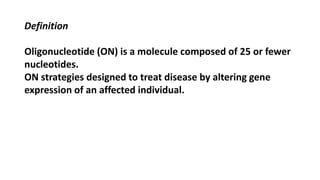
Definition
Oligonucleotide (ON) is a molecule composed of 25 or fewer
nucleotides.
ON strategies designed to treat disease by altering gene
expression of an affected individual.
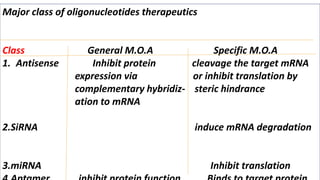
Major class of oligonucleotides therapeutics
Class General M.O.A Specific M.O.A
1. Antisense Inhibit protein cleavage the target mRNA
expression via or inhibit translation by
complementary hybridiz- steric hindrance
ation to mRNA
2.SiRNA induce mRNA degradation
3.miRNA Inhibit translation
Characteristics
1. The majority of Ots are chemically modified to block nuclease based
metabolism and prolong duration of action.
2. Many Ots are chemically conjugated or encapsulated to facilitate delivery ,
block renal filtration.
e.g; cholesterol , lipid nanoparticles , small molecules functional gp etc.
3. Ots are highly “tunable” by site directed chemical modification, may of
which are now well characterized.
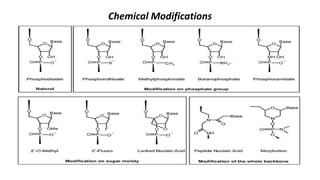
Chemical Modifications
 Antisense Oligonucleotides are unmodified or chemically
modified ssDNA, RNA or their analogs.
 They are 13-25 nucleotides long and are specifically designed
to hybridize to the corresponding mRNA by Watson-Crick
binding .
Antisense Oligonucleotides
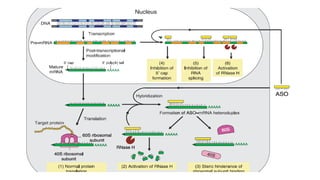
 On the basis of mechanism of action
Two classes of antisense oligonucleotides can be discerned
1.The Rnase H-dependent oligonucleotides ,which induce the
degradation of mRNA
2. The Steric-blocker oligonucleotides, which physically prevent or
inhibit the progression of splicing or the translational machinery.
Antisense oligonucleotide design
The strength & stability of interaction between the ASO & complementry target
mRNA depend on factors such as thermodynamic stability.
 We need to consider at least four parameter in ASO design in order to increases
the hit rate.
1. Prediction of secondary structure of RNA.
2. Identification of preferable RNA secondary local structures.
3. Motifs searching & GC content calculation,
4. Binding energy prediction.
Chemical modification of ASo
Various chemical modification have been developed o enhance nuclease resistance, prolong tissue half-
life, increases affinity & potency & reduce non-sequence specific toxicity.
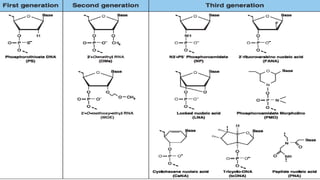
•Three types of generation as follows:
1. First generation ASO ; Phosphoro-thioate-deoxy-nucleotides are the first nucleotides & have a
sulfur atom replacing the non-binding backbone.
2. Second generation ASO ; containing nucleotides with alkyl modification at the 2’position of the
ribose
3. Third generation ASO ; newest & most promising .
enhance binding affinity & biostability.
Chemical modification of the furanose ring of the nucleotide.
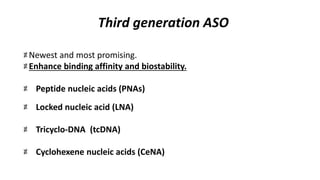
Third generation ASO
Newest and most promising.
Enhance binding affinity and biostability.
Peptide nucleic acids (PNAs)
Locked nucleic acid (LNA)
Tricyclo-DNA (tcDNA)
Cyclohexene nucleic acids (CeNA)
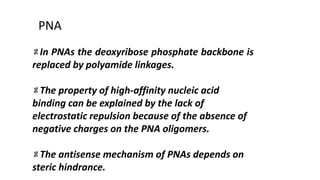
In PNAs the deoxyribose phosphate backbone is
replaced by polyamide linkages.
The property of high-affinity nucleic acid
binding can be explained by the lack of
electrostatic repulsion because of the absence of
negative charges on the PNA oligomers.
The antisense mechanism of PNAs depends on
steric hindrance.
PNA
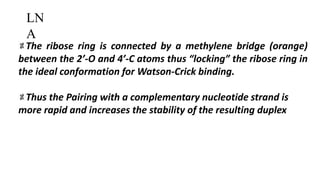
The ribose ring is connected by a methylene bridge (orange)
between the 2’-O and 4’-C atoms thus “locking” the ribose ring in
the ideal conformation for Watson-Crick binding.
Thus the Pairing with a complementary nucleotide strand is
more rapid and increases the stability of the resulting duplex
LN
A
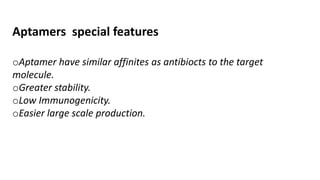
Aptamers special features
oAptamer have similar affinites as antibiocts to the target
molecule.
oGreater stability.
oLow Immunogenicity.
oEasier large scale production.
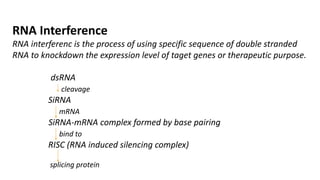
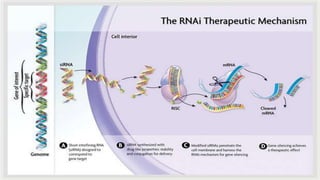
RNA Interference
RNA interferenc is the process of using specific sequence of double stranded
RNA to knockdown the expression level of taget genes or therapeutic purpose.
dsRNA
cleavage
SiRNA
mRNA
SiRNA-mRNA complex formed by base pairing
bind to
RISC (RNA induced silencing complex)
splicing protein
References
www.niper.ac.innucleic.pdf
•Nus.edu.sgngsstudent achieve papers2006 antisense
oligonucleotidedesigntherapeuticapplication.pdf
•https:en.wikipedia.orgwikioligonucleotide
•https:www.ncbi.nlm.nih.govpubmed25093706
Delivery vectors can take care of both toxicity and drug delivery
problems .The vector can also protect the drug from degradation
and also from rapid clearance from the body. The vector must:
Be of small size to allow intercalation between tissues.
To allow intracellular transport, they must be non-toxic and stable
in the blood stream
Delivery vectors:
They must retain the drug when in the circulation, and
Must release it at its target before elimination.
These are quite challenging tasks but many ideas have been
developed such as liposomes, protein or peptide constructs
and polymers.
Application of Antisense Oligonucleotides:
Antisense drugs are being researched to treat a variety of
diseases such as :
Lung cancer,
Colorectal carcinoma
Pancreatic carcinoma
Malignant melanoma
Diabetes
Amyotrophic lateral sclerosis (ALS),
Asthma,
Arthritis.
Oligonucleotide

Oligonucleotide

  • 1.
  • 2.
    Definition Oligonucleotide (ON) isa molecule composed of 25 or fewer nucleotides. ON strategies designed to treat disease by altering gene expression of an affected individual.
  • 3.
    Major class ofoligonucleotides therapeutics Class General M.O.A Specific M.O.A 1. Antisense Inhibit protein cleavage the target mRNA expression via or inhibit translation by complementary hybridiz- steric hindrance ation to mRNA 2.SiRNA induce mRNA degradation 3.miRNA Inhibit translation
  • 4.
    Characteristics 1. The majorityof Ots are chemically modified to block nuclease based metabolism and prolong duration of action. 2. Many Ots are chemically conjugated or encapsulated to facilitate delivery , block renal filtration. e.g; cholesterol , lipid nanoparticles , small molecules functional gp etc. 3. Ots are highly “tunable” by site directed chemical modification, may of which are now well characterized.
  • 5.
  • 7.
     Antisense Oligonucleotidesare unmodified or chemically modified ssDNA, RNA or their analogs.  They are 13-25 nucleotides long and are specifically designed to hybridize to the corresponding mRNA by Watson-Crick binding . Antisense Oligonucleotides
  • 8.
     On thebasis of mechanism of action Two classes of antisense oligonucleotides can be discerned 1.The Rnase H-dependent oligonucleotides ,which induce the degradation of mRNA 2. The Steric-blocker oligonucleotides, which physically prevent or inhibit the progression of splicing or the translational machinery.
  • 10.
    Antisense oligonucleotide design Thestrength & stability of interaction between the ASO & complementry target mRNA depend on factors such as thermodynamic stability.  We need to consider at least four parameter in ASO design in order to increases the hit rate. 1. Prediction of secondary structure of RNA. 2. Identification of preferable RNA secondary local structures. 3. Motifs searching & GC content calculation, 4. Binding energy prediction.
  • 11.
    Chemical modification ofASo Various chemical modification have been developed o enhance nuclease resistance, prolong tissue half- life, increases affinity & potency & reduce non-sequence specific toxicity. •Three types of generation as follows: 1. First generation ASO ; Phosphoro-thioate-deoxy-nucleotides are the first nucleotides & have a sulfur atom replacing the non-binding backbone. 2. Second generation ASO ; containing nucleotides with alkyl modification at the 2’position of the ribose 3. Third generation ASO ; newest & most promising . enhance binding affinity & biostability. Chemical modification of the furanose ring of the nucleotide.
  • 12.
    Third generation ASO Newestand most promising. Enhance binding affinity and biostability. Peptide nucleic acids (PNAs) Locked nucleic acid (LNA) Tricyclo-DNA (tcDNA) Cyclohexene nucleic acids (CeNA)
  • 14.
    In PNAs thedeoxyribose phosphate backbone is replaced by polyamide linkages. The property of high-affinity nucleic acid binding can be explained by the lack of electrostatic repulsion because of the absence of negative charges on the PNA oligomers. The antisense mechanism of PNAs depends on steric hindrance. PNA
  • 15.
    The ribose ringis connected by a methylene bridge (orange) between the 2’-O and 4’-C atoms thus “locking” the ribose ring in the ideal conformation for Watson-Crick binding. Thus the Pairing with a complementary nucleotide strand is more rapid and increases the stability of the resulting duplex LN A
  • 18.
    Aptamers special features oAptamerhave similar affinites as antibiocts to the target molecule. oGreater stability. oLow Immunogenicity. oEasier large scale production.
  • 19.
    RNA Interference RNA interferencis the process of using specific sequence of double stranded RNA to knockdown the expression level of taget genes or therapeutic purpose. dsRNA cleavage SiRNA mRNA SiRNA-mRNA complex formed by base pairing bind to RISC (RNA induced silencing complex) splicing protein
  • 21.
    References www.niper.ac.innucleic.pdf •Nus.edu.sgngsstudent achieve papers2006antisense oligonucleotidedesigntherapeuticapplication.pdf •https:en.wikipedia.orgwikioligonucleotide •https:www.ncbi.nlm.nih.govpubmed25093706
  • 22.
    Delivery vectors cantake care of both toxicity and drug delivery problems .The vector can also protect the drug from degradation and also from rapid clearance from the body. The vector must: Be of small size to allow intercalation between tissues. To allow intracellular transport, they must be non-toxic and stable in the blood stream Delivery vectors:
  • 23.
    They must retainthe drug when in the circulation, and Must release it at its target before elimination. These are quite challenging tasks but many ideas have been developed such as liposomes, protein or peptide constructs and polymers.
  • 24.
    Application of AntisenseOligonucleotides: Antisense drugs are being researched to treat a variety of diseases such as : Lung cancer, Colorectal carcinoma Pancreatic carcinoma Malignant melanoma Diabetes Amyotrophic lateral sclerosis (ALS), Asthma, Arthritis.