Antiplatelet drugs and
Neurosurgery


           David Bervini
           15 Nov 2012

                           EBS presentation   1
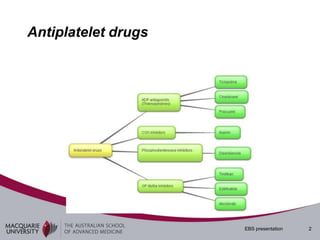
Antiplatelet drugs


                     EBS presentation   2
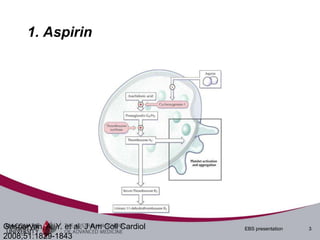
1. Aspirin


Gasparyan, A. Y. et al. J Am Coll Cardiol   EBS presentation   3
2008;51:1829-1843
1.Aspirin (Acetylsalicylic acid)

     • Mechanism of action: inhibition of
       Cyclooxygenase-1  irreversible inhibition of
       platelet aggregation
     • Dosage 75-325 mg once daily
     • Indications:
         – Primary prophylaxis against stroke, TIA, myocardial
           infarction and thromboembolic disorders (e.g. atrial
           fibrillation with low CHADS2 score) and in patients with
           renal failure, HIV,…
         – Secondary prophylaxis after stroke, myocardial
           infarction, in peripheral arterial disease (PAD) and
           dialysis patients (lifelong)

www.compendium.ch                                       EBS presentation   4
1. Aspirin


     • Contraindications:
        - Allergy
       - Hemorragic diathesis (especially platelet count < 50 G/L)
       - Severe liver failure
       - “Fresh” peptic ulcer
     • Maximal plasma concentration 0.3-3h after intake
     • The action lasts until new platelets are synthesized: 7-10
       days


www.compendium.ch                                      EBS presentation   5
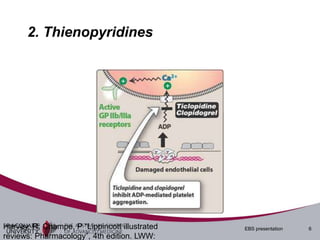
2. Thienopyridines


Harvey, R; Champe, P “Lippincott illustrated   EBS presentation   6
reviews: Pharmacology”, 4th edition. LWW:
2. Thienopyridines


      • Plavix® (Clopidogrel) 75mg 1/day
      • Efient® (Prasugrel) 10mg 1/day
      • Brilinta® (Ticagrelor) 90mg 1/day
      • Efient® and Brilinta® are “newer”
        thienopyridines, indication restricted to acute
        myocardial infarction in patients undergoing
        PCI (alternative to Plavix)

Australian Medicines Handbook                  EBS presentation   7
2a. Plavix® (Clopidogrel)


• Indications:
   - secondary prophylaxis of myocardial
infarction (mandatory: 3 months after stent
implantation for BMS, 1 year for DES)
   - secondary prophylaxis of stroke/TIA
(lifelong)
   - secondary prophylaxis in PAD (alone or in
combination with aspirine depending on the
clinical situation)

                                        EBS presentation   8
2a. Plavix®


     • Contraindications: same as Aspirin
     • CAVE: Clopidogrel is a prodrug (activation in
       the liver through CYP450, effect depends on
       the CYP2C19 genotype genotypes 2-6
       show a decreased metabolism to its active
       form and thus a decreased efficacy of the
       drug itself)
     • Plasma peak levels 45 min after intake
     • Effect lasts 7-10 days

www.compendium.ch                           EBS presentation   9
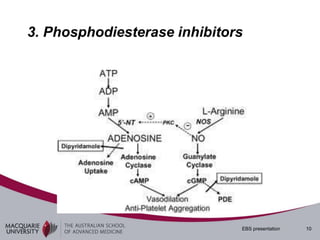
3. Phosphodiesterase inhibitors


                              EBS presentation   10
3. Phosphodiesterase inhibitors

     • Asasantine®= Dipyridamole 200mg + Aspirin
       50mg
     • 1 capsule 2/day
     • Indications: secondary prophylaxis after stroke in
       patients who were already taking Aspirin
       (alternative to Plavix®)
     • Inhibits uptake of adenosine in platelets and
       endothelial cells
     • Duration of effect and contraindications similar to
       Aspirin

www.compendium.ch                               EBS presentation   11
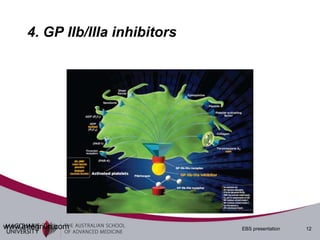
4. GP IIb/IIIa inhibitors


www.integrilin.com                EBS presentation   12
4. GP IIb/IIIa inhibitors

      • Newer class of molecules
      • Only used as infusion before, during and max 72h
        after PCI in acute coronary syndrome (mostly STEMI)
      • Reopro® (Abciximab)
      • Aggrastat® (Tirofiban)
      • Integrilin® (Ebtifibatide)
      • Platelet function returns to normal 24-48h after the
        end of the infusion for Reopro®, a bit faster for
        Aggrastat® and Integrilin®
      • High risk of bleeding, especially since used
        concomitantly to Aspirin and Plavix!


Australian Medicines handbook                    EBS presentation   13
Aspirin, Plavix® and neurosurgery

      • We cannot REVERSE their action, since it is
        irreversible (but we can administer platelet
        transfusions in “emergency” situations)
      • When Aspirin is for primary prophylaxis, we
        can stop it 5-7 days prior to surgery
      • Heparin and LMWH do NOT substitute the
        action of antiplatelet drugs


Korte et al, GTH recommandations on peri-         EBS presentation   14
interventional antiplatelet therapy, Thrombosis
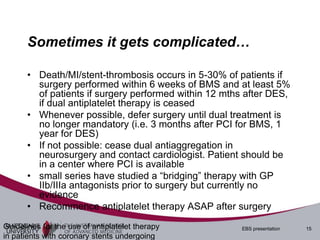
Sometimes it gets complicated…

       • Death/MI/stent-thrombosis occurs in 5-30% of patients if
         surgery performed within 6 weeks of BMS and at least 5%
         of patients if surgery performed within 12 mths after DES,
         if dual antiplatelet therapy is ceased
       • Whenever possible, defer surgery until dual treatment is
         no longer mandatory (i.e. 3 months after PCI for BMS, 1
         year for DES)
       • If not possible: cease dual antiaggregation in
         neurosurgery and contact cardiologist. Patient should be
         in a center where PCI is available
       • small series have studied a “bridging” therapy with GP
         IIb/IIIa antagonists prior to surgery but currently no
         evidence
       • Recommence antiplatelet therapy ASAP after surgery
Guidelines for the use of antiplatelet therapy         EBS presentation   15
in patients with coronary stents undergoing
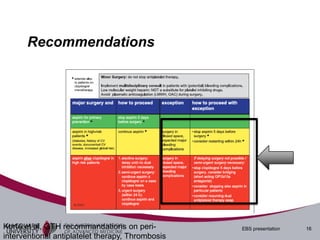
Recommendations


Korte et al, GTH recommandations on peri-         EBS presentation   16
interventional antiplatelet therapy, Thrombosis
“Reversal” in Intracranial hemorrhage


       • Spontaneous ICH: administration of platelets in
         patients under Aspirin, Plavix® or dual therapy.
       • Traumatic ICH: no current guidelines- no
         recommendations based on studies.
       • Desmopressin (DDAVP®): increases FVIII and
         vWF activity
       • rF VIIa (Novoseven®): “reversal” of antiplatelet
         drugs in healthy volunteers. CAVE: costs!


Campbell et al, Emergency reversal of             EBS presentation   17
antiplatelet agents in patients presenting with
Recommendations

       • Patients with ICH on Aspirin: give 5 platelet
         concentrate units upon admission
       • Patients with ICH on Plavix®/dual and small
         hemorrhages: give 10 units upon admission
       • Patients with severe ICH on Plavix®: 10 units
         upon admission in association with 0.3mcg/kg
         BW DDAVP® iv initially. Platelet transfusions are
         subsequently performed every 12h for 48h.
       • CAVE: hyponatremia risk with Desmopressin!

Campbell et al, Emergency reversal of             EBS presentation   18
antiplatelet agents in patients presenting with
EBS presentation   19

Antiplatelets and nch asam

  • 1.
    Antiplatelet drugs and Neurosurgery David Bervini 15 Nov 2012 EBS presentation 1
  • 2.
    Antiplatelet drugs EBS presentation 2
  • 3.
    1. Aspirin Gasparyan, A.Y. et al. J Am Coll Cardiol EBS presentation 3 2008;51:1829-1843
  • 4.
    1.Aspirin (Acetylsalicylic acid) • Mechanism of action: inhibition of Cyclooxygenase-1  irreversible inhibition of platelet aggregation • Dosage 75-325 mg once daily • Indications: – Primary prophylaxis against stroke, TIA, myocardial infarction and thromboembolic disorders (e.g. atrial fibrillation with low CHADS2 score) and in patients with renal failure, HIV,… – Secondary prophylaxis after stroke, myocardial infarction, in peripheral arterial disease (PAD) and dialysis patients (lifelong) www.compendium.ch EBS presentation 4
  • 5.
    1. Aspirin • Contraindications: - Allergy - Hemorragic diathesis (especially platelet count < 50 G/L) - Severe liver failure - “Fresh” peptic ulcer • Maximal plasma concentration 0.3-3h after intake • The action lasts until new platelets are synthesized: 7-10 days www.compendium.ch EBS presentation 5
  • 6.
    2. Thienopyridines Harvey, R;Champe, P “Lippincott illustrated EBS presentation 6 reviews: Pharmacology”, 4th edition. LWW:
  • 7.
    2. Thienopyridines • Plavix® (Clopidogrel) 75mg 1/day • Efient® (Prasugrel) 10mg 1/day • Brilinta® (Ticagrelor) 90mg 1/day • Efient® and Brilinta® are “newer” thienopyridines, indication restricted to acute myocardial infarction in patients undergoing PCI (alternative to Plavix) Australian Medicines Handbook EBS presentation 7
  • 8.
    2a. Plavix® (Clopidogrel) •Indications: - secondary prophylaxis of myocardial infarction (mandatory: 3 months after stent implantation for BMS, 1 year for DES) - secondary prophylaxis of stroke/TIA (lifelong) - secondary prophylaxis in PAD (alone or in combination with aspirine depending on the clinical situation) EBS presentation 8
  • 9.
    2a. Plavix® • Contraindications: same as Aspirin • CAVE: Clopidogrel is a prodrug (activation in the liver through CYP450, effect depends on the CYP2C19 genotype genotypes 2-6 show a decreased metabolism to its active form and thus a decreased efficacy of the drug itself) • Plasma peak levels 45 min after intake • Effect lasts 7-10 days www.compendium.ch EBS presentation 9
  • 10.
  • 11.
    3. Phosphodiesterase inhibitors • Asasantine®= Dipyridamole 200mg + Aspirin 50mg • 1 capsule 2/day • Indications: secondary prophylaxis after stroke in patients who were already taking Aspirin (alternative to Plavix®) • Inhibits uptake of adenosine in platelets and endothelial cells • Duration of effect and contraindications similar to Aspirin www.compendium.ch EBS presentation 11
  • 12.
    4. GP IIb/IIIainhibitors www.integrilin.com EBS presentation 12
  • 13.
    4. GP IIb/IIIainhibitors • Newer class of molecules • Only used as infusion before, during and max 72h after PCI in acute coronary syndrome (mostly STEMI) • Reopro® (Abciximab) • Aggrastat® (Tirofiban) • Integrilin® (Ebtifibatide) • Platelet function returns to normal 24-48h after the end of the infusion for Reopro®, a bit faster for Aggrastat® and Integrilin® • High risk of bleeding, especially since used concomitantly to Aspirin and Plavix! Australian Medicines handbook EBS presentation 13
  • 14.
    Aspirin, Plavix® andneurosurgery • We cannot REVERSE their action, since it is irreversible (but we can administer platelet transfusions in “emergency” situations) • When Aspirin is for primary prophylaxis, we can stop it 5-7 days prior to surgery • Heparin and LMWH do NOT substitute the action of antiplatelet drugs Korte et al, GTH recommandations on peri- EBS presentation 14 interventional antiplatelet therapy, Thrombosis
  • 15.
    Sometimes it getscomplicated… • Death/MI/stent-thrombosis occurs in 5-30% of patients if surgery performed within 6 weeks of BMS and at least 5% of patients if surgery performed within 12 mths after DES, if dual antiplatelet therapy is ceased • Whenever possible, defer surgery until dual treatment is no longer mandatory (i.e. 3 months after PCI for BMS, 1 year for DES) • If not possible: cease dual antiaggregation in neurosurgery and contact cardiologist. Patient should be in a center where PCI is available • small series have studied a “bridging” therapy with GP IIb/IIIa antagonists prior to surgery but currently no evidence • Recommence antiplatelet therapy ASAP after surgery Guidelines for the use of antiplatelet therapy EBS presentation 15 in patients with coronary stents undergoing
  • 16.
    Recommendations Korte et al,GTH recommandations on peri- EBS presentation 16 interventional antiplatelet therapy, Thrombosis
  • 17.
    “Reversal” in Intracranialhemorrhage • Spontaneous ICH: administration of platelets in patients under Aspirin, Plavix® or dual therapy. • Traumatic ICH: no current guidelines- no recommendations based on studies. • Desmopressin (DDAVP®): increases FVIII and vWF activity • rF VIIa (Novoseven®): “reversal” of antiplatelet drugs in healthy volunteers. CAVE: costs! Campbell et al, Emergency reversal of EBS presentation 17 antiplatelet agents in patients presenting with
  • 18.
    Recommendations • Patients with ICH on Aspirin: give 5 platelet concentrate units upon admission • Patients with ICH on Plavix®/dual and small hemorrhages: give 10 units upon admission • Patients with severe ICH on Plavix®: 10 units upon admission in association with 0.3mcg/kg BW DDAVP® iv initially. Platelet transfusions are subsequently performed every 12h for 48h. • CAVE: hyponatremia risk with Desmopressin! Campbell et al, Emergency reversal of EBS presentation 18 antiplatelet agents in patients presenting with
  • 19.

Editor's Notes

  • #3 Here is a summary of the antiplatelets drugs which are available on the market at present; I will shortly describe each class and then focus on the most commonly used agents, which are aspirin and plavix
  • #4 First of all, Aspirin: the figure shows its mechanism of action. It inhibits COX-1 in an irreversible way, thus preventing the production of TXA2 and the activation of platelets
  • #5 It is very difficult to list all the precise aspirin indications, but I summarized the most important ones
  • #6 And here the contraindications, which are quite obvious. It is very important to point out that the action of aspirin lasts until new platelets are produced, i.e. 7-10 days
  • #7 Now, let’s move to another family of molecules: thienopyridines, which block the binding of ADP to its receptor on the platelet surface, thus inhibiting the activation of the GPIIb/IIIa receptor, necessary to platelet activation, This action is irreversible for Plavix.
  • #8 Here are some other, newer thienopyridines. They are more expensive and so their indication is restricted to patients after MI undergoing Percutaneous coronary intervention, as an alternative to Plavix.
  • #9 Since Plavix is still the most commonly used thienopyridine, I will focus on it. First of all, here is a summary of the indications (which, as for aspirin, are complex and numerous)Bms bare metal stent. Des: drug eluting stent
  • #10 Like Aspirin, the effect of Plavix is irreversible and lasts for 7-10 days, which corresponds to the life span of platelets
  • #11 Now, let’s move to the phosphodiesterase inhibitors, and the only member of this class is dipyridamole, which is used as Asasantin in combination with aspirin. It inhibits the uptake of adenosin in platelets and endothelial cells
  • #12 The only indication at present is secondary prophylaxis after stroke in patients who were already taking aspirine. Nevertheless, Plavix is a more commonly used drug for this indication
  • #13 Just two slides for the last but newer class of antiaggregants, the glycoprotein Iib/IIIa inhibitors, which block the GP Iib/IIIA receptor, thus inhibiting platelet aggregation
  • #14 Their indication is restricted to the peri-Percutaneous coronary intervention period, and they are used in combination with aspirine and plavix to achieve a higher grade of platelet inactivation. Obviously, the bleeding risk in these patients is extremely high.
  • #15 Now, I would like to move to how, as neurosurgeons, we can handle patients under antiplatelet drugs… first of all, we must remember that we cannot reverse their action, and that heparin and LMWH are not substitutes. We should stop aspirin or plavix 5-7 days prior to surgery, if their indication is not strict.
  • #16 Sometimes, though, it is not so easy: in patients after MI and Percutaneous coronary intervention ceasing antiplatelet drugs carries a very high risk of morbidity and mortality. We should defer surgery in patients under dual antiaggregation, whenever possible. Otherwise, we have to stop aspirin and plavix and resume them asap after surgery. Administration of GPIIb/IIIa for bridging until surgery is currently under trial, but at present there is no sufficient evidence. What we can and must do, is contact the cardiologist and transfer the patient in a center with a PCI facility.
  • #17 And here are the recommendations published in thrombosis and hemostasis 2011. I highlighted in black the part that affects us.
  • #18 In the emergency setting of ICH, evidence is lacking regarding when and how to “reverse” antiplatelet drugs. Nevertheless, platelets are commonly administered especially in patients on Plavix or dual antiaggregation, who are at higher risk of bleeding, and especially in spontaneous ICH. There are no current guidelines for reversal of antiplatelet drugs in traumatic ICH. Desmopressin is a synthetic derivate of the antidiuretic hormone ADH and it is known to increase FVIII and vWF thus favouring platelet aggregation. Recombinant factor vIIA has not been tested in ICH so far and its cost limits its use.
  • #19 The only literature review I found recommends giving 5 units platelets to patients with ICH who are on Aspirin, and 10 units to patients on plavix or dual therapy and small ICH. Patients with severe ICH on Plavix should receive 10 units platelets AND desmopressin upon admission, and platelets should be administered every 12h for 48h. We must remember that desmopressin administration carries a high risk of hyponatremia and thus we must monitor the sodium levels strictly. Also, we should contact an hematologist prior to desmopressin administration.