Tracking tumour evolution in glioma through
liquid biopsies of cerebrospinal fluid
Miller AM, Shah RH, Pentsova EI et al, Nature.2019 Jan; 565(7741):654-658)
Dr Angela Li Ching Ng
Date 7.2.19
Is the study question relevant?
Why was the study done?
• To evaluate the representation of glioma genome in CSF – circulating
tumour DNA (ctDNA)
Originality of the work?
• No
Did the study add anything new?
• Demonstrates tumour ctDNA in CSF from patients with glioma provides a
comprehensive and genetically faithful representation of tumour genome at
time of csf collection
Where was the study published?
• Nature / Miller et al / Memorial Sloan Kettering (MSK) Centre, NY (Jan 2015-
2017)
Research hypothesis
What was the research hypothesis?
• Tumour derived DNA detected in CSF is a reliable way to determine glioma
genome
Was it explicitly stated?
• No
Did the study follow a protocol?
• Yes
Was the protocol followed throughout?
• Not clearly stated
Study design
What type of research question was being asked?
• Diagnostic accuracy, Prognosis
What was the study design?
• Cohort study
Is there an appropriate Critical Appraisal checklist that can be used?
• CASP (Critical Appraisal Skills Programme) cohort checklist
Internal Validity (Sources of Bias)
Trial design –
• 85 patients diagnosed with gliomas undergoing collection of CSF as part of their
clinical evaluation for neurological signs of symptoms
• All had received treatment
• DNA from serology, tumour ct DNA from CSF, radiological analysis
Used previously published sequencing cohort including 553 MSK glioma samples
from 512 patients to benchmark CSF findings
Sample size / power calculations
• N = 85 , no power calculation
• 42 had ct DNA +ve, of which 36 were able to have sequencing
Randomisation = No
Blinding - neuroradiologist reviewing MRI was blinded
External validity (generalisability)
Statistics:
• Associations between ct-DNA positivity and patient and treatment characteristics:
nonparametric tests by either Wilcoxon rank-sum test or Fisher’s exact test.
Wilcoxon rank-sum test : continuous variables
Fischer’s exact test : categorical variables.
All tests were two-sided with α ≤ 0.05 for statistical significance.
The association between CSF ctDNA positivity and overall survival multivariable
Cox model which included CSF ctDNA positivity and further adjusted for per cent
extent of resection at original diagnosis, tumour burden at CSF collection, and IDH
status.
Follow-up time was calculated from time of CSF collection until death or last follow-
up. Deaths were treated as events and those who were alive at last follow-up were
censored.
External validity (generalisability)
Inclusion / exclusion criteria
• Not specified cohort:
• CSF and tumour samples from 85 patients who were treated for glioma at
MSK from Jan 2015-2017
• MRI brains as indicated by standard of care
• LP as standard of care
Intervention
• Analysis on 42 who had ctDNA detected in CSF
• 36 had residual tumour tissue and germline DNA for targeted sequencing
• These were matched between CSF and tumour genome
Duration of follow-up
• Up to 40 months after CSF collection
Results
Primary outcomes / secondary outcomes
• Analysis of tumour genome vs csf
• Csf analysis as prognostic value
Adverse events
• none
Statistical analysis (estimate of effect size and precision)
• Not a powered study
• Small sample size
• Selection bias in sample
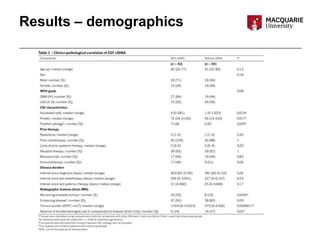
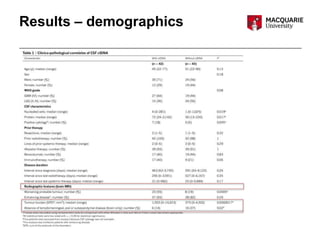
Results – demographics
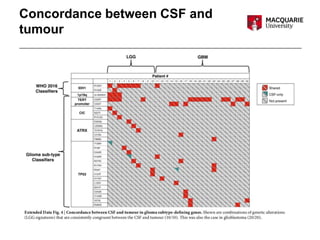
Concordance between CSF and
tumour
Discussion / conclusions
Were all clinically important outcomes considered? Yes
Did the data justify the conclusions? Yes
What were the study limitations?
Small sample size
Selection bias
Shedding of tumour DNA into CSF is not a universal property
Are the likely treatment benefits worth the potential harms and costs?
CSF as diagnostic and prognostic value esp in recurrent tumour; also for
targeted therapy
Were there any conflicts of interest (declared or otherwise)?No
Presentation and style
Clarity of writing, economy of words, organization of paper
Difficult to read; graphs not clearly explained
Letter to the editor type separate introduction/conclusion followed by
elaboration of methods
Number & quality of figures, tables & illustrations
Good figures and tables
Relevance, accuracy and completeness of bibliography
Conclusion
Summary of key strengths and weaknesses (take away message)
CSF genomic analysis important avenue
Has been used in lymphoma or other forms of tumour
Could be useful for tumours which cannot be biopsied/surgically resected
for diagnosis, recurrence  LP safer and simpler, prognosis
Is the study believable (internally valid)?Yes
Is the study relevant (externally valid)?Yes but could be with further study
Will the study change my practice? No but would follow further research on
the topic

Journal club 5.2.19

  • 1.
    Tracking tumour evolutionin glioma through liquid biopsies of cerebrospinal fluid Miller AM, Shah RH, Pentsova EI et al, Nature.2019 Jan; 565(7741):654-658) Dr Angela Li Ching Ng Date 7.2.19
  • 2.
    Is the studyquestion relevant? Why was the study done? • To evaluate the representation of glioma genome in CSF – circulating tumour DNA (ctDNA) Originality of the work? • No Did the study add anything new? • Demonstrates tumour ctDNA in CSF from patients with glioma provides a comprehensive and genetically faithful representation of tumour genome at time of csf collection Where was the study published? • Nature / Miller et al / Memorial Sloan Kettering (MSK) Centre, NY (Jan 2015- 2017)
  • 3.
    Research hypothesis What wasthe research hypothesis? • Tumour derived DNA detected in CSF is a reliable way to determine glioma genome Was it explicitly stated? • No Did the study follow a protocol? • Yes Was the protocol followed throughout? • Not clearly stated
  • 4.
    Study design What typeof research question was being asked? • Diagnostic accuracy, Prognosis What was the study design? • Cohort study Is there an appropriate Critical Appraisal checklist that can be used? • CASP (Critical Appraisal Skills Programme) cohort checklist
  • 5.
    Internal Validity (Sourcesof Bias) Trial design – • 85 patients diagnosed with gliomas undergoing collection of CSF as part of their clinical evaluation for neurological signs of symptoms • All had received treatment • DNA from serology, tumour ct DNA from CSF, radiological analysis Used previously published sequencing cohort including 553 MSK glioma samples from 512 patients to benchmark CSF findings Sample size / power calculations • N = 85 , no power calculation • 42 had ct DNA +ve, of which 36 were able to have sequencing Randomisation = No Blinding - neuroradiologist reviewing MRI was blinded
  • 6.
    External validity (generalisability) Statistics: •Associations between ct-DNA positivity and patient and treatment characteristics: nonparametric tests by either Wilcoxon rank-sum test or Fisher’s exact test. Wilcoxon rank-sum test : continuous variables Fischer’s exact test : categorical variables. All tests were two-sided with α ≤ 0.05 for statistical significance. The association between CSF ctDNA positivity and overall survival multivariable Cox model which included CSF ctDNA positivity and further adjusted for per cent extent of resection at original diagnosis, tumour burden at CSF collection, and IDH status. Follow-up time was calculated from time of CSF collection until death or last follow- up. Deaths were treated as events and those who were alive at last follow-up were censored.
  • 7.
    External validity (generalisability) Inclusion/ exclusion criteria • Not specified cohort: • CSF and tumour samples from 85 patients who were treated for glioma at MSK from Jan 2015-2017 • MRI brains as indicated by standard of care • LP as standard of care Intervention • Analysis on 42 who had ctDNA detected in CSF • 36 had residual tumour tissue and germline DNA for targeted sequencing • These were matched between CSF and tumour genome Duration of follow-up • Up to 40 months after CSF collection
  • 8.
    Results Primary outcomes /secondary outcomes • Analysis of tumour genome vs csf • Csf analysis as prognostic value Adverse events • none Statistical analysis (estimate of effect size and precision) • Not a powered study • Small sample size • Selection bias in sample
  • 9.
  • 10.
  • 14.
  • 17.
    Discussion / conclusions Wereall clinically important outcomes considered? Yes Did the data justify the conclusions? Yes What were the study limitations? Small sample size Selection bias Shedding of tumour DNA into CSF is not a universal property Are the likely treatment benefits worth the potential harms and costs? CSF as diagnostic and prognostic value esp in recurrent tumour; also for targeted therapy Were there any conflicts of interest (declared or otherwise)?No
  • 18.
    Presentation and style Clarityof writing, economy of words, organization of paper Difficult to read; graphs not clearly explained Letter to the editor type separate introduction/conclusion followed by elaboration of methods Number & quality of figures, tables & illustrations Good figures and tables Relevance, accuracy and completeness of bibliography
  • 19.
    Conclusion Summary of keystrengths and weaknesses (take away message) CSF genomic analysis important avenue Has been used in lymphoma or other forms of tumour Could be useful for tumours which cannot be biopsied/surgically resected for diagnosis, recurrence  LP safer and simpler, prognosis Is the study believable (internally valid)?Yes Is the study relevant (externally valid)?Yes but could be with further study Will the study change my practice? No but would follow further research on the topic

Editor's Notes

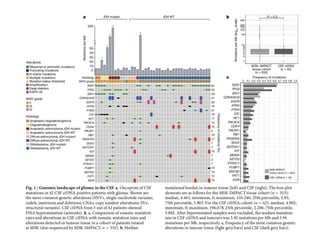
  • #3 Tumour DNA ctDNA in patient srology with primary brain tumours remain challenging Sequencing of ctDNA from the CSF may profide alternative way to genotype gliomas with lower morbidity and cost Genome in csf from 85 patients with glioma who underwent an LP because they showed neurological signs or symptoms Tumour derived DNA detected in CSF from 42/85 ie 49.4% and was associated with disease burden and adverse outcome WHO grade IV 46/85, 54% , WHO grade III 26/85, 31% and WHO grade II 13/85, 15% The dx of extablisehed by prior tumour biopsy or resection Use of LP safe and done reoutinely for stage eg CNS lymphtoma/medulloblastoma germ cell tumours If tumour non surgical LP offers opportunity to obtain molecular signature and possibly defintiive diagnosis In recurrence LP in simpleer and safer procedure thansecond craniotomy for anotehr tumour sampel Shedding of tumour DNA in CSF is not universal property of diffuse glima Presence fo ctDNA in csf may be an eraky inidcation fo progression in glioma All patients had received tx for glioma before csf collection incl 85 surgery, radiation 84, and at least one sytemic tumoru directed chmo 81/85 Median duration of diseases before CSF collection was 355 days for IDH wild type GBM, 473 days for IDH wild type LGG and 2077 days for IDH mutant LGG Stats: MSK IMPACT generation sequencing based tumour sequencing assay One genetic alteration in the CSF 42/85 with glioma No oncogenic variants in 7 with non malignant Radiographic findings with shedding of tumour DNA into csf: Tumour progression (P=0.00005) Tumour burden Spread of tumour towards the ventricular system of SAS Csf collected during surgery in which tumour DNA was more commonly detected in CSF from patients with tumour abutting a csf reservoir or cortical surface The presence of tumour DNA in the csf was associated with shorter survival following csf collection Multivariate analysis presenve of csf ctdna statistically significant prognostic factor even after adjustment for percent extent of resectio n, tumour burden and IDH status Subjects who had ctDNA in csf had x4 higher risk fo death than subjevts who did not No significant association between ctDNA +ve csf and glioma grade, disease duration, or prior therapy 90% of ctDNA positive CSF did not have detectable malignant cells in the csf as assessed by standard csf cytopathologic analysis Sequenced all available tumour biopsies from patients with positive CSF ctDNA 36/42 patients 10 LGG, 20 GBM, 6 tumour swith DNA hypermutation in tissue or csf In all LGG with hypermutation the combination fo genetic alterations that definef the LGG subtype were congruent between CSF and tumour Genetic alterations occurring at earliest stages of glioma development  truncal events during tumour evolution  prognostically distinct subtypes of LGG Codeletion of chromosome arms 1p and 19q and mutations in the metabolic genes isocitrate dehydrogenase 1 IDH 1 and IDH 2 Were shared in all matched ctDNA positive CSF tumour pairs GFR signalling pathwyas showed considerable evolution
  • #10 Patient demographics 85 patients, 46 GBM, 26 Grade III, 13 grade II Dx extablished prior to tumour biopsy or resection We detected at least one tumour-derived genetic alteration in the CSF from 42 out of 85 patients with glioma (49.4%).  ctDNA +ve No significant association between ct DNA positive CSF and glioma grade, disease duration or prior therapy
  • #11 Shedding of tumour DNA was associated with tumour progression, tumour burden and spread towards the ventricular system or SAS Similar to another study demonstrating tumours abutting a csf reservoir or cortical surface being more likely to shed tumour DNA
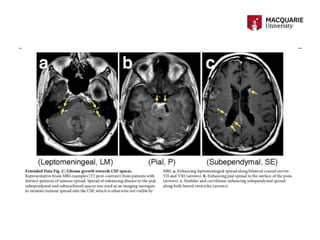
  • #12 Glioma growth towards CSF spaces Shedding of tumour DNA was associated with tumour progression, tumour burden and spread towards the ventricular system or SAS Similar to another study demonstrating tumours abutting a csf reservoir or cortical surface being more likely to shed tumour DNA
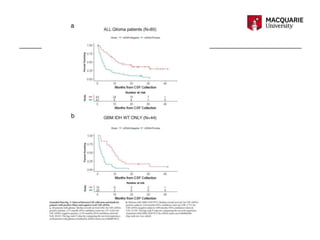
  • #13 Subjects who had ct DNA in their csf experienced a fourfold higher risk fo death than subjects who did not Also tried to determine if mutations detected in CSF were present in plasma Sequenced plasma cell free DNA from 19 patients in gliomas who were positive for CSF ct DNA using high sensitivity capture based next generation sequencing asay no mutation in 16/19 patients Only 35 mutations detected in 3 patients CSF as a more frequent reservoir for tumour DNA than plasma in patients with glioma Tumour also sheds directly into csf rather than into plasma
  • #14 In 42 CSF ct DNA positive patients with glioma Common genetic alterations are shown In 5 of 42 had markedly higher mutation rate  had a signature G:C  A:T transitions suggesting prior exposure to alkylating agents Allo which had received temozolamide
  • #15 Of the tumours 10 were LGG, 20 were GBM and 6 were hypermutated Of the ones with LGG/GBM tumour and CSF was consistently congruent Combination fo genetic alterations that defined the LGG subtype were congruent between csf and tumour Mutations were also shared between the CSF and tumour in all 20 patients with GBMs without DNA hypermutations Futher analysis of CSF ctDNA – broad spectrum of protein coding mutations CNA promoter mutations, strutural rearrangements Most commonly observed alterations  mutations with TERT promotoer, the protein coding regions of the TP 53 and the catalytic domain of IDH 1 as well as deletion CDK2A, CDKN2b amplification fothe gene for EGFR and the infram EGFR variant III deletion All LGG no hypermutation had congruent csf and tumour and all 20 GBM withouth DNA hypermutation had shared mutations between CSF and tumour This revealed broad spectrum of protein coding mutations, copy number alterations and promoter mutatinos and structural rearrangements Most commonly TERT promoter, protein coding regions fo TP 53, catalytic domain of IDH 1 and deletions of CDK 2A, CDKN2B, amplifications of EGFR and inframe EGFR variant III deletion
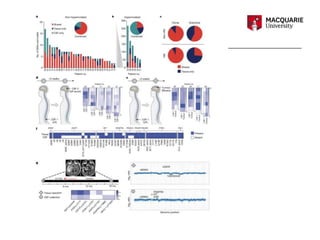
  • #16  Frequency of shared vs tissue only or csf only mutations in matched tumour tissue-csf sample pairs 30 tumour pairs without DNA hypermutation Median 81.7% shared mutation range (0-100%) a. Demontsrating shared vs tissue or CSF only mutations matched tumour tissue - without DNA hypermutaiont In patients with hypermutated tumours shared mutations were considerably less comman 3-49% Median 19.6% Nb. With DNA hypermutation Comparison between clonal and subclonal with clonal tumour mutations The majority fo mutations that were clonal in tissue were also present in csf even in patients with DNA hypermutatin Subclonal mutations were less lilkey to be shared (2c) d, CSF ctDNA results from contemporaneously collected CSF replicates. Five patients underwent two CSF collections within three weeks (one lumbar puncture (LP) and one ventricular sample collected during ventriculo-peritoneal (VP) shunt placement). Heat maps display the variant allele frequencies of all the mutations detected in either replicate. e. Comparison of tumour – csf pairs colleted withitn a three week period Tumour samples via bx and CSF via LP  demonsdtrate variant allele frerquencies fo all the mutations present in either sample f. Divergence of mutations in growth factor receptor pathway Concordance between contemporaneously collected CSF replicatses and tumour –csf pairs 6 patients in the study underwent placement of VPS for hydrocpehalus withint 3 weeks of intiial LP CSF replicates were highly concordant Near identical As interval between tumour and csf collection increasd greater divergence f genetic profile esp for gene encoding memberes fo GF signalling patwhays 2f. 5 patients had a tumour resection within 3 weeks fo CSF collection and showed near identiftical genetic profiles in csf and tumour tissue 2e As the interval between tumour and csf collection increasd therer was greater divergence of the genetic profiles in particular for genes encoding members of growth factor signalling pathwyas *2f) Our study shows that tumour-derived DNA in CSF from patients with glioma provides a comprehensive and genetically faithful rep- resentation of the tumour genome at the time of the CSF collection. The frequency and type of alterations in the CSF closely resembled the genomic landscape of diffuse glioma, as defined in large oncogenomic studies2,1, and we observed high concordance between CSF and tumour DNA in patients who underwent both lumbar puncture and neurosurgical tumour resection within a few weeks. . Any divergence between CSF and tumour genomes within the same patient followed the pattern of genomic evolution that has been reported in studies of sequential tumour biopsies. This evolution is characterized by the per- sistence of truncal genetic alterations (IDH1, 1p/19q codeletion, TP53, TERT, ATRX) and by convergent and branched evolution within glioma core pathways, in particular growth factor receptor pathways3–1
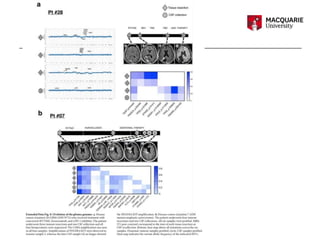
  • #17 the initial tumour profile of patient 28 showed an activating mutation in PIK3CA (E545K), whereas a later tumour biopsy showed amplifications of MET and PDGFRA and a sub- sequent CSF sample retained the MET amplification and acquired a MYC amplification while losing the PDGFRA amplification In LGGs, truncal alterations (IDH1, TP53 and ATRX) persisted throughout the disease course, but later samples contained additional mutations in glioma core pathways (Extended Data Fig. 8b), a pattern consistent with branched evolution of the LGG genome.