MACQUARIE NEUROSURGERY JOURNAL CLUB
Ahmad M. Badran
10 November 2016
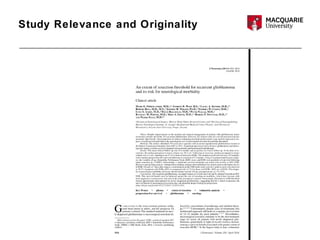
Clinical benefit from resection of recurrent glioblastomas:
results of a multicenter study including 503 patients with
recurrent glioblastomas undergoing surgical resection
Institution metrics/ Authors/ Journal
20 participating neurosurgical departments in Germany, Switzerland,
and Austria.
• Department of Neurosurgery, Klinikum Rechts der Isar, Technische Universita¨ t Mu¨ nchen,
Munich, Germany (F.R., H.P., B.M.); Department of Neurosurgery, Heinrich Heine Universita¨ t Du¨
sseldorf, Du¨ sseldorf, Germany (M.S.); Department of Neurosurgery, Universita¨ tsklinikum Carl
Gustav Carus, Dresden, Germany (D.K.); Department of Neurosurgery, Universita¨ tsmedizin
Go¨ ttingen, Go¨ ttingen, Germany (H.C.B.); Department of Neurosurgery, Charite´
Universita¨ tsmedizin, Berlin, Germany (M.M.); Department of Neurosurgery, Universita¨ tsklinikum
Freiburg, Freiburg, Germany (A.W.); Department of Neurosurgery, Universita¨ tsklinikum
Wu¨ rzburg, Wu¨ rzburg, Germany (T.W.); Department of Neurosurgery, Goethe Universita¨ t
Frankfurt, Frankfurt, Germany (C.S.); Department of Neurosurgery, Inselspital, Universita¨ tsklinikum
Bern, Bern, Switzerland (P.S.); Department of Neurosurgery, Universita¨ tskliniken Bonn,
Rheinische Friedrich Wilhelms Universita¨ t, Bonn, Germany (M.S.)
Institution metrics/ Authors/ Journal
• Florian Ringel, Haiko Pape, Michael Sabel, Dietmar Krex, Hans
Christoph Bock, Martin Misch, Astrid Weyerbrock, Thomas
Westermaier, Christian Senft, Philippe Schucht, Bernhard Meyer,
Matthias Simon, and the SN1 study group.
• Neuro-Oncology 18(1), 96–104, 2016.
Study Relevance and Originality
• Both relevant and important.
• The role of a surgical resection of recurrent glioblastomas remains
largely unclear at present.
• This study aimed to assess the effect of repeated resection of
recurrent glioblastomas on patient survival.
Study Relevance and Originality
Research hypothesis
Aggressive surgical resection of recurrent/ progressive glioblastomas,
followed by adjuvant therapy, could contribute to increased overall
survival.
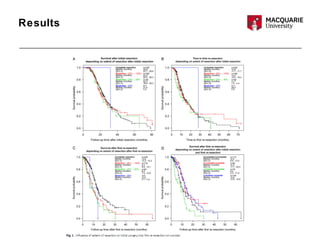
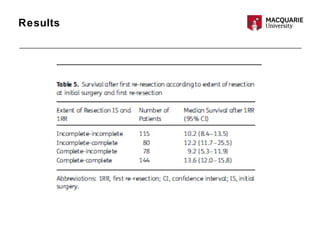
A beneficial influence of repeat surgery on survival is also suggested
by the correlation between the extent of resection and survival.
Study Design
• Retrospective cohort study.
• Database (2006-2010).
• Multicenter study (20 participating neurosurgical departments in
Germany, Switzerland, and Austria).
• 503 patients with primary glioblastomas undergoing repeat resections
for recurrent tumours were evaluated for factors affecting survival.
• Age, Karnofsky performance status (KPS), extent of resection (EOR),
tumour location, and complications were assessed.
Internal Validity
This is a retrospective analysis and is, therefore, inherently subject to
bias. Patient’s selection bias may have resulted from the treating
surgeons leading a group of patients towards redo surgery.
This is a multi-center analysis and thereby doesn’t reflect the treatment
bias of one institution.
The number of patients and longitudinal nature of follow-up was good
compared to other reports in the literature.
Statistical analysis was reasonable.
External Validity
• Inclusion criteria:
(i) De novo glioblastoma (WHO IV) upon initial tumour diagnosis.
(ii) Initial diagnosis between January 2006 and June 2010.
(iii) Surgical tumour resection following initial diagnosis.
(iv) Surgical resection of a recurrent tumour or progressive tumour
remnant.
External Validity
• Exclusion criteria:
(i) Secondary glioblastomas.
(ii) If the initially diagnosed tumour was not resected (biopsy only).
(iii) If the patient received a nonsurgical treatment for first tumour
recurrence.
External Validity
• For each patient, the following parameters were recorded: sex, date of
first (second, third, etc.) surgery, age at the respective surgeries, and
extent of resection.
• The extent of the surgical resection (EOR) was categorized as
(i)complete, (ii) resection above 90% but incomplete, (iii) resection
between 50% and 90%, and (iv) resection of less than 50%.
• EOR was assessed at the respective centres, which all used
postoperative imaging during the period of patient inclusion as a
routine procedure.
Results
Results
Results
Results
Results
Results
Results
Discussion / conclusions
Repeat surgery was believed to be associated with a higher
incidence of new neurological deficits, and the oncological
benefit of a second resection remained obscure.
When comparing repeat surgery with nonsurgical therapy from
retrospective and prospective data, studies so far have failed to
reveal a benefit from repeat resection.
Discussion / conclusions
Selection of patients for repeat resections was at the discretion of the
respective centres, and not all patients undergoing surgery in the study
period might have been reported.
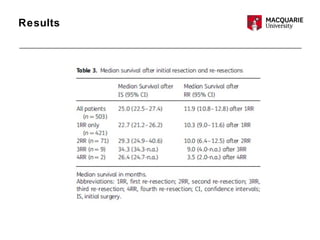
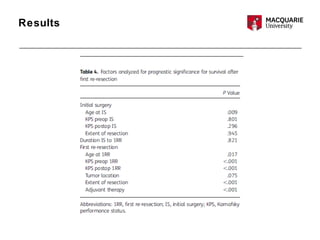
Surprisingly, the duration between initial surgery and re-resection did
not influence survival after re-resection. However, this might be due to
a selection bias since patients with early progression/recurrence were
probably not chosen for a re-resection by the contributing centres.
Standardized information on tumour size, location, and extent of
resection are not available. This could change the results if only
small-sized recurrent tumours would have been included.
Presentation and style
The paper was clear and organized.
The number of words were acceptable.
The tables and figures were good.
Conclusion
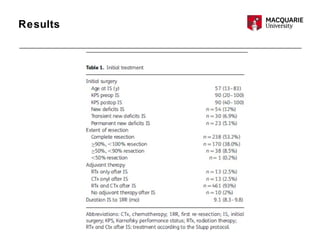
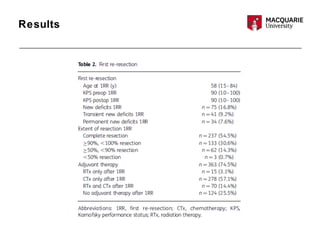
Repeat resection of a recurrent/progressive glioblastoma should be
considered whenever safely possible, especially in young age
group patients, high KPS, and longer time of recurrence.
The surgery should aim at a maximum safe resection and should
be followed by adjuvant chemotherapy.
Conclusion
Is the study believable (internally valid)?
Is the study relevant (externally valid)?
Will the study change my practice?
Thank You

JC recurrent gbm

  • 1.
    MACQUARIE NEUROSURGERY JOURNALCLUB Ahmad M. Badran 10 November 2016
  • 2.
    Clinical benefit fromresection of recurrent glioblastomas: results of a multicenter study including 503 patients with recurrent glioblastomas undergoing surgical resection
  • 3.
    Institution metrics/ Authors/Journal 20 participating neurosurgical departments in Germany, Switzerland, and Austria. • Department of Neurosurgery, Klinikum Rechts der Isar, Technische Universita¨ t Mu¨ nchen, Munich, Germany (F.R., H.P., B.M.); Department of Neurosurgery, Heinrich Heine Universita¨ t Du¨ sseldorf, Du¨ sseldorf, Germany (M.S.); Department of Neurosurgery, Universita¨ tsklinikum Carl Gustav Carus, Dresden, Germany (D.K.); Department of Neurosurgery, Universita¨ tsmedizin Go¨ ttingen, Go¨ ttingen, Germany (H.C.B.); Department of Neurosurgery, Charite´ Universita¨ tsmedizin, Berlin, Germany (M.M.); Department of Neurosurgery, Universita¨ tsklinikum Freiburg, Freiburg, Germany (A.W.); Department of Neurosurgery, Universita¨ tsklinikum Wu¨ rzburg, Wu¨ rzburg, Germany (T.W.); Department of Neurosurgery, Goethe Universita¨ t Frankfurt, Frankfurt, Germany (C.S.); Department of Neurosurgery, Inselspital, Universita¨ tsklinikum Bern, Bern, Switzerland (P.S.); Department of Neurosurgery, Universita¨ tskliniken Bonn, Rheinische Friedrich Wilhelms Universita¨ t, Bonn, Germany (M.S.)
  • 4.
    Institution metrics/ Authors/Journal • Florian Ringel, Haiko Pape, Michael Sabel, Dietmar Krex, Hans Christoph Bock, Martin Misch, Astrid Weyerbrock, Thomas Westermaier, Christian Senft, Philippe Schucht, Bernhard Meyer, Matthias Simon, and the SN1 study group. • Neuro-Oncology 18(1), 96–104, 2016.
  • 5.
    Study Relevance andOriginality • Both relevant and important. • The role of a surgical resection of recurrent glioblastomas remains largely unclear at present. • This study aimed to assess the effect of repeated resection of recurrent glioblastomas on patient survival.
  • 6.
  • 7.
    Research hypothesis Aggressive surgicalresection of recurrent/ progressive glioblastomas, followed by adjuvant therapy, could contribute to increased overall survival. A beneficial influence of repeat surgery on survival is also suggested by the correlation between the extent of resection and survival.
  • 8.
    Study Design • Retrospectivecohort study. • Database (2006-2010). • Multicenter study (20 participating neurosurgical departments in Germany, Switzerland, and Austria). • 503 patients with primary glioblastomas undergoing repeat resections for recurrent tumours were evaluated for factors affecting survival. • Age, Karnofsky performance status (KPS), extent of resection (EOR), tumour location, and complications were assessed.
  • 9.
    Internal Validity This isa retrospective analysis and is, therefore, inherently subject to bias. Patient’s selection bias may have resulted from the treating surgeons leading a group of patients towards redo surgery. This is a multi-center analysis and thereby doesn’t reflect the treatment bias of one institution. The number of patients and longitudinal nature of follow-up was good compared to other reports in the literature. Statistical analysis was reasonable.
  • 10.
    External Validity • Inclusioncriteria: (i) De novo glioblastoma (WHO IV) upon initial tumour diagnosis. (ii) Initial diagnosis between January 2006 and June 2010. (iii) Surgical tumour resection following initial diagnosis. (iv) Surgical resection of a recurrent tumour or progressive tumour remnant.
  • 11.
    External Validity • Exclusioncriteria: (i) Secondary glioblastomas. (ii) If the initially diagnosed tumour was not resected (biopsy only). (iii) If the patient received a nonsurgical treatment for first tumour recurrence.
  • 12.
    External Validity • Foreach patient, the following parameters were recorded: sex, date of first (second, third, etc.) surgery, age at the respective surgeries, and extent of resection. • The extent of the surgical resection (EOR) was categorized as (i)complete, (ii) resection above 90% but incomplete, (iii) resection between 50% and 90%, and (iv) resection of less than 50%. • EOR was assessed at the respective centres, which all used postoperative imaging during the period of patient inclusion as a routine procedure.
  • 13.
  • 14.
  • 15.
  • 16.
  • 17.
  • 18.
  • 19.
  • 20.
    Discussion / conclusions Repeatsurgery was believed to be associated with a higher incidence of new neurological deficits, and the oncological benefit of a second resection remained obscure. When comparing repeat surgery with nonsurgical therapy from retrospective and prospective data, studies so far have failed to reveal a benefit from repeat resection.
  • 21.
    Discussion / conclusions Selectionof patients for repeat resections was at the discretion of the respective centres, and not all patients undergoing surgery in the study period might have been reported. Surprisingly, the duration between initial surgery and re-resection did not influence survival after re-resection. However, this might be due to a selection bias since patients with early progression/recurrence were probably not chosen for a re-resection by the contributing centres. Standardized information on tumour size, location, and extent of resection are not available. This could change the results if only small-sized recurrent tumours would have been included.
  • 22.
    Presentation and style Thepaper was clear and organized. The number of words were acceptable. The tables and figures were good.
  • 23.
    Conclusion Repeat resection ofa recurrent/progressive glioblastoma should be considered whenever safely possible, especially in young age group patients, high KPS, and longer time of recurrence. The surgery should aim at a maximum safe resection and should be followed by adjuvant chemotherapy.
  • 24.
    Conclusion Is the studybelievable (internally valid)? Is the study relevant (externally valid)? Will the study change my practice?
  • 25.

Editor's Notes

  • #6 Devastating condition, esp if missed aneurysm etc. For example: 30 day mortality of 45% From their lit review: 13 references for the 15%; many of these references for the 2-24% (wide range) Not original in the sense that there were other retrospective reviews of this topic
  • #7 Devastating condition, esp if missed aneurysm etc. For example: 30 day mortality of 45% From their lit review: 13 references for the 15%; many of these references for the 2-24% (wide range) Not original in the sense that there were other retrospective reviews of this topic
  • #9 Who collected and who reviewed the data? Main outcome is evaluating diagnostic yield rather than accuracy Can infer that it’s atraumatic SAH with negative initial DSA
  • #11 Can this be applied to my patients? US centre could be similar 70/244 did not have 6 week DSA. Not commented on. High proportion
  • #12 Can this be applied to my patients? US centre could be similar 70/244 did not have 6 week DSA. Not commented on. High proportion
  • #13 Can this be applied to my patients? US centre could be similar 70/244 did not have 6 week DSA. Not commented on. High proportion
  • #14 All the important data in this paragraph Should be tabulated
  • #15 First point is that there were 17 aneurysms identified by DSA All these patients were NPM No diagnostic MRIs
  • #16 Total of 254 patients (don’t say how many atraumatic SAHs they had) Listed some severity indicators and complications Trend toward greater severity for NPM which is what has been described previously in the literature
  • #17 Total of 254 patients (don’t say how many atraumatic SAHs they had) Listed some severity indicators and complications Trend toward greater severity for NPM which is what has been described previously in the literature
  • #18 Total of 254 patients (don’t say how many atraumatic SAHs they had) Listed some severity indicators and complications Trend toward greater severity for NPM which is what has been described previously in the literature
  • #19 Total of 254 patients (don’t say how many atraumatic SAHs they had) Listed some severity indicators and complications Trend toward greater severity for NPM which is what has been described previously in the literature
  • #20 Reasonable if they are presenting a paper to report simple description of data Also, the clinical importance of the number might be more relevant But they had reasonable numbers, could have done statistical analysis on NPM v PM