MACQUARIE NEUROSURGERY JOURNAL CLUB
27/7/17
Dr Michael Mulcahy
MACQUARIE NEUROSURGERY
JOURNAL CLUB
Jennifer Urquhart, Osama Alrehaili, Charles Fisher, Alyssa Fleming, Parham Rasoulinejad, Kevin Gurr,
Stewart Bailey, Fawaz Siddiqi, and Christopher Bailey
Treatment of thoracolumbar burst fractures: extended follow-up
of a randomised clinical trial comparing orthosis versus no orthosis
Journal of Neurosurgery Spine, July 2017, Volume 27, pp42-7.
Authors
• 8 authors from Division of Orthopaedics, London Health Sciences Centre,
Ontario
• Charles Fisher (orthopaedic surgeon) Vancouver Hospital and Health
Sciences, University of British Columbia
• 1st author possibly a statistician
Disclosures/Funding
• Charles Fisher - consultant for Medtronic and NuVasive; royalties from
Medtronic; fellowship program support from Medtronic AOSpine
Study Relevance
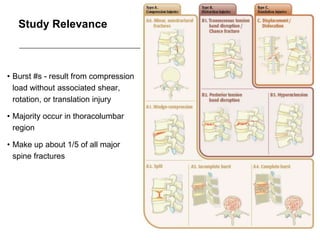
• Burst #s - result from compression
load without associated shear,
rotation, or translation injury
• Majority occur in thoracolumbar
region
• Make up about 1/5 of all major
spine fractures
Study Relevance
• Historically, burst #s were managed with prolonged bed rest (6-12 weeks)
• Use of brace is controversial
• Small retrospective studies showed success with early mobilisation with or
without brace or body cast
Study Relevance
• Theories of orthosis: provide stability thereby reducing pain and maintaining
alignment; reduce risk of neurologic injury; improve functional outcome
• Negatives of orthosis: deconditioning/muscular atrophy; practical
application; skin irritation; cost; accessibility; delay in waiting for brace
Originality
• First study to report on the long term outcomes of early ambulation without
orthosis in burst fractures without neurologic injury
Aim
• To determine if the results of the primary and secondary outcomes would be
sustained over time (defined as 5-10years)
Hypothesis
• Patients treated without an orthosis would be functionally and radiographically
similar to those treated with a TLSO on longer-term follow up.
Trial Design
• Prospective cohort study
• Subgroup of randomised controlled trial
• One centre
Initial RCT:
• registered with clinical trials registry
• unblinded
• consecutive patients
• 1:1 site-specific randomisation by concealed computer generated system
• Stratification - WC status; severity of kyphosis (< or >20deg)
Trial Design
Inclusion criteria:
• AO Type A3 burst # from T10 to L3
• age 16-60
• admitted within 72hrs of injury
• initial kyphotic deformity <35deg
• neurologically intact
Trial Design
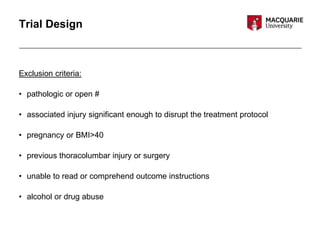
Exclusion criteria:
• pathologic or open #
• associated injury significant enough to disrupt the treatment protocol
• pregnancy or BMI>40
• previous thoracolumbar injury or surgery
• unable to read or comprehend outcome instructions
• alcohol or drug abuse
Trial Design
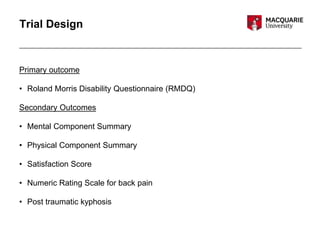
Primary outcome
• Roland Morris Disability Questionnaire (RMDQ)
Secondary Outcomes
• Mental Component Summary
• Physical Component Summary
• Satisfaction Score
• Numeric Rating Scale for back pain
• Post traumatic kyphosis
Trial Design
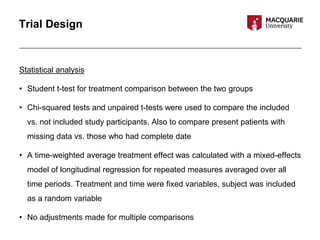
Statistical analysis
• Student t-test for treatment comparison between the two groups
• Chi-squared tests and unpaired t-tests were used to compare the included
vs. not included study participants. Also to compare present patients with
missing data vs. those who had complete date
• A time-weighted average treatment effect was calculated with a mixed-effects
model of longitudinal regression for repeated measures averaged over all
time periods. Treatment and time were fixed variables, subject was included
as a random variable
• No adjustments made for multiple comparisons
Results
Results
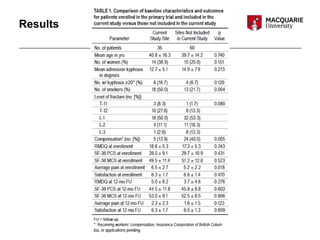
• 36 patients from one site
• 16 randomised to TLSO, 20 to no orthosis
• 23 returned for long term follow up, 13 did not
• 8 were lost to follow-up; 2 declined; 2 were overseas; 1
was deceased
• No baseline characteristic differences in subjects who
returned for follow up and those who didn't (though data not
shown)
110
96
36
23
Results
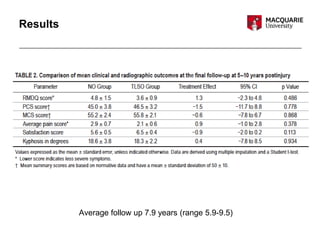
Average follow up 7.9 years (range 5.9-9.5)
Results
Results
Internal Validity
Sources of bias:
Loss to follow up
Within-subgroup effect
Number of patients not prescribed
RCT was unblinded, blinding not mentioned in the follow up
Multiple comparisons
Different baseline characteristics
Internal Validity
Sources of bias:
Loss to follow up
Within-subgroup effect
Number of patients not prescribed
RCT was unblinded, blinding not mentioned in the follow up
Multiple comparisons
Different baseline characteristics
External Validity
• Is this study important?
• Inclusion criteria misses a large group of patients
• The trial design is replicable
• Included all relevant outcomes
• Follow up is the longest reported so far
• Orthosis compliance difficult to assess, but this indicates the effectiveness
which is more generalisable
Conclusion
• There is a evidence from a subgroup analysis of a small RCT (with a high risk of bias) that
patients treated with early mobilisation and NO, maintain similar pain and functional
improvement at 5-10yrs as those initially treated with a TLSO.
• The overall message, identified by the original RCT, is that the fractures defined by the
inclusion criteria are inherently stable
• Limited by small numbers; loss of follow up; important hidden statistics. Why didn’t they look
at all the original patients?
• Similar study with osteoporotic patients and elderly patients is required and would be more
useful clinically

Tlso jc

  • 1.
    MACQUARIE NEUROSURGERY JOURNALCLUB 27/7/17 Dr Michael Mulcahy
  • 2.
    MACQUARIE NEUROSURGERY JOURNAL CLUB JenniferUrquhart, Osama Alrehaili, Charles Fisher, Alyssa Fleming, Parham Rasoulinejad, Kevin Gurr, Stewart Bailey, Fawaz Siddiqi, and Christopher Bailey Treatment of thoracolumbar burst fractures: extended follow-up of a randomised clinical trial comparing orthosis versus no orthosis Journal of Neurosurgery Spine, July 2017, Volume 27, pp42-7.
  • 3.
    Authors • 8 authorsfrom Division of Orthopaedics, London Health Sciences Centre, Ontario • Charles Fisher (orthopaedic surgeon) Vancouver Hospital and Health Sciences, University of British Columbia • 1st author possibly a statistician
  • 4.
    Disclosures/Funding • Charles Fisher- consultant for Medtronic and NuVasive; royalties from Medtronic; fellowship program support from Medtronic AOSpine
  • 5.
    Study Relevance • Burst#s - result from compression load without associated shear, rotation, or translation injury • Majority occur in thoracolumbar region • Make up about 1/5 of all major spine fractures
  • 6.
    Study Relevance • Historically,burst #s were managed with prolonged bed rest (6-12 weeks) • Use of brace is controversial • Small retrospective studies showed success with early mobilisation with or without brace or body cast
  • 7.
    Study Relevance • Theoriesof orthosis: provide stability thereby reducing pain and maintaining alignment; reduce risk of neurologic injury; improve functional outcome • Negatives of orthosis: deconditioning/muscular atrophy; practical application; skin irritation; cost; accessibility; delay in waiting for brace
  • 8.
    Originality • First studyto report on the long term outcomes of early ambulation without orthosis in burst fractures without neurologic injury
  • 9.
    Aim • To determineif the results of the primary and secondary outcomes would be sustained over time (defined as 5-10years)
  • 10.
    Hypothesis • Patients treatedwithout an orthosis would be functionally and radiographically similar to those treated with a TLSO on longer-term follow up.
  • 11.
    Trial Design • Prospectivecohort study • Subgroup of randomised controlled trial • One centre Initial RCT: • registered with clinical trials registry • unblinded • consecutive patients • 1:1 site-specific randomisation by concealed computer generated system • Stratification - WC status; severity of kyphosis (< or >20deg)
  • 12.
    Trial Design Inclusion criteria: •AO Type A3 burst # from T10 to L3 • age 16-60 • admitted within 72hrs of injury • initial kyphotic deformity <35deg • neurologically intact
  • 13.
    Trial Design Exclusion criteria: •pathologic or open # • associated injury significant enough to disrupt the treatment protocol • pregnancy or BMI>40 • previous thoracolumbar injury or surgery • unable to read or comprehend outcome instructions • alcohol or drug abuse
  • 14.
    Trial Design Primary outcome •Roland Morris Disability Questionnaire (RMDQ) Secondary Outcomes • Mental Component Summary • Physical Component Summary • Satisfaction Score • Numeric Rating Scale for back pain • Post traumatic kyphosis
  • 15.
    Trial Design Statistical analysis •Student t-test for treatment comparison between the two groups • Chi-squared tests and unpaired t-tests were used to compare the included vs. not included study participants. Also to compare present patients with missing data vs. those who had complete date • A time-weighted average treatment effect was calculated with a mixed-effects model of longitudinal regression for repeated measures averaged over all time periods. Treatment and time were fixed variables, subject was included as a random variable • No adjustments made for multiple comparisons
  • 16.
  • 17.
    Results • 36 patientsfrom one site • 16 randomised to TLSO, 20 to no orthosis • 23 returned for long term follow up, 13 did not • 8 were lost to follow-up; 2 declined; 2 were overseas; 1 was deceased • No baseline characteristic differences in subjects who returned for follow up and those who didn't (though data not shown) 110 96 36 23
  • 18.
    Results Average follow up7.9 years (range 5.9-9.5)
  • 19.
  • 20.
  • 21.
    Internal Validity Sources ofbias: Loss to follow up Within-subgroup effect Number of patients not prescribed RCT was unblinded, blinding not mentioned in the follow up Multiple comparisons Different baseline characteristics
  • 22.
    Internal Validity Sources ofbias: Loss to follow up Within-subgroup effect Number of patients not prescribed RCT was unblinded, blinding not mentioned in the follow up Multiple comparisons Different baseline characteristics
  • 23.
    External Validity • Isthis study important? • Inclusion criteria misses a large group of patients • The trial design is replicable • Included all relevant outcomes • Follow up is the longest reported so far • Orthosis compliance difficult to assess, but this indicates the effectiveness which is more generalisable
  • 24.
    Conclusion • There isa evidence from a subgroup analysis of a small RCT (with a high risk of bias) that patients treated with early mobilisation and NO, maintain similar pain and functional improvement at 5-10yrs as those initially treated with a TLSO. • The overall message, identified by the original RCT, is that the fractures defined by the inclusion criteria are inherently stable • Limited by small numbers; loss of follow up; important hidden statistics. Why didn’t they look at all the original patients? • Similar study with osteoporotic patients and elderly patients is required and would be more useful clinically

Editor's Notes

  • #6 by definition, plc is intact
  • #7 2 small RCTs: insufficient evidence, though Sx group had more complications, more delayed surgery, greater healthcare cost Possible reasons for lack of clinical equipoise: retrospective research; heterogeneous population; unclear/consistent definition of burst #s (still different classifications in use); difficulty in defining their inherent stability
  • #8 $550
  • #9 Randomised 96 of 110 eligible patients to TLSO or NO across 3 spine centres No difference in Roland Morris Disability Questionnaire score, pain score, satisfaction score, or kyphosis at 3 months (and up to 24months)
  • #12 A case-control study is designed to help determine if an exposure is associated with an outcome Brace for 10 weeks total Return to normal activities at 8 weeks Both groups had a rehab program
  • #13 From the initial RCT
  • #14  (can’t wear a brace)
  • #15 RMDQ is a validated score for disability due to low back pain Components of the 12 item short form health survey Kyphosis was measured by the Cobb technique (angle between the perpendicular to the superior and inferior endplate of the vertebral body above and below the fractured level, respectively)
  • #16 2 weeks, 6 weeks, 12 weeks, 6 months, 1 year, 2 years, 5-10yrs student t test for evaluating a hypothesis in a normal distribution a statistical method assessing the goodness of fit between a set of observed values and those expected theoretically. Missing data was assumed to be missing at random, and was replaced with a set of plausible values derived using a multiple imputation procedure with 10 iterations
  • #17 Recruitment was 2002-2009 Statistically significant differences were WC, number of smokers, pain at enrolment…?all patients likely to have chronic problems
  • #18 Don’t say which site patients were from i.e. less than 2/3. Of significance, did not mention which group the lost to follow up were in
  • #19 RMDQ score evaluates 24 items to get a score from 0-24 (24 is severe disability)
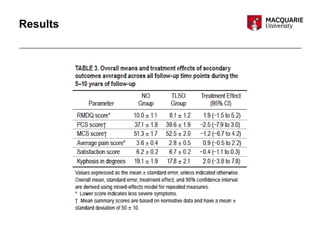
  • #20 time-weighted average treatment effect was calculated with a mixed-effects model of longitudinal regression for repeated measures averaged over all time periods.
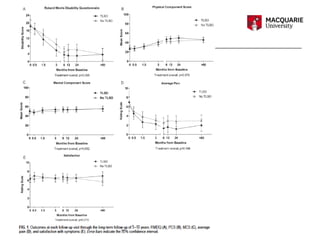
  • #21 Scores at each follow up for the primary and secondary outcomes Error bars are 95% CI Overall treatment not statistically different The improvement in RMDQ at all time points to six months was statistically significant in both groups
  • #22 Loss to follow up - cohort studies prone to drop out. Mixed effects model accounted for missed values. Cohort studies often need to be conducted over a long period of time…difficult to do. Loss to follow up - not mentioning which groups the lost patients were in…hiding data Within-subgroup effect - difference between subgroups in an rct and is it true or not not prescribed - unable to ensure adequate statistical power Initial RCT outcome measures were assessed by a blinded assessor Multiplicity- more likely to have a statistically significant result by chance alone
  • #23 Lost a third of patients so how would they know? Didn't compare with the other group, so how would you know?
  • #24 common, pain and reduced mobility, financial costly, burden on health care Although most patients are older and/or this significantly reduces helpfulness Rather than efficacy
  • #25  (rather than TLSO brace fails at stabilising) The hidden statistics and looking at only one centre make me suspicious