ANTIPLATELET 
THERAPY 
Alireza Kashani 
SET 2 Cardiothoracic Training 
Liverpool Hospital
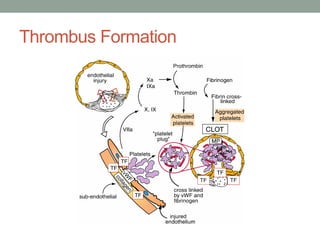
Thrombus Formation
What is Tissue Factor? 
• A cell surface glycoprotein : 
• Abundantly expressed in damaged endothelial and exposed 
subendothelial cells and also in the atherosclerotic plaques 
• Also derived from circulating microparticles (MPs) released during 
plaque rupture 
• Forms a complex with and activates factor VII 
• VII > VIIa 
• X > Xa and IX > IXa 
• Prothrombin > Thrombin
Platelet 
Activation 
Self-Amplification
Aspirin 
• Acetyl-Salicylic Acid 
• Platelet COX Inhibition by Acetylation 
• COX I: 
• Cardiovascular Protection 
• Toxic Gastric Side Effects 
• Reduction in TXA2 
• COX II: NOT INHIBITED AS MUCH 
• PGE2 : Inflammatory Response 
• At low dose permits production of PGI2 
• Until the end of life of the platelets 
• Vascular Endothelial COX I: 
• Reduction in both TXA2 and PGI2 
• However this enzyme can be reproduced here
Aspirin 
• GI Bleeding requiring hospitalization: 
• 2/1000 patients treated per year 
• Small Increase in haemorrhagic stroke 
• Bleeding is dose-dependent 
• Doubling as the dose is increased from less than 100 mg to less 
than 200 mg 
• Blocks platelet aggregation in response to TXA2; however, 
this can be overcome by other stimuli, in particular with 
thrombin. 
• Anti-inflammatory effects through blocking platelet-neutrophil 
interactions through higher doses.
Aspirin Nonresponsiveness 
• Present in16% of those with prior MI and is associated 
with 4x increase in: 
• DEATH 
• RE-INFARCTION 
• RE-HOSPITALIZATION 
Over 12 Months
Aspirin Nonresponsiveness 
• Definition: 
• High urinary concentration of TXA2 metabolite ≈ 2X risk of MI 
• Platelet function tests and presumed clinical unresponsiveness ≈ 
3X lifetime risk of: 
• MI 
• Stroke 
• Death 
• Mechanism: 
• GP polymorphism 
• Platelet activation by pathways other than COX 
• Enhanced inflammatory activity with increased expression of COX- 
2
Aspirin Nonresponsiveness 
• Detection: 
• Not a straight forward test 
• What to do? 
• Add-On Clopidogrel might help 
• Those with Aspirin resistance might be resistant to clopidogrel
Aspirin 
• Primary Prevention: 
• Assessing potential risk versus overall benefit (including cancer 
prevention) is the key 
• Secondary Prevention 
• The balance strongly favors the benefits 
• All patients with prior CV events 
• Prior MI : 25% reduction in re-MI 
• Stable Angina > β-blockers + Aspirin 75 mg/d : 34% reduction in MI or 
sudden death in comparison with placebo 
• UAP: 46% risk reduction 
• Coronary Angioplasty: 53% 
• Prior Stroke: 22% 
• Peripheral Arterial Disease : 23%
Aspirin 
• Cancer Prevention 
• Cardiovascular Indications: 
• ACS: 
• AMI + Fibrinolytic Therapy / Primary PCI 
• UAP + Conservative/Invasive Strategies 
• Antiinflammatory: 
• It is an important point to factor in the inflammatory response in the 
genesis of cardiovascular disease. Hence, the preventative effects 
of aspirin is not limited only to platelet inhibition.
Aspirin 
• Other: 
• Post CABG : should be started within 48h. It reduces the total 
mortality by 2/3 
• Prevention of AF-Related Stroke: 
• Warfarin Contraindicated 
• CHADS-VASc Score of <2 : CHF, HTN, >75, DM, CVA, TIA, TE, 
Vascular Disease 
• Arteriovenous Shunts 
• Stroke Prevention in intra-cranial arterial stenosis : HIGH DOSE 
ASPIRIN (325-1300 mg/day) WAS BETTER THAN WARFARIN 
• Urgent Therapy in TIAs and minor strokes: 
• Part of the regimen : Aspirin + Clopidogrel + Statin + Anti-HTN ± Anti- 
Coagulation
Aspirin 
• What Dose? 
• 75-150 mg/d covers a wide range of conditions 
• NSTE ACS : 75-100 mg/d 
• 80 mg/d completely blocks platelet aggregation through COX 
• 30 mg/d to prevent TIA 
• This takes 2 days before it is effective 
• AMI : 160 mg to achieve a much faster inhibition 
• Side Effects: 
• The most serious is GIT Bleeding 
• The most common is GI Upset : Dyspepsia, Nausea, and Vomiting 
• GI Side Effects: Dose Dependent 
• Enteric-Coated: 
• Reduced Gastric Side Effects 
• Reduced Bio-Availability 
• Increased Risk of Cardiovascular Side Effects 
• Kidney Injury, decreased uric acid secretion, increased risk of gout: 
more commonly seen in elderly even with low-dose aspirin
Aspirin Contraindications 
• Absolute: 
• Aspirin Intolerance 
• Hx of GI Bleeding 
• PUD 
• Other potential source of GI or GU Bleeding 
• Relative: 
• Gout 
• Dyspepsia 
• IDA 
• Possibility of increased peri-operative bleeding 
• Note: 
• Hemophilia in case of strong cardiovascular indications is not an 
absolute contraindication.
Aspirin Interactions 
• Warfarin : Increased risk of bleeding 
• NSAIDS: 
• COX-1 inhibitors: Interfere with cardioprotective effects of aspirin 
• Ibuprofen, Naproxen 
• COX-2 inhibitors: less than above 
• ACE-Inh: opposing effects on haemodynamics of the kidneys. 
• ACE-Inh when chronically used for HF, Post MI Protection, or high-risk 
protection even when the aspirin was given they were still beneficial. 
Aspirin might reduce but can not eliminate this effect. 
• A good policy is to keep the aspirin at a low dose. 
• Phenobarbital, phenytoin, and rifampin by inducing the hepatic 
metabolizing enzymes reduce the efficacy of the aspirin 
• Effects of OHA and Insulin are enhanced by aspirin. 
• Combination of Thiazides and Aspirin : Increased risk of Gout
ADP-Mediated Antiplatelets 
• ADP 
• Released during platelet 
activation 
• Externalized 
• Coupled with G Proteins: 
• P2Y1 
• Platelet shape change 
• GPIIb/IIIa activation initiation 
• P2Y12 
• Perpetuates GPIIb/IIIa 
activation 
• Stabilizes the platelet 
aggregation 
• Rapid activation of 
intravascular TF
ADP-Mediated Antiplatelets 
• ADP Antagonism: 
• Inhibit platelet shape change 
• Inhibit platelet GPIIb/IIIa activation 
• Reduce activation of intravascular TF 
• Hence: 
• Reduce platelet aggregation 
• Destabilize the aggregated platelets 
• Potentially disaggregate the platelets 
• Anticoagulation effects 
• Group: 
• Ticlopidine 
• Clopidogrel 
• Prasugrel 
• Ticagrelor
Ticlopidine 
• The first of this group 
• Adverse reactions: 
• Neutropenia which occurs within the first 3 months and patients that 
are started on this should undergo FBC check prior to commencement 
and every 2 weeks up to 3 months 
• TTP 
• Liver Abnormalities 
• Indications: 
• Prevent repeat stroke or TIA in those intolerant of or resistant to 
Aspirin 
• Coronary artery stenting in combination with aspirin for up to 30 days 
• Due to the above ADRs it is rarely used; however, it is still 
available to those: 
• Allergic to or intolerant of Clopidogrel 
• Living in countries in which Clopidogrel is not readily available
Ticlopidine Pharmacokinetics 
• Nonlinear 
• Markedly decreased clearance on repeated dosing 
• To achieve maximum platelet aggregation inhibition : 4-7 
days when given with aspirin 
• This can be expedited by oral loading 
• The plasma half-life during constant dosing 4-5 days 
• Metabolism: 
• Hepatic Metabolism 
• Renal Excretion
Clopidogrel 
• P2Y12 ADP Receptor Inhibitor 
• Prevention of GPIIb/IIIa receptor activation and transformation 
• Substantially less myelotoxic than ticlopidine 
• Less major GI bleeding than aspirin 
• The same as aspirin, the clopidogrel resistance also 
occurs
Clopidogrel 
• Inactive prodrug requires in vivo oxidation by hepatic or 
intestinal cytochrome isoenzymes: 
• CYP3A4 
• 2C19 
• Onset of action: 
• A single oral dose: within hours, and reaches a steady state in 3-7 
days 
• Upstream before PCI 
• 600 mg : 2 hours 
• 300 mg : 24 – 48 hours
Clopidogrel 
• It is recommended that clopidogrel should be stopped for 5 
days before CABG to avoid major bleeding. 
• Dose adjustment is not necessary in elderly and those with 
renal disease. 
• Side effects: 
• Neutropenia : 0.02% 
• Major bleeding without an increase in intracranial bleeding 
• Contraindication: 
• Major bleeding 
• Interactions: 
• PPIs and Statins inhibit hepatic activation of Clopidogrel esp. those 
which inhibit P450 Cytochrome like Omeprazole or Atorvastatin 
• This is not proven in vivo
Clopidogrel 
• Genetic Testing: 
• The CYP2C19*2 allele: 
• Increased rates of ischemic events and stent thrombosis after PCI 
• 30% of Western Europeans 
• 40% of Asians and Africans 
• Indications: 
• Reduction of atherosclerotic events (MI, Stroke, Vascular Death) in 
patients with recent stroke, recent MI, or with established arterial 
disease 
• ACS whether or not PCI (with or without stent) or CABG is performed 
• Dosage: 
• For loading 600 mg is better 
• How Long After PCI? 
• DES : at least 12 months 
• BMS : 1 month
Prasugrel 
• Newer thienopyridine 
• Irreversible and noncompetitively inhibits P2Y12 exactly 
the same as Clopidogrel 
• A prodrug 
Digestion 
Hydrolyzed By 
Intestinal Cells to 
Thiolactone 
Single Step 
Activation in 
the Liver by 
either 
CYP3A4 or 
CYP2B6
Prasugrel 
• The active metabolite’s elimination half-life: 7 hours (2-15 
hours) 
• CYP3A Inhibitors: 
• Verapamil and Diltiazem 
• Do not alter its activity but decrease the maximum concentration by 
34-46% 
• Its platelet aggregation inhibition is 5-9 times more potent 
than that of Clopidogrel 
• Initiation of Action : 1 hour
Prasugrel 
• TRITON-TIMI 38 Trial: 
• 2 arms in patients undergoing PCI: 
• Prasugrel: 60 mg then 10 mg/d 
• Clopidogrel: 300mg then 75 mg/d 
• Follow Up for 6-15 months 
• Prasugrel 
•  Primary endpoint of cardiovascular death, MI, and stroke from 12% 
to 9.9% (p<0.001) 
•  Stent Thrombosis from 2.4% to 1.1% (p<0.001) 
• 46 patients needed to be treated for 5 months to avoid one primary end 
point as opposed to 167 patients treated to result in one major bleeding 
(not CABG related)
Prasugrel 
• Indication: 
• Patients with ACS who are to be managed with PCI for: 
• Unstable Angina 
• NSTEMI 
• STEMI (either primary or delayed) 
• Risks: 
• FDA Black Box Warning: 
• Serious Bleeding 
• Occasionally TTP 
• If possible the bleeding should be managed without stopping prasugrel, esp. in the first few 
weeks after ACS 
• Risk factors based on TRITON 38 data analysis: 
• Use of GPIIb/IIIa Inhibitor even for short period of time 
• A history of stroke or TIA 
• Age 75 years or older 
• Female gender 
• Body weight < 60 kg 
• Femoral Access 
• Patients with a history of stroke or TIA or low body weight should not receive 
prasugrel.
Ticagrelor 
• Oral Reversibly Binding 
Noncompetitive P2Y12 
receptor inhibitor 
• Half Life: 12 hours 
• The level of inhibition is 
determined by plasma 
ticagrelor level and to a 
lesser extent an active 
metabolite 
• More rapid and consistent 
action than clopidogrel 
• Quicker Offset than 
Prasugrel 
• NO HEPATIC ACTIVATION 
IS REQUIRED.
Ticagrelor 
• Inhibits hepatic CYP3A 
• Increase blood levels of drugs such as : 
• Amlodipine 
• Simvastatin 
• Atorvastatin 
• Moderate CYP3A inhibitors: 
• Diltiazem, Verapamil, and Amlodipine 
• Increase levels of Ticagrelor 
• Reduce the speed of offset
Ticagrelor 
• PLATO Trial: 
• Patient pool: 
• Moderate-high risk NSTE-ACS planned for either conservative or 
invasive management 
• STEMI planned for primary PCI 
• Randomized: 
• Clopidogrel: 300 mg Loading / 75 mg D (9333 patients) 
• Ticagrelor: 180 mg Loading / 90 mg BD (9291 patients) 
• Results: 
• Death 4.5% vs. 5.9% P < 0.001 
• Primary PCI group death 9.8% vs. 11.7% P < 0.001 
• General composite endpoint 9% vs. 10.7% P : 0.0025
Ticagrelor 
• Adverse Effects: 
• Bleeding 
• Dyspnea 
• Most frequently within the first week of Rx 
• Maybe transient or persistent until the Rx is ceased 
• It is not linked to deterioration in cardiac or pulmonary function. 
• Increased Frequency of Ventricular Pauses 
• Asymptomatic Uric Acidaemia 
• Mechanism of Vent. Pauses and Dyspnea remains unclear 
• Caution: 
• Advanced SA nodal dysfunction 
• 2nd/3rd-degree AV blocks 
• PLATO trial stated that Ticagrelor effects are less when 
combined with high-dose aspirin.
Cangrelor 
• Rapid-acting, reversible, potent, competitive inhibitor of 
the P2Y12 receptor 
• Intravenous 
• Onset of action (85% inhibition of AD-induced platelet 
aggregation) 20 minutes 
• CHAMPION Trial: Cangrelor use in NSTE ACS patients 
undergoing PCI was associated with significant reduction 
in early ischaemic events when compared with 
clopidogrel. 
• When Cangrelor is added to Clopidogrel: further reduction 
in platelet reactivity but did not alter cardiac surgery-related 
bleeding
Vorapaxar 
• A potent, competitive PAR-1 
antagonist 
• In a large outcome trials (12944 
patients) 
• Failed to improve the primary end 
point of a composite major 
cardiovascular events 
• Reduced the secondary endpoint 
of cardiovascular death, MI, or 
stroke (p = 0.02) 
• Significant increase in major 
bleeding including ICH (p < 
0.0001) 
• Trial was terminated. 
• In another large trial with 26499 
the same endpoints met but 
indicated those without a history 
of stroke have a lesser risk of 
ICH.
Atopaxar 
• The same group of medication 
• No outcome trials are available 
• Current Phase 2 trial on patients with NSTE ACS has 
failed to show any benefits.
Dipyridamole & Sulfinpyrazone 
• Dipyridamole: 
• Site of action is the same as 
prostacyclin. 
• It helps to reduce recurrent 
stroke when given with 
aspirin* 
• Sulfinpyrazone: 
• Site of action is similar to 
aspirin and it inhibits the COX 
pathway. 
• Requires multiple daily doses 
and is more expensive 
• It is a uricosuric agent and is 
indicated in chronic or 
intermittent gouty arthritis.
Dual Antiplatelet Therapy 
• Substantial data shows that adding clopidogrel to aspirin is beneficial 
in the setting of acute vascular injury, whether procedure-induced as 
in stenting, or spontaneous as in ACS, including AMI. 
• CHARISMA Trial: high-risk subgroups benefited from dual antiplatelet 
therapy. 
• ACS Recommends: 
• STEMI, NSTEMI patients with intended PCI: 
• 300-600 mg Loading of Clopidogrel 
• 75 mg/d for 1 year 
• OASIS-7 Trial: 
• 17263 patients randomized to two arms of standard and double-dose loading: 
• 600 mg day 1, 150 mg on days 2-7, and 75 mg/d: 
• Reduced cardiovascular events and stent thrombosis at 30 days when compared with 
standard dosing 
• Efficacy and safety did not differ between high-dose and low-dose aspirin 
• CURE Trial (12562 patients) 
• Clopidogrel + Aspirin : reduced the composite of combined death, MI, and 
stroke at 9 months by 20% (p < 0.001) 
• Clopidogrel increased major bleeding (3.7% vs. 2.7% P = 0.003)
2011 ACC/AHA Guidelines 
• Preoperative: 
• CLASS I: 
• Aspirin (100 mg to 325 mg daily) should be administered to CABG patients 
preoperatively (Level of Evidence: B) 
• In patients referred for elective CABG, clopidogrel and ticagrelor should be 
discontinued for at least 5 days before surgery (Level of Evidence: B) and 
prasugrel for at least 7 days (Level of Evidence: C) to limit blood 
transfusions. 
• In patients referred for urgent CABG, clopidogrel and ticagrelor should be 
discontinued for at least 24 hours to reduce major bleeding complications. 
(Level of Evidence: B) 
• In patients referred for CABG, short-acting intravenous GPIIb/IIIa inhibitors 
(eptifibatide or tirofiban) should be discontinued for at least 2 to 4 hours 
before surgery and abciximab for at least 12 hours beforehand to limit blood 
loss and transfusions. (Level of Evidence: B) 
• CLASS IIb: 
• In patients referred for urgent CABG, it may be reasonable to perform 
surgery less than 5 days after clopidogrel or ticagrelor has been 
discontinued and less than 7 days after prasugrel has been discontinued. 
(Level of Evidence: C)
2011 ACC/AHA Guidelines 
• Postoperative: 
• CLASS I: 
• If aspirin (100 mg to 325 mg daily) was not initiated preoperatively, it 
should be initiated within 6 hours postoperatively and then continued 
indefinitely to reduce the occurrence of SVG closure and adverse 
cardiovascular events. (Level of Evidence: A) 
• CLASS IIa: 
• For patients undergoing CABG, clopidogrel 75 mg daily is a reasonable 
alternative in patients who are intolerant of or allergic to aspirin. (Level 
of Evidence: C)

Coagulation

  • 1.
    ANTIPLATELET THERAPY AlirezaKashani SET 2 Cardiothoracic Training Liverpool Hospital
  • 2.
  • 3.
    What is TissueFactor? • A cell surface glycoprotein : • Abundantly expressed in damaged endothelial and exposed subendothelial cells and also in the atherosclerotic plaques • Also derived from circulating microparticles (MPs) released during plaque rupture • Forms a complex with and activates factor VII • VII > VIIa • X > Xa and IX > IXa • Prothrombin > Thrombin
  • 4.
  • 7.
    Aspirin • Acetyl-SalicylicAcid • Platelet COX Inhibition by Acetylation • COX I: • Cardiovascular Protection • Toxic Gastric Side Effects • Reduction in TXA2 • COX II: NOT INHIBITED AS MUCH • PGE2 : Inflammatory Response • At low dose permits production of PGI2 • Until the end of life of the platelets • Vascular Endothelial COX I: • Reduction in both TXA2 and PGI2 • However this enzyme can be reproduced here
  • 8.
    Aspirin • GIBleeding requiring hospitalization: • 2/1000 patients treated per year • Small Increase in haemorrhagic stroke • Bleeding is dose-dependent • Doubling as the dose is increased from less than 100 mg to less than 200 mg • Blocks platelet aggregation in response to TXA2; however, this can be overcome by other stimuli, in particular with thrombin. • Anti-inflammatory effects through blocking platelet-neutrophil interactions through higher doses.
  • 9.
    Aspirin Nonresponsiveness •Present in16% of those with prior MI and is associated with 4x increase in: • DEATH • RE-INFARCTION • RE-HOSPITALIZATION Over 12 Months
  • 10.
    Aspirin Nonresponsiveness •Definition: • High urinary concentration of TXA2 metabolite ≈ 2X risk of MI • Platelet function tests and presumed clinical unresponsiveness ≈ 3X lifetime risk of: • MI • Stroke • Death • Mechanism: • GP polymorphism • Platelet activation by pathways other than COX • Enhanced inflammatory activity with increased expression of COX- 2
  • 11.
    Aspirin Nonresponsiveness •Detection: • Not a straight forward test • What to do? • Add-On Clopidogrel might help • Those with Aspirin resistance might be resistant to clopidogrel
  • 12.
    Aspirin • PrimaryPrevention: • Assessing potential risk versus overall benefit (including cancer prevention) is the key • Secondary Prevention • The balance strongly favors the benefits • All patients with prior CV events • Prior MI : 25% reduction in re-MI • Stable Angina > β-blockers + Aspirin 75 mg/d : 34% reduction in MI or sudden death in comparison with placebo • UAP: 46% risk reduction • Coronary Angioplasty: 53% • Prior Stroke: 22% • Peripheral Arterial Disease : 23%
  • 13.
    Aspirin • CancerPrevention • Cardiovascular Indications: • ACS: • AMI + Fibrinolytic Therapy / Primary PCI • UAP + Conservative/Invasive Strategies • Antiinflammatory: • It is an important point to factor in the inflammatory response in the genesis of cardiovascular disease. Hence, the preventative effects of aspirin is not limited only to platelet inhibition.
  • 14.
    Aspirin • Other: • Post CABG : should be started within 48h. It reduces the total mortality by 2/3 • Prevention of AF-Related Stroke: • Warfarin Contraindicated • CHADS-VASc Score of <2 : CHF, HTN, >75, DM, CVA, TIA, TE, Vascular Disease • Arteriovenous Shunts • Stroke Prevention in intra-cranial arterial stenosis : HIGH DOSE ASPIRIN (325-1300 mg/day) WAS BETTER THAN WARFARIN • Urgent Therapy in TIAs and minor strokes: • Part of the regimen : Aspirin + Clopidogrel + Statin + Anti-HTN ± Anti- Coagulation
  • 15.
    Aspirin • WhatDose? • 75-150 mg/d covers a wide range of conditions • NSTE ACS : 75-100 mg/d • 80 mg/d completely blocks platelet aggregation through COX • 30 mg/d to prevent TIA • This takes 2 days before it is effective • AMI : 160 mg to achieve a much faster inhibition • Side Effects: • The most serious is GIT Bleeding • The most common is GI Upset : Dyspepsia, Nausea, and Vomiting • GI Side Effects: Dose Dependent • Enteric-Coated: • Reduced Gastric Side Effects • Reduced Bio-Availability • Increased Risk of Cardiovascular Side Effects • Kidney Injury, decreased uric acid secretion, increased risk of gout: more commonly seen in elderly even with low-dose aspirin
  • 16.
    Aspirin Contraindications •Absolute: • Aspirin Intolerance • Hx of GI Bleeding • PUD • Other potential source of GI or GU Bleeding • Relative: • Gout • Dyspepsia • IDA • Possibility of increased peri-operative bleeding • Note: • Hemophilia in case of strong cardiovascular indications is not an absolute contraindication.
  • 17.
    Aspirin Interactions •Warfarin : Increased risk of bleeding • NSAIDS: • COX-1 inhibitors: Interfere with cardioprotective effects of aspirin • Ibuprofen, Naproxen • COX-2 inhibitors: less than above • ACE-Inh: opposing effects on haemodynamics of the kidneys. • ACE-Inh when chronically used for HF, Post MI Protection, or high-risk protection even when the aspirin was given they were still beneficial. Aspirin might reduce but can not eliminate this effect. • A good policy is to keep the aspirin at a low dose. • Phenobarbital, phenytoin, and rifampin by inducing the hepatic metabolizing enzymes reduce the efficacy of the aspirin • Effects of OHA and Insulin are enhanced by aspirin. • Combination of Thiazides and Aspirin : Increased risk of Gout
  • 18.
    ADP-Mediated Antiplatelets •ADP • Released during platelet activation • Externalized • Coupled with G Proteins: • P2Y1 • Platelet shape change • GPIIb/IIIa activation initiation • P2Y12 • Perpetuates GPIIb/IIIa activation • Stabilizes the platelet aggregation • Rapid activation of intravascular TF
  • 19.
    ADP-Mediated Antiplatelets •ADP Antagonism: • Inhibit platelet shape change • Inhibit platelet GPIIb/IIIa activation • Reduce activation of intravascular TF • Hence: • Reduce platelet aggregation • Destabilize the aggregated platelets • Potentially disaggregate the platelets • Anticoagulation effects • Group: • Ticlopidine • Clopidogrel • Prasugrel • Ticagrelor
  • 21.
    Ticlopidine • Thefirst of this group • Adverse reactions: • Neutropenia which occurs within the first 3 months and patients that are started on this should undergo FBC check prior to commencement and every 2 weeks up to 3 months • TTP • Liver Abnormalities • Indications: • Prevent repeat stroke or TIA in those intolerant of or resistant to Aspirin • Coronary artery stenting in combination with aspirin for up to 30 days • Due to the above ADRs it is rarely used; however, it is still available to those: • Allergic to or intolerant of Clopidogrel • Living in countries in which Clopidogrel is not readily available
  • 22.
    Ticlopidine Pharmacokinetics •Nonlinear • Markedly decreased clearance on repeated dosing • To achieve maximum platelet aggregation inhibition : 4-7 days when given with aspirin • This can be expedited by oral loading • The plasma half-life during constant dosing 4-5 days • Metabolism: • Hepatic Metabolism • Renal Excretion
  • 23.
    Clopidogrel • P2Y12ADP Receptor Inhibitor • Prevention of GPIIb/IIIa receptor activation and transformation • Substantially less myelotoxic than ticlopidine • Less major GI bleeding than aspirin • The same as aspirin, the clopidogrel resistance also occurs
  • 24.
    Clopidogrel • Inactiveprodrug requires in vivo oxidation by hepatic or intestinal cytochrome isoenzymes: • CYP3A4 • 2C19 • Onset of action: • A single oral dose: within hours, and reaches a steady state in 3-7 days • Upstream before PCI • 600 mg : 2 hours • 300 mg : 24 – 48 hours
  • 25.
    Clopidogrel • Itis recommended that clopidogrel should be stopped for 5 days before CABG to avoid major bleeding. • Dose adjustment is not necessary in elderly and those with renal disease. • Side effects: • Neutropenia : 0.02% • Major bleeding without an increase in intracranial bleeding • Contraindication: • Major bleeding • Interactions: • PPIs and Statins inhibit hepatic activation of Clopidogrel esp. those which inhibit P450 Cytochrome like Omeprazole or Atorvastatin • This is not proven in vivo
  • 26.
    Clopidogrel • GeneticTesting: • The CYP2C19*2 allele: • Increased rates of ischemic events and stent thrombosis after PCI • 30% of Western Europeans • 40% of Asians and Africans • Indications: • Reduction of atherosclerotic events (MI, Stroke, Vascular Death) in patients with recent stroke, recent MI, or with established arterial disease • ACS whether or not PCI (with or without stent) or CABG is performed • Dosage: • For loading 600 mg is better • How Long After PCI? • DES : at least 12 months • BMS : 1 month
  • 27.
    Prasugrel • Newerthienopyridine • Irreversible and noncompetitively inhibits P2Y12 exactly the same as Clopidogrel • A prodrug Digestion Hydrolyzed By Intestinal Cells to Thiolactone Single Step Activation in the Liver by either CYP3A4 or CYP2B6
  • 28.
    Prasugrel • Theactive metabolite’s elimination half-life: 7 hours (2-15 hours) • CYP3A Inhibitors: • Verapamil and Diltiazem • Do not alter its activity but decrease the maximum concentration by 34-46% • Its platelet aggregation inhibition is 5-9 times more potent than that of Clopidogrel • Initiation of Action : 1 hour
  • 29.
    Prasugrel • TRITON-TIMI38 Trial: • 2 arms in patients undergoing PCI: • Prasugrel: 60 mg then 10 mg/d • Clopidogrel: 300mg then 75 mg/d • Follow Up for 6-15 months • Prasugrel •  Primary endpoint of cardiovascular death, MI, and stroke from 12% to 9.9% (p<0.001) •  Stent Thrombosis from 2.4% to 1.1% (p<0.001) • 46 patients needed to be treated for 5 months to avoid one primary end point as opposed to 167 patients treated to result in one major bleeding (not CABG related)
  • 30.
    Prasugrel • Indication: • Patients with ACS who are to be managed with PCI for: • Unstable Angina • NSTEMI • STEMI (either primary or delayed) • Risks: • FDA Black Box Warning: • Serious Bleeding • Occasionally TTP • If possible the bleeding should be managed without stopping prasugrel, esp. in the first few weeks after ACS • Risk factors based on TRITON 38 data analysis: • Use of GPIIb/IIIa Inhibitor even for short period of time • A history of stroke or TIA • Age 75 years or older • Female gender • Body weight < 60 kg • Femoral Access • Patients with a history of stroke or TIA or low body weight should not receive prasugrel.
  • 31.
    Ticagrelor • OralReversibly Binding Noncompetitive P2Y12 receptor inhibitor • Half Life: 12 hours • The level of inhibition is determined by plasma ticagrelor level and to a lesser extent an active metabolite • More rapid and consistent action than clopidogrel • Quicker Offset than Prasugrel • NO HEPATIC ACTIVATION IS REQUIRED.
  • 32.
    Ticagrelor • Inhibitshepatic CYP3A • Increase blood levels of drugs such as : • Amlodipine • Simvastatin • Atorvastatin • Moderate CYP3A inhibitors: • Diltiazem, Verapamil, and Amlodipine • Increase levels of Ticagrelor • Reduce the speed of offset
  • 33.
    Ticagrelor • PLATOTrial: • Patient pool: • Moderate-high risk NSTE-ACS planned for either conservative or invasive management • STEMI planned for primary PCI • Randomized: • Clopidogrel: 300 mg Loading / 75 mg D (9333 patients) • Ticagrelor: 180 mg Loading / 90 mg BD (9291 patients) • Results: • Death 4.5% vs. 5.9% P < 0.001 • Primary PCI group death 9.8% vs. 11.7% P < 0.001 • General composite endpoint 9% vs. 10.7% P : 0.0025
  • 34.
    Ticagrelor • AdverseEffects: • Bleeding • Dyspnea • Most frequently within the first week of Rx • Maybe transient or persistent until the Rx is ceased • It is not linked to deterioration in cardiac or pulmonary function. • Increased Frequency of Ventricular Pauses • Asymptomatic Uric Acidaemia • Mechanism of Vent. Pauses and Dyspnea remains unclear • Caution: • Advanced SA nodal dysfunction • 2nd/3rd-degree AV blocks • PLATO trial stated that Ticagrelor effects are less when combined with high-dose aspirin.
  • 35.
    Cangrelor • Rapid-acting,reversible, potent, competitive inhibitor of the P2Y12 receptor • Intravenous • Onset of action (85% inhibition of AD-induced platelet aggregation) 20 minutes • CHAMPION Trial: Cangrelor use in NSTE ACS patients undergoing PCI was associated with significant reduction in early ischaemic events when compared with clopidogrel. • When Cangrelor is added to Clopidogrel: further reduction in platelet reactivity but did not alter cardiac surgery-related bleeding
  • 36.
    Vorapaxar • Apotent, competitive PAR-1 antagonist • In a large outcome trials (12944 patients) • Failed to improve the primary end point of a composite major cardiovascular events • Reduced the secondary endpoint of cardiovascular death, MI, or stroke (p = 0.02) • Significant increase in major bleeding including ICH (p < 0.0001) • Trial was terminated. • In another large trial with 26499 the same endpoints met but indicated those without a history of stroke have a lesser risk of ICH.
  • 37.
    Atopaxar • Thesame group of medication • No outcome trials are available • Current Phase 2 trial on patients with NSTE ACS has failed to show any benefits.
  • 38.
    Dipyridamole & Sulfinpyrazone • Dipyridamole: • Site of action is the same as prostacyclin. • It helps to reduce recurrent stroke when given with aspirin* • Sulfinpyrazone: • Site of action is similar to aspirin and it inhibits the COX pathway. • Requires multiple daily doses and is more expensive • It is a uricosuric agent and is indicated in chronic or intermittent gouty arthritis.
  • 39.
    Dual Antiplatelet Therapy • Substantial data shows that adding clopidogrel to aspirin is beneficial in the setting of acute vascular injury, whether procedure-induced as in stenting, or spontaneous as in ACS, including AMI. • CHARISMA Trial: high-risk subgroups benefited from dual antiplatelet therapy. • ACS Recommends: • STEMI, NSTEMI patients with intended PCI: • 300-600 mg Loading of Clopidogrel • 75 mg/d for 1 year • OASIS-7 Trial: • 17263 patients randomized to two arms of standard and double-dose loading: • 600 mg day 1, 150 mg on days 2-7, and 75 mg/d: • Reduced cardiovascular events and stent thrombosis at 30 days when compared with standard dosing • Efficacy and safety did not differ between high-dose and low-dose aspirin • CURE Trial (12562 patients) • Clopidogrel + Aspirin : reduced the composite of combined death, MI, and stroke at 9 months by 20% (p < 0.001) • Clopidogrel increased major bleeding (3.7% vs. 2.7% P = 0.003)
  • 40.
    2011 ACC/AHA Guidelines • Preoperative: • CLASS I: • Aspirin (100 mg to 325 mg daily) should be administered to CABG patients preoperatively (Level of Evidence: B) • In patients referred for elective CABG, clopidogrel and ticagrelor should be discontinued for at least 5 days before surgery (Level of Evidence: B) and prasugrel for at least 7 days (Level of Evidence: C) to limit blood transfusions. • In patients referred for urgent CABG, clopidogrel and ticagrelor should be discontinued for at least 24 hours to reduce major bleeding complications. (Level of Evidence: B) • In patients referred for CABG, short-acting intravenous GPIIb/IIIa inhibitors (eptifibatide or tirofiban) should be discontinued for at least 2 to 4 hours before surgery and abciximab for at least 12 hours beforehand to limit blood loss and transfusions. (Level of Evidence: B) • CLASS IIb: • In patients referred for urgent CABG, it may be reasonable to perform surgery less than 5 days after clopidogrel or ticagrelor has been discontinued and less than 7 days after prasugrel has been discontinued. (Level of Evidence: C)
  • 41.
    2011 ACC/AHA Guidelines • Postoperative: • CLASS I: • If aspirin (100 mg to 325 mg daily) was not initiated preoperatively, it should be initiated within 6 hours postoperatively and then continued indefinitely to reduce the occurrence of SVG closure and adverse cardiovascular events. (Level of Evidence: A) • CLASS IIa: • For patients undergoing CABG, clopidogrel 75 mg daily is a reasonable alternative in patients who are intolerant of or allergic to aspirin. (Level of Evidence: C)

Editor's Notes

  • #3 Exposure of Subendothelial Tissue Factor to Circulating Blood Tissue factor activation of coagulation factors to produce Thrombin and converting Fibrinogen to Fibrin Platelet Adhesion, Activation, and Aggregation as a result of: Direct platelet exposure to subendothelial factors (collagen, VWF, etc.) Thrombin effect on the platelets and also produced fibrin stabilizing the cross-linkage between platelets Fibrin Cross-Linkage
  • #6 Different platelet inhibitors act at different sites and on different mechanisms, ultimately to inhibit the calcium-dependent pathways of platelet activation. Note the self- amplification platelet activation cycle on the right side of the figure, initiated by platelet membrane damage that “exposes” and alters membrane configuration, and activates crucial receptors (thrombin, thromboxane A2 [TXA2], glycoprotein (Gp) IIb/IIIa, and others). AC, Adenyl cyclase; ADP, adenosine diphosphate; Ca2􏰉, calcium; ER, endoplasmic reticulum; Gi, G protein, inhibitory form; Gs, G protein, stimulatory form; PAR, protease-activated receptors; PLC, phospholipase c; Rho, Rho kinase; vWF, von Willebrand factor.
  • #13 Juul-Möller S, et al. For the Swedish Angina Pectoris Aspirin Trial (SAPAT) Group. Double- blind trial of aspirin in primary prevention of myocardial infarction in patients with stable chronic angina pectoris. Lancet 1992;340:1421–1425. The largest study on aspirin and bleeding comes from the Italian National Health System on new users of low-dose aspirin (#300 mg) from 2003 to 2008.33 The study authors selected 186,425 patient’s using propensity-score matching and compared them with an equal number not currently taking low-dose aspirin. During a median follow-up of 5.7 years, there were 1.6 million person-years of observation. For those currently taking aspirin, the rate of total hemorrhagic events per 1000 person-years was 5.58,whereas the rate was 3.60 per 1000 person-years in those not taking aspirin, with an incidence rate ratio (IRR) of 1.55 (confidence interval [CI], 1.48-1.63). The excess aspirin-induced bleeding was similar in numbers to the expected aspirin-induced reduction of major cardiovascular events for those with a 10-year risk of between 10% and 20%. Of note, an increased intake of proton pump inhibitors (PPIs) was associated with reduced major bleeding.A major problem with this study is that “low dose” could be 300 mg daily, much higher than our recommendation
  • #20 Ticlopidine : The first of this group, a lot of adverse reactions. Neutropenia which occurs within the first 3 months, TTP, Liver Abnormalities. Prior to commencement the patient should have FBC
  • #25 In a prospective trial,in a secondary analysis double-dose clopidogrel (a loading dose of 600 mg and then150 mg for 7 days) was superior to standard-dose prior (a loading dose of 300 mg and then 75 mg/day) for PCI for ACS at 30 days.
  • #26 Nonetheless, higher doses of clopidogrel (600 mg) and atorvastatin (40-80 mg as currently used) may interact, as is being tested in the prospective SPICE trial.
  • #30 The FDA states that prasugrel’s greater treatment effect and greater bleeding rate in TRITON might in part be explained by the decreased conversion of clopidogrel to active metabolites in approxi- mately 30% of white patients, and also because the concurrent use of PPIs in an unspecified number of the subjects in the trial might have led to a genetically based interaction that also decreased clopidogrel’s effective activity. Another factor is that clopidogrel was intentionally given at the same time as prasugrel in TRITON, whereas ideally it should have been given earlier for an optimal effect
  • #39 ESPIRIT Trial