Evidence Based Neurosurgery
Ursalan Khan
16/10/2024
Clipping of a Previously Flow
Diverted PCOM Aneurysm:
Evidence Based Surgery and
Surgical Nuances
Clinical case
A 41 year old woman who works as a university lecturer was investigated for
headache and was found to have an incidental finding of a left sided 4.5mm PCOM
aneurysm. She has no significant past medical history and is a non-smoker. Her
family history is specific for her mother being treated for an unruptured intracranial
aneurysm at the age of 50. Her grandmother suffered an intracerebral haemorrhage
of unknown aetiology. She has expressed wishes to start a family.
The aneurysm was treated at a different department after discussion at their
cerebrovascular multidisciplinary team meeting with an endovascular pipeline shield
flow diverting stent deployed to the distal ICA. Her post procedural course was
complicated by a left retinal artery occlusion causing an inferior scotoma requiring a
prolonged course of dual antiplatelets. In addition, she developed symptoms of
amaurosis fugax and required re-commencement of Aspirin. On close follow up, by 3
years and 7 months the aneurysm demonstrated persistent filling via the PCOM
artery.
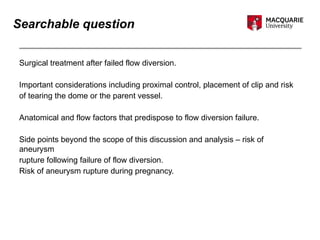
Searchable question
Surgical treatment after failed flow diversion.
Important considerations including proximal control, placement of clip and risk
of tearing the dome or the parent vessel.
Anatomical and flow factors that predispose to flow diversion failure.
Side points beyond the scope of this discussion and analysis – risk of
aneurysm
rupture following failure of flow diversion.
Risk of aneurysm rupture during pregnancy.
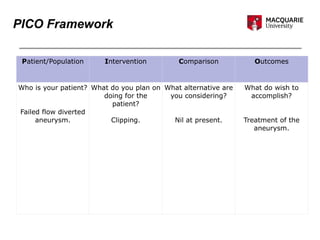
PICO Framework
Patient/Population Intervention Comparison Outcomes
Who is your patient?
Failed flow diverted
aneurysm.
What do you plan on
doing for the
patient?
Clipping.
What alternative are
you considering?
Nil at present.
What do wish to
accomplish?
Treatment of the
aneurysm.
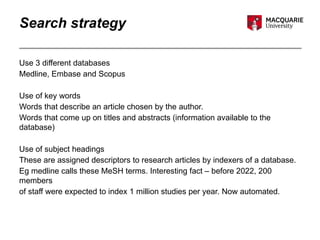
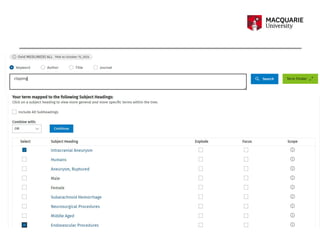
Search strategy
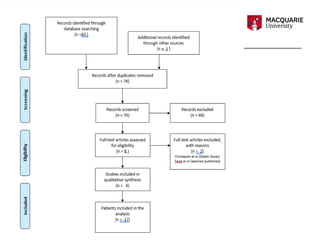
Use 3 different databases
Medline, Embase and Scopus
Use of key words
Words that describe an article chosen by the author.
Words that come up on titles and abstracts (information available to the
database)
Use of subject headings
These are assigned descriptors to research articles by indexers of a database.
Eg medline calls these MeSH terms. Interesting fact – before 2022, 200
members
of staff were expected to index 1 million studies per year. Now automated.
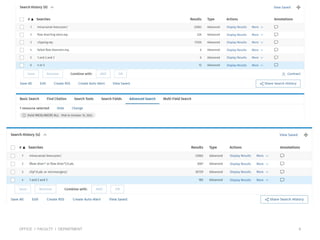
Search strategy
Use 3 different databases
Medline, Embase and Scopus
Use of key words
Words that describe an article chosen by the author.
Words that come up on titles and abstracts (information available to the
database)
Use of subject headings
These are assigned descriptors to research articles by indexers of a database.
Eg medline calls these MeSH terms. Interesting fact – before 2022, 200
members
of staff were expected to index 1 million studies per year. Now automated.
9
OFFICE I FACULTY I DEPARTMENT
10
OFFICE I FACULTY I DEPARTMENT
11
OFFICE I FACULTY I DEPARTMENT
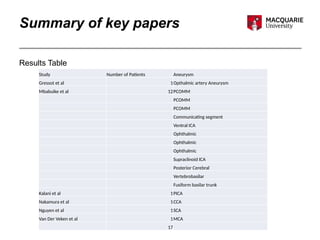
Summary of key papers
Results Table
Study Number of Patients Aneurysm
Gressot et al 1Opthalmic artery Aneurysm
Mbabuike et al 12PCOMM
PCOMM
PCOMM
Communicating segment
Ventral ICA
Ophthalmic
Ophthalmic
Ophthalmic
Supraclinoid ICA
Posterior Cerebral
Vertebrobasilar
Fusiform basilar trunk
Kalani et al 1PICA
Nakamura et al 1CCA
Nguyen et al 1SCA
Van Der Veken et al 1MCA
17
Conclusions &
recommendations
for patient
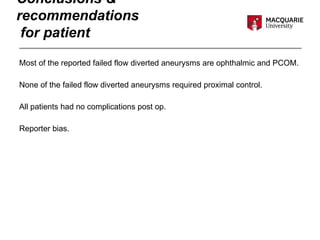
Most of the reported failed flow diverted aneurysms are ophthalmic and PCOM.
None of the failed flow diverted aneurysms required proximal control.
All patients had no complications post op.
Reporter bias.
failed flow diverted aneurysm - Evidence Based Neurosurgery

failed flow diverted aneurysm - Evidence Based Neurosurgery

  • 1.
    Evidence Based Neurosurgery UrsalanKhan 16/10/2024 Clipping of a Previously Flow Diverted PCOM Aneurysm: Evidence Based Surgery and Surgical Nuances
  • 2.
    Clinical case A 41year old woman who works as a university lecturer was investigated for headache and was found to have an incidental finding of a left sided 4.5mm PCOM aneurysm. She has no significant past medical history and is a non-smoker. Her family history is specific for her mother being treated for an unruptured intracranial aneurysm at the age of 50. Her grandmother suffered an intracerebral haemorrhage of unknown aetiology. She has expressed wishes to start a family. The aneurysm was treated at a different department after discussion at their cerebrovascular multidisciplinary team meeting with an endovascular pipeline shield flow diverting stent deployed to the distal ICA. Her post procedural course was complicated by a left retinal artery occlusion causing an inferior scotoma requiring a prolonged course of dual antiplatelets. In addition, she developed symptoms of amaurosis fugax and required re-commencement of Aspirin. On close follow up, by 3 years and 7 months the aneurysm demonstrated persistent filling via the PCOM artery.
  • 4.
    Searchable question Surgical treatmentafter failed flow diversion. Important considerations including proximal control, placement of clip and risk of tearing the dome or the parent vessel. Anatomical and flow factors that predispose to flow diversion failure. Side points beyond the scope of this discussion and analysis – risk of aneurysm rupture following failure of flow diversion. Risk of aneurysm rupture during pregnancy.
  • 5.
    PICO Framework Patient/Population InterventionComparison Outcomes Who is your patient? Failed flow diverted aneurysm. What do you plan on doing for the patient? Clipping. What alternative are you considering? Nil at present. What do wish to accomplish? Treatment of the aneurysm.
  • 6.
    Search strategy Use 3different databases Medline, Embase and Scopus Use of key words Words that describe an article chosen by the author. Words that come up on titles and abstracts (information available to the database) Use of subject headings These are assigned descriptors to research articles by indexers of a database. Eg medline calls these MeSH terms. Interesting fact – before 2022, 200 members of staff were expected to index 1 million studies per year. Now automated.
  • 7.
    Search strategy Use 3different databases Medline, Embase and Scopus Use of key words Words that describe an article chosen by the author. Words that come up on titles and abstracts (information available to the database) Use of subject headings These are assigned descriptors to research articles by indexers of a database. Eg medline calls these MeSH terms. Interesting fact – before 2022, 200 members of staff were expected to index 1 million studies per year. Now automated.
  • 9.
    9 OFFICE I FACULTYI DEPARTMENT
  • 10.
    10 OFFICE I FACULTYI DEPARTMENT
  • 11.
    11 OFFICE I FACULTYI DEPARTMENT
  • 13.
    Summary of keypapers Results Table Study Number of Patients Aneurysm Gressot et al 1Opthalmic artery Aneurysm Mbabuike et al 12PCOMM PCOMM PCOMM Communicating segment Ventral ICA Ophthalmic Ophthalmic Ophthalmic Supraclinoid ICA Posterior Cerebral Vertebrobasilar Fusiform basilar trunk Kalani et al 1PICA Nakamura et al 1CCA Nguyen et al 1SCA Van Der Veken et al 1MCA 17
  • 14.
    Conclusions & recommendations for patient Mostof the reported failed flow diverted aneurysms are ophthalmic and PCOM. None of the failed flow diverted aneurysms required proximal control. All patients had no complications post op. Reporter bias.

Editor's Notes

  • #2 Please ensure that no identifying features are included
  • #3 Please ensure that no identifying features are included
  • #8 Please ensure that no identifying features are included