ANTIMICROBIAL THERAPY AND DRUG
SENSITIVITY
CONTENTS
HISTORICAL ASPECT
PROPERTIES OF DRUGS
MECHANISM OF DRUGS
ANTIBIOTIC SENSITIVITY TESTING
HISTORICAL ASPECT
 PAUL EHRLICH(1854-1915)
 Demonstrated the antimalarial effect of methylene
blue.
 Introduced arsenical compounds for treatment of syphilis
 GERRHARD DOMAGK(1927)
 Demonstrated the antibacterial effect of
Prontosil(Sulphonamide).
 Received Nobel prize (1939) in medicine for the discovery of
sulphonamides or sulfa drugs.
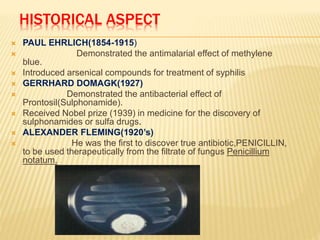
 ALEXANDER FLEMING(1920’s)
 He was the first to discover true antibiotic,PENICILLIN,
to be used therapeutically from the filtrate of fungus Penicillium
notatum.
PROPERTIES OF ANTIMICROBIAL DRUGS
A Chemotherapeutic agent must have selective toxicity: antibiotics should be
harmful to parasite but not to the host,at a concentration tolerated by host.
Depending upon the primary effects of drug it can either be bacteriostatic or
bacteriocidal.
Can be either broad or narrow spectrum.
Based on general microbial group they act against can be classified as:-
(a) Antibacterial
(b) Antifungal
(c) Antiprotozoan
(d) Antiviral
Effectiveness of chemotherapeutic agents can be obtained from either MIC or
MBC.
MECHANISM OF ACTION OF DRUGS
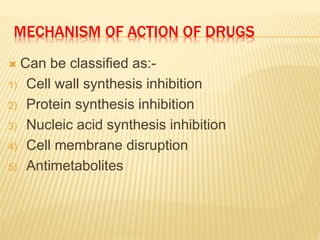
 Can be classified as:-
1) Cell wall synthesis inhibition
2) Protein synthesis inhibition
3) Nucleic acid synthesis inhibition
4) Cell membrane disruption
5) Antimetabolites
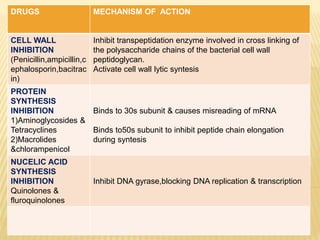
DRUGS MECHANISM OF ACTION
CELL WALL
INHIBITION
(Penicillin,ampicillin,c
ephalosporin,bacitrac
in)
Inhibit transpeptidation enzyme involved in cross linking of
the polysaccharide chains of the bacterial cell wall
peptidoglycan.
Activate cell wall lytic syntesis
PROTEIN
SYNTHESIS
INHIBITION
1)Aminoglycosides &
Tetracyclines
2)Macrolides
&chlorampenicol
Binds to 30s subunit & causes misreading of mRNA
Binds to50s subunit to inhibit peptide chain elongation
during syntesis
NUCELIC ACID
SYNTHESIS
INHIBITION
Quinolones &
fluroquinolones
Inhibit DNA gyrase,blocking DNA replication & transcription
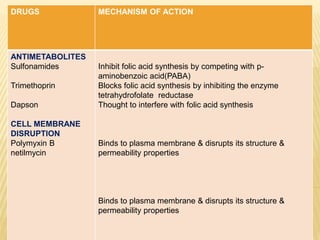
DRUGS MECHANISM OF ACTION
ANTIMETABOLITES
Sulfonamides
Trimethoprin
Dapson
CELL MEMBRANE
DISRUPTION
Polymyxin B
netilmycin
Inhibit folic acid synthesis by competing with p-
aminobenzoic acid(PABA)
Blocks folic acid synthesis by inhibiting the enzyme
tetrahydrofolate reductase
Thought to interfere with folic acid synthesis
Binds to plasma membrane & disrupts its structure &
permeability properties
Binds to plasma membrane & disrupts its structure &
permeability properties
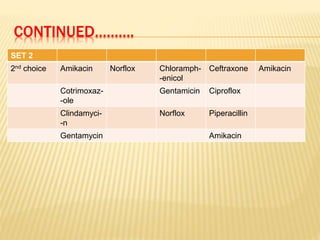
CONTINUED……….
SET 2
2nd choice Amikacin Norflox Chloramph-
-enicol
Ceftraxone Amikacin
Cotrimoxaz-
-ole
Gentamicin Ciproflox
Clindamyci-
-n
Norflox Piperacillin
Gentamycin Amikacin
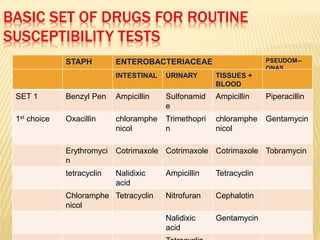
BASIC SET OF DRUGS FOR ROUTINE
SUSCEPTIBILITY TESTS
STAPH ENTEROBACTERIACEAE PSEUDOM--
ONAS
AERUGINO
SA
INTESTINAL URINARY TISSUES +
BLOOD
SET 1 Benzyl Pen Ampicillin Sulfonamid
e
Ampicillin Piperacillin
1st choice Oxacillin chloramphe
nicol
Trimethopri
n
chloramphe
nicol
Gentamycin
Erythromyci
n
Cotrimaxole Cotrimaxole Cotrimaxole Tobramycin
tetracyclin Nalidixic
acid
Ampicillin Tetracyclin
Chloramphe
nicol
Tetracyclin Nitrofuran Cephalotin
Nalidixic
acid
Gentamycin
CONTROL/STANDARD STRAINS
1. ATCC-American Type Culture Collection
Staph. aureus ATCC 25923
E.coli ATCC 25922
P. aeruginosa ATCC 27853
2. NCTC- National Collection Type Cultures
(United Kingdom) England
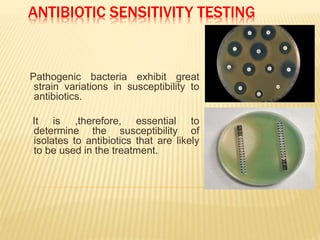
ANTIBIOTIC SENSITIVITY TESTING
Pathogenic bacteria exhibit great
strain variations in susceptibility to
antibiotics.
It is ,therefore, essential to
determine the susceptibility of
isolates to antibiotics that are likely
to be used in the treatment.
MEDIUM
 Muller hinton agar.
 pH of the medium- 7.3±0.1.
 5% sheep lysed horse blood should be
added to the medium for test with
sulphonamides and trimethoprim.
 It is also needed to support the growth of
fastidious organism eg. Hemophilus
influenzae.
ANTIBIOTIC SENSITIVITY TESTS
 1. Diffusion methods
 Kirby-bauer disc diffusion method
 Stokes disc diffusion method
 2. Dilution methods
 Broth dilution method
 Agar dilution method
DILUTION METHODS
 In this drug is allowed to diffuse through the
solid medium so that a gradient is
established
 Concentration being the highest near the site
of application of drug
 The effectiveness of drug is based on size of
inhibition zone
ZONE SIZE VARY DUE TO
a) Diffusibility of drug
b) Size of innoculum
c) Type of inhibition zone
d) Disc concentration
e) Nature & composition of medium
KIRBY-BAUER DISC DIFFUSION METHOD
1. Agar plate is inoculated by streaking the swab over the entire plate
surface.
2. Allow 3-5 minutes for surface of the agar to dry before applying the
discs.
3. Place the antimicrobial impregnated disc on the surface of the agar,
using sterile forcep.
4. After placing ,press the disc on the media surface to provide uniform
contact.
5. As soon as the dise comes in contact with moist agar surface,it
absorbs moisture from the agar & the antibiotic diffuses into the
surrounding medium.
6. The plates are then incubated at 35-370C for 16-18 hours.
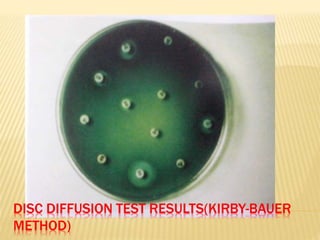
7. Visible growth of the bacteria occurs in the form of circle around the
disc.
8. By using ruler,the zone size is measured.
9. The interpretation is based on the interpretation chart.
DISC DIFFUSION TEST RESULTS(KIRBY-BAUER
METHOD)
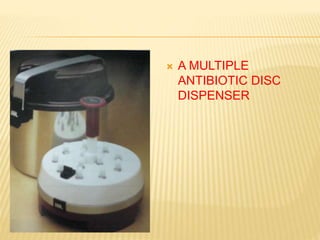
 A MULTIPLE
ANTIBIOTIC DISC
DISPENSER
STOKES DIFFUSION METHOD
1. The plate is divided into 3 parts.
2. The test organism is inoculated in the upper and lower
thirds and control on the central one third.
3. An uninoculated gap 2-3mm wide should separate the test
and control areas on which antibiotic disc are applied.
4. The plates are then incubated at 35-37OC for 16-18 hours.
5. After incubation the plates are interpreted as follows
a) Sensitive:-the zone size is equal to,larger than or not more
than 3mm smaller than the control.
b) Intermediate:-the zone size of test strain is at least
2mm,but smaller than that of the control strain
c) Resistant:-the zone of the test strain is smaller than 2mm.
DILUTION METHOD
In this serial dilutions of the drug are prepared
and inoculated with test bacterium.
They are generally employed
a)When the therapeutic dose is to be regulated
accurately.
b)For test on slow growing bacteria
c)When small degree of resistance are to be
demonstrated.
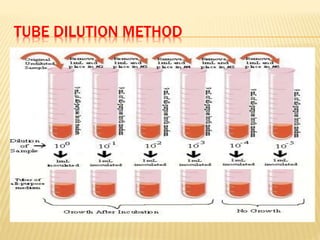
TUBE DILUTION METHOD
 Serial dilutions of the drug are prepared in the
tubes of broth and a standard concentration of
the bacterium is inoculated into each tube.
 The MIC of drug against the bacterium is
determined by noting the lowest concentration
at which the growth is inhibited.
 The MBC of the drug is the lowest concentration
of the drug that kills the test bacterium.
 It cab be estimated by subculturing from the
broth tubes that show no growth on suitable
solid media.
TUBE DILUTION METHOD
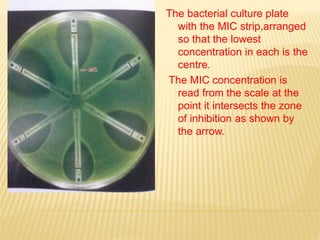
The bacterial culture plate
with the MIC strip,arranged
so that the lowest
concentration in each is the
centre.
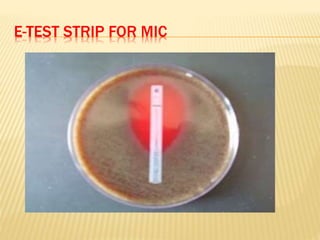
The MIC concentration is
read from the scale at the
point it intersects the zone
of inhibition as shown by
the arrow.
E-TEST STRIP FOR MIC
AGAR DILUTION METHOD
a) Serial dilutions of the drug are prepared in
agar and poured in to the plates.
b) It is more convenient when serial strains are
to be tested at the same time.
c) The advantage is that many strains can be
inoculated on each plate containing an
antibiotic dilution.
ANTIBIOTIC ASSAYS IN THE BODY FLUIDS
 These are mainly required to verify whether
in adequate drug concentration are achieved
in the blood and other body fluids, and to
guard against excessive blood levels of
potentially toxic drugs.
 The assay are generally done by making the
serial dilutions of the specimen and
inoculating standard suspensions of bacteria
of known of known MIC.
THANK YOU

Antimicrobial therapy and drug sensitivity testing

  • 1.
    ANTIMICROBIAL THERAPY ANDDRUG SENSITIVITY
  • 2.
    CONTENTS HISTORICAL ASPECT PROPERTIES OFDRUGS MECHANISM OF DRUGS ANTIBIOTIC SENSITIVITY TESTING
  • 3.
    HISTORICAL ASPECT  PAULEHRLICH(1854-1915)  Demonstrated the antimalarial effect of methylene blue.  Introduced arsenical compounds for treatment of syphilis  GERRHARD DOMAGK(1927)  Demonstrated the antibacterial effect of Prontosil(Sulphonamide).  Received Nobel prize (1939) in medicine for the discovery of sulphonamides or sulfa drugs.  ALEXANDER FLEMING(1920’s)  He was the first to discover true antibiotic,PENICILLIN, to be used therapeutically from the filtrate of fungus Penicillium notatum.
  • 4.
    PROPERTIES OF ANTIMICROBIALDRUGS A Chemotherapeutic agent must have selective toxicity: antibiotics should be harmful to parasite but not to the host,at a concentration tolerated by host. Depending upon the primary effects of drug it can either be bacteriostatic or bacteriocidal. Can be either broad or narrow spectrum. Based on general microbial group they act against can be classified as:- (a) Antibacterial (b) Antifungal (c) Antiprotozoan (d) Antiviral Effectiveness of chemotherapeutic agents can be obtained from either MIC or MBC.
  • 5.
    MECHANISM OF ACTIONOF DRUGS  Can be classified as:- 1) Cell wall synthesis inhibition 2) Protein synthesis inhibition 3) Nucleic acid synthesis inhibition 4) Cell membrane disruption 5) Antimetabolites
  • 6.
    DRUGS MECHANISM OFACTION CELL WALL INHIBITION (Penicillin,ampicillin,c ephalosporin,bacitrac in) Inhibit transpeptidation enzyme involved in cross linking of the polysaccharide chains of the bacterial cell wall peptidoglycan. Activate cell wall lytic syntesis PROTEIN SYNTHESIS INHIBITION 1)Aminoglycosides & Tetracyclines 2)Macrolides &chlorampenicol Binds to 30s subunit & causes misreading of mRNA Binds to50s subunit to inhibit peptide chain elongation during syntesis NUCELIC ACID SYNTHESIS INHIBITION Quinolones & fluroquinolones Inhibit DNA gyrase,blocking DNA replication & transcription
  • 7.
    DRUGS MECHANISM OFACTION ANTIMETABOLITES Sulfonamides Trimethoprin Dapson CELL MEMBRANE DISRUPTION Polymyxin B netilmycin Inhibit folic acid synthesis by competing with p- aminobenzoic acid(PABA) Blocks folic acid synthesis by inhibiting the enzyme tetrahydrofolate reductase Thought to interfere with folic acid synthesis Binds to plasma membrane & disrupts its structure & permeability properties Binds to plasma membrane & disrupts its structure & permeability properties
  • 8.
    CONTINUED………. SET 2 2nd choiceAmikacin Norflox Chloramph- -enicol Ceftraxone Amikacin Cotrimoxaz- -ole Gentamicin Ciproflox Clindamyci- -n Norflox Piperacillin Gentamycin Amikacin
  • 9.
    BASIC SET OFDRUGS FOR ROUTINE SUSCEPTIBILITY TESTS STAPH ENTEROBACTERIACEAE PSEUDOM-- ONAS AERUGINO SA INTESTINAL URINARY TISSUES + BLOOD SET 1 Benzyl Pen Ampicillin Sulfonamid e Ampicillin Piperacillin 1st choice Oxacillin chloramphe nicol Trimethopri n chloramphe nicol Gentamycin Erythromyci n Cotrimaxole Cotrimaxole Cotrimaxole Tobramycin tetracyclin Nalidixic acid Ampicillin Tetracyclin Chloramphe nicol Tetracyclin Nitrofuran Cephalotin Nalidixic acid Gentamycin
  • 10.
    CONTROL/STANDARD STRAINS 1. ATCC-AmericanType Culture Collection Staph. aureus ATCC 25923 E.coli ATCC 25922 P. aeruginosa ATCC 27853 2. NCTC- National Collection Type Cultures (United Kingdom) England
  • 11.
    ANTIBIOTIC SENSITIVITY TESTING Pathogenicbacteria exhibit great strain variations in susceptibility to antibiotics. It is ,therefore, essential to determine the susceptibility of isolates to antibiotics that are likely to be used in the treatment.
  • 12.
    MEDIUM  Muller hintonagar.  pH of the medium- 7.3±0.1.  5% sheep lysed horse blood should be added to the medium for test with sulphonamides and trimethoprim.  It is also needed to support the growth of fastidious organism eg. Hemophilus influenzae.
  • 13.
    ANTIBIOTIC SENSITIVITY TESTS 1. Diffusion methods  Kirby-bauer disc diffusion method  Stokes disc diffusion method  2. Dilution methods  Broth dilution method  Agar dilution method
  • 14.
    DILUTION METHODS  Inthis drug is allowed to diffuse through the solid medium so that a gradient is established  Concentration being the highest near the site of application of drug  The effectiveness of drug is based on size of inhibition zone
  • 15.
    ZONE SIZE VARYDUE TO a) Diffusibility of drug b) Size of innoculum c) Type of inhibition zone d) Disc concentration e) Nature & composition of medium
  • 16.
    KIRBY-BAUER DISC DIFFUSIONMETHOD 1. Agar plate is inoculated by streaking the swab over the entire plate surface. 2. Allow 3-5 minutes for surface of the agar to dry before applying the discs. 3. Place the antimicrobial impregnated disc on the surface of the agar, using sterile forcep. 4. After placing ,press the disc on the media surface to provide uniform contact. 5. As soon as the dise comes in contact with moist agar surface,it absorbs moisture from the agar & the antibiotic diffuses into the surrounding medium. 6. The plates are then incubated at 35-370C for 16-18 hours. 7. Visible growth of the bacteria occurs in the form of circle around the disc. 8. By using ruler,the zone size is measured. 9. The interpretation is based on the interpretation chart.
  • 17.
    DISC DIFFUSION TESTRESULTS(KIRBY-BAUER METHOD)
  • 18.
  • 19.
    STOKES DIFFUSION METHOD 1.The plate is divided into 3 parts. 2. The test organism is inoculated in the upper and lower thirds and control on the central one third. 3. An uninoculated gap 2-3mm wide should separate the test and control areas on which antibiotic disc are applied. 4. The plates are then incubated at 35-37OC for 16-18 hours. 5. After incubation the plates are interpreted as follows a) Sensitive:-the zone size is equal to,larger than or not more than 3mm smaller than the control. b) Intermediate:-the zone size of test strain is at least 2mm,but smaller than that of the control strain c) Resistant:-the zone of the test strain is smaller than 2mm.
  • 20.
    DILUTION METHOD In thisserial dilutions of the drug are prepared and inoculated with test bacterium. They are generally employed a)When the therapeutic dose is to be regulated accurately. b)For test on slow growing bacteria c)When small degree of resistance are to be demonstrated.
  • 21.
    TUBE DILUTION METHOD Serial dilutions of the drug are prepared in the tubes of broth and a standard concentration of the bacterium is inoculated into each tube.  The MIC of drug against the bacterium is determined by noting the lowest concentration at which the growth is inhibited.  The MBC of the drug is the lowest concentration of the drug that kills the test bacterium.  It cab be estimated by subculturing from the broth tubes that show no growth on suitable solid media.
  • 22.
  • 23.
    The bacterial cultureplate with the MIC strip,arranged so that the lowest concentration in each is the centre. The MIC concentration is read from the scale at the point it intersects the zone of inhibition as shown by the arrow.
  • 24.
  • 25.
    AGAR DILUTION METHOD a)Serial dilutions of the drug are prepared in agar and poured in to the plates. b) It is more convenient when serial strains are to be tested at the same time. c) The advantage is that many strains can be inoculated on each plate containing an antibiotic dilution.
  • 26.
    ANTIBIOTIC ASSAYS INTHE BODY FLUIDS  These are mainly required to verify whether in adequate drug concentration are achieved in the blood and other body fluids, and to guard against excessive blood levels of potentially toxic drugs.  The assay are generally done by making the serial dilutions of the specimen and inoculating standard suspensions of bacteria of known of known MIC.
  • 27.