1
School of Life and Health Sciences
Antimicrobial drugs
Current Antibiotics
Drugs
MOHAMMA HUSSAIN ALYAMI
STUDENT ID 109068062
2
Introduction
Antibiotic agents have been used for several years since Alexander Fleming
has observed the first antibiotic in 1928, which is called penicillin. Due to the
differences in bacteria structure, they are classified into gram-positive such as
Staphylococcus aureus, and gram-negative such as Klebsiella pneumoniae.
Nowadays, adequate of antibiotics are prescribed with a variety in efficacy,
potency, efficient and specificity. Unfortunately, misuse and inappropriate us
of those agents has driven to increase the bacteria resistance mechanism
(Range & et al, 2012; Katzung, 2009).
In this report, different classes of antibiotics, which are being marketed, will be
presented, according to the pharmacological activity and site of action.
1. Antibiotics that act on the bacteria cell wall synthesis
Beta-lactams and glycopeptides agents are examples of the antibiotics, which
act through inhibition the activity of transpeptidation enzyme. Thus,
peptidoglycan synthesis process will be inhibited which lead to bacteria cell
wall lysis and then bacteria death (Bryskier, 2005).
1.1Penicillins (Beta-lactam)
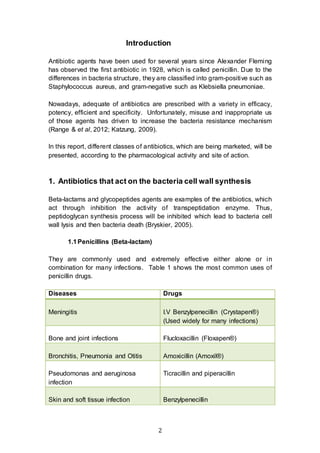
They are commonly used and extremely effective either alone or in
combination for many infections. Table 1 shows the most common uses of
penicillin drugs.
Diseases Drugs
Meningitis I.V Benzylpenecillin (Crystapen®)
(Used widely for many infections)
Bone and joint infections Flucloxacillin (Floxapen®)
Bronchitis, Pneumonia and Otitis Amoxicillin (Amoxil®)
Pseudomonas and aeruginosa
infection
Ticracillin and piperacillin
Skin and soft tissue infection Benzylpenecillin
3
(Table1: Adopted from Range & et al, 2012)
Nevertheless, bacteria produce Beta-lactamase enzyme to resist the activity
of those agents, such as Methicillin-resistant staphylococcus aureus (MRSA).
Accordingly, B-lactamases inhibitors have been used in order to extend
antibiotics agents’ activity (Bryskier, 2005).
 List of Beta-lactamase inhibitors that are conjugated with penicillin
agents:
 Glavulanic acid with penicillin. (Augmentin®)
 Sulbactam with Ampicillin. (Unasyn®)
 Tazobactam with Pipercillin. (Zosyn®)
 Brobactam with Pivampicillin. (Piptazin ®)
 Ticracillin with Glavulanic acid (Timentin®)
(Rotschafer, 1995; Bryskier, 2005; & Netdoctor website, 2011)
1.2Cephalosporins M5
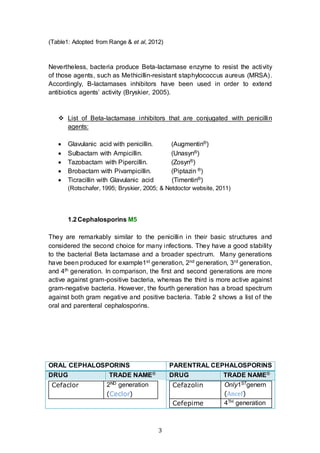
They are remarkably similar to the penicillin in their basic structures and
considered the second choice for many infections. They have a good stability
to the bacterial Beta lactamase and a broader spectrum. Many generations
have been produced for example1st generation, 2nd generation, 3rd generation,
and 4th generation. In comparison, the first and second generations are more
active against gram-positive bacteria, whereas the third is more active against
gram-negative bacteria. However, the fourth generation has a broad spectrum
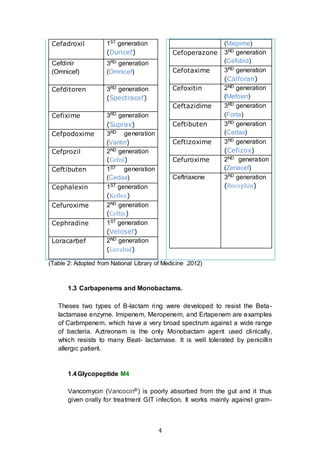
against both gram negative and positive bacteria. Table 2 shows a list of the
oral and parenteral cephalosporins.
ORAL CEPHALOSPORINS PARENTRAL CEPHALOSPORINS
DRUG TRADE NAME® DRUG TRADE NAME®
Cefaclor 2ND generation
(Ceclor)
Cefazolin Only1STgenern
(Ancef)
Cefepime 4TH generation
4
Cefadroxil 1ST generation
(Duricef)
Cefdinir
(Omnicef)
3RD generation
(Omnicef)
Cefditoren 3RD generation
(Spectracef)
Cefixime 3RD generation
(Suprax)
Cefpodoxime 3RD generation
(Vantin)
Cefprozil 2ND generation
(Cefzil)
Ceftibuten 1ST generation
(Cedax)
Cephalexin 1ST generation
(Keflex)
Cefuroxime 2ND generation
(Ceftin)
Cephradine 1ST generation
(Velosef)
Loracarbef 2ND generation
(Lorabid)
(Mxipime)
Cefoperazone 3RD generation
(Cefobid)
Cefotaxime 3RD generation
(Calforan)
Cefoxitin 2ND generation
(Mefoxin)
Ceftazidime 3RD generation
(Forta)
Ceftibuten 3RD generation
(Cedax)
Ceftizoxime 3RD generation
(Cefizox)
Cefuroxime 2ND generation
(Zenacef)
Ceftriaxone 3RD generation
(Rocephin)
(Table 2: Adopted from National Library of Medicine .2012)
1.3 Carbapenems and Monobactams.
Theses two types of B-lactam ring were developed to resist the Beta-
lactamase enzyme. Imipenem, Meropenem, and Ertapenem are examples
of Carbmpenem, which have a very broad spectrum against a wide range
of bacteria. Aztreonam is the only Monobactam agent used clinically,
which resists to many Beat- lactamase. It is well tolerated by penicillin
allergic patient.
1.4Glycopeptide M4
Vancomycin (Vancocin®) is poorly absorbed from the gut and it thus
given orally for treatment GIT infection. It works mainly against gram-
5
positive bacteria and MRSA. Daptomycin is a lipopeptide antibacterial
and used in combination for MRSA.
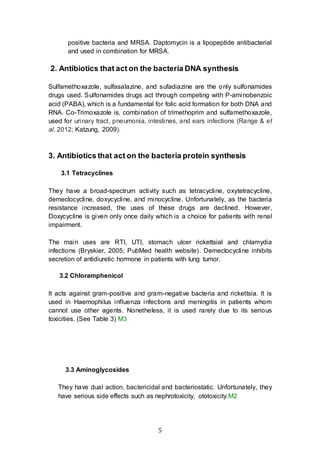
2. Antibiotics that act on the bacteria DNA synthesis
Sulfamethoxazole, sulfasalazine, and sufadiazine are the only sulfonamides
drugs used. Sulfonamides drugs act through competing with P-aminobenzoic
acid (PABA), which is a fundamental for folic acid formation for both DNA and
RNA. Co-Trimoxazole is, combination of trimethoprim and sulfamethoxazole,
used for urinary tract, pneumonia, intestines, and ears infections (Range & et
al, 2012; Katzung, 2009).
3. Antibiotics that act on the bacteria protein synthesis
3.1 Tetracyclines
They have a broad-spectrum activity such as tetracycline, oxytetracycline,
demeclocycline, doxycycline, and minocycline. Unfortunately, as the bacteria
resistance increased, the uses of these drugs are declined. However,
Doxycycline is given only once daily which is a choice for patients with renal
impairment.
The main uses are RTI, UTI, stomach ulcer rickettsial and chlamydia
infections (Bryskier, 2005; PubMed health website). Demeclocycline inhibits
secretion of antidiuretic hormone in patients with lung tumor.
3.2 Chloramphenicol
It acts against gram-positive and gram-negative bacteria and rickettsia. It is
used in Haemophilus influenza infections and meningitis in patients whom
cannot use other agents. Nonetheless, it is used rarely due to its serious
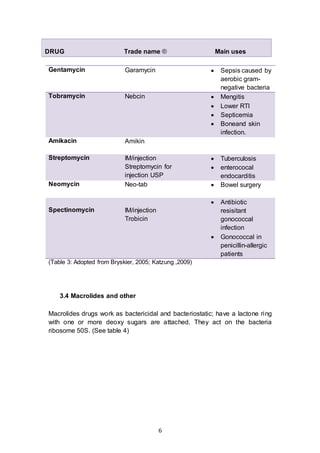
toxicities. (See Table 3) M3
3.3 Aminoglycosides
They have dual action, bactericidal and bacteriostatic. Unfortunately, they
have serious side effects such as nephrotoxicity, ototoxicity.M2
6
Gentamycin Garamycin  Sepsis caused by
aerobic gram-
negative bacteria
Tobramycin Nebcin  Mengitis
 Lower RTI
 Septicemia
 Boneand skin
infection.
Amikacin Amikin
Streptomycin IM/injection
Streptomycin for
injection USP
 Tuberculosis
 enterococal
endocarditis
Neomycin Neo-tab  Bowel surgery
Spectinomycin IM/injection
Trobicin
 Antibiotic
resisitant
gonococcal
infection
 Gonococcal in
penicillin-allergic
patients
(Table 3: Adopted from Bryskier, 2005; Katzung ,2009)
3.4 Macrolides and other
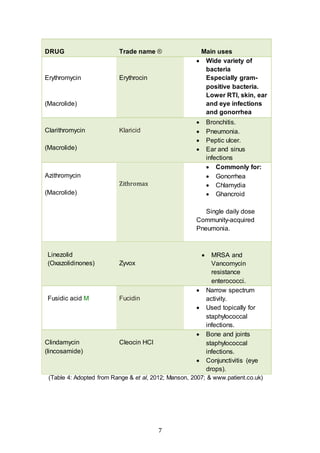
Macrolides drugs work as bactericidal and bacteriostatic; have a lactone ring
with one or more deoxy sugars are attached. They act on the bacteria
ribosome 50S. (See table 4)
DRUG Trade name ® Main uses
7
(Table 4: Adopted from Range & et al, 2012; Manson, 2007; & www.patient.co.uk)
DRUG Trade name ® Main uses
Erythromycin
(Macrolide)
Erythrocin
 Wide variety of
bacteria
Especially gram-
positive bacteria.
Lower RTI, skin, ear
and eye infections
and gonorrhea
Clarithromycin
(Macrolide)
Klaricid
 Bronchitis.
 Pneumonia.
 Peptic ulcer.
 Ear and sinus
infections
Azithromycin
(Macrolide)
Zithromax
 Commonly for:
 Gonorrhea
 Chlamydia
 Ghancroid
Single daily dose
Community-acquired
Pneumonia.
Linezolid
(Oxazolidinones) Zyvox
 MRSA and
Vancomycin
resistance
enterococci.
Fusidic acid M Fucidin
 Narrow spectrum
activity.
 Used topically for
staphylococcal
infections.
Clindamycin
(lincosamide)
Cleocin HCl
 Bone and joints
staphylococcal
infections.
 Conjunctivitis (eye
drops).
8
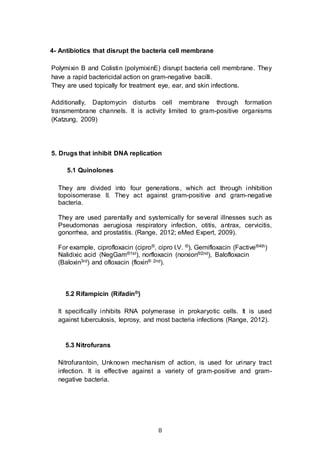
4- Antibiotics that disrupt the bacteria cell membrane
Polymixin B and Colistin (polymixinE) disrupt bacteria cell membrane. They
have a rapid bactericidal action on gram-negative bacilli.
They are used topically for treatment eye, ear, and skin infections.
Additionally, Daptomycin disturbs cell membrane through formation
transmembrane channels. It is activity limited to gram-positive organisms
(Katzung, 2009)
5. Drugs that inhibit DNA replication
5.1 Quinolones
They are divided into four generations, which act through inhibition
topoisomerase II. They act against gram-positive and gram-negative
bacteria.
They are used parentally and systemically for several illnesses such as
Pseudomonas aerugiosa respiratory infection, otitis, antrax, cervicitis,
gonorrhea, and prostatitis. (Range, 2012; eMed Expert, 2009).
For example, ciprofloxacin (cipro®, cipro I.V. ®), Gemifloxacin (Factive®4th)
Nalidixic acid (NegGam®1st), norfloxacin (norxion®2nd), Balofloxacin
(Baloxin3rd) and ofloxacin (floxin® 2nd).
5.2 Rifampicin (Rifadin®)
It specifically inhibits RNA polymerase in prokaryotic cells. It is used
against tuberculosis, leprosy, and most bacteria infections (Range, 2012).
5.3 Nitrofurans
Nitrofurantoin, Unknown mechanism of action, is used for urinary tract
infection. It is effective against a variety of gram-positive and gram-
negative bacteria.
9
New possible target or drug classes
Recently, new approaches are being conducted to create either new classes
of antibacterial agents or targets, for instance, Inhibition of bacteria virulence
factor have been significantly important due to two reasons; the specify of the
developed antibiotics and the targeted virulence factor is essential for bacteria
lifecycle.
Moreover, inhibition of adhesion and colonization (Virstatin, salicylidene
acylhydrazides), regulatory bacterial function (Antibodies), and inhibition of
the cell surface protein secretion (A salicylsulfamoyl adenosine) and, inhibition
bacteria cell wall resistance (Escaich, 2008). Additionally, new generation of
cephalosporins called Fifth generation as Ceftaroline (was approved oct.2010)
(Beckwith, 2011).
Recommendations
factor have been significantly important due to two reasons; the specify of the
developed antibiotics and the targeted virulence factor is essential for bacteria
lifecycle
10
References
Allen, H.2010.Patient.co.uk: Topical Fusidic acid. [Online] available at<
http://www.patient.co.uk/medicine/Fusidic-Acid.htm>[Accessed 03/11/2012].
*Beckwith, M.C., 2011. New Drug Bulletin: Ceftaroline Fosamil (TeflaroTM –
Forest Pharmaceuticals). [Online] available at<
http://healthcare.utah.edu/pharmacy/bulletins/NDB_219.pdf >. [Accessed
03/11/2012].
*Bryskier, A. 2005. Antimicrobial Agents: Antibacterials and Antifungals:Beta-
lactamase inhibitors:pencillins.2nd
ed. Washington, DC, USA : ASM Press.
[Online] available at
http://site.ebrary.com/lib/aston/docDetail.action?docID=10365032 [Accessed
3/11/2012].
Cunha, J.P., 2010. Rxlist the drug Internet Index website. Cleocin:
Clindamycin Side Effects Center. . [ Online] available at <
http://www.rxlist.com/clindamycin-side-effects-drug-center.htm>.
[Accessed 03/11/2012]
*Escaich, S. 2008. Antivirulence as a new antibacterial approach for
chemotherap. Current Opinion in Chemical Biology, Vol12, iss 4, august
2008,pp 400-408. [Online] available at
http://www.sciencedirect.com/science/article/pii/S1367593108001087.
[Accessed 3/11/2012].
*Katzung,B.G., Masters. S.B& Trevor.A.J, 2009. Basic and clinical
pharmacology, 11th ed. USA: THE McGraw companies Inc.
MedicineNet.com website. 2012. Gentamicin - injection, Garamycin. [Online]
available at< http://www.medicinenet.com/gentamicin-injection/article.htm >
[Accessed 03/11/2012].
Medline plus 2012. Co-trimoxazole Oral. [Online] available at
http://www.fpnotebook.com/id/pharm/Cphlsprn.htm . [Accessed 3/11/2012].
11
Monson, K. 2007.EMEDTV: What Is Azithromycin Used For?. [Online]
available at< http://bacteria.emedtv.com/azithromycin/what-is-azithromycin-
used-for.html>.[Accessed 03/11/2012].
Ntional Library of Medicine website .2012. Cephalosporins. [Online] availabl at
http://livertox.nih.gov/Cephalosporins.htm. [Accessed 03/11/2012].
Netdoctor website, 2011. Erythrocin (Erythromycin) / Clarithromycin. [Online]
available at <http://www.netdoctor.co.uk/sex-and
relationships/medicines/erythrocin.html>.[Accessed 03/11/2012].
Netdoctor website .2011. Timentin (ticarcillin, clavulanic acid). [Online]
available at<http://www.netdoctor.co.uk/infections/medicines/timentin.html>.
[Accessed 03/11/2012].
PubMed Health, 2010. Tetracycline: What is this medication
prescribed?.[Online] available at
http://www.ncbi.nlm.nih.gov/pubmedhealth/PMH0000576/.[Accessed
3/11/2012].
Range, H.P., Dale, J.M.,Flower.R.J.,& Henderson, G.(2012).Range and
Dale’s Pharmacology. UK. British library cataloguing in publication data.
Rotschafer,J.C. & Ostergaard, B.E. 1995. Combination beta-lactam and beta-
lactamase-inhibitor products: antimicrobial activity and efficiency of enzyme
inhibition. American Journal of Health-system Pharmacy. [Online] available at
<http://www.ajhp.org/content/52/suppl_2/S15>. [Accessed 3/11/2012].
Wise, R.,OSullivan, N., Jhonson, J.& Andrews, JM.(1992). Pharmacokinetics
and tissue penetration of ampicillin and brobactam following oral
administration of 2085P. Antimicrob Agents Chemother. 1992 May; iss 36(5):
pp.1002–1004.[Online] available at
http://www.ncbi.nlm.nih.gov/pmc/articles/PMC188825/. [Accessed 3/11/2012].

Antimicrobial drugs

  • 1.
    1 School of Lifeand Health Sciences Antimicrobial drugs Current Antibiotics Drugs MOHAMMA HUSSAIN ALYAMI STUDENT ID 109068062
  • 2.
    2 Introduction Antibiotic agents havebeen used for several years since Alexander Fleming has observed the first antibiotic in 1928, which is called penicillin. Due to the differences in bacteria structure, they are classified into gram-positive such as Staphylococcus aureus, and gram-negative such as Klebsiella pneumoniae. Nowadays, adequate of antibiotics are prescribed with a variety in efficacy, potency, efficient and specificity. Unfortunately, misuse and inappropriate us of those agents has driven to increase the bacteria resistance mechanism (Range & et al, 2012; Katzung, 2009). In this report, different classes of antibiotics, which are being marketed, will be presented, according to the pharmacological activity and site of action. 1. Antibiotics that act on the bacteria cell wall synthesis Beta-lactams and glycopeptides agents are examples of the antibiotics, which act through inhibition the activity of transpeptidation enzyme. Thus, peptidoglycan synthesis process will be inhibited which lead to bacteria cell wall lysis and then bacteria death (Bryskier, 2005). 1.1Penicillins (Beta-lactam) They are commonly used and extremely effective either alone or in combination for many infections. Table 1 shows the most common uses of penicillin drugs. Diseases Drugs Meningitis I.V Benzylpenecillin (Crystapen®) (Used widely for many infections) Bone and joint infections Flucloxacillin (Floxapen®) Bronchitis, Pneumonia and Otitis Amoxicillin (Amoxil®) Pseudomonas and aeruginosa infection Ticracillin and piperacillin Skin and soft tissue infection Benzylpenecillin
  • 3.
    3 (Table1: Adopted fromRange & et al, 2012) Nevertheless, bacteria produce Beta-lactamase enzyme to resist the activity of those agents, such as Methicillin-resistant staphylococcus aureus (MRSA). Accordingly, B-lactamases inhibitors have been used in order to extend antibiotics agents’ activity (Bryskier, 2005).  List of Beta-lactamase inhibitors that are conjugated with penicillin agents:  Glavulanic acid with penicillin. (Augmentin®)  Sulbactam with Ampicillin. (Unasyn®)  Tazobactam with Pipercillin. (Zosyn®)  Brobactam with Pivampicillin. (Piptazin ®)  Ticracillin with Glavulanic acid (Timentin®) (Rotschafer, 1995; Bryskier, 2005; & Netdoctor website, 2011) 1.2Cephalosporins M5 They are remarkably similar to the penicillin in their basic structures and considered the second choice for many infections. They have a good stability to the bacterial Beta lactamase and a broader spectrum. Many generations have been produced for example1st generation, 2nd generation, 3rd generation, and 4th generation. In comparison, the first and second generations are more active against gram-positive bacteria, whereas the third is more active against gram-negative bacteria. However, the fourth generation has a broad spectrum against both gram negative and positive bacteria. Table 2 shows a list of the oral and parenteral cephalosporins. ORAL CEPHALOSPORINS PARENTRAL CEPHALOSPORINS DRUG TRADE NAME® DRUG TRADE NAME® Cefaclor 2ND generation (Ceclor) Cefazolin Only1STgenern (Ancef) Cefepime 4TH generation
  • 4.
    4 Cefadroxil 1ST generation (Duricef) Cefdinir (Omnicef) 3RDgeneration (Omnicef) Cefditoren 3RD generation (Spectracef) Cefixime 3RD generation (Suprax) Cefpodoxime 3RD generation (Vantin) Cefprozil 2ND generation (Cefzil) Ceftibuten 1ST generation (Cedax) Cephalexin 1ST generation (Keflex) Cefuroxime 2ND generation (Ceftin) Cephradine 1ST generation (Velosef) Loracarbef 2ND generation (Lorabid) (Mxipime) Cefoperazone 3RD generation (Cefobid) Cefotaxime 3RD generation (Calforan) Cefoxitin 2ND generation (Mefoxin) Ceftazidime 3RD generation (Forta) Ceftibuten 3RD generation (Cedax) Ceftizoxime 3RD generation (Cefizox) Cefuroxime 2ND generation (Zenacef) Ceftriaxone 3RD generation (Rocephin) (Table 2: Adopted from National Library of Medicine .2012) 1.3 Carbapenems and Monobactams. Theses two types of B-lactam ring were developed to resist the Beta- lactamase enzyme. Imipenem, Meropenem, and Ertapenem are examples of Carbmpenem, which have a very broad spectrum against a wide range of bacteria. Aztreonam is the only Monobactam agent used clinically, which resists to many Beat- lactamase. It is well tolerated by penicillin allergic patient. 1.4Glycopeptide M4 Vancomycin (Vancocin®) is poorly absorbed from the gut and it thus given orally for treatment GIT infection. It works mainly against gram-
  • 5.
    5 positive bacteria andMRSA. Daptomycin is a lipopeptide antibacterial and used in combination for MRSA. 2. Antibiotics that act on the bacteria DNA synthesis Sulfamethoxazole, sulfasalazine, and sufadiazine are the only sulfonamides drugs used. Sulfonamides drugs act through competing with P-aminobenzoic acid (PABA), which is a fundamental for folic acid formation for both DNA and RNA. Co-Trimoxazole is, combination of trimethoprim and sulfamethoxazole, used for urinary tract, pneumonia, intestines, and ears infections (Range & et al, 2012; Katzung, 2009). 3. Antibiotics that act on the bacteria protein synthesis 3.1 Tetracyclines They have a broad-spectrum activity such as tetracycline, oxytetracycline, demeclocycline, doxycycline, and minocycline. Unfortunately, as the bacteria resistance increased, the uses of these drugs are declined. However, Doxycycline is given only once daily which is a choice for patients with renal impairment. The main uses are RTI, UTI, stomach ulcer rickettsial and chlamydia infections (Bryskier, 2005; PubMed health website). Demeclocycline inhibits secretion of antidiuretic hormone in patients with lung tumor. 3.2 Chloramphenicol It acts against gram-positive and gram-negative bacteria and rickettsia. It is used in Haemophilus influenza infections and meningitis in patients whom cannot use other agents. Nonetheless, it is used rarely due to its serious toxicities. (See Table 3) M3 3.3 Aminoglycosides They have dual action, bactericidal and bacteriostatic. Unfortunately, they have serious side effects such as nephrotoxicity, ototoxicity.M2
  • 6.
    6 Gentamycin Garamycin Sepsis caused by aerobic gram- negative bacteria Tobramycin Nebcin  Mengitis  Lower RTI  Septicemia  Boneand skin infection. Amikacin Amikin Streptomycin IM/injection Streptomycin for injection USP  Tuberculosis  enterococal endocarditis Neomycin Neo-tab  Bowel surgery Spectinomycin IM/injection Trobicin  Antibiotic resisitant gonococcal infection  Gonococcal in penicillin-allergic patients (Table 3: Adopted from Bryskier, 2005; Katzung ,2009) 3.4 Macrolides and other Macrolides drugs work as bactericidal and bacteriostatic; have a lactone ring with one or more deoxy sugars are attached. They act on the bacteria ribosome 50S. (See table 4) DRUG Trade name ® Main uses
  • 7.
    7 (Table 4: Adoptedfrom Range & et al, 2012; Manson, 2007; & www.patient.co.uk) DRUG Trade name ® Main uses Erythromycin (Macrolide) Erythrocin  Wide variety of bacteria Especially gram- positive bacteria. Lower RTI, skin, ear and eye infections and gonorrhea Clarithromycin (Macrolide) Klaricid  Bronchitis.  Pneumonia.  Peptic ulcer.  Ear and sinus infections Azithromycin (Macrolide) Zithromax  Commonly for:  Gonorrhea  Chlamydia  Ghancroid Single daily dose Community-acquired Pneumonia. Linezolid (Oxazolidinones) Zyvox  MRSA and Vancomycin resistance enterococci. Fusidic acid M Fucidin  Narrow spectrum activity.  Used topically for staphylococcal infections. Clindamycin (lincosamide) Cleocin HCl  Bone and joints staphylococcal infections.  Conjunctivitis (eye drops).
  • 8.
    8 4- Antibiotics thatdisrupt the bacteria cell membrane Polymixin B and Colistin (polymixinE) disrupt bacteria cell membrane. They have a rapid bactericidal action on gram-negative bacilli. They are used topically for treatment eye, ear, and skin infections. Additionally, Daptomycin disturbs cell membrane through formation transmembrane channels. It is activity limited to gram-positive organisms (Katzung, 2009) 5. Drugs that inhibit DNA replication 5.1 Quinolones They are divided into four generations, which act through inhibition topoisomerase II. They act against gram-positive and gram-negative bacteria. They are used parentally and systemically for several illnesses such as Pseudomonas aerugiosa respiratory infection, otitis, antrax, cervicitis, gonorrhea, and prostatitis. (Range, 2012; eMed Expert, 2009). For example, ciprofloxacin (cipro®, cipro I.V. ®), Gemifloxacin (Factive®4th) Nalidixic acid (NegGam®1st), norfloxacin (norxion®2nd), Balofloxacin (Baloxin3rd) and ofloxacin (floxin® 2nd). 5.2 Rifampicin (Rifadin®) It specifically inhibits RNA polymerase in prokaryotic cells. It is used against tuberculosis, leprosy, and most bacteria infections (Range, 2012). 5.3 Nitrofurans Nitrofurantoin, Unknown mechanism of action, is used for urinary tract infection. It is effective against a variety of gram-positive and gram- negative bacteria.
  • 9.
    9 New possible targetor drug classes Recently, new approaches are being conducted to create either new classes of antibacterial agents or targets, for instance, Inhibition of bacteria virulence factor have been significantly important due to two reasons; the specify of the developed antibiotics and the targeted virulence factor is essential for bacteria lifecycle. Moreover, inhibition of adhesion and colonization (Virstatin, salicylidene acylhydrazides), regulatory bacterial function (Antibodies), and inhibition of the cell surface protein secretion (A salicylsulfamoyl adenosine) and, inhibition bacteria cell wall resistance (Escaich, 2008). Additionally, new generation of cephalosporins called Fifth generation as Ceftaroline (was approved oct.2010) (Beckwith, 2011). Recommendations factor have been significantly important due to two reasons; the specify of the developed antibiotics and the targeted virulence factor is essential for bacteria lifecycle
  • 10.
    10 References Allen, H.2010.Patient.co.uk: TopicalFusidic acid. [Online] available at< http://www.patient.co.uk/medicine/Fusidic-Acid.htm>[Accessed 03/11/2012]. *Beckwith, M.C., 2011. New Drug Bulletin: Ceftaroline Fosamil (TeflaroTM – Forest Pharmaceuticals). [Online] available at< http://healthcare.utah.edu/pharmacy/bulletins/NDB_219.pdf >. [Accessed 03/11/2012]. *Bryskier, A. 2005. Antimicrobial Agents: Antibacterials and Antifungals:Beta- lactamase inhibitors:pencillins.2nd ed. Washington, DC, USA : ASM Press. [Online] available at http://site.ebrary.com/lib/aston/docDetail.action?docID=10365032 [Accessed 3/11/2012]. Cunha, J.P., 2010. Rxlist the drug Internet Index website. Cleocin: Clindamycin Side Effects Center. . [ Online] available at < http://www.rxlist.com/clindamycin-side-effects-drug-center.htm>. [Accessed 03/11/2012] *Escaich, S. 2008. Antivirulence as a new antibacterial approach for chemotherap. Current Opinion in Chemical Biology, Vol12, iss 4, august 2008,pp 400-408. [Online] available at http://www.sciencedirect.com/science/article/pii/S1367593108001087. [Accessed 3/11/2012]. *Katzung,B.G., Masters. S.B& Trevor.A.J, 2009. Basic and clinical pharmacology, 11th ed. USA: THE McGraw companies Inc. MedicineNet.com website. 2012. Gentamicin - injection, Garamycin. [Online] available at< http://www.medicinenet.com/gentamicin-injection/article.htm > [Accessed 03/11/2012]. Medline plus 2012. Co-trimoxazole Oral. [Online] available at http://www.fpnotebook.com/id/pharm/Cphlsprn.htm . [Accessed 3/11/2012].
  • 11.
    11 Monson, K. 2007.EMEDTV:What Is Azithromycin Used For?. [Online] available at< http://bacteria.emedtv.com/azithromycin/what-is-azithromycin- used-for.html>.[Accessed 03/11/2012]. Ntional Library of Medicine website .2012. Cephalosporins. [Online] availabl at http://livertox.nih.gov/Cephalosporins.htm. [Accessed 03/11/2012]. Netdoctor website, 2011. Erythrocin (Erythromycin) / Clarithromycin. [Online] available at <http://www.netdoctor.co.uk/sex-and relationships/medicines/erythrocin.html>.[Accessed 03/11/2012]. Netdoctor website .2011. Timentin (ticarcillin, clavulanic acid). [Online] available at<http://www.netdoctor.co.uk/infections/medicines/timentin.html>. [Accessed 03/11/2012]. PubMed Health, 2010. Tetracycline: What is this medication prescribed?.[Online] available at http://www.ncbi.nlm.nih.gov/pubmedhealth/PMH0000576/.[Accessed 3/11/2012]. Range, H.P., Dale, J.M.,Flower.R.J.,& Henderson, G.(2012).Range and Dale’s Pharmacology. UK. British library cataloguing in publication data. Rotschafer,J.C. & Ostergaard, B.E. 1995. Combination beta-lactam and beta- lactamase-inhibitor products: antimicrobial activity and efficiency of enzyme inhibition. American Journal of Health-system Pharmacy. [Online] available at <http://www.ajhp.org/content/52/suppl_2/S15>. [Accessed 3/11/2012]. Wise, R.,OSullivan, N., Jhonson, J.& Andrews, JM.(1992). Pharmacokinetics and tissue penetration of ampicillin and brobactam following oral administration of 2085P. Antimicrob Agents Chemother. 1992 May; iss 36(5): pp.1002–1004.[Online] available at http://www.ncbi.nlm.nih.gov/pmc/articles/PMC188825/. [Accessed 3/11/2012].