Chemotherapy
MR RODNEY KAWIMBE
Introduction
 Antimicrobial drugs are effective in the treatment of infections because of
their selective toxicity.
 They have the ability to kill or inhibit growth of invading microorganism
without harming the cells of the host.
 Selective toxicity is relative, requiring that the concentration of the drug
be carefully controlled to attack the microorganism while still being
tolerated by the host.
 Selective antimicrobial therapy takes advantage of the biochemical
differences that exist between microorganisms and human beings
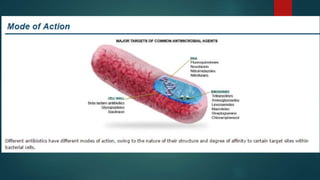
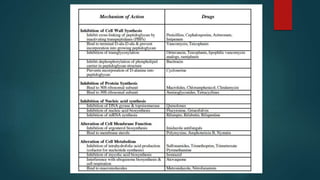
1. Inhibitors of cell wall synthesis: A drug that targets cell walls can therefore
selectively kill or inhibit bacterial organisms. Examples: penicllins, cephalosporins,
bacitracin and vancomycin.
2. Inhibitors of cell membrane function. A disruption or damage to this structure could
result in leakage of important solutes essential for the cell’s survival. Most clinical usage is
therefore limited to topical applications. Examples: polymixin B and colistin.
3. Inhibitors of protein synthesis. Several types of antibacterial agents target bacterial
protein synthesis by binding to either the 30S or 50S subunits of the intracellular ribosomes.
Examples: Aminoglycosides, macrolides, lincosamides, streptogramins,
chloramphenicol, tetracyclines.
4. Inhibitors of nucleic acid synthesis: DNA and RNA are keys to the replication of all
living forms, including bacteria. Some antibiotics work by binding to components involved in
the process of DNA or RNA synthesis. Examples: quinolones, metronidazole, and
rifampin
5. Inhibitors of other metabolic processes: Other antibiotics act on selected cellular
processes essential for the survival of the bacterial pathogens. For example, both
sulfonamides and trimethoprim disrupt the folic acid pathway, which is a necessary step for
bacteria to produce precursors important for DNA synthesis. Sulfonamides target and bind
to dihydropteroate synthase, trimethophrim inhibit dihydrofolate reductase; both of these
enzymes are essential for the production of folic acid, a vitamin synthesized by bacteria, but
not humans.
Bactericidal vs Bacteriostatic
Therapy
 A commonly used distinction among antibacterial agents is that of
bactericidal vs bacteriostatic agents.
 Bactericidal drugs, which cause death and disruption of the bacterial cell,
include drugs that primarily act on the cell wall (eg, b-lactams), cell
membrane (eg, daptomycin), or bacterial DNA (eg, fluoroquinolones).
 Bacteriostatic agents inhibit bacterial replication without killing the
organism. Most bacteriostatic drugs, including sulfonamides, tetracyclines,
and macrolides, act by inhibiting protein synthesis.
Commonly used drug families
Penicillins Cephalosporins Tetracyclines
Aminoglycosides Macrolides Fluoroquinolones
Penicillins
 β-lactam antibiotics, named after the β-lactam ring that is essential to their activity
 Selectively interfere with the synthesis of the bacterial cell wall, a structure not found in
mammalian cells
 Inactive against organisms devoid of a peptidoglycan cell wall, such as protozoa,
mycoplasma, fungi, and viruses
 To be maximally effective penicillins require actively proliferating bacteria, and they have
little or no effect on bacteria that are not dividing. Action is usually bacteriocidal
 Most widely effective antibiotics
 Side effects: hypersensitivity & resistance to these drugs
Cephalosporins
 Are β-lactam antibiotics that are closely related both structurally and functionally to the
penicillins and they are also bacteriocidal.
 Cephalosporins have the same mode of action as the penicillins, but they tend to be
more resistant than the penicillins to inactivation by b-lactamases produced by some
bacteria.
 Classified as first, second and third generation, largely on the basis of bacterial
susceptibility patterns and resistance to beta-lactamases.
 In this classification system, first generation agents are primarily active against against
gram positive organisms, including methicillin sensitive staphylococcus aureus, and
have limited activity against gram-negative bacilli.
 Second generation agents have limited activity against gram-negative bacilli and
variable activity against gram-positive cocci.
 Third generation agents have significantly increased activity against gram-negative
bacilli. With some of these agents active against Pseudomonas aeruginosa
 Cefepime has been classified by some as fourth generation because of its extended
spectrum of activity against both gram positive and gram-negative organisms that
include P. aeruginosa
Tetracyclines
 A number of antibiotics including tetraclyclines, aminoglycosides, and macrolides,
exert antimicrobial effects by targeting the bacterial ribosome, which has components
that differ structurally from those of the mammalian cytoplasmic ribosomes.
 Binding of tetraclycline to the 30S subunit of the bacterial ribosome is believed to block
access of the amino acyl-tRNA to the mRNA-ribosome complex at the acceptor site,
thereby inhibiting the bacterial protein synthesis.
 Tetracyclines are broad-spectrum antibiotics (i.e many bacteria are sensitive to these
drugs)
 Tetracyclines are generally bacteriostatic
Aminoglycosides
 Inhibit bacterial protein synthesis
 Susceptible organisms have an oxygen-dependent system that transports the antibiotic
across the cell membrane
 All aminoglycosides are bacteriocidal
 They are effective only against aerobic organisms because anerobes lack the oxygen-
requiring transport system.
 Gentamicin is used to treat a variety of infectious diseases including those caused by
enterobacteriaceae and in combination with penicillin, endocarditis caused by
viridans-group streptococci.
Macrolides
 Group of antibiotics with a macrocyclic lactone structure.
 Erythromycin was the first of these to find clinical application as a drug of first choice
and as an alternative to penicillin in individuals who are allergic to Beta-lactam
antibiotics.
 Newer macrolides, such as clarithromycin and azithromycin, offer extended activity
against some organisms and less severe adverse reactions.
 The macrolides bind irreversibly to a site on the 50S subunit of the bacterial ribosome,
thereby inhibiting the translocation steps of protein synthesis.
 Bacteriostatic, they may be bactericidal at higher doses
Fluoroquinolones
 Uniquely inhibit the replication of bacterial DNA by interfering with the action of DNA
gyrase (topoisomerase II) during bacterial growth.
 Binding quinolone to both the enzyme and DNA to form a tertiary complex inhibits the
rejoining step, and thus can cause cell death by inducing cleavage of the DNA. Because
DNA gyrase is a distinct target for antimicrobial therapy, cross-resistance with other more
commonly used antimicrobial therapy is rare but is increasing with multi-drug resistant
organisms,
 All fluoroquinolones are bactericidal
Carbapenems
 Synthetic beta-lactam antibiotics that differ in structure from the penicillins
 Imipenem, meropenem, doripenem, and ertapenem are drugs of this group currently
available.
 Imipenem is compounded with cilastatin to protect it from metabolism by renal
dehydropeptidase. Imipene resists hydrolysis by by most be-lactamases. This drug plays
a key role in empiric therapy because it is active against beta-lactamase-producing gram
positive and gram negative organisms, anerobes, and P. aureginosa.
 Meropenem and doripenem have antibacterial activity similar to that of imipenem.
Ertapenem is not an alternative for P. aeruginosa coverage because strains exhibit
resistance. Ertanepenem also lacks coverage against Enterococcus species and
Acinebacter species
Other important antibacterial agents
Vancomycin
 Tricyclic glycopeptide that has become increasingly medically important because of its
effectiveness against multi-drug resistant organisms such as methicillin-resistant
staphylococci.
 Inhibits synthesis of bacterial cell wall phospholipids as well as peptidoglycan
polymerization at a site earlier than that inhibited by Beta-lactam antibiotics.
 Useful in patients with serious allergic reactions to beta-lactam antibiotics and who have
gram-positive infections.
 Used for potentially life threatening antibiotic-associated colitis caused by clostridium
difficile or staphylococci.
 To reduce vancomycin-resistant bacteria, use of this agent should be restricted to the
treatment of serious infections caused by beta-lactam resistant gram-positive
microorganisms
 Vancomycin is ineffective against gram-negative bacteria.
Trimethoprim-
sulfamethoxazole
 A combination called cotrimoxazole shows greater antimicrobial activity
than equivalent quantities of drugs used alone.
 The synergistic antimicrobial activity of cotrimoxazole results from its
inhibition of two sequential steps in the synthesis of tetrahydrofolic acid:
sulfamethoxazole inhibits incorporation of PABA into folic acid, and
trimethoprim prevents reduction of dihydrofolate to tetrahydrofolate.
 it is effective in the treatment of urinary tract infections and respiratory tract
infections as well as in Pneumocystic jirovecii pneumonia and
ampicillin and chloramphenicol resistant systemic salmonella
infections.
 It has activity versus methicillin resistant S. aureus and can be
particularly useful in the community acquired skin and soft tissue infections
caused by this organism.
Drug Resistance
 Bacteria are said to be resistant to an antimicrobial drug if the maximal level of the
agent that can be used in vivo or tolerated by the host does not halt their growth.
 Some organisms are inherently resistant to an antibiotic, for example because they lack
the target of the antimicrobial agent.
 However, microbes that are normally responsive to a particular drug may develop
resistance through spontaneous mutation or by acquisition of new genes followed by
selection.
 Some strains may even become resistant to more than one antibiotic by acquisition of
genetic elements that encode multiple resistance genes
A. Genetic alterations leading
to drug resistance
 Acquired antibiotic resistance involves mutation of existing genes or the acquisition of new
genes
1. Spontaneous mutations in DNA
Chromosomal alteration can occur by insertion, deletion, or substitution of one or more
nucleotides within the genome. The resulting mutation may persist, be corrected by the
organism, or be lethal to the cell. if the cell survives, it can replicate and transmit its mutated
properties to progeny cells. Mutations that produce antibiotic resistant strains can result in
organisms that proliferate under selective pressure such as in the presence of the antimicrobial
agent. An example is the emergence of rifampicin-resistant Mycobacteria tuberculosis when
rifampicin is used as a single antibiotic.
2. DNA transfer of Drug Resistance
Of particular clinical concern is resistance acquired due to DNA transfer from one bacterium
to another. Resistance properties are often encoded on extrachromosomal plasmids, known
as R, or resistance factors. DNA can be transferred from one cell to recipient cell by
processes including transduction (phage mediated), transformation or bacterial conjugation.
B. Altered expression of proteins
in drug-resistant organisms
Drug resistance may be mediated by several different mechanisms including
alteration in the antimicrobial drug target, decreased uptake of the drug due to
changes in membrane permeability, increased efflux of the drug, or the
presence of antibiotic inactivating enzymes
1. Modification of target sites
Alteration of an antimicrobial agent’s target site through mutation can confer
resistance to one or more related antibiotics. For example S. pneumoniae
resistance to Beta-lactam drugs involves alterations in one or more of the
major bacterial penicillin-binding proteins; resulting in decreased binding of
the antimicrobial to its target.
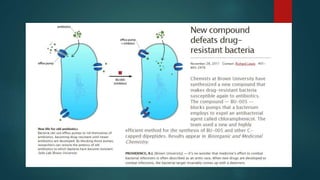
2. Decreased accumulation: Decreased uptake or increased efflux of an antimicrobial
agent can confer resistance because the drug is unable to attain access to the site of its
action in sufficient concentrations to inhibit or kill the organism.
Decreased accumulation:
Examples
1. Gram-negative bacteria can limit the penetration of certain agents,
including beta-lactams antibiotics, tetracyclines, and chloramphenical, as
a result of an alteration in the number and structure of porins (channels)
in the outer membrane.
Decreased accumulation:
Examples
 Expression of an efflux pump can limit levels of the drug that accumulate in an organism
 For example, transmembrane proteins located in the cytoplasmic membrane actively pump
intracellular antibiotic molecules out of the microorganism.
 These drug efflux pumps for xenobiotic compounds have a broad substrate specificity and
are responsible for decreased drug accumulation in multi-drug resistant cells.
 The efflux pumps may be coded on chromosomes and plasmids, thus contributing to both
intrinsic (natural) and acquired resistance, respectively.
 As an intrinsic mechanism of resistance, efflux pump genes allow bacteria expressing them to
survive a hostile environment (e.g. in the presence of antibiotics), which allows for the selection
of mutants that overexpress these genes. Being located on transmissible genetic elements as
plasmids or transposons is also advantageous for the microorganism in so far as it allows for
the spread of efflux genes between distinct species.
3. Enzymatic inactivation:
 The ability to destroy or inactivate the antimicrobial agent can also confer
resistance for microorganisms.
 Examples of antibiotic-inactivating enzymes include
1. Beta-lactamases that hydrolytically inactivate the beta-lactam ring of
penicillins, cephalosporins, and related drugs
2. Acetyltransferase that transfer an acyl group to the antibiotic,
inactivating chloramphenicol or aminoglycosides
3. Esterases that hydrolyze the lactone ring of macrolides
Agents used to treat
Viral Infections
 When viruses reproduce, they use much of the host’s own metabolic machinery.
Therefore few drugs are selective enough to prevent viral replication without injury to the
host.
 Viruses are also not affected by anti bacterial agents
 Some drugs sufficiently discriminate between cellular and viral reactions to be effective
and yet relatively non-toxic. e.g. management strategies are available for infections due
to herpes simplex virus, varicella zoster virus, cytomegalovirus, influenza A and B
viruses, and chronic hepatitis B and C and HIV.
A. Organization of viruses
 The clinically important viruses can be conveniently divided into seven
groups based on the nature of their genome, symmetry from their
organization, and the presence or absence of a lipid envelope….
 The therapeutic applications of selected antiviral agents are shown in
medical microbiology textbooks!!
B. Treatment of Herpes
Simplex Infections
 Most antiviral agents used in treating herpes virus infections are
nucleoside analogues that require conversion to mono, di, and
triphosphate forms by cellular kinases, viral kinases or both to selectively
inhibit viral DNA synthesis.
 This class of antiviral agents include acyclovir, cidofovir, famciclovir,
ganciclovir, penciclovir, valacyclovir, valganciclovir, fomivirsen and
vidarabine.
 A second class of antiviral drugs with action against herpes viruses is
represented by the pyrophosphate analogue, forscanet.
 Most antiviral agents, including nucleoside analogues and forscanet
exert their actions during the acute phase of viral infections and are
without effect in the latent phase.
C. Treatment of acquired
immunodeficiency Syndrome
 Antiretroviral drugs are divided into five main classes based on their mode
of inhibition of viral replication.
 The first class represents nucleoside analogs that inhibit the viral RNA-
dependent DNA polymerase (reverse transcriptase) of HIV.
 The second class of reverse transcriptase inhibitors includes
nonnucleoside analogs.
 The third class includes protease inhibitors
 The fourth class is a fusion inhibitor that prevent HIV from entering the
host cell.
 The fifth class, integrase inhibitors, blocks the action integrase, a viral
enzyme that inserts the viral genome into the DNA of the host cell.
Therapy with these antiretroviral agents, usually in combinations ( a “cocktail” of drugs referred
to as highly active antiretroviral therapy or HAART, is beneficial to prolong survival, to reduce the
incidence and severity of opportunistic infections in patients with advanced HIV disease ( by
allowing the partial recovery of CD4 lymphocyte populations) and to delay the disease
progression in asymptomatic HIV-infected patients.
C. Treatment of Viral Hepatitis
 Prolonged treatment (months) with interferon gamma has succeeded in
reducing or eliminating indicators of hepatitis B virus replication in about a
1/3 of patients. However, recurrence of indications of the infection may
occur after therapy cessation.
 Lamivudine, an oral nucleoside analogue, is effective in treatment in
patients with previously untreated chronic hepatitis B. However only a
minority of patients is cured or remains in remission after lamivudine
therapy is withdrawn.
 Maintenance therapy may be indicated but long term use of lamivudine is
limited by the appearance of viral polymerase gene mutants, which
leads to the re-emergence of the disease.
 The therapy of choice for Hepatitis C virus is interferon alfa in
combination with ribavirin
 The overall rate of response to this drug combination is three times greater
than seen with interferon alfa monotherapy. However, anemia is a
common side effect induced by ribavirin.
E. Treatment of Influenza
 Zanamivir and olseltamivir are effective against influenza A and B.
 They inhibit viral neuraminidase, thereby preventing the release of virus
from infected cells.
Supplementary slides
chemotherapy-181027041852-1.pdf

chemotherapy-181027041852-1.pdf

  • 1.
  • 2.
    Introduction  Antimicrobial drugsare effective in the treatment of infections because of their selective toxicity.  They have the ability to kill or inhibit growth of invading microorganism without harming the cells of the host.  Selective toxicity is relative, requiring that the concentration of the drug be carefully controlled to attack the microorganism while still being tolerated by the host.  Selective antimicrobial therapy takes advantage of the biochemical differences that exist between microorganisms and human beings
  • 5.
    1. Inhibitors ofcell wall synthesis: A drug that targets cell walls can therefore selectively kill or inhibit bacterial organisms. Examples: penicllins, cephalosporins, bacitracin and vancomycin. 2. Inhibitors of cell membrane function. A disruption or damage to this structure could result in leakage of important solutes essential for the cell’s survival. Most clinical usage is therefore limited to topical applications. Examples: polymixin B and colistin. 3. Inhibitors of protein synthesis. Several types of antibacterial agents target bacterial protein synthesis by binding to either the 30S or 50S subunits of the intracellular ribosomes. Examples: Aminoglycosides, macrolides, lincosamides, streptogramins, chloramphenicol, tetracyclines.
  • 6.
    4. Inhibitors ofnucleic acid synthesis: DNA and RNA are keys to the replication of all living forms, including bacteria. Some antibiotics work by binding to components involved in the process of DNA or RNA synthesis. Examples: quinolones, metronidazole, and rifampin 5. Inhibitors of other metabolic processes: Other antibiotics act on selected cellular processes essential for the survival of the bacterial pathogens. For example, both sulfonamides and trimethoprim disrupt the folic acid pathway, which is a necessary step for bacteria to produce precursors important for DNA synthesis. Sulfonamides target and bind to dihydropteroate synthase, trimethophrim inhibit dihydrofolate reductase; both of these enzymes are essential for the production of folic acid, a vitamin synthesized by bacteria, but not humans.
  • 7.
    Bactericidal vs Bacteriostatic Therapy A commonly used distinction among antibacterial agents is that of bactericidal vs bacteriostatic agents.  Bactericidal drugs, which cause death and disruption of the bacterial cell, include drugs that primarily act on the cell wall (eg, b-lactams), cell membrane (eg, daptomycin), or bacterial DNA (eg, fluoroquinolones).  Bacteriostatic agents inhibit bacterial replication without killing the organism. Most bacteriostatic drugs, including sulfonamides, tetracyclines, and macrolides, act by inhibiting protein synthesis.
  • 8.
    Commonly used drugfamilies Penicillins Cephalosporins Tetracyclines Aminoglycosides Macrolides Fluoroquinolones
  • 9.
    Penicillins  β-lactam antibiotics,named after the β-lactam ring that is essential to their activity  Selectively interfere with the synthesis of the bacterial cell wall, a structure not found in mammalian cells  Inactive against organisms devoid of a peptidoglycan cell wall, such as protozoa, mycoplasma, fungi, and viruses  To be maximally effective penicillins require actively proliferating bacteria, and they have little or no effect on bacteria that are not dividing. Action is usually bacteriocidal  Most widely effective antibiotics  Side effects: hypersensitivity & resistance to these drugs
  • 10.
    Cephalosporins  Are β-lactamantibiotics that are closely related both structurally and functionally to the penicillins and they are also bacteriocidal.  Cephalosporins have the same mode of action as the penicillins, but they tend to be more resistant than the penicillins to inactivation by b-lactamases produced by some bacteria.  Classified as first, second and third generation, largely on the basis of bacterial susceptibility patterns and resistance to beta-lactamases.  In this classification system, first generation agents are primarily active against against gram positive organisms, including methicillin sensitive staphylococcus aureus, and have limited activity against gram-negative bacilli.
  • 11.
     Second generationagents have limited activity against gram-negative bacilli and variable activity against gram-positive cocci.  Third generation agents have significantly increased activity against gram-negative bacilli. With some of these agents active against Pseudomonas aeruginosa  Cefepime has been classified by some as fourth generation because of its extended spectrum of activity against both gram positive and gram-negative organisms that include P. aeruginosa
  • 12.
    Tetracyclines  A numberof antibiotics including tetraclyclines, aminoglycosides, and macrolides, exert antimicrobial effects by targeting the bacterial ribosome, which has components that differ structurally from those of the mammalian cytoplasmic ribosomes.  Binding of tetraclycline to the 30S subunit of the bacterial ribosome is believed to block access of the amino acyl-tRNA to the mRNA-ribosome complex at the acceptor site, thereby inhibiting the bacterial protein synthesis.  Tetracyclines are broad-spectrum antibiotics (i.e many bacteria are sensitive to these drugs)  Tetracyclines are generally bacteriostatic
  • 13.
    Aminoglycosides  Inhibit bacterialprotein synthesis  Susceptible organisms have an oxygen-dependent system that transports the antibiotic across the cell membrane  All aminoglycosides are bacteriocidal  They are effective only against aerobic organisms because anerobes lack the oxygen- requiring transport system.  Gentamicin is used to treat a variety of infectious diseases including those caused by enterobacteriaceae and in combination with penicillin, endocarditis caused by viridans-group streptococci.
  • 14.
    Macrolides  Group ofantibiotics with a macrocyclic lactone structure.  Erythromycin was the first of these to find clinical application as a drug of first choice and as an alternative to penicillin in individuals who are allergic to Beta-lactam antibiotics.  Newer macrolides, such as clarithromycin and azithromycin, offer extended activity against some organisms and less severe adverse reactions.  The macrolides bind irreversibly to a site on the 50S subunit of the bacterial ribosome, thereby inhibiting the translocation steps of protein synthesis.  Bacteriostatic, they may be bactericidal at higher doses
  • 15.
    Fluoroquinolones  Uniquely inhibitthe replication of bacterial DNA by interfering with the action of DNA gyrase (topoisomerase II) during bacterial growth.  Binding quinolone to both the enzyme and DNA to form a tertiary complex inhibits the rejoining step, and thus can cause cell death by inducing cleavage of the DNA. Because DNA gyrase is a distinct target for antimicrobial therapy, cross-resistance with other more commonly used antimicrobial therapy is rare but is increasing with multi-drug resistant organisms,  All fluoroquinolones are bactericidal
  • 16.
    Carbapenems  Synthetic beta-lactamantibiotics that differ in structure from the penicillins  Imipenem, meropenem, doripenem, and ertapenem are drugs of this group currently available.  Imipenem is compounded with cilastatin to protect it from metabolism by renal dehydropeptidase. Imipene resists hydrolysis by by most be-lactamases. This drug plays a key role in empiric therapy because it is active against beta-lactamase-producing gram positive and gram negative organisms, anerobes, and P. aureginosa.  Meropenem and doripenem have antibacterial activity similar to that of imipenem. Ertapenem is not an alternative for P. aeruginosa coverage because strains exhibit resistance. Ertanepenem also lacks coverage against Enterococcus species and Acinebacter species
  • 17.
  • 18.
    Vancomycin  Tricyclic glycopeptidethat has become increasingly medically important because of its effectiveness against multi-drug resistant organisms such as methicillin-resistant staphylococci.  Inhibits synthesis of bacterial cell wall phospholipids as well as peptidoglycan polymerization at a site earlier than that inhibited by Beta-lactam antibiotics.  Useful in patients with serious allergic reactions to beta-lactam antibiotics and who have gram-positive infections.  Used for potentially life threatening antibiotic-associated colitis caused by clostridium difficile or staphylococci.  To reduce vancomycin-resistant bacteria, use of this agent should be restricted to the treatment of serious infections caused by beta-lactam resistant gram-positive microorganisms  Vancomycin is ineffective against gram-negative bacteria.
  • 19.
    Trimethoprim- sulfamethoxazole  A combinationcalled cotrimoxazole shows greater antimicrobial activity than equivalent quantities of drugs used alone.  The synergistic antimicrobial activity of cotrimoxazole results from its inhibition of two sequential steps in the synthesis of tetrahydrofolic acid: sulfamethoxazole inhibits incorporation of PABA into folic acid, and trimethoprim prevents reduction of dihydrofolate to tetrahydrofolate.  it is effective in the treatment of urinary tract infections and respiratory tract infections as well as in Pneumocystic jirovecii pneumonia and ampicillin and chloramphenicol resistant systemic salmonella infections.  It has activity versus methicillin resistant S. aureus and can be particularly useful in the community acquired skin and soft tissue infections caused by this organism.
  • 20.
  • 21.
     Bacteria aresaid to be resistant to an antimicrobial drug if the maximal level of the agent that can be used in vivo or tolerated by the host does not halt their growth.  Some organisms are inherently resistant to an antibiotic, for example because they lack the target of the antimicrobial agent.  However, microbes that are normally responsive to a particular drug may develop resistance through spontaneous mutation or by acquisition of new genes followed by selection.  Some strains may even become resistant to more than one antibiotic by acquisition of genetic elements that encode multiple resistance genes
  • 22.
    A. Genetic alterationsleading to drug resistance  Acquired antibiotic resistance involves mutation of existing genes or the acquisition of new genes 1. Spontaneous mutations in DNA Chromosomal alteration can occur by insertion, deletion, or substitution of one or more nucleotides within the genome. The resulting mutation may persist, be corrected by the organism, or be lethal to the cell. if the cell survives, it can replicate and transmit its mutated properties to progeny cells. Mutations that produce antibiotic resistant strains can result in organisms that proliferate under selective pressure such as in the presence of the antimicrobial agent. An example is the emergence of rifampicin-resistant Mycobacteria tuberculosis when rifampicin is used as a single antibiotic.
  • 23.
    2. DNA transferof Drug Resistance Of particular clinical concern is resistance acquired due to DNA transfer from one bacterium to another. Resistance properties are often encoded on extrachromosomal plasmids, known as R, or resistance factors. DNA can be transferred from one cell to recipient cell by processes including transduction (phage mediated), transformation or bacterial conjugation.
  • 24.
    B. Altered expressionof proteins in drug-resistant organisms Drug resistance may be mediated by several different mechanisms including alteration in the antimicrobial drug target, decreased uptake of the drug due to changes in membrane permeability, increased efflux of the drug, or the presence of antibiotic inactivating enzymes 1. Modification of target sites Alteration of an antimicrobial agent’s target site through mutation can confer resistance to one or more related antibiotics. For example S. pneumoniae resistance to Beta-lactam drugs involves alterations in one or more of the major bacterial penicillin-binding proteins; resulting in decreased binding of the antimicrobial to its target.
  • 25.
    2. Decreased accumulation:Decreased uptake or increased efflux of an antimicrobial agent can confer resistance because the drug is unable to attain access to the site of its action in sufficient concentrations to inhibit or kill the organism.
  • 27.
    Decreased accumulation: Examples 1. Gram-negativebacteria can limit the penetration of certain agents, including beta-lactams antibiotics, tetracyclines, and chloramphenical, as a result of an alteration in the number and structure of porins (channels) in the outer membrane.
  • 28.
    Decreased accumulation: Examples  Expressionof an efflux pump can limit levels of the drug that accumulate in an organism  For example, transmembrane proteins located in the cytoplasmic membrane actively pump intracellular antibiotic molecules out of the microorganism.  These drug efflux pumps for xenobiotic compounds have a broad substrate specificity and are responsible for decreased drug accumulation in multi-drug resistant cells.  The efflux pumps may be coded on chromosomes and plasmids, thus contributing to both intrinsic (natural) and acquired resistance, respectively.  As an intrinsic mechanism of resistance, efflux pump genes allow bacteria expressing them to survive a hostile environment (e.g. in the presence of antibiotics), which allows for the selection of mutants that overexpress these genes. Being located on transmissible genetic elements as plasmids or transposons is also advantageous for the microorganism in so far as it allows for the spread of efflux genes between distinct species.
  • 29.
    3. Enzymatic inactivation: The ability to destroy or inactivate the antimicrobial agent can also confer resistance for microorganisms.  Examples of antibiotic-inactivating enzymes include 1. Beta-lactamases that hydrolytically inactivate the beta-lactam ring of penicillins, cephalosporins, and related drugs 2. Acetyltransferase that transfer an acyl group to the antibiotic, inactivating chloramphenicol or aminoglycosides 3. Esterases that hydrolyze the lactone ring of macrolides
  • 30.
    Agents used totreat Viral Infections
  • 31.
     When virusesreproduce, they use much of the host’s own metabolic machinery. Therefore few drugs are selective enough to prevent viral replication without injury to the host.  Viruses are also not affected by anti bacterial agents  Some drugs sufficiently discriminate between cellular and viral reactions to be effective and yet relatively non-toxic. e.g. management strategies are available for infections due to herpes simplex virus, varicella zoster virus, cytomegalovirus, influenza A and B viruses, and chronic hepatitis B and C and HIV.
  • 32.
    A. Organization ofviruses  The clinically important viruses can be conveniently divided into seven groups based on the nature of their genome, symmetry from their organization, and the presence or absence of a lipid envelope….  The therapeutic applications of selected antiviral agents are shown in medical microbiology textbooks!!
  • 33.
    B. Treatment ofHerpes Simplex Infections  Most antiviral agents used in treating herpes virus infections are nucleoside analogues that require conversion to mono, di, and triphosphate forms by cellular kinases, viral kinases or both to selectively inhibit viral DNA synthesis.  This class of antiviral agents include acyclovir, cidofovir, famciclovir, ganciclovir, penciclovir, valacyclovir, valganciclovir, fomivirsen and vidarabine.  A second class of antiviral drugs with action against herpes viruses is represented by the pyrophosphate analogue, forscanet.  Most antiviral agents, including nucleoside analogues and forscanet exert their actions during the acute phase of viral infections and are without effect in the latent phase.
  • 34.
    C. Treatment ofacquired immunodeficiency Syndrome  Antiretroviral drugs are divided into five main classes based on their mode of inhibition of viral replication.  The first class represents nucleoside analogs that inhibit the viral RNA- dependent DNA polymerase (reverse transcriptase) of HIV.  The second class of reverse transcriptase inhibitors includes nonnucleoside analogs.  The third class includes protease inhibitors  The fourth class is a fusion inhibitor that prevent HIV from entering the host cell.  The fifth class, integrase inhibitors, blocks the action integrase, a viral enzyme that inserts the viral genome into the DNA of the host cell.
  • 35.
    Therapy with theseantiretroviral agents, usually in combinations ( a “cocktail” of drugs referred to as highly active antiretroviral therapy or HAART, is beneficial to prolong survival, to reduce the incidence and severity of opportunistic infections in patients with advanced HIV disease ( by allowing the partial recovery of CD4 lymphocyte populations) and to delay the disease progression in asymptomatic HIV-infected patients.
  • 36.
    C. Treatment ofViral Hepatitis  Prolonged treatment (months) with interferon gamma has succeeded in reducing or eliminating indicators of hepatitis B virus replication in about a 1/3 of patients. However, recurrence of indications of the infection may occur after therapy cessation.  Lamivudine, an oral nucleoside analogue, is effective in treatment in patients with previously untreated chronic hepatitis B. However only a minority of patients is cured or remains in remission after lamivudine therapy is withdrawn.  Maintenance therapy may be indicated but long term use of lamivudine is limited by the appearance of viral polymerase gene mutants, which leads to the re-emergence of the disease.
  • 37.
     The therapyof choice for Hepatitis C virus is interferon alfa in combination with ribavirin  The overall rate of response to this drug combination is three times greater than seen with interferon alfa monotherapy. However, anemia is a common side effect induced by ribavirin.
  • 38.
    E. Treatment ofInfluenza  Zanamivir and olseltamivir are effective against influenza A and B.  They inhibit viral neuraminidase, thereby preventing the release of virus from infected cells.
  • 39.