Mood Stabilizers
Mood stabilizers:
• Lithium,
• Various Anticonvulsants,
• Atypical antipsychotics.
Lithium
third element of the periodic table.
Mechanism of action:
• Not well understood, it affect various signal transduction sites beyond
neurotransmitter receptors through:
1) second messengers, such as the phosphatidyl inositol system, where
lithium inhibits the enzyme inositol monophosphatase;
2) modulation of G proteins;
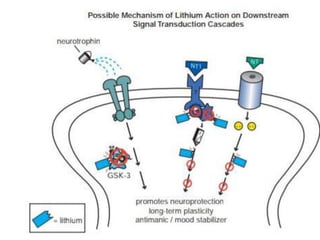
3) and most recently, regulation of gene expression for growth factors and
neuronal plasticity by interaction with downstream signal transduction
cascades, including inhibition of GSK-3 (glycogen synthase kinase 3) and
protein kinase C.
Effective in:
1.Manic episodes
2. Maintenance of recurrence, especially for manic episodes and
perhaps to a lesser extent for depressive episodes
3.Treat depressive episodes in bipolar disorder
4. As an augmenting agent to antidepressants for unipolar
depression, but is not formally approved for these uses
5.Well established to help prevent suicide in patients with mood
disorders.
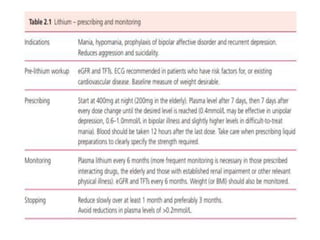
Clinical indications of lithium
1) Acute treatment of mania: plasma level of 0.8–1.0mmol/L.
•Treatment may be most successful in those without psychotic
symptoms or evidence of rapid cycling.
• It can be difficult to achieve therapeutic plasma lithium levels rapidly,
and monitoring may be problematic, an adjunctive or single-agent
antipsychotic with an evidence base for treating mania is
recommended.
• If the control of mania is inadequate, then adding a dopamine
antagonist, dopamine partial agonist or valproate is
recommended.
2) Maintenance treatment of bipolar disorder:
•Aim for the highest tolerable lithium plasma level in the range of 0.6–
0.8mmol/L.
•with the option to reduce it to 0.40–0.60mmol/L in case of good response
but poor tolerance or to increase it to 0.80–1.00mmol/L in case of
insufficient response and good tolerance.
3)Bipolar depression:
•Lithium is widely used in bipolar depression but evidence supporting
robust efficacy is lacking.
•Evidence for prevention of depressive episodes is more compelling
4) Augmentation of antidepressants in unipolar
depression especially treatment resistant
•Either lithium or quetiapine are agents of first choice for augmenting
the existing antidepressant
•Clinical predictors associated with a better outcome in lithium augmentation
for treatment-resistant depression include more severe depressive
symptomatology, psychomotor retardation, significant weight loss, a
family history of major depression and a personal experience of more
than three episodes.
5)Lithium and suicide
•Lithium reduced the risk of both attempted and completed suicide by 80% in
bipolar an In patients with unipolar depression.
6)Other uses of lithium
•used to treat aggressive and self-mutilating behaviour.
• to both prevent and treat steroid-induced psychosis
• to raise the white blood cell (WBC) count in patients receiving clozapine.
•Another potential use arises from the notion that inhibition of GSK-3 could
theoretically inhibit the phosphorylation of tau (τ) proteins and thus slow the
formation of plaques and tangles in Alzheimer’s disease
• lithium can prevent progression from mild cognitive impairment to
Alzheimer’s disease and reduce phosphorylated τ levels, especially if given
for a long period of time (> 1 year), and even at low doses.
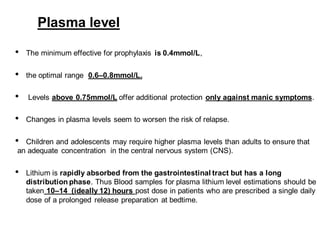
Plasma level
• The minimum effective for prophylaxis is 0.4mmol/L,
• the optimal range 0.6–0.8mmol/L.
• Levels above 0.75mmol/L offer additional protection only against manic symptoms.
• Changes in plasma levels seem to worsen the risk of relapse.
• Children and adolescents may require higher plasma levels than adults to ensure that
an adequate concentration in the central nervous system (CNS).
• Lithium is rapidly absorbed from the gastrointestinal tract but has a long
distribution phase. Thus Blood samples for plasma lithium level estimations should be
taken 10–14 (ideally 12) hours post dose in patients who are prescribed a single daily
dose of a prolonged release preparation at bedtime.
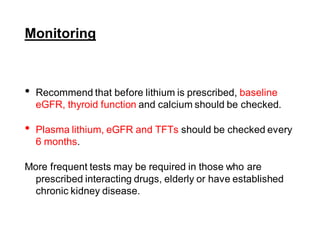
Monitoring
• Recommend that before lithium is prescribed, baseline
eGFR, thyroid function and calcium should be checked.
• Plasma lithium, eGFR and TFTs should be checked every
6 months.
More frequent tests may be required in those who are
prescribed interacting drugs, elderly or have established
chronic kidney disease.
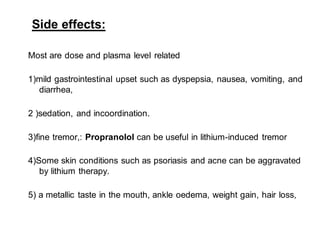
Side effects:
Most are dose and plasma level related
1)mild gastrointestinal upset such as dyspepsia, nausea, vomiting, and
diarrhea,
2 )sedation, and incoordination.
3)fine tremor,: Propranolol can be useful in lithium-induced tremor
4)Some skin conditions such as psoriasis and acne can be aggravated
by lithium therapy.
5) a metallic taste in the mouth, ankle oedema, weight gain, hair loss,
5)polyuria and polydipsia ( polyuria more in twice per ay )
• Lithium can cause a reduction in urinary concentrating capacity –
nephrogenic diabetes insipidus – hence the occurrence of thirst and
polyuria. This effect is usually reversible in the short to medium term
but renal effects may be irreversible after long-term treatment
(>15 years).
There are also long-term adverse effects upon the thyroid and kidney
6) Lead to a reduction in (GFR) although the magnitude of the risk is
uncertain.
• Lithium levels of >0.8mmol/L are associated with a higher risk of renal
toxicity,
• prolonged lithium treatment requires regular monitoring of kidney function.
7) In the longer term, lithium increases the risk of hypothyroidism in
middle-aged women, the risk may be up to 20%.
• Hypothyroidism is easily treated with thyroxine. TFTs usually
return to normal when lithium is discontinued.
8) Lithium also more rarely increases the risk of hyperthyroidism and
hyperparathyroidism, and some recommend that calcium levels
should be monitored in patients on long-term treatment
:
9) Lithium is a putative human teratogen.
• Women of child-bearing age should be advised to use a
reliable form of contraception
Because of lithium’s relatively narrow therapeutic index, pharmacokinetic interactions
with other drugs can precipitate lithium toxicity. Most clinically significant
interactions are with drugs that alter renal sodium handling e.g AE INHIBITOR,
THIAZIE, NSAIDS
Rarely as carbamazepine can cause hyponatraemia, which may in turn lead to lithium
retention and toxicity. Similarly, rare reports of CNS toxicity implicate SSRIs, another
group of drugs that can cause hyponatraemia.
Lithium toxicity
• Toxic effects reliably occur at levels >1.5mmol/L and usually
consist of gastrointestinal effects (increasing anorexia, nausea
and diarrhoea) and CNS effects (muscle weakness, drowsiness,
confusion, ataxia, course tremor and muscle twitching).
• Above 2mmol/L, increased disorientation and seizures usually
occur, which can progress to coma, and ultimately death,
• In the presence of more severe symptoms, osmotic or forced
alkaline diuresis should be used (note NEVER thiazide or loop
diuretics).
• Above 3mmol/L peritoneal or haemodialysis is often used.
• These plasma levels are only a guide, and individuals vary
in their susceptibility to symptoms of toxicity.
• Neurotoxicity at normal plasma levels has also been
described as brain lithium levels may not be reflected in
the plasma.
• Most risk factors for toxicity involve:
changes in sodium levels or the way the body handles
sodium; for example, low salt diets, dehydration, drug
interactions and some uncommon physical illnesses such
as Addison’s disease
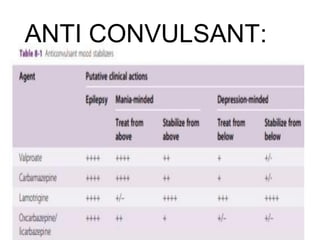
ANTI CONVULSANT:
1) Valproate
Mainly in the acute management of manic episode and also prevent recurrence of
mania
Mechanism of action:
1) Inhibiting voltage-sensitive sodium channels.
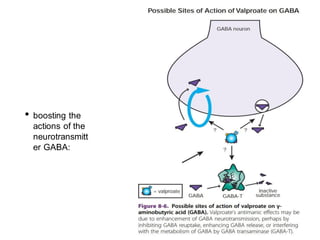
2) boosting the actions of the neurotransmitter GABA:
by increasing its release, decreasing, its reuptake, or slowing its metabolic inactivation
3) regulating downstream signal transduction cascade
4) also interact with other ion channels, such as voltage-sensitive calcium channels (VSCCs)
5) also indirectly block glutamate actions.
• boosting the
actions of the
neurotransmitt
er GABA:
• Although which of these actions may be related to mood
stabilization is not clear but it can be that they diminish
excessive neurotransmission by diminishing the flow of
ions through voltage-sensitive sodium channels (VSSCs)
If less sodium is able to pass into neurons, this may lead to
diminished release of glutamate and therefore less
excitatory neurotransmission.
• Another idea is that valproate enhances the actions of
GABA, and thus more inhibitory neurotransmission,
possibly explaining antimanic actions.
Clinical indications
1) proven effective for acute manic phase of bipolar disorder
2) is commonly used long term to prevent recurrence of mania though less
well established.
3) Antidepressant actions of valproate not shown to convincingly stabilize against
recurrent depressive episodes, but there may be some efficacy for the
depressed phase of bipolar disorder in some patients.
4))Some experts believe is more effective than lithium for rapid cycling and
mixed episodes of mania. In reality, such episodes are very difficult to treat,
and combinations of two or more mood stabilizers, including lithium plus
valproate, are usually in order..
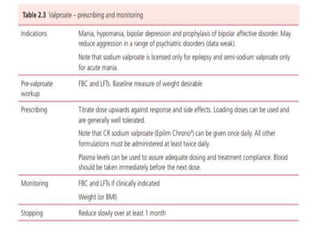
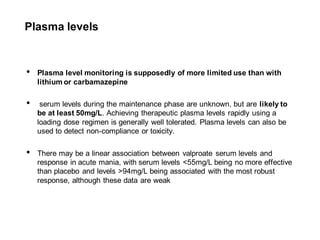
Plasma levels
• Plasma level monitoring is supposedly of more limited use than with
lithium or carbamazepine
• serum levels during the maintenance phase are unknown, but are likely to
be at least 50mg/L. Achieving therapeutic plasma levels rapidly using a
loading dose regimen is generally well tolerated. Plasma levels can also be
used to detect non-compliance or toxicity.
• There may be a linear association between valproate serum levels and
response in acute mania, with serum levels <55mg/L being no more effective
than placebo and levels >94mg/L being associated with the most robust
response, although these data are weak
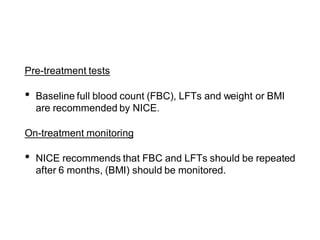
Pre-treatment tests
• Baseline full blood count (FBC), LFTs and weight or BMI
are recommended by NICE.
On-treatment monitoring
• NICE recommends that FBC and LFTs should be repeated
after 6 months, (BMI) should be monitored.
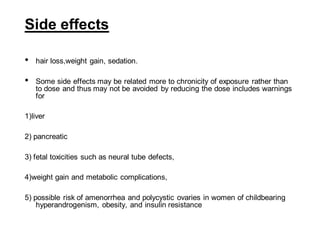
Side effects
• hair loss,weight gain, sedation.
• Some side effects may be related more to chronicity of exposure rather than
to dose and thus may not be avoided by reducing the dose includes warnings
for
1)liver
2) pancreatic
3) fetal toxicities such as neural tube defects,
4)weight gain and metabolic complications,
5) possible risk of amenorrhea and polycystic ovaries in women of childbearing
hyperandrogenism, obesity, and insulin resistance
Use in women of child-bearing age
• Valproate is an established human teratogen.
• NICE recommends that valproate should not be used to
treat bipolar illness in women of child-bearing age
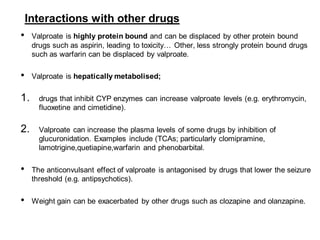
Interactions with other drugs
• Valproate is highly protein bound and can be displaced by other protein bound
drugs such as aspirin, leading to toxicity… Other, less strongly protein bound drugs
such as warfarin can be displaced by valproate.
• Valproate is hepatically metabolised;
1. drugs that inhibit CYP enzymes can increase valproate levels (e.g. erythromycin,
fluoxetine and cimetidine).
2. Valproate can increase the plasma levels of some drugs by inhibition of
glucuronidation. Examples include (TCAs; particularly clomipramine,
lamotrigine,quetiapine,warfarin and phenobarbital.
• The anticonvulsant effect of valproate is antagonised by drugs that lower the seizure
threshold (e.g. antipsychotics).
• Weight gain can be exacerbated by other drugs such as clozapine and olanzapine.
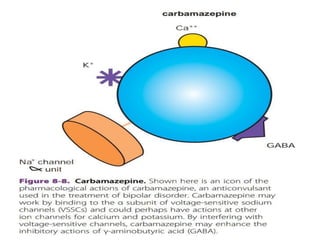
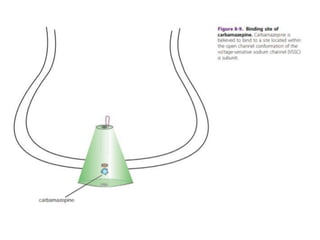
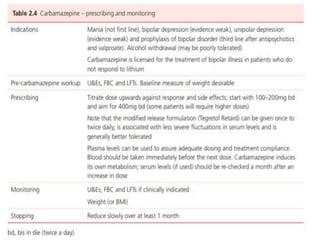
Carbamazepine:
was actually the first anticonvulsant to be shown effective in the manic
phase of bipolar disorder, but it did not receive formal FDA approval until
recently as a once-daily controlled-release formulation.
•
side-effect:
• suppressant effects upon the bone marrow, requiring initial
monitoring of bloody counts,
• sedating
• can cause fetal toxicity such as neural tube defects
• induction of the cytochrome P450 (CYP) enzyme3A4.
LAMOTRIGINE:
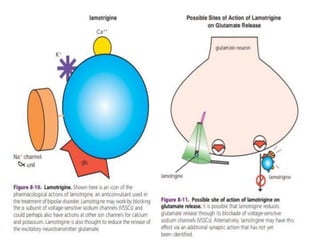
MECHANISM OF ACTION:
• Blocking sodium channels (VSSCs) activation through
binding to its open channel conformation as
carbamazepine.
• also have actions at other ion channels for calcium and
potassium.
• reduce the release of the excitatory neurotransmitter
glutamate through VSSc or to some additional
synapticaction.
Clinical indications
• moodstabilizer to prevent recurrence of both mania and
depression.
• treatment of the depressive episode MAINLY yet not well
established for the acute manic phase
• First, the FDA has not approved its use for bipolar
depression,yet most experts believe that lamotrigine is
effectivefor bipolar depression.
Given the growing concern about antidepressants inducing
mania, causing mood instability, and increasing suicidalityin
bipolar disorder, lamotrigine has largely replaced
antidepressants as a first-line recommendation in most
treatment guidelines for bipolar depression.
•AN interesting thing about lamotrigine is that it is not approved
for bipolar mania.
Perhaps
•its actions are not potent enough at sodium channels,
•or the long titration period required when starting this drug
makes it difficult to show any useful effectiveness for mania,
which generally requires drugs that can work quickly.
Main averse effect:
rashes, including (rarely) the life-threatening Stevens–
Johnson syndrome (toxic epidermal necrolysis).
Rashes caused by lamotrigine can be minimized by:
•very slow up-titration of drug during initiation of therapy,
•avoiding or managing drug interactions such as those with
valproate that raise lamotrigine levels,
Atypical antipsychotics as mood stabilizers:
For psychotic mania since the D2 antagonist actions predict
efficacy for psychosis in general.
However, surprising when proved effective for the core
nonpsychotic symptoms of mania and for maintenance treatment
to prevent the recurrence of mania.
some atypical antipsychotics are effective for bipolar depression,
namely Quitiapine
.
• Antipsychotics licensed by (FDA) for use in BD
include:
1.Aripiprazole (mania, mixed episodes, maintenance
treatment),
2.Asenapine (mania, mixed states),
3. lurasidone (depression),
4.Olanzapine (mania, mixed episodes, maintenance),
olanzapine and fluoxetine (depression),
5.Quetiapine (mania, maintenance, depression),
6.Risperidone (mania, mixed episodes)
• Risperidone long-acting injection (LAI) has been approved
for monotherapy or adjunctive maintenance,
• aripiprazole depot for monotherapy maintenance
treatment.
Most atypical antipsychotics approved for mania,
but only one for bipolar depression (quetiapine), with another one having
multiple positive clinical trials in bipolar depression (lurasidone).
Increasingly, therefore,
the treatment of bipolar disorder is not only with two or more agents, but with
one of those agents being an atypical antipsychotic

mood stabilizers.pdf 2024updated lithium

  • 1.
  • 2.
    Mood stabilizers: • Lithium, •Various Anticonvulsants, • Atypical antipsychotics.
  • 3.
    Lithium third element ofthe periodic table. Mechanism of action: • Not well understood, it affect various signal transduction sites beyond neurotransmitter receptors through: 1) second messengers, such as the phosphatidyl inositol system, where lithium inhibits the enzyme inositol monophosphatase; 2) modulation of G proteins; 3) and most recently, regulation of gene expression for growth factors and neuronal plasticity by interaction with downstream signal transduction cascades, including inhibition of GSK-3 (glycogen synthase kinase 3) and protein kinase C.
  • 5.
    Effective in: 1.Manic episodes 2.Maintenance of recurrence, especially for manic episodes and perhaps to a lesser extent for depressive episodes 3.Treat depressive episodes in bipolar disorder 4. As an augmenting agent to antidepressants for unipolar depression, but is not formally approved for these uses 5.Well established to help prevent suicide in patients with mood disorders.
  • 6.
    Clinical indications oflithium 1) Acute treatment of mania: plasma level of 0.8–1.0mmol/L. •Treatment may be most successful in those without psychotic symptoms or evidence of rapid cycling. • It can be difficult to achieve therapeutic plasma lithium levels rapidly, and monitoring may be problematic, an adjunctive or single-agent antipsychotic with an evidence base for treating mania is recommended. • If the control of mania is inadequate, then adding a dopamine antagonist, dopamine partial agonist or valproate is recommended.
  • 7.
    2) Maintenance treatmentof bipolar disorder: •Aim for the highest tolerable lithium plasma level in the range of 0.6– 0.8mmol/L. •with the option to reduce it to 0.40–0.60mmol/L in case of good response but poor tolerance or to increase it to 0.80–1.00mmol/L in case of insufficient response and good tolerance. 3)Bipolar depression: •Lithium is widely used in bipolar depression but evidence supporting robust efficacy is lacking. •Evidence for prevention of depressive episodes is more compelling
  • 8.
    4) Augmentation ofantidepressants in unipolar depression especially treatment resistant •Either lithium or quetiapine are agents of first choice for augmenting the existing antidepressant •Clinical predictors associated with a better outcome in lithium augmentation for treatment-resistant depression include more severe depressive symptomatology, psychomotor retardation, significant weight loss, a family history of major depression and a personal experience of more than three episodes.
  • 9.
    5)Lithium and suicide •Lithiumreduced the risk of both attempted and completed suicide by 80% in bipolar an In patients with unipolar depression. 6)Other uses of lithium •used to treat aggressive and self-mutilating behaviour. • to both prevent and treat steroid-induced psychosis • to raise the white blood cell (WBC) count in patients receiving clozapine. •Another potential use arises from the notion that inhibition of GSK-3 could theoretically inhibit the phosphorylation of tau (τ) proteins and thus slow the formation of plaques and tangles in Alzheimer’s disease • lithium can prevent progression from mild cognitive impairment to Alzheimer’s disease and reduce phosphorylated τ levels, especially if given for a long period of time (> 1 year), and even at low doses.
  • 11.
    Plasma level • Theminimum effective for prophylaxis is 0.4mmol/L, • the optimal range 0.6–0.8mmol/L. • Levels above 0.75mmol/L offer additional protection only against manic symptoms. • Changes in plasma levels seem to worsen the risk of relapse. • Children and adolescents may require higher plasma levels than adults to ensure that an adequate concentration in the central nervous system (CNS). • Lithium is rapidly absorbed from the gastrointestinal tract but has a long distribution phase. Thus Blood samples for plasma lithium level estimations should be taken 10–14 (ideally 12) hours post dose in patients who are prescribed a single daily dose of a prolonged release preparation at bedtime.
  • 12.
    Monitoring • Recommend thatbefore lithium is prescribed, baseline eGFR, thyroid function and calcium should be checked. • Plasma lithium, eGFR and TFTs should be checked every 6 months. More frequent tests may be required in those who are prescribed interacting drugs, elderly or have established chronic kidney disease.
  • 13.
    Side effects: Most aredose and plasma level related 1)mild gastrointestinal upset such as dyspepsia, nausea, vomiting, and diarrhea, 2 )sedation, and incoordination. 3)fine tremor,: Propranolol can be useful in lithium-induced tremor 4)Some skin conditions such as psoriasis and acne can be aggravated by lithium therapy. 5) a metallic taste in the mouth, ankle oedema, weight gain, hair loss,
  • 14.
    5)polyuria and polydipsia( polyuria more in twice per ay ) • Lithium can cause a reduction in urinary concentrating capacity – nephrogenic diabetes insipidus – hence the occurrence of thirst and polyuria. This effect is usually reversible in the short to medium term but renal effects may be irreversible after long-term treatment (>15 years). There are also long-term adverse effects upon the thyroid and kidney 6) Lead to a reduction in (GFR) although the magnitude of the risk is uncertain. • Lithium levels of >0.8mmol/L are associated with a higher risk of renal toxicity, • prolonged lithium treatment requires regular monitoring of kidney function.
  • 15.
    7) In thelonger term, lithium increases the risk of hypothyroidism in middle-aged women, the risk may be up to 20%. • Hypothyroidism is easily treated with thyroxine. TFTs usually return to normal when lithium is discontinued. 8) Lithium also more rarely increases the risk of hyperthyroidism and hyperparathyroidism, and some recommend that calcium levels should be monitored in patients on long-term treatment
  • 16.
    : 9) Lithium isa putative human teratogen. • Women of child-bearing age should be advised to use a reliable form of contraception
  • 17.
    Because of lithium’srelatively narrow therapeutic index, pharmacokinetic interactions with other drugs can precipitate lithium toxicity. Most clinically significant interactions are with drugs that alter renal sodium handling e.g AE INHIBITOR, THIAZIE, NSAIDS Rarely as carbamazepine can cause hyponatraemia, which may in turn lead to lithium retention and toxicity. Similarly, rare reports of CNS toxicity implicate SSRIs, another group of drugs that can cause hyponatraemia.
  • 18.
    Lithium toxicity • Toxiceffects reliably occur at levels >1.5mmol/L and usually consist of gastrointestinal effects (increasing anorexia, nausea and diarrhoea) and CNS effects (muscle weakness, drowsiness, confusion, ataxia, course tremor and muscle twitching). • Above 2mmol/L, increased disorientation and seizures usually occur, which can progress to coma, and ultimately death, • In the presence of more severe symptoms, osmotic or forced alkaline diuresis should be used (note NEVER thiazide or loop diuretics). • Above 3mmol/L peritoneal or haemodialysis is often used.
  • 19.
    • These plasmalevels are only a guide, and individuals vary in their susceptibility to symptoms of toxicity. • Neurotoxicity at normal plasma levels has also been described as brain lithium levels may not be reflected in the plasma. • Most risk factors for toxicity involve: changes in sodium levels or the way the body handles sodium; for example, low salt diets, dehydration, drug interactions and some uncommon physical illnesses such as Addison’s disease
  • 20.
  • 21.
    1) Valproate Mainly inthe acute management of manic episode and also prevent recurrence of mania Mechanism of action: 1) Inhibiting voltage-sensitive sodium channels. 2) boosting the actions of the neurotransmitter GABA: by increasing its release, decreasing, its reuptake, or slowing its metabolic inactivation 3) regulating downstream signal transduction cascade 4) also interact with other ion channels, such as voltage-sensitive calcium channels (VSCCs) 5) also indirectly block glutamate actions.
  • 23.
    • boosting the actionsof the neurotransmitt er GABA:
  • 24.
    • Although whichof these actions may be related to mood stabilization is not clear but it can be that they diminish excessive neurotransmission by diminishing the flow of ions through voltage-sensitive sodium channels (VSSCs) If less sodium is able to pass into neurons, this may lead to diminished release of glutamate and therefore less excitatory neurotransmission. • Another idea is that valproate enhances the actions of GABA, and thus more inhibitory neurotransmission, possibly explaining antimanic actions.
  • 25.
    Clinical indications 1) proveneffective for acute manic phase of bipolar disorder 2) is commonly used long term to prevent recurrence of mania though less well established. 3) Antidepressant actions of valproate not shown to convincingly stabilize against recurrent depressive episodes, but there may be some efficacy for the depressed phase of bipolar disorder in some patients. 4))Some experts believe is more effective than lithium for rapid cycling and mixed episodes of mania. In reality, such episodes are very difficult to treat, and combinations of two or more mood stabilizers, including lithium plus valproate, are usually in order..
  • 27.
    Plasma levels • Plasmalevel monitoring is supposedly of more limited use than with lithium or carbamazepine • serum levels during the maintenance phase are unknown, but are likely to be at least 50mg/L. Achieving therapeutic plasma levels rapidly using a loading dose regimen is generally well tolerated. Plasma levels can also be used to detect non-compliance or toxicity. • There may be a linear association between valproate serum levels and response in acute mania, with serum levels <55mg/L being no more effective than placebo and levels >94mg/L being associated with the most robust response, although these data are weak
  • 28.
    Pre-treatment tests • Baselinefull blood count (FBC), LFTs and weight or BMI are recommended by NICE. On-treatment monitoring • NICE recommends that FBC and LFTs should be repeated after 6 months, (BMI) should be monitored.
  • 29.
    Side effects • hairloss,weight gain, sedation. • Some side effects may be related more to chronicity of exposure rather than to dose and thus may not be avoided by reducing the dose includes warnings for 1)liver 2) pancreatic 3) fetal toxicities such as neural tube defects, 4)weight gain and metabolic complications, 5) possible risk of amenorrhea and polycystic ovaries in women of childbearing hyperandrogenism, obesity, and insulin resistance
  • 30.
    Use in womenof child-bearing age • Valproate is an established human teratogen. • NICE recommends that valproate should not be used to treat bipolar illness in women of child-bearing age
  • 31.
    Interactions with otherdrugs • Valproate is highly protein bound and can be displaced by other protein bound drugs such as aspirin, leading to toxicity… Other, less strongly protein bound drugs such as warfarin can be displaced by valproate. • Valproate is hepatically metabolised; 1. drugs that inhibit CYP enzymes can increase valproate levels (e.g. erythromycin, fluoxetine and cimetidine). 2. Valproate can increase the plasma levels of some drugs by inhibition of glucuronidation. Examples include (TCAs; particularly clomipramine, lamotrigine,quetiapine,warfarin and phenobarbital. • The anticonvulsant effect of valproate is antagonised by drugs that lower the seizure threshold (e.g. antipsychotics). • Weight gain can be exacerbated by other drugs such as clozapine and olanzapine.
  • 32.
    Carbamazepine: was actually thefirst anticonvulsant to be shown effective in the manic phase of bipolar disorder, but it did not receive formal FDA approval until recently as a once-daily controlled-release formulation. •
  • 36.
    side-effect: • suppressant effectsupon the bone marrow, requiring initial monitoring of bloody counts, • sedating • can cause fetal toxicity such as neural tube defects • induction of the cytochrome P450 (CYP) enzyme3A4.
  • 37.
    LAMOTRIGINE: MECHANISM OF ACTION: •Blocking sodium channels (VSSCs) activation through binding to its open channel conformation as carbamazepine. • also have actions at other ion channels for calcium and potassium. • reduce the release of the excitatory neurotransmitter glutamate through VSSc or to some additional synapticaction.
  • 39.
    Clinical indications • moodstabilizerto prevent recurrence of both mania and depression. • treatment of the depressive episode MAINLY yet not well established for the acute manic phase • First, the FDA has not approved its use for bipolar depression,yet most experts believe that lamotrigine is effectivefor bipolar depression. Given the growing concern about antidepressants inducing mania, causing mood instability, and increasing suicidalityin bipolar disorder, lamotrigine has largely replaced antidepressants as a first-line recommendation in most treatment guidelines for bipolar depression.
  • 40.
    •AN interesting thingabout lamotrigine is that it is not approved for bipolar mania. Perhaps •its actions are not potent enough at sodium channels, •or the long titration period required when starting this drug makes it difficult to show any useful effectiveness for mania, which generally requires drugs that can work quickly.
  • 41.
    Main averse effect: rashes,including (rarely) the life-threatening Stevens– Johnson syndrome (toxic epidermal necrolysis). Rashes caused by lamotrigine can be minimized by: •very slow up-titration of drug during initiation of therapy, •avoiding or managing drug interactions such as those with valproate that raise lamotrigine levels,
  • 42.
    Atypical antipsychotics asmood stabilizers: For psychotic mania since the D2 antagonist actions predict efficacy for psychosis in general. However, surprising when proved effective for the core nonpsychotic symptoms of mania and for maintenance treatment to prevent the recurrence of mania. some atypical antipsychotics are effective for bipolar depression, namely Quitiapine .
  • 43.
    • Antipsychotics licensedby (FDA) for use in BD include: 1.Aripiprazole (mania, mixed episodes, maintenance treatment), 2.Asenapine (mania, mixed states), 3. lurasidone (depression), 4.Olanzapine (mania, mixed episodes, maintenance), olanzapine and fluoxetine (depression), 5.Quetiapine (mania, maintenance, depression), 6.Risperidone (mania, mixed episodes)
  • 44.
    • Risperidone long-actinginjection (LAI) has been approved for monotherapy or adjunctive maintenance, • aripiprazole depot for monotherapy maintenance treatment.
  • 45.
    Most atypical antipsychoticsapproved for mania, but only one for bipolar depression (quetiapine), with another one having multiple positive clinical trials in bipolar depression (lurasidone). Increasingly, therefore, the treatment of bipolar disorder is not only with two or more agents, but with one of those agents being an atypical antipsychotic