ANTIDEPRESSANTS
Dr M.KARTHIGA
2ND YEAR POSTGRADUATE
M.D.PHARMACOLOGY
CONTENTS
DEPRESSION
PATHOGENESIS
ANTIDEPRESSANTS
RECENT DRUGS
CURRENT TREATMENT
GUIDELINES
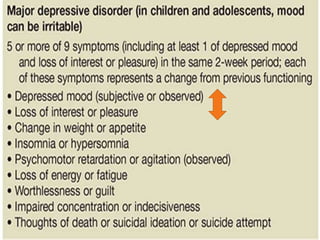
DEPRESSION
• MOOD
• Physical and cognitive symptoms
• NOT JUST BEING SAD !!!
• >15%
• TYPES
• Psychotic major depression
• Major depression with atypical feature
• Melancholic major depression
• Seasonal affective disorder
• Major depression with peripartum onset
• DISABILITY
• MORTALITY
• UNDERDIAGNOSED
• UNDERTREATED
• CO MORBID CONDITIONS
The Diagnostic and Statistical Manual of
Mental Disorders –DSM - V
PATHOGENESIS
• MONOAMINES THEORY – Noradrenaline,
Serotonin, Dopamine
• Neurotrophic Theory – Brain derived
Neurotrophic factors (BDNF)
• NMDA glutamatergic
receptors with ketamine
• Enhancing neurogenesis
• Cyclic nucleotide signaling
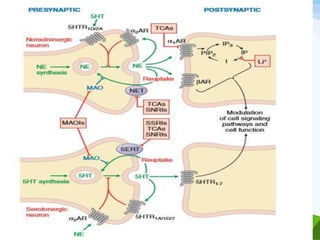
MONOAMINE THEORY
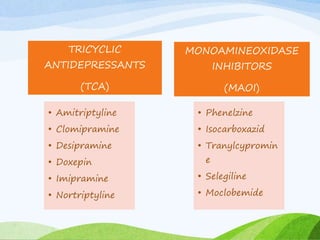
TRICYCLIC
ANTIDEPRESSANTS
(TCA)
• Amitriptyline
• Clomipramine
• Desipramine
• Doxepin
• Imipramine
• Nortriptyline
MONOAMINEOXIDASE
INHIBITORS
(MAOI)
• Phenelzine
• Isocarboxazid
• Tranylcypromin
e
• Selegiline
• Moclobemide
• Fluoxetine
• Citalopram
• Escitalopram
• Paroxetine
• Sertraline
SELECTIVE
SEROTONIN
REUPTAKE
INHIBITORS
• Duloxetine
• Venlafaxine
• Milnacipran
• Levomilnacipran
SELECTIVE
SEROTONIN AND
NORADRENALINE
REUPTAKE
INHIBITORS
• Trazodone
• Nefazodone
• Mirtazapine
• Mianserin
SEROTONIN
ANTAGONISTS
• Bupropion
• Atypical
antipsychotics
OTHERS
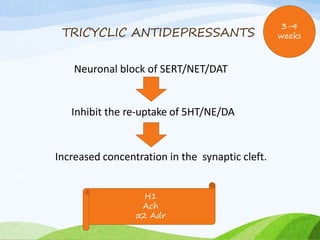
TRICYCLIC ANTIDEPRESSANTS
Neuronal block of SERT/NET/DAT
Inhibit the re-uptake of 5HT/NE/DA
Increased concentration in the synaptic cleft.

3-4
weeks
H1
Ach
α2 Adr
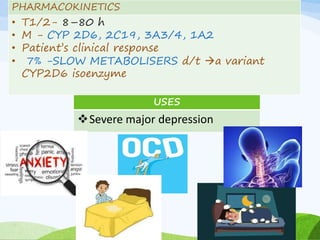
PHARMACOKINETICS
• T1/2- 8–80 h
• M - CYP 2D6, 2C19, 3A3/4, 1A2
• Patient’s clinical response
• 7% -SLOW METABOLISERS d/t a variant
CYP2D6 isoenzyme
USES
Severe major depression
ADVERSE EFFECTS
• Sedation,orthostatic hypotension
• Blurred vision, dry mouth, tachycardia,
constipation, difficulty urinating
• Weight gain
• Quinidine-like effects
• Lower the seizure
threshold.
DRUG INTERACTIONS
• Drugs that inhibit CYP2D6, such as
bupropion and SSRIs
• Shouldn’t be used within 14days of
MAOI
• Antipsychotic agents, type 1C
CHOLINERGIC
REBOUND
MONOAMINE OXIDASE INHIBITORS
• MAO-A and MAO-B 5HT,DA
• EXOGENOUS- TYRAMINENE
• 3rd line drugs
NE
HYPERTENSIVE
CRISIS
1.Tranylcypromine
2.Phenelzine
3.Isocarboxazid.
4.Selegiline
5.Moclobemide
6.Eprobemide,
• M - Acetylation.
• T1/2 – 24 hrs
• Effects – 2 weeks
USES
• Depression
unresponsive/
allergic to TCA
• Selegiline-
transdermal patch
ADVERSE EFFECTS
• Hypertensive crisis
• Hepatotoxicity.
• Sexual disturbances
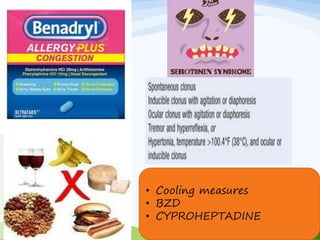
• Weight gain • Cooling measures
• BZD
• CYPROHEPTADINE
SELECTIVE SEROTONIN REUPTAKE
INHIBITORS
• 1st drug fluoxetine available in 1988
Inhibits SERT
AUTORECEPTOR
MECHANISM
5HT1A and 5HT7
autoreceptors reduces 5HT
synthesis and release
Increase in cAMP signalling
Phosphorylation of the
nuclear transcription factor
CREB
>Expression of BDNF
>Inc neurogenesis in
hippocampus and
subventricular zone
SERTRALINE
PAROXETINE
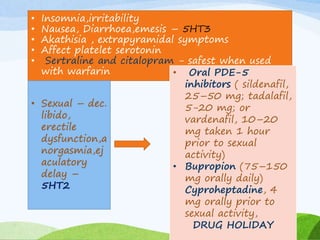
• Insomnia,irritability
• Nausea, Diarrhoea,emesis – 5HT3
• Akathisia , extrapyramidal symptoms
• Affect platelet serotonin
• Sertraline and citalopram - safest when used
with warfarin
• Sexual – dec.
libido,
erectile
dysfunction,a
norgasmia,ej
aculatory
delay –
5HT2
• Oral PDE-5
inhibitors ( sildenafil,
25–50 mg; tadalafil,
5-20 mg; or
vardenafil, 10–20
mg taken 1 hour
prior to sexual
activity)
• Bupropion (75–150
mg orally daily)
Cyproheptadine, 4
mg orally prior to
sexual activity,
DRUG HOLIDAY
• Initial dose -typically a therapeutic dose
• lower lethality in overdose compared to TCAs or
MAO inhibitors.
• Shorter t1/2rapid aborting of A/E
• SEROTONIN SYNDROME +TCA/MAOI
• The SSRIs should not be started until at least 14
days following discontinuation of treatment with
an MAOI; this allows for synthesis of the new
MAO
SEROTONIN NOREPINEPHRINE
REUPTAKE INHIBITORS
• Both NET and SERT
• VENLAFAXINE – 5(11) HRS
• DULOXETINE- 12 hrs
• CYP2D6,3A4
USES
• Depression,Anxiety,
• Fibromyalgia and
neuropathic pain
• Off-label
• Stress urinary
incontinence
(duloxetine)
• Autism
• Binge-eating
disorders, hot flashes
• PTSD (venlafaxine)
SEROTONIN SYNDROME
WASHOUT PERIOD
ADVERSE EFFECTS
• Nausea, constipation,
insomnia, headaches, sexual
dysfunction.
• DIASTOLIC
HYPERTENSION-Venlafaxine
• BLEEDING- Milnacipran
SEROTONIN RECEPTOR ANTAGONISTS
• Trazodone,Nefazadone,Vilazadone  Blocks 5HT2
and α1 adrenergic receptors.
• Mirtazapine and mianserin- H1> 5HT2A,
5HT2C, and 5HT3
• Vortioxetine - potent SERT inhibitor
partial agonist at 5HT1A, 5HT1B
Antagonist at 5HT1D, 5HT3, and 5HT7 receptors
PHARMACOKINETICS
MIRTAZIPINE 16-30
hrs
TRAZADONE 6 hrs
NEFAZADONE 2-4 hrs
ADVERSE EFFECTS
• Mirtazapine-somnolence, increased appetite,
and weight gain. Agranulocytosis.
• Trazodone - priapism
• Nefazodone - Liver failure
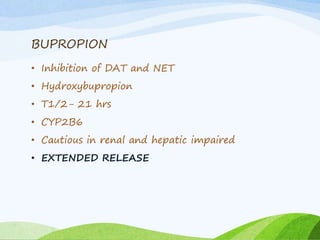
BUPROPION
• Inhibition of DAT and NET
• Hydroxybupropion
• T1/2- 21 hrs
• CYP2B6
• Cautious in renal and hepatic impaired
• EXTENDED RELEASE
BUPROPION
• ADVERSE EFFECTS
• Anxiety, mild
tachycardia,
hypertension,
irritability, and
tremor.
• Headache, nausea, dry
mouth, constipation,
appetite suppression,
insomnia,
• Aggression,
impulsivity, and
agitation
• Seizures -dose and
Cp, (>450 mg/day)
.
• USES
• Depression
• Seasonal depressive
disorder,
• Smoking cessation
treatment
• ADHD
• Off label-
neuropathic pain
and weight loss
ATYPICAL ANTIPSYCHOTICS
• Aripiprazole or Quetiapine
• Olanzapine and the SSRI fluoxetine
• Treatment resistant depression
• Combined with SSRI and SNRI
FDA
STIMULANTS AND OTHER DRUGS
• Dextroamphetamine
(5–30 mg/day orally)
and methylphenidate
(10–45 mg/day orally)
- short-term
treatment in medically
ill and geriatric
patients.
• Rapid onset of action
(hours)
• tachycardia, agitation
• two divided doses early
• Intravenous infusion of
the dissociative
anesthetic ketamine
• . The effects of a single
treatment are short-
lived (about 3–7 days
• NMDA antagonists -
RECENT DRUGS
• Esketamine intranasal
• Noncompetitive NMDA receptor antagonists -
memantine, dextromethorphan/quin idine,
dextromethorphan/bupropion, and lanicemine),
• NR2B subunit-specific NMDA receptor antagonists
(traxoprodil, MK-0657),
• NMDA receptor glycine site partial agonists (D-
cycloserine, rapastinel),
• metabotropic glutamate receptor (mGluR)
antagonists (basimglurant, declogurant)
Daly EJ, Singh JB, Fedgchin M, Cooper K, Lim P, Shelton RC, Thase ME, Winokur A, Van Nueten L,
Manji HA, Drevets WC: Efficacy and safety of intranasal esketamine adjunctive to oral
antidepressant therapy in treatment-resistant depression: a randomized clinical trial. JAMA
Psychiatry 2018; 75: 139–148.
The American Psychiatric Association (APA)
Practice Guideline for the Treatment of
Patients with Major Depressive Disorder(2011)
• .CUSTOMIZATION
• Hamilton or Montgomery-Asberg clinician-administered
rating scales or the self-administered Patient Health
Questionnaire
• Columbia-Suicide Severity Risk Scale
Clinical assessment
Reactions to
previous treatment
Patient preference
Stressors
Presence of other
disorders
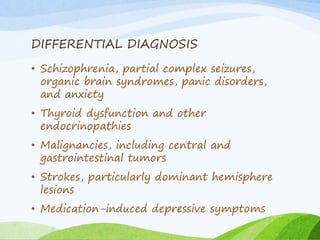
DIFFERENTIAL DIAGNOSIS
• Schizophrenia, partial complex seizures,
organic brain syndromes, panic disorders,
and anxiety
• Thyroid dysfunction and other
endocrinopathies
• Malignancies, including central and
gastrointestinal tumors
• Strokes, particularly dominant hemisphere
lesions
• Medication-induced depressive symptoms
• Lag 2–12 weeks
• SATISFACTORYcontd for 6-12 months
• Indefinite fixed dose
SWITCHING OVER
• Adequate washout – atleast 2 weeks
• Not required if of the same group
• If Antipsychotics  look for body mass index,
lipids, and glucose
• 1st episode at
<20/>50 age
• 2 episodes >40
• 3 episodes –
any age
• Chronic
depression >2
yrs
TAPERING
• Over several weeks.
• counseled about the potential for relapse,
• plan should be established for seeking treatment
if symptoms recur.
• Patients should be monitored for several months
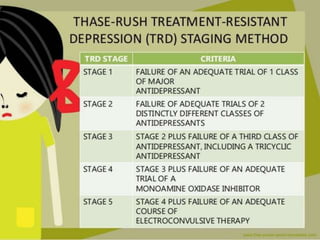
TREATMENT
RESISTANT
DEPRESSION
The STAR*D
1. switch to a second agent that may be from the same or
different class of antidepressant
2. Augmentation with
a. Bupropion (150–450 mg/day),
b. Lithium (eg, 300–900 mg/day orally),
c. Thyroid medication (eg, liothyronine, 25–50 mcg/day
orally)
d. Second-generation antipsychotic (eg, aripiprazole [5–15
mg/day] or olanzapine [5–15 mg/day]).
• PREGNANT
1. Psychotherapy
2. ECT and BRIGHT LIGHT
THEARAPY
SSRI – Persistent Pulmonary
hypertension
Neonatal withdrawal
symptoms
POST PARTUM DEPRESSION
• 1st episodes of depression-,
6-12 months
• Recurrent major depression
following pregnancy, long-
term maintenance
treatment with an
antidepressant
REFERENCES
• The Pharmacological basis of therapeutics,Goodman and
Gilman, 13 th edition
• Current Medical Diagnosis and Treatment ,2019
• Basic and Clinical Pharmacology,Katzung,14th edition
• Gabbards treatment of Psychiatric disorders
• American Psychiatric Association Guidelines
Add a Slide Title - 4

Antidepressants

  • 1.
    ANTIDEPRESSANTS Dr M.KARTHIGA 2ND YEARPOSTGRADUATE M.D.PHARMACOLOGY
  • 2.
  • 3.
    DEPRESSION • MOOD • Physicaland cognitive symptoms • NOT JUST BEING SAD !!! • >15% • TYPES • Psychotic major depression • Major depression with atypical feature • Melancholic major depression • Seasonal affective disorder • Major depression with peripartum onset • DISABILITY • MORTALITY • UNDERDIAGNOSED • UNDERTREATED • CO MORBID CONDITIONS
  • 4.
    The Diagnostic andStatistical Manual of Mental Disorders –DSM - V
  • 5.
    PATHOGENESIS • MONOAMINES THEORY– Noradrenaline, Serotonin, Dopamine • Neurotrophic Theory – Brain derived Neurotrophic factors (BDNF) • NMDA glutamatergic receptors with ketamine • Enhancing neurogenesis • Cyclic nucleotide signaling
  • 6.
  • 8.
    TRICYCLIC ANTIDEPRESSANTS (TCA) • Amitriptyline • Clomipramine •Desipramine • Doxepin • Imipramine • Nortriptyline MONOAMINEOXIDASE INHIBITORS (MAOI) • Phenelzine • Isocarboxazid • Tranylcypromin e • Selegiline • Moclobemide
  • 9.
    • Fluoxetine • Citalopram •Escitalopram • Paroxetine • Sertraline SELECTIVE SEROTONIN REUPTAKE INHIBITORS • Duloxetine • Venlafaxine • Milnacipran • Levomilnacipran SELECTIVE SEROTONIN AND NORADRENALINE REUPTAKE INHIBITORS
  • 10.
    • Trazodone • Nefazodone •Mirtazapine • Mianserin SEROTONIN ANTAGONISTS • Bupropion • Atypical antipsychotics OTHERS
  • 12.
    TRICYCLIC ANTIDEPRESSANTS Neuronal blockof SERT/NET/DAT Inhibit the re-uptake of 5HT/NE/DA Increased concentration in the synaptic cleft.  3-4 weeks H1 Ach α2 Adr
  • 13.
    PHARMACOKINETICS • T1/2- 8–80h • M - CYP 2D6, 2C19, 3A3/4, 1A2 • Patient’s clinical response • 7% -SLOW METABOLISERS d/t a variant CYP2D6 isoenzyme USES Severe major depression
  • 14.
    ADVERSE EFFECTS • Sedation,orthostatichypotension • Blurred vision, dry mouth, tachycardia, constipation, difficulty urinating • Weight gain • Quinidine-like effects • Lower the seizure threshold. DRUG INTERACTIONS • Drugs that inhibit CYP2D6, such as bupropion and SSRIs • Shouldn’t be used within 14days of MAOI • Antipsychotic agents, type 1C CHOLINERGIC REBOUND
  • 15.
    MONOAMINE OXIDASE INHIBITORS •MAO-A and MAO-B 5HT,DA • EXOGENOUS- TYRAMINENE • 3rd line drugs NE HYPERTENSIVE CRISIS 1.Tranylcypromine 2.Phenelzine 3.Isocarboxazid. 4.Selegiline 5.Moclobemide 6.Eprobemide,
  • 16.
    • M -Acetylation. • T1/2 – 24 hrs • Effects – 2 weeks USES • Depression unresponsive/ allergic to TCA • Selegiline- transdermal patch ADVERSE EFFECTS • Hypertensive crisis • Hepatotoxicity. • Sexual disturbances • Weight gain • Cooling measures • BZD • CYPROHEPTADINE
  • 17.
    SELECTIVE SEROTONIN REUPTAKE INHIBITORS •1st drug fluoxetine available in 1988 Inhibits SERT AUTORECEPTOR MECHANISM 5HT1A and 5HT7 autoreceptors reduces 5HT synthesis and release Increase in cAMP signalling Phosphorylation of the nuclear transcription factor CREB >Expression of BDNF >Inc neurogenesis in hippocampus and subventricular zone
  • 18.
  • 19.
    • Insomnia,irritability • Nausea,Diarrhoea,emesis – 5HT3 • Akathisia , extrapyramidal symptoms • Affect platelet serotonin • Sertraline and citalopram - safest when used with warfarin • Sexual – dec. libido, erectile dysfunction,a norgasmia,ej aculatory delay – 5HT2 • Oral PDE-5 inhibitors ( sildenafil, 25–50 mg; tadalafil, 5-20 mg; or vardenafil, 10–20 mg taken 1 hour prior to sexual activity) • Bupropion (75–150 mg orally daily) Cyproheptadine, 4 mg orally prior to sexual activity, DRUG HOLIDAY
  • 20.
    • Initial dose-typically a therapeutic dose • lower lethality in overdose compared to TCAs or MAO inhibitors. • Shorter t1/2rapid aborting of A/E • SEROTONIN SYNDROME +TCA/MAOI • The SSRIs should not be started until at least 14 days following discontinuation of treatment with an MAOI; this allows for synthesis of the new MAO
  • 21.
    SEROTONIN NOREPINEPHRINE REUPTAKE INHIBITORS •Both NET and SERT • VENLAFAXINE – 5(11) HRS • DULOXETINE- 12 hrs • CYP2D6,3A4 USES • Depression,Anxiety, • Fibromyalgia and neuropathic pain • Off-label • Stress urinary incontinence (duloxetine) • Autism • Binge-eating disorders, hot flashes • PTSD (venlafaxine) SEROTONIN SYNDROME WASHOUT PERIOD ADVERSE EFFECTS • Nausea, constipation, insomnia, headaches, sexual dysfunction. • DIASTOLIC HYPERTENSION-Venlafaxine • BLEEDING- Milnacipran
  • 22.
    SEROTONIN RECEPTOR ANTAGONISTS •Trazodone,Nefazadone,Vilazadone  Blocks 5HT2 and α1 adrenergic receptors. • Mirtazapine and mianserin- H1> 5HT2A, 5HT2C, and 5HT3 • Vortioxetine - potent SERT inhibitor partial agonist at 5HT1A, 5HT1B Antagonist at 5HT1D, 5HT3, and 5HT7 receptors PHARMACOKINETICS MIRTAZIPINE 16-30 hrs TRAZADONE 6 hrs NEFAZADONE 2-4 hrs
  • 23.
    ADVERSE EFFECTS • Mirtazapine-somnolence,increased appetite, and weight gain. Agranulocytosis. • Trazodone - priapism • Nefazodone - Liver failure
  • 24.
    BUPROPION • Inhibition ofDAT and NET • Hydroxybupropion • T1/2- 21 hrs • CYP2B6 • Cautious in renal and hepatic impaired • EXTENDED RELEASE
  • 25.
    BUPROPION • ADVERSE EFFECTS •Anxiety, mild tachycardia, hypertension, irritability, and tremor. • Headache, nausea, dry mouth, constipation, appetite suppression, insomnia, • Aggression, impulsivity, and agitation • Seizures -dose and Cp, (>450 mg/day) . • USES • Depression • Seasonal depressive disorder, • Smoking cessation treatment • ADHD • Off label- neuropathic pain and weight loss
  • 26.
    ATYPICAL ANTIPSYCHOTICS • Aripiprazoleor Quetiapine • Olanzapine and the SSRI fluoxetine • Treatment resistant depression • Combined with SSRI and SNRI FDA
  • 27.
    STIMULANTS AND OTHERDRUGS • Dextroamphetamine (5–30 mg/day orally) and methylphenidate (10–45 mg/day orally) - short-term treatment in medically ill and geriatric patients. • Rapid onset of action (hours) • tachycardia, agitation • two divided doses early • Intravenous infusion of the dissociative anesthetic ketamine • . The effects of a single treatment are short- lived (about 3–7 days • NMDA antagonists -
  • 28.
    RECENT DRUGS • Esketamineintranasal • Noncompetitive NMDA receptor antagonists - memantine, dextromethorphan/quin idine, dextromethorphan/bupropion, and lanicemine), • NR2B subunit-specific NMDA receptor antagonists (traxoprodil, MK-0657), • NMDA receptor glycine site partial agonists (D- cycloserine, rapastinel), • metabotropic glutamate receptor (mGluR) antagonists (basimglurant, declogurant) Daly EJ, Singh JB, Fedgchin M, Cooper K, Lim P, Shelton RC, Thase ME, Winokur A, Van Nueten L, Manji HA, Drevets WC: Efficacy and safety of intranasal esketamine adjunctive to oral antidepressant therapy in treatment-resistant depression: a randomized clinical trial. JAMA Psychiatry 2018; 75: 139–148.
  • 30.
    The American PsychiatricAssociation (APA) Practice Guideline for the Treatment of Patients with Major Depressive Disorder(2011) • .CUSTOMIZATION • Hamilton or Montgomery-Asberg clinician-administered rating scales or the self-administered Patient Health Questionnaire • Columbia-Suicide Severity Risk Scale Clinical assessment Reactions to previous treatment Patient preference Stressors Presence of other disorders
  • 31.
    DIFFERENTIAL DIAGNOSIS • Schizophrenia,partial complex seizures, organic brain syndromes, panic disorders, and anxiety • Thyroid dysfunction and other endocrinopathies • Malignancies, including central and gastrointestinal tumors • Strokes, particularly dominant hemisphere lesions • Medication-induced depressive symptoms
  • 33.
    • Lag 2–12weeks • SATISFACTORYcontd for 6-12 months • Indefinite fixed dose SWITCHING OVER • Adequate washout – atleast 2 weeks • Not required if of the same group • If Antipsychotics  look for body mass index, lipids, and glucose • 1st episode at <20/>50 age • 2 episodes >40 • 3 episodes – any age • Chronic depression >2 yrs
  • 34.
    TAPERING • Over severalweeks. • counseled about the potential for relapse, • plan should be established for seeking treatment if symptoms recur. • Patients should be monitored for several months
  • 36.
    TREATMENT RESISTANT DEPRESSION The STAR*D 1. switchto a second agent that may be from the same or different class of antidepressant 2. Augmentation with a. Bupropion (150–450 mg/day), b. Lithium (eg, 300–900 mg/day orally), c. Thyroid medication (eg, liothyronine, 25–50 mcg/day orally) d. Second-generation antipsychotic (eg, aripiprazole [5–15 mg/day] or olanzapine [5–15 mg/day]).
  • 37.
    • PREGNANT 1. Psychotherapy 2.ECT and BRIGHT LIGHT THEARAPY SSRI – Persistent Pulmonary hypertension Neonatal withdrawal symptoms POST PARTUM DEPRESSION • 1st episodes of depression-, 6-12 months • Recurrent major depression following pregnancy, long- term maintenance treatment with an antidepressant
  • 40.
    REFERENCES • The Pharmacologicalbasis of therapeutics,Goodman and Gilman, 13 th edition • Current Medical Diagnosis and Treatment ,2019 • Basic and Clinical Pharmacology,Katzung,14th edition • Gabbards treatment of Psychiatric disorders • American Psychiatric Association Guidelines
  • 41.
    Add a SlideTitle - 4