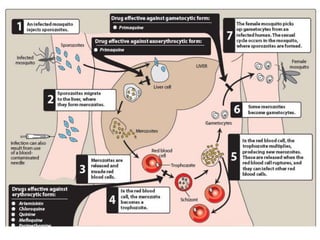
Tissue schizonticide: Primaquine
Primaquine is an 8-aminoquinoline that eradicates primary
exoerythrocytic forms of P. falciparum and P. vivax and the
secondary exoerythrocytic forms of recurring malarias (P. vivax and
P. Ovale
Mechanism of action:
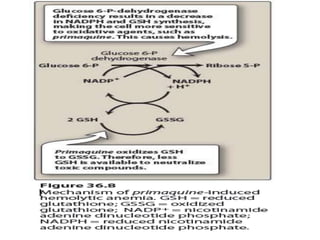
Metabolites of primaquine are believed to act as oxidants that are
responsible for the schizonticidal action as well as for the hemolysis
and methemoglobinemia encountered as toxicities.
Pharmacokinetics: Primaquine is well absorbed on oral
administration and is not concentrated in tissues. It is rapidly
oxidized to many compounds, primarily the deaminated drug. Which
compound possesses the schizontocidal activity has not been
established. Metabolites appear in urine
Adverse eff ects: Primaquine has a low incidence of adverse effects,
except for drug-induced hemolytic anemia
abdominal discomfort, especially when administered in combination
with chloroquine (which may affect patient compliance), and
occasional methemoglobinemia.
Primaquine is contraindicated during pregnancy.
All Plasmodium species may develop resistance to primaquine.
Blood schizonticide: Chloroquine
Chloroquine is a synthetic 4-aminoquinoline that has been the
mainstay of antimalarial therapy,
and it is the drug of choice in the treatment of erythrocytic P.
falciparum malaria.
Chloroquine is less effective against P. vivax malaria.
Chloroquine is also effective in the treatment of extraintestinal
amebiasis. [Note: The anti inflammatory action of chloroquine
explains its occasional use in rheumatoid arthritis and discoid lupus
erythematosus.] Chloroquine is a very potent blood
schizonticidal drug , effective against the erythrocytic forms of
all four plasmodial species (if sensitive to the drug), but it does
not have any effect on sporozoites, hypnozoites or gametocytes.
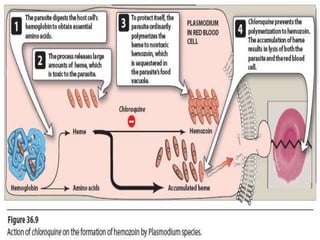
It has a complex mechanism of action that is not fully
understood. It is uncharged at neutral pH and can, therefore,
diffuse freely into the parasite lysosome. At the acid pH of the
lysosome, it is converted to a protonated, membrane-
impermeable form and is 'trapped' inside the parasite.
Pharmacokinetics: Chloroquine is rapidly and completely
absorbed following oral administration. Usually, 4 days of
therapy suffice to cure the disease. The drug has a very large
volume of distribution and concentrates in erythrocytes, liver,
spleen, kidney, lung, melanin-containing tissues, and leukocytes.
It persists in erythrocytes .
The drug also penetrates the central nervous system (CNS) and
traverses the placenta.
Chloroquine is dealkylated by the hepatic mixed-function oxidase
system, but some metabolic products retain antimalarial activity.
Both parent drug and metabolites are excreted predominantly in
urine The excretion rate is enhanced with acidified urine.
Adverse effects: Side effects are minimal at the low doses used in
the chemosuppression of malaria.
At higher doses, many more toxic effects occur, such as
gastrointestinal upset, pruritus, headaches, and blurred vision
[Note: An ophthalmologic examination should be routinely
performed.] Discoloration of the nail beds and mucous membranes
may be seen on chronic administration.
Chloroquine should be used cautiously in patients with hepatic
dysfunction or severe gastrointestinal problems and in patients with
neurologic or blood disorders. Chloroquine can cause
electrocardiographic (ECG) changes, because it has a quinidine-like
eff ect.
Resistance: Resistance of plasmodia to available drugs has become
a serious medical problem throughout Africa, Asia, and most areas
of Central and South America. Chloroquine-resistant P. falciparum
exhibit multigenic alterations that confer a high level of resistance.
Blood schizonticide: Quinine
Quinine is now reserved for malarial strains resistant
to other agents. Tlie drug can affect DNA synthesis.
Quinine interferes with heme polymerization, resulting in
death of the erythrocytic form of the plasmodial parasite.
It is reserved for severe infestations and for malarial strains that are
resistant to other agents such as chloroquine.
Taken orally, quinine is well distributed throughout the body and can
reach the fetus in pregnant patients.
Alkalinization of urine decreases its excretion.
The major adverse effect of quinine is cinchonism, a syndrome
causing nausea, vomiting, tinnitus, and vertigo.
However, quinine treatment should be suspended if a positive
Coombs test for hemolytic anemia occurs.
Drug interactions include potentiation of neuromuscular-blocking
agents and elevation of digoxin levels if taken concurrently with
quinine.
Quinine absorption is retarded when the drug is taken with
aluminum- containing antacids. Quinine is fetotoxic.
Blood schizonticide: Artemisinin
Artemisinin is derived from the qinghaosu plant, which
has been used in Chinese medicine for more than 2 millennia in
the treatment of fevers and malaria.
Artemisinin (or one of its derivatives) is available for the treatment
of severe, multidrug-resistant P. Falciparum malaria.
Its antimalarial action involves the production of free radicals
within the plasmodium food vacuole, following cleavage of the
drug’s endoperoxide bridge by heme iron in parasitized
erythrocytes.
It is also believed to covalently bind to and damage specific
malarial proteins.
Oral, rectal, and intravenous (IV) preparations are available, but
the short half-lives
They are metabolized in the liver and are excreted primarily in bile.
Adverse effects include nausea, vomiting, and diarrhea
Extremely high doses may cause neurotoxicity and prolongation
of the QT interval.
Blood schizonticide and sporontocide: Pyrimethamine
The antifolate agent pyrimethamine is frequently employed to effect
a radical cure as a blood schizonticide. It also acts as a strong
sporonticide in the mosquito’s gut
Pyrimethamine inhibits plasmodial dihydrofolate reductase3 at
much lower concentrations.
The inhibition deprives the protozoan of tetrahydrofolate, a cofactor
required in the de novo biosynthesis of purines and pyrimidines and
in the interconversions of certain amino acids.
Antimalarial drugs

Antimalarial drugs

  • 2.
    Tissue schizonticide: Primaquine Primaquineis an 8-aminoquinoline that eradicates primary exoerythrocytic forms of P. falciparum and P. vivax and the secondary exoerythrocytic forms of recurring malarias (P. vivax and P. Ovale Mechanism of action: Metabolites of primaquine are believed to act as oxidants that are responsible for the schizonticidal action as well as for the hemolysis and methemoglobinemia encountered as toxicities.
  • 3.
    Pharmacokinetics: Primaquine iswell absorbed on oral administration and is not concentrated in tissues. It is rapidly oxidized to many compounds, primarily the deaminated drug. Which compound possesses the schizontocidal activity has not been established. Metabolites appear in urine Adverse eff ects: Primaquine has a low incidence of adverse effects, except for drug-induced hemolytic anemia abdominal discomfort, especially when administered in combination with chloroquine (which may affect patient compliance), and occasional methemoglobinemia. Primaquine is contraindicated during pregnancy. All Plasmodium species may develop resistance to primaquine.
  • 5.
    Blood schizonticide: Chloroquine Chloroquineis a synthetic 4-aminoquinoline that has been the mainstay of antimalarial therapy, and it is the drug of choice in the treatment of erythrocytic P. falciparum malaria. Chloroquine is less effective against P. vivax malaria. Chloroquine is also effective in the treatment of extraintestinal amebiasis. [Note: The anti inflammatory action of chloroquine explains its occasional use in rheumatoid arthritis and discoid lupus erythematosus.] Chloroquine is a very potent blood schizonticidal drug , effective against the erythrocytic forms of all four plasmodial species (if sensitive to the drug), but it does not have any effect on sporozoites, hypnozoites or gametocytes. It has a complex mechanism of action that is not fully understood. It is uncharged at neutral pH and can, therefore, diffuse freely into the parasite lysosome. At the acid pH of the lysosome, it is converted to a protonated, membrane- impermeable form and is 'trapped' inside the parasite.
  • 7.
    Pharmacokinetics: Chloroquine israpidly and completely absorbed following oral administration. Usually, 4 days of therapy suffice to cure the disease. The drug has a very large volume of distribution and concentrates in erythrocytes, liver, spleen, kidney, lung, melanin-containing tissues, and leukocytes. It persists in erythrocytes . The drug also penetrates the central nervous system (CNS) and traverses the placenta. Chloroquine is dealkylated by the hepatic mixed-function oxidase system, but some metabolic products retain antimalarial activity. Both parent drug and metabolites are excreted predominantly in urine The excretion rate is enhanced with acidified urine.
  • 8.
    Adverse effects: Sideeffects are minimal at the low doses used in the chemosuppression of malaria. At higher doses, many more toxic effects occur, such as gastrointestinal upset, pruritus, headaches, and blurred vision [Note: An ophthalmologic examination should be routinely performed.] Discoloration of the nail beds and mucous membranes may be seen on chronic administration. Chloroquine should be used cautiously in patients with hepatic dysfunction or severe gastrointestinal problems and in patients with neurologic or blood disorders. Chloroquine can cause electrocardiographic (ECG) changes, because it has a quinidine-like eff ect.
  • 9.
    Resistance: Resistance ofplasmodia to available drugs has become a serious medical problem throughout Africa, Asia, and most areas of Central and South America. Chloroquine-resistant P. falciparum exhibit multigenic alterations that confer a high level of resistance.
  • 10.
    Blood schizonticide: Quinine Quinineis now reserved for malarial strains resistant to other agents. Tlie drug can affect DNA synthesis. Quinine interferes with heme polymerization, resulting in death of the erythrocytic form of the plasmodial parasite. It is reserved for severe infestations and for malarial strains that are resistant to other agents such as chloroquine. Taken orally, quinine is well distributed throughout the body and can reach the fetus in pregnant patients. Alkalinization of urine decreases its excretion.
  • 11.
    The major adverseeffect of quinine is cinchonism, a syndrome causing nausea, vomiting, tinnitus, and vertigo. However, quinine treatment should be suspended if a positive Coombs test for hemolytic anemia occurs. Drug interactions include potentiation of neuromuscular-blocking agents and elevation of digoxin levels if taken concurrently with quinine. Quinine absorption is retarded when the drug is taken with aluminum- containing antacids. Quinine is fetotoxic.
  • 12.
    Blood schizonticide: Artemisinin Artemisininis derived from the qinghaosu plant, which has been used in Chinese medicine for more than 2 millennia in the treatment of fevers and malaria. Artemisinin (or one of its derivatives) is available for the treatment of severe, multidrug-resistant P. Falciparum malaria. Its antimalarial action involves the production of free radicals within the plasmodium food vacuole, following cleavage of the drug’s endoperoxide bridge by heme iron in parasitized erythrocytes. It is also believed to covalently bind to and damage specific malarial proteins. Oral, rectal, and intravenous (IV) preparations are available, but the short half-lives
  • 13.
    They are metabolizedin the liver and are excreted primarily in bile. Adverse effects include nausea, vomiting, and diarrhea Extremely high doses may cause neurotoxicity and prolongation of the QT interval. Blood schizonticide and sporontocide: Pyrimethamine The antifolate agent pyrimethamine is frequently employed to effect a radical cure as a blood schizonticide. It also acts as a strong sporonticide in the mosquito’s gut Pyrimethamine inhibits plasmodial dihydrofolate reductase3 at much lower concentrations. The inhibition deprives the protozoan of tetrahydrofolate, a cofactor required in the de novo biosynthesis of purines and pyrimidines and in the interconversions of certain amino acids.