Physico-chemical Properties andy p
Biological activity
Dr Gopal Krishna PadhyDr. Gopal Krishna Padhy
18-04-2020
Effect of Hydrogen bonding on biological activity
 hydrogen bond is formed between hydrogen and
electronegative atom.
 A b d i hi h h d h ld h A bond in which a hydrogen atom serves to hold two other
atoms together.
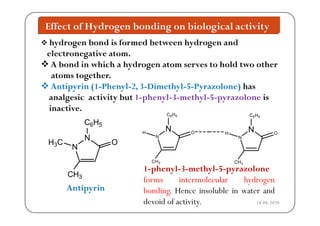
 Antipyrin (1-Phenyl-2 3-Dimethyl-5-Pyrazolone) has Antipyrin (1-Phenyl-2, 3-Dimethyl-5-Pyrazolone) has
analgesic activity but 1-phenyl-3-methyl-5-pyrazolone is
inactive.
C H
N
C6H5
N
N
C6H5
H O N
N
C6H5
H O
N
N
H3C O
CH3
N
CH3
CH3
3
1-phenyl-3-methyl-5-pyrazolone
forms intermolecular hydrogen
bonding Hence insoluble in ater andAntipyrin bonding. Hence insoluble in water and
devoid of activity.
Antipyrin
18-04-2020
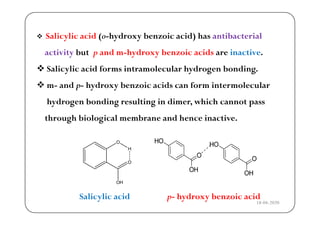
 Salicylic acid (o hydroxy benzoic acid) has antibacterial Salicylic acid (o-hydroxy benzoic acid) has antibacterial
activity but p and m-hydroxy benzoic acids are inactive.
 Salicylic acid forms intramolecular hydrogen bonding.
 m- and p- hydroxy benzoic acids can form intermolecular m and p hydroxy benzoic acids can form intermolecular
hydrogen bonding resulting in dimer, which cannot pass
through biological membrane and hence inactive.
Salicylic acid p- hydroxy benzoic acid
18-04-2020
Effect of Partition coefficient on biological activity
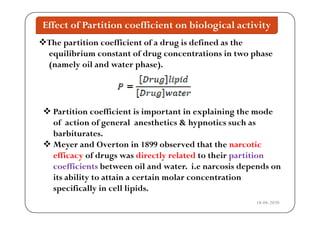
The partition coefficient of a drug is defined as the
equilibrium constant of drug concentrations in two phase
( l il d h )(namely oil and water phase).
 Partition coefficient is important in explaining the mode Partition coefficient is important in explaining the mode
of action of general anesthetics & hypnotics such as
barbiturates.
 Meyer and Overton in 1899 observed that the narcotic
efficacy of drugs was directly related to their partition
ffi i t b t il d t i i d dcoefficients between oil and water. i.e narcosis depends on
its ability to attain a certain molar concentration
specifically in cell lipids.specifically in cell lipids.
18-04-2020
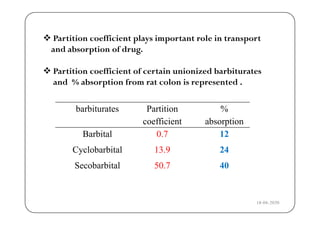
 P i i ffi i l i l i Partition coefficient plays important role in transport
and absorption of drug.
 Partition coefficient of certain unionized barbiturates
and % absorption from rat colon is represented .p p
barbiturates Partition %
coefficient absorption
Barbital 0.7 12
Cyclobarbital 13.9 24
Secobarbital 50 7 40Secobarbital 50.7 40
18-04-2020
Effect of optical isomerism on biological activity
•These compounds essentially possess identical physical as
well as chemical characteristic but have different
pharmacological activitypharmacological activity.
•The difference is due to the interaction of asymmetric
carbon atom of the molecule with stereo specific receptor.p p
•The enantiomer having high affinity for the receptor is
called eutomer, whereas the one with low affinity is called
distomer.
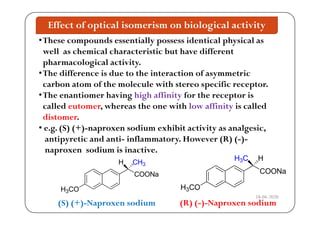
• e.g. (S) (+)-naproxen sodium exhibit activity as analgesic,
antipyretic and anti inflammatory However (R) ( )antipyretic and anti- inflammatory. However (R) (-)-
naproxen sodium is inactive.
(S) (+)-Naproxen sodium (R) (-)-Naproxen sodium
18-04-2020
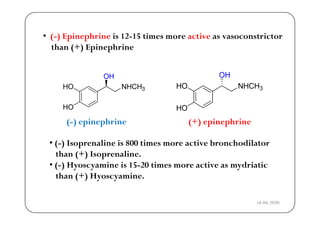
• ( ) Epinephrine is 12 15 times more active as vasoconstrictor• (-) Epinephrine is 12-15 times more active as vasoconstrictor
than (+) Epinephrine
33
(-) epinephrine (+) epinephrine
• (-) Isoprenaline is 800 times more active bronchodilator
than (+) Isoprenaline.
• ( ) Hyoscyamine is 15 20 times more active as mydriatic• (-) Hyoscyamine is 15-20 times more active as mydriatic
than (+) Hyoscyamine.
18-04-2020
Effect of Geometrical isomerism on biological activity
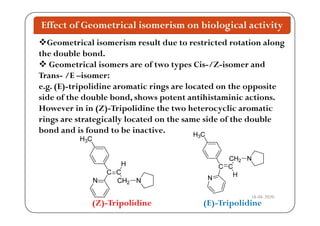
Geometrical isomerism result due to restricted rotation along
the double bond.
 G i l i f Ci i d Geometrical isomers are of two types Cis-/Z-isomer and
Trans- /E –isomer:
e g (E)-tripolidine aromatic rings are located on the oppositee.g. (E)-tripolidine aromatic rings are located on the opposite
side of the double bond, shows potent antihistaminic actions.
However in in (Z)-Tripolidine the two heterocyclic aromatic( ) p y
rings are strategically located on the same side of the double
bond and is found to be inactive.
(Z)-Tripolidine (E)-Tripolidine
18-04-2020
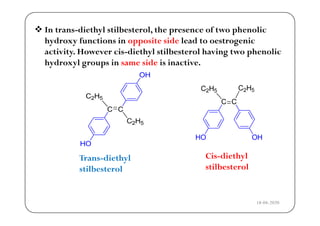
 In trans-diethyl stilbesterol, the presence of two phenolic
hydroxy functions in opposite side lead to oestrogenic
activity. However cis-diethyl stilbesterol having two phenolic
h dro l groups in same side is inacti ehydroxyl groups in same side is inactive.
Trans-diethyl Cis-diethyl
ilb lstilbesterol stilbesterol
18-04-2020
Effect of Chelation on biological activity
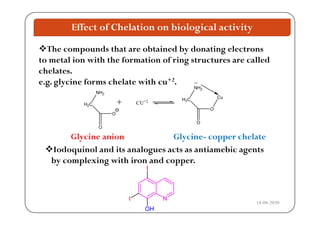
The compounds that are obtained by donating electrons
to metal ion with the formation of ring structures are calledto metal ion with the formation of ring structures are called
chelates.
e.g. glycine forms chelate with cu+2.
NH
H2C
NH2
O
CU+2 H2C
NH2
O
Cu
O
O
O
Glycine anion Glycine- copper chelateGlycine anion Glycine copper chelate
Iodoquinol and its analogues acts as antiamebic agents
by complexing with iron and copper.y p g pp
18-04-2020
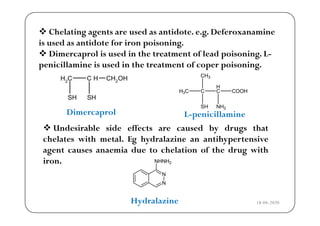
 Chelating agents are used as antidote. e.g. Deferoxanamineg g g
is used as antidote for iron poisoning.
 Dimercaprol is used in the treatment of lead poisoning. L-
i ill i i d i h f i ipenicillamine is used in the treatment of coper poisoning.
CH2
C H CH2OH
H
CH3
SH SH
C
H
C
SH NH2
COOHH3C
Dimercaprol L i ill iDimercaprol L-penicillamine
 Undesirable side effects are caused by drugs that
chelates with metal Eg hydralazine an antihypertensivechelates with metal. Eg hydralazine an antihypertensive
agent causes anaemia due to chelation of the drug with
iron. NHNH2
N
N
Hydralazine 18-04-2020
Effect of protein binding on biological activity
The phenomenon of complex formation with protein is called
protein binding of drugs. Binding of drug to protein is generally
Systemic solubility of drugs:
p g g g g p g y
reversible.
y y g
water insoluble drugs such as heparin, several steroid and oil
soluble vitamins are circulated and distributed by bindingy g
especially to lipoproteins which act as a vehicle for them.
Distribution:
•Plasma protein binding favors uniform distribution of drug
throughout the body by its buffer function.g y y
•Prevents accumulation of large fraction of drug in specific
tissue, thus prevent toxic reaction., p
18-04-2020
Displacement interactions and toxicity:
di l t i i ifi t i f d hi hdisplacement is significant in case of drugs which are more
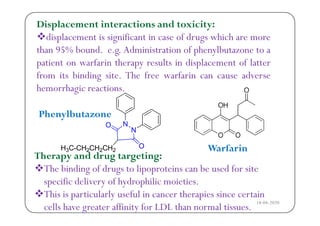
than 95% bound. e.g. Administration of phenylbutazone to a
ti t f i th lt i di l t f l ttpatient on warfarin therapy results in displacement of latter
from its binding site. The free warfarin can cause adverse
hemorrhagic reactionshemorrhagic reactions.
Phen lbuta onePhenylbutazone
Therapy and drug targeting:

Warfarin
The binding of drugs to lipoproteins can be used for site
specific delivery of hydrophilic moieties.
This is particularly useful in cancer therapies since certain
cells have greater affinity for LDL than normal tissues.
18-04-2020
Effect of ionisation on biological activity
The majority of the drugs are either weak acid (for example,
acetylsalicylic acid [aspirin] or weak base (for example, procaine).y y [ p ] ( p , p ).
Acidic drugs can give proton and basic drug can accept a
proton to ionise.p
Amphoteric drugs containing both acidic and basic drug can
give and accept proton.g p p
The dissociation of acetylsalicylic acid, a weak acid, could be
represented below. In this equilibrium, acetylsalicylic acid acts
O COCH3 O COCH
p . q , y y
as an acid, because it donates a proton.
O COCH3
OH
O
+ H2O
O COCH3
O
O
+ H3O
18-04-2020
O O
As membranes are lipid in nature hence it permits only
Th f th t t f i i ti f d h
As membranes are lipid in nature, hence it permits only
unionised drug (lipophilic) to pass through.
Therefore the extent of ionisation of a drug has an
important effect on its absorption, distribution and
li i tielimination.
The degree to which these drugs are ionised in solution
d d t th H
 For example, the pH of urine may be adjusted by
are dependent on the pH..
p , p y j y
administration of ammonium chloride in cases of overdosing
with amphetamines and narcotics. Similarly sodiump y
bicarbonate use in case of barbiturates and salicylic acid, to
ensure that these drugs are completely ionised and hence
18-04-2020
g p y
readily excreted
Effect of solubility on biological activity
Solubility is the important parameter to attain desired
concentration of drugs in the systemic circulation that couldg y
show desired therapeutic response.
A drug to be absorbed from the site of absorption must beg p
present in the form of an aqueous solution. Since, water
remains the solvent of choice many liquid dosage forms, poory q g p
water soluble drugs have slow absorption leading to
inadequate bioavailability.q y
Most of the drugs are either weakly acidic or weakly basic,
having poor aqueous solubility, especially in BCS Class IIg p q y p y
drugs, the rate-limiting step is drug release from dosage form
and its solubility in gastric pH than absorption.
18-04-2020
y g p p
Various solubilization techniques including cosolvencyVarious solubilization techniques, including cosolvency,
addition of surfactants, salt formation, and solid dispersion
are employed into solubilized poorly soluble drugs
Aqueous solubility of a given molecule is the interplay of
are employed into solubilized poorly soluble drugs
q y g p y
multiple factors, including solid-state properties (eg, crystal
packing, lattice energy), ionization (pH, pKa), andp g, gy), (p , p a),
solute/solvate interactions.
It is important to understand what limits solubility to design
new formulation .
18-04-2020
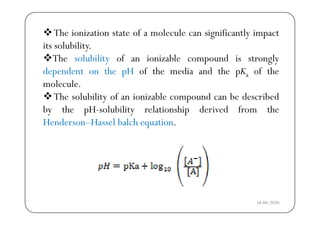
The ionization state of a molecule can significantly impactg y p
its solubility.
The solubility of an ionizable compound is stronglyy p g y
dependent on the pH of the media and the pKa of the
molecule.
The solubility of an ionizable compound can be described
by the pH-solubility relationship derived from they p y p
Henderson–Hassel balch equation.
18-04-2020
Effect of Bioisosterism on biological activity
In medicinal chemistry, bioisosteres are chemical
substituents or groups with similar physical or chemicalg p p y
properties which produce broadly similar biological properties
to another chemical compound.p
 In drug design,the purpose of exchanging one bioisostere forg g p p g g
another is to enhance the desired biological or physical
properties of a compound without making significant changes inp p p g g g
chemical structure.
Bioisosterism is used to reduce toxicity, change bioavailability,
or modify the activity of the lead compound, and may alter the
18-04-2020
y y p y
metabolism of the lead.
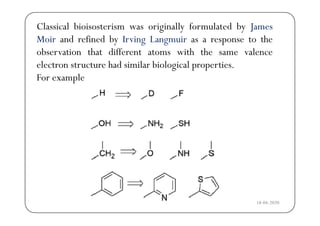
Classical bioisosterism was originally formulated by James
d f d b hMoir and refined by Irving Langmuir as a response to the
observation that different atoms with the same valence
l h d l b l lelectron structure had similar biological properties.
For example
18-04-2020
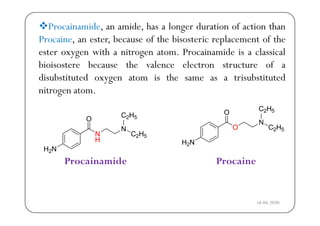
Procainamide, an amide, has a longer duration of action than
b f h b l f hProcaine, an ester, because of the bisosteric replacement of the
ester oxygen with a nitrogen atom. Procainamide is a classical
b b h l l fbioisostere because the valence electron structure of a
disubstituted oxygen atom is the same as a trisubstituted
nitrogen atom.
2 5
2 5
2
Procainamide Procaine
18-04-2020
BOOKS FOR FURTHER READING
Wil d Gi ld T b k f i M di i l
BOOKS FOR FURTHER READING
Wilson and Gisvold,Text book of organic, Medicinal
and Pharmaceutical Chemistry.
Foyes Principles of medicinal chemistry byWilliams
O. Foye.y
AText book of medicinal chemistry (Synthetic and
Biochemical Approach) vol I& II by SN PandeyaBiochemical Approach) vol. I& II by SN Pandeya.
16-04-2020

Effect of physicochemical factors on biological activity-Medicinal Chemistry

  • 1.
    Physico-chemical Properties andyp Biological activity Dr Gopal Krishna PadhyDr. Gopal Krishna Padhy 18-04-2020
  • 2.
    Effect of Hydrogenbonding on biological activity  hydrogen bond is formed between hydrogen and electronegative atom.  A b d i hi h h d h ld h A bond in which a hydrogen atom serves to hold two other atoms together.  Antipyrin (1-Phenyl-2 3-Dimethyl-5-Pyrazolone) has Antipyrin (1-Phenyl-2, 3-Dimethyl-5-Pyrazolone) has analgesic activity but 1-phenyl-3-methyl-5-pyrazolone is inactive. C H N C6H5 N N C6H5 H O N N C6H5 H O N N H3C O CH3 N CH3 CH3 3 1-phenyl-3-methyl-5-pyrazolone forms intermolecular hydrogen bonding Hence insoluble in ater andAntipyrin bonding. Hence insoluble in water and devoid of activity. Antipyrin 18-04-2020
  • 3.
     Salicylic acid(o hydroxy benzoic acid) has antibacterial Salicylic acid (o-hydroxy benzoic acid) has antibacterial activity but p and m-hydroxy benzoic acids are inactive.  Salicylic acid forms intramolecular hydrogen bonding.  m- and p- hydroxy benzoic acids can form intermolecular m and p hydroxy benzoic acids can form intermolecular hydrogen bonding resulting in dimer, which cannot pass through biological membrane and hence inactive. Salicylic acid p- hydroxy benzoic acid 18-04-2020
  • 4.
    Effect of Partitioncoefficient on biological activity The partition coefficient of a drug is defined as the equilibrium constant of drug concentrations in two phase ( l il d h )(namely oil and water phase).  Partition coefficient is important in explaining the mode Partition coefficient is important in explaining the mode of action of general anesthetics & hypnotics such as barbiturates.  Meyer and Overton in 1899 observed that the narcotic efficacy of drugs was directly related to their partition ffi i t b t il d t i i d dcoefficients between oil and water. i.e narcosis depends on its ability to attain a certain molar concentration specifically in cell lipids.specifically in cell lipids. 18-04-2020
  • 5.
     P ii ffi i l i l i Partition coefficient plays important role in transport and absorption of drug.  Partition coefficient of certain unionized barbiturates and % absorption from rat colon is represented .p p barbiturates Partition % coefficient absorption Barbital 0.7 12 Cyclobarbital 13.9 24 Secobarbital 50 7 40Secobarbital 50.7 40 18-04-2020
  • 6.
    Effect of opticalisomerism on biological activity •These compounds essentially possess identical physical as well as chemical characteristic but have different pharmacological activitypharmacological activity. •The difference is due to the interaction of asymmetric carbon atom of the molecule with stereo specific receptor.p p •The enantiomer having high affinity for the receptor is called eutomer, whereas the one with low affinity is called distomer. • e.g. (S) (+)-naproxen sodium exhibit activity as analgesic, antipyretic and anti inflammatory However (R) ( )antipyretic and anti- inflammatory. However (R) (-)- naproxen sodium is inactive. (S) (+)-Naproxen sodium (R) (-)-Naproxen sodium 18-04-2020
  • 7.
    • ( )Epinephrine is 12 15 times more active as vasoconstrictor• (-) Epinephrine is 12-15 times more active as vasoconstrictor than (+) Epinephrine 33 (-) epinephrine (+) epinephrine • (-) Isoprenaline is 800 times more active bronchodilator than (+) Isoprenaline. • ( ) Hyoscyamine is 15 20 times more active as mydriatic• (-) Hyoscyamine is 15-20 times more active as mydriatic than (+) Hyoscyamine. 18-04-2020
  • 8.
    Effect of Geometricalisomerism on biological activity Geometrical isomerism result due to restricted rotation along the double bond.  G i l i f Ci i d Geometrical isomers are of two types Cis-/Z-isomer and Trans- /E –isomer: e g (E)-tripolidine aromatic rings are located on the oppositee.g. (E)-tripolidine aromatic rings are located on the opposite side of the double bond, shows potent antihistaminic actions. However in in (Z)-Tripolidine the two heterocyclic aromatic( ) p y rings are strategically located on the same side of the double bond and is found to be inactive. (Z)-Tripolidine (E)-Tripolidine 18-04-2020
  • 9.
     In trans-diethylstilbesterol, the presence of two phenolic hydroxy functions in opposite side lead to oestrogenic activity. However cis-diethyl stilbesterol having two phenolic h dro l groups in same side is inacti ehydroxyl groups in same side is inactive. Trans-diethyl Cis-diethyl ilb lstilbesterol stilbesterol 18-04-2020
  • 10.
    Effect of Chelationon biological activity The compounds that are obtained by donating electrons to metal ion with the formation of ring structures are calledto metal ion with the formation of ring structures are called chelates. e.g. glycine forms chelate with cu+2. NH H2C NH2 O CU+2 H2C NH2 O Cu O O O Glycine anion Glycine- copper chelateGlycine anion Glycine copper chelate Iodoquinol and its analogues acts as antiamebic agents by complexing with iron and copper.y p g pp 18-04-2020
  • 11.
     Chelating agentsare used as antidote. e.g. Deferoxanamineg g g is used as antidote for iron poisoning.  Dimercaprol is used in the treatment of lead poisoning. L- i ill i i d i h f i ipenicillamine is used in the treatment of coper poisoning. CH2 C H CH2OH H CH3 SH SH C H C SH NH2 COOHH3C Dimercaprol L i ill iDimercaprol L-penicillamine  Undesirable side effects are caused by drugs that chelates with metal Eg hydralazine an antihypertensivechelates with metal. Eg hydralazine an antihypertensive agent causes anaemia due to chelation of the drug with iron. NHNH2 N N Hydralazine 18-04-2020
  • 12.
    Effect of proteinbinding on biological activity The phenomenon of complex formation with protein is called protein binding of drugs. Binding of drug to protein is generally Systemic solubility of drugs: p g g g g p g y reversible. y y g water insoluble drugs such as heparin, several steroid and oil soluble vitamins are circulated and distributed by bindingy g especially to lipoproteins which act as a vehicle for them. Distribution: •Plasma protein binding favors uniform distribution of drug throughout the body by its buffer function.g y y •Prevents accumulation of large fraction of drug in specific tissue, thus prevent toxic reaction., p 18-04-2020
  • 13.
    Displacement interactions andtoxicity: di l t i i ifi t i f d hi hdisplacement is significant in case of drugs which are more than 95% bound. e.g. Administration of phenylbutazone to a ti t f i th lt i di l t f l ttpatient on warfarin therapy results in displacement of latter from its binding site. The free warfarin can cause adverse hemorrhagic reactionshemorrhagic reactions. Phen lbuta onePhenylbutazone Therapy and drug targeting:  Warfarin The binding of drugs to lipoproteins can be used for site specific delivery of hydrophilic moieties. This is particularly useful in cancer therapies since certain cells have greater affinity for LDL than normal tissues. 18-04-2020
  • 14.
    Effect of ionisationon biological activity The majority of the drugs are either weak acid (for example, acetylsalicylic acid [aspirin] or weak base (for example, procaine).y y [ p ] ( p , p ). Acidic drugs can give proton and basic drug can accept a proton to ionise.p Amphoteric drugs containing both acidic and basic drug can give and accept proton.g p p The dissociation of acetylsalicylic acid, a weak acid, could be represented below. In this equilibrium, acetylsalicylic acid acts O COCH3 O COCH p . q , y y as an acid, because it donates a proton. O COCH3 OH O + H2O O COCH3 O O + H3O 18-04-2020 O O
  • 15.
    As membranes arelipid in nature hence it permits only Th f th t t f i i ti f d h As membranes are lipid in nature, hence it permits only unionised drug (lipophilic) to pass through. Therefore the extent of ionisation of a drug has an important effect on its absorption, distribution and li i tielimination. The degree to which these drugs are ionised in solution d d t th H  For example, the pH of urine may be adjusted by are dependent on the pH.. p , p y j y administration of ammonium chloride in cases of overdosing with amphetamines and narcotics. Similarly sodiump y bicarbonate use in case of barbiturates and salicylic acid, to ensure that these drugs are completely ionised and hence 18-04-2020 g p y readily excreted
  • 16.
    Effect of solubilityon biological activity Solubility is the important parameter to attain desired concentration of drugs in the systemic circulation that couldg y show desired therapeutic response. A drug to be absorbed from the site of absorption must beg p present in the form of an aqueous solution. Since, water remains the solvent of choice many liquid dosage forms, poory q g p water soluble drugs have slow absorption leading to inadequate bioavailability.q y Most of the drugs are either weakly acidic or weakly basic, having poor aqueous solubility, especially in BCS Class IIg p q y p y drugs, the rate-limiting step is drug release from dosage form and its solubility in gastric pH than absorption. 18-04-2020 y g p p
  • 17.
    Various solubilization techniquesincluding cosolvencyVarious solubilization techniques, including cosolvency, addition of surfactants, salt formation, and solid dispersion are employed into solubilized poorly soluble drugs Aqueous solubility of a given molecule is the interplay of are employed into solubilized poorly soluble drugs q y g p y multiple factors, including solid-state properties (eg, crystal packing, lattice energy), ionization (pH, pKa), andp g, gy), (p , p a), solute/solvate interactions. It is important to understand what limits solubility to design new formulation . 18-04-2020
  • 18.
    The ionization stateof a molecule can significantly impactg y p its solubility. The solubility of an ionizable compound is stronglyy p g y dependent on the pH of the media and the pKa of the molecule. The solubility of an ionizable compound can be described by the pH-solubility relationship derived from they p y p Henderson–Hassel balch equation. 18-04-2020
  • 19.
    Effect of Bioisosterismon biological activity In medicinal chemistry, bioisosteres are chemical substituents or groups with similar physical or chemicalg p p y properties which produce broadly similar biological properties to another chemical compound.p  In drug design,the purpose of exchanging one bioisostere forg g p p g g another is to enhance the desired biological or physical properties of a compound without making significant changes inp p p g g g chemical structure. Bioisosterism is used to reduce toxicity, change bioavailability, or modify the activity of the lead compound, and may alter the 18-04-2020 y y p y metabolism of the lead.
  • 20.
    Classical bioisosterism wasoriginally formulated by James d f d b hMoir and refined by Irving Langmuir as a response to the observation that different atoms with the same valence l h d l b l lelectron structure had similar biological properties. For example 18-04-2020
  • 21.
    Procainamide, an amide,has a longer duration of action than b f h b l f hProcaine, an ester, because of the bisosteric replacement of the ester oxygen with a nitrogen atom. Procainamide is a classical b b h l l fbioisostere because the valence electron structure of a disubstituted oxygen atom is the same as a trisubstituted nitrogen atom. 2 5 2 5 2 Procainamide Procaine 18-04-2020
  • 22.
    BOOKS FOR FURTHERREADING Wil d Gi ld T b k f i M di i l BOOKS FOR FURTHER READING Wilson and Gisvold,Text book of organic, Medicinal and Pharmaceutical Chemistry. Foyes Principles of medicinal chemistry byWilliams O. Foye.y AText book of medicinal chemistry (Synthetic and Biochemical Approach) vol I& II by SN PandeyaBiochemical Approach) vol. I& II by SN Pandeya. 16-04-2020