Antihistaminic agents
Dr. D. P. Kawade
Associate Professor
Priyadarshini J L College of Pharmacy
HISTAMINE
Histamine is a β-imidazolylethylamine derivative
present in all mammalian tissues.
It was first discovered by SIR HENRY DALE.
Its synthesis occurs in mast cells, parietal cells of
gastric mucosa, CNS, periphery.
It functions as an autocoid & one of the mediator
involved in the allergic inflammatory responses.
It has an important role in the regulation of gastric
acid secretion.
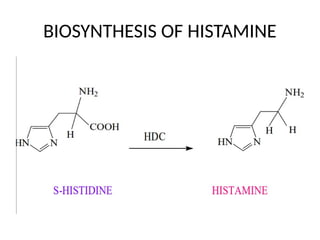
BIOSYNTHESIS OF HISTAMINE
• Histamine is synthesized in cytoplasmic
granules of its storage cells, mast cells &
basophils.
• It is formed from naturally occurring amino
acid, S-histidine, via the catalysis of the pyridoxal
phosphate – dependent enzyme histidine
decarboxylase/ aromatic decarboxylase.
METABOLISM OF HISTAMINE
• Metabolism of histamine takes by the
enzymatic inactivation.
• Enzymes that involve in the metabolism are:
1. Histamine N-methyl transferase(HMT)
2. Diamine oxidase.
•Histamine is metabolized as N-
methylimidazole acetic acid , imidazole acetic
acid riboside. Both are excreted through urine.
IMPORTANCE OF HISTAMINE
• It is not used therapeutically but in the past it
has been used to test acid secreting capacity of
stomach. To test bronchial hyperactivity in
asthmatics. For diagnosis of pheochromocytoma
, but these pharmacological tests are risky. In
pulmonary laboratories, histamine aerosol has
been used as a provocative test of bronchial
hyperactivity. To distinguish between real &
pseudoanesthesia
RECEPTORS
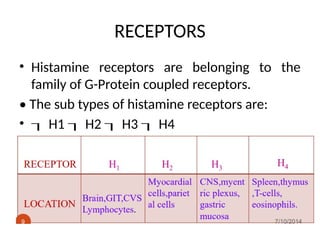
• Histamine receptors are belonging to the
family of G-Protein coupled receptors.
• The sub types of histamine receptors are:
•  H1 H2 H3 H4
  
HISTAMINE ANTAGONISTS
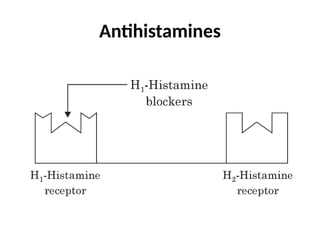
• Drugs that block the action of histamine at H1 ,H2 ,H3
,H4 receptors • The development of antihistamines
began by the discovery of PIPEROXAM.
1. Drugs that inhibits the histamine release.
2. Drugs that inhibits the action of released histamine
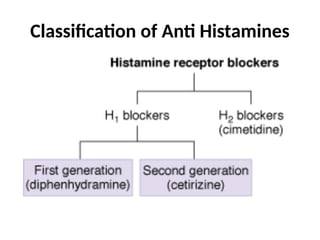
a. H1 antagonists(first,second&third generations)
b. H2 antagonists
c. H3 antagonists
3.Drugs having dual action
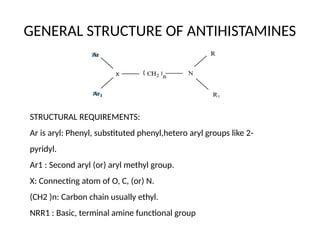
GENERAL STRUCTURE OF ANTIHISTAMINES
STRUCTURAL REQUIREMENTS:
Ar is aryl: Phenyl, substituted phenyl,hetero aryl groups like 2-
pyridyl.
Ar1 : Second aryl (or) aryl methyl group.
X: Connecting atom of O, C, (or) N.
(CH2 )n: Carbon chain usually ethyl.
NRR1 : Basic, terminal amine functional group
DRUGS THAT BLOCK THE RELEASED
HISTAMINE
H1 ANTAGONISTS(FIRST GENERATION DRUGS):
• These are classical antihistamines.
These are clinically used in the treatment of
histamine mediated allergic conditions like
allergic rhinitis, allergic conjuctivitis etc
Allergies and Histamine
Receptors
• H1 receptors tend to produce the symptoms of
allergy.
• H2 receptors tend to act as negative feedback
receptors and turn the allergic off.
• H2 receptors also exclusively activate the acid-
producing, parietal cells of the stomach lining.
• An H3 receptor, appears to exist only in the central
nervous
• system.
Antihistaminic agents
• Antihistamines act as competitive inhibitors of
histamine (agonist) binding.
• They compete for the H1 receptors on blood vessel
endothelial cells and smooth muscle cells.
• Competition: [antihistamine] > [natural histamine.]
Antihistamines
Classification of Anti Histamines
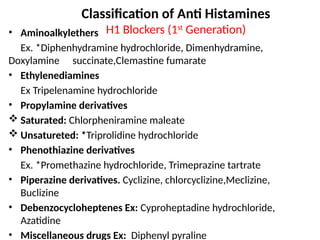
H1 Blockers (1st
Generation)
• Aminoalkylethers
Ex. *Diphenhydramine hydrochloride, Dimenhydramine,
Doxylamine succinate,Clemastine fumarate
• Ethylenediamines
Ex Tripelenamine hydrochloride
• Propylamine derivatives
 Saturated: Chlorpheniramine maleate
 Unsatureted: *Triprolidine hydrochloride
• Phenothiazine derivatives
Ex. *Promethazine hydrochloride, Trimeprazine tartrate
• Piperazine derivatives. Cyclizine, chlorcyclizine,Meclizine,
Buclizine
• Debenzocycloheptenes Ex: Cyproheptadine hydrochloride,
Azatidine
• Miscellaneous drugs Ex: Diphenyl pyraline
H1 Blockers (1st
Generation)
• H1 Antagonist with non classical structures
Ex: Astemizole
• Nonsedative H1 antagonist
Piperazine derivative: Cetrizine
Pyridine and piperidine derivatives
Ex: Loratidine,
• Inhibition of Histamine Release (mast cell stabilizers)
Ex: Cromolyn sodium
Second-Generation antihistamines.
The second-generation antihistamines bind only
to peripheral H1 receptors, and reduce allergic
response with little or no sedation.
Ex: Cetirizine, Loratidine, Fexofenadine.
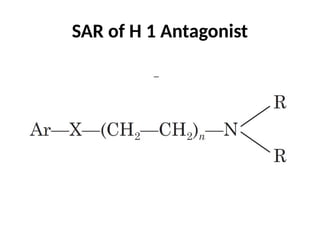
SAR of H 1 Antagonist
SAR’s
1. The nitrogen should be 3° in nature for maximum
antihistaminic activity. The ‘N’ may also form a part of
heterocyclic moieties like piperidine, or piperazine or diazocine.
2. The group present between nitrogen atom and group X may be
saturated or unsaturated or substituted.
3. The Ar group may be aryl or heteroaryl, which may be
substituted.
4. The group (X) can be carbon, oxygen or nitrogen.
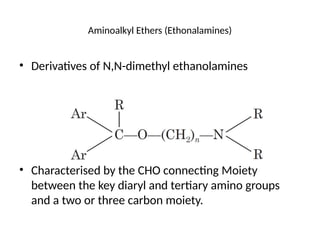
Aminoalkyl Ethers (Ethonalamines)
• Derivatives of N,N-dimethyl ethanolamines
• Characterised by the CHO connecting Moiety
between the key diaryl and tertiary amino groups
and a two or three carbon moiety.
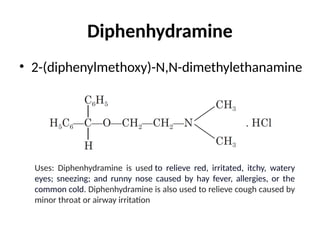
Diphenhydramine
• 2-(diphenylmethoxy)-N,N-dimethylethanamine
Uses: Diphenhydramine is used to relieve red, irritated, itchy, watery
eyes; sneezing; and runny nose caused by hay fever, allergies, or the
common cold. Diphenhydramine is also used to relieve cough caused by
minor throat or airway irritation
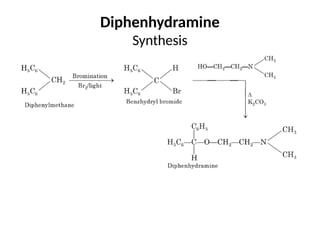
Diphenhydramine
Synthesis
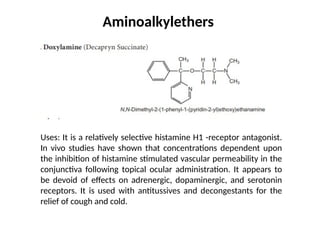
Aminoalkylethers
Uses: It is a relatively selective histamine H1 -receptor antagonist.
In vivo studies have shown that concentrations dependent upon
the inhibition of histamine stimulated vascular permeability in the
conjunctiva following topical ocular administration. It appears to
be devoid of effects on adrenergic, dopaminergic, and serotonin
receptors. It is used with antitussives and decongestants for the
relief of cough and cold.
Dimenhydrinate
Dimenhydrinate (Mixture of Diphenhydramine and 8-chlorotheophylline)
Used as histamine H1 -receptor antagonist, antinauseant, in
motion sickness, radiation sickness, and also in the case of nausea
during pregnancy.
Aminoalkylethers
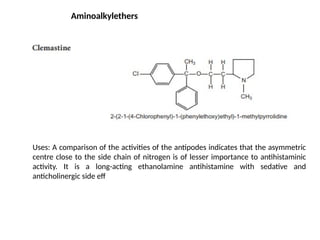
Aminoalkylethers
Uses: A comparison of the activities of the antipodes indicates that the asymmetric
centre close to the side chain of nitrogen is of lesser importance to antihistaminic
activity. It is a long-acting ethanolamine antihistamine with sedative and
anticholinergic side eff
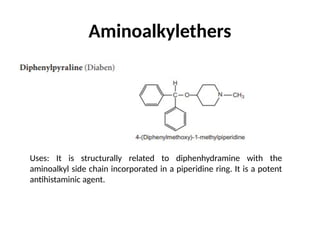
Aminoalkylethers
Uses: It is structurally related to diphenhydramine with the
aminoalkyl side chain incorporated in a piperidine ring. It is a potent
antihistaminic agent.
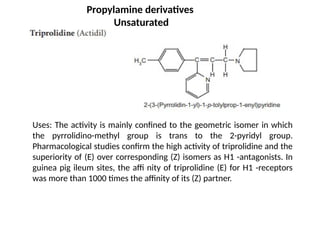
Uses: The activity is mainly confined to the geometric isomer in which
the pyrrolidino-methyl group is trans to the 2-pyridyl group.
Pharmacological studies confirm the high activity of triprolidine and the
superiority of (E) over corresponding (Z) isomers as H1 -antagonists. In
guinea pig ileum sites, the affi nity of triprolidine (E) for H1 -receptors
was more than 1000 times the affinity of its (Z) partner.
Propylamine derivatives
Unsaturated
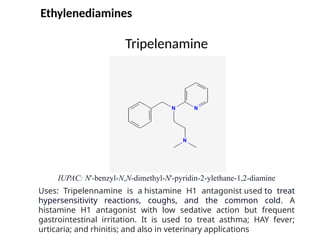
Tripelenamine
IUPAC: N'-benzyl-N,N-dimethyl-N'-pyridin-2-ylethane-1,2-diamine
Ethylenediamines
Uses: Tripelennamine is a histamine H1 antagonist used to treat
hypersensitivity reactions, coughs, and the common cold. A
histamine H1 antagonist with low sedative action but frequent
gastrointestinal irritation. It is used to treat asthma; HAY fever;
urticaria; and rhinitis; and also in veterinary applications
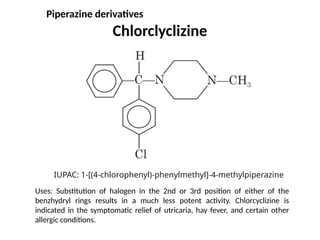
Chlorclyclizine
IUPAC: 1-[(4-chlorophenyl)-phenylmethyl]-4-methylpiperazine
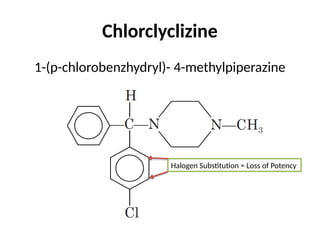
Uses: Substitution of halogen in the 2nd or 3rd position of either of the
benzhydryl rings results in a much less potent activity. Chlorcyclizine is
indicated in the symptomatic relief of utricaria, hay fever, and certain other
allergic conditions.
Piperazine derivatives
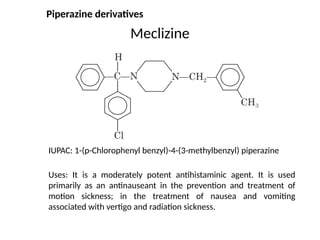
Meclizine
IUPAC: 1-(p-Chlorophenyl benzyl)-4-(3-methylbenzyl) piperazine
Uses: It is a moderately potent antihistaminic agent. It is used
primarily as an antinauseant in the prevention and treatment of
motion sickness; in the treatment of nausea and vomiting
associated with vertigo and radiation sickness.
Piperazine derivatives
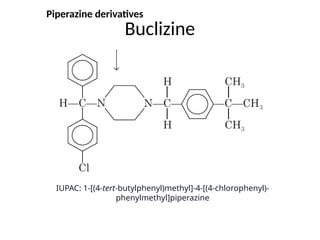
Buclizine
IUPAC: 1-[(4-tert-butylphenyl)methyl]-4-[(4-chlorophenyl)-
phenylmethyl]piperazine
Piperazine derivatives
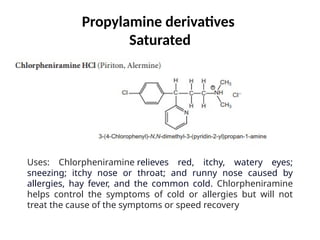
Propylamine derivatives
Saturated
Uses: Chlorpheniramine relieves red, itchy, watery eyes;
sneezing; itchy nose or throat; and runny nose caused by
allergies, hay fever, and the common cold. Chlorpheniramine
helps control the symptoms of cold or allergies but will not
treat the cause of the symptoms or speed recovery
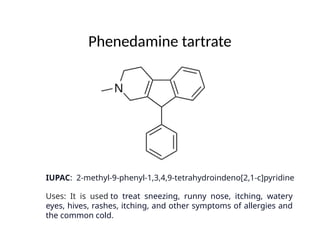
Phenedamine tartrate
IUPAC: 2-methyl-9-phenyl-1,3,4,9-tetrahydroindeno[2,1-c]pyridine
Uses: It is used to treat sneezing, runny nose, itching, watery
eyes, hives, rashes, itching, and other symptoms of allergies and
the common cold.
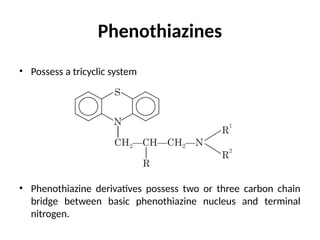
Phenothiazines
• Possess a tricyclic system
• Phenothiazine derivatives possess two or three carbon chain
bridge between basic phenothiazine nucleus and terminal
nitrogen.
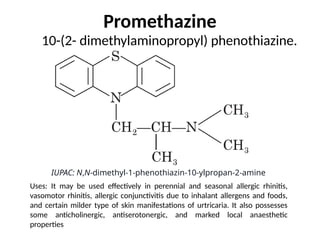
Promethazine
10-(2- dimethylaminopropyl) phenothiazine.
IUPAC: N,N-dimethyl-1-phenothiazin-10-ylpropan-2-amine
Uses: It may be used effectively in perennial and seasonal allergic rhinitis,
vasomotor rhinitis, allergic conjunctivitis due to inhalant allergens and foods,
and certain milder type of skin manifestations of urtricaria. It also possesses
some anticholinergic, antiserotonergic, and marked local anaesthetic
properties
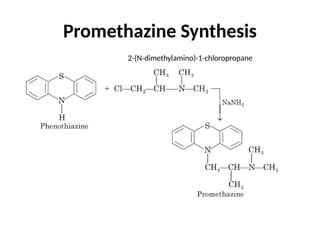
Promethazine Synthesis
2-(N-dimethylamino)-1-chloropropane
Promethazine Uses
• Antihistaminic agent with some anti
muscarinic, antiemetic and local anesthestic
properties.
– allergies,
– anxiety prior to surgery,
– as an anti-nauseant,
– and for control of motion sickness.
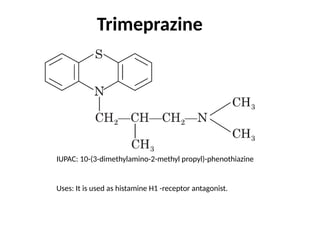
Trimeprazine
IUPAC: 10-(3-dimethylamino-2-methyl propyl)-phenothiazine
Uses: It is used as histamine H1 -receptor antagonist.
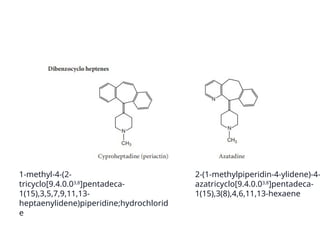
1-methyl-4-(2-
tricyclo[9.4.0.03,8
]pentadeca-
1(15),3,5,7,9,11,13-
heptaenylidene)piperidine;hydrochlorid
e
2-(1-methylpiperidin-4-ylidene)-4-
azatricyclo[9.4.0.03,8
]pentadeca-
1(15),3(8),4,6,11,13-hexaene
• Uses of Ciproheptadine: This dibenzocycloheptene may be regarded
as a phenothiazine analogue in which the sulphur atom has been
replaced by an isosteric vinyl group and the ring nitrogen
replaced by a sp2 carbon atom.
• It also possesses antiserotonin activity and is used as an
antipruritic agent associated with skin disorders (utricaria,
allergic dermatitis, neurodermatitis). It is used to stimulate the
appetite in under-weight patients and those suffering from
anorexia nervosa.
Uses of Azatadine: It is a potent, long-acting antihistaminic with
antiserotonin activity. In early testing, azatadine exhibited more
than three times the potency of chlorpheniramine in the isolated
guinea pig ileum screening and more than seven times the oral
potency of chlorpheniramine in the protection of guinea pig against
a double lethal dose of intravenously administered histamine
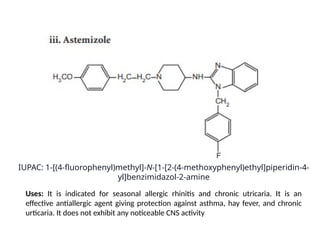
IUPAC: 1-[(4-fluorophenyl)methyl]-N-[1-[2-(4-methoxyphenyl)ethyl]piperidin-4-
yl]benzimidazol-2-amine
Uses: It is indicated for seasonal allergic rhinitis and chronic utricaria. It is an
effective antiallergic agent giving protection against asthma, hay fever, and chronic
urticaria. It does not exhibit any noticeable CNS activity
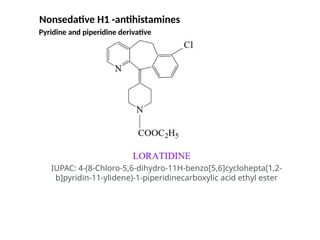
IUPAC: 4-(8-Chloro-5,6-dihydro-11H-benzo[5,6]cyclohepta[1,2-
b]pyridin-11-ylidene)-1-piperidinecarboxylic acid ethyl ester
Nonsedative H1 -antihistamines
Pyridine and piperidine derivative
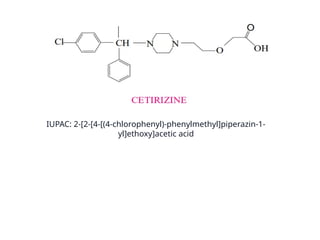
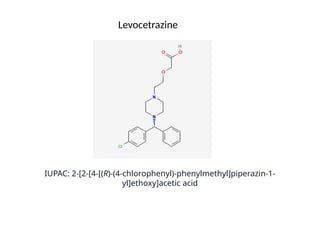
IUPAC: 2-[2-[4-[(4-chlorophenyl)-phenylmethyl]piperazin-1-
yl]ethoxy]acetic acid
IUPAC: 2-[2-[4-[(R)-(4-chlorophenyl)-phenylmethyl]piperazin-1-
yl]ethoxy]acetic acid
Levocetrazine
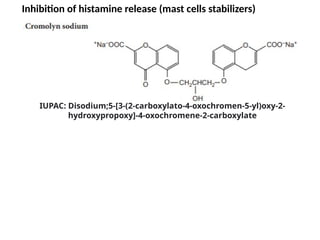
IUPAC: Disodium;5-[3-(2-carboxylato-4-oxochromen-5-yl)oxy-2-
hydroxypropoxy]-4-oxochromene-2-carboxylate
Inhibition of histamine release (mast cells stabilizers)
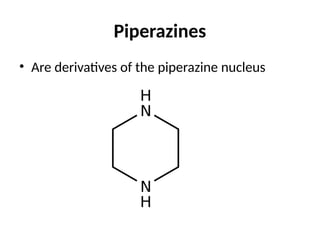
Piperazines
• Are derivatives of the piperazine nucleus
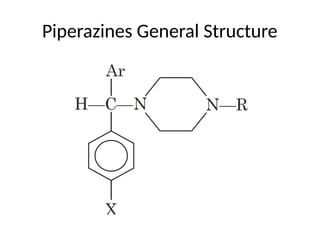
Piperazines General Structure
Piperazines
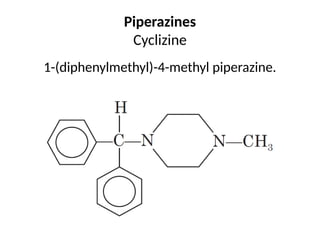
Cyclizine
1-(diphenylmethyl)-4-methyl piperazine.
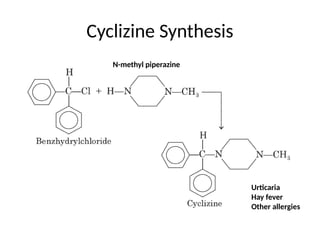
Cyclizine Synthesis
N-methyl piperazine
Urticaria
Hay fever
Other allergies
Chlorclyclizine
1-(p-chlorobenzhydryl)- 4-methylpiperazine
Halogen Substitution = Loss of Potency
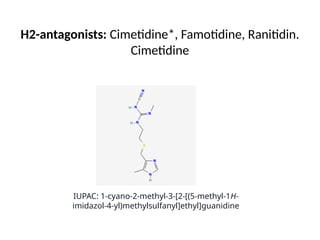
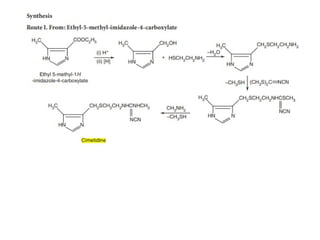
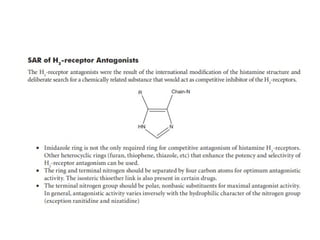
H2-antagonists: Cimetidine*, Famotidine, Ranitidin.
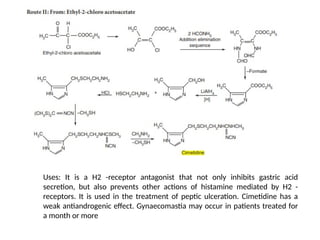
Cimetidine
IUPAC: 1-cyano-2-methyl-3-[2-[(5-methyl-1H-
imidazol-4-yl)methylsulfanyl]ethyl]guanidine
Uses: It is a H2 -receptor antagonist that not only inhibits gastric acid
secretion, but also prevents other actions of histamine mediated by H2 -
receptors. It is used in the treatment of peptic ulceration. Cimetidine has a
weak antiandrogenic effect. Gynaecomastia may occur in patients treated for
a month or more
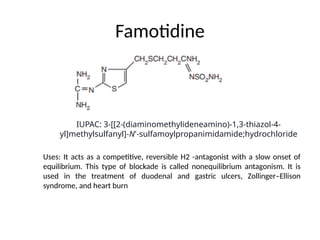
Famotidine
Uses: It acts as a competitive, reversible H2 -antagonist with a slow onset of
equilibrium. This type of blockade is called nonequilibrium antagonism. It is
used in the treatment of duodenal and gastric ulcers, Zollinger–Ellison
syndrome, and heart burn
IUPAC: 3-[[2-(diaminomethylideneamino)-1,3-thiazol-4-
yl]methylsulfanyl]-N'-sulfamoylpropanimidamide;hydrochloride
Ranitidin
Uses: In Ranitidine, the imidazole ring of cimitidine was replaced by furan
in conjugation with some rearrangement of the terminal functionality; the
128 Drugs Acting on Digestive System substituted guanidine group has
been isosterically modifi ed by utilizing a nitromethenyl moiety to basicity.
It is used in the treatment of duodenal ulcer, gastric ulcer, and pathological
hypersecretory conditions.
IUPAC: (E)-1-N'-[2-[[5-[(dimethylamino)methyl]furan-2-
yl]methylsulfanyl]ethyl]-1-N-methyl-2-nitroethene-1,1-diamine
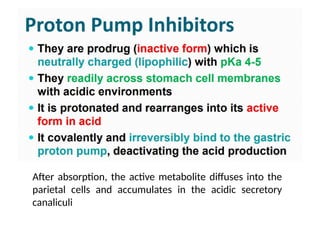
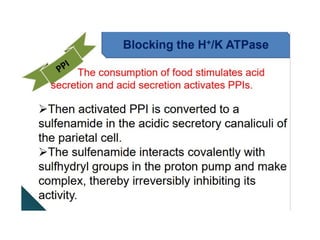
After absorption, the active metabolite diffuses into the
parietal cells and accumulates in the acidic secretory
canaliculi
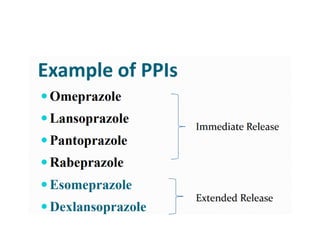
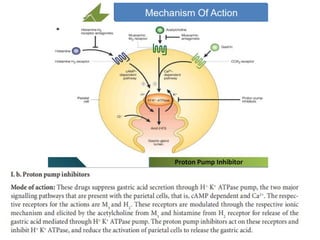
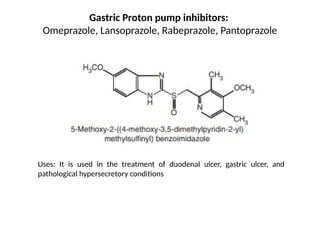
Gastric Proton pump inhibitors:
Omeprazole, Lansoprazole, Rabeprazole, Pantoprazole
Uses: It is used in the treatment of duodenal ulcer, gastric ulcer, and
pathological hypersecretory conditions
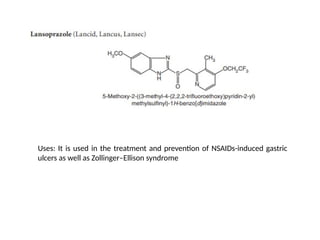
Uses: It is used in the treatment and prevention of NSAIDs-induced gastric
ulcers as well as Zollinger–Ellison syndrome
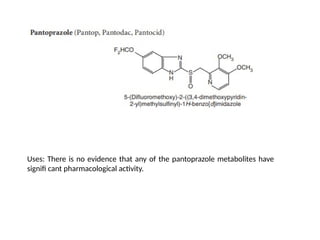
Uses: There is no evidence that any of the pantoprazole metabolites have
signifi cant pharmacological activity.
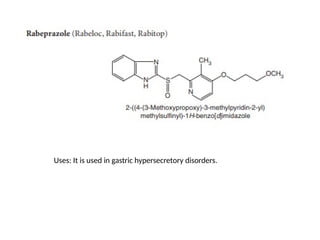
Uses: It is used in gastric hypersecretory disorders.