Antibodies: Generation, interaction with
antigens and functions
By Dr. Oyaro
Learning objectives
• Know definitions associated with Abs -(affinity,
avidity,valence, epitope, paratope, affinity maturation,
allelic exclusion)
• Describe immunoglobulin classes (structure &
functions (IgA,IgG,IgM,IgD,IgE)
• Explain how an Antibody interacts with an Antigen
(Fabs/V) or target receptors on immune cells (FcRs on
Macrophages, neutrophils, NK cells) via ADCC
• List specific effector functions of antibodies (Igs)
Antibody
Antibody: A disease fighting protein developed by the
body’s immune cell (B cell) in response to the presence of
an antigen (recognize and bind to a particular antigen
with very high specificity).
Made in response to exposure to the antigen.
One virus or microbe may have several antigenic
determinant sites, to which different antibodies may
bind.
Each antibody has at least two identical sites that bind
antigen: Antigen binding sites.
Valence of an antibody: Number of antigen binding
sites. Most are bivalent.
Belong to a group of serum proteins called
immunoglobulins (Igs).
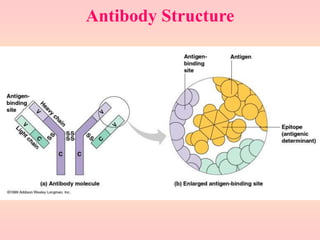
Antibody Structure
Monomer: A flexible Y-shaped molecule with
four protein chains:
– 2 identical light chains
– 2 identical heavy chains
Variable Regions (V): Two sections at the end of
Y’s arms. Contain the antigen binding sites
(Fab). Identical on the same antibody, but vary
from one antibody to another.
Variable regions (V) of Ab
• Within the variable domains are three regions of extreme
variability.
• These are referred to as the hypervariable regions (greater
specificity).
• These regions of the variable domains actually contact the
antigen.
• They therefore make up the antigen-binding site (Fab).
• These regions are also called the complementarity
determining regions, or CDRs.
• Variable region - amino acid sequence in the N terminal
regions of the H and L chains is different. This region
provides antibodies with unique specificity (Ag-specific)
Constant region of Ab (Fc)
Constant Regions (C): Stem of monomer and
lower parts of Y arms.
Fc region: Stem of monomer only. Important
because they can bind to complement or cells
(there are receptors on target cells including
receptors for other molecules like cytokines)
Constant region - amino acid sequence in the
C terminal regions of the H and L chains is the
same.
Please note this!
• Apart from binding of the complement to Fc region of the
antibody causing complement activation, the Fc region of
Ab can also bind to surface receptors on the innate
immune cells (effector target cells) that will cause killing
of the antigens/infected cells via ADCC. ADCC is
triggered through interaction of target‐bound antibodies
(belonging to IgG or IgA or IgE classes) with certain Fc
receptors (FcRs), glycoproteins present on the effector cell
surface
• Effector cells that mediate ADCC include natural killer (NK)
cells, monocytes, macrophages, neutrophils, eosinophils and
dendritic cells
• ADCC is dependent on density and stability of the antigen
on the surface of the target cell; antibody affinity and
FcR‐binding affinity
Antibody Structure
Ab structural variants
• Structural Variants of the Basic Immunoglobulin Molecule
• Different heavy chains can be used There are five major
types of heavy chain --> five major classes (isotypes) of
antibody - gamma --> IgG (in humans 4 subclasses: IgG1,
IgG2, IgG3, IgG4) - mu --> IgM - alpha --> IgA (in
humans, 2 subclasses: IgA1, IgA2) - delta --> IgD -
epsilon --> IgE
• Valency of antibody refers to the number of antigenic determinants that
an individual antibody molecule can bind (No of Ag binding sites).
• The valency of all antibodies is at least two and in some instances
more (10 for IgM).
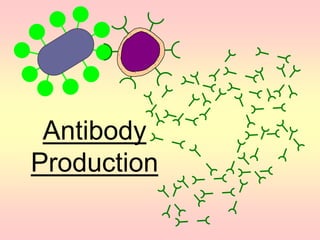
Antibody
Production
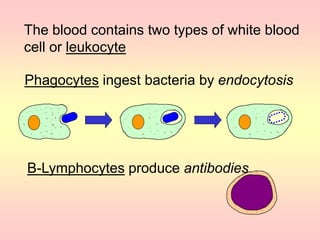
The blood contains two types of white blood
cell or leukocyte
Phagocytes ingest bacteria by endocytosis
B-Lymphocytes produce antibodies
Antibodies
• Antibodies are proteins that recognise and
bind to specific antigens
• Antigens are foreign substances that
stimulate the production of antibodies
• Many of the molecules on the surface of
viruses and bacteria are antigens
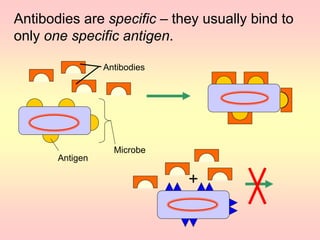
Antibodies are specific – they usually bind to
only one specific antigen.
Antigen
Antibodies
Microbe
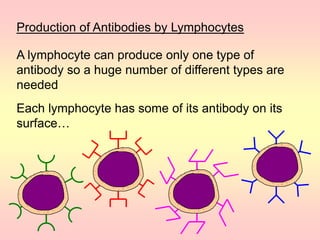
Production of Antibodies by Lymphocytes
A lymphocyte can produce only one type of
antibody so a huge number of different types are
needed
Each lymphocyte has some of its antibody on its
surface…
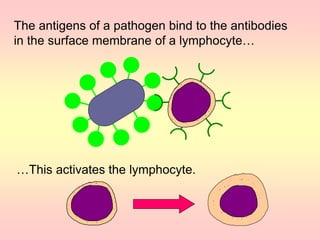
The antigens of a pathogen bind to the antibodies
in the surface membrane of a lymphocyte…
…This activates the lymphocyte.
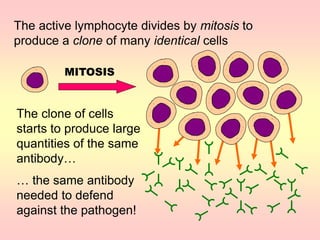
The active lymphocyte divides by mitosis to
produce a clone of many identical cells
MITOSIS
The clone of cells
starts to produce large
quantities of the same
antibody…
… the same antibody
needed to defend
against the pathogen!
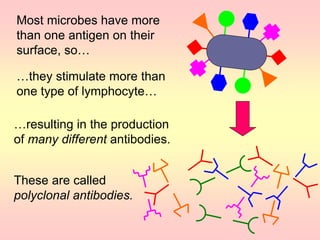
Most microbes have more
than one antigen on their
surface, so…
…they stimulate more than
one type of lymphocyte…
…resulting in the production
of many different antibodies.
These are called
polyclonal antibodies.
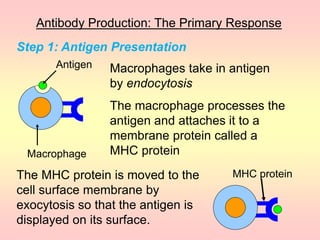
Antibody Production: The Primary Response
Macrophages take in antigen
by endocytosis
Antigen
Macrophage
The macrophage processes the
antigen and attaches it to a
membrane protein called a
MHC protein
The MHC protein is moved to the
cell surface membrane by
exocytosis so that the antigen is
displayed on its surface.
MHC protein
Step 1: Antigen Presentation
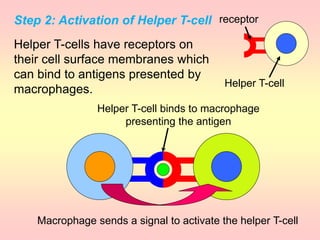
Helper T-cell binds to macrophage
presenting the antigen
Step 2: Activation of Helper T-cell
Helper T-cells have receptors on
their cell surface membranes which
can bind to antigens presented by
macrophages.
receptor
Helper T-cell
Macrophage sends a signal to activate the helper T-cell
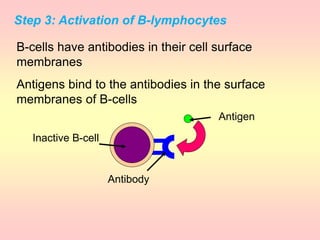
Step 3: Activation of B-lymphocytes
B-cells have antibodies in their cell surface
membranes
Inactive B-cell
Antibody
Antigens bind to the antibodies in the surface
membranes of B-cells
Antigen
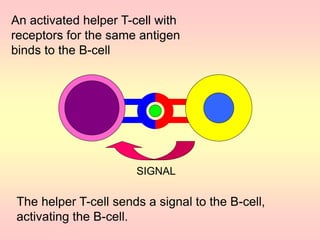
An activated helper T-cell with
receptors for the same antigen
binds to the B-cell
SIGNAL
The helper T-cell sends a signal to the B-cell,
activating the B-cell.
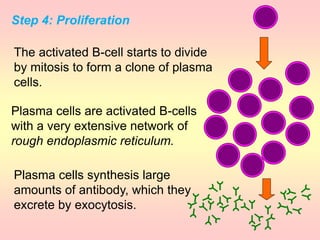
Step 4: Proliferation
Plasma cells are activated B-cells
with a very extensive network of
rough endoplasmic reticulum.
Plasma cells synthesis large
amounts of antibody, which they
excrete by exocytosis.
The activated B-cell starts to divide
by mitosis to form a clone of plasma
cells.
The Secondary Response: Memory Cells
• If an antigen invades your body a second time, a
much faster response occurs which produces
much larger quantity of the required antibody.
•When activated B-cells are dividing during the
primary response, some cells stop dividing and
secreting antibody and become memory cells.
• Large numbers of memory cells remain in the
body for a long time…
• …they are capable of producing large amounts of
antibody very quickly when stimulated.
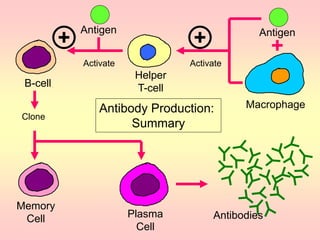
B-cell
Macrophage
Antigen
Activate
Antigen
Helper
T-cell
Activate
Clone
Memory
Cell Plasma
Cell
Antibodies
Antibody Production:
Summary
BIOLOGICAL & CHEMICAL PROPERTIES
OF Igs
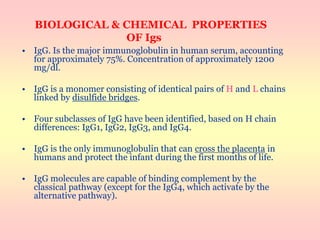
• IgG. Is the major immunoglobulin in human serum, accounting
for approximately 75%. Concentration of approximately 1200
mg/dl.
• IgG is a monomer consisting of identical pairs of H and L chains
linked by disulfide bridges.
• Four subclasses of IgG have been identified, based on H chain
differences: IgG1, IgG2, IgG3, and IgG4.
• IgG is the only immunoglobulin that can cross the placenta in
humans and protect the infant during the first months of life.
• IgG molecules are capable of binding complement by the
classical pathway (except for the IgG4, which activate by the
alternative pathway).
drmsaiem
BIOLOGICAL AND CHEMICAL PROPERTIES
OF IMMUNOGLOBULINS
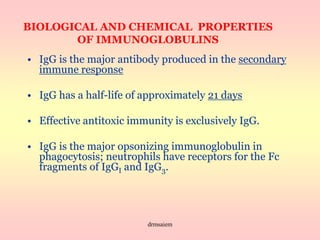
• IgG is the major antibody produced in the secondary
immune response
• IgG has a half-life of approximately 21 days
• Effective antitoxic immunity is exclusively IgG.
• IgG is the major opsonizing immunoglobulin in
phagocytosis; neutrophils have receptors for the Fc
fragments of IgGI and IgG3.
drmsaiem
BIOLOGICAL & CHEMICAL
PROPERTIES OF Igs
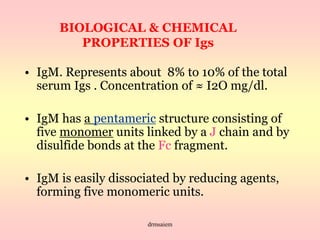
• IgM. Represents about 8% to 10% of the total
serum Igs . Concentration of ≈ I2O mg/dl.
• IgM has a pentameric structure consisting of
five monomer units linked by a J chain and by
disulfide bonds at the Fc fragment.
• IgM is easily dissociated by reducing agents,
forming five monomeric units.
drmsaiem
BIOLOGICALAND CHEMICAL
PROPERTIES OF IMMUNOGLOBULINS
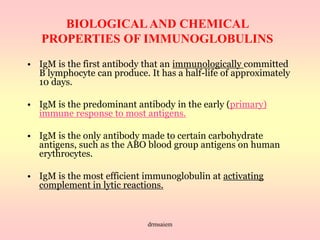
• IgM is the first antibody that an immunologically committed
B lymphocyte can produce. It has a half-life of approximately
10 days.
• IgM is the predominant antibody in the early (primary)
immune response to most antigens.
• IgM is the only antibody made to certain carbohydrate
antigens, such as the ABO blood group antigens on human
erythrocytes.
• IgM is the most efficient immunoglobulin at activating
complement in lytic reactions.
Relationship Between Cell-Mediated and
Humoral Immunity
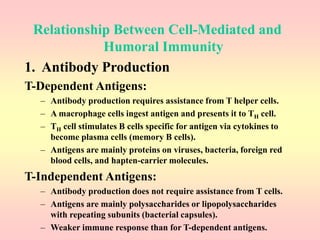
1. Antibody Production
T-Dependent Antigens:
– Antibody production requires assistance from T helper cells.
– A macrophage cells ingest antigen and presents it to TH cell.
– TH cell stimulates B cells specific for antigen via cytokines to
become plasma cells (memory B cells).
– Antigens are mainly proteins on viruses, bacteria, foreign red
blood cells, and hapten-carrier molecules.
T-Independent Antigens:
– Antibody production does not require assistance from T cells.
– Antigens are mainly polysaccharides or lipopolysaccharides
with repeating subunits (bacterial capsules).
– Weaker immune response than for T-dependent antigens.
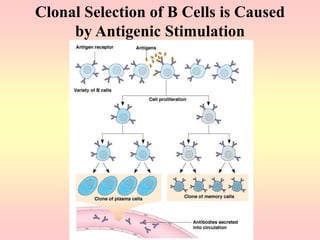
Clonal Selection of B Cells is Caused
by Antigenic Stimulation
Humoral Immunity
Clonal Selection
– Clonal Selection: B cells (and T cells) that encounter
stimulating antigen will proliferate into a large group of
cells.
– Why don’t we produce antibodies against our own
antigens? We have developed tolerance to them.
– Clonal Deletion: B and T cells that react against self
antigens appear to be destroyed during fetal development.
Process is poorly understood.
– Allelic exclusion is a process by which only one
allele of a gene is expressed while the other allele
is silenced (allows for each mature B lymphocyte to
express only one type of immunoglobulin)
Antigen-Antibody interactions
Characterized as:
• Non-covalent interaction (similar to “lock and key” fit of
enzyme-substrate)
• Does not lead to irreversible alteration of Ag or Ab
• This exact and specific interaction has led to many
immunological assays used to:
» detect Ag or Ab
» diagnose disease
» measure magnitude of humoral IR
» identify molecules of bio and med interest
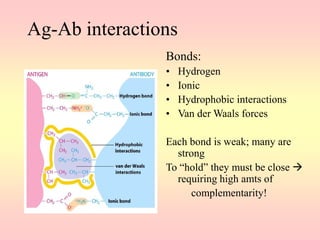
Ag-Ab interactions
Bonds:
• Hydrogen
• Ionic
• Hydrophobic interactions
• Van der Waals forces
Each bond is weak; many are
strong
To “hold” they must be close 
requiring high amts of
complementarity!
Functions of Antibodies
Antigen-Antibody Complex: Formed when an
antibody binds to an antigen it recognizes.
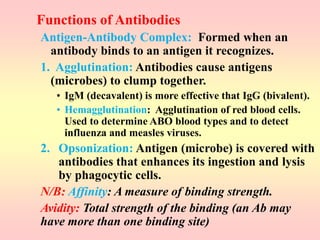
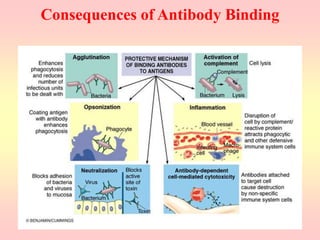
1. Agglutination: Antibodies cause antigens
(microbes) to clump together.
• IgM (decavalent) is more effective that IgG (bivalent).
• Hemagglutination: Agglutination of red blood cells.
Used to determine ABO blood types and to detect
influenza and measles viruses.
2. Opsonization: Antigen (microbe) is covered with
antibodies that enhances its ingestion and lysis
by phagocytic cells.
N/B: Affinity: A measure of binding strength.
Avidity: Total strength of the binding (an Ab may
have more than one binding site)
Humoral Immunity (Continued)
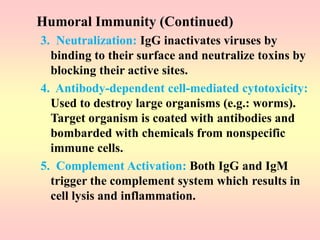
3. Neutralization: IgG inactivates viruses by
binding to their surface and neutralize toxins by
blocking their active sites.
4. Antibody-dependent cell-mediated cytotoxicity:
Used to destroy large organisms (e.g.: worms).
Target organism is coated with antibodies and
bombarded with chemicals from nonspecific
immune cells.
5. Complement Activation: Both IgG and IgM
trigger the complement system which results in
cell lysis and inflammation.
Consequences of Antibody Binding
Some additional definitions
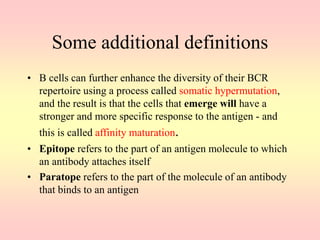
• B cells can further enhance the diversity of their BCR
repertoire using a process called somatic hypermutation,
and the result is that the cells that emerge will have a
stronger and more specific response to the antigen - and
this is called affinity maturation.
• Epitope refers to the part of an antigen molecule to which
an antibody attaches itself
• Paratope refers to the part of the molecule of an antibody
that binds to an antigen
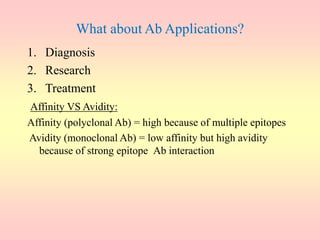
What about Ab Applications?
1. Diagnosis
2. Research
3. Treatment
Affinity VS Avidity:
Affinity (polyclonal Ab) = high because of multiple epitopes
Avidity (monoclonal Ab) = low affinity but high avidity
because of strong epitope Ab interaction
Further reading (assignments)
• Read and make short notes on the properties
& functions of individual immunoglobulins
(IgD, IgM, IgA, IgE, IgG)
THANK YOU!!

ANTIBODY STRUCTURE AND FUNCTION-2022.ppt

  • 1.
    Antibodies: Generation, interactionwith antigens and functions By Dr. Oyaro
  • 2.
    Learning objectives • Knowdefinitions associated with Abs -(affinity, avidity,valence, epitope, paratope, affinity maturation, allelic exclusion) • Describe immunoglobulin classes (structure & functions (IgA,IgG,IgM,IgD,IgE) • Explain how an Antibody interacts with an Antigen (Fabs/V) or target receptors on immune cells (FcRs on Macrophages, neutrophils, NK cells) via ADCC • List specific effector functions of antibodies (Igs)
  • 3.
    Antibody Antibody: A diseasefighting protein developed by the body’s immune cell (B cell) in response to the presence of an antigen (recognize and bind to a particular antigen with very high specificity). Made in response to exposure to the antigen. One virus or microbe may have several antigenic determinant sites, to which different antibodies may bind. Each antibody has at least two identical sites that bind antigen: Antigen binding sites. Valence of an antibody: Number of antigen binding sites. Most are bivalent. Belong to a group of serum proteins called immunoglobulins (Igs).
  • 4.
    Antibody Structure Monomer: Aflexible Y-shaped molecule with four protein chains: – 2 identical light chains – 2 identical heavy chains Variable Regions (V): Two sections at the end of Y’s arms. Contain the antigen binding sites (Fab). Identical on the same antibody, but vary from one antibody to another.
  • 5.
    Variable regions (V)of Ab • Within the variable domains are three regions of extreme variability. • These are referred to as the hypervariable regions (greater specificity). • These regions of the variable domains actually contact the antigen. • They therefore make up the antigen-binding site (Fab). • These regions are also called the complementarity determining regions, or CDRs. • Variable region - amino acid sequence in the N terminal regions of the H and L chains is different. This region provides antibodies with unique specificity (Ag-specific)
  • 6.
    Constant region ofAb (Fc) Constant Regions (C): Stem of monomer and lower parts of Y arms. Fc region: Stem of monomer only. Important because they can bind to complement or cells (there are receptors on target cells including receptors for other molecules like cytokines) Constant region - amino acid sequence in the C terminal regions of the H and L chains is the same.
  • 7.
    Please note this! •Apart from binding of the complement to Fc region of the antibody causing complement activation, the Fc region of Ab can also bind to surface receptors on the innate immune cells (effector target cells) that will cause killing of the antigens/infected cells via ADCC. ADCC is triggered through interaction of target‐bound antibodies (belonging to IgG or IgA or IgE classes) with certain Fc receptors (FcRs), glycoproteins present on the effector cell surface • Effector cells that mediate ADCC include natural killer (NK) cells, monocytes, macrophages, neutrophils, eosinophils and dendritic cells • ADCC is dependent on density and stability of the antigen on the surface of the target cell; antibody affinity and FcR‐binding affinity
  • 8.
  • 9.
    Ab structural variants •Structural Variants of the Basic Immunoglobulin Molecule • Different heavy chains can be used There are five major types of heavy chain --> five major classes (isotypes) of antibody - gamma --> IgG (in humans 4 subclasses: IgG1, IgG2, IgG3, IgG4) - mu --> IgM - alpha --> IgA (in humans, 2 subclasses: IgA1, IgA2) - delta --> IgD - epsilon --> IgE • Valency of antibody refers to the number of antigenic determinants that an individual antibody molecule can bind (No of Ag binding sites). • The valency of all antibodies is at least two and in some instances more (10 for IgM).
  • 10.
  • 11.
    The blood containstwo types of white blood cell or leukocyte Phagocytes ingest bacteria by endocytosis B-Lymphocytes produce antibodies
  • 12.
    Antibodies • Antibodies areproteins that recognise and bind to specific antigens • Antigens are foreign substances that stimulate the production of antibodies • Many of the molecules on the surface of viruses and bacteria are antigens
  • 13.
    Antibodies are specific– they usually bind to only one specific antigen. Antigen Antibodies Microbe
  • 14.
    Production of Antibodiesby Lymphocytes A lymphocyte can produce only one type of antibody so a huge number of different types are needed Each lymphocyte has some of its antibody on its surface…
  • 15.
    The antigens ofa pathogen bind to the antibodies in the surface membrane of a lymphocyte… …This activates the lymphocyte.
  • 16.
    The active lymphocytedivides by mitosis to produce a clone of many identical cells MITOSIS The clone of cells starts to produce large quantities of the same antibody… … the same antibody needed to defend against the pathogen!
  • 17.
    Most microbes havemore than one antigen on their surface, so… …they stimulate more than one type of lymphocyte… …resulting in the production of many different antibodies. These are called polyclonal antibodies.
  • 18.
    Antibody Production: ThePrimary Response Macrophages take in antigen by endocytosis Antigen Macrophage The macrophage processes the antigen and attaches it to a membrane protein called a MHC protein The MHC protein is moved to the cell surface membrane by exocytosis so that the antigen is displayed on its surface. MHC protein Step 1: Antigen Presentation
  • 19.
    Helper T-cell bindsto macrophage presenting the antigen Step 2: Activation of Helper T-cell Helper T-cells have receptors on their cell surface membranes which can bind to antigens presented by macrophages. receptor Helper T-cell Macrophage sends a signal to activate the helper T-cell
  • 20.
    Step 3: Activationof B-lymphocytes B-cells have antibodies in their cell surface membranes Inactive B-cell Antibody Antigens bind to the antibodies in the surface membranes of B-cells Antigen
  • 21.
    An activated helperT-cell with receptors for the same antigen binds to the B-cell SIGNAL The helper T-cell sends a signal to the B-cell, activating the B-cell.
  • 22.
    Step 4: Proliferation Plasmacells are activated B-cells with a very extensive network of rough endoplasmic reticulum. Plasma cells synthesis large amounts of antibody, which they excrete by exocytosis. The activated B-cell starts to divide by mitosis to form a clone of plasma cells.
  • 23.
    The Secondary Response:Memory Cells • If an antigen invades your body a second time, a much faster response occurs which produces much larger quantity of the required antibody. •When activated B-cells are dividing during the primary response, some cells stop dividing and secreting antibody and become memory cells. • Large numbers of memory cells remain in the body for a long time… • …they are capable of producing large amounts of antibody very quickly when stimulated.
  • 24.
  • 25.
    BIOLOGICAL & CHEMICALPROPERTIES OF Igs • IgG. Is the major immunoglobulin in human serum, accounting for approximately 75%. Concentration of approximately 1200 mg/dl. • IgG is a monomer consisting of identical pairs of H and L chains linked by disulfide bridges. • Four subclasses of IgG have been identified, based on H chain differences: IgG1, IgG2, IgG3, and IgG4. • IgG is the only immunoglobulin that can cross the placenta in humans and protect the infant during the first months of life. • IgG molecules are capable of binding complement by the classical pathway (except for the IgG4, which activate by the alternative pathway).
  • 26.
    drmsaiem BIOLOGICAL AND CHEMICALPROPERTIES OF IMMUNOGLOBULINS • IgG is the major antibody produced in the secondary immune response • IgG has a half-life of approximately 21 days • Effective antitoxic immunity is exclusively IgG. • IgG is the major opsonizing immunoglobulin in phagocytosis; neutrophils have receptors for the Fc fragments of IgGI and IgG3.
  • 27.
    drmsaiem BIOLOGICAL & CHEMICAL PROPERTIESOF Igs • IgM. Represents about 8% to 10% of the total serum Igs . Concentration of ≈ I2O mg/dl. • IgM has a pentameric structure consisting of five monomer units linked by a J chain and by disulfide bonds at the Fc fragment. • IgM is easily dissociated by reducing agents, forming five monomeric units.
  • 28.
    drmsaiem BIOLOGICALAND CHEMICAL PROPERTIES OFIMMUNOGLOBULINS • IgM is the first antibody that an immunologically committed B lymphocyte can produce. It has a half-life of approximately 10 days. • IgM is the predominant antibody in the early (primary) immune response to most antigens. • IgM is the only antibody made to certain carbohydrate antigens, such as the ABO blood group antigens on human erythrocytes. • IgM is the most efficient immunoglobulin at activating complement in lytic reactions.
  • 29.
    Relationship Between Cell-Mediatedand Humoral Immunity 1. Antibody Production T-Dependent Antigens: – Antibody production requires assistance from T helper cells. – A macrophage cells ingest antigen and presents it to TH cell. – TH cell stimulates B cells specific for antigen via cytokines to become plasma cells (memory B cells). – Antigens are mainly proteins on viruses, bacteria, foreign red blood cells, and hapten-carrier molecules. T-Independent Antigens: – Antibody production does not require assistance from T cells. – Antigens are mainly polysaccharides or lipopolysaccharides with repeating subunits (bacterial capsules). – Weaker immune response than for T-dependent antigens.
  • 30.
    Clonal Selection ofB Cells is Caused by Antigenic Stimulation
  • 31.
    Humoral Immunity Clonal Selection –Clonal Selection: B cells (and T cells) that encounter stimulating antigen will proliferate into a large group of cells. – Why don’t we produce antibodies against our own antigens? We have developed tolerance to them. – Clonal Deletion: B and T cells that react against self antigens appear to be destroyed during fetal development. Process is poorly understood. – Allelic exclusion is a process by which only one allele of a gene is expressed while the other allele is silenced (allows for each mature B lymphocyte to express only one type of immunoglobulin)
  • 32.
    Antigen-Antibody interactions Characterized as: •Non-covalent interaction (similar to “lock and key” fit of enzyme-substrate) • Does not lead to irreversible alteration of Ag or Ab • This exact and specific interaction has led to many immunological assays used to: » detect Ag or Ab » diagnose disease » measure magnitude of humoral IR » identify molecules of bio and med interest
  • 33.
    Ag-Ab interactions Bonds: • Hydrogen •Ionic • Hydrophobic interactions • Van der Waals forces Each bond is weak; many are strong To “hold” they must be close  requiring high amts of complementarity!
  • 34.
    Functions of Antibodies Antigen-AntibodyComplex: Formed when an antibody binds to an antigen it recognizes. 1. Agglutination: Antibodies cause antigens (microbes) to clump together. • IgM (decavalent) is more effective that IgG (bivalent). • Hemagglutination: Agglutination of red blood cells. Used to determine ABO blood types and to detect influenza and measles viruses. 2. Opsonization: Antigen (microbe) is covered with antibodies that enhances its ingestion and lysis by phagocytic cells. N/B: Affinity: A measure of binding strength. Avidity: Total strength of the binding (an Ab may have more than one binding site)
  • 35.
    Humoral Immunity (Continued) 3.Neutralization: IgG inactivates viruses by binding to their surface and neutralize toxins by blocking their active sites. 4. Antibody-dependent cell-mediated cytotoxicity: Used to destroy large organisms (e.g.: worms). Target organism is coated with antibodies and bombarded with chemicals from nonspecific immune cells. 5. Complement Activation: Both IgG and IgM trigger the complement system which results in cell lysis and inflammation.
  • 36.
  • 37.
    Some additional definitions •B cells can further enhance the diversity of their BCR repertoire using a process called somatic hypermutation, and the result is that the cells that emerge will have a stronger and more specific response to the antigen - and this is called affinity maturation. • Epitope refers to the part of an antigen molecule to which an antibody attaches itself • Paratope refers to the part of the molecule of an antibody that binds to an antigen
  • 38.
    What about AbApplications? 1. Diagnosis 2. Research 3. Treatment Affinity VS Avidity: Affinity (polyclonal Ab) = high because of multiple epitopes Avidity (monoclonal Ab) = low affinity but high avidity because of strong epitope Ab interaction
  • 39.
    Further reading (assignments) •Read and make short notes on the properties & functions of individual immunoglobulins (IgD, IgM, IgA, IgE, IgG) THANK YOU!!