Pharmacology
By-
Dr. Mrunal R. Akre
Tranquilisers
 A tranquilizer is an old term which refers to a drug which is
designed for the treatment of anxiety, fear, tension, agitation, and
disturbances of mind specifically to reduce states
of anxiety and tension.
 Minor tranquilizer usually refers to anxiolytic.
 Major might refer to antipsychotics
 the psychotropic drugs may be grouped into:
◦ Antipsychotic (neuroleptic, ataractic, major tranquillizer)-
 useful in all types of functional psychosis, especially schizophrenia. (The term
‘Neuroleptic’ is applied to chlorpromazine/haloperidol like conventional
antipsychotic drugs which have potent D2 receptor blocking activity and produce
psychic indifference, emotional quietening with extrapyramidal symptoms, but
without causing ataxia or cognitive impairment.)
◦ Antimanic (mood stabiliser)-
 used to control mania and to break into cyclic affective disorders.
◦ Antidepressants-
 used for minor as well as major depressive illness, phobic states, obsessive-
compulsive behaviour, and certain anxiety disorders.
◦ Antianxiety (anxiolytic-sedative, minor tranquillizer)-
 used for anxiety and phobic states.
◦ Psychotomimetic (psychedelic, psychodysleptic, hallucinogen).
 They are seldom used therapeutically, but produce psychosis-like states. Majority
of them are drugs of abuse, e.g. cannabis, LSD.
ANTIPSYCHOTIC
DRUGS(Neuroleptics)
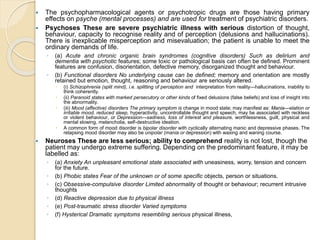
 The psychopharmacological agents or psychotropic drugs are those having primary
effects on psyche (mental processes) and are used for treatment of psychiatric disorders.
 Psychoses These are severe psychiatric illness with serious distortion of thought,
behaviour, capacity to recognise reality and of perception (delusions and hallucinations).
There is inexplicable misperception and misevaluation; the patient is unable to meet the
ordinary demands of life.
◦ (a) Acute and chronic organic brain syndromes (cognitive disorders) Such as delirium and
dementia with psychotic features; some toxic or pathological basis can often be defined. Prominent
features are confusion, disorientation, defective memory, disorganized thought and behaviour.
◦ (b) Functional disorders No underlying cause can be defined; memory and orientation are mostly
retained but emotion, thought, reasoning and behaviour are seriously altered.
 (i) Schizophrenia (split mind), i.e. splitting of perception and interpretation from reality—hallucinations, inability to
think coherently.
 (ii) Paranoid states with marked persecutory or other kinds of fixed delusions (false beliefs) and loss of insight into
the abnormality.
 (iii) Mood (affective) disorders The primary symptom is change in mood state; may manifest as: Mania—elation or
irritable mood, reduced sleep, hyperactivity, uncontrollable thought and speech, may be associated with reckless
or violent behaviour, or Depression—sadness, loss of interest and pleasure, worthlessness, guilt, physical and
mental slowing, melancholia, self-destructive ideation.
 A common form of mood disorder is bipolar disorder with cyclically alternating manic and depressive phases. The
relapsing mood disorder may also be unipolar (mania or depression) with waxing and waning course.
 Neuroses These are less serious; ability to comprehend reality is not lost, though the
patient may undergo extreme suffering. Depending on the predominant feature, it may be
labelled as:
◦ (a) Anxiety An unpleasant emotional state associated with uneasiness, worry, tension and concern
for the future.
◦ (b) Phobic states Fear of the unknown or of some specific objects, person or situations.
◦ (c) Obsessive-compulsive disorder Limited abnormality of thought or behaviour; recurrent intrusive
thoughts
◦ (d) Reactive depression due to physical illness
◦ (e) Post-traumatic stress disorder Varied symptoms
◦ (f) Hysterical Dramatic symptoms resembling serious physical illness,
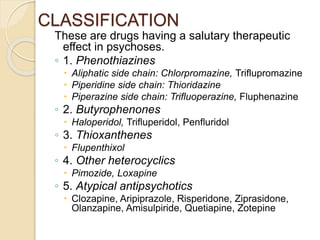
CLASSIFICATION
These are drugs having a salutary therapeutic
effect in psychoses.
◦ 1. Phenothiazines
 Aliphatic side chain: Chlorpromazine, Triflupromazine
 Piperidine side chain: Thioridazine
 Piperazine side chain: Trifluoperazine, Fluphenazine
◦ 2. Butyrophenones
 Haloperidol, Trifluperidol, Penfluridol
◦ 3. Thioxanthenes
 Flupenthixol
◦ 4. Other heterocyclics
 Pimozide, Loxapine
◦ 5. Atypical antipsychotics
 Clozapine, Aripiprazole, Risperidone, Ziprasidone,
Olanzapine, Amisulpiride, Quetiapine, Zotepine
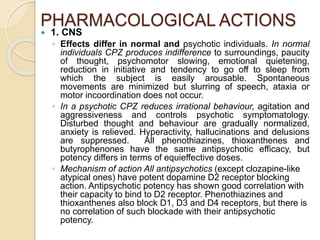
PHARMACOLOGICAL ACTIONS
 1. CNS
◦ Effects differ in normal and psychotic individuals. In normal
individuals CPZ produces indifference to surroundings, paucity
of thought, psychomotor slowing, emotional quietening,
reduction in initiative and tendency to go off to sleep from
which the subject is easily arousable. Spontaneous
movements are minimized but slurring of speech, ataxia or
motor incoordination does not occur.
◦ In a psychotic CPZ reduces irrational behaviour, agitation and
aggressiveness and controls psychotic symptomatology.
Disturbed thought and behaviour are gradually normalized,
anxiety is relieved. Hyperactivity, hallucinations and delusions
are suppressed. All phenothiazines, thioxanthenes and
butyrophenones have the same antipsychotic efficacy, but
potency differs in terms of equieffective doses.
◦ Mechanism of action All antipsychotics (except clozapine-like
atypical ones) have potent dopamine D2 receptor blocking
action. Antipsychotic potency has shown good correlation with
their capacity to bind to D2 receptor. Phenothiazines and
thioxanthenes also block D1, D3 and D4 receptors, but there is
no correlation of such blockade with their antipsychotic
potency.
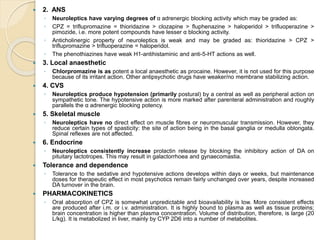
 2. ANS
◦ Neuroleptics have varying degrees of α adrenergic blocking activity which may be graded as:
◦ CPZ = triflupromazine = thioridazine > clozapine > fluphenazine > haloperidol > trifluoperazine >
pimozide, i.e. more potent compounds have lesser α blocking activity.
◦ Anticholinergic property of neuroleptics is weak and may be graded as: thioridazine > CPZ >
triflupromazine > trifluoperazine = haloperidol.
◦ The phenothiazines have weak H1-antihistaminic and anti-5-HT actions as well.
 3. Local anaesthetic
◦ Chlorpromazine is as potent a local anaesthetic as procaine. However, it is not used for this purpose
because of its irritant action. Other antipsychotic drugs have weaker/no membrane stabilizing action.
 4. CVS
◦ Neuroleptics produce hypotension (primarily postural) by a central as well as peripheral action on
sympathetic tone. The hypotensive action is more marked after parenteral administration and roughly
parallels the α adrenergic blocking potency.
 5. Skeletal muscle
◦ Neuroleptics have no direct effect on muscle fibres or neuromuscular transmission. However, they
reduce certain types of spasticity: the site of action being in the basal ganglia or medulla oblongata.
Spinal reflexes are not affected.
 6. Endocrine
◦ Neuroleptics consistently increase prolactin release by blocking the inhibitory action of DA on
pituitary lactotropes. This may result in galactorrhoea and gynaecomastia.
 Tolerance and dependence
◦ Tolerance to the sedative and hypotensive actions develops within days or weeks, but maintenance
doses for therapeutic effect in most psychotics remain fairly unchanged over years, despite increased
DA turnover in the brain.
 PHARMACOKINETICS
◦ Oral absorption of CPZ is somewhat unpredictable and bioavailability is low. More consistent effects
are produced after i.m. or i.v. administration. It is highly bound to plasma as well as tissue proteins;
brain concentration is higher than plasma concentration. Volume of distribution, therefore, is large (20
L/kg). It is metabolized in liver, mainly by CYP 2D6 into a number of metabolites.
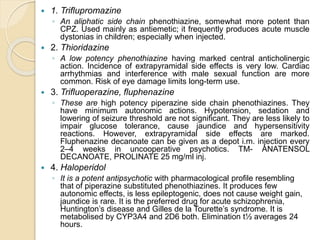
 1. Triflupromazine
◦ An aliphatic side chain phenothiazine, somewhat more potent than
CPZ. Used mainly as antiemetic; it frequently produces acute muscle
dystonias in children; especially when injected.
 2. Thioridazine
◦ A low potency phenothiazine having marked central anticholinergic
action. Incidence of extrapyramidal side effects is very low. Cardiac
arrhythmias and interference with male sexual function are more
common. Risk of eye damage limits long-term use.
 3. Trifluoperazine, fluphenazine
◦ These are high potency piperazine side chain phenothiazines. They
have minimum autonomic actions. Hypotension, sedation and
lowering of seizure threshold are not significant. They are less likely to
impair glucose tolerance, cause jaundice and hypersensitivity
reactions. However, extrapyramidal side effects are marked.
Fluphenazine decanoate can be given as a depot i.m. injection every
2–4 weeks in uncooperative psychotics. TM- ANATENSOL
DECANOATE, PROLINATE 25 mg/ml inj.
 4. Haloperidol
◦ It is a potent antipsychotic with pharmacological profile resembling
that of piperazine substituted phenothiazines. It produces few
autonomic effects, is less epileptogenic, does not cause weight gain,
jaundice is rare. It is the preferred drug for acute schizophrenia,
Huntington’s disease and Gilles de la Tourette’s syndrome. It is
metabolised by CYP3A4 and 2D6 both. Elimination t½ averages 24
hours.
 5. Trifluperidol
◦ It is similar to but slightly more potent than haloperidol.
 6. Penfluridol
◦ An exceptionally long acting neuroleptic, recommended for
chronic schizophrenia, affective withdrawal and social
maladjustment. Dose: 20–60 mg oral (max 120 mg) once
weekly; SEMAP, FLUMAP, PENFLUR 20 mg tab.
 7. Flupenthixol
◦ This thioxanthine is less sedating than CPZ; indicated in
schizophrenia and other psychoses, particularly in withdrawn
and apathetic patients, but not in those with psychomotor
agitation or mania. Infrequently used now.
 8. Pimozide
◦ It is a selective DA antagonist with little α adrenergic or
cholinergic blocking activity. Because of long duration of action
(several days; elimination t½ 48–60 hours) after a single oral
dose, it is considered good for maintenance therapy but not
when psychomotor agitation is prominent. Incidence of dystonic
 9. Loxapine
◦ A dibenzoxazepine having CPZ like DA blocking and
antipsychotic activity. The actions are quick and short lasting (t½
8 hr).
 ATYPICAL (Second generation) ANTIPSYCHOTICS
 1. Clozapine
◦ It is the first atypical antipsychotic; pharmacologically distinct from CPZ and related
drugs in that it has only weak D2 blocking action, produces few/no extrapyramidal
symptoms; tardive dyskinesia is rare and prolactin level does not rise.
 2. Risperidone
◦ Another compound whose antipsychotic activity has been ascribed to a combination
of D2 + 5-HT2 receptor blockade.
 3. Olanzapine
◦ This atypical antipsychotic; resembles clozapine in blocking multiple monoaminergic
(D2, 5-HT2, α1, α2) as well as muscarinic and H1 receptors.
 4. Quetiapine
◦ This new short-acting (t½ 6 hours) atypical antipsychotic requires twice daily dosing.
It blocks 5-HT1A, 5-HT2, D2, α1, α2 and H1 receptors in the brain, but D2 blocking
activity is low: extrapyramidal and hyperprolactinaemic side effects are minimal.
 5. Aripiprazole
 This atypical antipsychotic is unique in being a partial agonist at D2 and
5-HT1A receptor, but antagonist at 5-HT2 receptor. Aripiprazole is quite long-
acting (t½ ~ 3 days); dose adjustments should be done after 2 weeks
treatment
 6. Ziprasidone
 Another atypical antipsychotic with combined D2 + 5-HT2A/2C + H1+ α1blocking
activity. Antagonistic action at 5-HT1D + agonistic activity at 5-HT1A receptors
along with moderately potent inhibition of 5-HT and NA reuptake
indicates some anxiolytic and antidepressant property as well. The t½ of
ziprasidone is ~8 hours; needs twice daily dosing.
 7. Amisulpiride
◦ This congener of Sulpiride (typical antipsychotic) is categorized with the atypical
antipsychotics because it produces few extrapyramidal side effects and improves many
negative symptoms of schizophrenia as well. Amisulpiride is absorbed orally and
mainly excreted unchanged in urine with a t½ of 12 hours. Dose: 50–300 mg/day in 2
doses for schizophrenia with predominant negative symptoms. Also for acute
psychosis 200–400 mg BD. TM -SULPITAC, AMIPRIDE, ZONAPRIDE 50, 100, 200 mg
tabs.
 8. Zotepine
◦ Another atypical antipsychotic with dopamine D2+D1, 5-HT2, α1 adrenergic and
histamine H1 receptor blocking activities. Dose: Initially 25 mg TDS; increase upto 100
mg TDS. ZOLEPTIL, NIPOLEPT 25, 50 mg tabs.
 ADVERSE EFFECTS
◦ Antipsychotics are very safe drugs in single or infrequent doses: deaths from overdose
are almost unknown. However, side effects are common and often limit their use.
◦ 1. CNS Drowsiness, lethargy, mental confusion
◦ 2. CVS Postural hypotension, palpitation, inhibition of ejaculation
◦ 3. Anticholinergic Dry mouth, blurring of vision, constipation, urinary hesitancy in
elderly males
◦ 4. Endocrine Hyperprolactinemia (due to D2 blockade) is common with typical
neuroleptics and risperidone.
 USES
◦ 1. Psychoses – Schizophrenia, Mania, Organic brain syndromes
◦ Anxiety
◦ As antiemetic
To be continued…………..

Tranquilisers

  • 1.
  • 2.
  • 3.
     A tranquilizeris an old term which refers to a drug which is designed for the treatment of anxiety, fear, tension, agitation, and disturbances of mind specifically to reduce states of anxiety and tension.  Minor tranquilizer usually refers to anxiolytic.  Major might refer to antipsychotics  the psychotropic drugs may be grouped into: ◦ Antipsychotic (neuroleptic, ataractic, major tranquillizer)-  useful in all types of functional psychosis, especially schizophrenia. (The term ‘Neuroleptic’ is applied to chlorpromazine/haloperidol like conventional antipsychotic drugs which have potent D2 receptor blocking activity and produce psychic indifference, emotional quietening with extrapyramidal symptoms, but without causing ataxia or cognitive impairment.) ◦ Antimanic (mood stabiliser)-  used to control mania and to break into cyclic affective disorders. ◦ Antidepressants-  used for minor as well as major depressive illness, phobic states, obsessive- compulsive behaviour, and certain anxiety disorders. ◦ Antianxiety (anxiolytic-sedative, minor tranquillizer)-  used for anxiety and phobic states. ◦ Psychotomimetic (psychedelic, psychodysleptic, hallucinogen).  They are seldom used therapeutically, but produce psychosis-like states. Majority of them are drugs of abuse, e.g. cannabis, LSD.
  • 4.
  • 5.
     The psychopharmacologicalagents or psychotropic drugs are those having primary effects on psyche (mental processes) and are used for treatment of psychiatric disorders.  Psychoses These are severe psychiatric illness with serious distortion of thought, behaviour, capacity to recognise reality and of perception (delusions and hallucinations). There is inexplicable misperception and misevaluation; the patient is unable to meet the ordinary demands of life. ◦ (a) Acute and chronic organic brain syndromes (cognitive disorders) Such as delirium and dementia with psychotic features; some toxic or pathological basis can often be defined. Prominent features are confusion, disorientation, defective memory, disorganized thought and behaviour. ◦ (b) Functional disorders No underlying cause can be defined; memory and orientation are mostly retained but emotion, thought, reasoning and behaviour are seriously altered.  (i) Schizophrenia (split mind), i.e. splitting of perception and interpretation from reality—hallucinations, inability to think coherently.  (ii) Paranoid states with marked persecutory or other kinds of fixed delusions (false beliefs) and loss of insight into the abnormality.  (iii) Mood (affective) disorders The primary symptom is change in mood state; may manifest as: Mania—elation or irritable mood, reduced sleep, hyperactivity, uncontrollable thought and speech, may be associated with reckless or violent behaviour, or Depression—sadness, loss of interest and pleasure, worthlessness, guilt, physical and mental slowing, melancholia, self-destructive ideation.  A common form of mood disorder is bipolar disorder with cyclically alternating manic and depressive phases. The relapsing mood disorder may also be unipolar (mania or depression) with waxing and waning course.  Neuroses These are less serious; ability to comprehend reality is not lost, though the patient may undergo extreme suffering. Depending on the predominant feature, it may be labelled as: ◦ (a) Anxiety An unpleasant emotional state associated with uneasiness, worry, tension and concern for the future. ◦ (b) Phobic states Fear of the unknown or of some specific objects, person or situations. ◦ (c) Obsessive-compulsive disorder Limited abnormality of thought or behaviour; recurrent intrusive thoughts ◦ (d) Reactive depression due to physical illness ◦ (e) Post-traumatic stress disorder Varied symptoms ◦ (f) Hysterical Dramatic symptoms resembling serious physical illness,
  • 6.
    CLASSIFICATION These are drugshaving a salutary therapeutic effect in psychoses. ◦ 1. Phenothiazines  Aliphatic side chain: Chlorpromazine, Triflupromazine  Piperidine side chain: Thioridazine  Piperazine side chain: Trifluoperazine, Fluphenazine ◦ 2. Butyrophenones  Haloperidol, Trifluperidol, Penfluridol ◦ 3. Thioxanthenes  Flupenthixol ◦ 4. Other heterocyclics  Pimozide, Loxapine ◦ 5. Atypical antipsychotics  Clozapine, Aripiprazole, Risperidone, Ziprasidone, Olanzapine, Amisulpiride, Quetiapine, Zotepine
  • 7.
    PHARMACOLOGICAL ACTIONS  1.CNS ◦ Effects differ in normal and psychotic individuals. In normal individuals CPZ produces indifference to surroundings, paucity of thought, psychomotor slowing, emotional quietening, reduction in initiative and tendency to go off to sleep from which the subject is easily arousable. Spontaneous movements are minimized but slurring of speech, ataxia or motor incoordination does not occur. ◦ In a psychotic CPZ reduces irrational behaviour, agitation and aggressiveness and controls psychotic symptomatology. Disturbed thought and behaviour are gradually normalized, anxiety is relieved. Hyperactivity, hallucinations and delusions are suppressed. All phenothiazines, thioxanthenes and butyrophenones have the same antipsychotic efficacy, but potency differs in terms of equieffective doses. ◦ Mechanism of action All antipsychotics (except clozapine-like atypical ones) have potent dopamine D2 receptor blocking action. Antipsychotic potency has shown good correlation with their capacity to bind to D2 receptor. Phenothiazines and thioxanthenes also block D1, D3 and D4 receptors, but there is no correlation of such blockade with their antipsychotic potency.
  • 8.
     2. ANS ◦Neuroleptics have varying degrees of α adrenergic blocking activity which may be graded as: ◦ CPZ = triflupromazine = thioridazine > clozapine > fluphenazine > haloperidol > trifluoperazine > pimozide, i.e. more potent compounds have lesser α blocking activity. ◦ Anticholinergic property of neuroleptics is weak and may be graded as: thioridazine > CPZ > triflupromazine > trifluoperazine = haloperidol. ◦ The phenothiazines have weak H1-antihistaminic and anti-5-HT actions as well.  3. Local anaesthetic ◦ Chlorpromazine is as potent a local anaesthetic as procaine. However, it is not used for this purpose because of its irritant action. Other antipsychotic drugs have weaker/no membrane stabilizing action.  4. CVS ◦ Neuroleptics produce hypotension (primarily postural) by a central as well as peripheral action on sympathetic tone. The hypotensive action is more marked after parenteral administration and roughly parallels the α adrenergic blocking potency.  5. Skeletal muscle ◦ Neuroleptics have no direct effect on muscle fibres or neuromuscular transmission. However, they reduce certain types of spasticity: the site of action being in the basal ganglia or medulla oblongata. Spinal reflexes are not affected.  6. Endocrine ◦ Neuroleptics consistently increase prolactin release by blocking the inhibitory action of DA on pituitary lactotropes. This may result in galactorrhoea and gynaecomastia.  Tolerance and dependence ◦ Tolerance to the sedative and hypotensive actions develops within days or weeks, but maintenance doses for therapeutic effect in most psychotics remain fairly unchanged over years, despite increased DA turnover in the brain.  PHARMACOKINETICS ◦ Oral absorption of CPZ is somewhat unpredictable and bioavailability is low. More consistent effects are produced after i.m. or i.v. administration. It is highly bound to plasma as well as tissue proteins; brain concentration is higher than plasma concentration. Volume of distribution, therefore, is large (20 L/kg). It is metabolized in liver, mainly by CYP 2D6 into a number of metabolites.
  • 9.
     1. Triflupromazine ◦An aliphatic side chain phenothiazine, somewhat more potent than CPZ. Used mainly as antiemetic; it frequently produces acute muscle dystonias in children; especially when injected.  2. Thioridazine ◦ A low potency phenothiazine having marked central anticholinergic action. Incidence of extrapyramidal side effects is very low. Cardiac arrhythmias and interference with male sexual function are more common. Risk of eye damage limits long-term use.  3. Trifluoperazine, fluphenazine ◦ These are high potency piperazine side chain phenothiazines. They have minimum autonomic actions. Hypotension, sedation and lowering of seizure threshold are not significant. They are less likely to impair glucose tolerance, cause jaundice and hypersensitivity reactions. However, extrapyramidal side effects are marked. Fluphenazine decanoate can be given as a depot i.m. injection every 2–4 weeks in uncooperative psychotics. TM- ANATENSOL DECANOATE, PROLINATE 25 mg/ml inj.  4. Haloperidol ◦ It is a potent antipsychotic with pharmacological profile resembling that of piperazine substituted phenothiazines. It produces few autonomic effects, is less epileptogenic, does not cause weight gain, jaundice is rare. It is the preferred drug for acute schizophrenia, Huntington’s disease and Gilles de la Tourette’s syndrome. It is metabolised by CYP3A4 and 2D6 both. Elimination t½ averages 24 hours.
  • 10.
     5. Trifluperidol ◦It is similar to but slightly more potent than haloperidol.  6. Penfluridol ◦ An exceptionally long acting neuroleptic, recommended for chronic schizophrenia, affective withdrawal and social maladjustment. Dose: 20–60 mg oral (max 120 mg) once weekly; SEMAP, FLUMAP, PENFLUR 20 mg tab.  7. Flupenthixol ◦ This thioxanthine is less sedating than CPZ; indicated in schizophrenia and other psychoses, particularly in withdrawn and apathetic patients, but not in those with psychomotor agitation or mania. Infrequently used now.  8. Pimozide ◦ It is a selective DA antagonist with little α adrenergic or cholinergic blocking activity. Because of long duration of action (several days; elimination t½ 48–60 hours) after a single oral dose, it is considered good for maintenance therapy but not when psychomotor agitation is prominent. Incidence of dystonic  9. Loxapine ◦ A dibenzoxazepine having CPZ like DA blocking and antipsychotic activity. The actions are quick and short lasting (t½ 8 hr).
  • 11.
     ATYPICAL (Secondgeneration) ANTIPSYCHOTICS  1. Clozapine ◦ It is the first atypical antipsychotic; pharmacologically distinct from CPZ and related drugs in that it has only weak D2 blocking action, produces few/no extrapyramidal symptoms; tardive dyskinesia is rare and prolactin level does not rise.  2. Risperidone ◦ Another compound whose antipsychotic activity has been ascribed to a combination of D2 + 5-HT2 receptor blockade.  3. Olanzapine ◦ This atypical antipsychotic; resembles clozapine in blocking multiple monoaminergic (D2, 5-HT2, α1, α2) as well as muscarinic and H1 receptors.  4. Quetiapine ◦ This new short-acting (t½ 6 hours) atypical antipsychotic requires twice daily dosing. It blocks 5-HT1A, 5-HT2, D2, α1, α2 and H1 receptors in the brain, but D2 blocking activity is low: extrapyramidal and hyperprolactinaemic side effects are minimal.  5. Aripiprazole  This atypical antipsychotic is unique in being a partial agonist at D2 and 5-HT1A receptor, but antagonist at 5-HT2 receptor. Aripiprazole is quite long- acting (t½ ~ 3 days); dose adjustments should be done after 2 weeks treatment  6. Ziprasidone  Another atypical antipsychotic with combined D2 + 5-HT2A/2C + H1+ α1blocking activity. Antagonistic action at 5-HT1D + agonistic activity at 5-HT1A receptors along with moderately potent inhibition of 5-HT and NA reuptake indicates some anxiolytic and antidepressant property as well. The t½ of ziprasidone is ~8 hours; needs twice daily dosing.
  • 12.
     7. Amisulpiride ◦This congener of Sulpiride (typical antipsychotic) is categorized with the atypical antipsychotics because it produces few extrapyramidal side effects and improves many negative symptoms of schizophrenia as well. Amisulpiride is absorbed orally and mainly excreted unchanged in urine with a t½ of 12 hours. Dose: 50–300 mg/day in 2 doses for schizophrenia with predominant negative symptoms. Also for acute psychosis 200–400 mg BD. TM -SULPITAC, AMIPRIDE, ZONAPRIDE 50, 100, 200 mg tabs.  8. Zotepine ◦ Another atypical antipsychotic with dopamine D2+D1, 5-HT2, α1 adrenergic and histamine H1 receptor blocking activities. Dose: Initially 25 mg TDS; increase upto 100 mg TDS. ZOLEPTIL, NIPOLEPT 25, 50 mg tabs.  ADVERSE EFFECTS ◦ Antipsychotics are very safe drugs in single or infrequent doses: deaths from overdose are almost unknown. However, side effects are common and often limit their use. ◦ 1. CNS Drowsiness, lethargy, mental confusion ◦ 2. CVS Postural hypotension, palpitation, inhibition of ejaculation ◦ 3. Anticholinergic Dry mouth, blurring of vision, constipation, urinary hesitancy in elderly males ◦ 4. Endocrine Hyperprolactinemia (due to D2 blockade) is common with typical neuroleptics and risperidone.  USES ◦ 1. Psychoses – Schizophrenia, Mania, Organic brain syndromes ◦ Anxiety ◦ As antiemetic
  • 13.