 WHO definition:
3 or more loose or watery stools in a 24hr
period
 Diarrhoea constitute a major cause of
morbidity and mortality
 In India around 1000 children die every day
 Recurrent diarrhoea is also a major cause of
protein calorie malnutrition
Pathology:
 It occurs due to passage of excess water in
faeces
 Decreased electrolyte and water absorption
 Increased secretion by intestinal mucosa
 Increased luminal osmotic load
 Inflammation of mucosa and exudation into
lumen
 Most of the diarrhoeas are self limiting
 Therapeutic measures are
A. Treatment of fluid depletion, shock, acidosis
B. Maintenance of nutrition
C. Drug therapy
Intravenous rehydration:
 Needed only when
1. Fluid loss is severe i.e >10% of body weight
2. If the patient is losing >10 ml/kg/hr
3. Unable to take enough oral fluids
 The recommended composition of i.v fluid is
NaCl - 85 mM - 5 g
KCl - 13 mM - 1 g
NaHCO3 - 48mM - 4 g
in 1 l of water or 5% glucose solution
 Volume equivalent to 10% of BW should be
infused over 2-4 hrs
 Oral rehydration is possible if glucose is
added with salt
 It capitalizes on the intactness of glucose
coupled Na+ absorption
 It should be isotonic or hypotonic to plasma
 The molar ratio of glucose should be equal to
or heigher than sodium
 Enough K+ and bicarbonate/ citrate should be
added to make up the losses in stool
Formula WHO – ORS:
 Standard ORS osmolarity is 310mOsm/l
 New formula ORS osmolarity is 245 mOsm/l
 Low sodium low glucose
 Faster water absorption
 Precludes risk of hypernatremia
 cheaper
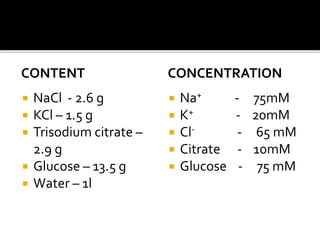
CONTENT
 NaCl - 2.6 g
 KCl – 1.5 g
 Trisodium citrate –
2.9 g
 Glucose – 13.5 g
 Water – 1l
CONCENTRATION
 Na+ - 75mM
 K+ - 20mM
 Cl- - 65 mM
 Citrate - 10mM
 Glucose - 75 mM
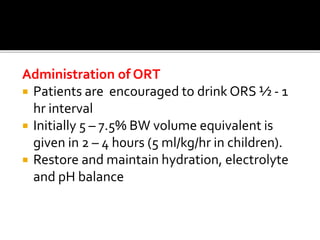
Administration of ORT
 Patients are encouraged to drink ORS ½ - 1
hr interval
 Initially 5 – 7.5% BW volume equivalent is
given in 2 – 4 h0urs (5 ml/kg/hr in children).
 Restore and maintain hydration, electrolyte
and pH balance
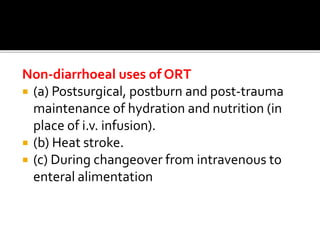
Non-diarrhoeal uses of ORT
 (a) Postsurgical, postburn and post-trauma
maintenance of hydration and nutrition (in
place of i.v. infusion).
 (b) Heat stroke.
 (c) During changeover from intravenous to
enteral alimentation
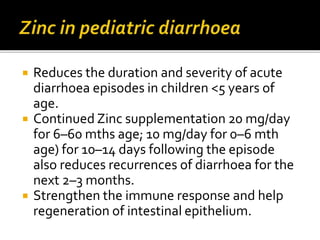
 Reduces the duration and severity of acute
diarrhoea episodes in children <5 years of
age.
 Continued Zinc supplementation 20 mg/day
for 6–60 mths age; 10 mg/day for 0–6 mth
age) for 10–14 days following the episode
also reduces recurrences of diarrhoea for the
next 2–3 months.
 Strengthen the immune response and help
regeneration of intestinal epithelium.
 Patients of diarrhoea should not be starved
 Feeding during diarrhoea has been shown to
increase intestinal digestive enzymes and cell
proliferation in mucosa.
 Simple foods like breast milk or ½ strength
buffalo milk, boiled potato, rice, chicken
soup, banana, sago, etc. should be given
 Drugs used in diarrhoeas may be categorised
into:
1. Specific antimicrobial drugs
2. Probiotics
3. Drugs for inflammatory bowel disease
(IBD)
4. Nonspecific antidiarrhoeal drugs.
 Have a limited role in the overall treatment of
diarrhoeal diseases;
 The reasons are:
• Bacterial pathogen is responsible for only a
fraction of cases.
• Even in bacterial diarrhoea, antimicrobials
alter the course of illness only in selected
cases.
• Antimicrobials may prolong the carrier
state.
 Irritable bowel syndrome (IBS)
 Coeliac disease
 Pancreatic enzyme deficiency
 Tropical sprue
 Thyrotoxicosis.
 Rotavirus induced diarrhoea
 Salmonella food poisoning is generally a
selflimiting disease.Antibiotics have been
widely used, but may be harmful rather than
beneficial
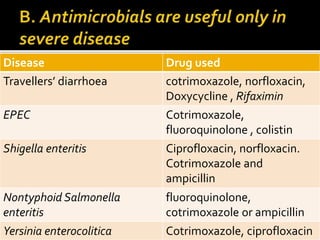
Disease Drug used
Travellers’ diarrhoea cotrimoxazole, norfloxacin,
Doxycycline , Rifaximin
EPEC Cotrimoxazole,
fluoroquinolone , colistin
Shigella enteritis Ciprofloxacin, norfloxacin.
Cotrimoxazole and
ampicillin
Nontyphoid Salmonella
enteritis
fluoroquinolone,
cotrimoxazole or ampicillin
Yersinia enterocolitica Cotrimoxazole, ciprofloxacin
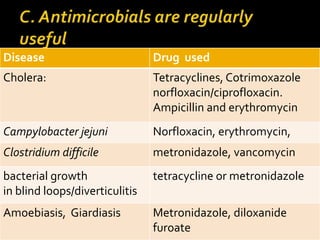
Disease Drug used
Cholera: Tetracyclines, Cotrimoxazole
norfloxacin/ciprofloxacin.
Ampicillin and erythromycin
Campylobacter jejuni Norfloxacin, erythromycin,
Clostridium difficile metronidazole, vancomycin
bacterial growth
in blind loops/diverticulitis
tetracycline or metronidazole
Amoebiasis, Giardiasis Metronidazole, diloxanide
furoate
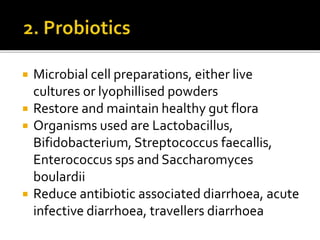
 Microbial cell preparations, either live
cultures or lyophillised powders
 Restore and maintain healthy gut flora
 Organisms used are Lactobacillus,
Bifidobacterium, Streptococcus faecallis,
Enterococcus sps and Saccharomyces
boulardii
 Reduce antibiotic associated diarrhoea, acute
infective diarrhoea, travellers diarrhoea
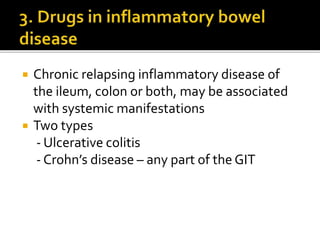
 Chronic relapsing inflammatory disease of
the ileum, colon or both, may be associated
with systemic manifestations
 Two types
- Ulcerative colitis
- Crohn’s disease – any part of the GIT
Drugs used in IBD can be grouped into:
 5 amino salicylic acid
 Corticosteroids
 Immunosuppressants
 TNF alpha inhibitors
 Antibiotics like metronidazole/ ciprofloxacin
 Anti integrin monoclonal antibody -
Natalizumab
Sulfasalazine:
 5 aminosalicylic acid with sufapyridine linked
through azo bond
 Low solubility, poorly absorbed from ileum
 Azo bond split by colonic bacteria to 5 ASA
and sulfapyridine.
 5 ASA exerts local anti-inflammatory effect
 Reduces number of stools, abdominal cramps
and fever
 A dose of 3-4 g/day gives remission
 Maintenance dose therapy with 1.5- 2 g/day
 Most useful in ulcerative colitis
 Sulfapyridine acts as carrier for 5 ASA to the
colon. Has therapeutic effect in RA
 Side effects - rashes, fever, joint pains,
haemolysis and blood dyscrasias, nausea,
vomiting, headache, malaise and anaemia
Mesalazine:
 5 ASA compond,
 Primary use in preventing relapse of UC
 Better tolerated
 Side effects: nausea, diarrhoea, abdominal pain.
 Nephrotoxic
 Enhance the gastric toxicity of corticosteroids
and hypoglycemic action of sulfonylureas
 4g enema once or twice daily is effective in distal
Olsalazine:
 Consist of 2 molecules of 5 ASA together by
azo bond
Balsalazine:
 5 ASA linked to 4 aminobenzoyl β alanine
 Dose: 1.5g bd to 2.25g tds
 Prednisolone 40 – 60 mg/day effective in
controlling remission in both UC and CD
 Symptomatice relief starts within 3-7 days
and remission is induced in 2-3 wks
 In severe cases with systemic manifestations
i.v. Methylprednisolone 40 – 60 mg 12 to 24
hrly for few days
 Hydrocortisone enema or foam can be used
for topical treatment of proctitis
 Generally used for short term
 Neither effective nor suitable for maintaining
remission
 Long term management of IBD especially
CrD
Azathioprine: purine antimetabolite
 indicated in steroid resistant, steroid
dependent and severe cases of IBD
 Side effects bone marrow hyper sensitivity
 Dose 1.5 -2 mg/kg/day
Methotrexate:
 Dihydrofolate reductase inhibitor
 Acts faster than azathioprine
 Doses effective in IBD are higher than those
for RA
 Weekly parenteral therapy is needed
 Toxicity is more
Cyclosporine:
 Potent immunosuppresant used in UC
 I.V. Cyclosporine usually controls symptoms
in 7-10 days, bridge therapy for 2-3 mnths till
azathioprine takes effects
 Renal toxicity
 Poor efficacy in IBD
TNF alpha inhibitors:
INFLIXIMAB, ADALIMUMAB,
CERTOLIZUMAB:
 Indicated in severe activeCrD, fistulating Crd
and severe UC
 Infused every 2-8 wks, it decreases acute
flareups and helps in fistula closure
 Absorbants and adsorbants
 Antisecretary drugs
 Antimotility drugs
 Colloidal bulk forming substances like
isphagula, methyl cellulose, carboxy methyl
cellulose which absorbs water and swell
 Modify consistency and frequency of stools
 Useful in diarrhoeal phase of IBS
 Adsorbants like kaolin, pectin adsorb
bacterial toxins in the gut and protects
mucosa
Racecadotril:
 Prodrug that rapidly converted to thiorphan
 Prevents degradation of endogenous
enkephalins
 Decreases intestinal hypersecretion
 Indicated in short term treatment of acute
secretary diarrhoea
 T1/2 is 3 hrs
 Side effects: nausea, vomiting, drowsiness,
flatulance
 Dose: 100mg tds
Bismuth subsalicylate:
 Taken as suspension 60ml 6hrly
 Decreases PG synthesis
 Reduces Cl secretion
 Prophylactic value in travellers diarrhoea
Anticholinergic:
 Atropinic drugs reduce bowel motility and
secretion
 Benefit in nervous /drug induced diarrhoea
 Provide symptamatic relief in dysenteries,
diverticulitis
Octreotide
 Somatostatin analogue
 Have long halflife. t1/2 is 90 mins
 Has antisecretory and antimotility action
 Used to control diarrhoea in carcinoid and
vasoactive intestinal peptide secreting
tumours and for refractory diarrhoea in AIDS
patients given by S.C injection
 Opioid drugs which increase small bowel tone
and segmental activity, reduce propulsive
movements and diminish intestinal
secretions
 Symptomatic relief in diarrhoea
 They increase the resistance to luminal
transit and allow more time for the
absorptive process
Codeine:
 Alkaloid
 Prominent constipating activity
 60mg tds
 Dependence potential
Diphenoxylate:2.5mg + atropine 0.025mg
 Synthetic opioid, chemically related to
pethidine
 Crosses blood brain barrier – CNS effects
 Abuse liability is low
 Causes respiratory depression, paralytic ileus
and toxic megacolon in children
 Contraindicated in children below 6 yrs
Loperamide:
 Opiate analogue with weak antichollinergic
property
 Poor water solubility
 Longer duration of action
 Also inhibits secretion
 Side effects are abdominal cramps and rashes
and paralytic ileus and toxic megacolon in
children
 contraindicated in children < 4yrs
 Use in noninfective diarrhoea, mild travellers
diarrhoea
 Contraindicated in infective diarrhoea – delay
the clearance of pathogen
 Careful use in mild IBD
 Can be used to induce short term
constipation eg; after anal surgery, reduce
the volume, fluidity and bag cleaning
frequency in ileostomy/ colostomy patients
 A 35yr old man has come with complaint of
acute onset diarrhoea.The stools are
relatively small volume, liquid but not watery,
frothy and are preceded by gripping pain in
abdomen. Foul smelling wind, eructation and
mild fever are the other complaints. He has
passed 4 loose motions in the past 8 hrs and
there is no appetite. He admits to have eaten
spicy snacks last evening at a road side stall.
 Physical examination reveals body
temperature 101f, no signs of dehydration
but diffuse abdominal tenderness.A tentative
diagnosis of enteroinvasive diarrhoea is
made.
 Does this patient require rehydration
therapy?
 Should an antibiotic be prescribed? If so
which antibiotic is preferred?
 Should an antimotility drug to coprescribed
to reduce number of stools?
 Should any other symptomatic drug be given
to him?

Diarrhoea

  • 2.
     WHO definition: 3or more loose or watery stools in a 24hr period  Diarrhoea constitute a major cause of morbidity and mortality  In India around 1000 children die every day  Recurrent diarrhoea is also a major cause of protein calorie malnutrition
  • 3.
    Pathology:  It occursdue to passage of excess water in faeces  Decreased electrolyte and water absorption  Increased secretion by intestinal mucosa  Increased luminal osmotic load  Inflammation of mucosa and exudation into lumen
  • 4.
     Most ofthe diarrhoeas are self limiting  Therapeutic measures are A. Treatment of fluid depletion, shock, acidosis B. Maintenance of nutrition C. Drug therapy
  • 5.
    Intravenous rehydration:  Neededonly when 1. Fluid loss is severe i.e >10% of body weight 2. If the patient is losing >10 ml/kg/hr 3. Unable to take enough oral fluids
  • 6.
     The recommendedcomposition of i.v fluid is NaCl - 85 mM - 5 g KCl - 13 mM - 1 g NaHCO3 - 48mM - 4 g in 1 l of water or 5% glucose solution  Volume equivalent to 10% of BW should be infused over 2-4 hrs
  • 7.
     Oral rehydrationis possible if glucose is added with salt  It capitalizes on the intactness of glucose coupled Na+ absorption  It should be isotonic or hypotonic to plasma  The molar ratio of glucose should be equal to or heigher than sodium  Enough K+ and bicarbonate/ citrate should be added to make up the losses in stool
  • 8.
    Formula WHO –ORS:  Standard ORS osmolarity is 310mOsm/l  New formula ORS osmolarity is 245 mOsm/l  Low sodium low glucose  Faster water absorption  Precludes risk of hypernatremia  cheaper
  • 9.
    CONTENT  NaCl -2.6 g  KCl – 1.5 g  Trisodium citrate – 2.9 g  Glucose – 13.5 g  Water – 1l CONCENTRATION  Na+ - 75mM  K+ - 20mM  Cl- - 65 mM  Citrate - 10mM  Glucose - 75 mM
  • 10.
    Administration of ORT Patients are encouraged to drink ORS ½ - 1 hr interval  Initially 5 – 7.5% BW volume equivalent is given in 2 – 4 h0urs (5 ml/kg/hr in children).  Restore and maintain hydration, electrolyte and pH balance
  • 11.
    Non-diarrhoeal uses ofORT  (a) Postsurgical, postburn and post-trauma maintenance of hydration and nutrition (in place of i.v. infusion).  (b) Heat stroke.  (c) During changeover from intravenous to enteral alimentation
  • 12.
     Reduces theduration and severity of acute diarrhoea episodes in children <5 years of age.  Continued Zinc supplementation 20 mg/day for 6–60 mths age; 10 mg/day for 0–6 mth age) for 10–14 days following the episode also reduces recurrences of diarrhoea for the next 2–3 months.  Strengthen the immune response and help regeneration of intestinal epithelium.
  • 13.
     Patients ofdiarrhoea should not be starved  Feeding during diarrhoea has been shown to increase intestinal digestive enzymes and cell proliferation in mucosa.  Simple foods like breast milk or ½ strength buffalo milk, boiled potato, rice, chicken soup, banana, sago, etc. should be given
  • 14.
     Drugs usedin diarrhoeas may be categorised into: 1. Specific antimicrobial drugs 2. Probiotics 3. Drugs for inflammatory bowel disease (IBD) 4. Nonspecific antidiarrhoeal drugs.
  • 15.
     Have alimited role in the overall treatment of diarrhoeal diseases;  The reasons are: • Bacterial pathogen is responsible for only a fraction of cases. • Even in bacterial diarrhoea, antimicrobials alter the course of illness only in selected cases. • Antimicrobials may prolong the carrier state.
  • 16.
     Irritable bowelsyndrome (IBS)  Coeliac disease  Pancreatic enzyme deficiency  Tropical sprue  Thyrotoxicosis.  Rotavirus induced diarrhoea  Salmonella food poisoning is generally a selflimiting disease.Antibiotics have been widely used, but may be harmful rather than beneficial
  • 17.
    Disease Drug used Travellers’diarrhoea cotrimoxazole, norfloxacin, Doxycycline , Rifaximin EPEC Cotrimoxazole, fluoroquinolone , colistin Shigella enteritis Ciprofloxacin, norfloxacin. Cotrimoxazole and ampicillin Nontyphoid Salmonella enteritis fluoroquinolone, cotrimoxazole or ampicillin Yersinia enterocolitica Cotrimoxazole, ciprofloxacin
  • 18.
    Disease Drug used Cholera:Tetracyclines, Cotrimoxazole norfloxacin/ciprofloxacin. Ampicillin and erythromycin Campylobacter jejuni Norfloxacin, erythromycin, Clostridium difficile metronidazole, vancomycin bacterial growth in blind loops/diverticulitis tetracycline or metronidazole Amoebiasis, Giardiasis Metronidazole, diloxanide furoate
  • 19.
     Microbial cellpreparations, either live cultures or lyophillised powders  Restore and maintain healthy gut flora  Organisms used are Lactobacillus, Bifidobacterium, Streptococcus faecallis, Enterococcus sps and Saccharomyces boulardii  Reduce antibiotic associated diarrhoea, acute infective diarrhoea, travellers diarrhoea
  • 20.
     Chronic relapsinginflammatory disease of the ileum, colon or both, may be associated with systemic manifestations  Two types - Ulcerative colitis - Crohn’s disease – any part of the GIT
  • 21.
    Drugs used inIBD can be grouped into:  5 amino salicylic acid  Corticosteroids  Immunosuppressants  TNF alpha inhibitors  Antibiotics like metronidazole/ ciprofloxacin  Anti integrin monoclonal antibody - Natalizumab
  • 22.
    Sulfasalazine:  5 aminosalicylicacid with sufapyridine linked through azo bond  Low solubility, poorly absorbed from ileum  Azo bond split by colonic bacteria to 5 ASA and sulfapyridine.  5 ASA exerts local anti-inflammatory effect  Reduces number of stools, abdominal cramps and fever
  • 23.
     A doseof 3-4 g/day gives remission  Maintenance dose therapy with 1.5- 2 g/day  Most useful in ulcerative colitis  Sulfapyridine acts as carrier for 5 ASA to the colon. Has therapeutic effect in RA  Side effects - rashes, fever, joint pains, haemolysis and blood dyscrasias, nausea, vomiting, headache, malaise and anaemia
  • 24.
    Mesalazine:  5 ASAcompond,  Primary use in preventing relapse of UC  Better tolerated  Side effects: nausea, diarrhoea, abdominal pain.  Nephrotoxic  Enhance the gastric toxicity of corticosteroids and hypoglycemic action of sulfonylureas  4g enema once or twice daily is effective in distal
  • 25.
    Olsalazine:  Consist of2 molecules of 5 ASA together by azo bond Balsalazine:  5 ASA linked to 4 aminobenzoyl β alanine  Dose: 1.5g bd to 2.25g tds
  • 26.
     Prednisolone 40– 60 mg/day effective in controlling remission in both UC and CD  Symptomatice relief starts within 3-7 days and remission is induced in 2-3 wks  In severe cases with systemic manifestations i.v. Methylprednisolone 40 – 60 mg 12 to 24 hrly for few days  Hydrocortisone enema or foam can be used for topical treatment of proctitis
  • 27.
     Generally usedfor short term  Neither effective nor suitable for maintaining remission
  • 28.
     Long termmanagement of IBD especially CrD Azathioprine: purine antimetabolite  indicated in steroid resistant, steroid dependent and severe cases of IBD  Side effects bone marrow hyper sensitivity  Dose 1.5 -2 mg/kg/day
  • 29.
    Methotrexate:  Dihydrofolate reductaseinhibitor  Acts faster than azathioprine  Doses effective in IBD are higher than those for RA  Weekly parenteral therapy is needed  Toxicity is more
  • 30.
    Cyclosporine:  Potent immunosuppresantused in UC  I.V. Cyclosporine usually controls symptoms in 7-10 days, bridge therapy for 2-3 mnths till azathioprine takes effects  Renal toxicity  Poor efficacy in IBD
  • 31.
    TNF alpha inhibitors: INFLIXIMAB,ADALIMUMAB, CERTOLIZUMAB:  Indicated in severe activeCrD, fistulating Crd and severe UC  Infused every 2-8 wks, it decreases acute flareups and helps in fistula closure
  • 32.
     Absorbants andadsorbants  Antisecretary drugs  Antimotility drugs
  • 33.
     Colloidal bulkforming substances like isphagula, methyl cellulose, carboxy methyl cellulose which absorbs water and swell  Modify consistency and frequency of stools  Useful in diarrhoeal phase of IBS  Adsorbants like kaolin, pectin adsorb bacterial toxins in the gut and protects mucosa
  • 34.
    Racecadotril:  Prodrug thatrapidly converted to thiorphan  Prevents degradation of endogenous enkephalins  Decreases intestinal hypersecretion  Indicated in short term treatment of acute secretary diarrhoea  T1/2 is 3 hrs  Side effects: nausea, vomiting, drowsiness, flatulance  Dose: 100mg tds
  • 35.
    Bismuth subsalicylate:  Takenas suspension 60ml 6hrly  Decreases PG synthesis  Reduces Cl secretion  Prophylactic value in travellers diarrhoea
  • 36.
    Anticholinergic:  Atropinic drugsreduce bowel motility and secretion  Benefit in nervous /drug induced diarrhoea  Provide symptamatic relief in dysenteries, diverticulitis
  • 37.
    Octreotide  Somatostatin analogue Have long halflife. t1/2 is 90 mins  Has antisecretory and antimotility action  Used to control diarrhoea in carcinoid and vasoactive intestinal peptide secreting tumours and for refractory diarrhoea in AIDS patients given by S.C injection
  • 38.
     Opioid drugswhich increase small bowel tone and segmental activity, reduce propulsive movements and diminish intestinal secretions  Symptomatic relief in diarrhoea  They increase the resistance to luminal transit and allow more time for the absorptive process
  • 39.
    Codeine:  Alkaloid  Prominentconstipating activity  60mg tds  Dependence potential
  • 40.
    Diphenoxylate:2.5mg + atropine0.025mg  Synthetic opioid, chemically related to pethidine  Crosses blood brain barrier – CNS effects  Abuse liability is low  Causes respiratory depression, paralytic ileus and toxic megacolon in children  Contraindicated in children below 6 yrs
  • 41.
    Loperamide:  Opiate analoguewith weak antichollinergic property  Poor water solubility  Longer duration of action  Also inhibits secretion  Side effects are abdominal cramps and rashes and paralytic ileus and toxic megacolon in children  contraindicated in children < 4yrs
  • 42.
     Use innoninfective diarrhoea, mild travellers diarrhoea  Contraindicated in infective diarrhoea – delay the clearance of pathogen  Careful use in mild IBD  Can be used to induce short term constipation eg; after anal surgery, reduce the volume, fluidity and bag cleaning frequency in ileostomy/ colostomy patients
  • 43.
     A 35yrold man has come with complaint of acute onset diarrhoea.The stools are relatively small volume, liquid but not watery, frothy and are preceded by gripping pain in abdomen. Foul smelling wind, eructation and mild fever are the other complaints. He has passed 4 loose motions in the past 8 hrs and there is no appetite. He admits to have eaten spicy snacks last evening at a road side stall.
  • 44.
     Physical examinationreveals body temperature 101f, no signs of dehydration but diffuse abdominal tenderness.A tentative diagnosis of enteroinvasive diarrhoea is made.  Does this patient require rehydration therapy?  Should an antibiotic be prescribed? If so which antibiotic is preferred?
  • 45.
     Should anantimotility drug to coprescribed to reduce number of stools?  Should any other symptomatic drug be given to him?