ANTIDEPRESSANT
DRUGS
AND
MOOD STABILIZERS
Pharmacology
2020
DEPRESSION
 Depression-related illnesses are one of the
most common causes of ill health, productivity
losses and the inability to work and decreased
quality of life.
DEPRESSION
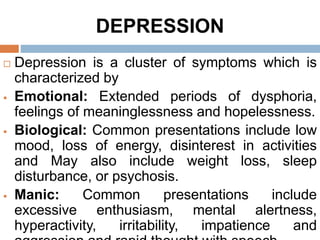
 Depression is a cluster of symptoms which is
characterized by
 Emotional: Extended periods of dysphoria,
feelings of meaninglessness and hopelessness.
 Biological: Common presentations include low
mood, loss of energy, disinterest in activities
and May also include weight loss, sleep
disturbance, or psychosis.
 Manic: Common presentations include
excessive enthusiasm, mental alertness,
hyperactivity, irritability, impatience and
DEPRESSION
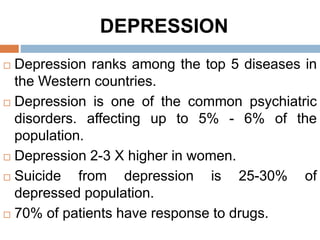
 Depression ranks among the top 5 diseases in
the Western countries.
 Depression is one of the common psychiatric
disorders. affecting up to 5% - 6% of the
population.
 Depression 2-3 X higher in women.
 Suicide from depression is 25-30% of
depressed population.
 70% of patients have response to drugs.
DIAGNOSIS
Types of Depressive Mood (Affective) Disorders:
Unipolar (depressive) and Bipolar (manic-
depressive)
 Unipolar (depressive) [reactive depression] in
which the patient swinging between normal mood
and depression caused by stressful life events.
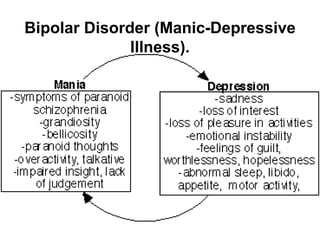
 Bipolar depressive disorder (Manic-Depressive
Illness) in which the patient swinging between
mania and depression caused by hereditary
DIAGNOSIS
I. Unipolar depression – depression alone
 Reactive or Secondary (Exogenous) (~60%)
Related to some “loss”, physical illness (MI,
Cancer), Drugs, Other psychiatric disorders
(senility).
 Major or Endogenous (~25%) No
clear/adequate precipitating event, re-current,
inability to exp. ordinary pleasure/cope with
DIAGNOSIS
II. Bipolar affective disorder – alternating.
Bipolar affective/ manic-depression (10-15%)
Episodes of mania associated with depression.
III. Depression alone - occasional
IV. Mania alone – rare
Bipolar Disorder (Manic-Depressive
Illness).
NEUROBIOLOGICAL THEORY BASIS
OF DEPRESSION
I. Monoamine (catecholamine) theory or
Hypothesis (deficiency in 5-HT and/or NE
and/or DA) (1965):
 The underlying biological or neuro-anatomical
basis for depression is a deficiency in the
amount of the monoamine neurotransmitters
[serotonin and/or norepinephrine and/or
dopamine] of the central noradrenergic and/or
serotonergic transmission in the brain [cortical
and limbic] including the frontal cortex,
NEUROBIOLOGICAL THEORY BASIS
OF DEPRESSION
 Serotonergic neurons originate within the brain
stem. 5-HT may be related to anxiety,
compulsions and sleep disturbances.
 The central noradrenergic neurotransmitter
system originates from two distinct groups of
cells in the brain stem. The main noradrenergic
brain circuits are located in the locus coeruleus.
NE to alertness and energy as well as anxiety,
attention, and interest in life.
NEUROBIOLOGICAL THEORY BASIS
OF DEPRESSION
 Dopaminergic neurotransmission strengthens
the hypothesis that DA also regulates mood.
Most DA-producing neurons in the brain are
located in brain stem nuclei: the retro-rubrofield,
the substantia nigra pars compacta, and the
ventral tegmental area.
NEUROBIOLOGICAL THEORY BASIS
OF DEPRESSION
 A dysfunction of the mesocortical dopaminergic
pathway, innervating limbic structures including
the nucleus accumbens, amygdala, ventral
hippocampus and cortical areas may reduce
dopaminergic activity has been linked to
decreased motivation, anhedonia (loss of
pleasure) and loss of interest, whereas
increased dopaminergic transmission has been
linked to positive affect [to motivation, pleasure,
and reward, as well as interest in life].
NEUROBIOLOGICAL THEORY OF
DEPRESSION
II. Receptor theory Sensitivity or Hypothesis
(depletion)
 the problem is in up-regulation of post-synaptic
state receptors and alterations in their
sensitivity is believed to be associated with the
clinical symptoms of depression..
 If the NT level ↑→ down-regulation.
 If the NT level ↓→ up-regulation.
 The precise pathophysiology of depression
remains unsolved
I. MONOAMINE HYPOTHESIS OF
MOOD
The monoamine hypothesis of depression
Proposed by Schildkraut in 1965. Abnormal
amounts of NTs:
 Normal mood depends on appropriate levels of
monoamine activity in brain.
•Levels too low → Depression
•Levels too high → Euphoria and mania
 According to this hypothesis, depression can be
alleviated by drugs that increase the availability
of noradrenaline and/or serotonin.
Antidepressant therapy should therefore be
II. RECEPTOR HYPOTHESIS OF
MOOD
 [Supersensitivity pre-synaptic → down-
regulation receptors and Decreased post-
synaptic sensitivity → up-regulation of post-
synaptic receptors] leads to depression.
 The antidepressant treatment increases the
amount of monoamines in CNS and gradually
normalize the density/sensitivity of their
receptors.
DIFFERENT TYPES OF
DEPRESSION
 Patient A: depression may be largely as a result
of a noradrenaline deficiency.
 Patient B: may be depressed because of
serotonin deficiency.
 Patient C: depression might be due to a
deficiency of both these neurotransmitters.
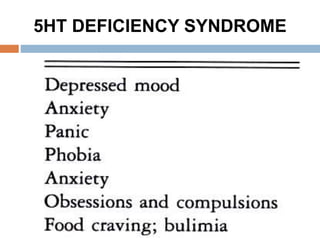
5HT DEFICIENCY SYNDROME
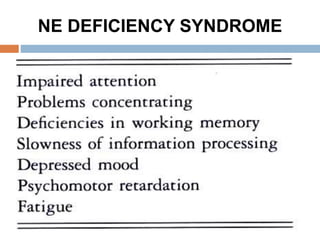
NE DEFICIENCY SYNDROME
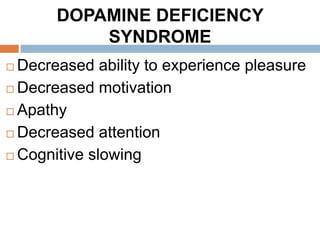
DOPAMINE DEFICIENCY
SYNDROME
 Decreased ability to experience pleasure
 Decreased motivation
 Apathy
 Decreased attention
 Cognitive slowing
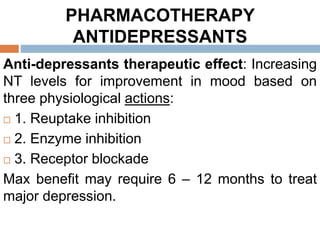
PHARMACOTHERAPY
ANTIDEPRESSANTS
Anti-depressants therapeutic effect: Increasing
NT levels for improvement in mood based on
three physiological actions:
 1. Reuptake inhibition
 2. Enzyme inhibition
 3. Receptor blockade
Max benefit may require 6 – 12 months to treat
major depression.
PHARMACOTHERAPY
ANTIDEPRESSANTS
I. MONOAMINE UPTAKE INHIBITORS
1. Tricyclic antidepressants (TCAs) and
Heterocyclics (HCAs).[During the 1950s]
2. Selective Serotonin reuptake inhibitors
(SSRIs).[The beginning of the 1980s]
3. Serotonin-Norepinephrine reuptake inhibitors
(SNRIs). [During the 1990s]
4. Norepinephrine/Dopamine Reuptake Inhibitors
(NDRIs).
5. Norepinephrine reuptake inhibitor (NRIs).
6. The triple reuptake inhibitors (TRIs)
PHARMACOTHERAPY
ANTIDEPRESSANTS
II. MONOAMINE RECEPTOR ANTAGONISTS
[BLOCKERS]
1. Noradrenergic and Specific Serotonergic Antidepressant
(NaSSA)
2. Serotonin2A Antagonist/Serotonin Reuptake Inhibitors
(SARI)
III. MONOAMINE OXIDASE INHIBITORS (MAOIS)[Two
isoforms: MAO-A and MAO-B].
1. Non-Selective Irreversible inhibition of MAO.
2. Selective Irreversible inhibition of MAO-B.
3. Selective Reversible MAO-A Inhibitors/Reversible
inhibitors of monoamine oxidase – A (RIMAs).
2. SELECTIVE SEROTONIN
REUPTAKE INHIBITORS (SSRI’s)
Fluoxetine, Fluvoxamine, Paroxetine, Sertraline,
Citalopram, Escitalopram.
 Fluoxetine (Prozac) [Prototype]
 2nd generation antidepressant category.
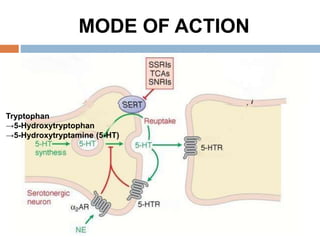
 Selectively inhibits presynaptic reuptake of
serotonin (5-HT) leading to increased
concentration of serotonin in the synaptic cleft and
increased postsynaptic neuronal activity.
 SSRIs: Most commonly first choice for unipolar
disorder; preferred for moderate depression and in
the elderly [Not as sedating as many of the tricylic
compounds]
MODE OF ACTION
Tryptophan
→5-Hydroxytryptophan
→5-Hydroxytryptamine (5-HT)
2. SELECTIVE SEROTONIN
REUPTAKE INHIBITORS (SSRI’s)
 No blockade of α1, histamine or M
cholinergic receptors or Na+ pump [Less
likely to cause anticholinergic side effects, no
cardiac effects, no postural hypotension].
 Relatively safest antidepressant group in
overdose. [may be better tolerated and have a
wider safety margin].
2. SELECTIVE SEROTONIN
REUPTAKE INHIBITORS (SSRI’s)
 Lipophilic Well absorbed when given orally
 Plasma half-lives of 18-24 h allowing once daily
dosage.
 Metabolised by liver through CYP450 system
and most SSRIs inhibit some CYP450 isoforms
[may lead to drug interactions] and excreted in
urine.
 Therapeutic effect is delayed for 2-12 weeks
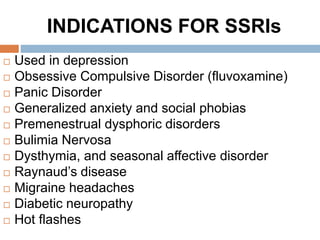
INDICATIONS FOR SSRIs
 Used in depression
 Obsessive Compulsive Disorder (fluvoxamine)
 Panic Disorder
 Generalized anxiety and social phobias
 Premenestrual dysphoric disorders
 Bulimia Nervosa
 Dysthymia, and seasonal affective disorder
 Raynaud’s disease
 Migraine headaches
 Diabetic neuropathy
 Hot flashes
ADVERSE DRUG REACTIONS
SSRI’S
 Headache, Apathy, Insomnia, fatigue, increased
anxiety, irritability, Anorexia
 Restlessness(akathisia), Extrapyramidal side
effects (EPSEs) Tremor.
 Erectile dysfunction: Decreased libido,
anorgasmia, and ejaculatory delay.
 Increased prolactin levels
 Hyponatraemia.
 GIT – nausea, vomiting, diarrhea, [Constipation
only with paroxetine].
 Withdrawal syndrome
 Serotonin syndrome upon intoxication or drug
interactions
ADVERSE DRUG REACTIONS
SSRI’S
 Bruising and Bleeding disorders: Increased
risk of gastrointestinal bleeding with aspirin [5-
HT released from platelets causes local
vasoconstriction (5-HT2A, 5-HT1B) and platelet
aggregation (5-HT2A)] by a 5-HT transporter is
blocked by SSRI’s ]
 SSRI’s reduce probability of new infarcts after
MI
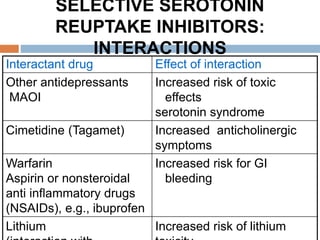
SELECTIVE SEROTONIN
REUPTAKE INHIBITORS:
INTERACTIONS
Interactant drug Effect of interaction
Other antidepressants
MAOI
Increased risk of toxic
effects
serotonin syndrome
Cimetidine (Tagamet) Increased anticholinergic
symptoms
Warfarin
Aspirin or nonsteroidal
anti inflammatory drugs
(NSAIDs), e.g., ibuprofen
Increased risk for GI
bleeding
Lithium Increased risk of lithium
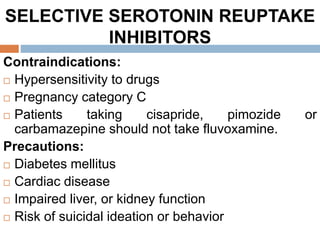
SELECTIVE SEROTONIN REUPTAKE
INHIBITORS
Contraindications:
 Hypersensitivity to drugs
 Pregnancy category C
 Patients taking cisapride, pimozide or
carbamazepine should not take fluvoxamine.
Precautions:
 Diabetes mellitus
 Cardiac disease
 Impaired liver, or kidney function
 Risk of suicidal ideation or behavior
TCA’s vs. SSRI’s
 SSRI’s low anticholinergic, antiadrenergic
activities. SSRI’s low or no affinity for
histaminergic and muscarinic receptors.
 SSRI’s low cardiovascular side effects
 SSRI’s low lethality in overdose [very low
suicide risk].
 SSRI’s safer than Clomipramine for
serotonergic actions.

ANTIDEPRESSANT DRUGS.pptx

  • 1.
  • 2.
    DEPRESSION  Depression-related illnessesare one of the most common causes of ill health, productivity losses and the inability to work and decreased quality of life.
  • 3.
    DEPRESSION  Depression isa cluster of symptoms which is characterized by  Emotional: Extended periods of dysphoria, feelings of meaninglessness and hopelessness.  Biological: Common presentations include low mood, loss of energy, disinterest in activities and May also include weight loss, sleep disturbance, or psychosis.  Manic: Common presentations include excessive enthusiasm, mental alertness, hyperactivity, irritability, impatience and
  • 4.
    DEPRESSION  Depression ranksamong the top 5 diseases in the Western countries.  Depression is one of the common psychiatric disorders. affecting up to 5% - 6% of the population.  Depression 2-3 X higher in women.  Suicide from depression is 25-30% of depressed population.  70% of patients have response to drugs.
  • 5.
    DIAGNOSIS Types of DepressiveMood (Affective) Disorders: Unipolar (depressive) and Bipolar (manic- depressive)  Unipolar (depressive) [reactive depression] in which the patient swinging between normal mood and depression caused by stressful life events.  Bipolar depressive disorder (Manic-Depressive Illness) in which the patient swinging between mania and depression caused by hereditary
  • 6.
    DIAGNOSIS I. Unipolar depression– depression alone  Reactive or Secondary (Exogenous) (~60%) Related to some “loss”, physical illness (MI, Cancer), Drugs, Other psychiatric disorders (senility).  Major or Endogenous (~25%) No clear/adequate precipitating event, re-current, inability to exp. ordinary pleasure/cope with
  • 7.
    DIAGNOSIS II. Bipolar affectivedisorder – alternating. Bipolar affective/ manic-depression (10-15%) Episodes of mania associated with depression. III. Depression alone - occasional IV. Mania alone – rare
  • 8.
  • 9.
    NEUROBIOLOGICAL THEORY BASIS OFDEPRESSION I. Monoamine (catecholamine) theory or Hypothesis (deficiency in 5-HT and/or NE and/or DA) (1965):  The underlying biological or neuro-anatomical basis for depression is a deficiency in the amount of the monoamine neurotransmitters [serotonin and/or norepinephrine and/or dopamine] of the central noradrenergic and/or serotonergic transmission in the brain [cortical and limbic] including the frontal cortex,
  • 10.
    NEUROBIOLOGICAL THEORY BASIS OFDEPRESSION  Serotonergic neurons originate within the brain stem. 5-HT may be related to anxiety, compulsions and sleep disturbances.  The central noradrenergic neurotransmitter system originates from two distinct groups of cells in the brain stem. The main noradrenergic brain circuits are located in the locus coeruleus. NE to alertness and energy as well as anxiety, attention, and interest in life.
  • 11.
    NEUROBIOLOGICAL THEORY BASIS OFDEPRESSION  Dopaminergic neurotransmission strengthens the hypothesis that DA also regulates mood. Most DA-producing neurons in the brain are located in brain stem nuclei: the retro-rubrofield, the substantia nigra pars compacta, and the ventral tegmental area.
  • 12.
    NEUROBIOLOGICAL THEORY BASIS OFDEPRESSION  A dysfunction of the mesocortical dopaminergic pathway, innervating limbic structures including the nucleus accumbens, amygdala, ventral hippocampus and cortical areas may reduce dopaminergic activity has been linked to decreased motivation, anhedonia (loss of pleasure) and loss of interest, whereas increased dopaminergic transmission has been linked to positive affect [to motivation, pleasure, and reward, as well as interest in life].
  • 13.
    NEUROBIOLOGICAL THEORY OF DEPRESSION II.Receptor theory Sensitivity or Hypothesis (depletion)  the problem is in up-regulation of post-synaptic state receptors and alterations in their sensitivity is believed to be associated with the clinical symptoms of depression..  If the NT level ↑→ down-regulation.  If the NT level ↓→ up-regulation.  The precise pathophysiology of depression remains unsolved
  • 14.
    I. MONOAMINE HYPOTHESISOF MOOD The monoamine hypothesis of depression Proposed by Schildkraut in 1965. Abnormal amounts of NTs:  Normal mood depends on appropriate levels of monoamine activity in brain. •Levels too low → Depression •Levels too high → Euphoria and mania  According to this hypothesis, depression can be alleviated by drugs that increase the availability of noradrenaline and/or serotonin. Antidepressant therapy should therefore be
  • 15.
    II. RECEPTOR HYPOTHESISOF MOOD  [Supersensitivity pre-synaptic → down- regulation receptors and Decreased post- synaptic sensitivity → up-regulation of post- synaptic receptors] leads to depression.  The antidepressant treatment increases the amount of monoamines in CNS and gradually normalize the density/sensitivity of their receptors.
  • 16.
    DIFFERENT TYPES OF DEPRESSION Patient A: depression may be largely as a result of a noradrenaline deficiency.  Patient B: may be depressed because of serotonin deficiency.  Patient C: depression might be due to a deficiency of both these neurotransmitters.
  • 17.
  • 18.
  • 19.
    DOPAMINE DEFICIENCY SYNDROME  Decreasedability to experience pleasure  Decreased motivation  Apathy  Decreased attention  Cognitive slowing
  • 20.
    PHARMACOTHERAPY ANTIDEPRESSANTS Anti-depressants therapeutic effect:Increasing NT levels for improvement in mood based on three physiological actions:  1. Reuptake inhibition  2. Enzyme inhibition  3. Receptor blockade Max benefit may require 6 – 12 months to treat major depression.
  • 21.
    PHARMACOTHERAPY ANTIDEPRESSANTS I. MONOAMINE UPTAKEINHIBITORS 1. Tricyclic antidepressants (TCAs) and Heterocyclics (HCAs).[During the 1950s] 2. Selective Serotonin reuptake inhibitors (SSRIs).[The beginning of the 1980s] 3. Serotonin-Norepinephrine reuptake inhibitors (SNRIs). [During the 1990s] 4. Norepinephrine/Dopamine Reuptake Inhibitors (NDRIs). 5. Norepinephrine reuptake inhibitor (NRIs). 6. The triple reuptake inhibitors (TRIs)
  • 22.
    PHARMACOTHERAPY ANTIDEPRESSANTS II. MONOAMINE RECEPTORANTAGONISTS [BLOCKERS] 1. Noradrenergic and Specific Serotonergic Antidepressant (NaSSA) 2. Serotonin2A Antagonist/Serotonin Reuptake Inhibitors (SARI) III. MONOAMINE OXIDASE INHIBITORS (MAOIS)[Two isoforms: MAO-A and MAO-B]. 1. Non-Selective Irreversible inhibition of MAO. 2. Selective Irreversible inhibition of MAO-B. 3. Selective Reversible MAO-A Inhibitors/Reversible inhibitors of monoamine oxidase – A (RIMAs).
  • 23.
    2. SELECTIVE SEROTONIN REUPTAKEINHIBITORS (SSRI’s) Fluoxetine, Fluvoxamine, Paroxetine, Sertraline, Citalopram, Escitalopram.  Fluoxetine (Prozac) [Prototype]  2nd generation antidepressant category.  Selectively inhibits presynaptic reuptake of serotonin (5-HT) leading to increased concentration of serotonin in the synaptic cleft and increased postsynaptic neuronal activity.  SSRIs: Most commonly first choice for unipolar disorder; preferred for moderate depression and in the elderly [Not as sedating as many of the tricylic compounds]
  • 24.
  • 25.
    2. SELECTIVE SEROTONIN REUPTAKEINHIBITORS (SSRI’s)  No blockade of α1, histamine or M cholinergic receptors or Na+ pump [Less likely to cause anticholinergic side effects, no cardiac effects, no postural hypotension].  Relatively safest antidepressant group in overdose. [may be better tolerated and have a wider safety margin].
  • 26.
    2. SELECTIVE SEROTONIN REUPTAKEINHIBITORS (SSRI’s)  Lipophilic Well absorbed when given orally  Plasma half-lives of 18-24 h allowing once daily dosage.  Metabolised by liver through CYP450 system and most SSRIs inhibit some CYP450 isoforms [may lead to drug interactions] and excreted in urine.  Therapeutic effect is delayed for 2-12 weeks
  • 27.
    INDICATIONS FOR SSRIs Used in depression  Obsessive Compulsive Disorder (fluvoxamine)  Panic Disorder  Generalized anxiety and social phobias  Premenestrual dysphoric disorders  Bulimia Nervosa  Dysthymia, and seasonal affective disorder  Raynaud’s disease  Migraine headaches  Diabetic neuropathy  Hot flashes
  • 28.
    ADVERSE DRUG REACTIONS SSRI’S Headache, Apathy, Insomnia, fatigue, increased anxiety, irritability, Anorexia  Restlessness(akathisia), Extrapyramidal side effects (EPSEs) Tremor.  Erectile dysfunction: Decreased libido, anorgasmia, and ejaculatory delay.  Increased prolactin levels  Hyponatraemia.  GIT – nausea, vomiting, diarrhea, [Constipation only with paroxetine].  Withdrawal syndrome  Serotonin syndrome upon intoxication or drug interactions
  • 29.
    ADVERSE DRUG REACTIONS SSRI’S Bruising and Bleeding disorders: Increased risk of gastrointestinal bleeding with aspirin [5- HT released from platelets causes local vasoconstriction (5-HT2A, 5-HT1B) and platelet aggregation (5-HT2A)] by a 5-HT transporter is blocked by SSRI’s ]  SSRI’s reduce probability of new infarcts after MI
  • 30.
    SELECTIVE SEROTONIN REUPTAKE INHIBITORS: INTERACTIONS Interactantdrug Effect of interaction Other antidepressants MAOI Increased risk of toxic effects serotonin syndrome Cimetidine (Tagamet) Increased anticholinergic symptoms Warfarin Aspirin or nonsteroidal anti inflammatory drugs (NSAIDs), e.g., ibuprofen Increased risk for GI bleeding Lithium Increased risk of lithium
  • 31.
    SELECTIVE SEROTONIN REUPTAKE INHIBITORS Contraindications: Hypersensitivity to drugs  Pregnancy category C  Patients taking cisapride, pimozide or carbamazepine should not take fluvoxamine. Precautions:  Diabetes mellitus  Cardiac disease  Impaired liver, or kidney function  Risk of suicidal ideation or behavior
  • 32.
    TCA’s vs. SSRI’s SSRI’s low anticholinergic, antiadrenergic activities. SSRI’s low or no affinity for histaminergic and muscarinic receptors.  SSRI’s low cardiovascular side effects  SSRI’s low lethality in overdose [very low suicide risk].  SSRI’s safer than Clomipramine for serotonergic actions.