AIM: Anticonvulsant effect of drugs by MES
and PTZ method.
Presented by:
Prof. Mirza Anwar Baig
Dept of Pharmcaology
AIKTC, School of Pharmacy, New Panvel
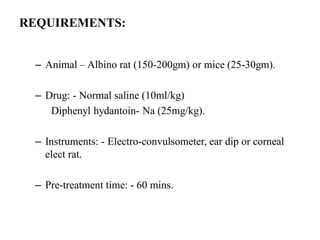
REQUIREMENTS:
– Animal – Albino rat (150-200gm) or mice (25-30gm).
– Drug: - Normal saline (10ml/kg)
Diphenyl hydantoin- Na (25mg/kg).
– Instruments: - Electro-convulsometer, ear dip or corneal
elect rat.
– Pre-treatment time: - 60 mins.
PRINCIPLE:
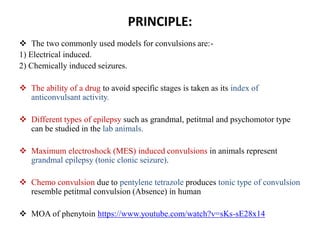
 The two commonly used models for convulsions are:-
1) Electrical induced.
2) Chemically induced seizures.
 The ability of a drug to avoid specific stages is taken as its index of
anticonvulsant activity.
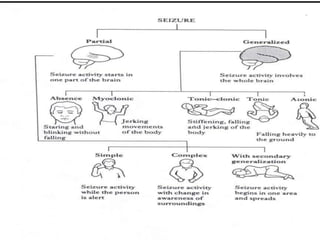
 Different types of epilepsy such as grandmal, petitmal and psychomotor type
can be studied in the lab animals.
 Maximum electroshock (MES) induced convulsions in animals represent
grandmal epilepsy (tonic clonic seizure).
 Chemo convulsion due to pentylene tetrazole produces tonic type of convulsion
resemble petitmal convulsion (Absence) in human
 MOA of phenytoin https://www.youtube.com/watch?v=sKs-sE28x14
PRINCIPLE: contd…
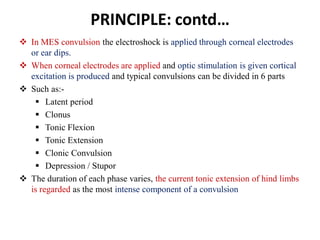
 In MES convulsion the electroshock is applied through corneal electrodes
or ear dips.
 When corneal electrodes are applied and optic stimulation is given cortical
excitation is produced and typical convulsions can be divided in 6 parts
 Such as:-
 Latent period
 Clonus
 Tonic Flexion
 Tonic Extension
 Clonic Convulsion
 Depression / Stupor
 The duration of each phase varies, the current tonic extension of hind limbs
is regarded as the most intense component of a convulsion
PROCEDURES:
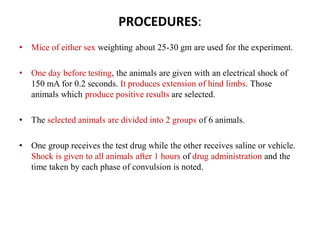
• Mice of either sex weighting about 25-30 gm are used for the experiment.
• One day before testing, the animals are given with an electrical shock of
150 mA for 0.2 seconds. It produces extension of hind limbs. Those
animals which produce positive results are selected.
• The selected animals are divided into 2 groups of 6 animals.
• One group receives the test drug while the other receives saline or vehicle.
Shock is given to all animals after 1 hours of drug administration and the
time taken by each phase of convulsion is noted.
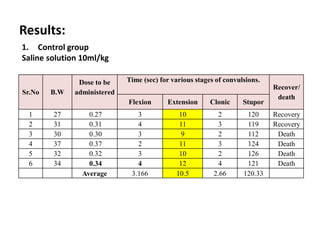
Results:
Sr.No B.W
Dose to be
administered
Time (sec) for various stages of convulsions.
Recover/
death
Flexion Extension Clonic Stupor
1 27 0.27 3 10 2 120 Recovery
2 31 0.31 4 11 3 119 Recovery
3 30 0.30 3 9 2 112 Death
4 37 0.37 2 11 3 124 Death
5 32 0.32 3 10 2 126 Death
6 34 0.34 4 12 4 121 Death
Average 3.166 10.5 2.66 120.33
1. Control group
Saline solution 10ml/kg
Sr.No B.W
Dose to be
adminstered
Time (sec) for various stages of convulsions.
Recover/
death
Flexion Extension Clonic Stupor
1 27 0.625 3 3 2 111 Recovery
2 31 0.75 2 2 1 101 Recovery
3 30 0.8 2 1 2 98 Recovery
4 37 0.875 2 2 2 85 Recovery
5 32 0.825 3 3 1 91 Recovery
6 34 0.85 4 5 2 98 Recovery
Average 2.66 2.66 1.66 97.33
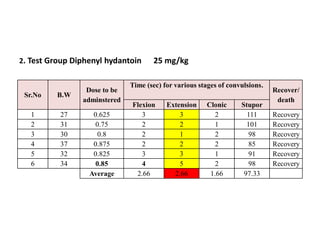
2. Test Group Diphenyl hydantoin 25 mg/kg
Conclusion:
• There is a decrease in time spent by animal in tonic extension
phase of the convulsion which indicate anticonvulsant activity
of phenytoin.
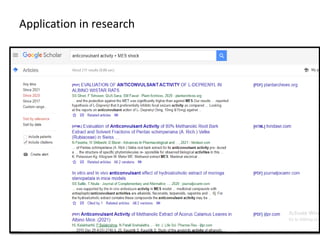
Application in research
References:
• Ghosh MN. Fundamentals of Experimental
Pharmacology. Hilton & Company, Kolkata.
• Kulkarni SK. Handbook of experimental
pharmacology. VallabhPrakashan
Thank You