AIM: Study of Anti-ulcer Activity of Drug using Pyloric
Ligation Rat Model
Presented by:
Prof. Mirza Anwar Baig
Dept of Pharmcology
AIKTC, School of Pharmacy, New Panvel
REQUIREMENTS:
– Animal: Wistar rats (150-170g)
– Drugs:
Ranitidine ( 15mg/kg).
Saline- 0.1N NaOH
– Equipment: Scissor, suturing needle, thread , cord board,
centrifugation tubes.
Principle:
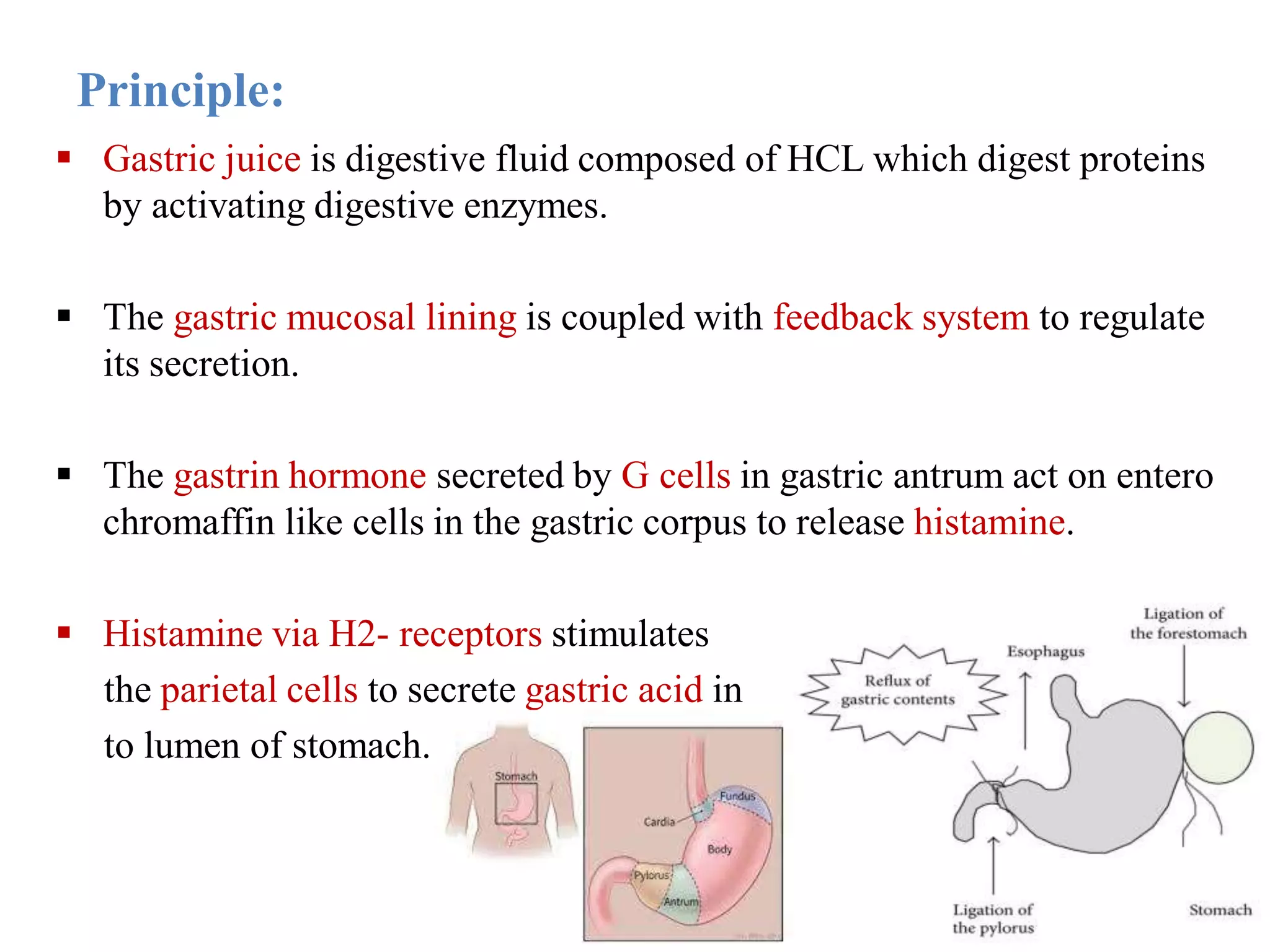
 Gastric juice is digestive fluid composed of HCL which digest proteins
by activating digestive enzymes.
 The gastric mucosal lining is coupled with feedback system to regulate
its secretion.
 The gastrin hormone secreted by G cells in gastric antrum act on entero
chromaffin like cells in the gastric corpus to release histamine.
 Histamine via H2- receptors stimulates
the parietal cells to secrete gastric acid in
to lumen of stomach.
Principle contd:
 The cause of gastric ulcers is H. plori, NSAIDs, Crohn’s disease,
hypergastriaemia, hyperthyroidism and ulcerogenic agents like
indomethacin, aspirin, reserpine.
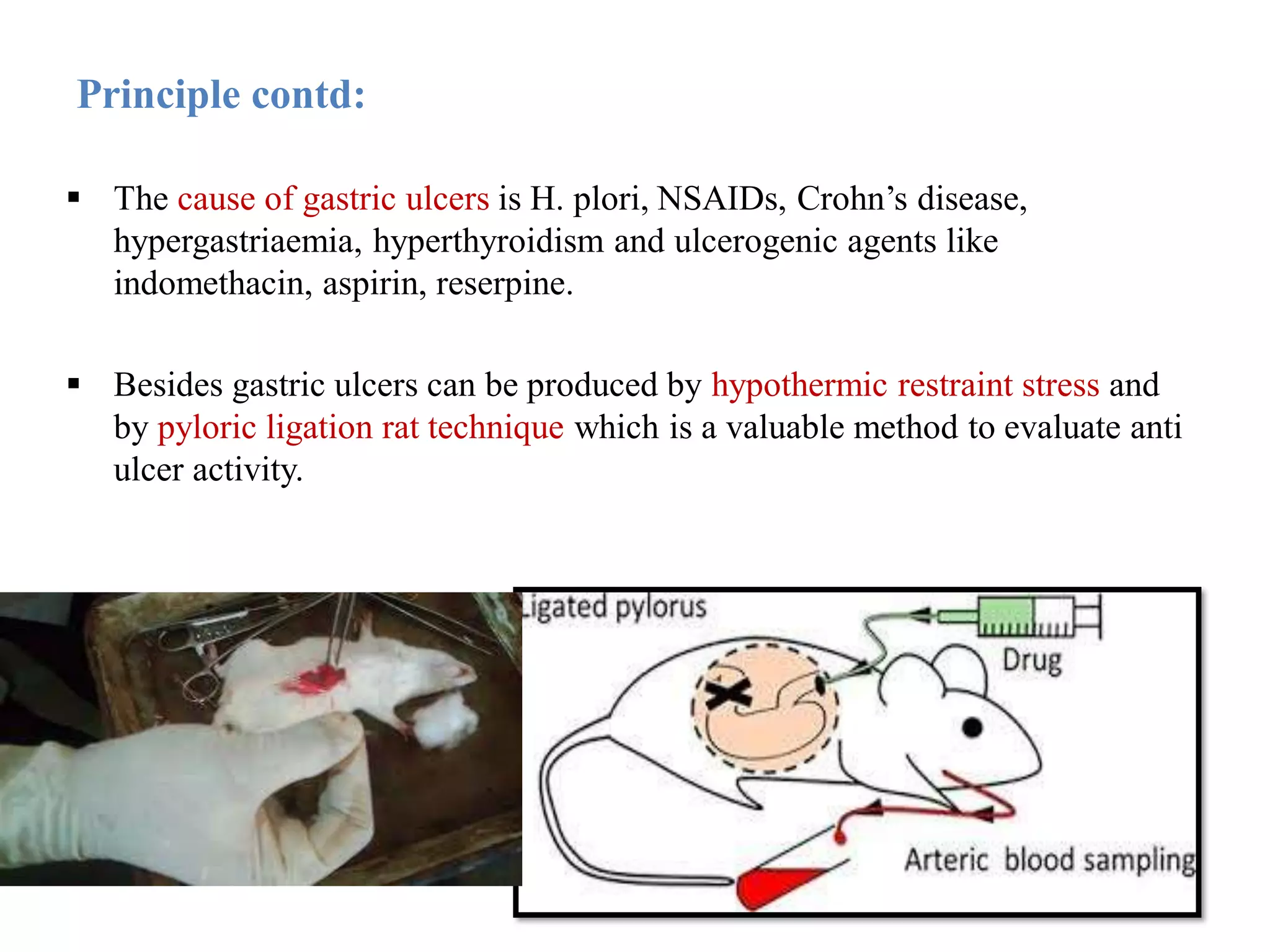
 Besides gastric ulcers can be produced by hypothermic restraint stress and
by pyloric ligation rat technique which is a valuable method to evaluate anti
ulcer activity.
PROCEDURE:
1. Starved the rats for 24 hours but having acess to drinking water.
2. During this time, they are to be housed single in cages with raised bottom
of wide wire mesh in order to avoid connibalism and coprophagy.
3. 10 animals to be used per dose and as controls. Under ether anesthesia an
midline abdominal incision has to be made.
4. The pylorus to be ligated, care has to exercised that neither damage to the
blood supply nor traction on the pylorus.
5. Grasping the stomach with instruments is to be meticulously avoided, else
ulceration will invariably develop at such points.
PROCEDURE CONTD:
6. The abdominal wall to be closed by sutures. The test compounds to be
given either orally by gavage or injected subcutaneously.
7. The animals have to be placed for 19 hours in plastic cylinders with an
inner diameter of 45 mm being closed on both ends by wire mesh.
8. Afterwards, the animals to be sacrificed under CO2 anesthesia.
9. The abdomen to be opened and a ligature to be placed around the
esophagus close to the diaphragm.
10. The stomach has to be removed, and the contents are to be drained in to a
centrifuge tube.
11. Along the greater curvature the stomach has to be opened and pinned on a
cork plate.
PROCEDURE CONTD:
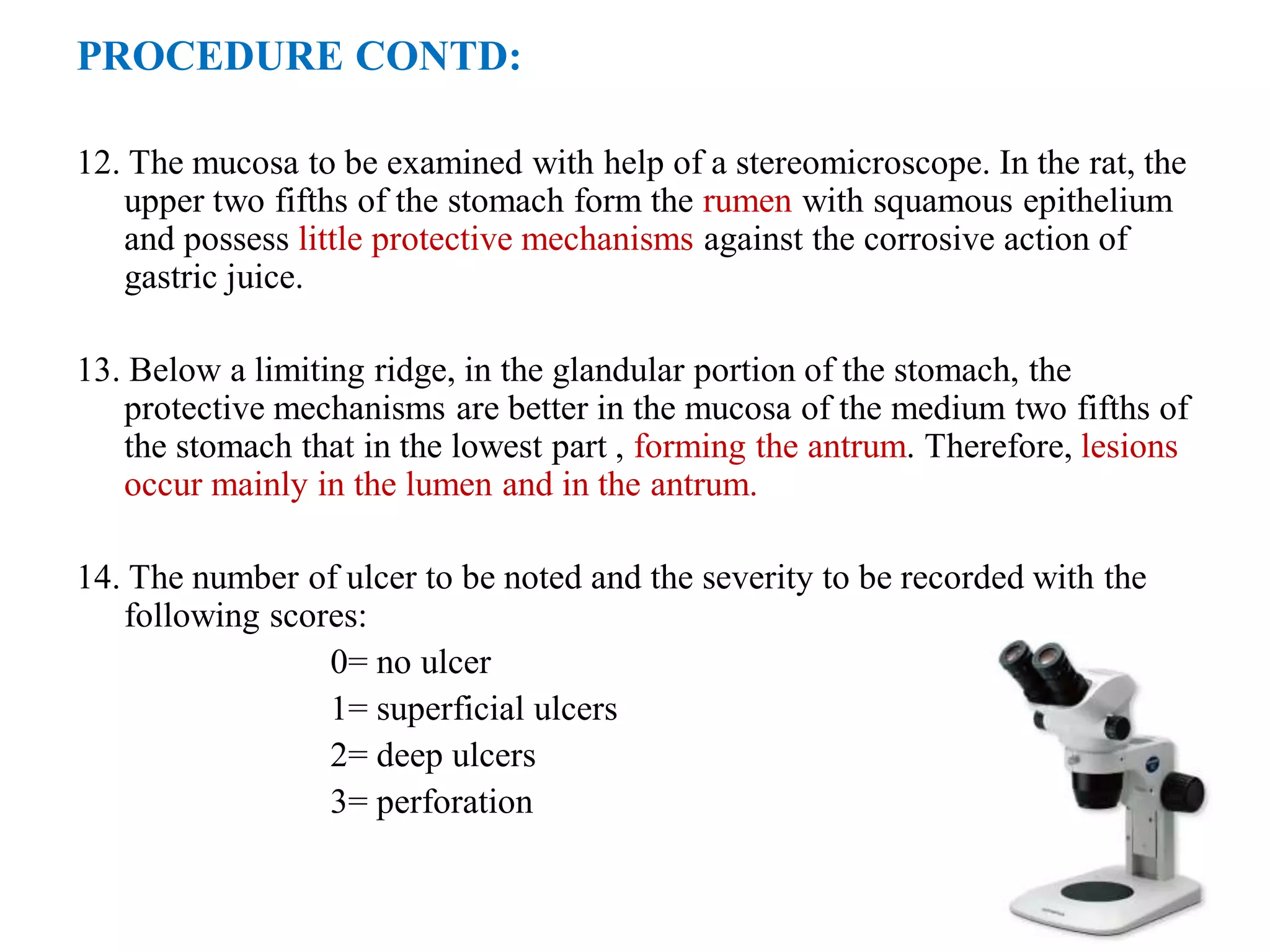
12. The mucosa to be examined with help of a stereomicroscope. In the rat, the
upper two fifths of the stomach form the rumen with squamous epithelium
and possess little protective mechanisms against the corrosive action of
gastric juice.
13. Below a limiting ridge, in the glandular portion of the stomach, the
protective mechanisms are better in the mucosa of the medium two fifths of
the stomach that in the lowest part , forming the antrum. Therefore, lesions
occur mainly in the lumen and in the antrum.
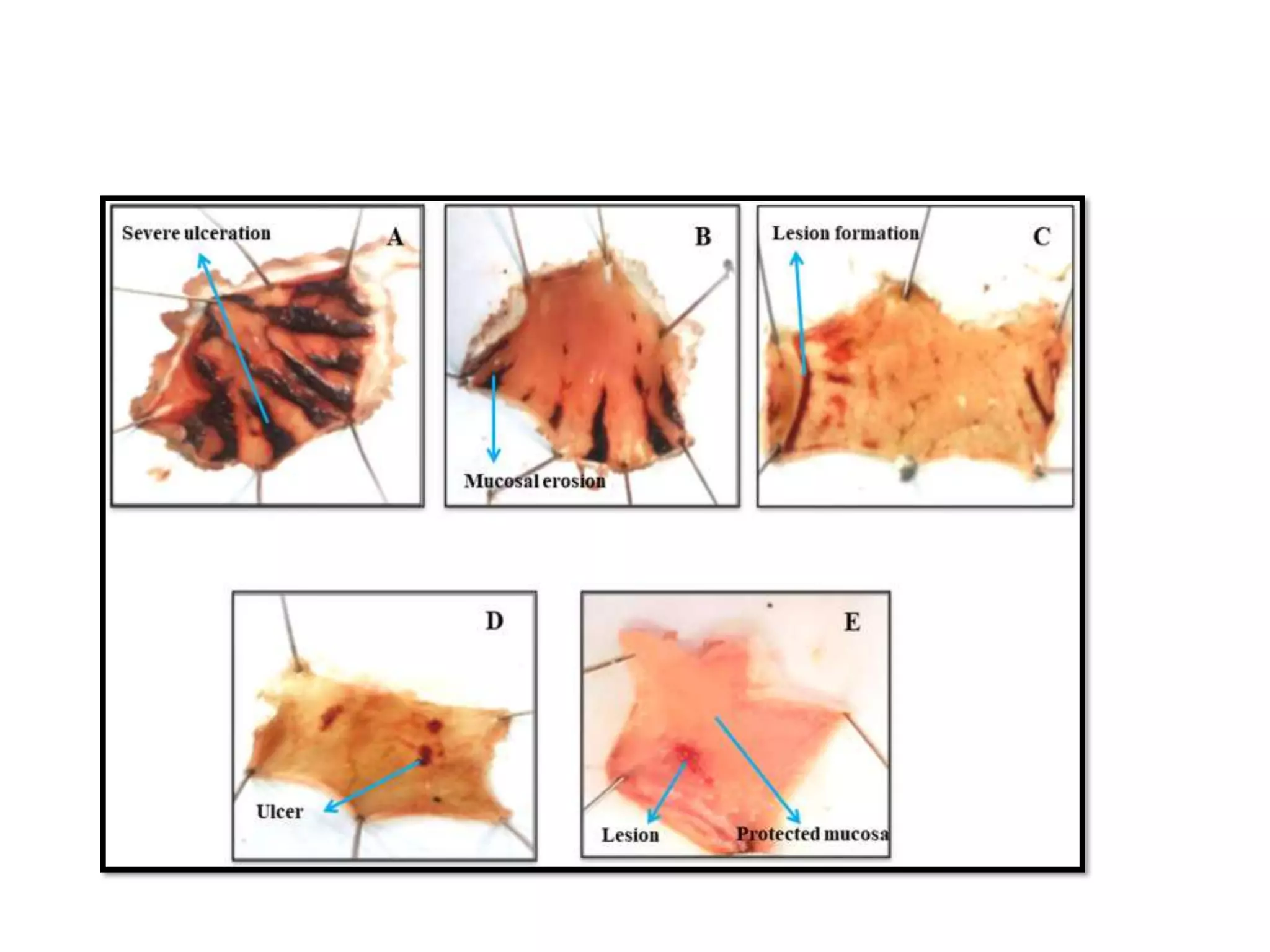
14. The number of ulcer to be noted and the severity to be recorded with the
following scores:
0= no ulcer
1= superficial ulcers
2= deep ulcers
3= perforation
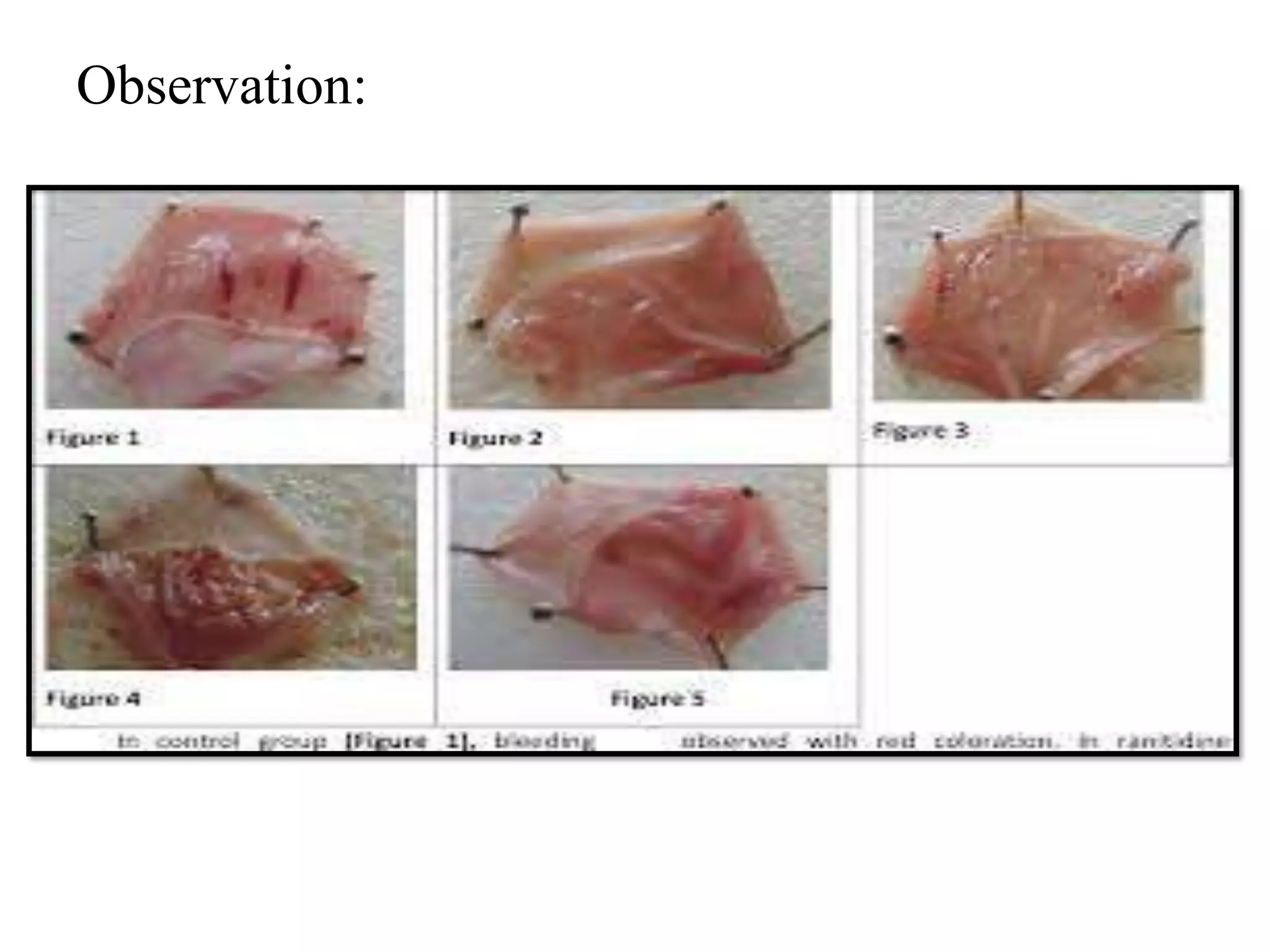
Observation:
PROCEDURE CONTD:
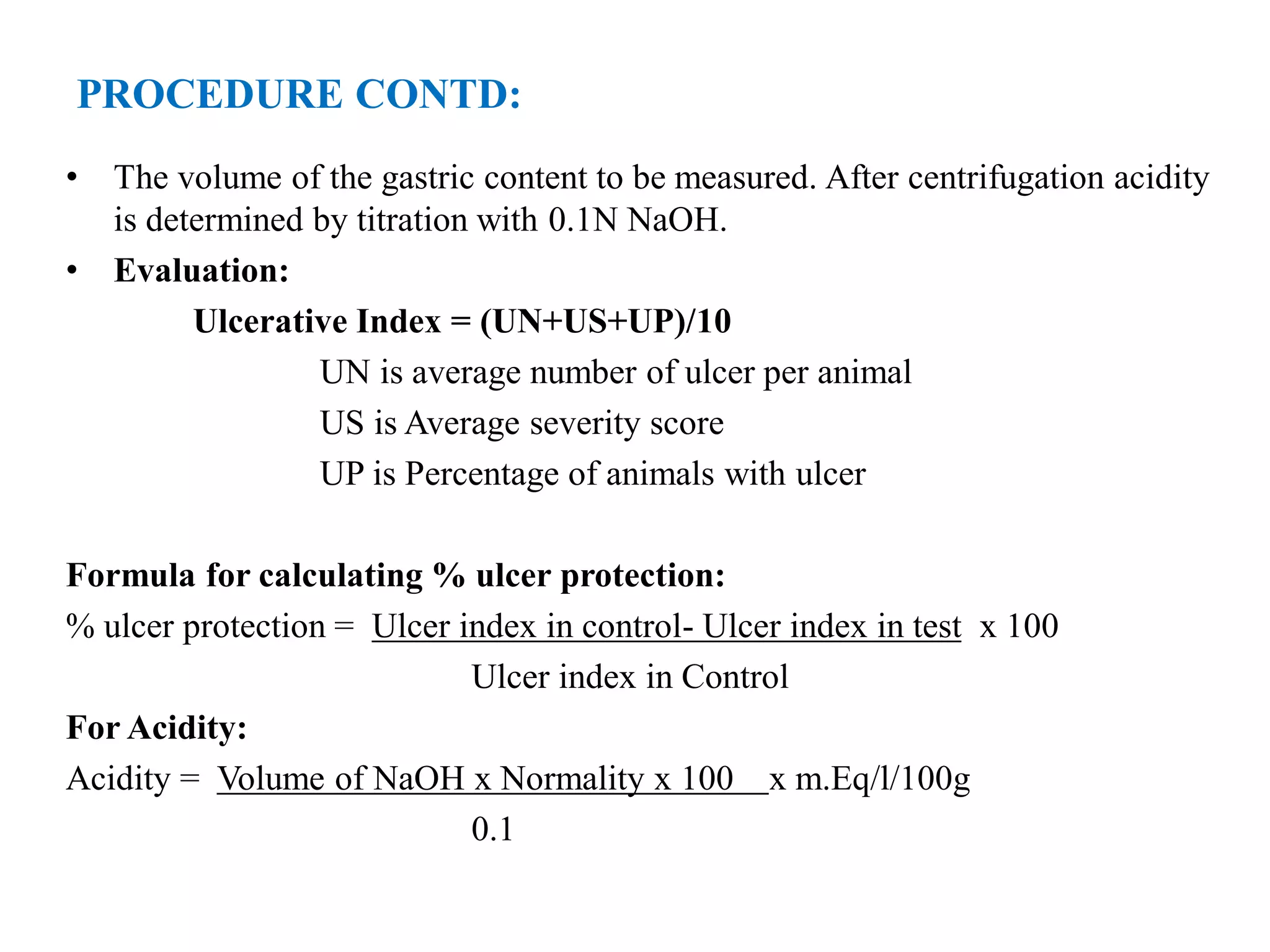
• The volume of the gastric content to be measured. After centrifugation acidity
is determined by titration with 0.1N NaOH.
• Evaluation:
Ulcerative Index = (UN+US+UP)/10
UN is average number of ulcer per animal
US is Average severity score
UP is Percentage of animals with ulcer
Formula for calculating % ulcer protection:
% ulcer protection = Ulcer index in control- Ulcer index in test x 100
Ulcer index in Control
For Acidity:
Acidity = Volume of NaOH x Normality x 100 x m.Eq/l/100g
0.1
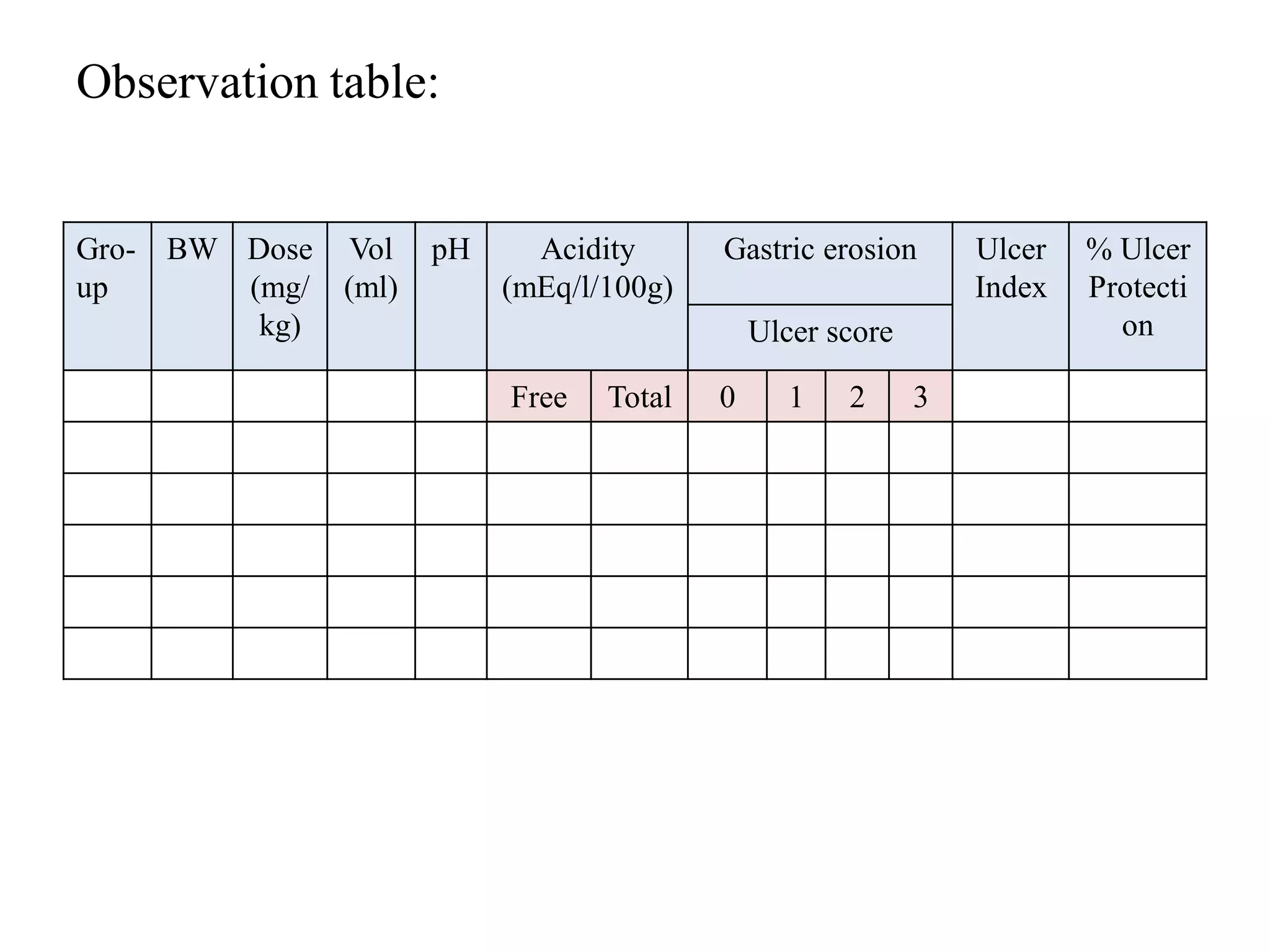
Observation table:
Gro-
up
BW Dose
(mg/
kg)
Vol
(ml)
pH Acidity
(mEq/l/100g)
Gastric erosion Ulcer
Index
% Ulcer
Protecti
on
Ulcer score
Free Total 0 1 2 3
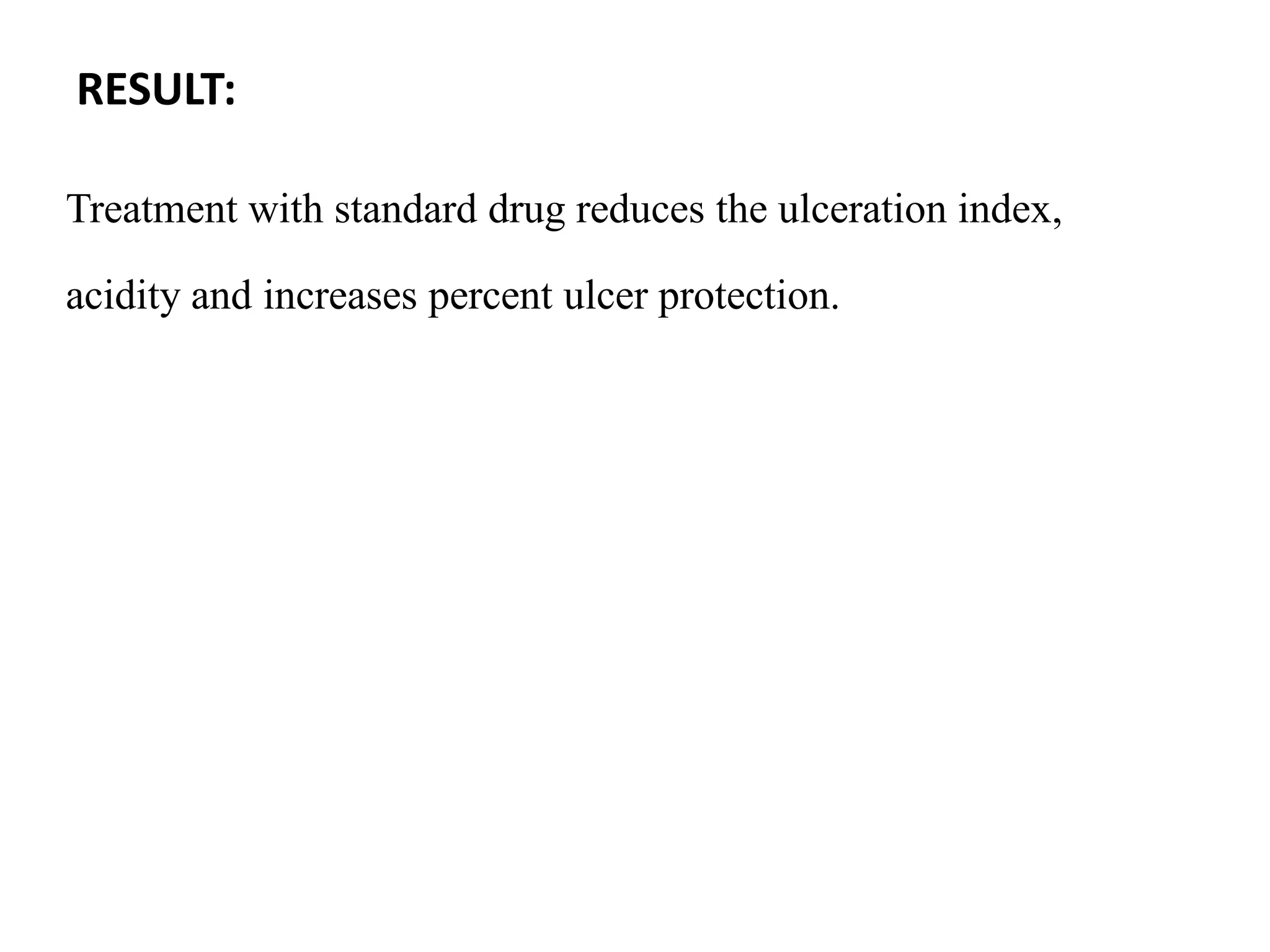
RESULT:
Treatment with standard drug reduces the ulceration index,
acidity and increases percent ulcer protection.
References:
• Ghosh MN. Fundamentals of Experimental
Pharmacology. Hilton & Company, Kolkata.
• Kulkarni SK. Handbook of experimental
pharmacology. VallabhPrakashan
Thank You

Expt 3 antiulcer activity by pyloric ligation method

  • 1.
    AIM: Study ofAnti-ulcer Activity of Drug using Pyloric Ligation Rat Model Presented by: Prof. Mirza Anwar Baig Dept of Pharmcology AIKTC, School of Pharmacy, New Panvel
  • 2.
    REQUIREMENTS: – Animal: Wistarrats (150-170g) – Drugs: Ranitidine ( 15mg/kg). Saline- 0.1N NaOH – Equipment: Scissor, suturing needle, thread , cord board, centrifugation tubes.
  • 3.
    Principle:  Gastric juiceis digestive fluid composed of HCL which digest proteins by activating digestive enzymes.  The gastric mucosal lining is coupled with feedback system to regulate its secretion.  The gastrin hormone secreted by G cells in gastric antrum act on entero chromaffin like cells in the gastric corpus to release histamine.  Histamine via H2- receptors stimulates the parietal cells to secrete gastric acid in to lumen of stomach.
  • 4.
    Principle contd:  Thecause of gastric ulcers is H. plori, NSAIDs, Crohn’s disease, hypergastriaemia, hyperthyroidism and ulcerogenic agents like indomethacin, aspirin, reserpine.  Besides gastric ulcers can be produced by hypothermic restraint stress and by pyloric ligation rat technique which is a valuable method to evaluate anti ulcer activity.
  • 5.
    PROCEDURE: 1. Starved therats for 24 hours but having acess to drinking water. 2. During this time, they are to be housed single in cages with raised bottom of wide wire mesh in order to avoid connibalism and coprophagy. 3. 10 animals to be used per dose and as controls. Under ether anesthesia an midline abdominal incision has to be made. 4. The pylorus to be ligated, care has to exercised that neither damage to the blood supply nor traction on the pylorus. 5. Grasping the stomach with instruments is to be meticulously avoided, else ulceration will invariably develop at such points.
  • 6.
    PROCEDURE CONTD: 6. Theabdominal wall to be closed by sutures. The test compounds to be given either orally by gavage or injected subcutaneously. 7. The animals have to be placed for 19 hours in plastic cylinders with an inner diameter of 45 mm being closed on both ends by wire mesh. 8. Afterwards, the animals to be sacrificed under CO2 anesthesia. 9. The abdomen to be opened and a ligature to be placed around the esophagus close to the diaphragm. 10. The stomach has to be removed, and the contents are to be drained in to a centrifuge tube. 11. Along the greater curvature the stomach has to be opened and pinned on a cork plate.
  • 7.
    PROCEDURE CONTD: 12. Themucosa to be examined with help of a stereomicroscope. In the rat, the upper two fifths of the stomach form the rumen with squamous epithelium and possess little protective mechanisms against the corrosive action of gastric juice. 13. Below a limiting ridge, in the glandular portion of the stomach, the protective mechanisms are better in the mucosa of the medium two fifths of the stomach that in the lowest part , forming the antrum. Therefore, lesions occur mainly in the lumen and in the antrum. 14. The number of ulcer to be noted and the severity to be recorded with the following scores: 0= no ulcer 1= superficial ulcers 2= deep ulcers 3= perforation
  • 8.
  • 10.
    PROCEDURE CONTD: • Thevolume of the gastric content to be measured. After centrifugation acidity is determined by titration with 0.1N NaOH. • Evaluation: Ulcerative Index = (UN+US+UP)/10 UN is average number of ulcer per animal US is Average severity score UP is Percentage of animals with ulcer Formula for calculating % ulcer protection: % ulcer protection = Ulcer index in control- Ulcer index in test x 100 Ulcer index in Control For Acidity: Acidity = Volume of NaOH x Normality x 100 x m.Eq/l/100g 0.1
  • 11.
    Observation table: Gro- up BW Dose (mg/ kg) Vol (ml) pHAcidity (mEq/l/100g) Gastric erosion Ulcer Index % Ulcer Protecti on Ulcer score Free Total 0 1 2 3
  • 12.
    RESULT: Treatment with standarddrug reduces the ulceration index, acidity and increases percent ulcer protection.
  • 13.
    References: • Ghosh MN.Fundamentals of Experimental Pharmacology. Hilton & Company, Kolkata. • Kulkarni SK. Handbook of experimental pharmacology. VallabhPrakashan
  • 14.