Expt 10- To evaluate pyrogen test for given sample using rabbit
This document outlines the procedure for evaluating a sample for pyrogens using rabbits. It involves taking the temperatures of 3 rabbits before and after injection of the sample. If 2 or more rabbits show a temperature rise of more than 0.6°C, or the combined rise across all rabbits is more than 1.4°C, the test is considered positive, meaning the sample contains pyrogens. The procedure provides steps for proper handling and care of the rabbits, administration of the sample, and temperature measurement and analysis.
Expt 10- To evaluate pyrogen test for given sample using rabbit
1.
AIM: To evaluatepyrogen test for given sample using rabbit
Presented by:
Prof. Mirza Anwar Baig
Dept of Pharmcology
AIKTC, School of Pharmacy, New Panvel
2.
REQUIREMENTS:
Animal:
Rabbits weighing 1.3-1.5kg.
Apparatus:
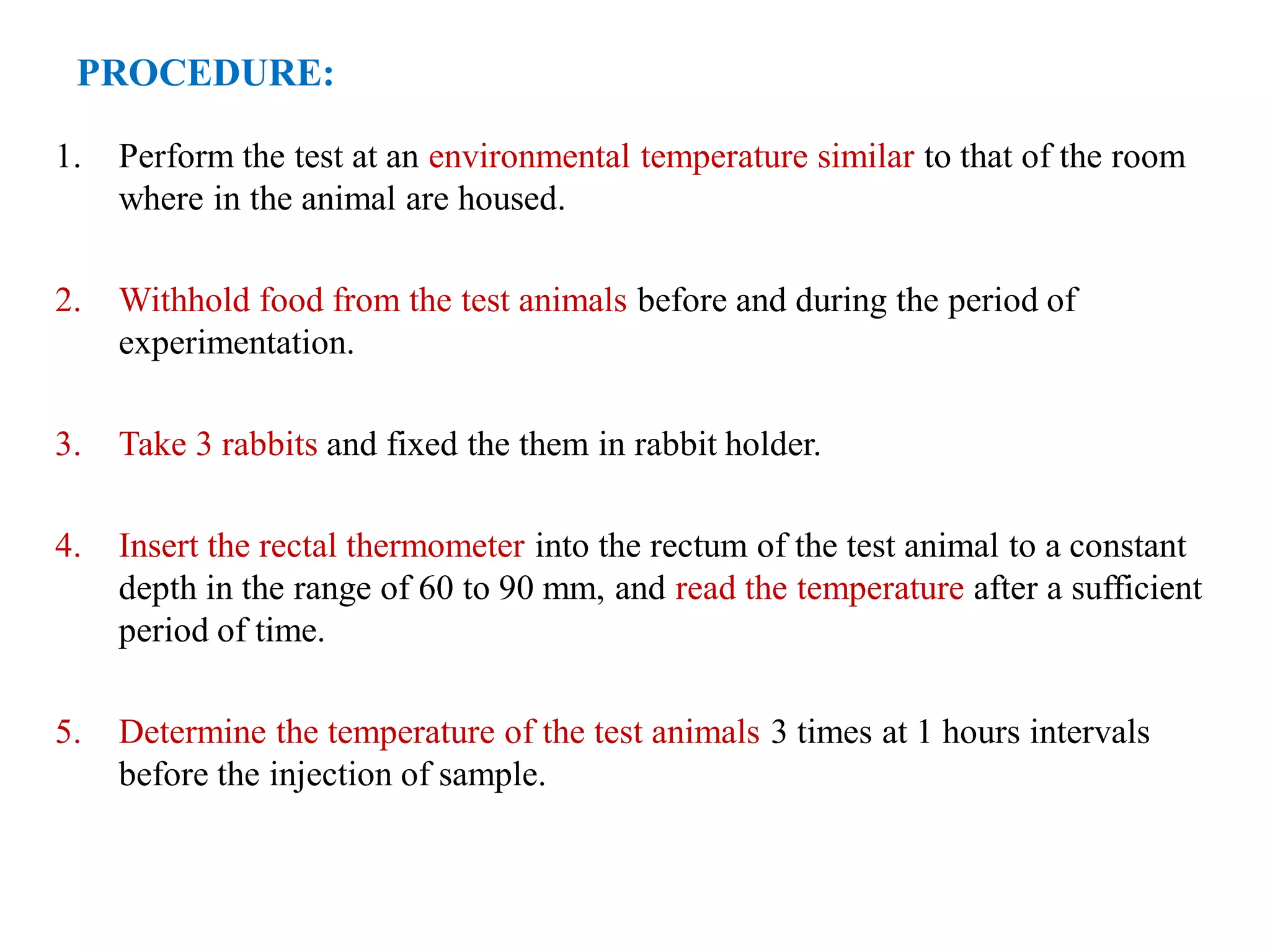
Thermometer
Syringe and injection needle: Render the syringes and needles pyrogen
free by heating at 2500C for not less than 30 minutes.
Drugs:
Quantity of injection: Unless otherwise specified, 10 ml of the sample per kg
of body mass of the animals is used/injected.
3.
Principle:
• The pyrogenrefer to all the substance that cause as increase in fever, also
known as pyroxia.
• Upon entering into contact with pyrogens, rabbit's have an increase in their
temperature, just like humans.
• The pyrogen test is aim to check the existence of pyrogen by using rabbits.
• Based on the measurement of the increase in the rabbit's temperature upon
being injected with a product that might contain contaminant of the pyrogen
type.
4.
PROCEDURE:
1. Perform thetest at an environmental temperature similar to that of the room
where in the animal are housed.
2. Withhold food from the test animals before and during the period of
experimentation.
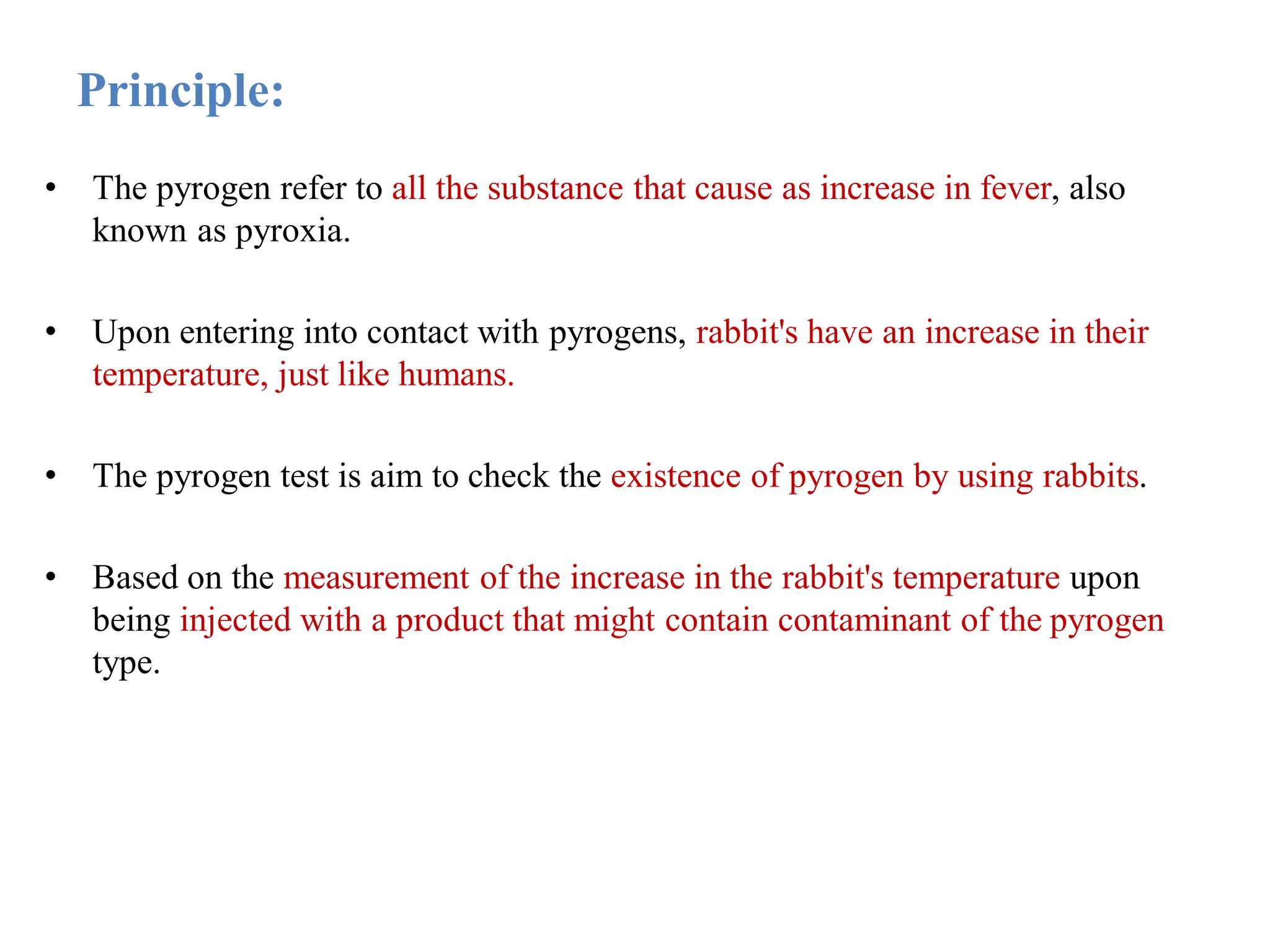
3. Take 3 rabbits and fixed the them in rabbit holder.
4. Insert the rectal thermometer into the rectum of the test animal to a constant
depth in the range of 60 to 90 mm, and read the temperature after a sufficient
period of time.
5. Determine the temperature of the test animals 3 times at 1 hours intervals
before the injection of sample.
5.
PROCEDURE:
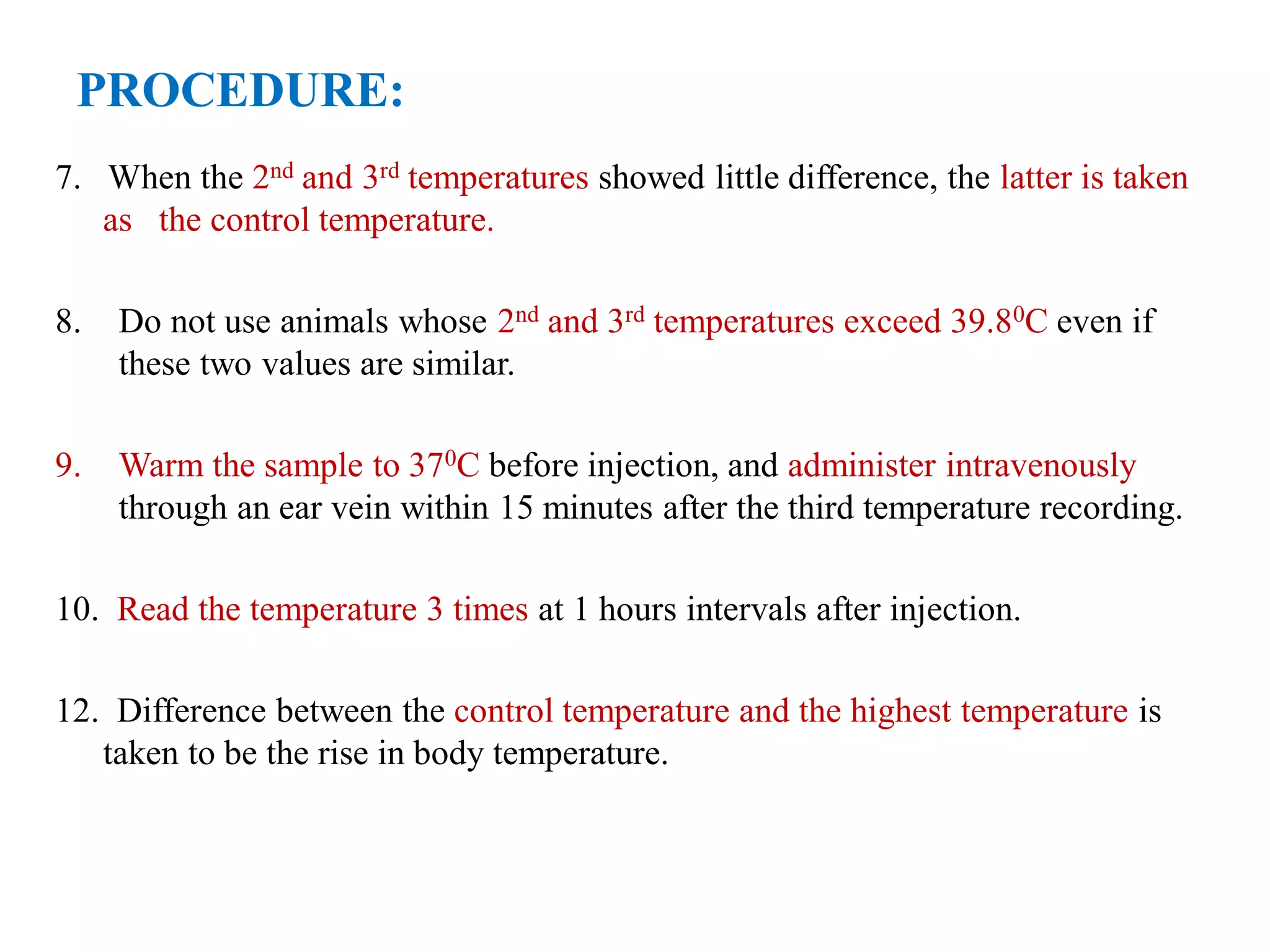
7. When the2nd and 3rd temperatures showed little difference, the latter is taken
as the control temperature.
8. Do not use animals whose 2nd and 3rd temperatures exceed 39.80C even if
these two values are similar.
9. Warm the sample to 370C before injection, and administer intravenously
through an ear vein within 15 minutes after the third temperature recording.
10. Read the temperature 3 times at 1 hours intervals after injection.
12. Difference between the control temperature and the highest temperature is
taken to be the rise in body temperature.
6.
Conclusion:
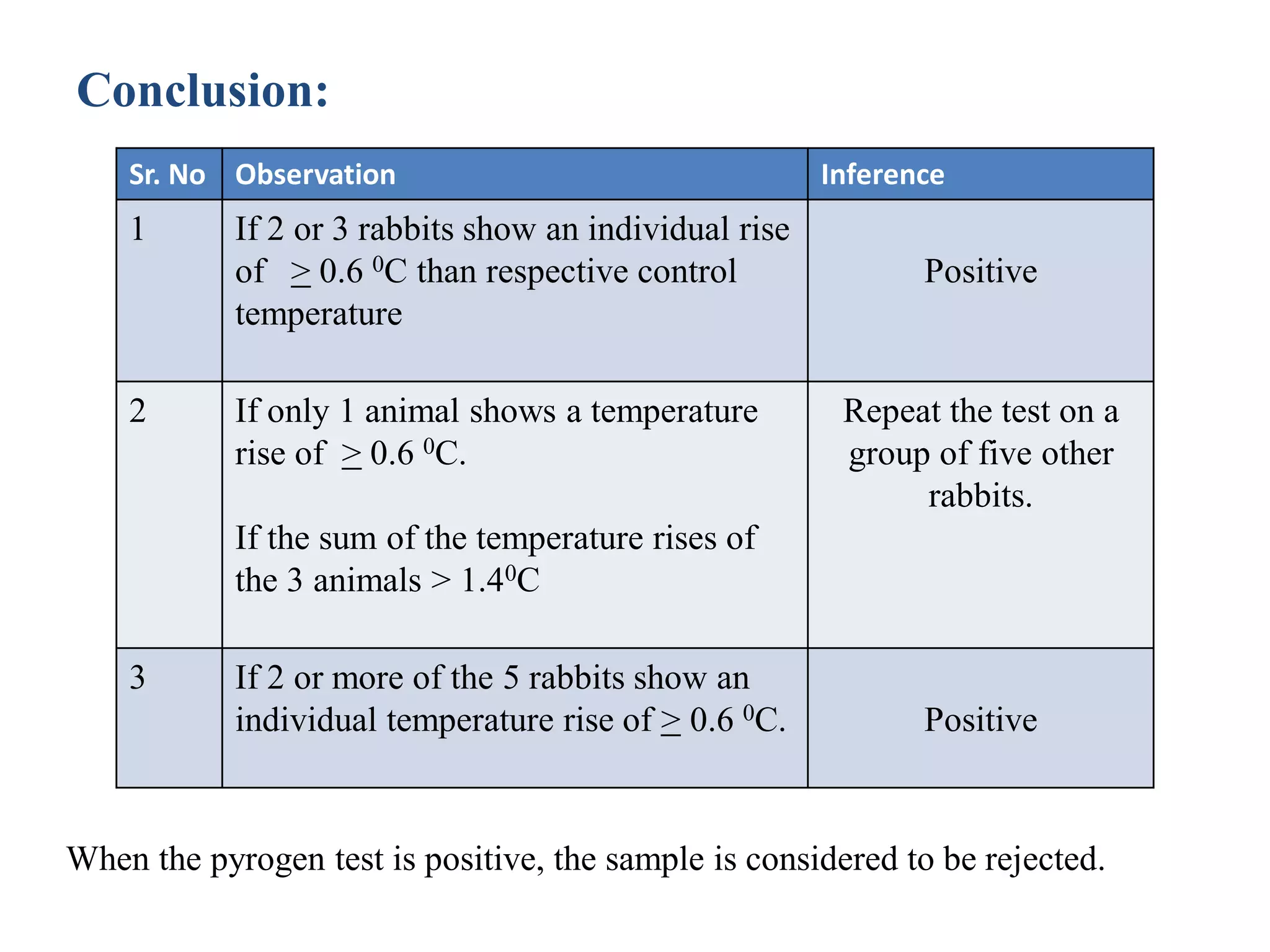
When the pyrogentest is positive, the sample is considered to be rejected.
Sr. No Observation Inference
1 If 2 or 3 rabbits show an individual rise
of > 0.6 0C than respective control
temperature
Positive
2 If only 1 animal shows a temperature
rise of > 0.6 0C.
If the sum of the temperature rises of
the 3 animals > 1.40C
Repeat the test on a
group of five other
rabbits.
3 If 2 or more of the 5 rabbits show an
individual temperature rise of > 0.6 0C. Positive
7.
Disadvantages/ Limitations
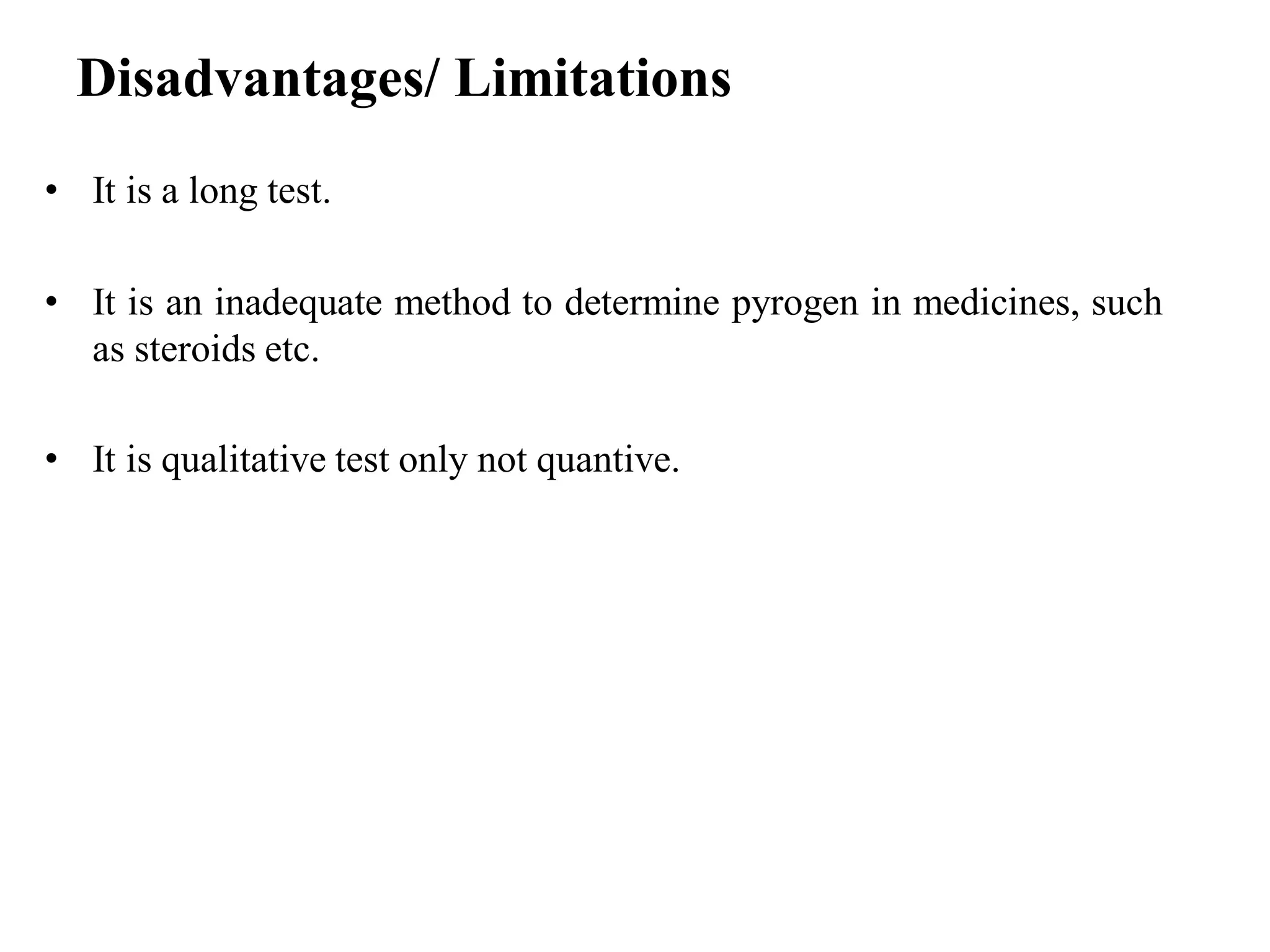
• Itis a long test.
• It is an inadequate method to determine pyrogen in medicines, such
as steroids etc.
• It is qualitative test only not quantive.
8.
References:
• Ghosh MN.Fundamentals of Experimental
Pharmacology. Hilton & Company, Kolkata.
• Kulkarni SK. Handbook of experimental
pharmacology. VallabhPrakashan