M pharmacy 2nd sem.
Session :- 2020-2021
Submitted By :-
Sachin Gulia
(9003)
Submitted To :-
Dr. Govind
DEPARTMENT OF PHARMACEUTICAL
SCIENCES
MDU
TOPIC :- preclinical screening methods for analgesic
Pain is an unpleasant sensory and emotional
experience associated
with actual and potential tissue damage.
Nociception :- Perception of noxious stimuli.
An analgesic or painkiller is any member of the group
of drugs used to achieve analgesia — relief from pain.
Analgesics is defined as the agents which selectively
relieve pain by acting in the CNS or by peripheral
pain mechanisms without significantly altering
consciousness.
Acute pain
Source is soft tissue damage, infection or
inflammation
Short in duration
Serves to protect one after an injury
Chronic pain
Lasts 6 months or longer
Defined as ‘Disease of pain’
e.g. cancer pain, neuropathic pain, arthritic pain.
Analgesic drugs act in various ways on the
peripheral and central nervous systems.
Opioids produce analgesia by binding to specific G –
protein coupled receptors in brain and spinal cord.
NSAIDs inhibit the activity of both cyclooxygenase-1
(COX-1) and cyclooxygenase-2 (COX-2) and thereby
the synthesis of prostaglandins and thromboxanes.
Inhibition of COX-2 leads to the anti-inflammatory,
analgesic and antipyretic effects.
1. Models using thermal stimuli:
– Hot plate method
–The tail flick model using radiant
heat/immersion of the tail in hot water
– Pain state models using cold stimuli
•Cold tail flick test
• Cold ethanol tail flick test (CET)
2. Models using electrical stimuli:
– Stimulation of the tooth pulp
– Electrical stimulation of the tail
– Monkey shock titration test
3. Models using chemical stimuli:
– Formalin test
–Writhing test
– Stimulation of hollow organs
• Rat sigmoid colon model
• Inflammatory uterine pain model
4. Models using mechanical stimuli:
– Haffner’s tail clip method
– Randall Selitto Test
3H-Naloxone binding assay
3H-Dihydromorphine binding to μ opiate
receptors in rat brain
Inhibition of enkephalinase
Receptor binding of nociceptin
Receptor binding of cannabinoids
Vanilloid (capsaicin) receptor binding
Evaluation of vanilloid receptor antagonists
Vasoactive intestinal polypeptide (VIP) and
pituitary adenylate cyclase-activating
peptide (PACAP)
IN VIVO MODELS
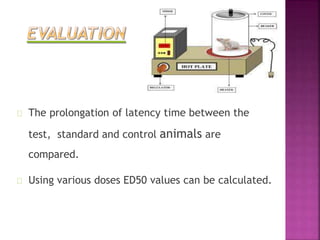
HOT- PLATE METHOD : -
Purpose and rationale
The paws of mice and rats are
sensitive to heat at temperatures
which are not damaging to skin.
The responses are jumping, withdrawal of the paws
and licking of the paws.
The responses are prolonged after administration of
centrally acting analgesics, whereas peripheral
analgesics of the acetylsalicylic acid or phenyl-
acetic acid type do not generally affect these
responses.
mice (18-22g) are used
The temperature of the hot plate is maintained at 55° to
56°C.
The animals are placed on the hot plate & time until
either licking or jumping occurs is recorded.
The latency is recorded before & after 20, 60 and 90 min
after the administration of standard or test compound.
The prolongation of latency time between the
test, standard and control animals are
compared.
Using various doses ED50 values can be calculated.
Purpose and rationale
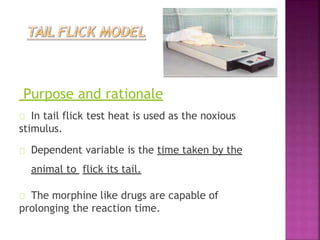
In tail flick test heat is used as the noxious
stimulus.
Dependent variable is the time taken by the
animal to flick its tail.
The morphine like drugs are capable of
prolonging the reaction time.
Mice (18-22g) are placed into small cage
Leaving the tail exposed
Appropriate
temperature is
maintained on the
radiant source
The tail of the mice is placed on the radiant source & time taken by
the mice to withdraw its tail is recorded.
Usually withdrawal time is within 2-10s
The Tail-flick latency is recorded before & after the administration
of standard or test compound.
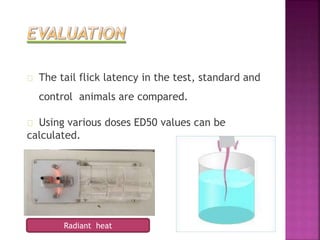
The tail flick latency in the test, standard and
control animals are compared.
Using various doses ED50 values can be
calculated.
Radiant heat
Procedure
Wistar rat (170- 210gms) is used
Rat is placed into cage in such a way that their tail
hangs freely.
Distal 5 cm of the tail of wistar rat is marked and
immersed in a cup of warm water ( 55°Cto56°C)
for 15 seconds.
The reaction time is determined periodically after
administration of test drug (0.5, 1, 2, 3, 4, and 6
hours)
Response and Evaluation: - Withdrawal of
tail or attempt to escape or abrupt
movement of tail and sometimes the
recoiling of whole body is seen.
Centrally acting analgesics are capable of
causing prolongation of tail withdrawal
reflex( more than 6 sec.).
Modification:
–Cold tail Flick test
–Cold ethanol Tail flick test
Models using electrical stimuli
 Procedure
 Rabbits 2-3 kg, anesthetized
with thiopental sodium15mg/kg iv.
 Using Dental drill, tooth pulp chambers are
exposed close
 to upper incisors .
 Clamping electrodes are placed into the drilled
holes.
 After 30 min. electrical stimulus is applied by
rectangular current of frequency 50 Hz upto 1sec.
 Current is started 0.2 mA and increased until
animal starts licking and a threshold is
determined.
Weiss and Laties(1958)
This test is used for final
evaluation of new analgesic
agents.
Monkeys are seated on restraining
chairs.
By Coulbourn Instrument
Programmable Shocker electric
current is applied through
electrodes to shaved portion of tail.
Current ranges from 0-4 mA
through 29 progressive steps.
Monkey presses a bar to interrupt
the shock.
For each monkey stable base line
shock level is recorded day prior to
drug administration.
After 24hr of drug, shock titration is
Models using chemical stimuli
Chronic pain model and sensitive to opioid like
drugs.
Pain is induced in Male Wistar rats (180–300 g) by a
subcutaneous injection of 0.05ml of 10% formalin
on the dorsal surface of the right hind paw.
Each individual rat is placed into a clear
plastic cage for observation.
The response is the amount of time the
animals spend in elevation or favoring of
the paw, licking and biting of the injected
paw.
Two distinct periods of high licking activity can be identified:
1.Early phase lasting the first 3-5 min (direct effect on
nociceptors )
2.Late phase lasting from 15 to 30 min after the injection of
formalin. (an inflammatory reaction in the peripheral tissue
and functional changes in the dorsal horn of the spinal cord)
 Centrally acting analgesics(Morphine) are antinociceptive in
both phases.
 NSAIDS(indomethacin and naproxen) inhibit only the late
phase.
Substance P and bradykinin act as mediators in the first
phase, while histamine, serotonin, prostaglandin and
bradykinin are involved in the nociceptive response of
the second stage.
WRITHING TEST
Mice of either sex (20 and 25 g) is used
Pain is induced by intraperitoneal injection of
chemicals that irritate serous membranes : 0.6% acetic
acid, Phenylquinone 0.02%, 4% NaCl etc. given i.p.
The onset of writhing, abdominal contractions & trunk
twist response are recorded for 10 min.
The test and standard drug is administered 15 min
prior to the acetic acid administration.
The writhing period is recorded and compared
with the control group.
writhes in (control group-test group) × 100
writhes in control group
Writhing response in the drug treated must be less
when compared to the control group.
MODELS USING MECHANICAL STIMULUS
Purpose and rationale
Preferred sites for applying nociceptive mechanical
stimuli are the hind paw and the tail
Highly sensitive for centrally acting drugs
Tests using constant pressure have been abandoned
progressively for those applying gradually increasing
pressures
An artery clip is placed at the root of tail of mice.
A quick response is seen as biting the clip or tail, where
clip has been placed.
Then after 15, 30, and 60 minutes, the same procedure is
repeated and the reaction time is measured.
Principal: Inflammation increases the pain
sensitivity and decreases pain threshold.
Male Wistar rats (130 to 175 g) are used.
0.1 ml of a 20% suspension of Brewer’s yeast is
injected s.c. into plantar surface of hind paw
and after 3hr, using a special apparatus
pressure is applied on the paw at a constant
rate until animal struggles and threshold is
determined.
ANIMAL MODELS OF CHRONIC PAIN
preclinical screening models for Analgesic drugs

preclinical screening models for Analgesic drugs

  • 1.
    M pharmacy 2ndsem. Session :- 2020-2021 Submitted By :- Sachin Gulia (9003) Submitted To :- Dr. Govind DEPARTMENT OF PHARMACEUTICAL SCIENCES MDU TOPIC :- preclinical screening methods for analgesic
  • 2.
    Pain is anunpleasant sensory and emotional experience associated with actual and potential tissue damage. Nociception :- Perception of noxious stimuli. An analgesic or painkiller is any member of the group of drugs used to achieve analgesia — relief from pain. Analgesics is defined as the agents which selectively relieve pain by acting in the CNS or by peripheral pain mechanisms without significantly altering consciousness.
  • 3.
    Acute pain Source issoft tissue damage, infection or inflammation Short in duration Serves to protect one after an injury Chronic pain Lasts 6 months or longer Defined as ‘Disease of pain’ e.g. cancer pain, neuropathic pain, arthritic pain.
  • 4.
    Analgesic drugs actin various ways on the peripheral and central nervous systems. Opioids produce analgesia by binding to specific G – protein coupled receptors in brain and spinal cord. NSAIDs inhibit the activity of both cyclooxygenase-1 (COX-1) and cyclooxygenase-2 (COX-2) and thereby the synthesis of prostaglandins and thromboxanes. Inhibition of COX-2 leads to the anti-inflammatory, analgesic and antipyretic effects.
  • 6.
    1. Models usingthermal stimuli: – Hot plate method –The tail flick model using radiant heat/immersion of the tail in hot water – Pain state models using cold stimuli •Cold tail flick test • Cold ethanol tail flick test (CET) 2. Models using electrical stimuli: – Stimulation of the tooth pulp – Electrical stimulation of the tail – Monkey shock titration test
  • 7.
    3. Models usingchemical stimuli: – Formalin test –Writhing test – Stimulation of hollow organs • Rat sigmoid colon model • Inflammatory uterine pain model 4. Models using mechanical stimuli: – Haffner’s tail clip method – Randall Selitto Test
  • 8.
    3H-Naloxone binding assay 3H-Dihydromorphinebinding to μ opiate receptors in rat brain Inhibition of enkephalinase Receptor binding of nociceptin Receptor binding of cannabinoids Vanilloid (capsaicin) receptor binding Evaluation of vanilloid receptor antagonists Vasoactive intestinal polypeptide (VIP) and pituitary adenylate cyclase-activating peptide (PACAP)
  • 9.
  • 10.
    HOT- PLATE METHOD: - Purpose and rationale The paws of mice and rats are sensitive to heat at temperatures which are not damaging to skin. The responses are jumping, withdrawal of the paws and licking of the paws. The responses are prolonged after administration of centrally acting analgesics, whereas peripheral analgesics of the acetylsalicylic acid or phenyl- acetic acid type do not generally affect these responses.
  • 11.
    mice (18-22g) areused The temperature of the hot plate is maintained at 55° to 56°C. The animals are placed on the hot plate & time until either licking or jumping occurs is recorded. The latency is recorded before & after 20, 60 and 90 min after the administration of standard or test compound.
  • 13.
    The prolongation oflatency time between the test, standard and control animals are compared. Using various doses ED50 values can be calculated.
  • 14.
    Purpose and rationale Intail flick test heat is used as the noxious stimulus. Dependent variable is the time taken by the animal to flick its tail. The morphine like drugs are capable of prolonging the reaction time.
  • 15.
    Mice (18-22g) areplaced into small cage Leaving the tail exposed Appropriate temperature is maintained on the radiant source The tail of the mice is placed on the radiant source & time taken by the mice to withdraw its tail is recorded. Usually withdrawal time is within 2-10s The Tail-flick latency is recorded before & after the administration of standard or test compound.
  • 16.
    The tail flicklatency in the test, standard and control animals are compared. Using various doses ED50 values can be calculated. Radiant heat
  • 17.
    Procedure Wistar rat (170-210gms) is used Rat is placed into cage in such a way that their tail hangs freely. Distal 5 cm of the tail of wistar rat is marked and immersed in a cup of warm water ( 55°Cto56°C) for 15 seconds. The reaction time is determined periodically after administration of test drug (0.5, 1, 2, 3, 4, and 6 hours)
  • 18.
    Response and Evaluation:- Withdrawal of tail or attempt to escape or abrupt movement of tail and sometimes the recoiling of whole body is seen. Centrally acting analgesics are capable of causing prolongation of tail withdrawal reflex( more than 6 sec.). Modification: –Cold tail Flick test –Cold ethanol Tail flick test
  • 19.
  • 20.
     Procedure  Rabbits2-3 kg, anesthetized with thiopental sodium15mg/kg iv.  Using Dental drill, tooth pulp chambers are exposed close  to upper incisors .  Clamping electrodes are placed into the drilled holes.  After 30 min. electrical stimulus is applied by rectangular current of frequency 50 Hz upto 1sec.  Current is started 0.2 mA and increased until animal starts licking and a threshold is determined.
  • 21.
    Weiss and Laties(1958) Thistest is used for final evaluation of new analgesic agents. Monkeys are seated on restraining chairs. By Coulbourn Instrument Programmable Shocker electric current is applied through electrodes to shaved portion of tail. Current ranges from 0-4 mA through 29 progressive steps. Monkey presses a bar to interrupt the shock. For each monkey stable base line shock level is recorded day prior to drug administration. After 24hr of drug, shock titration is
  • 22.
  • 23.
    Chronic pain modeland sensitive to opioid like drugs. Pain is induced in Male Wistar rats (180–300 g) by a subcutaneous injection of 0.05ml of 10% formalin on the dorsal surface of the right hind paw. Each individual rat is placed into a clear plastic cage for observation. The response is the amount of time the animals spend in elevation or favoring of the paw, licking and biting of the injected paw.
  • 24.
    Two distinct periodsof high licking activity can be identified: 1.Early phase lasting the first 3-5 min (direct effect on nociceptors ) 2.Late phase lasting from 15 to 30 min after the injection of formalin. (an inflammatory reaction in the peripheral tissue and functional changes in the dorsal horn of the spinal cord)  Centrally acting analgesics(Morphine) are antinociceptive in both phases.  NSAIDS(indomethacin and naproxen) inhibit only the late phase. Substance P and bradykinin act as mediators in the first phase, while histamine, serotonin, prostaglandin and bradykinin are involved in the nociceptive response of the second stage.
  • 25.
    WRITHING TEST Mice ofeither sex (20 and 25 g) is used Pain is induced by intraperitoneal injection of chemicals that irritate serous membranes : 0.6% acetic acid, Phenylquinone 0.02%, 4% NaCl etc. given i.p. The onset of writhing, abdominal contractions & trunk twist response are recorded for 10 min. The test and standard drug is administered 15 min prior to the acetic acid administration.
  • 26.
    The writhing periodis recorded and compared with the control group. writhes in (control group-test group) × 100 writhes in control group Writhing response in the drug treated must be less when compared to the control group.
  • 27.
  • 28.
    Purpose and rationale Preferredsites for applying nociceptive mechanical stimuli are the hind paw and the tail Highly sensitive for centrally acting drugs Tests using constant pressure have been abandoned progressively for those applying gradually increasing pressures
  • 29.
    An artery clipis placed at the root of tail of mice. A quick response is seen as biting the clip or tail, where clip has been placed. Then after 15, 30, and 60 minutes, the same procedure is repeated and the reaction time is measured.
  • 30.
    Principal: Inflammation increasesthe pain sensitivity and decreases pain threshold. Male Wistar rats (130 to 175 g) are used. 0.1 ml of a 20% suspension of Brewer’s yeast is injected s.c. into plantar surface of hind paw and after 3hr, using a special apparatus pressure is applied on the paw at a constant rate until animal struggles and threshold is determined.
  • 32.
    ANIMAL MODELS OFCHRONIC PAIN