Dr. Jitendra Agrawal
Second year resident
INTRODUCTION
 A Seizure (from the Latin sacire, “To take possession
of”) is a paroxysmal event due to
abnormal, excessive, hyper synchronous discharges
from an aggregate of central nervous system (CNS)
neurons.
 Epilepsy describes a condition in which a person has
reccurent seizures due to a chronic, underlying process.
WHY WE NEED ANIMAL MODEL?
 Discovery of new AED
 Characterization of spectrum of anticonvulsant
activity of new AED
 Evaluation whether efficacy of new AED changes
during chronic treatment of epilepsy
 Discovery of antiepileptogenic or disease modifying
agent
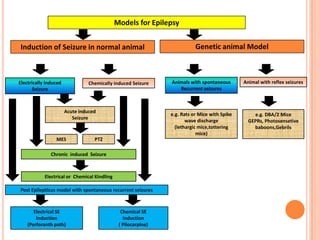
Models for Epilepsy
Induction of Seizure in normal animal Genetic animal Model
Electrically induced
Seizure
Chemically induced Seizure Animals with spontaneous
Recurrent seizures
Acute induced
Seizure
MES PTZ
Chronic induced Seizure
Electrical or Chemical Kindling
Post Epilepticus model with spontaneous recurrent seizures
Electrical SE
Induction
(Perforanth path)
Chemical SE
Induction
( Pilocarpine)
e.g. Rats or Mice with Spike
wave discharge
(lethargic mice,tottering
mice)
e.g. DBA/2 Mice
GEPRs, Photosensetive
baboons,Gebrils
Animal with reflex seizures
ELECTROSHOCK SEIZURES IN MICE & RATS
 Protection against electroshock induced seizures in mice and
rats is used as an indication for compounds which may prove
effective in Generalized tonic clonic seizures
 Electric stimuli evoke tonic hind limb extensions, which are
suppressed by anti-epileptic drugs.
 CC50 : current for inducing hind limb extension 50% of animal
MAXIMAL ELECTROSHOCK SEIZURE
 Merritt and Putnam (1938)
 Animals are stimulated 2-5 times the threshold current strength
 The purpose of this test is to induce the most intense
physiologically possible seizure by a method analogous to human
electroshock therapy.
METHODOLOGY
 ANIMALS: Groups of 6-10 male Swiss mice (20-32g) or Wistar
rats (100-150g) are used.
 ROUTE OF DRUG ADMINISTRATION:
i. Intraperitoneal
ii. Oral
 30 min after i.p. injection and 60 min after oral
administration the animals are subjected to electroshock.
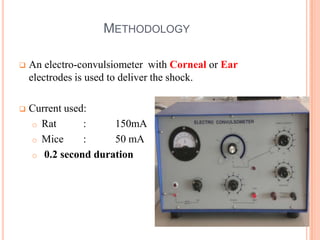
 An electro-convulsiometer with Corneal or Ear
electrodes is used to deliver the shock.
 Current used:
o Rat : 150mA
o Mice : 50 mA
o 0.2 second duration
METHODOLOGY
 The PHASES of maximal seizure shown by normal mice typically
consists of :
 Phase of tonic limb flexion
 Full extension of limbs
 Clonic interval ( variable )
 Death (in some animals)
video
EVALUATION
 Supression of hind limb extenson - measure of
eficcacy
 Calculation of ED50 for supression of tonic hind limb
extension – anticonvulsant potency
 Phenytoin, carbmazepine, phenobarbitone –
effective
 Ethosuximide - ineffective
DISADVANTAGE
 Do not give clue about mechanism of action of drug
PENTYLENETETRAZOL INDUCED SEIZURES
 Pentylenetetrazol (PTZ) produces generalized asynchronized
clonic movements which are superceded by tonic convulsions
characterized by flexion of limbs followed by extension.
 Act by antagonizing the inhibitory GABAergic transmission
 The test is considered as indicative of anticonvulsant activity of
drugs against Absence seizure
METHODOLOGY
 ANIMALS: Groups of 6-10 mice (18-22g) of either sex
 ROUTE OF DRUG ADMINISTRATION:
 Determine S.C. CD97 (convulsive dose in 97% animals)
 1% solution of PTZ , 80-100mg/kg S.c. in scruff of neck
 There are 3 distinct phases constituted the PTZ seizure
sequence i.e.
 Myoclonic jerk
 Clonic seizures
 Tonic-clonic hind limb extension.
 Death
EVALUATION
 End point
 First episode of clonic jerking last for 5 sec
 First clonic seizure with loss of righting reflex
 Evaluation
 Efficacy: measured by ED50 for suppression of clonic
seizure
 Ethosuximide, valproate – effective
 Phenytoin, Carbamazepine – not effective
STRYCHNINE INDUCED SEIZURES
 The convulsant action of strychnine is due to interference
with post-synaptic inhibition that is mediated by Glycine.
 It acts as a selective competitive antagonist to block the
inhibitory effect of glycine at all glycine receptors.
 The convulsions has a characteristic Motor pattern.
 Dose : 2 mg/kg.
 Route : i.p.
 Time for onset of tonic extensor convulsions and death of
animals is noted.
 Strychnine abolishes the flexor latency completely, leading to
almost instantaneous onset of the extensor seizure.
PICROTOXIN-INDUCED CONVULSIONS
 Picrotoxin is a and it modifies the
function of chloride ion channel of the GABA receptor
complex.
 Dose : 3.5 mg/kg
 Route : subcutaneous
BICUCULINE TESTS IN RATS
 Bicuculine is a
 Dose : 1 mg/kg
 Route : Intravenous.
 The tonic convulsions appear in all treated rats
within 30 seconds of injection.
4-AMINOPYRIDINE INDUCED SEIZURES IN
MICE
 4-Aminopyridine, is a powerful
convulsant.
 The epileptiform activity is predominantly mediated by non-
NMDA type excitatory amino acid receptors.
 Dose : 13.3 mg/kg
 Route : Subcutaneous
EPILEPSY INDUCED BY FOCAL SEIZURES
 Topical or intracerebral application of metal and chemical can
lead to simple partial seizures
 Cortical imlanted metals:
 Alumina cream, cobalt, tungstic acid
 Appliead onto or into the cerebral cortex
 Injection of iron in brain cortex
 Aluminium Hydroxide gel model
 4% aluminium hydroxide is injected into surgically exposed monkey
neocortex
 One or two month after injection spontaneous and recurrent seizures
begins
 Model for focal epilepsy
 Chemical
 Intrahippocampal – kainic acid, tetanus toxin
 Topical application – penicillin, picrotoxin, bicuculline
KINDLED RAT SEIZURE MODEL
 The kindled seizure model in rats offer a method to study the
anticonvulsant activity on the basis of pathophysiological
model.
 Kindling results from repetitive sub convulsive electrical
stimulation of certain areas of brain .
 On continued stimulation electrical activity spreads and
generalized convulsions occur.
 The animals are given stimulation through an electrode
implanted with in right amygdala.
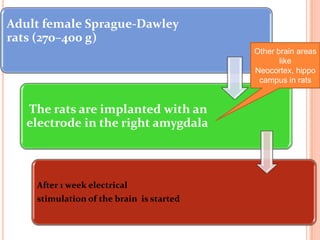
Adult female Sprague-Dawley
rats (270–400 g)
The rats are implanted with an
electrode in the right amygdala
After 1 week electrical
stimulation of the brain is started
Other brain areas
like
Neocortex, hippo
campus in rats
 Duration and amplitude, behavioral seizure duration and
seizure stage are recorded
 Seizure severity is graded into 5 stages.
 1: immobility, eye closure, twitching of vibrissae, sterotyping
sniffing
 2: facial clonus and head nodding
 3: facial clonus , head nodding and forelimb clonus
 4: rearing , often accompanied by bilateral forlimb clonus
 5: rearing with loss of balance and falling accompanied by
generalized clonic seizures
 Rats are considered to be kindled on the 1st stimulation
causing a stage 5 seizure which is followed by at least two
consecutive stage 5 seizures
EVALUATION
 Test animals are tested on the day before and after
the test compound is given orally or i.p.
 Test and control are compared with four different
measures of efficacy
 Seizure latency – time from stimulation to the first sign
of seizure activity
 Seizure severity
 Seizure duration
 After discharge duration
 Drug efficacy can be measured by determining
separate ED50 value for total supression of
 Generalized seizure (stage 4,5)
 Focal seizure (Stage 1-3)
 Amygdala after discharges
ADVANTAGE:
 Efficacy of drug :
 Process of epileptogenesis
 Fully kindled state
 Efficacy against generalized seizures provides
model for effective in secondary generalized
seizures of partial epilepsy
 Efficacy against the focal component of kindled
seizures provides a valid model for drugs effective
in complex partial seizures
OTHER METHODS OF KINDLING
 Corneal Electroshock kindling
 Mice: once daily application of 3 mA current 60 Hz for 2
sec
 Rat : once daily application of 8 mA current 60 Hz for 4
sec
 Stage 5 seizure is considered as animal is kindled
CHEMICAL INDUCED KINDLING
 Rat: 3o mg/kg of PTZ i.p. 3 dose/week for 9 weeks
 Scoring :
 0 - no response
 1 – ear and facial twitching
 2 – one to 20 myoclonic jerck
 3 – more than 20 body jerck
 4 – clonic forelimb convulsion
 5 – generalized convulsions with rearing and falling down
episodes
 6 – generelized convulsions with tonic extension episodes
and status epilepticus
 At the end of the 9th week 90% animals are kindeled
 Seizure score more than or equal to 3
MODELS FOR STATUS EPILEPTICUS
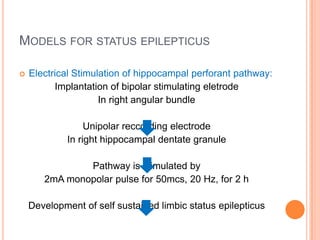
 Electrical Stimulation of hippocampal perforant pathway:
Implantation of bipolar stimulating eletrode
In right angular bundle
Unipolar reccording electrode
In right hippocampal dentate granule
Pathway is stimulated by
2mA monopolar pulse for 50mcs, 20 Hz, for 2 h
Development of self sustained limbic status epilepticus
CHEMICAL INDUCED STATUS EPILEPTICUS
 Pilocarpine
 Cholinomimetic
 Can produce status epilepticus in rats
 Dose : 380-400 mg/kg
 Route : ip
 Lithium- Pilocarpine;
 Pretreatment with lithium – 3meq/kg ip
 Followed by pilocarpine – 30-40 mg/kg ip
 Lithium – methomyl
 Pretreatment with lithium
 Methomyl – 5.2mg / kg s.c.
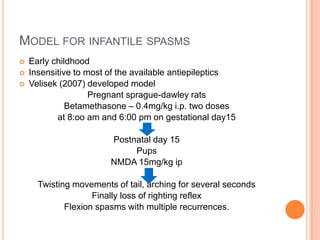
MODEL FOR INFANTILE SPASMS
 Early childhood
 Insensitive to most of the available antiepileptics
 Velisek (2007) developed model
Pregnant sprague-dawley rats
Betamethasone – 0.4mg/kg i.p. two doses
at 8:oo am and 6:00 pm on gestational day15
Postnatal day 15
Pups
NMDA 15mg/kg ip
Twisting movements of tail, arching for several seconds
Finally loss of righting reflex
Flexion spasms with multiple recurrences.
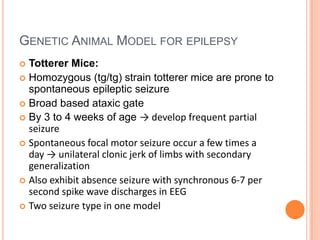
GENETIC ANIMAL MODEL FOR EPILEPSY
 Totterer Mice:
 Homozygous (tg/tg) strain totterer mice are prone to
spontaneous epileptic seizure
 Broad based ataxic gate
 By 3 to 4 weeks of age → develop frequent partial
seizure
 Spontaneous focal motor seizure occur a few times a
day → unilateral clonic jerk of limbs with secondary
generalization
 Also exhibit absence seizure with synchronous 6-7 per
second spike wave discharges in EEG
 Two seizure type in one model
LETHARGIC MICE
 Homozygous (lh/lh)
 Model for absence seizure
 Recognized by ataxic gate at the age of 3 weeks
 Behavioural , EEG, and anticonvulsant profile is
similar to those in absence seizure in human
DBA/2J MICE
 Inbred strain of house mouse (mus musculus)
 Audiogenic seizure susceptible mice
 Between age 2-4 weeks these mice exhibit sound
induced seizures
 Susceptibility gradually declines → at the 8 week
totally free of audiogenic seizures
 Exposed to loud sound (12-16 kHz)
 Seizure pattern → wild running phase → clonic
convulsion → tonic extension → respiratory arrest/ full
recovery
 Sensitive gross screening model for anticonvulsant drug
GEPRS
 Genetically epilepsy prone Rats:
 Seizures can be induced by various stimuli
 Sound
 Hyperthermia
 Chemcal
 Electrical
 Seizure pattern → wild running phase → clonic jercks →
tonic extension → respiratory arrest/ full recovery
 Model for tonic-clonic convulsion
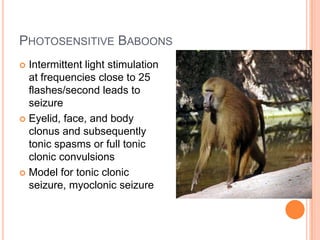
PHOTOSENSITIVE BABOONS
 Intermittent light stimulation
at frequencies close to 25
flashes/second leads to
seizure
 Eyelid, face, and body
clonus and subsequently
tonic spasms or full tonic
clonic convulsions
 Model for tonic clonic
seizure, myoclonic seizure
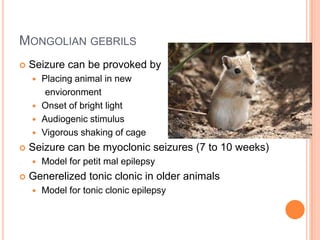
MONGOLIAN GEBRILS
 Seizure can be provoked by
 Placing animal in new
envioronment
 Onset of bright light
 Audiogenic stimulus
 Vigorous shaking of cage
 Seizure can be myoclonic seizures (7 to 10 weeks)
 Model for petit mal epilepsy
 Generelized tonic clonic in older animals
 Model for tonic clonic epilepsy
CONCLUSION
 Ideal model of epilepsy should show the following
characteristics
 Development of spontaneously occurring seizures
 Type of seizure similar to that seen in human epilepsy
 EEG correlates of epileptic –like activity
 Age dependency in the onset of epilepsy as seen in
many epileptic syndromes
 At present no model follows all criteria
 Only genetic model come close to call ideal
 Resemble idiopathic epilepsy in humans more
closely than any other experimental model
 The antiepileptic drug development program
primarily based on two seizure model, the MES and
the s.c. PTZ
 Single method of screening of antiepileptic drugs
can not predict the full pharmacological profile of
the drug.
REFERENCES
 Hans GV. Drug Discovery and Evaluation:Pharmacological
Assays. Springer. 3rd edition. New York :Springer-Verlag Berlin
Heidelberg ; 2008.
 Gupta SK. Drug Screening Methods (Preclinical Evaluation of
New Drugs). 2nd edition.New Delhi:Jaypee Brothers Medical
Publishers; 2009.
 Wolfgang L. Critical review of current animal models of seizures
and epilepsy used in the discovery and development of new
antiepileptic drugs. Seizure. 2011(20):359–368.
THANK YOU !

Aminal models for seizure

  • 1.
  • 2.
    INTRODUCTION  A Seizure(from the Latin sacire, “To take possession of”) is a paroxysmal event due to abnormal, excessive, hyper synchronous discharges from an aggregate of central nervous system (CNS) neurons.  Epilepsy describes a condition in which a person has reccurent seizures due to a chronic, underlying process.
  • 3.
    WHY WE NEEDANIMAL MODEL?  Discovery of new AED  Characterization of spectrum of anticonvulsant activity of new AED  Evaluation whether efficacy of new AED changes during chronic treatment of epilepsy  Discovery of antiepileptogenic or disease modifying agent
  • 4.
    Models for Epilepsy Inductionof Seizure in normal animal Genetic animal Model Electrically induced Seizure Chemically induced Seizure Animals with spontaneous Recurrent seizures Acute induced Seizure MES PTZ Chronic induced Seizure Electrical or Chemical Kindling Post Epilepticus model with spontaneous recurrent seizures Electrical SE Induction (Perforanth path) Chemical SE Induction ( Pilocarpine) e.g. Rats or Mice with Spike wave discharge (lethargic mice,tottering mice) e.g. DBA/2 Mice GEPRs, Photosensetive baboons,Gebrils Animal with reflex seizures
  • 5.
    ELECTROSHOCK SEIZURES INMICE & RATS  Protection against electroshock induced seizures in mice and rats is used as an indication for compounds which may prove effective in Generalized tonic clonic seizures  Electric stimuli evoke tonic hind limb extensions, which are suppressed by anti-epileptic drugs.  CC50 : current for inducing hind limb extension 50% of animal
  • 6.
    MAXIMAL ELECTROSHOCK SEIZURE Merritt and Putnam (1938)  Animals are stimulated 2-5 times the threshold current strength  The purpose of this test is to induce the most intense physiologically possible seizure by a method analogous to human electroshock therapy.
  • 7.
    METHODOLOGY  ANIMALS: Groupsof 6-10 male Swiss mice (20-32g) or Wistar rats (100-150g) are used.  ROUTE OF DRUG ADMINISTRATION: i. Intraperitoneal ii. Oral  30 min after i.p. injection and 60 min after oral administration the animals are subjected to electroshock.
  • 8.
     An electro-convulsiometerwith Corneal or Ear electrodes is used to deliver the shock.  Current used: o Rat : 150mA o Mice : 50 mA o 0.2 second duration METHODOLOGY
  • 9.
     The PHASESof maximal seizure shown by normal mice typically consists of :  Phase of tonic limb flexion  Full extension of limbs  Clonic interval ( variable )  Death (in some animals) video
  • 10.
    EVALUATION  Supression ofhind limb extenson - measure of eficcacy  Calculation of ED50 for supression of tonic hind limb extension – anticonvulsant potency  Phenytoin, carbmazepine, phenobarbitone – effective  Ethosuximide - ineffective
  • 11.
    DISADVANTAGE  Do notgive clue about mechanism of action of drug
  • 12.
    PENTYLENETETRAZOL INDUCED SEIZURES Pentylenetetrazol (PTZ) produces generalized asynchronized clonic movements which are superceded by tonic convulsions characterized by flexion of limbs followed by extension.  Act by antagonizing the inhibitory GABAergic transmission  The test is considered as indicative of anticonvulsant activity of drugs against Absence seizure
  • 13.
    METHODOLOGY  ANIMALS: Groupsof 6-10 mice (18-22g) of either sex  ROUTE OF DRUG ADMINISTRATION:  Determine S.C. CD97 (convulsive dose in 97% animals)  1% solution of PTZ , 80-100mg/kg S.c. in scruff of neck  There are 3 distinct phases constituted the PTZ seizure sequence i.e.  Myoclonic jerk  Clonic seizures  Tonic-clonic hind limb extension.  Death
  • 14.
    EVALUATION  End point First episode of clonic jerking last for 5 sec  First clonic seizure with loss of righting reflex  Evaluation  Efficacy: measured by ED50 for suppression of clonic seizure  Ethosuximide, valproate – effective  Phenytoin, Carbamazepine – not effective
  • 15.
    STRYCHNINE INDUCED SEIZURES The convulsant action of strychnine is due to interference with post-synaptic inhibition that is mediated by Glycine.  It acts as a selective competitive antagonist to block the inhibitory effect of glycine at all glycine receptors.  The convulsions has a characteristic Motor pattern.  Dose : 2 mg/kg.  Route : i.p.  Time for onset of tonic extensor convulsions and death of animals is noted.  Strychnine abolishes the flexor latency completely, leading to almost instantaneous onset of the extensor seizure.
  • 16.
    PICROTOXIN-INDUCED CONVULSIONS  Picrotoxinis a and it modifies the function of chloride ion channel of the GABA receptor complex.  Dose : 3.5 mg/kg  Route : subcutaneous
  • 17.
    BICUCULINE TESTS INRATS  Bicuculine is a  Dose : 1 mg/kg  Route : Intravenous.  The tonic convulsions appear in all treated rats within 30 seconds of injection.
  • 18.
    4-AMINOPYRIDINE INDUCED SEIZURESIN MICE  4-Aminopyridine, is a powerful convulsant.  The epileptiform activity is predominantly mediated by non- NMDA type excitatory amino acid receptors.  Dose : 13.3 mg/kg  Route : Subcutaneous
  • 19.
    EPILEPSY INDUCED BYFOCAL SEIZURES  Topical or intracerebral application of metal and chemical can lead to simple partial seizures  Cortical imlanted metals:  Alumina cream, cobalt, tungstic acid  Appliead onto or into the cerebral cortex  Injection of iron in brain cortex  Aluminium Hydroxide gel model  4% aluminium hydroxide is injected into surgically exposed monkey neocortex  One or two month after injection spontaneous and recurrent seizures begins  Model for focal epilepsy  Chemical  Intrahippocampal – kainic acid, tetanus toxin  Topical application – penicillin, picrotoxin, bicuculline
  • 20.
    KINDLED RAT SEIZUREMODEL  The kindled seizure model in rats offer a method to study the anticonvulsant activity on the basis of pathophysiological model.  Kindling results from repetitive sub convulsive electrical stimulation of certain areas of brain .  On continued stimulation electrical activity spreads and generalized convulsions occur.  The animals are given stimulation through an electrode implanted with in right amygdala.
  • 21.
    Adult female Sprague-Dawley rats(270–400 g) The rats are implanted with an electrode in the right amygdala After 1 week electrical stimulation of the brain is started Other brain areas like Neocortex, hippo campus in rats
  • 22.
     Duration andamplitude, behavioral seizure duration and seizure stage are recorded  Seizure severity is graded into 5 stages.  1: immobility, eye closure, twitching of vibrissae, sterotyping sniffing  2: facial clonus and head nodding  3: facial clonus , head nodding and forelimb clonus  4: rearing , often accompanied by bilateral forlimb clonus  5: rearing with loss of balance and falling accompanied by generalized clonic seizures  Rats are considered to be kindled on the 1st stimulation causing a stage 5 seizure which is followed by at least two consecutive stage 5 seizures
  • 23.
    EVALUATION  Test animalsare tested on the day before and after the test compound is given orally or i.p.  Test and control are compared with four different measures of efficacy  Seizure latency – time from stimulation to the first sign of seizure activity  Seizure severity  Seizure duration  After discharge duration
  • 24.
     Drug efficacycan be measured by determining separate ED50 value for total supression of  Generalized seizure (stage 4,5)  Focal seizure (Stage 1-3)  Amygdala after discharges
  • 25.
    ADVANTAGE:  Efficacy ofdrug :  Process of epileptogenesis  Fully kindled state  Efficacy against generalized seizures provides model for effective in secondary generalized seizures of partial epilepsy  Efficacy against the focal component of kindled seizures provides a valid model for drugs effective in complex partial seizures
  • 26.
    OTHER METHODS OFKINDLING  Corneal Electroshock kindling  Mice: once daily application of 3 mA current 60 Hz for 2 sec  Rat : once daily application of 8 mA current 60 Hz for 4 sec  Stage 5 seizure is considered as animal is kindled
  • 27.
    CHEMICAL INDUCED KINDLING Rat: 3o mg/kg of PTZ i.p. 3 dose/week for 9 weeks  Scoring :  0 - no response  1 – ear and facial twitching  2 – one to 20 myoclonic jerck  3 – more than 20 body jerck  4 – clonic forelimb convulsion  5 – generalized convulsions with rearing and falling down episodes  6 – generelized convulsions with tonic extension episodes and status epilepticus  At the end of the 9th week 90% animals are kindeled  Seizure score more than or equal to 3
  • 28.
    MODELS FOR STATUSEPILEPTICUS  Electrical Stimulation of hippocampal perforant pathway: Implantation of bipolar stimulating eletrode In right angular bundle Unipolar reccording electrode In right hippocampal dentate granule Pathway is stimulated by 2mA monopolar pulse for 50mcs, 20 Hz, for 2 h Development of self sustained limbic status epilepticus
  • 29.
    CHEMICAL INDUCED STATUSEPILEPTICUS  Pilocarpine  Cholinomimetic  Can produce status epilepticus in rats  Dose : 380-400 mg/kg  Route : ip  Lithium- Pilocarpine;  Pretreatment with lithium – 3meq/kg ip  Followed by pilocarpine – 30-40 mg/kg ip  Lithium – methomyl  Pretreatment with lithium  Methomyl – 5.2mg / kg s.c.
  • 30.
    MODEL FOR INFANTILESPASMS  Early childhood  Insensitive to most of the available antiepileptics  Velisek (2007) developed model Pregnant sprague-dawley rats Betamethasone – 0.4mg/kg i.p. two doses at 8:oo am and 6:00 pm on gestational day15 Postnatal day 15 Pups NMDA 15mg/kg ip Twisting movements of tail, arching for several seconds Finally loss of righting reflex Flexion spasms with multiple recurrences.
  • 31.
    GENETIC ANIMAL MODELFOR EPILEPSY  Totterer Mice:  Homozygous (tg/tg) strain totterer mice are prone to spontaneous epileptic seizure  Broad based ataxic gate  By 3 to 4 weeks of age → develop frequent partial seizure  Spontaneous focal motor seizure occur a few times a day → unilateral clonic jerk of limbs with secondary generalization  Also exhibit absence seizure with synchronous 6-7 per second spike wave discharges in EEG  Two seizure type in one model
  • 32.
    LETHARGIC MICE  Homozygous(lh/lh)  Model for absence seizure  Recognized by ataxic gate at the age of 3 weeks  Behavioural , EEG, and anticonvulsant profile is similar to those in absence seizure in human
  • 33.
    DBA/2J MICE  Inbredstrain of house mouse (mus musculus)  Audiogenic seizure susceptible mice  Between age 2-4 weeks these mice exhibit sound induced seizures  Susceptibility gradually declines → at the 8 week totally free of audiogenic seizures  Exposed to loud sound (12-16 kHz)  Seizure pattern → wild running phase → clonic convulsion → tonic extension → respiratory arrest/ full recovery  Sensitive gross screening model for anticonvulsant drug
  • 34.
    GEPRS  Genetically epilepsyprone Rats:  Seizures can be induced by various stimuli  Sound  Hyperthermia  Chemcal  Electrical  Seizure pattern → wild running phase → clonic jercks → tonic extension → respiratory arrest/ full recovery  Model for tonic-clonic convulsion
  • 35.
    PHOTOSENSITIVE BABOONS  Intermittentlight stimulation at frequencies close to 25 flashes/second leads to seizure  Eyelid, face, and body clonus and subsequently tonic spasms or full tonic clonic convulsions  Model for tonic clonic seizure, myoclonic seizure
  • 36.
    MONGOLIAN GEBRILS  Seizurecan be provoked by  Placing animal in new envioronment  Onset of bright light  Audiogenic stimulus  Vigorous shaking of cage  Seizure can be myoclonic seizures (7 to 10 weeks)  Model for petit mal epilepsy  Generelized tonic clonic in older animals  Model for tonic clonic epilepsy
  • 38.
    CONCLUSION  Ideal modelof epilepsy should show the following characteristics  Development of spontaneously occurring seizures  Type of seizure similar to that seen in human epilepsy  EEG correlates of epileptic –like activity  Age dependency in the onset of epilepsy as seen in many epileptic syndromes  At present no model follows all criteria  Only genetic model come close to call ideal  Resemble idiopathic epilepsy in humans more closely than any other experimental model
  • 39.
     The antiepilepticdrug development program primarily based on two seizure model, the MES and the s.c. PTZ  Single method of screening of antiepileptic drugs can not predict the full pharmacological profile of the drug.
  • 40.
    REFERENCES  Hans GV.Drug Discovery and Evaluation:Pharmacological Assays. Springer. 3rd edition. New York :Springer-Verlag Berlin Heidelberg ; 2008.  Gupta SK. Drug Screening Methods (Preclinical Evaluation of New Drugs). 2nd edition.New Delhi:Jaypee Brothers Medical Publishers; 2009.  Wolfgang L. Critical review of current animal models of seizures and epilepsy used in the discovery and development of new antiepileptic drugs. Seizure. 2011(20):359–368.
  • 41.

Editor's Notes
  • #34 Mutation in myelin protien ZeroA new spontaneous recessive mutation has been discovered and characterized at The Jackson Laboratory. Mice affected by the new totterer mutation have a neuromuscular phenotype causing a shaky gait. PCR and sequence analysis determined that this is a mutation in the myelin protein zero (Mpz) gene.
  • #35 Lethargic (lh) mice are spontaneous mutant mice presenting a loss of β4 subunit of voltage-gated calcium channels (VGCC) due to a mutation in the gene encoding for β4, Cacnb4. These lh mice are characterized by a complex phenotype with notably severe neurobehavioral defects