Screening methods of anti-epileptics
By
T. Sravanthi,
12DG1SO1O9,
Pharmacology,
M.Pharmacy
1
 Epilepsy is a very common disorder, characterised by
seizures, which take various forms and results from
neurongal discharges, with or without characteristic
body movement
 Epilepsy was described by JH Jackson.
2
Primary Genralised Partial Seizure Unclassified Seizure
Tonic – Clonic seizure
Absence seizure
Atonic seizure
Myoclonic seizure
Simple Partial Seizure
Complex Partial Seizure
Partial Seizures
Secondarily generalized.
Infantile Spasms
Status
Epilepticus
3
 Generalised seizure
 Whole brain is involved
 Characterised by immediate loss of consciousness
 Major Types
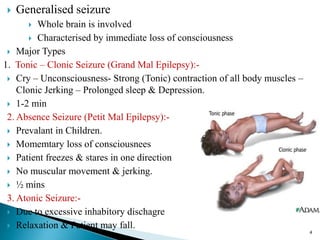
1. Tonic – Clonic Seizure (Grand Mal Epilepsy):-
 Cry – Unconsciousness- Strong (Tonic) contraction of all body muscles –
Clonic Jerking – Prolonged sleep & Depression.
 1-2 min
2. Absence Seizure (Petit Mal Epilepsy):-
 Prevalant in Children.
 Momemtary loss of consciousnees
 Patient freezes & stares in one direction
 No muscular movement & jerking.
 ½ mins
3. Atonic Seizure:-
 Due to excessive inhabitory dischagre
 Relaxation & Patient may fall.
4
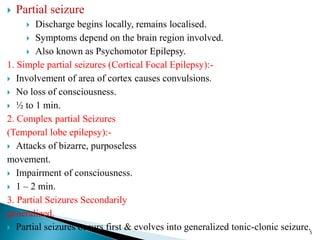
 Partial seizure
 Discharge begins locally, remains localised.
 Symptoms depend on the brain region involved.
 Also known as Psychomotor Epilepsy.
1. Simple partial seizures (Cortical Focal Epilepsy):-
 Involvement of area of cortex causes convulsions.
 No loss of consciousness.
 ½ to 1 min.
2. Complex partial Seizures
(Temporal lobe epilepsy):-
 Attacks of bizarre, purposeless
movement.
 Impairment of consciousness.
 1 – 2 min.
3. Partial Seizures Secondarily
generalized.
 Partial seizures occurs first & evolves into generalized tonic-clonic seizure.5
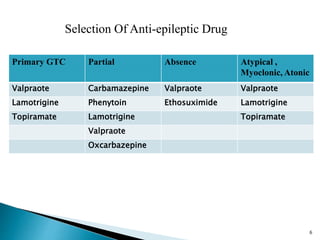
Selection Of Anti-epileptic Drug
Primary GTC Partial Absence Atypical ,
Myoclonic, Atonic
Valpraote Carbamazepine Valpraote Valpraote
Lamotrigine Phenytoin Ethosuximide Lamotrigine
Topiramate Lamotrigine Topiramate
Valpraote
Oxcarbazepine
6
PRECLINICAL
EVALUATION
7
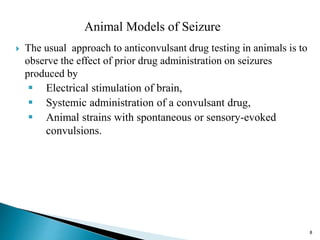
Animal Models of Seizure
 The usual approach to anticonvulsant drug testing in animals is to
observe the effect of prior drug administration on seizures
produced by
 Electrical stimulation of brain,
 Systemic administration of a convulsant drug,
 Animal strains with spontaneous or sensory-evoked
convulsions.
8
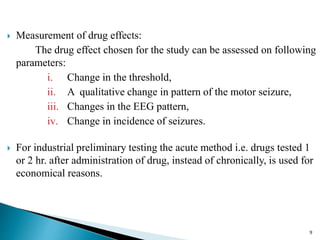
 Measurement of drug effects:
The drug effect chosen for the study can be assessed on following
parameters:
i. Change in the threshold,
ii. A qualitative change in pattern of the motor seizure,
iii. Changes in the EEG pattern,
iv. Change in incidence of seizures.
 For industrial preliminary testing the acute method i.e. drugs tested 1
or 2 hr. after administration of drug, instead of chronically, is used for
economical reasons.
9
Methods (in vivo methods)
1. Electroshock seizures
2. Chemical induced seizures :
1. Pentylenetetrazol ( Leptazol/PTZ) induced seizures.
2. Strychnine-induced convulsions.
3. Picrotoxin-induced convulsions.
4. Isoniazid-induced convulsions.
5. Bicuculine tests in rats.
6. 4-Aminopyridine induced seizures in mice.
3. Epilepsy induced by Focal Seizures.
4. Kindled rat seizure model.
5. Genetic rat model of epilepsy.
10
 Hippocampal slices.
 Electrial recording from isolated brain cells.
 GABA uptake in rat cerebral cortex.
 TBPS binding assay.
11
Electroshock Seizures In Mice & Rats
 Protection against electroshock induced seizures in mice and
rats is used as an indication for compounds which may prove
effective in
 Electric stimuli evoke tonic hind limb extensions, which are
suppressed by anti-epileptic drugs.
12
 Supramaximal Electroshock.
 Extensor Seizure Latency.
 Psychomotor Electroshock.
 Minimal Electroshock Threshold.
13
 The purpose of this test is to induce the most intense
physiologically possible seizure by a method analogous to
human electroshock therapy.
 The stimulation used in this method is considerably above
threshold ( 5-10 times).
14
 ANIMALS: Groups of 6-10 male Swiss mice (20-32g) or Wistar
rats (100-150g) are used.
 ROUTE OF DRUG ADMINISTRATION:
i. Intraperitoneal
ii. Oral
 30 min after i.p. injection and 60 min after oral
administration the animals are subjected to electroshock.
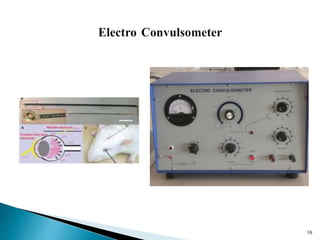
 An electro-convulsiometer with Corneal or Ear electrodes is
used to deliver the shock.
 Current used:
o Rat : 150mA
o Mice : 50 mA 0.2 second duration
15
16
 The PHASES of maximal seizure shown by normal mice
typically consists of :
◦ Phase of tonic limb flexion ( about 1.5 sec)
◦ Full extension of limbs (about 10 sec )
◦ Clonic interval ( variable )
◦ Death (in some animals).
 END POINT : Disappearance of hind limb extensor tonic
convulsions is taken as criteria of protection.
 The effect of drugs will be observed in terms of prolongation of
latent phase, decrease in the duration of tonic phase.
17
Purpose : To evaluate antiepileptic drugs. Pentylenetetrazole is a
CNS Stimulant. It Produces jerky type of clonic convulsion in
rats and mice similar to petit mal type of convulsion in man.
It causes direct depolarization of central neurons.
Also interfere with GABAergic inhibition.
Procedure:
 Two groups of 10 Albino Swiss mice of either sex (20-25 gm)
 First group is injected with Diazepam 4mg/kg(i.p.)
 Second group as control
 30min after Diazepam treatment inject with 75 mg/kg of PTZ by
s.c.
 Each animal is observed for 1 hr. in plastic cage
18
 Seizure & myoclonic convulsions are recorded
 At least 80% of animals in control have to show convulsion.
Evaluation:
 The number of protected animal in treated group is calculated
as percentage of affected animal in control group.
 ED 50 values calculated & time interval between PTZ
injection and occurance of seizure can be measured.
19
Purpose : Isoniazid is regarded as GABA synthesis inhibitor.
It is known to produce convulsions in patients having history of
seizures.
Procedure:
o Two groups each of 10 albino mice (18-22gm)
o First group is injected with Diazepam 5mg/kg. (i.p.)
o Second group as control, receive vehicle saline 10ml/kg .
o 15 min after s.c. injection/30min after i.p./60 min after oral route,
300 mg/kg of INH is injected by s.c. to the both groups.
o During next 120 minutes clonic seizure, tonic seizure and death is
recorded
20
o At least 80% of animals in control have to show convulsion.
Evaluation:
o The percentage of seizures or death occuring in the control group
is taken as 100%
o The supression of these effects in the treated groups is calculated
as percentage of controls. ED 50 values are calculated.
21
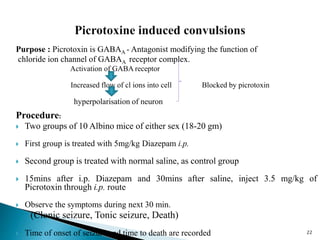
Purpose : Picrotoxin is GABAA - Antagonist modifying the function of
chloride ion channel of GABAA receptor complex.
Activation of GABA receptor
Increased flow of cl ions into cell Blocked by picrotoxin
hyperpolarisation of neuron
Procedure:
 Two groups of 10 Albino mice of either sex (18-20 gm)
 First group is treated with 5mg/kg Diazepam i.p.
 Second group is treated with normal saline, as control group
 15mins after i.p. Diazepam and 30mins after saline, inject 3.5 mg/kg of
Picrotoxin through i.p. route
 Observe the symptoms during next 30 min.
(Clonic seizure, Tonic seizure, Death)
 Time of onset of seizure and time to death are recorded 22
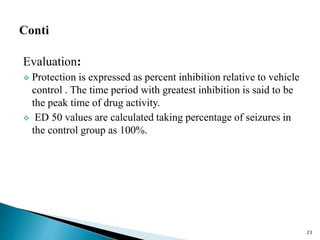
Evaluation:
 Protection is expressed as percent inhibition relative to vehicle
control . The time period with greatest inhibition is said to be
the peak time of drug activity.
 ED 50 values are calculated taking percentage of seizures in
the control group as 100%.
23
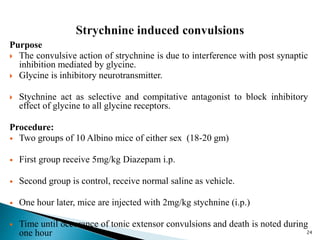
Purpose
 The convulsive action of strychnine is due to interference with post synaptic
inhibition mediated by glycine.
 Glycine is inhibitory neurotransmitter.
 Stychnine act as selective and compitative antagonist to block inhibitory
effect of glycine to all glycine receptors.
Procedure:
 Two groups of 10 Albino mice of either sex (18-20 gm)
 First group receive 5mg/kg Diazepam i.p.
 Second group is control, receive normal saline as vehicle.
 One hour later, mice are injected with 2mg/kg stychnine (i.p.)
 Time until occurance of tonic extensor convulsions and death is noted during
one hour 24
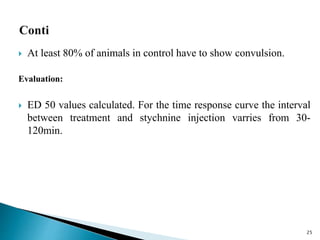
 At least 80% of animals in control have to show convulsion.
Evaluation:
 ED 50 values calculated. For the time response curve the interval
between treatment and stychnine injection varries from 30-
120min.
25
 INH is a
 It is known to produce convulsions in patients with a
history of seizure disorders.
 The typical pattern is of tonic-clonic seizures.
 Dose : 300 mg/kg
 Route : subcutaneous
26
 Bicuculine is a
 Dose : 1 mg/kg
 Route : Intravenous.
 The tonic convulsions appear in all treated rats within
30 seconds of injection.
27
Different animal models used are:
 pilocarpine induced status epilepticus.
 Lithium pilocarpine induced status epilepticus.
 Lithium methomyl induced seizure in rats.
 Electrical stimulation of hippocampal perforant
pathways.
 D,L-homocysteine induced status epilepticus.
28
29
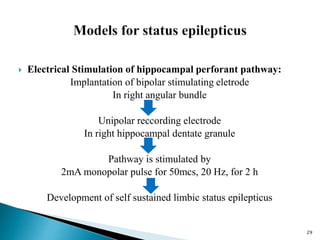
 Electrical Stimulation of hippocampal perforant pathway:
Implantation of bipolar stimulating eletrode
In right angular bundle
Unipolar reccording electrode
In right hippocampal dentate granule
Pathway is stimulated by
2mA monopolar pulse for 50mcs, 20 Hz, for 2 h
Development of self sustained limbic status epilepticus
30
 Pilocarpine
◦ Cholinomimetic
◦ Can produce status epilepticus in rats
◦ Dose : 380-400 mg/kg
◦ Route : ip
 Lithium- Pilocarpine;
◦ Pretreatment with lithium – 3meq/kg ip
◦ Followed by pilocarpine – 30-40 mg/kg ip
 Lithium – methomyl
◦ Pretreatment with lithium
◦ Methomyl – 5.2mg / kg s.c.
31
Totterer Mice:
 Homozygous strain totterer mice are prone to spontaneous
epileptic seizure
 Broad based ataxic gate
 By 3 to 4 weeks of age → develop frequent partial seizure
 Spontaneous focal motor seizure occur a few times a day →
unilateral clonic jerk of limbs with secondary generalization
 Also exhibit absence seizure with synchronous 6-7 per
second spike wave discharges in EEG
 Two seizure type in one model
 Ideal model of epilepsy should show the following
characteristics
◦ Development of spontaneously occurring seizures
◦ Type of seizure similar to that seen in human epilepsy
◦ EEG correlates of epileptic –like activity
◦ Age dependency in the onset of epilepsy as seen in many
epileptic syndromes
 At present no model follows all criteria
 Only genetic model come close
32
 The antiepileptic drug development program primarily based
on two seizure model, the MES and the PTZ.
 Single method of screening of antiepileptic drugs can not
predict the full pharmacological profile of the drug.
33
 S. K. Kulkarni, Handbook of Experimental
Pharmacology.
 S.K Gupta, text book of screening methods and toxicology,
page no:401-419
 Tripathi KD, Essentials of medical pharmacology, 6th edition,
chapter-7 page no:401-413
 N S Parmar, screening methods of pharmacology, chapter-5
page no:90-97
34
35
Thank you

screening methods for Antiepileptic activity

  • 1.
    Screening methods ofanti-epileptics By T. Sravanthi, 12DG1SO1O9, Pharmacology, M.Pharmacy 1
  • 2.
     Epilepsy isa very common disorder, characterised by seizures, which take various forms and results from neurongal discharges, with or without characteristic body movement  Epilepsy was described by JH Jackson. 2
  • 3.
    Primary Genralised PartialSeizure Unclassified Seizure Tonic – Clonic seizure Absence seizure Atonic seizure Myoclonic seizure Simple Partial Seizure Complex Partial Seizure Partial Seizures Secondarily generalized. Infantile Spasms Status Epilepticus 3
  • 4.
     Generalised seizure Whole brain is involved  Characterised by immediate loss of consciousness  Major Types 1. Tonic – Clonic Seizure (Grand Mal Epilepsy):-  Cry – Unconsciousness- Strong (Tonic) contraction of all body muscles – Clonic Jerking – Prolonged sleep & Depression.  1-2 min 2. Absence Seizure (Petit Mal Epilepsy):-  Prevalant in Children.  Momemtary loss of consciousnees  Patient freezes & stares in one direction  No muscular movement & jerking.  ½ mins 3. Atonic Seizure:-  Due to excessive inhabitory dischagre  Relaxation & Patient may fall. 4
  • 5.
     Partial seizure Discharge begins locally, remains localised.  Symptoms depend on the brain region involved.  Also known as Psychomotor Epilepsy. 1. Simple partial seizures (Cortical Focal Epilepsy):-  Involvement of area of cortex causes convulsions.  No loss of consciousness.  ½ to 1 min. 2. Complex partial Seizures (Temporal lobe epilepsy):-  Attacks of bizarre, purposeless movement.  Impairment of consciousness.  1 – 2 min. 3. Partial Seizures Secondarily generalized.  Partial seizures occurs first & evolves into generalized tonic-clonic seizure.5
  • 6.
    Selection Of Anti-epilepticDrug Primary GTC Partial Absence Atypical , Myoclonic, Atonic Valpraote Carbamazepine Valpraote Valpraote Lamotrigine Phenytoin Ethosuximide Lamotrigine Topiramate Lamotrigine Topiramate Valpraote Oxcarbazepine 6
  • 7.
  • 8.
    Animal Models ofSeizure  The usual approach to anticonvulsant drug testing in animals is to observe the effect of prior drug administration on seizures produced by  Electrical stimulation of brain,  Systemic administration of a convulsant drug,  Animal strains with spontaneous or sensory-evoked convulsions. 8
  • 9.
     Measurement ofdrug effects: The drug effect chosen for the study can be assessed on following parameters: i. Change in the threshold, ii. A qualitative change in pattern of the motor seizure, iii. Changes in the EEG pattern, iv. Change in incidence of seizures.  For industrial preliminary testing the acute method i.e. drugs tested 1 or 2 hr. after administration of drug, instead of chronically, is used for economical reasons. 9
  • 10.
    Methods (in vivomethods) 1. Electroshock seizures 2. Chemical induced seizures : 1. Pentylenetetrazol ( Leptazol/PTZ) induced seizures. 2. Strychnine-induced convulsions. 3. Picrotoxin-induced convulsions. 4. Isoniazid-induced convulsions. 5. Bicuculine tests in rats. 6. 4-Aminopyridine induced seizures in mice. 3. Epilepsy induced by Focal Seizures. 4. Kindled rat seizure model. 5. Genetic rat model of epilepsy. 10
  • 11.
     Hippocampal slices. Electrial recording from isolated brain cells.  GABA uptake in rat cerebral cortex.  TBPS binding assay. 11
  • 12.
    Electroshock Seizures InMice & Rats  Protection against electroshock induced seizures in mice and rats is used as an indication for compounds which may prove effective in  Electric stimuli evoke tonic hind limb extensions, which are suppressed by anti-epileptic drugs. 12
  • 13.
     Supramaximal Electroshock. Extensor Seizure Latency.  Psychomotor Electroshock.  Minimal Electroshock Threshold. 13
  • 14.
     The purposeof this test is to induce the most intense physiologically possible seizure by a method analogous to human electroshock therapy.  The stimulation used in this method is considerably above threshold ( 5-10 times). 14
  • 15.
     ANIMALS: Groupsof 6-10 male Swiss mice (20-32g) or Wistar rats (100-150g) are used.  ROUTE OF DRUG ADMINISTRATION: i. Intraperitoneal ii. Oral  30 min after i.p. injection and 60 min after oral administration the animals are subjected to electroshock.  An electro-convulsiometer with Corneal or Ear electrodes is used to deliver the shock.  Current used: o Rat : 150mA o Mice : 50 mA 0.2 second duration 15
  • 16.
  • 17.
     The PHASESof maximal seizure shown by normal mice typically consists of : ◦ Phase of tonic limb flexion ( about 1.5 sec) ◦ Full extension of limbs (about 10 sec ) ◦ Clonic interval ( variable ) ◦ Death (in some animals).  END POINT : Disappearance of hind limb extensor tonic convulsions is taken as criteria of protection.  The effect of drugs will be observed in terms of prolongation of latent phase, decrease in the duration of tonic phase. 17
  • 18.
    Purpose : Toevaluate antiepileptic drugs. Pentylenetetrazole is a CNS Stimulant. It Produces jerky type of clonic convulsion in rats and mice similar to petit mal type of convulsion in man. It causes direct depolarization of central neurons. Also interfere with GABAergic inhibition. Procedure:  Two groups of 10 Albino Swiss mice of either sex (20-25 gm)  First group is injected with Diazepam 4mg/kg(i.p.)  Second group as control  30min after Diazepam treatment inject with 75 mg/kg of PTZ by s.c.  Each animal is observed for 1 hr. in plastic cage 18
  • 19.
     Seizure &myoclonic convulsions are recorded  At least 80% of animals in control have to show convulsion. Evaluation:  The number of protected animal in treated group is calculated as percentage of affected animal in control group.  ED 50 values calculated & time interval between PTZ injection and occurance of seizure can be measured. 19
  • 20.
    Purpose : Isoniazidis regarded as GABA synthesis inhibitor. It is known to produce convulsions in patients having history of seizures. Procedure: o Two groups each of 10 albino mice (18-22gm) o First group is injected with Diazepam 5mg/kg. (i.p.) o Second group as control, receive vehicle saline 10ml/kg . o 15 min after s.c. injection/30min after i.p./60 min after oral route, 300 mg/kg of INH is injected by s.c. to the both groups. o During next 120 minutes clonic seizure, tonic seizure and death is recorded 20
  • 21.
    o At least80% of animals in control have to show convulsion. Evaluation: o The percentage of seizures or death occuring in the control group is taken as 100% o The supression of these effects in the treated groups is calculated as percentage of controls. ED 50 values are calculated. 21
  • 22.
    Purpose : Picrotoxinis GABAA - Antagonist modifying the function of chloride ion channel of GABAA receptor complex. Activation of GABA receptor Increased flow of cl ions into cell Blocked by picrotoxin hyperpolarisation of neuron Procedure:  Two groups of 10 Albino mice of either sex (18-20 gm)  First group is treated with 5mg/kg Diazepam i.p.  Second group is treated with normal saline, as control group  15mins after i.p. Diazepam and 30mins after saline, inject 3.5 mg/kg of Picrotoxin through i.p. route  Observe the symptoms during next 30 min. (Clonic seizure, Tonic seizure, Death)  Time of onset of seizure and time to death are recorded 22
  • 23.
    Evaluation:  Protection isexpressed as percent inhibition relative to vehicle control . The time period with greatest inhibition is said to be the peak time of drug activity.  ED 50 values are calculated taking percentage of seizures in the control group as 100%. 23
  • 24.
    Purpose  The convulsiveaction of strychnine is due to interference with post synaptic inhibition mediated by glycine.  Glycine is inhibitory neurotransmitter.  Stychnine act as selective and compitative antagonist to block inhibitory effect of glycine to all glycine receptors. Procedure:  Two groups of 10 Albino mice of either sex (18-20 gm)  First group receive 5mg/kg Diazepam i.p.  Second group is control, receive normal saline as vehicle.  One hour later, mice are injected with 2mg/kg stychnine (i.p.)  Time until occurance of tonic extensor convulsions and death is noted during one hour 24
  • 25.
     At least80% of animals in control have to show convulsion. Evaluation:  ED 50 values calculated. For the time response curve the interval between treatment and stychnine injection varries from 30- 120min. 25
  • 26.
     INH isa  It is known to produce convulsions in patients with a history of seizure disorders.  The typical pattern is of tonic-clonic seizures.  Dose : 300 mg/kg  Route : subcutaneous 26
  • 27.
     Bicuculine isa  Dose : 1 mg/kg  Route : Intravenous.  The tonic convulsions appear in all treated rats within 30 seconds of injection. 27
  • 28.
    Different animal modelsused are:  pilocarpine induced status epilepticus.  Lithium pilocarpine induced status epilepticus.  Lithium methomyl induced seizure in rats.  Electrical stimulation of hippocampal perforant pathways.  D,L-homocysteine induced status epilepticus. 28
  • 29.
    29  Electrical Stimulationof hippocampal perforant pathway: Implantation of bipolar stimulating eletrode In right angular bundle Unipolar reccording electrode In right hippocampal dentate granule Pathway is stimulated by 2mA monopolar pulse for 50mcs, 20 Hz, for 2 h Development of self sustained limbic status epilepticus
  • 30.
    30  Pilocarpine ◦ Cholinomimetic ◦Can produce status epilepticus in rats ◦ Dose : 380-400 mg/kg ◦ Route : ip  Lithium- Pilocarpine; ◦ Pretreatment with lithium – 3meq/kg ip ◦ Followed by pilocarpine – 30-40 mg/kg ip  Lithium – methomyl ◦ Pretreatment with lithium ◦ Methomyl – 5.2mg / kg s.c.
  • 31.
    31 Totterer Mice:  Homozygousstrain totterer mice are prone to spontaneous epileptic seizure  Broad based ataxic gate  By 3 to 4 weeks of age → develop frequent partial seizure  Spontaneous focal motor seizure occur a few times a day → unilateral clonic jerk of limbs with secondary generalization  Also exhibit absence seizure with synchronous 6-7 per second spike wave discharges in EEG  Two seizure type in one model

  • 32.
     Ideal modelof epilepsy should show the following characteristics ◦ Development of spontaneously occurring seizures ◦ Type of seizure similar to that seen in human epilepsy ◦ EEG correlates of epileptic –like activity ◦ Age dependency in the onset of epilepsy as seen in many epileptic syndromes  At present no model follows all criteria  Only genetic model come close 32
  • 33.
     The antiepilepticdrug development program primarily based on two seizure model, the MES and the PTZ.  Single method of screening of antiepileptic drugs can not predict the full pharmacological profile of the drug. 33
  • 34.
     S. K.Kulkarni, Handbook of Experimental Pharmacology.  S.K Gupta, text book of screening methods and toxicology, page no:401-419  Tripathi KD, Essentials of medical pharmacology, 6th edition, chapter-7 page no:401-413  N S Parmar, screening methods of pharmacology, chapter-5 page no:90-97 34
  • 35.