NUTRITION

SE R I E S

FOOD AND

TITLE 2
I N D I C ATO R G U I D E S

TECHNICAL
ASSISTANCE

Anthropometric
Indicators
Measurement
Guide
Bruce Cogill
Artwork proof 3

8/8/01 2:59 pm

Page 1

FOOD AND
NUTRITION
TECHNICAL
ASSISTANCE

Anthropometric
Indicators
Measurement
Guide
Bruce Cogill
Artwork proof 3

8/8/01 2:59 pm

Page 2

This publication was made possible
through support provided by the Office of
Health and Nutrition, Bureau for Global
Programs, US Agency for International
Development, under the terms of Award
No. HRN-A-00-98-00046-00, the Food
and Nutrition Technical Assistance
Project (FANTA). Additional support was
provided by the Office of Food for Peace,
Bureau for Humanitarian Response.
Earlier drafts of the guide were developed
with funding from the Food and Nutrition
Monitoring Project (IMPACT) (Contract
No. DAN-5110-Q-00-0014-00, Delivery
Order 16), managed by the International
Science and Technology Institute, Inc.
and the Food Security Unit of the
LINKAGES Project (Cooperative
Agreement: HRN-A-00-97-00007-00),
managed by the Academy for Educational
Development. The opinions expressed
herein are those of the author and do not
necessarily reflect the views of the
US Agency for International Development.
It may be reproduced, if credit is given to
the FANTA Project.
Recommended citation: Cogill, Bruce.
Anthropometric Indicators Measurement
Guide. Food and Nutrition Technical
Assistance Project, Academy for
Educational Development, Washington
DC, 2001.
Published June 2001

Copies of the Guide can
be obtained from:
Food and Nutrition Technical
Assistance Project,
Academy for Educational Development,
1825 Connecticut Ave., NW,
Washington D.C., 20009-5721
Tel: 202-884 8700.
Fax: 202-884 8432.
E-mail: fanta@aed.org
Website: www.fantaproject.org
Artwork proof 3

8/8/01 2:59 pm

Page 3

Contents
Page number
8

Part 1.
Introduction

1.

2.
10
10
10
11
12

Part 2.
Anthropometric and annual monitoring indicators
2.1 Anthropometric Indicators
2.1.1 Building blocks of anthropometry: indices
2.1.2 What the indices reflect about the nutritional status of
infants and children
2.2 Annual monitoring indicators

3.

4.

14
14

Part 3.
Collecting anthropometric data through surveys
3.1 Steps for conducting a survey

17
17
20
22

Part 4.
Weighing and measuring equipment
4.1 Scales
4.2 Length/height boards
4.3 Mid-upper arm circumference measure
Artwork proof 3

8/8/01 2:59 pm

Page 4

Contents - continued
23
23
24
24
24
26
28
30
34
36
36
37
37
38
38

Part 5.
Taking measurements
5.1 Interviewer field materials
5.2 Procedures before measuring
5.3 How to measure age, height, length, weight and MUAC
5.3.1 Age
5.3.2 Height
5.3.3 Length
5.3.4 Weight
5.3.5 MUAC
5.4 Assessing the accuracy of measurements
5.5 Entering the data
5.6 Training field staff
5.6.1 Planning the training
5.6.2 Field exercises and standardization
5.6.3 Survey training manual

39
39
39
40
40
41

Part 6.
Comparison of anthropometric data to reference standards
6.1 NCHS/WHO reference standards
6.2 Comparisons to the reference standard
6.3 Standard deviation units or z-scores
6.4 Percentage of the median and percentiles
6.5 Cut-offs

5.
6.
Artwork proof 3

8/8/01 2:59 pm

Page 5

43
44
44
45
48

Part 7.
Data analysis
7.1 Source of Epi Info software
7.2 Recommendations for analysis and presentation of height data
7.3 Examples of data analysis
7.4 Additional data analysis information

49
49
49
50

Part 8.
Annual monitoring indicators
8.1 Introduction
8.2 Routine data collection
8.3 Data on growth monitoring and promotion (GMP)

51
55
63
64
67
69
74
79
82
93
95

Part 9.
References
Glossary
Acronyms
Appendix 1. Calculating Z-scores
Appendix 2. Uses of anthropometric data
Appendix 3. Selecting a sample
Appendix 4. Measuring adults
Appendix 5. Adolescent anthropometric indicators
Appendix 6. Standardization of anthropometric measurements
Appendix 7. Guidelines for supervising surveys
Appendix 8. Title II generic indicators

7.

8.

9.
Artwork proof 3

8/8/01 2:59 pm

Page 6

Acknowledgements

This guide draws extensively from materials from the Anthropometry
Resource Center, funded by the FAO/SADC project GCP/RAF/284/NET,
Development of a Regional Food Security and Nutrition Information System,
particularly the UN publication, How to Weigh and Measure Children:
Assessing the Nutritional Status of Young Children in Household Surveys; and
the WHO publication, Physical Status: The Use and Interpretation of
Anthropometry. The training tool was developed by Bill Bender and Sandy
Remancus.
We thank the reviewers for their thoughtful comments during the
development of this guide. The Cooperating Sponsors were essential to the
development of the guide and this guide is dedicated to them. Eunyong
Chung of the Global Bureau’s Office of Health and Nutrition has provided
insight and support for the guides and her efforts are appreciated. USAID
Food for Peace officers encouraged and supported the development of the
guides. A number of people assisted in the development of the guide and the
writing of sections. Phil Harvey and Matthew Saaks rewrote and revised
sections of the guide and their input is greatly appreciated. Sumathi
Subramaniam and Laura Caulfield of Johns Hopkins University also
contributed sections to the guide — Irwin Shorr, Penny Nestel, Anne
Swindale, Patrick Diskin and Anne Ralte provided extensive comments and
support for the guide.
Artwork proof 3

8/8/01 2:59 pm

Page 7

This series

This series of Title II Generic Indicator Guides has been developed by the
Food and Nutrition Technical Assistance (FANTA) Project, and its
predecessor projects (LINKAGES and IMPACT), as part of USAID’s support
to develop monitoring and evaluation systems for use in Title II programs.
These guides are intended to provide the technical basis for the indicators
and the recommended method for collecting, analyzing and reporting on the
indicators. A list of Title II Generic Indicators that were developed in
consultation with the cooperating sponsors in 1995/1996 is included in
Appendix 8.
The guides are available on the project website
www.fantaproject.org.
Below is the list of available guides:
Agricultural Productivity Indicators Measurement Guide
Food Security Indicators and Framework for Use in the Monitoring and
Evaluation of Food Aid Programs
Infant and Child Feeding Indicators Measurement Guide
Measuring Household Food Consumption: A Technical Guide
Sampling Guide
Water and Sanitation Indicators Measurement Guide.
PA RT

Artwork proof 3

8/8/01 2:59 pm

1.

Page 8

Introduction

1.

T

his guide provides information on the Anthropometric Impact
Indicators and the Annual Monitoring Indicators for Maternal and
Child Health/Child Survival (MCH/CS) and income-related Title II
activities, a subset of the P.L. 480 Title II Generic Performance Indicators for
Development Activities. The impact indicators are:
decreased percent of stunted children (presented for ages 24-60
months and by gender), where stunting is defined as percent of children
falling below -2 standard deviations for height-for-age;
decreased percent of underweight children (in specified age
groupings such as 12-24 months 36-59 months and by gender) where
underweight is defined as percent of children falling below -2 standard
deviations for weight-for-age.
These indicators are required for the reports of projects with specific
nutrition components and are collected at baseline, mid-term and final-year
evaluations. Stunting, reflected by deficits in height-for-age would not be
expected to change in a short time period. It is recommended, therefore, not
to report stunting figures annually. Underweight (or weight for age), reported
for specific age groupings, would change more quickly as it is influenced by
short-term effects such as a recent outbreak of diarrheal diseases.
Some programs report stunting for children under 24 months of age
rather than the recommended 24-60 months age grouping. Restricting the
age grouping to children under 24 months has the disadvantage of not
capturing the lagged effects of the program and reducing the numbers of
potential participants in a survey. The advantage of using children under 24
months is that the data are more useful to determine the factors related to
stunting for program design or redesign.
The monitoring indicators are:
increased
percent
of
eligible
children
in
growth
monitoring/promotion (usually presented for children <24 months or
< 36 months of age, depending on the target group of the program);

•
•

•

8
Artwork proof 3

8/8/01 2:59 pm

Page 9

I N T RO D U C T I O N

PA R T 1 .

1.

•

increased percent of children in growth promotion program
gaining weight in past 3 months (by gender and age group, will depend
upon the target group of the program).
The choice of indicators for annual monitoring and reporting should
be based upon a review of available sources of data and the information
needs of the Cooperating Sponsor and USAID. Reporting the annual
monitoring indicators is recommended rather than required as in the case
for reporting on impact. The primary purpose of collecting and reporting
the monitoring indicators is to improve program management but these
indicators can also provide valuable insights into the interpretation of the
anthropometric indicators of program impact. In addition, reporting the
annual indicators may provide Cooperating Sponsors a further opportunity
to demonstrate progress towards the achievement of results.
While the focus of this guide is on the consistent collection and
reporting of nutritional anthropometry indicators and annual
monitoring indicators, suggestions are provided for additional
information related to monitoring and evaluation. This information will
help Cooperating Sponsors to track and improve child nutrition activities
and performance. The focus is on anthropometric assessment of infants and
young children. The guide is a programming tool and is not meant to
substitute for adequate technical and academic training needed to conduct
problem analysis, design programs and for implementation. Cooperating
Sponsors are encouraged to seek technical expertise in nutritional
assessment and related topics needed to ensure appropriate use
anthropometric indicators.
The assessment of children over 5 years of age, adolescents, adults and
the elderly is not the primary focus of the guide. Appendices 4 and 5, however,
provide information on the nutritional assessments of adults and adolescents.

9
PA RT

Artwork proof 3

8/8/01 2:59 pm

2.

Page 10

Anthropometric
Evaluation and Annual
Monitoring Indicators
2.1. Anthropometric Indicators

2.

Changes in body dimensions reflect the
overall health and welfare of individuals
and populations. Anthropometry is used to
assess and predict performance, health
and survival of individuals and reflect the
economic and social well being of populations. Anthropometry is a widely used,
inexpensive and non-invasive measure of
the general nutritional status of an
individual or a population group. Recent
studies have demonstrated the applications
of anthropometry to include the prediction
of who will benefit from interventions,
identifying social and economic inequity
and evaluating responses to interventions.
For more information on the application of
anthropometric data, refer to Appendix 2.
Anthropometry can be used for various
purposes, depending on the anthrop-

ometric indicators selected. For example,
weight-for-height (wasting) is useful for
screening children at risk and for measuring short-term changes in nutritional
status. However, weight-for-height is not
appropriate for evaluating changes in a
population over longer time periods. A
clear understanding of the different uses
and interpretations of each anthropometric indicator will help to determine the
most appropriate indicator(s) for program
evaluation. For more detailed explanations of age and sex specific appropriate
anthropometric uses, refer to Appendices
4 and 5. Key terms are defined in the
glossary.

2.1.1.The Building Blocks of Anthropometry: Indices
The four building blocks or measures used to undertake anthropometric assessment are:

1

3

4

AGE

10

2
SEX

LENGTH
(or height)

WEIGHT
Artwork proof 3

8/8/01 2:59 pm

Page 11

I M PA C T I N D I C ATO R S F O R I M P RO V E D H O U S E H O L D N U T R I T I O N

Each of these variables provides one piece
of information about a person. When they
are used together they can provide
important information about a person’s
nutritional status. The actual measurement of age, weight and height of children
requires
specific
equipment
and
techniques which are described later.
When two of these variables are used
together they are called an index. Three
indices are commonly used in assessing
the nutritional status of children:

•
•
•

PA R T 2 .

Weight-for-age;
Length-for-age or Height-for-age;
Weight-for-length or Weight-for-height.

There are many other anthropometric
measures including mid-upper-armcircumference (MUAC), sitting height to
standing height ratio (Cormic Index),
and many skinfold measures. This guide
will concentrate on the measurements
and interpretation of weight and height
in children.

2.1.2.What the Indices Reflect About the Nutritional Status of Infants and Children
The advantages and disadvantages of the
three indices and the information they
can provide is summarized below:
Weight-for-age: Low weight-for-age
index identifies the condition of being
underweight, for a specific age. The
advantages of this index are that it may
reflect both past (chronic) and/or present
(acute) undernutrition (although it is
unable to distinguish between the two).
Height-for-age:
This index is an
indicator of past undernutrition or
chronic malnutrition. It cannot measure
short term changes in malnutrition. For
children below 2 years of age, the term is
length-for-age; above 2 years of age, the
index is referred to as height-for-age.
Deficits in length-for-age or height-forage are signs of stunting.
Weight-for-height: This index helps to
identify children suffering from current
or acute undernutrition or wasting and is
useful when exact ages are difficult to
determine.
Weight-for-length (in
children under 2 years of age) or weightfor-height (in children over 2 years of age)
is appropriate for examining short-term
effects such as seasonal changes in food
supply or short-term nutritional stress
brought about by illness.
The three indices are used to identify
three nutritional conditions: underweight,
stunting and wasting.

Underweight: Underweight, based on
weight-for-age, is a composite measure of
stunting
and
wasting
and
is
recommended as the indicator to assess
changes in the magnitude of malnutrition
over time.
Stunting: Low length-for-age, stemming
from a slowing in the growth of the fetus
and the child and resulting in a failure to
achieve expected length as compared to a
healthy, well nourished child of the same
age, is a sign of stunting. Stunting is an
indicator of past growth failure. It is
associated with a number of long-term
factors including chronic insufficient
protein and energy intake, frequent
infection,
sustained
inappro-priate
feeding practices and poverty.
In
children over 2 years of age, the effects of
these long-term factors may not be
reversible. For evaluation purposes, it is
preferable to use children under 2 years
of age because the prevalence of stunting
in children of this age is likely to be more
responsive to the impact of interventions
than in older children.
Data on
prevalence of stunting in a community
may be used in problem analysis in
designing interventions. Information on
stunting for individual children is useful
clinically as an aid to diagnosis.
Stunting, based on height-for-age can be
used for evaluation purposes but is not
recommended for monitoring as it does
not change in the short term such as 6 12 months.

11

2.
Artwork proof 3

2.

8/8/01 2:59 pm

Page 12

Wasting: Wasting is the result of a weight
falling significantly below the weight
expected of a child of the same length or
height. Wasting indicates current or
acute malnutrition resulting from failure
to gain weight or actual weight loss.
Causes include inadequate food intake,
incorrect feeding practices, disease, and
infection or, more frequently, a combination of these factors.
Wasting in
individual children and population groups
can change rapidly and shows marked
seasonal patterns associated with changes
in food availability or disease prevalence
to which it is very sensitive. Because of its
response to short-term influences, wasting
is not used to evaluate Title II programs
but may be used for screening or targeting
purposes in emergency settings and is
sometimes used for annual reporting.
Weight-for-height is not advised for
evaluation of change in a population since
it is highly susceptible to seasonality.

•

Edema Edema is the presence of
excessive amounts of fluid in the
intracellular tissue.
Edema can be
diagnosed by applying moderate thumb
pressure to the back of the foot or ankle.
The impression of the thumb will remain
for some time when edema is present.
Edema is diagnosed only if both feet show

the impression for some time. As a
clinical sign of severe malnutrition, the
presence of edema should be recognized
when using short term indicators such as
wasting. The presence of edema in
individuals should be recorded when
using weight-for-height for surveillance or
screening purposes. When a child has
edema, it is automatically included with
children counted as severely malnourished, independently of its wasting,
stunting, or underweight status. This is
due to the strong association between
edema and mortality. Edema is a rare
event and its diagnosis is used only for
screening and surveillance and not for
evaluation purposes.

•

Mid — Upper Arm Circumference
(MUAC) MUAC is relatively easy to
measure and a good predictor of immediate
risk of death. It is used for rapid screening
of acute malnutrition from the 6-59 month
age range (MUAC overestimates rates of
malnutrition in the 6-12 month age group).
MUAC can be used for screening in
emergency situations but is not typically
used for evaluation purposes. (MSF, 1995)
MUAC is recommended for assessing acute
adult undernutrition and for estimating
prevalence of undernutrition at the
population level.

2.2. Annual Monitoring Indicators
Well chosen and reported monitoring
indicators
will
enhance
program
management and can provide valuable
insights into trends of anthropometric
indicators used for determining impact.
Part 8 of this Guide describes how annual
monitoring indicators that are based upon
data from growth monitoring and
promotion programs (GMP) may be
collected and reported in a standard
format. This is intended to make the
indicators more useful for management of
programs at all levels within countries,
and also for reporting to USAID.
The two recommended annual monitoring
indicators serve several purposes.

12

1. Percent of eligible children in Growth
Monitoring and Promotion programs
a. supports program management -providing information on coverage,
targeting, and may provide a useful basis
for supervision of field staff;
b. provides information on context, or
some explanation, in the reporting of
anthropometric impact indicators; and
c. provides an indication of patterns of, or
trends in, service delivery and use and
thus has potential to demonstrate
successes of efforts to achieve specified
project results.
Artwork proof 3

8/8/01 2:59 pm

Page 13

C O L L E C T I N G A N D A N A LY Z I N G T H E DATA

2. percent of children in Growth
Monitoring and Promotion (GMP) programs gaining weight in past 3 months
(by gender)
a. As a management
tool, this
information is a trigger to increase growth
promotion
and
health
education
counseling. The information can be a
positive communication between the
health worker and caregiver concerning
the health of the child. This information is
most effective when provided with other
information such as food availability and
presence or history of infection.
b. As a surveillance tool, the indicator
may be useful as a lagged indicator of a
community facing severe food or healthrelated stress. The usefulness of this
indicator for surveillance is reduced when
small numbers are being monitored and
aggregations over ages tend to even out .
A major advantage for an organization in
reporting on the two monitoring
indicators is that it provides national level
staff with a framework to think about,
interpret, and act upon data that are
currently being reported to them. A
barrier to “institutionalizing” the reporting of monitoring data is that often no
action is taken on information reported
and sometimes no meaningful feedback is
provided to the staff who collect and report
them. Reporting on monitoring indicators
at a national level will provide some
evidence that GMP data have been
collected and used as intended.

PA R T 3 .

Growth monitoring and promotion
programs are key components of many
food assisted health and nutrition
activities of Title II programs.
The
development of the guidelines presented
here was based upon four assumptions:
a) growth monitoring without growth
promotion will not benefit the health of
participating children;
b) it is not useful to report village-level
activities of GMPs to regional and national
levels unless some action is taken, or some
decision is based upon the information
reported;
c) the reporting system will not be
sustainable without some meaningful
action or feedback; and

2.
d) continuing effort will be required to
improve the quality of data reported from
GMP activities, but reporting GMP data
can be useful when it is interpreted within
an appropriate context.

13
PA RT

Artwork proof 3

3.

8/8/01 2:59 pm

3.

Page 14

Collecting
Anthropometric Data
Through Surveys

The type of anthropometric data collected
will depend on the reason for the survey.
When the survey results will be used for
long-term planning the information
needed might be different than information for program management. The
evaluation of Title II programs is a
situation in which long-term changes in
stunting or undernutrition need to be
reflected. Monitoring of growth promotion
programs will require different types of
information.

The collection of anthropometric data may
be the main purpose of a survey or it may be
part of a larger more comprehensive survey
such as the KPC (Knowledge, Practice,
Coverage). Information on individuals and
households should be collected to interpret
anthropometric data.
Deciding what
information will be collected, how it will be
collected and from whom it will be
collected is all part of planning the survey.
The steps that should be taken to conduct a
survey are outlined below.

3.1. Steps for Conducting a Survey
The following checklist outlines the steps
necessary for conducting a survey. All of
these steps should be clearly thought out
before the survey begins.

•

Define survey objectives. The first
step is to determine the specific purpose of
the survey. Make a detailed list of what is
expected to be achieved and what
information is needed.

design. Depending
• Choose theofsurveysurvey, the survey
on the goal
the
planning team should review different
design possibilities such as a case-control
or reflexive design before choosing the
final design. Having a clear idea of the
survey goals will help to determine which
people or which groups of people to
include in the survey and the best method
for collecting the information.

Develop a
personnel, facilities, and
• Budget for the survey. for all the • Plan forConducting a survey within a
detailed item-by-item budget
equipment.
costs and expenses of the survey,
including personnel, supplies, materials,
transportation, accommodation and
meals. Determine the costs associated
with data entry, cleaning, analysis,
reporting and testing of all steps to ensure
smooth implementation.
14

limited time-frame (usually less than six
months) requires early planning for
materials and staff. During this stage the
survey planning team decides how many
field staff and how many office personnel
they will need and how they will recruit
them. Any advance work needed to find
Artwork proof 3

8/8/01 2:59 pm

Page 15

C O L L E C T I N G A N D A N A LY Z I N G T H E DATA

and hire staff is planned at this point.
Other needs such as office space and
equipment are also considered and
planned. Specific equipment is needed to
do anthropometric assessments as part of
a survey and is discussed in Part 4.

•

Select the sample. Once the survey
goals and methods of collecting the
information have been decided, the groups
and numbers of people to be interviewed
are selected. A sample is a small part of
the group being studied that has been
chosen to represent the whole group.
There are special considerations when
choosing a sample for anthropometric
assessment. Sampling is discussed in
Appendix 3 and the reader is referred
to
the
FANTA
Sampling
Guide.
(www.fantaproject.org/publications)
of
• Develop the questionnaire. The listthe
essential information needed to meet
survey objectives forms the basis of the
survey questionnaire. A standard, printed
questionnaire ensures that all the
respondents are asked the same questions
and enables the survey responses to be
tabulated easily and quickly.
The
questionnaire may need to be translated
into local languages.
Translated
questionnaires should be translated back
to the original language by another
translator and compared to the original
questionnaire. Enumerators need to be
trained in the appropriate use of the
translation. See Figure 5.4 for a sample
questionnaire.

•

Pre-test the questionnaire. Before the
questionnaire is finalized it should be
tested for content and length; the
questions should gather the needed
information and should be easily
understood by both interviewers and
respondents. In the pre-test a small
number of interviews are conducted and
the questionnaire is revised on the basis of
these results and comments from the
interviewers.

•

Train personnel. Training of field staff
is a vital step in the survey process;
accurate, meaningful information can be

PA R T 3 .

collected only if interviewers thoroughly
understand all their field instructions and
procedures. When all the field materials
have been prepared and finalized, and the
field staff has been hired, all interviewers
and supervisors should be brought to a
central location to be taught survey
procedures, how to collect the data and
how to use the questionnaire. When
anthropometric assessment will be part of
the survey, correct methods for taking
measurements should also be part of the
training schedule. If the actual survey is
delayed for more than three weeks
following training, it will be necessary to
retrain personnel.

•

Standardize the anthropometric
technique. The training of personnel on
specific measurement and recording
techniques should include not only
theoretical explanations and demonstrations, but also provide an opportunity
for participants to practice the measurement techniques, as well as reading and
recording the results. Once all personnel
have adequately practiced the measurement and recording techniques, and feel
comfortable with their performance,
standardization exercises should be
carried out to ensure that all interviewers
acquire the skills necessary to collect high
quality data. Details of these exercises are
presented in Appendix 6.

•

Interview. The success of a survey
depends on the quality of the field
procedures, supervision and interviewing.
Interviewers should follow sampling and
interviewing instructions precisely and
accurately. They need to keep in touch
with their field supervisor and bring any
problems or difficulties to their attention.
data
• Supervise thebegins,collection. Once
the interviewing
field supervisors
should be present to assist interviewers
with problems that may arise in finding
the correct households, conducting the
interviews or completing the work on
time. Field supervisors, in addition to
solving field problems, are responsible for
distributing materials, reviewing and
checking completed questionnaires and
15

3.
Artwork proof 3

8/8/01 2:59 pm

Page 16

making progress reports to the central
office. Detailed guidelines for supervisors
are presented in Appendix 7.

•

Edit and code the interviews.
Completed interviews should be reviewed
to make sure all the questions have been
asked and the answers have been
recorded clearly. Someone from the
survey planning team should check all
numerical codes on the questionnaire and
assign codes to any responses written in
respondents’ own words. Some surveys
directly enter data into the computer at the
time of the measurement. This improves
quality and speed but requires functioning
equipment in often difficult conditions.
the
• Tabulate the todata. Whetherhand
survey results are be compiled by

3.

or by computer, the responses for each
questionnaire will have to be assigned
numerical codes. This process is usually
simplified by including numerical codes
for each of the response categories on to
the printed questionnaire form. When the
interviews are completed, these codes are
then transferred by hand to tabulation
sheets or the codes can be entered into a
computer. Both of these methods allow
the survey results to be read and
interpreted by means of statistical tables
and percentages. As field computers and
satellite communication become more
common, it will be possible to enter data
directly by the interviewer with
immediate feedback for possible errors in
measurement and recording.

• Analyze and report the survey results.
On the basis of the tables prepared, the
survey data are studied and interpreted
and conclusions are drawn about the
nutritional and socio-economic conditions
of the households in the project area. The
report on the survey contains the most
important findings and conclusions,
statistical tables and a description of the
procedures used in conducting the survey.
The survey results should be presented in
a clear and straightforward manner.

16
Artwork proof 3

8/8/01 2:59 pm

Page 17

Equipment is required to do anthropometric
assessment. The most common types of
equipment used are scales and measuring
boards. Sources for obtaining equipment
and tips on what to look for in equipment
are listed below. Whatever equipment is
chosen, staff need training to ensure its
proper use and care.
For Title II

Cooperating Sponsors, electronic weighing
scales and locally adapted height measuring boards are recommended. Check with
the local UNICEF office for their
specifications and availability. UNICEF
equipment specifications can be found at:
www.supply.unicef.dk/catalogue/index.htm
in the 03 Nutrition Section.

4.

4.1. Scales
Scales used in the field should be portable,
durable and capable of reading up to 25 kg
for children and have 100 gram
increments. There are several different
attachments that can be used to help
weigh children with spring scales. The
size of the child will determine which
attachment should be used. For weighing
infants, a sling or basket is usually
attached to the spring scale. For children,
weighing trousers are used to suspend
them. These are small pants with straps
that the child steps into. The trousers are
then hung from the scale by the straps.
There are other alternatives than the
trousers, but they can be difficult to use for
infants and small children. For infants, a
cloth folded to hang from the scale with
the infant is preferred. For children who
are old enough to grasp firmly onto
something, a handle is sometimes
attached to the scale and the child hangs
from it by their hands until their weight is
read. Whatever is used to suspend the

4.

PA R T

Weighing and
Measuring Equipment

child, the scale should be zeroed to ensure
that the weight of the trousers, sling or
basket is not added to the child’s weight.
Oxfam Anthropometric Kit 1 (UNICEF
Item No. 0000824) (Survey, screening,
monitoring). The Anthropometric Kit
contains equipment for measuring the
weight and height of children to assess
their nutritional status, along with other
materials for nutritional surveys. The kit
weighs 26 kgs and contains measuring
and survey materials for two survey
teams, or measuring equipment for 2
feeding centers, and contains:

Oxfam Anthropometric Kit 1
Code
NK3
NK6
NK7
NK20

Qty
2
2
4
2

Description
Backpacks - nylon
Board - height/length & head block
Book - exercise
Calculator - solar and battery

17
Artwork proof 3

8/8/01 2:59 pm

Page 18

Code
NK26
NK29

Qty
4
1

NK30
NK31
NK32
NK33A

2
4
2
1

NK33B 1
NK34
NK39
NK40
NK41
NK42
NK44
NK45
NK51

1
10
4
12
4
4

NK53

2

NK55
NK63
NK64

4.

40
2

1
4
4

NK65

4

NK66
NK67

2
50

NK68
NK77

2
10

Description
Clipboard - A4, folding, spring clip
Roll cord 10M x 6mm, polypropylene,
endless fibres
Counter - manual/hand held, metal
Eraser
Forms - evaluation
Notes on the revised Oxfam Feeding
Kits - English
Notes on the revised Oxfam Feeding
Kits - French
Forms - survey
Pads, paper, four colors of paper,100
pages per pad, 90 x 90mm
Pad, paper, graph, A4 in mm
Pens - BIC ballpoint, black, medium
Pen - large, indelible, black marker
Pencil- HB
Pencil sharpener - metal, single hole
Ruler, 30cm, transparent, flat, plastic,
shatterproof
Scales, 25kg hanging scale, with bar, 3
pants and sling, 100gm graduation
Scissors - 17cm, blended
Tables - random number A4, plasticized
Tables - %Weight-for-height
NCHS/CDC/WHO Sex combined,
elasticized
Tables,Weight-for-height Z-score
NCHS/CDC/WHO Sex combined,
plasticized
Tape measure - fiberglass
Tapes, MUAC: red (<11cm),
orange (11-12.5cm), white 12.5-13.5cm),
green (>13.5cm)
Rolls, tape - metric adhesive
Wallets - A4 transparent plastic, open on
2-sides

Publications - Books
NK80 2
Food Scarcity and Famine - Oxfam
Practical Guide No. 7
NK83 1
MSF Nutrition Guidelines - English
NK84 1
MSF Nutrition Guidelines - French
NK85A 1
Refugee Health Care - Oxfam Practical
Guide No. 9 - English
NK85B 1
Refugee Health Care - Oxfam Practical
Guide No. 9 - French
NK86 1
Selective Feeding Program - Oxfam
Practical Guide 1 - English
NK87 1
Selective Feeding Program - Oxfam
Practical Guide 1 - French

18

Unless
weighing
and
measuring
equipment is available locally, the
Anthropometric Kit should be bought
together with the Therapeutic Kit (Kit 4)
or supplementary Kit (Kit 2 or Kit 3) for
the initial establishment of feeding
programs.
Electronic Scales: UNICEF and others
have found electronic scales to be durable
and flexible especially given the option of
weighing the mother with the child. The
mother can be weighed with the child.
The mother is then weighed without the
child. The difference between the two
measures is the child’s weight. This
technique is useful in situations where the
child struggles and use of a sling or
weighing pants causes stress for the child.
An additional advantage is that the weight
of the mother is also available.
Each member of the field staff should have
their own scale if possible, otherwise it
might take longer to do measurements and
complete the survey. Several scales that are
available for purchase are listed below:
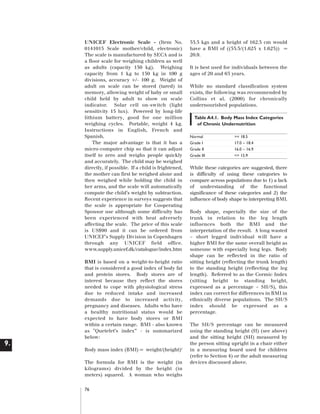
UNICEF Electronic Scale (Item No.
0141015 Scale mother/child, electronic)
The scale is manufactured by SECA and is
a floor scale for weighing children as well
as adults (capacity 150 kg). Weighing
capacity from 1 kg to 150 kg in 100 g
divisions, accuracy +/- 100 g. Weight of
adult on scale can be stored (tared) in
memory, allowing weight of baby or small
child held by adult to show on scale
indicator. Solar cell on-switch (light
sensitivity 15 lux). Powered by long-life
lithium battery, good for one million
weighing cycles. Portable, weight 4 kg.
Instructions in English, French and Spanish.
The major advantage of this scale is the
micro-computer chip so that it can adjust
to zero and weigh people quickly and
accurately. The child may be weighed
directly. If a child is frightened, the
mother can first be weighed alone and
then weighed while holding the child in
her arms, and the scale will automatically
compute the child’s weight by subtraction.
Recent experience in surveys suggests that
the scale is appropriate for Cooperating
Artwork proof 3

8/8/01 2:59 pm

Page 19

WEIGHING AND MEASURING EQUIPMENT

Sponsor use although there have been
some difficulties with heat adversely
affecting the scale. The price of this scale
is US$90. For more information contact:
UNICEF Supply Division, Customer
Services and Support Center, UNICEF
Plads, Freeport, DK-2000 Copenhagen,
Denmark;
Email:supply@unicef.dk;
Website: www.supply.unicef.dk. or contact
UNICEF field office: www.unicef.org/
uwwide/fo.htm.
UNICEF Hanging Scale
(Item No.
0145555 Scale, infant, spring, 25kgx100g
with No. 0189000 Weighing trousers/pack
of 5) This is a Salter type spring scale with
a capacity of 25 kg and 100 gram
increments. Using this scale requires that
the child be dressed in a set of plastic or
nylon trousers before being weighed. The
interviewers will need several pairs of
these special trousers if they are going to
use hanging scales. A hook for hanging
the scale from a door or a ceiling beam
may also be necessary. The scale should
be checked periodically with standard 5 or
10 kg weights. Beam-and-spring or dial
type scale, with two suspension hooks.
With adjustment screw on top. Provided
WITHOUT weighing trousers. Weighing
trousers must be ordered separately, in the
proportion of 1 scale per 1 pack of 5
trousers, item no. S0189000, in pack of 5.
The scale weighs about 1 kg. For weight
monitoring. Practical to use, easy to
transport. Suspend the scale from a solid
support. The price of this scale is about
US$30. For more information contact:
UNICEF Supply Division, Customer
Services and Support Center, UNICEF
Plads, Freeport, DK-2000 Copenhagen,
Denmark;
Email:supply@unicef.dk;
Website: www.supply.unicef.dk. or contact
UNICEF field office: www.unicef.org/
uwwide/fo.htm.
TALC Weighing Scale The TALC scale
can be used like any other hanging scale,
with the advantage that a growth chart can
be put in it, and the child’s weight is
marked directly from the pointer on the
spring. The TALC scale can be made
locally from a TALC starter kit. This

PA R T 4 .

includes three springs, instructions and
three specimen growth charts. The scale
can also be made from local materials with
the purchase of the TALC scale spring and
instructions. A TALC sample pack includes
spring, hook, nylon cord, wood pieces,
screws and instructions. These can be
ordered from: Teaching Aids at Low Cost,
P.O. Box 49, St. Albans, Herts. AL1 4AX,
England. Payments from overseas must be
made by: (1) International Money Order,
National Giro or U.K. Postal Order; (2)
Sterling check drawn on a U.K. bank; (3)
Eurocheque made out in Sterling; (4) US
dollar check drawn on US bank using the
correct rate of exchange; or (5) UNESCO
Coupons.
Suspended Infant Weighing Pack (Model No. PE-HS-25) This scale was
developed in conjunction with the US
Centers for Disease Control. It is a dial
scale made of durable plastic with an easy
to read face. It is capable of weighing up
to 25 kg in 100 gram increments. The
pack includes a sling, weighing trousers,
a detachable handle for weighing larger
children and a vinyl shoulder bag. The
price is US$150.
Additional slings,
trousers and handles are available for
US$12. For information on this pack
contact: Perspective Enterprises, 7829
Sprinkle Road, Kalamazoo, MI 49001,
USA; Telephone: 800-323-7452; Fax: 616327-0837.
Chasmors Ltd. Model MP25 This is a
lightweight scale with a stainless steel
case and an unbreakable plastic cover. It
is easy to read and can weigh up to 25kg in
100 gram gradations. The scale comes
with two weighing trousers and one sling
(for newborns). The price is US$75.
Chasmors also carries a variety of arm
circumference measuring tapes ranging
from $US10 to US$30.
For more
information on their products contact:
CMS Weighing Equipment, Ltd., 18
Camden High School, London NW1 OJH,
U.K.; Telephone: 01-387-2060 (international)
+44 171 387 2060.

19

4.
Artwork proof 3

8/8/01 2:59 pm

Page 20

Salter Model 235-6S This is a lightweight
scale in a durable non-rust metal case with
an unbreakable plastic face. Its capacity is
25 kgs with 100g increments. The price is
US$77. For more information contact:
Salter Industrial Measurement, Ltd.,
George Street, West Bromwich,
West Midlands, B70 6AD, U.K.
Telephone: +44 121 553 1855.
In the US - Salter Weighing Products 3620
Central Avenue, N.E., MN 55418.
Telephone: 1-800-637-0529.
Email: rdhal@salter
weighing.com. www.salterbrecknell.com.

Medecins sans Frontieres Nutrition
Survey Kit (MSF code: KMEDKNUT1--)
This kit includes standard equipment for
surveys. It comes in one box and weighs
21 kgs. The price is approximately
US$600. The kit can be bought at either
OXFAM or TRANSFER (formerly associated with MSF-Belgium). TRANSFER can
be contacted by email at zoom@msfbrussels.ccmail.compuserve.com (state that
the message is for TRANSFER).

4.2. Length/Height Boards

4.

Length/height boards should be designed
to measure children under 2 years of age
lying down (recumbent), and older
children standing up. The board should
measure up to 120 cm (1.2 meters) for
children and be readable to 0.1 of a
centimeter. A measuring board should be
lightweight, durable and have few moving
parts. The metal part on the boards
absorbs heat easily so care must be taken
in field conditions. Another concern with
length/height boards is that they resemble
coffins and this can be disconcerting to the
caregiver.
Check with the survey
personnel and adjust the design. Provide
adequate training both in using the
equipment and in providing appropriate
information for the caregiver. Ideally,
each field staff should have their own
board. This makes the survey process
more efficient than when boards have to
be shared. Several types of length and
height boards are available and are listed
below.
The Dutch infant-child-adult
measuring board is recommended but
local adaptations are possible to reduce
the cost.
UNICEF Model (Item No. 0114500 Infant
length/height measuring board)
An
infant/child height measuring board
measuring both recumbent length and
standing height. This board is made of
wood, smooth-finish, all parts glued and
screwed; height is 130 cm (collapses to 75
cm); and width 30 cm. Supplied with a
20

shoulder strap. Illustrated instructions for
assembly and use are included, also
guidelines
and
plans
for
local
construction. Estimated weight: 10 kg.
The price of the board is about US$350.
For more information contact:
UNICEF Supply Division, Customer
Services and Support Center,
UNICEF Plads, Freeport,
DK-2000 Copenhagen, Denmark;
Email:supply@unicef.dk;
Website: www.supply.unicef.dk. or contact
UNICEF field office: www.unicef.org/
uwwide/fo.htm.
Infant/Child Height/Length Measuring
Board This board has 130 cm capacity
(collapses to 75cm) and has 0.1 cm
increments. The board weighs 6 kg, is
portable, water-resistant and has an
adjustable, removable nylon shoulder
strap. It is easy to assemble and dismantle,
with the sliding head-footpiece stored in the
base of the board for transport or storage.
This board has a lifetime warranty and
costs $285. For more information contact:
Shorr Productions,
17802 Shotley Bridge Place,
Olney, Maryland 20832, USA;
Telephone: 301-774-9006
(toll free 877-900-9007);
Fax: 301-774-0436;
Email: ijshorr@shorrproductions.com.
Infant Recumbent Length Board (Model
No. PE-RILB-122-PC) This board is
Artwork proof 3

8/8/01 2:59 pm

Page 21

WEIGHING AND MEASURING EQUIPMENT

lightweight, durable and capable of
measuring recumbent length up to 100
cm. The price of this board is US$215.
For more information contact:
Perspective Enterprises,
7829 Sprinkle Road, Kalamazoo,
MI 49001, USA;
Telephone: 800-323-7452;
Fax: 616-327-0837.
Recumbent Length Measuring Board
This board has 106 cm capacity in 0.1
cm increments and costs $185. For
more information contact:
Shorr Productions,
17802 Shotley Bridge Place,
Olney, Maryland 20832, USA;
Telephone: 301-774-9006
(toll free 877-900-9007);
Fax: 301-774-0436;
Email: ijshorr@shorrproductions.com.
Infant Measuring Board (Model No. PERILB-LTWT) This measuring board is
designed to be especially lightweight and
extremely portable. It can measure up to
100 cm, is collapsible and comes with a
vinyl plastic tote bag. The price of this
board is US$250. For more information
contact:
Perspective Enterprises,
7829 Sprinkle Road, Kalamazoo,
MI 49001, USA;
Telephone: 800-323-7452;
Fax: 616-327-0837.
Portable Adult/Infant Measuring Board
(Model No. PE-AIM-101) This is an
adjustable measuring board which has
been extensively used by WHO and CDC,
with a vertical aluminum post. It can
measure the height of adults and then by
taking off its vertical extension it can be
adapted to measuring infants. When
collapsed it is approximately the length of
two briefcases laid end to end. It also has
an optional vinyl carrying case. The price
of this board is US$385. For more
information contact:
Perspective Enterprises,
7829 Sprinkle Road, Kalamazoo,
MI 49001, USA.;
Telephone: 800-323-7452;
Fax: 616-327-0837.

PA R T 4 .

Infant/Child/Adult Height/ Length
Measuring Board This measuring board
has a 200 cm capacity (collapses to 85 cm)
and has 0.1 cm increments. The board
weighs 6 kg, is portable, water-resistant
and has an adjustable, removable nylon
shoulder strap. It is easy to assemble and
dismantle and costs $285. For more
information contact:
Shorr Productions,
17802 Shotley Bridge Place,
Olney, Maryland 20832, USA;
Telephone: 301-774-9006
(toll free 877-900-9007);
Fax: 301-774-0436;
Email: ijshorr@shorrproductions.com.
Adult Measuring Device (Microtoise)
(UNICEF No. 0114400 Height measuring
instrument (0-2 m)) This lightweight
portable tape is wall mounted and fits
easily into the package needed for field
measurements.
Made of plastic, the
Microtoise measures up to 2 meters and is
available at a price of approximately
$US20. For more information contact:
UNICEF Supply Division, Customer
Services and Support Center,
UNICEF Plads, Freeport,
DK-2000 Copenhagen, Denmark;
Email:supply@unicef.dk;
Website: www.supply.unicef.dk. or contact
UNICEF field office: www.unicef.org/
uwwide/fo.htm.
Adult Measuring Device (Harpenden
Pocket Stadiometer) An inexpensive height
measuring device useful for children over
24 months and adults (range 0-2000mm).
The price is approximately $US100.
CMS Weighing Equipment, Ltd.,
18 Camden High School,
London NW1 OJH, UK;
Telephone: 01-387-2060 +44 171 387 2060.
Local Construction Various plans exist
for the local construction of foldable
height/length boards and they can be
made for around $US20. It is important
that the materials are durable, lightweight
and the wood should be well seasoned to
guard against warping. Sealing the wood
with water repellant and ensuring the
measuring tape is protected from wear
21

4.
Artwork proof 3

8/8/01 2:59 pm

Page 22

will improve the durability of the board.
The tape measure should be durable with
0.1 cm increments and the numbers of the
tape measure must be next to the markings
on the board when the measure is glued to
the side of the board. The boards should
be long enough to measure children up to
5 years and a “correction” factor is needed
to convert recumbent length to standing
height for children over 24 months in
order to use the WHO/NCHS growth

reference standards. Designs can be found
in Annex 4 of the FAO field manual.
Blueprints for the construction of portable
measuring boards are available from the
Nutrition Division of Cornell University as
well as from the Center for Health
Promotion and Education:
Centers for Disease Control and Prevention,
1600 Clifton Road, N.E., Atlanta,
GA 30333,
USA.

4.3. Mid-Upper Arm Circumference Measure
MUAC Tape (UNICEF Item No. 145600
Arm circumference insertion tape/pack of
50) Arm circumference insertion tape: to
measure mid-upper arm circumference of
children, up to 25 cm. Color-coded in
red/yellow/green, non-tear, stretchresistant plasticized paper. Supplied in
pack of tapes together with written and
pictorial instructions for use. Refer to
UNICEF's Supply Division in Copenhagen

4.

22

through any UNICEF field office. For more
information contact:
UNICEF Supply Division, Customer
Services and Support Center,
UNICEF Plads, Freeport,
DK-2000 Copenhagen, Denmark;
Email:supply@unicef.dk;
Website: www.supply.unicef.dk.
or contact UNICEF field office:
www.unicef.org/uwwide/fo.htm.
Artwork proof 3

8/8/01 2:59 pm

Page 23

Accurate anthropometric measurement is a
skill requiring specific training. A number
of tools are available and additional
references and sources are provided in
Appendix 6. Training requires step-by-step
procedures to follow when taking
measurements. Standardizing methods
helps ensure that the measurements will be
correct and makes comparisons possible.

5.

PA RT

Taking Measurements

Comparisons may be done between data
collected from different areas of a country,
between different surveys or between
measurements and the reference standards.
None of these comparisons will be possible
without a standard method for taking
measurements. This section will cover the
necessary field equipment and methods for
taking measurements.

5.1. Interviewer field materials
The checklist below includes the equipment
and materials interviewers should have with
them in the field. All of these items may not
be necessary for every survey.

•
•
•
•
•
•
•
•
•
•
•
•
•
•
•

Equipment bag
List of assigned households and their
addresses (or location)
Map of the area
Log book
Pre-numbered questionnaires for
assigned households
Spare questionnaires
Waterproof envelopes for blank and
completed questionnaires
Weighing scale
Scale hooks
Weighing pants or hanging swing
Storage bag for pants
Piece of rope for scales
Storage box for scales
Height/length measuring board
Sliding head/foot pieces

•
•
•
•
•
•

Clipboard
Stapler and box of staples
Pencils and pencil sharpener
Eraser
Pens
Spare paper

5.

23
Artwork proof 3

8/8/01 2:59 pm

Page 24

5.2. Procedures Before Measuring
There are a few preparatory procedures
and decisions that should be addressed
prior to obtaining measurements.
Guidelines to make the field experience
easier are:

• Initial preparation. Ensure that the
mother or caretaker understands what is
happening to the child. The measurement
of weight and length can be traumatic.
Participants need to be comfortable with
the process. The equipment should be
cool, clean and safely secured. Work out
of direct sunlight since it can interfere
with reading scales and other equipment
and it is more comfortable for the
measurer and child.

•

Two trained people required.
When possible, two trained people should
measure a child’s height and length. The
measurer holds the child and takes the
measurements. The assistant helps hold
the child and records the measurements
on the questionnaire. If only one trained
person is available to take the
measurements, then the child’s mother
can help. The measurer would also
record the measurements on the
questionnaire.

5.

•

Measuring
board
and
scale
placement. There will usually be several
choices on where to place the measuring

board or scale, but the choice should be
made carefully. Be sure that you have a
sturdy, flat surface for measuring boards,
a strong place to hang scales from and
adequate light so the measurements can
be read with precision.

•

When to weigh and measure.
Weighing and measuring should not be
the first thing you do when you start an
interview. It is better to begin with
questions that need to be answered. This
helps make the mother and child feel
more comfortable before the measurements begin.

•

Weigh and measure one child at a
time. You should complete the questions
and measurements for one child at a time.
This avoids potential problems with mixups that might occur if you have several
children to measure.

•

Control the child. When you are
taking
weight
and
length/height
measurements the child needs to be as
calm as possible. A child who is excited
or scared can make it difficult to get an
accurate measurement.

•

Recording measurements.
All
measurements should be recorded in
pencil. If a mistake is made when recording
a measurement, it can be corrected.

5.3. How to Measure Age, Height, Length,Weight and MUAC
The following suggestions are adapted
from How to Weigh and Measure Children:
Assessing the Nutritional Status of Young
Children in Household Surveys, UN
Department of Technical Cooperation for
Development and Statistical Office, 1986.

5.3.1 Age
The child’s accurate age is required for
sampling, deciding on whether the child is
measured standing or reclining for height
or length, and for converting height and
weight into the standard indices. At the
time of measurement, an age estimate is
needed for decisions on sampling and for
24

the position on the measuring board. It is
recommended the enumerators use simple
methods to approximate the age and that
the data analyst calculates the age using a
computer program which will require the
date of birth and date of measurement.
To complete the determination, the
enumerator needs to examine documentary evidence of the birth date (such as
birth, baptismal certificate, clinic care or
horoscope). Cross checking is necessary
even if the mother knows the birth date or
age of the child as errors in recall are
common. Where there is a general
registration of births and where ages are
Artwork proof 3

8/8/01 2:59 pm

Page 25

TA K I N G M E A S U R E M E N T S

PA R T 5 .

generally known, the recording of age is a
straightforward procedure, with age
measured to the nearest month or year as
the case may be. For example, an infant
whose date of birth is 13 July, 1996 could
be recorded as being 6 months if seen
between 13 December, 1996 and 12
January, 1997 (both dates inclusive).
Similarly, a child born on 13 July, 1995
could be recorded as 6 years old if seen
between 13 July 2001 and 12 July, 2002
(both dates inclusive). If dates cannot be
recalled, use of a local calendar will assist
mothers in recalling the date of birth.
Construction of the local calendar should
be done prior to the survey and tested
using the enumerators.

5.

25
Artwork proof 3

8/8/01 2:59 pm

Page 26

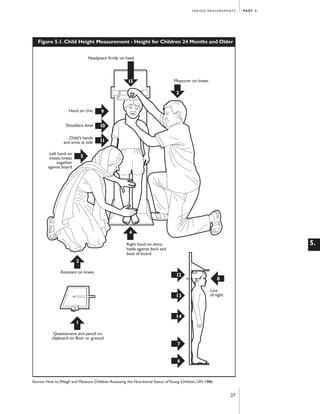
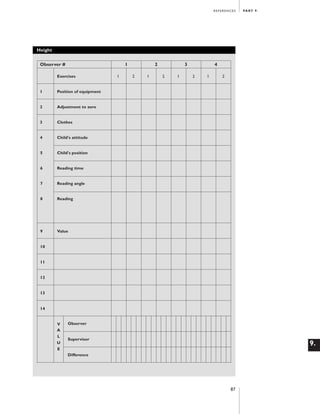
5.3.2. Height for children 24 months and
older (Figure 5.1)
1. Measurer or assistant: Place the
measuring board on a hard flat surface
against a wall, table, tree, staircase, etc.
Make sure the board is not moving.
2. Measurer or assistant: Ask the
mother to remove the child’s shoes and
unbraid any hair that would interfere
with the height measurement. Ask her to
walk the child to the board and to kneel in
front of the child. If a Microtoise measure
is used, stand the child vertically in the
middle of the platform.
3. Assistant: Place the questionnaire and
pencil on the ground (Arrow 1). Kneel
with both knees on the right side of the
child (Arrow 2).
4. Measurer: Kneel on your right knee
on the child’s left side (Arrow 3). This will
give you maximum mobility.

5.

5. Assistant: Place the child’s feet flat and
together in the center of and against the
back and base of the board/wall. Place your
right hand just above the child’s ankles on
the shins (Arrow 4), your left hand on the
child’s knees (Arrow 5) and push against
the board/wall. Make sure the child’s legs
are straight and the heels and calves are
against the board/wall (Arrows 6 and 7).
Tell the measurer when you have
completed positioning the feet and legs.
6. Measurer: Tell the child to look
straight ahead at the mother who should
stand in front of the child. Make sure the
child’s line of sight is level with the
ground (Arrow 8). Place your open left
hand under the child’s chin. Gradually
close your hand (Arrow 9). Do not cover
the child’s mouth or ears. Make sure the
shoulders are level (Arrow 10), the hands
are at the child’s side (Arrow 11), and the
head, shoulder blades and buttocks are
against the board/wall (Arrows 12, 13,
and 14). With your right hand, lower the
headpiece on top of the child’s head.
Make sure you push through the child’s
hair (Arrow 15).
26

7. Measurer and assistant: Check the
child’s position (Arrows 1-15). Repeat any
steps as necessary.
8. Measurer: When the child’s position
is correct, read and call out the
measurement to the nearest 0.1 cm.
Remove the headpiece from the child’s
head and your left hand from the child’s
chin.
9. Assistant: Immediately record the
measurement and show it to the
measurer.
10. Measurer: Check the recorded
measurement on the questionnaire for
accuracy and legibility. Instruct the
assistant to erase and correct any errors.
Artwork proof 3

8/8/01 2:59 pm

Page 27

TA K I N G M E A S U R E M E N T S

PA R T 5 .

Figure 5.1. Child Height Measurement - Height for Children 24 Months and Older
Headpiece firmly on head

15

Measurer on knees

3

Hand on chin

9

Shoulders level

10

Child's hands
and arms at side

11

Left hand on
knees; knees
together
against board

5

4

5.

Right hand on shins;
heels against back and
base of board

2
Assistant on knees

12

13

8
Line
of sight

14
1
Questionaire and pencil on
clipboard on floor or ground

7
6

Source: How to Weigh and Measure Children: Assessing the Nutritional Status of Young Children, UN 1986.

27
Artwork proof 3

8/8/01 2:59 pm

Page 28

5.3.3. Length for infants and children
0-23 months (Figure 5.2)
1. Measurer or assistant: Place the
measuring board on a hard flat surface,
i.e., ground, floor, or steady table.
2. Assistant: Place the questionnaire and
pencil on the ground, floor, or table
(Arrow 1). Kneel with both knees behind
the base of the board if it is on the ground
or floor (Arrow 2).
3. Measurer: Kneel on the right side of
the child so that you can hold the foot
piece with your right hand (Arrow 3).
4. Measurer and assistant: With the
mother’s help, lay the child on the board
by supporting the back of the child’s head
with one hand and the trunk of the body
with the other hand. Gradually lower the
child onto the board.
5. Measurer or assistant: Ask the
mother to kneel close on the opposite side
of the board facing the measurer as this
will help to keep the child calm.

5.

6. Assistant: Cup your hands over the
child’s ears (Arrow 4). With your arms
comfortably straight (Arrow 5), place the
child’s head against the base of the board
so that the child is looking straight up.
The child’s line of sight should be
perpendicular to the ground (Arrow 6).
Your head should be straight over the
child’s head. Look directly into the child’s
eyes.
7. Measurer: Make sure the child is
lying flat and in the center of the board
(Arrows 7). Place your left hand on the
child’s shins (above the ankles) or on the
knees (Arrow 8). Press them firmly
against the board. With your right hand,
place the foot piece firmly against the
child’s heels (Arrow 9).
8. Measurer and assistant: Check the
child’s position (Arrows 1-9). Repeat any
steps as necessary.

28

9. Measurer: When the child’s position
is correct, read and call out the
measurement to the nearest 0.1 cm.
Remove the foot piece and release your left
hand from the child’s shins or knees.
10. Assistant: Immediately release the
child’s head, record the measurement, and
show it to the measurer.
11. Measurer: Check the recorded
measurement on the questionnaire for
accuracy and legibility.
Instruct the
assistant to erase and correct any errors.
Artwork proof 3

8/8/01 2:59 pm

Page 29

TA K I N G M E A S U R E M E N T S

PA R T 5 .

Figure 5.2. Child length measurement - length for infants andchildren 0-23 months

Measurer on knees
Assistant on knees

3
2

Arms comfortably straight

8

9
Child's feet flat
against footpiece

5

Hand on knees or
shins; legs straight

7

4
Hands cupped over ears;
head against base of board

Child flat on board

5.

1
Questionaire and pencil on
clipboard on floor or ground

Line of sight perpendicular to base of board

6

90o
Source: How to Weigh and Measure Children: Assessing the Nutritional Status of Young Children, UN 1986.

29
Artwork proof 3

8/8/01 2:59 pm

Page 30

5.3.4. Weight Using Salter-like Hanging
Scale (Figure 5.3)
1. Measurer or assistant: Hang the
scale from a secure place like the ceiling
beam. You may need a piece of rope to
hang the scale at eye level. Ask the mother
to undress the child as much as possible.
2. Measurer: Attach a pair of the empty
weighing pants to the hook of the scale
and adjust the scale to zero, then remove
from the scale.
3. Measurer: Have the mother hold the
child. Put your arms through the leg holes
of the pants (Arrow 1). Grasp the child’s
feet and pull the legs through the leg holes
(Arrow 2). Make certain the strap of the
pants is in front of the child.
4. Measurer: Attach the strap of the
pants to the hook of the scale. DO NOT
CARRY THE CHILD BY THE STRAP
ONLY. Gently lower the child and allow
the child to hang freely (Arrow 3).
5. Assistant: Stand behind and to one
side of the measurer ready to record the
measurement. Have the questionnaire
ready (Arrow 4).

5.

6. Measurer and assistant: Check the
child’s position. Make sure the child is
hanging freely and not touching anything.
Repeat any steps as necessary.
7. Measurer: Hold the scale and read the
weight to the nearest 0.1 kg. (Arrow 5).
Call out the measurement when the child
is still and the scale needle is stationary.
Even children who are very active, which
causes the needle to wobble greatly, will
become still long enough to take a
reading. WAIT FOR THE NEEDLE TO
STOP MOVING.
8. Assistant: Immediately record the
measurement and show it to the
measurer.
9. Measurer: As the assistant records the
measurement, gently lift the child by the
body. DO NOT LIFT THE CHILD BY THE
30

STRAP OF THE WEIGHING PANTS.
Release the strap from the hook of the
scale.
10. Measurer: Check the recorded
measurement on the questionnaire for
accuracy and legibility. Instruct the
assistant to erase and correct any errors.
Artwork proof 3

8/8/01 2:59 pm

Page 31

TA K I N G M E A S U R E M E N T S

PA R T 5 .

Figure 5.3. Child Weight
Put hands through
legholes

Grasp feet

2

1

Measurer reads scale at eye level

5
Assistant with
questionaire

4

5.

3

Child hangs
freely

Source: How to Weigh and Measure Children: Assessing the Nutritional Status of Young Children, UN 1986.

31
Artwork proof 3

8/8/01 2:59 pm

Page 32

5.3.4. Child Weight Using UNICEF
UNISCALE (Figure 5.4)
The UNICEF electronic scale requires the
mother and child to be weighed
simultaneously. Minimize the clothing on
the child. Ensure the scale is not overheated in the sun and is on an even
surface enabling the reading to be clear.
Ask the mother to stand on the scale.
Record the weight and include the reading
with one decimal point (e.g. 65.5 kgs).
Pass the child to a person nearby. Record
the second reading with just the mother
(e.g. 58.3 kgs). The difference (e.g. 7.2 kgs)
is the weight of the child. Refer to the
UNICEF document “How to Use the
UNISCALE” (June, 2000) prepared by the
Nutrition Section
Program Division/UNICEF New York.
Contact:
Esther Liestyowati, Nutrition Section,
UNICEF New York,
fax: 212.824.6465,
e-mail: eliestyowati@unicef.org

5.

32
Artwork proof 3

8/8/01 2:59 pm

Page 33

TA K I N G M E A S U R E M E N T S

PA R T 5 .

Figure 5.4. Child Weight Measurement

5.

Source: "How to use the UNISCALE" UNICEF, 2000

33
Artwork proof 3

8/8/01 2:59 pm

Page 34

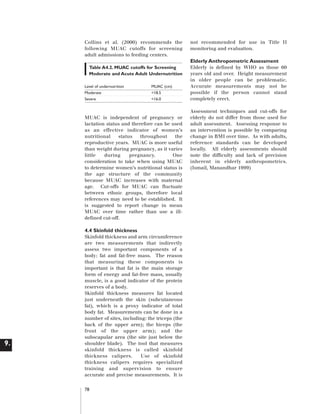
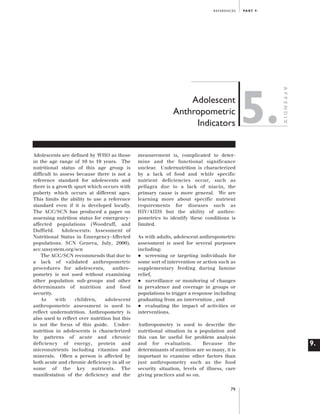
5.3.5. Child Mid-Upper Arm Circumference (MUAC) Procedure (Figure 5.5)
1. Measurer: Keep your work at eye level.
Sit down when possible. Very young
children can be held by their mother
during this procedure. Ask the mother to
remove clothing that may cover the child’s
left arm.
2. Measurer: Calculate the midpoint of
the child’s left upper arm by first locating
the tip of the child’s shoulder (Arrows 1
and 2) with your finger tips. Bend the
child’s elbow to make a right angle (Arrow
3). Place the tape at zero, which is
indicated by two arrows, on the tip of the
shoulder (Arrow 4) and pull the tape
straight down past the tip of the elbow
(Arrow 5). Read the number at the tip of
the elbow to the nearest centimeter.
Divide this number by two to estimate the
midpoint. As an alternative, bend the tape
up to the middle length to estimate the
midpoint. A piece of string can also be
used for this purpose. Either you or an
assistant can mark the midpoint with a
pen on the arm (Arrow 6).

5.

3. Measurer: Straighten the child’s arm
and wrap the tape around the arm at
midpoint. Make sure the numbers are
right side up. Make sure the tape is flat
around the skin (Arrow7).
4. Measurer and assistant: Inspect the
tension of the tape on the child’s arm.
Make sure the tape has the proper tension
(Arrow 7) and is not too tight or too loose
(Arrows 8-9).
Repeat any steps as
necessary.
5. Assistant: Have the questionnaire
ready.
6. Measurer: When the tape is in the
correct position on the arm with the
correct tension, read and call out the
measurement to the nearest 0.1cm.
(Arrow 10).

34

7. Assistant: Immediately record the
measurement on the questionnaire and
show it to the measurer.
8. Measurer: While the assistant records
the measurement, loosen the tape on the
child’s arm.
9. Measurer: Check the recorded
measurement on the questionnaire for
accuracy and legibility. Instruct the
assistant to erase and correct any errors.
10. Measurer: Remove the tape from the
child’s arm.
Artwork proof 3

8/8/01 2:59 pm

Page 35

TA K I N G M E A S U R E M E N T S

PA R T 5 .

Figure 5.5. Child Mid-Upper Arm Circumference Measurement
Arm circumference “insertion” tape
0. cm
cm

6

7

8

9

10

11

12

13

14

15

16

18

19

20

21

22

23

24

25

0. cm

4

2

6

1
5
3
1. Locate tip of
shoulder

2. Tip of shoulder
3. Tip of elbow

4. Place tape at tip of
shoulder
5. Pull tape past tip of
bent elbow

6. Mark midpoint

7

7. Correct tape tension

5.
10
9

10

8

8. Tape too tight

9

9. Tape too loose

10. Correct tape position for arm circumference

How to weigh and measure children: assessing the nutritional status of young children in UN (1986)

35
Artwork proof 3

8/8/01 2:59 pm

Page 36

5.4. Assessing the Accuracy of Measurements
Accuracy is achieved through good
training and supervision. There are
techniques for measuring the accuracy of
the measurements. When taking more
than one height or weight measurement
on
the
same
person,
the
two
measurements can be averaged. If they
are vastly different from each other, the
measurements should be disregarded and
the measuring should start again (Table
5.1 provides specific parameters).

Table 5.1. Largest acceptable differences
between repeated measurements
Anthropometric
measurement
Weight
Height
MUAC

Largest acceptable
difference
0.5kg
1.0cm
0.5cm

The field supervisor is usually responsible
for
assessing
the
accuracy
of
measurements. There are a few practices
a supervisor should employ to make sure
that the data collected is of high quality.

These are:

•

Checking the measurements recorded
and submitted by field staff, to see whether
they look reasonable.
Accompanying field staff on interviews
to watch how measurements are taken.
Conducting repeat visits to some
households that have already been interviewed by the field staff. Measurements
should be repeated to determine if the
previous measurements are supported by
the repeat measurements.

•
•

Appendix 6 has a section on Anthropometric
Standardization tests. These tests can be
used during training or at any point during
the survey process to check how accurately
field staff take measurements. These tests
can be especially useful during training to
determine who needs more training or who
might need a little extra supervision once in
the field.

5.5. Entering the data

5.

A survey questionnaire usually contains a
wide range of information to be collected.
A questionnaire should be adapted to the
needs for measuring anthropometry.
Some information will carry over from
one module or section to another. The
following is an example of one format
used for survey work for children under
five years of age.
Anthropometry - basic information:
Enter the children’s names and
identification code numbers, enter the sex
and their ages (see Figure 5.6). Be careful
not to mix up children when moving from
one section of a questionnaire to another.
Child weight: Record the child’s weight
in kilograms to one decimal. Read the
supporting notes carefully as they should
be known to all interviewers and
supervisors. In the example of Mary
36

(Figure 5.6), her weight was 10.2
kilograms. Had her weight been 9.5 kgs,
the entry would be |0|9:5|. Always note the
zeros and the decimals.
Child length: Record the child’s length
in centimeters to one decimal. In the
example of Mary (Figure 5.6), her length
was 67.3 centimeters. The entry is made
as |0|6|7:3|. Always note the zeros and the
decimals. Make sure the information is
entered accurately and fully on each child.
Artwork proof 3

8/8/01 2:59 pm

Page 37

TA K I N G M E A S U R E M E N T S

PA R T 5 .

Figure 5.6. Child anthropometry questionnaire (partial)

Section 1: Health and Nutrition

0 1

Household ID

1.1 Anthropometry

Date of interview
dd

Name

Child
ID

Sex
Age
1 = Male
Weight
(months) 2 = Female (kg 0.1)

Date of birth
(dd/mm/yy)

mm

yy

Length
(cms 0.1)

:
dd

mm

mm

:

yy

0 2
dd

:

:

0 1

yy

To the nearest
0.1kg and 0.1cm

For Example:
Mary, a girl, born on 7 August 1996, is approximately 11 months old and weighed 10.2 kilograms and
was 67.3 centimetres long
Mary

0 2

0 7 0 8 9 6
dd

mm

1 1

2

1 0:2

0 6 7:3

yy

5.6.Training field staff
Training field staff to collect anthropometric data through surveys usually
involves learning: to take anthropometric
measurements; and other skills such as
household
selection,
interviewing
techniques and recording requirements.
All of these skills are important for
conducting surveys that yield valid results.
This section will cover what should be
expected from field staff training.

5.6.1 Planning the training
It is recommended that you always select
more candidates than you need. This will
allow you to pick the candidates with the
best performance when training is over
and will give you some extra trainees in
case of dropouts.
The length of the training will vary
depending on the resources available and
the complexity of the survey.
As a

guideline, training is generally scheduled
for two to five days. Usually, the first day
of training is spent explaining the purpose
of the survey and outlining the survey
procedures; the second and third days
focus more closely on survey procedures
and the questionnaire; and the last couple
of days should be used for field exercises
and tests. Field exercises will be covered
in more detail later in this section.
The checklist below lists the topics that
should be covered during training:

• Purpose and background of the survey
• Organization of the survey team and
division of responsibilities
• Explanation of sampling and
household selection procedures
• Question-by-question review of the
questionnaire
• Instruction in techniques of interviewing, recording answers and checking
37

5.
Artwork proof 3

8/8/01 2:59 pm

Page 38

out questionnaires
Explanation of specific nutrition
indicators
Instructions on how to take and record
anthropometric
measurements
and
standardization tests
Administrative details (timetable, logbook, supplies, reports).

•
•
•

5.

5.6.2. Field exercises and standardization
Survey staff should have ample
opportunity to practice the skills taught
during training. This is especially true
with training on taking anthropometric
measurements. Trainees practical skills
need to be developed. During practice
sessions a supervisor can determine who
needs more training. Practice sessions
might begin by taking trainees to a school,
maternal and child health clinic, hospital
or orphanage and letting them practice
taking children’s measurements. The
standardization exercises described in
Appendix 6 ensure the trainees have
acquired the necessary skills.
By the end of training, all trainees
should also have had a chance to practice
what they have learned. Choose a village
that is close to the training center. The
trainees should go through an entire
survey with a few households and the
supervisor should watch how each trainee
performs. This will provide trainees with
hands-on experience, make them feel
more confident when they go into the field
and will give the supervisor a chance to
correct any mistakes.
5.6.3. Survey training manual
A training manual should give an overview
of the purpose of the survey, an outline of
the whole survey process and clearly
define what is expected of the field staff. It
can also include useful tips and answers to
common questions that come up in the
field. All field staff should be provided with
their own copy of the training manual.

38
Artwork proof 3

8/8/01 2:59 pm

Page 39

Comparing the measurements of children to
reference standards is an easy procedure
because of readily available public-domain
computer software. This section describes

6.

PA R T

Comparison of
Anthropometric Data to
Reference Standards

some underlying principles for efficient use
of the available software beginning with
how individual measurements are
compared to the reference standard.

6.1. NCHS/WHO Reference Standards
The reference standards most commonly
used to standardize measurements were
developed by the US National Center for
Health Statistics (NCHS) and are
recommended for international use by the
World Health Organization. The reference
population chosen by NCHS was a
statistically valid random population of
healthy infants and children. Questions
have frequently been raised about the
validity of the US-based NCHS reference
standards for populations from other ethnic
backgrounds. Available evidence suggests

that until the age of approximately 10 years,
children from well-nourished and healthy
families throughout the world grow at
approximately the same rate and attain the
same height and weight as children from
industrialized countries. The NCHS/WHO
reference standards are available for
children up to 18 years old but are most
accurate when limited to use with children
up to the age of 10 years. The international
reference standards can be used for
standardizing anthropometric data from
around the world.

6.2. Comparisons to the Reference Standard
References are used to standardize a child’s
measurement by comparing the child’s
measurement with the median or average
measure for children at the same age and
sex. For example, if the length of a 3 month
old boy is 57 cm, it would be difficult to know
if that was reflective of a healthy 3 month old
boy without comparison to a reference
standard. The reference or median length
for a population of 3 month old boys is 61.1
cm and the simple comparison of lengths

would conclude that the child was almost 4
cm shorter than could be expected.
When describing the differences from
the reference, a numeric value can be
standardized to enable children of different
ages and sexes to be compared. Using the
example above, the boy is 4 cm shorter than
the reference child but this does not take the
age or the sex of the child into consideration.
Comparing a 4 cm difference from the
reference for a child 3 months old is not the
39

6.
Artwork proof 3

8/8/01 2:59 pm

Page 40

same as a 4 cm difference from the
reference for a 9 year old child, because of
their relatively different body sizes.
Taking age and sex into consideration,
differences in measurements can be
expressed a number of ways:

•
•
•

To
standardize
reporting,
USAID
recommends that Cooperating Sponsors
calculate percentages of children below cutoffs as well as other statistics using Z-scores.
If Z-scores cannot be used, percentage of the
median should be used.

standard deviation units, or Z-scores
percentage of the median
percentiles.

6.3. Standard Deviation Units or Z-Scores
Z-scores are more commonly used by the
international nutrition community because
they offer two major advantages. First,
using Z-scores allows us to identify a fixed
point in the distributions of different
indices and across different ages, i.e., for all
indices for all ages, 2.28% of the reference
population lie below a cut-off of -2 Zscores. The percent of the median does not
have this characteristic. For example,
because weight and height have different
distributions (variances), -2 Z-scores on
the weight-for-age distribution is about
80% of the median, and -2 Z-scores on the
height-for-age distribution is about 90% of
the median. Further, the proportion of the
population identified by a particular
percentage of the median varies at different
ages on the same index.
The second major advantage of using Zscores is that useful summary statistics can

be calculated from them. The approach
allows the mean and standard deviation to
be calculated for the Z-scores for a group of
children. This can not be done with
percentages of the median or centiles.
Thus, the Z-score application is considered
the simplest way of describing the
reference
population
and
making
comparisons to it. It is the statistic
recommended for use when reporting
results of nutritional assessments.
Examples of Z-score calculations are
presented in Appendix 1.
The Z-score or standard deviation
unit (SD) is defined as the difference
between the value for an individual and the
median value of the reference population
for the same age or height, divided by the
standard deviation of the reference
population. This can be written in equation
form as:

6.
(observed value) - (median reference value)
Z-score (or SD-score) =
standard deviation of reference population

6.4. Percentage of the Median and Percentiles
The percentage of the median is defined
as the ratio of a measured or observed
value in the individual to the median
value of the reference data for the same

age or height for the specific sex,
expressed as a percentage. This can be
written in equation form as:

observed value
Percent of median =
median value of reference population
40

100
Artwork proof 3

8/8/01 2:59 pm

Page 41

C O M PA R I S O N O F A N T H RO P O M E T R I C DATA TO R E F E R E N C E S TA N DA R D S

The median is the value at exactly the
mid-point between the largest and
smallest. If a child’s measurements are
exactly the same as the median of the
reference population we say that they are
“100% of the median”. Examples of
calculations for percent of median can be
found in Appendix 1.
The percentile is the rank position of
an individual on a given reference
distribution, stated in terms of what
percentage of the group the individual
equals or exceeds. Percentiles will not be
presented in this guide. The distribution
of Z-scores follows a normal (bell-shaped
or Gaussian) distribution. The commonly
used -3, -2, and -1 Z-scores are, respect-

PA R T 6 .

ively the 0.13th, 2.28th, and 15.8th
percentiles.
The percentiles can be
thought of as the percentage of children in
the reference population below the
equivalent cut-off. Approximately 0.13
percent of children would be expected to
be below -3 Z-score in a normally
distributed population.

Z-score
-3
-2
-1

Percentile
0.13
2.28
15.8

6.5. Cut-offs
The use of a cut-off enables the different
individual measurements to be converted
into prevalence statistics. Cut-offs are also
used for identifying those children
suffering from or at a higher risk of
adverse outcomes. The children screened
under such circumstances may be
identified as eligible for special care.
The most commonly-used cut-off with
Z-scores is -2 standard deviations,
irrespective of the indicator used. This
means children with a Z-score for
underweight, stunting or wasting, below
-2 SD are considered moderately or
severely malnourished. For example, a
child with a Z-score for height-for-age of
-2.56 is considered stunted, whereas a
child with a Z-score of -1.78 is not
classified as stunted.
In the reference population, by
definition, 2.28% of the children would be
below -2 SD and 0.13% would be below -3
SD (a cut-off reflective of a severe
condition). In some cases, the cut-off for
defining malnutrition used is -1 SD (e.g. in
Latin America). In the reference or
healthy population, 15.8% would be below
a cut-off of -1 SD. The use of -1 SD is
generally discouraged as a cut-off due to
the large percentage of healthy children
normally falling below this cut-off. For
example, the 1995 DHS survey using a –2
SD cut-off for stunting in Uganda found a

36% prevalence of stunting in under-three
year olds. This level of stunting is about 16
times the level of the reference population.
A comparison of cutoffs for percent of
median and Z-scores illustrates the
following
90% =
-1 Z-score
80% =
-2 Z-score
70% =
-3 Z-score (approx.)
60% =
-4 Z-score (approx.)
Cut-off Points for MUAC for the 6 - 59
Month Age Group
MUAC cut-offs are somewhat arbitrary
due to its lack of precision as a measure of
malnutrition. A cut-off of 11.0cm can be
used for screening severely malnourished
children. Those children with MUAC
below 13.5cm should be selected to have
their weight-for-height measured.
Global Malnutrition is a term generally
used in emergency settings. The global
malnutrition rate refers to the percent of
children with weight-for-height below -2 Zscores and/or edema. This refers to all
moderate and severe malnutrition
combined. The combination of a low
weight-for-height and any child with edema
contributes to those children counted as in
the global malnutrition statistic.

41

6.
Artwork proof 3

8/8/01 2:59 pm

Page 42

Malnutrition Classification Systems
The
cut-off
points
for
different
malnutrition classification systems are
listed below. The most widely used system
is WHO classification (Z-scores). The
Road-to-Health (RTH) system is typically
seen in clinic-based growth-monitoring
systems. The Gomez system was widely
used in the 1960s and 1970s, but is only
used in a few countries now. An analysis
of prevalence elicits different results from
different systems. These results would not
be directly comparable. The difference is

especially broad at the severe malnutrition
cut-off between the WHO method (Zscores) and percent of median methods. At
60% of the median the closest
corresponding Z-score is –4. The WHO
method is recommended for analysis and
presentation of data (see Part 6.2).
Mild, moderate and severe are different
in each of the classification systems listed
below. It is important to use the same
system to analyze and present data. The
RTH and Gomez classification systems
typically use weight-for-age.

System
WHO

Cut-off
< -1 Z-score
< -2 Z-score
< -3 Z-score

Malnutrition classification
mild
moderate
severe

RTH

≥ 80% of median
60% - < 80% of median
< 60% of median

normal
mild-to-moderate
severe

Gomez

≥ 90% of median
75% - < 90% of median
60% - < 75% of median
≤ 60% of median

normal
mild
moderate
severe

6.

42
Artwork proof 3

8/8/01 2:59 pm

Page 43

Computer software can be used to make
comparisons to the reference standards. The
Centers for Disease Control and Prevention
(CDC) has developed a free software
package called Epi Info that can handle all of
these
anthropometric
calculations.
Cooperating
Sponsors
are
strongly
encouraged to use available software to
analyze nutrition data. Not only will the
software enable raw anthropometric survey
data to be transformed into the indices and
scores described in Part 6, the software will
flag outliers which are usually the result of
incorrect measurements, coding errors or
incorrect ages. Once the anthropometric
indices have been calculated, they can be
presented in simple tables using specified
cut-offs and age categories consistent with
the Title II Generic Indicator list.
When using computer software for
anthropometry, there are three separate
procedures that should be performed.
First, the raw measurement data should be
entered into the computer. Second, the
program should combine the raw data on
the variables (age, sex, length, weight) to
compute a nutritional status index such as
weight-for-age, height-for-age or weightfor-height. Third, the program should
transform these data into Z-scores so that
the prevalence of nutritional conditions
such as being underweight and stunted can
be calculated.
Another software called ANTHRO
analyzes anthropometric data and can be
downloaded from the WHO Global Database

on Child Growth and Malnutrition
(www.who.int/nutgrowthdb).
There is another Windows based
software available from: www.nutrisurvey.de.
This software program was designed
specifically for nutrition surveys by the Work
Group on International Nutrition of the
University of Hohenheim/Stuttgart in
cooperation with the German Agency for
Technical Cooperation (GTZ).
The
software is based on the Guidelines for
Nutrition Baseline Surveys in Communities
published by GTZ. The purpose of the
program is to integrate all steps of a
Nutrition Baseline Survey into a single
program.
The program contains a
standard Nutrition Baseline questionnaire
which can be easily customized for the
specific site, a function for printing out the
questionnaire, a data entry unit which
controls the data being entered, a specially
adapted plausibility check, a report
function and a graphics section. The report
function produces the full set of descriptive
statistics of a baseline survey. The graphics
section contains standard graphs and
additional graphics for the anthropometric
indices with comparison to the NCHS
standard. The anthropometric indices (Zscores of height-for-age, weight-for-height,
weight-for-age) and the prevalence of
stunting, wasting, underweight and
overweight of children are calculated
automatically.
For further statistical
evaluation, the data can be exported to
SPSS or other statistical programs.

43

7.

PA RT

Data Analysis

7.
Artwork proof 3

8/8/01 2:59 pm

Page 44

7.1. Sources of Epi Info Software
Public domain sources of Epi Info
software and supporting materials
Epi Info is available from the Centers
for Disease Control and Prevention (CDC),
1600 Clifton Road,
Atlanta, GA 30333, USA

or downloaded from:
www.cdc.gov/epiinfo/
The Epi Info 2000 package comes with
a manual and tutorials to help the user to
become familiar with data analysis using
Epi Info.

7.2. Recommendation for Analysis and Presentation of Height Data
For evaluation purposes, the presentation of
stunting data for children less than 24
months is useful. An intervention among
children under 24 months is likely to be
more effective than among children 24-59
months. This is because 1) the determinants of stunting in the older children
are more varied, and 2) stunting in older
children may reflect historical nutritional or
health stress and be ‘permanent,’ i.e. not
responsive to any intervention. A further
consideration in the presentation of data on
stunting by age groups is the change in
measurement technique at 24 months of
age. Data on length for children less than
24 months should not be grouped together

with data on height for children more
than 24 months of age.
Prevalence - For use in Title II programs,
the prevalence of nutritional status
conditions can be calculated using cut-off
points for height-for-age and weight-forage. The cut-off points can be set using Zscores, percentiles or percentage of the
median. For Title II programs, a cut-off of
-2 Z-score is recommended and results
should be presented for both males and
females. An example of a prevalence table
for low height-for-age as established by -2
SD for groups of children aged 6 - 59.99
months is given below:

Table 7.1. Prevalence of low height-for-age (stunting) in a sample of 97 children,
by sex and age group
Age Group
(months)
<6

6-11.99

12-23.99

7.

24-35.99

36-47.99

48-59.99

Total

Sex
Boys
Girls
Combined
Boys
Girls
Combined
Boys
Girls
Combined
Boys
Girls
Combined
Boys
Girls
Combined
Boys
Girls
Combined
Boys
Girls
Combined

Number below
cut-off (-2 SD)
0
0
0
0
0
0
1
2
3
0
4
4
6
3
9
6
5
11
13
14
27

Number in age
group
6
4
10
6
3
9
6
10
16
7
13
20
10
10
20
15
7
22
50
47
97

Percentage below
cut-off
0.0
0.0
0.0
0.0
0.0
0.0
16.7
20.0
18.8
0.0
30.8
20.0
60.0
30.0
45.0
40.0
71.4
50.0
26.0
29.8
27.8

Overall, this table shows that 26.0 percent of the boys had a low height-for-age or were stunted, while 29.8 percent
of girls were stunted. Interpretations can also be made about the various age groups or with boys and girls
grouped together.

44
Artwork proof 3

8/8/01 2:59 pm

Page 45

DATA A N A LY S I S

PA R T 7 .

7.3. Examples of Data Analysis
This section covers an analysis of data
pertaining to maternal and child nutrition
programs using food aimed at vulnerable
groups in two populations (countries A and
B), simulating situations often encountered
in Title II operations. These examples
illustrate an analysis that would allow one to
reach, at a minimum cost, statistically valid
conclusions concerning the nutritional
impact of a supplementary feeding program.
The analysis compares the “before
intervention” and “after intervention” data
according to the following plan going from
the general to the specific.
For all ages and sexes combined:
all ages, both sexes comparison of
change in the indicators;
calculation of general prevalence of
malnutrition (stunting and underweight);
calculation of changes in prevalence;

•
•
•

Examination of data separated by sex
(ages combined):
calculation of general prevalence of
malnutrition for each sex;

•

•

calculation of changes in prevalence;

Examination of data by age categories
(sexes combined):
calculation of prevalence of malnutrition by age category;
calculation of changes in prevalence.

•
•

With reference to this plan of analysis, the
following assumptions should be noted:

•

the final year evaluation measurements were taken after an interval
sufficiently long for the program to have
produced a nutritional impact (e.g. five
years);
data were collected from a crosssectional sample representative of the program population; and
baseline data had been collected.

•
•

The first example is a comparison of
percentage or prevalence changes.
Cooperating Sponsors are encouraged to
compare changes in the mean Z-scores
for statistical and epidemiological rigor.

Example 1
In 1995, a US-supported Cooperating Sponsor in cooperation with the Government of Country A,
introduced a community-based health and nutrition program with a supplementary feeding scheme
aimed at vulnerable groups. The scheme covered 6 of the 14 administrative districts of the country.
Food supplements were distributed through community centers on a year-round basis to infants over
six months of age and children up to the age of 3 years and to pregnant women and lactating mothers
over an 18-month period (last 6 months of pregnancy and the first 12 months postpartum). In all,
86,000 individuals (21,000 women and 65,000 children) were covered by the program.

7.
In agreement with the USAID Mission and Food for Peace (FFP), the Cooperating Sponsor decided to
evaluate the nutritional changes at three intervals (baseline, mid-term and final year). The first
collection of data began in the second year following the initiation of operations. By adopting a prepost or reflexive design, data on sex, age, weight and height were collected from three representative
cross-sectional sample surveys of the infant and child beneficiaries in 1996, 1998 and 2000.
Ages of the sample children ranged from 3 months to 5 years. Due to some problems in age
estimations and incomplete data, sample sizes of the children varied between 3700 and 2500. No data
were collected from the 8 districts in which the program had not been implemented.The population
of the 8 districts was not comparable, from the nutritional and socioeconomic standpoints, with the
population of the 6 districts covered by the program.

45
Artwork proof 3

8/8/01 2:59 pm

Page 46

Calculation of Nutrition Levels
The measurement of nutritional impact
was based on a comparison of data
collected in 1996 and 2000 so that the
figures would include the largest possible
proportion of children who had
participated in the program for one year or
more. It was felt that this time interval
was necessary to allow for any anticipated
impact to manifest itself. The collected
data are summarized in Table 7.5.
The results for weight-for-height are
presented to illustrate that this indicator
is inappropriate to evaluate the program
since it reflects short-term changes. The
tables also include age ranges that will
not be used in the final presentation but

Cooperating Sponsors are encouraged to
examine the results for different age
groups to better understand how the
indicator responds.

Table 7.2. Distribution of nutritional indicators (Z-scores) at baseline (all ages)
Height-for-age
HAZ
2695
1294
48.0

No. examined
No. below -2 S.D.
% below -2 S.D.

Weight-for-age
WAZ
2695
916
34.0

Height-for-height
WHZ
2695
110
4.1

Table 7.3. Prevalence of low levels of nutritional indicators by sex at baseline (all ages)
HAZ < -2
49.5
47.3

Girls
Boys

WAZ < -2
32.4
35.6

WHZ < -2
3.6
4.6

Table 7.4. Prevalence of stunting or low levels of height-for-age by age
categories at baseline

7.

HAZ < -2
No. examined

3-11 months
34.5
560

12-23 months
42.4
523

24-35 months
48.5
534

36-59 months
52.7
1078

Table 7.5. Prevalence of low levels of nutritional indicators by sex and stage of
intervention (for specific age categories)
HAZ < -2
24-59 months

WAZ < -2
3-35 months

WHZ < -2
3-35 months

Baseline
Girls
Boys
Sexes combined

46

Final year

Baseline

Final year

Baseline

Final year

49.5
47.3
48.0

35.5
37.5
36.6

32.4
35.6
34.0

23.1
26.5
25.0

3.6
4.6
4.1

3.2
4.0
3.8
Artwork proof 3

8/8/01 2:59 pm

Page 47

DATA A N A LY S I S

Tables 7.4 and 7.5 show that over the four
years of the intervention, stunting in girls
and boys was substantially reduced along
with underweight. For sexes combined,
the reduction was 11.4 and 9.0 percentage
points for stunting and underweight,
respectively. The reduction for stunting
was more dramatic while wasting (WHZ)
was virtually unaffected. Wasting should
not be used for evaluation purposes as it is
a relatively rare event and very susceptible
to seasonal influences.
Note the different age groupings for
stunting and wasting in Table 7.5. Some of
the children measured for stunting were
older than the children in the intervention.
The reason for selecting the 24-59 month
age group for evaluation was to capture
the cumulative and lagged effect that the
nutrition project would have on stunting.
There is another reason for the
different age groupings.
It is not
recommended to aggregate data for
children under 24 months with those over
24 months (see Part 7.2). Also, the Title II
Generic Indicators recommend either
stunting or underweight indices but
require specific age groupings for
underweight.

Comparison of Mean Z-scores
The alternative and preferred approach to
evaluating the change in a percentage for
a nutritional index is to compare mean Zscore change over the life of the program.
Just as in the above calculation of change
in prevalence of an index, the data are

analyzed at baseline with the mean and
standard deviation calculated and
compared with the same project area in
the final year of the program. The mean
Z-score comparison has the advantage of
describing the entire population directly,
without resorting to a subset of individuals below a set cut-off. Comparing
means over prevalences is desired as
many of the Title II interventions target
whole communities not just the severely
malnourished.
A community health and nutrition
intervention would expect all children to
benefit whereas a targeted feeding
program for the severely malnourished
would only benefit these children. Using a
-2 SD cut-off and presenting a prevalence
change would show a change in the
prevalence of those below the cut-off.
Therapeutic feeding programs would
focus on changes in nutritional status
among the severely malnourished but
community based programs target all
children and their caregivers.
A
presentation of the mean would reflect all
the children and comparing means would
reflect the community shift or improvement. The statistical comparison of mean
Z-scores over time using the Student’s Ttest for example, is a more powerful
statistical test than comparing prevalences
using the Chi-square statistical test. Using
the same example from above, Table 7.6
presents the results of the mean Z-scores
for height-for-age and weight-for-age.

Table 7.6. Mean Z-scores for stunting (HAZ) and underweight (WAZ) by sex and stage of
intervention (for specific age groupings)
WAZ 3-35 months

HAZ 24-59 months
Baseline
Girls
Boys
Sexes combined

Final year

Baseline

Final year

-2.53
-2.48
-2.50

-2.33
-2.45
-2.36

-1.98
-1.86
-1.93

-1.54
-1.65
-1.58

The evaluation recommendation for Title
II programs is to use a comparison of
mean Z-scores for statistical testing but
the results should be presented with both

PA R T 7 .

change in mean Z-score and change in
prevalence as the latter is more easily
understood by a general audience.

47

7.
Artwork proof 3

8/8/01 2:59 pm

Page 48

Example 2
A Cooperating Sponsor conducted a baseline and final-year survey collecting height and weight data on 24-59
month old children. At both times the sample was randomly drawn from the target communities and did not include
the same children in both surveys. The pre-post design enabled a comparison of change in nutritional status (as
reflected by height-for-age) in the target communities.
Baseline at time zero:
(t0):

Mean Z-score = -2.05 (sd=1.26); Prevalence (-2SD cut-off) = 40%
Sample size = 940

Final year at time five:
(t5):

Mean Z-score = -1.20 (sd=1.15); Prevalence (-2SD cut-off) = 23%
Sample size = 1056

Using statistical software to conduct the t-test (e.g. SPSS, or STATA; note that Epi Info 2000 or Epi Info 6 does not
have this test), the testing of the significance of the change in the sample means is straightforward.
t=

(Mean t0 - Mean t5) / sq. root (Variance t0/n0 + variance t5/n5)

where n0 and n5 is sample size at baseline and final year.
t
t
t
t

=
=
=
=

(-2.05 - (-1.20)) / [sq. root ((1.26x1.26)/940)) + ((1.15x1.15)/1056))]
(-0.85) /[sq. root (0.0016889) + (0.0012523)]
(-0.85) /[ 0.054233]
15.67

This change in mean Z-scores is highly significant (i.e. well above the critical t-value of 1.96 at 0.05 level).

7.4. Additional Data Analysis Information

7.

In cooperation with Food Aid Management,
FANTA developed a workshop for the
training of program managers in the
calculation and analysis of basic
anthropometric data using Epi Info and
SPSS. The materials from the Data Analysis
Workshop are available at:
www.fantaproject.org/focus/index under
Monitoring and Evaluation.
Step by step instructions on data analysis
can be found on the Practical Analysis of
Nutritional Data (PANDA) website:
www.tulane.edu/~panda2/. PANDA was
designed for data analysis instruction using
SPSS software.

48

There are many statistical analysis software
packages available, other than Epi Info. The
packages listed below are only a few of the
commonly used statistical analysis software
programs.
These packages vary in
capability and cost.
Information on
capability and ordering the packages can be
found on their web sites.
SPSS (Statistical Package for Social
Sciences) www.spss.com
SAS
(Statistical
Analysis
System)
www.sas.com
STATA (Statistics/Data Analysis)
www.stata.com
SUDAAN (Software for the Statistical
Analysis of Correlated Data)
www.rti.org/patents/sudaan/sudaan.html
Artwork proof 3

8/8/01 2:59 pm

Page 49

8.

PA RT

Annual
Monitoring
Indicators
8.1. Introduction
Information from regular reporting of
activities from growth monitoring and
promotion programs (GMP) will enhance
program management and can provide
valuable insights into the interpretation of
anthropometric indicators of impact that
are required by USAID. This section
describes how annual monitoring
indicators that are based upon data from
monitoring may be collected and reported
in a standard format. This will help make
the
indicators
more
useful
for
management of programs at all levels

within countries and for reporting to
USAID. Reporting information to USAID
on annual monitoring indicators is
recommended but not required.
The recommended annual monitoring
indicators for maternal and child health
and nutrition programs are:
Percent of eligible children in growth
monitoring/promotion (MP);
Percent of children in GMP program
gaining weight in past 3 months (gender
specific).

•
•

8.2. Routine Data Collection
These guidelines are designed to avoid any
unnecessary burden of reporting on staff at
all levels in program implementation and
so information for the monitoring
indicators should come from routinely
collected data rather than special surveys.
At this time, there is not a standard format
for collecting data from GMP activity and,
the indicators that are available will vary
widely, among Cooperating Sponsors and
countries, and in some cases within the
same Cooperating Sponsor.
It is
appropriate to report whatever data are
readily accessible and avoid investing
scarce resources in attempts to generate or
retrieve data that are not readily accessible.
Data needed for the first index, GMP
attendance rate:

1. The denominator - the number of
eligible children in the population, by
gender and age (usually the most reliable
estimates will be those the project has
gathered as part of its baseline survey, or
other data collection activities);
2. The numerator - the number of
children in growth monitoring/promotion.
The classification of
“in growth
monitoring/promotion” is meant to reflect
the total number of children whose weight
has been monitored in clinic- and/or
village-based activities. This number may
be the total number of children weighed in
the ‘round’ immediately before the
reporting period, or it may be an estimate
of the ‘usual’ total number of children
attending weighing activities over the
reporting period. How the number is
49

8.
Artwork proof 3

8/8/01 2:59 pm

Page 50

derived is not necessarily important, but it
is most important to report clearly how
the estimate was made.
Because
attendance at GMP programs varies
widely with age, this number will be more
meaningful if it is age specific - e.g., <12
months, 12-<24 months, 24-<60 months
(ages reported will be influenced by the
target age group of the project).
The definition of the numerator of the first
index is central to the definition of the
second index.
Data needed for the second index, GMP
increased weight rate among enrolled
children:
1. The denominator -- this will be the
same as the numerator from the first
index, i.e. the total number of children
attending growth monitoring/promotion;
and
2. The numerator -- the number of
children in growth monitoring/promotion
who gained weight in the last 3 months.
Two elements should be considered but
the direction of weight change is more
important than the second concerning the
3-month time frame.
The reports of many weighing activities,
both clinic- and village-based, include a
summary that presents a) the total number
of children attending, b) the number of
children who gained weight, and c) the
number of children who did not gain
weight. All children weighed should be
classified as either gaining weight or not
gaining weight - usually over a three month
period. Calculate the index by dividing the
number of children who gained weight by
the total number of children attending,
then multiply this by 100. This index

should be considered available only in
those programs in which the appropriate
summary numbers are reported. In some
situations a time frame other than 3
months is the only available information.
Collecting accurate data from weighing
is difficult. To ensure the quality of the
data, health workers should be properly
trained to make accurate measurements of
whether or not a child is gaining weight.
Data from assessments are central to the
usefulness of growth monitoring and
promotion programs.
Annual
benchmarks
are
not
appropriate for these indicators because
their interpretation is specific to the
context of the particular program and its
activities. For example, when a program
extends activities into areas of highest
need (perhaps because of remoteness or
food insecurity) the overall percent of
children in growth monitoring/promotion
and the percent of children gaining weight
are likely to decrease. Clearly this result
will not be interpreted as reflecting poorly
on program implementation.
This
example demonstrates that the monitoring
indicators proposed here could not be
interpreted independent of the context of
the activities of a program.
These
indicators are not useful for summative
evaluation and are not intended to be used
for this purpose.
Substantial resources should not be
invested to gather data on annual
monitoring indicators reported by
Cooperating Sponsors. However, it is
recommended that Cooperating Sponsors
consider the advantages of including the
monitoring indicators in their annual
reports
and
to
modify
training,
implementation and information management systems to incorporate these
indicators in the future.

8.
8.3. Data on Growth Monitoring and Promotion
Relevant items could be added to
questionnaires at baseline and end-line to
describe changes over the time period of an
intervention (provides an assessment of
impact of the intervention on service delivery
that might help support or explain findings
50

from anthropometric status of children).
Resources on GMP are available in a
Diarrhea Dialogue supplement on Growth
Monitoring Health Basics: Issue no. 24 March 1986 at: www.nand.org/
dd/html/su24.htm.
Artwork proof 3

8/8/01 2:59 pm

Page 51

Adair, L., Polhamus, B.,
Testing Indicators for Use in Monitoring
Interventions to Improve Women’s
Nutritional Status. MEASURE Evaluation
Project, The United Nations University
Press, May 1998.

Food and Nutrition Bulletin
Surveillance for actions towards better
nutrition, Volume 16, Number 2, The
United Nations University Press, June
1995. www.unu.edu/unupress/food/
8F162e/8F162E00.htm#Contents

Beaton, G., Kelly, A., Kevany, J.,
Martorell, R., and Mason, J.
Appropriate Uses of Anthropometric
Indices in Children. Geneva: UN
ACC/SCN, 1990

9.

PA R T

References

FAO (Food and Agriculture
Organization), Conducting small-scale
nutrition surveys: A field manual, No. 5,
FAO, Rome, 1990.

Bender, W., and Remancus, S.
The Anthropometry Resource Center
funded by the FAO/SADC project
GCP/RAF/284/NET, Development of a
Regional Food Security and Nutrition
Information System.
CDC. ANTHRO software analyzes
anthropometric data can be downloaded
at www.cdc.gov/epiinfo/ and from the
WHO Global Database on Child Growth
and Malnutrition at
www.who.int/nutgrowthdb
Collins, S., Duffield, A., and Myatt, M.
Assessment of nutritional status in
emergency-affected populations: Adults.
ACC/SCN, Geneva, July, 2000
Dean, A. G., Epi Info Version 6: A Word
Processing Database and Statistics System
for Epidemiology on Microcomputers,
Atlanta, Georgia, 1994.

Hennekens, C., Burring, J.
Epidemiology in Medicine. Little, Brown
and Company. 1987.
Ismail, S., Manandhar, M., Better
Nutrition for Older People, Assessment and
Action. HelpAge International and
London School of Hygiene & Tropical
Medicine, London, UK, 1999.
Médecins sans Frontèries (MSF),
Nutrition Guidelines. Coordinated by M
Boerlart, A Davis, B Lelin, M J Michelet,
K Ritmeijer, Svan der Kam and F Vautier.
MSF Holland, 1995.
Médecins sans Frontèries (MSF),
Refugee Health, An Approach to
Emergency Situations, 1997.

9.

Norusis, M., Marketing Department,
SPSS Inc. 1990.

51
Artwork proof 3

8/8/01 2:59 pm

Page 52

Pellitier, D., Frongillo Jr., E, Schroeder,
D., Habicht, J. A Methodology for
Estimating the Contribution of
Malnutrition to Child Mortality in
Developing Countries. The Journal of
Nutrition. October 1994, Supplement.
SCF Drought Relief in Ethiopia. Compiled
by J Appleton with the SCF Ethiopian
Team, London. 1987.
Starr, C., McMillan, B., Human Biology,
Third Edition. Brooks/Cole Publishing
Company, 1999.
United Nations Department of
Technical Co-operation for
Development and Statistical Office,
How to Weigh and Measure Children:
Assessing the Nutritional Status of Young
Children in Household Surveys, UN, New
York, 1986.
UNICEF, 1995. Monitoring progress toward
the goals of the World Summit for Children:
A practical handbook for multipleindicator surveys, UNICEF, New York.

9.

UNICEF equipment specifications can be
found at:
www.supply.unicef.dk/catalogue/index.htm
under 03 NUTRITION
USAID/BHR, Commodities Reference
Guide (CRG), 2000.
www.usaid.gov/hum_response/crg.
52

USAID/BHR/FFP. Title II Guidelines for
Development Programs. January 2000.
www.usaid.gov/hum_response/ffp/dappaa.htm
USAID/CDIE. Performance Monitoring
and Evaluation Tips. 1996.
www.usaid.gov/pubs/usaid_eval/#02.
Waterlow JC. Classification and
definition of Protein Calorie malnutrition.
British Medical Journal 3:566-569, 1972
Waterlow JC, Buzina R, Keller W, Lane
JM, Nichaman MZ, Tanner JM.
The presentation and use of height and
weight data for comparing the nutritional
status of groups of children under the age
of 10 years. Bulletin of the World Health
Organization 55(4):489-498., 1977
WHO (World Health Organization)
Measuring Change in Nutritional Status.
Guidelines for Assessing the Nutritional
Impact of Supplementary Feeding
Programs for Vulnerable Groups. World
Health Organization, Geneva, 1983.
WHO (World Health Organization)
Management of Severe Malnutrition: A
Manual for Physicians and Other Senior
Health Workers. World Health
Organization, Geneva, 1999.
Artwork proof 3

8/8/01 2:59 pm

Page 53

REFERENCES

WHO (World Health Organization)
The Management of Nutrition in Major
Emergencies. World Health Organization,
Geneva, 2000.
WHO (World Health Organization)
Field Guide on rapid nutritional
assessment in emergencies. WHO Regional
Office for the Eastern Mediterranean,
World Health Organization, Geneva,
1995.

PA R T 9 .

Anthropometric Desk Reference:
www.odc.com/anthro/
Center for Disease Control (CDC)
Growth Charts:
www.cdc.gov/growthcharts/
Child Survival Technical Support
Project (CSTS) for KPC Material and
other useful information:
www.childsurvival.com

WHO (World Health Organization)
Physical Status: The use and interpretation of anthropometry. Report of a
WHO Expert Committee. World Health
Organization, Geneva, 1995.

CORE: USAID/PVO Core Group:
www.coregroup.org/

Woodruff, B.A. and Duffield, A.
Assessment of nutritional status in
emergency-affected populations:
Adolescents. ACC/SCN, Geneva, July, 2000

Food and Agriculture Organization
(FAO) Nutrition Division:
www.fao.org/WAICENT/FAOINFO/ECO
NOMIC/ESN/NUTRI.HTM

World Food Programme (WFP).
Supplementary Feeding for Mothers and
Children: Operational Guidelines also see
UNHCR/WFP Guidelines For Selective
Feeding Programmes In Emergency
Situations, February 1999
www.wfp.org/OP/guide/PolGuideSelect.html.

Food Aid Management (FAM) provides
USAID documents related to Title II
programs for PVOs: www.foodaid.org

Useful Websites

International Life Sciences Institute
(ILSI): www.ilsi.org/

ACC/SCN (Nutrition Sub-committee of
the UN): acc.unsystem.org/scn/

Demographic Household Survey (DHS)
Macro Inc. www.measuredhs.com/

Food and Nutrition Technical
Assistance Project: www.fantaproject.org

9.

London School of Hygiene and Tropical
Medicine, Public Health Nutrition Unit
www.lshtm.ac.uk/eps/phnu/phnintro.htm
53
Artwork proof 3

8/8/01 2:59 pm

Page 54

LSMS World Bank Surveys:
www.worldbank.org/html/prdph/lsms/in
dex.htm
MEASURE I (DHS):
www.measuredhs.com/
MEASURE II Evaluation USAID
Project:
www.cpc.unc.edu/measure/home.html

Nutrition Surveys and Assessment:
www.nutrisurvey.de/
Practical Analysis of Nutrition Data
(PANDA) Tulane University:
www.tulane.edu/~panda2/
USAID Commodity Reference Guide,
Part Two:
www.usaid.gov/hum_response/crg/
WHO Global Database on Child
Growth and Malnutrition:
www.who.int/nutgrowthdb/

9.

54
Artwork proof 3

8/8/01 2:59 pm

Page 55

REFERENCES

PA R T 9 .

Glossary
Acute undernutrition - Serious and usually
current periods of inadequate food intake.

Batch processing - The processing of data
for a large group of people at one time.

Age chart - A chart that can be used
quickly to determine a child’s current age
by the month and year the child was born;
a tool used to determine if reported birth
dates match the age of a child given by
parents or estimated from the child’s
appearance. (FAO, 1990)

Bias - A consistent, repeated difference of
the sample from the population, in the
same direction; sample values that do not
center on the population values but are
always off in one direction.

Anthropometry - The study and
technique of taking body measurements,
especially for use on a comparison or
classification basis.

Body Mass Index (BMI) - Also known as
“Quetelet’s index”. An index that uses the
variables weight and height to measure
body fat stores, usually in adults rather
than children (weight in kilograms
divided by the square of height in meters).

Arm circumference - A measurement
done on the mid-upper arm; a
measurement used to assess total body
muscle mass and in some circumstances,
protein-energy malnutrition.

Case-control study - A study in which
subjects are selected on the basis of
whether they are (cases) or are not
(controls) receiving benefits of a health
and, or nutrition program.

Asymmetrical - Being lopsided; not
having a equal correspondence of form
and arrangement of parts on opposite
sides of a boundary; an asymmetrical
distribution would not have two equal
halves on each side of the median.

Chi-Squared test - The Chi-Squared Test
of Association looks at the statistical
significance of an association between a
categorical outcome (such as wasted or
not wasted) and a categorical determining
variable (such as diarrhea in the last two
weeks, no diarrhea).

Bar chart - A chart in which the length
of the bars depends on the number of
cases in that category and the number of
bars depends on the number of
categories.

Chronic undernutrition - Extended
periods of inadequate food intake.
Circumference
measuring
tape
(circumference insertion tape) - A tool
used to assess arm circumference; a
55

9.
Artwork proof 3

8/8/01 2:59 pm

Page 56

plastic, non-stretchable tape that is pulled
taut around the mid-point of the upper
arm to measure circumference of the arm.
Classification system - A system that
establishes
cut-off
points
using
percentiles, percentages of the median or
standard deviations and identifies
different levels of nutritional risk.
Cluster sample - The selection of groups
that are geographically close to one
another for a sample; usually used in
instances when lists of households or
individuals are not readily available.
Cohort studies - A study which focuses
on the same group of people, but uses
different individuals over time; a study
that uses the same specific population
each time but uses different samples.

9.

Confidence interval - An interval that has
a specified probability of covering the true
population value of a variable or
condition.
Cross-section plus over-sample survey A survey in which data is collected from a
random sample and then additional data
is collected so that an in-depth view can
be gained of a certain group or problem.
Cut-off point - Predetermined risk levels
used
to
differentiate
between
malnourished and adequately nourished
segments of a population.
56

Design effect - The loss of sampling
efficiency resulting from the use of cluster
sampling instead of random sampling (a
design effect of 2.0 is commonly used for
anthropometric and immunization surveys).
Distribution - A display that shows the
number of observations (or measurements) and how often they occur.
Edema - The presence of excessive
amounts of fluid in the intercellular tissue.
It is the key clinical sign of a severe form
of protein energy malnutrition.
Epidemiology - The science of the
occurrence and determinants of disease in
a population.
Epi Info software - A series of microcomputer programs produced by the CDC
and WHO, for handling epidemiological
data in questionnaire format and for organizing study designs and results into text and
tables that may form part of written reports.
External validity - Being able to
generalize conclusions drawn from a
sample or sub-set to a wider population.
Gomez classification system - A
classification system that uses percentage
of the median weight-for-age to identify
children as being normal or having mild
malnutrition, moderate malnutrition or
severe malnutrition.
Artwork proof 3

8/8/01 2:59 pm

Page 57

REFERENCES

Graph - A drawing that shows the
relationship between two sets of numbers
as a set of points having coordinates
determined by their relationship; a display
of numerical relationships.

common provisions for food and possibly
other essentials for living; the smallest
and most common unit of production,
consumption and organization in
societies.

Growth chart - A graph that is usually
used to record a child’s weight-for-age in
months; a chart typically used by mothers
and health workers to determine if a child
is experiencing a normal gain in weight.

PA R T 9 .

Index - An index is usually made up of
two or more unrelated variables that
are used together to measure an
underlying characteristic.

Growth faltering - A condition identified
by emphasizing the direction of growth
obtained in serial recordings, rather than
actual weight-for-age itself; signified by no
change or an actual decrease in
measurements. (ACC/SCN, 1990)
Growth monitoring and promotion The practice of following changes in a
child’s physical development, by regular
measurement of weight and sometimes of
length with accompanying information to
guide the care givers’ nutritional and
related care.
Histogram - A display that shows the
number of observations and how often
they occur, usually through the use of
vertical bars and a horizontal base that is
marked off in equal units.
Household - One person who lives alone
or a group of persons, related or
unrelated, who share food or make

Indicator - A measure used at the
population level to describe the proportion
of a group below a cut-off point; example:
30 percent of the region’s children are
below -2 SD for height-for-age.
Intrahousehold distribution - The
distribution of food within a household;
the act of determining what proportion of
the total household food supply each
member of the household receives.
Length-for-age - An index of past or
chronic nutritional status; an index
which assesses the prevalence of
stunting.
Local events calendar - A calendar that
reflects important local events and
seasons that might help a parent pinpoint
the birth date of their child.
Longitudinal survey - A survey which
follows people over time, to capture data
on an evolving situation or problem.
Different types of longitudinal surveys
57

9.
Artwork proof 3

8/8/01 2:59 pm

Page 58

include: cohort studies, trend studies and
panel studies.
Malnutrition - A nutritional disorder or
condition resulting from faulty or
inadequate nutrition.
Mean - The average value for a set of data;
a measure of central location obtained by
adding all the data items and dividing by
the number of items.
Measurement error - The error that can
result in a survey from incorrect
(anthropometric) measurements being
taken.
Median - A measure of central location
for a set of data; the value that falls in the
middle of a set of data when all the values
are ordered from lowest to highest.
Morbidity - A condition resulting from or
pertaining to disease; illness.
Mortality rate - Death rate; frequency of
number of deaths in proportion to a
population in a given period of time; death.

9.

NCHS reference standards - Growth
percentiles developed by the National
Center for Health Statistics in the US that
provide standards for weight-for-age,
length-for-age and weight-for-length.

58

Normal distribution - A normal
distribution takes a bell-shape and has the
following characteristics: the highest point
occurs at the mean; it is symmetric; the
standard deviation determines the width
of the distribution; and it can be described
with only two numbers: the mean and the
standard deviation.
Numeric value - A value expressed as a
number or numeral.
Nutritional surveillance - A system of
data collection and application; systems
that are based on routinely compiled data
and that monitor changes in variables over
time, give warning of impending crisis or
monitor the effectiveness/ineffectiveness
of existing programs and policies; the
continuous monitoring of the nutritional
status of a specific group.
One-tailed Test - A statistical test to detect
a difference in means between two
populations in a specified direction (i.e. to
detect improved nutritional status).
One time assessment - The practice of
assessing nutritional status through the
use of measurements taken on one
occasion, usually used to screen
participants for immediate interventions.
Panel studies - A type of longitudinal survey
that studies the same people over time.
Artwork proof 3

8/8/01 2:59 pm

Page 59

REFERENCES

Percentiles - A number that corresponds
to one of 100 equal divisions in a range of
values; a measure of relative location; a
value such that at least p% of the items in
the data set are less then or equal to its
value and at least (100 - p)% of the items
are greater than or equal to it; example:
the 60th percentile means that 60% of
values in the data set are less than or equal
to it and (100 - 60) 40% are greater than or
equal to it.
Percentage of the median - A fraction or
ratio based on a total of 100, where the
median value of the data set equals 100; a
value that equals a proportion or part of a
distribution where the median represents
100 percent.
Population - The entire group of people
that is the focus of the study (everyone in
the country, or those in a particular
location, or a special ethnic, economic or
age group).
Prevalence - The proportion of the
population that has a condition of interest
(i.e. wasting) at a specific point in time; a
measure of a condition that is independent
of the size of the population; a value that is
always between 0 and 1.
Protein-energy malnutrition - Undernutrition that results in an individual not
receiving adequate protein or calories for
normal growth, body maintenance, and the

PA R T 9 .

energy necessary for ordinary human
activities.
References or reference standards Measurement data collected on representative, healthy populations through
standardized methods; a data set that
allows comparisons to be made between
its values and individuals or populations
being measured.
Reflexive study design – One group pre/post-test. A study in which one population
group is studied on two different occasions
to compare changes over time.
Risk - The possibility of suffering harm;
danger; “a continuous variable relating to
the likelihood that a defined undesirable
outcome will occur”.
Sample - A part or subset of the
population used to supply information
about the whole population.
Sample size - The number of households
or persons selected to be included in a
sample or survey.
Sampling - The technique of selecting a
representative part of the population for
the purpose of determining characteristics
of the whole population.

59

9.
Artwork proof 3

8/8/01 2:59 pm

Page 60

Sampling error - The difference between
the results obtained from a survey sample
and those that would have been obtained
if the entire population was surveyed. The
size of sampling error varies both with the
size of the sample and with the
percentages giving a particular response.
Screening - The practice of distinguishing
between individuals who should be
enrolled in a program/intervention and
those who should not be enrolled; a tool
for identifying individuals at risk; to
examine carefully to determine suitability.
Self-selection - The act whereby
individuals determine their participation
in some activity or event, because of
underlying values, characteristics or
circumstances.
Simple cross-section survey - A survey
that collects data using random sampling;
a survey that gives all individuals or
household in the study area an equal
chance of being chosen for the survey.

9.

Simple random sample - The results of a
method of sampling that gives everyone
an equal chance of being selected; the
simplest form of probability sampling; a
sample in which an individual’s selection
is independent of the selection of any
other individual.

60

Skewed distribution - A distribution in
which one side is unequal to the other
side; a distribution in which the two sides
do not mirror each other across the center
line of the mean.
Skinfold calipers - A tool used to assess
skinfold thickness by measuring the
thickness of the skin pinched between its
prongs.
Skinfold thickness - A measurement that
provides an estimate of subcutaneous fat
deposits, which in turn provides
information on total body fat.
Specificity - Characteristic of a
classification system that correctly
identifies children who are not at risk; the
probability that a healthy individual will
be classified as healthy; a system with few
false positives.
Spring scale - A scale that measures
weight by the amount a spring is pulled by
the object being weighed; a hanging scale.

Standard deviation - A statistical
measure of dispersion away from the
mean; the square root of the variance.
Stratified sample - A method of sampling
that ensures proportional representation
from all sub-groups or strata.
Artwork proof 3

8/8/01 2:59 pm

Page 61

REFERENCES

Stratified survey - A survey that chooses
participants randomly after they have
been divided into the applicable strata or
sub-groups.
Student’s t-test - A statistical test to
determine if there is a significant
difference in means of a continuous
variable between two groups.
Stunting - A slowing of skeletal growth
that results in reduced stature or length; a
condition that usually results from
extended periods of inadequate food
intake, especially during the years of
greatest growth for children.
Subcutaneous fat - Fat located just
underneath the skin; fat that is used as a
measure of total body fat stores in skinfold
thickness measurements.
Subscapular area - The site just below
the shoulder blade; situated below or on
the underside of the scapula.
Summary statistics - Statistics that are
used to describe the center and spread of
the distribution of a variable; statistics
that usually make up such a summary
include: the mean, standard deviation,
median, variance, mode, total, standard
error, and upper and lower quartiles.

PA R T 9 .

Survey - A method of gathering
information about a large number of people
by talking to a few of them; a way to collect
information on people’s needs, behavior,
attitudes, environment and opinions, as
well as on such personal characteristics as
age, income and occupation.
Systematic sample - A modification of a
simple random sample, that consists of
picking individuals at regular intervals
from a random list.
Tolerated sampling error - The amount
of difference permissible between the
estimate (results from a survey sample)
and the actual value in the population.
Trend assessment - The process of
tracking nutritional progress over time;
examples of nutritional trend assessment
include
growth
monitoring
and
nutritional surveillance.
Trend studies - A type of longitudinal
survey that uses different individuals for
study over time; a study which uses
different households in each survey, but
in which each sample represents the
same general population at different
times.
Triceps - The muscle at the back of the
upper arm; a large three-headed muscle
running along the back of the upper arm
and functioning to extend the forearm.
61

9.
Artwork proof 3

8/8/01 2:59 pm

Page 62

Two-tailed Test - A statistical test to detect
a difference in means between two
populations regardless of the direction of
the difference.
Underweight - A condition measured by
weight-for-age; a condition that can also
act as a composite measure of stunting and
wasting.
Variable - A quantity that may vary from
object to object; a characteristic of a unit.
Wasting - A condition measured by
weight-for-height; a condition that results
from the loss of both body tissue and fat, in
a body; a condition that usually reflects
severely inadequate food intake happening
at present.
Waterlow classification system - A
nutritional classification system that uses
percentage of the median of height-for-age
and weight-for-height in combination to
identify children who are wasted, stunted
or both.
Weighing trousers - A pair of little pants
that a child can step into and be suspended
by for weighing from a hanging scale.

9.
Weight-for-age - An index of acute
malnutrition; a valuable index for use with
very young children or when length
measurements are difficult to do
accurately.
62

Weight-for-height - An index of current
nutritional status also referred to as
wasting.
Weighting - A data analysis process that
involves adjusting key variables used for
sample selection to their actual
proportions in the population.
Z-score - A statistical measure of the
distance, in units of standard deviations, of
a value from the mean; the standardized
value for an item based on the mean and
standard deviation of a data set; a
standardized
value
computed
by
subtracting the mean from the data value x
and then dividing the results by the
standard deviation.
Artwork proof 3

8/8/01 2:59 pm

Page 63

REFERENCES

Acronyms
BHR
BMI
CDC
Cm
CS
DHS
DHS-III
DOB
DOM
EBF
FFP
GMP
HAZ
HAM
HAP
Ht
ID
Kgs
KPC
MCH
MUAC
NGO
PVO
UNICEF
USAID
SPSS
USAID
WAZ
WAM
WAP
WHZ
WHM
WHP
WHO
Wt

Bureau of Humanitarian Response
Body Mass Index
Centers for Disease Control and Prevention
Centimeters
Cooperating Sponsor
Demographic and Health Survey
Demographic & Health Survey (third phase DHS surveys conducted in country)
Date of birth
Date of measurement
Exclusive breastfeeding
Food for Peace
Growth monitoring and promotion
Height for age Z-score
Height for age % median
Height for age percentile
Height
Identification
Kilograms
Knowledge Practice and Coverage
Maternal and child health
Mid-upper arm circumference
Non-governmental organization
Private voluntary organization
United Nations Children’s Fund
United States Agency for International Development
Statistical Package for Social Sciences (software)
United Stated Agency for International Development
Weight for age Z-score
Weight for age % median
Weight for age Percentile
Weight for height Z-score
Weight for height for age % median
Weight for height percentile
World Health Organization
Weight

63

PA R T 9 .
APPENDIX

Artwork proof 3

8/8/01 2:59 pm

1.

Page 64

Calculating
Z-scores

Using Distributions by Standard Deviation
The reference population data are
available with the mean measurement
values and the measurement values for up
to +/- 3SD displayed, for the three
nutritional status indices. These values
are given for each month of age up to 119
months, for both boys and girls. The data
may be viewed in the following three
formats: (1) table; (2) graph; and (3)
spreadsheet. An example of how a table of
weight-for-age values for boys can be used
is as follows.

Procedure
A 19-month-old boy who weighs 9.8 kg is
compared to the reference standards. Use a
distribution of the reference standards that
already has values for the standard
deviations calculated. First, the appropriate
distribution should be consulted.

9.

Example: Part of the table below is the
weight-for-age by standard deviation for
boys. Age in months is listed in the far left
column. The mean or expected values for
an “average” healthy boy of each age is
located in the middle column.
The
measurement values range from -3 to +3
SDs, with the standard deviation for the
lower and upper halves of the distribution
also shown. The correct line of the table
should be found (lines vary by months of
age or centimeters of length). The child’s
measurement should then be pinpointed
along this line.
64

Example: In this case, we need to locate
the line for the age 19 months and then
find where 9.8 kg falls. The table shows
that such a child falls between -2 and -1
SD.
Therefore, we would say that a 19 month
old boy who weighed 9.8 kg is between -2
and -1 SD from the mean. To obtain a
more accurate statistic, a Z-score would
have to be calculated.

Calculating Z-scores
When the mean and standard deviation
for a set of data are available, as they are
with the reference standards, a Z-score
can be calculated. In this case, a Z-score
calculated for an individual tells exactly
how many standard deviation units his
measurements are away from the mean of
the reference distribution. A positive Zscore means that an individual’s
measurements are higher than the
reference mean and a negative Z-score
means that the measurements are lower
than the reference mean. The advantage
of calculating a Z-score is that it provides
more precision than just locating a
position on a table, as we did above. Only
the mean and standard deviation are
needed.

Procedure
Assume we have the same 19 month old
boy from the example above, who weighs
9.8 kilograms. If we look at the reference
Artwork proof 3

8/8/01 2:59 pm

Page 65

REFERENCES

PA R T 9 .

Weight (kg) for age distribution by standard deviation for boys
Age Group
(months)

Lower
S.D.

-3
S.D.

-2
S.D.

-1
S.D.

Mean

+1
S.D.

+2
S.D.

+3
S.D.

Upper
S.D.

12
13
14
15
16
17
18
19
20
21
22
23
24

1.0
1.0
1.1
1.1
1.1
1.1
1.2
1.2
1.2
1.3
1.3
1.3
1.1

7.1
7.3
7.5
7.6
7.7
7.8
7.9
8.0
8.1
8.3
8.4
8.5
9.0

8.1
8.3
8.5
8.7
8.8
9.0
9.1
9.2
9.4
9.5
9.7
9.8
10.1

9.1
9.4
9.6
9.8
10.0
10.1
10.3
10.5
10.6
10.8
10.9
11.1
11.2

10.2
10.4
10.7
10.9
11.1
11.3
11.5
11.7
11.8
12.0
12.2
12.4
12.3

11.3
11.5
11.8
12.0
12.3
12.5
12.7
12.9
13.1
13.3
13.5
13.7
14.0

12.4
12.7
13.0
13.2
13.5
13.7
13.9
14.1
14.4
14.6
14.8
15.0
15.7

13.5
13.8
14.1
14.4
14.7
14.9
15.2
15.4
15.6
15.8
16.0
16.2
17.4

1.1
1.1
1.2
1.2
1.2
1.2
1.2
1.2
1.3
1.3
1.3
1.3
1.7

standards for weight-for-age we see that
the “average” healthy boy of 19 months
should weigh 11.7 kilograms. Since this
child is obviously under the mean of 11.7
kilograms, we need to check the lower
standard deviation value (remember: with
weight-for-age the lower and upper
standard deviations might differ!). It is 1.2
kilograms. With these two pieces of
information, we can calculate the Z-score
of a child’s weight-for-age, using the
following procedures:
Subtract the mean weight from the actual
weight of the child. The results in this case
will be negative.

the Z-scores for length-for-age and
weight-for-height.

Percent of the Median
Procedure
For this example, we will assume we have
just measured the length of a girl who is
24 months old. This girl is 64.9 cm long.
We want to use percentages of the median
to compare her to the reference standards.
Using the percentile distribution for the
appropriate index (weight-for-age, lengthfor-age or weight-for-length) and sex, find
the measurement that corresponds to the
50th percentile (remember the 50th
percentile is the same as the median).

Example: 9.8 kg - 11.7 kg = -1.9
Divide the result by the standard deviation
for the child’s age and gender.

Example: From a table of reference
values we learn that the 50th percentile
length measurement for a 24 month old
girl is 86.5 cm.

Example: -1.9 / 1.2 sd = -1.58 SD units
The resulting number is the Z-score for
that child.
Example: The Z-score for a 19 month old
boy who weighs 9.8 kg is -1.58 standard
deviation units.
This procedure can be repeated with the
appropriate graphs or tables to calculate

Divide the measurement of the individual child
by the appropriate median measurement.
Example: Our girl is 64.9 cm.
The median value for girls is 86.5 cm.

9.

64.9 cm / 86.5 cm = .75
Multiply this fraction by 100, to convert it
to a percentage.
Example:
0.75 x 100 = 75%
65
Artwork proof 3

8/8/01 2:59 pm

Page 66

A 24 month old girl who is 64.9 cm long is
75 percent of the median. The procedure
would be the same for a child who has a
measurement that is larger than the
median. That child would, however, be
over 100 percent of the median.
The main disadvantage of this system is
the lack of exact correspondence with a
fixed point of the distribution across age or
height status. For example, depending on
the child’s age, 80% of the median weightfor-age might be above or below
-2 Z-scores. In terms of health, being
below or above -2 Z-scores this would
result in a different classification of risk.
In addition, typical cut-offs for percent of
median are different for different
anthropometric indices.
To approximate a cut-off of -2 Z-scores,
the usual cut-off for low height-for-age is
90%, and for low weight-for-height and
low weight-for-age 80% of the median.

standard deviation unit (you should notice
that the number of centimeters in one
standard deviation unit generally
increases as age goes up).
In the example of a 3 month old boy,
we can see under the mean column in the
table, that 61.1 cm is the expectation for a
healthy boy. If we had measured a 3
month old boy who was 2.6 cm under this
expectation (or 58.5 cm), we would find
that this measurement falls exactly 1
standard deviation unit under the mean.
Therefore, we could state that this
individual child is -1 standard deviation
from the mean or average (expectation)
for length-for-age. A 12 month old boy
who measured 2.7 cm under the
expectation for his age (or 73.4 cm), would
also be 1 standard deviation unit under
the mean length-for-age, for his age.
Standard deviation provides an easy way
to tell what measurements are of equal
concern when we are measuring boys and
girls of different ages.

The table below is the reference for
length-for-age for boys aged 0-12 months.
The value given in the “Mean” column is
the average length in centimeters that we
would expect for a healthy boy at each age.
Age in months is given in the far left-hand
column. The column next to it shows the
number of centimeters needed to equal 1

Length (cm) for age (months) distribution by standard deviation for boys
Age Group
(months)

9.

Lower
S.D.

-3
S.D.

-2
S.D.

-1
S.D.

Mean

+1
S.D.

+2
S.D.

+3
S.D.

Upper
S.D.

0
1
2
3
4
5
6
7
8
9
10
11
12

2.3
2.5
2.6
2.6
2.7
2.7
2.7
2.7
2.7
2.6
2.6
2.7
2.7

43.6
47.2
50.4
53.2
55.6
57.8
59.8
61.5
63.0
64.4
65.7
66.9
68.0

45.9
49.7
52.9
55.8
58.3
60.5
62.4
64.1
65.7
67.0
68.3
69.6
70.7

48.2
52.1
55.5
58.5
61.0
63.2
65.1
66.8
68.3
69.7
71.0
72.2
73.4

50.5
54.6
58.1
61.1
63.7
65.9
67.8
69.5
71.0
72.3
73.6
74.9
76.1

52.8
57.0
60.7
63.7
66.4
68.6
70.5
72.2
73.6
75.0
76.3
77.5
78.7

55.1
59.5
63.2
66.4
69.1
71.3
73.2
74.8
76.3
77.6
78.9
80.2
81.5

57.3
61.9
65.8
69.0
71.7
74.0
75.9
77.5
78.9
80.3
81.6
82.9
84.2

2.3
2.5
2.6
2.6
2.7
2.7
2.7
2.7
2.7
2.6
2.6
2.7
2.7

66
Artwork proof 3

8/8/01 2:59 pm

Page 67

REFERENCES

Anthropometric indicators can be
classified according to the objectives of
their use, which include the following (the
order of listing is dictated by various
methodological considerations discussed
later):
Identification
of
individuals
or
populations at risk. In general, this
requires data based upon indicators of
impaired performance, health or survival.
Depending on the specific objective, the
anthropometric indicators should:

•
•

reflect past or present risk, or
predict future risk

An indicator may reflect both present and
future risk; for instance, an indicator of
present malnutrition may also be a
predictor of an increased risk of mortality
in the future. However, a reflective
indicator of past problems may have no
value as a predictor of future risk; for
example, stunting of growth in early
childhood as a result of malnutrition may
persist throughout life, but with age
probably becomes less reliably predictive
of future risk.
Indicators of this type might be used in
the risk approach to identification of
health
problems
and
potential
interventions, although, the risk approach
may have little value in predicting or
evaluating the benefit derived from
interventions.

2.

APPENDIX

Uses of
Anthropometric Data

PA R T 9 .

Selection of individuals or populations
for an intervention. In this application,
indicators should predict the benefit to be
derived from the intervention.
The distinction between indicators of
risk and indicators of benefit is not widely
appreciated, yet it is paramount for
developing and targeting interventions.
Some indicators of present or future risk
may also predict benefit, but this is not
necessarily the case.
Low maternal
height, for example, predicts low birth
weight, but, in contrast to low maternal
weight in the same population, does not
predict any benefit of providing an
improved diet to pregnant women. By the
same token, predictors of benefit may not
be good predictors of risk.
Anthropometry provides important
indicators of overall socioeconomic
development among the poorest members
of a population. Data on stunting in
children and adults reflects socioeconomic
conditions that are not conducive to good
health and nutrition. Thus stunting in
young children may be used effectively to
target development programs.
Evaluation of the effects of changing
nutritional, health, or socioeconomic
influences, including interventions. For
this purpose indicators should reflect
responses
to
past
and
present
interventions. This is the case with Title II
program evaluations.

67

9.
Artwork proof 3

8/8/01 2:59 pm

Page 68

Change in weight-for-height (wasting) is a
good example of an indicator of shortterm response in a wasted child being
treated for malnutrition, whereas a
decrease in the prevalence of stunting at
the population level is a long-term
indicator that social development is
benefiting the poor as well as the
comparatively affluent. On the other
hand, a decrease in the prevalence of low
birth weight might be used to indicate
success in such activities as controlling
malaria during pregnancy.
In describing an indicator of response,
the possible lag between the start of an
intervention and the time when a
response becomes apparent is an
important consideration. At the individual
level, a wasted infant will respond to
improved nutrition first by putting on
weight and then by “catching up” in linear
growth. At the population level, however,
decades may elapse before improvements
can be seen in adult height.
Excluding individuals from high-risk
treatments, from employment or from
certain benefits. Decisions regarding an
individual’s inclusion in, or exclusion
from, a high-risk treatment protocol,
consideration for employment in a
particular setting (e.g. an occupation
requiring appreciable physical strength),
or admission to certain benefits (e.g. low
life-insurance rates) depend on indicators
that predict a lack of risk.
Anthropometric indicators of lack of
risk were once presumed to be the same
as those that predict risk, but recent work
has revealed that this is not invariably the
case. Studies have found that indicators of
poor growth were less effective in
predicting adequate growth than other
indicators.

9.

Achieving
normative
standards.
Assessing achievement of normative
standards requires indicators that reflect
“normality”.
Some activities appear to have no
objectives beyond encouraging individuals to attain some norm. For instance,
some have argued that moderate obesity
among the elderly is not associated with
68

poor health or increased risk of mortality,
and if this were true, advocacy for the
need for weight control in this age group
would be based solely on normative
distributions.
Research purposes that do not involve
decisions affecting nutrition, health, or
well-being. The indicator requirements
for these objectives, whether they concern
individuals or whole populations, are
generally beyond the scope of this guide.
There may be differences in the
interpretation
of
anthropometric
indicators when applied to individuals
or to populations. For example, while a
reflective indicator, such as the presence
of marasmus, signifies malnutrition in a
given child today, a sudden increase of
marasmus in a population may be
predictive of future famine.
The appropriateness of indicators thus
depends on the specific objectives of their
use, and research is only just beginning to
address
this
specificity
and
its
implications. Little is known, for example,
about how the use of different cut-offs for
anthropometric indicators fulfills different
objectives.
Artwork proof 3

8/8/01 2:59 pm

Page 69

REFERENCES

Sampling is the process that is used to
select a representative group of individuals
whose characteristics can be described and
used to represent the whole population.
The following section outlines a few of the
problems that can result from incorrect
sampling.

Sampling Error
A lot of thought should go into how to
select the sample, and the following
examples illustrate this.
Example: You are interested in doing a
survey that will gather information on the
prevalence of underweight children
between 6 and 35 months and on the
characteristics of their households. Each
village that you will be conducting surveys
in has a clinic where mothers and their
children can be found on certain days of
the week. The clinics already have scales,
which would make them convenient. You
decide to go to the clinics and measure all
the children found there. Is this a good
sampling plan for conducting your survey?
The answer is no. Mothers who go to
the clinic are considered self-selecting.
The mothers who decide to go to the clinic
might have reasons for going that would
make them different from mothers who do
not go to the clinic. They might be more
concerned with their child’s health. Or
they might be mothers who have sicker
children. Or they might be mothers who
do not have to work everyday and

3.

APPENDIX

Selecting
a Sample

PA R T 9 .

therefore have the time to take their
children to the clinic.
Any characteristic that makes an
individual do something may also make
them different from the population as a
whole and have an effect on their
children’s nutritional status. When you
have a sample that is made up of people
who are not representative of the
population for a certain reason, you have
what is called sampling bias. This type of
sampling error can happen when you
select a sample from a group who all go to
a specific place, but it can also happen if
the sample is from one area of a village or
a city or among people who are neighbors.
These individuals may share some
characteristic that makes them more
similar to each other than to the larger
population.
Here are some tips for avoiding this type of
sampling error:
Do not choose samples exclusively
from particular groups, such as children
coming to clinics.
Do not ask mothers to bring their
children to a central point in the
community, because some of them will
not come; you will not be able to find out
how many failed to appear and how
different they may be from those who
came.
Do not use samples chosen at will by
the interviewer, field supervisor or field
director.

•
•

•

69

9.
Artwork proof 3

8/8/01 2:59 pm

Page 70

•

Do not restrict your sample to families
living in easily accessible households,
such as those close to a main road or near
a village center; families living in less
accessible areas may be poorer and less
healthy.
Do not omit households where no one
is at home the first time you call.

•

Sampling error can also happen if the
sample size is not large enough.
Sample Size
Factors influencing sample size decisions
The sample size required for a given
survey is determined by its measurement
objectives. For surveys designed to either
measure changes in indicators over time
or differences in indicators between
project and control areas, the required
sample size for a given indicator for each
survey round and/or comparison group
depends upon five factors:

•

how numerous the measurement units
for the indicator are in the target
population;
the initial or “baseline” level of the
indicator;
the
magnitude
of
change
or
comparison group differences on the
indicator it is desired to be able to reliably
measure;
the degree of confidence with which it
is desired to be certain that an observed
change or comparison-group difference of
the magnitude specified above would not
have occurred by chance (that is, the level
of statistical significance); and
the degree of confidence with which it
is desired to be certain of measuring an
actual change or difference of the
magnitude specified above will be
detected (i.e., statistical power).

•
•
•

•

9.

Note that the first two of these parameters
are population characteristics, while the
last three are chosen by the evaluator/
survey designer.

70

An example using
nutritional status:

changes

in

To illustrate how these parameters enter
into the determination of sample size
requirements, consider an evaluation
where changes in indicators for the
project area are being measured over time
(i.e., a one-group pretest-post-test or
reflexive design). For such an evaluation,
the
objectives
for
sample
size
determination purposes might be stated in
terms of a key indicator as follows: to be
able to measure a decrease of 20
percentage points in the proportion of
children 6-59 months of age who are
stunted with 95% confidence and 80%
power. Thus, if the estimated proportion
of children who were stunted at the time
of the baseline survey was 40%, the
objective would be to measure a change in
the prevalence of stunted children from
40% to 20% and be (1) 95% confident that
a decline of this magnitude would not
have occurred by chance and (2) 80%
confident of detecting such a decline if one
actually occurred.
The sample size
calculations would answer the questions
(1) how many children ages 6-59 months
would be required to accomplish the
above objectives and (2) how many
households would have to be chosen in
order to find this number of children.
For evaluation designs involving comparisons between project and control
areas, the objectives are framed in terms
of the magnitude of differences between
the two groups it is desired to be able to
reliably detect. For example, in a reflexive
evaluation design, sample size requirements might be set to detect a difference
between project and control areas of 20
percentage points on a specified indicator.
Similarly, when a pre- and post-test
design with treatment and control areas is
to be used, the sample size would be set to
ensure that a difference in the degree of
change on a key indicator between project
and control areas of a specified magnitude
(e.g., 20 percentage points) could be
reliably detected.
Artwork proof 3

8/8/01 2:59 pm

Page 71

REFERENCES

PA R T 9 .

Figure A3.1. Illustrative informational needs for determining sample size, generic
Title II "health" indicators
A. Information on population composition:
1. Mean number of persons per household
2. Proportion of total population that are:
a. Children under 0-59 months of age.
b. Children under 24 months of age.
c. Infants under 6 months of age.
d. Infants between the ages of 6 and 10 months.
B. Information about "expected" levels or rates in the target population:
1. Proportion of children aged 6-59 months who are stunted.
2. Proportion of children aged 6-59 months who are underweight.

Steps involved in determining survey sample size requirements for a given survey:
• Calculating the number of sample elements required in order to satisfy the measurement requirements for
a given indicator, and how many households would have to be contacted in order to find the number of
elements needed in the first step.
a.

For indicators expressed as proportions:

The following formula may be used to calculate the required sample size for indicators expressed as a
percentage or proportion. Note that the sample sizes obtained are for each survey round or each comparison
group:
alpha = ∞ beta = ß
n = D [(Z∞ + Zß)2 * (P1 (1 - P1) + P2 (1 - P2)) /(P2 - P1)2]
or n = D [(Z alpha + Z beta) squared times (P one times (1 minus P one) plus P two times (1 minus P two))
divided by (P two minus P one) squared]
Where:
n = required minimum sample size per survey round or comparison group;
D = design effect;
P1 = P one, the estimated level of an indicator measured as a proportion at the time of the first survey or for
the control area;
P2 = P two, the expected level of the indicator either at some future date or for the project area such that the
quantity (P2 - P1) is the size of the magnitude of change it is desired to be able to detect;
Z∞ = Z alpha, is the Z-score corresponding to the degree of confidence with which it is desired to be able to
conclude that an observed change of size (P2 - P1) would not have occurred by chance; and
Zß = Z beta, is the Z-score corresponding to the degree of confidence with which it is desired to be certain of
detecting a change of size (P2 - P1) if one actually occurred.
* refers to a multiplication.
Standard values of Z alpha (Z∞ ) and Z beta (Zß ) are provided in Figure A5.2, and the use of the above formula
is illustrated in Figure A5.3. The different parameters in the formula are discussed below.

9.

71
Artwork proof 3

8/8/01 2:59 pm

Page 72

Figure A3.2. Values of Z alpha (Z∞) and Z beta (Zß)
alpha ∞
.90
.95
.975
.99

One-tailed test
1.282
1.645
1.960
2.326

Two-tailed test
1.645
1.960
2.240
2.576

beta ß
.80
.90
.95
.975
.999

Z beta Zß
0.840
1.282
1.645
1.960
2.320

Figure A3.3. Illustrative sample size calculations for indicators expressed as proportions
Example 1
Suppose that it were desired to measure a decrease in the prevalence of underweight (weight-for-age) of 10
percentage points. At the time of the first survey, it is thought that about 40 percent of children between 12
and 36 months were underweight. Thus, P1 = .40 and P2 = .30. Using ‘standard’ parameters of 95 percent level
of significance and 80 percent power, values from Figure A5.2 of alpha (∞) = 1.645 (for a one-tailed test - see
below for further discussion) and beta (ß) = 0.840 are chosen. Inserting these values into the above formula,
we obtain:
n = 2 [(1.645 + 0.840) 2 * ((.3)(.7) + (.6)(.4))] / (.3 - .4) 2
= 2 [(6.175 * 0.45)] / .01
= 2 * [2.77875] / .01 = 2 (277.875) = 555.75
or 556 households per survey round.

Figure A3.4 provides a "lookup" table based upon the above formula to permit sample sizes to be chosen
without having to perform calculations. The table provides sample sizes needed to measure changes/differences
in a given indicator of specified magnitudes P two minus P one (P2 - P1) for different initial levels of the
indicator (P1). The table is for values of alpha (∞) = 0.95 and beta (ß) = 0.80.

Figure A3.4. Sample sizes required for selected combinations of P one (P1) and changes
or comparison-group differences to be detected (for alpha (∞) = .95 and beta (ß) = .80)
Change/difference to be detected (P2 - P1) (P two minus P one)
P one
P1
.10
.15
.20
.25
.30
.35
.40
.45
.50

9.

.05

.10

.15

.20

.25

.30

1,075
1,420
1,176
1,964
2,161
2,310
2,408
2,458
2,458

309
389
457
513
556
587
606
611
606

152
185
213
235
251
262
268
268
262

93
110
124
134
142
147
148
147
142

63
73
81
57
90
92
92
90
87

45
52
56
60
62
62
62
60
56

Note: sample sizes shown assume a design effect of 2.0 and one-tailed tests. In a study of population-based cluster surveys to
determine the design effects Katz (AJCN, 1995 Jan; 61(1):155-60) found the design effect range from 0.44 to 2.59. The use of
D=2.0, therefore is conservative. For values of P one (P1) greater than .50, use the value in the table that differs from .50 by
the same amount. For example, for P one (P1 ) = .60, use the value for P one (P1 ) = .40; for P one (P1 ) = .70, use the value for
P one (P1 ) = .30.

72
Artwork proof 3

8/8/01 2:59 pm

Page 73

REFERENCES

PA R T 9 .

For indicators expressed as means or totals
For indicators that are means or totals, the following formula may be used to calculate sample size
requirements for each survey round or comparison group:
n = D [(Z∞ + Zß)2 * (sd12 + sd22) / (X2 - X1)2]
(n equals D time [(Z alpha plus Z beta) squared times (sd one squared + sd two squared) divided
(X two minus X minus) squared]
Where:
n = required minimum sample size per survey round or comparison group;
D = design effect;
Z∞ = Z alpha the Z-score corresponding to the degree of confidence with which it is desired to be able to
conclude that an observed change of size (X2 - X1) would not have occurred by chance;
Zß = Z beta the Z-score corresponding to the degree of confidence with which it is desired to be certain of
detecting a change of size (X2 - X1) if one actually occurred;
sd1 and sd2 = "expected" standard deviations for the indicators for the respective survey rounds or comparison
groups being compared;
X1 = X one is the estimated level of an indicator at the time of the first survey or for the control area; and
X2 = X two is the expected level of the indicator either at some future date or for the project area such that
the quantity (X2 - X1) is the size of the magnitude of change or comparison-group differences it is desired to be
able to detect.
The primary difficulty in using the above formula is that it requires information on the standard deviation of the
indicator being used in the sample size computations. The preferred solution to this problem would be to use
values from a prior survey that had been undertaken in the setting in which a program under evaluation is being
carried out. If such data are not available, data from another part of the country or a neighboring country with
similar characteristics may be used. Such data are often presented in survey reports.

9.

73
APPENDIX

Artwork proof 3

9.

8/8/01 2:59 pm

4.

Page 74

Measuring
Adults

The use of indicators of adult nutritional
status for evaluating and monitoring
USAID Title II development programs is
limited. There is some experience with
micronutrient status including anemia
and Vitamin A and more with assessing
body mass index for women. This section
does not deal with obesity, micronutrient
malnutrition or pregnancy. The information in this section refers to anthropometric assessment and is derived from
various sources including FAO, WHO and
the recent publication from the ACC/SCN
available from their website:
acc.unsystem.org/scn/.
Adults are defined by WHO as those in
the age range of 25-60 years although
categories often extend from 20 years to 65
years of age. Adult anthropometrics have
not been standardized in terms of
reference data or choice of indicators for
risk and response assessment as they have
been for children. As noted in various
sources, there is no recommended
indicator or assessment approach for adult
nutritional status. The assessment of
adults older than 60 years presents a
number of specific challenges not covered
here. The reader is referred to the work of
Help Age to deal with these assessments
(Ismail, S. and Manandhar, M. 1999).
As with children, adult anthropometric
assessment is used to reflect undernutrition. Anthropometry is also used to
reflect over nutrition but this is not the
focus of this guide. Undernutrition in
74

adults is characterized by patterns of acute
and chronic deficiency of energy, protein
and micronutrients including vitamins
and minerals. Often a person is affected
by both acute and chronic deficiency in all
or some of the key nutrients.
The
manifestation of the deficiency and the
measurement is therefore, complicated to
determine and the functional significance
unclear. Undernutrition is characterized
by a lack of food and while specific
nutrient deficiencies occur, such as
pellagra due to a lack of niacin, the
primary cause is more general. We are
learning more about specific nutrient
requirements for diseases such as HIV/
AIDS but the ability of anthropometrics to
identify these conditions is limited.
Adult anthropometric assessment is used
for several purposes including:
screening or targeting individuals for
some sort of intervention or action such as
supplementary feeding during famine
relief,
surveillance or monitoring of changes
in prevalence and coverage in groups or
populations to trigger a response
including graduating from an intervention,
evaluating the impact of activities or
interventions.

•
•
•

Anthropometry is used to describe the
nutritional situation in a population and
this can be useful for problem analysis
and for evaluation. Because the deter-
Artwork proof 3

8/8/01 2:59 pm

Page 75

REFERENCES

it is
than
food
care

measurements. Made of plastic, the
Microtoise measures up to 2 meters and is
available for approximately $US20. Refer
to the local UNICEF office for
procurement options.

For assessing women’s nutrition status,
usually, a combination of indicators is
needed. Unlike children, reference data
have not been standardized for women. For
cross-sectional comparisons, reference
data can be gathered from within the same
population that the intervention group
belongs to among healthy women, women
with positive pregnancy outcomes.
Construction of an adult nutrition reference
has been done for some populations.

PA R T 9 .

Adult
Measuring
Device
An
inexpensive height measuring device
useful for children over 24 months and
adults is the Harpenden pocket
stadiometer (range 0-2m) available from
CMS weighing equipment. The cost is
approximately $US100. CMS Weighing
Equipment, Ltd., 18 Camden High School,
London NW1 OJH, U.K.; Telephone: 01387-2060 (international) +44 171 387 2060.

minants of nutrition are so many,
important to examine other factors
just anthropometry such as the
security situation, levels of illness,
giving practices and so on.

4.2 Weight
Each anthropometric indicator listed for
adults and especially for women has its
own advantages and limitations. To
determine the best indicator, one should
consider the objectives of the nutrition
program and its associated reporting
requirements. Several possible uses of
indicators are:

4.1 Height
Adults are not growing in stature. Height
in adults is determined by a person’s
genetic potential and the health and
nutrition experiences dating back to the
fetus. Most growth in height is completed
by age 17 with some incremental growth
for another 10 years. Height, therefore,
may be useful for a reflection of past
events and be used in some screening
situations, but will not be able to reflect
recent or current nutritional shocks or
change. Women’s height is a useful
predictor of pregnancy outcomes such as
low birth weight and possible delivery
complications; thus it is an indicator of
risk. Because height will change very little
among adult women, it is not useful for
evaluating interventions (outcome).
Height can not be used for monitoring and
evaluation of programs.

Weight does change reflecting recent
events. For monitoring change in an
individual, weight change is helpful as
height would not be expected to change.
For controlled studies where the same
participants are being followed and height
would not be changing, weight can be
used for screening and evaluation
purposes. More than one measurement is
necessary for tracking changes.
For women who are pregnant, weight
gains of 1.5 kg/month during the last two
trimesters are consistent with positive
pregnancy outcomes in developing
countries. Short maternal stature, low
pregnant BMI and poor weight gain
during pregnancy are all indicators of risk
for low birth weight. As stated above, not
all of these are indicators of outcome.
For comparing within or across
groups, an interpretation of weight change
needs to be done controlling for the
variation in height. The most common
indicator used to control for height and to
reflect body mass is referred to as the body
mass index (BMI). There are limitations
in the use of this indicator.
Scales are used to weigh adults and can be
obtained from various sources. Ensure
the scale is sturdy, reliable and accurate.

Adult Measuring Device (Microtoise) (UNICEF No. 0114400 Height measuring
instrument (0-2 m)) This lightweight
portable tape is wall mounted and fits
easily into the package needed for field
75

9.
Artwork proof 3

8/8/01 2:59 pm

Page 76

UNICEF Electronic Scale - (Item No.
0141015 Scale mother/child, electronic)
The scale is manufactured by SECA and is
a floor scale for weighing children as well
as adults (capacity 150 kg). Weighing
capacity from 1 kg to 150 kg in 100 g
divisions, accuracy +/- 100 g. Weight of
adult on scale can be stored (tared) in
memory, allowing weight of baby or small
child held by adult to show on scale
indicator. Solar cell on-switch (light
sensitivity 15 lux). Powered by long-life
lithium battery, good for one million
weighing cycles. Portable, weight 4 kg.
Instructions in English, French and
Spanish.
The major advantage is that it has a
micro-computer chip so that it can adjust
itself to zero and weighs people quickly
and accurately. The child may be weighed
directly, if possible. If a child is frightened,
the mother can first be weighed alone and
then weighed while holding the child in
her arms, and the scale will automatically
compute the child’s weight by subtraction.
Recent experience in surveys suggests that
the scale is appropriate for Cooperating
Sponsor use although some difficulty has
been experienced with heat adversely
affecting the scale. The price of this scale
is US$90 and it can be ordered from
UNICEF's Supply Division in Copenhagen
through any UNICEF field office.
www.supply.unicef.dk/catalogue/index.htm
BMI is based on a weight-to-height ratio
that is considered a good index of body fat
and protein stores. Body stores are of
interest because they reflect the stores
needed to cope with physiological stress
due to reduced intake and increased
demands due to increased activity,
pregnancy and diseases. Adults who have
a healthy nutritional status would be
expected to have body stores or BMI
within a certain range. BMI - also known
as "Quetelet’s index” - is summarized
below:

9.
Body mass index (BMI) = weight/(height)2
The formula for BMI is the weight (in
kilograms) divided by the height (in
meters) squared. A woman who weighs
76

55.5 kgs and a height of 162.5 cm would
have a BMI of ((55.5/(1.625 x 1.625)) =
20.9.
It is best used for individuals between the
ages of 20 and 65 years.
While no standard classification system
exists, the following was recommended by
Collins et al. (2000) for chronically
undernourished populations.
Table A4.1. Body Mass Index Categories
of Chronic Undernutrition
Normal
Grade I
Grade II
Grade III

>= 18.5
17.0 – 18.4
16.0 – 16.9
<= 15.9

While these categories are suggested, there
is difficulty of using these categories to
compare across populations due to 1) a lack
of understanding of the functional
significance of these categories and 2) the
influence of body shape to interpreting BMI.
Body shape, especially the size of the
trunk in relation to the leg length
influences both the BMI and the
interpretation of the result. A long wasted
– short legged individual will have a
higher BMI for the same overall height as
someone with especially long legs. Body
shape can be reflected in the ratio of
sitting height (reflecting the trunk length)
to the standing height (reflecting the leg
length). Referred to as the Cormic Index
(sitting height to standing height,
expressed as a percentage – SH/S), this
index can correct for differences in BMI in
ethnically diverse populations. The SH/S
index should be expressed as a
percentage.
The SH/S percentage can be measured
using the standing height (H) (see above)
and the sitting height (SH) measured by
the person sitting upright in a chair either
in a measuring board used for children
(refer to Section 4) or the adult measuring
devices discussed above.
Artwork proof 3

8/8/01 2:59 pm

Page 77

REFERENCES

The correction from Collins et al. (2000)
for standardizing BMI using the Cormic
Index (SH/S percentage) applies the
following formula:
Male

BMI = 0.78 (SH/S) – 18.43

Females

BMI = 1.19 (SH/S) – 40.34

The reader is referred to Collins et al.
(2000) for the use of the Cormic Index for
comparing across population groups
where an average for the Cormic Index
can be used. For individuals, their own
Cormic Index should be used to correct
the BMI.
BMI changes during pregnancy. It will be
necessary to separate pregnant women
from non-pregnant women when comparing BMI.
In summary:

•

For comparisons within populations
over relative short times for evaluation
purposes, BMI should not require a
correction using the Cormic Index.
Assessing or screening individuals for
targeting using BMI should correct the
individuals BMI using the Cormic Index
for that individual.

•

The authors of the ACC/SCN review
(Collins et al., 2000) conclude that in
situations of emergency screening, the
measurement of height and sitting height
and the use of the Cormic Index correction
is time consuming and mostly unrealistic.
In situations of famine relief, they caution
that without the standardization with the
Cormic Index, the use of BMI alone for
screening is inappropriate.
BMI
measured during emergency situations
requires good equipment, well-trained
personnel and an ability to convert the
measures into the BMI. Challenges in
measuring people who are very sick,
elderly and disabled may make the use of
BMI for screening even more difficult.
In addition to a Cormic Index correction,
the age distribution is important. As
people grow older, the distribution of fat

PA R T 9 .

and fat free mass (water, bone and
muscle) changes. For screening purposes,
BMI may have to be adjusted for age.
There is no guidance for this at the
moment. For evaluation purposes, as long
as the distribution of age in the baseline
and follow up remain the same, the biases
will be consistent and age should not
confound the analysis of change. Where
age is a potential confounding variable,
data may have to be presented for age
group which has assessment implications
(not all respondents know their ages) and
sample size estimations (stratification of
the sample increases size requirements).

4.3 Mid-upper
(MUAC)

arm

circumference

MUAC is the circumference of the left
upper arm measured in centimeters. The
point is between the tip of the shoulder
and the elbow. The use of MUAC and the
equipment for the measurement is
detailed in section 5 of this Guide. Arm
circumference is measured with special
circumference measuring tapes or
circumference insertion tapes.
Because the equipment is lightweight
and
training
to
do
MUAC
is
straightforward, MUAC is utilized for
screening in emergency situations when
nutritional status information is needed
immediately for large groups of people,
especially children. The indicator is useful
for assessing acute adult undernutrition
and for assessing the prevalence of
undernutrition at the population level.
While arm circumference measures
both muscle and fat, some populations
would be expected to have very little
subcutaneous fat on their arms. A low or
decreasing arm circumference for these
populations would signal the loss of
muscle mass, a serious sign, possibly
indicative of protein-energy malnutrition
or starvation. MUAC is usually unaffected
by edema common in famine, and is a
sensitive reflection of tissue loss and is
independent of height.
The use of MUAC for emergency
program screening has limitations. The
choice of cutoffs is challenging as there is
a lack of an understanding of the
functional significance of different levels.
77

9.
Artwork proof 3

8/8/01 2:59 pm

Page 78

Collins et al. (2000) recommends the
following MUAC cutoffs for screening
adult admissions to feeding centers.

not recommended for use in Title II
monitoring and evaluation.

Elderly Anthropometric Assessment
Table A4.2. MUAC cutoffs for Screening
Moderate and Acute Adult Undernutrition
Level of undernutrition
Moderate
Severe

MUAC (cm)
<18.5
<16.0

MUAC is independent of pregnancy or
lactation status and therefore can be used
as an effective indicator of women’s
nutritional
status
throughout
the
reproductive years. MUAC is more useful
than weight during pregnancy, as it varies
little
during
pregnancy.
One
consideration to take when using MUAC
to determine women’s nutritional status is
the age structure of the community
because MUAC increases with maternal
age. Cut-offs for MUAC can fluctuate
between ethnic groups, therefore local
references may need to be established. It
is suggested to report change in mean
MUAC over time rather than use a illdefined cut-off.

4.4 Skinfold thickness

9.

Skinfold thickness and arm circumference
are two measurements that indirectly
assess two important components of a
body: fat and fat-free mass. The reason
that measuring these components is
important is that fat is the main storage
form of energy and fat-free mass, usually
muscle, is a good indicator of the protein
reserves of a body.
Skinfold thickness measures fat located
just underneath the skin (subcutaneous
fat), which is a proxy indicator of total
body fat. Measurements can be done in a
number of sites, including: the triceps (the
back of the upper arm); the biceps (the
front of the upper arm); and the
subscapular area (the site just below the
shoulder blade). The tool that measures
skinfold thickness is called skinfold
thickness calipers.
Use of skinfold
thickness calipers requires specialized
training and supervision to ensure
accurate and precise measurements. It is
78

Elderly is defined by WHO as those 60
years old and over. Height measurement
in older people can be problematic.
Accurate measurements may not be
possible if the person cannot stand
completely erect.
Assessment techniques and cut-offs for
elderly do not differ from those used for
adult assessment. Assessing response to
an intervention is possible by comparing
change in BMI over time. As with adults,
reference standards can be developed
locally. All elderly assessments should
note the difficulty and lack of precision
inherent in elderly anthropometrics.
(Ismail, Manandhar 1999)
Artwork proof 3

8/8/01 2:59 pm

Page 79

REFERENCES

Adolescents are defined by WHO as those
in the age range of 10 to 19 years. The
nutritional status of this age group is
difficult to assess because there is not a
reference standard for adolescents and
there is a growth spurt which occurs with
puberty which occurs at different ages.
This limits the ability to use a reference
standard even if it is developed locally.
The ACC/SCN has produced a paper on
assessing nutrition status for emergencyaffected populations (Woodruff, and
Duffield. Adolescents: Assessment of
Nutritional Status in Emergency-Affected
populations. SCN Geneva, July, 2000).
acc.unsystem.org/scn
The ACC/SCN recommends that due to
a lack of validated anthropometric
procedures for adolescents,
anthropometry is not used without examining
other population sub-groups and other
determinants of nutrition and food
security.
As
with
children,
adolescent
anthropometric assessment is used to
reflect undernutrition. Anthropometry is
also used to reflect over nutrition but this
is not the focus of this guide. Undernutrition in adolescents is characterized
by patterns of acute and chronic
deficiency of energy, protein and
micronutrients including vitamins and
minerals. Often a person is affected by
both acute and chronic deficiency in all or
some of the key nutrients. The
manifestation of the deficiency and the

5.

APPENDIX

Adolescent
Anthropometric
Indicators

PA R T 9 .

measurement is, complicated to determine and the functional significance
unclear. Undernutrition is characterized
by a lack of food and while specific
nutrient deficiencies occur, such as
pellagra due to a lack of niacin, the
primary cause is more general. We are
learning more about specific nutrient
requirements for diseases such as
HIV/AIDS but the ability of anthropometrics to identify these conditions is
limited.
As with adults, adolescent anthropometric
assessment is used for several purposes
including:
screening or targeting individuals for
some sort of intervention or action such as
supplementary feeding during famine
relief,
surveillance or monitoring of changes
in prevalence and coverage in groups or
populations to trigger a response including
graduating from an intervention , and
evaluating the impact of activities or
interventions.

•
•
•

Anthropometry is used to describe the
nutritional situation in a population and
this can be useful for problem analysis
and for evaluation.
Because the
determinants of nutrition are so many, it is
important to examine other factors than
just anthropometry such as the food
security situation, levels of illness, care
giving practices and so on.
79

9.
Artwork proof 3

9.

8/8/01 2:59 pm

Page 80

There are a number of recommendations
for different purposes. The reader is
cautioned that some of the recommendations (including WHO) are being
questioned (see Woodruff and Duffield,
2000).
The complex physiological
changes, pubertal development, interethnic differences in genetic growth
potential, and the different determinants
of body size and shape makes rigid
recommendations difficult.
The recommendations for emergency
screening should be for indicators that are
easy to measure and do not require
cumbersome or complicated equipment
and procedures. The indicator should be
determined taking into account differences
between the survey and reference
populations in age, sexual development
and ethnicity. Most commonly found
measurements in emergency situations
are weight, height and mid-upper-armcircumference (MUAC). Measuring height
can be challenging especially in
emergency situations and for severely
malnourished people who are feeble and
disabled, height measurement may be
impossible.
The presence of famine
edema is a serious indicator of nutritional
stress and the accumulation of fluid
distorts weight measures. Any situation of
edema would be an indication for a range
of nutrition interventions.
For targeting interventions and
assessing the situation, thinness measures
are recommended. Thinness can be
reflected by percent median weight-forheight or BMI-for-age and the Rohrer
Index. Thinness is especially of concern
among those adolescents who have not yet
finished their growth spurt. Pregnancy
adds weight to the girl and will distort the
various weight based measures. During
pregnancy, measures of weight change
and MUAC are recommended.
For assessing response to an
intervention for adolescents, BMI should
be used for programs designed to reduce
the prevalence of thinness. BMI can be
compared to local reference data or
changes from pre- and post-intervention
can be compared.
It should be stressed that there is a lack
of data to relate the specific indicator and
80

its cutoff with health or survival
outcomes. This means that to define
undernutrition in adolescents, we do not
have evidence of the choice of indicator or
cutoff that exists with children under the
age of five years. Weight for height and
BMI indicators need to be examined based
on an accurate determination of age. This
may not be possible in many situations
where age is unknown.
The ACC/SCN recommend that
clinical criteria be used for screening for
therapeutic feeding.
Surveys, they
suggest, should correct for different ages
of sexual maturation if the age of
maturation in the survey population
differs from the reference population.
This is likely if the reference population is
from a developed country.
The recommendation for screening in
Pre-Pubertal Adolescents, is to use weight
for height as the index of choice (using
weight for height reference standards).
For Post-Pubertal Adolescents, BMI
should be used and compared with the
international reference standards.
Height-for-age. The measure for height
for estimating stunting during adolescence is the same as it is for young
children. Stunting reflects chronic malnutrition. The height is compared to the
height of adolescents of the same sex and
age in the NCHS reference population.
Growth charts for the US are available at:
www.cdc.gov/growthcharts/. The cut off
of <-2 Z-scores is also used. This measure
is limited because height varies much
more among healthy adolescents than it
does for preadolescent children, making it
difficult to establish reliable benchmarks.
Locally defined cut-offs can provide
greater accuracy.
Weight-for-height
is
problematic
because at a given height, the median
weight differs depending on age. This
does not allow analysis of weight-forheight across wide age categories.
BMI is the foundation of accurate
anthropometric assessment for adolescents. However, without age, BMI data
is quite limited for adolescents.
Artwork proof 3

8/8/01 2:59 pm

Page 81

REFERENCES

BMI-for-age. Median and less than
median BMI-for-age varies little among
well nourished populations.
High
percentage BMI at any age has shown
variations and is a less accurate indicator
for overweight assessment. BMI-for-age
is also inaccurate for stunted individuals.
Cut-off values are not well tested for
assessing
risk
and
response
to
interventions. Local reference standards
should be developed. Growth charts for
the
US
are
available
at
www.cdc.gov/growthcharts/ but the
ACC/SCN cautions on the use of these
reference standards. It should be noted
that BMI-for-age is not a straightforward
concept and has not been examined for its
ability to predict outcomes among
malnourished adolescents.
Rohrer Index (weight/height3) is
calculated as the weight in kilograms
divided by height in meters cubed. An
adolescent girl weight 24.4 kilograms and
is 132.3 cm tall would have a Rohrer
Index of 10.5. There is some evidence that
the Rohrer Index is less age dependent
and can be used like BMI. There are no
reference standards for the use of this
index.
Percent median weight-for-height. In
the absence of strong, simple adolescent
indicators, recommendations are to use
percent of the median weight-for-height.
Using weight-for-height has the limitation
being an indicator of current or acute
malnutrition. Because of its response to
short-term influences, wasting is not used
to evaluate Title II programs but may be
used for screening or targeting purposes
and is sometimes used for annual
reporting.

PA R T 9 .

Because the equipment is lightweight and
training to do MUAC is straightforward,
MUAC is utilized for screening in
emergency situations when nutritional
status information is needed immediately
for large groups of people, especially
children. The indicator is useful for
assessing acute adult undernutrition and
for assessing the prevalence of
undernutrition at the population level.
While arm circumference measures
both muscle and fat, some populations
would be expected to have very little
subcutaneous fat on their arms. A low or
decreasing arm circumference for these
populations would signal the loss of
muscle mass, a serious sign, possibly
indicative of protein-energy malnutrition
or starvation. MUAC is usually unaffected
by edema common in famine and is a
sensitive reflection of tissue loss and is
independent of height.
The use of MUAC for emergency
program screening has limitations. The
choice of cutoffs is challenging as there is
a lack of an understanding of the
functional significance of different levels.
No reference standards exist for MUAC.
Careful training is required to ensure that
the correct location is identified on the
arm. This is especially important with
rapidly growing adolescents.
It is
suggested that MUAC be presented by age
category and sex.
There are no recommended MUAC
cutoffs for determining adolescent
undernutrition or for admissions to
feeding centers.

Mid-upper arm circumference (MUAC)
is the circumference of the left upper arm
measured in centimeters. The point is
between the tip of the shoulder and the
elbow.
The use of MUAC and the
equipment for the measurement is
detailed in section 5 of this Guide. Arm
circumference is measured with special
circumference measuring tapes or
circumference insertion tapes.

9.

81
APPENDIX

Artwork proof 3

8/8/01 2:59 pm

6.

Page 82

Standardization of
Anthropometric
Measurements

The training of personnel on specific
measurement and recording techniques
includes not only theoretical explanations
and demonstrations, but also an
opportunity to allow participants to
practice the measurement techniques, as
well as reading and recording the results.
This practice is more efficient when a
large number of children are available.
Once all personnel have adequately
practiced the measurement and recording
techniques, and feel comfortable with
their
performance,
standardization
exercises can be carried out. Each
exercise is performed with a group of 10
children whose ages fall within the preestablished range for the study.
A
sequential identification number is
assigned to both children and staff. To
conduct the exercises the following are
needed:

• balances/scales and height boards;
• pens; and Anthropometric Standard• sufficient 1 and 2, to record the
ization Forms
9.

exercise number, name and number of the
measurer, date on which the exercise is
conducted, and a sequential listing of
children with their name, age and
identification number.

82
Artwork proof 3

8/8/01 2:59 pm

Page 83

REFERENCES

PA R T 9 .

Form 1. Formula for Anthropometric Standardization
Weight

Exercise number:
Name of measurer:
Measurer's code:
Date

Name

/

Age in
months

/ 2000

No.

My measure

Standard
measure

Difference
sign ( + , -)

1

2

3

4

5

6

7

8

9

10

Number of large differences

(0.3 Kg or more)

Whole circles

1

Number of medium differences

(0.2 Kg)

Empty circles

2

Number of small differences

(0.0 or 0.1 Kg)

Without circles

3

=

9.

83
Artwork proof 3

8/8/01 2:59 pm

Page 84

Form 2. Formula for Anthropometric Standardization
Height

Exercise number:
Name of measurer:
Measurer's code:
Date

Name

/

Age in
months

/ 2000

No.

My measure

Standard
measure

Difference
sign ( + , -)

1

2

3

4

5

6

7

8

9

10

Number of large differences

(1.0cm or more)

Whole circles

1

Number of medium differences

(0.6-0.9cm)

Empty circles

2

Number of small differences

(0-0.5cm)

Without circles

3

No. DIFS. Sign (+):

9.

84

No. DIFS. Sign (-):

=
Artwork proof 3

8/8/01 2:59 pm

Page 85

REFERENCES

Measurement and Recording
Before carrying out the exercise, the
supervisor carefully weighs and measures
each child and records the results without
any of the trainees seeing the results. For
each exercise, a group of up to 10
measurers will conduct the measurements in a pre-determined order. Each
child will remain at a fixed location. The
distance between each child should be big
enough to prevent measurers seeing/
hearing each others results.
At the beginning of an exercise, each
measurer and assistant is paired with a
child. Once the children and the
measurers have been positioned with their
respective materials and instruments, the
supervisors should instruct the measurers
to begin the measurements following the
pre-established sequence. The measurer
carefully conducts the measurements and
clearly records in ink the results on the
anthropometric standardization form (MY
MEASURE column) next to the child’s
identification number. The measurers
remain with the child until the supervisor
instructs them to move. Once results are
recorded, corrections are not allowed.
When all the measurers have conducted
their measurements, the supervisor
should instruct them to move to next child
following the numerical order and
requests that they wait for instructions to
begin the measurement. This process is
repeated until all children have been
weighed and measured by all the
measurers.
Use the same equipment to measure
each child’s weight and stature.
Measurers and assistants should rotate to
conduct the measurement, but the
equipment remains stationed next to each
child. Only one pair of measurers should
be with a child at any one time. Talking
between measurer-pairs during this
exercise is not allowed.
The supervisor should take advantage
of the standardization exercises to
systematically observe each measurer’s
performance using the Measurement
Techniques Observation Form 3. This
form contains a list of the most important
steps of each measurement technique, that
allows the supervisor to record if each step

PA R T 9 .

was completed appropriately, and to later
discuss the results of these observations
with the staff.

9.

85
Artwork proof 3

8/8/01 2:59 pm

Page 86

Form 3. Measurement techniques observation
Weight
Observer #

1

Exercises

1

Position of equipment

2

Adjustment to zero

3

Clothes

4

Child's attitude

5

Child's position

6

Reading time

7

Reading angle

8

Reading

9

Value

10

11

12

13

14

V
A
L
U
E

9.

Observer

Supervisor

Difference

86

1

2
2

1

3
2

1

4
2

1

2
Artwork proof 3

8/8/01 2:59 pm

Page 87

REFERENCES

PA R T 9 .

Height
Observer #

1

Exercises

1

Reading

9

2

Reading angle

8

1

Reading time

7

2

Child's position

6

1

Child's attitude

5

2

Clothes

4

1

4

Adjustment to zero

3

2

3

Position of equipment

2

1

2

Value

10

11

12

13

14

V
A
L
U
E

Observer

Supervisor

9.

Difference

87
Artwork proof 3

8/8/01 2:59 pm

Page 88

Form 4. Example of overplacing of forms to compare measurers
Height
Exercise #1

Exercise #1

Exercise #1

Exercise #1

Measurer A

Standardization of
Anthropometrics Weight

Measurer B

Measurer C

Measurer D

Difference
A-B
sign (+ , -)

Difference
A-B
sign (+ , -)

Difference
A-B
sign (+ , -)

Difference
A-B
sign (+ , -)

Name of measurer
Age in
months

#

Measurement
A

1

2

3

4

5

6

7

8

9

10

Standard
Measurement
B

.

.

( )

.

( )

.

( )

.

( )

.

.

.

( )

.

( )

.

( )

.

( )

.

.

.

( )

.

( )

.

( )

.

( )

.

.

.

( )

.

( )

.

( )

.

( )

.

.

.

( )

.

( )

.

( )

.

( )

.

.

.

( )

.

( )

.

( )

.

( )

.

.

.

( )

.

( )

.

( )

.

( )

.

.

.

( )

.

( )

.

( )

.

( )

.

.

.

( )

.

( )

.

( )

.

( )

.

.

.

( )

.

( )

.

( )

.

( )

.

Total
Large differences (1.0 or more) = whole circles
Medium differences (0.6 or 0.9cm) = empty circles
Small differences (0.5 or less) = no circles

# of diffs. sign +

9.

88

Total

Total

Total

3

Total

Total

2

Total

Total

Total

( )

( )

( )

1

LESS # of diffs. sign -

=( )
Artwork proof 3

8/8/01 2:59 pm

Page 89

REFERENCES

PA R T 9 .

Form 5. Tracking measurer's progress

Name of measurer-pair
No.
Name of supervisor
Name of supervisor

Height

Weight

Height

Weight

Result exercise No. #
Date
Number of full circles
Number of empty circles
Number without circles
Total markings

Name of measurer-pair
No.
Name of supervisor
Name of supervisor

Result exercise No. #
Date
Number of full circles
Number of empty circles
Number without circles

9.

Total markings

89
Artwork proof 3

8/8/01 2:59 pm

Page 90

Analysis
Once all the children have been measured
by all the measurer-pairs, the supervisor
should meet with the group to analyze the
results of the exercise and the measurers
read out-loud the results of his/her
measurements for each child.
The
measurers should record these results in
their respective forms, under the
STANDARD MEASURE column (see
Forms 1 and 2). Next, each of the
measurers should calculate the difference
between MY MEASURE and STANDARD
MEASURE for each measurement and
child, and record the result on the same
form under the DIFFERENCE column,
using the corresponding + or - sign: if the
measurer’s measurement is larger than
the supervisor’s measurement (standard
measurement), the sign is positive; if the
measurer’s measurement is lower than
the supervisor’s measurement, the sign is
negative. Following this procedure, the
measurers should draw a circle to the
right of the large and medium differences
as follows:
Measurement
Empty Circle

No Circle

Child’s weight
0.3 kg or more

0.2 kg

< 0.2 kg

Child’s length
/height 1.0 cm
or more

9.

Whole Circle

0.6 to 0.9 cm

< 0.6 cm

Each measurer then totals the number of
large differences (marked with a whole
circle) and the number of medium
differences (marked with an empty circle),
and records the totals in the corresponding
boxes on the lower part of the form (box 1
for large differences and box 2 for medium
differences).
The sum of all small
differences or no differences should be
calculated and recorded in box 3.
Finally, the difference between the
number of positive and negative differences
(excluding zeros) should be calculated and
recorded in the big box on the form with its
corresponding sign. For example, if there
are 6 positive differences, 3 negative
differences, and a zero, the result is +3; if
90

there are 8 negative differences and 2
positive differences, the result is -6.

Interpretation
The interpretation of the standardization
exercise results is made by the measurers
with the supervisor’s help. The purpose is
to detect differences, identify their
possible causes, and correct them. To
achieve this, it is important to take into
account the size of the differences
between each measurer and the
supervisor, as well as the positive or
negative sign of the differences.
1. Size of the differences
The total number of the differences,
according to their size, has already been
recorded by line 1, 2, and 3 located in at
the bottom of the form, as follows: large
differences in line 1, medium ones in line
2, and small differences (including the
absence of differences) in line 3. As the
number of differences in lines 1 and 2
decreases, especially in line 1, the
agreement between the measurer and the
supervisor increases; that is, the better the
standardization of the measurer with the
supervisor. Large differences (line 1)
generally indicate carelessness in the
reading or recording, or serious problems
in the measurement technique. Moderate
differences usually indicate problems in
the measurement technique. The ideal is
to obtain the largest number in line 3,
(small
differences
or
complete
agreement).
In cases where large or medium
differences are found, the respective
measurer with the assistance of the
supervisor should carefully repeat the
measurement in order to identify and
correct the cause of the differences.
2. Sign of the differences
If the total registered in the big box is +6
or more, the measurer’s measurements
are consistently larger than the
supervisor’s. For weight measurements,
the most frequent causes for differences
are: not adjusting the scale to zero at the
beginning; reading the scale in an oblique
position and not facing the scale; or
reading the scale by following the
Artwork proof 3

8/8/01 2:59 pm

Page 91

REFERENCES

incorrect direction. In height or length
measurements, the most frequent causes
for differences are: inadequate position of
the head or feet; a reading done in an
oblique position and not facing the reading
point of the measuring board or heightmeasuring apparatus; or a reading
conducted by following the incorrect
direction of the scale.
If the total in the big box is -6 or less
(for example, -8), the measurer’s
measurements are consistently smaller
than the supervisor’s measurements.
With weight measurements, the most
frequent causes for differences are similar
to those described above for consistently
large measurements. With height or
length measurements the most frequent
causes are similar to those described
above
for
consistently
large
measurements, in addition to flexing of the
child’s legs during measurement.
In all cases in which large or medium
differences are found, the respective
measurer with the assistance of the
supervisor should carefully repeat the
measurement in order to identify and
correct the cause of the differences.
3. Sample exercise with 4 measurers
Measurers
A
B

C

D

Large differences
(line 1)

1

2

0

0

Medium differences
(line 2)

4

0

2

8

Small differences
(line 3)

5

Signs exercise
(final box)

+2

8

-5

8

2

+6

-6

Possible interpretation:
Measurer A
Careless measurement (reading or
recording) and problems with the
measurement technique.

PA R T 9 .

Measurer B
Careless measurement, but no evident
problems
with
the
measurement
technique.
Measurer C
Generally well done (1 to 2 moderate
differences may be allowed), but the sign
test gives +6.
Measurer D
Problems
are
evident
with
the
measurement technique and the sign test
gives -6.
4. Comparison between measurers
The forms used in the exercise for each
anthropometric pattern can be overlapped
so that comparisons can be made between
measurers (see Form 4 for example of
weight measurements). A summary table
that shows progress made by the
measurer-pairs can also be prepared
(Form 5). If the frequency, magnitude,
and sign of the differences with the
supervisor are similar for 2 or more
measurers, this can suggest that they may
have common problems. If the differences
concentrate in the measurements of 1 or 2
particular children, all the measurers in
conjunction with the supervisor should
repeat the measurements for these
children, in order to identify and correct
any problems. In some cases problems
can be the result of children who move too
much and are difficult to measure.

D. Replication of the Exercises
The exercises should be repeated as many
times as necessary until none of the
measurers have large differences (line 1),
and a maximum of 1 or 2 medium
differences (ideally zero) and until the
tendency to obtain larger or smaller
values than those of the supervisor
disappears (less than 6 in the big box).
Generally, this is accomplished after 2or 3
exercises for weight and height. The
progress made by the measurers during
the standardization exercises can be
observed using Form 5.

91

9.
Artwork proof 3

8/8/01 2:59 pm

Page 92

Figure A6.1 Recording Measurements

9.

92
Artwork proof 3

8/8/01 2:59 pm

Page 93

REFERENCES

In order to facilitate the supervision required
for quality control of anthropometric data,
this guide describes the procedures that
supervisors need to follow to routinely
conduct quality control on field data.

Focus and Content of Supervision
Supervision should have a focus on
guidance and training and not be seen as
policing. In other words, reinforcing
training and motivating staff to guarantee
good quality data is essential. From a
quality control perspective, supervision
includes two basic activities:
1. Direct observation of the measurement techniques conducted by the
measurers. The supervisor routinely
observes the performance of the
measurers while they weigh and measure
throughout the entire data collection
process. To do this, the supervisor should
make a list of the most important steps
that need to be systematically observed, or
a form similar to the one used during the
training and standardization (Form 5),
which contains a column to record
whether each step was correctly followed.
2. Replication of measurements in 10
percent of the sample. The supervisor
should
repeat
the
measurements
conducted by the measures in 10 percent
of the children (one out of every ten),
preferably on different days and in a
random fashion so that the measurers will

7.

APPENDIX

Guidelines
for Supervising
Surveys

PA R T 9 .

not know which children’s measurements
will be repeated. The supervisor records
the results of these repeated measurements on the regular data collection
forms, compares these results with the
ones conducted by the respective
measurer and, if discrepancies are found,
discusses the results with the measurer so
as to identify the causes and correct them.
Through observation of the measurers
and a careful review of results of the
replications, the supervisor can reinforce
measurer training and correct any faults.
The standardization exercises should be
repeated whenever needed.

Quality
Control Through
Inspection of the Forms

Visual

The supervisor will, on a daily basis and
in a systematic way, visually inspect the
forms where the data are recorded. The
purpose of this inspection is to detect
missing data, inconsistencies, recording
errors and values outside the preestablished permissible ranges. During
the review, emphasis should be given to
the following points:
1. Date of measurement
2. Correct identification of the form with
the mother or infant’s identification
number, as well as the correct sex of
the child
3. Date of birth of the child
4. Weight of the child
5. Length/height of the child
93

9.
Artwork proof 3

8/8/01 2:59 pm

Page 94

Points 1 to 3 are especially important to
detect errors in identification. These errors
should be immediately corrected. The
anthropometric data (4 and 5) are
reviewed with the goal of detecting errors
in recording (coding) and values outside
the preestablished range, as follows:

•

for the child’s weight, values falling
outside the following ranges according to age:
Age (months)
6 - 11
12 -17
18-23
24-29
30-35
36-41
42-47
48-53
54-59
60-65
66-71
72-77
78-83

Range of Weights (Kg)
4.00-13.00
7.00-15.00
8.00-16.50
8.50-17.50
9.00-19.00
9.50-22.15
10.00-23.00
11.00-24.50
11.50-26.00
12.00-27.50
13.00-29.50
13.50-31.50
14.00-33.50

Age (months)

Range of
Length/heights (cm)
60-90
65-95
70-100
75-105
80-110
80-115
85-115
90-120
90-125
95-130
95-130
100-135
100-140

6 - 11
12 -17
18-23
24-29
30-35
36-41
42-47
48-53
54-59
60-65
66-71
72-77
78-83

9.

Values outside the ranges should be
carefully reviewed by both the supervisor
and the measurers with the aim of
assuring that there were no errors in
measurement or recording. In cases of
doubt, the measurement should be
repeated; if this is not possible the data
should be erased and replaced with the
code “999” for the weight or “9999” for
height. If it is confirmed that the data are
correct, they are kept even though they
may be outside the range.
94

Once the coding has been visually
inspected, data are entered into the
computer. Data processing procedures for
quality control will also be applied to
detect
possible
coding
errors,
inconsistencies, and data outside the
specified ranges.
It is important to
emphasize, however, that quality control
in the field through supervision, including
the daily and routine inspection of forms,
is the only efficient procedure to detect
and correct errors, omissions, and
inconsistencies in a timely manner. The
feasibility of correcting errors during data
processing is much lower given that
generally it is too late to return to the
primary source of the data, the majority of
errors detected at that late time cannot be
corrected and many of them end up as
missing data.
Artwork proof 3

8/8/01 2:59 pm

Page 95

REFERENCES

8.

APPENDIX

Title II
Generic Indicators

PA R T 9 .

The Title II Generic Indicators
Category

Level

Health, nutrition
and MCH

Impact

Annual
monitoring

Water and
Sanitation

Impact

Annual
monitoring
Household food
consumption

Impact

Indicator
% stunted children 24-59 months (height/age Z-score)
% underweight children by age group (weight/age Z-score)
% infants breastfed w/in 8 hours of birth
% infants under 6 months breastfed only
% infants 6-10 months fed complementary foods
% infants continuously fed during diarrhea
% infants fed extra food for 2 weeks after diarrhea
% eligible children in growth monitoring/promotion
% children immunized for measles at 12 months
% of communities with community health organization
% children in growth promotion program gaining weight in past 3
months (by gender)
% infants with diarrhea in last two weeks
liters of household water use per person
% population with proper hand washing behavior
% households with access to adequate sanitation (also annual
monitoring)
% households with year-round access to safe water
% water/sanitation facilities maintained by community
% households consuming minimum daily food requirements
number of meals/snacks eaten per day
number of different food/food groups eaten

9.

continued overleaf

95
Artwork proof 3

8/8/01 2:59 pm

Page 96

The Title II Generic Indicators - continued
Category

Level

Agricultural
productivity

Impact

Annual
monitoring

Natural resource
management

Impact

Annual
monitoring
FFW / CFW roads

Impact

Indicator
annual yield of targeted crops
yield gaps (actual vs. potential)
yield variability under varying conditions
value of agricultural production per vulnerable household
months of household grain provisions
% of crops lost to pests or environment
annual yield of targeted crops
number of hectares in which improved practices adopted
number of storage facilities built and used
imputed soil erosion
imputed soil fertility
yields or yield variability (also annual monitoring)
number of hectares in which NRM practices used
seedling/ sapling survival rate
agriculture input price margins between areas
availability of key agriculture inputs
staple food transport costs by seasons
volume of agriculture produce transported by households to markets
volume of vehicle traffic by vehicle type
kilometers of farm to market roads rehabilitated
selected annual measurements of the impact indicators

9.

96
FOOD
Food and Nutrition Technical Assistance Project
Academy for Educational Development
1825 Connecticut Ave, NW,
Washington D.C., 20009-5721
Tel: 202-884 8000
Fax: 202-884 8432
E-mail: fanta@aed.org
Website: www.fantaproject.org

NUTR

TECH

ASSIST

Anthropometric measuring guide

  • 1.
    NUTRITION SE R IE S FOOD AND TITLE 2 I N D I C ATO R G U I D E S TECHNICAL ASSISTANCE Anthropometric Indicators Measurement Guide Bruce Cogill
  • 2.
    Artwork proof 3 8/8/012:59 pm Page 1 FOOD AND NUTRITION TECHNICAL ASSISTANCE Anthropometric Indicators Measurement Guide Bruce Cogill
  • 3.
    Artwork proof 3 8/8/012:59 pm Page 2 This publication was made possible through support provided by the Office of Health and Nutrition, Bureau for Global Programs, US Agency for International Development, under the terms of Award No. HRN-A-00-98-00046-00, the Food and Nutrition Technical Assistance Project (FANTA). Additional support was provided by the Office of Food for Peace, Bureau for Humanitarian Response. Earlier drafts of the guide were developed with funding from the Food and Nutrition Monitoring Project (IMPACT) (Contract No. DAN-5110-Q-00-0014-00, Delivery Order 16), managed by the International Science and Technology Institute, Inc. and the Food Security Unit of the LINKAGES Project (Cooperative Agreement: HRN-A-00-97-00007-00), managed by the Academy for Educational Development. The opinions expressed herein are those of the author and do not necessarily reflect the views of the US Agency for International Development. It may be reproduced, if credit is given to the FANTA Project. Recommended citation: Cogill, Bruce. Anthropometric Indicators Measurement Guide. Food and Nutrition Technical Assistance Project, Academy for Educational Development, Washington DC, 2001. Published June 2001 Copies of the Guide can be obtained from: Food and Nutrition Technical Assistance Project, Academy for Educational Development, 1825 Connecticut Ave., NW, Washington D.C., 20009-5721 Tel: 202-884 8700. Fax: 202-884 8432. E-mail: fanta@aed.org Website: www.fantaproject.org
  • 4.
    Artwork proof 3 8/8/012:59 pm Page 3 Contents Page number 8 Part 1. Introduction 1. 2. 10 10 10 11 12 Part 2. Anthropometric and annual monitoring indicators 2.1 Anthropometric Indicators 2.1.1 Building blocks of anthropometry: indices 2.1.2 What the indices reflect about the nutritional status of infants and children 2.2 Annual monitoring indicators 3. 4. 14 14 Part 3. Collecting anthropometric data through surveys 3.1 Steps for conducting a survey 17 17 20 22 Part 4. Weighing and measuring equipment 4.1 Scales 4.2 Length/height boards 4.3 Mid-upper arm circumference measure
  • 5.
    Artwork proof 3 8/8/012:59 pm Page 4 Contents - continued 23 23 24 24 24 26 28 30 34 36 36 37 37 38 38 Part 5. Taking measurements 5.1 Interviewer field materials 5.2 Procedures before measuring 5.3 How to measure age, height, length, weight and MUAC 5.3.1 Age 5.3.2 Height 5.3.3 Length 5.3.4 Weight 5.3.5 MUAC 5.4 Assessing the accuracy of measurements 5.5 Entering the data 5.6 Training field staff 5.6.1 Planning the training 5.6.2 Field exercises and standardization 5.6.3 Survey training manual 39 39 39 40 40 41 Part 6. Comparison of anthropometric data to reference standards 6.1 NCHS/WHO reference standards 6.2 Comparisons to the reference standard 6.3 Standard deviation units or z-scores 6.4 Percentage of the median and percentiles 6.5 Cut-offs 5. 6.
  • 6.
    Artwork proof 3 8/8/012:59 pm Page 5 43 44 44 45 48 Part 7. Data analysis 7.1 Source of Epi Info software 7.2 Recommendations for analysis and presentation of height data 7.3 Examples of data analysis 7.4 Additional data analysis information 49 49 49 50 Part 8. Annual monitoring indicators 8.1 Introduction 8.2 Routine data collection 8.3 Data on growth monitoring and promotion (GMP) 51 55 63 64 67 69 74 79 82 93 95 Part 9. References Glossary Acronyms Appendix 1. Calculating Z-scores Appendix 2. Uses of anthropometric data Appendix 3. Selecting a sample Appendix 4. Measuring adults Appendix 5. Adolescent anthropometric indicators Appendix 6. Standardization of anthropometric measurements Appendix 7. Guidelines for supervising surveys Appendix 8. Title II generic indicators 7. 8. 9.
  • 7.
    Artwork proof 3 8/8/012:59 pm Page 6 Acknowledgements This guide draws extensively from materials from the Anthropometry Resource Center, funded by the FAO/SADC project GCP/RAF/284/NET, Development of a Regional Food Security and Nutrition Information System, particularly the UN publication, How to Weigh and Measure Children: Assessing the Nutritional Status of Young Children in Household Surveys; and the WHO publication, Physical Status: The Use and Interpretation of Anthropometry. The training tool was developed by Bill Bender and Sandy Remancus. We thank the reviewers for their thoughtful comments during the development of this guide. The Cooperating Sponsors were essential to the development of the guide and this guide is dedicated to them. Eunyong Chung of the Global Bureau’s Office of Health and Nutrition has provided insight and support for the guides and her efforts are appreciated. USAID Food for Peace officers encouraged and supported the development of the guides. A number of people assisted in the development of the guide and the writing of sections. Phil Harvey and Matthew Saaks rewrote and revised sections of the guide and their input is greatly appreciated. Sumathi Subramaniam and Laura Caulfield of Johns Hopkins University also contributed sections to the guide — Irwin Shorr, Penny Nestel, Anne Swindale, Patrick Diskin and Anne Ralte provided extensive comments and support for the guide.
  • 8.
    Artwork proof 3 8/8/012:59 pm Page 7 This series This series of Title II Generic Indicator Guides has been developed by the Food and Nutrition Technical Assistance (FANTA) Project, and its predecessor projects (LINKAGES and IMPACT), as part of USAID’s support to develop monitoring and evaluation systems for use in Title II programs. These guides are intended to provide the technical basis for the indicators and the recommended method for collecting, analyzing and reporting on the indicators. A list of Title II Generic Indicators that were developed in consultation with the cooperating sponsors in 1995/1996 is included in Appendix 8. The guides are available on the project website www.fantaproject.org. Below is the list of available guides: Agricultural Productivity Indicators Measurement Guide Food Security Indicators and Framework for Use in the Monitoring and Evaluation of Food Aid Programs Infant and Child Feeding Indicators Measurement Guide Measuring Household Food Consumption: A Technical Guide Sampling Guide Water and Sanitation Indicators Measurement Guide.
  • 9.
    PA RT Artwork proof3 8/8/01 2:59 pm 1. Page 8 Introduction 1. T his guide provides information on the Anthropometric Impact Indicators and the Annual Monitoring Indicators for Maternal and Child Health/Child Survival (MCH/CS) and income-related Title II activities, a subset of the P.L. 480 Title II Generic Performance Indicators for Development Activities. The impact indicators are: decreased percent of stunted children (presented for ages 24-60 months and by gender), where stunting is defined as percent of children falling below -2 standard deviations for height-for-age; decreased percent of underweight children (in specified age groupings such as 12-24 months 36-59 months and by gender) where underweight is defined as percent of children falling below -2 standard deviations for weight-for-age. These indicators are required for the reports of projects with specific nutrition components and are collected at baseline, mid-term and final-year evaluations. Stunting, reflected by deficits in height-for-age would not be expected to change in a short time period. It is recommended, therefore, not to report stunting figures annually. Underweight (or weight for age), reported for specific age groupings, would change more quickly as it is influenced by short-term effects such as a recent outbreak of diarrheal diseases. Some programs report stunting for children under 24 months of age rather than the recommended 24-60 months age grouping. Restricting the age grouping to children under 24 months has the disadvantage of not capturing the lagged effects of the program and reducing the numbers of potential participants in a survey. The advantage of using children under 24 months is that the data are more useful to determine the factors related to stunting for program design or redesign. The monitoring indicators are: increased percent of eligible children in growth monitoring/promotion (usually presented for children <24 months or < 36 months of age, depending on the target group of the program); • • • 8
  • 10.
    Artwork proof 3 8/8/012:59 pm Page 9 I N T RO D U C T I O N PA R T 1 . 1. • increased percent of children in growth promotion program gaining weight in past 3 months (by gender and age group, will depend upon the target group of the program). The choice of indicators for annual monitoring and reporting should be based upon a review of available sources of data and the information needs of the Cooperating Sponsor and USAID. Reporting the annual monitoring indicators is recommended rather than required as in the case for reporting on impact. The primary purpose of collecting and reporting the monitoring indicators is to improve program management but these indicators can also provide valuable insights into the interpretation of the anthropometric indicators of program impact. In addition, reporting the annual indicators may provide Cooperating Sponsors a further opportunity to demonstrate progress towards the achievement of results. While the focus of this guide is on the consistent collection and reporting of nutritional anthropometry indicators and annual monitoring indicators, suggestions are provided for additional information related to monitoring and evaluation. This information will help Cooperating Sponsors to track and improve child nutrition activities and performance. The focus is on anthropometric assessment of infants and young children. The guide is a programming tool and is not meant to substitute for adequate technical and academic training needed to conduct problem analysis, design programs and for implementation. Cooperating Sponsors are encouraged to seek technical expertise in nutritional assessment and related topics needed to ensure appropriate use anthropometric indicators. The assessment of children over 5 years of age, adolescents, adults and the elderly is not the primary focus of the guide. Appendices 4 and 5, however, provide information on the nutritional assessments of adults and adolescents. 9
  • 11.
    PA RT Artwork proof3 8/8/01 2:59 pm 2. Page 10 Anthropometric Evaluation and Annual Monitoring Indicators 2.1. Anthropometric Indicators 2. Changes in body dimensions reflect the overall health and welfare of individuals and populations. Anthropometry is used to assess and predict performance, health and survival of individuals and reflect the economic and social well being of populations. Anthropometry is a widely used, inexpensive and non-invasive measure of the general nutritional status of an individual or a population group. Recent studies have demonstrated the applications of anthropometry to include the prediction of who will benefit from interventions, identifying social and economic inequity and evaluating responses to interventions. For more information on the application of anthropometric data, refer to Appendix 2. Anthropometry can be used for various purposes, depending on the anthrop- ometric indicators selected. For example, weight-for-height (wasting) is useful for screening children at risk and for measuring short-term changes in nutritional status. However, weight-for-height is not appropriate for evaluating changes in a population over longer time periods. A clear understanding of the different uses and interpretations of each anthropometric indicator will help to determine the most appropriate indicator(s) for program evaluation. For more detailed explanations of age and sex specific appropriate anthropometric uses, refer to Appendices 4 and 5. Key terms are defined in the glossary. 2.1.1.The Building Blocks of Anthropometry: Indices The four building blocks or measures used to undertake anthropometric assessment are: 1 3 4 AGE 10 2 SEX LENGTH (or height) WEIGHT
  • 12.
    Artwork proof 3 8/8/012:59 pm Page 11 I M PA C T I N D I C ATO R S F O R I M P RO V E D H O U S E H O L D N U T R I T I O N Each of these variables provides one piece of information about a person. When they are used together they can provide important information about a person’s nutritional status. The actual measurement of age, weight and height of children requires specific equipment and techniques which are described later. When two of these variables are used together they are called an index. Three indices are commonly used in assessing the nutritional status of children: • • • PA R T 2 . Weight-for-age; Length-for-age or Height-for-age; Weight-for-length or Weight-for-height. There are many other anthropometric measures including mid-upper-armcircumference (MUAC), sitting height to standing height ratio (Cormic Index), and many skinfold measures. This guide will concentrate on the measurements and interpretation of weight and height in children. 2.1.2.What the Indices Reflect About the Nutritional Status of Infants and Children The advantages and disadvantages of the three indices and the information they can provide is summarized below: Weight-for-age: Low weight-for-age index identifies the condition of being underweight, for a specific age. The advantages of this index are that it may reflect both past (chronic) and/or present (acute) undernutrition (although it is unable to distinguish between the two). Height-for-age: This index is an indicator of past undernutrition or chronic malnutrition. It cannot measure short term changes in malnutrition. For children below 2 years of age, the term is length-for-age; above 2 years of age, the index is referred to as height-for-age. Deficits in length-for-age or height-forage are signs of stunting. Weight-for-height: This index helps to identify children suffering from current or acute undernutrition or wasting and is useful when exact ages are difficult to determine. Weight-for-length (in children under 2 years of age) or weightfor-height (in children over 2 years of age) is appropriate for examining short-term effects such as seasonal changes in food supply or short-term nutritional stress brought about by illness. The three indices are used to identify three nutritional conditions: underweight, stunting and wasting. Underweight: Underweight, based on weight-for-age, is a composite measure of stunting and wasting and is recommended as the indicator to assess changes in the magnitude of malnutrition over time. Stunting: Low length-for-age, stemming from a slowing in the growth of the fetus and the child and resulting in a failure to achieve expected length as compared to a healthy, well nourished child of the same age, is a sign of stunting. Stunting is an indicator of past growth failure. It is associated with a number of long-term factors including chronic insufficient protein and energy intake, frequent infection, sustained inappro-priate feeding practices and poverty. In children over 2 years of age, the effects of these long-term factors may not be reversible. For evaluation purposes, it is preferable to use children under 2 years of age because the prevalence of stunting in children of this age is likely to be more responsive to the impact of interventions than in older children. Data on prevalence of stunting in a community may be used in problem analysis in designing interventions. Information on stunting for individual children is useful clinically as an aid to diagnosis. Stunting, based on height-for-age can be used for evaluation purposes but is not recommended for monitoring as it does not change in the short term such as 6 12 months. 11 2.
  • 13.
    Artwork proof 3 2. 8/8/012:59 pm Page 12 Wasting: Wasting is the result of a weight falling significantly below the weight expected of a child of the same length or height. Wasting indicates current or acute malnutrition resulting from failure to gain weight or actual weight loss. Causes include inadequate food intake, incorrect feeding practices, disease, and infection or, more frequently, a combination of these factors. Wasting in individual children and population groups can change rapidly and shows marked seasonal patterns associated with changes in food availability or disease prevalence to which it is very sensitive. Because of its response to short-term influences, wasting is not used to evaluate Title II programs but may be used for screening or targeting purposes in emergency settings and is sometimes used for annual reporting. Weight-for-height is not advised for evaluation of change in a population since it is highly susceptible to seasonality. • Edema Edema is the presence of excessive amounts of fluid in the intracellular tissue. Edema can be diagnosed by applying moderate thumb pressure to the back of the foot or ankle. The impression of the thumb will remain for some time when edema is present. Edema is diagnosed only if both feet show the impression for some time. As a clinical sign of severe malnutrition, the presence of edema should be recognized when using short term indicators such as wasting. The presence of edema in individuals should be recorded when using weight-for-height for surveillance or screening purposes. When a child has edema, it is automatically included with children counted as severely malnourished, independently of its wasting, stunting, or underweight status. This is due to the strong association between edema and mortality. Edema is a rare event and its diagnosis is used only for screening and surveillance and not for evaluation purposes. • Mid — Upper Arm Circumference (MUAC) MUAC is relatively easy to measure and a good predictor of immediate risk of death. It is used for rapid screening of acute malnutrition from the 6-59 month age range (MUAC overestimates rates of malnutrition in the 6-12 month age group). MUAC can be used for screening in emergency situations but is not typically used for evaluation purposes. (MSF, 1995) MUAC is recommended for assessing acute adult undernutrition and for estimating prevalence of undernutrition at the population level. 2.2. Annual Monitoring Indicators Well chosen and reported monitoring indicators will enhance program management and can provide valuable insights into trends of anthropometric indicators used for determining impact. Part 8 of this Guide describes how annual monitoring indicators that are based upon data from growth monitoring and promotion programs (GMP) may be collected and reported in a standard format. This is intended to make the indicators more useful for management of programs at all levels within countries, and also for reporting to USAID. The two recommended annual monitoring indicators serve several purposes. 12 1. Percent of eligible children in Growth Monitoring and Promotion programs a. supports program management -providing information on coverage, targeting, and may provide a useful basis for supervision of field staff; b. provides information on context, or some explanation, in the reporting of anthropometric impact indicators; and c. provides an indication of patterns of, or trends in, service delivery and use and thus has potential to demonstrate successes of efforts to achieve specified project results.
  • 14.
    Artwork proof 3 8/8/012:59 pm Page 13 C O L L E C T I N G A N D A N A LY Z I N G T H E DATA 2. percent of children in Growth Monitoring and Promotion (GMP) programs gaining weight in past 3 months (by gender) a. As a management tool, this information is a trigger to increase growth promotion and health education counseling. The information can be a positive communication between the health worker and caregiver concerning the health of the child. This information is most effective when provided with other information such as food availability and presence or history of infection. b. As a surveillance tool, the indicator may be useful as a lagged indicator of a community facing severe food or healthrelated stress. The usefulness of this indicator for surveillance is reduced when small numbers are being monitored and aggregations over ages tend to even out . A major advantage for an organization in reporting on the two monitoring indicators is that it provides national level staff with a framework to think about, interpret, and act upon data that are currently being reported to them. A barrier to “institutionalizing” the reporting of monitoring data is that often no action is taken on information reported and sometimes no meaningful feedback is provided to the staff who collect and report them. Reporting on monitoring indicators at a national level will provide some evidence that GMP data have been collected and used as intended. PA R T 3 . Growth monitoring and promotion programs are key components of many food assisted health and nutrition activities of Title II programs. The development of the guidelines presented here was based upon four assumptions: a) growth monitoring without growth promotion will not benefit the health of participating children; b) it is not useful to report village-level activities of GMPs to regional and national levels unless some action is taken, or some decision is based upon the information reported; c) the reporting system will not be sustainable without some meaningful action or feedback; and 2. d) continuing effort will be required to improve the quality of data reported from GMP activities, but reporting GMP data can be useful when it is interpreted within an appropriate context. 13
  • 15.
    PA RT Artwork proof3 3. 8/8/01 2:59 pm 3. Page 14 Collecting Anthropometric Data Through Surveys The type of anthropometric data collected will depend on the reason for the survey. When the survey results will be used for long-term planning the information needed might be different than information for program management. The evaluation of Title II programs is a situation in which long-term changes in stunting or undernutrition need to be reflected. Monitoring of growth promotion programs will require different types of information. The collection of anthropometric data may be the main purpose of a survey or it may be part of a larger more comprehensive survey such as the KPC (Knowledge, Practice, Coverage). Information on individuals and households should be collected to interpret anthropometric data. Deciding what information will be collected, how it will be collected and from whom it will be collected is all part of planning the survey. The steps that should be taken to conduct a survey are outlined below. 3.1. Steps for Conducting a Survey The following checklist outlines the steps necessary for conducting a survey. All of these steps should be clearly thought out before the survey begins. • Define survey objectives. The first step is to determine the specific purpose of the survey. Make a detailed list of what is expected to be achieved and what information is needed. design. Depending • Choose theofsurveysurvey, the survey on the goal the planning team should review different design possibilities such as a case-control or reflexive design before choosing the final design. Having a clear idea of the survey goals will help to determine which people or which groups of people to include in the survey and the best method for collecting the information. Develop a personnel, facilities, and • Budget for the survey. for all the • Plan forConducting a survey within a detailed item-by-item budget equipment. costs and expenses of the survey, including personnel, supplies, materials, transportation, accommodation and meals. Determine the costs associated with data entry, cleaning, analysis, reporting and testing of all steps to ensure smooth implementation. 14 limited time-frame (usually less than six months) requires early planning for materials and staff. During this stage the survey planning team decides how many field staff and how many office personnel they will need and how they will recruit them. Any advance work needed to find
  • 16.
    Artwork proof 3 8/8/012:59 pm Page 15 C O L L E C T I N G A N D A N A LY Z I N G T H E DATA and hire staff is planned at this point. Other needs such as office space and equipment are also considered and planned. Specific equipment is needed to do anthropometric assessments as part of a survey and is discussed in Part 4. • Select the sample. Once the survey goals and methods of collecting the information have been decided, the groups and numbers of people to be interviewed are selected. A sample is a small part of the group being studied that has been chosen to represent the whole group. There are special considerations when choosing a sample for anthropometric assessment. Sampling is discussed in Appendix 3 and the reader is referred to the FANTA Sampling Guide. (www.fantaproject.org/publications) of • Develop the questionnaire. The listthe essential information needed to meet survey objectives forms the basis of the survey questionnaire. A standard, printed questionnaire ensures that all the respondents are asked the same questions and enables the survey responses to be tabulated easily and quickly. The questionnaire may need to be translated into local languages. Translated questionnaires should be translated back to the original language by another translator and compared to the original questionnaire. Enumerators need to be trained in the appropriate use of the translation. See Figure 5.4 for a sample questionnaire. • Pre-test the questionnaire. Before the questionnaire is finalized it should be tested for content and length; the questions should gather the needed information and should be easily understood by both interviewers and respondents. In the pre-test a small number of interviews are conducted and the questionnaire is revised on the basis of these results and comments from the interviewers. • Train personnel. Training of field staff is a vital step in the survey process; accurate, meaningful information can be PA R T 3 . collected only if interviewers thoroughly understand all their field instructions and procedures. When all the field materials have been prepared and finalized, and the field staff has been hired, all interviewers and supervisors should be brought to a central location to be taught survey procedures, how to collect the data and how to use the questionnaire. When anthropometric assessment will be part of the survey, correct methods for taking measurements should also be part of the training schedule. If the actual survey is delayed for more than three weeks following training, it will be necessary to retrain personnel. • Standardize the anthropometric technique. The training of personnel on specific measurement and recording techniques should include not only theoretical explanations and demonstrations, but also provide an opportunity for participants to practice the measurement techniques, as well as reading and recording the results. Once all personnel have adequately practiced the measurement and recording techniques, and feel comfortable with their performance, standardization exercises should be carried out to ensure that all interviewers acquire the skills necessary to collect high quality data. Details of these exercises are presented in Appendix 6. • Interview. The success of a survey depends on the quality of the field procedures, supervision and interviewing. Interviewers should follow sampling and interviewing instructions precisely and accurately. They need to keep in touch with their field supervisor and bring any problems or difficulties to their attention. data • Supervise thebegins,collection. Once the interviewing field supervisors should be present to assist interviewers with problems that may arise in finding the correct households, conducting the interviews or completing the work on time. Field supervisors, in addition to solving field problems, are responsible for distributing materials, reviewing and checking completed questionnaires and 15 3.
  • 17.
    Artwork proof 3 8/8/012:59 pm Page 16 making progress reports to the central office. Detailed guidelines for supervisors are presented in Appendix 7. • Edit and code the interviews. Completed interviews should be reviewed to make sure all the questions have been asked and the answers have been recorded clearly. Someone from the survey planning team should check all numerical codes on the questionnaire and assign codes to any responses written in respondents’ own words. Some surveys directly enter data into the computer at the time of the measurement. This improves quality and speed but requires functioning equipment in often difficult conditions. the • Tabulate the todata. Whetherhand survey results are be compiled by 3. or by computer, the responses for each questionnaire will have to be assigned numerical codes. This process is usually simplified by including numerical codes for each of the response categories on to the printed questionnaire form. When the interviews are completed, these codes are then transferred by hand to tabulation sheets or the codes can be entered into a computer. Both of these methods allow the survey results to be read and interpreted by means of statistical tables and percentages. As field computers and satellite communication become more common, it will be possible to enter data directly by the interviewer with immediate feedback for possible errors in measurement and recording. • Analyze and report the survey results. On the basis of the tables prepared, the survey data are studied and interpreted and conclusions are drawn about the nutritional and socio-economic conditions of the households in the project area. The report on the survey contains the most important findings and conclusions, statistical tables and a description of the procedures used in conducting the survey. The survey results should be presented in a clear and straightforward manner. 16
  • 18.
    Artwork proof 3 8/8/012:59 pm Page 17 Equipment is required to do anthropometric assessment. The most common types of equipment used are scales and measuring boards. Sources for obtaining equipment and tips on what to look for in equipment are listed below. Whatever equipment is chosen, staff need training to ensure its proper use and care. For Title II Cooperating Sponsors, electronic weighing scales and locally adapted height measuring boards are recommended. Check with the local UNICEF office for their specifications and availability. UNICEF equipment specifications can be found at: www.supply.unicef.dk/catalogue/index.htm in the 03 Nutrition Section. 4. 4.1. Scales Scales used in the field should be portable, durable and capable of reading up to 25 kg for children and have 100 gram increments. There are several different attachments that can be used to help weigh children with spring scales. The size of the child will determine which attachment should be used. For weighing infants, a sling or basket is usually attached to the spring scale. For children, weighing trousers are used to suspend them. These are small pants with straps that the child steps into. The trousers are then hung from the scale by the straps. There are other alternatives than the trousers, but they can be difficult to use for infants and small children. For infants, a cloth folded to hang from the scale with the infant is preferred. For children who are old enough to grasp firmly onto something, a handle is sometimes attached to the scale and the child hangs from it by their hands until their weight is read. Whatever is used to suspend the 4. PA R T Weighing and Measuring Equipment child, the scale should be zeroed to ensure that the weight of the trousers, sling or basket is not added to the child’s weight. Oxfam Anthropometric Kit 1 (UNICEF Item No. 0000824) (Survey, screening, monitoring). The Anthropometric Kit contains equipment for measuring the weight and height of children to assess their nutritional status, along with other materials for nutritional surveys. The kit weighs 26 kgs and contains measuring and survey materials for two survey teams, or measuring equipment for 2 feeding centers, and contains: Oxfam Anthropometric Kit 1 Code NK3 NK6 NK7 NK20 Qty 2 2 4 2 Description Backpacks - nylon Board - height/length & head block Book - exercise Calculator - solar and battery 17
  • 19.
    Artwork proof 3 8/8/012:59 pm Page 18 Code NK26 NK29 Qty 4 1 NK30 NK31 NK32 NK33A 2 4 2 1 NK33B 1 NK34 NK39 NK40 NK41 NK42 NK44 NK45 NK51 1 10 4 12 4 4 NK53 2 NK55 NK63 NK64 4. 40 2 1 4 4 NK65 4 NK66 NK67 2 50 NK68 NK77 2 10 Description Clipboard - A4, folding, spring clip Roll cord 10M x 6mm, polypropylene, endless fibres Counter - manual/hand held, metal Eraser Forms - evaluation Notes on the revised Oxfam Feeding Kits - English Notes on the revised Oxfam Feeding Kits - French Forms - survey Pads, paper, four colors of paper,100 pages per pad, 90 x 90mm Pad, paper, graph, A4 in mm Pens - BIC ballpoint, black, medium Pen - large, indelible, black marker Pencil- HB Pencil sharpener - metal, single hole Ruler, 30cm, transparent, flat, plastic, shatterproof Scales, 25kg hanging scale, with bar, 3 pants and sling, 100gm graduation Scissors - 17cm, blended Tables - random number A4, plasticized Tables - %Weight-for-height NCHS/CDC/WHO Sex combined, elasticized Tables,Weight-for-height Z-score NCHS/CDC/WHO Sex combined, plasticized Tape measure - fiberglass Tapes, MUAC: red (<11cm), orange (11-12.5cm), white 12.5-13.5cm), green (>13.5cm) Rolls, tape - metric adhesive Wallets - A4 transparent plastic, open on 2-sides Publications - Books NK80 2 Food Scarcity and Famine - Oxfam Practical Guide No. 7 NK83 1 MSF Nutrition Guidelines - English NK84 1 MSF Nutrition Guidelines - French NK85A 1 Refugee Health Care - Oxfam Practical Guide No. 9 - English NK85B 1 Refugee Health Care - Oxfam Practical Guide No. 9 - French NK86 1 Selective Feeding Program - Oxfam Practical Guide 1 - English NK87 1 Selective Feeding Program - Oxfam Practical Guide 1 - French 18 Unless weighing and measuring equipment is available locally, the Anthropometric Kit should be bought together with the Therapeutic Kit (Kit 4) or supplementary Kit (Kit 2 or Kit 3) for the initial establishment of feeding programs. Electronic Scales: UNICEF and others have found electronic scales to be durable and flexible especially given the option of weighing the mother with the child. The mother can be weighed with the child. The mother is then weighed without the child. The difference between the two measures is the child’s weight. This technique is useful in situations where the child struggles and use of a sling or weighing pants causes stress for the child. An additional advantage is that the weight of the mother is also available. Each member of the field staff should have their own scale if possible, otherwise it might take longer to do measurements and complete the survey. Several scales that are available for purchase are listed below: UNICEF Electronic Scale (Item No. 0141015 Scale mother/child, electronic) The scale is manufactured by SECA and is a floor scale for weighing children as well as adults (capacity 150 kg). Weighing capacity from 1 kg to 150 kg in 100 g divisions, accuracy +/- 100 g. Weight of adult on scale can be stored (tared) in memory, allowing weight of baby or small child held by adult to show on scale indicator. Solar cell on-switch (light sensitivity 15 lux). Powered by long-life lithium battery, good for one million weighing cycles. Portable, weight 4 kg. Instructions in English, French and Spanish. The major advantage of this scale is the micro-computer chip so that it can adjust to zero and weigh people quickly and accurately. The child may be weighed directly. If a child is frightened, the mother can first be weighed alone and then weighed while holding the child in her arms, and the scale will automatically compute the child’s weight by subtraction. Recent experience in surveys suggests that the scale is appropriate for Cooperating
  • 20.
    Artwork proof 3 8/8/012:59 pm Page 19 WEIGHING AND MEASURING EQUIPMENT Sponsor use although there have been some difficulties with heat adversely affecting the scale. The price of this scale is US$90. For more information contact: UNICEF Supply Division, Customer Services and Support Center, UNICEF Plads, Freeport, DK-2000 Copenhagen, Denmark; Email:supply@unicef.dk; Website: www.supply.unicef.dk. or contact UNICEF field office: www.unicef.org/ uwwide/fo.htm. UNICEF Hanging Scale (Item No. 0145555 Scale, infant, spring, 25kgx100g with No. 0189000 Weighing trousers/pack of 5) This is a Salter type spring scale with a capacity of 25 kg and 100 gram increments. Using this scale requires that the child be dressed in a set of plastic or nylon trousers before being weighed. The interviewers will need several pairs of these special trousers if they are going to use hanging scales. A hook for hanging the scale from a door or a ceiling beam may also be necessary. The scale should be checked periodically with standard 5 or 10 kg weights. Beam-and-spring or dial type scale, with two suspension hooks. With adjustment screw on top. Provided WITHOUT weighing trousers. Weighing trousers must be ordered separately, in the proportion of 1 scale per 1 pack of 5 trousers, item no. S0189000, in pack of 5. The scale weighs about 1 kg. For weight monitoring. Practical to use, easy to transport. Suspend the scale from a solid support. The price of this scale is about US$30. For more information contact: UNICEF Supply Division, Customer Services and Support Center, UNICEF Plads, Freeport, DK-2000 Copenhagen, Denmark; Email:supply@unicef.dk; Website: www.supply.unicef.dk. or contact UNICEF field office: www.unicef.org/ uwwide/fo.htm. TALC Weighing Scale The TALC scale can be used like any other hanging scale, with the advantage that a growth chart can be put in it, and the child’s weight is marked directly from the pointer on the spring. The TALC scale can be made locally from a TALC starter kit. This PA R T 4 . includes three springs, instructions and three specimen growth charts. The scale can also be made from local materials with the purchase of the TALC scale spring and instructions. A TALC sample pack includes spring, hook, nylon cord, wood pieces, screws and instructions. These can be ordered from: Teaching Aids at Low Cost, P.O. Box 49, St. Albans, Herts. AL1 4AX, England. Payments from overseas must be made by: (1) International Money Order, National Giro or U.K. Postal Order; (2) Sterling check drawn on a U.K. bank; (3) Eurocheque made out in Sterling; (4) US dollar check drawn on US bank using the correct rate of exchange; or (5) UNESCO Coupons. Suspended Infant Weighing Pack (Model No. PE-HS-25) This scale was developed in conjunction with the US Centers for Disease Control. It is a dial scale made of durable plastic with an easy to read face. It is capable of weighing up to 25 kg in 100 gram increments. The pack includes a sling, weighing trousers, a detachable handle for weighing larger children and a vinyl shoulder bag. The price is US$150. Additional slings, trousers and handles are available for US$12. For information on this pack contact: Perspective Enterprises, 7829 Sprinkle Road, Kalamazoo, MI 49001, USA; Telephone: 800-323-7452; Fax: 616327-0837. Chasmors Ltd. Model MP25 This is a lightweight scale with a stainless steel case and an unbreakable plastic cover. It is easy to read and can weigh up to 25kg in 100 gram gradations. The scale comes with two weighing trousers and one sling (for newborns). The price is US$75. Chasmors also carries a variety of arm circumference measuring tapes ranging from $US10 to US$30. For more information on their products contact: CMS Weighing Equipment, Ltd., 18 Camden High School, London NW1 OJH, U.K.; Telephone: 01-387-2060 (international) +44 171 387 2060. 19 4.
  • 21.
    Artwork proof 3 8/8/012:59 pm Page 20 Salter Model 235-6S This is a lightweight scale in a durable non-rust metal case with an unbreakable plastic face. Its capacity is 25 kgs with 100g increments. The price is US$77. For more information contact: Salter Industrial Measurement, Ltd., George Street, West Bromwich, West Midlands, B70 6AD, U.K. Telephone: +44 121 553 1855. In the US - Salter Weighing Products 3620 Central Avenue, N.E., MN 55418. Telephone: 1-800-637-0529. Email: rdhal@salter weighing.com. www.salterbrecknell.com. Medecins sans Frontieres Nutrition Survey Kit (MSF code: KMEDKNUT1--) This kit includes standard equipment for surveys. It comes in one box and weighs 21 kgs. The price is approximately US$600. The kit can be bought at either OXFAM or TRANSFER (formerly associated with MSF-Belgium). TRANSFER can be contacted by email at zoom@msfbrussels.ccmail.compuserve.com (state that the message is for TRANSFER). 4.2. Length/Height Boards 4. Length/height boards should be designed to measure children under 2 years of age lying down (recumbent), and older children standing up. The board should measure up to 120 cm (1.2 meters) for children and be readable to 0.1 of a centimeter. A measuring board should be lightweight, durable and have few moving parts. The metal part on the boards absorbs heat easily so care must be taken in field conditions. Another concern with length/height boards is that they resemble coffins and this can be disconcerting to the caregiver. Check with the survey personnel and adjust the design. Provide adequate training both in using the equipment and in providing appropriate information for the caregiver. Ideally, each field staff should have their own board. This makes the survey process more efficient than when boards have to be shared. Several types of length and height boards are available and are listed below. The Dutch infant-child-adult measuring board is recommended but local adaptations are possible to reduce the cost. UNICEF Model (Item No. 0114500 Infant length/height measuring board) An infant/child height measuring board measuring both recumbent length and standing height. This board is made of wood, smooth-finish, all parts glued and screwed; height is 130 cm (collapses to 75 cm); and width 30 cm. Supplied with a 20 shoulder strap. Illustrated instructions for assembly and use are included, also guidelines and plans for local construction. Estimated weight: 10 kg. The price of the board is about US$350. For more information contact: UNICEF Supply Division, Customer Services and Support Center, UNICEF Plads, Freeport, DK-2000 Copenhagen, Denmark; Email:supply@unicef.dk; Website: www.supply.unicef.dk. or contact UNICEF field office: www.unicef.org/ uwwide/fo.htm. Infant/Child Height/Length Measuring Board This board has 130 cm capacity (collapses to 75cm) and has 0.1 cm increments. The board weighs 6 kg, is portable, water-resistant and has an adjustable, removable nylon shoulder strap. It is easy to assemble and dismantle, with the sliding head-footpiece stored in the base of the board for transport or storage. This board has a lifetime warranty and costs $285. For more information contact: Shorr Productions, 17802 Shotley Bridge Place, Olney, Maryland 20832, USA; Telephone: 301-774-9006 (toll free 877-900-9007); Fax: 301-774-0436; Email: ijshorr@shorrproductions.com. Infant Recumbent Length Board (Model No. PE-RILB-122-PC) This board is
  • 22.
    Artwork proof 3 8/8/012:59 pm Page 21 WEIGHING AND MEASURING EQUIPMENT lightweight, durable and capable of measuring recumbent length up to 100 cm. The price of this board is US$215. For more information contact: Perspective Enterprises, 7829 Sprinkle Road, Kalamazoo, MI 49001, USA; Telephone: 800-323-7452; Fax: 616-327-0837. Recumbent Length Measuring Board This board has 106 cm capacity in 0.1 cm increments and costs $185. For more information contact: Shorr Productions, 17802 Shotley Bridge Place, Olney, Maryland 20832, USA; Telephone: 301-774-9006 (toll free 877-900-9007); Fax: 301-774-0436; Email: ijshorr@shorrproductions.com. Infant Measuring Board (Model No. PERILB-LTWT) This measuring board is designed to be especially lightweight and extremely portable. It can measure up to 100 cm, is collapsible and comes with a vinyl plastic tote bag. The price of this board is US$250. For more information contact: Perspective Enterprises, 7829 Sprinkle Road, Kalamazoo, MI 49001, USA; Telephone: 800-323-7452; Fax: 616-327-0837. Portable Adult/Infant Measuring Board (Model No. PE-AIM-101) This is an adjustable measuring board which has been extensively used by WHO and CDC, with a vertical aluminum post. It can measure the height of adults and then by taking off its vertical extension it can be adapted to measuring infants. When collapsed it is approximately the length of two briefcases laid end to end. It also has an optional vinyl carrying case. The price of this board is US$385. For more information contact: Perspective Enterprises, 7829 Sprinkle Road, Kalamazoo, MI 49001, USA.; Telephone: 800-323-7452; Fax: 616-327-0837. PA R T 4 . Infant/Child/Adult Height/ Length Measuring Board This measuring board has a 200 cm capacity (collapses to 85 cm) and has 0.1 cm increments. The board weighs 6 kg, is portable, water-resistant and has an adjustable, removable nylon shoulder strap. It is easy to assemble and dismantle and costs $285. For more information contact: Shorr Productions, 17802 Shotley Bridge Place, Olney, Maryland 20832, USA; Telephone: 301-774-9006 (toll free 877-900-9007); Fax: 301-774-0436; Email: ijshorr@shorrproductions.com. Adult Measuring Device (Microtoise) (UNICEF No. 0114400 Height measuring instrument (0-2 m)) This lightweight portable tape is wall mounted and fits easily into the package needed for field measurements. Made of plastic, the Microtoise measures up to 2 meters and is available at a price of approximately $US20. For more information contact: UNICEF Supply Division, Customer Services and Support Center, UNICEF Plads, Freeport, DK-2000 Copenhagen, Denmark; Email:supply@unicef.dk; Website: www.supply.unicef.dk. or contact UNICEF field office: www.unicef.org/ uwwide/fo.htm. Adult Measuring Device (Harpenden Pocket Stadiometer) An inexpensive height measuring device useful for children over 24 months and adults (range 0-2000mm). The price is approximately $US100. CMS Weighing Equipment, Ltd., 18 Camden High School, London NW1 OJH, UK; Telephone: 01-387-2060 +44 171 387 2060. Local Construction Various plans exist for the local construction of foldable height/length boards and they can be made for around $US20. It is important that the materials are durable, lightweight and the wood should be well seasoned to guard against warping. Sealing the wood with water repellant and ensuring the measuring tape is protected from wear 21 4.
  • 23.
    Artwork proof 3 8/8/012:59 pm Page 22 will improve the durability of the board. The tape measure should be durable with 0.1 cm increments and the numbers of the tape measure must be next to the markings on the board when the measure is glued to the side of the board. The boards should be long enough to measure children up to 5 years and a “correction” factor is needed to convert recumbent length to standing height for children over 24 months in order to use the WHO/NCHS growth reference standards. Designs can be found in Annex 4 of the FAO field manual. Blueprints for the construction of portable measuring boards are available from the Nutrition Division of Cornell University as well as from the Center for Health Promotion and Education: Centers for Disease Control and Prevention, 1600 Clifton Road, N.E., Atlanta, GA 30333, USA. 4.3. Mid-Upper Arm Circumference Measure MUAC Tape (UNICEF Item No. 145600 Arm circumference insertion tape/pack of 50) Arm circumference insertion tape: to measure mid-upper arm circumference of children, up to 25 cm. Color-coded in red/yellow/green, non-tear, stretchresistant plasticized paper. Supplied in pack of tapes together with written and pictorial instructions for use. Refer to UNICEF's Supply Division in Copenhagen 4. 22 through any UNICEF field office. For more information contact: UNICEF Supply Division, Customer Services and Support Center, UNICEF Plads, Freeport, DK-2000 Copenhagen, Denmark; Email:supply@unicef.dk; Website: www.supply.unicef.dk. or contact UNICEF field office: www.unicef.org/uwwide/fo.htm.
  • 24.
    Artwork proof 3 8/8/012:59 pm Page 23 Accurate anthropometric measurement is a skill requiring specific training. A number of tools are available and additional references and sources are provided in Appendix 6. Training requires step-by-step procedures to follow when taking measurements. Standardizing methods helps ensure that the measurements will be correct and makes comparisons possible. 5. PA RT Taking Measurements Comparisons may be done between data collected from different areas of a country, between different surveys or between measurements and the reference standards. None of these comparisons will be possible without a standard method for taking measurements. This section will cover the necessary field equipment and methods for taking measurements. 5.1. Interviewer field materials The checklist below includes the equipment and materials interviewers should have with them in the field. All of these items may not be necessary for every survey. • • • • • • • • • • • • • • • Equipment bag List of assigned households and their addresses (or location) Map of the area Log book Pre-numbered questionnaires for assigned households Spare questionnaires Waterproof envelopes for blank and completed questionnaires Weighing scale Scale hooks Weighing pants or hanging swing Storage bag for pants Piece of rope for scales Storage box for scales Height/length measuring board Sliding head/foot pieces • • • • • • Clipboard Stapler and box of staples Pencils and pencil sharpener Eraser Pens Spare paper 5. 23
  • 25.
    Artwork proof 3 8/8/012:59 pm Page 24 5.2. Procedures Before Measuring There are a few preparatory procedures and decisions that should be addressed prior to obtaining measurements. Guidelines to make the field experience easier are: • Initial preparation. Ensure that the mother or caretaker understands what is happening to the child. The measurement of weight and length can be traumatic. Participants need to be comfortable with the process. The equipment should be cool, clean and safely secured. Work out of direct sunlight since it can interfere with reading scales and other equipment and it is more comfortable for the measurer and child. • Two trained people required. When possible, two trained people should measure a child’s height and length. The measurer holds the child and takes the measurements. The assistant helps hold the child and records the measurements on the questionnaire. If only one trained person is available to take the measurements, then the child’s mother can help. The measurer would also record the measurements on the questionnaire. 5. • Measuring board and scale placement. There will usually be several choices on where to place the measuring board or scale, but the choice should be made carefully. Be sure that you have a sturdy, flat surface for measuring boards, a strong place to hang scales from and adequate light so the measurements can be read with precision. • When to weigh and measure. Weighing and measuring should not be the first thing you do when you start an interview. It is better to begin with questions that need to be answered. This helps make the mother and child feel more comfortable before the measurements begin. • Weigh and measure one child at a time. You should complete the questions and measurements for one child at a time. This avoids potential problems with mixups that might occur if you have several children to measure. • Control the child. When you are taking weight and length/height measurements the child needs to be as calm as possible. A child who is excited or scared can make it difficult to get an accurate measurement. • Recording measurements. All measurements should be recorded in pencil. If a mistake is made when recording a measurement, it can be corrected. 5.3. How to Measure Age, Height, Length,Weight and MUAC The following suggestions are adapted from How to Weigh and Measure Children: Assessing the Nutritional Status of Young Children in Household Surveys, UN Department of Technical Cooperation for Development and Statistical Office, 1986. 5.3.1 Age The child’s accurate age is required for sampling, deciding on whether the child is measured standing or reclining for height or length, and for converting height and weight into the standard indices. At the time of measurement, an age estimate is needed for decisions on sampling and for 24 the position on the measuring board. It is recommended the enumerators use simple methods to approximate the age and that the data analyst calculates the age using a computer program which will require the date of birth and date of measurement. To complete the determination, the enumerator needs to examine documentary evidence of the birth date (such as birth, baptismal certificate, clinic care or horoscope). Cross checking is necessary even if the mother knows the birth date or age of the child as errors in recall are common. Where there is a general registration of births and where ages are
  • 26.
    Artwork proof 3 8/8/012:59 pm Page 25 TA K I N G M E A S U R E M E N T S PA R T 5 . generally known, the recording of age is a straightforward procedure, with age measured to the nearest month or year as the case may be. For example, an infant whose date of birth is 13 July, 1996 could be recorded as being 6 months if seen between 13 December, 1996 and 12 January, 1997 (both dates inclusive). Similarly, a child born on 13 July, 1995 could be recorded as 6 years old if seen between 13 July 2001 and 12 July, 2002 (both dates inclusive). If dates cannot be recalled, use of a local calendar will assist mothers in recalling the date of birth. Construction of the local calendar should be done prior to the survey and tested using the enumerators. 5. 25
  • 27.
    Artwork proof 3 8/8/012:59 pm Page 26 5.3.2. Height for children 24 months and older (Figure 5.1) 1. Measurer or assistant: Place the measuring board on a hard flat surface against a wall, table, tree, staircase, etc. Make sure the board is not moving. 2. Measurer or assistant: Ask the mother to remove the child’s shoes and unbraid any hair that would interfere with the height measurement. Ask her to walk the child to the board and to kneel in front of the child. If a Microtoise measure is used, stand the child vertically in the middle of the platform. 3. Assistant: Place the questionnaire and pencil on the ground (Arrow 1). Kneel with both knees on the right side of the child (Arrow 2). 4. Measurer: Kneel on your right knee on the child’s left side (Arrow 3). This will give you maximum mobility. 5. 5. Assistant: Place the child’s feet flat and together in the center of and against the back and base of the board/wall. Place your right hand just above the child’s ankles on the shins (Arrow 4), your left hand on the child’s knees (Arrow 5) and push against the board/wall. Make sure the child’s legs are straight and the heels and calves are against the board/wall (Arrows 6 and 7). Tell the measurer when you have completed positioning the feet and legs. 6. Measurer: Tell the child to look straight ahead at the mother who should stand in front of the child. Make sure the child’s line of sight is level with the ground (Arrow 8). Place your open left hand under the child’s chin. Gradually close your hand (Arrow 9). Do not cover the child’s mouth or ears. Make sure the shoulders are level (Arrow 10), the hands are at the child’s side (Arrow 11), and the head, shoulder blades and buttocks are against the board/wall (Arrows 12, 13, and 14). With your right hand, lower the headpiece on top of the child’s head. Make sure you push through the child’s hair (Arrow 15). 26 7. Measurer and assistant: Check the child’s position (Arrows 1-15). Repeat any steps as necessary. 8. Measurer: When the child’s position is correct, read and call out the measurement to the nearest 0.1 cm. Remove the headpiece from the child’s head and your left hand from the child’s chin. 9. Assistant: Immediately record the measurement and show it to the measurer. 10. Measurer: Check the recorded measurement on the questionnaire for accuracy and legibility. Instruct the assistant to erase and correct any errors.
  • 28.
    Artwork proof 3 8/8/012:59 pm Page 27 TA K I N G M E A S U R E M E N T S PA R T 5 . Figure 5.1. Child Height Measurement - Height for Children 24 Months and Older Headpiece firmly on head 15 Measurer on knees 3 Hand on chin 9 Shoulders level 10 Child's hands and arms at side 11 Left hand on knees; knees together against board 5 4 5. Right hand on shins; heels against back and base of board 2 Assistant on knees 12 13 8 Line of sight 14 1 Questionaire and pencil on clipboard on floor or ground 7 6 Source: How to Weigh and Measure Children: Assessing the Nutritional Status of Young Children, UN 1986. 27
  • 29.
    Artwork proof 3 8/8/012:59 pm Page 28 5.3.3. Length for infants and children 0-23 months (Figure 5.2) 1. Measurer or assistant: Place the measuring board on a hard flat surface, i.e., ground, floor, or steady table. 2. Assistant: Place the questionnaire and pencil on the ground, floor, or table (Arrow 1). Kneel with both knees behind the base of the board if it is on the ground or floor (Arrow 2). 3. Measurer: Kneel on the right side of the child so that you can hold the foot piece with your right hand (Arrow 3). 4. Measurer and assistant: With the mother’s help, lay the child on the board by supporting the back of the child’s head with one hand and the trunk of the body with the other hand. Gradually lower the child onto the board. 5. Measurer or assistant: Ask the mother to kneel close on the opposite side of the board facing the measurer as this will help to keep the child calm. 5. 6. Assistant: Cup your hands over the child’s ears (Arrow 4). With your arms comfortably straight (Arrow 5), place the child’s head against the base of the board so that the child is looking straight up. The child’s line of sight should be perpendicular to the ground (Arrow 6). Your head should be straight over the child’s head. Look directly into the child’s eyes. 7. Measurer: Make sure the child is lying flat and in the center of the board (Arrows 7). Place your left hand on the child’s shins (above the ankles) or on the knees (Arrow 8). Press them firmly against the board. With your right hand, place the foot piece firmly against the child’s heels (Arrow 9). 8. Measurer and assistant: Check the child’s position (Arrows 1-9). Repeat any steps as necessary. 28 9. Measurer: When the child’s position is correct, read and call out the measurement to the nearest 0.1 cm. Remove the foot piece and release your left hand from the child’s shins or knees. 10. Assistant: Immediately release the child’s head, record the measurement, and show it to the measurer. 11. Measurer: Check the recorded measurement on the questionnaire for accuracy and legibility. Instruct the assistant to erase and correct any errors.
  • 30.
    Artwork proof 3 8/8/012:59 pm Page 29 TA K I N G M E A S U R E M E N T S PA R T 5 . Figure 5.2. Child length measurement - length for infants andchildren 0-23 months Measurer on knees Assistant on knees 3 2 Arms comfortably straight 8 9 Child's feet flat against footpiece 5 Hand on knees or shins; legs straight 7 4 Hands cupped over ears; head against base of board Child flat on board 5. 1 Questionaire and pencil on clipboard on floor or ground Line of sight perpendicular to base of board 6 90o Source: How to Weigh and Measure Children: Assessing the Nutritional Status of Young Children, UN 1986. 29
  • 31.
    Artwork proof 3 8/8/012:59 pm Page 30 5.3.4. Weight Using Salter-like Hanging Scale (Figure 5.3) 1. Measurer or assistant: Hang the scale from a secure place like the ceiling beam. You may need a piece of rope to hang the scale at eye level. Ask the mother to undress the child as much as possible. 2. Measurer: Attach a pair of the empty weighing pants to the hook of the scale and adjust the scale to zero, then remove from the scale. 3. Measurer: Have the mother hold the child. Put your arms through the leg holes of the pants (Arrow 1). Grasp the child’s feet and pull the legs through the leg holes (Arrow 2). Make certain the strap of the pants is in front of the child. 4. Measurer: Attach the strap of the pants to the hook of the scale. DO NOT CARRY THE CHILD BY THE STRAP ONLY. Gently lower the child and allow the child to hang freely (Arrow 3). 5. Assistant: Stand behind and to one side of the measurer ready to record the measurement. Have the questionnaire ready (Arrow 4). 5. 6. Measurer and assistant: Check the child’s position. Make sure the child is hanging freely and not touching anything. Repeat any steps as necessary. 7. Measurer: Hold the scale and read the weight to the nearest 0.1 kg. (Arrow 5). Call out the measurement when the child is still and the scale needle is stationary. Even children who are very active, which causes the needle to wobble greatly, will become still long enough to take a reading. WAIT FOR THE NEEDLE TO STOP MOVING. 8. Assistant: Immediately record the measurement and show it to the measurer. 9. Measurer: As the assistant records the measurement, gently lift the child by the body. DO NOT LIFT THE CHILD BY THE 30 STRAP OF THE WEIGHING PANTS. Release the strap from the hook of the scale. 10. Measurer: Check the recorded measurement on the questionnaire for accuracy and legibility. Instruct the assistant to erase and correct any errors.
  • 32.
    Artwork proof 3 8/8/012:59 pm Page 31 TA K I N G M E A S U R E M E N T S PA R T 5 . Figure 5.3. Child Weight Put hands through legholes Grasp feet 2 1 Measurer reads scale at eye level 5 Assistant with questionaire 4 5. 3 Child hangs freely Source: How to Weigh and Measure Children: Assessing the Nutritional Status of Young Children, UN 1986. 31
  • 33.
    Artwork proof 3 8/8/012:59 pm Page 32 5.3.4. Child Weight Using UNICEF UNISCALE (Figure 5.4) The UNICEF electronic scale requires the mother and child to be weighed simultaneously. Minimize the clothing on the child. Ensure the scale is not overheated in the sun and is on an even surface enabling the reading to be clear. Ask the mother to stand on the scale. Record the weight and include the reading with one decimal point (e.g. 65.5 kgs). Pass the child to a person nearby. Record the second reading with just the mother (e.g. 58.3 kgs). The difference (e.g. 7.2 kgs) is the weight of the child. Refer to the UNICEF document “How to Use the UNISCALE” (June, 2000) prepared by the Nutrition Section Program Division/UNICEF New York. Contact: Esther Liestyowati, Nutrition Section, UNICEF New York, fax: 212.824.6465, e-mail: eliestyowati@unicef.org 5. 32
  • 34.
    Artwork proof 3 8/8/012:59 pm Page 33 TA K I N G M E A S U R E M E N T S PA R T 5 . Figure 5.4. Child Weight Measurement 5. Source: "How to use the UNISCALE" UNICEF, 2000 33
  • 35.
    Artwork proof 3 8/8/012:59 pm Page 34 5.3.5. Child Mid-Upper Arm Circumference (MUAC) Procedure (Figure 5.5) 1. Measurer: Keep your work at eye level. Sit down when possible. Very young children can be held by their mother during this procedure. Ask the mother to remove clothing that may cover the child’s left arm. 2. Measurer: Calculate the midpoint of the child’s left upper arm by first locating the tip of the child’s shoulder (Arrows 1 and 2) with your finger tips. Bend the child’s elbow to make a right angle (Arrow 3). Place the tape at zero, which is indicated by two arrows, on the tip of the shoulder (Arrow 4) and pull the tape straight down past the tip of the elbow (Arrow 5). Read the number at the tip of the elbow to the nearest centimeter. Divide this number by two to estimate the midpoint. As an alternative, bend the tape up to the middle length to estimate the midpoint. A piece of string can also be used for this purpose. Either you or an assistant can mark the midpoint with a pen on the arm (Arrow 6). 5. 3. Measurer: Straighten the child’s arm and wrap the tape around the arm at midpoint. Make sure the numbers are right side up. Make sure the tape is flat around the skin (Arrow7). 4. Measurer and assistant: Inspect the tension of the tape on the child’s arm. Make sure the tape has the proper tension (Arrow 7) and is not too tight or too loose (Arrows 8-9). Repeat any steps as necessary. 5. Assistant: Have the questionnaire ready. 6. Measurer: When the tape is in the correct position on the arm with the correct tension, read and call out the measurement to the nearest 0.1cm. (Arrow 10). 34 7. Assistant: Immediately record the measurement on the questionnaire and show it to the measurer. 8. Measurer: While the assistant records the measurement, loosen the tape on the child’s arm. 9. Measurer: Check the recorded measurement on the questionnaire for accuracy and legibility. Instruct the assistant to erase and correct any errors. 10. Measurer: Remove the tape from the child’s arm.
  • 36.
    Artwork proof 3 8/8/012:59 pm Page 35 TA K I N G M E A S U R E M E N T S PA R T 5 . Figure 5.5. Child Mid-Upper Arm Circumference Measurement Arm circumference “insertion” tape 0. cm cm 6 7 8 9 10 11 12 13 14 15 16 18 19 20 21 22 23 24 25 0. cm 4 2 6 1 5 3 1. Locate tip of shoulder 2. Tip of shoulder 3. Tip of elbow 4. Place tape at tip of shoulder 5. Pull tape past tip of bent elbow 6. Mark midpoint 7 7. Correct tape tension 5. 10 9 10 8 8. Tape too tight 9 9. Tape too loose 10. Correct tape position for arm circumference How to weigh and measure children: assessing the nutritional status of young children in UN (1986) 35
  • 37.
    Artwork proof 3 8/8/012:59 pm Page 36 5.4. Assessing the Accuracy of Measurements Accuracy is achieved through good training and supervision. There are techniques for measuring the accuracy of the measurements. When taking more than one height or weight measurement on the same person, the two measurements can be averaged. If they are vastly different from each other, the measurements should be disregarded and the measuring should start again (Table 5.1 provides specific parameters). Table 5.1. Largest acceptable differences between repeated measurements Anthropometric measurement Weight Height MUAC Largest acceptable difference 0.5kg 1.0cm 0.5cm The field supervisor is usually responsible for assessing the accuracy of measurements. There are a few practices a supervisor should employ to make sure that the data collected is of high quality. These are: • Checking the measurements recorded and submitted by field staff, to see whether they look reasonable. Accompanying field staff on interviews to watch how measurements are taken. Conducting repeat visits to some households that have already been interviewed by the field staff. Measurements should be repeated to determine if the previous measurements are supported by the repeat measurements. • • Appendix 6 has a section on Anthropometric Standardization tests. These tests can be used during training or at any point during the survey process to check how accurately field staff take measurements. These tests can be especially useful during training to determine who needs more training or who might need a little extra supervision once in the field. 5.5. Entering the data 5. A survey questionnaire usually contains a wide range of information to be collected. A questionnaire should be adapted to the needs for measuring anthropometry. Some information will carry over from one module or section to another. The following is an example of one format used for survey work for children under five years of age. Anthropometry - basic information: Enter the children’s names and identification code numbers, enter the sex and their ages (see Figure 5.6). Be careful not to mix up children when moving from one section of a questionnaire to another. Child weight: Record the child’s weight in kilograms to one decimal. Read the supporting notes carefully as they should be known to all interviewers and supervisors. In the example of Mary 36 (Figure 5.6), her weight was 10.2 kilograms. Had her weight been 9.5 kgs, the entry would be |0|9:5|. Always note the zeros and the decimals. Child length: Record the child’s length in centimeters to one decimal. In the example of Mary (Figure 5.6), her length was 67.3 centimeters. The entry is made as |0|6|7:3|. Always note the zeros and the decimals. Make sure the information is entered accurately and fully on each child.
  • 38.
    Artwork proof 3 8/8/012:59 pm Page 37 TA K I N G M E A S U R E M E N T S PA R T 5 . Figure 5.6. Child anthropometry questionnaire (partial) Section 1: Health and Nutrition 0 1 Household ID 1.1 Anthropometry Date of interview dd Name Child ID Sex Age 1 = Male Weight (months) 2 = Female (kg 0.1) Date of birth (dd/mm/yy) mm yy Length (cms 0.1) : dd mm mm : yy 0 2 dd : : 0 1 yy To the nearest 0.1kg and 0.1cm For Example: Mary, a girl, born on 7 August 1996, is approximately 11 months old and weighed 10.2 kilograms and was 67.3 centimetres long Mary 0 2 0 7 0 8 9 6 dd mm 1 1 2 1 0:2 0 6 7:3 yy 5.6.Training field staff Training field staff to collect anthropometric data through surveys usually involves learning: to take anthropometric measurements; and other skills such as household selection, interviewing techniques and recording requirements. All of these skills are important for conducting surveys that yield valid results. This section will cover what should be expected from field staff training. 5.6.1 Planning the training It is recommended that you always select more candidates than you need. This will allow you to pick the candidates with the best performance when training is over and will give you some extra trainees in case of dropouts. The length of the training will vary depending on the resources available and the complexity of the survey. As a guideline, training is generally scheduled for two to five days. Usually, the first day of training is spent explaining the purpose of the survey and outlining the survey procedures; the second and third days focus more closely on survey procedures and the questionnaire; and the last couple of days should be used for field exercises and tests. Field exercises will be covered in more detail later in this section. The checklist below lists the topics that should be covered during training: • Purpose and background of the survey • Organization of the survey team and division of responsibilities • Explanation of sampling and household selection procedures • Question-by-question review of the questionnaire • Instruction in techniques of interviewing, recording answers and checking 37 5.
  • 39.
    Artwork proof 3 8/8/012:59 pm Page 38 out questionnaires Explanation of specific nutrition indicators Instructions on how to take and record anthropometric measurements and standardization tests Administrative details (timetable, logbook, supplies, reports). • • • 5. 5.6.2. Field exercises and standardization Survey staff should have ample opportunity to practice the skills taught during training. This is especially true with training on taking anthropometric measurements. Trainees practical skills need to be developed. During practice sessions a supervisor can determine who needs more training. Practice sessions might begin by taking trainees to a school, maternal and child health clinic, hospital or orphanage and letting them practice taking children’s measurements. The standardization exercises described in Appendix 6 ensure the trainees have acquired the necessary skills. By the end of training, all trainees should also have had a chance to practice what they have learned. Choose a village that is close to the training center. The trainees should go through an entire survey with a few households and the supervisor should watch how each trainee performs. This will provide trainees with hands-on experience, make them feel more confident when they go into the field and will give the supervisor a chance to correct any mistakes. 5.6.3. Survey training manual A training manual should give an overview of the purpose of the survey, an outline of the whole survey process and clearly define what is expected of the field staff. It can also include useful tips and answers to common questions that come up in the field. All field staff should be provided with their own copy of the training manual. 38
  • 40.
    Artwork proof 3 8/8/012:59 pm Page 39 Comparing the measurements of children to reference standards is an easy procedure because of readily available public-domain computer software. This section describes 6. PA R T Comparison of Anthropometric Data to Reference Standards some underlying principles for efficient use of the available software beginning with how individual measurements are compared to the reference standard. 6.1. NCHS/WHO Reference Standards The reference standards most commonly used to standardize measurements were developed by the US National Center for Health Statistics (NCHS) and are recommended for international use by the World Health Organization. The reference population chosen by NCHS was a statistically valid random population of healthy infants and children. Questions have frequently been raised about the validity of the US-based NCHS reference standards for populations from other ethnic backgrounds. Available evidence suggests that until the age of approximately 10 years, children from well-nourished and healthy families throughout the world grow at approximately the same rate and attain the same height and weight as children from industrialized countries. The NCHS/WHO reference standards are available for children up to 18 years old but are most accurate when limited to use with children up to the age of 10 years. The international reference standards can be used for standardizing anthropometric data from around the world. 6.2. Comparisons to the Reference Standard References are used to standardize a child’s measurement by comparing the child’s measurement with the median or average measure for children at the same age and sex. For example, if the length of a 3 month old boy is 57 cm, it would be difficult to know if that was reflective of a healthy 3 month old boy without comparison to a reference standard. The reference or median length for a population of 3 month old boys is 61.1 cm and the simple comparison of lengths would conclude that the child was almost 4 cm shorter than could be expected. When describing the differences from the reference, a numeric value can be standardized to enable children of different ages and sexes to be compared. Using the example above, the boy is 4 cm shorter than the reference child but this does not take the age or the sex of the child into consideration. Comparing a 4 cm difference from the reference for a child 3 months old is not the 39 6.
  • 41.
    Artwork proof 3 8/8/012:59 pm Page 40 same as a 4 cm difference from the reference for a 9 year old child, because of their relatively different body sizes. Taking age and sex into consideration, differences in measurements can be expressed a number of ways: • • • To standardize reporting, USAID recommends that Cooperating Sponsors calculate percentages of children below cutoffs as well as other statistics using Z-scores. If Z-scores cannot be used, percentage of the median should be used. standard deviation units, or Z-scores percentage of the median percentiles. 6.3. Standard Deviation Units or Z-Scores Z-scores are more commonly used by the international nutrition community because they offer two major advantages. First, using Z-scores allows us to identify a fixed point in the distributions of different indices and across different ages, i.e., for all indices for all ages, 2.28% of the reference population lie below a cut-off of -2 Zscores. The percent of the median does not have this characteristic. For example, because weight and height have different distributions (variances), -2 Z-scores on the weight-for-age distribution is about 80% of the median, and -2 Z-scores on the height-for-age distribution is about 90% of the median. Further, the proportion of the population identified by a particular percentage of the median varies at different ages on the same index. The second major advantage of using Zscores is that useful summary statistics can be calculated from them. The approach allows the mean and standard deviation to be calculated for the Z-scores for a group of children. This can not be done with percentages of the median or centiles. Thus, the Z-score application is considered the simplest way of describing the reference population and making comparisons to it. It is the statistic recommended for use when reporting results of nutritional assessments. Examples of Z-score calculations are presented in Appendix 1. The Z-score or standard deviation unit (SD) is defined as the difference between the value for an individual and the median value of the reference population for the same age or height, divided by the standard deviation of the reference population. This can be written in equation form as: 6. (observed value) - (median reference value) Z-score (or SD-score) = standard deviation of reference population 6.4. Percentage of the Median and Percentiles The percentage of the median is defined as the ratio of a measured or observed value in the individual to the median value of the reference data for the same age or height for the specific sex, expressed as a percentage. This can be written in equation form as: observed value Percent of median = median value of reference population 40 100
  • 42.
    Artwork proof 3 8/8/012:59 pm Page 41 C O M PA R I S O N O F A N T H RO P O M E T R I C DATA TO R E F E R E N C E S TA N DA R D S The median is the value at exactly the mid-point between the largest and smallest. If a child’s measurements are exactly the same as the median of the reference population we say that they are “100% of the median”. Examples of calculations for percent of median can be found in Appendix 1. The percentile is the rank position of an individual on a given reference distribution, stated in terms of what percentage of the group the individual equals or exceeds. Percentiles will not be presented in this guide. The distribution of Z-scores follows a normal (bell-shaped or Gaussian) distribution. The commonly used -3, -2, and -1 Z-scores are, respect- PA R T 6 . ively the 0.13th, 2.28th, and 15.8th percentiles. The percentiles can be thought of as the percentage of children in the reference population below the equivalent cut-off. Approximately 0.13 percent of children would be expected to be below -3 Z-score in a normally distributed population. Z-score -3 -2 -1 Percentile 0.13 2.28 15.8 6.5. Cut-offs The use of a cut-off enables the different individual measurements to be converted into prevalence statistics. Cut-offs are also used for identifying those children suffering from or at a higher risk of adverse outcomes. The children screened under such circumstances may be identified as eligible for special care. The most commonly-used cut-off with Z-scores is -2 standard deviations, irrespective of the indicator used. This means children with a Z-score for underweight, stunting or wasting, below -2 SD are considered moderately or severely malnourished. For example, a child with a Z-score for height-for-age of -2.56 is considered stunted, whereas a child with a Z-score of -1.78 is not classified as stunted. In the reference population, by definition, 2.28% of the children would be below -2 SD and 0.13% would be below -3 SD (a cut-off reflective of a severe condition). In some cases, the cut-off for defining malnutrition used is -1 SD (e.g. in Latin America). In the reference or healthy population, 15.8% would be below a cut-off of -1 SD. The use of -1 SD is generally discouraged as a cut-off due to the large percentage of healthy children normally falling below this cut-off. For example, the 1995 DHS survey using a –2 SD cut-off for stunting in Uganda found a 36% prevalence of stunting in under-three year olds. This level of stunting is about 16 times the level of the reference population. A comparison of cutoffs for percent of median and Z-scores illustrates the following 90% = -1 Z-score 80% = -2 Z-score 70% = -3 Z-score (approx.) 60% = -4 Z-score (approx.) Cut-off Points for MUAC for the 6 - 59 Month Age Group MUAC cut-offs are somewhat arbitrary due to its lack of precision as a measure of malnutrition. A cut-off of 11.0cm can be used for screening severely malnourished children. Those children with MUAC below 13.5cm should be selected to have their weight-for-height measured. Global Malnutrition is a term generally used in emergency settings. The global malnutrition rate refers to the percent of children with weight-for-height below -2 Zscores and/or edema. This refers to all moderate and severe malnutrition combined. The combination of a low weight-for-height and any child with edema contributes to those children counted as in the global malnutrition statistic. 41 6.
  • 43.
    Artwork proof 3 8/8/012:59 pm Page 42 Malnutrition Classification Systems The cut-off points for different malnutrition classification systems are listed below. The most widely used system is WHO classification (Z-scores). The Road-to-Health (RTH) system is typically seen in clinic-based growth-monitoring systems. The Gomez system was widely used in the 1960s and 1970s, but is only used in a few countries now. An analysis of prevalence elicits different results from different systems. These results would not be directly comparable. The difference is especially broad at the severe malnutrition cut-off between the WHO method (Zscores) and percent of median methods. At 60% of the median the closest corresponding Z-score is –4. The WHO method is recommended for analysis and presentation of data (see Part 6.2). Mild, moderate and severe are different in each of the classification systems listed below. It is important to use the same system to analyze and present data. The RTH and Gomez classification systems typically use weight-for-age. System WHO Cut-off < -1 Z-score < -2 Z-score < -3 Z-score Malnutrition classification mild moderate severe RTH ≥ 80% of median 60% - < 80% of median < 60% of median normal mild-to-moderate severe Gomez ≥ 90% of median 75% - < 90% of median 60% - < 75% of median ≤ 60% of median normal mild moderate severe 6. 42
  • 44.
    Artwork proof 3 8/8/012:59 pm Page 43 Computer software can be used to make comparisons to the reference standards. The Centers for Disease Control and Prevention (CDC) has developed a free software package called Epi Info that can handle all of these anthropometric calculations. Cooperating Sponsors are strongly encouraged to use available software to analyze nutrition data. Not only will the software enable raw anthropometric survey data to be transformed into the indices and scores described in Part 6, the software will flag outliers which are usually the result of incorrect measurements, coding errors or incorrect ages. Once the anthropometric indices have been calculated, they can be presented in simple tables using specified cut-offs and age categories consistent with the Title II Generic Indicator list. When using computer software for anthropometry, there are three separate procedures that should be performed. First, the raw measurement data should be entered into the computer. Second, the program should combine the raw data on the variables (age, sex, length, weight) to compute a nutritional status index such as weight-for-age, height-for-age or weightfor-height. Third, the program should transform these data into Z-scores so that the prevalence of nutritional conditions such as being underweight and stunted can be calculated. Another software called ANTHRO analyzes anthropometric data and can be downloaded from the WHO Global Database on Child Growth and Malnutrition (www.who.int/nutgrowthdb). There is another Windows based software available from: www.nutrisurvey.de. This software program was designed specifically for nutrition surveys by the Work Group on International Nutrition of the University of Hohenheim/Stuttgart in cooperation with the German Agency for Technical Cooperation (GTZ). The software is based on the Guidelines for Nutrition Baseline Surveys in Communities published by GTZ. The purpose of the program is to integrate all steps of a Nutrition Baseline Survey into a single program. The program contains a standard Nutrition Baseline questionnaire which can be easily customized for the specific site, a function for printing out the questionnaire, a data entry unit which controls the data being entered, a specially adapted plausibility check, a report function and a graphics section. The report function produces the full set of descriptive statistics of a baseline survey. The graphics section contains standard graphs and additional graphics for the anthropometric indices with comparison to the NCHS standard. The anthropometric indices (Zscores of height-for-age, weight-for-height, weight-for-age) and the prevalence of stunting, wasting, underweight and overweight of children are calculated automatically. For further statistical evaluation, the data can be exported to SPSS or other statistical programs. 43 7. PA RT Data Analysis 7.
  • 45.
    Artwork proof 3 8/8/012:59 pm Page 44 7.1. Sources of Epi Info Software Public domain sources of Epi Info software and supporting materials Epi Info is available from the Centers for Disease Control and Prevention (CDC), 1600 Clifton Road, Atlanta, GA 30333, USA or downloaded from: www.cdc.gov/epiinfo/ The Epi Info 2000 package comes with a manual and tutorials to help the user to become familiar with data analysis using Epi Info. 7.2. Recommendation for Analysis and Presentation of Height Data For evaluation purposes, the presentation of stunting data for children less than 24 months is useful. An intervention among children under 24 months is likely to be more effective than among children 24-59 months. This is because 1) the determinants of stunting in the older children are more varied, and 2) stunting in older children may reflect historical nutritional or health stress and be ‘permanent,’ i.e. not responsive to any intervention. A further consideration in the presentation of data on stunting by age groups is the change in measurement technique at 24 months of age. Data on length for children less than 24 months should not be grouped together with data on height for children more than 24 months of age. Prevalence - For use in Title II programs, the prevalence of nutritional status conditions can be calculated using cut-off points for height-for-age and weight-forage. The cut-off points can be set using Zscores, percentiles or percentage of the median. For Title II programs, a cut-off of -2 Z-score is recommended and results should be presented for both males and females. An example of a prevalence table for low height-for-age as established by -2 SD for groups of children aged 6 - 59.99 months is given below: Table 7.1. Prevalence of low height-for-age (stunting) in a sample of 97 children, by sex and age group Age Group (months) <6 6-11.99 12-23.99 7. 24-35.99 36-47.99 48-59.99 Total Sex Boys Girls Combined Boys Girls Combined Boys Girls Combined Boys Girls Combined Boys Girls Combined Boys Girls Combined Boys Girls Combined Number below cut-off (-2 SD) 0 0 0 0 0 0 1 2 3 0 4 4 6 3 9 6 5 11 13 14 27 Number in age group 6 4 10 6 3 9 6 10 16 7 13 20 10 10 20 15 7 22 50 47 97 Percentage below cut-off 0.0 0.0 0.0 0.0 0.0 0.0 16.7 20.0 18.8 0.0 30.8 20.0 60.0 30.0 45.0 40.0 71.4 50.0 26.0 29.8 27.8 Overall, this table shows that 26.0 percent of the boys had a low height-for-age or were stunted, while 29.8 percent of girls were stunted. Interpretations can also be made about the various age groups or with boys and girls grouped together. 44
  • 46.
    Artwork proof 3 8/8/012:59 pm Page 45 DATA A N A LY S I S PA R T 7 . 7.3. Examples of Data Analysis This section covers an analysis of data pertaining to maternal and child nutrition programs using food aimed at vulnerable groups in two populations (countries A and B), simulating situations often encountered in Title II operations. These examples illustrate an analysis that would allow one to reach, at a minimum cost, statistically valid conclusions concerning the nutritional impact of a supplementary feeding program. The analysis compares the “before intervention” and “after intervention” data according to the following plan going from the general to the specific. For all ages and sexes combined: all ages, both sexes comparison of change in the indicators; calculation of general prevalence of malnutrition (stunting and underweight); calculation of changes in prevalence; • • • Examination of data separated by sex (ages combined): calculation of general prevalence of malnutrition for each sex; • • calculation of changes in prevalence; Examination of data by age categories (sexes combined): calculation of prevalence of malnutrition by age category; calculation of changes in prevalence. • • With reference to this plan of analysis, the following assumptions should be noted: • the final year evaluation measurements were taken after an interval sufficiently long for the program to have produced a nutritional impact (e.g. five years); data were collected from a crosssectional sample representative of the program population; and baseline data had been collected. • • The first example is a comparison of percentage or prevalence changes. Cooperating Sponsors are encouraged to compare changes in the mean Z-scores for statistical and epidemiological rigor. Example 1 In 1995, a US-supported Cooperating Sponsor in cooperation with the Government of Country A, introduced a community-based health and nutrition program with a supplementary feeding scheme aimed at vulnerable groups. The scheme covered 6 of the 14 administrative districts of the country. Food supplements were distributed through community centers on a year-round basis to infants over six months of age and children up to the age of 3 years and to pregnant women and lactating mothers over an 18-month period (last 6 months of pregnancy and the first 12 months postpartum). In all, 86,000 individuals (21,000 women and 65,000 children) were covered by the program. 7. In agreement with the USAID Mission and Food for Peace (FFP), the Cooperating Sponsor decided to evaluate the nutritional changes at three intervals (baseline, mid-term and final year). The first collection of data began in the second year following the initiation of operations. By adopting a prepost or reflexive design, data on sex, age, weight and height were collected from three representative cross-sectional sample surveys of the infant and child beneficiaries in 1996, 1998 and 2000. Ages of the sample children ranged from 3 months to 5 years. Due to some problems in age estimations and incomplete data, sample sizes of the children varied between 3700 and 2500. No data were collected from the 8 districts in which the program had not been implemented.The population of the 8 districts was not comparable, from the nutritional and socioeconomic standpoints, with the population of the 6 districts covered by the program. 45
  • 47.
    Artwork proof 3 8/8/012:59 pm Page 46 Calculation of Nutrition Levels The measurement of nutritional impact was based on a comparison of data collected in 1996 and 2000 so that the figures would include the largest possible proportion of children who had participated in the program for one year or more. It was felt that this time interval was necessary to allow for any anticipated impact to manifest itself. The collected data are summarized in Table 7.5. The results for weight-for-height are presented to illustrate that this indicator is inappropriate to evaluate the program since it reflects short-term changes. The tables also include age ranges that will not be used in the final presentation but Cooperating Sponsors are encouraged to examine the results for different age groups to better understand how the indicator responds. Table 7.2. Distribution of nutritional indicators (Z-scores) at baseline (all ages) Height-for-age HAZ 2695 1294 48.0 No. examined No. below -2 S.D. % below -2 S.D. Weight-for-age WAZ 2695 916 34.0 Height-for-height WHZ 2695 110 4.1 Table 7.3. Prevalence of low levels of nutritional indicators by sex at baseline (all ages) HAZ < -2 49.5 47.3 Girls Boys WAZ < -2 32.4 35.6 WHZ < -2 3.6 4.6 Table 7.4. Prevalence of stunting or low levels of height-for-age by age categories at baseline 7. HAZ < -2 No. examined 3-11 months 34.5 560 12-23 months 42.4 523 24-35 months 48.5 534 36-59 months 52.7 1078 Table 7.5. Prevalence of low levels of nutritional indicators by sex and stage of intervention (for specific age categories) HAZ < -2 24-59 months WAZ < -2 3-35 months WHZ < -2 3-35 months Baseline Girls Boys Sexes combined 46 Final year Baseline Final year Baseline Final year 49.5 47.3 48.0 35.5 37.5 36.6 32.4 35.6 34.0 23.1 26.5 25.0 3.6 4.6 4.1 3.2 4.0 3.8
  • 48.
    Artwork proof 3 8/8/012:59 pm Page 47 DATA A N A LY S I S Tables 7.4 and 7.5 show that over the four years of the intervention, stunting in girls and boys was substantially reduced along with underweight. For sexes combined, the reduction was 11.4 and 9.0 percentage points for stunting and underweight, respectively. The reduction for stunting was more dramatic while wasting (WHZ) was virtually unaffected. Wasting should not be used for evaluation purposes as it is a relatively rare event and very susceptible to seasonal influences. Note the different age groupings for stunting and wasting in Table 7.5. Some of the children measured for stunting were older than the children in the intervention. The reason for selecting the 24-59 month age group for evaluation was to capture the cumulative and lagged effect that the nutrition project would have on stunting. There is another reason for the different age groupings. It is not recommended to aggregate data for children under 24 months with those over 24 months (see Part 7.2). Also, the Title II Generic Indicators recommend either stunting or underweight indices but require specific age groupings for underweight. Comparison of Mean Z-scores The alternative and preferred approach to evaluating the change in a percentage for a nutritional index is to compare mean Zscore change over the life of the program. Just as in the above calculation of change in prevalence of an index, the data are analyzed at baseline with the mean and standard deviation calculated and compared with the same project area in the final year of the program. The mean Z-score comparison has the advantage of describing the entire population directly, without resorting to a subset of individuals below a set cut-off. Comparing means over prevalences is desired as many of the Title II interventions target whole communities not just the severely malnourished. A community health and nutrition intervention would expect all children to benefit whereas a targeted feeding program for the severely malnourished would only benefit these children. Using a -2 SD cut-off and presenting a prevalence change would show a change in the prevalence of those below the cut-off. Therapeutic feeding programs would focus on changes in nutritional status among the severely malnourished but community based programs target all children and their caregivers. A presentation of the mean would reflect all the children and comparing means would reflect the community shift or improvement. The statistical comparison of mean Z-scores over time using the Student’s Ttest for example, is a more powerful statistical test than comparing prevalences using the Chi-square statistical test. Using the same example from above, Table 7.6 presents the results of the mean Z-scores for height-for-age and weight-for-age. Table 7.6. Mean Z-scores for stunting (HAZ) and underweight (WAZ) by sex and stage of intervention (for specific age groupings) WAZ 3-35 months HAZ 24-59 months Baseline Girls Boys Sexes combined Final year Baseline Final year -2.53 -2.48 -2.50 -2.33 -2.45 -2.36 -1.98 -1.86 -1.93 -1.54 -1.65 -1.58 The evaluation recommendation for Title II programs is to use a comparison of mean Z-scores for statistical testing but the results should be presented with both PA R T 7 . change in mean Z-score and change in prevalence as the latter is more easily understood by a general audience. 47 7.
  • 49.
    Artwork proof 3 8/8/012:59 pm Page 48 Example 2 A Cooperating Sponsor conducted a baseline and final-year survey collecting height and weight data on 24-59 month old children. At both times the sample was randomly drawn from the target communities and did not include the same children in both surveys. The pre-post design enabled a comparison of change in nutritional status (as reflected by height-for-age) in the target communities. Baseline at time zero: (t0): Mean Z-score = -2.05 (sd=1.26); Prevalence (-2SD cut-off) = 40% Sample size = 940 Final year at time five: (t5): Mean Z-score = -1.20 (sd=1.15); Prevalence (-2SD cut-off) = 23% Sample size = 1056 Using statistical software to conduct the t-test (e.g. SPSS, or STATA; note that Epi Info 2000 or Epi Info 6 does not have this test), the testing of the significance of the change in the sample means is straightforward. t= (Mean t0 - Mean t5) / sq. root (Variance t0/n0 + variance t5/n5) where n0 and n5 is sample size at baseline and final year. t t t t = = = = (-2.05 - (-1.20)) / [sq. root ((1.26x1.26)/940)) + ((1.15x1.15)/1056))] (-0.85) /[sq. root (0.0016889) + (0.0012523)] (-0.85) /[ 0.054233] 15.67 This change in mean Z-scores is highly significant (i.e. well above the critical t-value of 1.96 at 0.05 level). 7.4. Additional Data Analysis Information 7. In cooperation with Food Aid Management, FANTA developed a workshop for the training of program managers in the calculation and analysis of basic anthropometric data using Epi Info and SPSS. The materials from the Data Analysis Workshop are available at: www.fantaproject.org/focus/index under Monitoring and Evaluation. Step by step instructions on data analysis can be found on the Practical Analysis of Nutritional Data (PANDA) website: www.tulane.edu/~panda2/. PANDA was designed for data analysis instruction using SPSS software. 48 There are many statistical analysis software packages available, other than Epi Info. The packages listed below are only a few of the commonly used statistical analysis software programs. These packages vary in capability and cost. Information on capability and ordering the packages can be found on their web sites. SPSS (Statistical Package for Social Sciences) www.spss.com SAS (Statistical Analysis System) www.sas.com STATA (Statistics/Data Analysis) www.stata.com SUDAAN (Software for the Statistical Analysis of Correlated Data) www.rti.org/patents/sudaan/sudaan.html
  • 50.
    Artwork proof 3 8/8/012:59 pm Page 49 8. PA RT Annual Monitoring Indicators 8.1. Introduction Information from regular reporting of activities from growth monitoring and promotion programs (GMP) will enhance program management and can provide valuable insights into the interpretation of anthropometric indicators of impact that are required by USAID. This section describes how annual monitoring indicators that are based upon data from monitoring may be collected and reported in a standard format. This will help make the indicators more useful for management of programs at all levels within countries and for reporting to USAID. Reporting information to USAID on annual monitoring indicators is recommended but not required. The recommended annual monitoring indicators for maternal and child health and nutrition programs are: Percent of eligible children in growth monitoring/promotion (MP); Percent of children in GMP program gaining weight in past 3 months (gender specific). • • 8.2. Routine Data Collection These guidelines are designed to avoid any unnecessary burden of reporting on staff at all levels in program implementation and so information for the monitoring indicators should come from routinely collected data rather than special surveys. At this time, there is not a standard format for collecting data from GMP activity and, the indicators that are available will vary widely, among Cooperating Sponsors and countries, and in some cases within the same Cooperating Sponsor. It is appropriate to report whatever data are readily accessible and avoid investing scarce resources in attempts to generate or retrieve data that are not readily accessible. Data needed for the first index, GMP attendance rate: 1. The denominator - the number of eligible children in the population, by gender and age (usually the most reliable estimates will be those the project has gathered as part of its baseline survey, or other data collection activities); 2. The numerator - the number of children in growth monitoring/promotion. The classification of “in growth monitoring/promotion” is meant to reflect the total number of children whose weight has been monitored in clinic- and/or village-based activities. This number may be the total number of children weighed in the ‘round’ immediately before the reporting period, or it may be an estimate of the ‘usual’ total number of children attending weighing activities over the reporting period. How the number is 49 8.
  • 51.
    Artwork proof 3 8/8/012:59 pm Page 50 derived is not necessarily important, but it is most important to report clearly how the estimate was made. Because attendance at GMP programs varies widely with age, this number will be more meaningful if it is age specific - e.g., <12 months, 12-<24 months, 24-<60 months (ages reported will be influenced by the target age group of the project). The definition of the numerator of the first index is central to the definition of the second index. Data needed for the second index, GMP increased weight rate among enrolled children: 1. The denominator -- this will be the same as the numerator from the first index, i.e. the total number of children attending growth monitoring/promotion; and 2. The numerator -- the number of children in growth monitoring/promotion who gained weight in the last 3 months. Two elements should be considered but the direction of weight change is more important than the second concerning the 3-month time frame. The reports of many weighing activities, both clinic- and village-based, include a summary that presents a) the total number of children attending, b) the number of children who gained weight, and c) the number of children who did not gain weight. All children weighed should be classified as either gaining weight or not gaining weight - usually over a three month period. Calculate the index by dividing the number of children who gained weight by the total number of children attending, then multiply this by 100. This index should be considered available only in those programs in which the appropriate summary numbers are reported. In some situations a time frame other than 3 months is the only available information. Collecting accurate data from weighing is difficult. To ensure the quality of the data, health workers should be properly trained to make accurate measurements of whether or not a child is gaining weight. Data from assessments are central to the usefulness of growth monitoring and promotion programs. Annual benchmarks are not appropriate for these indicators because their interpretation is specific to the context of the particular program and its activities. For example, when a program extends activities into areas of highest need (perhaps because of remoteness or food insecurity) the overall percent of children in growth monitoring/promotion and the percent of children gaining weight are likely to decrease. Clearly this result will not be interpreted as reflecting poorly on program implementation. This example demonstrates that the monitoring indicators proposed here could not be interpreted independent of the context of the activities of a program. These indicators are not useful for summative evaluation and are not intended to be used for this purpose. Substantial resources should not be invested to gather data on annual monitoring indicators reported by Cooperating Sponsors. However, it is recommended that Cooperating Sponsors consider the advantages of including the monitoring indicators in their annual reports and to modify training, implementation and information management systems to incorporate these indicators in the future. 8. 8.3. Data on Growth Monitoring and Promotion Relevant items could be added to questionnaires at baseline and end-line to describe changes over the time period of an intervention (provides an assessment of impact of the intervention on service delivery that might help support or explain findings 50 from anthropometric status of children). Resources on GMP are available in a Diarrhea Dialogue supplement on Growth Monitoring Health Basics: Issue no. 24 March 1986 at: www.nand.org/ dd/html/su24.htm.
  • 52.
    Artwork proof 3 8/8/012:59 pm Page 51 Adair, L., Polhamus, B., Testing Indicators for Use in Monitoring Interventions to Improve Women’s Nutritional Status. MEASURE Evaluation Project, The United Nations University Press, May 1998. Food and Nutrition Bulletin Surveillance for actions towards better nutrition, Volume 16, Number 2, The United Nations University Press, June 1995. www.unu.edu/unupress/food/ 8F162e/8F162E00.htm#Contents Beaton, G., Kelly, A., Kevany, J., Martorell, R., and Mason, J. Appropriate Uses of Anthropometric Indices in Children. Geneva: UN ACC/SCN, 1990 9. PA R T References FAO (Food and Agriculture Organization), Conducting small-scale nutrition surveys: A field manual, No. 5, FAO, Rome, 1990. Bender, W., and Remancus, S. The Anthropometry Resource Center funded by the FAO/SADC project GCP/RAF/284/NET, Development of a Regional Food Security and Nutrition Information System. CDC. ANTHRO software analyzes anthropometric data can be downloaded at www.cdc.gov/epiinfo/ and from the WHO Global Database on Child Growth and Malnutrition at www.who.int/nutgrowthdb Collins, S., Duffield, A., and Myatt, M. Assessment of nutritional status in emergency-affected populations: Adults. ACC/SCN, Geneva, July, 2000 Dean, A. G., Epi Info Version 6: A Word Processing Database and Statistics System for Epidemiology on Microcomputers, Atlanta, Georgia, 1994. Hennekens, C., Burring, J. Epidemiology in Medicine. Little, Brown and Company. 1987. Ismail, S., Manandhar, M., Better Nutrition for Older People, Assessment and Action. HelpAge International and London School of Hygiene & Tropical Medicine, London, UK, 1999. Médecins sans Frontèries (MSF), Nutrition Guidelines. Coordinated by M Boerlart, A Davis, B Lelin, M J Michelet, K Ritmeijer, Svan der Kam and F Vautier. MSF Holland, 1995. Médecins sans Frontèries (MSF), Refugee Health, An Approach to Emergency Situations, 1997. 9. Norusis, M., Marketing Department, SPSS Inc. 1990. 51
  • 53.
    Artwork proof 3 8/8/012:59 pm Page 52 Pellitier, D., Frongillo Jr., E, Schroeder, D., Habicht, J. A Methodology for Estimating the Contribution of Malnutrition to Child Mortality in Developing Countries. The Journal of Nutrition. October 1994, Supplement. SCF Drought Relief in Ethiopia. Compiled by J Appleton with the SCF Ethiopian Team, London. 1987. Starr, C., McMillan, B., Human Biology, Third Edition. Brooks/Cole Publishing Company, 1999. United Nations Department of Technical Co-operation for Development and Statistical Office, How to Weigh and Measure Children: Assessing the Nutritional Status of Young Children in Household Surveys, UN, New York, 1986. UNICEF, 1995. Monitoring progress toward the goals of the World Summit for Children: A practical handbook for multipleindicator surveys, UNICEF, New York. 9. UNICEF equipment specifications can be found at: www.supply.unicef.dk/catalogue/index.htm under 03 NUTRITION USAID/BHR, Commodities Reference Guide (CRG), 2000. www.usaid.gov/hum_response/crg. 52 USAID/BHR/FFP. Title II Guidelines for Development Programs. January 2000. www.usaid.gov/hum_response/ffp/dappaa.htm USAID/CDIE. Performance Monitoring and Evaluation Tips. 1996. www.usaid.gov/pubs/usaid_eval/#02. Waterlow JC. Classification and definition of Protein Calorie malnutrition. British Medical Journal 3:566-569, 1972 Waterlow JC, Buzina R, Keller W, Lane JM, Nichaman MZ, Tanner JM. The presentation and use of height and weight data for comparing the nutritional status of groups of children under the age of 10 years. Bulletin of the World Health Organization 55(4):489-498., 1977 WHO (World Health Organization) Measuring Change in Nutritional Status. Guidelines for Assessing the Nutritional Impact of Supplementary Feeding Programs for Vulnerable Groups. World Health Organization, Geneva, 1983. WHO (World Health Organization) Management of Severe Malnutrition: A Manual for Physicians and Other Senior Health Workers. World Health Organization, Geneva, 1999.
  • 54.
    Artwork proof 3 8/8/012:59 pm Page 53 REFERENCES WHO (World Health Organization) The Management of Nutrition in Major Emergencies. World Health Organization, Geneva, 2000. WHO (World Health Organization) Field Guide on rapid nutritional assessment in emergencies. WHO Regional Office for the Eastern Mediterranean, World Health Organization, Geneva, 1995. PA R T 9 . Anthropometric Desk Reference: www.odc.com/anthro/ Center for Disease Control (CDC) Growth Charts: www.cdc.gov/growthcharts/ Child Survival Technical Support Project (CSTS) for KPC Material and other useful information: www.childsurvival.com WHO (World Health Organization) Physical Status: The use and interpretation of anthropometry. Report of a WHO Expert Committee. World Health Organization, Geneva, 1995. CORE: USAID/PVO Core Group: www.coregroup.org/ Woodruff, B.A. and Duffield, A. Assessment of nutritional status in emergency-affected populations: Adolescents. ACC/SCN, Geneva, July, 2000 Food and Agriculture Organization (FAO) Nutrition Division: www.fao.org/WAICENT/FAOINFO/ECO NOMIC/ESN/NUTRI.HTM World Food Programme (WFP). Supplementary Feeding for Mothers and Children: Operational Guidelines also see UNHCR/WFP Guidelines For Selective Feeding Programmes In Emergency Situations, February 1999 www.wfp.org/OP/guide/PolGuideSelect.html. Food Aid Management (FAM) provides USAID documents related to Title II programs for PVOs: www.foodaid.org Useful Websites International Life Sciences Institute (ILSI): www.ilsi.org/ ACC/SCN (Nutrition Sub-committee of the UN): acc.unsystem.org/scn/ Demographic Household Survey (DHS) Macro Inc. www.measuredhs.com/ Food and Nutrition Technical Assistance Project: www.fantaproject.org 9. London School of Hygiene and Tropical Medicine, Public Health Nutrition Unit www.lshtm.ac.uk/eps/phnu/phnintro.htm 53
  • 55.
    Artwork proof 3 8/8/012:59 pm Page 54 LSMS World Bank Surveys: www.worldbank.org/html/prdph/lsms/in dex.htm MEASURE I (DHS): www.measuredhs.com/ MEASURE II Evaluation USAID Project: www.cpc.unc.edu/measure/home.html Nutrition Surveys and Assessment: www.nutrisurvey.de/ Practical Analysis of Nutrition Data (PANDA) Tulane University: www.tulane.edu/~panda2/ USAID Commodity Reference Guide, Part Two: www.usaid.gov/hum_response/crg/ WHO Global Database on Child Growth and Malnutrition: www.who.int/nutgrowthdb/ 9. 54
  • 56.
    Artwork proof 3 8/8/012:59 pm Page 55 REFERENCES PA R T 9 . Glossary Acute undernutrition - Serious and usually current periods of inadequate food intake. Batch processing - The processing of data for a large group of people at one time. Age chart - A chart that can be used quickly to determine a child’s current age by the month and year the child was born; a tool used to determine if reported birth dates match the age of a child given by parents or estimated from the child’s appearance. (FAO, 1990) Bias - A consistent, repeated difference of the sample from the population, in the same direction; sample values that do not center on the population values but are always off in one direction. Anthropometry - The study and technique of taking body measurements, especially for use on a comparison or classification basis. Body Mass Index (BMI) - Also known as “Quetelet’s index”. An index that uses the variables weight and height to measure body fat stores, usually in adults rather than children (weight in kilograms divided by the square of height in meters). Arm circumference - A measurement done on the mid-upper arm; a measurement used to assess total body muscle mass and in some circumstances, protein-energy malnutrition. Case-control study - A study in which subjects are selected on the basis of whether they are (cases) or are not (controls) receiving benefits of a health and, or nutrition program. Asymmetrical - Being lopsided; not having a equal correspondence of form and arrangement of parts on opposite sides of a boundary; an asymmetrical distribution would not have two equal halves on each side of the median. Chi-Squared test - The Chi-Squared Test of Association looks at the statistical significance of an association between a categorical outcome (such as wasted or not wasted) and a categorical determining variable (such as diarrhea in the last two weeks, no diarrhea). Bar chart - A chart in which the length of the bars depends on the number of cases in that category and the number of bars depends on the number of categories. Chronic undernutrition - Extended periods of inadequate food intake. Circumference measuring tape (circumference insertion tape) - A tool used to assess arm circumference; a 55 9.
  • 57.
    Artwork proof 3 8/8/012:59 pm Page 56 plastic, non-stretchable tape that is pulled taut around the mid-point of the upper arm to measure circumference of the arm. Classification system - A system that establishes cut-off points using percentiles, percentages of the median or standard deviations and identifies different levels of nutritional risk. Cluster sample - The selection of groups that are geographically close to one another for a sample; usually used in instances when lists of households or individuals are not readily available. Cohort studies - A study which focuses on the same group of people, but uses different individuals over time; a study that uses the same specific population each time but uses different samples. 9. Confidence interval - An interval that has a specified probability of covering the true population value of a variable or condition. Cross-section plus over-sample survey A survey in which data is collected from a random sample and then additional data is collected so that an in-depth view can be gained of a certain group or problem. Cut-off point - Predetermined risk levels used to differentiate between malnourished and adequately nourished segments of a population. 56 Design effect - The loss of sampling efficiency resulting from the use of cluster sampling instead of random sampling (a design effect of 2.0 is commonly used for anthropometric and immunization surveys). Distribution - A display that shows the number of observations (or measurements) and how often they occur. Edema - The presence of excessive amounts of fluid in the intercellular tissue. It is the key clinical sign of a severe form of protein energy malnutrition. Epidemiology - The science of the occurrence and determinants of disease in a population. Epi Info software - A series of microcomputer programs produced by the CDC and WHO, for handling epidemiological data in questionnaire format and for organizing study designs and results into text and tables that may form part of written reports. External validity - Being able to generalize conclusions drawn from a sample or sub-set to a wider population. Gomez classification system - A classification system that uses percentage of the median weight-for-age to identify children as being normal or having mild malnutrition, moderate malnutrition or severe malnutrition.
  • 58.
    Artwork proof 3 8/8/012:59 pm Page 57 REFERENCES Graph - A drawing that shows the relationship between two sets of numbers as a set of points having coordinates determined by their relationship; a display of numerical relationships. common provisions for food and possibly other essentials for living; the smallest and most common unit of production, consumption and organization in societies. Growth chart - A graph that is usually used to record a child’s weight-for-age in months; a chart typically used by mothers and health workers to determine if a child is experiencing a normal gain in weight. PA R T 9 . Index - An index is usually made up of two or more unrelated variables that are used together to measure an underlying characteristic. Growth faltering - A condition identified by emphasizing the direction of growth obtained in serial recordings, rather than actual weight-for-age itself; signified by no change or an actual decrease in measurements. (ACC/SCN, 1990) Growth monitoring and promotion The practice of following changes in a child’s physical development, by regular measurement of weight and sometimes of length with accompanying information to guide the care givers’ nutritional and related care. Histogram - A display that shows the number of observations and how often they occur, usually through the use of vertical bars and a horizontal base that is marked off in equal units. Household - One person who lives alone or a group of persons, related or unrelated, who share food or make Indicator - A measure used at the population level to describe the proportion of a group below a cut-off point; example: 30 percent of the region’s children are below -2 SD for height-for-age. Intrahousehold distribution - The distribution of food within a household; the act of determining what proportion of the total household food supply each member of the household receives. Length-for-age - An index of past or chronic nutritional status; an index which assesses the prevalence of stunting. Local events calendar - A calendar that reflects important local events and seasons that might help a parent pinpoint the birth date of their child. Longitudinal survey - A survey which follows people over time, to capture data on an evolving situation or problem. Different types of longitudinal surveys 57 9.
  • 59.
    Artwork proof 3 8/8/012:59 pm Page 58 include: cohort studies, trend studies and panel studies. Malnutrition - A nutritional disorder or condition resulting from faulty or inadequate nutrition. Mean - The average value for a set of data; a measure of central location obtained by adding all the data items and dividing by the number of items. Measurement error - The error that can result in a survey from incorrect (anthropometric) measurements being taken. Median - A measure of central location for a set of data; the value that falls in the middle of a set of data when all the values are ordered from lowest to highest. Morbidity - A condition resulting from or pertaining to disease; illness. Mortality rate - Death rate; frequency of number of deaths in proportion to a population in a given period of time; death. 9. NCHS reference standards - Growth percentiles developed by the National Center for Health Statistics in the US that provide standards for weight-for-age, length-for-age and weight-for-length. 58 Normal distribution - A normal distribution takes a bell-shape and has the following characteristics: the highest point occurs at the mean; it is symmetric; the standard deviation determines the width of the distribution; and it can be described with only two numbers: the mean and the standard deviation. Numeric value - A value expressed as a number or numeral. Nutritional surveillance - A system of data collection and application; systems that are based on routinely compiled data and that monitor changes in variables over time, give warning of impending crisis or monitor the effectiveness/ineffectiveness of existing programs and policies; the continuous monitoring of the nutritional status of a specific group. One-tailed Test - A statistical test to detect a difference in means between two populations in a specified direction (i.e. to detect improved nutritional status). One time assessment - The practice of assessing nutritional status through the use of measurements taken on one occasion, usually used to screen participants for immediate interventions. Panel studies - A type of longitudinal survey that studies the same people over time.
  • 60.
    Artwork proof 3 8/8/012:59 pm Page 59 REFERENCES Percentiles - A number that corresponds to one of 100 equal divisions in a range of values; a measure of relative location; a value such that at least p% of the items in the data set are less then or equal to its value and at least (100 - p)% of the items are greater than or equal to it; example: the 60th percentile means that 60% of values in the data set are less than or equal to it and (100 - 60) 40% are greater than or equal to it. Percentage of the median - A fraction or ratio based on a total of 100, where the median value of the data set equals 100; a value that equals a proportion or part of a distribution where the median represents 100 percent. Population - The entire group of people that is the focus of the study (everyone in the country, or those in a particular location, or a special ethnic, economic or age group). Prevalence - The proportion of the population that has a condition of interest (i.e. wasting) at a specific point in time; a measure of a condition that is independent of the size of the population; a value that is always between 0 and 1. Protein-energy malnutrition - Undernutrition that results in an individual not receiving adequate protein or calories for normal growth, body maintenance, and the PA R T 9 . energy necessary for ordinary human activities. References or reference standards Measurement data collected on representative, healthy populations through standardized methods; a data set that allows comparisons to be made between its values and individuals or populations being measured. Reflexive study design – One group pre/post-test. A study in which one population group is studied on two different occasions to compare changes over time. Risk - The possibility of suffering harm; danger; “a continuous variable relating to the likelihood that a defined undesirable outcome will occur”. Sample - A part or subset of the population used to supply information about the whole population. Sample size - The number of households or persons selected to be included in a sample or survey. Sampling - The technique of selecting a representative part of the population for the purpose of determining characteristics of the whole population. 59 9.
  • 61.
    Artwork proof 3 8/8/012:59 pm Page 60 Sampling error - The difference between the results obtained from a survey sample and those that would have been obtained if the entire population was surveyed. The size of sampling error varies both with the size of the sample and with the percentages giving a particular response. Screening - The practice of distinguishing between individuals who should be enrolled in a program/intervention and those who should not be enrolled; a tool for identifying individuals at risk; to examine carefully to determine suitability. Self-selection - The act whereby individuals determine their participation in some activity or event, because of underlying values, characteristics or circumstances. Simple cross-section survey - A survey that collects data using random sampling; a survey that gives all individuals or household in the study area an equal chance of being chosen for the survey. 9. Simple random sample - The results of a method of sampling that gives everyone an equal chance of being selected; the simplest form of probability sampling; a sample in which an individual’s selection is independent of the selection of any other individual. 60 Skewed distribution - A distribution in which one side is unequal to the other side; a distribution in which the two sides do not mirror each other across the center line of the mean. Skinfold calipers - A tool used to assess skinfold thickness by measuring the thickness of the skin pinched between its prongs. Skinfold thickness - A measurement that provides an estimate of subcutaneous fat deposits, which in turn provides information on total body fat. Specificity - Characteristic of a classification system that correctly identifies children who are not at risk; the probability that a healthy individual will be classified as healthy; a system with few false positives. Spring scale - A scale that measures weight by the amount a spring is pulled by the object being weighed; a hanging scale. Standard deviation - A statistical measure of dispersion away from the mean; the square root of the variance. Stratified sample - A method of sampling that ensures proportional representation from all sub-groups or strata.
  • 62.
    Artwork proof 3 8/8/012:59 pm Page 61 REFERENCES Stratified survey - A survey that chooses participants randomly after they have been divided into the applicable strata or sub-groups. Student’s t-test - A statistical test to determine if there is a significant difference in means of a continuous variable between two groups. Stunting - A slowing of skeletal growth that results in reduced stature or length; a condition that usually results from extended periods of inadequate food intake, especially during the years of greatest growth for children. Subcutaneous fat - Fat located just underneath the skin; fat that is used as a measure of total body fat stores in skinfold thickness measurements. Subscapular area - The site just below the shoulder blade; situated below or on the underside of the scapula. Summary statistics - Statistics that are used to describe the center and spread of the distribution of a variable; statistics that usually make up such a summary include: the mean, standard deviation, median, variance, mode, total, standard error, and upper and lower quartiles. PA R T 9 . Survey - A method of gathering information about a large number of people by talking to a few of them; a way to collect information on people’s needs, behavior, attitudes, environment and opinions, as well as on such personal characteristics as age, income and occupation. Systematic sample - A modification of a simple random sample, that consists of picking individuals at regular intervals from a random list. Tolerated sampling error - The amount of difference permissible between the estimate (results from a survey sample) and the actual value in the population. Trend assessment - The process of tracking nutritional progress over time; examples of nutritional trend assessment include growth monitoring and nutritional surveillance. Trend studies - A type of longitudinal survey that uses different individuals for study over time; a study which uses different households in each survey, but in which each sample represents the same general population at different times. Triceps - The muscle at the back of the upper arm; a large three-headed muscle running along the back of the upper arm and functioning to extend the forearm. 61 9.
  • 63.
    Artwork proof 3 8/8/012:59 pm Page 62 Two-tailed Test - A statistical test to detect a difference in means between two populations regardless of the direction of the difference. Underweight - A condition measured by weight-for-age; a condition that can also act as a composite measure of stunting and wasting. Variable - A quantity that may vary from object to object; a characteristic of a unit. Wasting - A condition measured by weight-for-height; a condition that results from the loss of both body tissue and fat, in a body; a condition that usually reflects severely inadequate food intake happening at present. Waterlow classification system - A nutritional classification system that uses percentage of the median of height-for-age and weight-for-height in combination to identify children who are wasted, stunted or both. Weighing trousers - A pair of little pants that a child can step into and be suspended by for weighing from a hanging scale. 9. Weight-for-age - An index of acute malnutrition; a valuable index for use with very young children or when length measurements are difficult to do accurately. 62 Weight-for-height - An index of current nutritional status also referred to as wasting. Weighting - A data analysis process that involves adjusting key variables used for sample selection to their actual proportions in the population. Z-score - A statistical measure of the distance, in units of standard deviations, of a value from the mean; the standardized value for an item based on the mean and standard deviation of a data set; a standardized value computed by subtracting the mean from the data value x and then dividing the results by the standard deviation.
  • 64.
    Artwork proof 3 8/8/012:59 pm Page 63 REFERENCES Acronyms BHR BMI CDC Cm CS DHS DHS-III DOB DOM EBF FFP GMP HAZ HAM HAP Ht ID Kgs KPC MCH MUAC NGO PVO UNICEF USAID SPSS USAID WAZ WAM WAP WHZ WHM WHP WHO Wt Bureau of Humanitarian Response Body Mass Index Centers for Disease Control and Prevention Centimeters Cooperating Sponsor Demographic and Health Survey Demographic & Health Survey (third phase DHS surveys conducted in country) Date of birth Date of measurement Exclusive breastfeeding Food for Peace Growth monitoring and promotion Height for age Z-score Height for age % median Height for age percentile Height Identification Kilograms Knowledge Practice and Coverage Maternal and child health Mid-upper arm circumference Non-governmental organization Private voluntary organization United Nations Children’s Fund United States Agency for International Development Statistical Package for Social Sciences (software) United Stated Agency for International Development Weight for age Z-score Weight for age % median Weight for age Percentile Weight for height Z-score Weight for height for age % median Weight for height percentile World Health Organization Weight 63 PA R T 9 .
  • 65.
    APPENDIX Artwork proof 3 8/8/012:59 pm 1. Page 64 Calculating Z-scores Using Distributions by Standard Deviation The reference population data are available with the mean measurement values and the measurement values for up to +/- 3SD displayed, for the three nutritional status indices. These values are given for each month of age up to 119 months, for both boys and girls. The data may be viewed in the following three formats: (1) table; (2) graph; and (3) spreadsheet. An example of how a table of weight-for-age values for boys can be used is as follows. Procedure A 19-month-old boy who weighs 9.8 kg is compared to the reference standards. Use a distribution of the reference standards that already has values for the standard deviations calculated. First, the appropriate distribution should be consulted. 9. Example: Part of the table below is the weight-for-age by standard deviation for boys. Age in months is listed in the far left column. The mean or expected values for an “average” healthy boy of each age is located in the middle column. The measurement values range from -3 to +3 SDs, with the standard deviation for the lower and upper halves of the distribution also shown. The correct line of the table should be found (lines vary by months of age or centimeters of length). The child’s measurement should then be pinpointed along this line. 64 Example: In this case, we need to locate the line for the age 19 months and then find where 9.8 kg falls. The table shows that such a child falls between -2 and -1 SD. Therefore, we would say that a 19 month old boy who weighed 9.8 kg is between -2 and -1 SD from the mean. To obtain a more accurate statistic, a Z-score would have to be calculated. Calculating Z-scores When the mean and standard deviation for a set of data are available, as they are with the reference standards, a Z-score can be calculated. In this case, a Z-score calculated for an individual tells exactly how many standard deviation units his measurements are away from the mean of the reference distribution. A positive Zscore means that an individual’s measurements are higher than the reference mean and a negative Z-score means that the measurements are lower than the reference mean. The advantage of calculating a Z-score is that it provides more precision than just locating a position on a table, as we did above. Only the mean and standard deviation are needed. Procedure Assume we have the same 19 month old boy from the example above, who weighs 9.8 kilograms. If we look at the reference
  • 66.
    Artwork proof 3 8/8/012:59 pm Page 65 REFERENCES PA R T 9 . Weight (kg) for age distribution by standard deviation for boys Age Group (months) Lower S.D. -3 S.D. -2 S.D. -1 S.D. Mean +1 S.D. +2 S.D. +3 S.D. Upper S.D. 12 13 14 15 16 17 18 19 20 21 22 23 24 1.0 1.0 1.1 1.1 1.1 1.1 1.2 1.2 1.2 1.3 1.3 1.3 1.1 7.1 7.3 7.5 7.6 7.7 7.8 7.9 8.0 8.1 8.3 8.4 8.5 9.0 8.1 8.3 8.5 8.7 8.8 9.0 9.1 9.2 9.4 9.5 9.7 9.8 10.1 9.1 9.4 9.6 9.8 10.0 10.1 10.3 10.5 10.6 10.8 10.9 11.1 11.2 10.2 10.4 10.7 10.9 11.1 11.3 11.5 11.7 11.8 12.0 12.2 12.4 12.3 11.3 11.5 11.8 12.0 12.3 12.5 12.7 12.9 13.1 13.3 13.5 13.7 14.0 12.4 12.7 13.0 13.2 13.5 13.7 13.9 14.1 14.4 14.6 14.8 15.0 15.7 13.5 13.8 14.1 14.4 14.7 14.9 15.2 15.4 15.6 15.8 16.0 16.2 17.4 1.1 1.1 1.2 1.2 1.2 1.2 1.2 1.2 1.3 1.3 1.3 1.3 1.7 standards for weight-for-age we see that the “average” healthy boy of 19 months should weigh 11.7 kilograms. Since this child is obviously under the mean of 11.7 kilograms, we need to check the lower standard deviation value (remember: with weight-for-age the lower and upper standard deviations might differ!). It is 1.2 kilograms. With these two pieces of information, we can calculate the Z-score of a child’s weight-for-age, using the following procedures: Subtract the mean weight from the actual weight of the child. The results in this case will be negative. the Z-scores for length-for-age and weight-for-height. Percent of the Median Procedure For this example, we will assume we have just measured the length of a girl who is 24 months old. This girl is 64.9 cm long. We want to use percentages of the median to compare her to the reference standards. Using the percentile distribution for the appropriate index (weight-for-age, lengthfor-age or weight-for-length) and sex, find the measurement that corresponds to the 50th percentile (remember the 50th percentile is the same as the median). Example: 9.8 kg - 11.7 kg = -1.9 Divide the result by the standard deviation for the child’s age and gender. Example: From a table of reference values we learn that the 50th percentile length measurement for a 24 month old girl is 86.5 cm. Example: -1.9 / 1.2 sd = -1.58 SD units The resulting number is the Z-score for that child. Example: The Z-score for a 19 month old boy who weighs 9.8 kg is -1.58 standard deviation units. This procedure can be repeated with the appropriate graphs or tables to calculate Divide the measurement of the individual child by the appropriate median measurement. Example: Our girl is 64.9 cm. The median value for girls is 86.5 cm. 9. 64.9 cm / 86.5 cm = .75 Multiply this fraction by 100, to convert it to a percentage. Example: 0.75 x 100 = 75% 65
  • 67.
    Artwork proof 3 8/8/012:59 pm Page 66 A 24 month old girl who is 64.9 cm long is 75 percent of the median. The procedure would be the same for a child who has a measurement that is larger than the median. That child would, however, be over 100 percent of the median. The main disadvantage of this system is the lack of exact correspondence with a fixed point of the distribution across age or height status. For example, depending on the child’s age, 80% of the median weightfor-age might be above or below -2 Z-scores. In terms of health, being below or above -2 Z-scores this would result in a different classification of risk. In addition, typical cut-offs for percent of median are different for different anthropometric indices. To approximate a cut-off of -2 Z-scores, the usual cut-off for low height-for-age is 90%, and for low weight-for-height and low weight-for-age 80% of the median. standard deviation unit (you should notice that the number of centimeters in one standard deviation unit generally increases as age goes up). In the example of a 3 month old boy, we can see under the mean column in the table, that 61.1 cm is the expectation for a healthy boy. If we had measured a 3 month old boy who was 2.6 cm under this expectation (or 58.5 cm), we would find that this measurement falls exactly 1 standard deviation unit under the mean. Therefore, we could state that this individual child is -1 standard deviation from the mean or average (expectation) for length-for-age. A 12 month old boy who measured 2.7 cm under the expectation for his age (or 73.4 cm), would also be 1 standard deviation unit under the mean length-for-age, for his age. Standard deviation provides an easy way to tell what measurements are of equal concern when we are measuring boys and girls of different ages. The table below is the reference for length-for-age for boys aged 0-12 months. The value given in the “Mean” column is the average length in centimeters that we would expect for a healthy boy at each age. Age in months is given in the far left-hand column. The column next to it shows the number of centimeters needed to equal 1 Length (cm) for age (months) distribution by standard deviation for boys Age Group (months) 9. Lower S.D. -3 S.D. -2 S.D. -1 S.D. Mean +1 S.D. +2 S.D. +3 S.D. Upper S.D. 0 1 2 3 4 5 6 7 8 9 10 11 12 2.3 2.5 2.6 2.6 2.7 2.7 2.7 2.7 2.7 2.6 2.6 2.7 2.7 43.6 47.2 50.4 53.2 55.6 57.8 59.8 61.5 63.0 64.4 65.7 66.9 68.0 45.9 49.7 52.9 55.8 58.3 60.5 62.4 64.1 65.7 67.0 68.3 69.6 70.7 48.2 52.1 55.5 58.5 61.0 63.2 65.1 66.8 68.3 69.7 71.0 72.2 73.4 50.5 54.6 58.1 61.1 63.7 65.9 67.8 69.5 71.0 72.3 73.6 74.9 76.1 52.8 57.0 60.7 63.7 66.4 68.6 70.5 72.2 73.6 75.0 76.3 77.5 78.7 55.1 59.5 63.2 66.4 69.1 71.3 73.2 74.8 76.3 77.6 78.9 80.2 81.5 57.3 61.9 65.8 69.0 71.7 74.0 75.9 77.5 78.9 80.3 81.6 82.9 84.2 2.3 2.5 2.6 2.6 2.7 2.7 2.7 2.7 2.7 2.6 2.6 2.7 2.7 66
  • 68.
    Artwork proof 3 8/8/012:59 pm Page 67 REFERENCES Anthropometric indicators can be classified according to the objectives of their use, which include the following (the order of listing is dictated by various methodological considerations discussed later): Identification of individuals or populations at risk. In general, this requires data based upon indicators of impaired performance, health or survival. Depending on the specific objective, the anthropometric indicators should: • • reflect past or present risk, or predict future risk An indicator may reflect both present and future risk; for instance, an indicator of present malnutrition may also be a predictor of an increased risk of mortality in the future. However, a reflective indicator of past problems may have no value as a predictor of future risk; for example, stunting of growth in early childhood as a result of malnutrition may persist throughout life, but with age probably becomes less reliably predictive of future risk. Indicators of this type might be used in the risk approach to identification of health problems and potential interventions, although, the risk approach may have little value in predicting or evaluating the benefit derived from interventions. 2. APPENDIX Uses of Anthropometric Data PA R T 9 . Selection of individuals or populations for an intervention. In this application, indicators should predict the benefit to be derived from the intervention. The distinction between indicators of risk and indicators of benefit is not widely appreciated, yet it is paramount for developing and targeting interventions. Some indicators of present or future risk may also predict benefit, but this is not necessarily the case. Low maternal height, for example, predicts low birth weight, but, in contrast to low maternal weight in the same population, does not predict any benefit of providing an improved diet to pregnant women. By the same token, predictors of benefit may not be good predictors of risk. Anthropometry provides important indicators of overall socioeconomic development among the poorest members of a population. Data on stunting in children and adults reflects socioeconomic conditions that are not conducive to good health and nutrition. Thus stunting in young children may be used effectively to target development programs. Evaluation of the effects of changing nutritional, health, or socioeconomic influences, including interventions. For this purpose indicators should reflect responses to past and present interventions. This is the case with Title II program evaluations. 67 9.
  • 69.
    Artwork proof 3 8/8/012:59 pm Page 68 Change in weight-for-height (wasting) is a good example of an indicator of shortterm response in a wasted child being treated for malnutrition, whereas a decrease in the prevalence of stunting at the population level is a long-term indicator that social development is benefiting the poor as well as the comparatively affluent. On the other hand, a decrease in the prevalence of low birth weight might be used to indicate success in such activities as controlling malaria during pregnancy. In describing an indicator of response, the possible lag between the start of an intervention and the time when a response becomes apparent is an important consideration. At the individual level, a wasted infant will respond to improved nutrition first by putting on weight and then by “catching up” in linear growth. At the population level, however, decades may elapse before improvements can be seen in adult height. Excluding individuals from high-risk treatments, from employment or from certain benefits. Decisions regarding an individual’s inclusion in, or exclusion from, a high-risk treatment protocol, consideration for employment in a particular setting (e.g. an occupation requiring appreciable physical strength), or admission to certain benefits (e.g. low life-insurance rates) depend on indicators that predict a lack of risk. Anthropometric indicators of lack of risk were once presumed to be the same as those that predict risk, but recent work has revealed that this is not invariably the case. Studies have found that indicators of poor growth were less effective in predicting adequate growth than other indicators. 9. Achieving normative standards. Assessing achievement of normative standards requires indicators that reflect “normality”. Some activities appear to have no objectives beyond encouraging individuals to attain some norm. For instance, some have argued that moderate obesity among the elderly is not associated with 68 poor health or increased risk of mortality, and if this were true, advocacy for the need for weight control in this age group would be based solely on normative distributions. Research purposes that do not involve decisions affecting nutrition, health, or well-being. The indicator requirements for these objectives, whether they concern individuals or whole populations, are generally beyond the scope of this guide. There may be differences in the interpretation of anthropometric indicators when applied to individuals or to populations. For example, while a reflective indicator, such as the presence of marasmus, signifies malnutrition in a given child today, a sudden increase of marasmus in a population may be predictive of future famine. The appropriateness of indicators thus depends on the specific objectives of their use, and research is only just beginning to address this specificity and its implications. Little is known, for example, about how the use of different cut-offs for anthropometric indicators fulfills different objectives.
  • 70.
    Artwork proof 3 8/8/012:59 pm Page 69 REFERENCES Sampling is the process that is used to select a representative group of individuals whose characteristics can be described and used to represent the whole population. The following section outlines a few of the problems that can result from incorrect sampling. Sampling Error A lot of thought should go into how to select the sample, and the following examples illustrate this. Example: You are interested in doing a survey that will gather information on the prevalence of underweight children between 6 and 35 months and on the characteristics of their households. Each village that you will be conducting surveys in has a clinic where mothers and their children can be found on certain days of the week. The clinics already have scales, which would make them convenient. You decide to go to the clinics and measure all the children found there. Is this a good sampling plan for conducting your survey? The answer is no. Mothers who go to the clinic are considered self-selecting. The mothers who decide to go to the clinic might have reasons for going that would make them different from mothers who do not go to the clinic. They might be more concerned with their child’s health. Or they might be mothers who have sicker children. Or they might be mothers who do not have to work everyday and 3. APPENDIX Selecting a Sample PA R T 9 . therefore have the time to take their children to the clinic. Any characteristic that makes an individual do something may also make them different from the population as a whole and have an effect on their children’s nutritional status. When you have a sample that is made up of people who are not representative of the population for a certain reason, you have what is called sampling bias. This type of sampling error can happen when you select a sample from a group who all go to a specific place, but it can also happen if the sample is from one area of a village or a city or among people who are neighbors. These individuals may share some characteristic that makes them more similar to each other than to the larger population. Here are some tips for avoiding this type of sampling error: Do not choose samples exclusively from particular groups, such as children coming to clinics. Do not ask mothers to bring their children to a central point in the community, because some of them will not come; you will not be able to find out how many failed to appear and how different they may be from those who came. Do not use samples chosen at will by the interviewer, field supervisor or field director. • • • 69 9.
  • 71.
    Artwork proof 3 8/8/012:59 pm Page 70 • Do not restrict your sample to families living in easily accessible households, such as those close to a main road or near a village center; families living in less accessible areas may be poorer and less healthy. Do not omit households where no one is at home the first time you call. • Sampling error can also happen if the sample size is not large enough. Sample Size Factors influencing sample size decisions The sample size required for a given survey is determined by its measurement objectives. For surveys designed to either measure changes in indicators over time or differences in indicators between project and control areas, the required sample size for a given indicator for each survey round and/or comparison group depends upon five factors: • how numerous the measurement units for the indicator are in the target population; the initial or “baseline” level of the indicator; the magnitude of change or comparison group differences on the indicator it is desired to be able to reliably measure; the degree of confidence with which it is desired to be certain that an observed change or comparison-group difference of the magnitude specified above would not have occurred by chance (that is, the level of statistical significance); and the degree of confidence with which it is desired to be certain of measuring an actual change or difference of the magnitude specified above will be detected (i.e., statistical power). • • • • 9. Note that the first two of these parameters are population characteristics, while the last three are chosen by the evaluator/ survey designer. 70 An example using nutritional status: changes in To illustrate how these parameters enter into the determination of sample size requirements, consider an evaluation where changes in indicators for the project area are being measured over time (i.e., a one-group pretest-post-test or reflexive design). For such an evaluation, the objectives for sample size determination purposes might be stated in terms of a key indicator as follows: to be able to measure a decrease of 20 percentage points in the proportion of children 6-59 months of age who are stunted with 95% confidence and 80% power. Thus, if the estimated proportion of children who were stunted at the time of the baseline survey was 40%, the objective would be to measure a change in the prevalence of stunted children from 40% to 20% and be (1) 95% confident that a decline of this magnitude would not have occurred by chance and (2) 80% confident of detecting such a decline if one actually occurred. The sample size calculations would answer the questions (1) how many children ages 6-59 months would be required to accomplish the above objectives and (2) how many households would have to be chosen in order to find this number of children. For evaluation designs involving comparisons between project and control areas, the objectives are framed in terms of the magnitude of differences between the two groups it is desired to be able to reliably detect. For example, in a reflexive evaluation design, sample size requirements might be set to detect a difference between project and control areas of 20 percentage points on a specified indicator. Similarly, when a pre- and post-test design with treatment and control areas is to be used, the sample size would be set to ensure that a difference in the degree of change on a key indicator between project and control areas of a specified magnitude (e.g., 20 percentage points) could be reliably detected.
  • 72.
    Artwork proof 3 8/8/012:59 pm Page 71 REFERENCES PA R T 9 . Figure A3.1. Illustrative informational needs for determining sample size, generic Title II "health" indicators A. Information on population composition: 1. Mean number of persons per household 2. Proportion of total population that are: a. Children under 0-59 months of age. b. Children under 24 months of age. c. Infants under 6 months of age. d. Infants between the ages of 6 and 10 months. B. Information about "expected" levels or rates in the target population: 1. Proportion of children aged 6-59 months who are stunted. 2. Proportion of children aged 6-59 months who are underweight. Steps involved in determining survey sample size requirements for a given survey: • Calculating the number of sample elements required in order to satisfy the measurement requirements for a given indicator, and how many households would have to be contacted in order to find the number of elements needed in the first step. a. For indicators expressed as proportions: The following formula may be used to calculate the required sample size for indicators expressed as a percentage or proportion. Note that the sample sizes obtained are for each survey round or each comparison group: alpha = ∞ beta = ß n = D [(Z∞ + Zß)2 * (P1 (1 - P1) + P2 (1 - P2)) /(P2 - P1)2] or n = D [(Z alpha + Z beta) squared times (P one times (1 minus P one) plus P two times (1 minus P two)) divided by (P two minus P one) squared] Where: n = required minimum sample size per survey round or comparison group; D = design effect; P1 = P one, the estimated level of an indicator measured as a proportion at the time of the first survey or for the control area; P2 = P two, the expected level of the indicator either at some future date or for the project area such that the quantity (P2 - P1) is the size of the magnitude of change it is desired to be able to detect; Z∞ = Z alpha, is the Z-score corresponding to the degree of confidence with which it is desired to be able to conclude that an observed change of size (P2 - P1) would not have occurred by chance; and Zß = Z beta, is the Z-score corresponding to the degree of confidence with which it is desired to be certain of detecting a change of size (P2 - P1) if one actually occurred. * refers to a multiplication. Standard values of Z alpha (Z∞ ) and Z beta (Zß ) are provided in Figure A5.2, and the use of the above formula is illustrated in Figure A5.3. The different parameters in the formula are discussed below. 9. 71
  • 73.
    Artwork proof 3 8/8/012:59 pm Page 72 Figure A3.2. Values of Z alpha (Z∞) and Z beta (Zß) alpha ∞ .90 .95 .975 .99 One-tailed test 1.282 1.645 1.960 2.326 Two-tailed test 1.645 1.960 2.240 2.576 beta ß .80 .90 .95 .975 .999 Z beta Zß 0.840 1.282 1.645 1.960 2.320 Figure A3.3. Illustrative sample size calculations for indicators expressed as proportions Example 1 Suppose that it were desired to measure a decrease in the prevalence of underweight (weight-for-age) of 10 percentage points. At the time of the first survey, it is thought that about 40 percent of children between 12 and 36 months were underweight. Thus, P1 = .40 and P2 = .30. Using ‘standard’ parameters of 95 percent level of significance and 80 percent power, values from Figure A5.2 of alpha (∞) = 1.645 (for a one-tailed test - see below for further discussion) and beta (ß) = 0.840 are chosen. Inserting these values into the above formula, we obtain: n = 2 [(1.645 + 0.840) 2 * ((.3)(.7) + (.6)(.4))] / (.3 - .4) 2 = 2 [(6.175 * 0.45)] / .01 = 2 * [2.77875] / .01 = 2 (277.875) = 555.75 or 556 households per survey round. Figure A3.4 provides a "lookup" table based upon the above formula to permit sample sizes to be chosen without having to perform calculations. The table provides sample sizes needed to measure changes/differences in a given indicator of specified magnitudes P two minus P one (P2 - P1) for different initial levels of the indicator (P1). The table is for values of alpha (∞) = 0.95 and beta (ß) = 0.80. Figure A3.4. Sample sizes required for selected combinations of P one (P1) and changes or comparison-group differences to be detected (for alpha (∞) = .95 and beta (ß) = .80) Change/difference to be detected (P2 - P1) (P two minus P one) P one P1 .10 .15 .20 .25 .30 .35 .40 .45 .50 9. .05 .10 .15 .20 .25 .30 1,075 1,420 1,176 1,964 2,161 2,310 2,408 2,458 2,458 309 389 457 513 556 587 606 611 606 152 185 213 235 251 262 268 268 262 93 110 124 134 142 147 148 147 142 63 73 81 57 90 92 92 90 87 45 52 56 60 62 62 62 60 56 Note: sample sizes shown assume a design effect of 2.0 and one-tailed tests. In a study of population-based cluster surveys to determine the design effects Katz (AJCN, 1995 Jan; 61(1):155-60) found the design effect range from 0.44 to 2.59. The use of D=2.0, therefore is conservative. For values of P one (P1) greater than .50, use the value in the table that differs from .50 by the same amount. For example, for P one (P1 ) = .60, use the value for P one (P1 ) = .40; for P one (P1 ) = .70, use the value for P one (P1 ) = .30. 72
  • 74.
    Artwork proof 3 8/8/012:59 pm Page 73 REFERENCES PA R T 9 . For indicators expressed as means or totals For indicators that are means or totals, the following formula may be used to calculate sample size requirements for each survey round or comparison group: n = D [(Z∞ + Zß)2 * (sd12 + sd22) / (X2 - X1)2] (n equals D time [(Z alpha plus Z beta) squared times (sd one squared + sd two squared) divided (X two minus X minus) squared] Where: n = required minimum sample size per survey round or comparison group; D = design effect; Z∞ = Z alpha the Z-score corresponding to the degree of confidence with which it is desired to be able to conclude that an observed change of size (X2 - X1) would not have occurred by chance; Zß = Z beta the Z-score corresponding to the degree of confidence with which it is desired to be certain of detecting a change of size (X2 - X1) if one actually occurred; sd1 and sd2 = "expected" standard deviations for the indicators for the respective survey rounds or comparison groups being compared; X1 = X one is the estimated level of an indicator at the time of the first survey or for the control area; and X2 = X two is the expected level of the indicator either at some future date or for the project area such that the quantity (X2 - X1) is the size of the magnitude of change or comparison-group differences it is desired to be able to detect. The primary difficulty in using the above formula is that it requires information on the standard deviation of the indicator being used in the sample size computations. The preferred solution to this problem would be to use values from a prior survey that had been undertaken in the setting in which a program under evaluation is being carried out. If such data are not available, data from another part of the country or a neighboring country with similar characteristics may be used. Such data are often presented in survey reports. 9. 73
  • 75.
    APPENDIX Artwork proof 3 9. 8/8/012:59 pm 4. Page 74 Measuring Adults The use of indicators of adult nutritional status for evaluating and monitoring USAID Title II development programs is limited. There is some experience with micronutrient status including anemia and Vitamin A and more with assessing body mass index for women. This section does not deal with obesity, micronutrient malnutrition or pregnancy. The information in this section refers to anthropometric assessment and is derived from various sources including FAO, WHO and the recent publication from the ACC/SCN available from their website: acc.unsystem.org/scn/. Adults are defined by WHO as those in the age range of 25-60 years although categories often extend from 20 years to 65 years of age. Adult anthropometrics have not been standardized in terms of reference data or choice of indicators for risk and response assessment as they have been for children. As noted in various sources, there is no recommended indicator or assessment approach for adult nutritional status. The assessment of adults older than 60 years presents a number of specific challenges not covered here. The reader is referred to the work of Help Age to deal with these assessments (Ismail, S. and Manandhar, M. 1999). As with children, adult anthropometric assessment is used to reflect undernutrition. Anthropometry is also used to reflect over nutrition but this is not the focus of this guide. Undernutrition in 74 adults is characterized by patterns of acute and chronic deficiency of energy, protein and micronutrients including vitamins and minerals. Often a person is affected by both acute and chronic deficiency in all or some of the key nutrients. The manifestation of the deficiency and the measurement is therefore, complicated to determine and the functional significance unclear. Undernutrition is characterized by a lack of food and while specific nutrient deficiencies occur, such as pellagra due to a lack of niacin, the primary cause is more general. We are learning more about specific nutrient requirements for diseases such as HIV/ AIDS but the ability of anthropometrics to identify these conditions is limited. Adult anthropometric assessment is used for several purposes including: screening or targeting individuals for some sort of intervention or action such as supplementary feeding during famine relief, surveillance or monitoring of changes in prevalence and coverage in groups or populations to trigger a response including graduating from an intervention, evaluating the impact of activities or interventions. • • • Anthropometry is used to describe the nutritional situation in a population and this can be useful for problem analysis and for evaluation. Because the deter-
  • 76.
    Artwork proof 3 8/8/012:59 pm Page 75 REFERENCES it is than food care measurements. Made of plastic, the Microtoise measures up to 2 meters and is available for approximately $US20. Refer to the local UNICEF office for procurement options. For assessing women’s nutrition status, usually, a combination of indicators is needed. Unlike children, reference data have not been standardized for women. For cross-sectional comparisons, reference data can be gathered from within the same population that the intervention group belongs to among healthy women, women with positive pregnancy outcomes. Construction of an adult nutrition reference has been done for some populations. PA R T 9 . Adult Measuring Device An inexpensive height measuring device useful for children over 24 months and adults is the Harpenden pocket stadiometer (range 0-2m) available from CMS weighing equipment. The cost is approximately $US100. CMS Weighing Equipment, Ltd., 18 Camden High School, London NW1 OJH, U.K.; Telephone: 01387-2060 (international) +44 171 387 2060. minants of nutrition are so many, important to examine other factors just anthropometry such as the security situation, levels of illness, giving practices and so on. 4.2 Weight Each anthropometric indicator listed for adults and especially for women has its own advantages and limitations. To determine the best indicator, one should consider the objectives of the nutrition program and its associated reporting requirements. Several possible uses of indicators are: 4.1 Height Adults are not growing in stature. Height in adults is determined by a person’s genetic potential and the health and nutrition experiences dating back to the fetus. Most growth in height is completed by age 17 with some incremental growth for another 10 years. Height, therefore, may be useful for a reflection of past events and be used in some screening situations, but will not be able to reflect recent or current nutritional shocks or change. Women’s height is a useful predictor of pregnancy outcomes such as low birth weight and possible delivery complications; thus it is an indicator of risk. Because height will change very little among adult women, it is not useful for evaluating interventions (outcome). Height can not be used for monitoring and evaluation of programs. Weight does change reflecting recent events. For monitoring change in an individual, weight change is helpful as height would not be expected to change. For controlled studies where the same participants are being followed and height would not be changing, weight can be used for screening and evaluation purposes. More than one measurement is necessary for tracking changes. For women who are pregnant, weight gains of 1.5 kg/month during the last two trimesters are consistent with positive pregnancy outcomes in developing countries. Short maternal stature, low pregnant BMI and poor weight gain during pregnancy are all indicators of risk for low birth weight. As stated above, not all of these are indicators of outcome. For comparing within or across groups, an interpretation of weight change needs to be done controlling for the variation in height. The most common indicator used to control for height and to reflect body mass is referred to as the body mass index (BMI). There are limitations in the use of this indicator. Scales are used to weigh adults and can be obtained from various sources. Ensure the scale is sturdy, reliable and accurate. Adult Measuring Device (Microtoise) (UNICEF No. 0114400 Height measuring instrument (0-2 m)) This lightweight portable tape is wall mounted and fits easily into the package needed for field 75 9.
  • 77.
    Artwork proof 3 8/8/012:59 pm Page 76 UNICEF Electronic Scale - (Item No. 0141015 Scale mother/child, electronic) The scale is manufactured by SECA and is a floor scale for weighing children as well as adults (capacity 150 kg). Weighing capacity from 1 kg to 150 kg in 100 g divisions, accuracy +/- 100 g. Weight of adult on scale can be stored (tared) in memory, allowing weight of baby or small child held by adult to show on scale indicator. Solar cell on-switch (light sensitivity 15 lux). Powered by long-life lithium battery, good for one million weighing cycles. Portable, weight 4 kg. Instructions in English, French and Spanish. The major advantage is that it has a micro-computer chip so that it can adjust itself to zero and weighs people quickly and accurately. The child may be weighed directly, if possible. If a child is frightened, the mother can first be weighed alone and then weighed while holding the child in her arms, and the scale will automatically compute the child’s weight by subtraction. Recent experience in surveys suggests that the scale is appropriate for Cooperating Sponsor use although some difficulty has been experienced with heat adversely affecting the scale. The price of this scale is US$90 and it can be ordered from UNICEF's Supply Division in Copenhagen through any UNICEF field office. www.supply.unicef.dk/catalogue/index.htm BMI is based on a weight-to-height ratio that is considered a good index of body fat and protein stores. Body stores are of interest because they reflect the stores needed to cope with physiological stress due to reduced intake and increased demands due to increased activity, pregnancy and diseases. Adults who have a healthy nutritional status would be expected to have body stores or BMI within a certain range. BMI - also known as "Quetelet’s index” - is summarized below: 9. Body mass index (BMI) = weight/(height)2 The formula for BMI is the weight (in kilograms) divided by the height (in meters) squared. A woman who weighs 76 55.5 kgs and a height of 162.5 cm would have a BMI of ((55.5/(1.625 x 1.625)) = 20.9. It is best used for individuals between the ages of 20 and 65 years. While no standard classification system exists, the following was recommended by Collins et al. (2000) for chronically undernourished populations. Table A4.1. Body Mass Index Categories of Chronic Undernutrition Normal Grade I Grade II Grade III >= 18.5 17.0 – 18.4 16.0 – 16.9 <= 15.9 While these categories are suggested, there is difficulty of using these categories to compare across populations due to 1) a lack of understanding of the functional significance of these categories and 2) the influence of body shape to interpreting BMI. Body shape, especially the size of the trunk in relation to the leg length influences both the BMI and the interpretation of the result. A long wasted – short legged individual will have a higher BMI for the same overall height as someone with especially long legs. Body shape can be reflected in the ratio of sitting height (reflecting the trunk length) to the standing height (reflecting the leg length). Referred to as the Cormic Index (sitting height to standing height, expressed as a percentage – SH/S), this index can correct for differences in BMI in ethnically diverse populations. The SH/S index should be expressed as a percentage. The SH/S percentage can be measured using the standing height (H) (see above) and the sitting height (SH) measured by the person sitting upright in a chair either in a measuring board used for children (refer to Section 4) or the adult measuring devices discussed above.
  • 78.
    Artwork proof 3 8/8/012:59 pm Page 77 REFERENCES The correction from Collins et al. (2000) for standardizing BMI using the Cormic Index (SH/S percentage) applies the following formula: Male BMI = 0.78 (SH/S) – 18.43 Females BMI = 1.19 (SH/S) – 40.34 The reader is referred to Collins et al. (2000) for the use of the Cormic Index for comparing across population groups where an average for the Cormic Index can be used. For individuals, their own Cormic Index should be used to correct the BMI. BMI changes during pregnancy. It will be necessary to separate pregnant women from non-pregnant women when comparing BMI. In summary: • For comparisons within populations over relative short times for evaluation purposes, BMI should not require a correction using the Cormic Index. Assessing or screening individuals for targeting using BMI should correct the individuals BMI using the Cormic Index for that individual. • The authors of the ACC/SCN review (Collins et al., 2000) conclude that in situations of emergency screening, the measurement of height and sitting height and the use of the Cormic Index correction is time consuming and mostly unrealistic. In situations of famine relief, they caution that without the standardization with the Cormic Index, the use of BMI alone for screening is inappropriate. BMI measured during emergency situations requires good equipment, well-trained personnel and an ability to convert the measures into the BMI. Challenges in measuring people who are very sick, elderly and disabled may make the use of BMI for screening even more difficult. In addition to a Cormic Index correction, the age distribution is important. As people grow older, the distribution of fat PA R T 9 . and fat free mass (water, bone and muscle) changes. For screening purposes, BMI may have to be adjusted for age. There is no guidance for this at the moment. For evaluation purposes, as long as the distribution of age in the baseline and follow up remain the same, the biases will be consistent and age should not confound the analysis of change. Where age is a potential confounding variable, data may have to be presented for age group which has assessment implications (not all respondents know their ages) and sample size estimations (stratification of the sample increases size requirements). 4.3 Mid-upper (MUAC) arm circumference MUAC is the circumference of the left upper arm measured in centimeters. The point is between the tip of the shoulder and the elbow. The use of MUAC and the equipment for the measurement is detailed in section 5 of this Guide. Arm circumference is measured with special circumference measuring tapes or circumference insertion tapes. Because the equipment is lightweight and training to do MUAC is straightforward, MUAC is utilized for screening in emergency situations when nutritional status information is needed immediately for large groups of people, especially children. The indicator is useful for assessing acute adult undernutrition and for assessing the prevalence of undernutrition at the population level. While arm circumference measures both muscle and fat, some populations would be expected to have very little subcutaneous fat on their arms. A low or decreasing arm circumference for these populations would signal the loss of muscle mass, a serious sign, possibly indicative of protein-energy malnutrition or starvation. MUAC is usually unaffected by edema common in famine, and is a sensitive reflection of tissue loss and is independent of height. The use of MUAC for emergency program screening has limitations. The choice of cutoffs is challenging as there is a lack of an understanding of the functional significance of different levels. 77 9.
  • 79.
    Artwork proof 3 8/8/012:59 pm Page 78 Collins et al. (2000) recommends the following MUAC cutoffs for screening adult admissions to feeding centers. not recommended for use in Title II monitoring and evaluation. Elderly Anthropometric Assessment Table A4.2. MUAC cutoffs for Screening Moderate and Acute Adult Undernutrition Level of undernutrition Moderate Severe MUAC (cm) <18.5 <16.0 MUAC is independent of pregnancy or lactation status and therefore can be used as an effective indicator of women’s nutritional status throughout the reproductive years. MUAC is more useful than weight during pregnancy, as it varies little during pregnancy. One consideration to take when using MUAC to determine women’s nutritional status is the age structure of the community because MUAC increases with maternal age. Cut-offs for MUAC can fluctuate between ethnic groups, therefore local references may need to be established. It is suggested to report change in mean MUAC over time rather than use a illdefined cut-off. 4.4 Skinfold thickness 9. Skinfold thickness and arm circumference are two measurements that indirectly assess two important components of a body: fat and fat-free mass. The reason that measuring these components is important is that fat is the main storage form of energy and fat-free mass, usually muscle, is a good indicator of the protein reserves of a body. Skinfold thickness measures fat located just underneath the skin (subcutaneous fat), which is a proxy indicator of total body fat. Measurements can be done in a number of sites, including: the triceps (the back of the upper arm); the biceps (the front of the upper arm); and the subscapular area (the site just below the shoulder blade). The tool that measures skinfold thickness is called skinfold thickness calipers. Use of skinfold thickness calipers requires specialized training and supervision to ensure accurate and precise measurements. It is 78 Elderly is defined by WHO as those 60 years old and over. Height measurement in older people can be problematic. Accurate measurements may not be possible if the person cannot stand completely erect. Assessment techniques and cut-offs for elderly do not differ from those used for adult assessment. Assessing response to an intervention is possible by comparing change in BMI over time. As with adults, reference standards can be developed locally. All elderly assessments should note the difficulty and lack of precision inherent in elderly anthropometrics. (Ismail, Manandhar 1999)
  • 80.
    Artwork proof 3 8/8/012:59 pm Page 79 REFERENCES Adolescents are defined by WHO as those in the age range of 10 to 19 years. The nutritional status of this age group is difficult to assess because there is not a reference standard for adolescents and there is a growth spurt which occurs with puberty which occurs at different ages. This limits the ability to use a reference standard even if it is developed locally. The ACC/SCN has produced a paper on assessing nutrition status for emergencyaffected populations (Woodruff, and Duffield. Adolescents: Assessment of Nutritional Status in Emergency-Affected populations. SCN Geneva, July, 2000). acc.unsystem.org/scn The ACC/SCN recommends that due to a lack of validated anthropometric procedures for adolescents, anthropometry is not used without examining other population sub-groups and other determinants of nutrition and food security. As with children, adolescent anthropometric assessment is used to reflect undernutrition. Anthropometry is also used to reflect over nutrition but this is not the focus of this guide. Undernutrition in adolescents is characterized by patterns of acute and chronic deficiency of energy, protein and micronutrients including vitamins and minerals. Often a person is affected by both acute and chronic deficiency in all or some of the key nutrients. The manifestation of the deficiency and the 5. APPENDIX Adolescent Anthropometric Indicators PA R T 9 . measurement is, complicated to determine and the functional significance unclear. Undernutrition is characterized by a lack of food and while specific nutrient deficiencies occur, such as pellagra due to a lack of niacin, the primary cause is more general. We are learning more about specific nutrient requirements for diseases such as HIV/AIDS but the ability of anthropometrics to identify these conditions is limited. As with adults, adolescent anthropometric assessment is used for several purposes including: screening or targeting individuals for some sort of intervention or action such as supplementary feeding during famine relief, surveillance or monitoring of changes in prevalence and coverage in groups or populations to trigger a response including graduating from an intervention , and evaluating the impact of activities or interventions. • • • Anthropometry is used to describe the nutritional situation in a population and this can be useful for problem analysis and for evaluation. Because the determinants of nutrition are so many, it is important to examine other factors than just anthropometry such as the food security situation, levels of illness, care giving practices and so on. 79 9.
  • 81.
    Artwork proof 3 9. 8/8/012:59 pm Page 80 There are a number of recommendations for different purposes. The reader is cautioned that some of the recommendations (including WHO) are being questioned (see Woodruff and Duffield, 2000). The complex physiological changes, pubertal development, interethnic differences in genetic growth potential, and the different determinants of body size and shape makes rigid recommendations difficult. The recommendations for emergency screening should be for indicators that are easy to measure and do not require cumbersome or complicated equipment and procedures. The indicator should be determined taking into account differences between the survey and reference populations in age, sexual development and ethnicity. Most commonly found measurements in emergency situations are weight, height and mid-upper-armcircumference (MUAC). Measuring height can be challenging especially in emergency situations and for severely malnourished people who are feeble and disabled, height measurement may be impossible. The presence of famine edema is a serious indicator of nutritional stress and the accumulation of fluid distorts weight measures. Any situation of edema would be an indication for a range of nutrition interventions. For targeting interventions and assessing the situation, thinness measures are recommended. Thinness can be reflected by percent median weight-forheight or BMI-for-age and the Rohrer Index. Thinness is especially of concern among those adolescents who have not yet finished their growth spurt. Pregnancy adds weight to the girl and will distort the various weight based measures. During pregnancy, measures of weight change and MUAC are recommended. For assessing response to an intervention for adolescents, BMI should be used for programs designed to reduce the prevalence of thinness. BMI can be compared to local reference data or changes from pre- and post-intervention can be compared. It should be stressed that there is a lack of data to relate the specific indicator and 80 its cutoff with health or survival outcomes. This means that to define undernutrition in adolescents, we do not have evidence of the choice of indicator or cutoff that exists with children under the age of five years. Weight for height and BMI indicators need to be examined based on an accurate determination of age. This may not be possible in many situations where age is unknown. The ACC/SCN recommend that clinical criteria be used for screening for therapeutic feeding. Surveys, they suggest, should correct for different ages of sexual maturation if the age of maturation in the survey population differs from the reference population. This is likely if the reference population is from a developed country. The recommendation for screening in Pre-Pubertal Adolescents, is to use weight for height as the index of choice (using weight for height reference standards). For Post-Pubertal Adolescents, BMI should be used and compared with the international reference standards. Height-for-age. The measure for height for estimating stunting during adolescence is the same as it is for young children. Stunting reflects chronic malnutrition. The height is compared to the height of adolescents of the same sex and age in the NCHS reference population. Growth charts for the US are available at: www.cdc.gov/growthcharts/. The cut off of <-2 Z-scores is also used. This measure is limited because height varies much more among healthy adolescents than it does for preadolescent children, making it difficult to establish reliable benchmarks. Locally defined cut-offs can provide greater accuracy. Weight-for-height is problematic because at a given height, the median weight differs depending on age. This does not allow analysis of weight-forheight across wide age categories. BMI is the foundation of accurate anthropometric assessment for adolescents. However, without age, BMI data is quite limited for adolescents.
  • 82.
    Artwork proof 3 8/8/012:59 pm Page 81 REFERENCES BMI-for-age. Median and less than median BMI-for-age varies little among well nourished populations. High percentage BMI at any age has shown variations and is a less accurate indicator for overweight assessment. BMI-for-age is also inaccurate for stunted individuals. Cut-off values are not well tested for assessing risk and response to interventions. Local reference standards should be developed. Growth charts for the US are available at www.cdc.gov/growthcharts/ but the ACC/SCN cautions on the use of these reference standards. It should be noted that BMI-for-age is not a straightforward concept and has not been examined for its ability to predict outcomes among malnourished adolescents. Rohrer Index (weight/height3) is calculated as the weight in kilograms divided by height in meters cubed. An adolescent girl weight 24.4 kilograms and is 132.3 cm tall would have a Rohrer Index of 10.5. There is some evidence that the Rohrer Index is less age dependent and can be used like BMI. There are no reference standards for the use of this index. Percent median weight-for-height. In the absence of strong, simple adolescent indicators, recommendations are to use percent of the median weight-for-height. Using weight-for-height has the limitation being an indicator of current or acute malnutrition. Because of its response to short-term influences, wasting is not used to evaluate Title II programs but may be used for screening or targeting purposes and is sometimes used for annual reporting. PA R T 9 . Because the equipment is lightweight and training to do MUAC is straightforward, MUAC is utilized for screening in emergency situations when nutritional status information is needed immediately for large groups of people, especially children. The indicator is useful for assessing acute adult undernutrition and for assessing the prevalence of undernutrition at the population level. While arm circumference measures both muscle and fat, some populations would be expected to have very little subcutaneous fat on their arms. A low or decreasing arm circumference for these populations would signal the loss of muscle mass, a serious sign, possibly indicative of protein-energy malnutrition or starvation. MUAC is usually unaffected by edema common in famine and is a sensitive reflection of tissue loss and is independent of height. The use of MUAC for emergency program screening has limitations. The choice of cutoffs is challenging as there is a lack of an understanding of the functional significance of different levels. No reference standards exist for MUAC. Careful training is required to ensure that the correct location is identified on the arm. This is especially important with rapidly growing adolescents. It is suggested that MUAC be presented by age category and sex. There are no recommended MUAC cutoffs for determining adolescent undernutrition or for admissions to feeding centers. Mid-upper arm circumference (MUAC) is the circumference of the left upper arm measured in centimeters. The point is between the tip of the shoulder and the elbow. The use of MUAC and the equipment for the measurement is detailed in section 5 of this Guide. Arm circumference is measured with special circumference measuring tapes or circumference insertion tapes. 9. 81
  • 83.
    APPENDIX Artwork proof 3 8/8/012:59 pm 6. Page 82 Standardization of Anthropometric Measurements The training of personnel on specific measurement and recording techniques includes not only theoretical explanations and demonstrations, but also an opportunity to allow participants to practice the measurement techniques, as well as reading and recording the results. This practice is more efficient when a large number of children are available. Once all personnel have adequately practiced the measurement and recording techniques, and feel comfortable with their performance, standardization exercises can be carried out. Each exercise is performed with a group of 10 children whose ages fall within the preestablished range for the study. A sequential identification number is assigned to both children and staff. To conduct the exercises the following are needed: • balances/scales and height boards; • pens; and Anthropometric Standard• sufficient 1 and 2, to record the ization Forms 9. exercise number, name and number of the measurer, date on which the exercise is conducted, and a sequential listing of children with their name, age and identification number. 82
  • 84.
    Artwork proof 3 8/8/012:59 pm Page 83 REFERENCES PA R T 9 . Form 1. Formula for Anthropometric Standardization Weight Exercise number: Name of measurer: Measurer's code: Date Name / Age in months / 2000 No. My measure Standard measure Difference sign ( + , -) 1 2 3 4 5 6 7 8 9 10 Number of large differences (0.3 Kg or more) Whole circles 1 Number of medium differences (0.2 Kg) Empty circles 2 Number of small differences (0.0 or 0.1 Kg) Without circles 3 = 9. 83
  • 85.
    Artwork proof 3 8/8/012:59 pm Page 84 Form 2. Formula for Anthropometric Standardization Height Exercise number: Name of measurer: Measurer's code: Date Name / Age in months / 2000 No. My measure Standard measure Difference sign ( + , -) 1 2 3 4 5 6 7 8 9 10 Number of large differences (1.0cm or more) Whole circles 1 Number of medium differences (0.6-0.9cm) Empty circles 2 Number of small differences (0-0.5cm) Without circles 3 No. DIFS. Sign (+): 9. 84 No. DIFS. Sign (-): =
  • 86.
    Artwork proof 3 8/8/012:59 pm Page 85 REFERENCES Measurement and Recording Before carrying out the exercise, the supervisor carefully weighs and measures each child and records the results without any of the trainees seeing the results. For each exercise, a group of up to 10 measurers will conduct the measurements in a pre-determined order. Each child will remain at a fixed location. The distance between each child should be big enough to prevent measurers seeing/ hearing each others results. At the beginning of an exercise, each measurer and assistant is paired with a child. Once the children and the measurers have been positioned with their respective materials and instruments, the supervisors should instruct the measurers to begin the measurements following the pre-established sequence. The measurer carefully conducts the measurements and clearly records in ink the results on the anthropometric standardization form (MY MEASURE column) next to the child’s identification number. The measurers remain with the child until the supervisor instructs them to move. Once results are recorded, corrections are not allowed. When all the measurers have conducted their measurements, the supervisor should instruct them to move to next child following the numerical order and requests that they wait for instructions to begin the measurement. This process is repeated until all children have been weighed and measured by all the measurers. Use the same equipment to measure each child’s weight and stature. Measurers and assistants should rotate to conduct the measurement, but the equipment remains stationed next to each child. Only one pair of measurers should be with a child at any one time. Talking between measurer-pairs during this exercise is not allowed. The supervisor should take advantage of the standardization exercises to systematically observe each measurer’s performance using the Measurement Techniques Observation Form 3. This form contains a list of the most important steps of each measurement technique, that allows the supervisor to record if each step PA R T 9 . was completed appropriately, and to later discuss the results of these observations with the staff. 9. 85
  • 87.
    Artwork proof 3 8/8/012:59 pm Page 86 Form 3. Measurement techniques observation Weight Observer # 1 Exercises 1 Position of equipment 2 Adjustment to zero 3 Clothes 4 Child's attitude 5 Child's position 6 Reading time 7 Reading angle 8 Reading 9 Value 10 11 12 13 14 V A L U E 9. Observer Supervisor Difference 86 1 2 2 1 3 2 1 4 2 1 2
  • 88.
    Artwork proof 3 8/8/012:59 pm Page 87 REFERENCES PA R T 9 . Height Observer # 1 Exercises 1 Reading 9 2 Reading angle 8 1 Reading time 7 2 Child's position 6 1 Child's attitude 5 2 Clothes 4 1 4 Adjustment to zero 3 2 3 Position of equipment 2 1 2 Value 10 11 12 13 14 V A L U E Observer Supervisor 9. Difference 87
  • 89.
    Artwork proof 3 8/8/012:59 pm Page 88 Form 4. Example of overplacing of forms to compare measurers Height Exercise #1 Exercise #1 Exercise #1 Exercise #1 Measurer A Standardization of Anthropometrics Weight Measurer B Measurer C Measurer D Difference A-B sign (+ , -) Difference A-B sign (+ , -) Difference A-B sign (+ , -) Difference A-B sign (+ , -) Name of measurer Age in months # Measurement A 1 2 3 4 5 6 7 8 9 10 Standard Measurement B . . ( ) . ( ) . ( ) . ( ) . . . ( ) . ( ) . ( ) . ( ) . . . ( ) . ( ) . ( ) . ( ) . . . ( ) . ( ) . ( ) . ( ) . . . ( ) . ( ) . ( ) . ( ) . . . ( ) . ( ) . ( ) . ( ) . . . ( ) . ( ) . ( ) . ( ) . . . ( ) . ( ) . ( ) . ( ) . . . ( ) . ( ) . ( ) . ( ) . . . ( ) . ( ) . ( ) . ( ) . Total Large differences (1.0 or more) = whole circles Medium differences (0.6 or 0.9cm) = empty circles Small differences (0.5 or less) = no circles # of diffs. sign + 9. 88 Total Total Total 3 Total Total 2 Total Total Total ( ) ( ) ( ) 1 LESS # of diffs. sign - =( )
  • 90.
    Artwork proof 3 8/8/012:59 pm Page 89 REFERENCES PA R T 9 . Form 5. Tracking measurer's progress Name of measurer-pair No. Name of supervisor Name of supervisor Height Weight Height Weight Result exercise No. # Date Number of full circles Number of empty circles Number without circles Total markings Name of measurer-pair No. Name of supervisor Name of supervisor Result exercise No. # Date Number of full circles Number of empty circles Number without circles 9. Total markings 89
  • 91.
    Artwork proof 3 8/8/012:59 pm Page 90 Analysis Once all the children have been measured by all the measurer-pairs, the supervisor should meet with the group to analyze the results of the exercise and the measurers read out-loud the results of his/her measurements for each child. The measurers should record these results in their respective forms, under the STANDARD MEASURE column (see Forms 1 and 2). Next, each of the measurers should calculate the difference between MY MEASURE and STANDARD MEASURE for each measurement and child, and record the result on the same form under the DIFFERENCE column, using the corresponding + or - sign: if the measurer’s measurement is larger than the supervisor’s measurement (standard measurement), the sign is positive; if the measurer’s measurement is lower than the supervisor’s measurement, the sign is negative. Following this procedure, the measurers should draw a circle to the right of the large and medium differences as follows: Measurement Empty Circle No Circle Child’s weight 0.3 kg or more 0.2 kg < 0.2 kg Child’s length /height 1.0 cm or more 9. Whole Circle 0.6 to 0.9 cm < 0.6 cm Each measurer then totals the number of large differences (marked with a whole circle) and the number of medium differences (marked with an empty circle), and records the totals in the corresponding boxes on the lower part of the form (box 1 for large differences and box 2 for medium differences). The sum of all small differences or no differences should be calculated and recorded in box 3. Finally, the difference between the number of positive and negative differences (excluding zeros) should be calculated and recorded in the big box on the form with its corresponding sign. For example, if there are 6 positive differences, 3 negative differences, and a zero, the result is +3; if 90 there are 8 negative differences and 2 positive differences, the result is -6. Interpretation The interpretation of the standardization exercise results is made by the measurers with the supervisor’s help. The purpose is to detect differences, identify their possible causes, and correct them. To achieve this, it is important to take into account the size of the differences between each measurer and the supervisor, as well as the positive or negative sign of the differences. 1. Size of the differences The total number of the differences, according to their size, has already been recorded by line 1, 2, and 3 located in at the bottom of the form, as follows: large differences in line 1, medium ones in line 2, and small differences (including the absence of differences) in line 3. As the number of differences in lines 1 and 2 decreases, especially in line 1, the agreement between the measurer and the supervisor increases; that is, the better the standardization of the measurer with the supervisor. Large differences (line 1) generally indicate carelessness in the reading or recording, or serious problems in the measurement technique. Moderate differences usually indicate problems in the measurement technique. The ideal is to obtain the largest number in line 3, (small differences or complete agreement). In cases where large or medium differences are found, the respective measurer with the assistance of the supervisor should carefully repeat the measurement in order to identify and correct the cause of the differences. 2. Sign of the differences If the total registered in the big box is +6 or more, the measurer’s measurements are consistently larger than the supervisor’s. For weight measurements, the most frequent causes for differences are: not adjusting the scale to zero at the beginning; reading the scale in an oblique position and not facing the scale; or reading the scale by following the
  • 92.
    Artwork proof 3 8/8/012:59 pm Page 91 REFERENCES incorrect direction. In height or length measurements, the most frequent causes for differences are: inadequate position of the head or feet; a reading done in an oblique position and not facing the reading point of the measuring board or heightmeasuring apparatus; or a reading conducted by following the incorrect direction of the scale. If the total in the big box is -6 or less (for example, -8), the measurer’s measurements are consistently smaller than the supervisor’s measurements. With weight measurements, the most frequent causes for differences are similar to those described above for consistently large measurements. With height or length measurements the most frequent causes are similar to those described above for consistently large measurements, in addition to flexing of the child’s legs during measurement. In all cases in which large or medium differences are found, the respective measurer with the assistance of the supervisor should carefully repeat the measurement in order to identify and correct the cause of the differences. 3. Sample exercise with 4 measurers Measurers A B C D Large differences (line 1) 1 2 0 0 Medium differences (line 2) 4 0 2 8 Small differences (line 3) 5 Signs exercise (final box) +2 8 -5 8 2 +6 -6 Possible interpretation: Measurer A Careless measurement (reading or recording) and problems with the measurement technique. PA R T 9 . Measurer B Careless measurement, but no evident problems with the measurement technique. Measurer C Generally well done (1 to 2 moderate differences may be allowed), but the sign test gives +6. Measurer D Problems are evident with the measurement technique and the sign test gives -6. 4. Comparison between measurers The forms used in the exercise for each anthropometric pattern can be overlapped so that comparisons can be made between measurers (see Form 4 for example of weight measurements). A summary table that shows progress made by the measurer-pairs can also be prepared (Form 5). If the frequency, magnitude, and sign of the differences with the supervisor are similar for 2 or more measurers, this can suggest that they may have common problems. If the differences concentrate in the measurements of 1 or 2 particular children, all the measurers in conjunction with the supervisor should repeat the measurements for these children, in order to identify and correct any problems. In some cases problems can be the result of children who move too much and are difficult to measure. D. Replication of the Exercises The exercises should be repeated as many times as necessary until none of the measurers have large differences (line 1), and a maximum of 1 or 2 medium differences (ideally zero) and until the tendency to obtain larger or smaller values than those of the supervisor disappears (less than 6 in the big box). Generally, this is accomplished after 2or 3 exercises for weight and height. The progress made by the measurers during the standardization exercises can be observed using Form 5. 91 9.
  • 93.
    Artwork proof 3 8/8/012:59 pm Page 92 Figure A6.1 Recording Measurements 9. 92
  • 94.
    Artwork proof 3 8/8/012:59 pm Page 93 REFERENCES In order to facilitate the supervision required for quality control of anthropometric data, this guide describes the procedures that supervisors need to follow to routinely conduct quality control on field data. Focus and Content of Supervision Supervision should have a focus on guidance and training and not be seen as policing. In other words, reinforcing training and motivating staff to guarantee good quality data is essential. From a quality control perspective, supervision includes two basic activities: 1. Direct observation of the measurement techniques conducted by the measurers. The supervisor routinely observes the performance of the measurers while they weigh and measure throughout the entire data collection process. To do this, the supervisor should make a list of the most important steps that need to be systematically observed, or a form similar to the one used during the training and standardization (Form 5), which contains a column to record whether each step was correctly followed. 2. Replication of measurements in 10 percent of the sample. The supervisor should repeat the measurements conducted by the measures in 10 percent of the children (one out of every ten), preferably on different days and in a random fashion so that the measurers will 7. APPENDIX Guidelines for Supervising Surveys PA R T 9 . not know which children’s measurements will be repeated. The supervisor records the results of these repeated measurements on the regular data collection forms, compares these results with the ones conducted by the respective measurer and, if discrepancies are found, discusses the results with the measurer so as to identify the causes and correct them. Through observation of the measurers and a careful review of results of the replications, the supervisor can reinforce measurer training and correct any faults. The standardization exercises should be repeated whenever needed. Quality Control Through Inspection of the Forms Visual The supervisor will, on a daily basis and in a systematic way, visually inspect the forms where the data are recorded. The purpose of this inspection is to detect missing data, inconsistencies, recording errors and values outside the preestablished permissible ranges. During the review, emphasis should be given to the following points: 1. Date of measurement 2. Correct identification of the form with the mother or infant’s identification number, as well as the correct sex of the child 3. Date of birth of the child 4. Weight of the child 5. Length/height of the child 93 9.
  • 95.
    Artwork proof 3 8/8/012:59 pm Page 94 Points 1 to 3 are especially important to detect errors in identification. These errors should be immediately corrected. The anthropometric data (4 and 5) are reviewed with the goal of detecting errors in recording (coding) and values outside the preestablished range, as follows: • for the child’s weight, values falling outside the following ranges according to age: Age (months) 6 - 11 12 -17 18-23 24-29 30-35 36-41 42-47 48-53 54-59 60-65 66-71 72-77 78-83 Range of Weights (Kg) 4.00-13.00 7.00-15.00 8.00-16.50 8.50-17.50 9.00-19.00 9.50-22.15 10.00-23.00 11.00-24.50 11.50-26.00 12.00-27.50 13.00-29.50 13.50-31.50 14.00-33.50 Age (months) Range of Length/heights (cm) 60-90 65-95 70-100 75-105 80-110 80-115 85-115 90-120 90-125 95-130 95-130 100-135 100-140 6 - 11 12 -17 18-23 24-29 30-35 36-41 42-47 48-53 54-59 60-65 66-71 72-77 78-83 9. Values outside the ranges should be carefully reviewed by both the supervisor and the measurers with the aim of assuring that there were no errors in measurement or recording. In cases of doubt, the measurement should be repeated; if this is not possible the data should be erased and replaced with the code “999” for the weight or “9999” for height. If it is confirmed that the data are correct, they are kept even though they may be outside the range. 94 Once the coding has been visually inspected, data are entered into the computer. Data processing procedures for quality control will also be applied to detect possible coding errors, inconsistencies, and data outside the specified ranges. It is important to emphasize, however, that quality control in the field through supervision, including the daily and routine inspection of forms, is the only efficient procedure to detect and correct errors, omissions, and inconsistencies in a timely manner. The feasibility of correcting errors during data processing is much lower given that generally it is too late to return to the primary source of the data, the majority of errors detected at that late time cannot be corrected and many of them end up as missing data.
  • 96.
    Artwork proof 3 8/8/012:59 pm Page 95 REFERENCES 8. APPENDIX Title II Generic Indicators PA R T 9 . The Title II Generic Indicators Category Level Health, nutrition and MCH Impact Annual monitoring Water and Sanitation Impact Annual monitoring Household food consumption Impact Indicator % stunted children 24-59 months (height/age Z-score) % underweight children by age group (weight/age Z-score) % infants breastfed w/in 8 hours of birth % infants under 6 months breastfed only % infants 6-10 months fed complementary foods % infants continuously fed during diarrhea % infants fed extra food for 2 weeks after diarrhea % eligible children in growth monitoring/promotion % children immunized for measles at 12 months % of communities with community health organization % children in growth promotion program gaining weight in past 3 months (by gender) % infants with diarrhea in last two weeks liters of household water use per person % population with proper hand washing behavior % households with access to adequate sanitation (also annual monitoring) % households with year-round access to safe water % water/sanitation facilities maintained by community % households consuming minimum daily food requirements number of meals/snacks eaten per day number of different food/food groups eaten 9. continued overleaf 95
  • 97.
    Artwork proof 3 8/8/012:59 pm Page 96 The Title II Generic Indicators - continued Category Level Agricultural productivity Impact Annual monitoring Natural resource management Impact Annual monitoring FFW / CFW roads Impact Indicator annual yield of targeted crops yield gaps (actual vs. potential) yield variability under varying conditions value of agricultural production per vulnerable household months of household grain provisions % of crops lost to pests or environment annual yield of targeted crops number of hectares in which improved practices adopted number of storage facilities built and used imputed soil erosion imputed soil fertility yields or yield variability (also annual monitoring) number of hectares in which NRM practices used seedling/ sapling survival rate agriculture input price margins between areas availability of key agriculture inputs staple food transport costs by seasons volume of agriculture produce transported by households to markets volume of vehicle traffic by vehicle type kilometers of farm to market roads rehabilitated selected annual measurements of the impact indicators 9. 96
  • 98.
    FOOD Food and NutritionTechnical Assistance Project Academy for Educational Development 1825 Connecticut Ave, NW, Washington D.C., 20009-5721 Tel: 202-884 8000 Fax: 202-884 8432 E-mail: fanta@aed.org Website: www.fantaproject.org NUTR TECH ASSIST