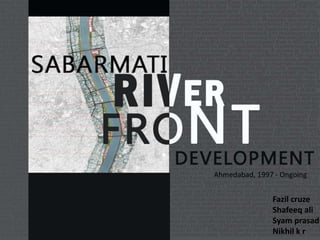
Ahmedabad, 1997 - Ongoing
Fazil cruze
Shafeeq ali
Syam prasad
Nikhil k r
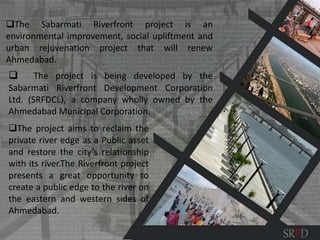
The project aims to reclaim the
private river edge as a Public asset
and restore the city’s relationship
with its river.The Riverfront project
presents a great opportunity to
create a public edge to the river on
the eastern and western sides of
Ahmedabad.
The Sabarmati Riverfront project is an
environmental improvement, social upliftment and
urban rejuvenation project that will renew
Ahmedabad.
 The project is being developed by the
Sabarmati Riverfront Development Corporation
Ltd. (SRFDCL), a company wholly owned by the
Ahmedabad Municipal Corporation.
SRFD
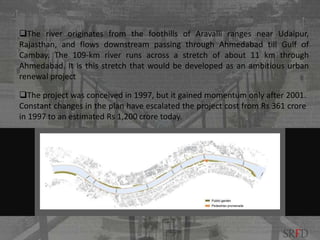
The river originates from the foothills of Aravalli ranges near Udaipur,
Rajasthan, and flows downstream passing through Ahmedabad till Gulf of
Cambay. The 109-km river runs across a stretch of about 11 km through
Ahmedabad. It is this stretch that would be developed as an ambitious urban
renewal project
The project was conceived in 1997, but it gained momentum only after 2001.
Constant changes in the plan have escalated the project cost from Rs 361 crore
in 1997 to an estimated Rs 1,200 crore today.
SRFD
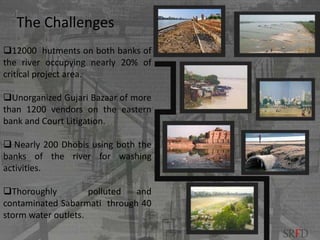
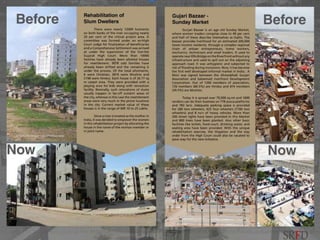
12000 hutments on both banks of
the river occupying nearly 20% of
critical project area.
Unorganized Gujari Bazaar of more
than 1200 vendors on the eastern
bank and Court Litigation.
 Nearly 200 Dhobis using both the
banks of the river for washing
activities.
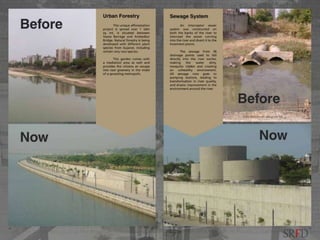
Thoroughly polluted and
contaminated Sabarmati through 40
storm water outlets.
The Challenges
SRFD
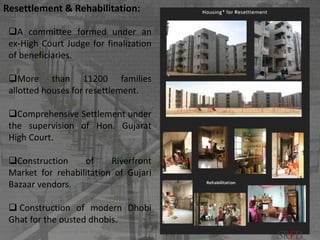
A committee formed under an
ex-High Court Judge for finalization
of beneficiaries.
More than 11200 families
allotted houses for resettlement.
Comprehensive Settlement under
the supervision of Hon. Gujarat
High Court.
Construction of Riverfront
Market for rehabilitation of Gujari
Bazaar vendors.
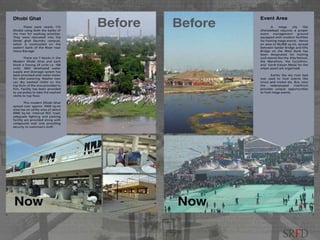
 Construction of modern Dhobi
Ghat for the ousted dhobis.
Resettlement & Rehabilitation:
SRFD
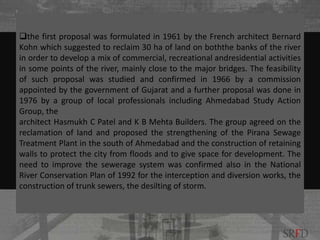
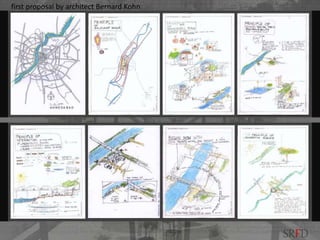
the first proposal was formulated in 1961 by the French architect Bernard
Kohn which suggested to reclaim 30 ha of land on boththe banks of the river
in order to develop a mix of commercial, recreational andresidential activities
in some points of the river, mainly close to the major bridges. The feasibility
of such proposal was studied and confirmed in 1966 by a commission
appointed by the government of Gujarat and a further proposal was done in
1976 by a group of local professionals including Ahmedabad Study Action
Group, the
architect Hasmukh C Patel and K B Mehta Builders. The group agreed on the
reclamation of land and proposed the strengthening of the Pirana Sewage
Treatment Plant in the south of Ahmedabad and the construction of retaining
walls to protect the city from floods and to give space for development. The
need to improve the sewerage system was confirmed also in the National
River Conservation Plan of 1992 for the interception and diversion works, the
construction of trunk sewers, the desilting of storm.
SRFD
first proposal by architect Bernard Kohn
SRFD
The proposal was commissioned to
the Environmental Planning
Collaborative (EPC), which in 2002
merged with the HCP Design and
Project Management Pvt.Ltd.,
responsible for the urban design of
the project. The works started in 2005
and are still ongoing.
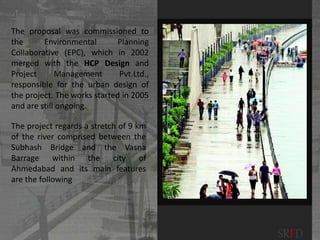
The project regards a stretch of 9 km
of the river comprised between the
Subhash Bridge and the Vasna
Barrage within the city of
Ahmedabad and its main features
are the following
SRFD
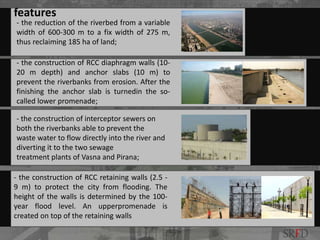
- the reduction of the riverbed from a variable
width of 600-300 m to a fix width of 275 m,
thus reclaiming 185 ha of land;
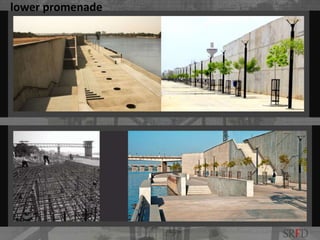
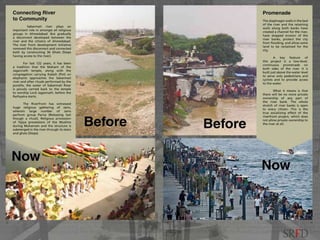
- the construction of RCC diaphragm walls (10-
20 m depth) and anchor slabs (10 m) to
prevent the riverbanks from erosion. After the
finishing the anchor slab is turnedin the so-
called lower promenade;
- the construction of interceptor sewers on
both the riverbanks able to prevent the
waste water to flow directly into the river and
diverting it to the two sewage
treatment plants of Vasna and Pirana;
- the construction of RCC retaining walls (2.5 -
9 m) to protect the city from flooding. The
height of the walls is determined by the 100-
year flood level. An upperpromenade is
created on top of the retaining walls
features
SRFD
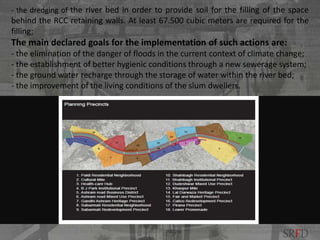
- the dredging of the river bed in order to provide soil for the filling of the space
behind the RCC retaining walls. At least 67.500 cubic meters are required for the
filling;
The main declared goals for the implementation of such actions are:
- the elimination of the danger of floods in the current context of climate change;
- the establishment of better hygienic conditions through a new sewerage system;
- the ground water recharge through the storage of water within the river bed;
- the improvement of the living conditions of the slum dwellers.
SRFD
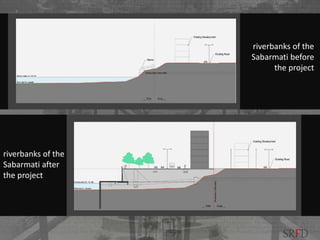
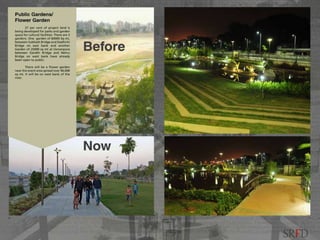
riverbanks of the
Sabarmati before
the project
riverbanks of the
Sabarmati after
the project
SRFD
lower promenade
SRFD
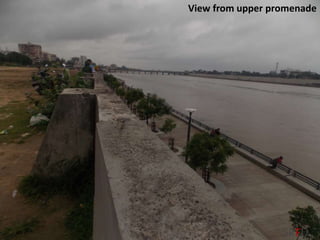
View from upper promenade
SRFD
SRFD
SRFD
SRFD
SRFD
SRFD
SRFD
SRFD
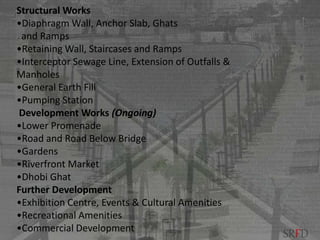
Structural Works
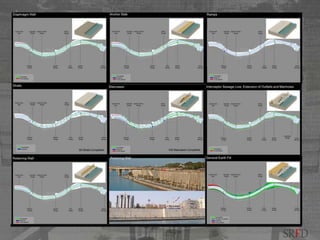
•Diaphragm Wall, Anchor Slab, Ghats
and Ramps
•Retaining Wall, Staircases and Ramps
•Interceptor Sewage Line, Extension of Outfalls &
Manholes
•General Earth Fill
•Pumping Station
Development Works (Ongoing)
•Lower Promenade
•Road and Road Below Bridge
•Gardens
•Riverfront Market
•Dhobi Ghat
Further Development
•Exhibition Centre, Events & Cultural Amenities
•Recreational Amenities
•Commercial Development
SRFD
SRFD
THANK

Urban design sabarmati

  • 1.
    Ahmedabad, 1997 -Ongoing Fazil cruze Shafeeq ali Syam prasad Nikhil k r
  • 2.
    The project aimsto reclaim the private river edge as a Public asset and restore the city’s relationship with its river.The Riverfront project presents a great opportunity to create a public edge to the river on the eastern and western sides of Ahmedabad. The Sabarmati Riverfront project is an environmental improvement, social upliftment and urban rejuvenation project that will renew Ahmedabad.  The project is being developed by the Sabarmati Riverfront Development Corporation Ltd. (SRFDCL), a company wholly owned by the Ahmedabad Municipal Corporation. SRFD
  • 3.
    The river originatesfrom the foothills of Aravalli ranges near Udaipur, Rajasthan, and flows downstream passing through Ahmedabad till Gulf of Cambay. The 109-km river runs across a stretch of about 11 km through Ahmedabad. It is this stretch that would be developed as an ambitious urban renewal project The project was conceived in 1997, but it gained momentum only after 2001. Constant changes in the plan have escalated the project cost from Rs 361 crore in 1997 to an estimated Rs 1,200 crore today. SRFD
  • 4.
    12000 hutments onboth banks of the river occupying nearly 20% of critical project area. Unorganized Gujari Bazaar of more than 1200 vendors on the eastern bank and Court Litigation.  Nearly 200 Dhobis using both the banks of the river for washing activities. Thoroughly polluted and contaminated Sabarmati through 40 storm water outlets. The Challenges SRFD
  • 5.
    A committee formedunder an ex-High Court Judge for finalization of beneficiaries. More than 11200 families allotted houses for resettlement. Comprehensive Settlement under the supervision of Hon. Gujarat High Court. Construction of Riverfront Market for rehabilitation of Gujari Bazaar vendors.  Construction of modern Dhobi Ghat for the ousted dhobis. Resettlement & Rehabilitation: SRFD
  • 6.
    the first proposalwas formulated in 1961 by the French architect Bernard Kohn which suggested to reclaim 30 ha of land on boththe banks of the river in order to develop a mix of commercial, recreational andresidential activities in some points of the river, mainly close to the major bridges. The feasibility of such proposal was studied and confirmed in 1966 by a commission appointed by the government of Gujarat and a further proposal was done in 1976 by a group of local professionals including Ahmedabad Study Action Group, the architect Hasmukh C Patel and K B Mehta Builders. The group agreed on the reclamation of land and proposed the strengthening of the Pirana Sewage Treatment Plant in the south of Ahmedabad and the construction of retaining walls to protect the city from floods and to give space for development. The need to improve the sewerage system was confirmed also in the National River Conservation Plan of 1992 for the interception and diversion works, the construction of trunk sewers, the desilting of storm. SRFD
  • 7.
    first proposal byarchitect Bernard Kohn SRFD
  • 8.
    The proposal wascommissioned to the Environmental Planning Collaborative (EPC), which in 2002 merged with the HCP Design and Project Management Pvt.Ltd., responsible for the urban design of the project. The works started in 2005 and are still ongoing. The project regards a stretch of 9 km of the river comprised between the Subhash Bridge and the Vasna Barrage within the city of Ahmedabad and its main features are the following SRFD
  • 9.
    - the reductionof the riverbed from a variable width of 600-300 m to a fix width of 275 m, thus reclaiming 185 ha of land; - the construction of RCC diaphragm walls (10- 20 m depth) and anchor slabs (10 m) to prevent the riverbanks from erosion. After the finishing the anchor slab is turnedin the so- called lower promenade; - the construction of interceptor sewers on both the riverbanks able to prevent the waste water to flow directly into the river and diverting it to the two sewage treatment plants of Vasna and Pirana; - the construction of RCC retaining walls (2.5 - 9 m) to protect the city from flooding. The height of the walls is determined by the 100- year flood level. An upperpromenade is created on top of the retaining walls features SRFD
  • 10.
    - the dredgingof the river bed in order to provide soil for the filling of the space behind the RCC retaining walls. At least 67.500 cubic meters are required for the filling; The main declared goals for the implementation of such actions are: - the elimination of the danger of floods in the current context of climate change; - the establishment of better hygienic conditions through a new sewerage system; - the ground water recharge through the storage of water within the river bed; - the improvement of the living conditions of the slum dwellers. SRFD
  • 11.
    riverbanks of the Sabarmatibefore the project riverbanks of the Sabarmati after the project SRFD
  • 12.
  • 13.
    View from upperpromenade SRFD
  • 14.
  • 15.
  • 16.
  • 17.
  • 18.
  • 19.
  • 20.
  • 21.
    Structural Works •Diaphragm Wall,Anchor Slab, Ghats and Ramps •Retaining Wall, Staircases and Ramps •Interceptor Sewage Line, Extension of Outfalls & Manholes •General Earth Fill •Pumping Station Development Works (Ongoing) •Lower Promenade •Road and Road Below Bridge •Gardens •Riverfront Market •Dhobi Ghat Further Development •Exhibition Centre, Events & Cultural Amenities •Recreational Amenities •Commercial Development SRFD
  • 22.
  • 23.