Congenital Limb Deficiency and
ISPO classification
Abhishek Tripathi
Lecturer, Prosthetics
NILD, Kolkata
Objectives
A. General introduction to congenital limb-
deficiency
B. Some example of limb deficiency terminology
based on Latin/Greek origin
C. Causes of congenital deficiency
D. ISPO- Classification of Congenital Limb
Deficiency and its purpose
a) Constraints for ISPO classification
b) Type of congenital deficiency under ISPO
classification
(A) Congenital Limb deficiency
• A congenital anomaly is a condition of congenital disorder/disease
existing at or before birth regardless of cause. It involve defects in a
developing fetus
• Dysmelia is the congenital disorder of limb resulting from
disturbance in the embryonic development
– Types:
• Aplasia (missing) limbs:
– Amelia
– Oligodactyly
– Congenital limb loss
• Malformation of limbs
– shortening (rhizomelia or mesomelia),
– Ectrodactyly,
– Phocomelia,
– Meromelia,
– Syndactyly,
– Brachydactyly,
– Club foot
(B) Some example of limb deficiency
terminology based on Latin/Greek origin
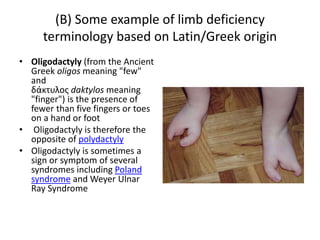
• Oligodactyly (from the Ancient
Greek oligos meaning "few"
and
δάκτυλος daktylos meaning
"finger") is the presence of
fewer than five fingers or toes
on a hand or foot
• Oligodactyly is therefore the
opposite of polydactyly
• Oligodactyly is sometimes a
sign or symptom of several
syndromes including Poland
syndrome and Weyer Ulnar
Ray Syndrome
(C) Causes of congenital deficiency
• Inheritance of abnormal genes,
e.g. polydactyly, ectrodactyly or brachydactyly,
symptoms of deformed limbs then often occur in
combination with other symptoms (syndromes)
• External causes during pregnancy (thus not inherited),
e.g. via amniotic band syndrome
• Teratogenic drugs (e.g. thalidomide, which
causes phocomelia) or environmental chemicals
• Ionizing radiation (nuclear
weapons, radioiodine, radiation therapy)
• Infections
• Metabolic imbalance
(D) ISPO- Classification of Congenital
Limb Deficiency
• Is a nomenclature/classification of congenital
limb deficiency published by Dr H.J. B. Day in
Prosthetics and Orthotics International journal
in 1991
• Congenital (Greek word): before birth
• Deficiency: failure of formation
Purpose of “Classification of
deficiencies”
• Purpose:
– To define variables/ characteristics in detail that
are affecting the outcome of intervention
– To aid clinician to choose the best treatment
method
– Provide information for useful counseling of the
patient and parent about its prognosis
– To define the patient population so that to serve
for future studies
(a) Constraints for ISPO classification
• The congenital deficiency present at birth are
described using three constraints:
– It is restricted to Skelton deficiency only, i.e. majority
of such cases are due to failure of formation
– It described on anatomical and radiological basis. No
attempt is made to classify in term of etiology,
embryology etc
– The classically derived term (of Greek/Latin origin)
such as Hemi-melia, Peromelia, meromelia etc are
avoided
(b) Type of congenital deficiency under
ISPO classification
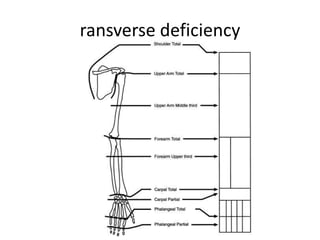
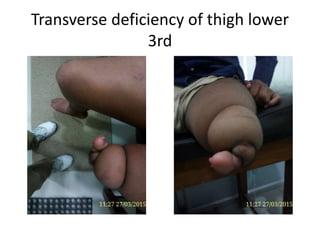
(i) Transverse deficiency
• Congenitally amputated
residual limb so that the
limb has developed
normally to a particular
level, beyond which no
skeletal element are
present
• There may be digital buds at
the amputated/ deficient
level
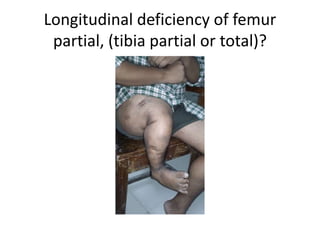
(ii) Longitudinal deficiency
• All other : A reduction,
absence of elements with in
the long axis of limb
(i) Transverse Nomenclature
• Naming the segment at which the limb terminates
• Then describing the level with in that segment beyond
which no Skelton element exist
• Note: This nomenclature should be done with caution
in case of disarticulations level/ or when there is full
limb segment exist. So that in such cases, the next non-
existing Skelton segment is used in the nomenclature.
For example:
– Transverse deficiency of forearm total: meant congenital
absent of limb form the forearm origin and is equivalent to
elbow disarticulation.
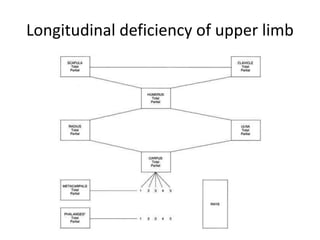
(ii) Longitudinal nomenclature
• There is reduction or absence of element with in the long axis of
limb
• There may be normal Skelton element distal to the affected bones.
• Procedure of naming :
– Name the bone affected in proximal –distal sequence by using by
using name as Noun. Bones not named is considered as presence
– State where each affected bone is total/ Partially
– In case of partial deficiency , the fraction & position of bone may be
stated
– The number of digit should be stated in relation to metacarpal meta
tarsal and phalanges, the number starts from pre-axial (along the long
axis of the limb, the proximal lost bone should be named first),
Radial (in upper limb), Tibial side (in lower limb)
– The term ray may be used to refer to a meta-carpal, meta-tarsal &
corresponding phalanges
Transverse deficiency of upper and
lower limb
Longitudinal deficiency of upper limb
Longitudinal deficiency of lower limb
ransverse deficiency
Transverse deficiency of thigh lower
3rd
Longitudinal deficiency of femur
partial, (tibia partial or total)?
Thank you!
Ref: AAOS, Atlas of limb deficiency
and amputation