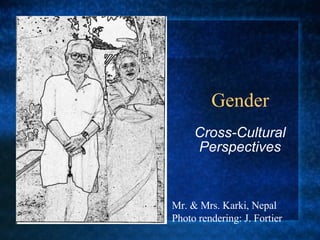
Gender  Cross-Cultural Perspectives Mr. & Mrs. Karki, Nepal Photo rendering: J. Fortier
Gender Sex and Gender Recurrent  G ender Patterns Gender Among Foragers Gender Among Horticulturalists Gender Among Agriculturalists Patriarchy and Violence Gender and Industrialism Sexual Orientation
Sex and Gender Gender  – cultural construction of male and female characteristics Sexual dimorphism  – marked differences in male and female biology besides the primary and secondary sexual features Sex  – biological differences
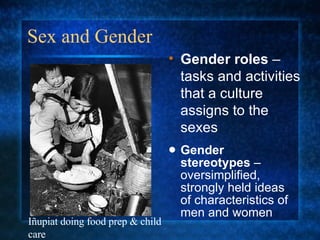
Sex and Gender Gender stereotypes  – oversimplified, strongly held ideas of characteristics of men and women Gender roles  – tasks and activities that a culture assigns to the sexes I ñupiat doing food prep & child care
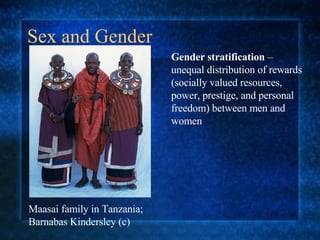
Sex and Gender Gender stratification  – unequal distribution of rewards (socially valued resources, power, prestige, and personal freedom) between men and women Maasai family in Tanzania;  Barnabas Kindersley (c)
Recurrent Gender Patterns In domestic activities, female labor dominates In extradomestic activities, male labor dominates Women are primary caregivers, but men often play a role Subsistence contributions of men and women are roughly equal cross-culturally
Recurrent Gender Patterns Men mate, within and outside marriage, more than women do Double standards that restrict women more than men illustrate gender stratification Gender stratification lower when domestic and public spheres not clearly distinguished Differences in male and female reproductive strategies
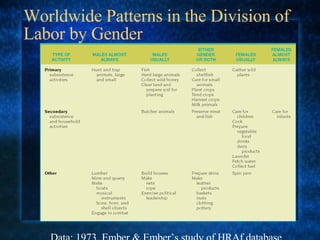
Worldwide Patterns in the Division of Labor by Gender Data: 1973, Ember & Ember’s study of HRAf database
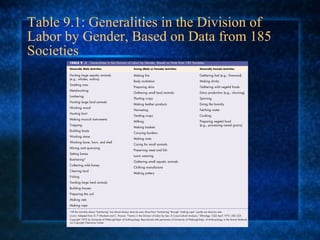
Table 9.1: Generalities in the Division of Labor by Gender, Based on Data from 185 Societies
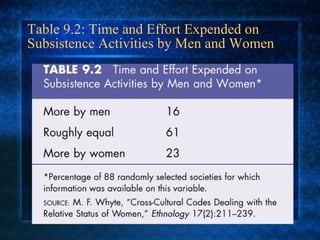
Table 9.2: Time and Effort Expended on Subsistence Activities by Men and Women
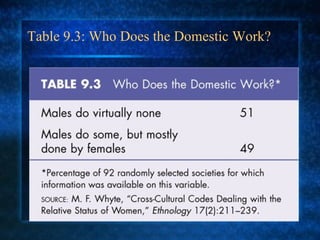
Table 9.3: Who Does the Domestic Work?
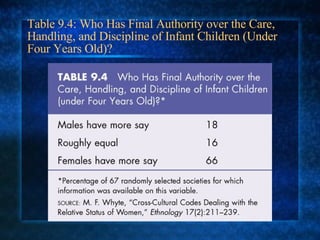
Table 9.4: Who Has Final Authority over the Care, Handling, and Discipline of Infant Children (Under Four Years Old)?
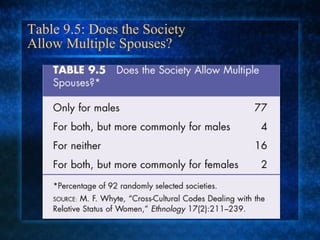
Table 9.5: Does the Society  Allow Multiple Spouses?
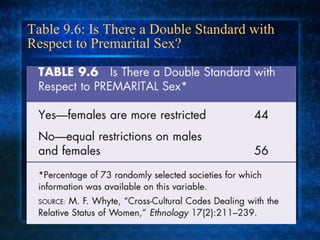
Table 9.6: Is There a Double Standard with Respect to Premarital Sex?
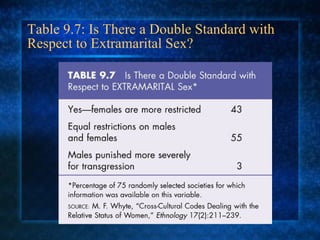
Table 9.7: Is There a Double Standard with Respect to Extramarital Sex?
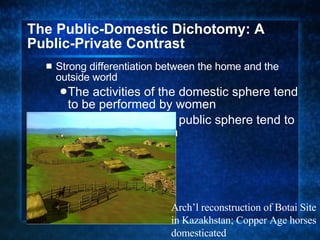
The Public-Domestic Dichotomy: A Public-Private Contrast Strong differentiation between the home and the outside world The activities of the domestic sphere tend to be performed by women The activities of the public sphere tend to be restricted to men Arch’l reconstruction of Botai Site in Kazakhstan; Copper Age horses domesticated
Divisions of Labor by Gender Public activities tend to have greater prestige than domestic ones, which promotes gender stratification Sex-Linked Activities All cultures have a division of labor based on gender, but the particular tasks assigned to men and women vary from culture to culture.
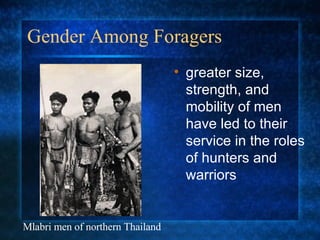
Gender Among Foragers greater size, strength, and mobility of men have led to their service in the roles of hunters and warriors Mlabri men of northern Thailand
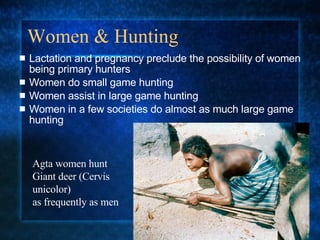
Women & Hunting Lactation and pregnancy preclude the possibility of women being primary hunters  Women do small game hunting Women assist in large game hunting Women in a few societies do almost as much large game hunting Agta women hunt Giant deer (Cervis unicolor) as frequently as men
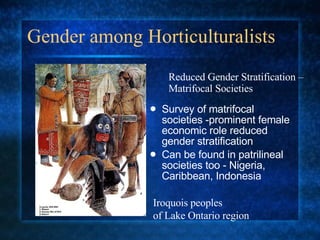
Gender among Horticulturalists Survey of matrifocal societies -prominent female economic role reduced gender stratification Can be found in patrilineal societies too - Nigeria, Caribbean, Indonesia Reduced Gender Stratification – Matrifocal Societies Iroquois peoples  of Lake Ontario region
Gender among Horticulturalists Spread of patrilineal-patrilocal societies has been associated with pressure on resources and increased local warfare Patrilineal-patrilocal complex  concentrates related males in villages, which solidifies their alliances for warfare Increased Gender Stratification-Patrilineal-Patrilocal Societies
Gender Among Horticulturalists Results in relatively high gender stratification (e.g., highland Papua-New Guinea) Women do most of the cultivation, cooking, and raising children, but are isolated from the public domain Males dominate the public domain (politics, feasts, warfare) Patrilineal-patrilocal tends to enhance male prestige opportunities
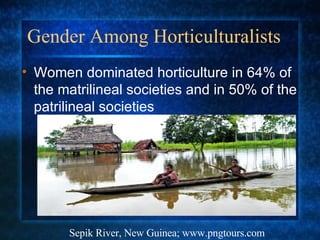
Gender Among Horticulturalists Women dominated horticulture in 64% of the matrilineal societies and in 50% of the patrilineal societies Sepik River, New Guinea; www.pngtours.com
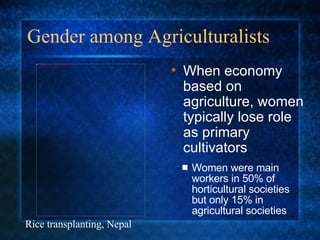
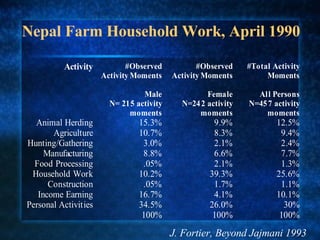
Gender among Agriculturalists Women were main workers in 50% of horticultural societies but only 15% in agricultural societies When economy based on agriculture, women typically lose role as primary cultivators Rice transplanting, Nepal
Nepal Farm Household Work, April 1990 J. Fortier, Beyond Jajmani 1993
Patriarchy and Violence Patriarchy  – political system ruled by men in which women have inferior social and political status Societies that feature a full-fledged patriarchy, replete with warfare and intervillage raiding, adopt such practices as dowry murders, female infanticide, and clitoridectomy
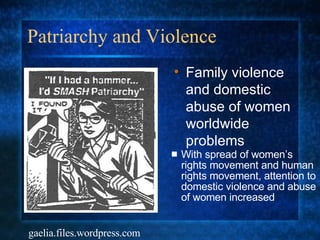
Patriarchy and Violence With spread of women’s rights movement and human rights movement, attention to domestic violence and abuse of women increased Family violence and domestic abuse of women worldwide problems gaelia.files.wordpress.com
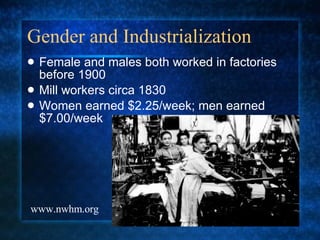
Gender and Industrialization Female and males both worked in factories before 1900 Mill workers circa 1830 Women earned $2.25/week; men earned $7.00/week www.nwhm.org
Gender and Industrialism “Traditional” idea that “a woman’s place is in the home” developed among middle- and upper-class Americans as industrialism spread after 1900 Attitudes about gendered work varied with class and region Woman’s role in the home stressed during periods of high unemployment Gender roles changing rapidly in North America
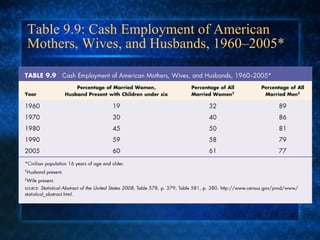
Table 9.9: Cash Employment of American Mothers, Wives, and Husbands, 1960–2005*
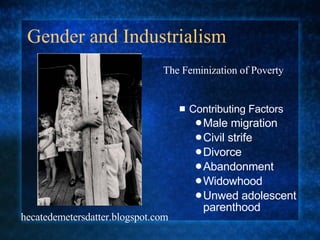
Gender and Industrialism Both men and women constrained by their cultural training, stereotypes, and expectations The Feminization of Poverty Increasing representation of women and their children among America’s poorest people Consequences in regard to living standards and health are widespread
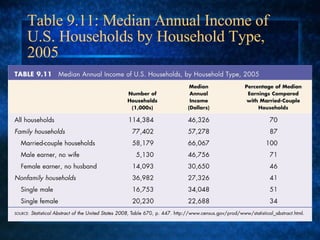
Table 9.11: Median Annual Income of U.S. Households by Household Type, 2005
Gender and Industrialism Contributing Factors Male migration Civil strife Divorce Abandonment Widowhood Unwed adolescent parenthood The Feminization of Poverty hecatedemetersdatter.blogspot.com
Sexual Orientation Persons of the opposite sex, heterosexuality Persons of the same sex, homosexuality Both sexes, bisexuality Person’s habitual sexual attraction to, and sexual activities with Nepal festival of Jatra &  an ex. of transvestism or “genderbending”
Sexual Orientation Recently in U.S., tendency has been to see sexual orientation as fixed and biologically based Culture always plays a role in molding individual sexual urges to a collective norm Sex acts involving people of the same sex were absent, rare, or secret in 37% of 76 societies studied by Ford and Beach
Sexual Orientation Sudanese Azande males shifted from sex with older men (as male brides), to sex with younger men (as warriors), to sex with women (as husbands) Etoro in Papua New Guinea believed limited lifetime supply of semen that boys had to acquire orally from older men Same-sex sexual activity considered normal and acceptable in some societies where population needs to be limited:
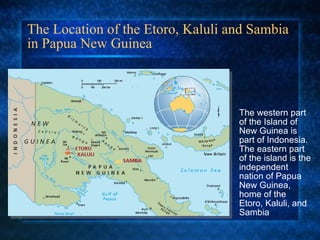
The Location of the Etoro, Kaluli and Sambia in Papua New Guinea The western part of the Island of New Guinea is part of Indonesia. The eastern part of the island is the independent nation of Papua New Guinea, home of the Etoro, Kaluli, and Sambia

Anth103 Gender

  • 1.
    Gender Cross-CulturalPerspectives Mr. & Mrs. Karki, Nepal Photo rendering: J. Fortier
  • 2.
    Gender Sex andGender Recurrent G ender Patterns Gender Among Foragers Gender Among Horticulturalists Gender Among Agriculturalists Patriarchy and Violence Gender and Industrialism Sexual Orientation
  • 3.
    Sex and GenderGender – cultural construction of male and female characteristics Sexual dimorphism – marked differences in male and female biology besides the primary and secondary sexual features Sex – biological differences
  • 4.
    Sex and GenderGender stereotypes – oversimplified, strongly held ideas of characteristics of men and women Gender roles – tasks and activities that a culture assigns to the sexes I ñupiat doing food prep & child care
  • 5.
    Sex and GenderGender stratification – unequal distribution of rewards (socially valued resources, power, prestige, and personal freedom) between men and women Maasai family in Tanzania; Barnabas Kindersley (c)
  • 6.
    Recurrent Gender PatternsIn domestic activities, female labor dominates In extradomestic activities, male labor dominates Women are primary caregivers, but men often play a role Subsistence contributions of men and women are roughly equal cross-culturally
  • 7.
    Recurrent Gender PatternsMen mate, within and outside marriage, more than women do Double standards that restrict women more than men illustrate gender stratification Gender stratification lower when domestic and public spheres not clearly distinguished Differences in male and female reproductive strategies
  • 8.
    Worldwide Patterns inthe Division of Labor by Gender Data: 1973, Ember & Ember’s study of HRAf database
  • 9.
    Table 9.1: Generalitiesin the Division of Labor by Gender, Based on Data from 185 Societies
  • 10.
    Table 9.2: Timeand Effort Expended on Subsistence Activities by Men and Women
  • 11.
    Table 9.3: WhoDoes the Domestic Work?
  • 12.
    Table 9.4: WhoHas Final Authority over the Care, Handling, and Discipline of Infant Children (Under Four Years Old)?
  • 13.
    Table 9.5: Doesthe Society Allow Multiple Spouses?
  • 14.
    Table 9.6: IsThere a Double Standard with Respect to Premarital Sex?
  • 15.
    Table 9.7: IsThere a Double Standard with Respect to Extramarital Sex?
  • 16.
    The Public-Domestic Dichotomy:A Public-Private Contrast Strong differentiation between the home and the outside world The activities of the domestic sphere tend to be performed by women The activities of the public sphere tend to be restricted to men Arch’l reconstruction of Botai Site in Kazakhstan; Copper Age horses domesticated
  • 17.
    Divisions of Laborby Gender Public activities tend to have greater prestige than domestic ones, which promotes gender stratification Sex-Linked Activities All cultures have a division of labor based on gender, but the particular tasks assigned to men and women vary from culture to culture.
  • 18.
    Gender Among Foragersgreater size, strength, and mobility of men have led to their service in the roles of hunters and warriors Mlabri men of northern Thailand
  • 19.
    Women & HuntingLactation and pregnancy preclude the possibility of women being primary hunters Women do small game hunting Women assist in large game hunting Women in a few societies do almost as much large game hunting Agta women hunt Giant deer (Cervis unicolor) as frequently as men
  • 20.
    Gender among HorticulturalistsSurvey of matrifocal societies -prominent female economic role reduced gender stratification Can be found in patrilineal societies too - Nigeria, Caribbean, Indonesia Reduced Gender Stratification – Matrifocal Societies Iroquois peoples of Lake Ontario region
  • 21.
    Gender among HorticulturalistsSpread of patrilineal-patrilocal societies has been associated with pressure on resources and increased local warfare Patrilineal-patrilocal complex concentrates related males in villages, which solidifies their alliances for warfare Increased Gender Stratification-Patrilineal-Patrilocal Societies
  • 22.
    Gender Among HorticulturalistsResults in relatively high gender stratification (e.g., highland Papua-New Guinea) Women do most of the cultivation, cooking, and raising children, but are isolated from the public domain Males dominate the public domain (politics, feasts, warfare) Patrilineal-patrilocal tends to enhance male prestige opportunities
  • 23.
    Gender Among HorticulturalistsWomen dominated horticulture in 64% of the matrilineal societies and in 50% of the patrilineal societies Sepik River, New Guinea; www.pngtours.com
  • 24.
    Gender among AgriculturalistsWomen were main workers in 50% of horticultural societies but only 15% in agricultural societies When economy based on agriculture, women typically lose role as primary cultivators Rice transplanting, Nepal
  • 25.
    Nepal Farm HouseholdWork, April 1990 J. Fortier, Beyond Jajmani 1993
  • 26.
    Patriarchy and ViolencePatriarchy – political system ruled by men in which women have inferior social and political status Societies that feature a full-fledged patriarchy, replete with warfare and intervillage raiding, adopt such practices as dowry murders, female infanticide, and clitoridectomy
  • 27.
    Patriarchy and ViolenceWith spread of women’s rights movement and human rights movement, attention to domestic violence and abuse of women increased Family violence and domestic abuse of women worldwide problems gaelia.files.wordpress.com
  • 28.
    Gender and IndustrializationFemale and males both worked in factories before 1900 Mill workers circa 1830 Women earned $2.25/week; men earned $7.00/week www.nwhm.org
  • 29.
    Gender and Industrialism“Traditional” idea that “a woman’s place is in the home” developed among middle- and upper-class Americans as industrialism spread after 1900 Attitudes about gendered work varied with class and region Woman’s role in the home stressed during periods of high unemployment Gender roles changing rapidly in North America
  • 30.
    Table 9.9: CashEmployment of American Mothers, Wives, and Husbands, 1960–2005*
  • 31.
    Gender and IndustrialismBoth men and women constrained by their cultural training, stereotypes, and expectations The Feminization of Poverty Increasing representation of women and their children among America’s poorest people Consequences in regard to living standards and health are widespread
  • 32.
    Table 9.11: MedianAnnual Income of U.S. Households by Household Type, 2005
  • 33.
    Gender and IndustrialismContributing Factors Male migration Civil strife Divorce Abandonment Widowhood Unwed adolescent parenthood The Feminization of Poverty hecatedemetersdatter.blogspot.com
  • 34.
    Sexual Orientation Personsof the opposite sex, heterosexuality Persons of the same sex, homosexuality Both sexes, bisexuality Person’s habitual sexual attraction to, and sexual activities with Nepal festival of Jatra & an ex. of transvestism or “genderbending”
  • 35.
    Sexual Orientation Recentlyin U.S., tendency has been to see sexual orientation as fixed and biologically based Culture always plays a role in molding individual sexual urges to a collective norm Sex acts involving people of the same sex were absent, rare, or secret in 37% of 76 societies studied by Ford and Beach
  • 36.
    Sexual Orientation SudaneseAzande males shifted from sex with older men (as male brides), to sex with younger men (as warriors), to sex with women (as husbands) Etoro in Papua New Guinea believed limited lifetime supply of semen that boys had to acquire orally from older men Same-sex sexual activity considered normal and acceptable in some societies where population needs to be limited:
  • 37.
    The Location ofthe Etoro, Kaluli and Sambia in Papua New Guinea The western part of the Island of New Guinea is part of Indonesia. The eastern part of the island is the independent nation of Papua New Guinea, home of the Etoro, Kaluli, and Sambia