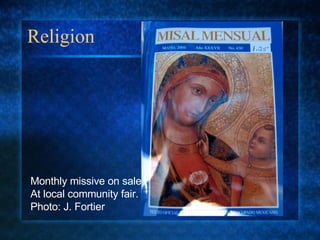
Religion Monthly missive on sale At local community fair.  Photo: J. Fortier
Religion What Is Religion? Origins, Functions, and Expressions of Religion Religion and Cultural Ecology Social Con t rol
Definitions Religion is any set of attitudes, beliefs, and practices pertaining to supernatural power, whether that power be forces, gods, spirits, ghosts, or demons Image of Hindu demon-deity ‘Bhairav’ Photo: J. Fortier
Definitions Magic Sorcery Witchcraft Greco-Roman magic figurine; Photo: Prof. E. Pollard, SDSU
Universality of Religion Need to understand  Reversion to childhood feelings Anxiety & uncertainty Need for community A Hindu astrologer; Photo J.Fortier
Animism Animism is seen as basic tendency to dream of soul-others at night Belief in souls that derives from the first attempt to explain dreams and like phenomena Has come to be seen as a belief in soul-beings in others Tylor first studied religion anthropologically and developed a taxonomy of religions
Animism - A need to understand? E. B. Tylor Early humans believed in souls (false) Evolutionary progression: animism>polytheism> monotheism>science Nurit Bird-David Relational Ontology- belief that all beings are related
Raji woman collects Yam ‘Mother’
Buddha attained enlightenment under  Ficus religiosa • Adam & Eve ate from the Fig tree Courtesy Woody Moise at picasaweb.google.com
Animism of the Pleiades:  “The 7 Sisters” Animation of star Formations is  Common across cultures
Types of Supernatural Forces & Beings Supernatural forces   Supernatural beings Folk form of Siva, Nepal. Photo: J. Fortier
Supernatural forces Inanimate Mana  Taboo  Winds  Weather elements,  Bad or good luck Hail storm. Photo: ccc.atmos.colostate.edu/.../ sheila_clouds2.htm
Mana and Taboo Polynesian mana and related concept of taboo related to the more hierarchical nature of Polynesian society Melanesian mana defined as sacred impersonal force that is much like the Western concept of luck Mana – belief in immanent supernatural domain or life-force, potentially subject to human manipulation
Weather as Supernatural Ban Raji call weather forces ‘Hawa’a” Batek of Malaysia call them ‘Hala’’ Thunder Windstorms Earthquake/’Big’ weather disasters Ban Raji woman struck by Hawa’a
Supernatural beings   Animate Gods, goddesses Spirits,  Fairies, sprites, ogres Ghosts  Dead ancestors  Totems
Totemism Totems are apical ancestor of clans Members of clan did not kill or eat their totem, except once a year when the members of the clan gathered for ceremonies dedicated to the totem In totemic societies, each descent group has an animal, plant, or geographical feature from which they claim descent
Religion and Cultural Ecology Sacred Cattle in India
Religion and Cultural Ecology Cattle play important adaptive role in Indian ecosystem that evolved over thousands of years Hindus use cattle for transportation, traction, and manure Bigger cattle eat more, making them more expensive to keep Sacred Cattle in India Views of Western experts are ethnocentric and incorrect because:
Religions & Social Correlations  Deities mimic aspects of human society Child-rearing practices Complexity of the society Degree of societal/governmental control Greek Minotaur. Photo: www.historyforkids.org
Types of Religions Shamanic  - shamans part-time religious intermediaries who may act as curers – these religions are characteristic of foragers but found in farming societies too Shaman Possessed; Photo:  J. Fortier
Kinds of Religion Olympian or Polytheistic religions –appeared with states, have full-time religious specialists and have potent anthropomorphic gods who may exist as a pantheon Monotheistic religions – have attributes  of Olympian religions, except pantheon  of gods subsumed under a single  eternal, omniscient, omnipotent, and omnipresent being Communal religions – have shamans, community rituals, multiple nature gods
Major World Religions by  Percentage of World Population 2005 Source: Adherents.com. 2005.  http://www.adherents.com/Religions_by_adherents .html.
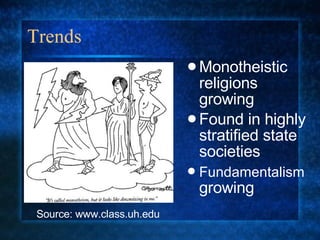
Trends Monotheistic religions growing Found in highly stratified state societies Fundamentalism  growing Source: www.class.uh.edu
Religion and Change Religious leaders also may seek to alter or revitalize their society Nativistic or Revitalization Movements Social moments that occur in times of change  The colonial-era Iroquois reformation led by Handsome Lake is example of revitalization movement Religion helps maintain social order
Syncretisms Voodoo, santeria Cargo cults  of Melanesia and Papua New Guinea are syncretisms of Christian doctrine with aboriginal beliefs Often emerge when traditional, non-Western societies have regular contact with industrialized societies Cultural mix, including religious blends, that emerge when two or more cultural traditions come into contact
Location of Melanesian Cargo Cults • Part of Revitalization Movements
Antimodernism and Fundamentalism Tribalism, Fundamentalism, Parochialism all opposed in some ways to Globalism Antimodernism  – rejection of the modern in favor of what is perceived as an earlier, purer, and better way of life
Antimodernism and Fundamentalism Assert an identity separate from the larger religious group from which they arose Seek to rescue religion from absorption into modern, Western culture Strive to protect distinctive doctrine and way of life and of salvations Many fundamentalists are politically aware citizens of nation-states Fundamentalism  – antimodernist movements in various religions
A New Age Number of Americans giving no religious preference grew from 7% to 13% between 1990 and 2001
A New Age Exemption from taxation on income and property Not all religions receive official recognition Scientology recognized as church in U.S. but not in Germany In U.S. official recognition of a religion entitles it to a modicum of respect
Secular Rituals Include formal, invariant, stereotyped, earnest, repetitive behavior and rites of passage that take place in nonreligious settings Many Americans seek in such apparently secular contexts as amusement parks, rock concerts, and sporting events what other people find in religious rites, beliefs, and ceremonies
Religious Composition (in Percentages) of the Populations of the U.S., 1990 and 2001, and Canada, 1991 and 2001

Anth Ch12 Religion

  • 1.
    Religion Monthly missiveon sale At local community fair. Photo: J. Fortier
  • 2.
    Religion What IsReligion? Origins, Functions, and Expressions of Religion Religion and Cultural Ecology Social Con t rol
  • 3.
    Definitions Religion isany set of attitudes, beliefs, and practices pertaining to supernatural power, whether that power be forces, gods, spirits, ghosts, or demons Image of Hindu demon-deity ‘Bhairav’ Photo: J. Fortier
  • 4.
    Definitions Magic SorceryWitchcraft Greco-Roman magic figurine; Photo: Prof. E. Pollard, SDSU
  • 5.
    Universality of ReligionNeed to understand Reversion to childhood feelings Anxiety & uncertainty Need for community A Hindu astrologer; Photo J.Fortier
  • 6.
    Animism Animism isseen as basic tendency to dream of soul-others at night Belief in souls that derives from the first attempt to explain dreams and like phenomena Has come to be seen as a belief in soul-beings in others Tylor first studied religion anthropologically and developed a taxonomy of religions
  • 7.
    Animism - Aneed to understand? E. B. Tylor Early humans believed in souls (false) Evolutionary progression: animism>polytheism> monotheism>science Nurit Bird-David Relational Ontology- belief that all beings are related
  • 8.
    Raji woman collectsYam ‘Mother’
  • 9.
    Buddha attained enlightenmentunder Ficus religiosa • Adam & Eve ate from the Fig tree Courtesy Woody Moise at picasaweb.google.com
  • 10.
    Animism of thePleiades: “The 7 Sisters” Animation of star Formations is Common across cultures
  • 11.
    Types of SupernaturalForces & Beings Supernatural forces Supernatural beings Folk form of Siva, Nepal. Photo: J. Fortier
  • 12.
    Supernatural forces InanimateMana Taboo Winds Weather elements, Bad or good luck Hail storm. Photo: ccc.atmos.colostate.edu/.../ sheila_clouds2.htm
  • 13.
    Mana and TabooPolynesian mana and related concept of taboo related to the more hierarchical nature of Polynesian society Melanesian mana defined as sacred impersonal force that is much like the Western concept of luck Mana – belief in immanent supernatural domain or life-force, potentially subject to human manipulation
  • 14.
    Weather as SupernaturalBan Raji call weather forces ‘Hawa’a” Batek of Malaysia call them ‘Hala’’ Thunder Windstorms Earthquake/’Big’ weather disasters Ban Raji woman struck by Hawa’a
  • 15.
    Supernatural beings Animate Gods, goddesses Spirits, Fairies, sprites, ogres Ghosts Dead ancestors Totems
  • 16.
    Totemism Totems areapical ancestor of clans Members of clan did not kill or eat their totem, except once a year when the members of the clan gathered for ceremonies dedicated to the totem In totemic societies, each descent group has an animal, plant, or geographical feature from which they claim descent
  • 17.
    Religion and CulturalEcology Sacred Cattle in India
  • 18.
    Religion and CulturalEcology Cattle play important adaptive role in Indian ecosystem that evolved over thousands of years Hindus use cattle for transportation, traction, and manure Bigger cattle eat more, making them more expensive to keep Sacred Cattle in India Views of Western experts are ethnocentric and incorrect because:
  • 19.
    Religions & SocialCorrelations Deities mimic aspects of human society Child-rearing practices Complexity of the society Degree of societal/governmental control Greek Minotaur. Photo: www.historyforkids.org
  • 20.
    Types of ReligionsShamanic - shamans part-time religious intermediaries who may act as curers – these religions are characteristic of foragers but found in farming societies too Shaman Possessed; Photo: J. Fortier
  • 21.
    Kinds of ReligionOlympian or Polytheistic religions –appeared with states, have full-time religious specialists and have potent anthropomorphic gods who may exist as a pantheon Monotheistic religions – have attributes of Olympian religions, except pantheon of gods subsumed under a single eternal, omniscient, omnipotent, and omnipresent being Communal religions – have shamans, community rituals, multiple nature gods
  • 22.
    Major World Religionsby Percentage of World Population 2005 Source: Adherents.com. 2005. http://www.adherents.com/Religions_by_adherents .html.
  • 23.
    Trends Monotheistic religionsgrowing Found in highly stratified state societies Fundamentalism growing Source: www.class.uh.edu
  • 24.
    Religion and ChangeReligious leaders also may seek to alter or revitalize their society Nativistic or Revitalization Movements Social moments that occur in times of change The colonial-era Iroquois reformation led by Handsome Lake is example of revitalization movement Religion helps maintain social order
  • 25.
    Syncretisms Voodoo, santeriaCargo cults of Melanesia and Papua New Guinea are syncretisms of Christian doctrine with aboriginal beliefs Often emerge when traditional, non-Western societies have regular contact with industrialized societies Cultural mix, including religious blends, that emerge when two or more cultural traditions come into contact
  • 26.
    Location of MelanesianCargo Cults • Part of Revitalization Movements
  • 27.
    Antimodernism and FundamentalismTribalism, Fundamentalism, Parochialism all opposed in some ways to Globalism Antimodernism – rejection of the modern in favor of what is perceived as an earlier, purer, and better way of life
  • 28.
    Antimodernism and FundamentalismAssert an identity separate from the larger religious group from which they arose Seek to rescue religion from absorption into modern, Western culture Strive to protect distinctive doctrine and way of life and of salvations Many fundamentalists are politically aware citizens of nation-states Fundamentalism – antimodernist movements in various religions
  • 29.
    A New AgeNumber of Americans giving no religious preference grew from 7% to 13% between 1990 and 2001
  • 30.
    A New AgeExemption from taxation on income and property Not all religions receive official recognition Scientology recognized as church in U.S. but not in Germany In U.S. official recognition of a religion entitles it to a modicum of respect
  • 31.
    Secular Rituals Includeformal, invariant, stereotyped, earnest, repetitive behavior and rites of passage that take place in nonreligious settings Many Americans seek in such apparently secular contexts as amusement parks, rock concerts, and sporting events what other people find in religious rites, beliefs, and ceremonies
  • 32.
    Religious Composition (inPercentages) of the Populations of the U.S., 1990 and 2001, and Canada, 1991 and 2001