Race in Cultures where Diversity is Minimized Diversity in Japan is also erased by dominant majority 10% of Japan’s population minorities of various sorts Intrinsic racism  – belief that perceived racial difference is a sufficient reason to value one person less than another American culture ignores considerable diversity as it socially constructs race within U.S.
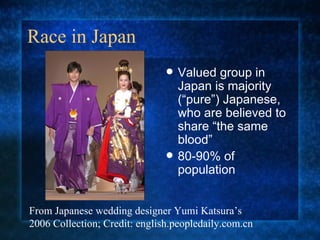
Race in Japan Valued group in Japan is majority (“pure”) Japanese, who are believed to share “the same blood” 80-90% of population From Japanese wedding designer Yumi Katsura’s 2006 Collection; Credit: english.peopledaily.com.cn
Race in Japan Japanese culture regards certain ethnic groups as having a biological basis, when there is no evidence Burakumin or "mura-no-mono" ("village people") – descendants of a low-status social class; genetically indistinguishable from the dominant population; treated as a different race Discrimination against Burakumin strikingly similar to discrimination that blacks faced in U.S. or “low castes” in South Asia Majority Japanese (~110 million) define themselves by opposition to others
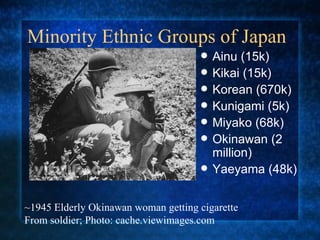
Minority Ethnic Groups of Japan Ainu (15k)  Kikai (15k)  Korean (670k)  Kunigami (5k) Miyako (68k) Okinawan (2 million)  Yaeyama (48k)  ~1945 Elderly Okinawan woman getting cigarette From soldier; Photo: cache.viewimages.com
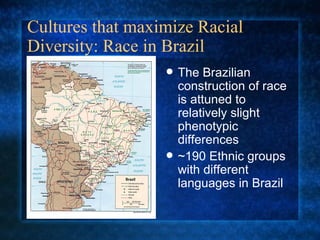
Cultures that maximize Racial Diversity: Race in Brazil The Brazilian construction of race is attuned to relatively slight phenotypic differences ~190 Ethnic groups with different languages in Brazil
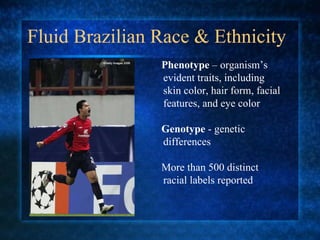
Fluid Brazilian Race & Ethnicity Phenotype  – organism’s evident traits, including skin color, hair form, facial features, and eye color Genotype  - genetic differences More than 500 distinct racial labels reported
Brazilian Race & Ethnicity Individual’s racial classification may change due to achieved status, developmental biological changes, and other irregular factors No hypodescent rule ever developed in Brazil to seperate whites and blacks Brazilian “race” far more flexible
Traditional Racial Laws of Nepal Racial hierarchy based on Hindu Laws Wearers of the holy cord  (Brahman, Thakuri, Chetri, highest Newar) Non-enslavable alcohol drinkers  (Magar, Gurung, some Newar) Enslavable alcohol drinkers (Tibetans, small tribes) Impure but touchable  (Newar butchers, musicians, washerwomen, Muslims, & Europeans!)  Untouchable  ( Hindu blacksmiths, tanners, shoemakers, tailors)
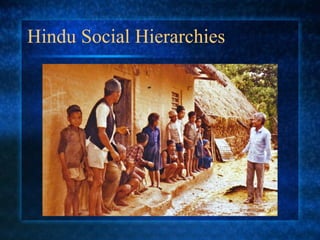
Hindu Social Hierarchies
Ethnic Groups and Nationalities Nation now similar to a “ state”  – independent, centrally organized political unit Migration, conquest, and colonialism led most nation-states to become ethnically heterogeneous. Nation once synonymous with “tribe” or “ethnic group” as in “Navajo nation”
Ethnic Groups, Nations,  and Nationalities Nation-State:  stratified society with formal, central government Migration, conquest, and colonialism  led most nation-states not to be ethnically homogeneous Nation :  a large aggregate of people united by common descent, history, culture, or language, inhabiting a particular country or territory
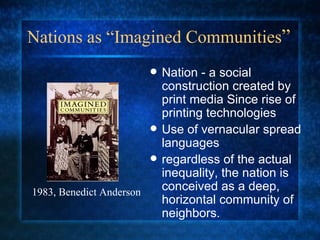
Nations as “Imagined Communities ” Nation - a social construction created by print media Since rise of printing technologies Use of vernacular spread languages regardless of the actual inequality, the nation is conceived as a deep, horizontal community of neighbors. 1983, Benedict Anderson
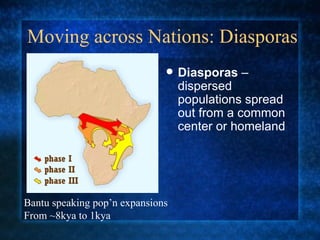
Moving across Nations: Diasporas Diasporas  – dispersed populations spread out from a common center or homeland Bantu speaking pop’n expansions  From ~8kya to 1kya
Assimilation “ Melting pot” model Incorporates into the dominant culture to point where it becomes a subculture Cultural Hegemony - Ruling class creates ideologies that others internalize “ Time is Money” “ You can never be too rich or too thin” “ Pull yourself up by your bootstraps” When minority adopts the patterns and culture of a host culture
The Plural Society Barth believed ethnic boundaries are most stable and enduring when groups occupy different ecological niches Barth shifted analytic focus from specific cultural practices and values to relations between ethnic groups A society combining ethnic  contrasts, ecological specialization,  and economic interdependence
Multiculturalism and Ethnic Identity Number and size of ethnic groups grew dramatically in recent years  Multiculturalism seeks ways for people to understand and interact with a respect for differences Multiculturalism  – socializes individuals into the dominant culture and into an ethnic culture
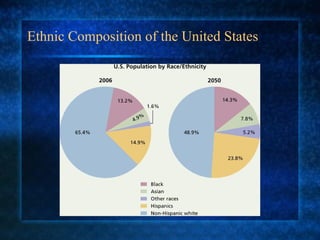
Ethnic Composition of the United States
Roots of Ethnic Conflict Prejudice  – devaluing a group because  of its assume behavior, values, capabilities or attributes Discrimination  – policies and practices that harm a group and its members De facto – practiced but not legally sanctioned De jure – part of the law Prejudice and Discrimination
Roots of Ethnic Conflict Ethnic competition and conflict evident in North America New arrivals versus long-established  ethnic groups Aftermaths of oppression Genocide Forced assimilation Ethnocide Cultural colonialism Chips in the Mosaic
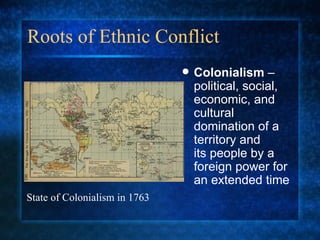
Roots of Ethnic Conflict Colonialism  – political, social, economic, and cultural domination of a territory and  its people by a foreign power for an extended time State of Colonialism in 1763
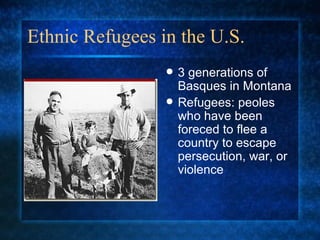
Ethnic Refugees in the U.S. 3 generations of Basques in Montana Refugees: peoles who have been foreced to flee a country to escape persecution, war, or violence

Anth1 Ethnicity B

  • 1.
    Race in Cultureswhere Diversity is Minimized Diversity in Japan is also erased by dominant majority 10% of Japan’s population minorities of various sorts Intrinsic racism – belief that perceived racial difference is a sufficient reason to value one person less than another American culture ignores considerable diversity as it socially constructs race within U.S.
  • 2.
    Race in JapanValued group in Japan is majority (“pure”) Japanese, who are believed to share “the same blood” 80-90% of population From Japanese wedding designer Yumi Katsura’s 2006 Collection; Credit: english.peopledaily.com.cn
  • 3.
    Race in JapanJapanese culture regards certain ethnic groups as having a biological basis, when there is no evidence Burakumin or "mura-no-mono" ("village people") – descendants of a low-status social class; genetically indistinguishable from the dominant population; treated as a different race Discrimination against Burakumin strikingly similar to discrimination that blacks faced in U.S. or “low castes” in South Asia Majority Japanese (~110 million) define themselves by opposition to others
  • 4.
    Minority Ethnic Groupsof Japan Ainu (15k) Kikai (15k) Korean (670k) Kunigami (5k) Miyako (68k) Okinawan (2 million) Yaeyama (48k) ~1945 Elderly Okinawan woman getting cigarette From soldier; Photo: cache.viewimages.com
  • 5.
    Cultures that maximizeRacial Diversity: Race in Brazil The Brazilian construction of race is attuned to relatively slight phenotypic differences ~190 Ethnic groups with different languages in Brazil
  • 6.
    Fluid Brazilian Race& Ethnicity Phenotype – organism’s evident traits, including skin color, hair form, facial features, and eye color Genotype - genetic differences More than 500 distinct racial labels reported
  • 7.
    Brazilian Race &Ethnicity Individual’s racial classification may change due to achieved status, developmental biological changes, and other irregular factors No hypodescent rule ever developed in Brazil to seperate whites and blacks Brazilian “race” far more flexible
  • 8.
    Traditional Racial Lawsof Nepal Racial hierarchy based on Hindu Laws Wearers of the holy cord (Brahman, Thakuri, Chetri, highest Newar) Non-enslavable alcohol drinkers (Magar, Gurung, some Newar) Enslavable alcohol drinkers (Tibetans, small tribes) Impure but touchable (Newar butchers, musicians, washerwomen, Muslims, & Europeans!) Untouchable ( Hindu blacksmiths, tanners, shoemakers, tailors)
  • 9.
  • 10.
    Ethnic Groups andNationalities Nation now similar to a “ state” – independent, centrally organized political unit Migration, conquest, and colonialism led most nation-states to become ethnically heterogeneous. Nation once synonymous with “tribe” or “ethnic group” as in “Navajo nation”
  • 11.
    Ethnic Groups, Nations, and Nationalities Nation-State: stratified society with formal, central government Migration, conquest, and colonialism led most nation-states not to be ethnically homogeneous Nation : a large aggregate of people united by common descent, history, culture, or language, inhabiting a particular country or territory
  • 12.
    Nations as “ImaginedCommunities ” Nation - a social construction created by print media Since rise of printing technologies Use of vernacular spread languages regardless of the actual inequality, the nation is conceived as a deep, horizontal community of neighbors. 1983, Benedict Anderson
  • 13.
    Moving across Nations:Diasporas Diasporas – dispersed populations spread out from a common center or homeland Bantu speaking pop’n expansions From ~8kya to 1kya
  • 14.
    Assimilation “ Meltingpot” model Incorporates into the dominant culture to point where it becomes a subculture Cultural Hegemony - Ruling class creates ideologies that others internalize “ Time is Money” “ You can never be too rich or too thin” “ Pull yourself up by your bootstraps” When minority adopts the patterns and culture of a host culture
  • 15.
    The Plural SocietyBarth believed ethnic boundaries are most stable and enduring when groups occupy different ecological niches Barth shifted analytic focus from specific cultural practices and values to relations between ethnic groups A society combining ethnic contrasts, ecological specialization, and economic interdependence
  • 16.
    Multiculturalism and EthnicIdentity Number and size of ethnic groups grew dramatically in recent years Multiculturalism seeks ways for people to understand and interact with a respect for differences Multiculturalism – socializes individuals into the dominant culture and into an ethnic culture
  • 17.
    Ethnic Composition ofthe United States
  • 18.
    Roots of EthnicConflict Prejudice – devaluing a group because of its assume behavior, values, capabilities or attributes Discrimination – policies and practices that harm a group and its members De facto – practiced but not legally sanctioned De jure – part of the law Prejudice and Discrimination
  • 19.
    Roots of EthnicConflict Ethnic competition and conflict evident in North America New arrivals versus long-established ethnic groups Aftermaths of oppression Genocide Forced assimilation Ethnocide Cultural colonialism Chips in the Mosaic
  • 20.
    Roots of EthnicConflict Colonialism – political, social, economic, and cultural domination of a territory and its people by a foreign power for an extended time State of Colonialism in 1763
  • 21.
    Ethnic Refugees inthe U.S. 3 generations of Basques in Montana Refugees: peoles who have been foreced to flee a country to escape persecution, war, or violence