ANTHROPOLOGICAL
FOUNDATIONS OF EDUCATION
What is Anthropology?
 Anthropology is the science of people
and culture.
The word is a combination of two Greek
roots, “anthropos,” man, and “logos,” an
account or calculation.
Branches of Anthropology
 The study of both humanity and culture
indicates the two major division of the
field.
Physical Anthropology
Cultural Anthropology
Cont…
 Physical Anthropology
Which studies people as biological organisms.
Physical anthropologists usually tend to concentrate
upon human genetics, the study of inherited
characteristics, upon morphological statistics, the
measurement of human body, and the analysis of the
body’s physical characteristics.
 Cultural Anthropology
Which is devoted to the behavior of people
and the products of that behavior.
It is sometimes called “social
anthropology.”
Ethnolography is the study of the particular
culture; in most instances the subject is a
living culture.
Cont…
History and Prospects of Anthropology
 The 19th century flowering of anthropology was
the work of number of pioneers.
 The paramount theme of this period was
evolution.
Cont…
 Spencer, frequently mentioned on how
environment produced variety in culture, and
he discussed various routes by which cultural
levels could be ascended.
 In the same vein, Morgan and Tylor
discussed the diffusion of traits from one
culture to another, Morgan in particular
pointed out that the American Indian cultures
he was studying were in process of leaping
cultural stage under the impact of European
derived US civilization.
Cont…
 Franz Boas, the vanguard anthropologist of
the late 19th c and 20 centuries, introduced
the modern emphasis of field works, although
he certainly did not create the notion.
Cont…
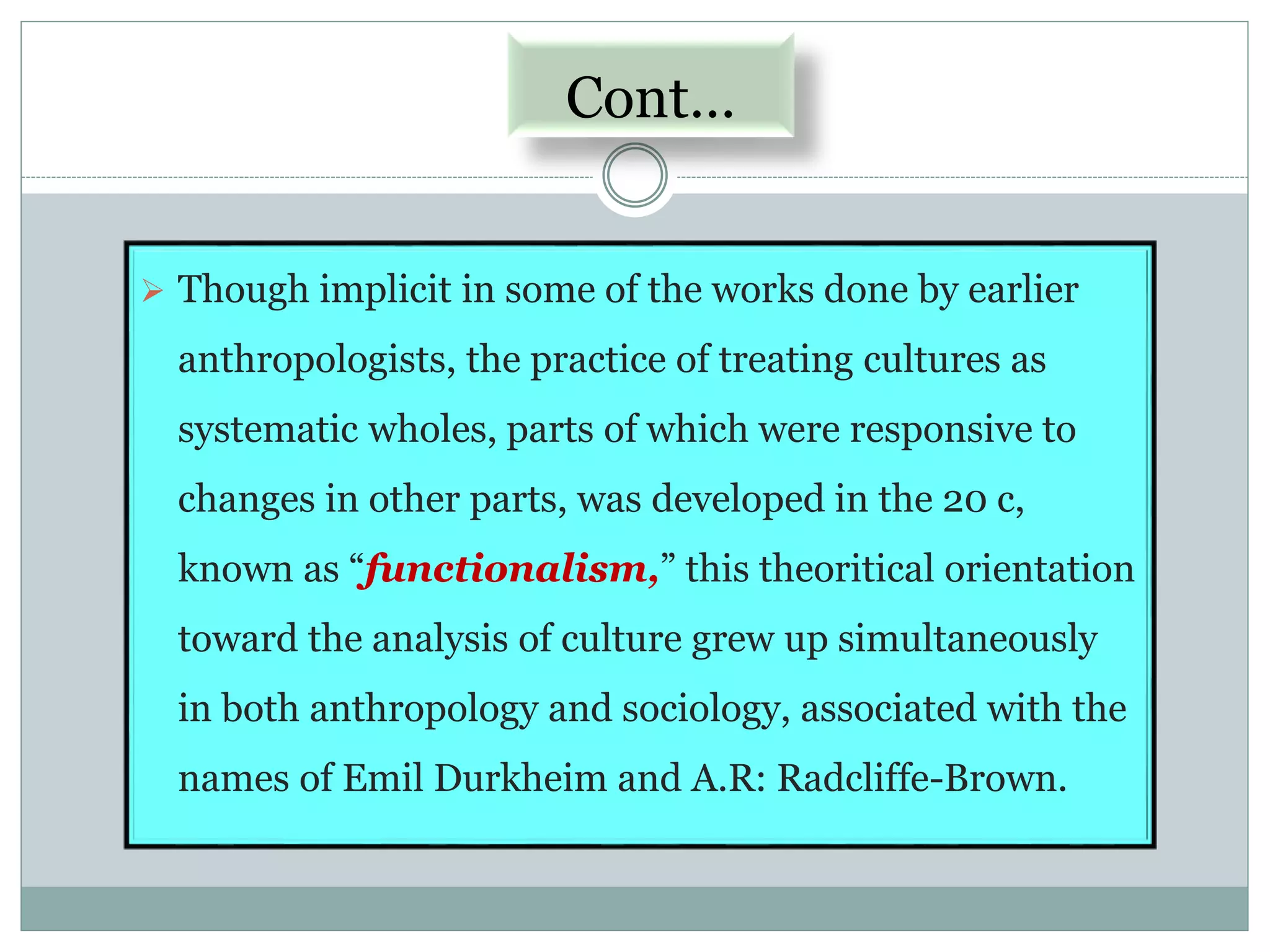
 Though implicit in some of the works done by earlier
anthropologists, the practice of treating cultures as
systematic wholes, parts of which were responsive to
changes in other parts, was developed in the 20 c,
known as “functionalism,” this theoritical orientation
toward the analysis of culture grew up simultaneously
in both anthropology and sociology, associated with the
names of Emil Durkheim and A.R: Radcliffe-Brown.
Cont…
 “Structuralism,” a technique for studying tribal
social organization, has had considerable influence
among students of cultural anthropology.
 Its most outstanding exponent in the French
anthropologist, Claude Levi-Strauss.
Cont…
Structuralism suggests that there is a limited
number of ways in which culture can be organized; it
seeks to investigate changes in cultures specially
through the examination of the mythology and other
non-material aspects of those culture.
 It rejects the classification of societies as “primitive”
or “advanced” and instead distinguished between
different degrees of technological progress.
Cont…
Another approach to the study of
cultural anthropology is the
ethnoscience, or componential analysis,
approach. It seeks to apply linguistic
methods to the examination of other
aspects of culture.
The Evolution of Man
Cont…
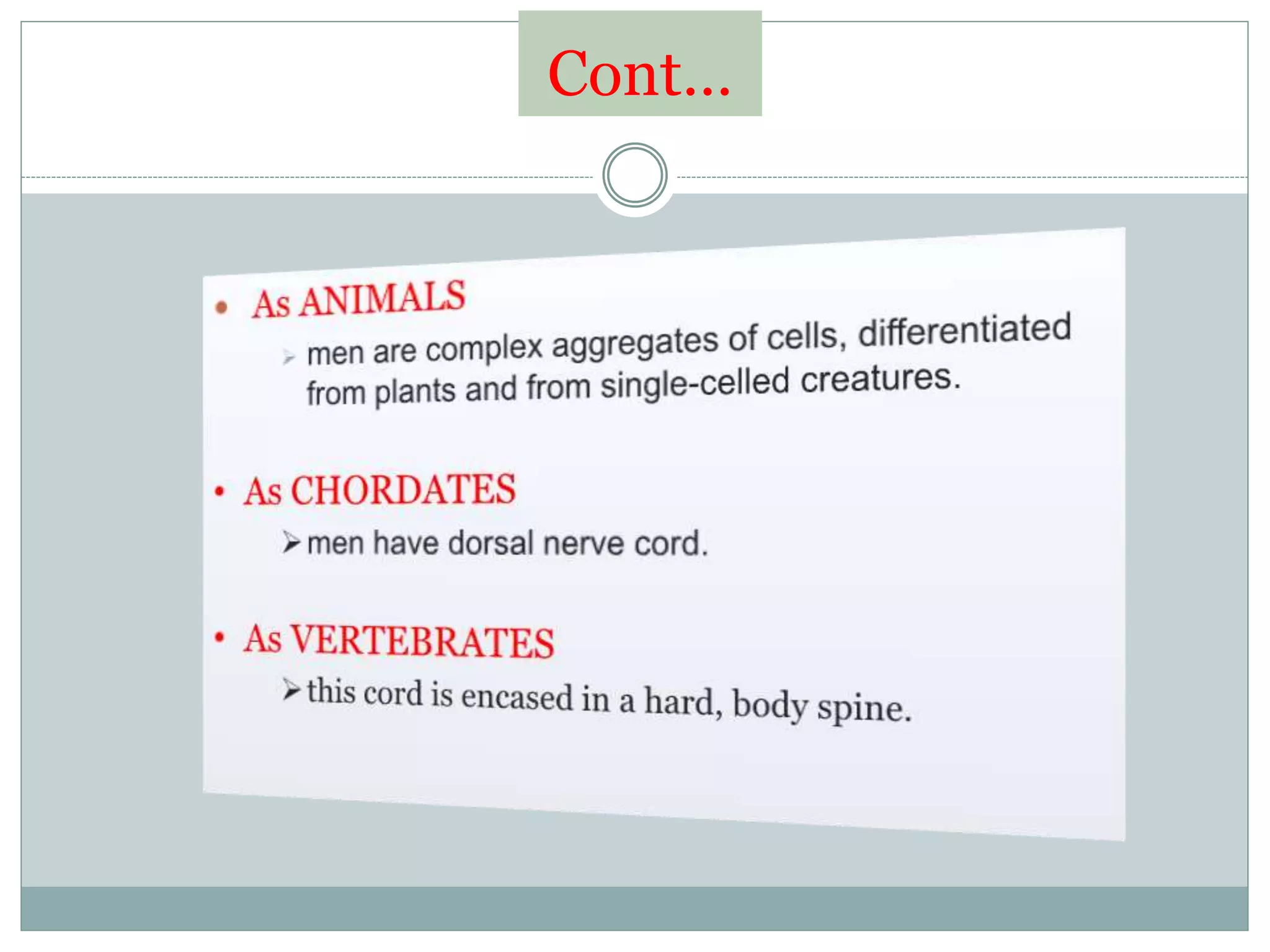
 Long before Charles Darwin published “The Descent
Man,” (1871), it was thought in certain scholarly circles
that man was an animal.
 Toady, virtually all scientist accept as a fact, although
some theologicians still express opposition to this view.
Cont…
 Various biological groups, from largest to the smallest, to which
he belong are:
kingdom: Animal
Phylum: Vertebrate
Class: Mammalia
Infraclass: Eutheria
Order: Primates
Suborder: Anthropoidea
Superfamily: Hominoidea
Family: Hominidae
Genus: Homo
Species: Sapiens
Cont…
Cont…
Cont…
Evidence of Evolution
Anthropological
Anthropological
Anthropological

Anthropological

  • 1.
  • 2.
    What is Anthropology? Anthropology is the science of people and culture. The word is a combination of two Greek roots, “anthropos,” man, and “logos,” an account or calculation.
  • 3.
    Branches of Anthropology The study of both humanity and culture indicates the two major division of the field. Physical Anthropology Cultural Anthropology
  • 4.
    Cont…  Physical Anthropology Whichstudies people as biological organisms. Physical anthropologists usually tend to concentrate upon human genetics, the study of inherited characteristics, upon morphological statistics, the measurement of human body, and the analysis of the body’s physical characteristics.
  • 5.
     Cultural Anthropology Whichis devoted to the behavior of people and the products of that behavior. It is sometimes called “social anthropology.” Ethnolography is the study of the particular culture; in most instances the subject is a living culture. Cont…
  • 6.
    History and Prospectsof Anthropology  The 19th century flowering of anthropology was the work of number of pioneers.  The paramount theme of this period was evolution.
  • 7.
    Cont…  Spencer, frequentlymentioned on how environment produced variety in culture, and he discussed various routes by which cultural levels could be ascended.  In the same vein, Morgan and Tylor discussed the diffusion of traits from one culture to another, Morgan in particular pointed out that the American Indian cultures he was studying were in process of leaping cultural stage under the impact of European derived US civilization.
  • 8.
    Cont…  Franz Boas,the vanguard anthropologist of the late 19th c and 20 centuries, introduced the modern emphasis of field works, although he certainly did not create the notion.
  • 9.
    Cont…  Though implicitin some of the works done by earlier anthropologists, the practice of treating cultures as systematic wholes, parts of which were responsive to changes in other parts, was developed in the 20 c, known as “functionalism,” this theoritical orientation toward the analysis of culture grew up simultaneously in both anthropology and sociology, associated with the names of Emil Durkheim and A.R: Radcliffe-Brown.
  • 10.
    Cont…  “Structuralism,” atechnique for studying tribal social organization, has had considerable influence among students of cultural anthropology.  Its most outstanding exponent in the French anthropologist, Claude Levi-Strauss.
  • 11.
    Cont… Structuralism suggests thatthere is a limited number of ways in which culture can be organized; it seeks to investigate changes in cultures specially through the examination of the mythology and other non-material aspects of those culture.  It rejects the classification of societies as “primitive” or “advanced” and instead distinguished between different degrees of technological progress.
  • 12.
    Cont… Another approach tothe study of cultural anthropology is the ethnoscience, or componential analysis, approach. It seeks to apply linguistic methods to the examination of other aspects of culture.
  • 13.
  • 14.
    Cont…  Long beforeCharles Darwin published “The Descent Man,” (1871), it was thought in certain scholarly circles that man was an animal.  Toady, virtually all scientist accept as a fact, although some theologicians still express opposition to this view.
  • 15.
    Cont…  Various biologicalgroups, from largest to the smallest, to which he belong are: kingdom: Animal Phylum: Vertebrate Class: Mammalia Infraclass: Eutheria Order: Primates Suborder: Anthropoidea Superfamily: Hominoidea Family: Hominidae Genus: Homo Species: Sapiens
  • 16.
  • 17.
  • 18.
  • 19.