Method & Theory in Cultural Anthropology Intro to Cultural Anthropology Prof. J. Fortier
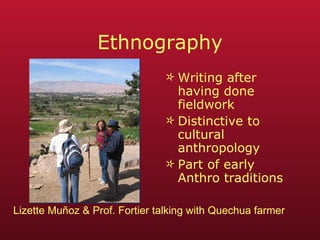
Ethnography Writing after having done fieldwork Distinctive to cultural anthropology Part of early Anthro traditions Lizette Mu ñoz & Prof. Fortier talking with Quechua farmer
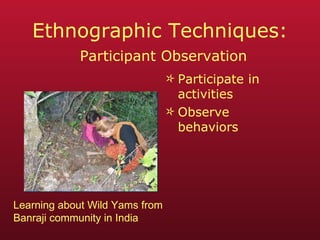
Ethnographic Techniques:   Participant Observation Participate in activities Observe behaviors Learning about Wild Yams from Banraji community in India
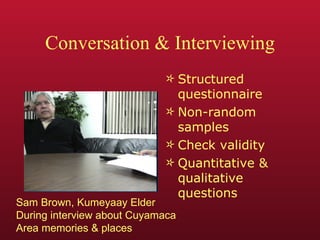
Conversation & Interviewing Structured questionnaire Non-random samples Check validity Quantitative & qualitative questions Sam Brown, Kumeyaay Elder During interview about Cuyamaca Area memories & places
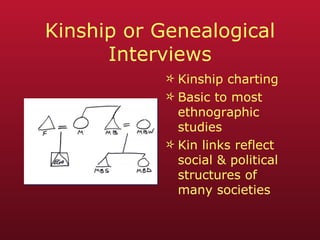
Kinship or Genealogical Interviews Kinship charting Basic to most ethnographic studies Kin links reflect social & political structures of many societies
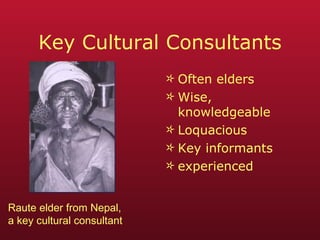
Key Cultural Consultants Often elders Wise, knowledgeable Loquacious Key informants experienced Raute elder from Nepal, a key cultural consultant
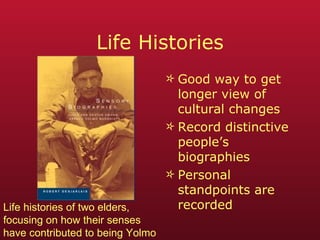
Life Histories Good way to get longer view of cultural changes Record distinctive people’s biographies Personal standpoints are recorded Life histories of two elders,  focusing on how their senses  have contributed to being Yolmo
Local knowledge & beliefs Ethnographies record  emic  views Local, insider’s, native, experiential Other studies can record  etic  views Scientific, comparative, non-experiential Shamanic knowledge involves altered states of consciousness
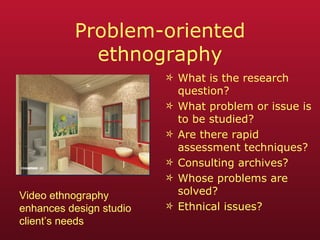
Problem-oriented ethnography What is the research question? What problem or issue is to be studied? Are there rapid assessment techniques? Consulting archives? Whose problems are solved? Ethnical issues? Video ethnography enhances design studio client’s needs
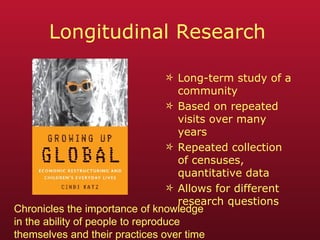
Longitudinal Research Long-term study of a community Based on repeated visits over many years Repeated collection of censuses, quantitative data  Allows for different research questions Chronicles the importance of knowledge  in the ability of people to reproduce  themselves and their practices over time
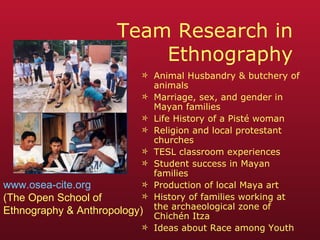
Team Research in Ethnography Animal Husbandry & butchery of animals Marriage, sex, and gender in Mayan families Life History of a Pisté woman Religion and local protestant churches TESL classroom experiences Student success in Mayan families Production of local Maya art History of families working at the archaeological zone of Chichén Itza Ideas about Race among Youth www.osea-cite.org (The Open School of  Ethnography & Anthropology)
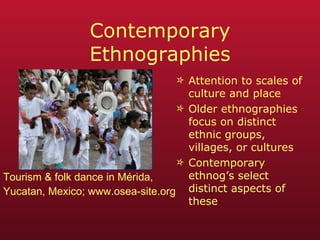
Contemporary Ethnographies Attention to scales of culture and place Older ethnographies focus on distinct ethnic groups, villages, or cultures Contemporary ethnog’s select distinct aspects of these Tourism & folk dance in M érida, Yucatan, Mexico; www.osea-site.org
Ethnography & Survey Research Studies sample pop’n Little personal contact Uses small # of variables Used in writing-based, literate societies Codes answers for statistical analysis Holistic: Studies whole communities First-hand, direct research experience Often carried out in small-scale societies Emph. On description, qualitative research
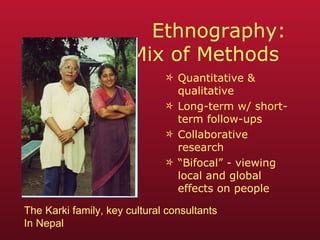
Ethnography:  Mix of Methods  Quantitative & qualitative Long-term w/ short-term follow-ups Collaborative research “ Bifocal” - viewing local and global effects on people The Karki family, key cultural consultants In Nepal

Anth1 Method & Theory

  • 1.
    Method & Theoryin Cultural Anthropology Intro to Cultural Anthropology Prof. J. Fortier
  • 2.
    Ethnography Writing afterhaving done fieldwork Distinctive to cultural anthropology Part of early Anthro traditions Lizette Mu ñoz & Prof. Fortier talking with Quechua farmer
  • 3.
    Ethnographic Techniques: Participant Observation Participate in activities Observe behaviors Learning about Wild Yams from Banraji community in India
  • 4.
    Conversation & InterviewingStructured questionnaire Non-random samples Check validity Quantitative & qualitative questions Sam Brown, Kumeyaay Elder During interview about Cuyamaca Area memories & places
  • 5.
    Kinship or GenealogicalInterviews Kinship charting Basic to most ethnographic studies Kin links reflect social & political structures of many societies
  • 6.
    Key Cultural ConsultantsOften elders Wise, knowledgeable Loquacious Key informants experienced Raute elder from Nepal, a key cultural consultant
  • 7.
    Life Histories Goodway to get longer view of cultural changes Record distinctive people’s biographies Personal standpoints are recorded Life histories of two elders, focusing on how their senses have contributed to being Yolmo
  • 8.
    Local knowledge &beliefs Ethnographies record emic views Local, insider’s, native, experiential Other studies can record etic views Scientific, comparative, non-experiential Shamanic knowledge involves altered states of consciousness
  • 9.
    Problem-oriented ethnography Whatis the research question? What problem or issue is to be studied? Are there rapid assessment techniques? Consulting archives? Whose problems are solved? Ethnical issues? Video ethnography enhances design studio client’s needs
  • 10.
    Longitudinal Research Long-termstudy of a community Based on repeated visits over many years Repeated collection of censuses, quantitative data Allows for different research questions Chronicles the importance of knowledge in the ability of people to reproduce themselves and their practices over time
  • 11.
    Team Research inEthnography Animal Husbandry & butchery of animals Marriage, sex, and gender in Mayan families Life History of a Pisté woman Religion and local protestant churches TESL classroom experiences Student success in Mayan families Production of local Maya art History of families working at the archaeological zone of Chichén Itza Ideas about Race among Youth www.osea-cite.org (The Open School of Ethnography & Anthropology)
  • 12.
    Contemporary Ethnographies Attentionto scales of culture and place Older ethnographies focus on distinct ethnic groups, villages, or cultures Contemporary ethnog’s select distinct aspects of these Tourism & folk dance in M érida, Yucatan, Mexico; www.osea-site.org
  • 13.
    Ethnography & SurveyResearch Studies sample pop’n Little personal contact Uses small # of variables Used in writing-based, literate societies Codes answers for statistical analysis Holistic: Studies whole communities First-hand, direct research experience Often carried out in small-scale societies Emph. On description, qualitative research
  • 14.
    Ethnography: Mixof Methods Quantitative & qualitative Long-term w/ short-term follow-ups Collaborative research “ Bifocal” - viewing local and global effects on people The Karki family, key cultural consultants In Nepal