Ethnography
ANT 2140
Rachel Wayne
What is Ethnography?
 Collecting cultural data
 stories (folklore, myths, history, urban legends,
personal stories)
 artifacts (art, tools, buildings, etc.)
 idioms and dialectal characteristics
 Creating a “thick description”
 more detail = less uninformed interpretation
 more detail = more research questions
 Participating in shared behaviors
 Gaining rapport with informants
What is an Ethnography?
 A descriptive record of a group of people.
 can be bounded by ethnicity, nationality, shared
distinctive behaviors (e.g. participation in a sport,
membership in a political party), or shared specific
beliefs (e.g. religious beliefs.
 is temporally and spatially grounded (the ethnographic
present).
 is an inductive approach that uses quantitative data
with an emic perspective.
What is an Ethnography?
 A scientific account of cultural behaviors.
 uses a mix of qualitative and quantitative data to
develop models of human behavior.
 may be inductive (ex. neurological model of language,
with data on situational use of language) or deductive
(ex. cross-analyzing church attendance with political
party)
 can track social networks, language use, and genetic
relations.
 generally uses a larger group of informants (10+).
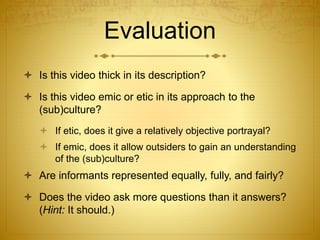
Evaluation
 Is this video thick in its description?
 Is this video emic or etic in its approach to the
(sub)culture?
 If etic, does it give a relatively objective portrayal?
 If emic, does it allow outsiders to gain an understanding
of the (sub)culture?
 Are informants represented equally, fully, and fairly?
 Does the video ask more questions than it answers?
(Hint: It should.)
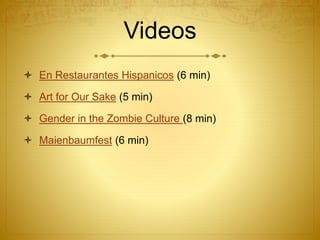
Videos
 En Restaurantes Hispanicos (6 min)
 Art for Our Sake (5 min)
 Gender in the Zombie Culture (8 min)
 Maienbaumfest (6 min)

Ethnography 101

  • 1.
  • 2.
    What is Ethnography? Collecting cultural data  stories (folklore, myths, history, urban legends, personal stories)  artifacts (art, tools, buildings, etc.)  idioms and dialectal characteristics  Creating a “thick description”  more detail = less uninformed interpretation  more detail = more research questions  Participating in shared behaviors  Gaining rapport with informants
  • 3.
    What is anEthnography?  A descriptive record of a group of people.  can be bounded by ethnicity, nationality, shared distinctive behaviors (e.g. participation in a sport, membership in a political party), or shared specific beliefs (e.g. religious beliefs.  is temporally and spatially grounded (the ethnographic present).  is an inductive approach that uses quantitative data with an emic perspective.
  • 4.
    What is anEthnography?  A scientific account of cultural behaviors.  uses a mix of qualitative and quantitative data to develop models of human behavior.  may be inductive (ex. neurological model of language, with data on situational use of language) or deductive (ex. cross-analyzing church attendance with political party)  can track social networks, language use, and genetic relations.  generally uses a larger group of informants (10+).
  • 5.
    Evaluation  Is thisvideo thick in its description?  Is this video emic or etic in its approach to the (sub)culture?  If etic, does it give a relatively objective portrayal?  If emic, does it allow outsiders to gain an understanding of the (sub)culture?  Are informants represented equally, fully, and fairly?  Does the video ask more questions than it answers? (Hint: It should.)
  • 6.
    Videos  En RestaurantesHispanicos (6 min)  Art for Our Sake (5 min)  Gender in the Zombie Culture (8 min)  Maienbaumfest (6 min)