ANTEGENIC VARIATION
IN BACTERIA
SOUSAN
A274153121006
HG&MM-INTEGRATED
INTRODUCTION
➢ Also known as antigenic alteration.
➢ Phenomenon in which an infectious agent such as a protozoan, bacterium, or
virus alters the proteins or carbohydrates on its surface and thus avoids
a host immune response, making it one of the mechanisms of antigenic escape.
➢ Related to phase variation.
➢ Also allows re-infection of previously infected hosts.
➢ Can result from gene conversion, site-specific DNA inversions, hypermutation,
or recombination of sequence cassettes.
➢ Result is that even a clonal population of pathogens expresses a heterogeneous
phenotype.
➢ Many of the proteins known to show antigenic or phase variation are related to
virulence.
PHASE VARIATION
➢Method of dealing with rapidly varying environments without
requiring random mutation.
➢It involves the variation of protein expression.
➢It's a reversible switch between an "all-or-none"(on/off) expressing
phase, resulting in variation in the level of expression of one or more
proteins between individual cells of a clonal population.
➢Majority of daughter cells will retain the expression phase of the
parent but a minority will have switched expression phase.
➢The switch can be influenced by external factors, the switching
frequency can be modulated.
ANTIGENIC VS PHASE VARIATION
ANTEGENIC VARIATION
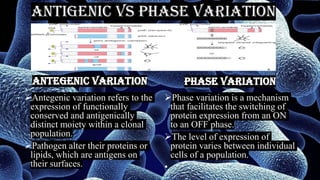
➢Antegenic variation refers to the
expression of functionally
conserved and antigenically
distinct moiety within a clonal
population.
➢Pathogen alter their proteins or
lipids, which are antigens on
their surfaces.
PHASE VARIATION
➢Phase variation is a mechanism
that facilitates the switching of
protein expression from an ON
to an OFF phase.
➢The level of expression of
protein varies between individual
cells of a population.
•
ANTEGENIC VARIATION IN SALMONELLA
BACTERIA
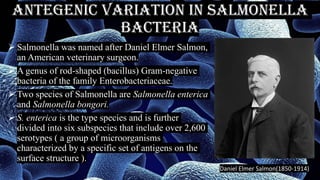
➢ Salmonella was named after Daniel Elmer Salmon,
an American veterinary surgeon.
➢ A genus of rod-shaped (bacillus) Gram-negative
bacteria of the family Enterobacteriaceae.
➢ Two species of Salmonella are Salmonella enterica
and Salmonella bongori.
➢ S. enterica is the type species and is further
divided into six subspecies that include over 2,600
serotypes ( a group of microorganisms
characterized by a specific set of antigens on the
surface structure ).
Daniel Elmer Salmon(1850-1914)
Serotypes and the Importance of
Serotyping Salmonella
➢ Salmonella bacteria look alike under the microscope but can be
separated into many serotypes based on two structures on their
surface:
❑The outermost portion of the bacteria’s surface covering, called the
O antigen; and
❑A slender threadlike structure called the H antigen, is part of the
flagella.
➢ The O antigens are distinguished by their different chemical make-
up. The H antigens are distinguished by the protein content of the
flagella. Each O and H antigen has a unique code number.
Scientists determine the serotype based on the distinct
combination of O and H antigens.
➢ The bacteria’s surface is covered with lipopolysaccharide (LPS).
The outermost portion of the LPS is the O antigen.
➢ Flagella are whip-like tails that bacteria use to move around.
Flagella is the whole structure, while the slender threadlike portion
of the flagella is called the H antigen.
SWITCH TO VIRULENCE
I. Approach, in which they travel towards a host cell either via the
intestinal peristalsis or through active swimming via the flagella, penetrate the
mucus barrier, and locate themselves close to the epithelium lining the intestine,
II. Adhesion, in which they adhere to a host cell using bacterial adhesins and a type
three-secretion system,
III. Invasion, in which Salmonella enters the host cell (see variant mechanisms below),
IV. Replication, in which the bacterium may reproduce inside the host cell,
V. Spread, in which the bacterium can spread to other organs via cells in the blood (if
it succeeded in avoiding the immune defense). Alternatively, bacteria can go back
towards the intestine, re-seeding the intestinal population.
VI. Re-invasion (a secondary infection, if now at a systemic site) and further
replication.
Common strategies for antigenic
variation by bacterial PATHOGENS
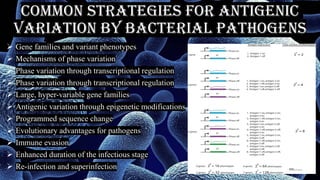
➢ Gene families and variant phenotypes
➢ Mechanisms of phase variation
➢ Phase variation through transcriptional regulation
➢ Large, hyper-variable gene families
➢ Antigenic variation through epigenetic modifications
➢ Programmed sequence change
➢ Evolutionary advantages for pathogens
➢ Immune evasion
➢ Enhanced duration of the infectious stage
➢ Re-infection and superinfection
Bacterial Antigens
➢ An antigen is defined as anything that causes an immune response in another organism. This
immune response can be a simple increase of inflammatory factors, or it can be an activation
of the adaptive immune system and the creation of antibodies.
➢ Antibodies have two or more specific paratopes, or antigen recognition sites, that identify and
combat the invading antigen.
➢ The number of antigen recognition sites is dependent on the antibody class. The word
“antigen” can also refer to any protein of interest detected by a bioassay or bio-detection
platform.
➢ In the case of a bacterial antigen, we are referring to surface proteins, lipopolysaccharides, and
peptidoglycans on the bacterial cell wall; these structures help bacteria invade other organisms
by gaining access between epithelial cells. While surface structures help bacteria infect other
organisms, they are also a detriment to the bacteria because they also serve as a unique tag that
antibodies and bacteriophages can recognize.
➢ Bacteriophages are viruses that attack bacteria. Both antibodies and phages are being used by
scientists to develop new bio-detection and biosensing platforms for rapid detection of
bacterial antigens in the environment and in clinical samples.
‘Nothing is permanent but change’ – antigenic variation
in persistent bacterial pathogens
➢ An amazing diversity of immune evasion mechanisms.
➢ More specifically on variants generated by gene conversion (non-reciprocal
homologous recombination).
➢ In contrast to RNA viruses in which continual antigenic variation within an
individual infected host occurs primarily through mutation, bacteria most
commonly use an existing repertoire of donor alleles or cassettes for
recombination into an active expression site.
➢ The variant-generating capacity of a specific bacterial pathogen is defined
by both the size of the allelic repertoire and the permissiveness for
recombination of segments versus complete allelic donors.
➢ While a large number of bacterial pathogens utilize gene conversion to
continuously generate antigenic variants within an individual infected host.
EXAMPLES OF ANTEGENIC VARIATION IN PERSISTENT
BACTERIA
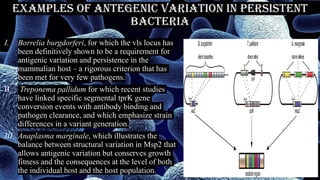
I. Borrelia burgdorferi, for which the vls locus has
been definitively shown to be a requirement for
antigenic variation and persistence in the
mammalian host – a rigorous criterion that has
been met for very few pathogens.
II. Treponema pallidum for which recent studies
have linked specific segmental tprK gene
conversion events with antibody binding and
pathogen clearance, and which emphasize strain
differences in a variant generation.
III. Anaplasma marginale, which illustrates the
balance between structural variation in Msp2 that
allows antigenic variation but conserves growth
fitness and the consequences at the level of both
the individual host and the host population.
WHY IS ANTIGENIC VARIATION ADVANTAGEOUS TO A
PATHOGEN?
➢ The process of co-evolution has resulted in the development of complex genetic
systems underlying antigenic variation by numerous pathogenic
microorganisms.
➢ The process of antigenic variation is focused at the host/pathogen interface, and
in particular at the cell surface of the infectious organisms. Molecules displayed
on the pathogen cell surface often mediate adhesion within specific niches and
are frequently virulence determinants.
➢ Some systems of antigenic variation involve the activation and silencing of
genes that encode molecules exposed to the immune system of the infected
host. In its simplest form, this entails changes in the expression of genes that
are regulated individually, an ON/OFF process referred to as phase variation.
➢ The pathogen has evolved into large, multi-copy gene families with each copy
encoding a different form of the surface antigen. In these organisms, each individual
gene has all of the elements necessary for expression, and each undergoes silencing
and activation. However, an additional layer of regulation exists to ensure that only a
single gene is active at any given time. Thus gene silencing and activation within the
family are coordinated and strictly mutually exclusive.
➢ While many of the genetic systems underlying antigenic variation, for instance,
slipped-strand mispairing or gene conversion, involve alterations to the genome, in
several organisms changes in gene expression, do not involve any alterations in the
primary DNA sequence. These systems instead rely on “epigenetic” modifications to
control gene activation and silencing, the hallmarks of which include histone
modifications, the use of modified nucleotides, changes in chromatin structure, and
nuclear organization.
➢ In a few cases, the order in which specific antigen variants are expressed over the
course of an infection is determined by the sequence of the encoding genes. This can
help to extend the length of an infection or the infectious stage, thus increasing the
likelihood of transmission to a new host.
CONCLUSION
➢ Antigenic variation is the process of genetic or epigenetic changes that occur
more frequently than the basal mutation rate.
➢ This variation mostly occurs in genes that encode surface-exposed proteins and
involves the sequential expression of multiple different forms of the antigenic
regions of those surface-exposed proteins.
➢ Phase variation is related to antigenic variation and refers to a switch between
two phenotypes (i.e., turning gene expression on or off and switching between
the production of two different gene products).
➢ Antigenic and phase variation is most often used by microorganisms to evade
the host immune response and to adapt to new environments within the host.
➢ Antigenic variation also enhances the ability of a pathogen to infect a host that
has resolved (or been cured of) prior infection (i.e., re-infection) or who is
persistently infected with the same organism (superinfection). This both expands
the population of susceptible hosts and permits genetic exchange between
organisms.
THANK YOU
REFERENCES
https://www.ncbi.nlm.nih.gov/pmc/articles/PMC3676878/
https://www.ncbi.nlm.nih.gov/pmc/articles/PMC4806564/
https://journals.asm.org/doi/abs/10.1128/cmr.17.3.581-611.2004
https://www.sciencedirect.com/topics/immunology-and-microbiology/antigenic-variation
https://academic.oup.com/femsre/article/36/5/917/660062
https://en.wikipedia.org/wiki/Antigenic_variation#:~:text=Antigenic%20variation%20or%20a
ntigenic%20alteration,is%20related%20to%20phase%20variation.

ANTEGENIC VARIATION IN BACTERIA.pdf

  • 1.
  • 2.
    INTRODUCTION ➢ Also knownas antigenic alteration. ➢ Phenomenon in which an infectious agent such as a protozoan, bacterium, or virus alters the proteins or carbohydrates on its surface and thus avoids a host immune response, making it one of the mechanisms of antigenic escape. ➢ Related to phase variation. ➢ Also allows re-infection of previously infected hosts. ➢ Can result from gene conversion, site-specific DNA inversions, hypermutation, or recombination of sequence cassettes. ➢ Result is that even a clonal population of pathogens expresses a heterogeneous phenotype. ➢ Many of the proteins known to show antigenic or phase variation are related to virulence.
  • 3.
    PHASE VARIATION ➢Method ofdealing with rapidly varying environments without requiring random mutation. ➢It involves the variation of protein expression. ➢It's a reversible switch between an "all-or-none"(on/off) expressing phase, resulting in variation in the level of expression of one or more proteins between individual cells of a clonal population. ➢Majority of daughter cells will retain the expression phase of the parent but a minority will have switched expression phase. ➢The switch can be influenced by external factors, the switching frequency can be modulated.
  • 4.
    ANTIGENIC VS PHASEVARIATION ANTEGENIC VARIATION ➢Antegenic variation refers to the expression of functionally conserved and antigenically distinct moiety within a clonal population. ➢Pathogen alter their proteins or lipids, which are antigens on their surfaces. PHASE VARIATION ➢Phase variation is a mechanism that facilitates the switching of protein expression from an ON to an OFF phase. ➢The level of expression of protein varies between individual cells of a population. •
  • 5.
    ANTEGENIC VARIATION INSALMONELLA BACTERIA ➢ Salmonella was named after Daniel Elmer Salmon, an American veterinary surgeon. ➢ A genus of rod-shaped (bacillus) Gram-negative bacteria of the family Enterobacteriaceae. ➢ Two species of Salmonella are Salmonella enterica and Salmonella bongori. ➢ S. enterica is the type species and is further divided into six subspecies that include over 2,600 serotypes ( a group of microorganisms characterized by a specific set of antigens on the surface structure ). Daniel Elmer Salmon(1850-1914)
  • 6.
    Serotypes and theImportance of Serotyping Salmonella ➢ Salmonella bacteria look alike under the microscope but can be separated into many serotypes based on two structures on their surface: ❑The outermost portion of the bacteria’s surface covering, called the O antigen; and ❑A slender threadlike structure called the H antigen, is part of the flagella. ➢ The O antigens are distinguished by their different chemical make- up. The H antigens are distinguished by the protein content of the flagella. Each O and H antigen has a unique code number. Scientists determine the serotype based on the distinct combination of O and H antigens. ➢ The bacteria’s surface is covered with lipopolysaccharide (LPS). The outermost portion of the LPS is the O antigen. ➢ Flagella are whip-like tails that bacteria use to move around. Flagella is the whole structure, while the slender threadlike portion of the flagella is called the H antigen.
  • 7.
    SWITCH TO VIRULENCE I.Approach, in which they travel towards a host cell either via the intestinal peristalsis or through active swimming via the flagella, penetrate the mucus barrier, and locate themselves close to the epithelium lining the intestine, II. Adhesion, in which they adhere to a host cell using bacterial adhesins and a type three-secretion system, III. Invasion, in which Salmonella enters the host cell (see variant mechanisms below), IV. Replication, in which the bacterium may reproduce inside the host cell, V. Spread, in which the bacterium can spread to other organs via cells in the blood (if it succeeded in avoiding the immune defense). Alternatively, bacteria can go back towards the intestine, re-seeding the intestinal population. VI. Re-invasion (a secondary infection, if now at a systemic site) and further replication.
  • 8.
    Common strategies forantigenic variation by bacterial PATHOGENS ➢ Gene families and variant phenotypes ➢ Mechanisms of phase variation ➢ Phase variation through transcriptional regulation ➢ Phase variation through transcriptional regulation ➢ Large, hyper-variable gene families ➢ Antigenic variation through epigenetic modifications ➢ Programmed sequence change ➢ Evolutionary advantages for pathogens ➢ Immune evasion ➢ Enhanced duration of the infectious stage ➢ Re-infection and superinfection
  • 9.
    Bacterial Antigens ➢ Anantigen is defined as anything that causes an immune response in another organism. This immune response can be a simple increase of inflammatory factors, or it can be an activation of the adaptive immune system and the creation of antibodies. ➢ Antibodies have two or more specific paratopes, or antigen recognition sites, that identify and combat the invading antigen. ➢ The number of antigen recognition sites is dependent on the antibody class. The word “antigen” can also refer to any protein of interest detected by a bioassay or bio-detection platform. ➢ In the case of a bacterial antigen, we are referring to surface proteins, lipopolysaccharides, and peptidoglycans on the bacterial cell wall; these structures help bacteria invade other organisms by gaining access between epithelial cells. While surface structures help bacteria infect other organisms, they are also a detriment to the bacteria because they also serve as a unique tag that antibodies and bacteriophages can recognize. ➢ Bacteriophages are viruses that attack bacteria. Both antibodies and phages are being used by scientists to develop new bio-detection and biosensing platforms for rapid detection of bacterial antigens in the environment and in clinical samples.
  • 10.
    ‘Nothing is permanentbut change’ – antigenic variation in persistent bacterial pathogens ➢ An amazing diversity of immune evasion mechanisms. ➢ More specifically on variants generated by gene conversion (non-reciprocal homologous recombination). ➢ In contrast to RNA viruses in which continual antigenic variation within an individual infected host occurs primarily through mutation, bacteria most commonly use an existing repertoire of donor alleles or cassettes for recombination into an active expression site. ➢ The variant-generating capacity of a specific bacterial pathogen is defined by both the size of the allelic repertoire and the permissiveness for recombination of segments versus complete allelic donors. ➢ While a large number of bacterial pathogens utilize gene conversion to continuously generate antigenic variants within an individual infected host.
  • 11.
    EXAMPLES OF ANTEGENICVARIATION IN PERSISTENT BACTERIA I. Borrelia burgdorferi, for which the vls locus has been definitively shown to be a requirement for antigenic variation and persistence in the mammalian host – a rigorous criterion that has been met for very few pathogens. II. Treponema pallidum for which recent studies have linked specific segmental tprK gene conversion events with antibody binding and pathogen clearance, and which emphasize strain differences in a variant generation. III. Anaplasma marginale, which illustrates the balance between structural variation in Msp2 that allows antigenic variation but conserves growth fitness and the consequences at the level of both the individual host and the host population.
  • 12.
    WHY IS ANTIGENICVARIATION ADVANTAGEOUS TO A PATHOGEN? ➢ The process of co-evolution has resulted in the development of complex genetic systems underlying antigenic variation by numerous pathogenic microorganisms. ➢ The process of antigenic variation is focused at the host/pathogen interface, and in particular at the cell surface of the infectious organisms. Molecules displayed on the pathogen cell surface often mediate adhesion within specific niches and are frequently virulence determinants. ➢ Some systems of antigenic variation involve the activation and silencing of genes that encode molecules exposed to the immune system of the infected host. In its simplest form, this entails changes in the expression of genes that are regulated individually, an ON/OFF process referred to as phase variation.
  • 13.
    ➢ The pathogenhas evolved into large, multi-copy gene families with each copy encoding a different form of the surface antigen. In these organisms, each individual gene has all of the elements necessary for expression, and each undergoes silencing and activation. However, an additional layer of regulation exists to ensure that only a single gene is active at any given time. Thus gene silencing and activation within the family are coordinated and strictly mutually exclusive. ➢ While many of the genetic systems underlying antigenic variation, for instance, slipped-strand mispairing or gene conversion, involve alterations to the genome, in several organisms changes in gene expression, do not involve any alterations in the primary DNA sequence. These systems instead rely on “epigenetic” modifications to control gene activation and silencing, the hallmarks of which include histone modifications, the use of modified nucleotides, changes in chromatin structure, and nuclear organization. ➢ In a few cases, the order in which specific antigen variants are expressed over the course of an infection is determined by the sequence of the encoding genes. This can help to extend the length of an infection or the infectious stage, thus increasing the likelihood of transmission to a new host.
  • 14.
    CONCLUSION ➢ Antigenic variationis the process of genetic or epigenetic changes that occur more frequently than the basal mutation rate. ➢ This variation mostly occurs in genes that encode surface-exposed proteins and involves the sequential expression of multiple different forms of the antigenic regions of those surface-exposed proteins. ➢ Phase variation is related to antigenic variation and refers to a switch between two phenotypes (i.e., turning gene expression on or off and switching between the production of two different gene products). ➢ Antigenic and phase variation is most often used by microorganisms to evade the host immune response and to adapt to new environments within the host. ➢ Antigenic variation also enhances the ability of a pathogen to infect a host that has resolved (or been cured of) prior infection (i.e., re-infection) or who is persistently infected with the same organism (superinfection). This both expands the population of susceptible hosts and permits genetic exchange between organisms.
  • 15.