Bacterial secretion system
Ahtesham Hanifi
I200602
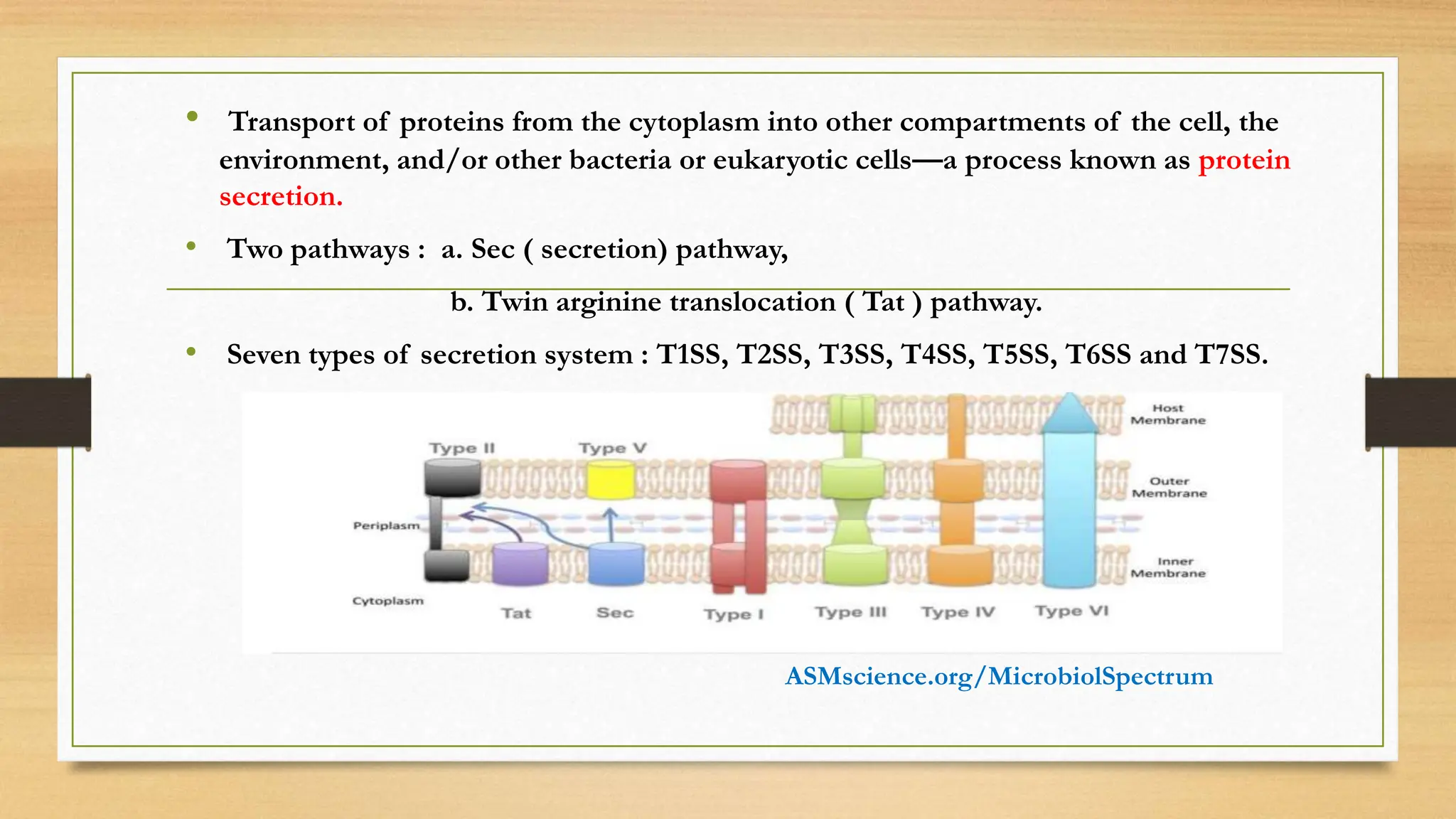
• Transport of proteins from the cytoplasm into other compartments of the cell, the
environment, and/or other bacteria or eukaryotic cells—a process known as protein
secretion.
• Two pathways : a. Sec ( secretion) pathway,
b. Twin arginine translocation ( Tat ) pathway.
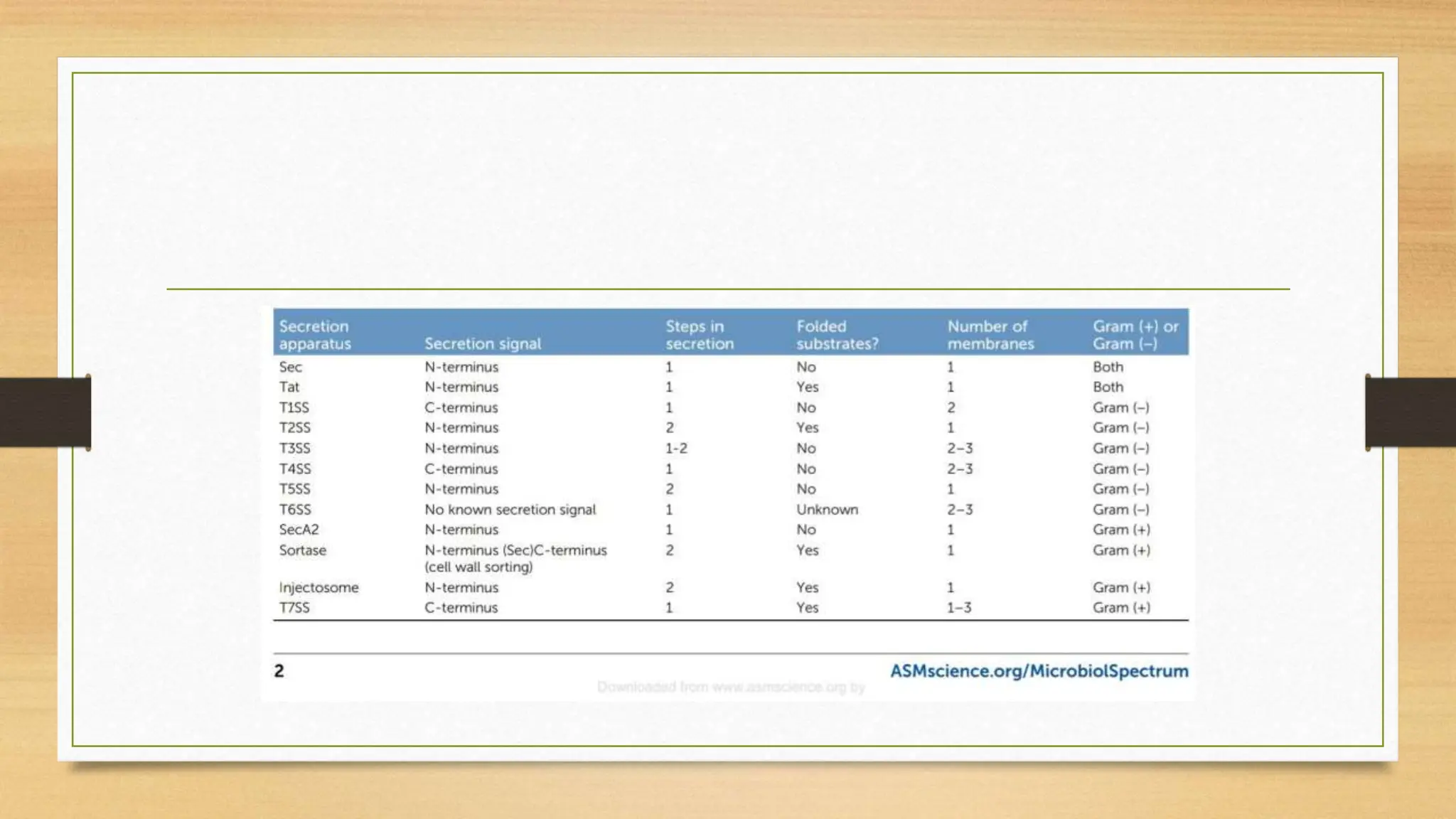
• Seven types of secretion system : T1SS, T2SS, T3SS, T4SS, T5SS, T6SS and T7SS.
ASMscience.org/MicrobiolSpectrum
The Sec secretion pathway
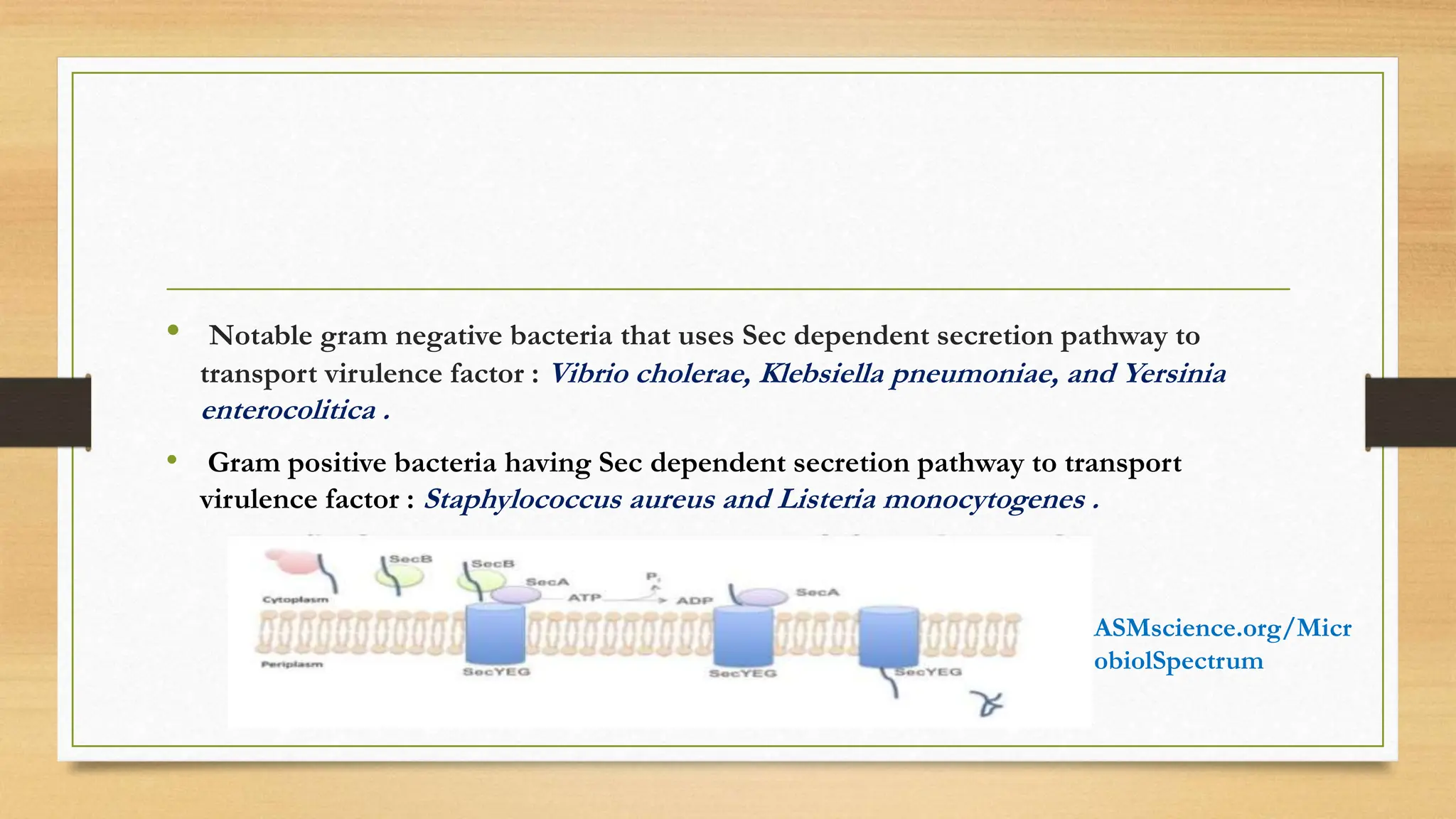
• Mainly translocate proteins in their unfolded state.
• This pathway relies on presence of signal sequence at N-terminal of nascent
polypeptide.
• Two types of signals :
a. SecB - specific signal sequence = Directs protein transport outside of cell.
b. SRP – specific signal sequence = proteins meant to remain in the inner
membrane.
• Notable gram negative bacteria that uses Sec dependent secretion pathway to
transport virulence factor : Vibrio cholerae, Klebsiella pneumoniae, and Yersinia
enterocolitica .
• Gram positive bacteria having Sec dependent secretion pathway to transport
virulence factor : Staphylococcus aureus and Listeria monocytogenes .
ASMscience.org/Micr
obiolSpectrum
The Tat secretion pathway
• Mainly concerned with secretion of folded proteins.
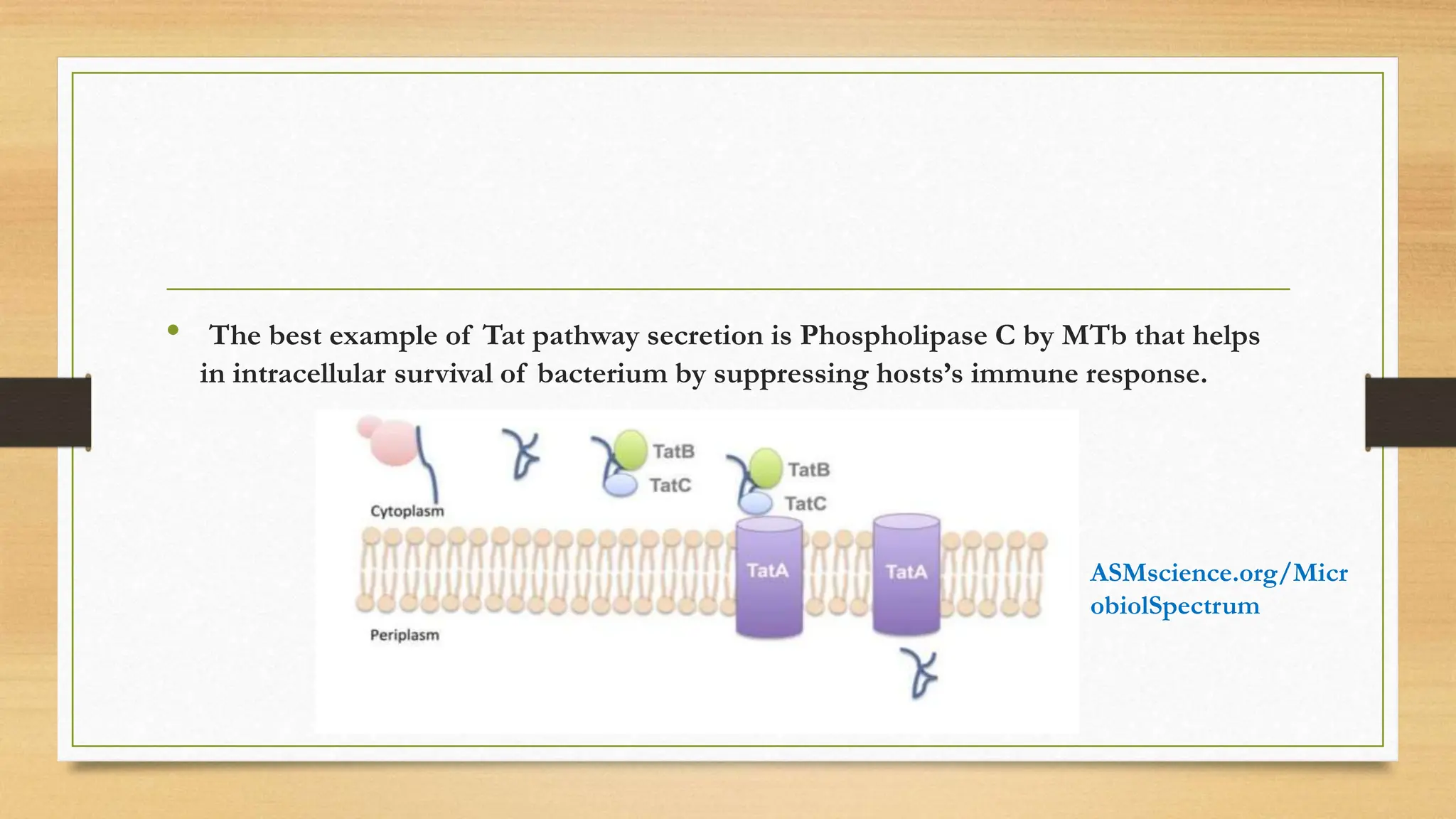
• Consists with two or three subunits : TatA, TatB and TatC (in Gram-positive
bacteria, TatA and TatB are combined into one multifunctional protein).
• Signal sequence contains a pair of twin arginine ( -X-R-R- ) in N-terminal of folded
proteins.
• Pathogenic bacteria having functional Tat pathway to transport virulence factor :
Pseudomonas aeruginosa, Yersinia pseudotuberculosis , and E. Coli O157:H7.
• The best example of Tat pathway secretion is Phospholipase C by MTb that helps
in intracellular survival of bacterium by suppressing hosts’s immune response.
ASMscience.org/Micr
obiolSpectrum
Types of secretion system in bacteria
1. Type 1 secretion system ( T1SS )
• Found in large number in gram negative pathogenic bacteria.
• Closely resemblance with ATP binding cassette ( ABC ) transporters family.
• Signal sequence found on C-terminus of polypeptide.
• Three essential structural components of T1SS :
i). ABC transporter protein : Found in inner membrane and catalyzes the ATP to
release energy to transport substrates.
ii). Membrane fusion protein ( MFP ) : Linking the inner and outer membrane. The
MFP associates with the ABC transporter in the inner membrane and spans the
periplasm to associate with the OMF. N-terminus of MFP play a role in substrate
selection.
iii). Outer membrane factor ( OMF ) : Found in outer membrane and generates a pore
through which substrate can cross the plasma membrane in an unfolded state.
• The best studies T1SS substrate is HlyA hemolysin protein of uropathogenic E.coli.
• Vibrio cholerae uses T1SS to secrete MARTX toxin – a virulence factor.
2. Type 2 Secretion System ( T2SS ).
• Found mostly in gram negative bacteria .
• Transport folded proteins from periplasm to outside of cell.
• T2SS located in outer membrane, hence protein needs to come in outer membrane
from cytosol through Sec or Tat pathway.
• Consists of four components of T2SS, which are :
i). Outer membrane complex : Found in outer membrane, where it serves as channel to
translocate T2SS substrate protein.
ii). Inner membrane plateform : plays crucial role proteins secretion process by
communicating with the secretin, pseudopilus, and ATPase to coordinate export of
substrates.
iii). ATPase region : located in cytoplasm and provides energy to power transport.
iv). Pseudopilus region : It acts as piston to provide push force to T2SS folded protein.
• Vibrio cholerae uses T2SS to release its cholera toxin.
• Bacteria having functional T2SS are : L. pneumophila, E. coli and K. pneumoniae.
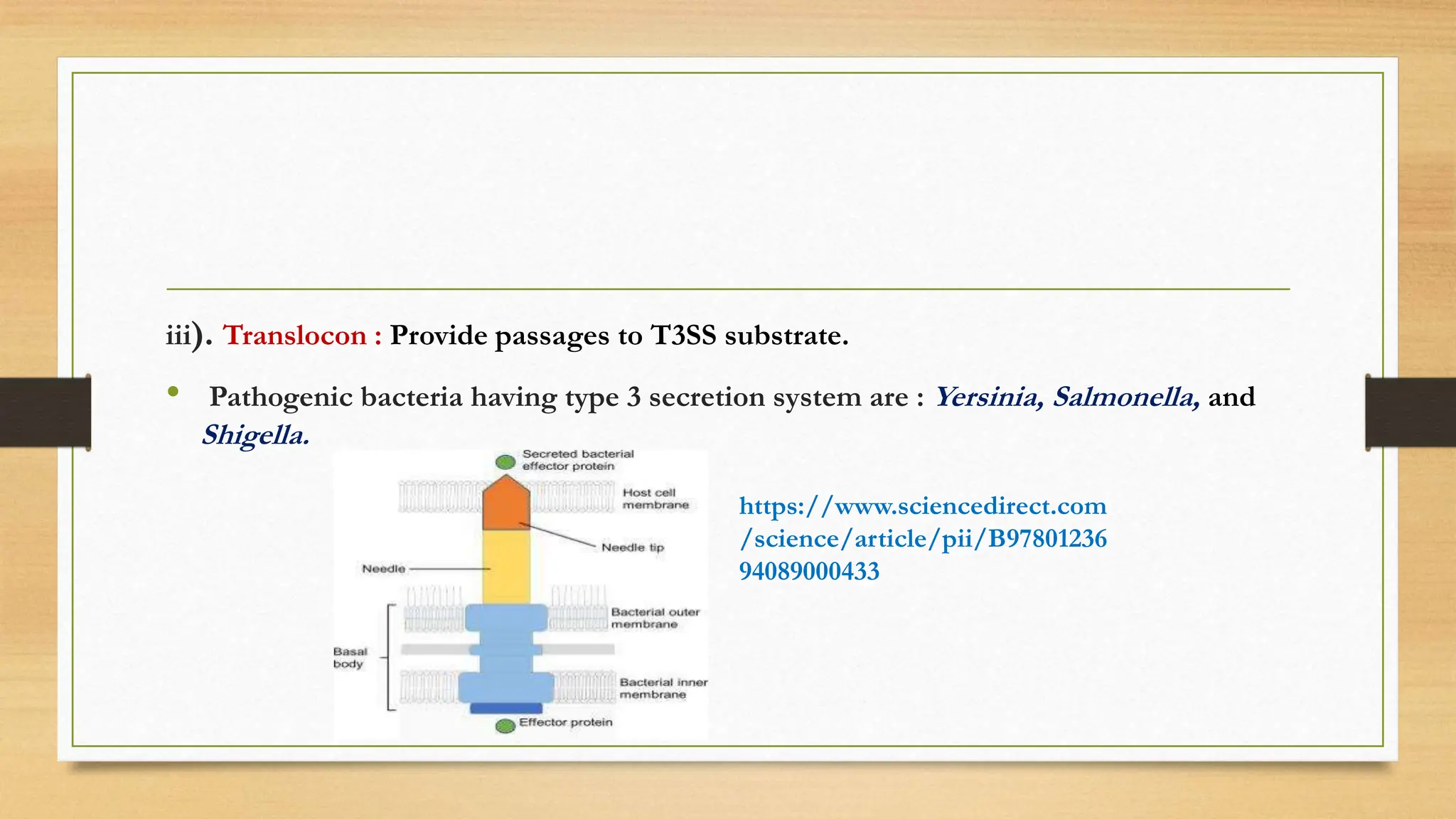
3. Type 3 Secretion System ( T3SS ).
• Found in large number in gram negative pathogenic and symbionts bacteria.
• Secrets wide variety of protein across both inner and outer membrane of bacterium.
• Composed of three main components:
i). Base complex : The base complex contains cytoplasmic components and spans the
inner and outer membrane, forming a socket-like structure consisting of several rings
with a centre rod.
ii). Needle : an intermediate hollow component.
iii). Translocon : Provide passages to T3SS substrate.
• Pathogenic bacteria having type 3 secretion system are : Yersinia, Salmonella, and
Shigella.
https://www.sciencedirect.com
/science/article/pii/B97801236
94089000433
4. Type 4 Secretion System ( T4SS )
• T4SSs are ancestrally related to bacterial DNA conjugation system .
• Secrets substrates into wide range of cells including other bacteria and eukaryotic
cells.
• Largely found in gram negative bacteria.
• Agrobacterium tumefacium uses its T4SS to transports its oncogene into plants.
• T4SSs plays a pivotal role in wide range of bacteria to transport virulence factor,
such as Neisseria gonorrhoe, L. Pneumophila, Brucella suis, and Helicobacter
pylori.
5. Type 5 Secretion System ( T5SS )
• Found in outer membrane of both, gram positive and gram negative bacteria.
• Having unique substrate possessing beta barrel domain.
• Because, found in outer membrane hence it is Sec pathway dependent secretion
system.
• Most notable T5SSs substrate is IcsA protein of Shigella flexneri and YadA of
Yersinia enterocolitica.
• Three classes of T5SSs are :
A. Auto transporter secretion: Contain components that allow them to secrete
themselves .
B. Two partner secretion : Found in gram negative bacteria and resposible for
secretion of large virulence protein such as filamentous hemagglutinin of
Bordetella pertussis.
C. Chaperone–usher secretion : Chaperone–usher systems are commonly used to
assemble pilins on the surface of Gram-negative bacteria, such as the P. Pilus of
uropathogenic E. coli.
6. Type 6 Secretion System ( T6SS )
• Most recent discovered bacterial secretion system.
• Conserved in wide variety of gram negative bacteria.
• capable of transporting effector proteins from one bacterium to another in a
contact-dependent manner.
• mechanisms of how these T6SSs contribute to survival in the environment (and in
mammalian infection) have not been determined.
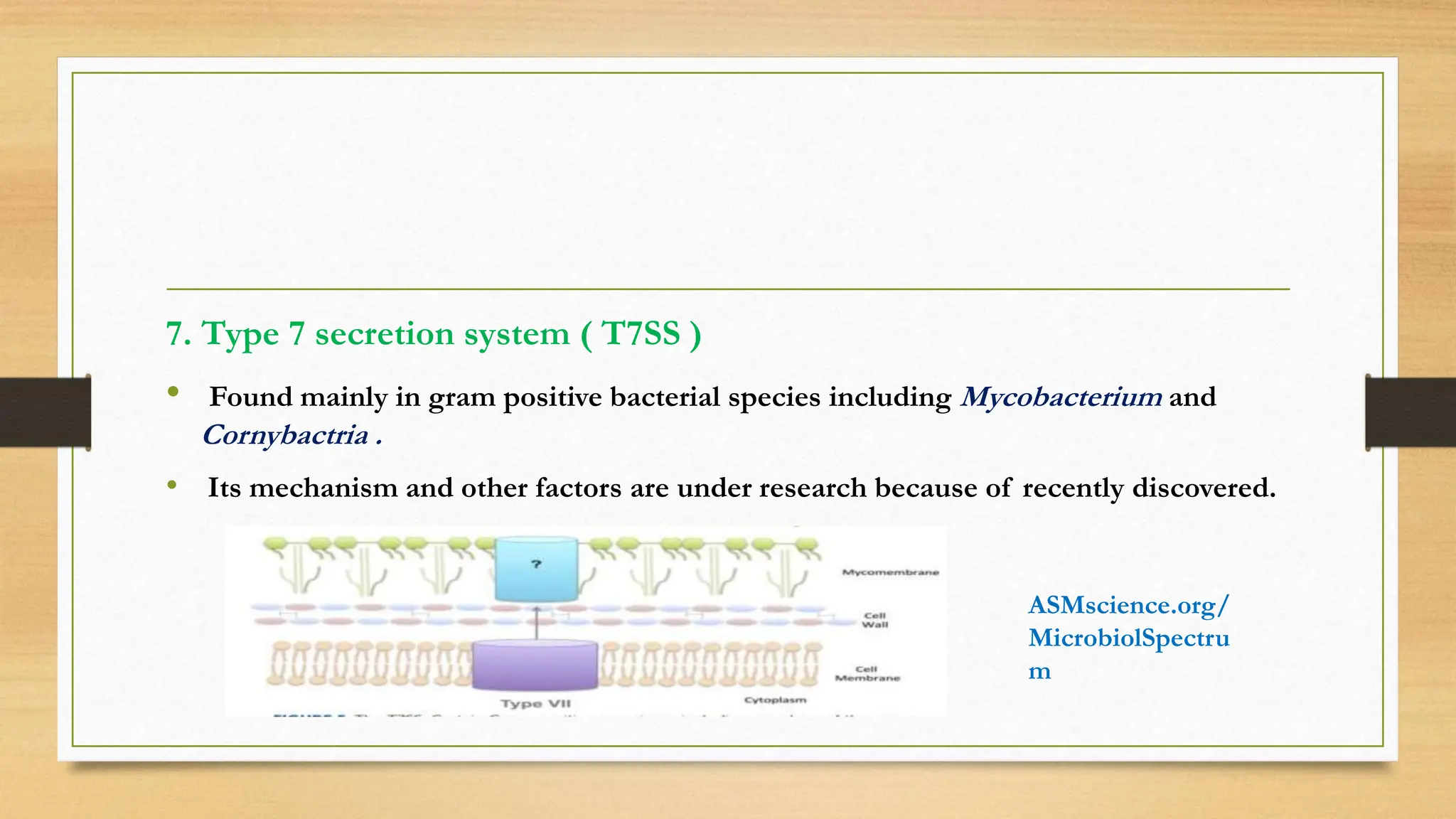
7. Type 7 secretion system ( T7SS )
• Found mainly in gram positive bacterial species including Mycobacterium and
Cornybactria .
• Its mechanism and other factors are under research because of recently discovered.
ASMscience.org/
MicrobiolSpectru
m
Thank you

Bacterial secretion system and types .pptx

  • 1.
  • 2.
    • Transport ofproteins from the cytoplasm into other compartments of the cell, the environment, and/or other bacteria or eukaryotic cells—a process known as protein secretion. • Two pathways : a. Sec ( secretion) pathway, b. Twin arginine translocation ( Tat ) pathway. • Seven types of secretion system : T1SS, T2SS, T3SS, T4SS, T5SS, T6SS and T7SS. ASMscience.org/MicrobiolSpectrum
  • 3.
    The Sec secretionpathway • Mainly translocate proteins in their unfolded state. • This pathway relies on presence of signal sequence at N-terminal of nascent polypeptide. • Two types of signals : a. SecB - specific signal sequence = Directs protein transport outside of cell. b. SRP – specific signal sequence = proteins meant to remain in the inner membrane.
  • 4.
    • Notable gramnegative bacteria that uses Sec dependent secretion pathway to transport virulence factor : Vibrio cholerae, Klebsiella pneumoniae, and Yersinia enterocolitica . • Gram positive bacteria having Sec dependent secretion pathway to transport virulence factor : Staphylococcus aureus and Listeria monocytogenes . ASMscience.org/Micr obiolSpectrum
  • 5.
    The Tat secretionpathway • Mainly concerned with secretion of folded proteins. • Consists with two or three subunits : TatA, TatB and TatC (in Gram-positive bacteria, TatA and TatB are combined into one multifunctional protein). • Signal sequence contains a pair of twin arginine ( -X-R-R- ) in N-terminal of folded proteins. • Pathogenic bacteria having functional Tat pathway to transport virulence factor : Pseudomonas aeruginosa, Yersinia pseudotuberculosis , and E. Coli O157:H7.
  • 6.
    • The bestexample of Tat pathway secretion is Phospholipase C by MTb that helps in intracellular survival of bacterium by suppressing hosts’s immune response. ASMscience.org/Micr obiolSpectrum
  • 7.
    Types of secretionsystem in bacteria 1. Type 1 secretion system ( T1SS ) • Found in large number in gram negative pathogenic bacteria. • Closely resemblance with ATP binding cassette ( ABC ) transporters family. • Signal sequence found on C-terminus of polypeptide. • Three essential structural components of T1SS : i). ABC transporter protein : Found in inner membrane and catalyzes the ATP to release energy to transport substrates.
  • 8.
    ii). Membrane fusionprotein ( MFP ) : Linking the inner and outer membrane. The MFP associates with the ABC transporter in the inner membrane and spans the periplasm to associate with the OMF. N-terminus of MFP play a role in substrate selection. iii). Outer membrane factor ( OMF ) : Found in outer membrane and generates a pore through which substrate can cross the plasma membrane in an unfolded state. • The best studies T1SS substrate is HlyA hemolysin protein of uropathogenic E.coli. • Vibrio cholerae uses T1SS to secrete MARTX toxin – a virulence factor.
  • 9.
    2. Type 2Secretion System ( T2SS ). • Found mostly in gram negative bacteria . • Transport folded proteins from periplasm to outside of cell. • T2SS located in outer membrane, hence protein needs to come in outer membrane from cytosol through Sec or Tat pathway. • Consists of four components of T2SS, which are : i). Outer membrane complex : Found in outer membrane, where it serves as channel to translocate T2SS substrate protein.
  • 10.
    ii). Inner membraneplateform : plays crucial role proteins secretion process by communicating with the secretin, pseudopilus, and ATPase to coordinate export of substrates. iii). ATPase region : located in cytoplasm and provides energy to power transport. iv). Pseudopilus region : It acts as piston to provide push force to T2SS folded protein. • Vibrio cholerae uses T2SS to release its cholera toxin. • Bacteria having functional T2SS are : L. pneumophila, E. coli and K. pneumoniae.
  • 11.
    3. Type 3Secretion System ( T3SS ). • Found in large number in gram negative pathogenic and symbionts bacteria. • Secrets wide variety of protein across both inner and outer membrane of bacterium. • Composed of three main components: i). Base complex : The base complex contains cytoplasmic components and spans the inner and outer membrane, forming a socket-like structure consisting of several rings with a centre rod. ii). Needle : an intermediate hollow component.
  • 12.
    iii). Translocon :Provide passages to T3SS substrate. • Pathogenic bacteria having type 3 secretion system are : Yersinia, Salmonella, and Shigella. https://www.sciencedirect.com /science/article/pii/B97801236 94089000433
  • 13.
    4. Type 4Secretion System ( T4SS ) • T4SSs are ancestrally related to bacterial DNA conjugation system . • Secrets substrates into wide range of cells including other bacteria and eukaryotic cells. • Largely found in gram negative bacteria. • Agrobacterium tumefacium uses its T4SS to transports its oncogene into plants. • T4SSs plays a pivotal role in wide range of bacteria to transport virulence factor, such as Neisseria gonorrhoe, L. Pneumophila, Brucella suis, and Helicobacter pylori.
  • 14.
    5. Type 5Secretion System ( T5SS ) • Found in outer membrane of both, gram positive and gram negative bacteria. • Having unique substrate possessing beta barrel domain. • Because, found in outer membrane hence it is Sec pathway dependent secretion system. • Most notable T5SSs substrate is IcsA protein of Shigella flexneri and YadA of Yersinia enterocolitica.
  • 15.
    • Three classesof T5SSs are : A. Auto transporter secretion: Contain components that allow them to secrete themselves . B. Two partner secretion : Found in gram negative bacteria and resposible for secretion of large virulence protein such as filamentous hemagglutinin of Bordetella pertussis. C. Chaperone–usher secretion : Chaperone–usher systems are commonly used to assemble pilins on the surface of Gram-negative bacteria, such as the P. Pilus of uropathogenic E. coli.
  • 16.
    6. Type 6Secretion System ( T6SS ) • Most recent discovered bacterial secretion system. • Conserved in wide variety of gram negative bacteria. • capable of transporting effector proteins from one bacterium to another in a contact-dependent manner. • mechanisms of how these T6SSs contribute to survival in the environment (and in mammalian infection) have not been determined.
  • 17.
    7. Type 7secretion system ( T7SS ) • Found mainly in gram positive bacterial species including Mycobacterium and Cornybactria . • Its mechanism and other factors are under research because of recently discovered. ASMscience.org/ MicrobiolSpectru m
  • 19.