Standards
HS-LS1-2. Developand use a model to illustrate the
key functions of animal body systems, including (a)
food digestion, nutrient uptake, and transport through
the body; (b) exchange of oxygen and carbon
dioxide; (c) removal of wastes; and (d) regulation of
body processes. Clarification Statement:
• Emphasis is on the primary function of the following body
systems (and structures): digestive (mouth, stomach,
small intestine [villi], large intestine, pancreas), respiratory
(lungs [alveoli], diaphragm), circulatory (heart, veins,
arteries, capillaries), excretory (kidneys, liver, skin), and
nervous (neurons, brain, spinal cord).
3.
Standards cont.
HS-LS1-3.Provide evidence that homeostasis maintains internal
body conditions through both body-wide feedback mechanisms
and small-scale cellular processes.
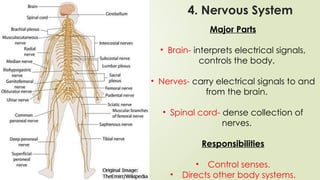
Clarification Statements:
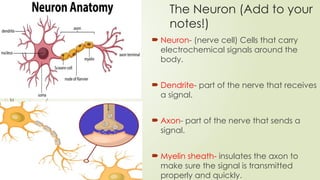
• Feedback mechanisms include the promotion of a stimulus through
positive feedback (e.g., injured tissues releasing chemicals in blood
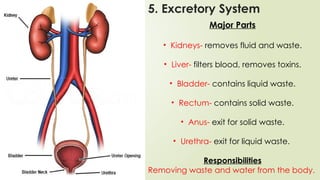
that activate platelets to facilitate blood clotting), and the inhibition
of stimulus through negative feedback (e.g., insulin reducing high
blood glucose to normal levels).
• Cellular processes include (a) passive transport and active transport
of materials across the cell membrane to maintain specific
concentrations of water and other nutrients in the cell and (b) the
role of lysosomes in recycling wastes, macromolecules, and cell
parts into monomers.
4.
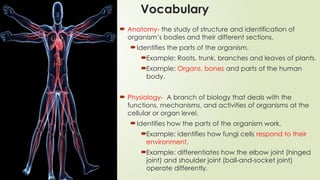
Vocabulary
Anatomy- thestudy of structure and identification of
organism’s bodies and their different sections.
Identifies the parts of the organism.
Example: Roots, trunk, branches and leaves of plants.
Example: Organs, bones and parts of the human
body.
Physiology- A branch of biology that deals with the
functions, mechanisms, and activities of organisms at the
cellular or organ level.
Identifies how the parts of the organism work.
Example: identifies how fungi cells respond to their
environment.
Example: differentiates how the elbow joint (hinged
joint) and shoulder joint (ball-and-socket joint)
operate differently.
Feedback Loops
Positivefeedback loop: the body will promote a change to
continue happening until the stimulus is gone.
Example: When a woman is in labor, the baby puts pressure on
the cervix (stimulus). This causes contractions and hormones to
be made to aid the woman in giving birth to her offspring. It
promotes birth.
Negative feedback loop: the body will reduce a change; it will take
measures to undo the stimulus to eventually return to a desired set
point.
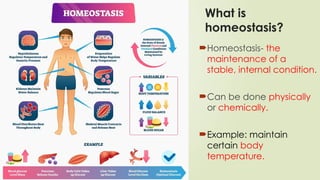
Example: When a human is hot, the body senses it has exceeded
the homeostatic temperature (98.6 F). The body will sweat, and
cause the body to cool down. Once the body has reached the
homeostatic temperature again, the sweating will stop.
8.
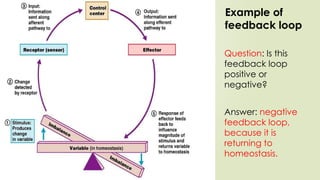
Example of
feedback loop
Question:Is this
feedback loop
positive or
negative?
Answer: negative
feedback loop,
because it is
returning to
homeostasis.
9.
Review: feedback loops
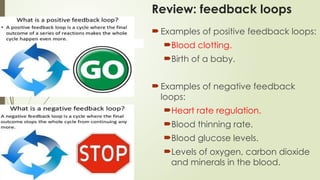
Examplesof positive feedback loops:
Blood clotting.
Birth of a baby.
Examples of negative feedback
loops:
Heart rate regulation.
Blood thinning rate.
Blood glucose levels.
Levels of oxygen, carbon dioxide
and minerals in the blood.
10.
Body systems
Students needto know the main responsibility of
each body system, and be familiar with the function
of the organs review in this lecture.
Review your notes thoroughly!
This unit will review the process of diffusion and cell
transport!
11.
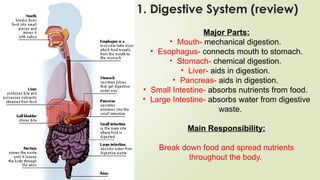
Major Parts:
• Mouth-mechanical digestion.
• Esophagus- connects mouth to stomach.
• Stomach- chemical digestion.
• Liver- aids in digestion.
• Pancreas- aids in digestion.
• Small Intestine- absorbs nutrients from food.
• Large Intestine- absorbs water from digestive
waste.
Main Responsibility:
Break down food and spread nutrients
throughout the body.
1. Digestive System (review)
12.
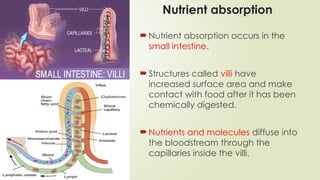
Nutrient absorption
Nutrient absorptionoccurs in the
small intestine.
Structures called villi have
increased surface area and make
contact with food after it has been
chemically digested.
Nutrients and molecules diffuse into
the bloodstream through the
capillaries inside the villi.
13.
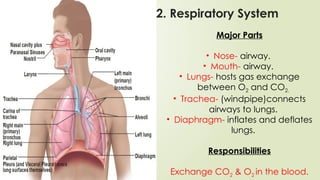
Major Parts
• Nose-airway.
• Mouth- airway.
• Lungs- hosts gas exchange
between O2 and CO2.
• Trachea- (windpipe)connects
airways to lungs.
• Diaphragm- inflates and deflates
lungs.
Responsibilities
Exchange CO2 & O2 in the blood.
2. Respiratory System
14.
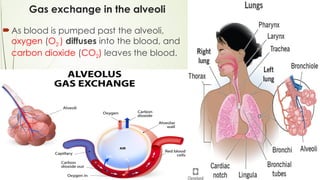
Gas exchange inthe alveoli
As blood is pumped past the alveoli,
oxygen (O2 ) diffuses into the blood, and
carbon dioxide (CO2) leaves the blood.
15.
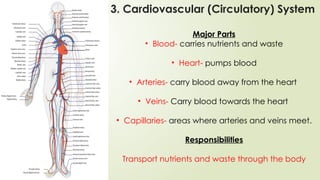
Major Parts
• Blood-carries nutrients and waste
• Heart- pumps blood
• Arteries- carry blood away from the heart
• Veins- Carry blood towards the heart
• Capillaries- areas where arteries and veins meet.
Responsibilities
Transport nutrients and waste through the body
3. Cardiovascular (Circulatory) System
16.
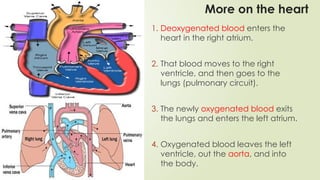
More on theheart
1. Deoxygenated blood enters the
heart in the right atrium.
2. That blood moves to the right
ventricle, and then goes to the
lungs (pulmonary circuit).
3. The newly oxygenated blood exits
the lungs and enters the left atrium.
4. Oxygenated blood leaves the left
ventricle, out the aorta, and into
the body.
17.
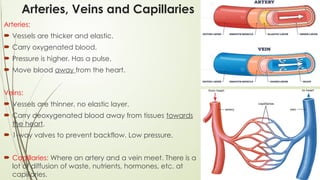
Arteries, Veins andCapillaries
Arteries:
Vessels are thicker and elastic.
Carry oxygenated blood.
Pressure is higher. Has a pulse.
Move blood away from the heart.
Veins:
Vessels are thinner, no elastic layer.
Carry deoxygenated blood away from tissues towards
the heart.
1-way valves to prevent backflow. Low pressure.
Capillaries: Where an artery and a vein meet. There is a
lot of diffusion of waste, nutrients, hormones, etc. at
capillaries.
18.
Major Parts
• Brain-interprets electrical signals,
controls the body.
• Nerves- carry electrical signals to and
from the brain.
• Spinal cord- dense collection of
nerves.
Responsibilities
• Control senses.
• Directs other body systems.
4. Nervous System
19.
The Neuron (Addto your
notes!)
Neuron- (nerve cell) Cells that carry
electrochemical signals around the
body.
Dendrite- part of the nerve that receives
a signal.
Axon- part of the nerve that sends a
signal.
Myelin sheath- insulates the axon to
make sure the signal is transmitted
properly and quickly.
20.
Parasympathetic nervous system
Motor neurons:
Responsible for connecting the brain to muscles
Cause muscles to move when prompted by the brain
Sensory neurons:
Responsible for sensing the 5 stimuli (sight, smell, touch, hearing, taste)
Send electrochemical information to the brain
21.
Major Parts
• Kidneys-removes fluid and waste.
• Liver- filters blood, removes toxins.
• Bladder- contains liquid waste.
• Rectum- contains solid waste.
• Anus- exit for solid waste.
• Urethra- exit for liquid waste.
Responsibilities
Removing waste and water from the body.
5. Excretory System
22.
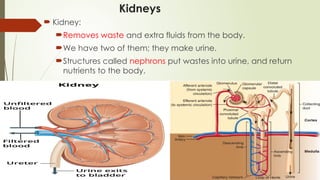
Kidneys
Kidney:
Removes wasteand extra fluids from the body.
We have two of them; they make urine.
Structures called nephrons put wastes into urine, and return
nutrients to the body.
23.
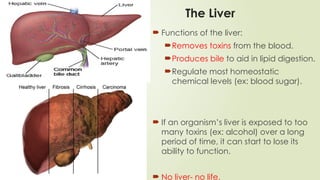
The Liver
Functionsof the liver:
Removes toxins from the blood.
Produces bile to aid in lipid digestion.
Regulate most homeostatic
chemical levels (ex: blood sugar).
If an organism’s liver is exposed to too
many toxins (ex: alcohol) over a long
period of time, it can start to lose its
ability to function.
No liver- no life.
24.
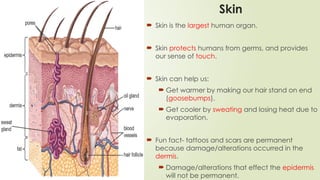
Skin
Skin isthe largest human organ.
Skin protects humans from germs, and provides
our sense of touch.
Skin can help us:
Get warmer by making our hair stand on end
(goosebumps).
Get cooler by sweating and losing heat due to
evaporation.
Fun fact- tattoos and scars are permanent
because damage/alterations occurred in the
dermis.
Damage/alterations that effect the epidermis
will not be permanent.

![Standards
HS-LS1-2. Develop and use a model to illustrate the
key functions of animal body systems, including (a)
food digestion, nutrient uptake, and transport through
the body; (b) exchange of oxygen and carbon
dioxide; (c) removal of wastes; and (d) regulation of
body processes. Clarification Statement:
• Emphasis is on the primary function of the following body
systems (and structures): digestive (mouth, stomach,
small intestine [villi], large intestine, pancreas), respiratory
(lungs [alveoli], diaphragm), circulatory (heart, veins,
arteries, capillaries), excretory (kidneys, liver, skin), and
nervous (neurons, brain, spinal cord).](https://image.slidesharecdn.com/humananatyomylecture-260113124112-e27924da/85/Human-Anatomy-Lecture-powerpoint-on-body-systems-2-320.jpg)



![PERI-PROSTHETIC FRACTURE NAIL-PLATE CONSTRUCT [NPC].pptx](https://cdn.slidesharecdn.com/ss_thumbnails/drarunkumardrmohamedashrafperiprostheticfrasturenail-plateconstructnpc-260209164459-7e9d15a1-thumbnail.jpg?width=640&height=640&fit=bounds)


