Annotated bibliography
INTERNATIONAL MANAGEMENT
Irena Trebic, Librarian
Outline
 Components of an annotated bibliography
 Citing resources using APA style
 Brainstorming activity
 CRAAP Checklist
 Article evaluation and discussion activity
 Mini quiz
 Workshop evaluation
Learning Outcomes
 Identify the format and components of an annotated bibliography
 Understand the purpose of an annotated bibliography
 Differentiate between scholarly and popular resources
 Identify bibliographic information such as journal title, volume, doi, etc in
a scholarly journal
 Critically evaluate resources using the CRAAP Checklist
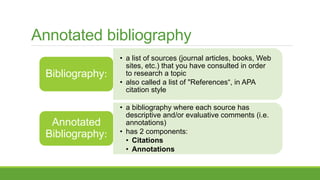
Annotated bibliography
• a list of sources (journal articles, books, Web
sites, etc.) that you have consulted in order
to research a topic
• also called a list of "References“, in APA
citation style
Bibliography:
• a bibliography where each source has
descriptive and/or evaluative comments (i.e.
annotations)
• has 2 components:
• Citations
• Annotations
Annotated
Bibliography:
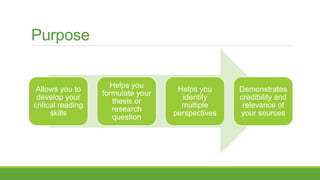
Purpose
Allows you to
develop your
critical reading
skills
Helps you
formulate your
thesis or
research
question
Helps you
identify
multiple
perspectives
Demonstrates
credibility and
relevance of
your sources
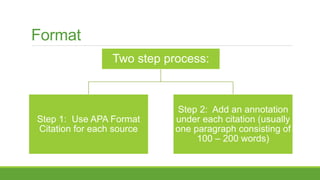
Format
Two step process:
Step 1: Use APA Format
Citation for each source
Step 2: Add an annotation
under each citation (usually
one paragraph consisting of
100 – 200 words)
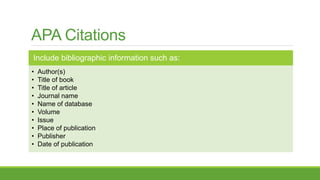
APA Citations
Include bibliographic information such as:
• Author(s)
• Title of book
• Title of article
• Journal name
• Name of database
• Volume
• Issue
• Place of publication
• Publisher
• Date of publication
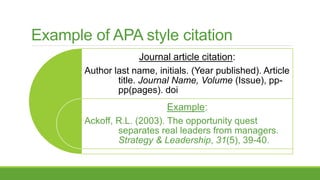
Example of APA style citation
Journal article citation:
Author last name, initials. (Year published). Article
title. Journal Name, Volume (Issue), pp-
pp(pages). doi
Example:
Ackoff, R.L. (2003). The opportunity quest
separates real leaders from managers.
Strategy & Leadership, 31(5), 39-40.
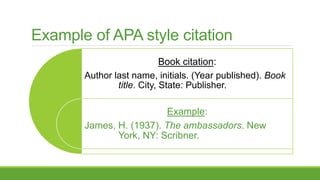
Example of APA style citation
Book citation:
Author last name, initials. (Year published). Book
title. City, State: Publisher.
Example:
James, H. (1937). The ambassadors. New
York, NY: Scribner.
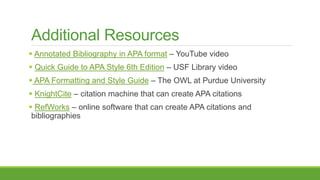
Additional Resources
 Annotated Bibliography in APA format – YouTube video
 Quick Guide to APA Style 6th Edition – USF Library video
 APA Formatting and Style Guide – The OWL at Purdue University
 KnightCite – citation machine that can create APA citations
 RefWorks – online software that can create APA citations and
bibliographies
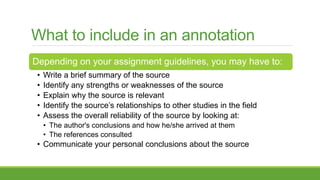
What to include in an annotation
Depending on your assignment guidelines, you may have to:
• Write a brief summary of the source
• Identify any strengths or weaknesses of the source
• Explain why the source is relevant
• Identify the source’s relationships to other studies in the field
• Assess the overall reliability of the source by looking at:
• The author's conclusions and how he/she arrived at them
• The references consulted
• Communicate your personal conclusions about the source
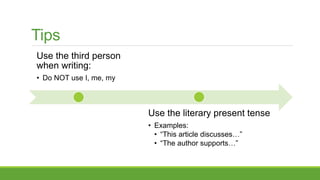
Tips
Use the third person
when writing:
• Do NOT use I, me, my
Use the literary present tense
• Examples:
• “This article discusses…”
• “The author supports…”
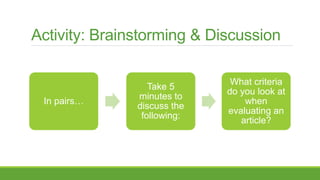
Activity: Brainstorming & Discussion
In pairs…
Take 5
minutes to
discuss the
following:
What criteria
do you look at
when
evaluating an
article?
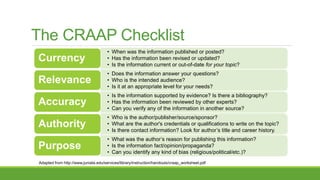
The CRAAP Checklist
• When was the information published or posted?
• Has the information been revised or updated?
• Is the information current or out-of-date for your topic?
Currency
• Does the information answer your questions?
• Who is the intended audience?
• Is it at an appropriate level for your needs?
Relevance
• Is the information supported by evidence? Is there a bibliography?
• Has the information been reviewed by other experts?
• Can you verify any of the information in another source?
Accuracy
• Who is the author/publisher/source/sponsor?
• What are the author's credentials or qualifications to write on the topic?
• Is there contact information? Look for author’s title and career history.
Authority
• What was the author’s reason for publishing this information?
• Is the information fact/opinion/propaganda?
• Can you identify any kind of bias (religious/political/etc.)?
Purpose
Adapted from http://www.juniata.edu/services/library/instruction/handouts/craap_worksheet.pdf
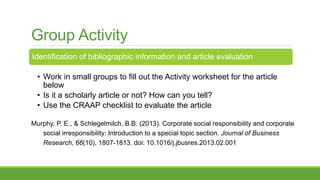
Group Activity
Identification of bibliographic information and article evaluation
• Work in small groups to fill out the Activity worksheet for the article
below
• Is it a scholarly article or not? How can you tell?
• Use the CRAAP checklist to evaluate the article
Murphy, P. E., & Schlegelmilch, B.B. (2013). Corporate social responsibility and corporate
social irresponsibility: Introduction to a special topic section. Journal of Business
Research, 66(10), 1807-1813. doi: 10.1016/j.jbusres.2013.02.001
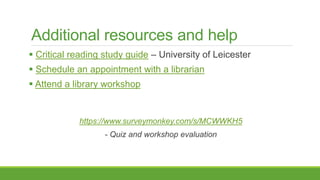
Additional resources and help
 Critical reading study guide – University of Leicester
 Schedule an appointment with a librarian
 Attend a library workshop
https://www.surveymonkey.com/s/MCWWKH5
- Quiz and workshop evaluation
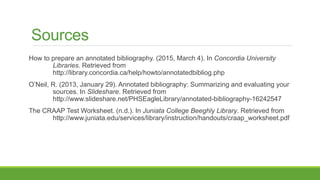
References
How to prepare an annotated bibliography. (2015, March 4). In Concordia University
Libraries. Retrieved from
http://library.concordia.ca/help/howto/annotatedbibliog.php
O’Neil, R. (2013, January 29). Annotated bibliography: Summarizing and evaluating your
sources. In Slideshare. Retrieved from
http://www.slideshare.net/PHSEagleLibrary/annotated-bibliography-16242547
The CRAAP Test Worksheet. (n.d.). In Juniata College Beeghly Library. Retrieved from
http://www.juniata.edu/services/library/instruction/handouts/craap_worksheet.pdf

Annotated bibliography MAN 4600

  • 1.
  • 2.
    Outline  Components ofan annotated bibliography  Citing resources using APA style  Brainstorming activity  CRAAP Checklist  Article evaluation and discussion activity  Mini quiz  Workshop evaluation
  • 3.
    Learning Outcomes  Identifythe format and components of an annotated bibliography  Understand the purpose of an annotated bibliography  Differentiate between scholarly and popular resources  Identify bibliographic information such as journal title, volume, doi, etc in a scholarly journal  Critically evaluate resources using the CRAAP Checklist
  • 4.
    Annotated bibliography • alist of sources (journal articles, books, Web sites, etc.) that you have consulted in order to research a topic • also called a list of "References“, in APA citation style Bibliography: • a bibliography where each source has descriptive and/or evaluative comments (i.e. annotations) • has 2 components: • Citations • Annotations Annotated Bibliography:
  • 5.
    Purpose Allows you to developyour critical reading skills Helps you formulate your thesis or research question Helps you identify multiple perspectives Demonstrates credibility and relevance of your sources
  • 6.
    Format Two step process: Step1: Use APA Format Citation for each source Step 2: Add an annotation under each citation (usually one paragraph consisting of 100 – 200 words)
  • 7.
    APA Citations Include bibliographicinformation such as: • Author(s) • Title of book • Title of article • Journal name • Name of database • Volume • Issue • Place of publication • Publisher • Date of publication
  • 8.
    Example of APAstyle citation Journal article citation: Author last name, initials. (Year published). Article title. Journal Name, Volume (Issue), pp- pp(pages). doi Example: Ackoff, R.L. (2003). The opportunity quest separates real leaders from managers. Strategy & Leadership, 31(5), 39-40.
  • 9.
    Example of APAstyle citation Book citation: Author last name, initials. (Year published). Book title. City, State: Publisher. Example: James, H. (1937). The ambassadors. New York, NY: Scribner.
  • 10.
    Additional Resources  AnnotatedBibliography in APA format – YouTube video  Quick Guide to APA Style 6th Edition – USF Library video  APA Formatting and Style Guide – The OWL at Purdue University  KnightCite – citation machine that can create APA citations  RefWorks – online software that can create APA citations and bibliographies
  • 11.
    What to includein an annotation Depending on your assignment guidelines, you may have to: • Write a brief summary of the source • Identify any strengths or weaknesses of the source • Explain why the source is relevant • Identify the source’s relationships to other studies in the field • Assess the overall reliability of the source by looking at: • The author's conclusions and how he/she arrived at them • The references consulted • Communicate your personal conclusions about the source
  • 12.
    Tips Use the thirdperson when writing: • Do NOT use I, me, my Use the literary present tense • Examples: • “This article discusses…” • “The author supports…”
  • 13.
    Activity: Brainstorming &Discussion In pairs… Take 5 minutes to discuss the following: What criteria do you look at when evaluating an article?
  • 14.
    The CRAAP Checklist •When was the information published or posted? • Has the information been revised or updated? • Is the information current or out-of-date for your topic? Currency • Does the information answer your questions? • Who is the intended audience? • Is it at an appropriate level for your needs? Relevance • Is the information supported by evidence? Is there a bibliography? • Has the information been reviewed by other experts? • Can you verify any of the information in another source? Accuracy • Who is the author/publisher/source/sponsor? • What are the author's credentials or qualifications to write on the topic? • Is there contact information? Look for author’s title and career history. Authority • What was the author’s reason for publishing this information? • Is the information fact/opinion/propaganda? • Can you identify any kind of bias (religious/political/etc.)? Purpose Adapted from http://www.juniata.edu/services/library/instruction/handouts/craap_worksheet.pdf
  • 15.
    Group Activity Identification ofbibliographic information and article evaluation • Work in small groups to fill out the Activity worksheet for the article below • Is it a scholarly article or not? How can you tell? • Use the CRAAP checklist to evaluate the article Murphy, P. E., & Schlegelmilch, B.B. (2013). Corporate social responsibility and corporate social irresponsibility: Introduction to a special topic section. Journal of Business Research, 66(10), 1807-1813. doi: 10.1016/j.jbusres.2013.02.001
  • 16.
    Additional resources andhelp  Critical reading study guide – University of Leicester  Schedule an appointment with a librarian  Attend a library workshop https://www.surveymonkey.com/s/MCWWKH5 - Quiz and workshop evaluation
  • 17.
    References How to preparean annotated bibliography. (2015, March 4). In Concordia University Libraries. Retrieved from http://library.concordia.ca/help/howto/annotatedbibliog.php O’Neil, R. (2013, January 29). Annotated bibliography: Summarizing and evaluating your sources. In Slideshare. Retrieved from http://www.slideshare.net/PHSEagleLibrary/annotated-bibliography-16242547 The CRAAP Test Worksheet. (n.d.). In Juniata College Beeghly Library. Retrieved from http://www.juniata.edu/services/library/instruction/handouts/craap_worksheet.pdf