Reliable Sources
& Annotated
Bibliography
RUSSELL RODRIGO
Lesson outcomes
1. Evaluate the reliability of sources using the
given criteria
2. Write annotated bibliography of selected
research sources
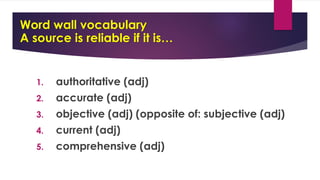
Word wall vocabulary
A source is reliable if it is…
1. authoritative (adj)
2. accurate (adj)
3. objective (adj) (opposite of: subjective (adj)
4. current (adj)
5. comprehensive (adj)
Authoritative
 The source is written by an expert in their field
Not always easy in Internet age
Not all sites list authors
Credentials not always included
If impossible to determine, better not use it
Accurate
A source is accurate if you can rely on the information
it contains.
 University press vs. commercial press
 academic magazines vs. commercial magazines
 respected newspapers vs. tabloids
Objective
A source is objective when it is not
influenced by personal opinions or
feelings (i.e. when it lacks bias).
Current
 A source is current if the information it contains is up-
to-date.
 How current a source should be depends on your
topic.
A current event or a topic about a modern
phenomenon (e.g. technology) needs sources from
the past few years.
For a topic about a historical phenomenon sources
that are decades old might still be current enough.
Comprehensive
 Are these topics successfully addressed, with clearly presented arguments
and adequate support to substantiate them?
 Does the work update other sources, substantiate other materials you have
read, or add new information?
 Is the target audience identified and appropriate for your needs?
 Does it acknowledge counter arguments and avoid biases?
Sample Articles
Dr Jonas’ blog
http://drjonasblog.blogspot.com/2009/03/laptop-use-in-
college-classroom.html
UNRELIABLE
Although Dr. academic research paper. It would be better to read
Dr Jones seems an authority on the subject (he has a Ph.D. and is
a college professor lecturing on technology), a blog is generally
not seen as objective enough to be used in an Jonas’ blog for a
summary of his ideas, and then find work he has actually published
in an authoritative journal (he has also provided helpful links).
Identify if the following are
reliable or unreliable.
1. Dreambox.com article
http://www.dreambox.com/blog/the-effects-of-student-laptops-in-the-classroom
2. Yahoo Answers! Article
https://answers.yahoo.com/question/index?qid=20090913165641AAjhe5V
3. New Orleans The Times Picayune article
http://www.nola.com/education/index.ssf/2016/04/students_should_stop_using_lap.html
4. Academic paper: Mueller and Oppenheimer (2014)
https://sites.udel.edu/victorp/files/2010/11/Psychological-Science-2014-Mueller-0956797614524581-
1u0h0yu.pdf
5. Academic paper: Quade (1996)
http://files.eric.ed.gov/fulltext/ED397825.pdf
Other possible sources on https://padlet.com/StamfordENG/103laptop
What is an ANNOTATED
BIBLIOGRAPHY
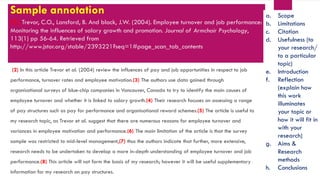
Sample annotation
(1) Trevor, C.O., Lansford, B. And black, J.W. (2004). Employee turnover and job performance:
Monitoring the influences of salary growth and promotion. Journal of Armchair Psychology,
113(1) pp 56-64. Retrieved from
http://www.jstor.org/stable/2393221?seq=1#page_scan_tab_contents
(2) In this article Trevor et al. (2004) review the influences of pay and job opportunities in respect to job
performance, turnover rates and employee motivation.(3) The authors use data gained through
organisational surveys of blue-chip companies in Vancouver, Canada to try to identify the main causes of
employee turnover and whether it is linked to salary growth.(4) Their research focuses on assessing a range
of pay structures such as pay for performance and organisational reward schemes.(5) The article is useful to
my research topic, as Trevor et al. suggest that there are numerous reasons for employee turnover and
variances in employee motivation and performance.(6) The main limitation of the article is that the survey
sample was restricted to mid-level management,(7) thus the authors indicate that further, more extensive,
research needs to be undertaken to develop a more in-depth understanding of employee turnover and job
performance.(8) This article will not form the basis of my research; however it will be useful supplementary
information for my research on pay structures.
a. Scope
b. Limitations
c. Citation
d. Usefulness (to
your research/
to a particular
topic)
e. Introduction
f. Reflection
(explain how
this work
illuminates
your topic or
how it will fit in
with your
research)
g. Aims &
Research
methods
h. Conclusions
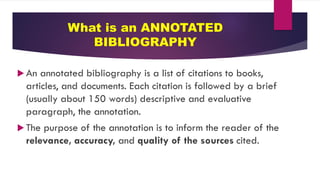
What is an ANNOTATED
BIBLIOGRAPHY
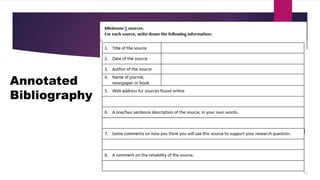
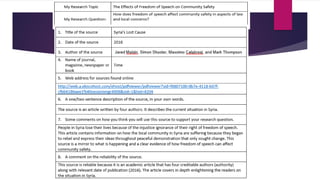
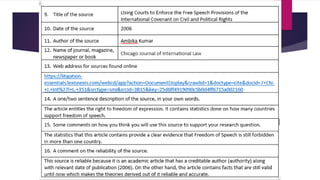
 An annotated bibliography is a list of citations to books,
articles, and documents. Each citation is followed by a brief
(usually about 150 words) descriptive and evaluative
paragraph, the annotation.
 The purpose of the annotation is to inform the reader of the
relevance, accuracy, and quality of the sources cited.
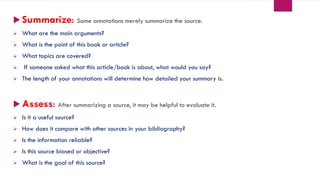
 Summarize: Some annotations merely summarize the source.
 What are the main arguments?
 What is the point of this book or article?
 What topics are covered?
 If someone asked what this article/book is about, what would you say?
 The length of your annotations will determine how detailed your summary is.
 Assess: After summarizing a source, it may be helpful to evaluate it.
 Is it a useful source?
 How does it compare with other sources in your bibliography?
 Is the information reliable?
 Is this source biased or objective?
 What is the goal of this source?
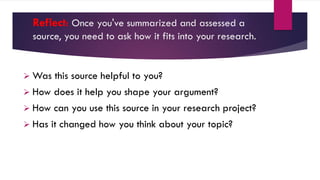
Reflect: Once you've summarized and assessed a
source, you need to ask how it fits into your research.
 Was this source helpful to you?
 How does it help you shape your argument?
 How can you use this source in your research project?
 Has it changed how you think about your topic?
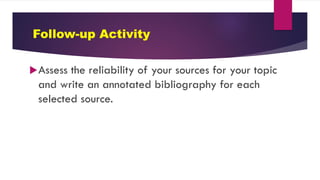
Follow-up Activity
Assess the reliability of your sources for your topic
and write an annotated bibliography for each
selected source.
Annotated
Bibliography
Reliable sources and annotated bibliography

Reliable sources and annotated bibliography

  • 1.
  • 2.
    Lesson outcomes 1. Evaluatethe reliability of sources using the given criteria 2. Write annotated bibliography of selected research sources
  • 3.
    Word wall vocabulary Asource is reliable if it is… 1. authoritative (adj) 2. accurate (adj) 3. objective (adj) (opposite of: subjective (adj) 4. current (adj) 5. comprehensive (adj)
  • 4.
    Authoritative  The sourceis written by an expert in their field Not always easy in Internet age Not all sites list authors Credentials not always included If impossible to determine, better not use it
  • 5.
    Accurate A source isaccurate if you can rely on the information it contains.  University press vs. commercial press  academic magazines vs. commercial magazines  respected newspapers vs. tabloids
  • 6.
    Objective A source isobjective when it is not influenced by personal opinions or feelings (i.e. when it lacks bias).
  • 7.
    Current  A sourceis current if the information it contains is up- to-date.  How current a source should be depends on your topic. A current event or a topic about a modern phenomenon (e.g. technology) needs sources from the past few years. For a topic about a historical phenomenon sources that are decades old might still be current enough.
  • 8.
    Comprehensive  Are thesetopics successfully addressed, with clearly presented arguments and adequate support to substantiate them?  Does the work update other sources, substantiate other materials you have read, or add new information?  Is the target audience identified and appropriate for your needs?  Does it acknowledge counter arguments and avoid biases?
  • 9.
    Sample Articles Dr Jonas’blog http://drjonasblog.blogspot.com/2009/03/laptop-use-in- college-classroom.html UNRELIABLE Although Dr. academic research paper. It would be better to read Dr Jones seems an authority on the subject (he has a Ph.D. and is a college professor lecturing on technology), a blog is generally not seen as objective enough to be used in an Jonas’ blog for a summary of his ideas, and then find work he has actually published in an authoritative journal (he has also provided helpful links).
  • 10.
    Identify if thefollowing are reliable or unreliable. 1. Dreambox.com article http://www.dreambox.com/blog/the-effects-of-student-laptops-in-the-classroom 2. Yahoo Answers! Article https://answers.yahoo.com/question/index?qid=20090913165641AAjhe5V 3. New Orleans The Times Picayune article http://www.nola.com/education/index.ssf/2016/04/students_should_stop_using_lap.html 4. Academic paper: Mueller and Oppenheimer (2014) https://sites.udel.edu/victorp/files/2010/11/Psychological-Science-2014-Mueller-0956797614524581- 1u0h0yu.pdf 5. Academic paper: Quade (1996) http://files.eric.ed.gov/fulltext/ED397825.pdf Other possible sources on https://padlet.com/StamfordENG/103laptop
  • 11.
    What is anANNOTATED BIBLIOGRAPHY
  • 12.
    Sample annotation (1) Trevor,C.O., Lansford, B. And black, J.W. (2004). Employee turnover and job performance: Monitoring the influences of salary growth and promotion. Journal of Armchair Psychology, 113(1) pp 56-64. Retrieved from http://www.jstor.org/stable/2393221?seq=1#page_scan_tab_contents (2) In this article Trevor et al. (2004) review the influences of pay and job opportunities in respect to job performance, turnover rates and employee motivation.(3) The authors use data gained through organisational surveys of blue-chip companies in Vancouver, Canada to try to identify the main causes of employee turnover and whether it is linked to salary growth.(4) Their research focuses on assessing a range of pay structures such as pay for performance and organisational reward schemes.(5) The article is useful to my research topic, as Trevor et al. suggest that there are numerous reasons for employee turnover and variances in employee motivation and performance.(6) The main limitation of the article is that the survey sample was restricted to mid-level management,(7) thus the authors indicate that further, more extensive, research needs to be undertaken to develop a more in-depth understanding of employee turnover and job performance.(8) This article will not form the basis of my research; however it will be useful supplementary information for my research on pay structures. a. Scope b. Limitations c. Citation d. Usefulness (to your research/ to a particular topic) e. Introduction f. Reflection (explain how this work illuminates your topic or how it will fit in with your research) g. Aims & Research methods h. Conclusions
  • 13.
    What is anANNOTATED BIBLIOGRAPHY  An annotated bibliography is a list of citations to books, articles, and documents. Each citation is followed by a brief (usually about 150 words) descriptive and evaluative paragraph, the annotation.  The purpose of the annotation is to inform the reader of the relevance, accuracy, and quality of the sources cited.
  • 14.
     Summarize: Someannotations merely summarize the source.  What are the main arguments?  What is the point of this book or article?  What topics are covered?  If someone asked what this article/book is about, what would you say?  The length of your annotations will determine how detailed your summary is.  Assess: After summarizing a source, it may be helpful to evaluate it.  Is it a useful source?  How does it compare with other sources in your bibliography?  Is the information reliable?  Is this source biased or objective?  What is the goal of this source?
  • 15.
    Reflect: Once you'vesummarized and assessed a source, you need to ask how it fits into your research.  Was this source helpful to you?  How does it help you shape your argument?  How can you use this source in your research project?  Has it changed how you think about your topic?
  • 16.
    Follow-up Activity Assess thereliability of your sources for your topic and write an annotated bibliography for each selected source.
  • 17.