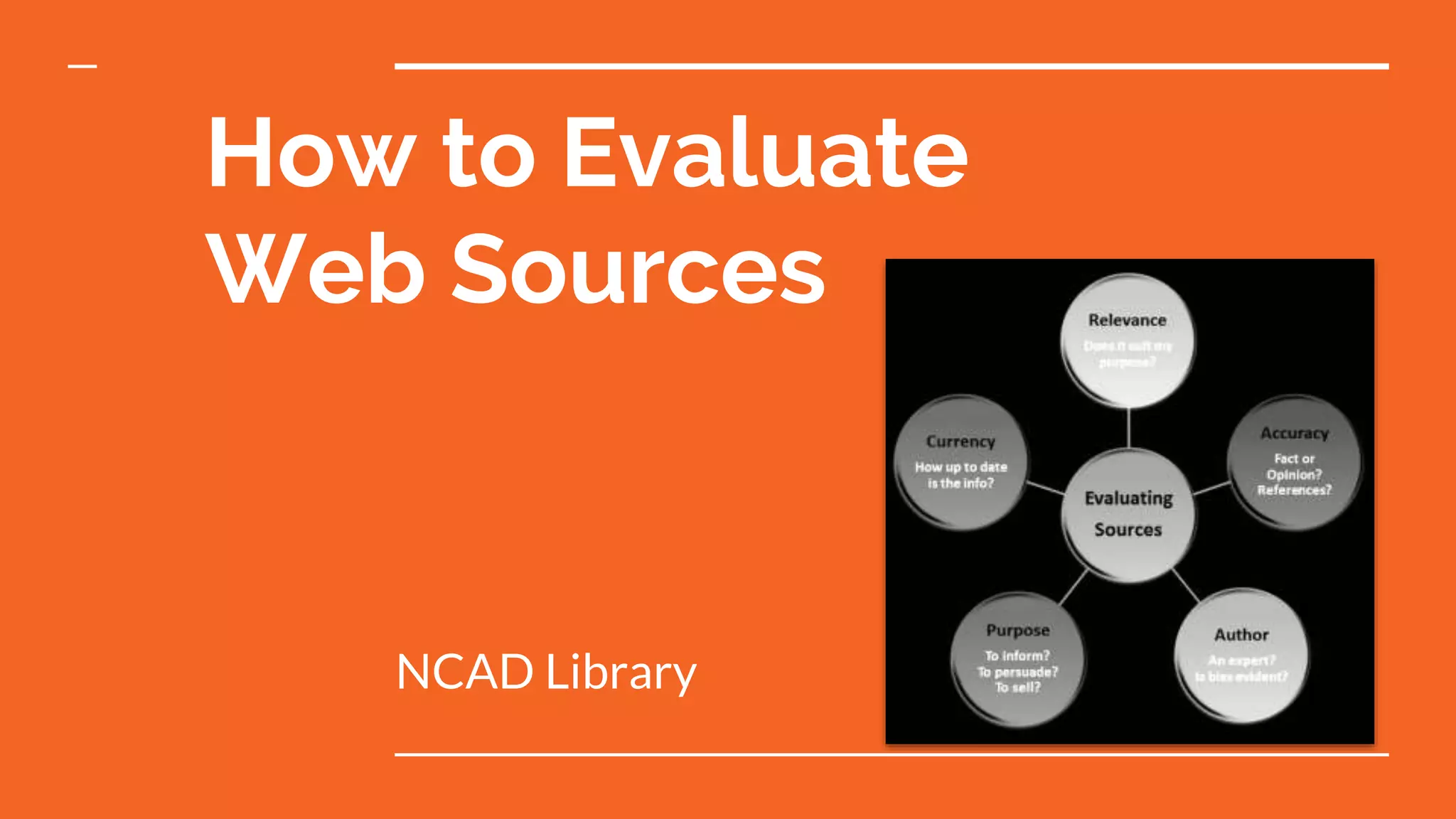
How to Evaluate
Web Sources
NCAD Library
Evaluation ……..WHY?
● Fake news or Fake facts!
● Academic scholarly work is assessed on its
accuracy of information
● Opinion or research!
● Evaluating
Websites
● There are numerous websites and blogs available on
the internet but some may not be accurate, creditable
or useful for Fine Arts.
● Anyone can put anything online!
● Therefore, always carefully evaluate a source - no
matter how reliable it seems to be - before using it for
your research.
How to Evaluate
Information & Sources
Currency, Relevancy, Authority,
Accuracy and Purpose (CRAAP Test)
Once you have found information it is important to
evaluate it so that you can ensure that you use the
information that works best for your project or
research. One way of doing this is by performing the
CRAAP test on your sources.
The CRAAP Test was developed by the Meriam Library at California State
University, Chico.
Currency relates to the timeliness of the resources
● When was the information published or posted?
● Has the information been revised or updated?
● Is it important to have current information, or will older
sources work as well?
● Are all the links working?
Website
● The publication date – this is the date when an article is
first uploaded on to a public website where humans and
search engines can find and access that page.
● For articles published online, the first place to look for the
publication date is right beneath the article title. The date
may also be displayed at the end of an article, near the
author biography. As a last resort, check the footer area of
the website where the article is published.
Relevance relates to the importance of the information
to you
● The information source selected must be suitable for the
intended audience and level of understanding.
● Does the information relate to your research or answer
your question?
● Have you looked at a range of of sources to be able to
judge that this sources is relevant?
● Are you comfortable citing this as a reputable source for
your research paper?
Tip
Is the information
directly related to
your topic or
question?
Authority relates to the source of the information
● Who is the author/publisher/source?
● What are the author's/organisation's credentials?
● Is the source qualified to write on the subject?
● Is there contact information and is it easy find out
more about the author/organisation?
● If it is a website, what does the URL (.com .ac .gov
.org .net) say about the source?
Check the URL (address) to assess the authority of a source. One part of the
URL indicates the type of domain:
● .ac - higher education college or university
● .gov - government agency or organization
● .com - commercial organization
● .net - network provider
● .org - non-profit organization
● .int - international
The origin of a web page can help you evaluate the legitimacy of a page.
Generally, you expect accurate information to be found at domains with .gov
or .ac and you can limit your searches to specific domains.
Authority - URL Address
Accuracy relates to the reliability of the
resource
● Where does the information come from?
● Is the information supported by correct
evidence - Research methods/ samples / trials?
● Can you verify any of the information in another
reliable source?
● Does the language or tone seem balanced,
unbiased and free from errors?
Purpose; relates to the reason the information
exists
● What is the purpose of the article? Why was it
written?
● Is the information fact, opinion or propaganda?
Is the information impartial and objective? Do
the authors make their intentions or purpose
clear?
● Are there any keywords that suggest partiality?
REVIEW
1. Look at the topic or question, is the most current information
required?
2. Look at the article you have, is it the most recent? What is the
publication date?
3. Is the information directly related to your question or topic?
4. What information shows it is relevant (or not)?
5. Who is the author? Are they an expert in the field? What are
they an expert in?
6. Do you think the information in the article is accurate? Why?
7. Do you think the journal article has been checked by an editor or
been peer-reviewed? Why?
8. What is the purpose of the article? (Review, research etc)
Video: How Library Stuff Works: How to
Evaluate Resources (the CRAAP Test)
McMaster Libraries Published on 23 Jan 2015
Good luck!
For more information on using
Library resources contact Maeve or
Tom in the Library
Maeve McElligott
mcelligottm@staff.ncad.ie
Tom Maher
mahert@staff.ncad.ie
References:
● Library and Archives, UCL Institute of Education, (2019) Evaluating Resources: CRAAP Test.
Available at: https://libguides.ioe.ac.uk/evaluating/craap (accessed 30th January 2019)
● UC San Diego (2018), Pruss School Website Evaluation. Available at
https://ucsd.libguides.com/preuss/webeval (accessed 30th January 2019)
● NUS Libraries (2018) SKILLS: Overview of CRAAP. Available at
http://libguides.nus.edu.sg/skills/evaluate/craap (accessed 29th January 2019)
● ACRL (2011) Guidelines for Instruction Programs in Academic Libraries. Available at
http://www.ala.org/acrl/standards/guidelinesinstruction (accessed 20th January 2019)
● ACRL (2016) Framework for Information Literacy for Higher Education. Available at
http://www.ala.org/acrl/standards/ilframework (accessed 22nd January 2019)

How to Evaluate Web Sources

  • 1.
    How to Evaluate WebSources NCAD Library
  • 2.
    Evaluation ……..WHY? ● Fakenews or Fake facts! ● Academic scholarly work is assessed on its accuracy of information ● Opinion or research!
  • 3.
    ● Evaluating Websites ● Thereare numerous websites and blogs available on the internet but some may not be accurate, creditable or useful for Fine Arts. ● Anyone can put anything online! ● Therefore, always carefully evaluate a source - no matter how reliable it seems to be - before using it for your research.
  • 4.
    How to Evaluate Information& Sources Currency, Relevancy, Authority, Accuracy and Purpose (CRAAP Test) Once you have found information it is important to evaluate it so that you can ensure that you use the information that works best for your project or research. One way of doing this is by performing the CRAAP test on your sources. The CRAAP Test was developed by the Meriam Library at California State University, Chico.
  • 5.
    Currency relates tothe timeliness of the resources ● When was the information published or posted? ● Has the information been revised or updated? ● Is it important to have current information, or will older sources work as well? ● Are all the links working? Website ● The publication date – this is the date when an article is first uploaded on to a public website where humans and search engines can find and access that page. ● For articles published online, the first place to look for the publication date is right beneath the article title. The date may also be displayed at the end of an article, near the author biography. As a last resort, check the footer area of the website where the article is published.
  • 6.
    Relevance relates tothe importance of the information to you ● The information source selected must be suitable for the intended audience and level of understanding. ● Does the information relate to your research or answer your question? ● Have you looked at a range of of sources to be able to judge that this sources is relevant? ● Are you comfortable citing this as a reputable source for your research paper? Tip Is the information directly related to your topic or question?
  • 7.
    Authority relates tothe source of the information ● Who is the author/publisher/source? ● What are the author's/organisation's credentials? ● Is the source qualified to write on the subject? ● Is there contact information and is it easy find out more about the author/organisation? ● If it is a website, what does the URL (.com .ac .gov .org .net) say about the source?
  • 8.
    Check the URL(address) to assess the authority of a source. One part of the URL indicates the type of domain: ● .ac - higher education college or university ● .gov - government agency or organization ● .com - commercial organization ● .net - network provider ● .org - non-profit organization ● .int - international The origin of a web page can help you evaluate the legitimacy of a page. Generally, you expect accurate information to be found at domains with .gov or .ac and you can limit your searches to specific domains. Authority - URL Address
  • 9.
    Accuracy relates tothe reliability of the resource ● Where does the information come from? ● Is the information supported by correct evidence - Research methods/ samples / trials? ● Can you verify any of the information in another reliable source? ● Does the language or tone seem balanced, unbiased and free from errors?
  • 10.
    Purpose; relates tothe reason the information exists ● What is the purpose of the article? Why was it written? ● Is the information fact, opinion or propaganda? Is the information impartial and objective? Do the authors make their intentions or purpose clear? ● Are there any keywords that suggest partiality?
  • 11.
    REVIEW 1. Look atthe topic or question, is the most current information required? 2. Look at the article you have, is it the most recent? What is the publication date? 3. Is the information directly related to your question or topic? 4. What information shows it is relevant (or not)? 5. Who is the author? Are they an expert in the field? What are they an expert in? 6. Do you think the information in the article is accurate? Why? 7. Do you think the journal article has been checked by an editor or been peer-reviewed? Why? 8. What is the purpose of the article? (Review, research etc)
  • 12.
    Video: How LibraryStuff Works: How to Evaluate Resources (the CRAAP Test) McMaster Libraries Published on 23 Jan 2015
  • 13.
    Good luck! For moreinformation on using Library resources contact Maeve or Tom in the Library Maeve McElligott mcelligottm@staff.ncad.ie Tom Maher mahert@staff.ncad.ie
  • 14.
    References: ● Library andArchives, UCL Institute of Education, (2019) Evaluating Resources: CRAAP Test. Available at: https://libguides.ioe.ac.uk/evaluating/craap (accessed 30th January 2019) ● UC San Diego (2018), Pruss School Website Evaluation. Available at https://ucsd.libguides.com/preuss/webeval (accessed 30th January 2019) ● NUS Libraries (2018) SKILLS: Overview of CRAAP. Available at http://libguides.nus.edu.sg/skills/evaluate/craap (accessed 29th January 2019) ● ACRL (2011) Guidelines for Instruction Programs in Academic Libraries. Available at http://www.ala.org/acrl/standards/guidelinesinstruction (accessed 20th January 2019) ● ACRL (2016) Framework for Information Literacy for Higher Education. Available at http://www.ala.org/acrl/standards/ilframework (accessed 22nd January 2019)