MONTEGGIA FRACTURE-
DISLOCATION IN CHLDREN
Rockwood & Wilkins’ fractures in children 2015
BY: DR HAMID HEJRATI
RESIDENT OF ORTHOPEDIC SURGERY
IRAN, MASHHAD UNIVERSITY OF MEDICAL SCIENCE
INTR0DUCTION
 1814  Giovanni Batista Monteggia, a surgical
pathologist and public health official in Milan, Italy
“a traumatic lesion distinguished by a fracture of
the proximal third of the ulna and an anterior
dislocation of the proximal epiphysis of the radius.”
 1967  Jose Luis Bado, while director of the
Orthopedic and Traumatology Institute in
Montevideo, Uruguay,  classification of Monteggia
lesions.
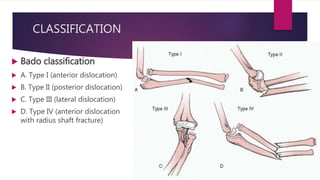
CLASSIFICATION
 Bado classification
 A. Type I (anterior dislocation)
 B. Type II (posterior dislocation)
 C. Type III (lateral dislocation)
 D. Type IV (anterior dislocation
with radius shaft fracture)
ASSOCIATED INJURIES
 Fracture of the wrist and the distal forearm.
 Galeazzi fractures
 Radial head and neck fractures  type II fractures
 Fractured radial neck and midshaft ulnar fracture  type I
equivalent lesions
 Fractures of the lateral condyle
TYPE I
 DEFINITION: A type I lesion is an anterior dislocation
of the radial head associated with an ulnar
diaphyseal fracture at any level. This is the most
common Monteggia lesion in children.
 ULNAR FRACTURE SITE: metaphysis or diaphysis
 INJURY MECHNISMS: direct trauma, hyperpronation,
and hyperextension
TYPE I
 SIGNS AND SYMPTOMS:, swelling about the elbow,
significant pain and limted elbow flexion and
extention an forearm supination and pronation, mild
valgus, ecchymosis on the volar aspect, PIN pulsy,
fullness in the cubital fossa
TYAPE I
 RADIOGRAPHIC EVALUATION: maybe normal on AP
despite obvius disruption on lateral view. Line drawn
through the center of the radial neck and head
should extend directly through the center of the
capitellum, and remain intact regardless of the
degree of flexion or extension of the elbow
TYPE I
 TREATMENT:
 An anatomic, stable reduction of the ulnar fracture 
Percutaneous intramedullary fixation of complete transverse
and short oblique ulna fractures is standard. Open reduction
and internal fixation with plate and screws of the rarer long
oblique and comminuted fracture is also standard
TYPE I
 stable reduction of the radial head dislocation 
Irreducible or unstable radial head  approached
surgically  usually involves repairing entrapped
soft tissues.
 This aggressive approach avoids late complications.
TYPE I
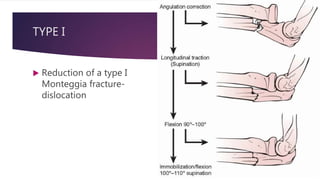
 A long-arm cast  4 to 6 weeks  forearm in slight
supination and the elbow flexed 90 to 110 degrees
depending on the degree of swelling.
 Radiographs are obtained every 1 to 2 weeks until
fracture healing.
TYPE I
 Reduction of a type I
Monteggia fracture-
dislocation
TYPE II
 DEFINITION: A type II lesion is a posterior dislocation of
the radial head associated with an ulnar diaphyseal or
metaphyseal fracture. This is the most common lesion in
adults but very rare in children
 ULNAR FRACTURE SITE: metaphysis or diaphysis
 INJURY MECHNISMS: direct force and sudden rotation
and supination
TYPE II
 CLINICAL FINDINGS: The elbow region is swelling,
posterior angulation of the proximal forearm,
marked prominence in the area posterolateral to the
normal location of the radial head.
TYPE II
 RADIOGRAPHIC EVALUATION: The typical finding is a proximal
metaphyseal fracture of the ulna with possible extension into
the olecranon. Midshaft fractures also occur, with an oblique
fracture pattern. The radial head is dislocated posteriorly or
posterolaterally and should be carefully examined for other
injuries.
 Accompanying fractures of the anterior margin of the radial
head have been noted.
TYPE II
 TREATMENT:
 Ulnar reduction  longitudinal traction.
 Radial head reduction  spontaneously or with gentle, anteriorly directed force
over the radial head.
 If the ulnar fracture is stable  cast immobilization with the elbow in extension.
 If the ulnar fracture is unstable  percutaneous intramedullary K-wire
 Comminuted or very proximal fractures  open reduction and internal fixation
with plate and screws or tension band fixation.
TYPE II
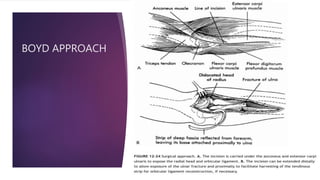
 The Boyd approach can be used to obtain reduction of the
radial head if it cannot be obtained through closed
manipulation.
 Associated compression fractures of the radial head require
early detection to avoid late loss of alignment. Open
reduction and internal fixation may be required to maintain
radiocapitellar joint stability.
 Cast immobilization  usually 6 weeks
TYPE II
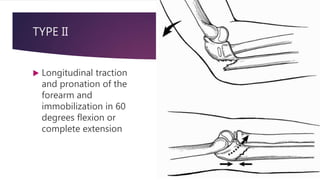
 Longitudinal traction
and pronation of the
forearm and
immobilization in 60
degrees flexion or
complete extension
TYPE III
 DEFINITION: A type III lesion is a lateral dislocation of
the radial head associated with an ulnar metaphyseal
fracture. This is the second most common pediatric
Monteggia lesion.
 ULNAR FRACTURE SITE: metaphysis
 INJURY MECHNISMS: varus stress at the level of the
elbow
TYPE III
 CLINICAL FINDINGS: Lateral swelling, varus
deformity of the elbow, and significant limitation of
motion, especially supination, are the hallmarks of
lateral (type III) Monteggia fracture-dislocations.
Again, these signs can be subtle and missed by
harried clinicians.
TYPE III
 RADIOGRAPHIC EVALUATION: Radiographs of the entire
forearm should be obtained because of the association
of distal radial and ulnar fractures with this complex
elbow injury.
TYPE III
 TREATMENT: As with any Monteggia lesion, treatment is
aimed at obtaining and maintaining reduction of the
radial head, either by open or closed technique. This is
usually performed by anatomic, stable reduction of the
ulnar fracture that in turn leads to a stable reduction of
the proximal radioulnar and radiocapitellar joints.
TYPE III
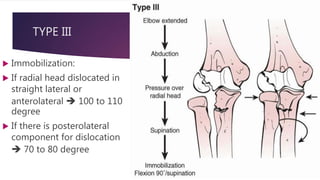
 Immobilization:
 If radial head dislocated in
straight lateral or
anterolateral  100 to 110
degree
 If there is posterolateral
component for dislocation
 70 to 80 degree
TYPE IV
 DEFINITION: A type IV lesion is an anterior dislocation of the
radial head associated with fractures of both the ulna and
the radius. The original description was of a radial fracture at
the same level or distal to the ulna fracture.
 ULNAR FRACTURE SITE: diaphysis
 INJURY MECHNISMS: hyperpronation and direct blow
TYPE IV
 CLINICAL FINDINGS: More swelling and pain are
present, Particular attention to the neurovascular
status, increased risk for a compartment syndrome.
 Failure to recognize the radial head dislocation is the
major complication of this fracture.
TYPE IV
 RADIOGRAPHIC EVALUATION: The radial and ulnar
fractures usually are in the middle third, with the radial
fracture usually distal to the ulnar injury. They may be
complete or greenstick.
TYPE IV
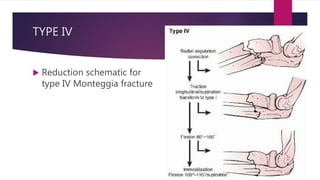
 TREATMENT: Stabilization of the radial fracture converts a
type IV lesion to a type I lesion  Closed reduction
,intramedullary or plate fixation  fallow type I protocol.
 Immobilized in a long-arm cast  4 to 6 weeks in 110 to
120 degrees of flexion with the forearm in neutral rotation.
 A short-arm cast is used thereafter if additional fracture
protection is necessary.
TYPE IV
 Reduction schematic for
type IV Monteggia fracture
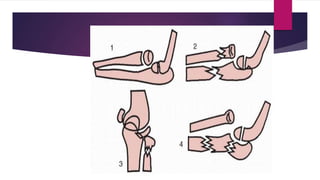
Monteggia Equivalent Lesions
 Type I Equivalents
 Isolated dislocation of radial head
 Radial neck fracture (isolated)
 Radial neck fracture in combination with a fracture of the ulnar
diaphysis
 Radial and ulnar fractures with the radial fracture above the
junction of the middle and proximal thirds
 Fracture of ulnar diaphysis with anterior dislocation of radial
head and an olecranon fracture
 Type II Equivalents
 Fractures of the proximal radial epiphysis or radial
neck.
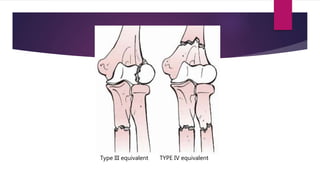
 Type III and Type IV Equivalents
 Fractures of the distal humerus (supracondylar, lateral
condylar) in association with proximal forearm fractures.
Type III equivalent TYPE IV equivalent
BOYD APPROACH

Monteggia fracture dislocation in chldren

  • 1.
    MONTEGGIA FRACTURE- DISLOCATION INCHLDREN Rockwood & Wilkins’ fractures in children 2015 BY: DR HAMID HEJRATI RESIDENT OF ORTHOPEDIC SURGERY IRAN, MASHHAD UNIVERSITY OF MEDICAL SCIENCE
  • 2.
    INTR0DUCTION  1814 Giovanni Batista Monteggia, a surgical pathologist and public health official in Milan, Italy “a traumatic lesion distinguished by a fracture of the proximal third of the ulna and an anterior dislocation of the proximal epiphysis of the radius.”
  • 3.
     1967 Jose Luis Bado, while director of the Orthopedic and Traumatology Institute in Montevideo, Uruguay,  classification of Monteggia lesions.
  • 4.
    CLASSIFICATION  Bado classification A. Type I (anterior dislocation)  B. Type II (posterior dislocation)  C. Type III (lateral dislocation)  D. Type IV (anterior dislocation with radius shaft fracture)
  • 5.
    ASSOCIATED INJURIES  Fractureof the wrist and the distal forearm.  Galeazzi fractures  Radial head and neck fractures  type II fractures  Fractured radial neck and midshaft ulnar fracture  type I equivalent lesions  Fractures of the lateral condyle
  • 6.
    TYPE I  DEFINITION:A type I lesion is an anterior dislocation of the radial head associated with an ulnar diaphyseal fracture at any level. This is the most common Monteggia lesion in children.  ULNAR FRACTURE SITE: metaphysis or diaphysis  INJURY MECHNISMS: direct trauma, hyperpronation, and hyperextension
  • 7.
    TYPE I  SIGNSAND SYMPTOMS:, swelling about the elbow, significant pain and limted elbow flexion and extention an forearm supination and pronation, mild valgus, ecchymosis on the volar aspect, PIN pulsy, fullness in the cubital fossa
  • 8.
    TYAPE I  RADIOGRAPHICEVALUATION: maybe normal on AP despite obvius disruption on lateral view. Line drawn through the center of the radial neck and head should extend directly through the center of the capitellum, and remain intact regardless of the degree of flexion or extension of the elbow
  • 9.
    TYPE I  TREATMENT: An anatomic, stable reduction of the ulnar fracture  Percutaneous intramedullary fixation of complete transverse and short oblique ulna fractures is standard. Open reduction and internal fixation with plate and screws of the rarer long oblique and comminuted fracture is also standard
  • 10.
    TYPE I  stablereduction of the radial head dislocation  Irreducible or unstable radial head  approached surgically  usually involves repairing entrapped soft tissues.  This aggressive approach avoids late complications.
  • 11.
    TYPE I  Along-arm cast  4 to 6 weeks  forearm in slight supination and the elbow flexed 90 to 110 degrees depending on the degree of swelling.  Radiographs are obtained every 1 to 2 weeks until fracture healing.
  • 12.
    TYPE I  Reductionof a type I Monteggia fracture- dislocation
  • 13.
    TYPE II  DEFINITION:A type II lesion is a posterior dislocation of the radial head associated with an ulnar diaphyseal or metaphyseal fracture. This is the most common lesion in adults but very rare in children  ULNAR FRACTURE SITE: metaphysis or diaphysis  INJURY MECHNISMS: direct force and sudden rotation and supination
  • 14.
    TYPE II  CLINICALFINDINGS: The elbow region is swelling, posterior angulation of the proximal forearm, marked prominence in the area posterolateral to the normal location of the radial head.
  • 15.
    TYPE II  RADIOGRAPHICEVALUATION: The typical finding is a proximal metaphyseal fracture of the ulna with possible extension into the olecranon. Midshaft fractures also occur, with an oblique fracture pattern. The radial head is dislocated posteriorly or posterolaterally and should be carefully examined for other injuries.  Accompanying fractures of the anterior margin of the radial head have been noted.
  • 16.
    TYPE II  TREATMENT: Ulnar reduction  longitudinal traction.  Radial head reduction  spontaneously or with gentle, anteriorly directed force over the radial head.  If the ulnar fracture is stable  cast immobilization with the elbow in extension.  If the ulnar fracture is unstable  percutaneous intramedullary K-wire  Comminuted or very proximal fractures  open reduction and internal fixation with plate and screws or tension band fixation.
  • 17.
    TYPE II  TheBoyd approach can be used to obtain reduction of the radial head if it cannot be obtained through closed manipulation.  Associated compression fractures of the radial head require early detection to avoid late loss of alignment. Open reduction and internal fixation may be required to maintain radiocapitellar joint stability.  Cast immobilization  usually 6 weeks
  • 18.
    TYPE II  Longitudinaltraction and pronation of the forearm and immobilization in 60 degrees flexion or complete extension
  • 19.
    TYPE III  DEFINITION:A type III lesion is a lateral dislocation of the radial head associated with an ulnar metaphyseal fracture. This is the second most common pediatric Monteggia lesion.  ULNAR FRACTURE SITE: metaphysis  INJURY MECHNISMS: varus stress at the level of the elbow
  • 20.
    TYPE III  CLINICALFINDINGS: Lateral swelling, varus deformity of the elbow, and significant limitation of motion, especially supination, are the hallmarks of lateral (type III) Monteggia fracture-dislocations. Again, these signs can be subtle and missed by harried clinicians.
  • 21.
    TYPE III  RADIOGRAPHICEVALUATION: Radiographs of the entire forearm should be obtained because of the association of distal radial and ulnar fractures with this complex elbow injury.
  • 22.
    TYPE III  TREATMENT:As with any Monteggia lesion, treatment is aimed at obtaining and maintaining reduction of the radial head, either by open or closed technique. This is usually performed by anatomic, stable reduction of the ulnar fracture that in turn leads to a stable reduction of the proximal radioulnar and radiocapitellar joints.
  • 23.
    TYPE III  Immobilization: If radial head dislocated in straight lateral or anterolateral  100 to 110 degree  If there is posterolateral component for dislocation  70 to 80 degree
  • 24.
    TYPE IV  DEFINITION:A type IV lesion is an anterior dislocation of the radial head associated with fractures of both the ulna and the radius. The original description was of a radial fracture at the same level or distal to the ulna fracture.  ULNAR FRACTURE SITE: diaphysis  INJURY MECHNISMS: hyperpronation and direct blow
  • 25.
    TYPE IV  CLINICALFINDINGS: More swelling and pain are present, Particular attention to the neurovascular status, increased risk for a compartment syndrome.  Failure to recognize the radial head dislocation is the major complication of this fracture.
  • 26.
    TYPE IV  RADIOGRAPHICEVALUATION: The radial and ulnar fractures usually are in the middle third, with the radial fracture usually distal to the ulnar injury. They may be complete or greenstick.
  • 27.
    TYPE IV  TREATMENT:Stabilization of the radial fracture converts a type IV lesion to a type I lesion  Closed reduction ,intramedullary or plate fixation  fallow type I protocol.  Immobilized in a long-arm cast  4 to 6 weeks in 110 to 120 degrees of flexion with the forearm in neutral rotation.  A short-arm cast is used thereafter if additional fracture protection is necessary.
  • 28.
    TYPE IV  Reductionschematic for type IV Monteggia fracture
  • 29.
    Monteggia Equivalent Lesions Type I Equivalents  Isolated dislocation of radial head  Radial neck fracture (isolated)  Radial neck fracture in combination with a fracture of the ulnar diaphysis  Radial and ulnar fractures with the radial fracture above the junction of the middle and proximal thirds  Fracture of ulnar diaphysis with anterior dislocation of radial head and an olecranon fracture
  • 31.
     Type IIEquivalents  Fractures of the proximal radial epiphysis or radial neck.
  • 32.
     Type IIIand Type IV Equivalents  Fractures of the distal humerus (supracondylar, lateral condylar) in association with proximal forearm fractures.
  • 33.
    Type III equivalentTYPE IV equivalent
  • 34.