Animal Organ Systems
Anatomy and Physiology
Fundamentals of Life
 All living things are made up of cells.
 Cells are the most basic structure of life.
 Cells need oxygen, food/energy, and
water to survive.
Natural Hierarchy
 Cells are the most basic and simple.
 Cells that are all alike work together to form
tissues which perform tasks.
 Tissues that are alike work together to form
organs which complete jobs.
 Organs work together in organ systems to
carry out processes.
 Organ systems work together to support the
life of an organism.
How do we study animals?
 We look at the outside of them – the
outer physical structures.
 We look inside of dead animals – the
internal physical structures.
 We look at the tissues under a
microscope – microscopic structures.
 We study the chemical reactions
between cells, tissues, and organs.
Anatomy
 The study of the form, shape, and
appearance of an animal – its structures
both internal and external.
 Gross anatomy is the study of the
structures – internal and external – that we
can see with the naked eye.
 Microscopic anatomy is the structures that
can only be seen under magnification
Physiology
 The study of the functions of the cells,
tissues, and organs of the animal.
 Biochemistry
 How cells, tissues and organs work
together to complete a task…digestion.
Why study anatomy and physiology?
 Efficient production of livestock requires
understanding the anatomy and
physiology related to Production.
 Production is muscle gain, milk or egg production,
and hair or wool production.
 Raising animals requires an
understanding of the requires needed for
animal wellbeing.
 Animal wellbeing is caring for animals so that their
basic needs are met and they do not suffer.
Mammals vs Non-mammals
 Most of our livestock are mammals.
 i.e. – vertebrate that has hair, gives birth to
live young, produces milk, & maintains
constant body temperature.
 Cattle, horses, pigs, goats & sheep, etc.
 Exceptions are poultry & aquacrops.
 Poultry – birds – ducks, chickens, turkeys, etc.
 Aquacrops – fish, shrimp, etc.
Organ Systems
 Skeletal
 Muscular
 Nervous
 Circulatory
 Respiratory
 Excretory
 Digestive
 Endocrine
 Integumentary
 Reproductive
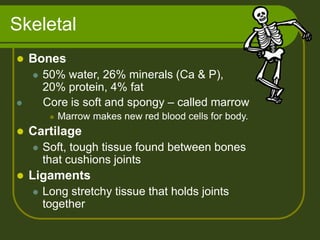
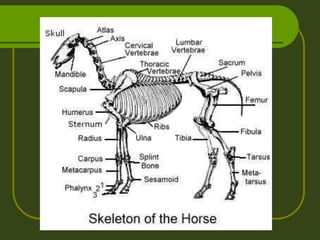
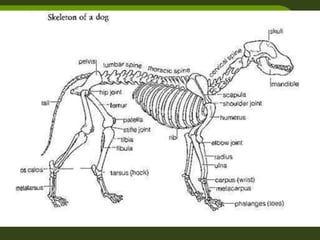
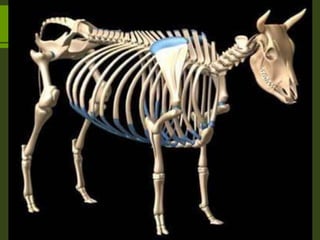
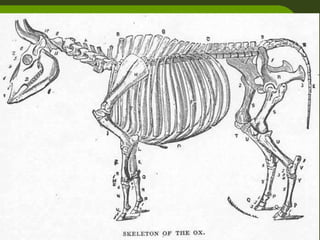
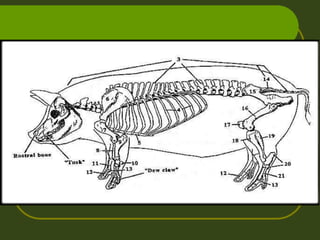
Skeletal
 Bones
 50% water, 26% minerals (Ca & P),
20% protein, 4% fat
 Core is soft and spongy – called marrow
 Marrow makes new red blood cells for body.
 Cartilage
 Soft, tough tissue found between bones
that cushions joints
 Ligaments
 Long stretchy tissue that holds joints
together
Skeletal
 Gives structure and support
 Protects internal organs
 Makes locomotion/movement possible
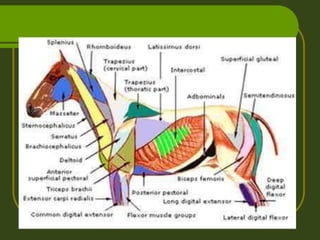
Muscular
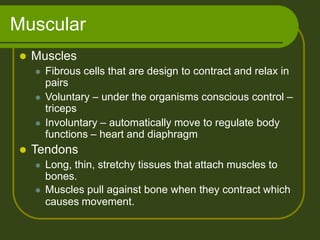
 Muscles
 Fibrous cells that are design to contract and relax in
pairs
 Voluntary – under the organisms conscious control –
triceps
 Involuntary – automatically move to regulate body
functions – heart and diaphragm
 Tendons
 Long, thin, stretchy tissues that attach muscles to
bones.
 Muscles pull against bone when they contract which
causes movement.
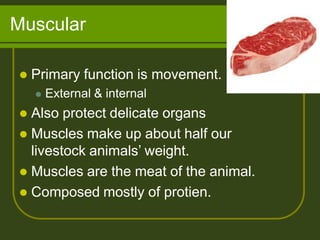
Muscular
 Primary function is movement.
 External & internal
 Also protect delicate organs
 Muscles make up about half our
livestock animals’ weight.
 Muscles are the meat of the animal.
 Composed mostly of protien.
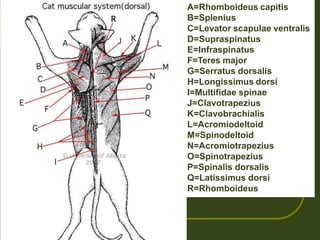
A=Rhomboideus capitis
B=Splenius
C=Levator scapulae ventralis
D=Supraspinatus
E=Infraspinatus
F=Teres major
G=Serratus dorsalis
H=Longissimus dorsi
I=Multifidae spinae
J=Clavotrapezius
K=Clavobrachialis
L=Acromiodeltoid
M=Spinodeltoid
N=Acromiotrapezius
O=Spinotrapezius
P=Spinalis dorsalis
Q=Latissimus dorsi
R=Rhomboideus
Nervous
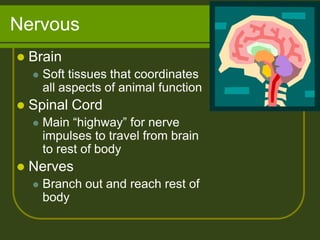
 Brain
 Soft tissues that coordinates
all aspects of animal function
 Spinal Cord
 Main “highway” for nerve
impulses to travel from brain
to rest of body
 Nerves
 Branch out and reach rest of
body
Nervous
 Uses electrical impulses to send
messages from brain throughout body.
 Controls activity, learning, memory
 Central Nervous System and Peripheral
Nervous System
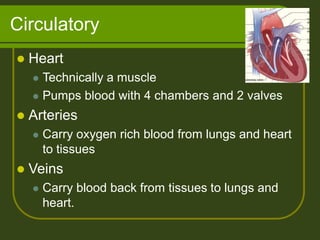
Circulatory
 Heart
 Technically a muscle
 Pumps blood with 4 chambers and 2 valves
 Arteries
 Carry oxygen rich blood from lungs and heart
to tissues
 Veins
 Carry blood back from tissues to lungs and
heart.
Circulatory
 Blood
 Plasma
 Liquid part of blood
 red blood cells
 Carries O2 and carbohydrates (glucose)
 white blood cells
 Fights pathogens
 Platelets
 Makes blood clot
Circulatory
 Also includes the Lymph Glands
 Secrete disease fighting materials
 Moves materials throughout the body
Respiratory
 Nose
 External opening of the body
 Pharynx & Larynx
 Pharynx connects the esophagus and trachea
 Larynx is the “voice box”
 Trachea
 Wind pipe that connects nasal passages with lungs
 Lungs
 “bags” that expand and contract to bring in fresh air
and expel old air
Respiratory
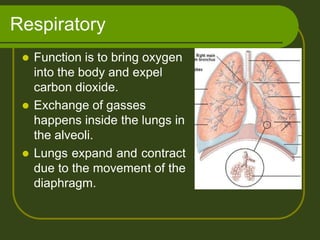
 Function is to bring oxygen
into the body and expel
carbon dioxide.
 Exchange of gasses
happens inside the lungs in
the alveoli.
 Lungs expand and contract
due to the movement of the
diaphragm.
Excretory
 Also referred to as the urinary system.
 Kidneys
 Remove waste materials from blood
 Bladder
 Holds liquid wastes - urine
 Ureters
 Connect bladder to urethra
 Urethra
 Empties urine to the exterior of the animal
Digestive
 Mouth, esophagus, stomach, small
intestine, cecum, large intestine, rectum,
anus
 Breaks down food into usable energy
 Removes unusable food from body
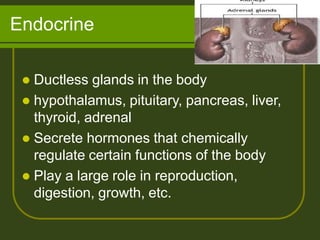
Endocrine
 Ductless glands in the body
 hypothalamus, pituitary, pancreas, liver,
thyroid, adrenal
 Secrete hormones that chemically
regulate certain functions of the body
 Play a large role in reproduction,
digestion, growth, etc.
Integumentary
 Skin, hair, hooves, horns, etc
 Keeps out pathogens, regulates body
temp, gives shape and color, protects
internal organs
 System made almost entirely out of protein
 Animal skin is called the hide
 Most animal hides made into leather
Reproductive System
 Most complex system in animals
 Allows for reproduction of animals and
the continuation of the species
 Different structures between male and
female
 Most animals fundamentally have the
same system, just varies in structure
between species.

animalorgansystems-111128150618-phpapp01.pptx

  • 1.
  • 2.
    Fundamentals of Life All living things are made up of cells.  Cells are the most basic structure of life.  Cells need oxygen, food/energy, and water to survive.
  • 3.
    Natural Hierarchy  Cellsare the most basic and simple.  Cells that are all alike work together to form tissues which perform tasks.  Tissues that are alike work together to form organs which complete jobs.  Organs work together in organ systems to carry out processes.  Organ systems work together to support the life of an organism.
  • 4.
    How do westudy animals?  We look at the outside of them – the outer physical structures.  We look inside of dead animals – the internal physical structures.  We look at the tissues under a microscope – microscopic structures.  We study the chemical reactions between cells, tissues, and organs.
  • 5.
    Anatomy  The studyof the form, shape, and appearance of an animal – its structures both internal and external.  Gross anatomy is the study of the structures – internal and external – that we can see with the naked eye.  Microscopic anatomy is the structures that can only be seen under magnification
  • 6.
    Physiology  The studyof the functions of the cells, tissues, and organs of the animal.  Biochemistry  How cells, tissues and organs work together to complete a task…digestion.
  • 7.
    Why study anatomyand physiology?  Efficient production of livestock requires understanding the anatomy and physiology related to Production.  Production is muscle gain, milk or egg production, and hair or wool production.  Raising animals requires an understanding of the requires needed for animal wellbeing.  Animal wellbeing is caring for animals so that their basic needs are met and they do not suffer.
  • 8.
    Mammals vs Non-mammals Most of our livestock are mammals.  i.e. – vertebrate that has hair, gives birth to live young, produces milk, & maintains constant body temperature.  Cattle, horses, pigs, goats & sheep, etc.  Exceptions are poultry & aquacrops.  Poultry – birds – ducks, chickens, turkeys, etc.  Aquacrops – fish, shrimp, etc.
  • 9.
    Organ Systems  Skeletal Muscular  Nervous  Circulatory  Respiratory  Excretory  Digestive  Endocrine  Integumentary  Reproductive
  • 10.
    Skeletal  Bones  50%water, 26% minerals (Ca & P), 20% protein, 4% fat  Core is soft and spongy – called marrow  Marrow makes new red blood cells for body.  Cartilage  Soft, tough tissue found between bones that cushions joints  Ligaments  Long stretchy tissue that holds joints together
  • 11.
    Skeletal  Gives structureand support  Protects internal organs  Makes locomotion/movement possible
  • 18.
    Muscular  Muscles  Fibrouscells that are design to contract and relax in pairs  Voluntary – under the organisms conscious control – triceps  Involuntary – automatically move to regulate body functions – heart and diaphragm  Tendons  Long, thin, stretchy tissues that attach muscles to bones.  Muscles pull against bone when they contract which causes movement.
  • 19.
    Muscular  Primary functionis movement.  External & internal  Also protect delicate organs  Muscles make up about half our livestock animals’ weight.  Muscles are the meat of the animal.  Composed mostly of protien.
  • 21.
    A=Rhomboideus capitis B=Splenius C=Levator scapulaeventralis D=Supraspinatus E=Infraspinatus F=Teres major G=Serratus dorsalis H=Longissimus dorsi I=Multifidae spinae J=Clavotrapezius K=Clavobrachialis L=Acromiodeltoid M=Spinodeltoid N=Acromiotrapezius O=Spinotrapezius P=Spinalis dorsalis Q=Latissimus dorsi R=Rhomboideus
  • 22.
    Nervous  Brain  Softtissues that coordinates all aspects of animal function  Spinal Cord  Main “highway” for nerve impulses to travel from brain to rest of body  Nerves  Branch out and reach rest of body
  • 23.
    Nervous  Uses electricalimpulses to send messages from brain throughout body.  Controls activity, learning, memory  Central Nervous System and Peripheral Nervous System
  • 25.
    Circulatory  Heart  Technicallya muscle  Pumps blood with 4 chambers and 2 valves  Arteries  Carry oxygen rich blood from lungs and heart to tissues  Veins  Carry blood back from tissues to lungs and heart.
  • 26.
    Circulatory  Blood  Plasma Liquid part of blood  red blood cells  Carries O2 and carbohydrates (glucose)  white blood cells  Fights pathogens  Platelets  Makes blood clot
  • 27.
    Circulatory  Also includesthe Lymph Glands  Secrete disease fighting materials  Moves materials throughout the body
  • 28.
    Respiratory  Nose  Externalopening of the body  Pharynx & Larynx  Pharynx connects the esophagus and trachea  Larynx is the “voice box”  Trachea  Wind pipe that connects nasal passages with lungs  Lungs  “bags” that expand and contract to bring in fresh air and expel old air
  • 29.
    Respiratory  Function isto bring oxygen into the body and expel carbon dioxide.  Exchange of gasses happens inside the lungs in the alveoli.  Lungs expand and contract due to the movement of the diaphragm.
  • 30.
    Excretory  Also referredto as the urinary system.  Kidneys  Remove waste materials from blood  Bladder  Holds liquid wastes - urine  Ureters  Connect bladder to urethra  Urethra  Empties urine to the exterior of the animal
  • 31.
    Digestive  Mouth, esophagus,stomach, small intestine, cecum, large intestine, rectum, anus  Breaks down food into usable energy  Removes unusable food from body
  • 32.
    Endocrine  Ductless glandsin the body  hypothalamus, pituitary, pancreas, liver, thyroid, adrenal  Secrete hormones that chemically regulate certain functions of the body  Play a large role in reproduction, digestion, growth, etc.
  • 33.
    Integumentary  Skin, hair,hooves, horns, etc  Keeps out pathogens, regulates body temp, gives shape and color, protects internal organs  System made almost entirely out of protein  Animal skin is called the hide  Most animal hides made into leather
  • 34.
    Reproductive System  Mostcomplex system in animals  Allows for reproduction of animals and the continuation of the species  Different structures between male and female  Most animals fundamentally have the same system, just varies in structure between species.